The banjo, a sonic staple of folk and bluegrass, has often been left to its established devices in traditional circles or, more optimistically, among contemporary newgrass like Punch Brothers, the Infamous Stringdusters, and New Grass Revival, which included the genre-bending banjoist himself, Béla Fleck. Still, some musical spaces, like classical performance and composition, remain largely devoid of the banjo despite its lengthy and socially complex history, global presence, and tonal variety. Thankfully, between artists like Fleck, Noam Pikelny, John Bullard, and others, classical compositions have had a chance to shine on the instrument, paving the way for next-generation players to embrace and mix the traditions of classical writing with the distinct sound and musical capabilities of the banjo.
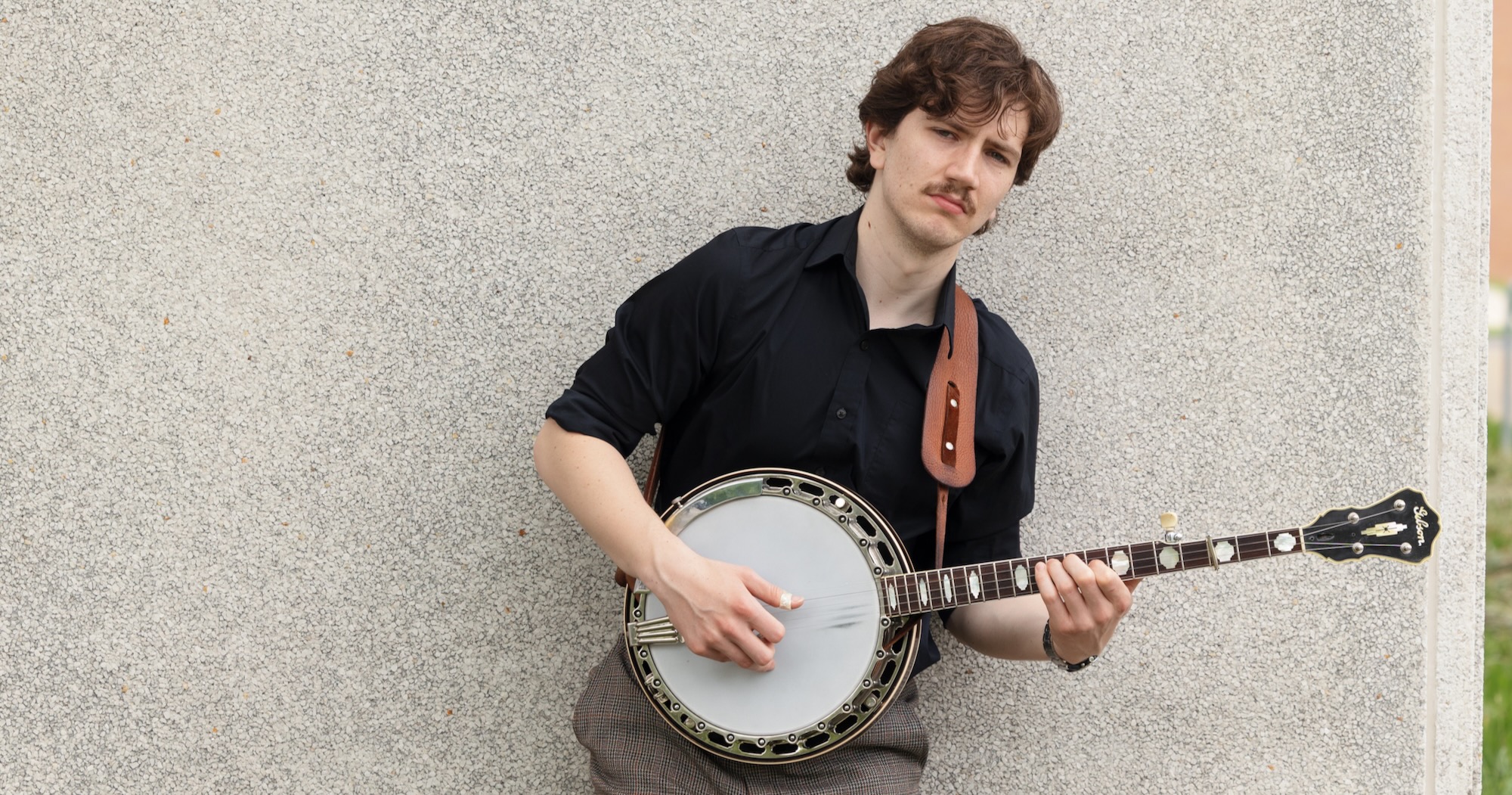
One such figure rising to the occasion is composer and artist Max Allard. A recent graduate of Oberlin College’s Conservatory of Music, the Chicago native is a champion of many cultures and genres in his work, which Allard describes as “an unclassifiable mix of bluegrass, jazz, new acoustic, classical, and pop.”
Allard has brought his stylistic openness to every facet of his artistry, including a duo with his brother Otto Allard; a bluegrass ensemble he co-founded, EZRA, that includes mandolinist Jacob Jolliff, guitarist and composer Jesse Jones, and bassist Craig Butterfield; and his touring support of Michigan-based bands Full Cord and Westbound Situation and Virginia-based band the Hackensaw Boys. Another instance finding him pushing banjo boundaries was his collaborative performance with fellow banjoists Bill Evans, BB Bowness, Cassidy Beentjes, and Matt Flinner in an adventurous arrangement of “In C,” the iconic composition by American minimalist composer Terry Riley, as part of a commissioned work series at the 2025 FreshGrass Festival.
Many of these ambitions grew alongside or after Allard’s studies, giving him several creative contexts in which to nurture his knowledge of classical forms and styles. One of the most impactful of these opportunities was part of Allard’s collegiate work itself: A Concerto for banjo and mixed ensemble. Encouraged by his EZRA bandmate and Oberlin professor Jesse Jones, Allard wrote his single movement work in 2023, giving the world premiere with the Oberlin Contemporary Music Ensemble under conductor Tim Weiss in December 2024. Though the piece has long since debuted, Allard’s vision for what the concerto would accomplish and what the experience of writing it revealed to him along the way remain ongoing sources of inspiration and guidance as Allard continues to write and perform for anyone who wants to listen. (Watch a video of Allard’s Concerto below.)
BGS recently spoke with Allard over the phone, discussing the many branches of his work as an artist and composer. We dive into how each stylistic space blends with his classical training, where he sees the banjo’s place in classical performance, his thoughts on cross-genre efforts by other artists, and more.
How would you describe the journey around your Banjo Concerto and its compositional process?
Max Allard: I had anticipated [the piece] for a while. I had gotten into Oberlin College as a composition major and part of the reason I chose Oberlin is because composition faculty member [Jesse Jones] comes from a background of playing bluegrass. He plays mandolin, some banjo, and guitar so I knew that I would have someone in the faculty on my side to help me, to know where I was coming from and to help guide the path forward in terms of a study and a pedagogy that I had not been taught before. So Jesse told me, “I think it would be great for your work here at Oberlin to culminate into a banjo concerto.”
I had the plan of approaching the banjo as a concert instrument – and as a concert instrument with the supporting ensemble. To do that, I had to get away a little bit from the folk aspects of the banjo in terms of a composition process, while still embracing those same aspects in terms of style.
[The concerto] sort of started as a banjo draft. And something I think is interesting to mention is that people have compared my banjo playing before to piano players and it’s a very valid comparison, because I take a lot of inspiration from piano players like Keith Jarrett, Chilly Gonzales, and many European classical composers like Sergei Rachmaninoff and Frédéric Chopin. I have long thought of the banjo as a very capable instrument to take solo composition very seriously on. I had to find ways to creatively think about which instruments to give various roles to. The nice thing was that I got to pick the makeup of the ensemble. I knew I wanted to have celesta. I wanted to have clarinet, flute with piccolo – there were certain sounds I knew I wanted to include.
I had very specific ideas about which instrument fulfills which role. It’s definitely a string-heavy piece and I’m a huge fan of writing for strings. So I had known that this piece would provide me the depths that the banjo doesn’t always have. I thought, “I can fill out these luscious piano-like chords that I usually like to write on the banjo, with the help of the supporting string section that has a much broader range than the banjo has by itself.” It was actually really liberating for me, because having an ensemble with a very diverse range – not just timbre-ly, but sonically and in terms of highs and lows – I had many options. It was a really great blank canvas for me to further explore creativity without some of the limitations of the banjo, be it physical or range related, or what have-you. I was able to basically apply my banjo knowledge and compositional tendencies to a blank slate, which presented a lot more opportunities.
What are your thoughts on the banjo’s “place” in classical music?
The banjo has a very checkered, problematic history and there’s a lot of moral debate that I’ve witnessed amongst people about what the banjo’s role is. It has had many different roles – a lot of it actually being erased. We talk about the problematic history of the banjo being used for minstrelsy but we actually forget about the banjo’s history of being used in parlor music. For a long time, the banjo actually had a role being played in parlors and social events, and even playing classical music.
I find it funny when people sort of criticize the banjo these days because the reputation has been ruined so much. People tend to think of the banjo with the film Deliverance. That film sort of ruined the reputation of the banjo as being this hillbilly folk instrument that’s not taken seriously. Unfortunately, that stereotype still exists, so people sort of scoff at banjo players who want to elevate the instrument into a certain concert environment.
I think all instruments can be used however people want. It’s like the artist has a final say in how they want to showcase their instrument. But for me, I think I’ll always still want to pay my respects to the traditions of the banjo. And as I said, the banjo has, throughout history, been used in a variety of different contexts. What I try to do is bridge the gap of pedagogic composition and folk music. If we’re talking about my banjo concerto, I want to write well-written concert music but [avoid creating] a totally contrived piece of music that just tries its best to fit the banjo in with an ensemble. I want to at least take my understanding of bluegrass, folk music, and old time music and still amalgamate it with concert music.
What do you find you learn most from other banjo players who have thrived in the classical space like Noam Pikelny, Béla Fleck, John Bullard, and others?
Broadly speaking, if [banjo players] want to put our instruments in the classical space, we need to do our best to understand the way the classic musicians think – really get in the minds of classical musicians. If one, as a banjo player, wants to pursue classical music, it behooves them to get at least a decent understanding of concert music. And I think most banjo players [like Fleck, Pikelny, Bullard] who have attempted that absolutely do have a different understanding. I just think the understanding of how deep it actually goes, what details go into really good concert music – it just takes a long, long time to master. And I am nowhere close to mastering it. But I at least have an understanding of how little I knew before attending [Oberlin].
Are there any aspects of Terry Riley’s “In C” that were especially challenging to capture with this banjo-centric arrangement?
I should give a shout out to Cassidy Beentjes, who did all this arranging – a really good pedagogue of the banjo. In terms of limitations though, the key [was one]. With the banjo’s natural key being G major, we took the piece down to a G-major tuning, so it makes much more sense to play the piece in G, especially since we want to achieve certain overtones. We could have played in C with a C tuning, but a lot of complexity would have arisen from playing in a foreign tuning. We were already uncomfortable in the first place, you know, with a piece of music like this, because banjo players don’t get the opportunity to do something like this very often, so we were careful.
What aspect of your musical identity does EZRA help you to fulfill that you don’t necessarily achieve in the same way with other pursuits?
I’d say it’s a good opportunity to write for a smaller acoustic ensemble where there’s a good understanding of not only folk and bluegrass, but also classical and jazz music.
It makes a big difference when you’re writing for people who you’re friends with – writing for people you know. You want to give people roles that you know they’re going to enjoy doing and that they do well. When I write for EZRA, it’s definitely much more stripped down and basic than if I were writing something like the banjo concerto. Because with the banjo concerto, I give very specific instructions, I supply a whole score with those specific instructions for everyone to read from. And when I’m writing for EZRA, usually I’m just writing lead sheets, just chords with the melody. In terms of arrangements, that can be discussed in the studio.
It’s funny though, because anytime we’ve recorded a record, we’ve had such limited studio time that we have to get our act together in just 72 hours or so and make our arrangements studio-ready. But again, that’s freeing for me, because I can write more vague ideas, stuff that I would not feel as intrepid writing with a big ensemble. When I’m with EZRA, I can just do whatever the heck I want and know that we can get away with it in some way. It’s also definitely a great opportunity for me to write contemporary folk music that is absolutely rooted in folk and bluegrass but also has all these other influences. A lot of Béla Fleck influence, a lot of classical music as influence – all kinds of stuff. It’s definitely a very special opportunity for me.
What’s the most unique aspect about the duo you perform in with your brother? How do you both approach playing together?
I guess the main thing that stands out is just the brotherly synergy. My brother is the easiest musician to play with because we know each other so darn well. Not much has to be planned – there’s almost never any stress. We’ve played plenty of gigs where we haven’t rehearsed at all beforehand and it goes pretty well just because we can glance at each other a certain way and know exactly what we mean musically. We’ve also played gigs where like a half hour has gone by and the whole thing is improvised. We just weave sounds together and it’s great.
It’s great to have a brother who plays music because it’s just that very intense, personal connection that one has with their sibling. You know each other so well that no communication really has to be done verbally. In general, playing with my brother is just very fun because we make crazy, spontaneous decisions and do ridiculous things that we would not do in any other setting.
Do you think the folk and bluegrass communities could better embrace the banjo being a genre-versatile instrument? And do you think that schools or community spaces are the best starting place to initiate that shift?
If I were talking to a banjo player who wants to get into classical music, I would say you can learn just as much by surrounding yourself with the right people. I think the most viable option is to try to meet some people who come from that background. And it can be any background. Like, say you want to get into a certain style – find musicians who can do that and try your best to talk to them, befriend them, whatever you can, and surround yourself with that. I think community is always important in the arts. Definitely, it’s very important to surround yourself with people – not even not necessarily like-minded people – but people who have very different experiences and very different backgrounds. Personally and musically in any way.
I think the bluegrass culture and scene could definitely benefit from opening themselves up a little bit. I think sometimes we forget that bluegrass has a very progressive foundation to it. Even Bill Monroe valued when he heard New Grass Revival. He was supportive of it, supportive of all those people who were taking bluegrass in a different direction. So I think it’s very progressive by nature. And music has always evolved and always will evolve and it has to sort of be accepted.
I think the banjo is actually in a very good place right now, because we’ve never had so many banjo players. It’s very good because the banjo is becoming popular for the right reasons – not necessarily gimmicky reasons, with banjos being used in pop music – but it’s being taken seriously amongst musicians from all different types of backgrounds. Broadly speaking, I don’t have too many complaints. I think it’s in good hands.
Photo Credit: Tanya Rosen-Jones