John Reischman: Between the Salish Sea and Salt Spring

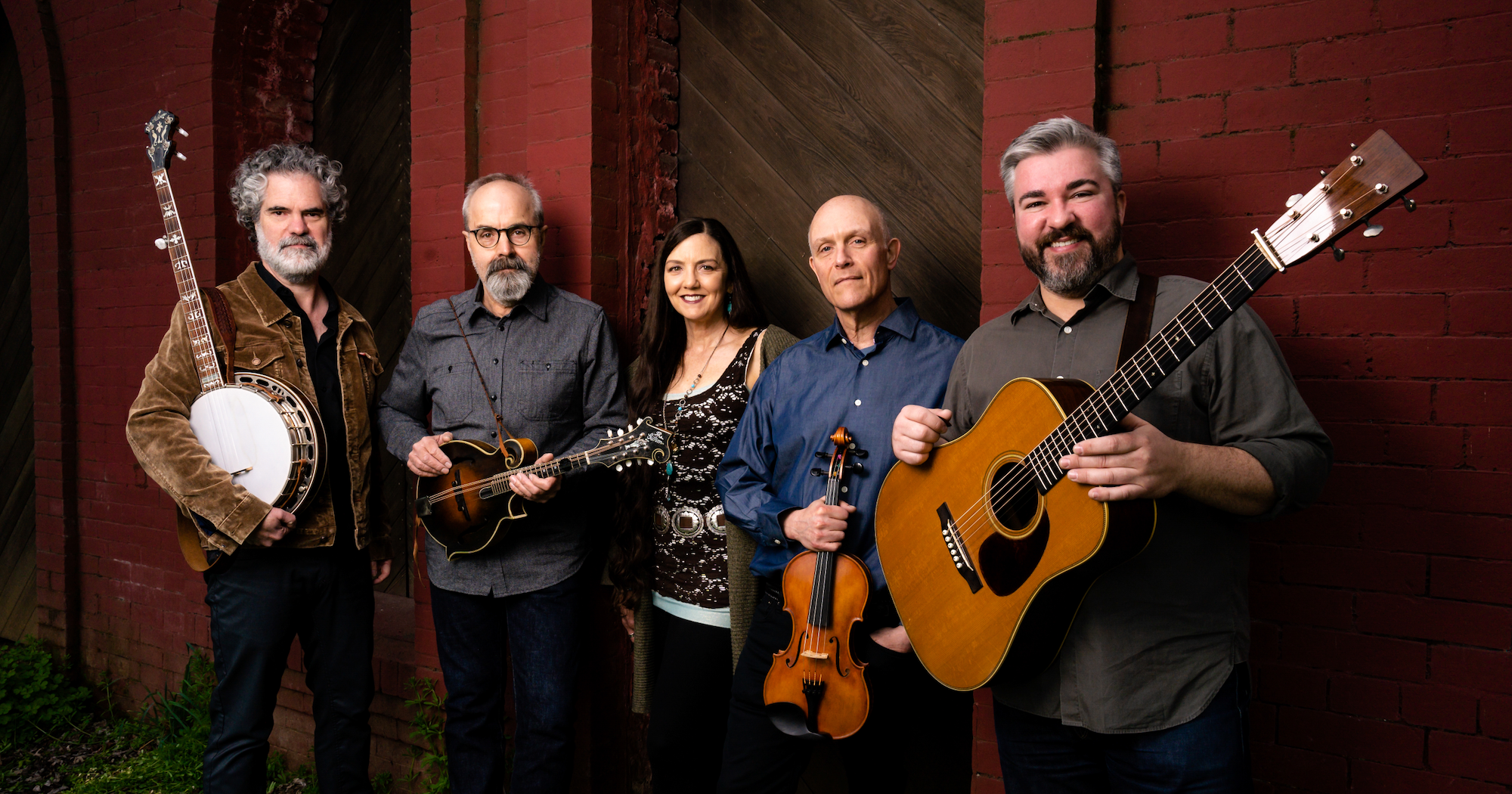
There are no U.S./Canada border wars when it comes to John Reischman. The revered mandolin master was born in Northern California but has lived in British Columbia since the early 1990s. His longtime band, the Jaybirds, are a quartet that includes two members who are also based in British Columbia (bassist/vocalist Trisha Gagnon and banjoist Nick Hornbuckle) and two who reside in America (fiddler Greg Spatz lives in Eastern Washington and guitarist/vocalist Patrick Sauber is from Southern California).

Their latest album, The Salish Sea, refers to the body of water between Vancouver Island and the British Columbia mainland. The record is their first since 2017’s On That Other Green Shore along with being the first to feature “new” guitarist Sauber on the entire album. The song “The Salish Sea” not only serves as the album’s title, but also is part of an original “Bluegrass Concerto” that Reischman was commissioned to create for FreshGrass in 2024. The honor is just one example in a long line of accolades for Reischman, who began his career in the Bay Area bluegrass/folk scene of the 1970s (including a stretch with the Tony Rice Unit) before moving to Canada, where he started the Jaybirds as well as performing solo and in other groupings.

In recent years, Reischman has seen his song “Salt Spring” become something of a modern bluegrass classic. He spoke with the BGS from his home in Vancouver about “Salt Spring” as well as The Salish Sea, his famous Lloyd Loar mandolin, and how he got into bluegrass music.

What was the process of putting the new album together?

John Reischman: There was one venue in Washington State where we had a residency. It was in the fall, in a beautiful spot. It was just ideal. So we took the extra day, worked up like six new tunes, and then started performing them right away. I guess this was October of ‘23.

And then you recorded the album in Vancouver?

In December of ‘23, I wanted the band to check out the studio here in Vancouver, where we ended up ultimately recording. I just want to make sure everybody was cool with it. I knew I liked it, because I had used it for my solo record, New Time & Old Acoustic. They all liked it. At the end of any tour we had that was close to Vancouver in 2024, I’d book a day or two in the studio, and we’d go record two or three or four songs. We were able to perform all this material mostly before we recorded it. … And it was great, because we’d be warmed up from the tour and we’d go in and track some tunes.

This album was the first in a while, and also the first that Patrick Sauber was fully on it.

Right, On That Other Green Shore came out in 2017. That was kind of the tail end of our time with [guitarist] Jim Nunally being a band member. He was exploring other things and decided he’d leave the band. We had a few more tracks to do… and we had some dates on the calendar.

I thought of Patrick immediately, because I’d known him for many years and I thought he’d be good. So he signed on for a tour and then another tour and it was just like, “This works great.” We asked him to join and he immediately said yes. He was a great fit.

How did the Jaybirds come together in the first place?

I didn’t really set out to have a band, except for the fact that I had a solo record called Up in the Woods. There was a local festival, so I put the band together to help promote the record. Seemed like a good idea. And I liked playing with all those people and it just continued on.

It’s called John Reischman and the Jaybirds, because I conceived of it. My name was probably the most well known at the time, but I wanted to be integrated into a bluegrass band. People present stuff, and I almost always accept it. Mostly it’s a pretty democratic presentation, I think. That’s what I like. It’s not Gladys Knight & the Pips.

Can you talk about the title track and how it’s also part of a larger project?

I had been asked to write what they call a “Bluegrass Concerto” by the East Coast festival FreshGrass, and I came up with these three tunes that work together. The first tune was the first movement, which ultimately was called “The Salish Sea.” I thought this will be my contribution to the new Jaybirds record, because they were involved with the performance of the Concerto.

We performed it [at FreshGrass in 2024] and I really liked the idea of having two mandolins and I’ve always loved two fiddles. I knew Darol Anger was going to there, so I asked him if he’d play twin fiddles on it. And then Sharon Gilchrist is a good friend and great mandolinist; we’ve played a lot together, and I asked her to play a mandolin on two of the three pieces.

I’ve got to acknowledge David Grisman, because the music is influenced by his “Dawg Music.” It’s also the sound that I initially heard on his first solo record, The David Grisman Rounder Record. He incorporated harmony mandolin on a lot of it.

It must have been very inspiring and gratifying to receive this commission.

You know, I’ve written a lot of tunes and a lot of folks have learned my tunes, which is really gratifying. But to have been commissioned to write this and have the confidence of this great festival and organization, yeah it was.

I had plenty of time to work on it and the time that it mostly came together was when I think my wife was visiting family. I had the house to myself. That first piece, in particular, really developed over a period of time. The second one [“The Family’s Farewell”], I came up with the A part pretty quickly and it took a while to get a bridge for it.

The third part [“The Little River Ramble”] was similar. … The thing about the concerto format is the third movement typically has an extended solo section and it’s often a bender where it’s just the featured soloist playing solo without any accompaniment. But I wasn’t really comfortable so much with that. I thought, I’ll just have it break down and I’ll solo all through there but have it build back up.

I’m really happy with the response it has gotten. Even playing it just as the five-piece band, I think the band sounds great on it. It’s only like icing on the cake when the twin fiddles and the twin mandolins are there.

And this spring, you’re going to record the entire concerto?

At the end of March, we’re going to be on tour on the East Coast and the FreshGrass Festival has a recording studio. They offered to make the studio available, so we’re going to record that just as we performed it, with Darol and Sharon joining in. That will be part of a solo record, even though I’m using those musicians. And I have other sessions planned. I’ve done one session that will add to the whole thing. Those three tunes of the concerto will just be one component of the new recording.

“Salt Spring,” one of your older songs, has become a highly popular instrumental now in the bluegrass world. How much of a pleasant surprise has that been?

It’s kind of remarkable to me that it’s as popular as it is. I mean, I’m not complaining. It’s great. … But it’s interesting how it’s just traveled all over and people think it’s just a traditional tune in some circles. They have no idea that it was composed by me. That’s cool, too.

The Jaybirds recorded it and it came out on a CD in 2001. We were at a music camp with some folks from Colorado and they learned it. I think that’s largely the beginning of it getting circulated among other people – where they took it back to Colorado. They’re the “patient zero,” I guess.

I know that a certain generation of Berklee students were playing it a lot, and maybe a bit later – maybe 10 years later. It’s pretty cool having people play your tune when you’re not there. That CD was never available digitally until recently, but we made a video of it around 2011… and that was the source, I think, for a lot of people learning it.

And then you recorded it again with Molly Tuttle, Alex Hargreaves, Max Schwartz, and Allison de Groot on your 2021 solo album New Time & Old Acoustic.

I didn’t have all the material when I started that whole project, but I knew I wanted to re-record “Salt Spring” with some of these younger musicians who had grown up playing it.

What do you remember about writing it? And why do you think so many musicians have gravitated to playing it?

I was on Salt Spring Island [in British Columbia] staying with some friends and they had a little old turn-of-the-century Martin small-body guitar. I was just playing the guitar and I was playing out of a D chord shape, and the A part of the tune just kind of took shape under my fingers. It was memorable enough that I don’t think I had to record it to remember it. The B part was just this little phrase I would play on the mandolin, just noodling around … so I just kind of stuck it on there and it worked pretty well.

I think the thing about the tune is the basic melody is very simple, but the way I played on the mandolin, the technique I use, is not quite cross-picking. But it falls into a right-hand pattern that sort of mimics the way the frailing banjo is played with that “bum-ditty, bum-ditty, down-down up, down-down up” pick stroke. So, these extra “down ups” are drone notes and that just kind of enhance the whole overall effect. Because of that, it lays out really nicely on the banjo. Then on the fiddle, you can add drones and add to it that way. And on the guitar also, you can fall into that kind of “bum-ditty” pattern as well.

I think you can learn the tune pretty easily. It’s not super challenging like some fiddle tunes where they’re very detailed in the melody. It’s pretty straight and so I think that’s partly why people gravitate towards it.

You grew up in Northern California. How did you get interested and involved in music, specifically bluegrass music?

Have you heard of a guitar player named Robben Ford? He grew up in the same town where I did in Northern California. He was in a high school band with my neighbors. I must have been 12 or 13. They were rehearsing on a patio and I went over to listen. I was interested in music and I heard them play the Freddie King tune “Hideaway,” which Eric Clapton recorded on the John Mayall & the Blues Breakers record. My brother Steve had that record. I recognized the tune and I thought, “What? This is impossible. This sounds as good as the record!”

From then on, I was just focused on trying to play the guitar. I had taken guitar lessons prior to that, but it didn’t really work. But there were guitars around the house. So that was the thing that really sparked my interest in learning to play. But I was open to all kinds of music. I’d have access to the PBS station KQED and they’d often air Pete Seeger’s Rainbow Quest, where he’d have different folk musicians, bluegrass musicians, old-time musicians. I thought, “Oh, this is cool!” And then the mainstream presentation of bluegrass with The Beverly Hillbillies, having Flatt & Scruggs on it, and the Dillards and the Country Boys playing on The Andy Griffith Show.

At some point, I had access to a mandolin, which I associated [with] bluegrass music, and taught myself to play it. I tuned it to an open chord for a long time, like a banjo, which was incorrect. And I didn’t use a pick. But eventually I got things squared away.

I discovered the John Hartford Aereo-Plain record. I saw them on TV as well. That was very inspiring. Then I discovered Norman Blake and Vassar Clements. I come to find out they had their own records. … That first Norman Blake record, I couldn’t believe it. I just flipped over that, and I thought, “This is so great!” And I’d heard Doc Watson at that point, so I just got really interested in it, and focused on that music, primarily.

So, was the Good Ol’ Persons your first significant band?

Yeah, it was the first real pro band I was ever in, and I was a fan of theirs before that. I [had] lived in San Francisco for a short while and saw their original lineup, which included all women. And it was exciting to get the opportunity to play with these folks. Because I was living near Eugene, Oregon, and I was just playing the mandolin all the time – a lot with my brother, Steve – but I wasn’t in a band, and I was working on a farm, just part-time. And a friend from the Oregon bluegrass scene had joined them and they needed a mandolin player. He said, “I know a guy.”

That placed me in the Bay Area, which was a great scene. There were lots of good bluegrass bands. And the Grisman Quintet was there. … But the thing that set Good Ol’ Persons apart was their original material, because Kathy [Kallick] is a fantastic songwriter. And Paul Shelasky, who was in the band, also wrote great songs. That opened the door for me to try and write tunes – because, “Oh, these guys write tunes. I’ll try it.” I wrote a few and people liked them. That just gave me encouragement to keep at it, which I have done.

So consequently, when Grisman and Tony Rice parted ways, Tony was aware of me. He’d heard me play at the local bar. He wanted to put a band together and needed a mandolin player. So, I went to the audition and he hired me.

You are well known for having an antique Gibson Lloyd Loar mandolin. What do you think makes those mandolins so special?

I guess that [mandolin] was kind of the ultimate expression of Gibson mandolins. But there’s plenty of new makers and a lot of them are using that basic design. So, aesthetically and as far as the craft of the instruments, some of these builders are way better than the Gibson mandolins were to look at, but the Gibsons have 100 years of aging and playing.

I think the playing of the instrument contributes hugely to its sound. Because, if there’s a Lloyd Loar that left the factory and went into someone’s closet and never came out for 50 years, I don’t think it’s going to sound like one like mine that has been played consistently over time.

I feel fortunate to be the caretaker for this great instrument. I think for most bluegrass musicians, it’s not only the music, but it’s the tools. These vintage instruments, like the Martins from the ‘30s and ‘40s, and Gibson mandolins from the ‘20s, and old banjos, it’s just a vibe that goes along with the music and aesthetic.


Photo courtesy of John Reischman.
Max Allard Wrote a Banjo Concerto

The banjo, a sonic staple of folk and bluegrass, has often been left to its established devices in traditional circles or, more optimistically, among contemporary newgrass like Punch Brothers, the Infamous Stringdusters, and New Grass Revival, which included the genre-bending banjoist himself, Béla Fleck. Still, some musical spaces, like classical performance and composition, remain largely devoid of the banjo despite its lengthy and socially complex history, global presence, and tonal variety. Thankfully, between artists like Fleck, Noam Pikelny, John Bullard, and others, classical compositions have had a chance to shine on the instrument, paving the way for next-generation players to embrace and mix the traditions of classical writing with the distinct sound and musical capabilities of the banjo.

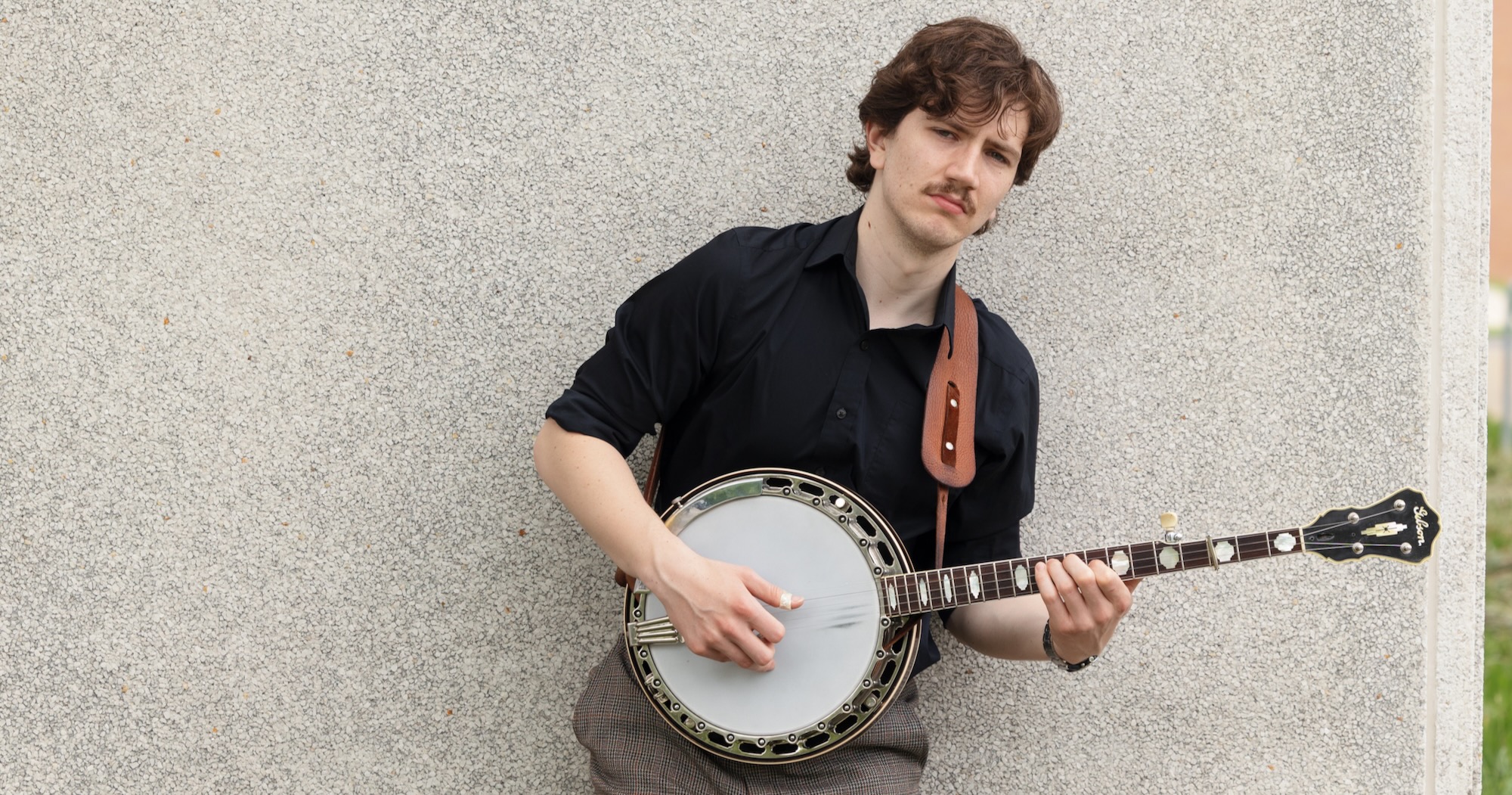
One such figure rising to the occasion is composer and artist Max Allard. A recent graduate of Oberlin College’s Conservatory of Music, the Chicago native is a champion of many cultures and genres in his work, which Allard describes as “an unclassifiable mix of bluegrass, jazz, new acoustic, classical, and pop.”

Allard has brought his stylistic openness to every facet of his artistry, including a duo with his brother Otto Allard; a bluegrass ensemble he co-founded, EZRA, that includes mandolinist Jacob Jolliff, guitarist and composer Jesse Jones, and bassist Craig Butterfield; and his touring support of Michigan-based bands Full Cord and Westbound Situation and Virginia-based band the Hackensaw Boys. Another instance finding him pushing banjo boundaries was his collaborative performance with fellow banjoists Bill Evans, BB Bowness, Cassidy Beentjes, and Matt Flinner in an adventurous arrangement of “In C,” the iconic composition by American minimalist composer Terry Riley, as part of a commissioned work series at the 2025 FreshGrass Festival.

Many of these ambitions grew alongside or after Allard’s studies, giving him several creative contexts in which to nurture his knowledge of classical forms and styles. One of the most impactful of these opportunities was part of Allard’s collegiate work itself: A Concerto for banjo and mixed ensemble. Encouraged by his EZRA bandmate and Oberlin professor Jesse Jones, Allard wrote his single movement work in 2023, giving the world premiere with the Oberlin Contemporary Music Ensemble under conductor Tim Weiss in December 2024. Though the piece has long since debuted, Allard’s vision for what the concerto would accomplish and what the experience of writing it revealed to him along the way remain ongoing sources of inspiration and guidance as Allard continues to write and perform for anyone who wants to listen. (Watch a video of Allard’s Concerto below.)

BGS recently spoke with Allard over the phone, discussing the many branches of his work as an artist and composer. We dive into how each stylistic space blends with his classical training, where he sees the banjo’s place in classical performance, his thoughts on cross-genre efforts by other artists, and more.

How would you describe the journey around your Banjo Concerto and its compositional process?

Max Allard: I had anticipated [the piece] for a while. I had gotten into Oberlin College as a composition major and part of the reason I chose Oberlin is because composition faculty member [Jesse Jones] comes from a background of playing bluegrass. He plays mandolin, some banjo, and guitar so I knew that I would have someone in the faculty on my side to help me, to know where I was coming from and to help guide the path forward in terms of a study and a pedagogy that I had not been taught before. So Jesse told me, “I think it would be great for your work here at Oberlin to culminate into a banjo concerto.”

I had the plan of approaching the banjo as a concert instrument – and as a concert instrument with the supporting ensemble. To do that, I had to get away a little bit from the folk aspects of the banjo in terms of a composition process, while still embracing those same aspects in terms of style.

[The concerto] sort of started as a banjo draft. And something I think is interesting to mention is that people have compared my banjo playing before to piano players and it’s a very valid comparison, because I take a lot of inspiration from piano players like Keith Jarrett, Chilly Gonzales, and many European classical composers like Sergei Rachmaninoff and Frédéric Chopin. I have long thought of the banjo as a very capable instrument to take solo composition very seriously on. I had to find ways to creatively think about which instruments to give various roles to. The nice thing was that I got to pick the makeup of the ensemble. I knew I wanted to have celesta. I wanted to have clarinet, flute with piccolo – there were certain sounds I knew I wanted to include.

I had very specific ideas about which instrument fulfills which role. It’s definitely a string-heavy piece and I’m a huge fan of writing for strings. So I had known that this piece would provide me the depths that the banjo doesn’t always have. I thought, “I can fill out these luscious piano-like chords that I usually like to write on the banjo, with the help of the supporting string section that has a much broader range than the banjo has by itself.” It was actually really liberating for me, because having an ensemble with a very diverse range – not just timbre-ly, but sonically and in terms of highs and lows – I had many options. It was a really great blank canvas for me to further explore creativity without some of the limitations of the banjo, be it physical or range related, or what have-you. I was able to basically apply my banjo knowledge and compositional tendencies to a blank slate, which presented a lot more opportunities.

What are your thoughts on the banjo’s “place” in classical music?

The banjo has a very checkered, problematic history and there’s a lot of moral debate that I’ve witnessed amongst people about what the banjo’s role is. It has had many different roles – a lot of it actually being erased. We talk about the problematic history of the banjo being used for minstrelsy but we actually forget about the banjo’s history of being used in parlor music. For a long time, the banjo actually had a role being played in parlors and social events, and even playing classical music.

I find it funny when people sort of criticize the banjo these days because the reputation has been ruined so much. People tend to think of the banjo with the film Deliverance. That film sort of ruined the reputation of the banjo as being this hillbilly folk instrument that’s not taken seriously. Unfortunately, that stereotype still exists, so people sort of scoff at banjo players who want to elevate the instrument into a certain concert environment.

I think all instruments can be used however people want. It’s like the artist has a final say in how they want to showcase their instrument. But for me, I think I’ll always still want to pay my respects to the traditions of the banjo. And as I said, the banjo has, throughout history, been used in a variety of different contexts. What I try to do is bridge the gap of pedagogic composition and folk music. If we’re talking about my banjo concerto, I want to write well-written concert music but [avoid creating] a totally contrived piece of music that just tries its best to fit the banjo in with an ensemble. I want to at least take my understanding of bluegrass, folk music, and old time music and still amalgamate it with concert music.

What do you find you learn most from other banjo players who have thrived in the classical space like Noam Pikelny, Béla Fleck, John Bullard, and others?

Broadly speaking, if [banjo players] want to put our instruments in the classical space, we need to do our best to understand the way the classic musicians think – really get in the minds of classical musicians. If one, as a banjo player, wants to pursue classical music, it behooves them to get at least a decent understanding of concert music. And I think most banjo players [like Fleck, Pikelny, Bullard] who have attempted that absolutely do have a different understanding. I just think the understanding of how deep it actually goes, what details go into really good concert music – it just takes a long, long time to master. And I am nowhere close to mastering it. But I at least have an understanding of how little I knew before attending [Oberlin].

Are there any aspects of Terry Riley’s “In C” that were especially challenging to capture with this banjo-centric arrangement?

I should give a shout out to Cassidy Beentjes, who did all this arranging – a really good pedagogue of the banjo. In terms of limitations though, the key [was one]. With the banjo’s natural key being G major, we took the piece down to a G-major tuning, so it makes much more sense to play the piece in G, especially since we want to achieve certain overtones. We could have played in C with a C tuning, but a lot of complexity would have arisen from playing in a foreign tuning. We were already uncomfortable in the first place, you know, with a piece of music like this, because banjo players don’t get the opportunity to do something like this very often, so we were careful.

What aspect of your musical identity does EZRA help you to fulfill that you don’t necessarily achieve in the same way with other pursuits?

I’d say it’s a good opportunity to write for a smaller acoustic ensemble where there’s a good understanding of not only folk and bluegrass, but also classical and jazz music.

It makes a big difference when you’re writing for people who you’re friends with – writing for people you know. You want to give people roles that you know they’re going to enjoy doing and that they do well. When I write for EZRA, it’s definitely much more stripped down and basic than if I were writing something like the banjo concerto. Because with the banjo concerto, I give very specific instructions, I supply a whole score with those specific instructions for everyone to read from. And when I’m writing for EZRA, usually I’m just writing lead sheets, just chords with the melody. In terms of arrangements, that can be discussed in the studio.

It’s funny though, because anytime we’ve recorded a record, we’ve had such limited studio time that we have to get our act together in just 72 hours or so and make our arrangements studio-ready. But again, that’s freeing for me, because I can write more vague ideas, stuff that I would not feel as intrepid writing with a big ensemble. When I’m with EZRA, I can just do whatever the heck I want and know that we can get away with it in some way. It’s also definitely a great opportunity for me to write contemporary folk music that is absolutely rooted in folk and bluegrass but also has all these other influences. A lot of Béla Fleck influence, a lot of classical music as influence – all kinds of stuff. It’s definitely a very special opportunity for me.

What’s the most unique aspect about the duo you perform in with your brother? How do you both approach playing together?

I guess the main thing that stands out is just the brotherly synergy. My brother is the easiest musician to play with because we know each other so darn well. Not much has to be planned – there’s almost never any stress. We’ve played plenty of gigs where we haven’t rehearsed at all beforehand and it goes pretty well just because we can glance at each other a certain way and know exactly what we mean musically. We’ve also played gigs where like a half hour has gone by and the whole thing is improvised. We just weave sounds together and it’s great.

It’s great to have a brother who plays music because it’s just that very intense, personal connection that one has with their sibling. You know each other so well that no communication really has to be done verbally. In general, playing with my brother is just very fun because we make crazy, spontaneous decisions and do ridiculous things that we would not do in any other setting.

Do you think the folk and bluegrass communities could better embrace the banjo being a genre-versatile instrument? And do you think that schools or community spaces are the best starting place to initiate that shift?

If I were talking to a banjo player who wants to get into classical music, I would say you can learn just as much by surrounding yourself with the right people. I think the most viable option is to try to meet some people who come from that background. And it can be any background. Like, say you want to get into a certain style – find musicians who can do that and try your best to talk to them, befriend them, whatever you can, and surround yourself with that. I think community is always important in the arts. Definitely, it’s very important to surround yourself with people – not even not necessarily like-minded people – but people who have very different experiences and very different backgrounds. Personally and musically in any way.

I think the bluegrass culture and scene could definitely benefit from opening themselves up a little bit. I think sometimes we forget that bluegrass has a very progressive foundation to it. Even Bill Monroe valued when he heard New Grass Revival. He was supportive of it, supportive of all those people who were taking bluegrass in a different direction. So I think it’s very progressive by nature. And music has always evolved and always will evolve and it has to sort of be accepted.

I think the banjo is actually in a very good place right now, because we’ve never had so many banjo players. It’s very good because the banjo is becoming popular for the right reasons – not necessarily gimmicky reasons, with banjos being used in pop music – but it’s being taken seriously amongst musicians from all different types of backgrounds. Broadly speaking, I don’t have too many complaints. I think it’s in good hands.


Photo Credit: Tanya Rosen-Jones

Combining Classical and Bluegrass, Scroggins & Rose Improvise and Inspire on ‘Speranza’

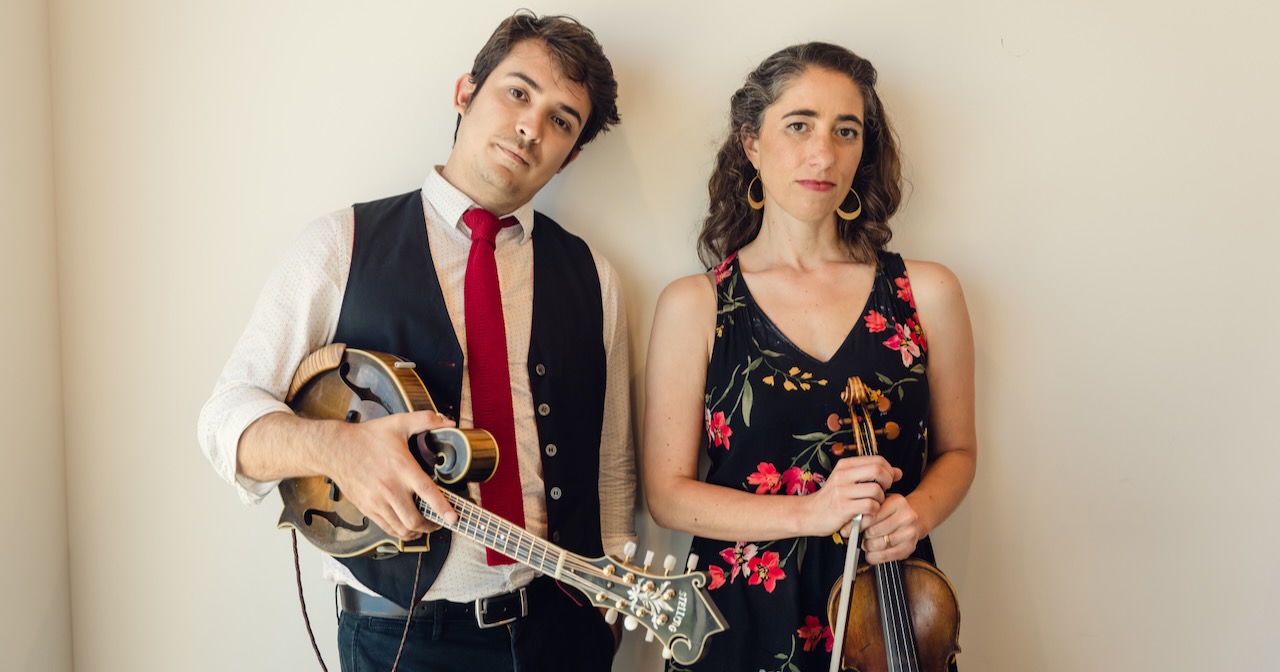
Acutely expressive, profoundly innovative, and ceaselessly gripping, Scroggins & Rose are masters of sonic storytelling. The project consists of Alisa Rose (violin) and Tristan Scroggins (mandolin), both virtuosic talents with a sprawling list of credits each in their own right. While Scroggins primarily forays in the bluegrass sphere and Rose spent her musical upbringing largely studying classical music, the two alchemize a blend of genres to achieve their distinct style.

The duo’s third collection, Speranza, relays a moving dialogue between fiddle and mandolin, drawing upon a diverse range of musical influences to weave together a thoughtful assortment of colors and textures. Initial ideas for the project began back in the quarantine days of 2020, and Speranza – which consists of six immersive instrumentals, a dynamic assortment of original and familiar tunes – now arrives nearly five years later in a moment where its intonations of hope feel just as crucial.

BGS had the pleasure of sitting down with Scroggins & Rose to discuss their origins, influences, and the percolation of their most recent release.

Congratulations on the album release! To start us off, could you talk about how the two of you came into playing together?

Alisa Rose: We both taught at NimbleFingers, which is a camp in British Columbia.

Tristan Scroggins: It’s a bluegrass week of workshops that has been going on for a couple decades. I always describe it on stage as “sleepaway camp for adults who want to learn how to play the banjo and drink.”

AR: There’s a really nice feel at that camp. Tristan was in a band with his dad at the time, so I did some shows with them there. Then one night, I remember the two of us improvising by a picnic table and we just had a really nice musical chemistry where we follow each other’s ideas around. Immediately it felt like, “Oh, this is a good musical fit.”

TS: At that time I was playing with my dad in Jeff Scroggins & Colorado, and we were touring full-time. So I just ended up in California a lot and I would tack on extra time to come hang out with Alisa. And we started writing music and playing shows. I live in Nashville now, so these days it’s more of a deliberate effort when I come out to collaborate.

At this point you’ve been able to flesh out that musical chemistry over the course of three collections. What would you say unites your musicality or differentiates it?

AR: I think when we improvise, it’s playful and creative and experimental – we’re not afraid to leave what may be reasonable behind, and sometimes that takes us to good places, and sometimes we fall on our faces. We also have a similar sense of rhythm and how we respond to it. It allows us to improvise freely because we feel rhythm in the same way. So that’s where we unify, but we have really different musical backgrounds.

Could you tell me more about that?

AR: Sure. Growing up I played a little bit of fiddle, but mostly I grew up in the classical world. I was a Suzuki kid, so I learned by ear initially, which I think has allowed me to play a lot of different music, but I was learning primarily classical violin growing up. Tristan grew up very much in the bluegrass world, and I’ve studied bluegrass and I’ve played in bluegrass bands, but I still have a different sense of melody and expressiveness. I think a lot about how to make music really expressive emotionally and I play with timings – those two things are less common in the bluegrass world.

TS: I think it’s been really valuable for me, generally musically and especially in the context of this project, to be exposed to those different ways of thinking about playing. I grew up playing with my dad, and in mandolin contests just learning how to play bluegrass, which does instigate this question of, is bluegrass expressive or not? I think it is sort of, but it’s so different from how classical music is expressive or how jazz is expressive. I’ve had to work a lot on navigating that challenge, because for me, I didn’t go to school at all for music. So much of how I play is very instinctual and this project often has me figuring out how to adapt those instincts in order to have more options, especially since there’s just two of us. We have to really be on the same page a lot of the time and work together to fill in spaces or leave holes where we want them to be – they have to line up, and it’s really obvious if they don’t.

Speranza does an excellent job at combining those classical and bluegrass sensibilities to achieve expression while still leaning into roots-like melodies. Can you tell me about the impetus behind your latest release? What drove you to create this third collection?

AR: So our first collection, Grana, was very improvised and we were a new duo. Basically we set out to make a demo – we wanted to record, like, three tunes and get some gigs. We got an Airbnb, rented some recording equipment, had our awesome engineer friend set it up for us, and we just hit record over and over for a weekend. By the end it seemed like it was an album, so that’s how that one came to be. Very improvised, very sort of exploratory. There were like 1000 takes of everything. Well, not actually 1000 because we didn’t have that long, but there was definitely a sort of trial and error of figuring out what we wanted to create.

And then for the second album, Curios, we worked out everything. We rearranged everything and really sought to emphasize the strength of melodies. A lot of that album was about making the melodies come out. To me, it’s also an exploration of different sound colors. We worked with Wes Corbett on that one and he helped bring that out in that album. We really tried to shape each tune into a little story, so they’re more composed. Some have solo sections, but they’re more like little pieces and arches – I mean, I would call them miniatures, but really they’re sort of standard length for bluegrass. In the classical world they might be considered miniatures– little, crafted, sparkly gems.

But we put [Curios] out in the pandemic, which was very anticlimactic. We were supposed to have a release tour and we worked really hard on that album for a long time. We had received a great grant from FreshGrass and were able to do a lot of things in the way we wanted. We worked with Dave Sinko as our engineer, who was awesome, and recorded in this pretty church in Nashville with Egyptian stained glass.

So the third one, Speranza, is more organic. We’ve grown as a duo in terms of creating, so we decided that instead of writing a whole record of stuff we would write and record as we went, or write and improvise as we went, and do some of both. So I believe this album combines the freedom of the first album and the shape and craft of the second album. And the material for Speranza came out of the pandemic – that was such a crazy time. Life seems sort of normal now, but a lot of the tunes started in that time and then we finished them once we could get back together.

TS: I think that in a lot of ways Speranza feels very shaped by the reality of the pandemic, 2020, things getting shut down – the first stuff that we worked on remotely, because we had to. It feels wild that we’ve been working on this for years now. It’s funny, similarly to the pandemic, it doesn’t feel like that was five years ago. We recorded it over different sessions and then mixed it over different sessions.

AR: “Pandemic Buddy” and “Reaper” are the darkest ones – those I did write in like that first month of the pandemic, but I just came up with the beginning idea and then as a duo, over two or three or four visits, we finished writing the pieces together. We’re often coming up with ideas, kind of sitting with them, and then recording voice memos and listening to them. It takes us a fair amount of time to do it and we really flesh out the arrangement and how our parts fit together in person. That tends to be pretty time-intensive. Basically we’re writing the pieces, but we’re memorizing them at the same time, with space for improv – everything is fluid, but the basic composition is pretty worked out. So our compositional process is pretty spacious and lengthy.

What was inspiring you during the composition of these pieces? Any art that you were ingesting or other cultural touchstones of during that moment?

AR: In the beginning of the pandemic, Tristan did a tune challenge, which is where some of these songs started. There was a word prompt every day to write a tune about. For example, “Reaper” began with the prompt “death.” “Pandemic Buddy” was for the prompt “friend.” It was a really nice way to channel energy at the beginning of the pandemic, when everything was crazy. I spent hours every day writing these tunes and trying to get a good video, and I think I got a little better at them as I went.

TS: I mean, it’s sort of an obvious one, but we talk a lot about Mike Marshall and Darol Anger. It’s the same mando and violin pairing, but I love listening to them and listening to other people who do this kind of new acoustic music/composing. I spend a lot of time in Nashville with Wes Corbett. Wes produced our second album, but he’s also a friend of mine, and I helped him with publicity for his first album, which has a lot of really beautifully written instrumental pieces.

It’s interesting – we spent so much time working on this in chunks and that was a very different part of my brain than the part of that was working very hard on, like, Texas-style fiddle tunes. Those weren’t crossing over, exactly. I think rather than being influenced by something specific, it’s more that I try to cultivate something within myself by listening to both stuff I like and new stuff. Absorbing all of that, letting it ferment inside, and then figuring out how to express that all together, rather than trying to emulate any one thing.

AR: I tend to think that when composing, everything you’ve ever listened to, everything that ever resonated with you and definitely anything you’ve ever played with your body or had in your body – whether you danced to it, or you physically played it – is a part of your musical sensibility. I don’t know what I was listening to when I was writing these tunes, but I definitely love Darol Anger and Mike Marshall. I also love Schubert string quartets, I love Beethoven piano sonatas, and I love Debussy piano music – I love a lot of different kinds of music, and I think all of that is part of what comes out. That’s all part of what’s in my head when I’m conceiving of new material.


Photo Credit: Lenny Gonzalez

PHOTOS: Trampled by Turtles and the Unique Appeal of FreshGrass Bentonville

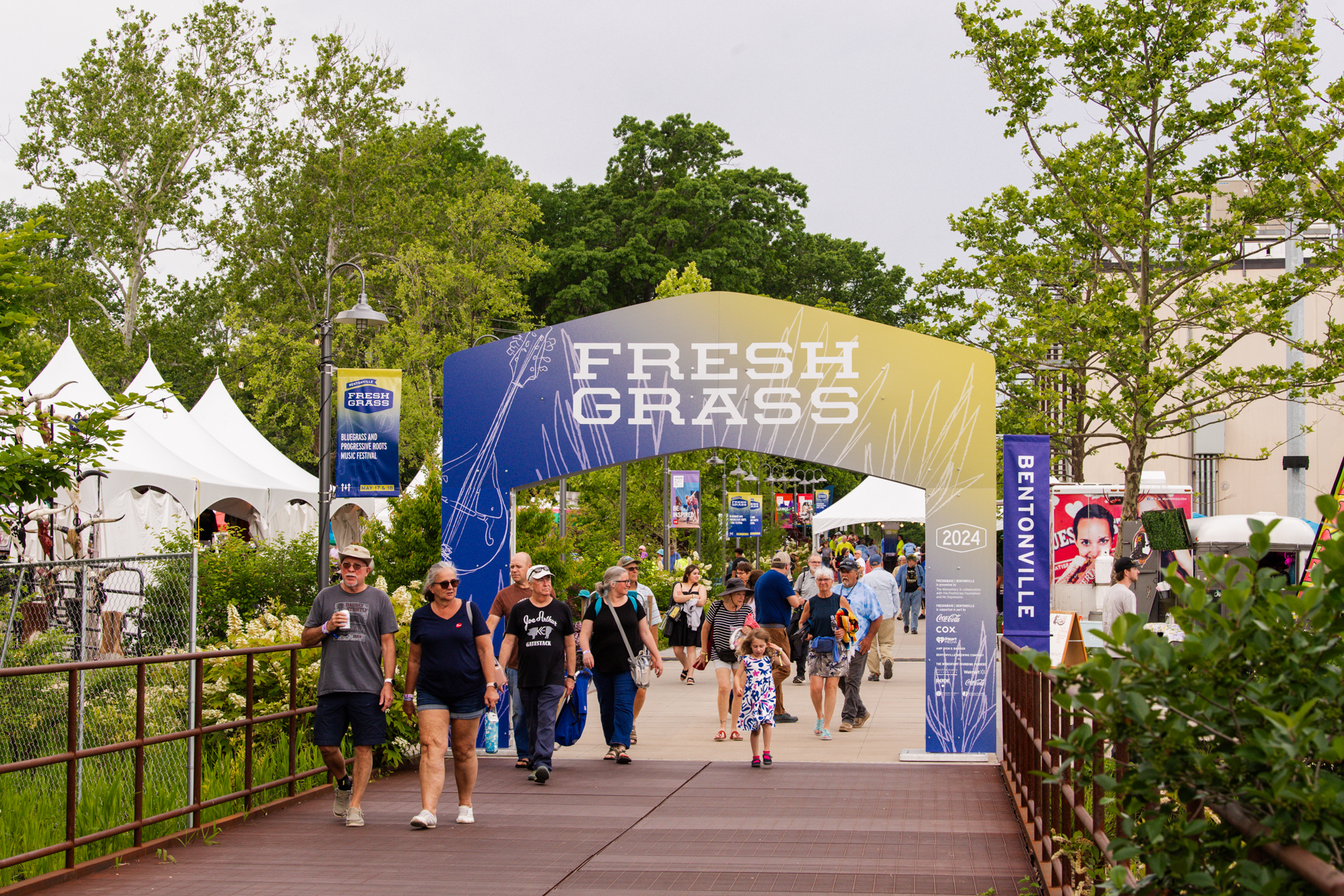
On my way from the Northwest Arkansas International Airport to the apparently booming town of Bentonville, Ron, the man driving the van, pointed at an old farmhouse that was now sticking out like a sore thumb among its newer, beige-r neighbors. “I remember when that house was way out in the country,” he told me. The town is growing rapidly, and the surrounding countryside is disappearing at the same rate. Bentonville is probably best known as the birthplace and headquarters of mega-retailer Walmart. However, it is also now home to a couple high-quality art museums, miles and miles of mountain biking trails (the city’s Chamber of Commerce website dubs Bentonville “The Mountain Biking Capital of the World”), and a very cool festival, FreshGrass. I’m here to play that festival with my band, Trampled by Turtles.

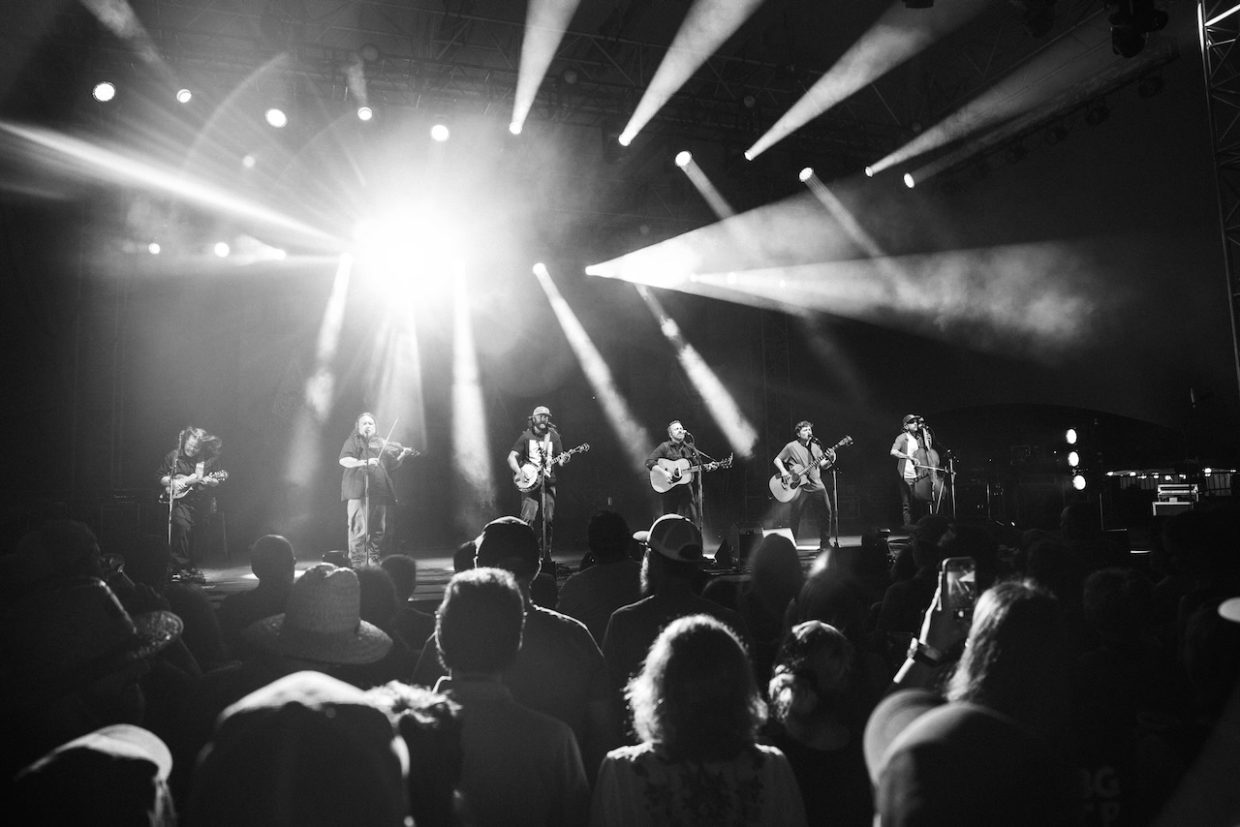
Trampled by Turtles perform under the lights at FreshGrass Bentonville. Photo by Cooper Baumgartner.

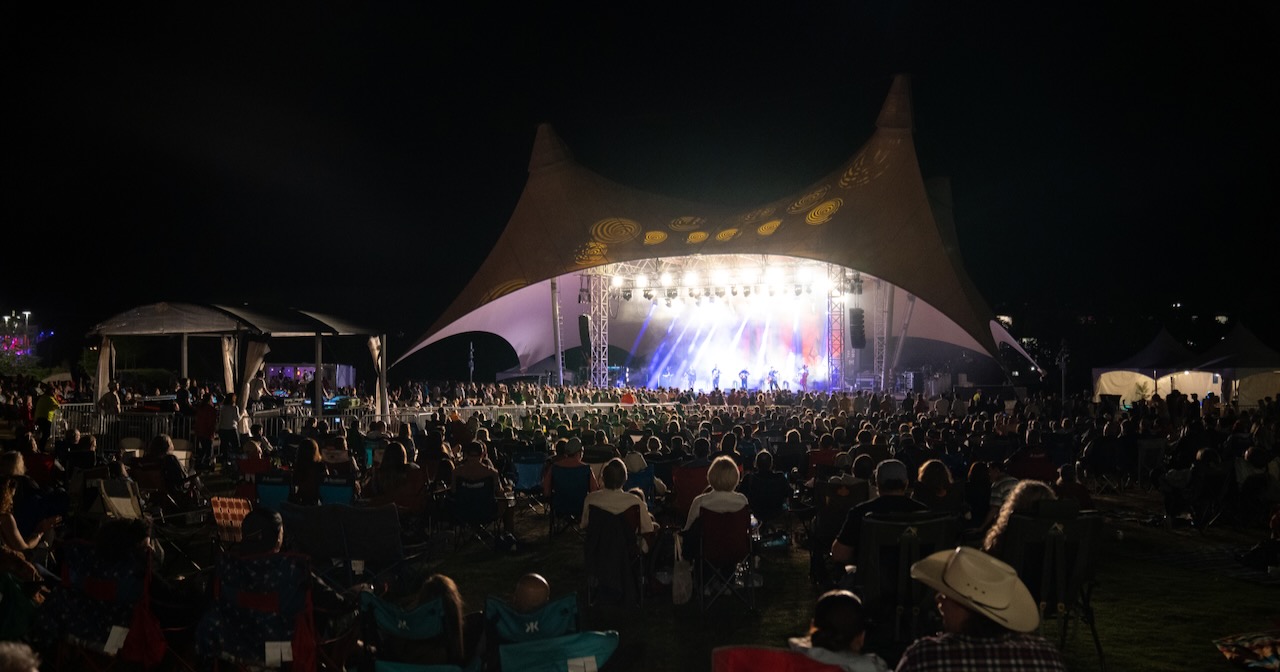
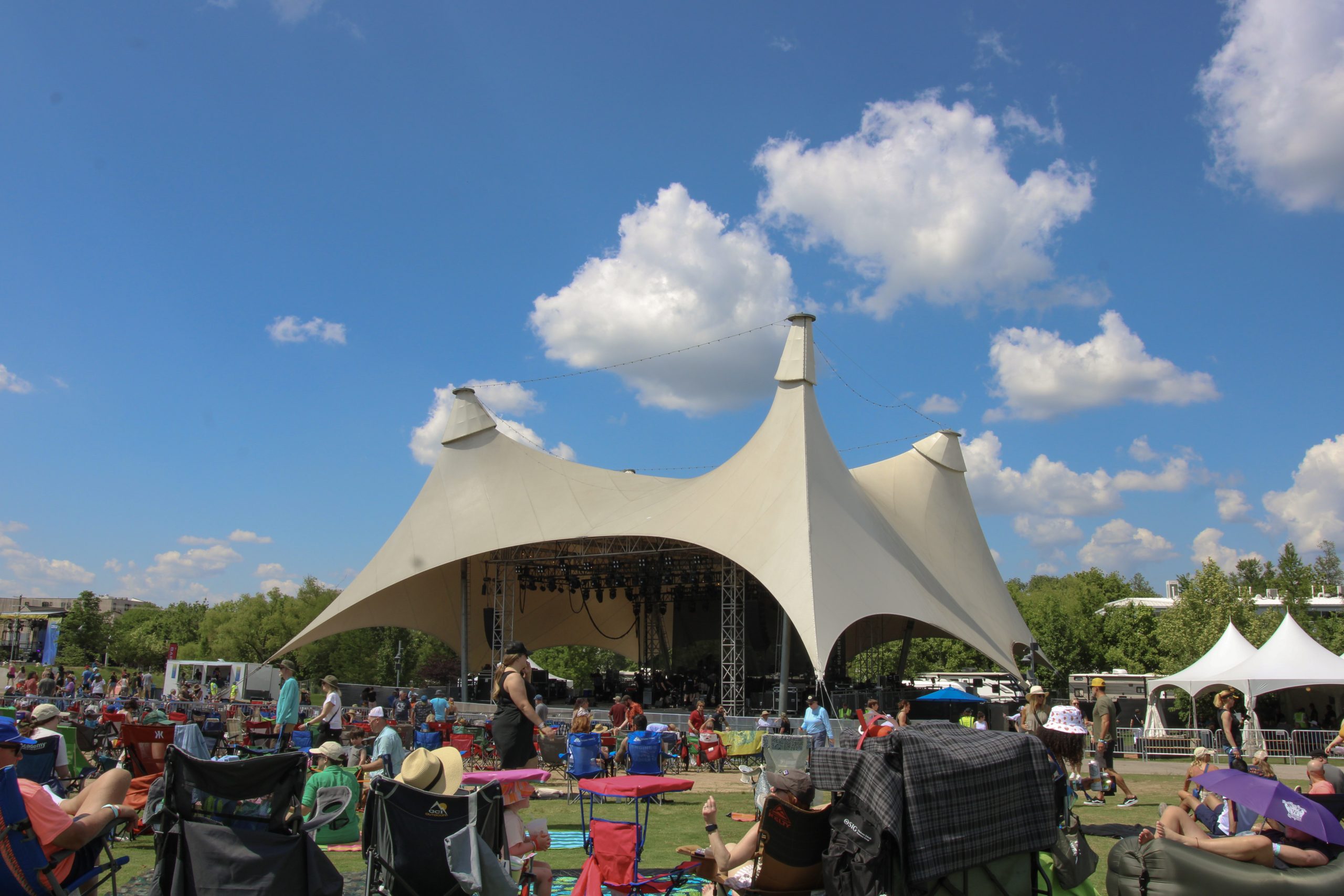
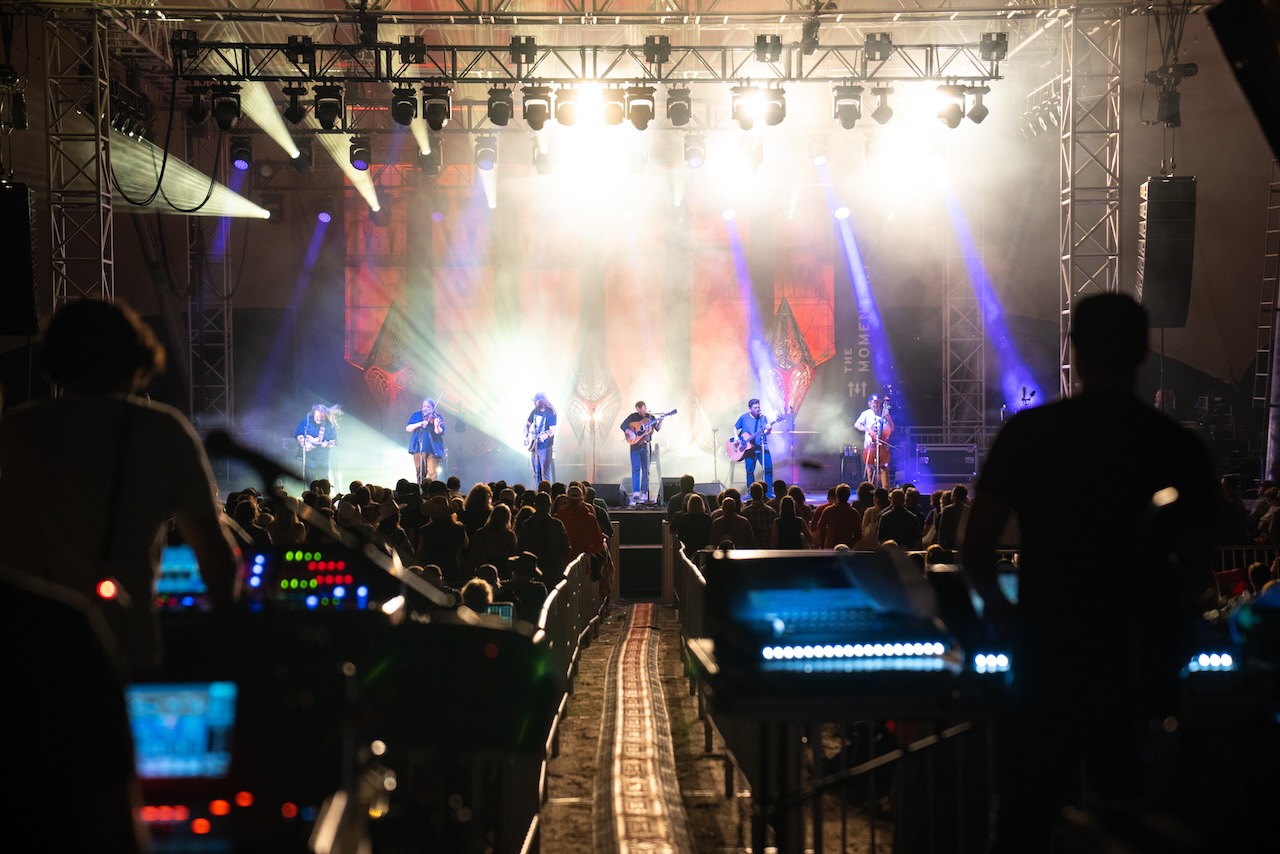
We have played FreshGrass a couple times before, but those shows were at its other and original location way up in Massachusetts. This being our first foray into the burgeoning Arkansas version, I was curious to see how it would compare. As with its Massachusetts sibling, FreshGrass Bentonville is set up on the grounds of a multi-use art space. The Momentary, as it’s called, is a decommissioned cheese factory that is now a hub of artistic activity in the region. There are indoor and outdoor installations, several performing arts venues, a variety of food experiences, and for our purposes here, a large outdoor concert area. I mean, what a cool place to play a show! I love the venues this festival chooses. We have played all manner of these things and though it probably goes without saying, the setting has so much to do with the experience of the ticketholders and the performers alike. There is something about a concert being surrounded by an atmosphere of artistic creativity that gives the FreshGrass festivals their unique flavor. Don’t get me wrong, we have had great times at festivals set up in nameless fields, but given the choice, I would choose this. I enjoy playing a show at a place that I would go anyway.

Fans react to Trampled by Turtles. Photo by Cooper Baumgartner.

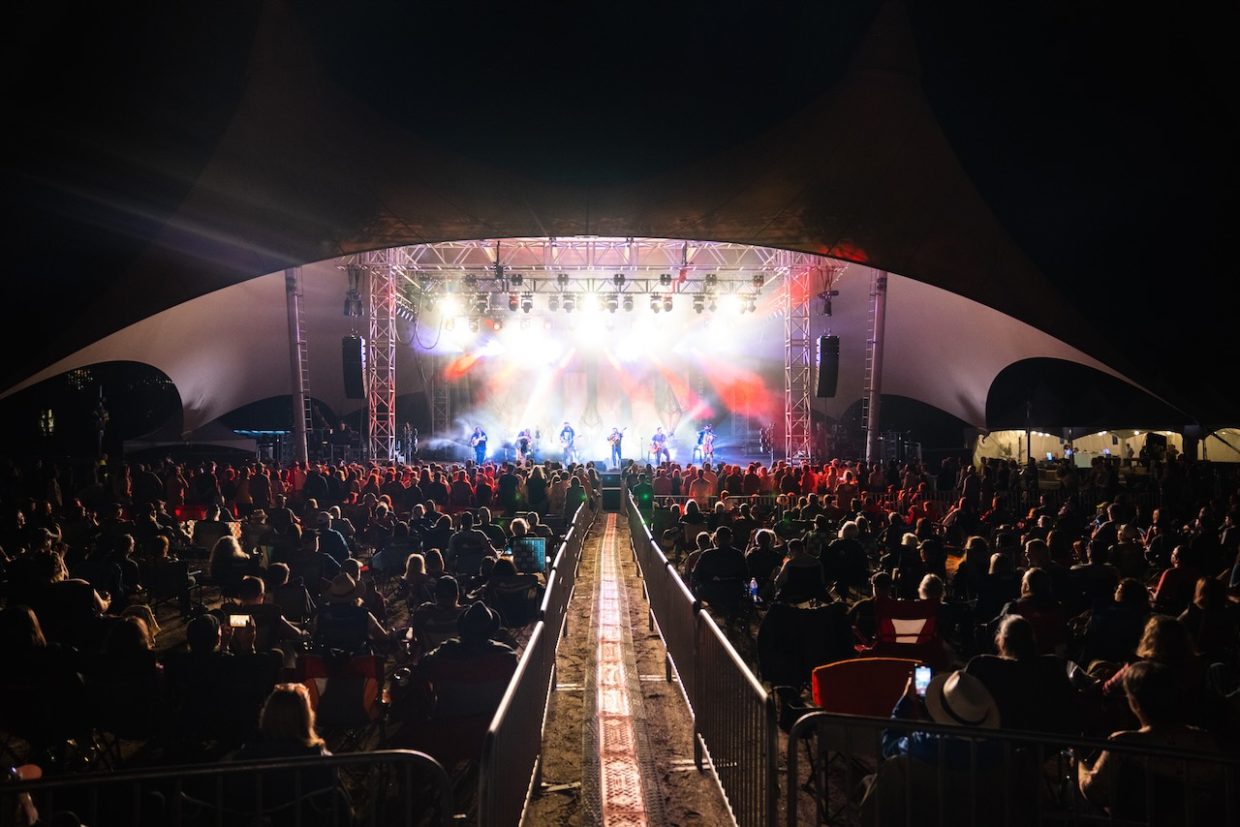
We had a lovely experience here. The crowd seemed very happy to be there and all the music I heard was great. I want to give a little shoutout to whoever set up the main stage concert bowl as well. Often at outdoor venues with both seated and standing areas, the seats are up against the stage and the standing lawn is way in the back. At The Momentary they’ve made a bit of a hybrid setup. There are small standing room areas right up in front, a large section of seating, and then a wide lawn in the back.  Everyone can enjoy the show in the way they choose, whether that’s dancing like demons in the front row, having a comfortable chair in the middle, or spreading out on a blanket with the family in the back. Having standing room up against the stage is such a boon for the band that’s up there, as well. There is an energy partnership with those wilder, bouncing audience members and it can feel weird to have them way behind the seated crowd. I don’t know if that was the reason for this layout, but we enjoyed its effect at our set last night.

Trampled by Turtles and a “full house” at FreshGrass Bentonville. Photo by Cooper Baumgartner.

I am not surprised to be impressed with the younger FreshGrass. This festival has consistently proven its desire to provide a unique and art-forward experience for both band and crowd alike. They invest in interesting lineups and create visually exciting venues in which to show them off. They’ve made us feel very welcome over the years and I hope we get to play these festivals forever.  – Dave SimonettTrampled by Turtles

Make plans to attend FreshGrass Bentonville next year May 16 – 17, 2025 at the Momentary.


Dave Simonett is the lead singer, guitarist, and a songwriter for fan-favorite bluegrass group Trampled by Turtles. Subscribe to his Substack, Good Record, here.

Photo Credit: All photo credits as marked. Lead image and Trampled by Turtles photos by Cooper Baumgartner. All other photos courtesy of the Momentary.

Mental Health, Healing, and Redemption Flow From Becky Buller’s ‘Jubilee’

With her work as a songwriter and as a sidewoman, Becky Buller made a name for herself long before she became a bandleader. In 2015, after becoming a mother, she realized the need to control her own schedule and reluctantly began a touring career under her own name. But for someone more comfortable outside of the spotlight, the pressure and stress of leading her own project took its toll and in 2020 Buller found herself in a mental health crisis.

Her new album, Jubilee (available May 17), chronicles her journey through depression in the form of a song cycle including instrumental interludes. This project was initially commissioned by the FreshGrass Foundation and was recorded almost entirely live with Buller’s band. The music is beautiful and vulnerable – and the group’s chemistry and musicianship shine.

In a BGS interview, Buller opens up about what triggered her mental health breakdown, about the stigma around mental health care, and how she found her way out of the dark through medication, songwriting, therapy, and prayer.

This album was commissioned as a long form composition by the FreshGrass Foundation for debut at their 2023 Bentonville, Arkansas festival. How was your experience as a writer working in a song cycle/conceptual format, versus previous songs and albums that you’ve written?

Becky Buller: I almost always follow the muse where she leads. Having an assignment generally tends to squelch my creativity. I’m so grateful to the FreshGrass Foundation for commissioning me to write this piece, but I’ll admit, after I hung up the phone last fall, I did panic a little bit. But once I settled on the topic for the cycle and decided that the previously unreleased song, “Jubilee” (co-written with Aoife O’Donovan), would be the seed I would plant and water to cultivate the entire project, the rest of the music came to me pretty quickly.

Tell me about your connection with Aoife – how did that come about, and where did it lead the project?

She and I were talking at the 2019 Newport Folk Festival about writing together at some point. She was there touring with I’m With Her, and I was there with the First Ladies of Bluegrass as part of a historic all-female Saturday night headliner set curated by Brandi Carlile, which included folks like Yola, Sheryl Crow, Linda Perry, and Dolly Parton.

Once I got back home, I ended up sending Aoife the first stanza of “Jubilee” and she said the idea of needing a rest resonated with her. We started writing “Jubilee” just before the pandemic shutdown, finishing it in December. Ironic that we were singing about needing a rest… and then we got one! [Laughs]

[Laughs] You manifested it! But the rest for you – it didn’t really help? From your bio it seems like it caused a crumbling of sorts?

No, I don’t know how to rest.

I’m the same. I find that when I have time to think it can be very confronting.

That totally resonates with me, it exposed all the cracks in my foundation.

I was really interested in the line, “She’s been told that she’s absurd,” as a potential crack in the foundation – the idea of the separation between an artist and a human. That one could feel respected as a musician, but not as a person… where is that line coming from for you?

Or not respected as either…

We all have so many voices and opinions whirling around us. Some louder than others. Some speak honey, some poison. Unfortunately, and more often than not, I tend to fall victim to the poison, trying my best to get others to change their opinion of me. Fruitless, I know.

So you’re speaking about personal and professional critics who you feel don’t respect you and your art, that type of chatter, seeing negative feedback or commentary?

I’ve always been more comfortable in the background.

Interesting! So how did you end up leading a band?

I was terrified of leading a band! There were folks that got mad at me, because I wouldn’t start my own band. I didn’t know how I would fund it. I definitely didn’t think I could handle the stress.

What made you decide to do it in the end?

I was a side person for the first half of my professional career. Wrote a lot of songs cut by colleagues and heroes in the bluegrass industry. In 2011, I took a break from the road. In 2012, Jeff and I were expecting [our daughter] Romy. That fall, I joined up with Darin & Brooke Aldridge’s band and toured with them for two seasons… We had our baby girl in March 2013.

I recorded a solo record, my first in 10 tears and my first with Dark Shaddow Recording. It officially came out October of 2014. By that point, Romy had started walking and Jeff and I determined that I needed to be able to create my own schedule. I was under contract to the label to sell a record, so I needed shows…

So I gave my notice to Darin & Brooke, held my nose, and walked out on the water. I’ve had my own band since 2015.

When I started the band, I also started going to a Christian counselor. I knew the stress of running a band would be too much for me… it helps. It helped untie all sorts of knots in my brain. Even after all of these years, I will wind up in situations where I feel myself leaning in a certain negative way and I’m so grateful when I catch myself and say, “No, I don’t have to think that way anymore.” But the counseling wasn’t enough when the world shut down.

I totally understand what you’re saying about the schedule. It’s so interesting how being a mother in some ways necessitates being a band leader rather than a hired gun on tour. It’s something I think about a lot, because you need control. But also, man, that’s a lot to take on at once!

It is. And I’m so grateful for a tight community of touring mamas who get it. My folks are working on moving to Tennessee, but up ‘til now, they’ve been in Minnesota and unable to help us much. I’m so grateful for the beautiful Tennessee family God planted me in. We also have the best neighbors and church family. I couldn’t do what I do without their love and support.

I wanted to thank you for your openness about mental health on this record. I saw in the liner notes that you said medication has been a really helpful part of your healing. I also take medication for mental health and I feel there’s a lot of stigma around it. Often on the road, I’m surrounded by folks self-medicating with drugs and alcohol who are afraid to take prescribed medication for their mental health issues. How has medication helped for you?

The culture I grew up in was very against prescription medication for mental health. More faith and prayer and less self-pity, that was supposed to take care of things. I’m like the fellow in the Gospel of Mark who fell at Jesus’s feet, crying out “I do believe, help my unbelief!”

Like you, I’ve also been around a lot of musicians who are self-medicating with drugs and alcohol. I never want to wake up not knowing where I’ve been, etc. For these reasons, I was afraid to take medication.

But in mid-2020, I literally felt something in my brain pop. I couldn’t make complete sentences. I couldn’t write my own name correctly. I needed the medicine to help me begin climbing out of the hole I was in.

My doctor is also a musician and understood where I was at. He told me to give him a year and we’d get it sorted out. And he was right. In the late summer of 2021, when we found a medicine that I responded to, it felt as if a cinder block was lifted off of my head. I know getting to debut at the Grand Ole Opry on September 3, 2021, was also a huge validation, and part of my healing journey.

Thanks so much for sharing all of this, Becky! You’ve made a beautiful record and one that I think will help a lot of people feel less alone in facing their own mental health journey.


Photo Credit: Shayna Cooley

Explore the Essential Songs of Sarah Jarosz’s Discography

Stripping away convention, honing in on narrative, and keeping complex melodies afloat with her ethereal vocals, Sarah Jarosz is a superlative presence in the roots music landscape. The daughter of two schoolteachers hailing from Wimberley, Texas, she began learning to play the mandolin at age 9. By the time she turned 12, Sarah was already gracing stages alongside the likes of musical giants David Grisman and Ricky Skaggs.

Her multi-instrumentalist capabilities and songwriting proficiency only grew from there; at the age of 16, Jarosz signed a deal with Sugar Hill Records and released her first album, Song Up in Her Head, in 2009. This critically acclaimed record would be the first of what now surmounts to seven full-length, tremendously lauded projects. Polaroid Lovers, Jarosz’s latest and the muse of her current tour, is set to be released on January 26, 2024.

Over the span of nearly two decades spent recording and touring, Sarah Jarosz has established herself as a foundational thread in the tapestry of modern roots music. From impeccable collaborations (with Punch Brothers, David Grisman, Sierra Ferrell), to forming a supergroup alongside Aoife O’Donovan and Sarah Watkins (I’m With Her), to a whopping 5 hours and 45 minutes of music published under her name, Jarosz stands firmly in her power. As she forges ahead, she only continues to outdo herself.

While her entire catalog is sure to edify any listener, this compilation showcases some of Jarosz’s most essential tracks. Tracing the arc of her musicianship from adolescence to adulthood, the following 17 songs demonstrate the particular sonic maturity, lyrical astuteness, and emotional evocation that span all she creates.

“Mansinneedof”

From Jarosz’s first album, Song Up in Her Head, this indelible instrumental boldly answers the question, “Can a mandolin be a lead instrument?” with a resounding, “Of course!” The first of many Grammy nominations acquired throughout her career, this tune was considered for Best Country Instrumental in 2009. Impossibly advanced beyond her years, Jarosz’s nimble and articulate melody is akin to a sonic coast through star-studded galaxies.

“Come On Up To The House”

In a clear demonstration of the range of her musical influences, the most-streamed song from Sarah’s inaugural album is a cover of Tom Waits’s “Come On Up To The House.” Her cool, slippery voice lends a new angle to the iconic tune. Paired with astute backing vocals from Tim O’Brien and a slick fiddle solo by Alex Hargreaves, this song grooves right along – an ingenious, albeit unlikely, bluegrass cover.

“Annabelle Lee”

Jarosz’s sophomore album, Follow Me Down, is latent with a mystical quality that reaches towards the ethers, shepherded into expansiveness by a creative spectrum of influences. The third track, “Annabelle Lee,” features lyrics adapted from the illustrious Edgar Allen Poe poem of the same name. Jarosz sets the eerie tale against a conglomerate of haunting textures – the heightened pace and drums evoke a sense of urgency while Jerry Douglas makes his lap steel wail, a somber cello moans, and Dan Tyminski’s backing vocals lend fullness to the ravenous depths of this dark tune. It is also worth noting that Jarosz performed and recorded this tune, very fittingly filmed in an old hunting lodge in the Scottish Highlands, for the Transatlantic Sessions in 2011. (Watch above.)

“The Tourist”

Sarah sure knows how to pick a cover. From Prince to the Decemberists to Joanna Newsom, she can masterfully braid her grace and artistry into anything. “The Tourist” offers Jarosz’s take on Radiohead, an influence cited among many of Jarosz’s contemporaries, including Madison Cunningham and Chris Thile. In fact, Punch Brothers provide the musical backdrop on this track, their syncopated rhythms and blustery fills meeting Jarosz and Thile’s airtight harmonies to create a sense of whirling, palpable, delicate angst.

“Build Me Up From Bones”

Off of her Grammy-nominated third album, this titular track received an additional nom for Best American Roots Song of 2014. This song is SJ’s most popular of all time, having racked up a total of 70.7M streams on Spotify. Here, Jarosz’s songwriting forges into new territory; her lyrics are both poetic and measured, imbued with textures of velvety longing. The form matches the content, from Aoife O’Donovan’s dewy harmonies to the pizzicato string section to the gorgeous cello solo. Effectively, listeners are bathed in a most intimate listening experience that beckons infinite re-listens.

“1,000 Things”

In another track off of Build Me Up From Bones, here SJ shares songwriting credits with the legendary Darrell Scott. The result? Pure synastry. Underscored by pulsating Celtic rhythms, this uptempo earworm says 1,000 things despite its brevity.

“House of Mercy”

This tune, along with the album carrying it – Undercurrent – won Sarah her first two Grammys in one night. “House of Mercy” was crowned Best American Roots Performance of 2017, and it was indubitably worthy. Jarosz shares songwriting credits with Australian singer-songwriter Jedd Hughes, and together they achieve a dark story arc as the encumbered narrator addresses an unwanted visitor. Jarosz opens up her sound into cutting, fierce Americana twang – effectively offering audiences a new layer to her multitudes of sound.

“Jacqueline”

The closing track of Undercurrent is stark, honest, and bewildering. The song is named after the Jacqueline Kennedy Onassis Reservoir in New York City where Jarosz, who once lived nearby, would often do her pondering. Accompanied solely by an electric guitar, Jarosz’s voice is agile and glimmering as liquid silver. She muses over the reflective surface and projected companion while disclosing her own state of unease, immersing listeners in an intimate, unyielding pensiveness.

“Your Water” (with Parker Millsap)

The first of a two-single release titled the Luck Mansion Sessions (2017), SJ here collaborates with fellow singer-songwriter and multi-instrumentalist Parker Millsap. The track, written and originally released by Millsap, is delivered as a duet. The groove opens up into a soul-type feel, allowing for Sarah to showcase a more raw, bluesy, unmeasured latitude of her voice.

“See You Around”

“See You Around” is the title track off of supergroup I’m With Her’s first and – to every listener’s chagrin – only full-length album. In 2018, Jarosz linked up with two of the most astounding women in roots music, Aoife O’Donovan and Sara Watkins, to form a trio of unadulterated excellence (it should be noted that that group won Americana Music Association’s Music Duo/Group of the Year). The album waffles between the three songwriters’ contributions, with each vocalist singing lead on an approximately even number of tracks. “See You Around” is driven by Jarosz’s signature poetic lyrics and fluttery melody, elevated to new horizons by the pristine, angelic blend of harmonies from Watkins and O’Donovan. The musical chemistry these women share evokes the divine; every single song on this album delivers listeners into the sublime.

“Johnny”

For her also Grammy-winning fifth studio album, World on the Ground (2020), Sarah Jarosz invites listeners to experience an array of vignettes; her songs on this album, more than ever, become vehicles for potent storytelling.“Johnny” is the second of three tracks on the album named, presumably, for a character the song aims to illustrate. Jarosz has said that during this album, she “[Tried] to take a step back and look out at the world in my songwriting, rather than looking inward,” and spent much time constructing the album as a patchwork of memories from her hometown in Texas, both faithful and fictionalized.

“Johnny” conveys the psychological landscape of a slightly drunk, slightly disillusioned man who is “just waitin’ on the stars/ that will never align.” It’s all slightly devastating, yet the melody latches onto an unforgettable earworm of a hook uplifted by its folk-pop flavor. Jarosz incorporates a strings section alongside drums, electric guitar, and mandolin, seamlessly using the nuances of sound to bolster the complex mundanities of Johnny’s life.

“Pay It No Mind”

Jarosz shares the songwriting credits on “Pay It No Mind” (also off of World on the Ground) with the renowned John Leventhal, who also produced the album and plays a slew of instruments sprinkled throughout. The song begins with just Sarah and a pensive guitar riff, musing upon a bird and her ponderings. The song then builds in dynamics, layering percussion and eventually a full orchestration of instruments and vocals. It’s slick, it’s sly, and it looks at the world with a cool sense of distance.

“I Still Haven’t Found What I’m Looking For” / “my future”

In the midst of quarantine, Sarah Jarosz committed to staying connected with fans by using Garageband and her home microphone to record one cover each week from July to October of 2020. In January 2021, she released two of the covers, U2’s “I Still Haven’t Found What I’m Looking For” and Billie Eilish’s “my future,” on streaming services. These barebones covers are a time capsule of a moment drenched in emotion, isolation, and fear. Catharsis swells through the minimalistic recordings – Jarosz cradles her whole soul into these songs, and the results are absolutely astounding.

“Mama”

For her sixth full-length studio album, Blue Heron Suite (2021), Sarah Jarosz released a song cycle that she first premiered at Freshgrass in 2017, whereupon she was awarded with the Freshgrass Composition Commission. At the time, Sarah was reckoning with her mother’s cancer diagnosis and reflecting upon childhood trips to the town of Port Aransas, Texas, which at that time had recently been severely affected by Hurricane Harvey. Named for the Great Blue Herons she and her mother used to observe along the town’s shore, this album is imbued with love and hope in its deepest forms. “Mama,” the opening track, is an utterly gorgeous, pared-down arrangement of voice and guitar – a most gentle and tender ode to Jarosz’s mother, who is thankfully now in remission.

“For Free” (with David Crosby)

An astonishing songwriter and pioneer of three-part harmony in American roots/folk music as we know it, David Crosby was a long time supporter of Sarah Jarosz’s work up until his passing last January. Sarah graced the title track of Crosby’s final full-length solo album, For Free (2021). The two sing the entirety of this Joni Mitchell cover in tight harmony, their voices mirroring one another perfectly. The pared back solo piano accompaniment highlights the duo’s vocal finesse; every riff is intertwined with precision and elegance.

“Jealous Moon”

“Jealous Moon” was the first of four singles SJ released from her upcoming album, Polaroid Lovers (out this Friday). Co-written alongside Daniel Tashian, the record’s producer, Sarah remarks of the song, “I’m always seeking to push myself into new sonic territory, and this song gave me permission to not hold back.” In this track, she boldly steps away from her traditional acoustic tethers and moves towards a more pop-rock-twang fusion. Jarosz successfully elicits a sense of novelty while still embodying the sense of fullness and depth she puts into all she creates – reminding us that we still have yet to see the full bloom of her artistry.


Photo Credit: Shervin Lainez

Leyla McCalla in Conversation with Singer-Activist Barbara Dane

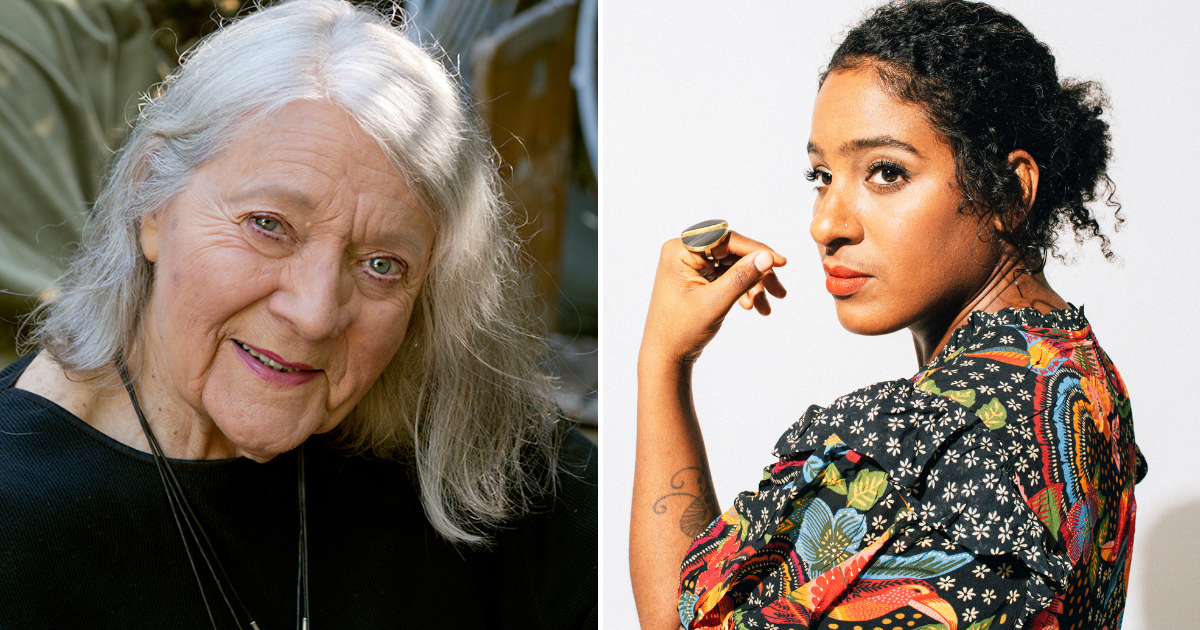
(Editor’s Note: Cellist, composer, and creator Leyla McCalla brings us a conversation as guest contributor with singer and community activist Barbara Dane – in celebration of her 96th birthday on May 12.)

I felt an immediate connection to Barbara Dane when I heard her voice. I first learned of Dane while developing music for a FreshScore – a commissioned piece written to a film in the public domain to be performed at the Freshgrass festival back in 2018. I had just given birth to my twins and I found myself researching songs to use in my score. During that time, I came across a civil rights era song called “Freedom Is a Constant Struggle” that Dane had released with a group called the Chambers Brothers in 1966. I fell in love with the recording – the performance was powerful and poignant; the message was so direct. 

Some songs just make you want to learn them. Freedom is a constant struggle. A perfect and ever true statement. It inspired me to write a song I called “Trying to Be Free” that became one of the songs in my FreshScore. I dug further into Barbara Dane’s catalogue and found a song that she had written called “I Hate the Capitalist System.” This felt very in line with the themes in my (at that time) yet-to-be-released third album, The Capitalist Blues. This is the epitome of the “folk process,” a phrase I jokingly use when talking about songwriting. You think you’ve found a unique idea, only to find that the idea has existed since time immemorial. The road that is paved with gold keeps on getting mined, refilled, and recycled and on and on. 

Years ago, a friend suggested that I check out the song “Dodinin” by Atis Indepandan – a group of Haitian artists living in exile in New York City from the brutal Duvalier dictatorship in Haiti. The album is considered a classic within the Haitian diasporic community.  When I was doing research for Breaking the Thermometer – the album I made inspired by Radio Haiti and the legacy of its journalists – I found myself more deeply exploring the songs. I’ve never been more grateful that Smithsonian Folkways has downloadable liner notes on their website! And beyond that, I was grateful that the liner notes were so thorough; it included essays on the political context of the music as well as Kreyol and English Translations of the songs. The songs spoke to the struggles of the times and longing for home of Haitians in exile. It is hands down one of my favorite pieces of art ever made. I knew I had to include Dodinin on the record.  

Fast forward to the release of the album, Barbara Dane’s son, Pablo Menendez, emailed me. He was curious about whether I was aware of his mother’s legacy and if I knew that the album was originally released on Paredon Records, the label that Dane cofounded with her husband, Irwin Silber. Paredon Records was not a typical label; all of their releases highlighted the political struggles of people from all over the world with a mission to uplift movements and voices of opposition to oppression. He also mentioned that I should read her newly released autobiography, This Bell Still Rings, and I immediately ordered it and began to read her fascinating life story. I was even more amazed when I looked at the inner flap of the hardcover and saw that my name was mentioned as one of the inheritors of her legacy! It was a very life affirming surprise. How did I not know?!

I worry that we are living in a time of tragic disconnection. As musicians, we are constantly being pushed towards releasing a steady stream of “content” to get more views and more likes, more money, and more recognition. But, often times that comes at the expense of our health. I mention this because I feel that more people in our musical community should be aware of the music, ideas, and ethos of Barbara Dane. She is someone who has always centered the needs of the community, locally and globally. She doggedly worked to understand the causes behind the stratification of our society and gracefully occupied so many roles to be able to use her creativity for the greatest good for herself, her family, and others. As a mother of three myself, I was very curious about how she did it! Whether you realize it or not, we need Barbara Dane right now – if nothing else, to remind us of our essential power when we center community care.

Reading her memoir and seeing that Dane’s 96th birthday was coming up (it was May 12, 2023), I felt inspired to do something to mark her birthday. I remember thinking to myself, “Let’s celebrate our heroes while they are still here!” I released a cover of her song “Freedom Is a Constant Struggle” alongside a cohort of collaborators from my adopted home of New Orleans. My manager suggested that perhaps we could arrange an email interview and I was ecstatic when Dane graciously replied with a yes. 

I am incredibly pleased to share the interview with you here on BGS and I hope it will inspire you all to think more about the potential we all have to take better care of each other. This bell still rings!

Leyla McCalla: I have been reading your new autobiography, This Bell Still Rings. What does this title mean to you and what do you want readers to understand from it?

Barbara Dane: The title is taken from a lyric by Leonard Cohen which I will quote for you:

Ring the bell that still can ring
Forget your perfect offering
There’s a crack in everything
That’s how the light gets in

What I’d like readers to take from that is that the imperfections in things are what offer possibilities for learning and growth.

How did your early experiences of blending music and activism shape your career? Was there any particular moment where you felt that this would be your life’s work?

I never thought of myself as having a “career,” I guess my professional work grew out of the need to put food on the table. As far as blending music and activism, early on it became clear that my voice was a valuable tool for my community work. I was lucky enough to be exposed to movements like People’s Songs that allowed me to see the possibilities at a young age. The artists that influenced me the most in this regard during my formative years were Paul Robeson and Pete Seeger.

Who do you cite as some of your earliest teachers and/or influences to your musical approach?

Early on I was exposed to the music of Billie Holiday and Louis Jordon and of course the big bands so popular in the 1940s, like Ellington, Basie, and Glenn Miller. Earl Robinson’s famous “Ballad for Americans” was foundational. And definitely such giants as Paul Robeson, Leadbelly, Pete Seeger, and Malvina Reynolds, and later, the blues women of the 1920s and 30s: Bessie Smith, Ida Cox, Ma Rainey, and Sippie Wallace. And of course there was my beloved Mama Yancey.

Your vocal phrasing is incomparably gorgeous; it feels both so natural and so intentional. When did you realize that you had a natural gift and was your craft something that you worked on intentionally, or something that came naturally, or both?

Listening to Louis and Billie taught me that you don’t have to stick to the bar lines. I was more comfortable with the conversational feel of their phrasing. Once you understood the structure of the piece, you can be free within it. So no, I never worked on it and none of it was intentional. My intention has always been to be completely in the song and let its emotions and meanings lead me.

 You opened a music venue in 1961 called Sugar Hill. It sounds awfully stressful to run a music venue while raising small children! Can you share more about how that came to be and that time in your life?

Actually, on the contrary, the whole idea of opening the club in our hometown, was it that it would allow me to spend more time with my family instead of always being out on tour. Running the club was a joy and gave me the opportunity to introduce some of the old timers who had more to give to a new audience that was just beginning to become interested in the blues.

Who were the Chambers Brothers and how did you come to collaborate with them?

They were four talented brothers, recently migrated from Mississippi to LA, who had formed a gospel group and were looking for ways to broaden their audience. I first met them in 1960 when I invited them up to the stage at the Ash Grove to join me in singing some of the songs that were emerging from the civil rights movement.

You were the first U.S. artist to tour in Cuba after its revolution. What was the impact of that experience on your life?

Going to Cuba in 1966 changed my life. I was energized by the optimism of the Cuban people as they engaged in building a new and more equitable way of life. For the first time I felt identified with the direction society was moving in, whereas at home I was always in the opposition.

Paredon Records is the label you founded with your husband Irwin Silber in 1969. What made you want to start a record label and produce albums?

In 1967, I attended Cuba’s Encuentro de Canción Protesta where I met singers from all over the world who were deeply committed to struggles for peace and justice. When I returned home, I felt the urgent need to expose the U.S. public to the significant and timely music I heard there. First I experimented with translating and singing some of the songs myself, but I soon realized it would make more sense to present the original voices. So I decided to launch a record label. Irwin had skills to bring to the table from his years of experience in publishing, and with his support, I produced and curated over 50 LPs of liberation music from the U.S. and around the world. Eventually, to ensure the collection’s availability in perpetuity, we donated it to Smithsonian Folkways.

You’ve toured internationally, including Franco-era Spain, Marcos’ Philippines under martial law, and North Vietnam under the threat of American bombs. What inspired these tours and why did you feel they were important places to bring your music?

With my international work I carried a message of peace and anti-imperialism, representing the sentiments of peace-loving Americans.

I’m also a mother of three and I find myself in awe of how much you were able to accomplish in your life while also raising your three children. How did you balance your musical life, activism and child rearing? Do you have advice for artist parents on how to navigate it all?

Be sure to include your children in all aspects of your life and help them learn to be independent. Trust and respect them. Make sure your partner is willing and able to actively do their share of the parenting.

Sometimes it seems that peace and justice are impossible to achieve. What would you say to people who feel that they do not have the power to make a difference?

As expressed in Beverly Grant’s moving song, “Together, we can move mountains. Alone, we can’t move at all!”


Photos courtesy of Leyla McCalla (by Laura E. Partain) and Barbara Dane.