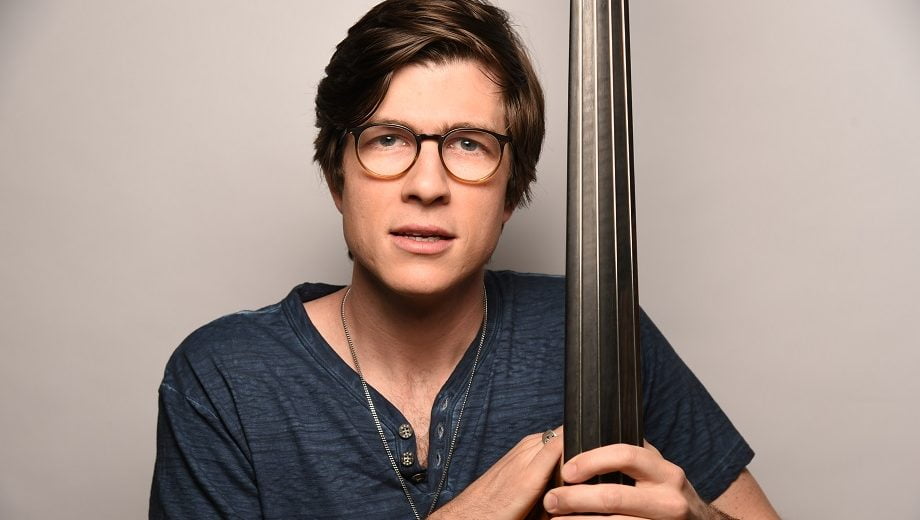
BGS 5+5: Scott Mulvahill

Artist: Scott Mulvahill
Hometown: Friendswood, Texas (near Houston)
Latest album: Himalayas
Personal nicknames (or rejected band names): I played one show as “Scott Hill” towards the end of college. I was self-conscious about my rather different last name, but after that I just decided to embrace it. If Jake Gyllenhaal can do it…

What’s your favorite memory from being on stage?

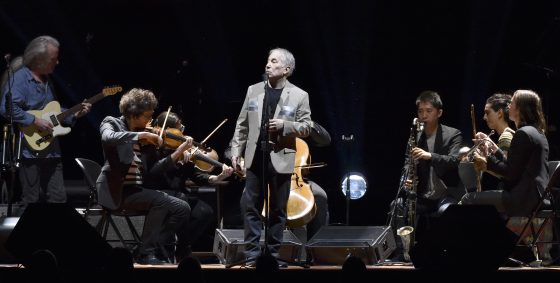
A few years ago, I played a show in Nashville where I gathered a bunch of friends to cover all of Paul Simon’s Graceland album, which is one of my desert island records. It was as fun as it sounds!! But we had a moment of true magic when the power went out in the building. Everyone in the room gathered in and gave us light from their cell phones, and we sang the song “Homeless” acoustically — just my upright and about 10 singers, no PA [system]. It was so powerful, and a moment of chaos was turned into something beautiful. We actually captured it all on video and it’s on YouTube. After we finished the song, the power miraculously came back on and we finished the show. That was such a great moment that I recorded that arrangement of that song and included it on my album.

What’s the toughest time you ever had writing a song?

I just finished a new one that I re-wrote about five times. Eventually I had verses in a decent form, and I ended up writing the chorus with my brilliant friend Ben Shive. At that point it was good, but still not quite there, so I took it into a co-write with the great Beth Nielsen Chapman, and we edited it line by line and she made it so much stronger. So that was a long process, but worth it because I think the end result is pretty special. I’m excited to record it.

What rituals do you have, either in the studio or before a show?

I don’t believe in pre-show rituals, besides a very simple warm-up of singing or playing just about anything. I’ll sing a few notes, noodle on bass, mostly just relax. If I had some elaborate ritual that I depended on, I think that would be a mental crutch more than a help. I’ll hear singers talk about certain warm-up routines, or how dairy will throw you off, how you must drink honey, and stuff like that. I want to get my technique and experience to a level where I’m not worried about things like milk ruining my show. Was it really the milk?

If you had to write a mission statement for your career, what would it be?

To always get down to the truth, to find the edge of my abilities, and try to spend as much time there as possible. A song can’t be too vulnerable or too personal in my opinion. The more personal and vulnerable, the more distinct and powerful it’s likely to be. People are looking to artists to be brave in their music, to speak truths from their own angle, and that’s my goal.

How often do you hide behind a character in a song or use “you” when it’s actually “me”?

At times I’ve done this without knowing it; I’ve written songs that feel powerful, and only half-way through writing it do I realize that it’s about me and my real-life events. I almost never purposefully write characters, and I wish I could… it’s a different approach that I just don’t know how to do convincingly yet. So my songs to date are almost all autobiographical. And that doesn’t prevent them from being relatable for people. For almost every song I sing, I have a person in mind that I conjure while I sing the song, and that helps me re-enter the emotional space of when the song was written. For songs that are about real events, I want them to feel as real as possible for the audience.


Photo credit: David Dobson

Small World: Joni Mitchell at 75

A few years back a video started circulating online, a black-and-white clip of a 1965 TV appearance on a local Canadian show of a young woman from Saskatoon, Joni Anderson by name. She performed two songs: a distinctive original “Born to Take the Highway” and a version of John Phillips’ cowboy ballad “Me and My Uncle,” her demeanor tipping between self-possessed and shy. And then, a few times, she looked sideways into the camera, eyes big, sparkling and mysterious, as if she was saying, “Oh, you just wait. I have some things to show you.”

But even she — you know her as Joni Mitchell — could not have had any idea of all the things that were to come as she would become one of the most individualistically creative and influential music artists of our era, someone who defined, redefined, and refused to be defined by what it means to be a singer-songwriter.

One simply cannot sum up the scope of her life in the arts. Yes, arts plural, as she has long said that she considers herself a painter first and a musician second. But in music, her reach is matched by no other’s, starting early on as she drew as much on theater music and classical forms as on anything that one could call folk, no matter how much she used her mountain dulcimer.

Her first albums were marked by invention all her own, starting with her indecipherable guitar tunings. By the early ‘70s she was tapping top jazz musicians, from slick Tom Scott and the L.A. Express to world-exploring Weather Report to worlds-creating Charles Mingus, to expand her already vast musical world, a decade before Sting did the same. Soon she was reveling in African and Afro-Latin sources, from the Burundi drummers to Don Alias, Alex Acuña and Airto Moreira, for some of her most distinctive work, also years before Talking Heads or Peter Gabriel did similar, not to mention Paul Simon’s Graceland.

And in the larger picture, she still stands as one of the most impactful documentarians and enactors of modern womanhood, placing female perspective in prominence where male views had dominated. Her willingness to reveal herself, with her flaws and vulnerabilities visible, was and remains a courageous act.

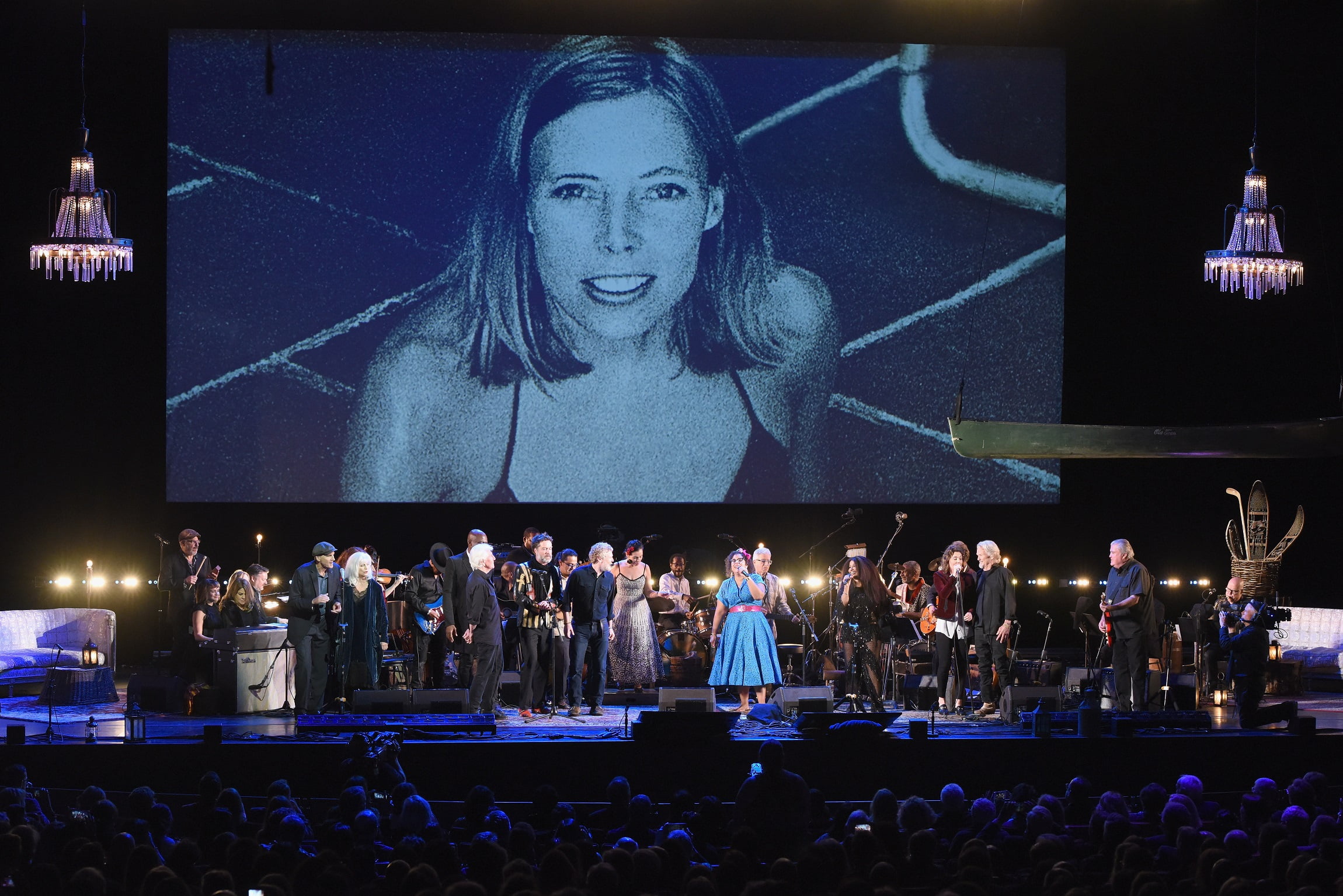
(L-R) James Taylor, Emmylou Harris, Graham Nash, Seal, Rufus Wainwright, Glen Hansard, Louie Perez, La Marisoul, Chaka Khan, Brandi Carlile and Kris Kristofferson perform at Joni 75: A Birthday Celebration Live At The Dorothy Chandler Pavilion.

Hence, the seemingly impossible task facing JONI 75: A Birthday Celebration Live at the Dorothy Chandler Pavilion, the two-night, all-star celebration of Mitchell’s milestone birthday presented by the Music Center last week in downtown Los Angeles. How can you capture a singular artist in just a few hours? And how can the particular singularity of this artist translate in full flower through other artists? Mitchell herself — her talents, vision and methods — is inextricable from her music. Mitchell is her art, and vice versa.

Several performances on the second night (her actual birthday) embraced and embodied that concept, and in the process transcended mere tribute: Diana Krall’s performances of “For the Roses” and “Amelia” had the audience members in hushed reverence in their course and had stolen their breath by the end. Seal tapped his inner Nat King Cole to transform “Both Sides Now” and “A Strange Boy” into heights-scaling soul-pop-jazz.

Following an audio clip of Mitchell talking about her passion for exploring the richness of America’s ethnic syntheses, three members of Los Lobos, two of the ensemble Los Cambalache, and singer La Marisoul of La Santa Cecilia — three groups crossing generations of musical leadership in L.A.’s Mexican-rooted heritage — teamed with the stellar house band for “Dreamland,” using the percussion-drive of Mitchell’s 1976 original as a mere starting point. For this grouping, with Los Cambalache’s Xochi Flores on the dance-percussion zapateado, the song was transformed into a Mexican folk song, to the point that “La Bamba” was spliced seamlessly into its middle. (Oh, and Chaka Khan, who did vocal counterpoint with Mitchell on the original, came on stage to spar delightfully with La Marisoul!)

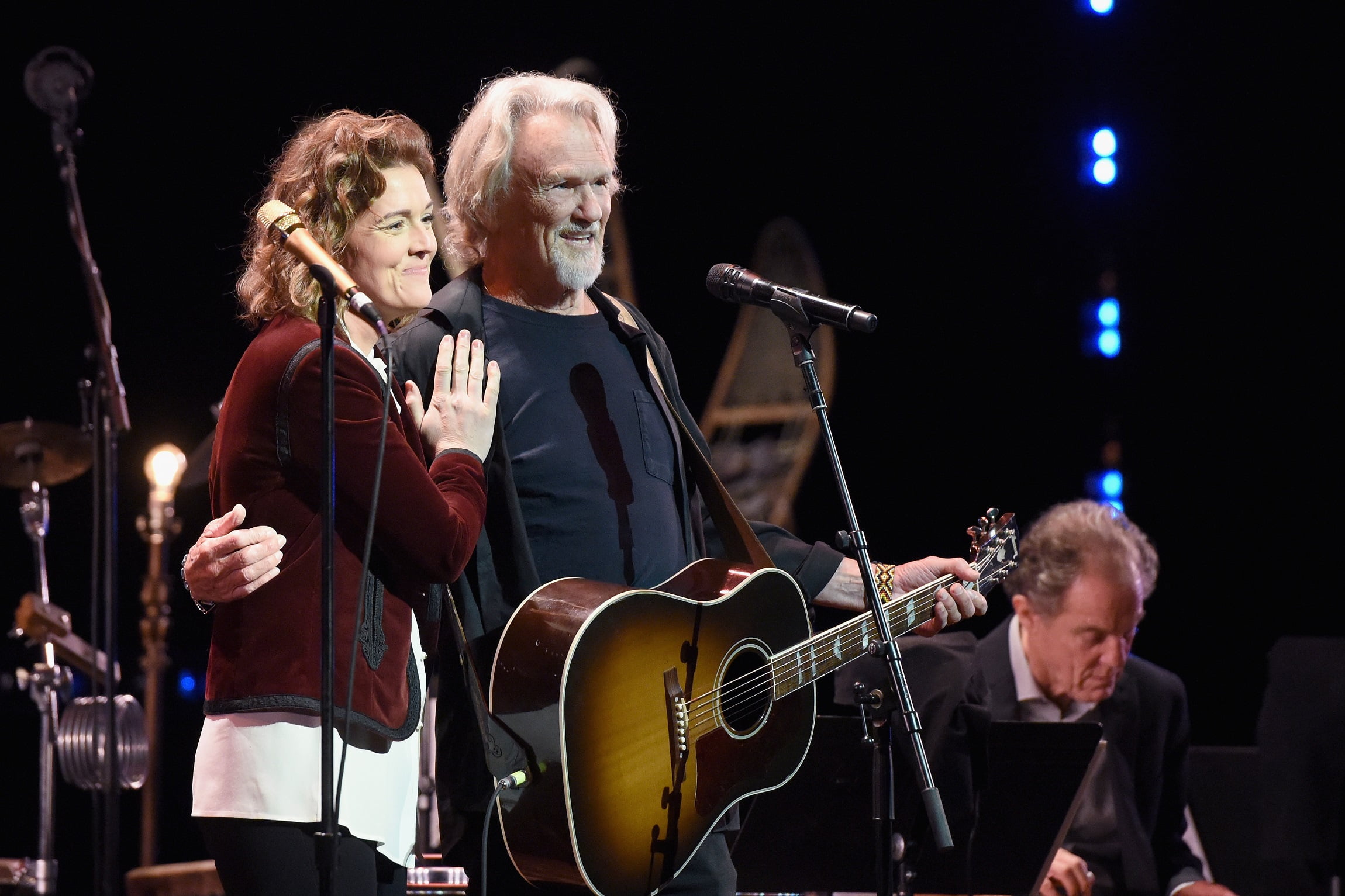
Brandi Carlile (L) and Kris Kristofferson perform at Joni 75: A Birthday Celebration Live At The Dorothy Chandler Pavilion.

Brandi Carlile was just as arresting sticking to the Mitchell blueprint on her version of “Down to You,” which she did following a charming if ragged “A Case of You” in duet with Kris Kristofferson. On the red carpet before the show, Carlile explained her process.

“I try to do it just like she does it,” she said. “Because, out of respect, out of reverence and out of the fact that I don’t think it can be done better than she does it.”

But as an artist, doesn’t she want herself in anything she does?

“Anybody but Joni,” she said, definitively.

Even Emmylou Harris admitted to the daunting prospect of covering Mitchell. Though “an interpreter for most of my career,” she noted, also on the red carpet, that she had only ever recorded one Mitchell song, “The Magdalene Laundries,” for a 2007 Mitchell tribute album.

“We’re all feeling the little bit of pressure,” she said. “You don’t want to take too much of Joni out of this, but on the other hand we have to make it our own. You’ll see most of the artists did an amazing job.”

Harris performed that song (a lament for “women enslaved in convents in Ireland”) at Joni 75, perfectly striking the balance she cited, and also for these shows added the similarly dark “Cold Blue Steel and Sweet Fire” to her Joni repertoire. Others found their own balance to varying degrees. Norah Jones brought some twang to “Court and Spark” and “Borderline.” Glen Hansard injected his Irish exuberance into “Coyote” and “The Boho Dance.” Rufus Wainwright, a fellow Canadian, added his mannered drama to “Blue” and took “All I Want” to Broadway. Khan in her two spots brought soul-jazz to “Help Me” and “Two Grey Rooms.” James Taylor managed to make “River” and “Woodstock” sound as if they were his own songs, without losing any of Mitchell’s presence in them.

Through it all, the house band, led and arranged by pianist Jon Cowherd and drummer Brian Blade (the latter a veteran of Mitchell’s bands), expertly covered the full range of the music, shining and soaring in particular on the chamber-orchestral middle section of “Down to You.”

Graham Nash, rather than doing a song by Mitchell, did one about her: “Our House,” his portrait of their Laurel Canyon domesticity from so many years back, the crowd singing along on the chorus and sharing the bliss.

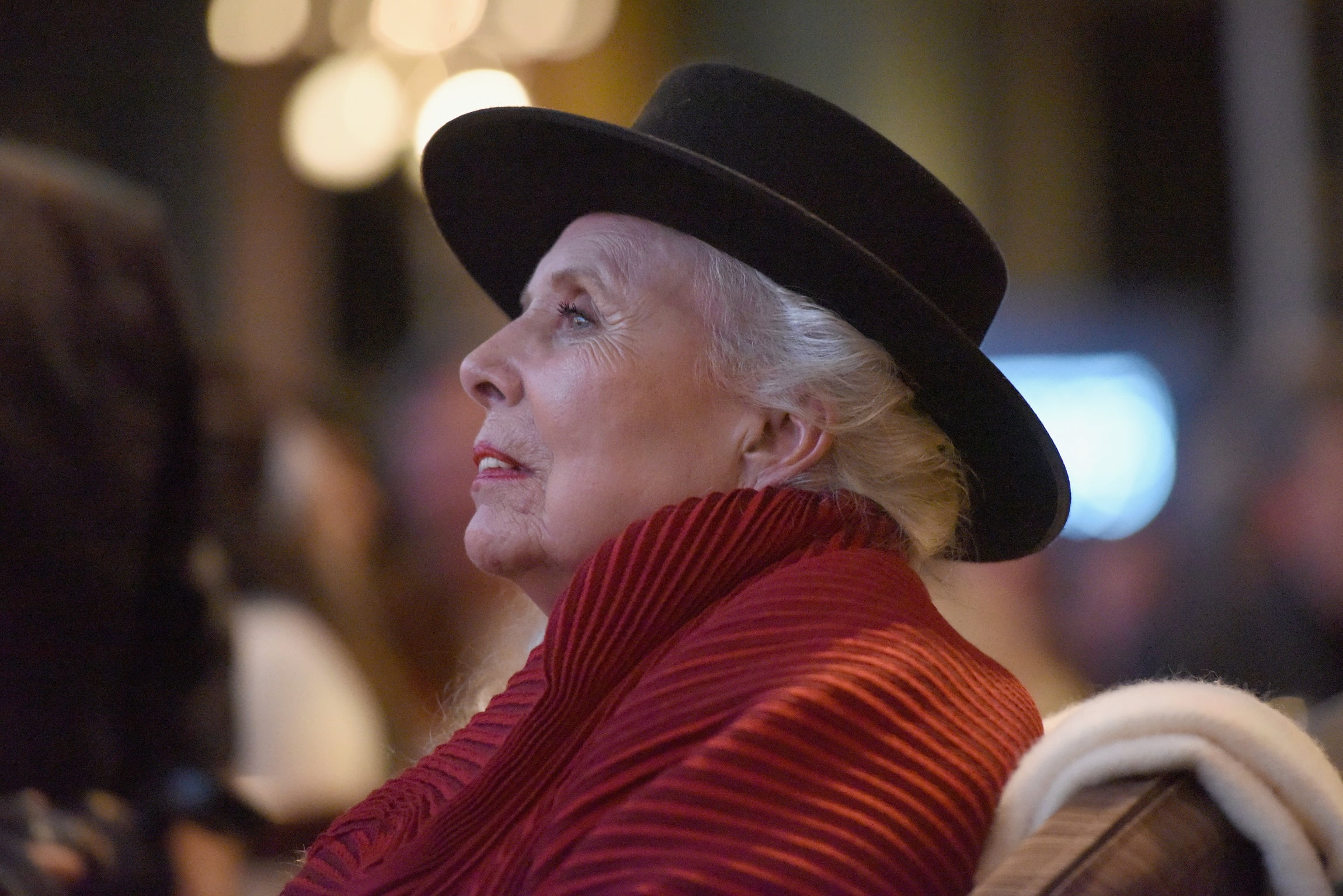
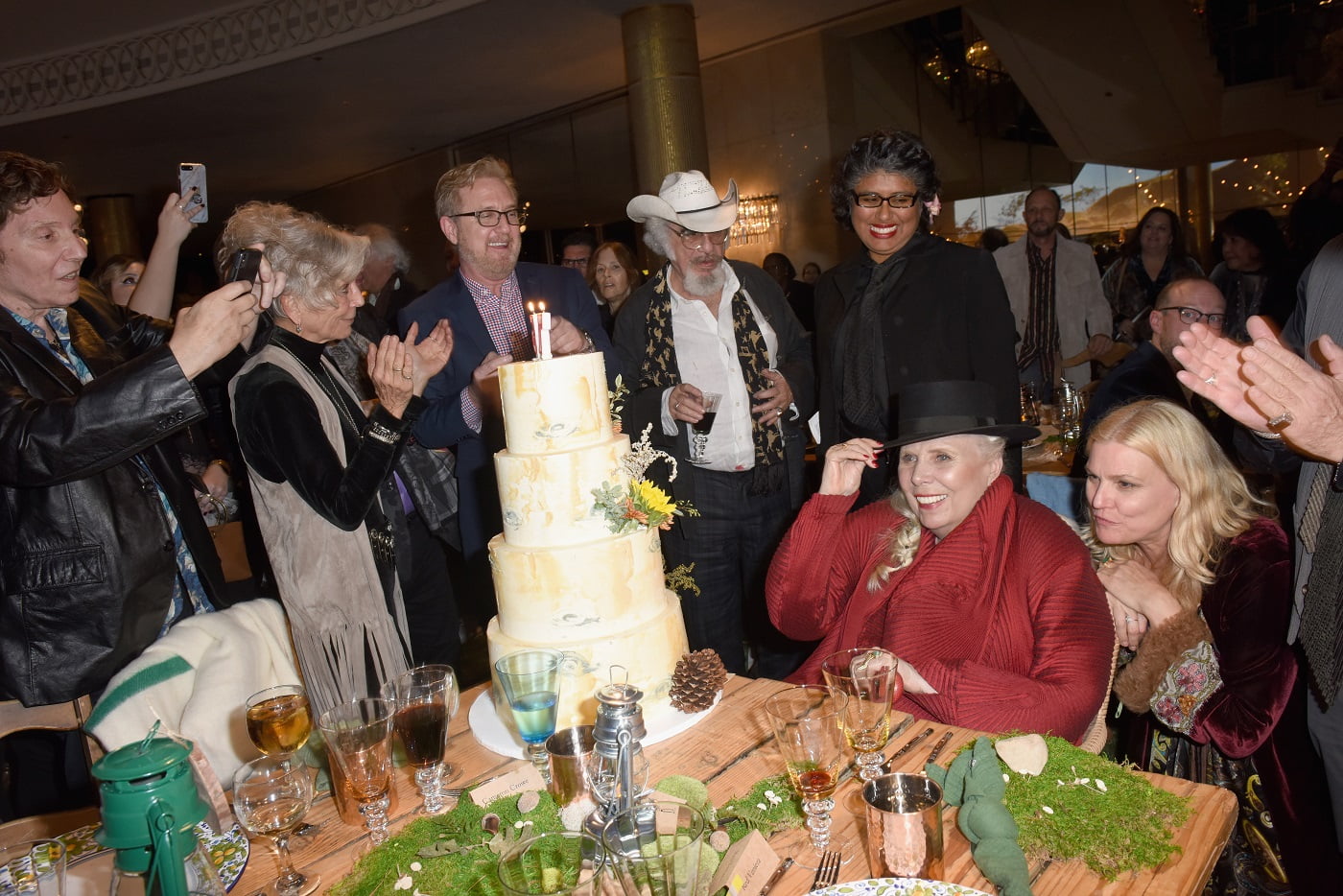
Mitchell herself was in attendance on the second night, hobbled but hearty more than three and a half years after suffering a brain aneurysm. The crowd sang “Happy Birthday” to her twice — once as she took her seat before the show, and again when she came on stage for a curtain call, a cake brought out and the assembled cast and crew reprising the all-hands closer, “Big Yellow Taxi,” Mitchell sporting a huge smile, mouthing the words and even dancing a bit.

Did Joni 75 capture the entire scope and depth of Mitchell’s magnificence? Of course not. With her Canadian roots spotlighted in the stage decorations (a canoe suspended overhead, skis leaned at the back, a couple of barrels framing the set), the evening summed up her global embrace of music and art, and the global embrace of her music and art.

(Editor’s Note — Check out this writer’s Spotify playlist, Epiphanies: A Joni Mitchell Deep Dive.)

Joni Mitchell (seated) attends Joni 75: A Birthday Celebration Live At The Dorothy Chandler Pavilion.

All photos: Vivien Killilea/Getty Images for The Music Center

Small World: How Paul Simon Found Himself in the ‘60s English Folk Scene

In 1965, a dejected Paul Simon went for an extended stay in England. When he returned home to New York toward the end of the year, he brought Anji with him.

Well, “Anji.” A piece of music, not a woman.

“Anji” — sometimes spelled “Angi” or “Angie” — was written and first recorded in the late 1950s by English guitarist Davy Graham, considered by many the first star of the U.K. folk guitar renaissance. It’s a snappy little fingerpicked number, a series of trills over a descending bass line. Really more jazzy than folkie. By the time Simon first heard it, apparently via the playing of another young star of the scene, Bert Jansch, it had become the touchstone for English acoustic guitarists. This was the piece they had to master to gain entry into that world and in the process serving to popularize the dark modal DADGAD open tuning as the scene standard.

Simon’s recording of “Anji,” with the writing credit originally going to Jansch before later being corrected, served as an instrumental interlude at the end of side one of The Sounds of Silence, the second album he made with Art Garfunkel. But in the context of the sweep of Simon’s eventual status as one of the modern era’s supreme songwriters (and Simon and Garfunkel’s standing as one of the key pop acts of the 1960s and ‘70s), “Anji” marks a turning point.

“One of the things he found [in England] was a welcome, warm music community,” says Robert Hilburn, author of the new biography Paul Simon: The Life. The book is a comprehensive and colorfully enlightening look at the artist, done with his full cooperation. It was published in May, on the eve of what he says will be his final full concert tour. He’s named it the “Homeward Bound” Tour, after a song he wrote while in England.

“He hadn’t felt accepted in folk circles of America — Greenwich Village put him down because he came from Queens,” says Hilburn, who was the pop music critic and editor at the Los Angeles Times for more than three decades (and with whom this writer worked for more than 20 years). “But there, he was from America and people listened to him and liked him. And he said that the folk clubs in England were generally away from the bars and people listened to the songs. In America they were in bars and people chatted and ignored the music.”

Simon was feeling that rejection acutely when he moved to England. While Simon and Garfunkel had been signed to Columbia Records by tom Wilson after some furtive steps under the name Tom & Jerry (and some solo Simon work under the name Jerry Landis), their debut album, the acoustic folk-tinged Wednesday Morning, 3 A.M., had flopped and the partners were at odds — a common state through their lives. In England he found something to give him new artistic life, new purpose, a setting in which he could define his own goals and ambitions, and in which he was valued.

He released a 1965 solo album featuring acoustic performances of his own songs (The Paul Simon Songbook, not issued in the U.S. until its inclusion in the 1981 Paul Simon: Collected Works box set), co-wrote with Australian-born musician Bruce Woodley (including the bouncy “Red Rubber Ball,” a 1966 hit by the band the Cyrkle) and produced an album by fellow American ex-pat Jackson C. Frank, including the song “Blues Run The Game.” (Simon & Garfunkel recorded the song as well.) The composition became another standard of English folkies and later came to mark the tragic life and death of its writer. In the process, Simon discovered key things about who he was, and who he wasn’t, as an artist.

“Most of those musicians there were guitar players and played old folk music,” Hilburn says. “They didn’t write as much of their own. He couldn’t play guitar like they did. Martin Carthy [another rising star of the scene] was particularly helpful in teaching him things, but he realized that it was words that would distinguish him. That’s what the other English musicians wouldn’t do. He wasn’t a fan of the old-time English ballads. When he heard Dylan, he said, ‘That’s what I want to do, write about the world today, not just “I went down to the river and killed my baby.”’”

Now, to be fair, those “down to the river” ballads were just as much core to the American folk revival as the English one. But by and large they originated in England and elsewhere in the British Isles and Europe. The songs of murder, treachery and heartbreak arrived on these shores with the many waves of immigrants, mutating in various ways but still very recognizable in the forms associated with Appalachia and the Delta, bluegrass and blues alike, Cajun and country, you name it.

Of course, that all found its way back across the Atlantic where American folk and blues (and, of course, rock ’n’ roll) influenced and inspired a generation of English musicians looking for meaning and authenticity, even if borrowed, first in the “skiffle” movement, and then in both the folk revival and with the Rolling Stones, the Animals, of course the Beatles and the others who, in the mid’60s British Invasion, brought blues back to America.

Davy Graham was heavily influenced by American blues and jazz, and his early ‘60s albums were full of his arrangements drawn from that repertoire. And one of Graham’s frequent collaborators, singer Shirley Collins, traveled through the South in 1959 with American folk and blues collector and preservationist Alan Lomax, researching and recording the music on porches, in churches and prisons and at social occasions, documenting various forms that were threatened with extinction in the face of “progress.”

It is, in fact, a blues song that kicks off the upcoming Live in Kyoto 1978 concert recording by English folk great John Renbourn, who passed away in 2015. Renbourn, who in addition to his own long and fruitful solo career co-founded the revolutionary jazzed-up folk band Pentangle with Jansch, started this show with a version of “Candy Man,” a raunchy ragtime tune first recorded by Mississippi John Hurt in 1928. But the second song of that concert? Yup. “Anji,” with an introduction by Renbourn explaining that it was a “tune that started me, and a lot of other people, trying to play the guitar.” The album is a wonderful slice of a remarkable career from a stellar guitar talent who regularly tied together Medieval Italian and French dance tunes with American blues and jazz, all fixed around the English folk traditions of such songs as “Banks of the Sweet Primroses.”

It’s the Circle of Folk.

And it circled back when Simon found himself moving home to New York due to an unexpected turn of events. While he was in England, producer Tom Wilson — without Simon’s knowledge — added some folk-rock instruments to the acoustic version of “The Sound of Silence” that had been on the S&G debut. Suddenly it was the right song at the right time, a perfect fit alongside the Rubber Soul Beatles, the sparkling folk-rock of the Byrds and, of course, the newly electrified Dylan himself. That new version became both the title song of the next album and the launching point for new approaches that would quickly distinguish the duo.

How did the time in England make an impact, aside from “Anji”? Hilburn sees little direct evidence of the English folk scene on Simon’s writing, though there’s certainly some of the mood and filigrees of the guitar styles in the fingerpicked lines of “April Come She Will.” And there is “Scarborough Fair,” an actual English folk song that Simon took almost note-for-note from Carthy’s arrangement into an unlikely pop hit, its refrain providing the title of the third S&G album, Parsley, Sage, Rosemary and Thyme.

Carthy has said he was “thunderstruck” when he saw the song credited as “words and music by Paul Simon” on the original S&G release. Later it was discovered that while royalties were paid, the money was never forwarded to Carthy by his publisher. Simon years later made sure that new payments were made to the English artist, an act Carthy deemed “honorable” per Hilburn’s account.

But it remains a controversial episode for some, presaging later controversies of proper crediting and cultural appropriation that saddled Simon, particularly regarding his Graceland work with South African musicians at a time of a cultural embargo due to the countries brutal apartheid policies. (And, for Carthy, it was a second case of an American artist nicking one of his arrangements, as Dylan himself used Carthy’s version of the traditional “Lord Franklin” for “Bob Dylan’s Dream.” In addition, “Scarborough Fair” was liberally adapted into “Girl From the North Country,” with the source noted readily in the liner notes of The Freewheelin’ Bob Dylan as well as in various interviews by Dylan over the years. A duet by Dylan and Johnny Cash made for a highlight from the later Nashville Skyline album.)

If the direct impact of what he learned in England was not an ongoing presence in Simon’s writing and performance, it did seem to stimulate a hunger for exploring music from various cultures and countries, which soon emerged in a variety of ways — the Andean folk-tune on which he based in “El Condor Pasa” (in turn making it virtually inescapable for later travelers in Peru), reggae in “Mother and Child Reunion” (recorded in Kingston with Jamaican studio mainstays), and gospel in “Love Me Like a Rock.” Then he took that giant leap into South African music with the landmark Graceland album in 1985 and various Afro-Brazilian and Latin American inspirations and collaborations on Rhythm of the Saints in 1990, profoundly the batucada drumming on the song “The Obvious Child.”

And, with this all in mind, it was striking during one of Simon’s Hollywood Bowl shows on his farewell-ish tour how well the song, “Dazzling Blue,” which had been on the 2012 So Beautiful or So What album, could have fit alongside many things done by Graham, Jansch and Renbourn. In this performance, Simon’s fingerpicked figures and lilting melody were weaving through the Indian-derived rhythms and modes carried in Jamey Haddad’s ghatam (clay pot) percussion and the veena-like melisma of Mark Stewart’s slide guitar. Ultimately it’s all of a piece, the band on this tour anchored by South African bassist Bakithi Kumalo, who has been Simon’s partner on much of the music he’s made from Graceland on. Young Nigerian guitarist Biodun Kuti steps in with grace and aplomb to the hole left by the death last December of Cameroonian musician Vincent N’guini, who had been with Simon since Rhythm of the Saints. But still the music is threading back to the epiphanies of London in the ‘60s. And yes, even Greenwich Village.

“He loves roots music,” Hilburn says. “What was interesting to me is that as a songwriter he doesn’t come up with a theme first. If you or I were writing a song, we might go, ‘Let’s write about ecology, or about breaking up with a girlfriend.’ He lets the music inspire him, plays guitar or piano and if something sounds interesting, he thinks, ‘What do those notes mean to me?’ and tried to put that into words. One line, then to the next line, and he discovers the theme as he’s writing. So he constantly needs new musical inspiration. He started with doo-wop and blues, then rock and folk. But by the end of 1969 he felt he couldn’t go any further in folk. He didn’t want to be part of that. So he goes to classical and jazz and gospel and bluegrass. And then South African music. He has to have fresh inspiration.”


Photo credit: Lester Cohen


MIXTAPE: David Wilcox’s Character Study

I love songs that have interesting characters in them. One of my favorite questions to ask, when I’m investigating a lyric is, “Who is speaking to whom, and why?” I love it when a song contains a complex idea that changes the way I see the world. — David Wilcox

Paul Simon — “Train in the Distance”

The narrator watches a couple who have the best of intentions, as they try to make a relationship work, but the chorus keeps coming back with this haunting restlessness.

Susannah McCorkle — “The Waters of March”

I think my favorite song is probably the Susannah McCorkle version of “The Waters of March.” How can such a simple song communicate such complexity of how we miss the beauty that is all around us?

Joni Mitchell — “Paprika Plains”

This song contrasts the small scale pursuits of us humans with a giant desert landscape, communicated so beautifully with orchestral music.

James Taylor — “Sugar Trade”

I love the big view of the song “Sugar Trade” which was written by James Taylor and Jimmy Buffett. Start with a specific question about that guy in the boat, as you’re walking the beach. How deep do you want to go to understand the workings of the world?

Randy Newman — “Dixie Flyer”

The Randy Newman song “Dixie Flyer” describes his earliest memories in a way that explains why he has worked his whole life to sing about the issues of race and justice.

Donald Fagen — “The Goodbye Look”

Speaking of childhood memories, the Donald Fagen album The Nightfly is full of thoughts he had as a kid. There are some great characters in the song “The Goodbye Look.” He does a detailed character description of the man with the motor launch for hire — a skinny man with two-tone shoes.

Peter Case — “Blue Distance”

Peter Case made a record called Flying Saucer Blues that has lots of lovely characters. On that CD, there’s a song called “Blue Distance.” Indescribable longing frustratingly pursued in carnal relationships … Hey! My favorite theme.

Annie Gallup — “West Memphis Arkansas”

Another in this category is Annie Gallup’s song “West Memphis Arkansas.” We get the whole story, but the characters are described sparingly with the most meticulous details.

Justin Farren — “Little Blue Dirtbike”

It’s the details that describe the characters so beautifully, as he thinks about his grandfather’s adventures and the mutual shyness that kept them from ever talking.

Peter Mayer — “The Birthday Party”

Bravely communicating across our cultural and religious differences is the subject of this song. I like the version that’s on his live album.

Andy Gullahorn — “Holy Ground”

Andy Gullahorn has a song about Shane Claiborne that’s called “Holy Ground.” I learned how to play it and, after a few days of practice, I could sing it without being moved to tears.

XTC — “Harvest Festival”

The XTC album called Apple Venus is one of my favorite records of all time. Lots of beautiful characters. “Fruit Nut” is a great song, but my favorite for this mix would have to be the song “Harvest Festival.”

Ana Egge — “Dreamer”

Next is Ana Egge with her song “Dreamer” from the album Bright Shadow.

Robinson & Rohe — “The Longest Winter”

And for the last song on this mixtape, Jean Rohe and her husband Liam Robinson singing “The Longest Winter.”


Photo credit: Stuart Dahne

3×3: Chelsea Williams on Paul Simon, Perfect Songs, and Picking Condiments

Artist: Chelsea Williams
Hometown: Sunland, CA
Latest Album: Boomerang
Personal Nicknames: N/A


Chillin’ in Kentucky at the @grandvictorianinn #BoomernagTour

A post shared by Chelsea Williams (@chelseawmusic) on

What song do you wish you had written?

“River” by Joni Mitchell is absolutely perfect.

Who would be in your dream songwriter round?

Oliver Wood, Paul Simon, Joni Mitchell

If you could only listen to one artist’s discography for the rest of your life, whose would you choose?

Paul Simon


Guitar daaaze with @garrenandcohan

A post shared by Chelsea Williams (@chelseawmusic) on

How often do you do laundry?

A couple days after all of my clothes are dirty.

What was the last movie that you really loved?

I recently watched Barton Fink by the Coen brothers and really enjoyed it.

If you could re-live one year of your life, which would it be and why?

This one has been my favorite, so far. Releasing my new record Boomerang and touring the country has been thrilling, to say the least.


Neon in Memphis Tennessee #BoomerangTour

A post shared by Chelsea Williams (@chelseawmusic) on

What’s your go-to comfort food?

Wine

Kombucha — love it or hate it?

It’s somewhat related to wine … so I’m gonna say love it.

Mustard or mayo?

That’s like asking cake or pie … obviously, both.

3×3: Humbird on the Rockies, the Radish, and the Teriyaki

Artist: Humbird
Hometown: Minneapolis, MN
Latest Album: Where Else (EP)
Rejected Band Names: Too many to list. Highlights include “Arm” and “Fork” and “Yes Gnome.”

What’s the best concert you’ve ever attended?

Paul Simon with YMusic at Eaux Claires Music Festival. Many tears were shed.

How many unread emails or texts currently fill your inbox?

1,878. It’s terrifying.

How many pillows do you sleep with?

One pillow.


Peach magic in Paonia, as always 

A post shared by Humbird (@humbirdhumbird) on

How many pairs of shoes do you own?

Over 20 pairs. Only wear three of them.

Which mountains are your favorite — Smoky, Blue Ridge, Rocky, Appalachian, or Catskill?

The Rockies — so far.

What’s your favorite vegetable?

Radish

Fate or free will?

Who knows?

Sweet or sour?

Teriyaki

Sunrise or sunset?

Depends on the clouds.

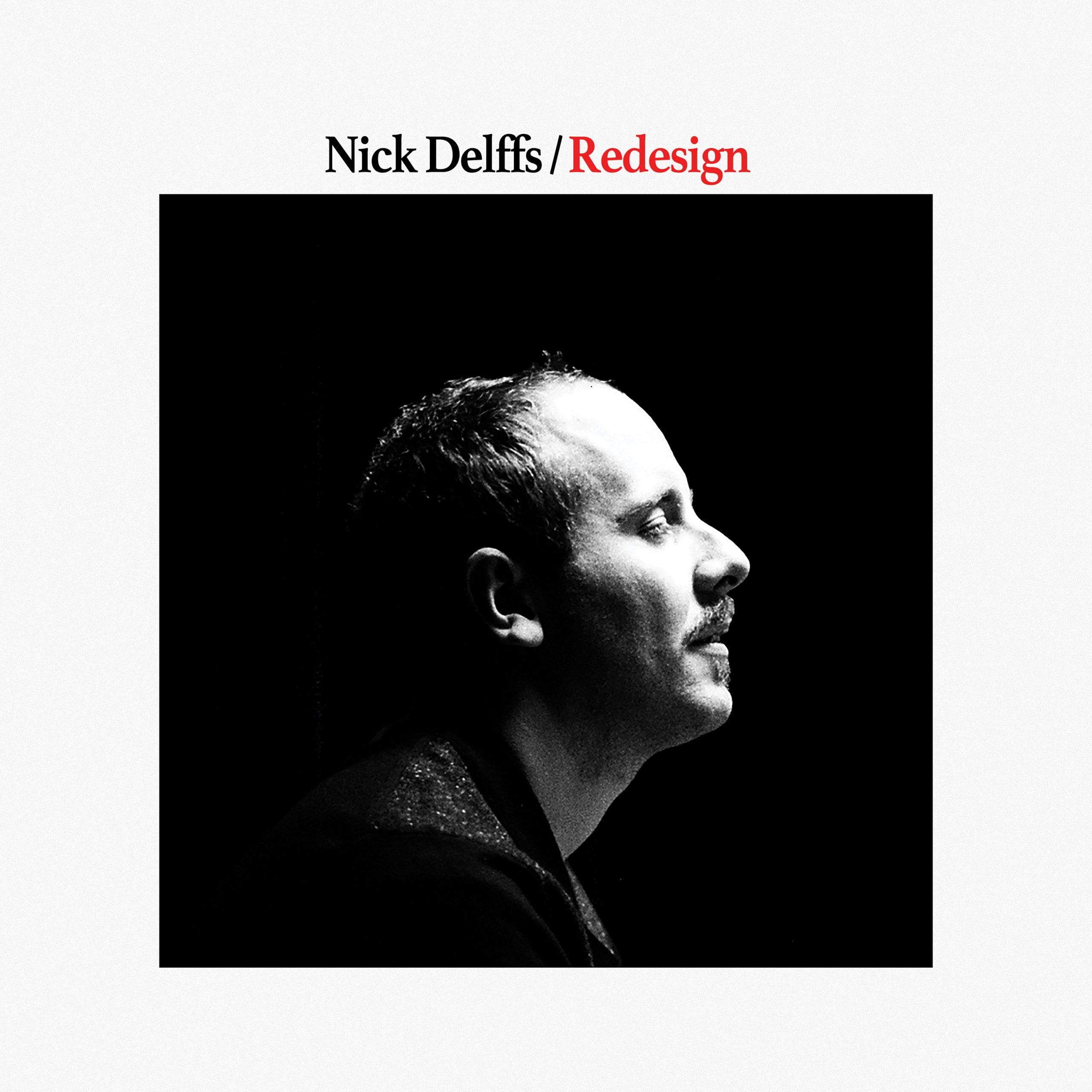
Nick Delffs, ‘Song for Aja’

There are a few things that come instinctually to humans, at the earliest of ages. Crying, drinking, smiling — the bare bones of staying alive and growing, really. But there’s another reflex that happens before most children can even walk or crawl, and that’s how babies, sitting on the floor or in their cribs, react to music: They’ll grin, shake, rock back and fourth, clap their hands. Before they even know the meaning of a song, they will dance. To a young child, that rhythm almost feels as essential as a taste of milk or a restful nap; it feeds them and pleases them like none other. It’s the essential proof, maybe, that music isn’t just enjoyable and nourishing, but necessary, too.

Nick Delffs, of the Shaky Hands, has a young son and, on Redesign, his forthcoming solo LP, he pays tribute not only to the joy of childhood but the melodies that make us move with “Song for Aja.” With hints of Paul Simon and Phosphorescent, it grooves with that sort of tribal rhythm that anyone — child or grown person — would have trouble not nodding along to. But cased in that beautiful syncopation is a track about balancing the magical moments of parenthood with the demands of adulthood and all that we must leave behind, at home or away, to be the best mother, father, and version of ourselves that we can be. “Work is done, it’s time to play, say ‘so long’ to a terrible day,” he sings. Delffs’ joyful hollers and rolling lyrical style, alongside infectious percussion, form a something that’s visceral and nearly primal — just like the way those babies, before they can even walk or talk, react to a steady beat.

3X3: Ryan Harris Brown on Brussel Sprouts, Smoky Mountains, and Soundtracks

Artist: Ryan Harris Brown
Hometown: Scranton, PA
Latest Album: Stranded in the Present Tense
Personal Nicknames: RHB

If your life were a movie, which songs would be on the soundtrack?

Jimi Hendrix, “Wind Cries Mary”

Ben Folds Five, “One Angry Dwarf and 200 Solemn Faces”

Ryan Adams, “Come Pick Me Up”

John Mayer, “No Such Thing”

Paul Simon, “Graceland”

How many unread emails or texts currently fill your inbox?

A big fat ZERO on both fronts.

How many pillows do you sleep with?

Two to three, but the third usually ends up on the floor by morning.


New blog post up. Link in bio. #nashville #nashvillemusic #indiemusic #indieartist #tumblr #blog

A post shared by Ryan Harris Brown (@ryanharrisbrown) on

How many pairs of shoes do you own?

10

Which mountains are your favorite — Smoky, Blue Ridge, Rocky, Appalachian, or Catskill?

Well, I’ve only seen the Smokies and the Blue Ridge Mountains, so I’m going to go with the Smokies.

What’s your favorite vegetable?

Brussel Sprouts

Fate or free will?

Fate    

Sweet or sour?

Sweet

Sunrise or sunset?

Sunrise

3×3: Ali Sperry on Mystics, Morocco, and Memoirs

Artist: Ali Sperry
Hometown: Fairfield, IA
Latest Album: Crooked Feelings
Personal Nicknames: Ribs, Albo, Spears

If you had to live the life of a character in a song, which song would you choose?

I’d like to live the life of the woman Bob Dylan describes in “She Belongs to Me”: “She’s got everything she needs, she’s an artist, she don’t look back.” If someone described me that way, I’d be pretty psyched. I’d also like to wear an Egyptian ring that sparkles before I speak. There is a queenly grandeur about this character. She’s revered for being mystical and wise and for creating her own reality.

Where would you most like to live or visit that you haven’t yet?

I’d like to visit Morocco. It seems very exotic and romantic there. And I think it would be fun to ride a camel.

What was the last thing that made you really mad?

November 8, 2016

What’s the best concert you’ve ever attended?

Paul Simon at the Ryman last Summer. I splurged on a ticket and went by myself. I got there early, in time to get a beer and box of popcorn and take my “obstructed view” seat with a huge grin on my face. He started the show with “The Boy in the Bubble” and, by the time he was singing “don’t cry, baby, don’t cry,” I definitely already was. I cried and laughed and danced through the whole show, completely enveloped by the music. I’ve been listening to his songs my whole life. He’s a hero of mine and seeing him that night further solidified it. What a massive, stunning body of work, and how inspiring that he is still executing it so beautifully.

Whose career do you admire the most?

Patty Griffin. To me, she is equal parts artist and songwriter, and excels at both. I respect the longevity of her career and the way she has always re-invented aspects of her sound to make each album feel like new territory, while maintaining her complete Patty Griffin-ness that is so recognizable and lovable. She is constantly collaborating with killer musicians, and I just get the feeling that she’s always doing exactly what she wants. Her songs are so her and yet translate gracefully to other artists — to the point of having an entire, massive, country tour by the Dixie Chicks named after one of one of her songs.

What are you reading right now?

I just finished Composed, Rosanne Cash’s memoir and have been recommending it to everyone. She has a true gift with words, and I was enthralled by her stories and the way she told them. She wrote eloquently about life and death, music, being a woman and an artist, family. She was able to do that magical thing that authors sometimes do where you feel like they are speaking directly to you. In the thick of endeavoring to navigate the waters of a music career, this book felt like a much-needed dose of the bigger picture, a reminder of how all of the little parts connect, and what will be most significant when looking back. If you haven’t, read it!

Whiskey, water, or wine?

All three are vital

Facebook or Twitter?

Facebook

Grammys or Oscars?

Grammys

7 Americana Songs That Should Absolutely Not Be Covered By Anyone (Even Bob Dylan)

We all know that feeling, the one we get when someone does a cover of one of our favorite songs. It's the same mix of excitement and fear we felt as teenagers, when we jumped into the back of Dad's Plymouth Reliant and started working on our 'Night Moves.' Will it be an ecstatic experience or will it completely suck? But just as there are people with whom we'd never endeavor to join in the back of that car, there are songs that are patently untouchable, recordings that should be left alone for posterity, never to be covered by anyone (even Bob Dylan). Here's a list of seven that are sacred.

"Wagon Wheel" — Old Crow Medicine Show

It’s not too farfetched to imagine that somewhere in this great musical land of ours some ‘record guy’ is hatching a plot to have Bob Dylan cover his own co-write, like some evil scientist plotting to destroy the North Carolina transit system. Don’t engage with the dark side, Bob. I gave you a pass on that semi-awful Frank Sinatra thing but, if you dare lay hands on this Americana classic (part owner though you may be), I’ll be compelled to give you a thorough tongue-lashing. Worse than I would’ve given Darius Rucker had I cared enough to talk about it. And don’t get me started on the other versions that are floating around from bands that ought to know better (but apparently don’t). Heck, there's even an entire website devoted to stopping the spread of "Wagon Wheel."

"La Cienega Just Smiled" — Ryan Adams

I have a 15-year old son who’s quite an accomplished musician, who does a pretty nice piano and vocal version of this song. But he’ll never record it or perform it in public, he says, “because the original version is perfect and I’ll never, ever come close.” Others should have such foresight. Out of the mouths of babes, as they say.

"Don’t Think About Her When You’re Trying To Drive" — Little Village

A good friend of mine, once the music editor of a hi-fi magazine, said the demise of Little Village came because there was no one in charge (so everyone thought he was in charge). I’m guessing that dogs like "Solar Sex Panel" had something to do with it, too. But tucked among the mutts was this Westminster Best In Show, a fervently heart-breaking ballad about being on the road to somewhere without someone. The arrangement is beautiful, the twanging Telecasters are glorious and drummer Jim Keltner has more taste in his left foot than most people have in their whole body.

"Quits" — Danny O’Keefe

“What will we call it now? It’s not a marriage anymore.” Seriously, I tear up every time I hear this song, probably the most heart-wrenching three minutes and nineteen seconds about divorce ever written. Weeping pedal steel, desolate strings, lonely harmonies (courtesy of Linda Ronstadt), lyrics that are hankie worthy, even for the toughest of tough guys. A couple of country dudes have covered this one and they're still meeting with their therapists to work through their guilt and shame.

"Windfall" — Son Volt

Quite possibly the greatest Americana song ever written, it’s hard to imagine why anyone would try to improve on this example of perfection. It’s all here: moaning vocals, steel guitars (settlin’ down), fabulous fiddles, all night radio stations, hands on the wheel, the wind in your face, troubles, troubles and more troubles at 134 beats per minute. I’ll give ‘Rusty Fender” a pass on his YouTube bass cover (Really? bass cover?) but that’s as far as my forgiveness will extend.

"Big Yellow Taxi" — Joni Mitchell

As much as my boy and I are pretty simpatico when it comes to music, I think about putting him up for adoption every time he cracks open Spotify and plays the isn't-he-cute boyfriend funk version of this song that Counting Crows massacred for the benefit of pop radio. The codpiece caterwaul of the emotive Mr. Durwitz that was somewhat charming when he was hanging with "Mr. Jones" just proves he has no clue what he's singing about. For God sakes, dude, the song isn't about the girl. It's about our collective loss of childhood innocence and appreciation that's leading us to destroy the planet. 

"Tenderness" — Paul Simon

There Goes Rhymin’ Simon was one of Paul Simon’s most popular records and "Tenderness" followed "Kodachrome" so, even by mistake, this song got played a lot back when vinyl and tape were all we had. And why wouldn’t it? It’s New Orleans blues meets New York folk in its finest form, perfectly framed by The Dixie Hummingbirds. And that’s why it should never be covered … ’cuz no one sings like those guys.