True to Her Activist Roots, Folk Legend Peggy Seeger Still Longs for Peace (Part 2 of 2)

At 85 years old, Peggy Seeger stands as one of the most accomplished figures in folk music. She has recorded 25 solo albums, plus dozens more with her late husband, Ewan MacColl, along with collaborations with her siblings and generations of other folk musicians. She is a multi-instrumentalist who has edited and compiled folk music anthologies, and she ran a well-known magazine featuring contemporary songs for 20 years. All that while touring, writing more than 200 songs, raising three children and serving as an immoveable force for peace and human rights. And hers was the face that inspired MacColl to write “The First Time Ever I Saw Your Face.”

From her home in England, Seeger spoke to BGS about her new album, First Farewell, and what that title really means.

(Editor’s Note: Read the first of our two-part Artist of the Month interview with Peggy Seeger.)

BGS: You wrote “How I Long for Peace” 20 years ago, but it’s really appropriate now. Can you talk about it?

When we decided to make a new CD, my son Calum had me sing to him any song that I hadn’t recorded. Because I lived in the United States for 16 years and wasn’t touring England, I wrote quite a number of songs that my kids never heard. “How I Long for Peace” was one of those. And when Calum heard it, he loved it. So, it went on the album, and so many people are commenting on it. It’s kind of like a hymn, and it has a very singable chorus, and it ties up nations and politics with climate change and the plunder of the planet. When I sing it, I feel such a longing in my heart. I feel the violence of the world. We’ve just had a horrendous murder here. In this country, a young girl who was walking home by herself disappeared. She was found two counties away in a woods. And there’s been a tremendous uprising here on the part of women. But it’s not until men uprise against this that it’ll ever be changed.

Can you talk about the project’s title, First Farewell?

I remember my brother Mike, who was with New Lost City Ramblers — once they broke up they had an annual farewell concert every year. I thought that was marvelously funny. So, I thought First Farewell will make people think. But it’s based on the two farewells that you give at the airport. You know, if you stay to wave goodbye to the person at our airport, you hug, and then they go through where only passengers are allowed. And they walk about 40 yards away, and then they turn to the right. So, the first farewell is the hug, and there is a second farewell where they wave goodbye just before they turn that corner.

In lots of ways at my age, I’m saying farewell to a lot of things, almost daily. When you’re my age, you see your body doing this, doing that, and you feel you’re slowly decaying. And it gives you a new feeling of togetherness with nature. I really have more of an attachment to nature and the birds and the daffodils and the trees than ever I did before. And I’m doing a lot of listening to books about nature. I’m beginning to feel that humanity is this very, very powerful paper-thin sandwich filling between what happens above the earth and below the earth, and we are just this kind of bacteria that is sitting along the edge of the earth. [Laughs]

Because I do feel that nature is calling us. Nature realizes that we are a danger. The same way as we’re trying to get rid of COVID, nature’s trying to get rid of us. And power to her if that’s her best way of teaching us anything, because we don’t learn at all. We just repeat everything that we’ve done before. But the first farewell is the recognition that I am near the goalpost. And within sight of the goalpost. I’ve been running like hell. But I run more slowly now.

Why did you move back to the United States in 2006, and then why did you return to Great Britain?

A tumultuous love affair brought me here permanently in 1959. I became a British subject in 1959 and settled down here. After Ewan MacColl died, 30 years ago, I had a new partner, a woman, my best friend, the only person that I’ve been head over heels in love with. And after four or five years, I had an incredible urge to go to America to find out who I had been before I came here – because I was a child when I moved here. And I immediately became totally involved in England. I grew up in England from age 24 and 54. That’s when I really became an adult. (I shouldn’t say that, because I’m not an adult yet.)

In 1994, I got this terrific urge to go back to America. I wanted my partner to come with me, but she couldn’t. So, I said, I’ll go and see what it’s like. It was the first time I’d lived on my own ever in my life. I toured America endlessly for 16 years. Then I began to realize that I really, really, really missed my kids. So, I just felt that urge to come back here. And now that I’m back here, I’m so glad I came back.

My children live in three corners of London. I can reach any of them in two hours. We talk on the phone, and I’m part of my family that I created again. My American family is very big, but very scattered. And the ones that I was really attached to are all gone. So, what made me move back was a gut feeling of where I belonged. And it’s so wonderful that my children are helping. They’re making it possible for me to keep going.

What do you see as the bright spots in today’s political and social movements? What gives you hope?

On all of the really big issues, what’s happening is small grassroots groups. People who want something done, want something changed, want something different are realizing that the government says it will take care of it — but it doesn’t. So, small groups are forming everywhere, saying, “We have to do this ourselves because our government is not doing it.” I’m part of a group like that here where I live, near the edge of Oxford. And Oxford has just spread and spread and spread and spread until it has incorporated one beautiful old village and then another old village. Then they become surrounded with new housing. And they have taken away the green land, taken away the beauty of the old villages.

I live in an old village called Iffley. Its church was built in the 1100s. And since 1964, 16 of its green spaces have been sequestered for housing. Plunk, they put 20 houses here; plunk, they put 50 houses there. Well, there are four acres left, two ancient fields that have not been touched for 1000 years. And our council wants to put 50 houses on them. I’m part of a group that is acting out of incandescent rage at this. If the housing is put in, it will be the end of our village – the end of it. I’ve always tried to be part of a small group that does something locally.

Parting words?

I’d like to thank you for the attention you gave to Laurie Lewis, because she is so good. She’s wonderful. I love that kind of music. I really, really do. And it’s something that I really miss over here, joining in on the radio with all of that wonderful singing that you can sing along with. I do miss the whole American scene, I do. But I’m a Gemini and I’ve chosen one of my twins, so I live here.

What I would like to say is that I have been very privileged in my life, extremely privileged, unlike a lot of people who need to struggle to make their names recognized. My name was recognizable due to my brother Pete, and my mother, my father. And I came at the end of other musicians who had smoothed the path out for me. I have had every possible advantage: two wonderful life partners, both of whom contributed to my career, and who have pushed me on and helped me. And children who don’t hate me! [Laughs] And a country that I kind of understand.

And enough money that I’m not in need in my old age. “First Time Ever I Saw Your Face” brings in a reasonable amount of income. People still hear it all over the place with some very funny covers. Oh, my god, it’s been covered over 400 times that we know of. There’s a rap version. There’s a country and western version. There’s a gospel version. There’s what I call a barbeque quartets version. There’s one with Scruggs banjo on it. I am just so fortunate, and I’m thankful that I’m being given an old age that makes me visible and worthwhile.

(Editor’s Note: Read the first of our two-part Artist of the Month interview with Peggy Seeger.)


Photo credit: Vicki Sharp
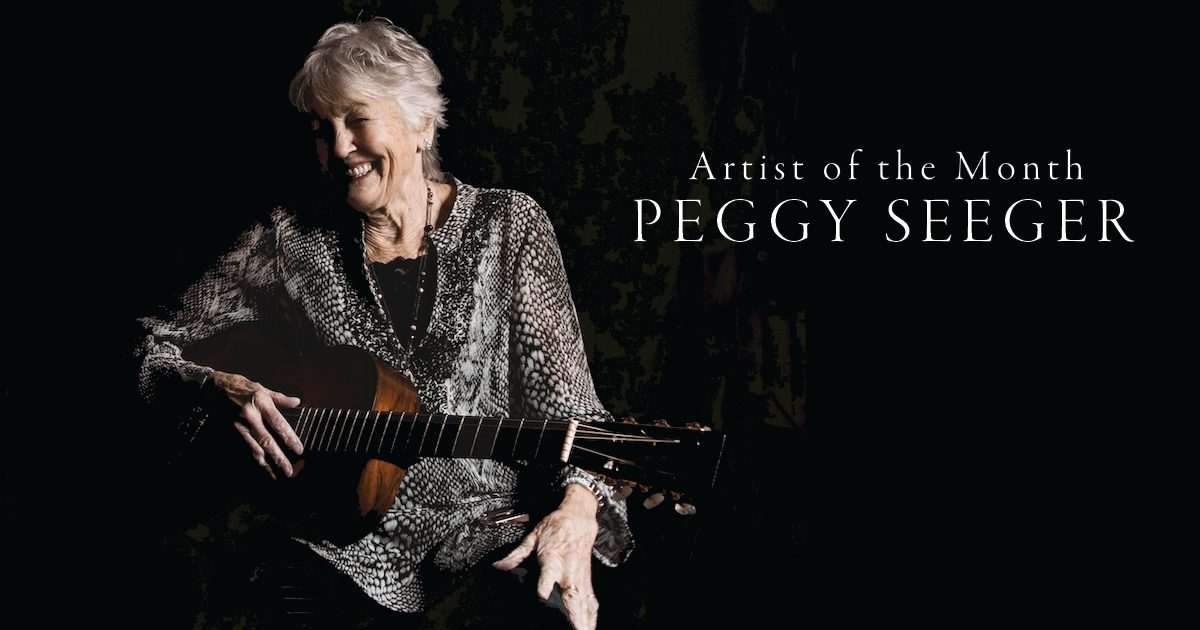
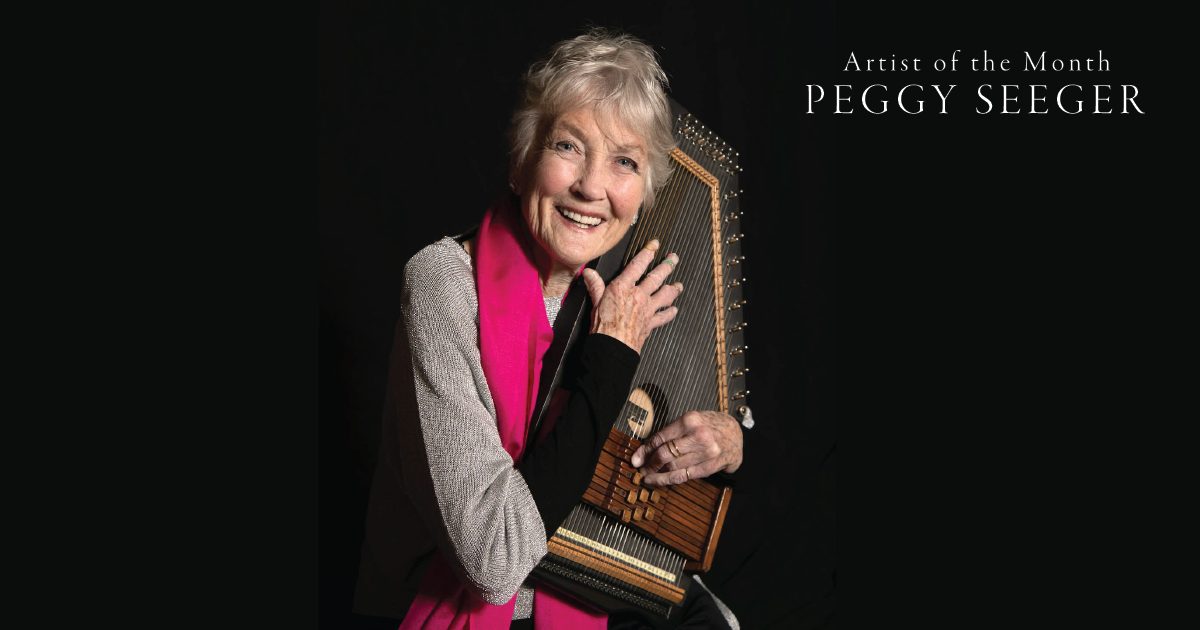
Artist of the Month: Peggy Seeger

Peggy Seeger is saying goodbye to recording and the road with First Farewell, which she’s considering her likely final album in a career spanning seven decades. A folk legend in her own right, Seeger comes from a sterling musical pedigree, and she’s ensuring that lineage continues by enlisting her sons Neill and Calum MacColl to join her on the album.

Seeger’s reemergence is marked by “The Invisible Woman,” immersed in a perspective that anyone of a certain age can understand. Upon its release, she noted, “My older son Neill MacColl was hesitant for ages about co-writing with me. He turned up at my home one day, laid his 6’1” self along my two-seater sofa and laconically offered a possible subject for a song. ‘The Invisible Woman’ strolled in gradually, wearing clown shoes and lace underwear. We ended up with a song that expressed an uncomfortable new feeling that was creeping up on us both, but that echoed the folk songs that I’d sung to him since birth.”

For dedicated fans of folk music, Seeger remains an important figure in a family that shaped the modern folk era. Her mother, Ruth Crawford Seeger, is a notable composer who was the first woman to be awarded the Guggenheim Fellowship Award for Music. Her rather, Charles Louis Seeger, did pioneering work in ethnomusicology at the University of California in Los Angeles, while her brother Mike Seeger and half-brother Pete Seeger carved out their own indelible careers in the folk framework. Peggy, though she was a child, may also be credited with discovering singer-guitarist Libba Cotten, who worked in the Seeger home.

At 85, Peggy Seeger stands as a folk icon in England and America, and if First Farewell is her swan song, she’s still making herself heard on topics ranging from suicide and loneliness, to social media and modern slavery. Fans in the UK can expect multiple tour dates to support the eloquent project. Our two-part, exclusive interview is available now (Read part one here. Read part two here.) and we hope you enjoy our Essential Peggy Seeger playlist, as well.


Photo credit: Vicki Sharp

BGS 5+5: Bill Kirchen

Artist: Bill Kirchen
Hometown: Austin, Texas
Latest album: The Proper Years (July 24, 2020)
Personal nicknames (or rejected band names): First band name, 1965: The Who Knows Pickers, an acoustic jug band. One gig only, we shared stage with The Iguanas, Jim “Iggy” Osterberg on drums.

Which artist has influenced you the most… and how?

I have to go all the way back to Pete Seeger. I learned my first string instrument, the 5-string banjo, from his instructional book and record, and had lots of his recordings from the ’40s, ’50s, and ’60s. He was an ecstatic singer, very successful and influential songwriter, and multi-instrumentalist. Soft-spoken on stage, he was most definitely outspoken politically his entire career, always for racial equality, workers rights, and freedom of speech. In the early 1950s McCarthy era, he went up against the powerful but later utterly disgraced House Un-American Activity Committee. He earned himself a career-hijacking blacklist that lasted years by asserting his constitutional rights and refusing to name names and implicate others. He never backed down. His performing career spanned nearly 70 years. I saw him in the mid-’60s many times, then again in the ’90s.

What was the first moment that you knew you wanted to be a musician?

I wanted to be a musician as soon as I figured I could sing a song. I have early memories of being a toddler lumbering around, singing along with my cardboard record (yep, they existed!) of “Teddy Bears’ Picnic.” At 8 I learned trombone, then played it in orchestras and bands until the mid-’60s folk scare lured me away. As for wanting to be a professional musician, I guess getting my first paying gig in ’64 or ’65 cemented that desire. I certainly never thought, “I’ll just do this for a bit then quit and get a job.”

If you had to write a mission statement for your career, what would it be?

Not clear on the concept here, but it sounds interesting and I’ll give it a try. I certainly never had a mission statement, rather I just got in the canoe and now here I am and where I’ll be next, I don’t know. So here are my suggestions to the young me: Bill! You know you love listening to, singing, whistling music all the time. That’s super important, don’t let go. Learn to play an instrument as soon as they’ll let you, then learn some others. Play with folks, preferably better than you. Take any opportunity you can to go hear live music. Now don’t blow this one: you liked the 1963 Blues at Newport record and Mississippi John Hurt. Well, you are within hitchhiking distance of the ’64 Newport Folk Festival, he’s gonna be there, Dylan too, go do it. Sleep on the beach, whatever, it’ll all work out. Then do the same in ’65, trust me. Many of the extraordinary people you will see will be gone less than 10 years later. Then before the ’60s are over, move away from your Ann Arbor hometown. Try San Francisco. Travel everywhere and play as much you can. Pull up roots and move across country a couple more times, find more kindred spirits and play with them. Just get in the canoe. You’ll be surprised.

What’s the toughest time you ever had writing a song?

The toughest time I always have writing is making myself sit down and do it. I love the process when I get rolling, but I don’t have a burning desire to bare my soul in verse and melody, then buttonhole folks and make ‘em listen. But I enjoy making up my own songs, lots of perspiration plus a little inspiration. Then again I wouldn’t mind just singing Haggard and Dylan songs all day. Couldn’t really ask people to pay for that, I know. As the great Roger Miller said writing a hit song is just like taking candy from a gorilla.

How often do you hide behind a character in a song or use “you” when it’s actually “me”?

I hid behind characters a lot early on. Wrote a lot of truck-driving songs, though I’m not and don’t want to be a truck driver. It was a legitimate sub-genre when I discovered country music, and I do come by a love of the road and travel honestly. As for finger-pointing songs, I’m usually not a big fan. And you know what they say, when I point my finger there are three more pointing back at me. Oops.

I didn’t let myself write songs that were more personal and closer to the bone until I started making records under my own name in the ’90s. When I went to England to record my first record for Proper, Hammer of The Honky-Tonk Gods, it was with Nick Lowe and the band with which we’d recorded and toured the world several years before. Nick is one of my favorite songwriters and I remember thinking, dang, I can’t just show up with a bunch of I’m A Burly Truck Driver songs. I’ve got to get closer to the bone and try a little harder.


Photo credit: Valerie Fremin

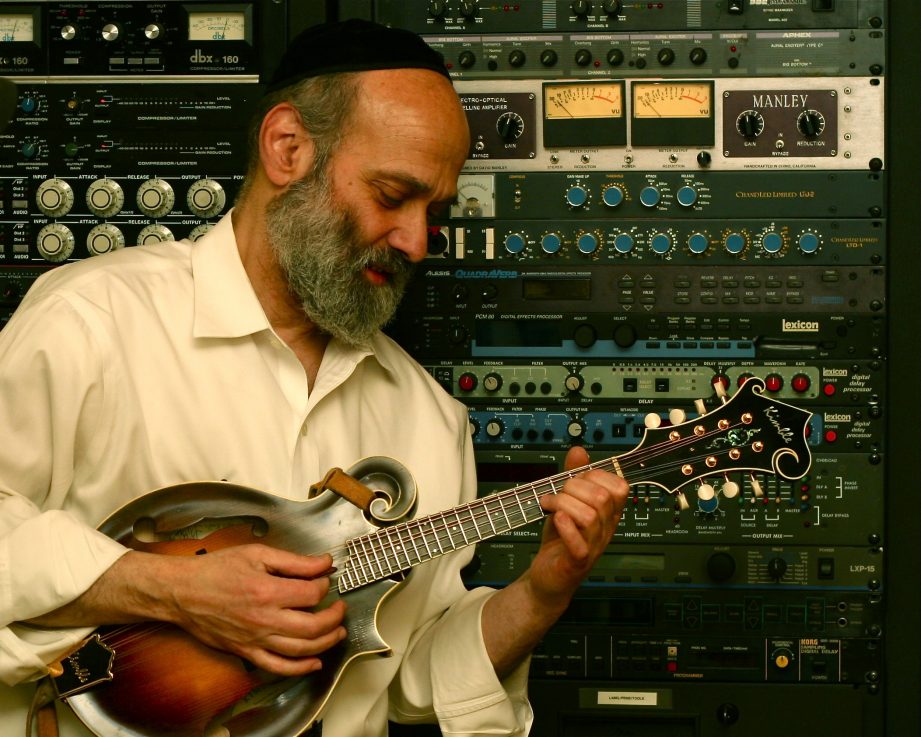
For Mandolinist Andy Statman, Music Is the Great Unifier

Mandolinist Andy Statman is quick to deny that his identity — he’s a devout modern Orthodox Jew — has anything to do with his music. “To tell you the truth,” he says, “it never entered the picture. I was just into the music…”

However, his latest album, Monroe Bus — an exploration of traditional mandolin techniques utilized in contexts as familiar as Bill Monroe standards and as far-reaching as klezmer and jazz-infused originals — belies that denial. And, as we converse about his history in music and the harlequin nature of the album it becomes obvious that his work isn’t devoid of his identity at all. In fact, the opposite is demonstrable.

Statman’s music is, of course, archetypically and idiosyncratically his own. He, as much or more so than any other mandolinist on the scene today, is truly original. He’s reached this destination not through purposeful attempts in his music to express his identity — religious, cultural, and otherwise. Instead he simply focuses on playing the most meaningful music he can, while remaining in the moment and establishing human connection with his fellow musicians. The rest, his whole identity, shines through his art organically and effortlessly as a result. Statman is a testament to roots music’s ability — whether consciously or subconsciously, overtly or covertly — to allow its purveyors’ souls to be the keystones on which entire albums, catalogs, and genres are built.

BGS: Your record strikes me as “melting pot” music. Whether you’re playing more jazzy music or bluegrass or klezmer, you’ve always considered your music to be quintessentially American. Why is that?

Statman: First of all, I’m an American, so the culture I grew up in was an American culture. I heard things through an American ear, I saw things from an American eye, and while there might be certain regional differences, all in all it’s all pretty much the same. I grew up right after World War II, my father was a veteran. I was born in 1950, so I grew up in the early 1950s in an area in Queens, New York called Jackson Heights. It was a diverse neighborhood. Everyone got along. Everyone grew up together. The other kids were just other kids, and it didn’t matter what their background was. The music played at this time was classical music, or jazz, or square dance music, or other stuff. As a kid we used to have square dances every week in public school. I remember every year we used to have a Lebanese American come and play songs for us. At that era you were able to sort of culturally imbue almost all of the last one hundred years of American culture. It was all there to be touched and heard and seen and lived. It was there, in the air, but it was America so it was live and let live.

What was your entry point to bluegrass, then?

My brother is about eight years older than me. He went to college in the ‘60s — 1960 I guess was his first year. He got very involved in listening to like the Kingston Trio, the Limeliters, the beginning of the folk revival. Then he started bringing home records of Dave Van Ronk, Bob Dylan, and Joan Baez. That wasn’t really so much for me, but then he started bringing home some New Lost City Ramblers records and this other record that Mike Seeger was involved in, Mountain Music Bluegrass Style, which basically was recordings of the incredible bluegrass scene in Baltimore, Maryand, and Washington D.C. in the late ‘50s and early ‘60s — people like Earl Taylor and Smiley Hobbs, just an amazing collection. I really gravitated to that. I remember for my birthday he got me Foggy Mountain Jamboree, a compilation of the early, classic Flatt & Scruggs Columbia 45s. He was also involved in what they used to call jug and skiffle bands and they used to rehearse at the house. He played guitar and sang and there was a banjo player in the band who played some bluegrass and I was just very excited by that whole thing. That just did it for me. All I wanted to do was play bluegrass.

What was it about the music that grabbed your ear?

On a very simple level, emotionally, I was excited and moved by the music. It really spoke to me. The singing, the harmonies, the instrumental playing. There was an excitement to it that I really liked. I was very moved by the slower, ballad types of things, also. I started listening on the AM radio to WWVA out of Wheeling, West Virginia, which was a bastion of country music back at that time. We had a guitar in the house, my brother’s guitar, so I started learning the Doc Williams guitar method, I learned some chords, but I really wanted to learn banjo. I finally was able to get a banjo and started taking lessons.

On Sundays back then in Washington Square Park people would go down and play outside in different groups. There’d be a group playing bluegrass, a group doing topical songs, a group doing blues, so I started meeting people doing bluegrass. On these records that I liked I was getting more and more moved by the mandolin playing — it was really exciting me. Earl Taylor’s playing and I think on the Scruggs records it was Everett Lilly playing one or two solos that were just like, wow. I was getting chills from hearing this stuff. I decided I would make the switch and become a mandolinist. I had already been playing banjo and guitar for a few years. I was still in my early teens, so when I stepped into the mandolin role I already had some muscles developed and some understanding of the music.

The record, Monroe Bus, really clearly illustrates the value and the beauty that comes from allowing our musical art forms to reflect our identities. How do you think we can help foster the idea that any background or identity is valid and can be showcased through these art forms?

You know, I don’t think that way. Forgive me. I’m just into playing music, playing the best music that I can, and I’ve been fortunate that I’ve been able to study with a lot of musicians of different cultures and different backgrounds, both playing American music and music that maybe isn’t played here so much. To me, it’s all about the music. When I’m playing, I’m just playing. Identity or background is really meaningless to me. It was always like that, but at this point in my life even more so. When I’m playing I’m just looking to play the most meaningful music I can play. Those are my only real concerns.


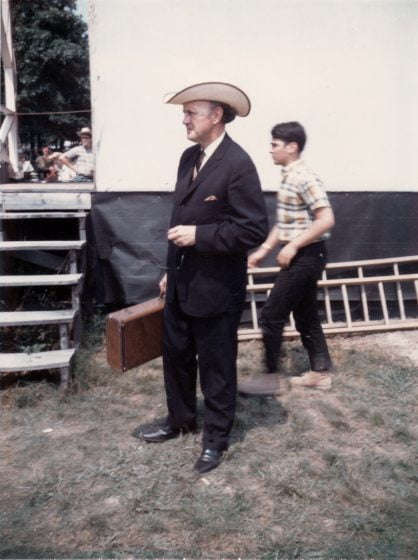
Bill Monroe (foreground) and Andy Statman at Fincastle Bluegrass 1966. Photo by Fred Robbins

You are always blending different musical forms in these crazy, unexpected ways. How do you respond to folks that are worried that that dilutes bluegrass or that it will kill the genre in the long run? What’s your response to the typical, “That ain’t bluegrass” kind of gripe? Do you have one?

First of all, this is not a bluegrass record, obviously.

But there are undeniable bluegrass threads throughout.

Of course, but I’m not presenting myself as [pure bluegrass.] I spent a lot of time studying bluegrass, and there are always new insights and things to learn, but for me, the original blossoming of bluegrass is where it’s at, where it reached its fullest expression. If I’m going to listen to bluegrass, I’m probably going to listen to bluegrass from before 1970. Not to say that what came after is bad, this is just my preference. The feelings and creativity of that particular period, to me, are really unsurpassed. And while the technical level might have gotten better, this doesn’t necessarily make for a more meaningful, deeper music, it just makes for a more athletic music. [Laughs]

Listen, people have to be who they are. It’s just music. There are always going to be people who hear things differently, who want to add or subtract things, and if you don’t like it, then you don’t like it. I can see that there’s a strong core of people who are really interested in playing music in the mode of what was played in the ‘40s, ‘50s, and ‘60s. I think there isn’t any danger of that not continuing.

I do believe, though, that it’s important for musicians to really try and master a traditional style. Because, if you’re going to try to build on something, you really need to understand where it’s coming from, to be able to relate to that music on its own terms. Which is getting back to the roots of all this music and being able to speak that language naturally, in your own way and find your own voice in it. You’ll understand phrasing, variation, improvisation, how to play melodies, how to bring out what’s in the melody, how to play rhythm. Without that firm grounding in a particular style, particularly when we’re talking about folk music, it won’t click.

It’s interesting that you say that, because I think that a song that perfectly illustrates what you’re talking about on the record is “Raw Ride,” a sort of version of Bill Monroe’s “Rawhide.” I love this version because the song is so iconic, but you’re still turning it on its ear. You’re demonstrating that foundation that you’re talking about, but you’re finding your own voice in it. How did you come up with this arrangement?

Well, I’ve been playing the tune for years. “Rawhide” is one of those tunes that, if played in the traditional Monroe manner, requires a lot of energy. It’s always a question of is it worth the energy for the payoff? [Laughs] It usually is. There’s obvious extensions of the melody or the chords that you hear if you’ve been involved in playing other types of music. So I just sort of followed those. As with all of these things, it reflects who I am, my musical experiences, and my studies.

…When you’re writing music and playing music it really just reflects who you are and what your experiences are and how you live. It’s a reflection of that. That’s what Bill Monroe did. His music was a synthesis, an ongoing synthesis, and he developed a certain kind of aesthetic.

When I came out of the closet and was going through that process of coming to terms with my identity as a gay man, I had a moment where I doubted my place in bluegrass. I thought maybe bluegrass wasn’t the place for me, it wasn’t a place where I could belong. Did you ever feel like your Jewishness made you question your place in bluegrass?

Not really, no. To me, it was all about the music. All the musicians I know are wonderful, thoughtful, and kind people — in the bluegrass scene and in others as well. We’re all in this together and we all have a common passion for the music. It’s a uniting force. It has a real life of its own, and we’re just sort of passing through it, so to speak. If you’re worried about the thoughts or beliefs of the people you’re playing music with, then you can’t really be playing music. Music, in its essence, is the great unifier. It can unify people in terms of ideas and feelings and speak to the commonality of everyone. At that point, all of these other things melt away.

It really has to do with heart. It’s a spiritual thing. In Hasidic teachings they say that music, particularly instrumental music, can go higher than anything. A song without words isn’t even bound by the concepts of those words. In certain ways, it’s a universal heartbeat. You can see the tremendous life force that music carries. To me it’s something that’s very sacred.


Photo credit:Bradley Klein