Like Father, Like Sons: Del McCoury & The Travelin’ McCourys

Even after five decades in the bluegrass business, the McCoury family is having a banner year in 2019. In February, Del McCoury turned 80 years old and shared the Grand Ole Opry stage with some of his most famous admirers. That same month, the Travelin’ McCourys – fronted by Del’s sons Rob and Ronnie McCoury — picked up a Grammy award in Los Angeles for their self-titled, debut album. And looking ahead, the 12th annual DelFest music festival in Cumberland, Maryland is slated for May, with performances by both bands on the schedule.

In person and off stage, Del McCoury is as polite and warm as one would expect. Smiling broadly as he enters the Opry dressing room, he’s wearing a Hawaiian shirt, his pompadour is on point (as always), and he seems unfazed by the fact that show time is less than 30 minutes away. To paraphrase another Opry star, he’s just so proud to be here.

“I’ve been listening to the Grand Ole Opry since I was at least 10 years old,” he says. “My brother and my dad would listen because it was before TV, you know? Especially out in the country where we lived. People had TVs, but I don’t remember anybody who did out in the country. We grew up on a farm. Like I said, I’ve been listening to the Grand Ole Opry since then and I’ve always looked up to all the acts on here. Especially the bluegrass acts, like Bill Monroe and Flatt & Scruggs. It’s a big show in my mind! Still is!”

Though the time set aside for the interview is somewhat brief, Del conjures up stories about everything from crusty club owners to playing Carnegie Hall. He cracks up at a memory of Bill Monroe flat-out telling festival promoter Carlton Haney that a bluegrass festival would never work. Thinking even further back to his childhood, he reminisces about being fascinated by Earl Scruggs’ banjo on “Rollin’ in My Sweet Baby’s Arms” when he was around 11 years old.

“Something hit me here,” Del says, touching his heart. “That banjo behind the lead singer was so good. And so I learned how to play that. I was already a guitar player but I heard this record and I thought, ‘Wow, that’s what I want to do!’ So, when I could get a banjo, I started learning it. Just take the record, pick the needle up and put it over, and try to play what Earl was doing. It was not simple!”
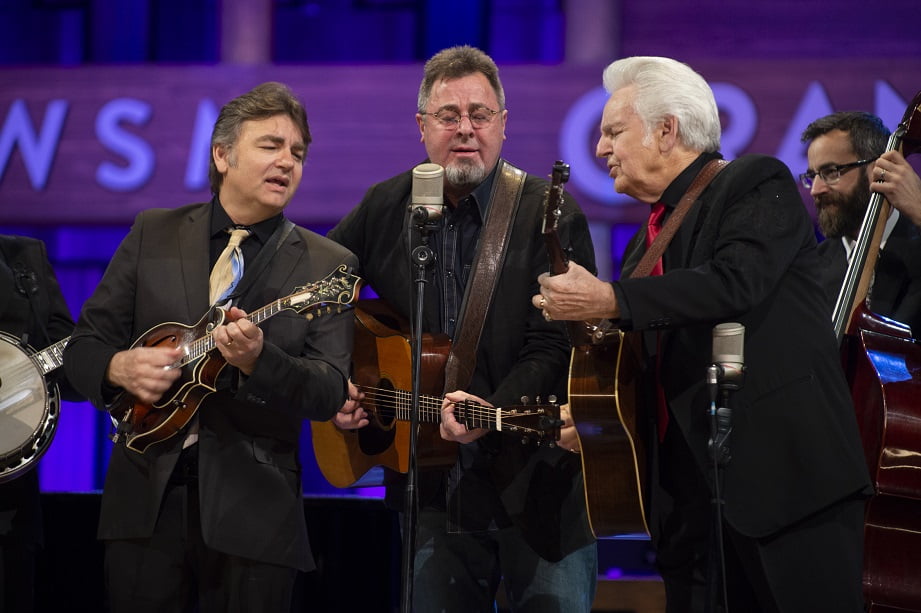
Ronnie McCoury, Vince Gill, Del McCoury

Asked about the decision to spin off a group from The Del McCoury Band, employing everybody except himself, Del says he conferred with manager Stan Strickland about how to make it work.

“I got to an age where I thought, you know, I’m [not] gonna be around here forever,” he noted, just before breaking into his trademark laugh. “I felt good, and I still feel good, but you never know. When you get to 70, you don’t know how many days you got left. I thought, these guys depend on me. My wife and I talked to Stan and I said, ‘You know, if we get them something going on their own, and if something happens to me, then by that time they might be established.’ So we got them a different booking agent than I had, and it seemed like right from the start they were starting to do good already! And I thought, ‘Wait a minute now, I wonder if I should have done that…’”

He breaks into laughter again, before adding, “Especially when they start winning Grammys! And they don’t take me with them!”

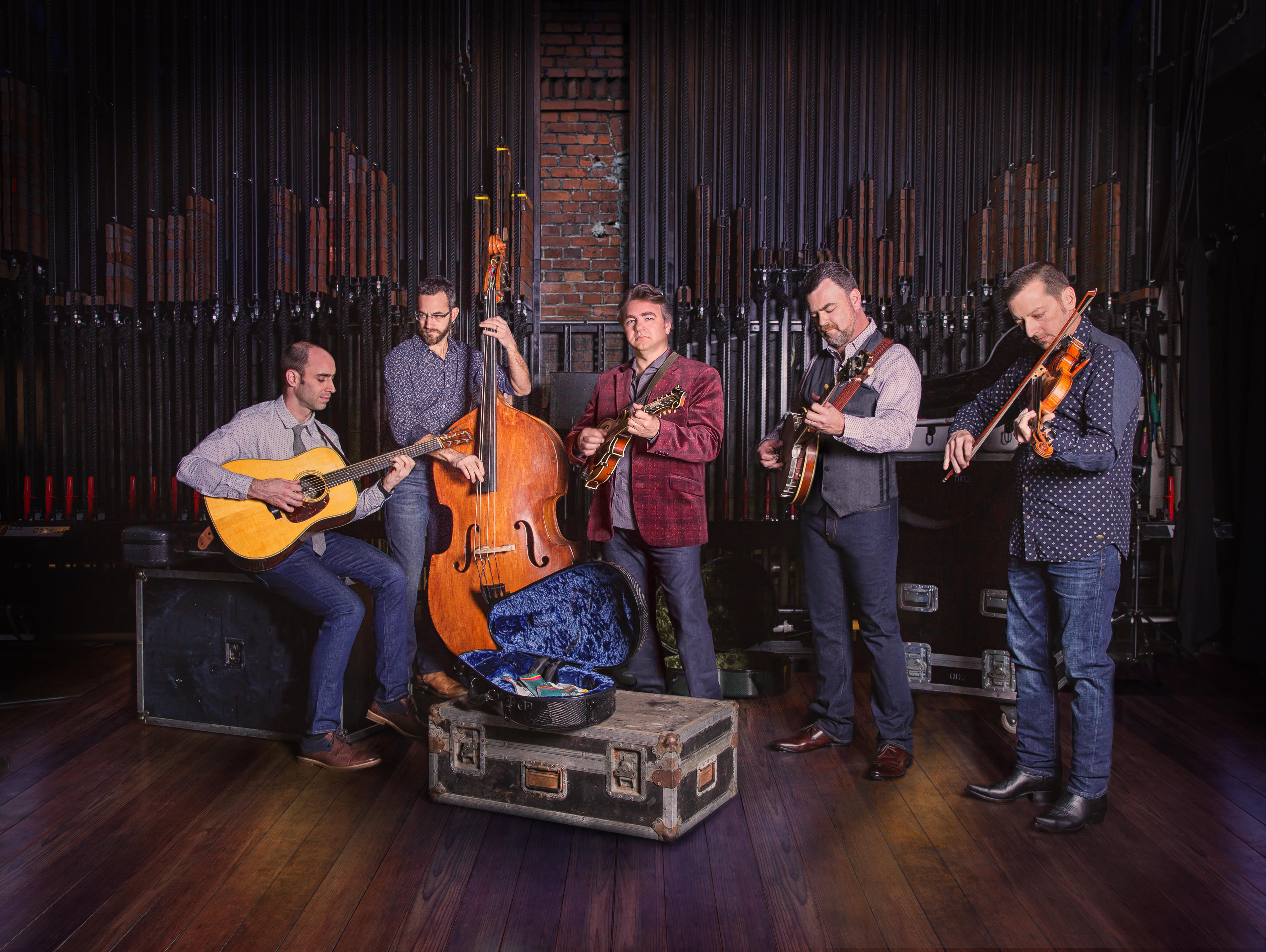
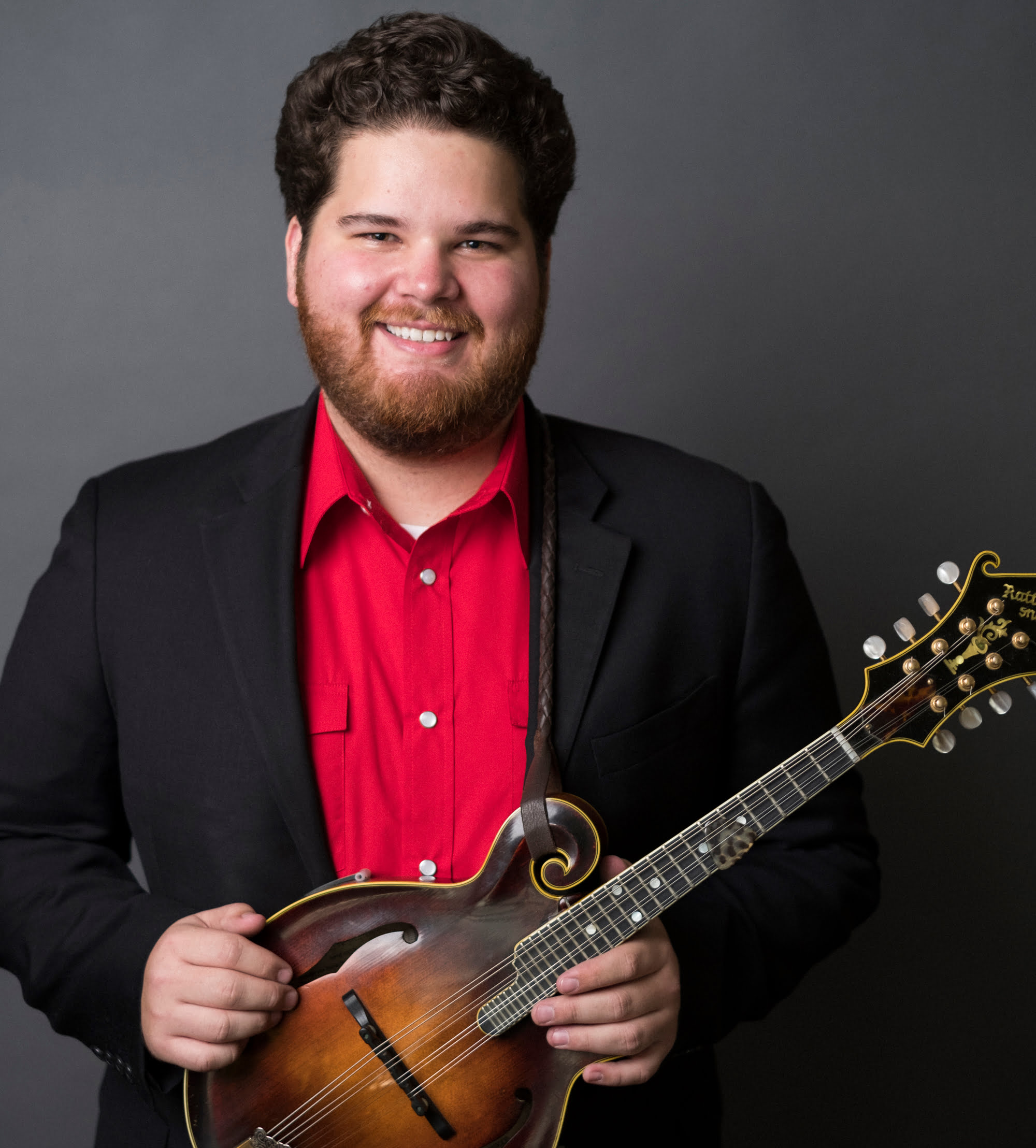
Loyal bluegrass fans know that for decades the Del McCoury Band has done its own share of travelin’ – not to mention winning two Grammy awards of their own. Led by Del on lead vocals and guitar, the good-natured group includes Ronnie on mandolin, Rob on banjo, Jason Carter on fiddle and Alan Bartram on bass. Cody Kilby assumes Del’s role as a guitarist in The Travelin’ McCourys, while the vocals in that ensemble are handled in equal share by Ronnie, Rob, Jason, and Alan.

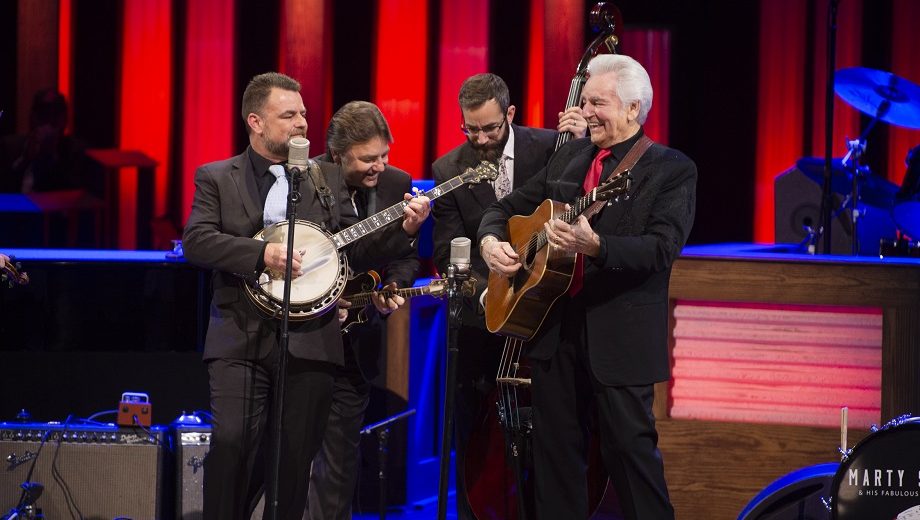
Three days after their Grammy win, the Travelin’ McCourys regrouped with Del when the Opry curated a special show called the Grand Del Opry, in order to commemorate McCoury’s milestone birthday as well as his 15th anniversary as an Opry member. Friends like Sam Bush, Bela Fleck and Abigail Washburn, Vince Gill, Old Crow Medicine Show, Jesse McReynolds, Ricky Skaggs, Marty Stuart, and of course Travelin’ McCourys jammed with the man himself.
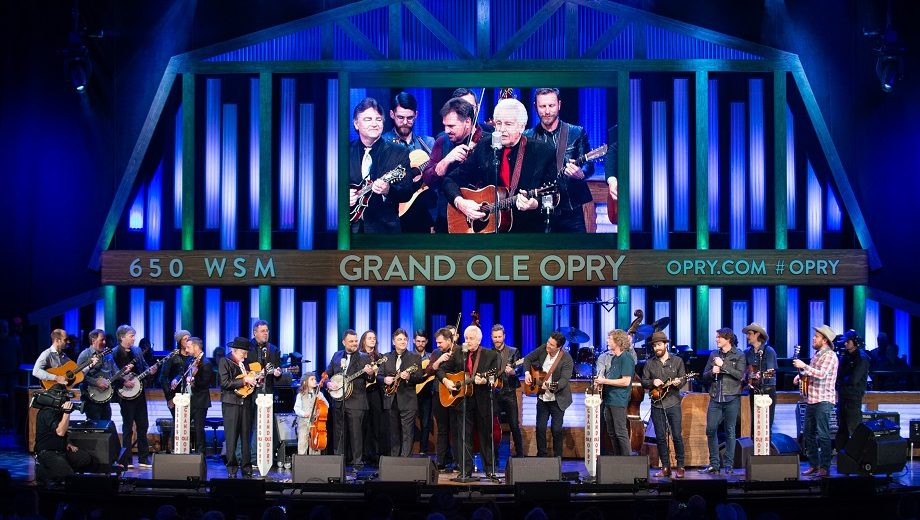
The finale of the Grand Del Opry

In an interview a few weeks after the show, Rob says, “One of the biggest things for me was the finale, and looking at all these people on stage to help Dad celebrate his birthday. And also looking out to see nearly a full house in honor of my father. It made me very proud to see all these folks that have such respect for my dad and the music, and they all took the time to come out to the Opry that night and put on a show in honor of my father.”

Del McCoury made his first appearance on the Grand Ole Opry as Bill Monroe’s guitarist in 1963 – and that performance was only McCoury’s second gig with the esteemed Father of Bluegrass. The first was not long before that, when McCoury subbed for Monroe’s banjo player at a New York show. Although McCoury still preferred playing banjo, Monroe offered him a spot as a guitarist and lead singer – a job he kept for a year. “He’s the reason I’m doing that now,” Del says with a chuckle. “I didn’t think I would be, but once I started playing guitar and singing, I liked it.”

Obviously he still does. McCoury has played a staggering number of festivals over the years, including a few of those seminal Carlton Haney bluegrass festivals of the 1960s. Still he needed some persuasion to launch his own music festival. He recalls, “My manager said to me, ‘Did you ever think about having your own festival?’ And I said, ‘Yeah, I’ve always wanted to, but I don’t want the headache! What a headache that’s got to be!’”

But with persistence, the right location, and a diverse lineup, DelFest has become a major player on the folk festival circuit. This year’s roster includes The String Cheese Incident, Trampled by Turtles, Tyler Childers, Railroad Earth, and more than a dozen bluegrass artists, including Billy Strings, Sam Bush, the Gibson Brothers, Sierra Hull, and the SteelDrivers.
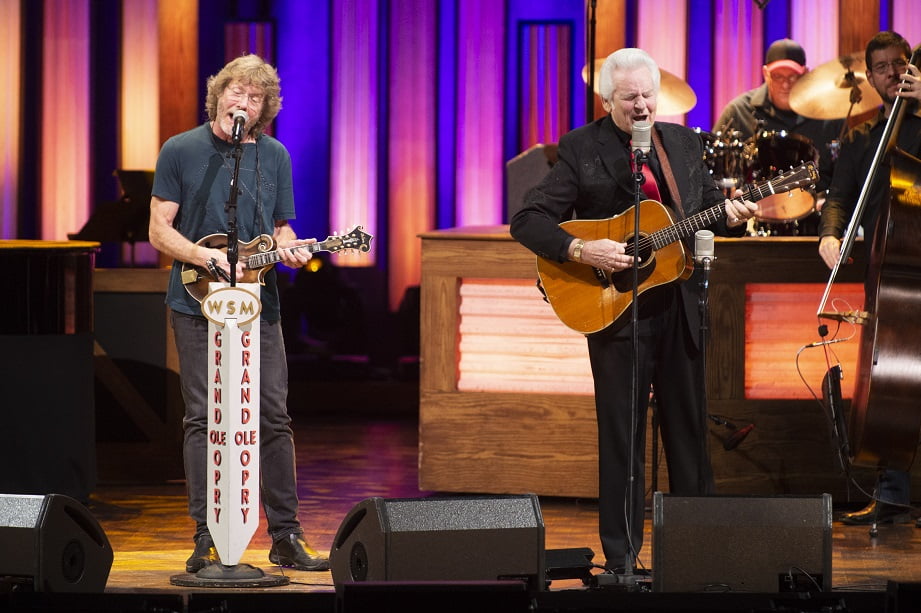
Sam Bush and Del McCoury

“Attendance is staying up there good, and it’s fun,” Del says. “It’s not a bluegrass festival, it’s just a music festival. We have a lot of bluegrass bands there, you know, but we have jam bands, and we have country acts, man, you name it. We had jazz bands, we had a mixture of music, and I like a variety of music my own self. I figured, if we have a variety of bands, some folks will come to see one band, then these folks will come to see another band, and that’s how you get your fans.”

Rob McCoury adds, “I thought having the festival was a great idea. We’ve played hundreds if not thousands of festivals through the years. So I think it was just the natural progression to have a festival of our own. I guess the most surprising thing is, the small details that add up to big things, that no one realizes is going on behind the scenes.”

Asked about the reward of all that work, he answers, “The fans, no doubt about it. All those folks come to DelFest, and anytime dad walks on stage at his own festival he’s a rock star. To me, it’s just the coolest thing.”

Rock star. Bluegrass Hall of Fame member. A nine-time IBMA Entertainer of the Year. Dad. These are just some of the ways you can describe Del McCoury. Winding down the interview backstage at the Opry, he pauses for a moment when he’s asked how he’d like the Opry family to remember him.

Finally, he says, “You know, I guess I’d want ‘em to remember me like a guy that never expected to be an Opry member. I knew I would play music, for years and years, but I thought, ‘The Opry is something is really special and I don’t know if they’d want me there.’ I was fortunate that they did, and I’m just so grateful. I hope they just remember a country guy that really loves the Grand Ole Opry and loves music.”
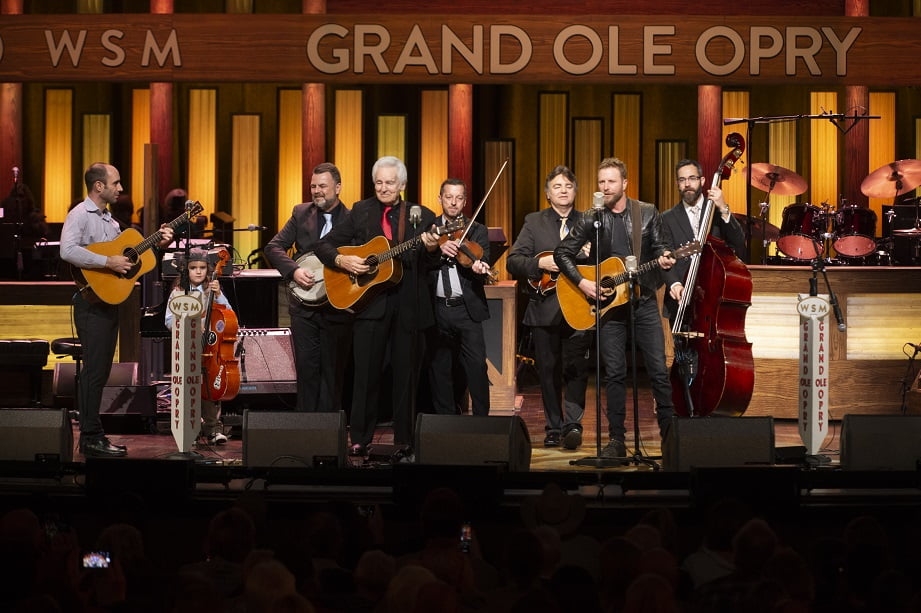
The Travelin’ McCourys, Vassar McCoury, Del McCoury, and Dierks Bentley


Photo credit: Chris Hollo / The Grand Ole Opry
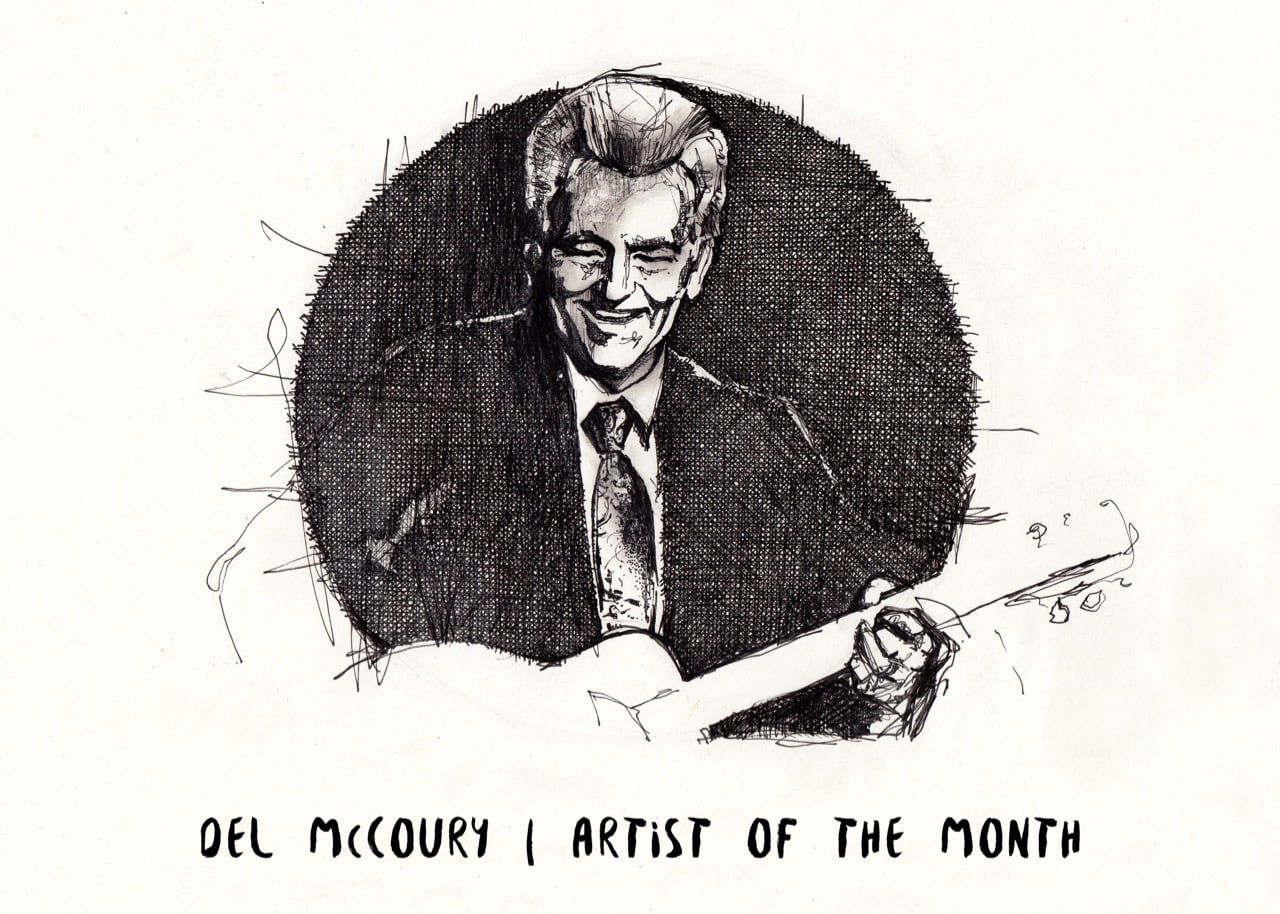
Del McCoury: Whatever Suits the Song

There are three things that you need to know about Del McCoury before anything else: His hair is incomparable, he giggles almost ceaselessly, and he still sings bluegrass.

Fifty years ago, after ending his stint with Bill Monroe’s Blue Grass Boys as lead singer and guitarist, McCoury released his debut solo project, Del McCoury Sings Bluegrass, with his now-iconic pompadour coiffed proudly and precisely on the cover. The album was released on Arhoolie Records, whose founder and proprietor, Chris Strachwitz, produced the album, phoning the young McCoury barely a day before the session to offer him the deal. Because of the severely short notice, the band was cobbled together from whomever was available and the songs chosen from whatever Del knew: A lot of Bill Monroe material, plenty of traditional bluegrass, and some old-time country, too.

Since those days in the late 1960s, songs have been the most significant driver of McCoury’s inspiration and creativity all along. “In the early years,” he remembers, “my producers would bring songs to me and I would usually just do them, even though sometimes I didn’t really like the song. As time went by, I got to thinking, ‘I’m just going to record songs that I like, instead of doing everything [anyone] brings to me.’ I figured I’m the one who’s going to have to sing these songs!”

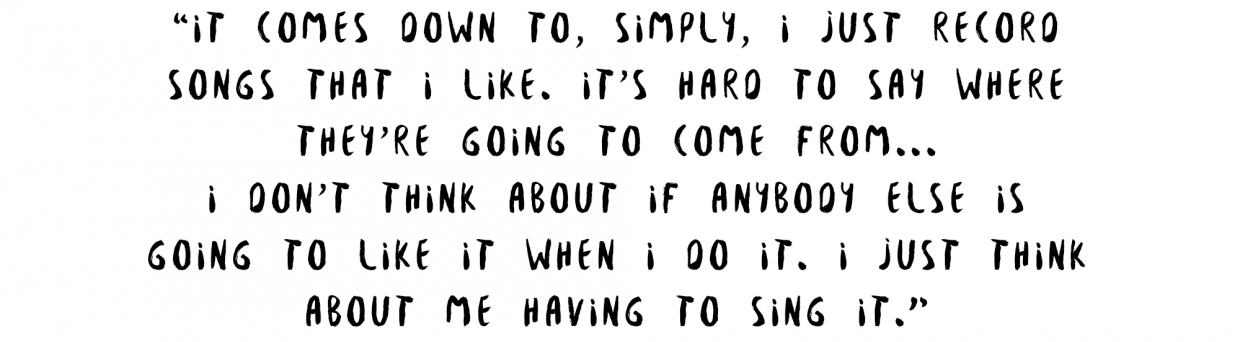
It’s this love for the songs themselves that has informed his entire career, sculpting the iconic McCoury style that can be detected through each and every one of his albums. It’s remarkable that he’s been able to sustain such a particular, tangible musical identity over the decades without it ever growing stale or cliched. That identity — innovation balanced with tradition and overlaid with melody-focused, virtuosic picking, while centered on soaring, high lonesome vocals, all accomplished with a wink and a smirk — doesn’t always come from overt attempts at consistency. “I’ll tell you what it is,” he says in a tone that foretells that this is not some ironclad secret. “It comes down to, simply, I just record songs that I like. It’s hard to say where they’re going to come from. … I don’t think about if anybody else is going to like it when I do it. I just think about me having to sing it.” And as far as production and arrangements? That’s no proprietary recipe under lock and key, either: “But really, it’s whatever suits the song.” Whatever he’s throwing into the pot, it is downright delectable on McCoury’s brand new album, Del McCoury Still Sings Bluegrass.


Thank goodness that he does. If his signature chuckle, a constant as he tells stories and discusses the new record over the phone, wasn’t indication enough, Del has always been a beacon of joy in bluegrass communities. From the first second of track one, the slightly silly, totally burning, almost-a-love-song “Hotwired,” through a high-speed Alan Jackson cover, a classic fast waltz, yes, a train song, too, and another couple of handfuls of carefully curated material, that joy is palpable. It’s a striking through line that stems first from his absolute adoration of just doing the thing. It’s a love he’s always had. “In the early days,” he says, “When I was playing bluegrass festivals, we’d stay up all night, play all night, and go and do a show the next day in the afternoon. I had that much interest in it that I could play night and day and never stop. When you get older, you can’t do that; you have to pace yourself. But I still have that interest, I really do.”

Even casual observers would not note McCoury’s current clip as “pacing oneself.” He’s a member of the Grand Ole Opry and a Bluegrass Music Hall of Fame inductee, he tours nationally, he hosts the radio show Hand Picked with Del McCoury on SiriusXM’s Bluegrass Junction, and he presents an annual roots-music-festival-meets-family-reunion, DelFest, in Cumberland, Maryland, every May. All of that notwithstanding any current album release cycles and press junkets he may be running. While plenty of other artists with such long, successful careers would be pumping the brakes, Del is still looking ahead. “I just never lost interest in it. I never lost interest in recording records and entertaining folks. It’s something I love to do.”

And the folks love him back. Whether listeners come from the most staunch camps of bluegrass diehards, or from hippie festivals and jammy string band gatherings, or symphony halls and performing arts centers, they all count Del as one of their own. The rarity of that fact is not lost on him. “[That’s why] when we do a show, we never have a set list. We figure these people paid to see us, so we’re just going to do what they want us to do, we’ll see what they want to hear. It keeps me enthused, the audience excited, and also the boys [excited, too.] And the audience never know[s] what we’re going to do. ‘Cause I don’t!”


By choosing to record and perform material that he connects with personally, he’s passing down that care and respect for songs to every one of his audiences, who, in turn, learn to appreciate and then reinforce that care. So, when a song comes along on Still Sings Bluegrass that includes an extended, rip-roaring electric guitar solo (in this case played by Del’s grandson, Heaven), or when “To Make Love Sweeter for You” kicks with a jangly upright piano, you don’t hear the predictable, “that ain’t bluegrass” balking. Furthermore, the traditional, straight-ahead policers are visibly absent from DelFest, where more fringe, jammy acts like Trey Anastasio and The String Cheese Incident are just as likely to appear as Larry Sparks — or Tedeschi Trucks Band. And whether he’s recording a set of songs such as this fresh crop, curated by the man himself, or lending his voice and his band to projects like Del and Woody, an album of unrecorded Woody Guthrie songs, or American Legacies, the New Orleans-meets-Nashville, jazz-meets-bluegrass, Del McCoury Band-meets-Preservation Hall Jazz Band crossover album, his footing within bluegrass never falters and is rarely challenged.  

Del doesn’t believe there’s a secret antidote to the signature, absolutist trains of thought some find in bluegrass and he clearly says so. When asked why he thinks his fans might let him off the hook he laughs, “You know what, I’m afraid they’re gonna let me go any minute!” But we know this isn’t true. Now more than fifty years into his song-led career, Del’s creative vision has never been so clear, his perspective never more innovative, his hair never more enviable, his laugh never so charming, and his music never more joyful.

No matter how that ends up sounding from the stage or through the speakers, by definition, it’s still bluegrass.


Illustration by: Zachary Johnson


LISTEN: The Travelin’ McCourys, ‘Lonesome, On’ry and Mean’

Artist: The Travelin’ McCourys
Hometown: Nashville, TN
Song: “Lonesome, On’ry and Mean”
Album: The Travelin’ McCourys
Release Date: May 25, 2018
Label: McCoury Music

In Their Words: “Jason Carter, who sings here, is a huge Waylon fan — we all are, really. Several years ago when we started looking for material to cut, Jason brought this one and it worked. We’ve been playing it for four or five years now. Using our instruments, we kept the arrangement similar to Waylon’s version with maybe a few more solos.” — Rob McCoury


Photo credit: Shelly Swanger

MIXTAPE: Casey Campbell’s Mandolin Masters

With his latest release being Mandolin Duets, Vol. 1, who better than Casey Campbell to put together a Mixtape of mandolin masters for us? No one. That’s who. He has studied them all — and played with many — so take his carefully selected collection to heart (and ear).

Bill Monroe & Doc Watson — “Watson’s Blues”

Where else to begin but with the Father of Bluegrass, Bill Monroe. There are hundreds of recordings to choose from, but I’ve always been a big fan of this duo album of Bill and Doc Watson entitled Live Recordings 1963-1980: Off the Record Volume 2. It features some great duet singing from Bill and Doc, as well as a bevy of short, sweet, and to-the-point instrumentals. I am partial to “Watson’s Blues” not only because this particular recording features the writer (Bill) and the inspiration for the tune (Doc), but also because it is a bluesy little number (and I like my bluegrass to be bluesy).

Ronnie McCoury — “McCoury Blues”

Ahhh … it was the mid-2000s. MySpace was all the rage, and we had yet to discover fidget spinners, stick basses, and Netflix. You know, the good ol’ days. I came across “McCoury Blues” while scouring through Rhapsody (the Spotify before Spotify existed), and, in my opinion, it is a 21st-century take on “Watson’s Blues” with Ronnie’s smooth tremolo and Del McCoury’s powerhouse guitar runs. More importantly, this song led me to the Bluegrass Mandolin Extravaganza album. This project, spearheaded by Ronnie and David Grisman, is a mandolin goldmine including Ronnie, David, Sam Bush, Ricky Skaggs, Buck White, Frank Wakefield, Bobby Osborne, Jesse McReynolds, and Del McCoury on rhythm guitar. Of course, growing up in the bluegrass world, I had heard all of these players before, but this album was my introduction to the concept of musical style and the intricate differences between musicians. Throughout my mandolin obsession, I have continually returned to this album to draw inspiration (read: steal licks). If there is one album I would recommend to any mandolin fan, it would be Bluegrass Mandolin Extravaganza.

Mike Compton & David Long — “Tanyards”

If you haven’t picked up on the pattern yet, I’m a big fan of duet recordings. A large part of that came from this album by mandolin masters Mike Compton and David Long. My mother picked me up from middle school in her silver PT Cruiser — yes, we were that cool — with a copy of this album in the passenger seat. We listened to it on the way home, then I listened to it again, and again, and again. Mike and David have such fluid playing styles, and you would be hard-pressed to find other players that could replicate the chemistry on this album. This track does a great job of showcasing each player and also letting the two intertwine as they swap licks. It is one of my favorite albums of all time.

Ricky Skaggs & Kentucky Thunder — “Crossing the Briney”

Adding a little Irish flair to the list, here is a song that starts out bare and ends with a full-on orchestra with all of the bells and whistles (literally). This song is featured on Ricky Skaggs’s Instrumentals albums and, in my opinion, is the standout hit. I mean, where else can you hear instrumentation like this, AND a kickass Andy Leftwich fiddle solo in the middle? This song also opened my mind to how to take what is essentially a pretty standard Irish fiddle tune and raise it to a new level. Admittedly, Ricky doesn’t really get to stretch out on this tune, so it’s not the best representation of his great mandolin playing. But don’t worry: He is one of the best players mixing modern and traditional styles together, and there are plenty of great examples on this album.

The Whites (Buck White) — “Old Man Baker”

Buck White is a national treasure. Not only is he one of the sweetest humans I’ve ever had the honor of spending time with, but he is also one of the swingin’-est mandolin players you will come across. Whether he is kicking up his heels as a special guest with the Grand Ole Opry Square Dancers or playing mandolin on one of his many iconic albums with the Whites, there is no doubt he has a huge smile on his face and joy in his heart. This tune, written for fiddler Kenny Baker, is one that I often play when I am warming up on the mandolin. It’s a tough tune, for sure, with plenty of pinky work and string-jumping, but it is undoubtedly the most fun song on this list to play. Buck’s playing is just like his personality: bouncy, memorable, and always tasteful. If you are at all interested in hearing some Texas Swing mandolin playing, check out more of his catalog.

Strength in Numbers (Sam Bush) — “Texas Red”

Picking one song from the Strength in Numbers album is like picking a favorite child. People in the music business like to throw around the word “supergroup” for every other band, in hopes that it will create some kind of buzz or increase sales. Strength is one of the few occasions where the term accurately applies: Sam Bush, Béla Fleck, Jerry Douglas, Mark O’Connor, and Edgar Meyer. Between the late ’70s and mid-’80s, each of these trail-blazing musicians had helped to established a new frontier of acoustic music. Here they are, together in their prime, with one of acoustic music’s most influential instrumental albums of all time. PS: This album is Sam Bush Rhythm 101. Class dismissed.

David Grisman & Doc Watson — “Kentucky Waltz”

When I am teaching lessons or at a camp, it is without a doubt that I’ll get asked about mandolin tremolo. What is it? How do I do it? How do I make it better? All of these questions (and more) can be answered with Doc & Dawg’s version of the “Kentucky Waltz.” It is one of the most beautiful, simplest recordings of a mandolin and guitar I have come across. For the uninitiated, David Grisman is an icon in the mandolin and acoustic music worlds, heavily influencing today’s top mandolin players like Sam Bush, Ronnie McCoury, and Ricky Skaggs. With dozens of must-have albums spanning throughout his 50-year career, David led the way to the frontier of “new acoustic music” during the ’70s and ’80s. Even today, at 72, he is still going strong. touring with the David Grisman Bluegrass Experience, the David Grisman Sextet, and as a duo with Del McCoury. Despite all of his ground-breaking compositions and albums, when it comes to keeping it simple and making the most of a melody, David is still the king.

Radim Zenkl — “Memory of Jaroslav Jezek”

I couldn’t consider this list finished without introducing you to something a little outside the box. For his Galactic Mandolin album, Czech Republic mandolinist Radim Zenkl (pronounced Ra-deem Zeen-kl) experimented with different mandolin tunings for each song. Because a mandolin has four sets of strings (eight total), it is normally tuned GG-DD-AA-EE. This particular tune has the mandolin tuned in minor thirds. When I first heard this tune, I felt like it was a crazy of mixture of big band jazz and harp music, or something I might’ve heard on the original Nintendo version of The Legend of Zelda. I’m kind of mesmerized by its weirdness.

Andy Statman — “Pale Ale Hop”

While we are spending some time outside the box, now would be a good time to introduce you to Andy Statman. If there is a musical genre out there, Andy has covered it: bluegrass, jazz, Irish, klezmer, rock ‘n’ roll, etc. “Pale Ale Hop” showcases his rockin’ mandolin playing, transforming into something you might hear at a surf-rock dance party in the ’50s. My favorite thing about Andy is that, for all of his experimental compositions, he is a true student of all music and can play the most traditional bluegrass style you could imagine, then turn around and play a John Coltrane solo. If you’re interested in more of Andy’s left-of-center music, check out his earlier LPs, like Flatbush Waltz or Nashville Morning, New York Nights.

Jethro Burns & Tiny Moore — “Flickin’ My Pick”

Here is a classic album with two of the best jazz and swing mandolin players of the past century. Jethro Burns is known primarily as one half of Homer & Jethro, one of the great country comedy duos of the 1930s-60s. Despite all of his joking around, Jethro was a serious musician, playing anything from classical to bluegrass. On this particular song, he is playing the acoustic mandolin and taking the second solo. The other player you’ll hear is Tiny Moore, a pioneer of the electric mandolin. Tiny played with Bob Wills & His Texas Playboys and Merle Haggard’s band, the Strangers. Together, these two legends recorded Back to Back, which would become one of the definitive albums for jazz mandolin enthusiasts.

Norman Blake — “Valley Head”

Getting back to the roots of old-timey mandolin music, here is a tune written and played by Norman Blake. Although he is known mostly as one of the great bluegrass guitarists, both Norman and his wife Nancy are great mandolin players and have recorded quite a bit of mandolin music over the years. Similar to the “Kentucky Waltz” earlier on this list, the thing I love about Norman’s playing and this track, in particular, is the simplicity. Sure, this tune might have a lot of notes, but Norman sticks to the melody the entire way through, letting the song speak for itself. For those interested in more of Norman and Nancy’s mandolin playing, check out Natasha’s Waltz, an album that features a slew of great mandolin tunes.

Chris Thile — “Watch ‘At Breakdown”

Sometimes you’ve got to give the kids what they want … and they want Chris Thile. Between his work with Nickel Creek, Mike Marshall, the Punch Brothers, Michael Daves, the Goat Rodeo Sessions, Edgar Meyer, Jon Brion, Béla Fleck, and Brad Mehldau, among others, Chris has traversed just about every inch of the musical landscape. As if that weren’t enough, he is now the host of A Prairie Home Companion, collaborating with a new lineup of musical guests every week, including Jack White, Jason Isbell, Lake Street Dive, and more. With such a long and diverse resumé, he has become one of the most popular and influential mandolin players in the realm of Bill Monroe, David Grisman, and Sam Bush. “Watch ‘At Breakdown” is the starting track on Chris’s How to Grow a Band album, and shows off his bluegrass chops, while hinting that there are no bounds to his abilities.