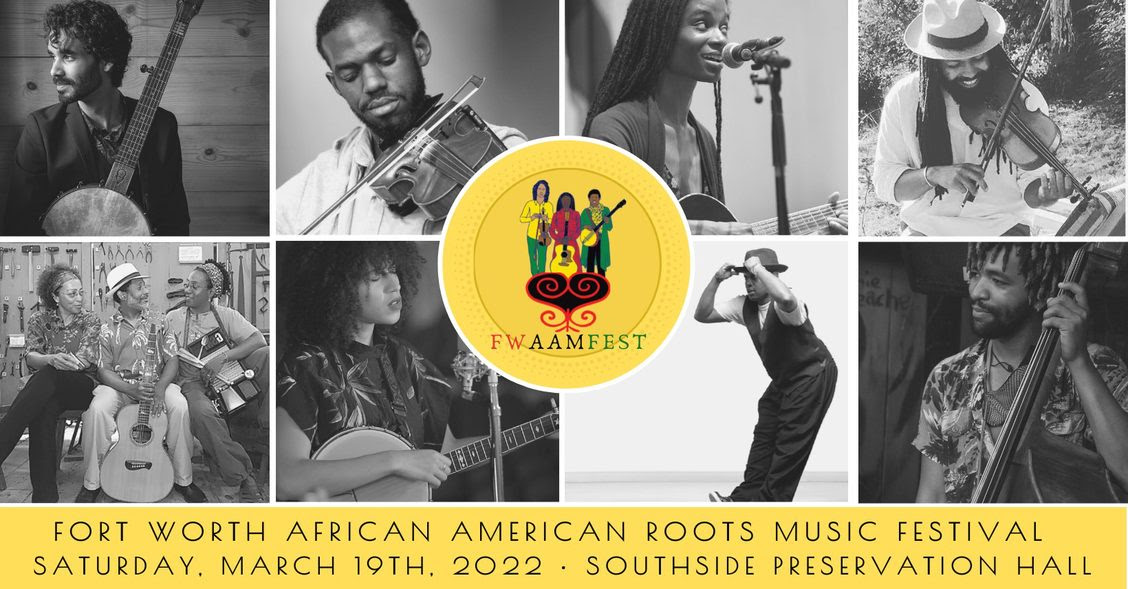
Fort Worth African American Roots Music Festival Is About Community

To put it simply, the Fort Worth African American Roots Music Festival is expanding awareness about the Black roots of old-time music. It’s also about representation, visibility, and perhaps most of all, community.

“We have been there since the beginning of this music, yet there is little to no representation in the large music festivals that cater to this genre,” says founder Brandi Waller-Pace. “We aim to change that.”

Also known as FWAAMFest, the event focuses on the genres of old-time, jug band, early blues and jazz music that is Black-led and showcases Black performers. Produced by Decolonizing the Music Room, FWAAMFest takes place on Saturday, March 19, at Southside Preservation Hall. Headliners include Jake Blount, Kaia Kater, and Justin Robinson.

Leading up to FWAAMFest, Brandi Waller-Pace shares how a sense of community shaped this one-of-a-kind event.

BGS: What led to the idea of launching a festival focused on African American roots music?

Brandi Waller-Pace: I started playing old-time music myself by finding the banjo not terribly long ago. Maybe five years ago is when I really turned my attention toward the instrument and began to play, and really quickly connected with one of the few people in my community who plays clawhammer. He convinced me to sing and play guitar in a string band with him and another member. So, I got my chops up and learned a lot and gradually learned a lot about the history.

Finding out how deeply embedded Blackness and Black history – the history of my own ancestors – was, in the case of the banjo and the tradition surrounding the music, felt really affirming to me. Before long I began to meet other Black folks who were deeply involved in the community and the history. We started to connect, and those circles grew.

I remember hearing about the Black Banjo Gathering before I had gotten into the music at all, and not really knowing its significance until later. And then I attended another event that Dr. Dena Jennings, at her farm in Orange, Virginia, called the Affrolachian On-Time Music Gathering — or “The Thang.” It was really the first time I was around a significant amount of Black folks who were engaged in roots music, talking about the history and just engaging with one another.

It wasn’t an exclusively Black event, but it was really the first time I was around a significant amount of Black folks who were engaged in roots music, talking about the history and just engaging with one another. It was really beautiful. It planted a seed, I think. As I engaged more in the community, there were discussions about “How do we work on inclusion in existing spaces? When is it time to create new spaces?” I considered, “You know, I could create something new.” I tend to operate that way. I’ll engage in existing spaces and systems but I love the idea of creating something new. And so I said, “I could do a festival.”

You cover multiple old-time music styles at this festival. How did you curate the lineup?

I have to be honest. I’ve just been really fortunate to know so many wonderful musicians, and to become acquainted with some, and to develop deep friendships with others. And so, the lineup came from asking, “What’s the community that I’m finding myself in? And who are the people that I know about that I don’t get to see as often but are amazing musicians?” As this event grows, I hope to engage with people further and further from my close circle while still making sure to have space for those that were so important to starting my journey into this music and learning the history of it.

A festival like this will bring visibility to the Black roots of old-time music. Why is that important to you?

In part, the visibility is connected to my own journey of discovery and finding myself, and what my Blackness means to me. The Black roots of old-time music are such a huge part of US culture. Enslaved Africans materially and economically and physically and culturally built so much of what we define as US culture.

In my work in music education, and in my scholarly work, and in my clinician work, that is what is so important to me – centering narratives that are so very important but are not broadly treated as such. It makes me happy to think of the idea of Black folks on a broader scale looking at these musical forms and seeing Black identity within that and having that engagement. It brings it back full circle to times when these traditions were seen as common in Black spaces.

What is the mission behind your nonprofit, Decolonizing the Music Room?

The mission of Decolonizing the Music Room is to center Black, Brown, Indigenous, and Asian voices, knowledge, and experiences in music education and related fields. So, we do this with things like FWAAMFest or with presenting to educators and other organizations, or by creating content that puts these narratives out there. We’re engaging with music education and other communities across disciplines to really connect to others and get this work out there as much as possible.

It’s a lot of work to launch a festival, but what have you enjoyed the most about creating this event?

You’re right, it is an immense amount of work to launch a festival, but what has brought me the most joy is doing it with friends. These are not just people I admire, experts in their field, genius performers, scholars, and community activists. They are actual people I know in real life and I still want to pinch myself when I think about the fact that this is actually happening with these people, because I feel like so much of a newbie. Being able to do this has been really amazing.

The second thing has been that it’s been in my community. I taught in public schools here. I taught music, wrote curriculum, and engaged in community advocacy work. I’ve been down here for 13 years now. I feel like I have roots here. I have children who go to school here. I have colleagues that I’ve worked with. I’m an artist in the community. For me personally, I wanted it to be something that feeds diversity into the community where I live, where I’ve taught, and where I’m raising my children. It’s wonderful to be able to do that.

For those music fans coming to check it out, what do you hope will take away from the experience?

I want people to come and understand that this music is Black music. Blackness is all throughout. This music is community music. This music is music that can bring people together, and that one can engage in. One of the things that I love most about learning old-time music is that there’s so much nuance and there are complicated things that you can learn, but also the level of accessibility. It didn’t take me long to be able to engage in a way that felt meaningful for me, even though the way I can play now is light years from the way I could play when I just started.

Seeing all that Blackness represented and understanding the connection. Seeing that it can be participatory and then knowing something like that is in Fort Worth. They’re gonna take away, “I gotta come back to Fort Worth every March because I have to be in this festival.” The folks in the community are gonna say, “You know what? Maybe I want to learn the banjo.” That is something I can do here. We can create more musical community here.
Carolina Calling, Greensboro: the Crossroads of Carolina

Known as the Gate City, Greensboro, North Carolina is a transitional town: hub of the Piedmont between the mountain high country to the west and coastal Sandhill Plains to the east, and a city defined by the people who have come, gone, and passed through over the years. As a crossroads location, it has long been a way station for many endeavors, including touring musicians – from the likes of the Rolling Stones and Jimi Hendrix at the Greensboro Coliseum, the state’s largest indoor arena, to James Brown and Otis Redding at clubs like the El Rocco on the Chitlin’ Circuit. Throw in the country and string band influences from the textile mill towns in the area, and the regional style of the Piedmont blues, and you’ve got yourself quite the musical melting pot.

LISTEN: APPLE • SPOTIFY • STITCHERAMAZON • YOUTUBEMP3
 

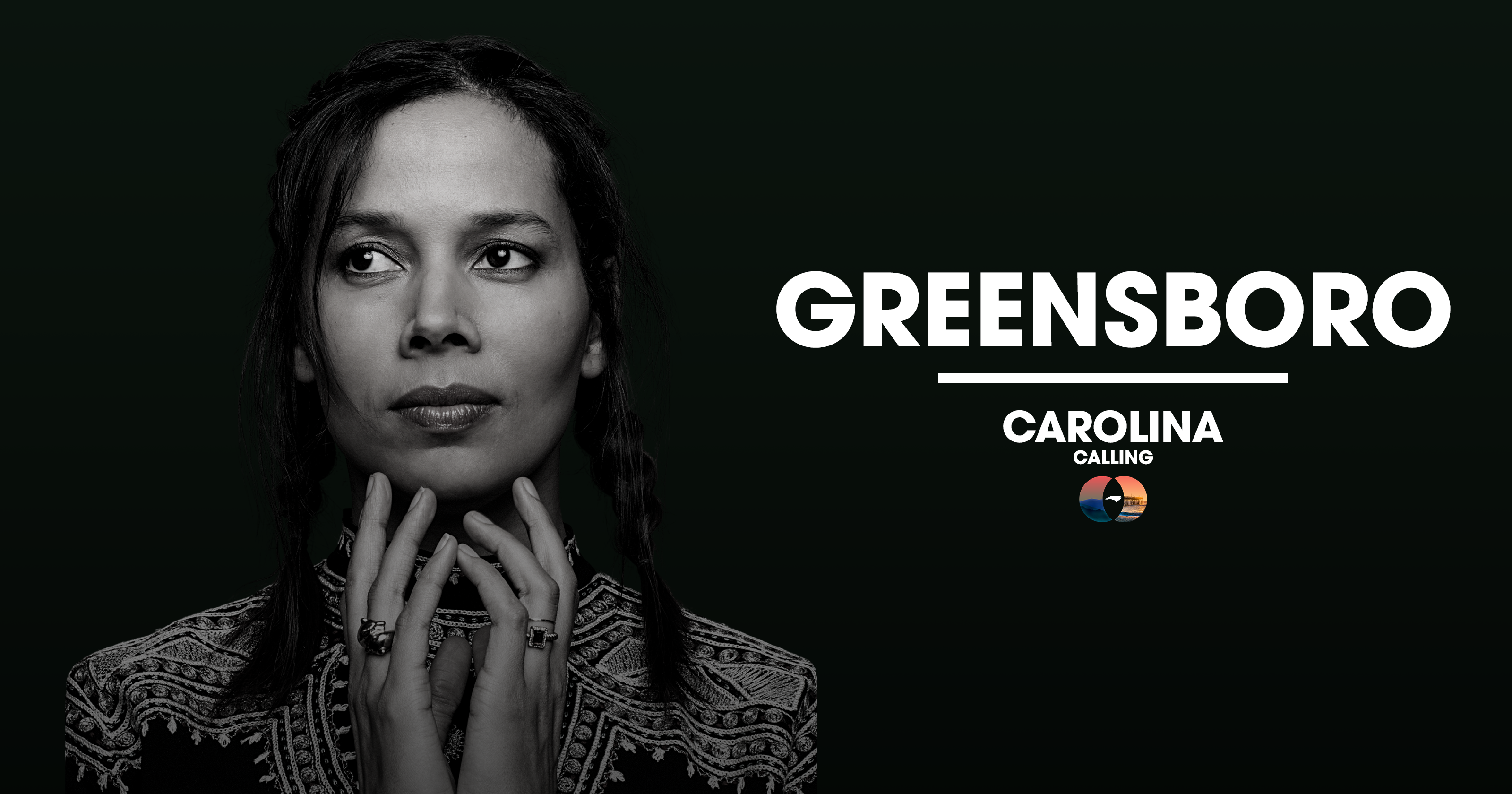
This historical mixture was not lost on one of Greensboro’s own, Rhiannon Giddens – one of modern day Americana’s ultimate crossover artists. A child of black and white parents, she grew up in the area hearing folk and country music, participating in music programs in local public schools, and eventually going on to study opera at Oberlin Conservatory in Ohio. Once she returned to North Carolina and came under the study of fiddler Joe Thompson and the Black string band tradition, she began playing folk music and forged an artistic identity steeped in classical as well as vernacular music. In this episode of Carolina Calling, we spoke with Giddens about her background in Greensboro and how growing up mixed and immersed in various cultures, in a city so informed by its history of segregation and status as a key civil rights battleground, informed her artistic interests and endeavors, musical styles, and her mission in the music industry.

Subscribe to Carolina Calling on any and all podcast platforms to follow along as we journey across the Old North State, visiting towns like Durham, Wilmington, Shelby, and more.


Music featured in this episode:

Rhiannon Giddens – “Black is the Color”
Andrew Marlin – “Erie Fiddler”
Carolina Chocolate Drops – “Cornbread and Butterbeans”
The Rolling Stones – “Rocks Off”
Count Basie and His Orchestra – “Honeysuckle Rose”
Roy Harvey – “Blue Eyes”
Blind Boy Fuller – “Step It Up and Go”
Rhiannon Giddens, Francesco Turrisi – “Avalon”
Carolina Chocolate Drops – “Snowden’s Jig (Genuine Negro Jig)”
Barbara Lewis -“Hello Stranger”
The O’Kaysions – “Girl Watcher”
Joe and Odell Thompson – “Donna Got a Rambling Mind”
Carolina Chocolate Drops – “Country Girl”
Carolina Chocolate Drops – “Hit ‘Em Up Style”
Our Native Daughters – “Moon Meets the Sun”
Rhiannon Giddens, Francesco Turrisi – “Si Dolce é’l Tormento”


BGS is proud to produce Carolina Calling in partnership with Come Hear NC, a campaign from the North Carolina Department of Natural & Cultural Resources designed to celebrate North Carolinians’ contribution to the canon of American music.

Photo Credit: Ebru Yildiz

Enter to win a prize bundle featuring a signed copy of author and Carolina Calling host David Menconi’s ‘Step It Up and Go: The Story of North Carolina Music,’ BGS Merch, and surprises from our friends at Come Hear North Carolina.

‘O Brother, Where Art Thou?’ Created an Instant Audience for Old-Time Music

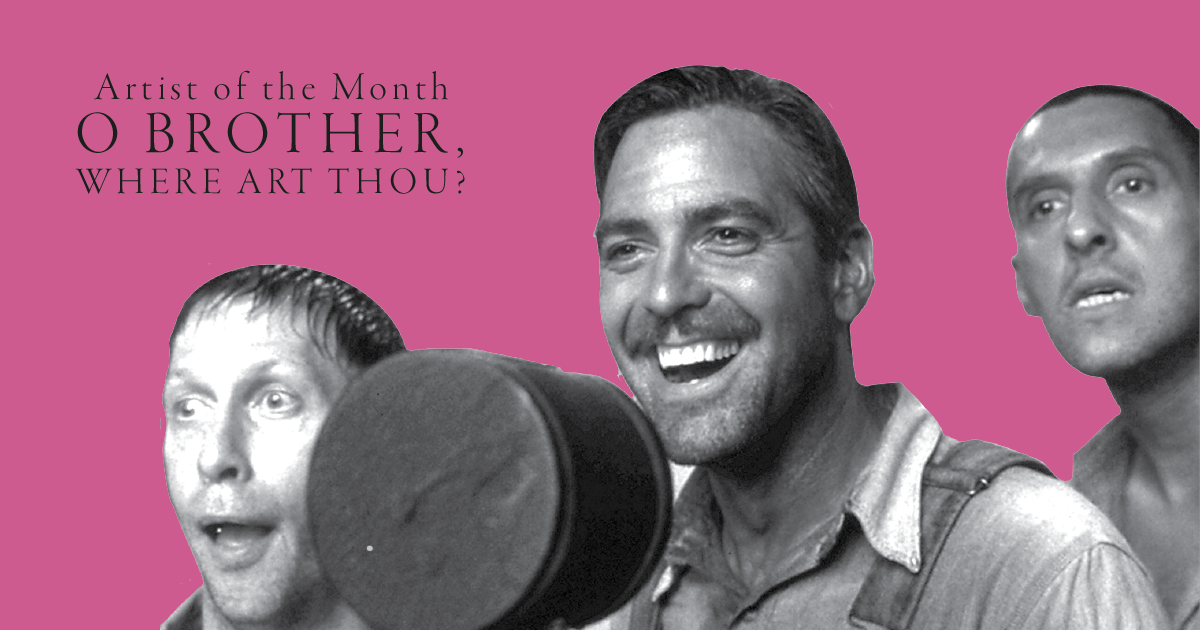
The O Brother, Where Art Thou? soundtrack, which was just starting to pick up momentum twenty years ago this winter, was both a forethought and an afterthought. The Coen Brothers had an idea for a film and even a title borrowed from Preston Sturges’ 1940 comedy, Sullivan’s Travels, but no screenplay. They commissioned T Bone Burnett to assemble a sprawling playlist of old-time music for them to use as writing prompts — original recordings from the first half of the twentieth century as well as new recordings of old songs. He gathered some of the finest vocalists and players, including Emmylou Harris, Gillian Welch, Alison Krauss, and members of Union Station, as well as Norman Blake, Sam Bush, and John Hartford. In various combinations they produced around sixty tracks covering hillbilly plaints, gospel numbers, Protestant hymns, children’s songs, labor songs, even prison songs.

From that pool the Coens selected a handful of tracks that served as the skeleton for their screenplay, which became a Deep South retelling of The Odyssey. As three yokel chain-gang fugitives wander the backwoods and cotton fields and gravel roads of Depression-era Mississippi, they inadvertently become country stars thanks to a hasty version of “Man of Constant Sorrow,” originally recorded in 1917 by Dick Burnett and re-recorded for the film by Dan Tyminski. Along the way they encounter a parade of white-clad Christians singing “Down to the River to Pray,” a blues singer who regales them with a campfire rendition of Skip James’ “Hard Time Killing Floor,” and a KKK klavern performing a Busby Berkley routine in white sheets and hoods.

Whittled down to eighteen tracks, the soundtrack hit stores just a few weeks before the film, and it seemed designed to stand alone as an upscale release. As Luke Lewis, formerly chairman/CEO of Universal Nashville, told Billboard in 2015: “When we were putting it together, a bunch of us said, ‘This is probably going to be a coffee table kind of a CD, where people will leave it around and be proud to have it.’ That turned out to be pretty much true… A lot of people that don’t buy records at all, or buy one a year, bought that record.”

Still, no one figured it would sell any more copies than your typical soundtrack, and certainly no one predicted it would so completely eclipse the film. Its success has been astounding: It has sold nearly 9 million copies, hung around the upper reaches of the Billboard Top 200 for several years, won the Grammy for Album of the Year (beating out Bob Dylan and Outkast, among others), spun off a sequel, inspired a series of tours and live albums, and redefined a massive market for traditional music in America.

Twenty years later, the gulf separating film and soundtrack remains remarkably wide. The former is glib to the point of nihilism, as though every line of dialogue and every camera angle is surrounded by quote marks. The soundtrack, by contrast, is sincere to the point of evangelism, as though these old songs were pieces of secular scripture. The music plays everything straight, while the film can’t keep a straight face. The soundtrack became a phenomenon, while the film sits in the lower tiers of its auteurs’ sprawling catalog.

Both are products of a very particular time: They were released during that short window between two defining events — the hand-wringing spectacle of Y2K and the horrific televised tragedy of 9/11. With the benefit of twenty years’ hindsight, they represent a pop-cultural pivot from the irony that defined the 1990s and much of the Coens’ output to the “New Sincerity” that defined the 2000s.

Why did this niche soundtrack become such a massive hit? Some have credited the popularity of O Brother to fin de siècle jitters and a desire to return to a rosier, more comfortable American past (never mind that the past, especially the 1930s, was never rosy or comfortable). Others have chalked it up to a rejection of the late ’90s pop music excess embodied by Britney Spears and the Backstreet Boys.

Perhaps the best reason for its success is also the most obvious: This is a good album, and an accessible one. It’s a well-curated tour through old-time music, a sampler of rural American traditions that serves as a primer on the subject without sounding like a textbook. All of these different styles are presented with an eloquence that is homespun yet modern: a balance that highlights rather than dampens their charms.

Burnett puts such an emphasis on the human voice that even the instrumental tracks sound a cappella. He wants you to hear the exquisite grain in the voices of Emmylou Harris, Gillian Welch, and Alison Krauss on “Didn’t Leave Nobody But the Baby” as well as the weight pressing on Chris Thomas King as he moans through “Hard Time Killing Floor.” Curiously, Dr. Ralph Stanley had to convince the producer to let him sing “Oh Death” without banjo, which was absolutely the right call. His voice is high and keening, a serious a death, shaken by the very subject he’s singing about.

If there’s a breakout song on O Brother — something resembling a hit — it was this very intense performance, which remains one of the finest renditions of this very odd and oft-covered song. Stanley was 73 years old when the album was released, had been playing since 1946, and was already celebrated as one of the fathers of bluegrass, but O Brother gave his career a considerable boost, introducing him to a significantly wider audience. (That said, it always struck me as deeply disrespectful that the Coens have a Klansman lip-synching Stanley’s performance in the film, as though they feared the words might actually mean something.)

Stanley performed the song a cappella at the 2002 Grammys — imagine anything a cappella at such a glitz-bound ceremony — not long before the soundtrack won Album of the Year. It might have been the climax of the soundtrack’s shelf life, but it kept selling and kept selling. It created an instant audience for old-time music, and upstart string-bands found themselves with readymade audiences, many of them shouting “Man of Constant Sorrow” the way they once might have yelled “Free Bird!” Every artist on the album got a boost, especially Alison Krauss & Union Station, who crossed over from bluegrass to pop and launched a series of hit records with the aptly titled New Favorite in August 2001. Similarly, Welch, Harris, and even Stanley enjoyed boosts in album and ticket sales in the wake of O Brother.

As with any sweeping change, there are new opportunities as well as new losses. The alt-country acts of the 1990s had already lost much of their luster, but roots suddenly had no room for punk anymore. Gone were the dark, twangy experiments like Daniel Lanois’s Americana trilogy — Harris’ Wrecking Ball in 1996, followed by Bob Dylan’s Time Out of Mind the next year and Willie Nelson’s Teatro the year after that. All three proved that roots music could accommodate new sounds, that it could look to the future without completely letting go of the past, and all three stand among the best entries in their artists’ remarkable catalogs.

But O Brother seemed to wipe most of those new avenues away, turning roots music into something largely acoustic, uniform, polite, conservative — beholden to the past and largely dismissive of the present. Watching certain acts riding that wave was like watching Civil War reenactors march on a makeshift battlefield, and ten years later groups like Mumford & Sons and the Lumineers were using roots music to sell arena-size sentiments.

Another aspect of old-time lost in the O Brother wave: politics. Previous folk revivals had a populist bent, extolling the music as the sound of the people and as an expression of a specifically American community. Woody Guthrie and Pete Seeger were branded subversives and communists, while Dylan and his early ‘60s cohort found radical possibilities in Harry Smith’s legendary Anthology of American Folk Music. But no one on O Brother is in any danger of being branded a pinko. The film itself nods to issues of race and class, but without really commenting on them in any serious or specific way. The soundtrack, by contrast, foregrounds songs about yearning, about breaking free of turmoil and hardship to find peace and contentment. Often that can be humorous, as on Harry McClintock’s fantastical “Big Rock Candy Mountain,” but more often it’s poignant, as on Krauss and Welch’s “I’ll Fly Away.” It’s a collection more concerned with needs of the spirit than of the flesh, so any earthly implications are largely ignored.

The roots market that sprang up in the soundtrack’s wake was consequently blanched of anything resembling social commentary, despite there being so much to comment on. That wave of bands might have provided a counterpart to the entrenched political conservatism that defined mainstream country music of the early 2000s, but instead it offered merely escapism.

A few artists did manage to question this rosy thinking about the past, in particular the Carolina Chocolate Drops. They traced strains of Black influence, craft, and contribution to old-time music, which is generally considered to be white, and therefore expanded its historical scope and current impact. As players, however, they injected their songs with no small amount of joy, as though taking great delight in what these old forms allowed them to express. The group’s three primary players — Dom Flemons, Rhiannon Giddens, and Justin Robinson — have carried that particular balance into their solo careers.

Any of the soundtrack’s shortcomings weren’t the fault of the musicians, who play and sing these songs much more beautifully and sympathetically than the film ever demanded. Nor is it the fault of the songs themselves, which obviously spoke to people as clearly in 2001 as they did in 1937. And it continues to speak loudly in 2021: The coffee table product wasn’t designed to bear the burden of the market it created, but the songs still inspire subsequent generations well into a new century, with its own tribulations and hardships.