Amid Climate Crisis, Emily Barker Brings ‘A Dark Murmuration of Words’ to Light

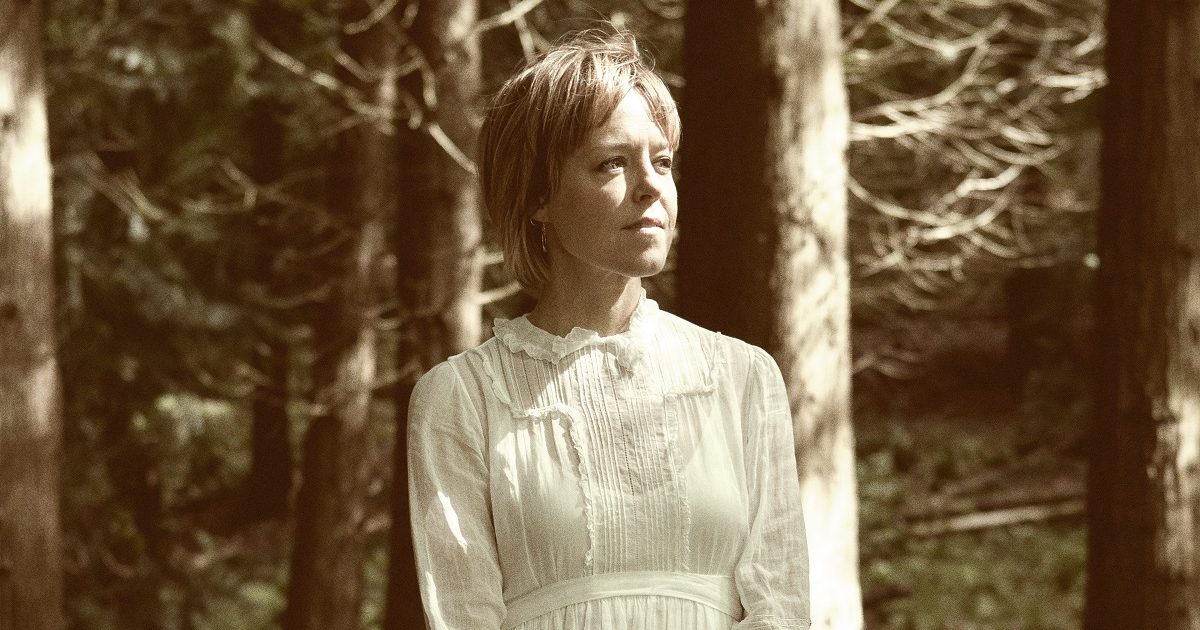
Emily Barker is sitting at home in the southwest of England, as the country sweats through its worst heat wave in 60 years. There’s something not quite right about temperatures of 90 degrees F and tropical downpours flooding the sleepy villages. It’s that kind of creeping unease that’s reflected in her new album, A Dark Murmuration of Words — a moving meditation on the state of the world today, in which climate change is a recurring theme.

Barker, who recorded the songs last November, worried whether it might be too much for an audience reeling from the pandemic. “Before the album came out I was wondering: are people going to want to hear these difficult songs at a time like this? Or do they just want escapism?” In the end, she decided to release them anyway. “I know myself I’ve been needing the hard stuff as a source of comfort to feel that collective experience of all the emotions we’re going through.”

In fact, her music achieves the perfect tone for the many unsettling feelings that COVID-19 has forced us to confront. Barker’s wistful melodies bear the listener along even as her evocative lyrics take you into uncomfortable territory. “Strange Weather” grapples with the real-life conversations she has had with her musician husband Lucas about whether to bring a child into a world under threat. “Any More Goodbyes” sounds like a breakup song, says Barker, but is actually a hymn of love to vanishing species. And “Where Have the Sparrows Gone,” with its haunting chorus (“they’re where the woods were once”), takes us into a not-so-distant future where birds have abandoned London, and the city is in lockdown.

The album captures the emotions of anyone struggling to take in the frightening predictions of climate scientists and witnessing the desperate fight of environmentalists like Greta Thunberg to bring humanity to its senses before it’s too late. “Last year the climate crisis was very much at the forefront of all of our conversations and thoughts, wondering what we can do to adapt, and feeling helpless and guilty and angry and upset and all these things,” says Barker, who admits she that even as an optimistic person, she had moments, in 2019, of feeling “really, really pessimistic about it.”

Her response was to try and change her perspective to focus on her closer community. “Sometimes that’s how we cope,” she says. “I have to focus on my immediate community and the things I can change, the conversations I can have, because I can’t fix the world.” Hence the presence on this album of a tribute to Wangari Maathai, “The Woman Who Planted Trees.” The Kenyan activist’s simple individual acts of tree-planting grew an entire movement, empowering the women around her with forestry and beekeeping skills, and educating thousands of people on ecology.

Barker’s new community focus manifested in all aspects of the album’s production. “I wanted to bring in as many local artists as I could,” says Barker, whose band was made up of good friends from the UK’s thriving South West scene, including her husband. “And not only the musicians but the painter who did the art cover and the filmmakers who did the music videos. That fit with the ethos of the album but also with lockdown — we’ve got limitations now and it’s a good reason to make the work happen here.”

Stroud, the town where she lives, sits in a beautiful landscape surrounded by rivers, lakes and rolling hills. She and Lucas have just moved into a new house, and are being visited by electricians and workmen when we talk. The theme of home has been a recurrent one throughout her work, prompted by the fact that she left her country of birth 20 years ago. Having grown up in a small country town in Western Australia, she came to the UK as a backpacker in 2000, and has made her life there.

Several songs in the new album remain redolent of her love for her homeland, from the vast night skies she conjures in “When Stars Cannot Be Found” to the nostalgia of “Return Me” and “Geography,” the music to which she wrote with English rock band 10cc’s Graham Gouldman. “Eucalyptus after rain remind me who I am again,” she sings, and it makes you wonder whether having two homes rather than one is a blessing or a burden.

“It’s less easy in some ways,” Barker agrees, “because I always have this constant question of where should I be. I’m always missing at least one place. Sometimes two places! You can feel quite fragmented.” Every year she escapes the English winter to spend 10 weeks with her family down under. She had just returned before the pandemic hit.

Barker wasted no time, when lockdown began, in reaching out to her neighbours. She saw the “viral kindness” forms that Extinction Rebellion had created and posted help slips through doors on her street, asking if anyone needed someone to talk to, or their errands done. “We had five vulnerable people who were living on their own give me a call and we started doing a weekly shop for them. It was such a good way of meeting people and gave us a sense of purpose, especially with festivals and gigs being cancelled seemingly every hour.”

Purpose and mission are clearly important to Barker. At university, aware that her Australian education had celebrated colonialist settlers and taught her nothing of the oppression and injustice they had brought with them, she sought out a course taught by Indigenous historians. “That was the trigger for me looking into structural racism,” she says. “I never understood growing up why in my country town there were so few Aboriginal people — we never learned about that.”

Recent years touring the US with her friend and mentor Mary Chapin Carpenter led her to research more widely. It was Ava DuVernay’s film The 13th, about the Constitutional amendment that abolished slavery, but allowed it to continue in prisons, which inspired her song “Machine.” Written before the killing of George Floyd, her lyrics prove uncannily timely, sung from the point of view of one of the architects of a system that has oppressed Black people for centuries.

“I covered all my tracks in books on history, justified my actions through anthropology,” she sings. And then, as if anticipating the Black Lives Matter protests that have since taken hold, “a crack has appeared, it keeps me up at night… I’ve been a bully and a sinner now I’m on the way out.”

She has seen, in Australia, how the arts have influenced politics by bringing untold stories and narratives to light. Some of her favourites are Indigenous singer/songwriters Archie Roach and Gurrumul. “I feel like the story of how Australia was settled is really well-known now among your average citizen,” she says.

So there remains hope in her outlook, however challenging times may appear. As she changes her own behaviour — flying less, taking trains when on European tours — she looks for ways to help others confront theirs. “Environment and equality are very important to me,” she says. “And it’s finding the right perspective to write that from and being respectful of the people in society who are suffering.”


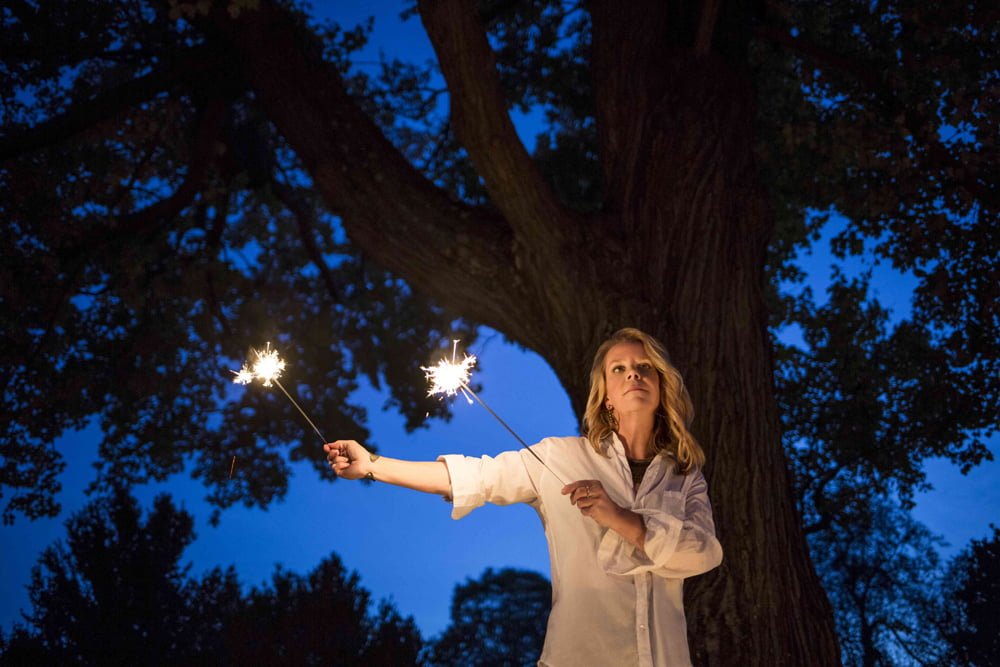
Photo credit: Emma John
Mary Chapin Carpenter Walks Us Through ‘The Dirt and the Stars’

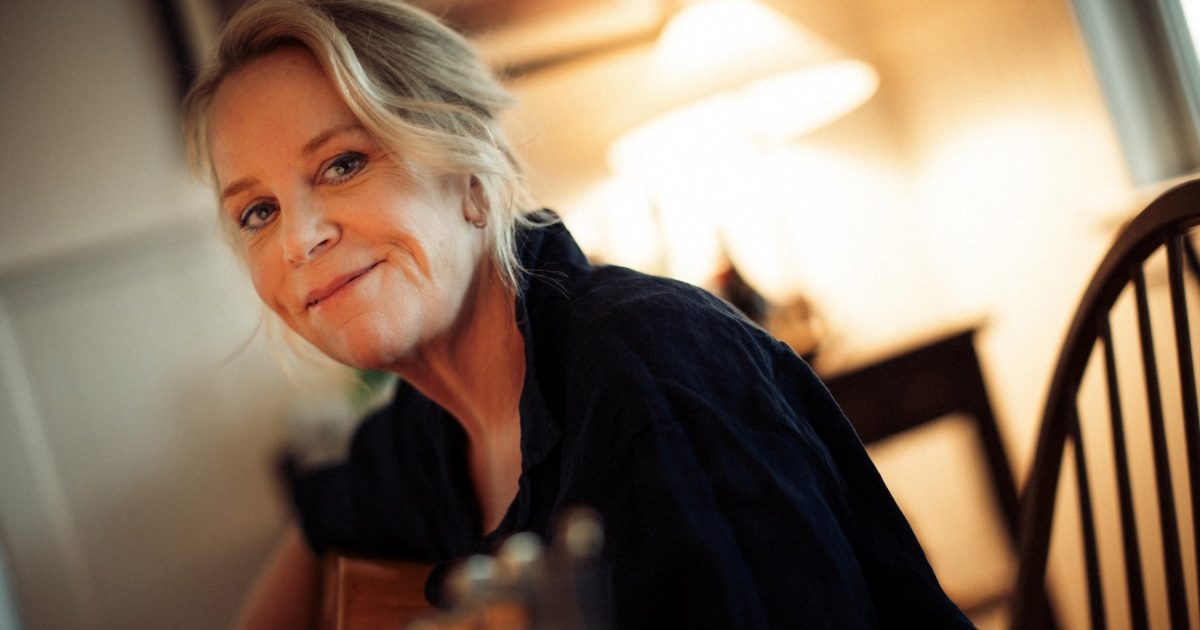
Mary Chapin Carpenter’s fans have got to know her kitchen well since the start of lockdown. It is a beautiful space, often ornamented with bright, round peonies from her garden. It makes you long to be as tidy, and as tasteful, as Mary Chapin Carpenter.

It’s in this kitchen that she records her Songs from Home series. She greets us with the tender familiarity of a family member on a weekly Zoom call. Guitar slung around her neck, she’ll share some snippet of news or wisdom before singing to us from a back catalogue so deep that there’s always something appropriate to the mood of the day. Often there’s an unscripted appearance, even an added harmony, from Angus, her golden retriever, or her cat, White Kitty. It’s less a house concert than a singalong with an old friend.

She’s in her kitchen again as we talk, this time making chicken stock. “I’ve got two enormous pots of chicken bones and carrots and celery boiling on the stove,” she says, and for a moment, it’s like an audience with Julia Child. “I get it started just before noon and then it simmers for about five hours. Just before dinner time I take it off and put it in jars. Then it’s there for whenever I need it.”

I tell her that I’d been wondering, from seeing the immaculate state of her kitchen on her lockdown videos, if she ever cooked at all. “Well, I make sure I clean the dishes out of the sink!” she laughs. “I love to cook. This kitchen is a place where I’m so happy. I wish everybody could come over and hang out!”

She pauses, as the thought strikes her. “These are things that you didn’t even think about, when this all started, about half the things you’d miss. It’s one of the pleasures of my life, feeding people around a table. I miss it so much.”

Carpenter was supposed to have continued her nationwide tour alongside Shawn Colvin this spring, playing songs from her new album, The Dirt and the Stars. With all gigs cancelled, and the travel that usually “balances” her introvert tendencies curtailed, lockdown has been challenging for Carpenter, who lives alone in the Blue Ridge Mountains.

“I’ve been very, very isolated for many months now,” she admits. “It’s a remote rural area, and I don’t need to leave the farm very often except to pick up groceries curbside and use the drive-through drug store. And just like everyone it can be tremendously lonesome and at times very hard, but my reality check at that moment is to remember that so many people are struggling so much more than I am. The minute I start feeling sorry for myself, that’s all I have to think about and I stand up a little straighter.”

After all, Carpenter quickly reminds herself, she is not completely alone — there’s Angus and White Kitty. “And here I am in this beautiful part of the world and I walk every morning for miles, I’m out in nature as much as possible and I really do try to use those elements of my life as meditation and medicine and inspiration.”

Her songwriting walks are a long-established part of her process, although she’s trying not to put pressure on herself to be creative during these extraordinary times. A friend recently phoned her and told her how the various things she’d hoped to accomplish while stuck at home were coming to nought, and how bad it made her feel.

“I said to her, and I think I was saying it to myself at the same time, who among us is going to be accomplished during this time? It’s asking too much. The best you can do in that moment of frustration is to be still and inhale and be kind to yourself.” She catches herself. “I know, it sounds very woo-woo and Oprah-like.”

Carpenter’s new album, recorded in January and February of this year, is arguably the most intimate and autobiographical of her career. But what’s particularly noticeable is the powerful thread of empathy that runs through it, along with a repeated message of tolerance for our fellow humans, all of us carrying our private burdens and flaws.

It’s there in the titles: “It’s OK to Be Sad,” “Secret Keepers,” “Everybody’s Got Something.” In “Where the Beauty Is,” she takes the image of kintsugi pottery — “the shattered pieces of a bowl/ Filled and fused with dust and gold” — to illustrate that our brokenness is what makes us beautiful.

The final song of the album, “Farther Along and Further In,” suggests that these discoveries are ones that Carpenter has been making herself: “There’s a crack in the armor, an opening/ My heart seeing out and my eyes see in/ Where they’ve never seen before.” She agrees with the analysis. “It’s like I’m writing about my own experience, but talking to myself at the same moment. And that new reckoning with self has everything to do with growing older, it’s directly connected to that. The wisdom that comes to you with growing older is the sense that you don’t care as much anymore about little things that used to nag at you. You’re able to let them go. You’re able to realise you can find sustenance and comfort and meaning in things you never did before.”

So much of life, she says, is struggling with oneself — wanting to be better, smarter, more accomplished. “It’s as if as you grow older you’re able to shed that somehow and not care as much. That’s the gift of growing older.” Even still, there are things that are hard to share, even in song. In her excellent three-part podcast, recorded with poet Sarah Kay, Carpenter shared the inspiration behind the song, “Secret Keepers” — born of a #MeToo experience in her past — and admitted to Kay that she found it difficult to reveal too much of herself in her work.

There are other difficult, poignant subjects, not least the death of her friend John Jennings, to whom she pays moving tribute in “Old D 35.” Her fellow songwriter and longtime producer passed away five years ago from cancer, aged 61. “We weren’t just musical partners — he was my best friend,” says Carpenter. “He had been my boyfriend years ago and we’d evolved into being oldest friends. I miss him every day — there’s a hole in my life that’s always going to be there.”

The talk of loss brings us to John Prine, who died of Covid-19 in April. “People are experiencing these losses and have been unable in many instances to even be there with their loved one when they pass away. There’s probably nothing crueller. I may be wrong, I’m just guessing, but I think this terrible disease and catastrophe became a lot more real when someone like John died of it. Sometimes things don’t seem quite real until they touch you directly.”

The scale of the pandemic was only just becoming apparent as Carpenter finished mixing the album. She had chosen to return to England, in order to work once again with Ethan Johns, who produced her last album, Sometimes Just the Sky. The West Country, where Johns’ studio is based, is one of the parts of the world Carpenter loves most, and she finds a beautiful symmetry with her own Virginia countryside. “I live in the northern part of the Blue Ridge, where the mountains aren’t so dramatic as North Carolina. It’s gentler hills and pastures and valleys and whenever I’ve spent time in that area in England near Bath, it’s real similar.”

She performed in a show in London before heading home to the growing crisis. “Someone said to me since, ‘You’ll be one of the few people who can say you had a gig in London in 2020!’” Even now, she can’t bear to ponder when her next live gig might be. “If I think about it too much I get really sad.”

It is no surprise to hear her vent her fury with the Trump White House. “This country is burning up because of the absolute abdication of responsibility of the current administration,” she says. “It’s a debacle, and I feel equal parts rage and sadness.” Her political outspokenness has often caused a backlash among parts of her audience — what she calls the “shut up and sing brigade” — and she says she’s still “incredulous” to hear it. “They’re saying that by deciding to be a songwriter or a singer you’re not permitted to have a conscience. I would direct them to Nina Simone, who said it’s an artist’s duty to reflect the times in which we live.”

Her passion for justice, both in her songs and through her support of organizations like the Women’s Refugee Commission, stems partly from the unusually global worldview she received during her childhood. Her father, an executive for the Asian edition of Life magazine, took his family to live in Japan for a couple of years when Carpenter was 11 years old. Her parents, prescient enough to know that they might never have the chance again, brought the children back to the US the long way, travelling through India, Hong Kong, Greece, Italy, and France.

It was, she says, a magical and eye-opening experience, and gave her “an understanding of what is necessary to be a contributing citizen of the world.” She notes, “My parents raised us to always speak out on behalf of people who have less than we do. That’s why it’s such an insult when people condemn artists for speaking out. I always think it’s a great loss when people feel they’re not able to speak their conscience.”

Still, a seam of hope for the future runs through this record, whatever present trials we face. “It’s disappointing to me when people think it’s a sad record – it’s almost as if they hear it and say, ‘There’s a lot of slow songs on here.’ Inherently it’s a record of looking toward the unknown future and believing that’s the best part.”

It’s certainly something she believes, as she return to the “solace and serenity” of the quiet farmland — to Angus, to White Kitty, and to her bubbling chicken stock.


Photo credit: Aaron Farrington

Hangin’ & Sangin’: Mary Chapin Carpenter

From the Bluegrass Situation and WMOT Roots Radio, it’s Hangin’ & Sangin’ with your host, BGS editor Kelly McCartney. Every week Hangin’ & Sangin’ offers up casual conversation and acoustic performances by some of your favorite roots artists. From bluegrass to folk, country, blues, and Americana, we stand at the intersection of modern roots music and old time traditions bringing you roots culture — redefined.

With me today in the Writers’ Rooms at the Hutton … Mary Chapin Carpenter. Hi!

How are you?

I’m good! This is fun already!

We’ve already been talking and having a great time.

Yes, bonding over all sorts of age-related issues. Good stuff. So now I guess we should talk about you and your record and all that kind of stuff, right?

If you’d like. [Laughs]

We could go back to talking about how many pairs of glasses we each have but … Sometimes Just the Sky — what a brilliant concept this was, this album.

Thank you.

Most people would have gone back and picked their seminal record and redone the whole thing. You didn’t do that.

No, and it wasn’t my desire to do a hits record or something like that. It wasn’t really to do anything at all. It was simply to mark time in a way where the idea was how does time — and the passing of time — if one were to pick a few songs, how would they hold up? How would they be different, if you recorded them 30 years on with half a lifetime already under your belt? How would they change? How would they differ? Would they hold up? Would they be dated? It was sort of an excavation and an experiment, but also the idea being to celebrate the passage of time.

I remember Sir George Martin — I may not have this word-for-word perfect — but he said something to the effect of, “Age is something you have to learn to deal with, if you’re lucky.” I love that.

Well, not everyone could go back through a 30-year career, to the beginning, and find songs that do still stand up, just as songs, but that also are still emotionally relevant that many decades later.

Well, you know, I think I certainly got lucky with the oldest song on the record, which came from the first album I made, which was called Hometown Girl, and it’s a song called “Heroes and Heroines.” And it does speak to our current times that we’re in in a way that’s kind of eerie. But that wasn’t something I immediately assumed would be the case. Again, it was like an excavation of sorts, figuring things out.

The inspiration for [the title track, “Sometimes Just the Sky”] was a Patti Smith interview, which I think is fantastic.

You’ve read it?

I haven’t. I’m gonna go find it, though.

You just Google — here we are in 2018 — “Patti Smith sometimes just the sky,” and it’ll bring you to this interview. It was this beautiful interview or talk she was giving in 2012, I think it was, to some young folks, and she was saying — and I’m paraphrasing wildly — but she was saying, “I’ve put out books of poetry that maybe 50 people have read. But if there’s something in your life that you love and are passionate about, you can think of it as your calling. And you have to pursue it and you should, but you have to be prepared for rejection and failure and other things in your life, because you’re living — loss and regret, heartbreak.” She goes on to list the things that you have to be prepared [for], the adversity of things.

Of humanness.

Of humanness. But then she stops and she says, “But on the other hand, life is magical and it’s beautiful and it’s amazing and it’s so worth it. It’s as simple as … a perfect cup of tea with a friend. Sometimes, just the sky.” And it comes right out. That phrase just carved its way immediately into my heart and, a few days later, I finished the song.

So many of the themes of the songs that are on the record speak to what she was saying. It was important to me that it be the title song. It was important to me that it be the end of the sequence to tie it all together, because all those themes — the connective tissue of these songs — it all sort of makes sense, in that regard.

It’s that idea of finding the things that soothe or comfort us, the beauty in things.

That’s one of the things in the lyrics. In the very last verse, it talks about making lists. Making lists of things that you know, and then when you feel like you don’t know anything, you start another list. You make another one. Things that are gratitude-based, things that just make you happy, things that you have to remind yourself to look up, you have to remind yourself to look out, you have to remind yourself to keep your heart open.

I’m gonna ask you questions based on song titles across your discography: Which beauty are you a slave to?

Love.

What lies between here and gone?

The unknown, and you have to be open to that.

That’s a hard one.

That’s a really hard one. I don’t know about you, but I think of myself as this person … I try to be open to everything and embrace the unknown and seek adventure wherever it may be, and yet the duality — I also know I’m this person who craves safety and security and order out of chaos. It’s really hard to have that coexistence.

I fully concur. What have you learned from the middle ages?

… Probably that the most wonderful thing is to get through them! [Laughs]

What do you need to be happy?

All the things that song [“Don’t Need Much To Be Happy’] lists. Books and food in my belly, driving toward home, a hand inside of mine … things like that. That song is a list song.

What would be the title of your life story?

To Be Continued

Watch all the episodes on YouTube, or download and subscribe to the Hangin’ & Sangin’ podcast and other BGS programs every week via iTunes, SpotifyPodbean, or your favorite podcast platform.


Photo credit: Aaron Farrington

Canon Fodder: Lucinda Williams, ‘Lucinda Williams’

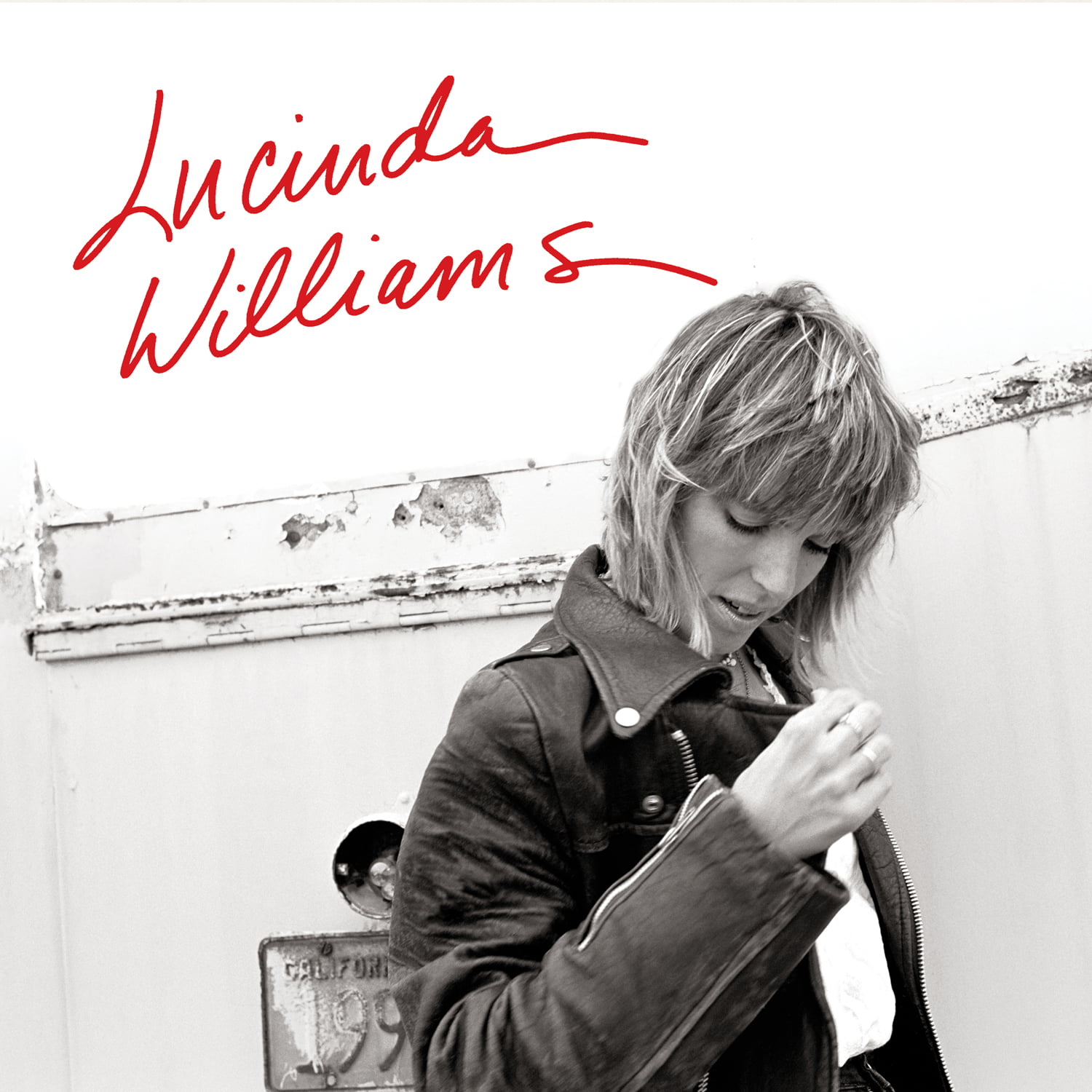
Because she spent so much time between albums — eight years between her second and third, six between her fourth and fifth — Lucinda Williams has been assigned a reputation as a perfectionist, as though country music must be approached with the sonic exactitude of prog-rock. But the near-decade interim separating 1980’s Happy Woman Blues and 1988’s Lucinda Williams doesn’t indicate a maniacal pursuit of a specific vision, although these songs are as close to perfect as just about any country album of that decade. Instead, the Louisiana-born, Los Angeles-based singer/songwriter spent those years redefining her sound away from acoustic blues to something closer to country-rock, moving out of Texas for Southern California, and trying like mad to sell herself to a record label. Recording Lucinda Williams took less than a month. Getting somebody to give a shit took significantly longer.

As Williams has said, in the 1980s, she was perceived as too country for rock radio and too rock for country radio. Lucinda Williams continually writes and rewrites its own rules, with each song presenting a slightly different definition of what “country” and “rock” might be. “I Just Wanted to See You So Bad” opens the album with a bouncy drum beat and a bright guitar lick, with Williams rushing through that title phrase, jumbling the words together as though mid-sprint. It’s full of hope and intense desire, both echoed on the story-song “The Night’s Too Long” and the list of demands “Passionate Kisses.” The blues still informs her songwriting, albeit in different forms: “Am I Too Blue” adheres to the country blues setting, but “Changed the Locks” is something new for Williams, a low-down urban blues tune surprisingly lascivious in its harmonica riff and humorous in its lust and self-delusion. “I changed the lock on my front door so you can’t see me anymore,” she testifies. “And you can’t come inside my house, and you can’t lie down on my couch.” Few singers — including Tom Petty, who covered the song in 1996 — could draw so much sexual promise out of the word “couch.”

Like Wilco’s Yankee Hotel Foxtrot, Lucinda Williams has become symbolic of the old art-versus-commerce debate, a manifestation of the grievous oversight of major labels and radio programmers, held up as evidence that the business of music, by default, ignores good music in favor of marketable product (as though there’s no overlap). Released in fall 1988, the album became a cause célèbre in Nashville, particularly among female musicians: Patty Loveless covered “The Night’s Too Long” in 1990, Mary Chapin Carpenter enjoyed her biggest hit with “Passionate Kisses” in 1991, and Emmylou Harris sang “Crescent City” on Cowgirl’s Prayer in 1993. You could almost reconstruct the tracklist with excellent covers.

Generally perceived as much more conservative than the audience or the artists it ostensibly serves, in the late 1980s, country radio was only just shifting away from the gauzy nostalgia of neo-traditionalists and the last sputterings of legacy artists and moving toward the hat acts who would define the genre into the next decade. In the fall of 1988, when Lucinda Williams finally made it to record store shelves, Dwight Yoakam, Rosanne Cash, Tanya Tucker, and the Oak Ridge Boys all enjoyed number one country hits. Noted country eccentric Lyle Lovett enjoyed two gold records in 1988 and 1989. Mainstream country music has become a thread-bare strawman for alt-country and roots audiences, but it wasn’t just the industry’s prudishness that kept Lucinda Williams off the charts and the playlists, despite that story’s persistence over the years.

It wasn’t something in the lyrics, either. There were rumors that radio executives objected to the prurience of the line, “His back’s all soaked with sweat,” sure to send housewives into a tizzy, but “The Night’s Too Long” was soon a single for Loveless. Williams’ voice was cited as a potentially alienating factor, one that blurred its syllables around the edges, slurring its speech after too many cold Coronas in some lost honkytonk. Williams replaces the recognizable twang with something more idiosyncratic, something more rooted in geography, something that was, at the time (and definitely still is), as foreign to country radio as ouds and zithers. Lovett’s deadpan drawl and Yoakam’s Bakersfield barb were similarly iconoclastic, but they were guys in an industry that preferred women more easily manageable and malleable (which is not to dismiss the self-possession of Williams’ female contemporaries, but more to speak to the considerable feat of their success).

Ultimately, Lucinda Williams just wasn’t designed for radio. It wasn’t meant for the mainstream. It has become exactly what it was supposed to be: a cult record, a foundational document, the wellspring of a new strain of music that would eventually be labeled alt-country. The Jayhawks might have debuted two years earlier, and Uncle Tupelo might have named the magazine, but this album — more than any other — revealed the limitations of Nashville and its neglect of very large swathes of country music listeners. Williams staked out all new territory. She had had a fairly itinerant life, born in Lake Charles, Louisiana, but raised elsewhere. She’d lived in Arkansas with her father, the poet Miller Williams, then Texas, where she made two albums of tentative country blues that even her most avid fans don’t spin much anymore. Most of her 1980s were spent in Los Angeles, which is perhaps the most significant aspect of Lucinda Williams.

That city was a mecca for country music as early as the Great Depression, when itinerant Southerners and Midwesterners moved west looking for work. Singing cowboys proliferated throughout the 1930s and 1940s before they were eventually replaced by crooners and rock stars. The term “country-rock” was coined in Southern California, thanks to Gram Parsons and the Beau Brummels (who recorded the overlooked Bradley’s Barn with Owen Bradley in 1968). Around the same time, Bakersfield became a powerful force in country music; roughly two hours north of Los Angeles, the town supported more than its fair share of roadhouses and honkytonks, where country music was played on electric guitars with strong backbeats and where Buck Owens and Merle Haggard cut their teeth.

Williams might have appreciated those artists, but at least on her self-titled album, her sound never borrowed much from those scenes. Instead, Lucinda Williams sounds bound to a city that, in 1988, would have still been viewed by those back east as a den of crime and ersatz glamour — cocaine and liberalism, yuppies and punks. The city’s punk scene had somehow made room for twang, with X spiking their punk with rockabilly (and sharing stages with Dwight Yoakam) and Lone Justice sneaking out of the underground with “Ways to Be Wicked.” As Williams told Spin in 2016, “There was an actual really cool thing going on out in L.A. in the mid-‘80s, [acts] like the Long Ryders, the Lonesome Strangers, the Blasters, Rosie Flores, and X. I was just opening for bands, and a lot of labels were noticing me and would come to my gigs, but nobody would sign me; they all passed on me, even the smaller labels like Rhino and Rounder.” It took an English label to finally sign her.

To call Rough Trade a punk label would be to minimize the breadth of its catalog, which included a remarkable mix of industrial (Cabaret Voltaire), punk (Stiff Little Fingers), post-punk (the Pop Group), pop (the Smiths), and things in between (Panther Burns). The label opened an American office in 1987, with a mission to sign more U.S. acts. Still, Williams was a departure for the label — a risky bet that paid off. Lucinda Williams peaked at 39 on the Billboard album charts and spawned two EPs in 1989. Her next album would be released by an imprint of Elektra Records, the one after that by Mercury.

The portrayal of Williams as somehow outside the industry — as an alternative to the mainstream — persists today, perpetuated by the woman herself. Williams has continually distanced herself from what she described to Billboard as the “straighter country music industry of Nashville.” In response to that interview, Chuck Klosterman calls her out in Sex, Drugs, & Cocoa Puffs and predicts “Lucinda Williams’ music won’t matter in 20 years. Oh, she’ll be remembered historically, because the brainiacs who write pop reference books will always include her name under W. She’ll be a nifty signpost for music geeks. But her songs will die like softcover books filled with post-modern poetry, endorsed by Robert Pinsky and empty to everyone else. Lucinda Williams does not matter.”

As with so many Klosterman statements, it’s provocative, entertaining, and demonstrably untrue. Fourteen years later, Lucinda Williams still matters — as a songwriter routinely covered by artists in a range of genres, as an industry cautionary tale, as an alt-country figurehead, as an artist boldly reinventing herself on her most recent albums. And Lucinda Williams matters perhaps even more — not because we’re still talking about it 30 years later, but because no one is really from Los Angeles. At its heart, this is an album about small-town transplants in big cities, about Southern ex-pats far from home, and few artists have taken up that musical sensibility as confidently or as comfortably as Williams, an LA native displaced in L.A.

“The Night’s Too Long” makes the theme literal, describing a young woman who sells her belongings to move to where things are actually happening. Williams gives her a name, a job, and a hometown in the song’s first line: “Sylvia was working as a waitress in Beaumont.” She moves away to “get what I want,” which might as well be the laundry list of demands on “Passionate Kisses.” Home and travel and loneliness and melancholy suffuse these songs. “Crescent City” recounts a trip back to Louisiana, where she — maybe Lucinda herself, or perhaps Sylvia — hangs out with her family, listens to zydeco, takes rides in open cars. “Let’s see how these blues’ll do in a town where the good times stay,” she sings, as Doug Atwell’s fiddle solo winds its way through those familiar backroads and across that “longest bridge” over Pontchartrain. It’s a poignant song for any listener who doesn’t live where they grew up. It’s the sound of rediscovering the joy and reassurance of home, a theme that ultimately transcends genre, industry, and even performer.

Mary Chapin Carpenter: Residing within the Questions

It’s been said with age comes wisdom, but for Mary Chapin Carpenter, it’s more likely to deliver questions. Where wisdom does arise for the now 58-year-old singer/songwriter is in living with them, rather than thinking answers offer any absolute understanding. “I think the questions are far more important than any answers,” she says. “Our job is to pose the questions and provoke each other to think about these things.” Carpenter has long exhibited an inquisitive nature, her music serving as the conduit for explorations both internal and external, but don’t expect her new album, The Things We Are Made Of, to provide shining pearls of knowledge. Instead, she remains content residing in the unknown. “I don’t know if I would describe anything as a lesson,” she says about her new music, “because that conjures up the idea that there was some kind of reckoning, in a way.”

Carpenter’s conversation contains a measured quality as she seeks to connect the shapelessness of thought with the structure of language, so that nothing gets lost in translation. Words, after all, don’t always naturally comprise the meaning that manifests internally. Based on the care and consideration she brings to her everyday speech, it’s easy to draw parallels to her writing process. Carpenter has long been a striking lyricist, her ability to capture phrases earning her five Grammys and 15 total nominations, among many other industry accolades.

Discussing how she approached songwriting, Carpenter explains reaching a place where she, quite simply, tried to get out of her own way. “It was a very gradual sense of trying to be as un-self-conscious in writing as possible, and to feel as open to the world as possible. I think that inspiration is everywhere you look, and you have to be open to it, let it sort of filter in.” As freeing as that openness sounds, it also involves uncertainty. To be open to an experience arguably means discarding any expectations or control attached to it.

In the album’s first song, “Something Tamed Something Wild,” Carpenter explores relinquishing control and enjoying the journey, rather than the destination, as a result. It’s a sentiment long-touted to an increasingly frenzied and fast-paced population, but under Carpenter’s care, her lyrics do what they do best: evoke a remarkable level of honesty. “So the things that matter to me now are different from the past / I care less about arriving and just being in the path / Of some light carved out of nothing / The way it feels when the universe has smiled,” she sings, breaking beyond the meter while the melody and rhythm hold tight. As a result, the platitude’s original meaning takes on refreshing perspective grounded from her subjective experience.

Carpenter also plays with the chorus throughout the song, revealing the heart’s complexities: Treasures become lessons become echoes become voices become love. She creates a space where juxtaposing forces exist within the same moment, which finds its culmination in the chorus’s final line, “Something tamed, something wild.” That phrase, perhaps, pushes against the cultural tendency to position people — but, really, women — in either/or spaces. To be both tamed and wild moves beyond a restrictive dichotomy to rest in the messiness that living entails and further emphasizes what she offers as a songwriter.

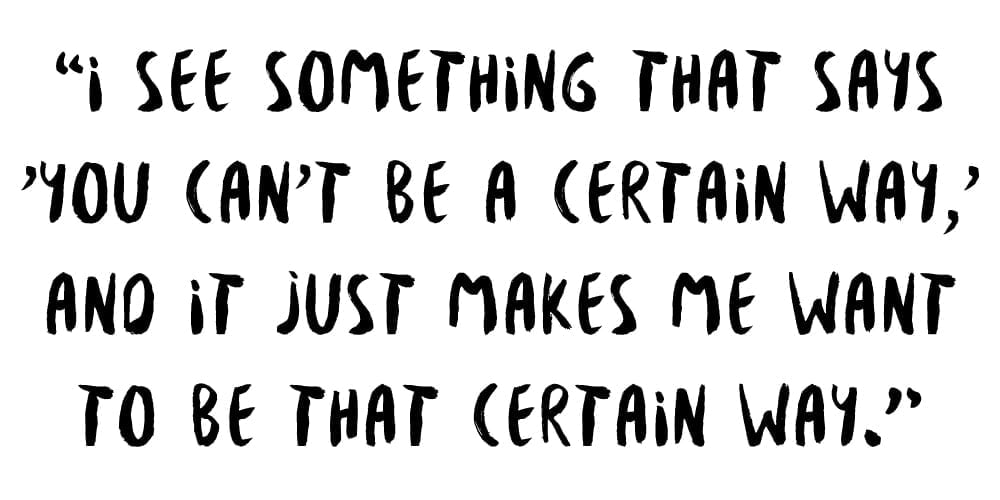
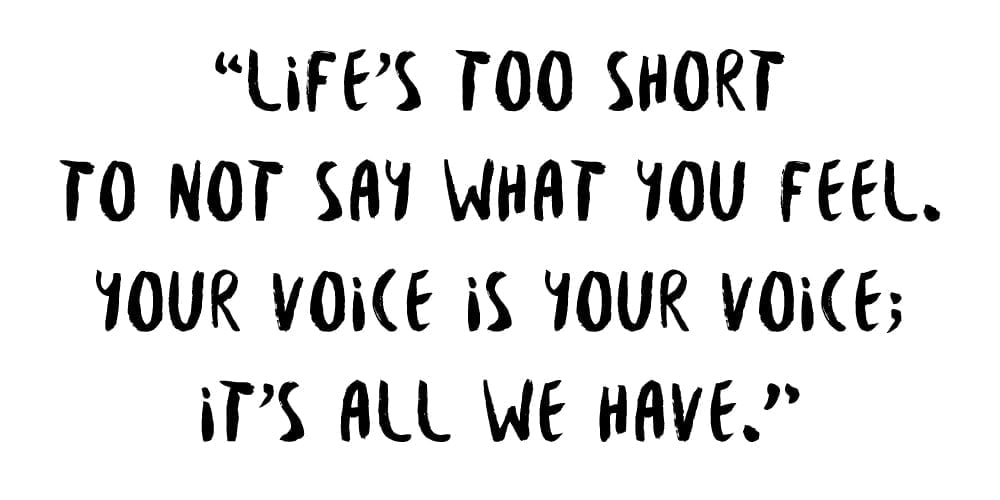
Carpenter admits, “I’ve never in my life felt limited by anything other than myself,” but that doesn’t mean her own experience blinds her to what takes place all around her. “I’m fully aware that, in our culture and in our society, there are myriad limits and boundaries and ridiculous glass ceilings and etiquettes from top to bottom,” she says. “I know those things exist. Maybe I’ve gotten myself in trouble here and there by either ignoring them or mouthing off about them or whatever it is. I see something that says you can’t be a certain way, and it just makes me want to be that certain way.” Any conscious pushback on her part derived from her refusal to be silenced by what others might think. Of course, Carpenter shares, there have been negative letters and comments and opinions, but that hasn’t made her rethink her approach to songwriting. “Life’s too short to not say what you feel. Your voice is your voice; it’s all we have. To even contemplate not using it … I can’t even contemplate it,” she says earnestly, her dusky timbre expressing an assuredness that only comes from someone comfortable in her own skin.

Aging — especially reaching an age where society tends to look away — manifests thematically on her new album. But, again, she refuses to take any experience at face value. Carpenter says about the current youth-obsessed culture, “When you get to this place in life, it emphasizes loss and the things that you no longer have, and I feel like that is not digging deep enough.” The album’s second song, “The Middle Ages,” touches upon the surprise of finding yourself older, as well as the questions that follow. Carpenter turns what at first could come across as a melancholy reaction into a celebration. “And way back in the back of your mind, you heard something getting through / Like some beautiful passage without words welcoming you / To the middle ages,” she sings, the song’s lead guitar producing a lighter melodic layer to contrast her deeper vocals.

Carpenter exhibits a sense of pride discussing the years she’s achieved, turning to one of her favorite philosophers, G. K. Chesterton. If ever she can’t hit upon the meaning using her own words, she’s more than comfortable leaning into someone else who has influenced her. Chesterton is one in a series of references that pepper her conversation. “He talked about how, when you’re young and something bad happens, it often can feel like the end of the world,” she explains, “but when you’re older, he says, ‘The soul survives its adventures.’ It’s that great inspiration that comes to people who are middle-aged. You don’t care as much what people think. There’s so much freedom in that; there’s so much autonomy. You have a greater sense of purpose, you have a greater sense of control over your own life, you realize how important personal growth is, having these experiences that challenge you to think about yourself.”

If it wasn’t clear already, Carpenter is an avid reader, her mind stacked full of stories, poems, authors, and more — each of which has helped her face that challenge of self-discovery and each containing an important message clarifying the experience of being alive. My Name Is Lucy Barton by Elizabeth Straught is one such book. In it, a writing instructor character says, according to Carpenter, “Each one of us, we only have one story. And you’re going to write that story a thousand different ways. Don’t ever worry about your story; you only have one.” She found it applicable to her craft. “When I read that, what it made me feel like is, ‘Yes, I have one story and the songs are the ways I write it a thousand different ways,’ she says. “That’s what they represent.”

For Carpenter, the telling has naturally changed as she’s gotten older, but she doesn’t recognize age as a limit, nor should she. The prolific songwriter has put out 14 albums, infusing each with a degree of thought that not only makes her an important voice but a necessary one. It’s a point she sees reflected in her fellow musicians. She says, “I love how vehement Lucinda Williams, an old friend and someone I admire so much, is. She was talking recently in an article and she makes no bones about saying, ‘I’m doing the best work I’ve ever done.’ For her to say that without apology is so wonderful, so refreshing. Shout it from the mountaintops!”

While she takes a more modest tone when discussing her own work, it’s clear she’s proud of The Things We Are Made Of, but also the new direction in which it pushed her. She partnered with producer Dave Cobb (Jason Isbell, Chris Stapleton, Lake Street Dive) for the first time. “As you can imagine it was terrifying to show up and you’ve never worked with someone before,” she says. “You’re putting yourself in their hands.” Curiously, Cobb did not want to hear her songs ahead of time. In the end, his process allowed Carpenter’s voice to shine through without weighing it down with unnecessary instrumentation or overproduction. “He wanted to be as responsive in an immediate way as possible,” she explains. “I didn’t know what to make of it.”

She adds, “He really pushed me to do certain things, but he freed me up, as well. I trusted him. It was a wonderful, wonderful experience.”

With yet another album to her name, Carpenter continues to serve as a kind of contemporary philosopher, mining questions for what they offer in and of themselves, rather than seeking answers from the very start. Hers is neither a naïve nor a quixotic outlook, but one willing to view all experiences — both good and bad — with a degree of curiosity that only benefits the recipients of what she’s learned and is learning. Referencing yet another meaningful figure in her life, Sir George Martin, she says, “One of his favorite things that he used to say is that, ‘Age is a thing you have to live with, if you’re lucky.’ If we’re lucky enough to reach this point in time, we get to be the beneficiaries of this wisdom that can only come with reaching this point and time. I think that’s a big thing.”


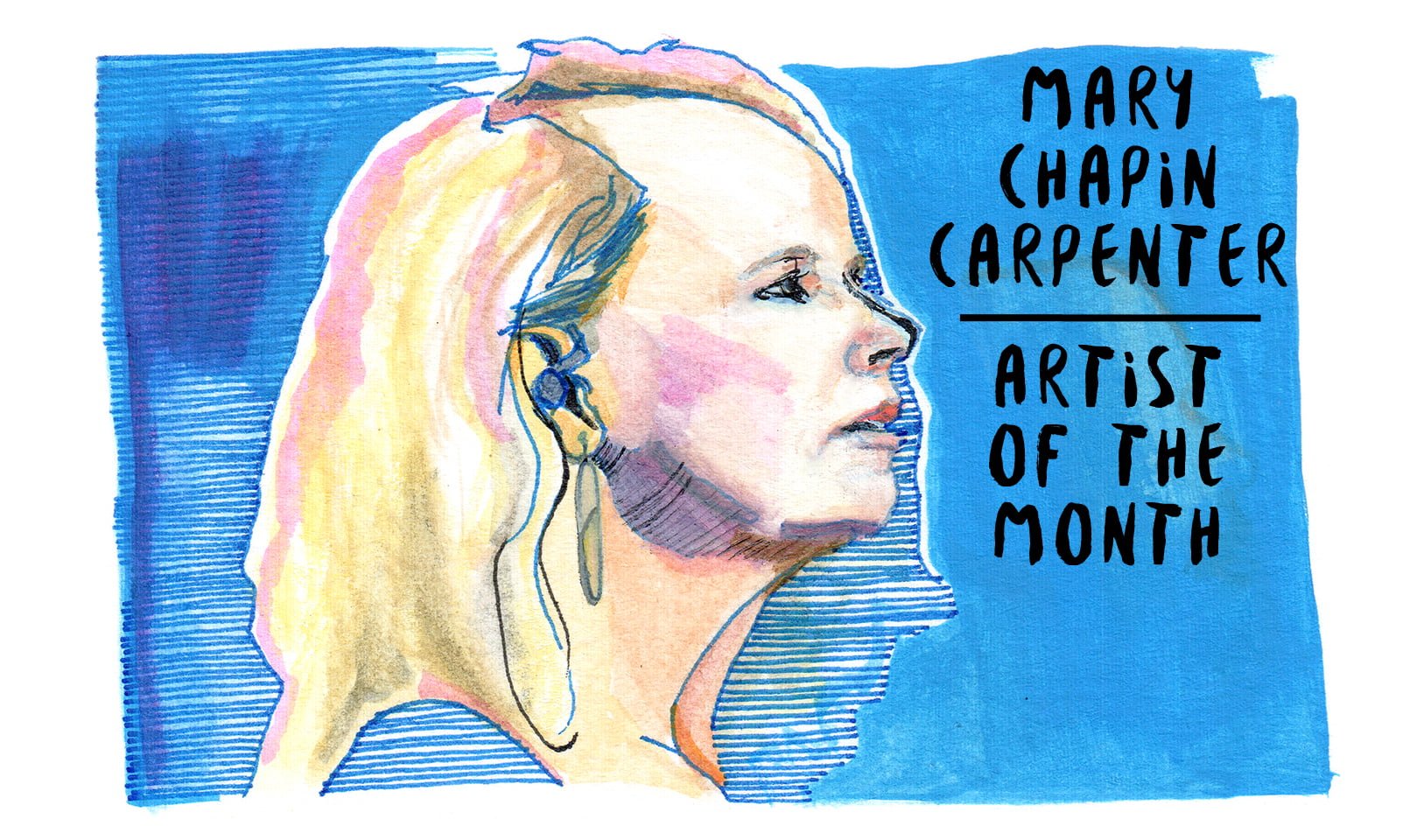
Lede illustration by Cat Ferraz.

LISTEN: Mary Chapin Carpenter, ‘The Blue Distance’

Artist: Mary Chapin Carpenter
Hometown: Princeton, NJ
Song: “The Blue Distance"
Album: The Things That We Are Made Of
Release Date: May 6
Label: Lambent Light Records via Thirty Tigers

In Their Words: "The Icelandic writer Roni Horn spoke of the world as being 'blue at it’s edges and it’s depths … the color of that distance is the color of emotion, the color of solitude and desire … the color of where you are not. And the color of where you can never go …' This song attempts to speak to these things — how they make us who we are and how deeply we need people in our lives to understand these things in us." — Mary Chapin Carpenter


Photo credit: Aaron Farrington

The Natural Course of Things: A Conversation with the Infamous Stringdusters

What do you get when you cross a bunch of roots-minded female singers with a bunch of bluegrass-adjacent male musicians? Why Ladies & Gentlemen, of course the new release from the Infamous Stringdusters which features appearances by Joan Osborne, Lee Ann Womack, Mary-Chapin Carpenter, Abigail Washburn, and eight more of the finest voices roots music has to offer. It's the sixth record in nine years for the band — which is comprised of co-founders Chris Pandolfi (banjo) and Andy Hall (dobro), along with Andy Falco (guitar), Jeremy Garrett (fiddle), and Travis Book (bass) — and it showcases why the Stringdusters are considered one of the most innovative groups currently on the circuit.

First off, kudos on some great guests. [Joan] Osborne and [Lee Ann] Womack are two of my all-time favorite voices. So, did you guys just put a bunch of singers' names on a dart board and start throwing? How'd you figure out who you wanted?

Chris Pandolfi: The concept for this thing was two-fold: On the one hand, we wanted to do something different, as far as an album goes, just to mix it up. But a big part of it was also that we had made a lot of great friends along the way and we thought, “Who could we utilize, in terms of special guests?” And this concept evolved out of that — “What if we call on some of these awesome lady singers that we've met over the years?”

As the process started, the list was mainly comprised of people who were more in our community, in our musical scene. But, then, of course, some of those names were not, necessarily, people that we knew before the advent of this project — like Joan Osborne. The list was a combination of the two and, as the material evolved and we were getting a feel for the aesthetic of these different songs, we just did the best we could. Once the list was close to what we thought it would be and we got some confirmations from people, we — along with our producer — just did our best to match up what songs we thought would be best for each lady.

To me, that's one of the awesome successes of this album: It really uses these artists, I think, in a context that works for them. Look at the Joss Stone track or the Lee Ann Womack track … or Celia Woodsmith, who had the perfect voice for that song. All the ladies, in their own ways, brought their thing to the project and I think, in the process, they helped us take these songs and make them something that we couldn't have necessarily done on our own. They helped us make the most of all these unique and different sounds and styles that they have. It really came together that way. Certain people weren't able to do it, and the list filled out from there. But where we ended up, as far as the guests and what songs they were on, I think that's one of the cool successes of the album. The song “Have a Little Faith” was actually written for Joss Stone, with her in mind. I know that.

I was going to ask … considering that the span does run from Joss Stone to Sarah Jarosz, which came first — the singers or the songs? Did you write for specific voices or was that the only one?

Andy Hall: Yes, I believe so. Aside from that, we all write individually or co-write or whatever and bring songs to the band. So we all had songs, individually, that we were ready to bring to the next project. But I think that was the only one that was written for the singer. In other instances, say for Aoife O'Donovan, hearing that song “Run to Heaven,” it sort of reminded us of Crooked Still, just the way that sounded. In that instance, that became clear that would work that way. Each song just triggered a little something … an idea. That was one of the fun, creative parts — who would sound good on what song.

So how'd you figure out that Joss likes a little bluegrass in her soul?

AH: [Laughs] Andy Falco was hired to play in her band for a Rock in Rio festival a number of years ago. That's how that connection came about. Our connection with Joss was one of the things that inspired this record because Joss came to the States, and we opened up for her in Kansas City. She wanted to do a video of us and her playing together, during the day. She sang our song “Fork in the Road” with us backing her up for this video project she was doing, and it just sounded so cool. That was one of the sparks for this project. But that's also how that connection came about.

Interesting. Who was the first to say yes? And who was the biggest long-shot you can't believe you landed?

CP: Hmmm … Who was the first to say yes?

AH: The first person who recorded with us was, I believe, Jen Hartswick who didn't sing, but played trumpet on a number of songs. Then Mary-Chapin Carpenter was the first vocalist to put her track down. She was in Nashville while we were tracking. But, as far as asking, I don't remember.

How free were the reins when it came time to let them do their thing? Was it, “Have at it, gals!”

CP: Our producer was on hand for every session, I think, except for one or two. He did a really great job with this project — Chris Goldsmith — just in terms of staying true to his vision, which a lot of it was sonic, and he got a really cool, consistent sound across the record, although there is a real variety of styles there. I think that vision extended into how these songs would sound best. But, then again, there were cases — Joss is a great example … that track, by design, was made to let her do her thing which is to cut loose and almost improvise a lot of the phrasing. In cases where that would make the music come to life, that's what happened. In other cases, probably Goldsmith had a clearer vision of how it was supposed to sound. To some extent, every song was about letting these ladies do their thing.

The Sara Watkins track jumps to mind. She has such a compelling vocal on there and it's all because she does her thing. There's a moment where she really goes for it, and she's such an awesome singer and performer that the idea of getting her to do her thing, that's the whole point. So, to some extent, I think that was going on with everyone.

Obviously, all the guest vocalists aren't on the road with you, so how are you touring this record?

AH: We have Nicki Bluhm on the road with us for this whole tour and she is really helping. She's singing a lot of the Ladies & Gentleman songs that we do. Sometimes we'll do a few just on our own, but Nicki's on every show for the whole Spring tour so she's singing a lot of it. We also had Della Mae opening for it on a bunch of it, and Celia Woodsmith would come up and sing her song.

It's amazing how you cross paths with musicians on the road and that's, initially, how we made a lot of these contacts. We ran into Aoife O'Donovan — she was in L.A. when we were there recently, so she came and sang with us, and did a Jam in the Van session with us. We've designed part of the tour to have female bands supporting us, so we have Paper Bird coming out to open some shows and, hopefully, they're going to be able to help share some of the vocal duties. We have a lot of guests, but Nicki is anchoring all that.

More broadly speaking, you guys are very invested in being innovators within “bluegrass.” That's often a very subtle thing, though, right? So break it down … what are some of the things you guys do to open it up a bit and set yourselves apart while still honoring the traditions?

CP: One big thing that we're really focused on, consciously, is playing our own original music. The process of crafting original music is the thing that, simultaneously, helps us develop our sound as a band. We have a lot of co-writing going on, but mostly we arrange the music together. And we just try to figure out new ways to make all these instruments go together and distill all the different styles and influences into one sound that makes sense. We're pretty conscious about that.

We're really conscious about our live show. We're pretty committed to making the live experience really different every night. Of course, we're not the first band to ever do that, but we just try really hard to do our own version of that. And our fan base has come to expect a lot of variation and innovation, as far as on a night-to-night basis. They expect to see something different, and we're playing almost three hours a night, so we have to mix it up for our own sakes, too. Those are two big ones: playing our own stuff and focusing on having that live show be something that is really predicated on being different every night.

AH: One thing, specifically, that I know we've worked on a lot in the past few years is that we don't have a mandolin, which a lot of bluegrass-type bands have. The mandolin is a key rhythmic thing. Since we don't have that, we've had to get really creative with how we play rhythm and play rhythms that are not, say, bluegrass. Like on the Ladies & Gentlemen record, there are a lot of songs that don't have a traditional bluegrass beat. We've consciously spent a lot of time developing unique ways to play our instruments that you wouldn't necessarily expect or hear in other string band contexts. Myself being a dobro player, I take a lot of the rhythmic responsibilities, which is not a common thing. Not having a mandolin, we've had to get somewhat innovative with how we create rhythm and play grooves that aren't necessarily bluegrass. To me, that's something unique that we do.

It seems like there has to be a lot of trust between the band and the fans. You have to trust that they're going to follow you wherever you go, musically. And they have to trust that you're not going to do some crazy, way out of left field thing. Do you ever worry about splitting the difference in such a way that you isolate them … or any part of them?

AH: Well, yeah. The scene of traditional bluegrass and, say, the broader music scene that we're playing more in now, there is quite a difference there. We've chosen to be part of a music scene that is broader, where we play in festivals that are not just bluegrass festivals. I think, in that context, it's not quite as strange to have music that is slightly more creative, record to record. A lot of the fans we're appealing to are a little more used to that. But this is the first time we've ever done a record like this that is a very different, specific vision. Sure, you certainly wonder, “What are people going to think?” [Laughs]

CP: And we have, over the course of our career, definitely alienated people. That's part of the natural course of things. What we do is our thing. We decide where the music goes. That's one of the cool upsides of not being in what most people would perceive as a more popular style of music: You're not really beholden to any record label or anything like that. In the grassroots scene, there is some idea that your fans are going to follow you wherever you will go. Obviously, there's an extreme there and there are anomalies to that rule. But, for the most part, we're lucky: We have these great fans who want to check out all the different voices.

I have a side project that involves electronic elements and it's clearly not for the hardcore bluegrass people of the world. But there are plenty of people in our fan base who, though they don't listen to anything like that, they are excited for that to be their introduction to this musical world. I think that's a good glimpse into the way they think. They're like, “We love this band. We want to see what they're going to do. If this particular thing is not my cup of tea, then there's always going to be another album that comes out.” I think they are getting used to the fact that there are a lot of variations between projects and between songs and the live show, so it's almost part of the whole thing. So, for me, I'm not ever too worried that they're not going to dig it. As long as we make music that we believe in, I think our fans will get behind it.


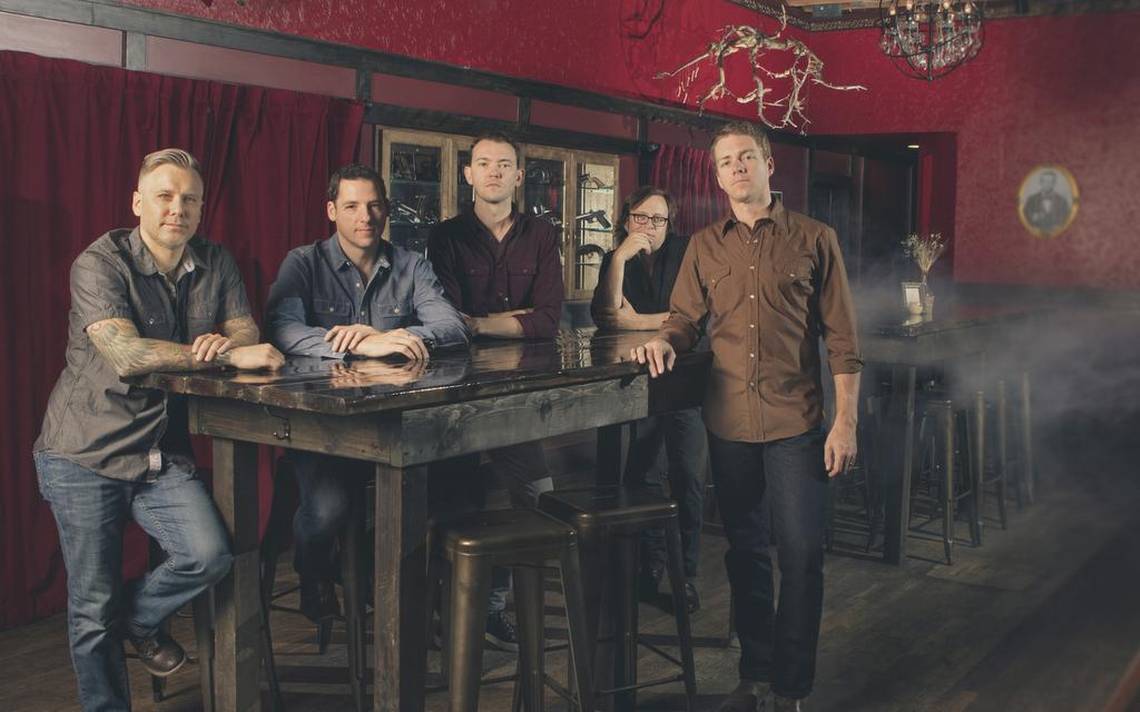
Photo credit: McCormick Photos & Design, LLC