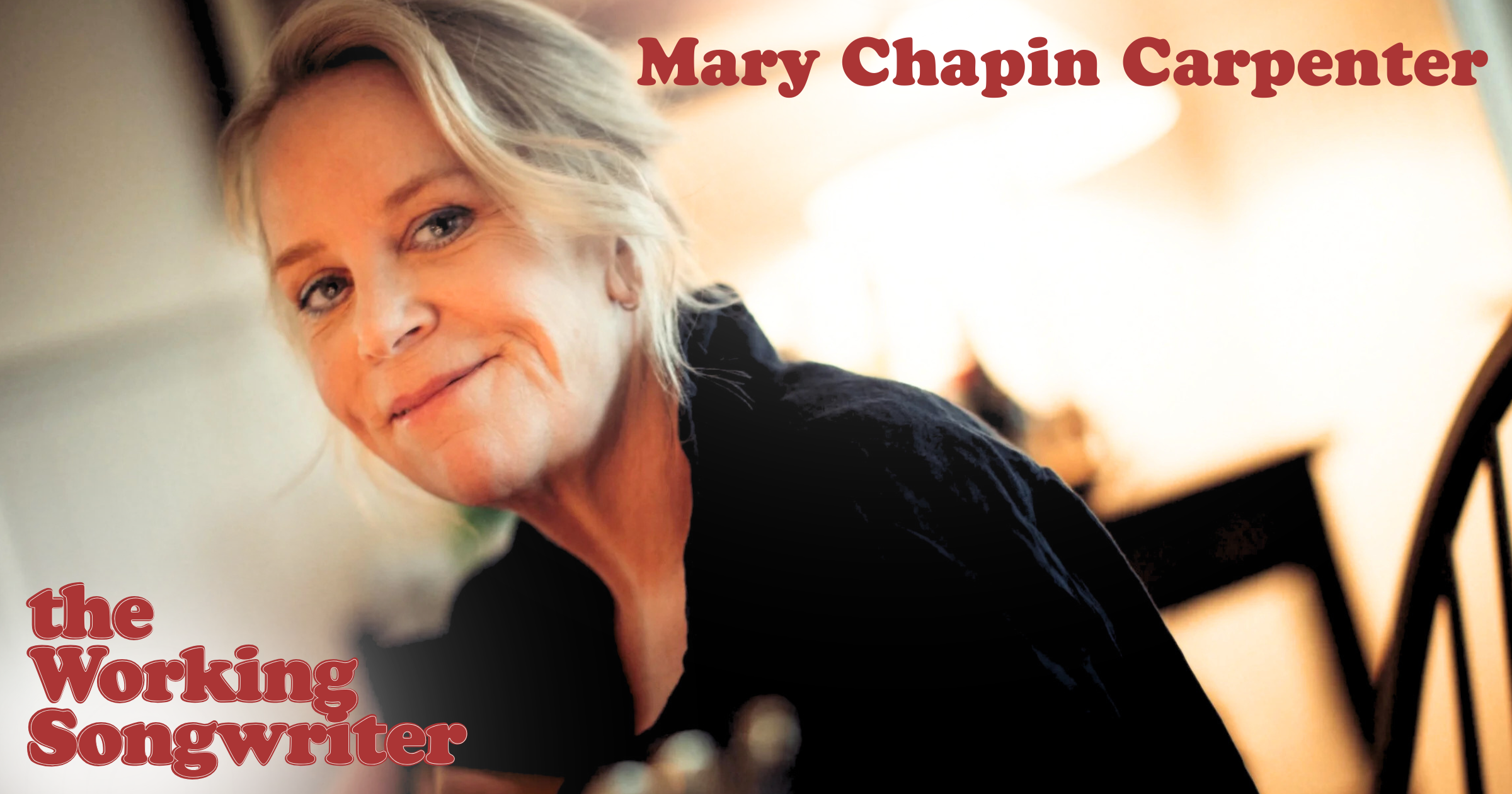
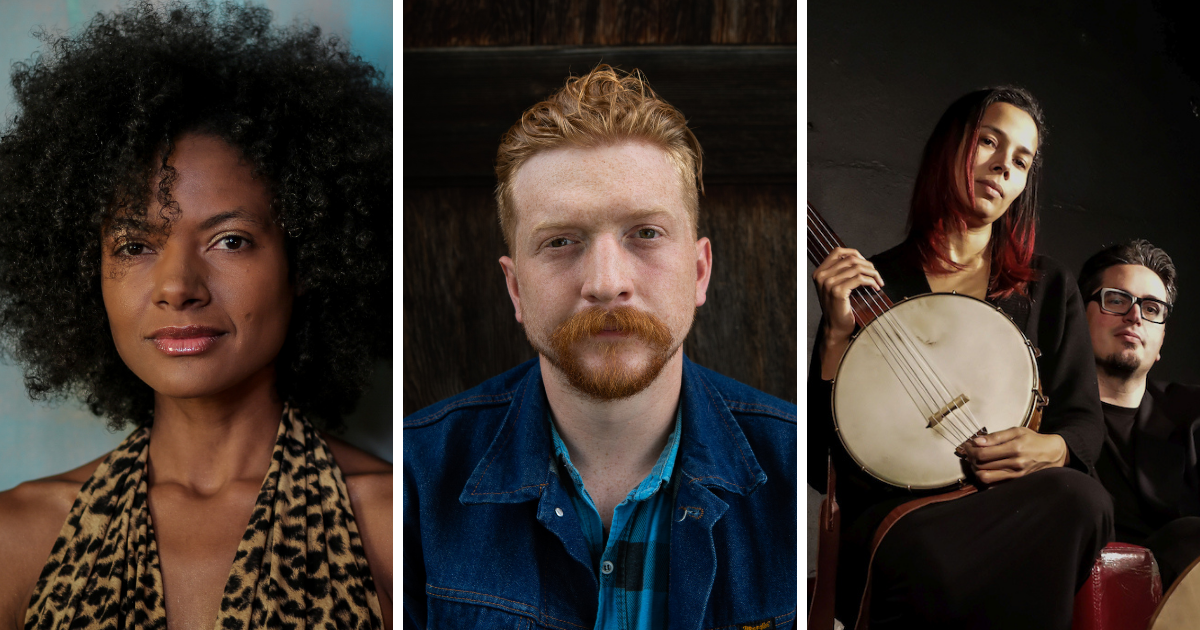
Our guest this week on the Working Songwriter hails from my neck of the woods, Washington, D.C. Mary Chapin Carpenter got her start in the proto-Americana music scene of 1970s and ’80s D.C. She broke out of that local circuit with her signing to Columbia Records; her 1992 album, Come On Come On, went quadruple platinum.
Carpenter has toured with Emmylou Harris, Shawn Colvin, and Rosanne Cash, she’s won five GRAMMY Awards, two CMA Awards, and two Academy of Country Music Awards. Her song, “Shut Up and Kiss Me,” went to the top of the country radio charts. She has appeared on the Late Night with David Letterman and Rolling Stone calls her “one of the most grounded, sentient songwriters of her generation.” NPR has said that she’s “a singular voice in country and folk” and the New York Times praises her “intelligent, literate songwriting with emotional depth.”
Simply put, she’s an all-timer. I got a chance to catch up with her earlier this year and hear about her musical journey so far.
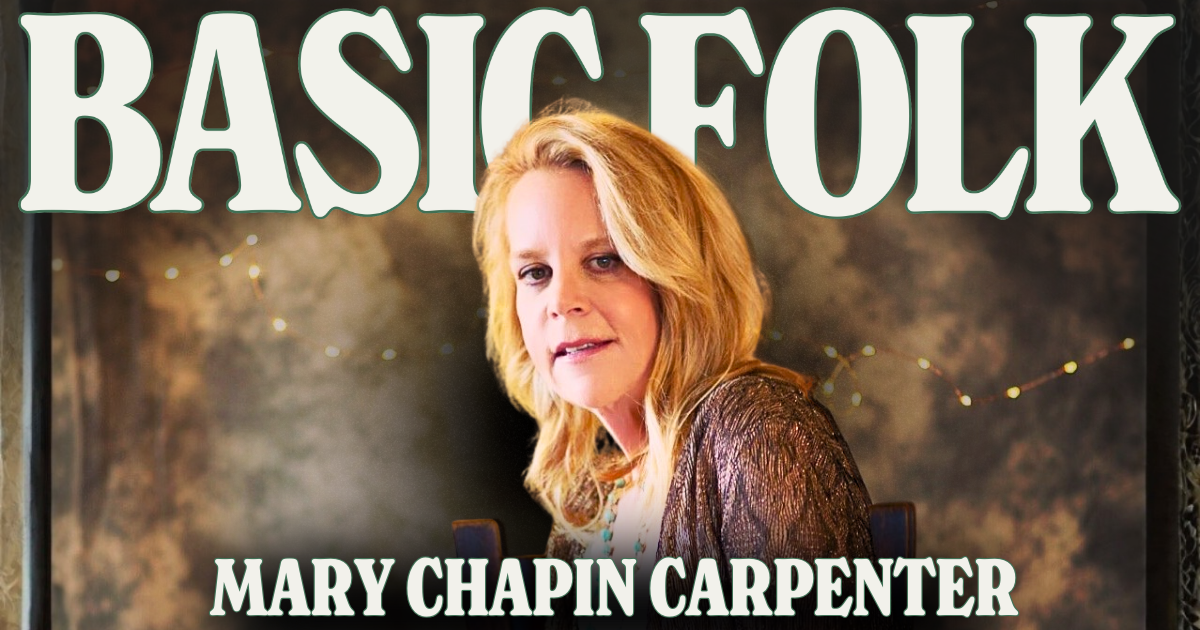
Mary Chapin Carpenter’s latest album, Personal History, is as lush in production and color as the beautiful farmland she calls home in Virginia. Carpenter will often wake up early for sunrise walks with her dog, Angus, and one of several daily cups of coffee (of course) to start the day. In our Basic Folk conversation, she reflects on how living in this serene farmhouse has brought her peace, drawing parallels to Carl Sandberg’s “creative hush.” Mary Chapin also discusses her method of “song walking” as a tool to overcome writer’s block, often accompanied by her pets.
Carpenter goes on to touch on her evolving relationship with fame and the importance of surrounding herself with grounded people; she reveals her younger self was shy, and talks about how being less concerned with others’ opinions has empowered her over time. We cover her connection to the Celtic music community and how it inspired her collaborative album Looking for the Thread with Scottish musicians Julie Fowlis and Karine Polwart. That record was her first with Josh Kaufman as producer and it worked so well, she decided to have him produce her new solo album, too. We also chat about “hyphen-gate,” due to her double first name, the process of feeling visible and valued, and the impact of Elizabeth Strout on her perspective of songwriting.
During the 1992 CMA Awards, Kathy Mattea had a decision to make. The singer-songwriter and 1989 and 1990 CMA Female Vocalist of the Year had opted to wear four red AIDS awareness ribbons, which had become prominent at award shows such as the Tonys, the GRAMMYs, and the Oscars. In ‘92, the Country Music Association decided to hand out green ribbons to promote environmental protection. According to a Billboard article, reports of the CMA’s decision sparked controversy and the organization reacted by offering to distribute red ribbons to artists backstage.
But there was no plan to publicly address the disease on the broadcast. After a local columnist wrote that country fans may not know what the red ribbons symbolize, calling for Mattea to publicly speak out on AIDS – which had become the number one cause of death for all Americans ages 25 to 44 – Mattea realized simply wearing the ribbon was not enough.
“We went to the CMA and said, look, we’ve been called out and I don’t wanna grandstand and I don’t want to go against you guys, but can you help me?” Mattea says. “We basically got no response. So the night of the show I had to decide what I was going to do. I didn’t want to be sanctimonious… How do you stand up in a moment when you feel called to do something bigger? I just went backstage during the commercial before and searched my heart.”
When Mattea took the stage to present, she spoke the names of three of her friends who had died from AIDS. One of those names belonged to her dear friend Michael, who had died without ever telling Mattea he had the disease.
“The problem was he couldn’t tell me,” she says. “You didn’t know who you could talk to and who you couldn’t back then. It’s hard to fathom now, but that’s the way it was.
“Something in me just kind snapped and I thought, I’d like to do something to help. I had a long talk with my manager and I was like, these people in New York who are working on this, they don’t even know that I’m down here in Nashville and we’re dealing with it, too.”
Mattea got in touch with the Red Hot organization, which was founded by Leigh Blake and John Carlin in 1989 to raise awareness and financial support around the AIDS epidemic. Carlin, who got his start in the New York art world, where he curated shows at the Whitney Museum of American Art and befriended artists such as Keith Haring and David Wojnarowicz, had already experienced immense loss among his friend group.
“Being in New York in the 1980s was at the start this kind of paradise liberation. There was all this creativity. If you think of the late ‘70s and early ‘80s in New York, it’s when hip-hop, punk art, music, the East Village arts scene, graffiti, all these things were really being born culturally,” Carlin says.
“Then by the mid ‘80s, the specter of HIV and AIDS turned what felt like a paradise into an inferno. All of a sudden people that you would see at parties or at openings – you’d go, ‘Where’s Nicholas?’ and people get that kind of quiet look and say, ‘Oh, he’s sick. He’s in St. Vincent’s.’”
Carlin, who had since left his job as an art curator to work as an entertainment lawyer, began working on Red Hot’s first project, 1990’s Red Hot + Blue, a compilation album featuring pop and rock artists such as Sinead O’Connor, Debbie Harry, Iggy Pop, U2, David Byrne, and more covering the songs of Cole Porter. The album was a smash hit, raising money for AIDS organizations, including ACT UP, a grassroots protest movement which successfully pushed the government and pharmaceutical companies to release drugs that now allow people to live with HIV.
Despite its success, Carlin had no initial plans to release more Red Hot compilations. He left the law firm where he was employed after the partners gave him an ultimatum. (“My reward for [organizing the project] was basically the partners of the law firm said, ‘stop doing that or leave,’” Carlin says.) Then he received a phone call that would change everything.
“I got a call from George Michael’s manager saying George was a big Red Hot fan. He wants to contribute a song to your next album,” Carlin says. “At the time, we didn’t have a next album. But, in 1991, if George Michael says he wants to give you a track, we were like, ‘Well, we better get an album together.’”
In 1992, the organization released Red Hot + Dance, featuring Michael, Madonna, Sly & the Family Stone, Lisa Stansfield, and more. The album cover featured artwork by Keith Haring. No Alternative, featuring Nirvana, Soul Asylum, Pavement, Patti Smith, and more, followed – and even spawned an MTV special with live performances. AIDS awareness was becoming a key issue among the MTV generation, but the country music industry was still mostly silent.
“I don’t think the seriousness of the problem has hit home yet with the country audience,” Mark Chesnutt, who co-chaired the Country Music AIDS Awareness Campaign alongside Mary Chapin Carpenter, told Billboard in 1992. “Most of the people who speak about AIDS and participate in the awareness programs have been in the pop business, movie stars and rock stars.”
Starting the Conversation
If Nashville’s music industry was slower to respond to the AIDS epidemic, it certainly wasn’t because the community hadn’t been impacted.
“If people found out you were HIV positive, there were landlords who threw people out on the street,” Mattea says. “There were medical facilities that would not take them in. I had a friend who worked on my crew for a while who was legendary in Nashville for taking people in during the AIDS crisis. If you had nowhere to go, you went to his house and he had an army of volunteers. There were lots of stories like that. But there was also a lot of rejection and a lot of stigma.”
After Mattea’s statement at the 1992 CMA Awards, she was quietly approached by people who had been impacted by AIDS. At an event the morning after the award show, Mattea was approached by a man named Bubba who worked at a large radio station in the Deep South who had lost his high school best friend to AIDS. Later, a man who worked for The Nashville Network’s hit talk show Nashville Now told Mattea his son was diagnosed with HIV. Another, a Nashville radio DJ, told Mattea that he had AIDS, but didn’t feel comfortable telling anyone else in his workplace.
“There were all these people in our community who couldn’t talk to each other about it,” Mattea says. “That’s what I was wanting – some compassion and support and for people to be able to speak up about what they were struggling with and hear each other.”
In 1992, Nashville mayor Phil Bredesen and Jo Walker-Meador, former executive director of the CMA, co-chaired the city’s first AIDS Walk. Mattea and Chesnutt performed at the event. With Red Hot + Country, Mattea set out to help expand country music’s AIDS outreach beyond Music City, leaving nerve-wracked answering machine messages for anyone she thought might be interested in taking part in the project.
“Kathy was very brave. I think it’s almost like a heroic gesture for her to take a stand at that moment,” John Carlin says. “Let’s just say [there was] a lot of homophobia in the South and country music in general, and AIDS-phobia. It was not a topic people wanted to talk about. It was really difficult. I think she made it her business so that people couldn’t ignore it.”
Hunter Kelly, a country journalist who hosted Apple Music Country’s Proud Radio from 2020 to 2024, says, as a gay kid growing up in Alabama, artists who championed LGBTQ+ causes felt like a safe place. He remembers Mattea’s speech at the 1992 CMA Awards and attending Reba McEntire’s 1996 tour and seeing her bring a replica of the famous AIDS Memorial Quilt, an ongoing community project to honor the lives lost to HIV/ AIDS.
“I definitely knew on some level I was gay, but I was also in a Southern Baptist church, so I was drawn to those things,” Kelly says. “I was drawn to that mainstream representation that was more open to queer people.”
“Teach Your Children Well”
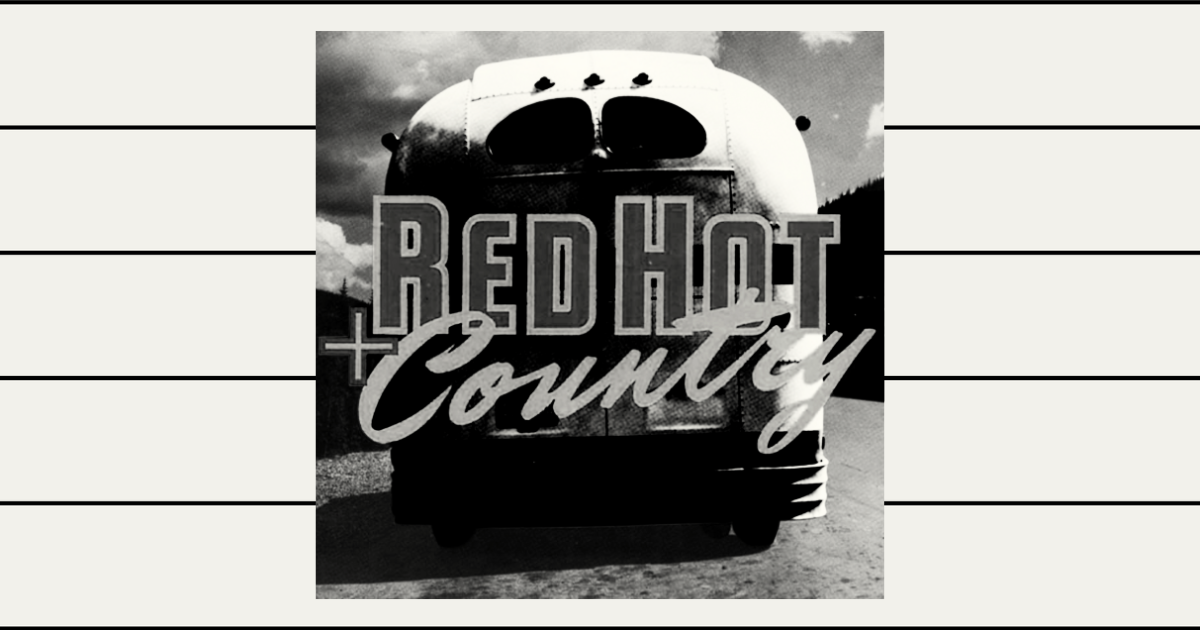
Carlin says the original idea for the Red Hot + Country album was to have country artists cover John Lennon songs. He even met with Yoko Ono, who granted the organization permission to use Lennon’s songs for the project. But when that idea didn’t come to fruition, the theme shifted to the Laurel Canyon folk-rock scene of the ‘60s and ‘70s and the songs of Jackson Browne, James Taylor, and Bob Dylan. The album would be produced by Randy Scruggs, a GRAMMY-winning musician and songwriter whose own father, Earl Scruggs, had played a significant role in the cross-generational Nitty Gritty Dirt Band album Will the Circle Be Unbroken two decades earlier.
“Randy kind of wanted to recreate that spirit of bringing generations together and, obviously, because of his dad, he had access on a level that I never could get,” Carlin says.
Alongside renditions of Crosby, Stills, Nash & Young’s “Teach Your Children Well” and Jackson Browne’s “Rock Me on the Water,” the album featured covers of country classics, such as the Carter Family’s “Keep On the Sunny Side” that had inspired California folkies of the ‘60s.
The album also features the first recording by the band Wilco, which was formed by Jeff Tweedy in 1994 after the breakup of his former band, Uncle Tupelo. The group teamed up with singer-songwriter Syd Straw to perform “The T.B. is Whipping Me,” an Ernest Tubb song inspired by his hero Jimmie Rodgers, who died of tuberculosis in 1933.
Carlin says he wanted to highlight that Rodgers, known as the father of country, had also died from a disease that weakened the immune system.
“What is the difference between tuberculosis and HIV? Really nothing other than homophobia,” Carlin says. “It’s a disease; it doesn’t choose people.”
Other standouts include Nanci Griffith and Jimmy Webb’s “If These Old Walls Could Speak,” Patty Loveless’ “When I Reach the Place I’m Going,” and Marty Stuart and Jerry & Tammy Sullivan’s cover of the traditional gospel tune, “Up Above My Head/ Blind Bartimus.”
Perhaps the most stirring song on the album is Mary Chapin Carpenter’s “Willie Short,” which was written by Carpenter’s producer and guitarist John Jennings after seeing a Newsweek feature called “The Faces of AIDS.” There, he spotted the photo of a Houston dishwasher named Willie Short.
“I was looking at the pictures, and under the picture of Willie Short, there was a very affecting caption and it just got to me: ‘Don’t forget me. From time to time, mention my name’,” Jennings told The Washington Post in 1994.
Red Hot also produced a Red Hot + Country television special, which aired on CMT. The program featured Mattea, Griffith, Earl Scruggs, Carl Perkins, Waylon Jennings, Vassar Clements, and more performing at the Ryman as well as interviews with rural and Southern folks impacted by the AIDS epidemic.
“Three Chords and the Truth”
In many ways, the early ‘90s seemed to usher in a new era in country, where queer issues were concerned. Kelly points to Garth Brooks’ song “We Shall Be Free,” which includes the line “when we’re free to love anyone we choose.”
“You also had Bill Clinton, who was a Southerner, but also a Democrat, in office,” Kelly says. “Culturally, in ‘94, there was a lot going on that dovetailed – I really see the Red Hot + Country album as country music being a part of the mainstream at that time.”
None of that translated to radio play, however. Despite the Red Hot + Country’s wealth of talent, Carlin says the album was “dead on arrival,” a huge contrast to the compilation album Common Thread: The Songs of the Eagles which was released the year prior and was certified Platinum three times by the RIAA. Red Hot + Country peaked at No. 30 on the U.S. Billboard Top Country Albums chart.
“Sadly, it was pretty clear it was homophobia in country radio,” Carlin says. “At that time, if you didn’t get played on radio, you couldn’t get arrested.”
Though Red Hot + Country didn’t gain the listenership of previous Red Hot releases, Carlin and Mattea both remain extremely proud of the project.
“It’s a beautiful cross section of musicians and music. Many of these people I know and love, and I feel proud of my community for stepping in and stepping up and doing something to try to contribute in this situation that just felt so impossible back then,” Mattea says. “I’m more of a ‘fraidy cat than it might appear, and I’m happy with my younger self that I could listen to my heart and step in.”
In the years since Red Hot + Country, LGBTQ+ representation in country music has grown tremendously. Queer artists such as Chely Wright, Brandi Carlile, Brandy Clark, Orville Peck, T.J. Osborne, and the Kentucky Gentlemen have opened doors within the genre. But Kelly says when he launched Proud Radio in 2020, he faced many of the same roadblocks Red Hot + Country faced 25 years earlier.
“There were artists whose publicists would be like ‘We don’t want to make [being gay] the main focus or we don’t want to belabor it,” Kelly says. “With the anti-DEI [diversity, equity and inclusion] thing [from the] Trump administration coming in, we might as well be in 1994, as far as the mainstream country space.”
Kelly champions LGBTQ+ country artists Adam Mac and Chris Housman’s recently released “The Outside” as an anthem for queer country artists who’ve never felt embraced by the industry.
“I keep going and keep hoping for progress, but it’s disheartening,” Kelly says. “But also I look to artists like Chris and Adam who keep making great music and purposefully [making music] in the mainstream.”
Earlier this year, singer-songwriter David Michael Hawkins, an openly gay and openly HIV-positive country artist, released his song “Sin,” which addresses the stigma around HIV.
“When I started to look back on the emotion surrounding primarily the stigma attached to the diagnosis, that’s where the emotional well ran really deep,” Hawkins says. “Stigma is rampant in a lot of LGBTQIA identities. For me, the HIV diagnosis was a big part of it, which was also surrounded by poverty, which was surrounded by substance abuse. They were all in this weird cycle of feeding each other. The healthier I got physically, mentally, and emotionally, the more I was able to put words to that deep well of emotion.”
Hawkins says he wants to expand the conversation around HIV/AIDS by helping more artists feel comfortable with sharing their personal connection to the disease.
“Sin is not the first country song written about HIV. There are probably hundreds or thousands, but up until very recently and maybe up until my song, there’s no one that’s been transparent about that being the root of why the song was written,” Hawkins says.
“I think if the industry is doing our job, which is to offer a safe space for artists to come up with inspiration from anyone or anything, then the artists should feel comfortable saying, ‘Yes, this is about HIV, or this is about drug use, or this is about domestic violence,’ and however closely it’s attached to them as an individual. I think we could probably do a little bit better about letting artists know that no matter the subject matter or the inspiration, if it’s a good song and if it helps people – if it’s three chords and the truth – then we’ve done our job as country musicians.”
Caroline Spence knows better than anyone the importance of community in the roots music scene. Since her 2015 debut album, Somehow, the singer-songwriter has risen through the ranks with four additional solo albums including her latest, Heart Go Wild. Stylistically, Spence fits within the realm of Natalie Hemby, Aoife O’Donovan, Lori McKenna, and Mary Bragg, with a smattering of Mary Chapin Carpenter sensibility. She has garnered praise from both direct peers and industry giants alike. From signal-boosting her work online to recording her songs, many musicians and artists have used their platforms to give Spence a well-deserved spotlight.
Throughout the past decade, Spence has used these moments to nurture friendships within a thankless industry. “The acknowledgement and validation from artists that I respect have been vital in keeping the fire burning under me when parts of the industry have threatened to put it out,” Spence tells BGS.
“No ‘suit’ can convince me I’m not good enough when I have worked with my heroes and have the respect of artists I admire.”
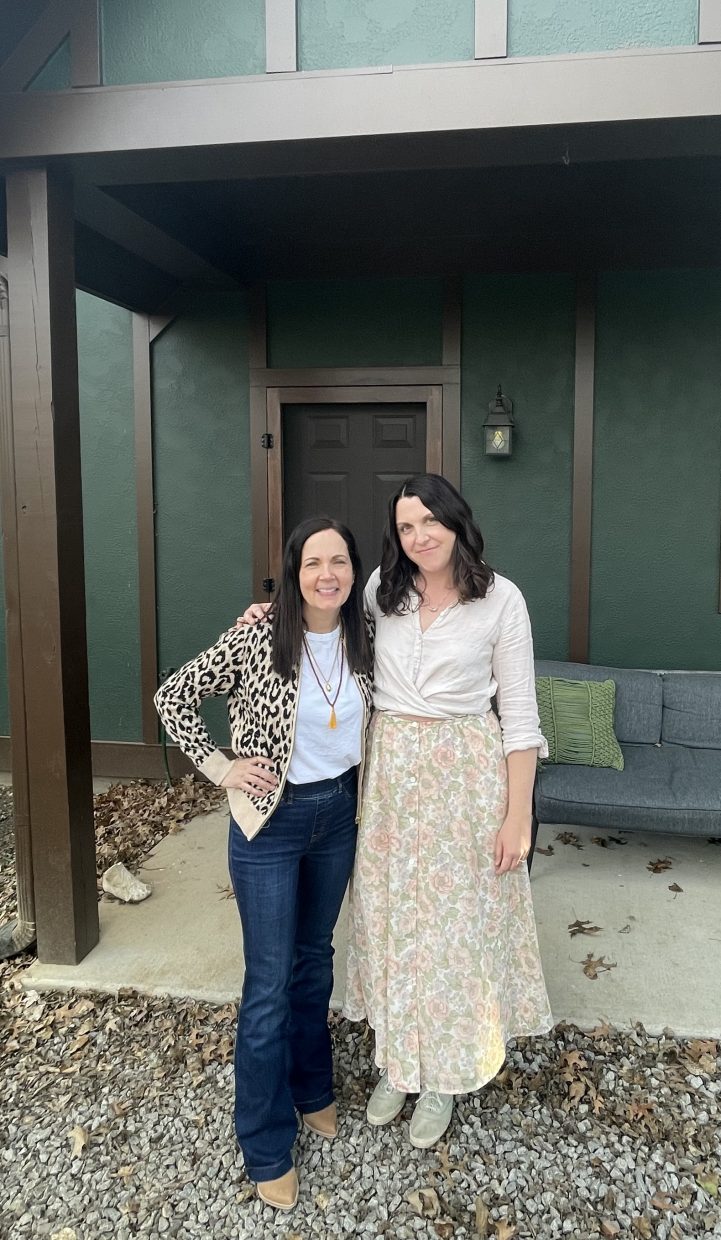
Lori McKenna and Caroline Spence after recording “The Next Good Time” together. Photo by Jordan Lehning.
Reciprocated applause and mutual admiration prove essential to building relationships, in addition to contextualizing an artist’s music within the scene for those fans who may not be familiar. For example, Miranda Lambert has enlisted countless lesser-known artists for her tours, including Gwen Sebastian, Ashley Monroe, and Angaleena Presley. These placements introduce her loyal audience to talent they might not have discovered elsewhere, thus giving those artists more name recognition.
Even more importantly, Spence finds these shout-outs and promotional spots to be her “life force” in keeping her inspired to push through trying times. “My primary goal has always been to be good at my craft and to get better at it,” she says. “To me, the most important judges of that are those who are masters of theirs, and it’s been deeply meaningful every time someone I admire has paid attention to, let alone praised, what it is that I do.”
In her career, Spence has tumbled into the orbits of countless artists who have shown unwavering support for her work. A big Hayes Carll fan, she covered his song “It’s a Shame,” from his 2002 album, Flowers & Liquor, early in her career and later toured with him in 2021 – a moment Spence describes as coming “full circle.” She’s also toured with John Moreland and Madi Diaz. In addition, she wrote “Heavy” with Carl Anderson for Andrew Combs’ album Worried Man and another song she wrote, “We Don’t Know We’re Living,” was recorded by Lucie Silvas, Brandi Carlile, and Joy Oladokun. “[Brandi] called it ‘a once in a century song,’” notes Spence.
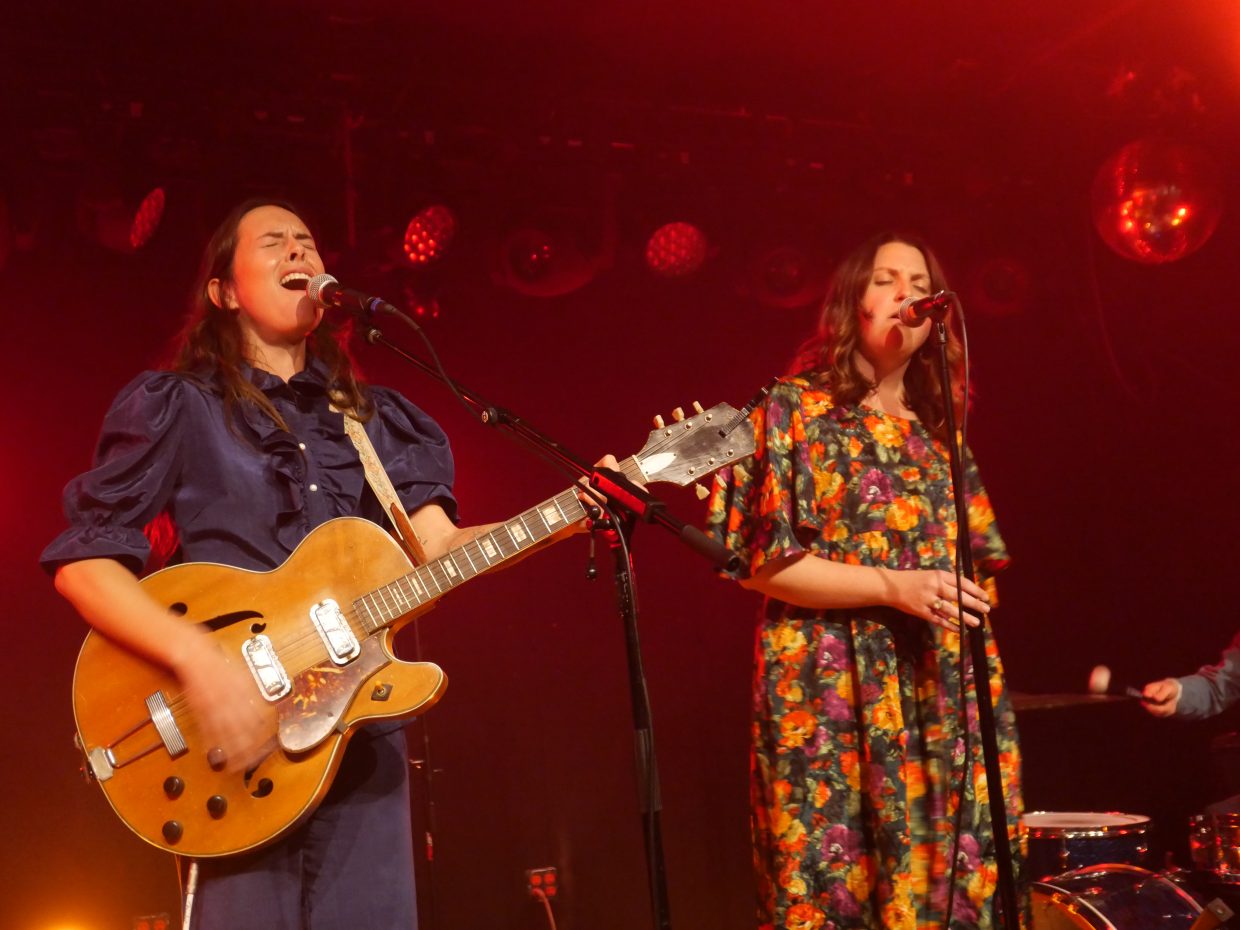
Madi Diaz performs with Spence as special guest and opener on tour in 2022.
Despite not having a “game-changing platform,” as she puts it, she pays it forward by sharing “the work of my peers and what I am loving listening to. I think word-of-mouth from trusted personal sources is still the best way to get someone to pay attention to music.”
She takes a moment to shout out others, beginning with Ken Yates & Brian Dunne before mentioning several other artists she’s been listening to, including Angela Autumn (“Her song ‘Electric Lizard’ is intoxicating and reminds me of some of the tracks that made me fall in love with music in high school,” she says), Brennan Wedl & Mariel Buckley, and Danny Malone, “an incredible songwriter out of Austin that I recently saw at a house show in Nashville and was absolutely floored by.”
In our conversation, Spence names an additional six artists, from Miranda Lambert to Tyler Childers, who have uplifted her music over the years.
The National
“The fact that I have a duet with Matt Berninger is still completely insane to me. When I was in college in Ohio, falling in love with The National, I could have never even dreamed that I would cross paths with Matt, let alone have him sing words I wrote. I love that band, and his voice is legendary. It still feels unreal.”
Miranda Lambert
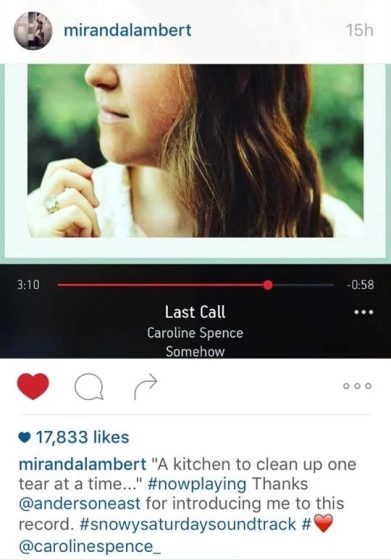
“[She] posted about my first record back in 2016, and that totally blew my mind. I had just been in the studio making my second record [Spades and Roses] and was questioning a lot, and that really felt like a sign to keep doing what I was doing. Part of my dream when I moved to Nashville was to write songs for her, so that was an incredibly validating moment.”
Miranda Lambert shared a Spence original, “Last Call” on her Instagram in 2016.
Lori McKenna
“Lori added my music to her monthly favorites playlists that she makes. She featured on a song we wrote together called ‘The Next Good Time.’ One of my biggest heroes and one of the people who inspired me to start pursuing this work.”
For our Artist of the Month feature, Spence joined McKenna for an intimate and engaging conversation. Read here.
Clare Bowen
“Clare recorded my song ‘All The Beds I’ve Made’ on her self-titled album.”
Tyler Childers
“I’ve known him since 2014 and he opened for me in early 2016 – a month after Miranda posted about my record, and she actually came to the show. I toured opening for him in 2017 and 2019. At some point, he posted about my album on his IG.”
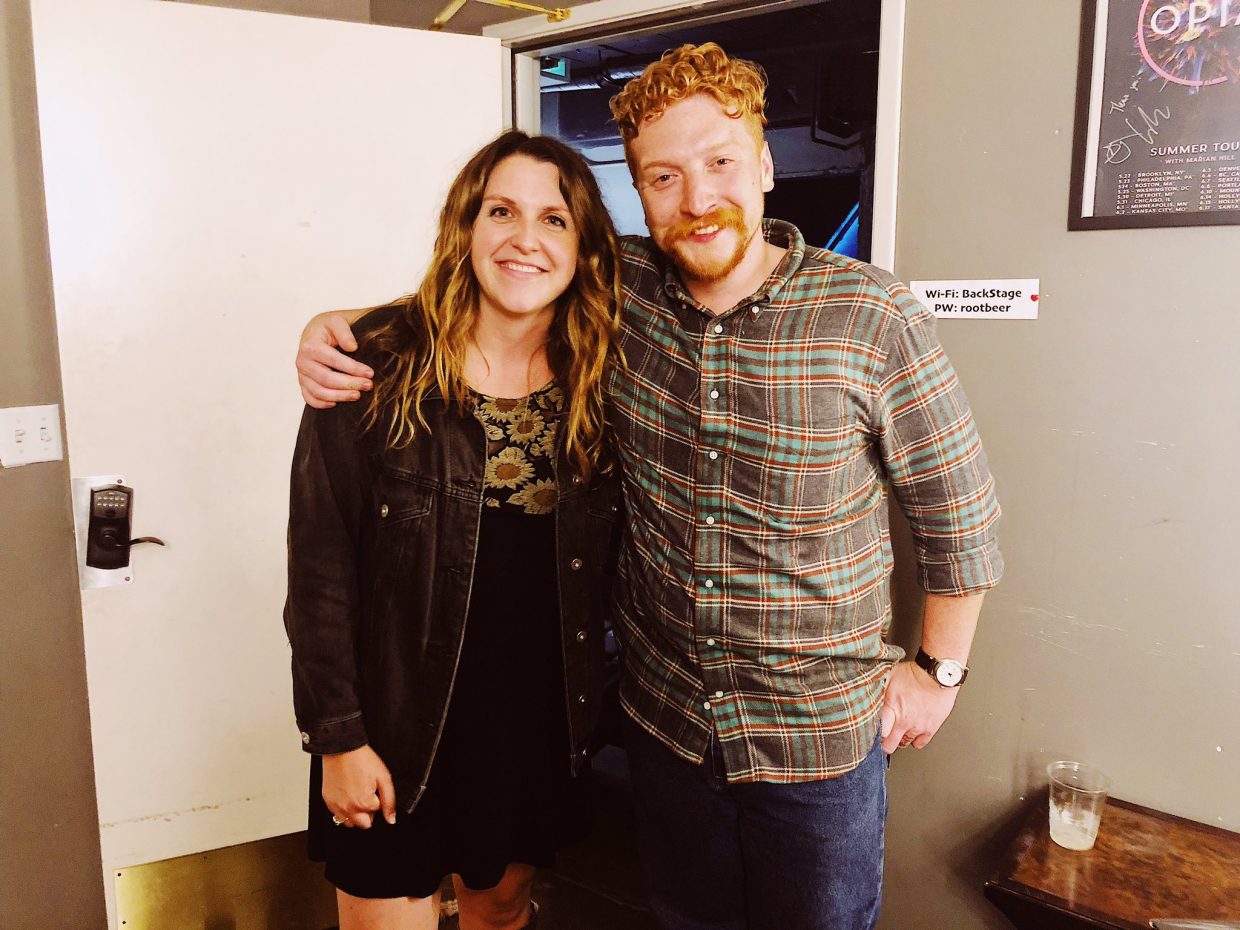
Spence and Tyler Childers backstage together on tour in 2019. Photo by Jace Kartye.
Mary Chapin Carpenter
“We connected on social media and she eventually invited me to open some shows for her. A treasured memory was performing in the round with her at the Edmonton Folk Festival and her asking me to play ‘I Know You Know Me’ and her singing it with me.”
Are you ready for some excellent new music? This week, You Gotta Hear This includes a heaping handful of stellar new tracks and a new music video, too.
Husband-and-wife duo Oh Jeremiah share an intimate performance video for “Rust,” a song about aging, maturing, and the rapid clip of time that features French horn by Corin Dubie. In a similar sonic space, the Couldn’t Be Happiers’ “Brown Mountain Lights” is a co-written eerie original about the mysterious lights that linger around Brown Mountain in North Carolina. You’ll also find a new track from singer-songwriter Olive Klug. “Train of Thought” is folky, bluegrassy, old-timey, and more, and is Klug’s favorite song from their upcoming album, Lost Dog. (You’ll quickly find out why, when you listen.)
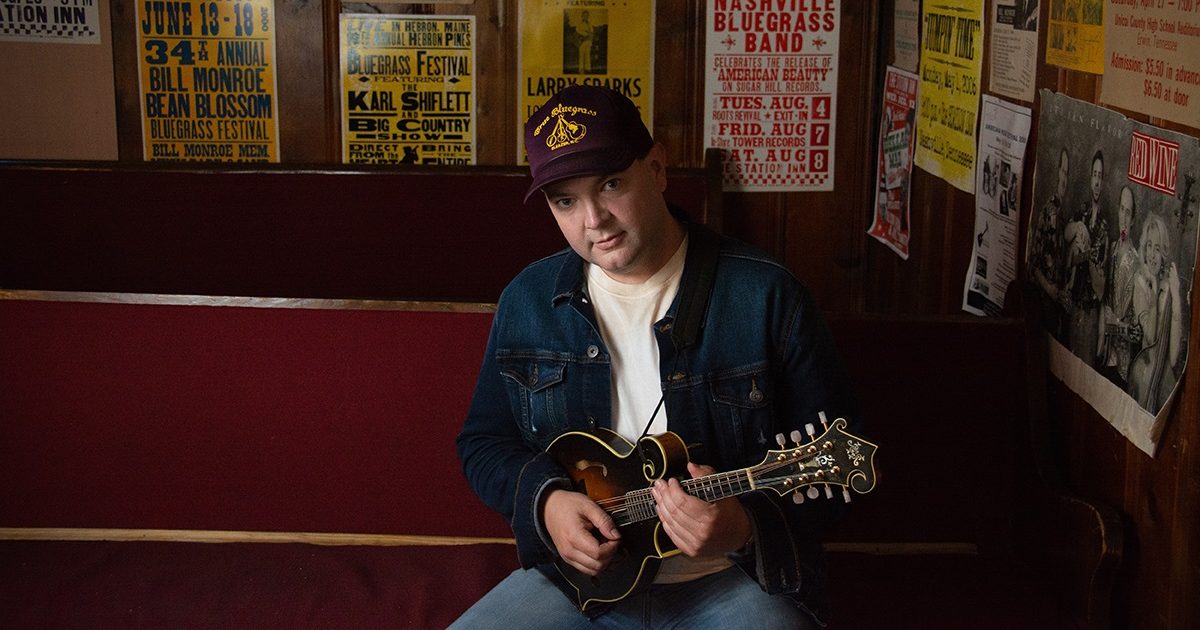
Mandolinist Ashby Frank has a new single, “The Bug,” a traditional-meets-jammy rendition of a Mark Knopfler song that, like Frank, you may recognize from Mary Chapin Carpenter’s discography. It’s hilarious, rollicking, and so much fun. Frank’s longtime friend and brand new labelmate Vickie Vaughn unveils her debut single with Mountain Home Music, “Leavin’,” her rendition of a Bruce Robison song with a stacked roster of musicians and singers.
We have a couple legendary bluegrass lineups represented herein, as well! The SteelDrivers, purveyors of “uneasy listening” and bluesy bluegrass for decades now, announce their brand new album, Outrun – their first with Sun Records – by sharing the title track for the upcoming project, a Tammy Rogers and Leslie Satcher co-write. And the cherry on top of it all is the HercuLeons (that is, the duo of veteran multi-hyphenate roots musicians John Cowan and Andrea Zonn) giving us a sneak peak at their new album, John Cowan & Andrea Zonn Are The HercuLeons, with a rare full album stream on their momentous release day.
It’s all below, so get scrolling and enjoy listening. You Gotta Hear This!
Couldn’t Be Happiers, “Brown Mountain Lights”
Artist:Couldn’t Be Happiers Hometown: Currently Winston-Salem, North Carolina Song: “Brown Mountain Lights” Album:Couple(t)s Release Date: March 20, 2025 (single); June 13, 2025 (album)
In Their Words: “So many different explanations exist for the faint flickering lights that sometimes appear floating around the atmosphere of Brown Mountain in North Carolina. One theory is that the lights are lanterns from the ghosts of miners who died in their quest for gold and jewels in those hills. Maybe so, but we think the heart of every good ghost story, usually, is a love story.” – Couldn’t Be Happiers
Track Credits: Jordan Crosby Lee – Vocals, acoustic guitars Jodi Hildebran – Vocals Doug Davis – Mandolin, high-strung acoustic guitar, melodica, Omnichord, Hammond organ, bass, percussion
Ashby Frank, “The Bug”
Artist:Ashby Frank Hometown: Nashville, Tennessee Song: “The Bug” Release Date: March 21, 2025 Label: Mountain Home Music Company
In Their Words: “I grew up listening to the great country music of the ’90s and first heard this song when it was recorded by one of my favorite singer-songwriters, the great Mary Chapin Carpenter. I wasn’t aware that it was a cover until several years later when I heard the original recording by Dire Straits and discovered that it was written by Mark Knopfler. That band had such a deep groove on that original cut that I really got into and I immediately started thinking about how a bluegrass arrangement might work. I brought the song up in the studio when we started recording my new album and we bounced it around until we came up with a groovy traditional-meets-jam band version that I’m super proud of. Seth Taylor (guitar) and Matt Menefee (banjo) added some wicked solos and my friend and labelmate Jaelee Roberts added some killer harmonies. I even threw in a couple of yodels, which is a career first for me. I can’t wait for everyone to hear it!” – Ashby Frank
Track Credits: Ashby Frank – Mandolin, vocals Seth Taylor – Acoustic guitar Travis Anderson – Bass Matt Menefee – Banjo Tony Creasman – Drums Jaelee Roberts – Harmony vocals
The HercuLeons, John Cowan & Andrea Zonn Are The HercuLeons
Artist:The HercuLeons Hometown: Nashville, Tennessee Album:John Cowan & Andrea Zonn Are The HercuLeons Release Date: March 21, 2025 Label: True Lonesome
In Their Words: “For me, the making of this record was not about career, revenue streams, or anything else. I had been singing with, around, and listening to Andrea Zonn for 20 years. Like most of us, we were stranded during the pandemic. This record was truly born out of our combined desire to once and for all record our voices singing together.” – John Cowan
“Like John, I was only too happy to make an entire record with one of my favorite singers, musicians, and humans. With the help of our dear friend [producer] Wendy Waldman, we began exploring ideas, crafting a sound, and pursuing a collection of songs that spoke to our creative and spiritual centers. We’re so thrilled to be sending out into the world, at long last.” – Andrea Zonn
Olive Klug, “Train of Thought”
Artist:Olive Klug Hometown: Portland, Oregon Song: “Train of Thought” Album:Lost Dog Release Date: April 25, 2025 Label: Signature Sounds
In Their Words: “This is actually my favorite song on the album. Written in Sisters, Oregon, during a songwriting workshop that I led about writing a song inspired by the style of your favorite artist, ‘Train of Thought’ is my take on Paul Simon’s wordy magical chaos. Breaking out of my usual literal storytelling lyrical style and breaking into the world of abstract metaphors, I let the listener into what it’s like to be neurodivergent and how I’ve recently embraced this internal chaos instead of trying so hard to control and repress it.
“With lyrics like ‘and they try to button up my suit and tie in an attempt to hold me back but I’m this strange old conductor wearing pearls and a backwards baseball cap,’ I highlight how my nontraditional gender presentation is intrinsically linked to this neurodivergence and desire to resist societal pressures.” – Olive Klug
Oh Jeremiah, “Rust”
Artist:Oh Jeremiah Hometown: Nashville, Tennessee Song: “Rust” Album:Jones County Ghosts Release Date: March 21, 2025 (single); June 13, 2025 (album) Label: Baldwin County Public Records
In Their Words: “I don’t know how it happens, one day you’re a kid getting your first kiss in sixth grade on the peewee football field and the next you’re in your mid-thirties. When Erin and I sat down to write ‘Rust,’ we wanted to capture the feeling of time running in a full sprint. Your only hope, it feels like, is to hang on to those things that keep you feeling young at heart. ” – Jeremiah Stricklin
“Most people think, because we’re married, that we write all the songs together, but this is actually the first co-write we’ve ever done.” – Erin Stricklin
Video Credits: Shot by Tim Sutherland. French Horn by Corin Dubie.
The SteelDrivers, “Outrun”
Artist:The SteelDrivers Hometown: Nashville, Tennessee Song: “Outrun” Album:Outrun Release Date: March 21, 2025 (single); May 23, 2025 (album) Label: Sun Records
In Their Words: “Leslie Satcher is a longtime SteelDriver co-writer with me. I happened to run into her the weekend before we were scheduled to go into the studio and told her we didn’t have any Leslie songs on the upcoming record. She made the time to get together and ‘Outrun’ was written in about an hour and a half! It was the last song we recorded. It is another song that really showcases that ‘SteelDriver Sound.'” – Tammy Rogers
Vickie Vaughn, “Leavin'”
Artist:Vickie Vaughn Hometown: Nashville, Tennessee Song: “Leavin'” Release Date: March 21, 2025 Label: Mountain Home Music Company
In Their Words: “‘Leavin” is a song that Kimber Ludiker showed me when she was playing fiddle with its writer, Bruce Robison. I immediately fell in love with the stream of consciousness style of writing and the emotion present in the song. I’m a pretty emotional gal myself, so singing this and getting to record it felt cathartic. It is definitely a heartstring tugger.” – Vickie Vaughn
Track Credits: Vickie Vaughn – Upright Bass, lead vocal Colby Kilby – Guitar Casey Campbell – Mandolin Wes Corbett – Banjo Dave Racine – Drums Deanie Richardson – Fiddle Lillie Mae Rische – Harmony vocal Frank Rische – Harmony vocal
Photo Credit: The HercuLeons courtesy of the artist; the SteelDrivers by Glenn Rose.
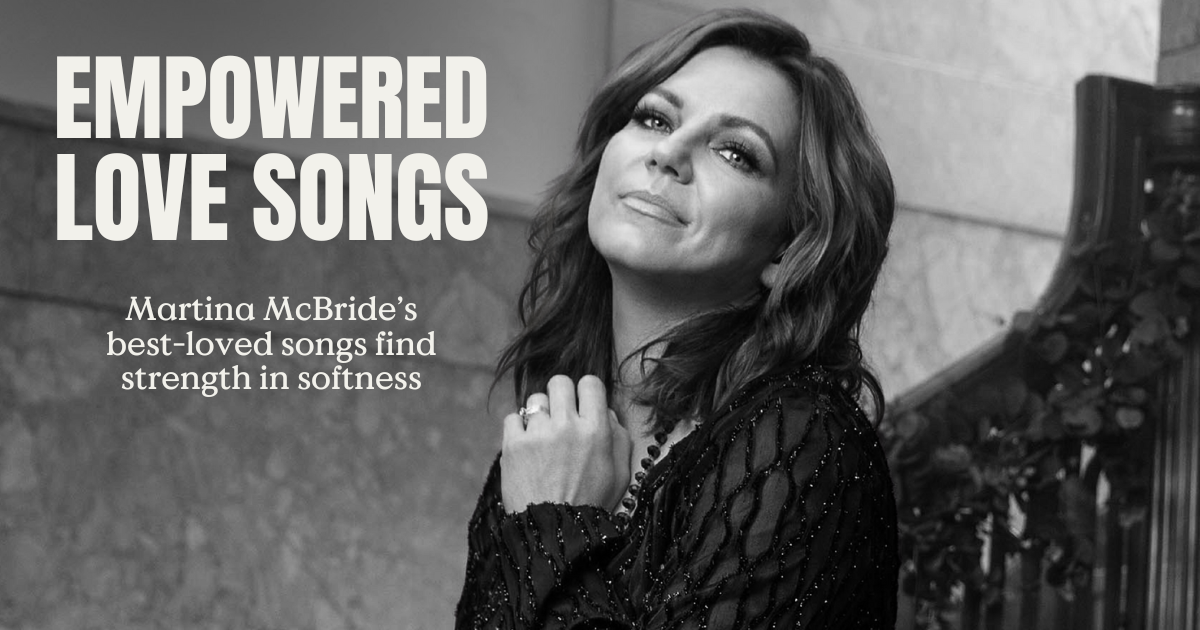
Consult the comments section of any Martina McBride music video and you will find paragraph-length, highly personal expressions of adversity and triumph. These entries are varied, but often take the form of earnest tributes to lost loved ones, painful confessions of romantic loneliness or haunting stories of abuse and neglect. It’s a testament to the power of McBride’s voice – that inimitable instrument that arguably did more than anyone else’s to popularize the wide, throaty belt style now common among female country singers – that her songs still provoke such intensely emotional reactions.
It also speaks to her choice of material. Many of McBride’s best-loved songs operate on a grand emotional scale, and she has singularly foregrounded issues of domestic violence and child abuse in her work. But even as social issues songs largely define her legacy, she has most often recorded love songs, approaching them with the same shrewdness and self-assurance that colors her most celebrated work.
Take, for example, “Safe in the Arms of Love,” a number four hit from 1995’s Wild Angels. Written by female songwriting trio Mary Ann Kennedy, Pam Rose and Pat Bunch, “Safe in the Arms of Love” was originally released in 1986 by Wild Choir, a short-lived country-rock outfit fronted by Gail Davies. More new wave than country, the Wild Choir version features a prominent bassline, heavy drums and synths, and little of the warmth or joy that McBride’s would bring to the song years later. McBride’s version is twangier and more streamlined, trading the original’s raw energy for country-pop polish and sunny bursts of fiddle and mandolin.
The first line of “Safe in the Arms of Love” is bracing, almost a cliche but not quite: “My heart’s not ready for the rocking chair.” It’s an off-kilter choice of words, immediately followed by a clarification: “I need somebody who really cares.” This first couplet sets the rules for the rest of the song, which moves between metaphor and straight-ahead, conversational lyricism as McBride voices her desire for a stabilizing partnership.
An avowed hater of “wimpy woman” and “doormat” songs, McBride brings a resolve that makes clear she isn’t looking to be rescued. Rather, like the narrator of Lucinda Williams’ “Passionate Kisses” – a number four country hit for Mary Chapin Carpenter in 1992 — she’s simply voicing her desires. (It’s no accident that the song’s chorus begins with the words I want.) McBride’s delivery is confident, never beseeching or desperate. Do we ever doubt she’ll achieve her romantic goals?
The song’s music video takes place in a circus-themed fantasy world inhabited by Cirque du Soleil performers dressed as children’s entertainers. There is, notably, no love interest in sight. In fact, men rarely figure in McBride’s videos, at least not as love objects. The men in her videos tend to appear only in glimpses, as with the abusive husband and father figures in “Independence Day” and “Concrete Angel,” flashes of motion that connote menace. In the videos for her love songs, she is more often than not alone, less a protagonist than a guide figure.
Consider the video for “Wild Angels” – filmed for whatever reason in a black and white, vérité style – which locates Martina on the roof of the Clock Tower Building in downtown Manhattan. The song is ostensibly about a couple whose bond prevails through thick and thin, but the video instead captures a group of citydwellers being visited by a mystical being. Then there’s the video for “My Baby Loves Me,” which features a barefoot Martina twirling in a floral dress as various, smiling couples pose behind an empty picture frame. (John McBride, Martina’s husband and long-time business partner, has a split-second cameo at the end of the video.)
Both “Wild Angels” and “My Baby Loves Me” continue the theme of the empowered love song. The rootsier “Wild Angels” presents a smartly egalitarian vision of love, with McBride expressing disbelief at her good fortune in finding such balance. “Somehow we wake up in each other’s arms,” she shrugs in the second verse before chalking it up to divine intervention in the song’s lofty, joyous chorus. The title track and opening song on McBride’s third album, “Wild Angels” also features the sound of McBride’s then-infant daughter Delaney giggling, a nod to the McBrides’ real-life love story and an indicator of how McBride would continue to foreground motherhood in her work.
Where “Safe in the Arms of Love” finds McBride searching for unconditional love, “My Baby Loves Me” takes the perspective of a woman who already has it. The song offers a typically country approach to beauty: fashion magazines, high heels, fancy clothes… who needs ‘em! It’s less feminist-presenting than, say, Shania Twain’s “Any Man of Mine,” but sets up a similar dynamic: This man is totally enthralled by me. In this country-pop version of the world, women run the show and men are their biggest cheerleaders.
Such was the utopian impulse of ‘90s country, particularly in the latter half of the decade, when a handful of female stars topped the charts nearly as often as their male peers and frequently sold more records. McBride was central to this moment and though she never quite reached the crossover heights of Twain or Faith Hill, she remained a steady presence on country radio even as the format purged female voices in the aughts and the wake of 9/11. She was in fact the only female country artist to notch a solo No. 1 during the entirety of 2002, a feat that wouldn’t be repeated until Gretchen Wilson took “Redneck Woman” to the top of the charts three years later. (This fact has depressing echoes of today’s hyper-masculine radio environment, in which it is nearly impossible for a woman to hit No. 1, even with the help of a male duet partner.)
To her detractors, McBride’s great sin at the turn of the millennium was her shift toward the smooth sounds of Adult Contemporary. She found great success in this format with “This One’s for the Girls” and “In My Daughter’s Eyes,” two hits from 2003’s Martina that reached No. 1 and No. 3, respectively. Critics have accused her of making “music for soccer moms,” an elitist term that equates suburban women with unrefined taste.
It’s true that McBride has at times leaned into inoffensive pop balladry, most successfully on “Valentine,” her hyper-smooth collaboration with pianist Jim Brickman that was her first brush with Adult Contemporary success in 1997. But to dismiss McBride’s music — which, yes, includes her honeyed love songs — as frothily unserious is to do a disservice to one of country’s great risk-takers. “Valentine” may not be hard-shell honky-tonk (for that, see cuts like “Cheap Whiskey” or her 2005 classic-country covers album, Timeless) but its softness isn’t a reason to reject it outright. It’s a symptom of country music’s eternal, exhausting authenticity debate that pop-leaning love songs, often the exact songs that allow women to break through country radio’s gender barrier and find commercial success, continue to be written off as superficial.
To be fair, not all of McBride’s more commercial instincts are brilliantly rendered; “I Love You” still smacks of a “This Kiss” retread, while “There You Are” is bland even as piano ballads go. But for every “I Love You” or “There You Are,” there’s an “I’m Gonna Love You Through It,” a 2011 cut about a breast cancer survivor who finds strength in the selfless love of her husband.
With its sweeping, string-laden sound, “I’m Gonna Love You Through It” risks being the kind of “soccer mom” fodder that McBride and her female peers have long been dinged for. But it’s also lyrically sober and undeniably moving, the kind of serious story song that has all but disappeared from the format. The song gave McBride her last top ten country hit and final GRAMMY nomination to date, for Best Country Solo Performance. (In one of the music industry’s great injustices, McBride has 14 GRAMMY nominations and zero wins.)
“Just take my hand, together we can do it,” McBride sings in the chorus, returning to the egalitarian vision of love that made her ‘90s work so disarming. Here, as in “Wild Angels,” McBride sees love not as a negation of self but rather as a mutual source of empowerment. Is it any wonder that her songs endure?
Want more Good Country? Sign up to receive our monthly email newsletter – and much more music! – direct to your inbox.
Photo Credit: Martina McBride courtesy of Red Light Management.
My new album Leaving Is Believing features songs that are related to my journey as an artist. I’ve spent 23 years on the road performing bluegrass, country and roots music, and I’m a huge history, food and geography nerd, so I’ve gained a unique perspective on both the culture in which I grew up and the cultures I’ve been fortunate enough to experience around the world throughout my travels. On this mixtape are some of my favorite songs that feel relevant to my life on the road, as well as some newer tunes that represent what’s moving me these days. — Ashby Frank
Blue Highway — “Message From the Wind”
Everyone has had that “urge to go” at one time or another, and I don’t know of another song that describes that feeling as well as this song does. It was perfectly written and sung by the great Shawn Lane, and I’d venture to guess that I’ve listened to it at least 10,000 times.
Rodney Crowell — “Earthbound”
The line “One man’s lust for life brings world renown, and the next guy can’t get two feet off the ground” always jumps out at me when I listen to this track. The same Rodney Crowell that wrote the classic “Song for the Life” that was recorded by bluegrass legends The Seldom Scene and Alison Krauss also wrote this song, and it’s one of my favorites. Lots of existential questions that we all have are masterfully referenced in “Earthbound,” but it also has such a catchy melody and production that the listener can choose to dive as deep into the lyrics as they want to. So perfect.
Mary Chapin Carpenter — “Down at the Twist and Shout”
Mary Chapin Carpenter is a songwriter’s songwriter. I’ve read that she wrote this song about a venue in Bethesda, Maryland, but the picture she paints with the words, melody, and backing musicians transports you so deep into Louisiana that you can almost smell the gumbo. It’s such a great song from such a great talent, and every time I hear it, I want to be in the scene she’s describing. What more could you ask for from a song?
Dale Ann Bradley — “Falling Down”
I wrote this song quite a few years back while I was stuck in an ice storm waiting for an accident to clear on I-40 coming back from a show at the old Pyramid in Memphis. The words came to me in less than 10 minutes, and I wrote the melody with a guitar as soon as I got back home. Everyone has doubts, insecurities, and anxiety, and I think for artists and creators, it’s amplified. This song is about those all too familiar feelings, which might be something you don’t hear a lot about in bluegrass music.
“Falling Down” was originally recorded by my buddy Will Southern when he was a student at Belmont, and the great Dale Ann Bradley came in to sing the harmony vocals. Luckily, she remembered the song and recorded it on her album The Things She Couldn’t Get Over some 15 years later and invited me to sing harmony and play mandolin on it. She did such a wonderful job and poured her heart into it.
Tim Wilson — “First Baptist Bar and Grill”
I grew up in rural west-central North Carolina and heard country comedians like Ray Stevens, Lewis Grizzard, Jerry Clower, Jeff Foxworthy, and Tim Wilson at my childhood home and at my grandparents’ home constantly. I think that the hokeyness that surrounds this sub-genre prevents a lot of people from realizing how brilliant and well-written a lot of the material is. These folks obviously greatly influenced my writing, and I’m really proud of that. This particular song is a masterpiece by the late great Tim Wilson.
Ashby Frank — “Arkansas Island”
This is one of three songs that I wrote on the new album, and all three of them come from a span of a few years in my life when I was living and working on cruise ships in the Caribbean. One day, I was stuck onboard in Cozumel because of a safety precaution known as “port manning” where the ship has to have a minimum number of employees onboard, and I wrote this song looking out my cabin window. The scene I witnessed looked very much like what you’d see at a marina or lakefront beach in rural America, and I thought that was amusing, so I wrote about it. The subtle Caribbean vibes that Scott Vestal added on the banjo and my Mountain Heart bandmate Josh Shilling added on organ really made this track fit the lyrics, and I couldn’t be more pleased with the end result.
The Wonderful Nobodies — “The Wire”
Lacy Green of The Wonderful Nobodies is one of my favorite singers and writers in Nashville. This song tells a different kind of story about performing and the highs and lows that go with it, creating tension and putting you on the edge of your seat.
Amanda Cook — “Point of No Return”
This is another song I wrote, and it’s about being a free spirit and going where you’ve never been before. There are many “normal life” sacrifices that are made when you pursue your dreams and try to make a living out of the art that you’re passionate about. But the rush that you get from a great performance where you connect with the audience, or from discovering a new town, venue, artist, song, or even a beautiful landscape is always something special and can be addicting. That’s what I wrote this song about, and Amanda, her band, and her producer Aaron Ramsey did a perfect job of presenting it.
Sean McConnell — “What the Hell Is Wrong with Me”
Sean McConnell’s 2021 album A Horrible Beautiful Dream is in my opinion one of the most masterfully written, produced, and performed collections of songs in recent American music. This song stands out to be included on this mixtape because it asks a lot of the questions that any sane professional musician would ask.
Sam Bush — “Same Ol’ River”
This song was masterfully written by the great Jeff Black, and to me the lyrics demonstrate the overwhelming feelings that free spirits often encounter when they think about the world around them and the myriad of possibilities in life and directions they could go. I first heard Sam sing this one at MerleFest when I was a teenager, and it’s still my favorite song that he performs.
Robbie Fulks — “Where There’s a Road”
Robbie Fulks has such a way with words, and this song is a road warrior’s anthem. So many of the lyrics to this one are relatable for any traveling musician, so it’s no surprise that there are also two great cover versions of this song by my friends Blue Moon Rising and the great Sam Bush.
Brandon Ratcliff — “Tale of Two Towns”
“Are you more brave for leaving or sticking around? It’s one dot on a map but a tale of two towns.” Whoa. Brandon Ratcliff is kind of new on the scene. He’s the son of roots music royalty (his mom is Suzanne Cox of the legendary Cox Family) and the writing on his new project has impressed me so much. This song really struck me and is very relatable to anyone that grew up in a small town.
The Grammy Awards have revealed their nominees, and the American Roots Music ballot is especially diverse this year. Take a look at nominations for the 2022 show, which will air January 31 from Los Angeles on CBS. (See the full list.)
Best American Roots Performance
Jon Batiste – “Cry” Billy Strings – “Love and Regret” The Blind Boys of Alabama and Béla Fleck – “I Wish I Knew How It Would Feel to be Free” Brandy Clark Featuring Brandi Carlile – “Same Devil” Allison Russell – “Nightflyer”
Best American Roots Song
Rhiannon Giddens, Francesco Turrisi – “Avalon” Valerie June Featuring Carla Thomas – “Call Me a Fool” Jon Batiste – “Cry” Yola – “Diamond Studded Shoes” Allison Russell – Nightflyer
Best Americana Album
Jackson Browne – Downhill From Everywhere John Hiatt with the Jerry Douglas Band – Leftover Feelings Los Lobos – Native Sons Allison Russell – Outside Child Yola – Stand for Myself
Best Bluegrass Album
Billy Strings – Renewal Béla Fleck – My Bluegrass Heart The Infamous Stringdusters – A Tribute to Bill Monroe Sturgill Simpson – Cuttin’ Grass Vol. 1 (Butcher Shoppe Sessions) Rhonda Vincent – Music Is What I See
Best Traditional Blues Album
Elvin Bishop and Charlie Musselwhite – 100 Years of Blues Blues Traveler – Traveler’s Blues Cedric Burnside – I Be Trying Guy Davis – Be Ready When I Call You Kim Wilson – Take Me Back
Best Contemporary Blues Album
The Black Keys Featuring Eric Deaton and Kenny Brown – Delta Kream Joe Bonamassa – Royal Tea Shemekia Copeland – Uncivil War Steve Cropper – Fire It Up Christone “Kingfish” Ingram – 662
Best Folk Album
Mary Chapin Carpenter – One Night Lonely (Live) Tyler Childers – Long Violent History Madison Cunningham – Wednesday (Extended Edition) Rhiannon Giddens with Francesco Turrisi – They’re Calling Me Home Sarah Jarosz – Blue Heron Suite
Best Regional Roots Music Album
Sean Ardoin and Kreole Rock and Soul – Live in New Orleans! Big Chief Monk Boudreaux – Bloodstains and Teardrops Cha Wa – My People Corey Ledet Zydaco – Corey Ledet Zydaco Kalani Pe’a – Kau Ka Pe’a
Photo of Allison Russell: Marc Baptiste Photo of Tyler Childers: David McClister Photo of Rhiannon Giddens and Francesco Turrisi: Karen Cox
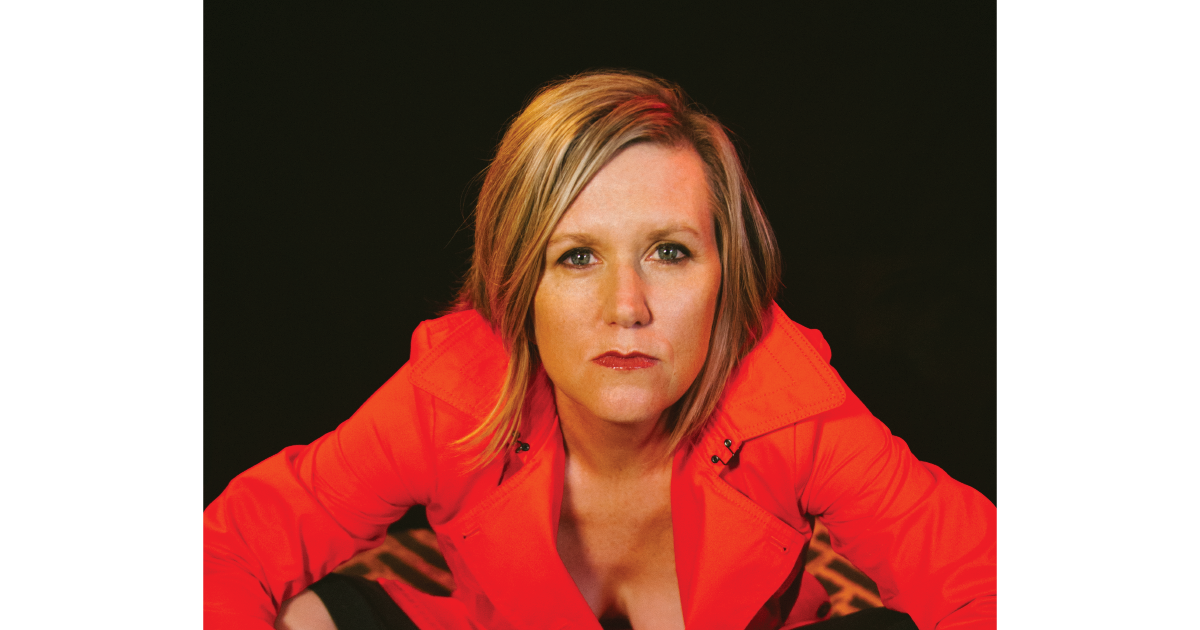
For the last decade, many queer singer-songwriters have doubled down on laconic melancholy, so it’s pleasant to hear Garrison Starr’s new album, Girl I Used to Be, has the ease of Dave Matthews or Sheryl Crow, but Starr is more open about her sexuality on this album than her previous work. At 45, she is older than a cluster of younger generation of performers (some queer, some writing about queerness) who are still working through experiences of gender, sexuality, and religion.
Listening to her new album, one can hear connections to work like Semler’s “Youth Group,” a small, pointed folk song about discovering that you are queer after a youth group lock-in, or Stephanie Lambring’s lacerating attack against homophobia, “Joys of Jesus.” There are also echoes of the joyous call for selfhood in some of Katie Pruitt’s best work. Starr has written with Pruitt, and “The Devil in Me” from Girl I Used to Be was at first intended for her.
“I was sure that would be a song for Katie’s upcoming record,” Starr tells BGS in an email interview. “But she didn’t take to it like I did, and truthfully, I’m happy because I realize how much that song really is a biography of my experience and of my questions as well. I love the curiosity in it and the sense of breaking away from something that doesn’t serve me anymore. I’m not sure where I fit in with Christianity at this point and even if I’m drawn to it, really. The hypocrisy and elitism, at least in the evangelical church, is repulsive to me, and though I think the story of Jesus’ love and redemption is the best thing about any of it, I’m still searching. I believe in a power greater than myself that I choose to call God — that’s all I really know.”
Lyrically there are places where Girl I Used to Be points to the woman she is now, while still drawing on the memories of her childhood in Mississippi, trying to fit in. This merging of past and present give Starr an authority which leads to a commitment to declarative sentences via a voice that is often plainer and clearer than younger queer performers. She is most declarative about issues of sexuality and geography, particularly on her best West Coast songs.
On “Downtown Hollywood,” Starr tells the story of a runaway that gradually shifts from third-person into first-person. She sings about how “they were raising and they were failing” and trying to “cash it all in.” It has a jab against kids with so much privilege that they didn’t need to grow up, and thus, is a grown-up song, almost burnt out, almost jaded about a town Starr still claims to love.
“My only advice to anybody is to find your authenticity, lean into it and never look back,” she says about her adopted hometown. “Los Angeles is a funny place… it’s changed so much and it hasn’t changed at all. The homeless situation here is definitely worse since I came in the late ‘90s. Some of my favorite old haunts aren’t there anymore, but new stuff has popped up in its place. The hustle, the funkiness, the freedom and the hills haven’t changed, and that’s really what made me fall in love with it in the first place.”
Starr grew up in the Deep South, spending some of her undergrad years at Ole Miss, where she was in a sorority. Feeling restricted in that environment, she moved to Los Angeles in the early 1990s. Her major label debut, Eighteen Over Me, was released by Geffen in 1997, and the sudden attention was complex for this queer songwriter. She has mentioned in an interview with Mississippi Today that in her mid-1990s heyday she was told by handlers not to butch it up too much, to avoid the tomboy aesthetic.
Her subsequent career was as an independent touring artist and a successful jobbing musician. She has sung back up for Mary Chapin Carpenter, worked with Josh Joplin, covered the Indigo Girls, and ended up on the soundtrack to multiple television shows, including The Fosters and Grey’s Anatomy. In 2019, her song “Better Day Comin’” was featured in a trailer for the Oscar-nominated Mister Rogers biopic, A Beautiful Day in the Neighborhood. In addition, her production credits include Margaret Cho’s Grammy-nominated comedy album, American Tragedy. “Margaret is one of the most generous and down to earth people on the planet. I am grateful to know her and have had the opportunity to work with her,” Starr says.
Girl I Used to Be builds upon all of this complex history, while at the same time, provides a way into the future.
“I’ve spent a lot more time in my studio, working on production and mixing, and I’ve been able to continue to create content,” she says about the past year. “My business hasn’t been dependent on touring, thank god. I realized a while ago that if I want to make a living in this business, I gotta figure out how to diversify. So, I write a lot of songs with a lot of people, and I make sure some of them make it into TV and film so I can afford to be an artist for a living.”
Like many contemporary singer-songwriters, a paradox exists between the authority she shows in her music and the helplessness she felt about the political situation as she was writing the record. She says that the song “Dam That’s Breaking” is a response to the administration of the 45th president. He was, she says, “empowered and embraced by evangelicals, even though they knew it was wrong. It’s definitely about religious hypocrisy as well as greed and power, cowardice, selfishness and everything else that makes you feel like the walls are closing in on you and you are powerless to stop it.”
What Starr has to say about long-won battles, about landscape, and about power, through the lens of knowing, has something to teach younger queer artists, and can be an example for a young artist striving to write with a strong sense of place, delicate emotion, and a talent for observation. For example, her song “Train That’s Bound for Glory” is inspired by a remark by her late grandfather at his birthday party.
“He loved to goof around and he loved to pick on you,” she says. “They were singing him ‘Happy Birthday,’ and he carried on about not being around for his next birthday and that it was ‘probably gonna be my last birthday. … He ended it with, ‘Yep, I can hear the whistle on the train that’s bound for glory, calling me home.’ I knew of the Guthrie song, but I had honestly never heard it until after I wrote my version.”
As a whole, Girl I Used to Be answers the question of who the girl is now: a queer woman attempting to reconcile her history and her present. She embodies a queer desire to reinvent oneself in another space. You can have a career anywhere these days, and stories of the Midwest and the South have become central to new LGBTQIA stories — and so the exile motif in Starr’s work might be another kind of lived-in quality. Her experience shows that finding home does not mean exile.
One such example is “Make Peace With It,” among the album’s most trenchant moments. Starr says, “Well, the lyric is, ‘If I’m ever gonna live this life, I gotta make peace with it.’ I was thinking in that moment about how much I was struggling to hold onto blame for the rejection I experienced in the church, for the way I felt like my career wasn’t working like I wanted it to, and name whatever else I felt victim to for a long time in my life. I finally got to a place, through what I’m calling grace, and I’ll explain that in a second, where I realized I’d rather be happy than be right. (Thank you, Alanon.).”
She concludes, “What I mean by grace is that there have been so many times in my life where I have been accepted, as I am, by people who truly love me, when I’ve been at my absolute worst. That is what I mean when I say grace. Grace is love, no matter what.”
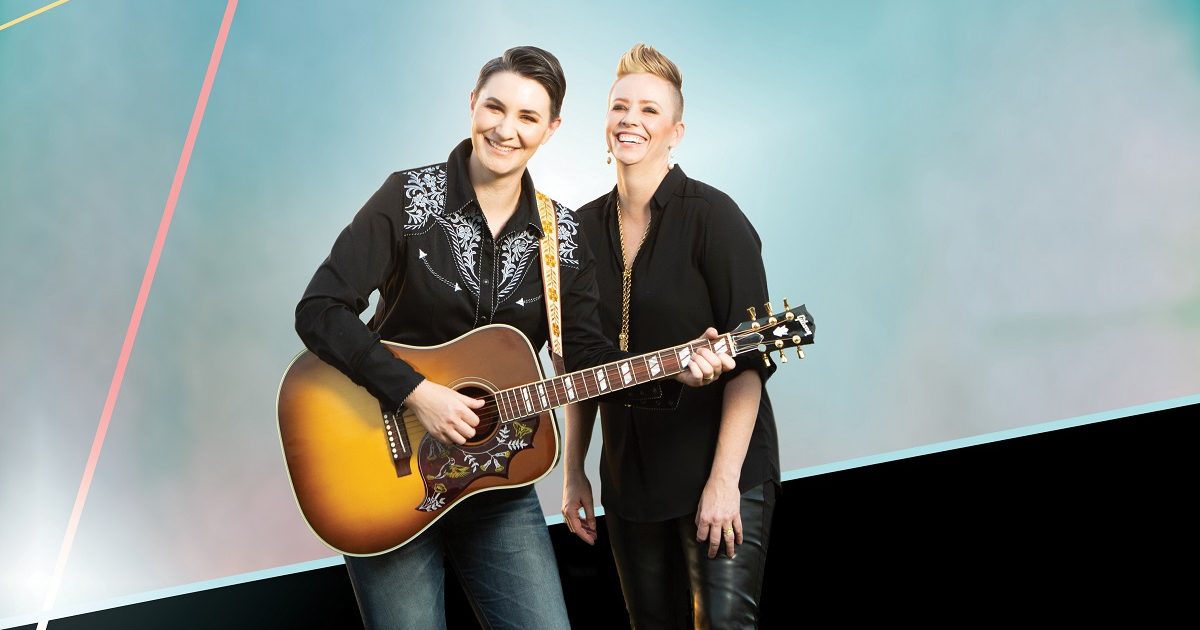
Artist:Hardened and Tempered Hometown: Austin, Texas Latest album: Hold the Line Personal nicknames (or rejected band names): Less of a nickname than a consequence of a band name for a duo that uses the conjunction “and” is that we are often asked, “which one are you?”
Answers provided by Kristin Davidson
Which artist has influenced you the most … and how?
I was 12 when I discovered a mixtape of the Indigo Girls in my older sister’s room. Their songs captured my ears, mind, and heart, and remained constant company for me growing up. I think it was the first time I felt transformed and transported by music. But the pantheon of my musical influences is full of powerful writers, and I can pair just about every childhood memory with songs by Indigo Girls, Mary Chapin Carpenter, Nanci Griffith, Tracy Chapman, Lucinda Williams, Patty Griffin, Emmylou Harris, Dolly Parton, Patti Smith, and Ani DiFranco.
What other art forms — literature, film, dance, painting, etc. — inform your music?
I love street photography and am drawn to the captured moments that expose the illusion of anonymity — that split second of absurdity or loneliness on a crowded street. I enjoy the process of finding words and sounds for the images that evoke emotion.
What rituals do you have, either in the studio or before a show?
We love to laugh and try to bring a joyful lightness to the stage. We are big fans of Maria Bamford. In the second season of her show, Lady Dynamite, Ana Gasteyer’s character keeps shouting a particular line as a rallying cry that we think is hilarious. We usually say that line to each other, giggle, and then walk onto the stage.
If you had to write a mission statement for your career, what would it be?
Hard enough to hold an edge; soft enough not to break. The band name, Hardened and Tempered, sums up the dynamic and delicate balance we try to keep in our lives and our music. Both Carolyn and I have intense personalities, we are drawn to big adventures and hard challenges, and we work with a lot of suffering. Slowly but surely, we are learning the artful balance of easing up a little and looking for light in dark places.
Since food and music go so well together, what is your dream pairing of a meal and a musician?
I have dreamed about finding refuge from a cold, big city night in a basement bar room, only to discover Nina Simone playing an impromptu set on an intimate stage. I order my favorite bourbon, but don’t drink it. How could I?!
Photo credit: Norah Levine Photography
This website uses cookies to improve your experience. We'll assume you're ok with this, but you can opt-out if you wish.AcceptRejectRead More
Privacy & Cookies Policy
Privacy Overview
This website uses cookies to improve your experience while you navigate through the website. Out of these, the cookies that are categorized as necessary are stored on your browser as they are essential for the working of basic functionalities of the website. We also use third-party cookies that help us analyze and understand how you use this website. These cookies will be stored in your browser only with your consent. You also have the option to opt-out of these cookies. But opting out of some of these cookies may affect your browsing experience.
Necessary cookies are absolutely essential for the website to function properly. This category only includes cookies that ensures basic functionalities and security features of the website. These cookies do not store any personal information.
Any cookies that may not be particularly necessary for the website to function and is used specifically to collect user personal data via analytics, ads, other embedded contents are termed as non-necessary cookies. It is mandatory to procure user consent prior to running these cookies on your website.