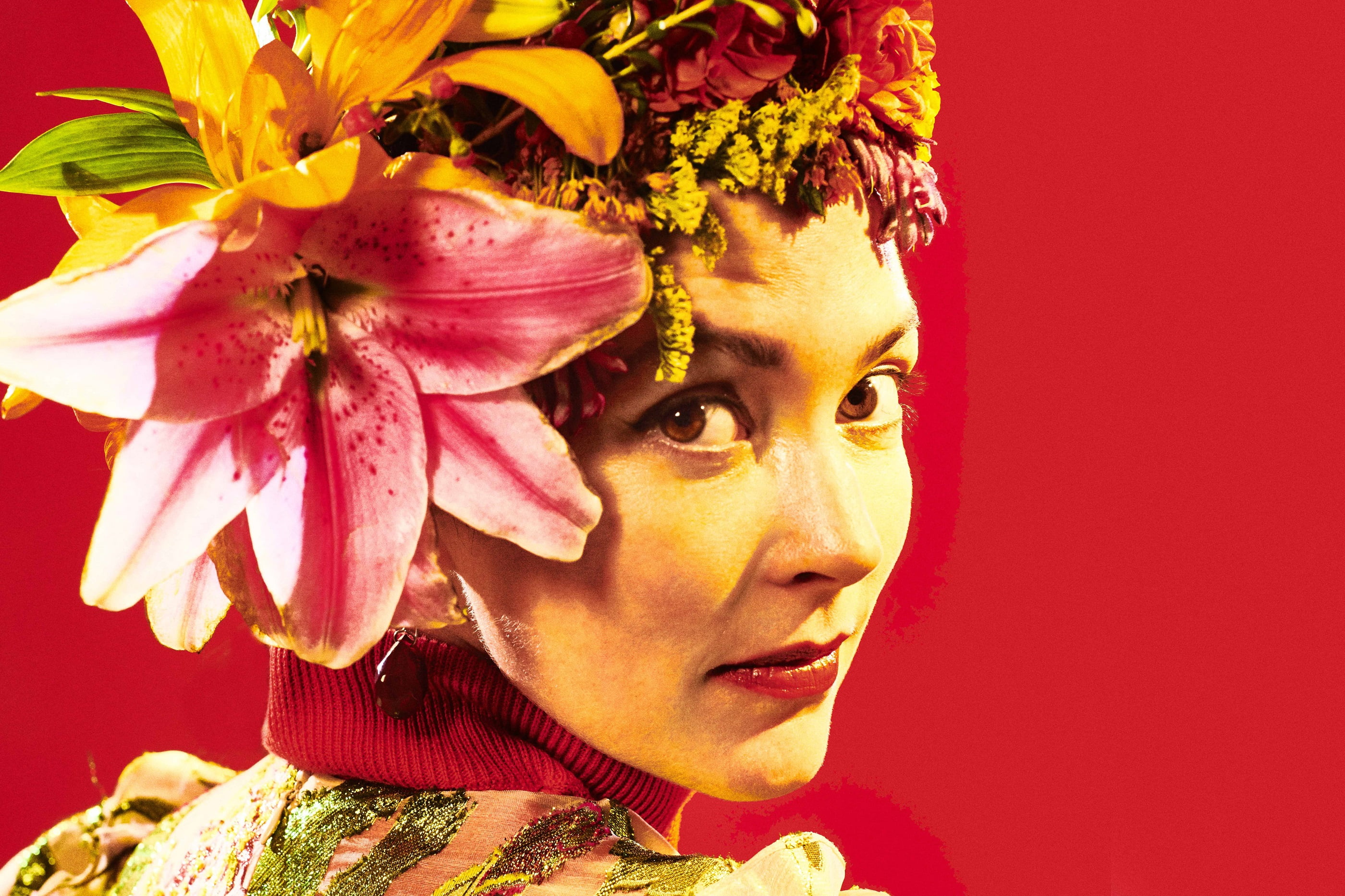
When Amanda Shires throws a party, it’s a crackling and cackling affair. The singer-songwriter has often enjoyed lacing her candor with a biting sense of humor, and her new album To the Sunset offers listeners a celebratory and sharp-tongued toast to all the bits—the good, the bad, the ugly—that have shaped her. Beyond giving birth to her daughter Mercy (with husband Jason Isbell), she completed her MFA in creative writing, but that was after someone stole her thesis and she faced the nightmare of starting over. To the Sunset presents many lessons, but central among them is learning how to accept both sides of the coin because together they pay your way.
Shires once again worked with Dave Cobb, the two aiming for a larger sound than what she’d previously accomplished. For longtime listeners, the result strikes a different chord. She and Cobb hit upon a headier pop sound, integrating slick vocal production, wild rhythms, and scorching, electrified solos. There’s a greater lightning running through To the Sunset, which comes, in part, from the use of pedals to elevate Shires’ fiddle from its folk roots. Between her new sonic direction and razor-edged lyricism—thanks to that MFA—her latest album raises a glass in raucous style. To the Sunset is a dark fête, the kind of party that only occurs when you truly let go and learn to be yourself.
Let’s talk about your MFA. How long did it take you to recover from having your thesis stolen?
I cried and then I got mad. Jason said, “You know, whatever you write will be better than what you already wrote because you’re practicing writing,” and at the time I thought that was the most stupid thing I’d ever heard somebody say, but it’s true. The more practice you get, the better you get, and it all works out in the end. If you really want something, you’re going to find a way to make it happen.
It’s so exciting to hear what you’ve written on this album.
I think it’s pretty cool because I can tell a difference from other records, where I was working with basically instinct. Going to school, I got what I wanted, which was to learn the reasons why I should go with one choice over another, or at least have a way to argue with myself, and a way to back myself up when I’m editing. They teach you there’s no such thing as writer’s block. If that was a thing then nobody would graduate.
Who are some of your favorite poets?
I like Billy Collins, Mary Oliver, Mark Strand, and then, you know, regular favorites like Octavio Paz and all the greats.
What would you say you look for in other poets’ writing?
It’s a time to be quiet and reflect and think deeply. You are the audience of one at the time, really. I like poetry because it can go pretty deep and it’s not three minutes long. It’s as long as it takes you to understand it. Songs are such different animals. You have a lot of things that you don’t get with poems, like, you get a sonic landscape and a mood can be provided, whereas on the page it has to be presented with such precision and such intention that you can understand it without anything else helping you.
You recorded your prior album, My Piece of Land, two weeks before giving birth, and you mentioned having to hide in a closet to write this album. Mercy has, in a way, impacted your last two albums. How do you continue to carve out space—besides the closet—for your creative side to flourish?
I’m lucky because Jason’s an excellent co-parent, so if I need to write and do stuff, he’s all hands on deck, and if he needs to write, I’m right there. When I had to be in the closet, I had to make use of a small space, and it wound up leaking into my bedroom, too, so I was taping everything to the walls, so it wouldn’t accidentally get smashed or crumbled by the two-year-old. I learned how to accept things in their early stages. Before, I was real, like, “Nobody sees what I write until it’s all done.” This was a cool thing where I learned to accept my very shitty lines as they faced me every day and tried to make them better. When I was done, I shredded them and I put them in a composter and that goes into my garden.
Have you found that your plants are growing better because of it?
I don’t know. It’s toward the end of the season until that composter’s done cooking. That was a lot of shredded letters. I’m an editor over and over. Some people can write real fast, but I think everything needs tweaking all the time.
Does the editor side of your brain gets in the way of your natural instinct?
It does, it sure does. I found a thing that helps me with that. It’s called FlowState, it’s an app. You set a timer and if you don’t keep typing it erases your work, so it removes the editing process; you can leave it up there and get your free association going, and really try to put your thoughts into words. When I first got it, I started out doing five minutes at a time, now I do 30 minutes at a time. The further you go with it, it’s like a door in your mind opens and you figure which things you need and which things can wait.
Turning to space, that theme—the space between people—surfaces throughout your catalogue. Here, on “Leave It Alone” and “Charms,” it functions in compelling ways. What particularly interests you about space and relationships?
On “Charms,” my mom’s mom abandoned her at a young age, and that’s where that song came from, and just thinking about how hard that would be for both parties. A lot of times as individuals, I know we all often deal with feeling alone or that nobody understands us. You’re born alone, and you die alone. It’s a thing I think about a lot, and that’s why it presents itself in the work.
As a touring musician, as much fun as it is, things get sacrificed. All that’s to say, writing about it and dealing with it makes me a happier person, and if there’s anybody else that feels like me, then I feel I’ve done a better job because it is a way of connecting in the end.
On the My Piece of Land track “I Know What It’s Like,” the desire to run away comes up, and that theme surfaces again on “Charms.” Except running has turned into forward momentum. When did that shift occur for you? How do you push against the desire to cut and run?
[For “I Know What It’s Like”,] I had a person in my life that was telling me these things, like, “I know what you’re going through, just keep talking to me about it.” To have a comrade in that was nice, and I wanted to keep that conversation, I wanted it to be preserved. The running thing, we all want to run away, but then we’re like, “Nah, our problems aren’t really that bad.” It’s really better for you to not run way, to pick up your big girl underwear or your big boy underwear, or whatever. Put your head down and do the work.
I appreciate that you took the momentum that would cause someone to run and shifted it to a positive momentum on “Charms.”
All this stuff is all inherited—you know, how we do life. I will now cite Philip Larkin: “Your mom and dad, they fuck you up.” So in that one I was moved that even though my mom experienced abandonment, she didn’t fall into that learned thing. I think it’s wild to break habits that have happened in your family, generationally. You can’t let fear be the thing that owns you. It’s just silly. This is such a vague thing to describe, fear and doubt and all that stuff—thinking about hypotheticals for situations—it’s so useless; it’s such a waste of time and energy because you can’t control the future, and you can’t control what’s already happened. It’s about trying to accept what’s happened and move forward, and if you fuck up, you fuck up. At least you tried.
Right, you need to make mistakes in order to figure it out. It’s like editing. You never write something perfect the first time.
Yeah, you’ve gotta find a way to trust yourself.
That’s hard when you’re younger.
Totally because you don’t have much experience with it, so you gotta do all the things that give you experience and wrinkles. They’re worth it. Then you start figuring out that, even as you get older, you were this person and now you’re this person. You’re always changing. You might look back and say, “I don’t even recognize that person.”
Joan Didion had that fantastic quote about making peace with your former selves because you’ll never fully leave them behind.
That’s a whole thing I’m trying to say with To the Sunset, that sort of a cheers or toast. It takes all the things to make you who you are and who you want to be, rather than just ignoring it, or putting it in a box under the bed.
It’s hard to fight, though, because there can be messy parts of yourself that you don’t want to admit.
If you’re not doing that, you’re probably ignoring something that you need to feel. You need to feel ashamed and humiliated sometimes by your own actions. It’s easy to rewrite the way things happened. Once you face it, you can learn yourself better.
Lastly, there are some beautiful portraits of women on this album. How has your sense of womanhood changed, if at all, since having Mercy?
I always felt like I had a responsibility, but I feel like I have that even more. Doing as much as I can and thinking more about the world for her and hopes for her and fears for her. I also feel like, for a long time, you couldn’t talk about things. Even the ugly parts of being pregnant or postpartum, you couldn’t talk about anything, and everything’s supposed to be dreamy and awesome. Now, it’s easier in that more and more women feel like it’s OK to talk about the ugly parts. I think that that might keep us going in the right direction, somehow. One of the coolest things on the record, woman-wise, is my only guest was Gillian Welch, and she sings the harmony part on “White Feather,” what I call the “God” part. Whatever your God is. That was pretty cool. That was a day I thought I was going to die.
Also, your album is coming out at a time when a lot of artists are challenging this sense of perfection.
Yeah, like we don’t need to write a lot of ballads or whatever. It is a cool moment. I’m so happy to see so many women putting out records this year. There’s always been a ton, but there’s not been as much attention or as much room. … It took all those people before us to get to this spot now; I definitely don’t think it’s just happened over the past few months. They’ve always been there, but to move together works better than to move singly.
Photo credit: Elizaveta Porodina