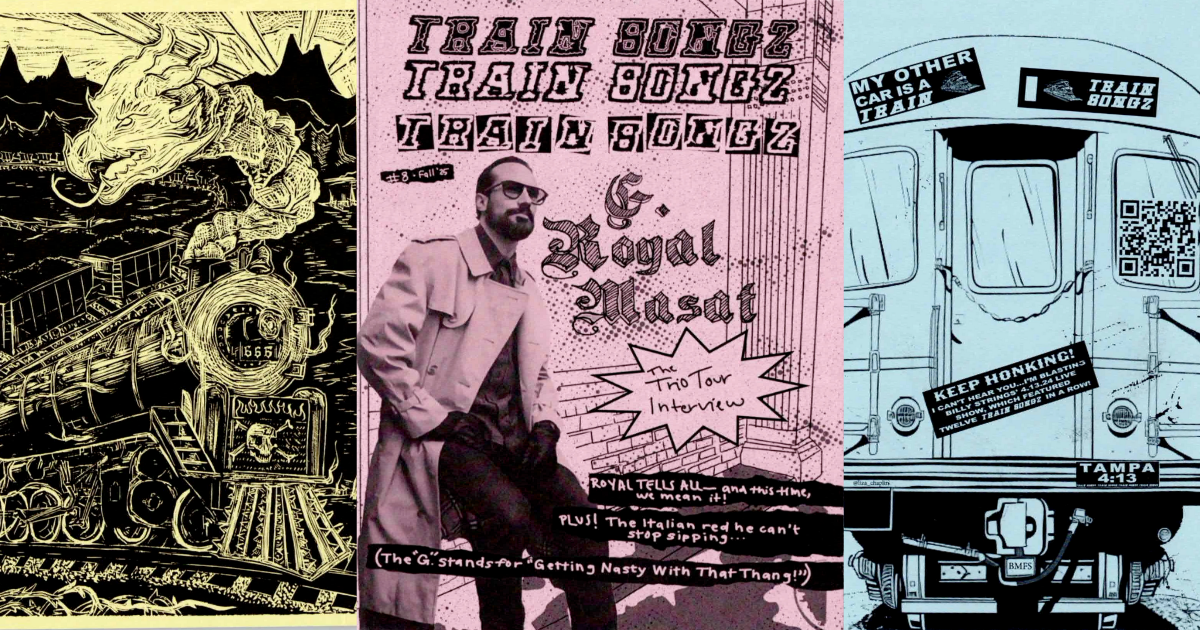
Somethin’ About Train Songz

What first began as a locomotive and string music meme page has transformed into one of the most quirky and beloved sources of independent journalism in roots music, one zine at a time.

Founded by Anthony “The Conductor” Perasso and James “Promontory Paul” Lucey in July 2023, Train Songz has since grown its community to over 28,000 Instagram followers and more than 1,200 paid subscribers. Readers collectively contribute anywhere from $33-$99 per year (or $11 per copy), with three to four issues published per year. The latest, eighth edition features a 44-page interview with Billy Strings’ bassist Royal Masat.

The interview for Masat is a full circle moment for Train Songz, which began with a Billy-centric focus before expanding to feature other bluegrass acts like Mountain Grass Unit, East Nash Grass, and Valley Flower. In fact, it was a Billy Strings show in Bridgeport, Connecticut, attended by Train Songz co-founders (that they rode the train to themselves, no less) where the concept for the then-meme page first came together.

“At the show Billy was wearing a hickory-striped railroad hat that someone (who we’ve since connected with on Instagram) threw up on stage a few shows prior, as trains were passing by the stage,” recalls Perasso.

“I tweeted from my personal account a photo of Billy with the hat on and the caption ‘Train Songz,’ which was a Trey Songz pun – like if Trey Songz is Trey Songz, then Billy Strings is Train Songz,” Perasso laughs. “Four days later, I locked down the @train_songz username and posted our first meme.”

After publishing some popular Billy and Grateful Dead inspired memes, Train Songz began transitioning to a zine in December 2023, while Perasso was home for the holidays and more sedentary than usual after recovering from multiple surgeries. No stranger to producing print media, having previously worked on a satirical newspaper while in college, he says the zine quickly filled a void left empty since graduating in 2017. Now two years in with eight installments of the printed zine, Train Songz has grown into a thriving community bigger and wilder than Perasso, Lucey, and the rest of the core team – including Liza Chaplin (art/design) and Mitchell “Brakeman” Harbin (writer/editor) – could have ever imagined.
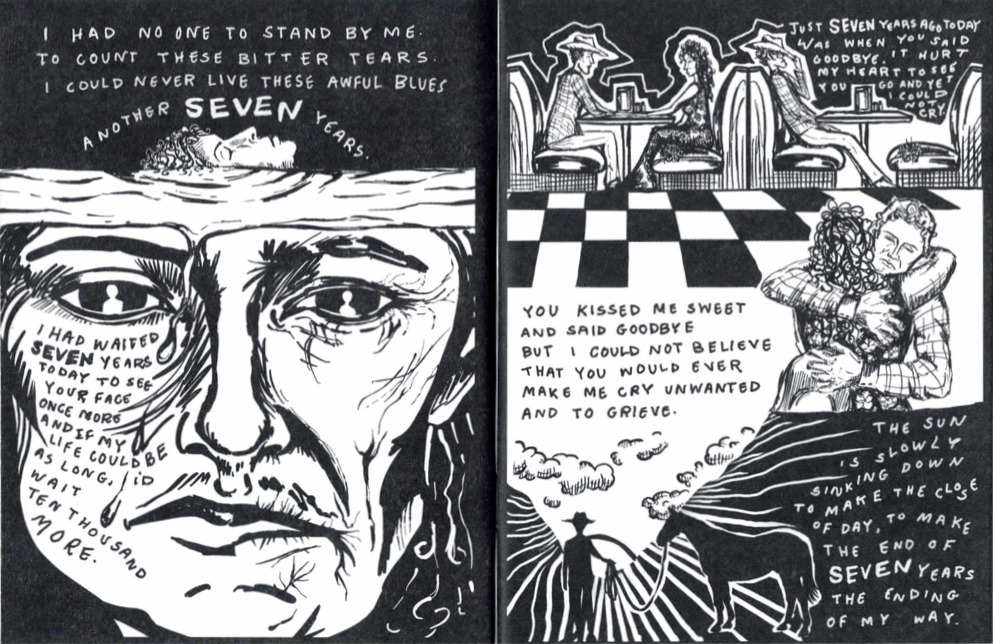
Original artwork by Morganne Allen from ‘Train Songz’ Vol. 7, Summer 2025.

“Beyond my personal penchant for print, Train Songz was gathering a community of wooden-instrument-music enjoyers, so print felt like a natural extension of that vibration,” Perasso continues. “And from a more boring media strategy point of view, print (and email!) offers you a direct relationship with your audience that algorithms can’t get in the way of and platforms can’t take away. So for both those reasons, a Train Songz zine felt like a perfect move.”

After wrapping up production on the eighth installment of the zine, the Train Songz crew spoke with BGS via Zoom about the zine’s origins, how they first discovered Billy Strings, the publication’s next steps for growth, and more.

Y’all use pen names in the zine (except for Liza). How did each of you come up with your alter egos?

James Lucey: Before I get to that, I’ll just add that leading up to this interview we all debated if we should do this as ourselves or go by our pen names. It’s been an interesting dynamic, [navigating] who are we in relationship to the zine [and] what the zine is in relationship to us and our audience. We made the zine to try and participate in some way in the broader conversation about modern-day bluegrass music; we’re not the face of the zine, we’re just the people that are powering it.

But regarding my pen name, “Promontory Paul,” he’s the voice of the Old Tune Review, which is one of the core pieces of the zine. In it we pick a handful of old songs [and] dive deep into [their] history through independent research. It’s born out of the idea that these old songs are still being played today and still resonate in some way. In some ways it’s like a time machine, because you’re feeling the same emotions that someone felt hundreds of years ago when they wrote these things. So it’s cool to dive in and see what the actual genesis of those songs are.

[Paul’s] the guy who runs that, but we also feature him in a little recurring cartoon series that sees him playing banjo and getting into all kinds of crazy adventures. “Promontory” is a reference to the Promontory Summit, which was the final completion [point] of the first transcontinental railroad in Utah, when the Union Pacific Railroad and the Central Pacific Railroads (which had been building from Nebraska and Sacramento, respectively) finally met.

This effectively connected the old world with the new one, sort of like what we do with the zine.

Mitchell Harbin: My name actually came out of the fact that a brakeman is a role on an actual train – he’s the guy that pulls the brakes. It was actually during the production of the zine’s third issue that I had come aboard to help with proofreading and copy editing. There were a couple of times in that process where James and Anthony were like, “Alright, we’re good to go, ready to launch” and I would pump the brakes and say, “Whoa, hold up.” Which is what eventually spawned the name idea.

Liza Chaplin: I’m still working on mine. [Laughs] It’s an ongoing thing that I’ve been thinking about, but so far I haven’t gotten anywhere with it. At first I decided to put my own name on it to use as a portfolio-building mechanism, but now with how the zine has grown it feels very silly to still have my actual name on it.

Anthony Perasso: “The Conductor” came to be when James and I were talking about taking the meme page offline [and moving] into print form with our first issue. We made a decision that Train Songz was the name of the publication and brand and community – or whatever vibration of people who value the same kind of music as we do, cultivating this eponymous meme page.

As the person who had started the meme page, I didn’t want Train Songz to be seen as an individual, as in, “That’s Anthony, he’s Train Songz.” Our desired outcome would be: “That’s Anthony, he’s The Conductor for Train Songz.” That allowed Train Songz [to be] less a single being and more of a vehicle for those involved. Pun intended. (A mentor even recommended to me that the title of The Conductor be something that can be passed on from individual to individual, like the Pope or the President. Time will tell if we get to that point!)
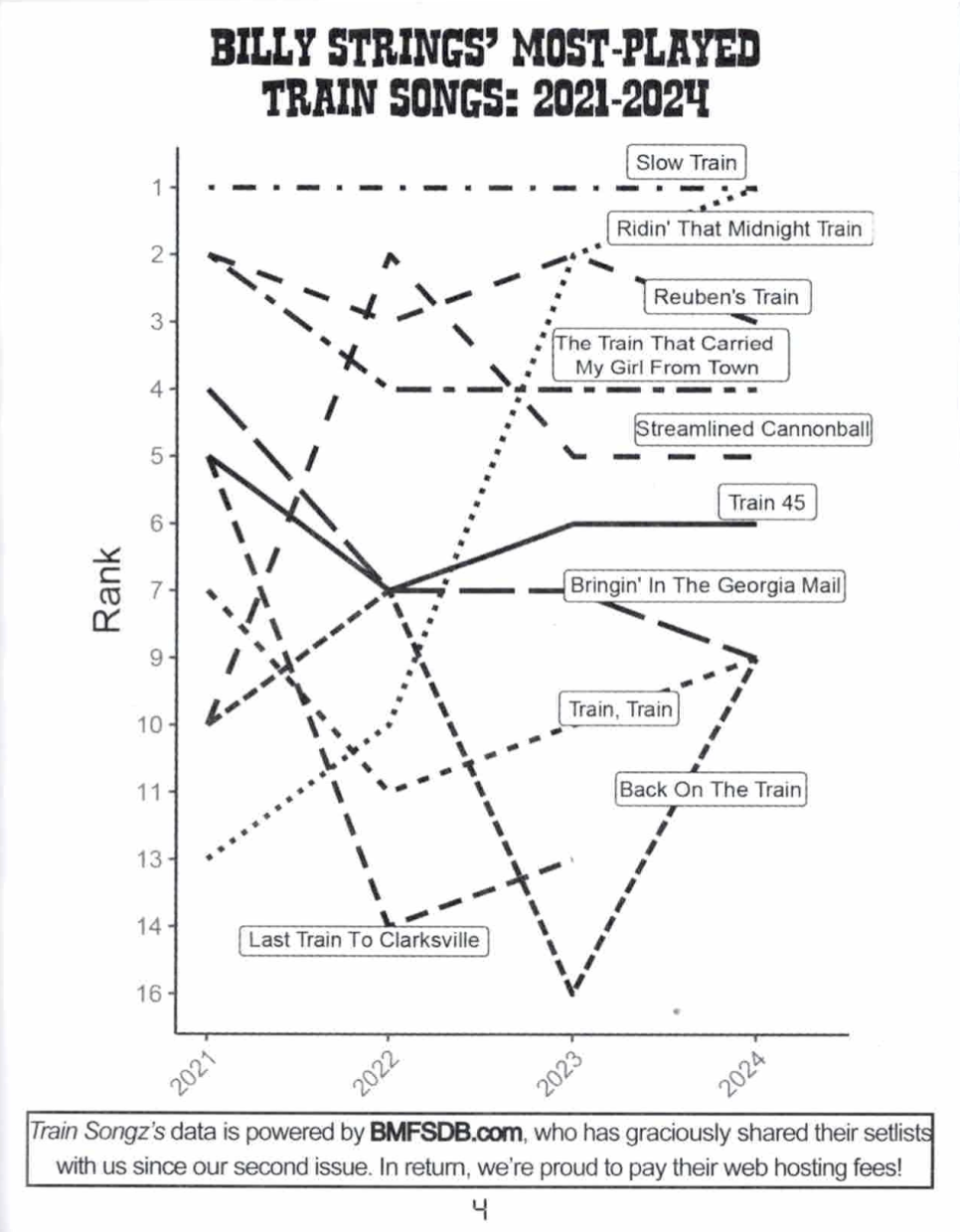
A Billy Strings train songs data visualization from ‘Train Songz’ Vol. 5, fall 2024.

What was Promontory Paul’s role in this latest issue of Train Songz given its focus on the Royal interview?

AP: Paul’s column still exists in the newest zine, but he went about it in a really cool way. The idea began with our third edition, when we gave Promontory Paul an entire section to write about old bluegrass songs regularly covered by the likes of Billy, the Sam Grisman Project, and whatever other bands we listened to or saw live that quarter. So we’d cite where we heard it played before diving into a history lesson and where it came from.

Then, for this issue with Royal, we took that Old Tune Review and instead of songs we heard out in the wild made it all about songs that he mentioned during the interview. Throughout the interview there are little interjections from Promontory Paul – almost like Clippy, the office assistant on Microsoft Word. It’s been fun to take these gimmicks that worked for us a year ago and apply them to the restrictions presented by this long-form interview. Royal gave us so much that we wanted to give him the entire issue, but we’re still going to sprinkle in the ethos of what our readers are familiar with and what we like to do, which is to connect something that’s happening in the present day – like the recent Billy Strings and Bryan Sutton tour with Royal – to the past. It’s been really fun connecting with folks like that through the zine. It’s almost like Paul’s on a time-traveling train or something. [Laughs]

We send surveys out to our subscribers after publishing each issue and Promontory Paul’s history lessons are always towards the top when it comes to [readers’] favorite parts of the zine. It’s also been a cool way to make note of the fact that it’s not just us behind the scenes who are enjoying this. It really speaks to how much we respect the audience that we have and how that drives us to create the best issue possible every quarter.


View this post on Instagram


A post shared by Royal Masat (@royalmasat)

I saw recently that Royal left a copy of Train Songz #7 at the NPR Tiny Desk following the session he recorded there with Billy. What did seeing that mean to y’all?

AP: He’s been a follower of ours for a long time and brought that copy of the zine to NPR on his own after reaching out to us to subscribe about a year ago. We knew he’d been reading along for a while, so once this tour came up with him, Bryan, and Billy, it just seemed like the perfect thing for the zine to cover. It was important for us to capture the combination of old and new in those shows dedicated to Doc and Merle Watson and T. Michael Coleman and featured the King of arena-grass playing these smaller rooms of 400 to [2,200] people with one of the most preeminent guitarists alive in Bryan Sutton.

It took us a second to come around to the idea, because we’ve been very cautious about not becoming a Billy Strings-exclusive fan zine. We want to serve the broader ecosystem, but that tour was something we couldn’t pass up, especially with Royal being a reader. Once we did reach out, he blew us out of the water with the time he put into it. His interview with Mitchell ended up being over 4,000 words that he sent us by email after wrapping up a tour in Europe. Once that wrapped I remember him sending us a literal tome – he took it very seriously and his responses were so thoughtful.

The final result almost looks like a children’s book with the way Liza designed it. None of that would be possible without our paying supporters, who make it possible for us to work with the 17 artists we partnered with on this issue to bring it even more to life with quirky illustrations that tie back to things Royal said, like throwing in an illustration of a medieval horse with a knight in shining armor where Royal refers to his bass as his trusty steed. I like to refer to what she does as “Andy Warhol-ing.” [Laughs]
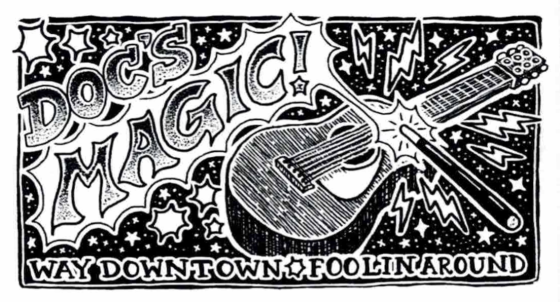
Inset artwork by Sara Dennis from the 8th and most recent edition of ‘Train Songz.’

I know you just mentioned not wanting to become exclusively a Billy Strings fan zine. However, I’m curious to hear when and how y’all first encountered his music?

LC: The first time I saw Billy was at RiverRock, a free festival on Brown’s Island in Richmond in 2019 before he blew up. I had heard of him prior to that, but after seeing him live I became absolutely mesmerized. I didn’t like bluegrass for the longest time, but something clicked with me when I saw Billy and was like, “Oh, this is what I want to keep following and chasing.”

MH: In college, I was a huge Deadhead and Phish fan and was consumed by the jam world. Then I heard about Billy on some Facebook groups and message boards, talking about how he covers The Dead really well.

I moved to Boston shortly thereafter and the first month I was living there Billy played at the Wang Theater. I wound up buying a ticket and went without having listened to his music at all beforehand and was absolutely blown away. To me, it was like a psychedelic Dead or Phish show combined with bluegrass, which in hindsight probably hit on the homesickness I was feeling at the time, because I had been around bluegrass before, but wasn’t really interested in it when I was living in the South. From there, I jumped down the rabbit hole into more old-time bluegrass, which is when I started playing the music myself. So I attribute my musical pursuits now to that moment and think that is probably true of other people, too.

JL: I remember [going down] a YouTube [rabbit] hole in 2020 and coming across a set of Billy playing Doc Watson tunes. It may have been Royal’s first gig with him. I just so happened to be in a bit of a bluegrass moment at the time I found that video of Billy and was instantly hooked, resulting in me digging even deeper. I was already a Deadhead as well, so I loved his covers of those songs too. Then I worked my way to his original stuff – which is also sick – and I have YouTube to thank for it!

AP: I remember James, “Promontory Paul,” showing me Billy for the first time. Like most of the bands I like, I channel my music taste through him. When we first got into him there was still a lot of remote work going on, so we’d listen to Billy while doing that or even while we were playing games like Fortnite. I started listening to a lot of The Dead in order to try to get to the point where I could listen and name the year the show came from. But over time Billy started taking more and more of the market share of my listening time away from the “What year is this Grateful Dead show from?” project.

What are your next steps for continuing to grow Train Songz?

AP: We occasionally host concerts (the next one is February 12, 2026 with The Asheville Mountain Boys), and have captured audio recordings – which we call Tiny Train Sessions – in the past, but we look at them more as a marketing tactic than a growth mechanism.

My day job is a social media manager and doing that I’ve noticed that the best way to get a lot of views on Instagram is to post reels, because they [are served] to non-followers and new followers first. We could post a bunch of concert clips and other things to build our audience, but we intentionally opted to not do that because we’re firm believers that things that grow slow last a long time. We don’t want to gatekeep or make it hard to find us, but rather [hope folks will] find us organically through a friend sharing one of our memes or sending you a copy of the zine itself. I want the first point of contact to be someone who’s already within our ecosystem that really digs it and turns you onto it, one person at a time.


All visuals, artwork, and zine scans courtesy of Train Songz. Learn more about artists Morganne Allen and Sara Dennis.

Guitar Center Salesman Surprised “Gal” He Mansplained Chords to Is Molly Tuttle

(Editor’s Note: Welcome to the debut of our new humor column, The Resonator – from the pen of satirist and performer Greg Hess.)

RALEIGH, N.C. — Gary Plapinger (48), a local Guitar Center salesman, expressed surprise upon realizing that the person he had been explaining chords to was none other than acclaimed guitarist Molly Tuttle.

“I feel tricked,” remarked Plapinger in retrospect. “I dedicated a considerable amount of time to that gal’s musical education.”

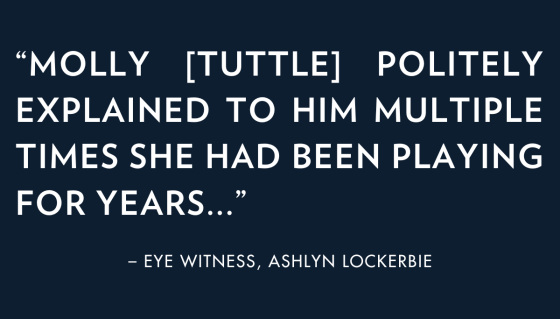
According to witness Ashlyn Lockerbie (32), the entire interaction could have been avoided. “Molly [Tuttle] politely explained to him multiple times that she had been playing for years,” Lockerbie stated. “She wasn’t even looking to buy a guitar.”

Plapinger, however, held a different perspective. “I was suggesting she get a ukulele; thought her kids could enjoy it too,” he explained, despite Tuttle not currently having children.

Observing the cringe-worthy spectacle from her hiding place behind a bass amplifier, Lockerbie later managed to escape through the loading dock to avoid Plapinger. “I’m not proud of running,” she said with a haunted look. “But I had to save myself.”

In a statement released on Friday, Grammy award-winning Tuttle revealed that she had entered the store seeking directions after leaving her cellphone in an Uber. To her dismay, this led to an hour and twenty-minute encounter with Plapinger, including a lecture on the greatest guitar solos of all time, a photo presentation of his 1999 canary yellow Camaro, and an impromptu performance of “Stairway to Heaven,” all without Tuttle’s consent.

According to Facebook, Plapinger has been a part-time sales associate at Guitar Center since 2016, following his divorce. He also serves as an alternate lead guitarist for the local Led Zeppelin cover band, Boogie With Stu.

“I even added her to the guest list for my show at Foamie’s that night. Surprise, surprise, she didn’t show up!” he exclaimed, before turning his attention to a woman perusing pedal boards. “Her loss. She could have learned how to rock,” he added with a shrug.

Tuttle is currently touring the United Kingdom with Tommy Emmanuel and said that the incident has motivated her to aid other women facing similar situations.

“I never pass a music retailer without checking on the women inside and ensuring they want to be there,” said Tuttle, whose Run Don’t Strum Foundation has rescued numerous musicians to date. “After what I’ve been through, it’s the least I can do.”


Greg Hess is a comedy writer and performer in Los Angeles. His work has been featured in The American Bystander, The Onion, Shouts & Murmurs, Points in Case, and he cohosts the hit satirical podcast MEGA.

2020: The Year of Dolly Parton

Dolly Parton kept her promise to bring good into the world in 2020 and beyond. For so many reasons, this is absolutely the Year of Dolly Parton.

Marking her 50th anniversary as an Opry member in October 2019, she told reporters, “This world is just so dark, ugly and awful. I just can’t believe how we just can’t have a little more light and a little more love. So, I’m going to make it my business to try to do songs that are more uplifting — not just all Christian-based songs but songs that are just about better things. Do better and just have a little more love, a little more light and just don’t be so dark and dirty!”

Gosh, where to begin? How about…


View this post on Instagram


A post shared by Dolly Parton (@dollyparton)

Although it seems like a million years ago now, Dolly launched a viral craze on January 21 with a meme that went around the world. Gotta love the acoustic guitar for Instagram!

Also in January, she notched a Top 10 track on Billboard’s Hot Dance/Electronic Songs chart with “Faith,” which basically transformed the John Hiatt classic into an international EDM hit. Co-starring in the video with her musical collaborators, Galantis, Parton camps things up as the world’s best-dressed bus driver.

Later in the month, Parton collected her ninth career Grammy Award, this time in the category of Best Contemporary Christian Music Performance/Song, sharing the honor with For King and Country with “God Only Knows.” Although Parton wasn’t in attendance, the duo’s Joel Smallbone remarked from the podium, “To dear Dolly Parton, who is an incredible human being. It’s one of the great moments of our career to collaborate with her and her team.”

He continued, “I taught two of her managers in Sunday school growing up, so they were kind enough to reach out and play her the song. But she said something on a call. She said, ‘I love this song because it’s reaching to the marginalized, to the depressed, to the suicidal,’ which is all of us at some point. And then she said this, in her Dolly accent: ‘I’m going to take this song from Dollywood to Bollywood to Hollywood.’ And we did it, Dolly, we took it all the way.”


View this post on Instagram


A post shared by Dolly Parton (@dollyparton)

A few months into the pandemic, Parton told Instagram followers, “I think God is in this, I really do. I think he’s trying to hold us up to the light so we can see ourselves and see each other through the eyes of love. I think that when this passes, we’re all gonna be better people.”

She also revealed on social media that she’d donated a million dollars to Vanderbilt University help find a cure for the coronavirus. She wrote, “My longtime friend Dr. Naji Abumrad, who’s been involved in research at Vanderbilt for many years, informed me that they were making some exciting advancements towards research of the coronavirus for a cure. I am making a donation of $1 million to Vanderbilt towards that research and to encourage people that can afford it to make donations.”

Incredibly, when news of the Moderna vaccine emerged in November, Parton’s contribution was duly noted. “Without a doubt in my mind, her funding made the research toward the vaccine go 10 times faster than it would be without it,” Abumrad told the Washington Post.

In April, she kicked off a series of bedtime stories, told online, in order to bring comfort to children who were scared about sheltering in place. “This is something I have been wanting to do for quite a while, but the timing never felt quite right,” she said. “I think it is pretty clear that now is the time to share a story and to share some love. It is an honor for me to share the incredible talent of these authors and illustrators. They make us smile, they make us laugh and they make us think.” Two of the chosen books she wrote herself: Coat of Many Colors and I Am a Rainbow.

In addition, a new line of uplifting greeting cards inspired by Parton appeared in Walmart stores over the summer. Meanwhile, musically, she responded to the pandemic with a beacon of optimism, titled “When Life Is Good Again.” She shared the song in tandem with an interview (while sitting on her porch in her first-ever Zoom call) with the series Time100 Talks: Finding Hope.

Bluegrass fans rejoiced in August as she made a surprise announcement that six of her albums from the early 2000s were finally available on streaming services, so how about adding title tracks of Little Sparrow and Halos & Horns to your Dolly playlists? Overall, 93 once-missing tracks are now available to stream.

Although she’s rarely controversial, Parton’s commentary about Black Lives Matter caused a commotion among its supporters and detractors — and even inspired a mural in East Nashville. She told Billboard in August, “I think that everybody needs to express themselves however they feel they have to. I’m not out here to tell you what to do. I don’t want you to tell me what to do. But I just do what my heart tells me to do, I ask God to direct me and lead me, and if I’ve got his direction, I don’t have to worry too much about anything else. But I do understand people having to make themselves known and felt and seen. And of course Black lives matter. Do we think our little white asses are the only ones that matter? No! Everybody matters.”

In November, she commemorated the 25th anniversary of the Imagination Library – an incredible program she launched in 1995 in order to provide free books every month to preschool children — with a new documentary titled The Library That Dolly Built. Parton stated, “I am so excited that we can finally tell the whole story of the Imagination Library. It is certainly not just about me. Our story is the story of children, of families and communities who all share the dream to inspire kids to love to read and to love to learn. My hope is this documentary will encourage more towns, more states and even more countries to jump onboard. One thing is for sure, I think this is the best investment I have ever made.”

Those who have been fans of Dolly Parton for their whole lives were treated to two magnificent overviews in 2020. The first is a Time Life box set of her career on camera, available in two different configurations. One option for Dolly: The Ultimate Collection clocks in at 11 DVDs, and the other at 19 DVDs. Some of the most interesting footage comes from her variety shows, such as this clip of the superstar singing “Amazing Grace” with Glen Campbell (who, for some reason, has brought along his bagpipes).

The other retrospective is Songteller, a book of lyrics that doubles as a memoir. Compiled by Parton and noted journalist Robert K. Oermann, it portrays Parton as a composer whose catalog goes way deeper (and darker) than “Jolene,” “9 to 5,” and “I Will Always Love You.” Dorian Lynskey, a contributor to the L.A. Times, wrote, “Her shows are carnivals of good-natured inclusivity that unite everyone from LGBTQ millennials to MAGA-hat boomers under one roof. There is room for heartbreak but not deep cuts about suicide and arson. Still, she would not have included so many of these dramas of cruelty and suffering in Songteller if she did not believe that this harsher strain in her life and work was worth remembering. Her optimism stands on the shoulders of pain.”

And if all that isn’t enough, she gifted us with a holiday album and a network special (both titled A Holly Dolly Christmas), a Netflix movie (Christmas on the Square), and even a baking kit at Williams-Sonoma. It may be the only time in history that she’s been affiliated with the words “cookie cutter.”

Right before Thanksgiving, the iconic musician logged her 50th Grammy nomination, this time for “There Was Jesus,” a collaboration with Zach Williams in the Best Contemporary Christian Music Performance/Song category. A week later, former President Barack Obama lamented that he hadn’t given Parton the Presidential Medal of Freedom. Perhaps that will happen in 2021?

Not that she’s short on awards. She picked up the new Hitmaker award from Billboard in December, and told viewers, “Of course, I’m proud of all the wonderful women in show business that write all these wonderful songs. I’d like to acknowledge a few — some of them older, kind of back in my day. Cindy Walker, who wrote some of the greatest songs ever, and of course Loretta Lynn, a wonderful, wonderful songwriter. And this day in time, of course, Taylor Swift, she’s just right up there, probably number one. And of course, Brandi Carlile, there’s just so many that write so many good songs. I think it’s so important that we acknowledge the women that write and sing in country music. And I think it’s also very important that they take control of their own business. I know I’ve had my own publishing company for years. Same with a lot of these women that I mentioned. But anyhow, I’ve just wanted to always say, ‘You go, girls!’ We can do it!” (Like hundreds of others, the trophy will be housed in her museum in Dollywood.)

This year, and in all years, we commend Dolly Parton for her work ethic and for making herself available to her fans. Yes, she knows how to market herself through visibility and personality, but in 2020, when so many of us have stayed in, she’s gone the extra mile to put herself out there, safely.

On November 30, she wound up in New York Times‘ Style magazine in its “Diva” series, alongside Patti LaBelle and Barbra Streisand. One of the most accurate depictions of what it’s like to be around Dolly (and to always wish you had more time to spend together), the article’s author Emily Lordi quotes Dolly talking about her ambition: “I just wanted to do really good work, and I wanted it to make a really big difference in the world … to uplift mankind and glorify God.”


Photo courtesy of Dolly Parton

14 Songs for Roller Skating in Buffalo Herds

No matter where you may stand on the Lil Nas X viral sensation “Old Town Road” and the associated media firestorm, Twitter debates, and raging country-purity authenticity signalling, we should all be able to agree on one thing: country music has always been a welcoming home to musical memes. Sure, that term may be more recent, a product of the internet age, but ever since the dawn of country as a format silly, tongue-in-cheek, self-deprecating, hilarious, and downright foolish songs have been just as integral a part of the genre as heartbreak, cheatin’, booze, and trucks.

We thought it’s high time we celebrate the knee-slappin’, gut-bustin’ history of country music’s meme-ready songs from across the decades. Here are fourteen of our favorites — yes, just fourteen. We can assure you there are dozens and dozens more where these came from.

“A Boy Named Sue” – Johnny Cash

The man in black, one of the most iconic personas in the history of country music, famous for his grit, his stoicism, and his rough-hewn voice wasn’t even “above” recording a song steeped in satire. Hopefully in 2019 life is getting easier for boys named Sue.

“What a Waste of Good Corn Liquor” – Tennessee Mafia Jug Band

Originally recorded by Country Music Hall of Fame and Bluegrass Hall of Fame member Mac Wiseman, this disconcertingly happy-sounding song tells a story with a moral: moonshine will melt you. Don’t spoil the moonshine.

“The King Is Gone (So Are You)” – George Jones

A song about Elvis, Fred Flintstone, drinking, and heartbreak. This one ticks all of the boxes. Even the “use yabadabadoo in a song” box.

“Did I Shave My Legs For This?” – Deana Carter

Country, after all, is all about the relatability of the human condition. Jilted would-be lovers everywhere have felt your pain, Deana. We truly have.

“Don’t Let The Stars Get In Your Eyeballs” – Homer & Jethro

The original Weird Al Yankovics of country and bluegrass, Homer & Jethro wrote (and re-wrote) scores of songs with wacky, eye roll-inducing, laugh-out-loud funny lyrics, ad libs, and arrangements. Check that steel solo!

“I’ll Oilwells Love You” – Dolly Parton

No, Whitney Houston did not cover this one. But that would have been magnificent.

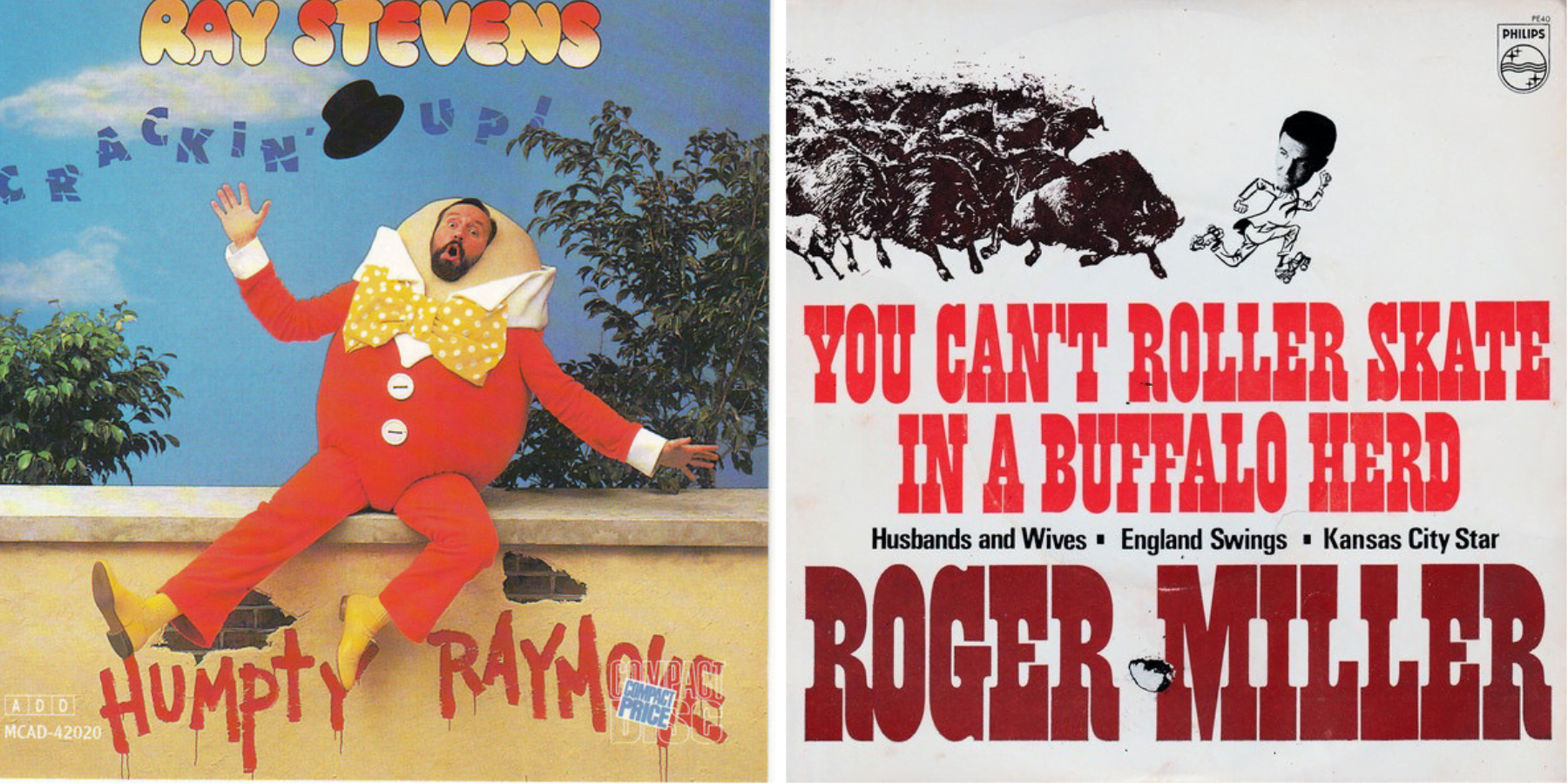
“You Can’t Roller Skate In A Buffalo Herd” – Roger Miller

One of country’s humorous kings, Roger Miller recorded a host of silly songs over the course of his career. We chose this particular number because of its evergreen wisdom. Of course.

“You’re The Reason Our Kids Are Ugly” – Loretta Lynn & Conway Twitty

But you know what? Looks ain’t everything. And money ain’t everything.

“I’m My Own Grandpa” – Willie Nelson

Get out a piece of scratch paper and sketch this family tree as you go. Does it seem a little… circular? Yeah… that’s the problem.

“Would Jesus Wear A Rolex” – Ray Stevens

A modern country parable. Again, an artist with plenty of silly and sarcastic songs to choose from — and Ray Stevens is being inducted into the Country Music Hall of Fame this year. Sounds pretty country to us…

“Cleopatra, Queen Of Denial” – Pam Tillis

Yes. More country songs with outright puns as their hooks, please. And of course, we’ve all been there, Pam. Denial is a popular destination.

“Illegal Smile” – John Prine

On the opening track of his debut album Prine immediately set the tone for his entire career with some of the most nonsensical and witty lyrics ever set to song. “Well done, hot dog bun, my sister’s a nun.”

“I’ll Think Of A Reason Later” – Lee Ann Womack

If you’ve never driven down the road shouting along with this one, we highly recommend that you do — as soon as possible. The song’s main character has a remarkable sense of self-awareness for being so viscerally incensed. If you really hate someone — who may or may not have ended up with your former significant other — it may be your family’s redneck nature.

“My Give A Damn’s Busted” – Jo Dee Messina

Look, if you’ve gotten to the end of this list and you haven’t enjoyed yourself, or maybe you don’t get the point, or maybe you think this is just useless clickbait… whatever the case may be, this song counts as our response. “Nah, man. Sorry.” (Isn’t country the best?)