You Gotta Hear This: Margo Price, Darren Nicholson, and More

A fresh batch of roots music has arrived! You Gotta Hear This.

To kick off our weekly roundup of new music, singer-songwriter Jacob Augustine shares a music video for “Halfway to Harlem,” a jangling, twanging, and bluesy roots track with post-apocalyptic vibes – and the video to match. For how forbidding the video and lyrics are in their subject matter, the song is still charming and inviting. You’ll also enjoy a new song from Swedish roots duo Orange Oak. “well, well, well” is tender and contemplative and, as they put it themselves, it “explores the struggles of confronting yourself after a period of avoidance and inner conflict.” Still, there’s ample redemption to be found in the alt-folk track.

For a bit of troubadour storytelling, Pennsylvania’s Jeff Mamett unveils “Like Old Uncle Jim.” With a bit of dark country & western tinge, it’s a story song that pays tribute to larger-than-life figures and finds truth even in fiction and mythology. Mamett’s baritone vocal is rich and engaging. Plus, Irish artist Helen O’Shea, who’s now based in New Jersey, calls on her friends the Carlile Family Band for her new track and lyric video for “There Will Be Days.” It’s Americana with a party vibe, but the subject matter is much more deep and involved, passing on wisdom and considering the many cycles of living life. It’s ripe for a sing along!

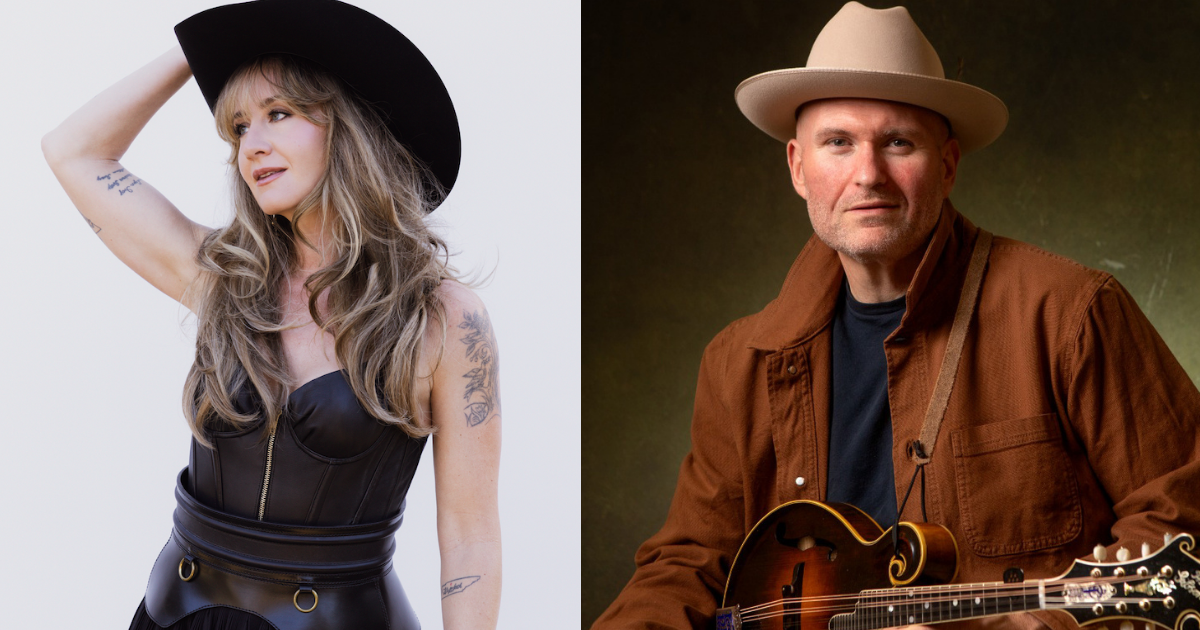
In bluegrass, mandolinist and singer-songwriter Darren Nicholson launches his new album, Lonesome Trails and Tall Tales, today. To celebrate, we’re sharing “All Trains Must Come to Pass” for release day. It’s a barn-burning traditional bluegrass number that Nicholson co-wrote with Charles Humphrey III and Thomm Jutz. And don’t miss the latest duo recording from Bryan Sutton, this time featuring guitar wizard Tommy Emmanuel alongside. “Don’t Let Your Deal Go Down” is a common choice by Sutton, but in this arrangement with Emmanuel there are equal infusions of jazz and swing alongside bluegrass and flatpicking.

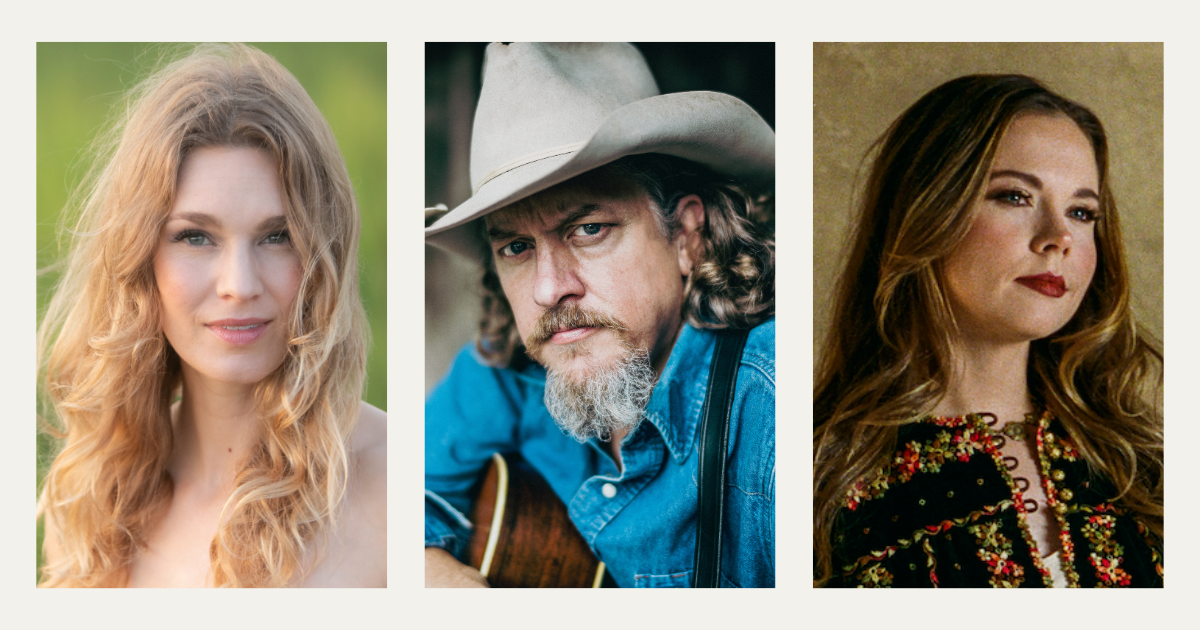
Also out today is a new tribute album to Guy Clark produced by Dan Knobler and released by Truly Handmade Records. Old No. 1 Revisited features performances by Jade Bird, Erin Rae, Brennen Leigh, Kelsey Waldon, Logan Ledger, and more. For our roundup, we’re sharing Margo Price’s rendition of “Rita Ballou.” Both Price and Knobler tell us their stories of how the track came to be below – it’s an absolutely lovely tribute to a songwriting and Americana legend.

There’s so much to enjoy! You Gotta Hear This…

Jacob Augustine, “Halfway to Harlem”

Artist: Jacob Augustine
Hometown: Portland, Maine
Song: “Halfway to Harlem”
Album: I Love You Forever
Release Date: April 29, 2026 (single); May 22, 2026 (album)
Label: Team Love Records

In Their Words: “Post-apocalyptic survivor studies. Car alarms serenading the cities of America to dead battery silence.

“What is it to fall in love, raise a child, and save the world all at the same time? This song explores these themes and questions. Questions I don’t really have the answers to. But questions that need to be asked I think.” – Jacob Augustine

Video Credits:
Directed by Jacob Augustine.
Co-directed, filmed, and edited by Joshua Powers, Wavin AM.
Starring Brandon Wardwell.
Produced by Wavin AM.


Jeff Mamett, “Like Old Uncle Jim”

Artist: Jeff Mamett
Hometown: Central Pennsylvania
Song: Like Old Uncle Jim
Album: Fortunate Son
Release Date: May 1, 2026 (single); August 21, 2026 (album)

In Their Words: “I grew up around people like this – the kind of man whose stories don’t always land the same way depending on who’s listening. With Uncle Jim, I was interested in that gap between what people say about somebody and what you see for yourself. As a kid, you don’t question it the same way, you just take it in.

“The details were important to me – the cigarette, the pony ride, the way he carried himself. Those things felt more honest than trying to explain him. By the end, the truth is there if you’re paying attention, but it doesn’t come out and announce itself. It just sits in the room. I think that’s how a lot of people are. You don’t always know who they are unless you’re looking closely.” – Jeff Mamett


Darren Nicholson, “All Trains Come to Pass”

Artist: Darren Nicholson
Hometown: Canton, North Carolina
Song: “All Trains Come to Pass”
Album: Lonesome Trails and Tall Tales
Release Date: May 1, 2026
Label: Mountain Home Music Company

In Their Words: “‘All Trains Come to Pass’ is a barn-burner! It was written by Thomm Jutz, Charles Humphrey III, and myself. The song speaks metaphorically about the passing of time and how important it is to live in every moment. Breathe it in. The band is kicking on this one, and it was so much fun to record! We hope you enjoy listening to it as much as we did creating it.” – Darren Nicholson

Track Credits:
Darren Nicholson – Mandolin, lead vocal
Kristin Scott Benson – Banjo
Mark Fain – Upright bass
David Johnson – Acoustic guitar
Tony Creasman – Drums
Deanie Richardson – Fiddle
Kevin Sluder – Harmony vocal
Avery Welter – Harmony vocal
Jennifer Nicholson – Harmony vocal


Orange Oak, “well, well, well”

Artist: Orange Oak
Hometown: Stockholm, Sweden
Song: “well, well, well”
Album: almost, I thought to myself
Release Date: May 1, 2026 (song); September 11, 2026 (album)
Label: Nettwerk Music Group

In Their Words: “This song explores the struggles of confronting yourself after a period of avoidance and inner conflict. It moves between self-criticism and a quiet desire for change; realizing escape is no longer sustainable. There’s tension between wanting control and accepting vulnerability. There’s strain in letting go of anger and returning to life with a new sense of honesty. At its core, ‘well, well, well’ is about self-reflection, reconciliation, and finding the courage to begin again and again and again.” – Filippa Frisell and Erik Olsson, Orange Oak


Helen O’Shea, “There Will Be Days”

Artist: Helen O’Shea
Hometown: Born in Limerick, Ireland; living in Long Branch, New Jersey
Song: “There Will Be Days”
Album: Songs In The Key Of O
Release Date: May 1, 2026
Label: White Butterfly Music

In Their Words: “The song ‘There Will Be Days’ started out in a conversation between Caroline Carlile and myself. She was starting out as a young artist with tremendous potential and I was telling her that there will be days when she feels the world is against her, but that is exactly when she must let her starlight shine through. First this line became a poem and then Caroline and I decided to write a song about it together, with help from Jay Carlile and Marc Swersky. The result is this beautiful duet between Caroline and myself with Jay on harmonica and the Carlile Family Band on backing vocals against the music of Andrew Carillo (Joan Osborne), Rob Clores (Jesse Malin), and Aaron Comess (Spin Doctors).” – Helen O’Shea

Track Credits:
Helen O’Shea – Vocals, songwriter
Caroline Carlile – Vocals, songwriter
The Carlile Family Band – Background vocals
Marc Swersky – Producer, songwriter
Andrew Carillo – Guitars
Rob Clores – Keys
Aaron Comess – Drums
Jay Carlile – Harmonica, songwriter

Video Credits: Story & Bone


Margo Price, “Rita Ballou”

Artist: Margo Price
Song: “Rita Ballou”
Album: Old No. 1 Revisited
Release Date: May 1, 2026
Label: Truly Handmade Records

In Their Words: “Many years ago, I was lucky enough to find Guy’s Clark’s perfectly crafted album, Old No. 1, while shuffling through the jukebox at the Devil’s Backbone Tavern in Fischer, Texas. His fingerpicking and storytelling on ‘Rita Ballou’ pulled me in. And I was hooked.

“Guy’s a carpenter in every sense of the word and every song he builds is ornate, solid, and reliable. It’s an honor to interpret his songwriting for this tribute, alongside producer and guitar virtuoso Dan Knobler, harmonies by my talented bandmate Logan Ledger, and the incredible, top-tier musicians that played on this track.” – Margo Price

“Margo Price was the immediate and obvious choice to extol the charms of ‘Rita Ballou.’ These songs do the work, all we have to do is cast them appropriately. So in that spirit I appointed the tracking room at Good Wishes with a proverbial joy carnival of musicians: octopus double drums from Jamie Dick and Dom Billett, powerhouse Jen Gunderman at the keys, the legend Russ Pahl walking into the studio with his steel on his shoulder, Will Honaker holding it down on bass, me strumming and picking. Margo stood out on the floor with us and nailed the song to the wall. Logan Ledger and Nicki Bluhm provided the backup choruses and a good time was had by all.” – Dan Knobler, producer

Track Credits:
Margo Price – Vocals
Logan Ledger – Harmony vocal
Nicki Bluhm – Harmony vocal
Maya de Vitry – Additional harmony vocals
Rachael Davis – Additional harmony vocals
Dan Knobler – Acoustic guitars, electric guitar
Jen Gunderman – Piano, organ, Wurlitzer
Russ Pahl – Pedal steel
Will Honaker – Bass
Jamie Dick – Drums, percussion
Dom Billett – Drums, percussion


Bryan Sutton, “Don’t Let Your Deal Go Down” with Tommy Emmanuel

Artist: Bryan Sutton with Tommy Emmanuel
Hometown: Nashville, Tennessee
Song: “Don’t Let Your Deal Go Down”
Album: From Roots to Branches
Release Date: May 1, 2026 (single)
Label: Mountain Home Music Company

In Their Words: “[Tommy is] another guy that’s just been gracious to me over the years… a big pal and he’s a big energy. Every time he sees me, you just get all of his attention … he’s a wonderful friend and a lovely dude. Certainly, the world knows how strong a musician he is, but you know, the choice for that song, something with energy, that sort of comes from more of a bluegrass background. Those chord changes lend a little more to the swing and jazz world, and that’s where he and I have spent a lot of time playing other songs together.

“I was a partner on his duet record some years ago. We did ‘C Jam Blues’ and some other swing music like that. Trying to choose songs that sort of honor a certain angle of our relationship, musically, so that mix of bluegrass and jazz and swing is where Tommy Emmanuel and I find some common ground.” – Bryan Sutton

Track Credits:
Bryan Sutton – Acoustic guitar, lead vocal
Tommy Emmanuel – Acoustic guitar, vocal


Photo Credit: Margo Price by Yana Yatsuk; Darren Nicholson by Jeff Smith.

35 Songs That Hate Nashville

Hating on Nashville – whether Music City, Music Row, Lower Broadway, the tourists, the industry, the traffic, or almost anything and everything else – is a trope and tradition essential to country itself. As long as this town has been a roots music mecca it’s been a curse, too. It’s a maker and breaker of dreams that’s all at once exactly what it is and what it looks like, and a figment of your imagination, too.

On the roots songwriter’s map, it might be the capital city. Flanked by Memphis and “Carolina” and Los Angeles and Malibu and the bluegrass of Kentucky and the “concrete jungle where dreams are made of,” all familiar locales to songsters of all genres referencing places and cities. Places are excellent characters in songs, and we return to our favorite destinations over and over as we relish tracks like “Dublin Blues,” “Eight More Miles to Louisville,” “Big Ball in Brooklyn,” “Take Me Home Country Roads,” and so many more.

But isn’t there just something special about songs that hate Nashville? As a motif, it stands out among songs about places or among places as a trope, in country and outside of it. Songs that hate Nashville can ooze pain or vengeance. They can be aspirational or giving up all hope. But perhaps their real unifier, besides Music City itself, is that each and every song that offers a variation on this theme is really, at its core, declaring a deep love for the town.

In March, country artist, singer, and songwriter Ashley Monroe surprise released an eight-track original album, Dear Nashville. Not quite a concept album – perhaps rather having a concept at its core, instead of as its entirety – it’s an incisive and vulnerable demonstration of Monroe’s love… and hatred of Music City. “I Hate Nashville” opens the album with gauzy pads and a forward-leaning train beat as Monroe sings words that clearly haunt her, and so many like her. Lyrics often uttered by the gatekeepers of the world, the holders of the keys to this city. “They can’t make you a star,” “somethin’ ain’t stickin’,” “pay your dues.”

The rest of the song, though, is something different. It’s exasperated and exhausted, yes. Defeated, almost. But it’s not a hate letter Monroe is writing to her hometown of decades. She sings on the chorus:

Country music
Is the reason I’m alive
Paul Franklin playin’ steel
God knows I love Vince Gill
But I hate Nashville

And wouldn’t you know it, that mournful, heart-wrenching pedal steel singing along with Monroe’s beautiful, East Tennessee voice is played by Paul Franklin himself. Because that’s what Nashville is capable of. That’s what it does best. It makes dreams reality, it makes friends of idols. It can be everything you pictured, but wouldn’t let yourself believe is possible.

Wrote a lot of songs
Made a lot of friends
And if I’m being honest
I’d do it all again
I remember the first time
I saw the skyline shining
Sometimes the road to the top’s
A lot of downhill climbin’

Verse two captures the duality of songs that hate Nashville perfectly. Monroe is displeased with the industry, with the machinations of a community designed to reap profits and profits and profits, and that isn’t so concerned with art or country anymore. But her dreams have come true. She has paid her dues – and then some – and she’s made records and sung songs with Franklin, Vince Gill, Miranda Lambert, and so many more name-droppable peers, heroes, legends, and virtuosos. And, if she’s being honest, she’d “do it all again.” Who wouldn’t?

In each of these 35 songs, you’ll find artists just like Monroe, from across generations and from a variety of backgrounds and origin points inside and outside Music City. Each grapples with these same essential questions of this place. Of Nashville, Tennessee. Struggling with the industry, or Music Row, or the politics of each. Some demonstrate internal battles, others are so external they itch. There are songs that decry capitalism and that long for acceptance by it. There are songs of love lost and romantic haunts turned sour. You may hear someone writing on the outside looking in, or the inside looking out. It’s all compelling, the same but different.

Whatever you hear across these songs that hate Nashville, you’ll hear excellent music and a country tradition so essential to the format it belongs right next to losing your love, your truck, your dog, your house, your job, your… dream of making it in Nashville. Three chords, the truth, and hating Nashville. It’s as country as it gets.

“Heartbreak Town” – The Chicks

“Square people in a world that’s round.” That’s an indictment, for sure, written as only Darrell Scott could. Scott is well-practiced in songs that hate Nashville whether this magnificent track made even more delicious by the Chicks or “Long Time Gone,” also cut by the Chicks and included on this playlist, or even “Hopkinsville,” a Scott original inspired by longing to be done working on the Shelby Street bridge downtown. The Chicks sold the true heartbreak of Nashville on this number even before the city’s central machine turned its ire toward them. As we all know, they survived being on the receiving end of Music City’s ire more than once – and made millions doing it.

“Kay” – John Wesley Ryles

A story song for the ages, and about Nashville, to boot. “Kay” is sung from the perspective of a depressed taxi driver, “I’m living and I’m dying, staring out at Music City, from my cab.” The singer moved his love, Kay, to town to give her a shot at making it big. He’s hearing her record on the jukebox – it “don’t sound bad.” Woof. Gut punch. (At least if she’s gonna be famous, let her sound bad!) The perspective in the song is dynamic and surprising in a modern context, but reminds of how literary and poetic country story songs in the ‘60s and ‘70s could be. And how narratively dense. “Kay” peaked at No. 9 in the U.S. and is Ryles’ best-known record.

“Nashville Blues” – Billy Strings, Bryan Sutton

Out of so many versions to choose from, we chose this one. Can you blame us? Perhaps Bryan Sutton’s joke at the top is the real reason it belongs on this playlist. He introduces “Nashville Blues,” a classic in the bluegrass and old-time canon, thusly, “Here’s a song about Nashville that Billy wrote on the way here stuck in traffic.” The crowd cheers at the joke and a man can be heard responding, “That’s gonna be a long song.” Everybody at the sold-out American Legion neighboring the famous, coveted 37206 zip code laughs. Hating Nashville unites us.

“Ten Year Town” – Hailey Whitters

Speaking of dues, Ashley Monroe’s “I Hate Nashville” immediately brings to mind Hailey Whitters’ “Ten Year Town.” Released in 2020 on The Dream, it drives to the heart of the strange but usual expectations projected by others and ourselves – onto Nashville, careers, dreams, and music- and art-making. What Whitters is really singing about – and Monroe, too, to a degree – is that country music is a trade. Whitters is asking what else she could do besides this, while noting all she’s had to do besides make music in order to make music her trade. But if, like Monroe and Whitters, the trade you’ve plied your whole life or for decades can’t make you a living, what good is paying dues? In investing 12 years in a “ten year town”?

“Nashville Without You” – Tim McGraw

You know what else is country AF? Referencing country songs in a country song. If roots music is going to be one thing, it’s going to be self-referential. All songs about Nashville do this to a degree, but Tim McGraw’s “Nashville Without You” does it remarkably well. Especially for highly stylized mainstream radio country such as this. As a bonus, this is also an “I Left My Heart in San Francisco” sort of love song, where one’s relationship to a place is entirely colored by another person and your shared connection to that place. Ryles’ “Kay” in another generation!

“Nashville” – Indigo Girls

Let’s not forget the folks who have the most reason to hate Nashville – in the music industry and outside of it – have always been women, queer folks, Black and Brown folks, and disabled folks. That’s certainly part of why so many women have written such excellent songs panning Music City. There’s an added layer of truth, an extra heaping helping of grit. 70 cents on the dollar, 12 years to equal the ten-year town requirement.

As an extension of that theory then, being both women and queer as alt-country indie folk artists in the ‘90s is a huge part of what imbues the Indigo Girls’ “Nashville” with honesty and resonance. It’s artful in its lyricism and for painting as much with absence as presence, fleshing out the story by leaving it out here and there. But it’s the perfect song to leave off with, as you continue your listening to the full 35-song playlist below.

Emily Saliers and Amy Ray touch yet again on the maelstrom of mixed feelings musicians and creatives feel about this place, reminding of the central existential love/hate in Monroe’s “I Hate Nashville.” Saliers sings:

I’m leaving
I’ve got all these debts to pay
You know we all have our dues
I’ll pay ’em some other place
I never ask that you pay me back
We all arrive with more
I left with less than I had

The song is so seemingly over-and-done-with Nashville and yet, there’s a crack under the door. The window is not quite latched. A pathway however slight to wiggle back in. You can see it again elsewhere in the song, “I can’t place no blame/ But if you forget my face/ I’ll never call your name again.” Are they singing to a person? To the industry? To Nashville? To all of the above?

One thing we know for sure, they hate (love) Nashville. Just like Monroe. Because how does she close her album, Dear Nashville? It’s how we decided to close our playlist, too. With “Quittin’.” Another song co-written by Monroe with co-producer Luke Laird. It ends:

So much for quitting
I guess I’ll stay on the ride
‘Til the day that I die

We should hope so. There are so many more songs about hating Nashville to write and to enjoy!

Below, sample many more songs that hate Nashville from artists like Marty Stuart, John Anderson, John Hartford, Margo Price, Donovan Woods, Lindi Ortega, Kacey Musgraves, Steve Earle, Kris Kristofferson, Charley Crockett, Dale Watson, Waylon Jennings, and many more.


Additional contributions and curation by Shelby Williamson. 

Photo Credit: Ashley Monroe by Becky Fluke.

You Gotta Hear This: New Music From River Shook, Bryan Sutton, and More

It’s another edition of our weekly collection of new roots music! You Gotta Hear This…

To get us started, singer-songwriter Jenn Grinels is giving us a preview of her upcoming single, “Always On The Run,” which will arrive next week. The track combines Californian indie twang with straight-ahead country & western and a gothic twist. While Grinels is an accomplished songwriter herself, in this instance she composed the music while the evocative, text-painting lyrics were penned by Alfred Howard, a poet and musician. We’re also very excited for new music from River Shook, who you may know from their prior project, Sarah Shook & the Disarmers. Their new roots-folk single, “Wildlands,” is actually a song begun more than 10 years ago – and in a completely different set of circumstances. Shook completed the song channeling feelings from their recent shift from the Disarmers to this new era, performing and releasing music solo, under their own name. With this track, we’re certainly looking forward to what comes next from Shook.

In bluegrass, Lonesome River Band pull a song seen performed by Stringbean (David Akeman) on The Porter Wagoner Show for their new single. “Pretty Little Widow” is hilarious and first rate, even employing an all-too-rare traditional bluegrass instrument, the Telecaster. Its twangy punctuations are a perfect addition to the single, out today. Acclaimed guitarists Bryan Sutton and Kenny Smith also launch a track today, “Three Star Hornpipe,” from Sutton’s upcoming album of six-string duets. Sutton and Smith’s decades-long friendship is easy to hear on the relaxed and loping modern fiddle tune.

There are a couple of great cover songs included today, too. Nashville-based artist Sweet Megg shares her new video for her most recent single, “Come On Up to the House,” her interpretation of the Tom Waits classic. She was inspired by her own family homeplace, a literal and figurative refuge where she grew up in New York City. Plus, after a lifetime of playing sets of cover songs, Jessie Wilson finally releases a cover – and it’s none other than Dolly Parton’s “Jolene.” A failsafe choice for a first cover release, Wilson’s take on the iconic favorite has a deep pocket, head-bobbing feel changes, and bluegrass instruments tucked into every one of the track’s nooks and crannies.

We hope you enjoy these songs as much as we have. You Gotta Hear This!

Jenn Grinels, “Always On The Run”

Artist: Jenn Grinels
Hometown: Originally Cupertino, California; currently working out of New York City
Song: “Always On The Run”
Release Date: April 10, 2026

In Their Words: “This song is a collaboration, with lyrics by Alfred Howard and music by me. I’ve always admired Al’s poetry, spoken word, and lyricism, so when he first reached out about collaborating, I was thrilled. These were the first lyrics he sent me – of many songs we ended up working on together – and when I read them, I was instantly inspired. The songwriting process was so quick, which definitely doesn’t always happen, and that ease ended up inspiring and setting the tone for the rest of the record.

“The imagery in Al’s writing naturally leant itself to this western feel that carries throughout the album – and a lot of that is rooted in the desert landscapes of Southern California that inspire him.

“At its heart, the song is about endless ambition – and the exhaustion that can come with it. We’re always reaching for our dreams, both of us having spent so many years in this business, constantly chasing that setting sun – and to metaphorically walk into it. It’s special to work with someone who’s in a similar place in life. He can write something deeply personal that I immediately connect to, and that sparks something in me musically.” – Jenn Grinels

Track Credits:
Jenn Grinels – Vocals, acoustic guitar, composer
Alfred Howard – Lyricist
Mike Butler – Guitars, lap steel, percussion, producer, engineer
Jason Littlefield – Bass
Jake Najor – Drums


Lonesome River Band, “Pretty Little Widow”

Artist: Lonesome River Band
Hometown: Floyd, Virginia
Song: “Pretty Little Widow”
Release Date: April 3, 2026
Label: Mountain Home Music Company

In Their Words: “Jesse [Smathers] brought this song to our attention from a video of Stringbean on The Porter Wagoner Show from the 1960s. We all love Stringbean’s music, and it was a song I had not heard before. He was backed by Porter’s country band and the electric guitar had a great part in the song. So it was an obvious choice of tunes for this project. Rod Riley on the Tele captures the vintage sound of that era of country music.” – Sammy Shelor

Track Credits:
Sammy Shelor – Banjo
Jesse Smathers – Acoustic, lead vocal
Mike Hartgrove – Fiddle
Adam Miller – Mandolin, harmony vocal
Kameron Keller – Upright bass
Rod Riley – Electric guitar


Bryan Sutton, “Three Star Hornpipe” with Kenny Smith

Artist: Bryan Sutton with Kenny Smith
Hometown: Nashville, Tennessee
Song: “Three Star Hornpipe”
Album: From Roots to Branches
Release Date: April 3, 2026 (single)
Label: Mountain Home Music Company

In Their Words: “I met Kenny when I first moved to Nashville. He had been there already a few years and was living down there near Wartrace, Tennessee, doing some work with Gallagher. And I forget exactly where I might have met him, but I was probably around the Station Inn or one of the music stores in Nashville. I went down and hung out with him. I had a guitar that I had some questions about and wanted to show it to him – you know, some structural issues – and he took a look at it and we played a little bit and I’ve just known him ever since. This is the early ’90s, over 30 years ago, and I just maintained a friendship with him all through these years.

“I’ve always loved the way Kenny is reverential towards fiddle tunes when he plays. He really finds that sweet spot of his guitar artistry, but you hear the melodies – he’s playing the tune and presenting the melody. I found this old song, ‘Three Star Hornpipe,’ that I’d heard from a fiddler named Roger Howell here in Western North Carolina. Tommy Hunter had recorded it years and years ago. I found an original recording and sent it to Kenny and went like, ‘What do you think? Here’s a tune that neither of us have ever played.’ Again, I didn’t necessarily want to do an obvious, low-hanging fruit kind of fiddle tune. So here was a newer tune and he was game to do it. That’s how we got into that tune, and I just love what he did with it.” – Bryan Sutton

Track Credits:
Bryan Sutton – Acoustic guitar
Kenny Smith – Acoustic guitar


River Shook, “Wildlands”

Artist: River Shook
Hometown: Chapel Hill, North Carolina
Song: “Wildlands”
Release Date: April 3, 2026

In Their Words: “I started writing ‘Wildlands’ when I was seeing a deeply controlling, scary person. One summer day, I snuck out of the house and went to the Haw River to clear my head. I sat writing at the water’s edge, feeling brave for the first time in years, and when I got back home, I hid the piece of paper with the lyrics deep in my closet. Nothing came of the song for almost a decade.

“Last year, when I decided to end my band (Sarah Shook & the Disarmers) and start over under my new name (River Shook), those old feelings came rushing back – fear, bravery, clarity, strength – and I remembered ‘Wildlands.’ I kept the original first verse, reworked the other two, and wrote a new chorus. Releasing this song is such a beautiful full-circle moment in my life. I feel so lucky to share ‘Wildlands’ with you.” – River Shook

Track Credits:
River Shook – Vocals, acoustic guitar, electric guitar, songwriter, producer
Blake Tallent – Drums, bass, acoustic guitar, electric guitar, pedal steel, harmonica, percussion, producer

Video Credits: Samantha Kniskern


Sweet Megg, “Come On Up To the House”

Artist: Sweet Megg
Hometown: New York City; based in Nashville, Tennessee
Song: “Come On Up To the House” (Tom Waits cover)
Album: Massive Negroni
Release Date: April 1, 2026 (single); May 1, 2026 (album)

In Their Words:  “When I heard this song, it reminded me of home – not just a place, but a feeling. My family came from Ireland in the 1920s and settled in the house where my mother grew up and where I grew up too. That house holds so many memories of family and friends. It’s a sacred space.

“When the world feels like it’s on fire, I can step inside and enter another dimension of peace and tranquility. That’s what home can be. This song by Tom Waits carries that feeling for me. It’s an invitation, a prayer I offer to others: when the world is getting you down, come on up.” – Sweet Megg

Track Credits:
Sweet Megg – Vocals
Hunter Strasser – Guitar
Norbert McGettigan – Bass
Chris Gelb – Drums

Video Credits: Filmed and edited by Matthew Farrell.


Jessie Wilson, “Jolene”

Artist: Jessie Wilson
Hometown: Phenix City, Alabama
Song: “Jolene”
Album: Rebel & Reverie (EP)
Release Date: April 3, 2026 (EP)

In Their Words: “As a girl who has played hundreds of cover shows in my lifetime, I’ve never actually released a cover song. I play ‘Jolene’ frequently at my live shows and we perform it a bit different. We play the choruses in double time and the verses in a half time, giving it our own spin.

“I recorded this version after jumping in a session with musicians I hadn’t met yet, who all happened to be monster musicians. We recorded at Station West in Nashville with Ilya Toshinskiy (acoustic guitar), Steven Sinatra (drums), Jimmy Nichols (keys), Kris Donegan (electric guitar), and Rob Cureton (bass). It surpassed my expectations and the session felt so natural and easy despite being in a room filled with all musicians that I was meeting for the first time. Sometimes, you just feel so ‘at home’ with a song, it feels like it gives you no choice but to release it.” – Jessie Wilson

Track Credits:
Jessie Wilson – Lead vocal
Nicole Boggs – BGVs
Steve Sinatra – Drums
Ilya Toshinskiy – Acoustic guitar
Jimmy Nichols – Keys
Kris Donegan – Electric guitar
Rob Cureton – Bass
Andy Ellison – Dobro


Photo Credit: River Shook by Jillian Clark; Bryan Sutton courtesy of the artist.

You Gotta Hear This: New Music From Brit Taylor, Trey Hensley, and More

Happy Friday! We have new music for you to enjoy and, as always, You Gotta Hear This.

To start us off, Chicago Farmer (singer-songwriter Cody Diekhoff), shares a nostalgic and stripped-down country song, “The Twenty Dollar Bill,” that pays tribute to his grandparents and the “family roots” that he takes with him wherever he goes. The track is from his brand new album, Homeaid, which is out today. Kentuckian country singer, songwriter, and artist Brit Taylor has a new album today as well, Land of the Forgotten. To celebrate, we’re sharing “Done Pretending,” a song from the project co-written by Taylor, Adam Wright, and Jon Decious that decries relationships that are all “take” and no “give.”

There’s plenty of excellent guitar picking included here, too. Bryan Sutton returns to the roundup, this time with blues guitarist Joe Bonamassa in tow. The pair duet on Bill Monroe’s “Blue Night,” acoustic and electric guitars in shred-tastic dialogue on the classic number. The track comes from Sutton’s upcoming duets album, From Roots to Branches. Then, bluegrass and Americana flatpicker Trey Hensley calls on his friend and fellow guitarist Molly Tuttle for his new single, “Going and Gone.” Hensley penned the song with Bobby Starnes and features the bluesy, breakneck picking for which he has become known.

To wrap up, we have a new music video featuring lush and groovin’ Americana from YARN, a genre blurring-and-blending outfit that has been performing and recording for more than 20 years. For a song considering existence, fate, and the rat race at large, “Might as Well Be King” has an exquisite, gritty vibe – an excellent harbinger for the group’s new album, Saturday Night Sermon, arriving in April.

Whether your tastes lean towards bluegrass, blues, country, or Americana – You Gotta Hear This!

Chicago Farmer, “The Twenty Dollar Bill”

Artist: Chicago Farmer
Hometown: Delavan, Illinois
Song: “The Twenty Dollar Bill”
Album: Homeaid
Release Date: March 6, 2026
Label: LoHi Records

In Their Words: “When I was in high school my grandma started giving me a $5 bill to keep in my shoe for emergencies. When I told her I was going to be a musician she upped it to a $10. When I told her I was moving to Chicago she said, ‘You’re going to need a $20.’

“My grandfather lived pretty much his whole life in the same farmhouse that he grew up in. He was a storyteller from a small town and sharp as a tack. Grandma was a city girl, she grew in Peoria, Illinois. The home of Richard Pryor. She rode the city bus and had street smarts. Together, there wasn’t much they didn’t know or couldn’t fix or remedy. Grandpa passed away a few years ago just shy of 102. Grandma will be 98 this summer. They’re farmers, they’re veterans, and they’re my family roots that I take with me wherever I go. In song and in my heart. This song is for them.” – Cody Diekhoff, Chicago Farmer


Trey Hensley, “Going and Gone” Featuring Molly Tuttle

Artist: Trey Hensley
Hometown: Jonesborough, Tennessee
Song: “Going and Gone” featuring Molly Tuttle
Album: Can’t Outrun The Blues
Release Date: March 6, 2026 (album)
Label: Pinecastle Records

In Their Words: “I wrote ‘Going and Gone’ with Bobby Starnes the same day that he and I wrote ‘Can’t Outrun the Blues.’ And I immediately loved both of those songs. It’s one of those story songs that just falls together and paints a picture without spelling out every detail. ‘Going and Gone’ was the first song we recorded for the project – and I was thrilled to get my friend and one of my favorite guitar players and singer-songwriters, Molly Tuttle, to join in on guitar and vocals. We had a blast getting to work together in the studio and I think that comes through in the final recording!” – Trey Hensley


Bryan Sutton, “Blue Night” with Joe Bonamassa

Artist: Bryan Sutton
Hometown: Nashville, Tennessee
Song: “Blue Night” with Joe Bonamassa
Album: From Roots to Branches
Release Date: March 6, 2026 (single)
Label: Mountain Home Music Company

In Their Words: “I couldn’t be more thrilled to have Joe Bonamassa on this duets project. I’ve been a fan of his for a long time. I wasn’t sure what he would play when we cut this song, because all of this was acoustic. I love that he played electric guitar. I love the fact that it’s a different kind of song for this record and being able to interpret an old Bill Monroe song like this was just really, really fun.” – Bryan Sutton

Track Credits:
Bryan Sutton – Acoustic guitar, vocal
Joe Bonamassa – Electric guitar


Brit Taylor, “Done Pretending”

Artist: Brit Taylor
Hometown: Hindman, Kentucky
Song: “Done Pretending”
Album: Land of the Forgotten
Release Date: March 6, 2026
Label: RidgeTone Records, distributed by Thirty Tigers

In Their Words: “I wrote this tune with Adam Wright and Jon Decious – two of the most clever humans I know.

“I don’t know if other women have ever felt this way, but I have been in more than a few relationships that were a whole lot of take and basically no give. Then I realized that once you’ve given all you can give and done all you can do, you reach a point where there’s nothing left. No sadness, no anger, no regret – you are just done. That’s where the character is at in this song. She’s basically emotionless about it. She’s just done and she’s at peace with it.” – Brit Taylor


YARN, “Might As Well Be King”

Artist: YARN
Hometown: New York City, New York
Song: “Might As Well Be King”
Album: Saturday Night Sermon
Release Date: March 6, 2026 (single); April 24, 2026 (album)
Label: 333 Entertainment

In Their Words: “Let the good times roll. We don’t know why we’re here or how any of this existence even works. Is it all fated? Is it all free will? So many folks in competition with each other fighting over some made up ‘green god,’ because they’re taught that is the way. But, it’s entirely up to us as individuals to define our own way. Nothing is law, there are no rules, this is whatever we make it. So the point of this song is nothing more than, don’t put too much stock in these ridiculous systems we’ve created. Have fun being human, embrace your human form and being able to do whatever you want with it; it doesn’t last long.” – Blake Christiana

Track Credits:
Blake Christiana – Lead vocals, guitar
Andy Thomas – Lead guitar, backing vocals
Rick Bugel – Bass
Robert Bonhomme – Drums
Damian Calcagne – Hammond B3


Photo Credit: Brit Taylor by Sammy Hearn; Trey Hensley by Cora Wagoner.

Somethin’ About Train Songz

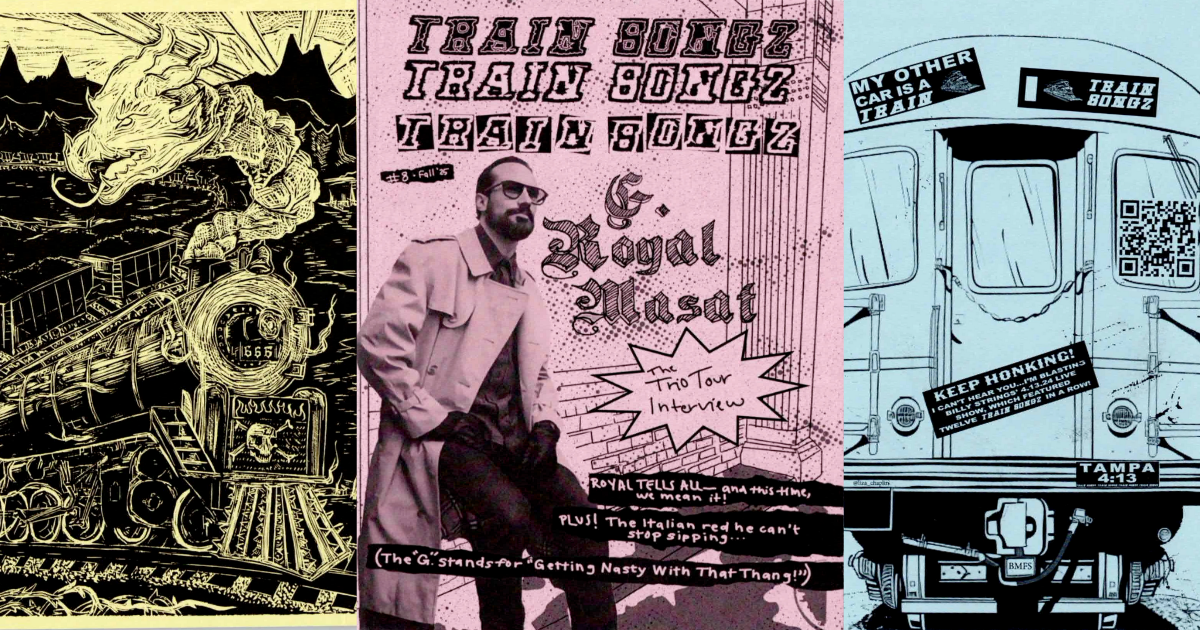
What first began as a locomotive and string music meme page has transformed into one of the most quirky and beloved sources of independent journalism in roots music, one zine at a time.

Founded by Anthony “The Conductor” Perasso and James “Promontory Paul” Lucey in July 2023, Train Songz has since grown its community to over 28,000 Instagram followers and more than 1,200 paid subscribers. Readers collectively contribute anywhere from $33-$99 per year (or $11 per copy), with three to four issues published per year. The latest, eighth edition features a 44-page interview with Billy Strings’ bassist Royal Masat.

The interview for Masat is a full circle moment for Train Songz, which began with a Billy-centric focus before expanding to feature other bluegrass acts like Mountain Grass Unit, East Nash Grass, and Valley Flower. In fact, it was a Billy Strings show in Bridgeport, Connecticut, attended by Train Songz co-founders (that they rode the train to themselves, no less) where the concept for the then-meme page first came together.

“At the show Billy was wearing a hickory-striped railroad hat that someone (who we’ve since connected with on Instagram) threw up on stage a few shows prior, as trains were passing by the stage,” recalls Perasso.

“I tweeted from my personal account a photo of Billy with the hat on and the caption ‘Train Songz,’ which was a Trey Songz pun – like if Trey Songz is Trey Songz, then Billy Strings is Train Songz,” Perasso laughs. “Four days later, I locked down the @train_songz username and posted our first meme.”

After publishing some popular Billy and Grateful Dead inspired memes, Train Songz began transitioning to a zine in December 2023, while Perasso was home for the holidays and more sedentary than usual after recovering from multiple surgeries. No stranger to producing print media, having previously worked on a satirical newspaper while in college, he says the zine quickly filled a void left empty since graduating in 2017. Now two years in with eight installments of the printed zine, Train Songz has grown into a thriving community bigger and wilder than Perasso, Lucey, and the rest of the core team – including Liza Chaplin (art/design) and Mitchell “Brakeman” Harbin (writer/editor) – could have ever imagined.

Original artwork by Morganne Allen from ‘Train Songz’ Vol. 7, Summer 2025.

“Beyond my personal penchant for print, Train Songz was gathering a community of wooden-instrument-music enjoyers, so print felt like a natural extension of that vibration,” Perasso continues. “And from a more boring media strategy point of view, print (and email!) offers you a direct relationship with your audience that algorithms can’t get in the way of and platforms can’t take away. So for both those reasons, a Train Songz zine felt like a perfect move.”

After wrapping up production on the eighth installment of the zine, the Train Songz crew spoke with BGS via Zoom about the zine’s origins, how they first discovered Billy Strings, the publication’s next steps for growth, and more.

Y’all use pen names in the zine (except for Liza). How did each of you come up with your alter egos?

James Lucey: Before I get to that, I’ll just add that leading up to this interview we all debated if we should do this as ourselves or go by our pen names. It’s been an interesting dynamic, [navigating] who are we in relationship to the zine [and] what the zine is in relationship to us and our audience. We made the zine to try and participate in some way in the broader conversation about modern-day bluegrass music; we’re not the face of the zine, we’re just the people that are powering it.

But regarding my pen name, “Promontory Paul,” he’s the voice of the Old Tune Review, which is one of the core pieces of the zine. In it we pick a handful of old songs [and] dive deep into [their] history through independent research. It’s born out of the idea that these old songs are still being played today and still resonate in some way. In some ways it’s like a time machine, because you’re feeling the same emotions that someone felt hundreds of years ago when they wrote these things. So it’s cool to dive in and see what the actual genesis of those songs are.

[Paul’s] the guy who runs that, but we also feature him in a little recurring cartoon series that sees him playing banjo and getting into all kinds of crazy adventures. “Promontory” is a reference to the Promontory Summit, which was the final completion [point] of the first transcontinental railroad in Utah, when the Union Pacific Railroad and the Central Pacific Railroads (which had been building from Nebraska and Sacramento, respectively) finally met.

This effectively connected the old world with the new one, sort of like what we do with the zine.

Mitchell Harbin: My name actually came out of the fact that a brakeman is a role on an actual train – he’s the guy that pulls the brakes. It was actually during the production of the zine’s third issue that I had come aboard to help with proofreading and copy editing. There were a couple of times in that process where James and Anthony were like, “Alright, we’re good to go, ready to launch” and I would pump the brakes and say, “Whoa, hold up.” Which is what eventually spawned the name idea.

Liza Chaplin: I’m still working on mine. [Laughs] It’s an ongoing thing that I’ve been thinking about, but so far I haven’t gotten anywhere with it. At first I decided to put my own name on it to use as a portfolio-building mechanism, but now with how the zine has grown it feels very silly to still have my actual name on it.

Anthony Perasso: “The Conductor” came to be when James and I were talking about taking the meme page offline [and moving] into print form with our first issue. We made a decision that Train Songz was the name of the publication and brand and community – or whatever vibration of people who value the same kind of music as we do, cultivating this eponymous meme page.

As the person who had started the meme page, I didn’t want Train Songz to be seen as an individual, as in, “That’s Anthony, he’s Train Songz.” Our desired outcome would be: “That’s Anthony, he’s The Conductor for Train Songz.” That allowed Train Songz [to be] less a single being and more of a vehicle for those involved. Pun intended. (A mentor even recommended to me that the title of The Conductor be something that can be passed on from individual to individual, like the Pope or the President. Time will tell if we get to that point!)

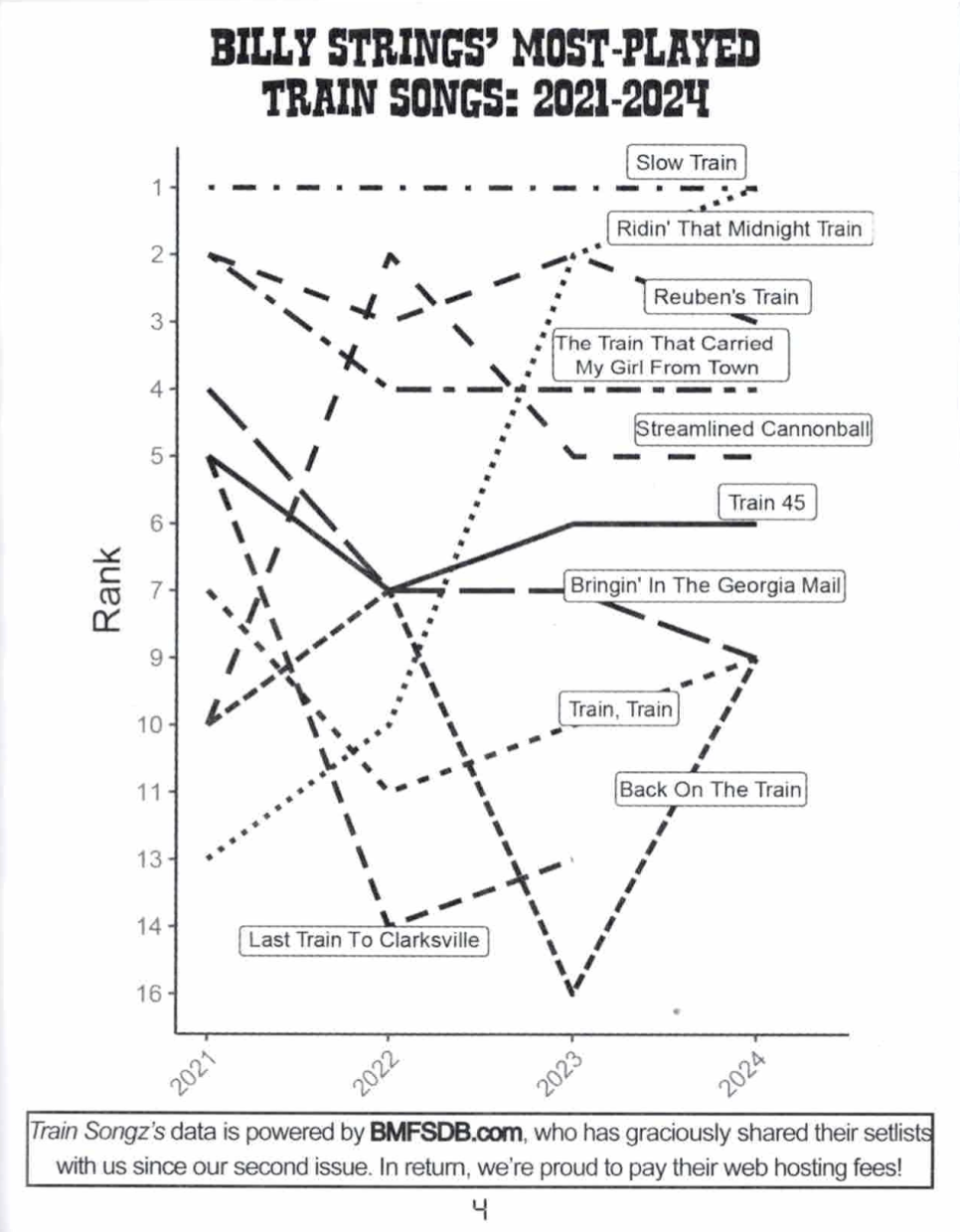
A Billy Strings train songs data visualization from ‘Train Songz’ Vol. 5, fall 2024.

What was Promontory Paul’s role in this latest issue of Train Songz given its focus on the Royal interview?

AP: Paul’s column still exists in the newest zine, but he went about it in a really cool way. The idea began with our third edition, when we gave Promontory Paul an entire section to write about old bluegrass songs regularly covered by the likes of Billy, the Sam Grisman Project, and whatever other bands we listened to or saw live that quarter. So we’d cite where we heard it played before diving into a history lesson and where it came from.

Then, for this issue with Royal, we took that Old Tune Review and instead of songs we heard out in the wild made it all about songs that he mentioned during the interview. Throughout the interview there are little interjections from Promontory Paul – almost like Clippy, the office assistant on Microsoft Word. It’s been fun to take these gimmicks that worked for us a year ago and apply them to the restrictions presented by this long-form interview. Royal gave us so much that we wanted to give him the entire issue, but we’re still going to sprinkle in the ethos of what our readers are familiar with and what we like to do, which is to connect something that’s happening in the present day – like the recent Billy Strings and Bryan Sutton tour with Royal – to the past. It’s been really fun connecting with folks like that through the zine. It’s almost like Paul’s on a time-traveling train or something. [Laughs]

We send surveys out to our subscribers after publishing each issue and Promontory Paul’s history lessons are always towards the top when it comes to [readers’] favorite parts of the zine. It’s also been a cool way to make note of the fact that it’s not just us behind the scenes who are enjoying this. It really speaks to how much we respect the audience that we have and how that drives us to create the best issue possible every quarter.


View this post on Instagram


A post shared by Royal Masat (@royalmasat)

I saw recently that Royal left a copy of Train Songz #7 at the NPR Tiny Desk following the session he recorded there with Billy. What did seeing that mean to y’all?

AP: He’s been a follower of ours for a long time and brought that copy of the zine to NPR on his own after reaching out to us to subscribe about a year ago. We knew he’d been reading along for a while, so once this tour came up with him, Bryan, and Billy, it just seemed like the perfect thing for the zine to cover. It was important for us to capture the combination of old and new in those shows dedicated to Doc and Merle Watson and T. Michael Coleman and featured the King of arena-grass playing these smaller rooms of 400 to [2,200] people with one of the most preeminent guitarists alive in Bryan Sutton.

It took us a second to come around to the idea, because we’ve been very cautious about not becoming a Billy Strings-exclusive fan zine. We want to serve the broader ecosystem, but that tour was something we couldn’t pass up, especially with Royal being a reader. Once we did reach out, he blew us out of the water with the time he put into it. His interview with Mitchell ended up being over 4,000 words that he sent us by email after wrapping up a tour in Europe. Once that wrapped I remember him sending us a literal tome – he took it very seriously and his responses were so thoughtful.

The final result almost looks like a children’s book with the way Liza designed it. None of that would be possible without our paying supporters, who make it possible for us to work with the 17 artists we partnered with on this issue to bring it even more to life with quirky illustrations that tie back to things Royal said, like throwing in an illustration of a medieval horse with a knight in shining armor where Royal refers to his bass as his trusty steed. I like to refer to what she does as “Andy Warhol-ing.” [Laughs]

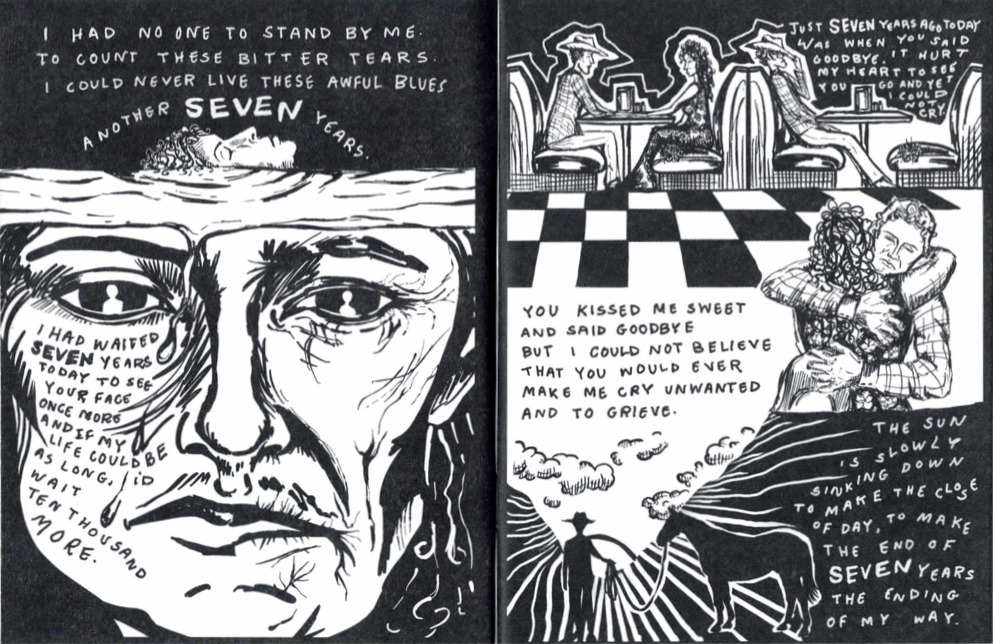
Inset artwork by Sara Dennis from the 8th and most recent edition of ‘Train Songz.’

I know you just mentioned not wanting to become exclusively a Billy Strings fan zine. However, I’m curious to hear when and how y’all first encountered his music?

LC: The first time I saw Billy was at RiverRock, a free festival on Brown’s Island in Richmond in 2019 before he blew up. I had heard of him prior to that, but after seeing him live I became absolutely mesmerized. I didn’t like bluegrass for the longest time, but something clicked with me when I saw Billy and was like, “Oh, this is what I want to keep following and chasing.”

MH: In college, I was a huge Deadhead and Phish fan and was consumed by the jam world. Then I heard about Billy on some Facebook groups and message boards, talking about how he covers The Dead really well.

I moved to Boston shortly thereafter and the first month I was living there Billy played at the Wang Theater. I wound up buying a ticket and went without having listened to his music at all beforehand and was absolutely blown away. To me, it was like a psychedelic Dead or Phish show combined with bluegrass, which in hindsight probably hit on the homesickness I was feeling at the time, because I had been around bluegrass before, but wasn’t really interested in it when I was living in the South. From there, I jumped down the rabbit hole into more old-time bluegrass, which is when I started playing the music myself. So I attribute my musical pursuits now to that moment and think that is probably true of other people, too.

JL: I remember [going down] a YouTube [rabbit] hole in 2020 and coming across a set of Billy playing Doc Watson tunes. It may have been Royal’s first gig with him. I just so happened to be in a bit of a bluegrass moment at the time I found that video of Billy and was instantly hooked, resulting in me digging even deeper. I was already a Deadhead as well, so I loved his covers of those songs too. Then I worked my way to his original stuff – which is also sick – and I have YouTube to thank for it!

AP: I remember James, “Promontory Paul,” showing me Billy for the first time. Like most of the bands I like, I channel my music taste through him. When we first got into him there was still a lot of remote work going on, so we’d listen to Billy while doing that or even while we were playing games like Fortnite. I started listening to a lot of The Dead in order to try to get to the point where I could listen and name the year the show came from. But over time Billy started taking more and more of the market share of my listening time away from the “What year is this Grateful Dead show from?” project.

What are your next steps for continuing to grow Train Songz?

AP: We occasionally host concerts (the next one is February 12, 2026 with The Asheville Mountain Boys), and have captured audio recordings – which we call Tiny Train Sessions – in the past, but we look at them more as a marketing tactic than a growth mechanism.

My day job is a social media manager and doing that I’ve noticed that the best way to get a lot of views on Instagram is to post reels, because they [are served] to non-followers and new followers first. We could post a bunch of concert clips and other things to build our audience, but we intentionally opted to not do that because we’re firm believers that things that grow slow last a long time. We don’t want to gatekeep or make it hard to find us, but rather [hope folks will] find us organically through a friend sharing one of our memes or sending you a copy of the zine itself. I want the first point of contact to be someone who’s already within our ecosystem that really digs it and turns you onto it, one person at a time.


All visuals, artwork, and zine scans courtesy of Train Songz. Learn more about artists Morganne Allen and Sara Dennis.

You Gotta Hear This: New Music From Foy Vance, Rissi Palmer, and More

We have new music for you, as always, to herald the end of the week and beginning of the weekend. You Gotta Hear This!

From just outside of Washington, D.C., singer-songwriter Connor Daly releases a new single today, “Echoes of Midnight.” An Americana “fast waltz” with a melancholy tinge, the track is clean but gritty. Daly thinks it’s the best song in his catalog to crank through a loudspeaker, and we agree. A longtime friend of BGS and Good Country now, Rissi Palmer releases her brand new EP Perspectives today, so we’re celebrating by sharing a new song from that collection, “Good to Me.” Written with Shannon Sanders and Hilton Wright II, the song finds Palmer much more assured in what she wants and needs from a life partner than she was in her 20s. (Stay tuned for an upcoming interview with Palmer about the EP, coming next week right here on BGS.)

Also in a country space, roots music renaissance man Jim Lauderdale announced a new upcoming album today, Country Super Hits Volume 2. He certainly has plenty of “super hits” to celebrate; we’re kicking off the countdown to the new LP by sharing “Everybody’s Got A Problem.” There’s a kernel of truth in that hook somewhere, isn’t there? Relatable, charming, and effortlessly traditional country, it’s another Lauderdale banger. Then, from across the Atlantic, Foy Vance launched a brand new, homemade music video earlier this week for “Hi, I’m The Preacher’s Son.” With sonics gleaned from the intersection of folk and outlaw, the song is well matched by the trippy and fun video that combines animation, stop motion, and many other forms and styles into a unique visual journey. His dad was a preacher and fond of a parable; the track and video suit their inspiration perfectly.

Don’t miss Bryan Sutton unveiling another tune from his upcoming duets album, as well. This time he’s partnered with fellow guitar picker Jake Stargel on an acrobatic and oftentimes jaw-dropping rendition of the popular fiddle tune-guitar instrumental “Crazy Creek.” These are two of the most personality-rich players and stylist on six strings, doing what they do best. Each single from the album, From Roots to Branches, has been stellar – this latest outing continues that trend.

There’s plenty to enjoy below! Scroll to listen, ’cause You Gotta Hear This…

Connor Daly, “Echoes of Midnight”

Artist: Connor Daly
Hometown: Ashburn, Virginia
Song: “Echoes of Midnight”
Release Date: February 6, 2026

In Their Words: “As soon as I started writing the first pieces of ‘Echoes of Midnight,’ I knew exactly what kind of production I wanted for the song. Going into the studio with David Dorn at Farmland Studios in Nashville, it didn’t take long for him to understand the vision. Big drums, wide acoustic guitar arrangements, and energy pushing through every line. It’s one of those songs that was clearly meant to be played live and I knew I needed to hear it fully take shape in the studio. Lyrically, ‘Echoes of Midnight’ captures a very now-or-never feeling of young love that has always stood out in my catalog. If I could choose any of my songs to play through a loudspeaker, this would be it.” – Connor Daly

Track Credits:
David Dorn – Keys
Shaun Richardson – Acoustic guitar
Tim Denbo – Electric bass
Dave Racine – Drums
Justin Ostrander – Electric guitar
Connor Daly Steggerda – Songwriter, vocals


Jim Lauderdale, “Everybody’s Got A Problem”

Artist: Jim Lauderdale
Hometown: Troutman, North Carolina
Song: “Everybody’s Got A Problem”
Album: Country Super Hits Volume 2
Release Date: February 6, 2026 (single); March 27, 2026 (album)

In Their Words: “This song relates to the common experience of going through difficult times and that very few of us are immune to that; it’s one thing we all have in common.” – Jim Lauderdale


Rissi Palmer, “Good to Me”

Artist: Rissi Palmer
Hometown: Durham, North Carolina
Song: “Good to Me”
Album: Perspectives (EP)
Release Date: February 6, 2026

In Their Words: “I started this song with Hilton Wright II and completed it with Shannon Sanders (producer of the project). I sat on this chorus for three years, in the midst of a divorce, not sure what I wanted to say. On this side of things, I’m a bit more clear about what I want from a partner. The things that 29-year-old Rissi wanted are very different from what 44-year-old Rissi wants. We had a really good time writing this…” – Rissi Palmer


Bryan Sutton, “Crazy Creek” featuring Jake Stargel

Artist: Bryan Sutton
Hometown: Nashville, Tennessee
Song: “Crazy Creek” featuring Jake Stargel
Album: From Roots to Branches
Release Date: February 6, 2026 (single)
Label: Mountain Home Music Company

In Their Words: “Ever since Jake Stargel came on the scene, I’ve been fascinated and inspired. I think his playing is continually creative and powerful. He was the one that actually suggested ‘Crazy Creek’ and part of my goal with this duets project was just to try to capture musical conversations with my friends. We definitely do that here with ‘Crazy Creek.'” – Bryan Sutton


Foy Vance, “Hi, I’m The Preacher’s Son”

Artist: Foy Vance
Hometown: Bangor, Northern Ireland
Song: “Hi, I’m The Preacher’s Son”
Album: The Wake
Release Date: February 4, 2026 (video); March 13, 2026 (album)
Label: Rounder Records

In Their Words: “Being a preacher, my Dad was fond of a fable. Parables and philosophies poured out of him on a good day. I couldn’t fully appreciate them at the time, but I would learn to cling to the little wisdoms he shared. So much of him has influenced what I do. Seeking ways to say something concisely.

“I’m glad of that influence. I am also glad to be free of any certainty that gives someone the desire to be a preacher. Even if I felt certain about whatever God might be, I reckon the desire to become a preacher should never allow you to become one!” – Foy Vance


Photo Credit: Foy Vance by Gregg Houston; Rissi Palmer by Dire Image.

You Gotta Hear This: New Music From Aaron Burdett, Trey Hedrick, and More

Happy New Year! We’re so excited to bring you our first collection of new music and videos for 2026. We’ve missed you over the past few weeks and, well, You Gotta Hear This…

Kicking us off, our old friend Joshua Britt returns with a new artist project, The Boy The Earth Sings To, and an official video for an original song, “Eyes Of God.” Falling on the continuum between gospel, sacred, and contemporary Christian roots music, the lush alt-folk track is built around the inspiration of a new mandola, tying the tone wood used to build the instrument to the forested visuals of the video. Meanwhile, Western North Carolina-based singer-songwriter Aaron Burdett unveils a new single, “Arthur’s Last Dance,” which pays tribute to folk dancer Arthur Grimes and his final performances at MerleFest before his retirement. It’s driving modern bluegrass appropriately perfect for flatfooting, clogging, and polishing those floorboards.

Then, from just up the mountains, Lonesome River Band also bring their first new single of 2026, “Bernadette,” written by Bob and Ginger Minner. Below, Bob offers his perspective on writing the tune, which he and his wife immediately imagined LRB recording, as soon as they had finished writing it. If you like crooked contemporary bluegrass that’s steeped in old-time mountain music – with a slightly dark, modal tinge – you’ll love this one.

Let’s continue up the mountains now, across Virginia and West Virginia to southeastern Ohio, where we’ll find the music of singer-songwriter Trey Hedrick and this new track, “Shoestring,” which features Tim O’Brien. It’s a testament to Hedrick’s grandpa, his relocation of the family to Ohio, and the way life, love, work, and place are passed down generation to generation.

Rounding out our collection this week, it’s a premiere we published elsewhere on the site this morning, as well. Celebrating his upcoming collaborative album, guitarist Bryan Sutton launches a hilarious and entertaining animated music video for “The Devil Went Down to Deep Gap” featuring Billy Strings, Del McCoury, and more. It’s a delightful reimagining of Charlie Daniels’ “The Devil Went Down to Georgia” that tells a fantastic version of Doc Watson’s origin story, pitting Doc’s style of picking against shredding metal electric guitars played by Sutton and Strings. You won’t want to miss this masterpiece of country, bluegrass, and flatpicking storytelling.

What a great way to kick off the year, right? There’s plenty to hear, love, and enjoy below. You Gotta Hear This!

The Boy The Earth Sings To, “Eyes of God”

Artist: The Boy The Earth Sings To
Hometown: Franklin, Kentucky
Song: “Eyes Of God”
Album: The Quiet Voice Of God
Release Date: November 7, 2025

In Their Words: “Years ago, my band played a show with Sierra Hull in Montana and that’s where she introduced me to mandolin builder Bruce Weber. Visiting his shop was unforgettable – an old schoolhouse where one room was filled with raw, uncarved slabs of wood that he would walk across, knocking on each piece, saying, ‘They all sound different, but some of them sing.’ It felt like he was listening for the mandolin already inside the wood, the way Michelangelo spoke about finding David inside the marble. Bruce built an octave mandolin for me that became the backbone of this album and while I was writing it I came across another Weber mandola. The first night I brought it home, I picked it up and wrote ‘Eyes Of God’ in one pass, as if the words and melody were already waiting inside that piece of wood. My favorite art has always felt more like discovery than invention.

“For the video I was inspired by time I spent in Bolzano, Italy, reading about the singing trees in the high altitude mountain forest – God placing the best wood high in the mountains, starved for air instead of down in the village. A reminder to me that making something great always requires adventure.” – Joshua Britt

Track Credits:
Joshua Britt – Vocals, mandola, other instruments, songwriter
Matt Menefee – Banjo
Neilson Hubbard – Drums
Colter Britt – Harmony vocals
Sarah Drake – Harmony vocals

Video Credits: Filmed on location in the Colorado Rockies.
Directed by Joshua Britt and Quincy Britt.


Aaron Burdett, “Arthur’s Last Dance”

Artist: Aaron Burdett
Hometown: Saluda, North Carolina
Song: “Arthur’s Last Dance”
Release Date: January 9, 2026
Label: Organic Records

In Their Words: “I was first introduced to Arthur Grimes when I lived in Boone, NC, in the ’90s. He’d materialize now and then at many shows I was playing or attending over the years. So when I played a set at MerleFest 2024 with Steep Canyon Rangers and heard that Arthur was going to be there with Old Crow Medicine Show – to do his last dance before largely retiring – my interest was piqued. After our set, I was checking out other performances and, sure enough, got to see Arthur doing his thing on the Watson stage one last time. It was an event that deserved a few songwriting notes. Those notes I took that night are what turned into this song commemorating Arthur’s long career dancing with any and every band or performer who came through the High Country of NC over the past 50 years or so.” – Aaron Burdett

Track Credits:
Aaron Burdett – Lead vocal, acoustic guitar
Kristin Scott Benson – Banjo
Carley Arrowood – Fiddle
Tristan Scroggins – Mandolin
Jon Weisberger – Upright bass
Wendy Hickman – Harmony vocal
Travis Book – Harmony vocal


Trey Hedrick, “Shoestring” (featuring Tim O’Brien)

Artist: Trey Hedrick
Hometown: Wilkesville, Ohio
Song: “Shoestring” featuring Tim O’Brien
Album: Sing, Appalachia
Release Date: January 7, 2026 (single); February 18, 2026 (album)

In Their Words: “‘Shoestring’ is a song about my Papaw, who was an incredible singer and multi-instrumentalist and the engine to the musical life of my immediate and extended family. Through him I came to the writers and songs that I still call on frequently in my own writings. Pap grew up in Parsons, West Virginia, and when work dried up or, more likely, after a need to move on after his brother Skip died in a mining accident, he moved north to southern Ohio. A move that anchored the geography of our family to southern Ohio after many generations in West Virginia and Kentucky. I didn’t try and likely couldn’t have written ‘Shoestring’ from any perspective other than reverent grandson, intentionally setting aside any precise detail. ‘Shoestring’ is about place, love, work, and life passed down, intentionally or not. I was honored to have Tim O’Brien sing and play fiddle on the track – Tim’s music has been an inspiration and has long meant a great deal to me.” – Trey Hedrick

Track Credits:
Trey Hedrick – Lead vocals, acoustic guitar, songwriter
Tim O’Brien – Lead and background vocals, fiddle
Maya de Vitry – Background vocals
John Mailander – Fiddle
Ethan Ballinger – Mandolin
Frank Evans – Banjo
Phillipe Bronchtein – Pedal steel
Jamie Dick – Drums
Rhees Williams – Bass


Lonesome River Band, “Bernadette”

Artist: Lonesome River Band
Hometown: Floyd, Virginia
Song: “Bernadette”
Release Date: January 9, 2026
Label: Mountain Home Music Company

In Their Words: “My wife Ginger and I write a lot of songs together and sometimes the ideas come from the strangest of places. ‘Bernadette’ came from when one of Ginger’s favorite authors, Shawn Inmon, who asked his fans to offer up unique women’s names to be used in his next novel. We were driving around and joking about names like Ethel, Maude, Calry, etc., and I just blurted out ‘How ’bout Bernadette?’ And out of nowhere I sang that name and first line. We got home and sat down and we wrote it in no time. It just fell out, so to speak. Plus, I always wanted to use the word ‘trifling’ in a song, so it seemed fitting for a woman like Bernadette in the story. We did a guitar and vocal demo of it and I sent it right to my buddy Jesse Smathers, because LRB was who we heard in our heads doing it as we wrote it. Thanks to LRB for cutting this one, we’re honored.” – Bob Minner, songwriter

Track Credits:
Sammy Shelor – Banjo
Jesse Smathers – Acoustic guitar, lead vocal, harmony vocal
Mike Hartgrove – Fiddle
Adam Miller – Mandolin
Kameron Keller – Upright bass
Rod Riley – Electric guitar
Bob & Ginger Minner – Songwriters


Bryan Sutton, “Devil Went Down to Deep Gap” with Billy Strings

Artist: Bryan Sutton with Billy Strings
Hometown: Nashville, Tennessee
Song: “The Devil Went Down to Deep Gap”
Album: From Roots to Branches
Release Date: January 9, 2026 (single/video)
Label: Mountain Home Music Company

In Their Words: “It was listening to Charlie Daniels’ original ‘The Devil Went Down to Georgia’ with my youngest daughter, Lily. She has very eclectic and broad musical tastes. I’ve loved sharing music with her and checking out what she has discovered. We found some other covers of the original and one that stuck with me was Jerry Reed’s interpretation, where he makes Johnny a guitarist instead of a fiddler. I have been working on a duets record for some time, collecting recordings here and there with my pals, and knew I wanted to do something different with Billy, as he and I have a whole record of duet playing.

“Billy and I also share a love for heavy metal. I was trying to think of a way he and I could do something connected to this duets project that would allow us to play acoustic and electric. It all kind of came together when I realized this song would allow for that. The Doc [Watson] origin story came about thinking how to make this not just a cover, but more personal and fun. It’s also another subtle tribute to Doc, who would oftentimes change or add lyrics to a song in order to make it fit for him. I fashioned the story, made a little demo, and sent it to Billy. He was into it and we were off.” – Bryan Sutton

Read more here. 


Photo Credit: Aaron Burdett by Sandlin Gaither; Trey Hedrick by Chris Heidl.

WATCH: Bryan Sutton, “The Devil Went Down to Deep Gap” with Billy Strings

Artist: Bryan Sutton with Billy Strings
Hometown: Nashville, Tennessee
Song: “The Devil Went Down to Deep Gap”
Album: From Roots to Branches
Release Date: January 9, 2026 (single/video)
Label: Mountain Home Music Company

In Their Words: How do you see Doc’s playing influencing both yours and Billy’s?

“I think beyond the specific influence of Doc’s guitar playing that informs most every note Billy or I may play, I know that we both are students of Doc’s complete artistry. To say Doc is just the most influential flatpicker ever is limiting. He brought so much to the table in his honest and emotional singing, his song choices and writing, banjo and harmonica playing, and Travis-style fingerpicking. He was not comfortable being labeled or limited within a specific genre. His onstage persona was true to him. Without being a ‘showman,’ he was informational when the song needed it and willing to share whatever emotion he might be experiencing. It’s also important to note that Doc and Merle’s duo playing has been a huge part of the overall focus for things Billy and I have done together. I know for both Billy and I, Doc provides a lifetime of inspiration, influence, and learning.”

How do you pay tribute to that in this song and video?

“First and foremost, this is kind of a silly or fun thing, along with being a somewhat serious tribute to Doc Watson. I wanted to use the song to have fun with the guitar shredding and good versus evil battle, but also imagine an origin story of how Arthel Watson could have become the ‘Doc’ we all have loved. Maybe it’s a gospel song in the way that Doc, even and especially in his blindness, can ‘see’ through the Devil’s lies. Ultimately, Doc carries his triumphant message to the world, and influences us all with wonderful and heartfelt music.”

It sounds like you had this concept before talking with Billy about it. How did the concept and song come to be, from start to finish?

“It was listening to Charlie Daniels’ original ‘The Devil Went Down to Georgia’ with my youngest daughter, Lily. She has very eclectic and broad musical tastes. I’ve loved sharing music with her and checking out what she has discovered. We found some other covers of the original and one that stuck with me was Jerry Reed’s interpretation, where he makes Johnny a guitarist instead of a fiddler. I have been working on a duets record for some time, collecting recordings here and there with my pals, and knew I wanted to do something different with Billy, as he and I have a whole record of duet playing.

“Billy and I also share a love for heavy metal. I was trying to think of a way he and I could do something connected to this duets project that would allow us to play acoustic and electric. It all kind of came together when I realized this song would allow for that. The Doc origin story came about thinking how to make this not just a cover, but more personal and fun. It’s also another subtle tribute to Doc, who would oftentimes change or add lyrics to a song in order to make it fit for him. I fashioned the story, made a little demo, and sent it to Billy. He was into it and we were off.

“I feel fortunate that Del was into playing the Devil. I also am so happy to have T. Michael Coleman and Sam Bush on the track, who played many years on the road and studio with Doc. My pal Jerry Roe, who is Jerry Reed’s grandson, plays the drums, connecting to the Reed version that inspired me. Once I had the concept and demo for the song, I knew it had to be an animated video and discovered Pat Bradley of Springshoe Animation. It was wonderful working with him to take what had been in my head and be able to visualize it. Ultimately, all this came about a little piece at a time, and I’m so happy to share it with the world.” – Bryan Sutton

Track Credits:
Bryan Sutton – Acoustic guitar, electric guitar, vocal
Billy Strings – Acoustic guitar, electric guitar, vocal
Del McCoury – Vocal
T. Michael Coleman – Electric bass, harmony vocal
Sam Bush – Mandolin
Jerry Roe – Drums

Video Credits: Animation by Pat Bradley, Springshoe Animation.


Lead image courtesy of the artist.

BGS Class of 2025: Best in Bluegrass

If you’re looking for a definitive, qualitative, and deliberate ranking; a firm and scientific rubric; or an unbiased, sterile reckoning of the best albums made in bluegrass this year, this roundup may not be for you.

Truthfully, as someone who’s worked, been acquainted, and become friends with many of the artists on this list in various capacities – from bio writing to onstage performances to media coverage to pickin’ parties to recordings and beyond – objectivity isn’t something I, personally, could establish anyway. And such year-end or other merit-based lists and collections aren’t all that interesting, are they, if not just to argue with their curation and selections.

I would not even attempt such things, because to me – to many of us – that’s not what bluegrass is about anyway. Bluegrass is about a feeling. It’s about innovation. It’s about virtuosity. It’s about tradition, loving it or retooling it or coaxing it or turning it upside down. It’s about adrenaline and a high pulse – and passing a mason jar around. It’s about feeling downtrodden or alone, shedding tears into that very ‘shine, and wailing along with the high lonesome sound. It’s folk music as much as it’s abject commercial country in “poor people drag.” It’s endlessly interesting and complex, but pretty damn simple, too.

Anyone with even an ounce of sense knows and understands that bluegrass can’t ever be objective. So indeed, why try? Why not acknowledge that bluegrass is always a matter of taste, of preference, of whimsical or capricious or convicted opinion? Bluegrass is always debatable, because, after all, bluegrass is always in the eye of the beholder.

In the eyes – and especially ears – of this particular beholder, these albums released in 2025 were the best, the most memorable, the most engaging. These collections stick to ribs like ham hocks, or stick in your throat like the tastiest clod of emotional peanut butter. They each advance, subvert, perpetuate, or wrinkle our core ideas of what bluegrass is – and what it can be.

Are each and every one of these LPs the best in bluegrass from 2025? Perhaps not… But also definitely yes.

Big Richard, Girl Dinner

In January, we gobbled down a heaping helping of Big Richard energy with the nourishing and nutritious Girl Dinner. The project may have been the band’s album debut, but this Colorado all-women quartet had already been making remarkable waves in the bluegrass, jamgrass, and string band scenes – and each of the members had extensive and glitzy musical resumés before they even convened. With a new album, Pet, on the horizon for February 2026, a signing with Signature Sounds, and an upcoming co-bill tour with fellow femme outfit Della Mae, we can tell this Girl Dinner is set to become an ongoing traveling feast.

Shawn Camp, The Ghost of Sis Draper

I remember attending Station Inn shows in Nashville in the early 2010s and sitting with rapt attention – like Martha’s sister Mary at the feet of Jesus – as Shawn Camp performed his suite of Sis Draper songs with his star-studded bluegrass bands. Often you’d hear just “Magnolia Wind” or just “Sis Draper.” Sometimes he would perform a more complete handful of the tracks he had written, individually and with his hero and mentor Guy Clark, about the mythical roots music figure from his home state of Arkansas. Now, he’s collected the slate of material – what could easily become a musical or multi-disciplinary theatre work of some kind – into one commanding, lovely, and visceral album. These are timeless songs, written and rendered as only Camp could.

Jason Carter & Michael Cleveland, Carter & Cleveland

Every now and again a new collaborative duo album comes along and makes you think, “Oh! This must have been what it felt like when Skaggs & Rice was released.” Or Tone Poems. Or Ralph Stanley and Jimmy Martin’s First Time Together. A monumental occasion, captured for posterity’s sake in the studio. When fiddlers Jason Carter & Michael Cleveland released their duo debut, that was the feeling. History made in the present, a work that will be regarded as seminal ages into the future being enjoyed in real time. Carter and Cleveland have collaborated quite a bit over the decades they’ve known each other, but what a gift to have that musical friendship ensconced forever on this album. We hope there is more to come.

Wes Corbett, Drift

Look, if all modernist banjo players sounded like Béla Fleck and Noam Pikelny, that would certainly be great. But thankfully there are dozens of five-string pickers continuing to expand on the Fleck (and Pikelny and Munde and Keith and Trischka) school of Scruggs-style, each in their own veins. Corbett is one of the best. Though he blends effortlessly into Scott Vestal’s former role in Sam Bush’s band – or into any number of recordings and one-off pick-up bands that boast his playing in newgrass and bluegrass and beyond – Corbett is a true idiosyncratic banjo player and composer. Drift, his latest, often employs traditional techniques as tools for innovation and contemporary tunesmithing. He recalls the great melodic pickers while always sounding first and foremost like himself.

East Nash Grass, All God’s Children

A few years ago, if you had told me the ragamuffin band holding down Monday nights at Dee’s Country Cocktail Lounge in Madison, Tennessee, would in 2025 release an album you’d describe as “heartfelt, contemplative, and intentional,” I would have probably laughed. East Nash Grass were just as jaw-dropping good then as they are now, but with that down-home silliness and clumsy charm all the great bluegrass bands born of indentured residencies have had. All God’s Children finds the band all the way grown up (but not really), and they never forsake their banter-rich, never-know-what-you’re-gonna-get roots. That overlap – of silly and heartfelt and virtuosic and not too serious – is where most (if not all) of the best bluegrass is born, anyway.

Sierra Hull, A Tip Toe High Wire

Every single time Sierra Hull releases a new album, journalists and critics love to talk about how she’s now “found herself” and “found her sound.” This writer, however, disagrees. I first saw Hull perform when we were both in our mid-teens and then as now I knew, wholeheartedly, this is someone who knows who they are. Granted, Hull has done plenty of finding herself along the way, as we all do, but the songs and tunes of A Tip Toe High Wire were obviously not born of someone just locating her voice, musically or otherwise. They don’t feel experimental or out on a limb, they are each solidly in her wheelhouse. They do still push the envelope, though, and they all tell personal stories, draw on individual experiences, and chase those treasured Hull-ian melodies wherever they lead.

I’m With Her, Wild and Clear and Blue

Perhaps all future I’m With Her albums should be made while basking in the “Ancient Light” of a total solar eclipse, given the striking sonic successes of Wild and Clear and Blue. Is that cosmic magic why their second full-length release feels so distinct and metamorphosed from their debut? Is it all the years and personal growth in between recordings? It’s not like they reinvented the wheel, they’re the exact same band – but something feels different here. Whatever the special sauce may be, all of I’m With Her’s offerings over the course of the band’s lifespan have been stellar, but this latest full-length project stands apart. As long as Jarosz, O’Donovan, and Watkins are making music together, we will be unendingly grateful they offer us these recorded windows into their creativity.

Kissing Other ppl, Kissing Other ppl

Bluegrass and old-time birth new projects, bands, and collaborations all the time. Some are purposefully momentary, some are unintentional flashes in the pan, some are such long strings of last names ampersand-ed together you know there’s no future for them. We hope Kissing Other ppl are here to stay. Rachel Baiman and Viv & Riley joined forces on the album – and band – turning mainstream and pop songs into bluegrassy and old-timey string band arrangements that positively vibrate with passion and life. “Sad boi” covers these are not, though you may at times find them subdued or tender or mild. Long may this old-time Americana musical polycule reign.

Cameron Knowler, CRK

If you’ve been craving a contemporary storyteller and poet who utilizes the guitar as their medium – like Norman Blake or Doc Watson or Tony Rice or so many others – I am so pleased to step onto my soapbox to tell you about Cameron Knowler. Also a writer (at times for BGS), archivist, photographer, and visual artist, Knowler’s guitar-centered album, CRK, is almost anything but a “guitar album,” despite each and every composition centering on the instrument. The LP paints vivid and haunting musical portraits of a place Knowler loves, longs for – and despises or begrudges, too – Yuma, Arizona. Knowler wouldn’t even pretend to compare himself to Norman Blake or state that he’s deliberately taking up Blake’s heavy, heavy mantle in the 2020s, but I’m saying he is. Thank goodness.

Bryan McDowell, Bryan McDowell

You may recognize multi-instrumentalist Bryan McDowell from his time performing, recording, and touring with artists like Claire Lynch, Sierra Hull, Molly Tuttle, Alison Brown, and many, many more. He’s an incredibly talented sideman and session player, so when I first received his new self-titled solo album, I imagined the sort of formless instrumental project most pickers with similar resumés create. What a pleasant surprise to find a fully fledged, well-rounded, complete song sequence chocked full of original songs and McDowell’s lovely, honeyed singing voice. (I know Bryan and I didn’t know he sang like this!) It’s on me, really – I shouldn’t have been surprised at all – but McDowell’s skill set is clearly no longer just geared towards backing others up. I am looking forward to seeing what’s next.

Shelby Means, Shelby Means

Speaking of artists ready to step out of the role of sideperson or session musician. Bassist, singer, and songwriter Shelby Means’ debut solo album is fantastic. Since departing Molly Tuttle’s Golden Highway, Means has already built striking momentum as an artist unto herself, and the quick success of her album has played a huge role in that. With originals, tasteful (and surprising) covers, and a star-studded roster of pickers – Tuttle, Ron Block, Michael Cleveland, and more – the project certainly doesn’t feel like a debut. And it shouldn’t, Means has crisscrossed the country and the globe for decades, she’s more than ready to step to the center of the stage. She’s done it before, she’s doing it again – and now a lot more frequently, I’d bet.

The Onlies, You Climb the Mountain

All the best bluegrass is old-time these days. (I say that over and over again, here’s what it means.) While mainstream bluegrass sounds more like ‘90s country played by a bluegrass string band, or jamgrass, or “MASH” – all of which depart greatly from the 1945/1946 sound of its origin – modern old-time becomes more and more of an audio swatch of essential parts of what bluegrass used to sound like and used to include. One album this year that epitomizes this phenomenon is the Onlies’ You Climb the Mountain. Is it phenotypical bluegrass? Oh, no. It’s not. But it also has plenty of textures and tones endemic to original bluegrass that are becoming increasingly rare in its modern forms. I shouldn’t sell the Onlies short, though, they aren’t here because they’re “better bluegrass” than bluegrass, or more authentic, or more “real.” They’re here because this album is excellent, on its own terms.

Danny Paisley, Bluegrass State of Mind

Danny Paisley is celebrating 50 years of bluegrass with his latest album, Bluegrass State of Mind. Still looking for new challenges and trying to add fresh sparkle to his dyed-in-the-wool traditional sound, the new LP includes Dobro (for the first time), drums (sacrilege!), and a bit of an Americana lean. (Don’t you dare call it “grassicana.”) To BGS readers, the project will most likely sound like straight down the middle bluegrass of the highest order. Longtime fans of Paisley & the Southern Grass, though, may notice that very sparkle Danny has been chasing, as he targets new audiences and still sets new goals, five decades into his career as a bluegrass tradesman. It’s the family business.

Missy Raines & Allegheny, Love & Trouble

Missy Raines is one of the winningest musicians in the history of IBMA, amassing 10 Bass Player of the Year trophies over the years and and a handful of honors in other categories, as well. She may have won her biggest prize, though, when she landed on her latest band lineup, Missy Raines & Allegheny, a few years ago now. Her second album with the group, Love & Trouble, continues building upon the chemistry and collaboration that dripped from 2024’s Highlander. They often rise to the occasion of my preferred nickname for them, Mashy Raines & Allegheny, but they remain a consistently dynamic group capable of gritty, barn-burning bluegrass and contemplative and emotive slow burners, just the same.

Red Camel Collective, Red Camel Collective

They began as Junior Sisk’s backing band, and like many of the great “spinoff” bluegrass bands of yore – Quicksilver (Authentic Unlimited), the New South (American Drive), and many more – Red Camel Collective have quickly shown they’ve got the chops to take the same route. Their debut self-titled album was released earlier this year and was made at Sisk’s suggestion – and with his blessing. (He regularly steps off the stage at his own shows to spotlight the Collective and their music, as well.) This band of lifelong pickers have clocked so many miles playing bluegrass and executing the visions of others that, when charting their own course as Red Camel Collective, they’re able to sound exactly like themselves. It’s tough to sound singular in modern, radio-inclined bluegrass. But Red Camel Collective do. Is that why they won New Artist of the Year at the IBMA Awards this fall? It sure ain’t coincidence.

Sister Sadie, All Will Be Well

Sister Sadie’s All Will Be Well is like dropping the needle on a 45-minute bluegrass therapy session. I don’t say it flippantly or sarcastically; it is indeed shocking the level of earnest contemplation, processing, emoting, and growth evident in the songs on this album. At the same time, when you hear the tracks played down at a bustling bluegrass festival or a packed rock club or a subdued listening room, they never feel twee or try-hard or sodden with greeting-card level sentiments. They never feel heavy, actually – this is fun, often hilarious, party-ready music. Dance-along music. Shout-along songs. You’ll laugh, you’ll cry. (At the vocals alone.) These are real human ideas, thoughts, and feelings set to bluegrass. Imagine.

Larry Sparks, Way Back When

How does this album seem like it could have been pulled from any year, any decade of Bluegrass Hall of Famer Larry Spark’s sceptered career? Because it could have been, damnit. He’s Larry Sparks. Way Back When sounds warm and live, like listening to tape or vinyl over earbuds or cell phone speakers. Like being in the room with that resonant, vibrant, and patinated voice. The material is timeless, but never tired or lost in retrospection. Sparks is obviously making bluegrass in the present, as he always has. He just sounds exactly like this. And the way he talks about making music – as he did in a BGS interview set for publish in January 2026 – you can tell, for him, it’s essential to inhabit the present and inhabit the song. Bluegrass really is his calling, and we’re all all the better for it.

Billy Strings & Bryan Sutton, Live At The Legion

One of the best bluegrass albums of the year? Of course. One of the best live shows and tours of the year? Doubly, triply, quadruply of course. You’d think it would be brain-melting to listen to hours of two acoustic guitars and an electric bass pick through bluegrass, fiddle tunes, and Doc Watson classics, but it was divine. Trance-like – not with eyes glazed over, but on the edge of your seat. I wasn’t at that show at the Legion when they tracked the album, but was lucky enough to catch their show this fall at the Ryman in Nashville. If you weren’t so fortunate, don’t worry, ‘cause this isn’t an incredibly exclusive club. This record really does capture all that’s ineffable of being “in the room.” (No one is surprised.) Turns out, you can actually bottle and sell it, if you’re these two. Now if only you could buy the skillset, too…

Thompson the Fox, The Fox in Tiger’s Clothing, vol. 1 & vol. 2

Maybe once a year I trip over or into a new music discovery that gets me so excited I start getting annoyed with myself from having to hear me recommend them over and over again. With Thompson the Fox, it never got annoying (not to me, at least) and the excitement of turning folks onto their music still hasn’t worn off. So here we are, again. If this is your initiation, don’t thank me, thank the people who sent Thompson the Fox my way. Jazz, newgrass, bluegrass, bebop, ragtime, and oh-so-many more styles and textures combine in a completely fresh and distinctive form. I’ve never heard new acoustic music quite like this, yet it’s clearly rooted in that tradition. The simple math of xylophone, banjo, bass, and drums doesn’t quite math, but this group sounds resplendent, rich, and fascinating. Takumi Kodera on banjo is a revelation and Rie Koyama (xylophone), Akihide Teshima (bass), and Tomohito Yoshijima (drums) complete the Tokyo-based ensemble.

Cristina Vane, Hear My Call

Cristina Vane exists at an intersection of roots music that far too few inhabit, because very few can manage there. Vane can. She does blues, bluegrass, old-time, country, and Americana. Sometimes blended, sometimes compartmentalized. She’s got short-form, short-attention-span, vertical-video appeal for days, but her songs are never vapid or playing to any kind of commercial common denominator. Her instrumental skills and the passion for learning and song collection across roots and folk genres that she exhibits bring it all together. I’d not want to subject either woman to the corniness of comparing one to the other, but for folks who love Sierra Ferrell and are looking for more artists in a similar roots-meets-mainstream space, Cristina Vane can do it. She is doing it.

Vickie Vaughn, Travel On

Vickie Vaughn has won IBMA Bass Player of the Year for three years in a row and on the heels of that remarkable accomplishment, she’s released her debut full-length solo album, Travel On. Produced by Deanie Richardson of Sister Sadie, it’s Vaughn’s first recording under her own name released in 10 years. Original songs and covers are packaged in a sound that’s always trad bluegrass, but often infused with a dash of Osborne Brothers from the ‘80s or Jim & Jesse with a drum kit. It’s an Earl Scruggs Revue sort of flair, troubadour-steeped bluegrass-country. And it’s divine.

To conclude this long yet non-exhaustive and surely myopic list of the best bluegrass albums of 2025, let me leave you with this gentle reminder. What’s bluegrass and what’s best are always in the eye – and the ear – of the beholder.

What was your favorite bluegrass album of 2025? Let us know on social media. We hope you discover some new music to love in our BGS Class of 2025 and we can’t wait to make new discoveries with you, too.


BGS Staff contributed to this list.

Photo Credit: Shelby Means by Hunter McRae; Shawn Camp by Neilson Hubbard; Sierra Hull by Spencer Showalter.

The Five Pillars of Doc Watson’s Legacy

What a difference a Doc made.

Lots of people would like to think their lives have made a difference – whether through their family life, or work, or some sort of creative endeavor.

However, even to approach the enduring heritage of the great musician Arthel “Doc” Watson, a person would have to achieve lifetime landmarks as imposing as the North Carolina Appalachian mountains that were his home. During a lifespan from his birth in 1923 until his death in 2012, Watson created a legacy of music, folklore, and goodwill that no one has entirely equaled.

First a little background: Arthel Lane Watson was born March 3, 1923, near Deep Gap – he is not from Asheville – in Western North Carolina. An audience member suggested the nickname “Doc” when his given name was found less than compelling for an entertainer.

His life story before and after becoming an admired folk musician has been often told, notably in Doc Watson: A Life in Music, a 2025 biography by Eddie Huffman published by the University of North Carolina Press.

Blind since infancy, Watson started to develop life skills and musical ability from an early age. He learned both formal and popular styles when sent to the state’s school for the blind in Raleigh at about age 10.

The boy was consumed by music and persistent in getting better at it. Watson had learned both the rudiments of harmonica and a few banjo tunes from his father, General Watson, before he went off to Raleigh. While living within the strict environment of the school for the blind, Watson learned braille and grew familiar with classical and church styles of music taught there. Perhaps as strong an influence as that education was fellow student Paul Montgomery, the talented friend from whom he learned guitar chords. Young Watson and Montgomery, later a well-known Raleigh pianist and children’s show host, shared enthusiasm for the popular music of the day, including jazz and big-band sounds.

His parents, Annie and General Watson, taught the boy skills of growing crops and basic carpentry, and he contributed to the family despite his blindness.

After years of mostly local performances back in Western North Carolina, it wasn’t until the early 1960s, when East Coast musician and historian Ralph Rinzler tuned into and promoted his far-reaching ability as a singer and picker, that Watson’s name gained national, then international attention.

According to an account at the Blue Ridge Heritage Area website Watson recorded over 50 albums and was honored with “the National Medal of Arts, a National Heritage Fellowship, the North Carolina Folk Heritage Award, seven GRAMMY Awards, and a GRAMMY Lifetime Achievement Award.”

As fans know, Doc Watson contained multitudes of skills, a breadth of ability that inspired this list of the five pillars of his musical and artistic legacy.

The King Flatpicker

Watson largely created the challenging fiddle-inspired guitar style that led many followers along a flatpicking trail.

It was during the 1950s, when playing an electric Gibson Les Paul in the local Jack Williams Band, that Watson developed a style that would transform the way the guitar was played in folk and bluegrass music.

Generally, earlier acoustic guitarists in roots-derived styles used a flatpick to create basic “boom-chuck” back up, perhaps throwing in some fills and Jimmie-Rodgers-style bass runs.

But when dancers at Williams’s gigs wanted music for square-dancing, Watson worked up single-note versions of fast fiddle tunes such as “June Apple” and “Bill Cheatham” on his Les Paul. This approach enables lead guitar pickers to achieve the same flowing, rapid attack that fiddlers used for tunes, many of which had come over from the British Isles in past generations.

It’s not possible to say that Doc Watson was the first guitarist to flatpick fiddle tunes. After all, it wasn’t until Watson emerged as a folk artist in the 1960s that the broader music scene caught on to his musicianship. And high achievers such as Arthur Smith on “Guitar Boogie,” Don Reno on “Country Boy Rock ‘n’ Roll,” and Bill Napier on the Stanley Brothers’ “Mountain Dew” – along with some jazz and blues players – all recorded hot-licks acoustic soloing before Watson did. Joe Maphis was also cranking out ultra-fast flatpicking numbers in the 1950s.

But it was Watson’s 1960s performances that created a precedent for a wave of guitarists who had to muscle up to the speed and dexterity he displayed.

A long line of guitarists at the top of the field – from Clarence White to Tony Rice, from Bryan Sutton to Billy Strings – all show Watson’s clear influence not just in recreating fiddle tunes, but also in rapid-fire picking and clean sound on a broad range of material.

Player and educator Alan Barnosky wrote in “An Exploration of Doc Watson’s Innovative and Joyful Guitar Stylings” for Acoustic Guitar in 2023 about the spread of this kind of playing.

“Watson amazed folk fans in the early 1960s by taking tunes typically reserved for the fiddle and reworking them for the acoustic with speed, clarity, and flash,” he wrote. “He never claimed to be the first to play fiddle tunes on a guitar, but for the majority of listeners at the time it was an entirely novel and groundbreaking approach.”

Another world-class, tradition-based player, Earl Scruggs, praised Watson’s adaptation of fiddle tunes as the two were joined by Ricky Skaggs for the 2003 The Three Pickers performance and album.

“He was the first man I ever heard on the guitar that was fooling with tunes like that,” Scruggs said in a Three Pickers introduction. “You had all these good G-C-D pickers – that’s chord positions – but I had never heard anybody that actually took over a lead like a banjo or a fiddle or a mandolin and do those tunes. He could do it.

“And what amazed me about Doc Watson’s picking, and still does, is he’s got that – I call it ‘mountain sound’ to his picking, and he’s one of the best to keep it in that mode of sound.”

New generations of players have immersed themselves in Watson’s style. When I interviewed him for a Bluegrass Unlimited article, leading guitar picker and multi-instrumentalist Bryan Sutton talked about being captivated by Watson’s playing during Sutton’s youth on Western North Carolina.

“Doc and Dan Crary were the first great influences on me,” he said. “Doc Watson was one of the first professional musicians/guitar players that I ever saw. He doesn’t live too far from Asheville, so I saw him play some different festivals and at Maggie Valley. So, he was the first one to really catch my ear as far as what you could do with the flatpick.

“My right hand – it may not as much anymore – but I remember at one time it was kind of like Doc’s. It’s kind of like the way Sam Bush plays, using the whole forearm and wrist involved in the playing, whereas with jazz players or Tony Rice it’s more of a wrist thing. I think I’ve got a little bit of both now.”

Billy Strings, the artist who’s likely doing the most to promote Watson’s legacy in the 21st century, sounded almost evangelical during a September 2025 interview for NPR’s Fresh Air.

“He’s like the ground upon which I stand, you know?” Strings said. “My dad played his music all around the house growing up. And by the time I could play guitar, you know, 5, 6 years old, I was learning those tunes, too. I might’ve been able to play some of them before I knew how to tie my shoes or something, you know?

“It was like, I was learning how to speak and talk and walk, and I was learning all these Doc Watson tunes at the same time. And it was just, like, a religion in my house, you know? His music is just – it’s the best.”

To see some of the top pickers in the field paying tribute, check out this video shot at the Merle Watson Memorial Festival – what would become MerleFest – in Wilkesboro, North Carolina, in 1992.

A Model Fingerpicker

From his first albums on, Watson regularly also played guitar with a thumbpick and index finger. As he noted with his customary self-deprecating humor in the DVD “Doc’s Guitar: Fingerpicking & Flatpicking,” “See, I just play with one finger and a thumb. I don’t use the sensible three-finger method that you should use on finger-style guitar.” (Watch below.)

Watson sounded great with that approach, making finger-picked tunes such as “Deep River Blues,” “Nashville Blues,” “Omie Wise,” and “Doc’s Guitar” fan favorites and objects of long study. For every striving guitarist who practiced hard on his fiddle-tune adaptations, plenty of pickers also worked on showcases such as “Windy and Warm,” with its alternating bass, pull-offs, note bending, and a jazzy minor sixth chord at its conclusion.

Watson’s fingerpicking often showed off his acquaintance with diverse approaches, as in “Deep River Blues,” with an E diminished as its second chord. It also illustrates the way he put his touch on existing pieces such as 1933’s “Big River Blues” by the Delmore Brothers, who played with flatpicks.

“There were two guitars, a tenor – a little four-string, and the regular flattop, and I never could get my guitar to sound like both of theirs did,” Watson said. “Then I began to hear brother Merle Travis, the late Merle Travis, on the radio. And I thought, Now, wait a minute. If I can steal me a lick off brother Travis, maybe I can learn ‘Deep River Blues.’”

Multi-talented Kentuckian Merle Travis (1917-1983) popularized a style in which the thumb plays an alternating bass on the guitar’s lower strings while picking the melody on treble strings. Watson also studied the work of the great guitarist Chet Atkins. The picking buddies released the album Reflections in 1980.

The centuries-old, transatlantic ballad “Georgie” would have once been sung unaccompanied, leaving Watson and others free to craft a brand new style of guitar back up. With no clear precedent on guitar, he might employ the flowing, almost classical patterns that became popular among folk revivalists.

And fingerpicking became the tool Watson used to play the blues that he loved and drew on so deeply, music he followed from the time he heard Mississippi John Hurt on the family’s disc player in childhood.

In the end, there’s no easy way to pin down the many elements Watson brought to his picking, musical points of view that enriched his listeners along the way.

A Standout Singer

Doc Watson’s vocal abilities don’t generally get as much attention as his top-drawer chops as an instrumentalist. However, he was also a tuneful singer with a natural, angelic mountain baritone.

Watson came along during an era when rougher-voiced vocalists such as Hobart Smith, Dock Boggs, and his picking buddy Clarence Ashley represented mountain singing to a growing audience. And Watson’s less mannered style likely contributed to acceptance among listeners less familiar with the high lonesome sound. His direct vocal approach was often heard in performances with no instrumental backing.

It’s useful to remember that Watson also enjoyed the smooth country vocalist Eddy Arnold so much that his son Merle Eddy Arnold was named not just after fingerpicker Merle Travis, but also for Arnold.

Tunes from the Tennessee Plowboy’s repertoire such as “Tennessee Stud,” “I Couldn’t Believe It Was True,” and “Anytime” also showed up in Watson’s repertoire. These were only a few examples of the eclectic side of Watson’s vocal approach, with emphasis on great material over genre labels.

Given his broad taste, Watson at times put some extra grit into his singing on a number such as “Blue Suede Shoes” from his Jack Williams days of the 1950s, later a concert favorite. But more often he sang songs straight, even on one like “Nights in White Satin,” a 1967 pop hit by British rockers the Moody Blues. With waltz-time guitar and plain singing, Watson makes the song come across as relevant to himself and listeners as songs by the Delmore Brothers and Jimmie Rodgers.

Watson’s first memories of vocal music came in church, and he prized the straightforward, no-vibrato sounds that carved such songs in his memory.

“If you love music, you have to listen from the time you’re big enough to notice music,” he told me when recording his 1991 GRAMMY-winning CD On Praying Ground.

“If you’re looking for old-time material in songs, those old songs that you heard when you were young were the easiest to put down.”

From his first commercial recordings on, Watson featured gospel numbers such as the a cappella version of “Talk About Suffering” from 1964 and “Down in the Valley to Pray” from 1966. Both radiate belief and unornamented clarity.

More recent listeners may know the latter song as “Down in the River to Pray,” as it was opportunistically relabeled to match a scene in the 2000 hit film, O Brother, Where Art Thou?.

Always A Song Man

Doc Watson had an impressively broad range of musical interests, perhaps markedly so, given the period in which he came along.

Country or folk music didn’t start appearing on commercial records until Watson was about two years old. In childhood he listened to down-home picking as well as church and gospel songs. It wasn’t until the 1930s that the family owned a radio that let them hear music beyond their 78-rpm record collection.

Virtually every great musician is a song collector at heart. And like Bob Dylan, Watson took on songs from tradition and added new elements. Take the mournful ballad “Omie Wise,” based on a North Carolina murder from the early 19th century.

In the 1920s notable old-time artists G.B. Grayson and Clarence Ashley recorded it with modal accompaniment that was neither truly major nor minor. When Watson recorded in the 1960s, he ventured into folky, arpeggiated picking that put it squarely into minor-chord territory, opening up the song to young folkies who couldn’t play fiddle like Grayson or banjo like Ashley.

In fact, Watson’s playing on “Omie Wise” occupied the same guitar realm as folk star Joan Baez’s playing on “East Virginia” and other traditional songs.


He also tuned into compositions by folk musicians Bob Dylan (“Don’t Think Twice It’s All Right), Tom Paxton (“The Last Thing on My Mind,” “Leavin’ London,” and “Bottle of Wine”), and Townes Van Zandt (“If I Needed You”).

Watson isn’t chiefly known as a songwriter, but he enjoyed notable success with “Your Lone Journey,” which he wrote with wife Rosa Lee. The starry duo of Led Zeppelin frontman Robert Plant and bluegrass’s own Alison Krauss released it as “Your Long Journey,” leading to what biographer Huffman called significant royalties for the family.

Watson’s greatest legacy in songs may have come with the wealth of lasting favorites – just a few are “Deep River Blues,” “I Am a Pilgrim,” “Banks of the Ohio,” “House Carpenter,” and “Shady Grove” – that made their way into the folk, old-time and bluegrass repertoire and could otherwise have been forgotten.

Ambassador for the Old-Time Way

This role for Watson may be the hardest to pin down, as it overlaps with almost all the others. By cleaving to his Appalachian heritage while also making the most of decades of change, Doc Watson was able to introduce countless fans to a rich, living culture.

“I don’t live in the past,” Watson told me in 1991. “I still burn wood in a furnace at the house, but I have heat ducts and a blower on it just like an oil furnace.

“I love to burn wood and I love to split wood. There’s a few of the old-timey things I love to do. I like good dried-apple pie and I like ‘leather britches’ beans.

“And I like to be at home, dadburn it. I hate the road.”

Watson’s long career of traveling to take his music to listeners, often in the company of his beloved son, Merle, nourished their taste for music that he built upon sold timbers of musical tradition.

Wade Smith, a legendary Tar Heel lawyer, told me once about his first experience of hearing Watson, at a small coffeehouse in downtown Raleigh in 1965.

“What word would I choose to describe how I felt?” Smith said for a later Raleigh News & Observer story. “Electrified, stunned at the speed of his fingers and the way he played single strings, and the clarity of the sound. Each note was like a piece of gold, so amazing.

“We stayed to the last note. When we left, I remember thinking that I had never heard anything like it and that in some way I had been changed by it, that I was in an altered state of existence.”

Watson’s national and international impact becomes more impressive given that he wasn’t heard outside his North Carolina stomping grounds until his late 30s. That’s when he honed his broad range of expertise into a mountain-based style that captivated and often amazed listeners at first hearing.

When the Society for American Music, a distinguished non-profit scholarly and educational organization, made Watson an honorary member in 2012, musicologist and musician Greg Reish paid tribute to Watson’s broad impact.

“As I discovered more of America’s traditional musical styles through my teenage years, Doc Watson always seemed to be at the core, an entrée into both older and newer styles,” Reish wrote. “Through Doc’s music I found my way to the pre-war music of the Carter Family, Jimmie Rodgers, and the Skillet Lickers; to the first-generation bluegrass of Bill Monroe and Flatt & Scruggs; to the classic country of Merle Travis, Chet Atkins, and Eddy Arnold; to the country blues of John Hurt and Frank Hutchison; and to the contemporary and progressive flatpicking of Clarence White, Norman Blake, and Tony Rice.”

Huffman’s book quotes the great bluegrass musician Roland White as he talked about the way his guitarist brother Clarence was caught up in Watson’s flatpicking after hearing him at California’s Ash Grove club.

“After seeing Doc, his picking became an obsession, an everyday part of everyday life. To play music and practice every day. Whether we played gigs or not, he was always playing music.”

Sixty years after White’s epiphany, Doc Watson’s music continues to gain and inspire new followers, whether through the picking and testimony of contemporary players such as Sutton and Springs, or through his own dozens of albums and videos. His legacy of tradition and innovation still flows like one of the ancient streams that nourish his cherished mountainsides.


Thomas Goldsmith is an award-winning journalist based in Tennessee and North Carolina. In addition to producing many hundreds of articles for newspapers and magazines, he edited The Bluegrass Reader and authored Earl Scruggs and Foggy Mountain Breakdown: The Making of an American Classic, both for the University of Illinois Press.

Lead image courtesy of MerleFest.

Explore more of our Doc in December Artist of the Month series here.