Tag: New York City
LISTEN: Rosanne Cash, “Time” (Tom Waits Tribute)
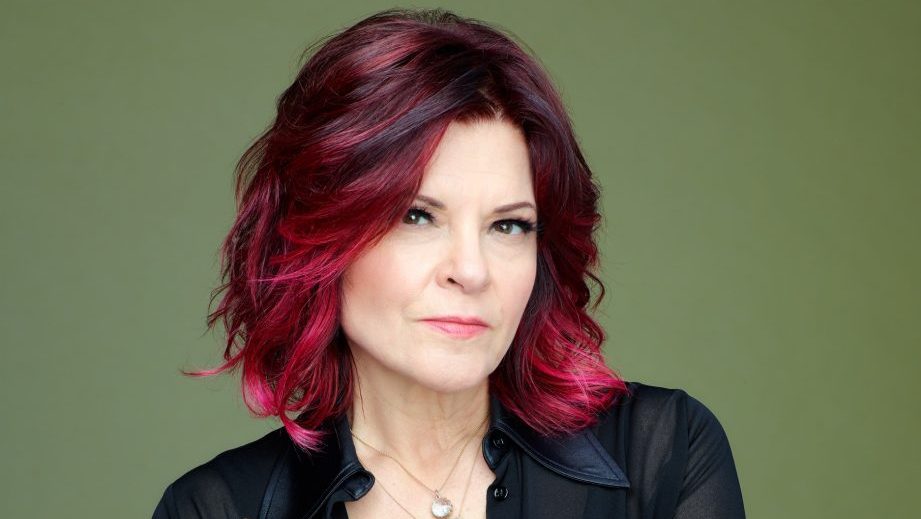
Artist: Rosanne Cash
Hometown: New York City
Song: “Time” (Tom Waits tribute)
Album: Come On Up To The House: Women Sing Waits
Release Date: November 22, 2019
Label: Dualtone Records
In Their Words: “What an honor to sing a song like ‘Time.’ Many years ago, I recorded it just for myself, just for the pleasure of singing those words. Maybe I seeded the notion in the deepest part of the creative ether, the place from where these songs travel through Tom. For whatever reason and from whatever source, I’m just thrilled to be a part of this album. There is no other songwriter in the world, past or future, like Tom Waits.” — Rosanne Cash
Photo credit: Michael Lavine
Shawn Colvin Still Going ‘Steady On’ With 30th Anniversary Acoustic Album
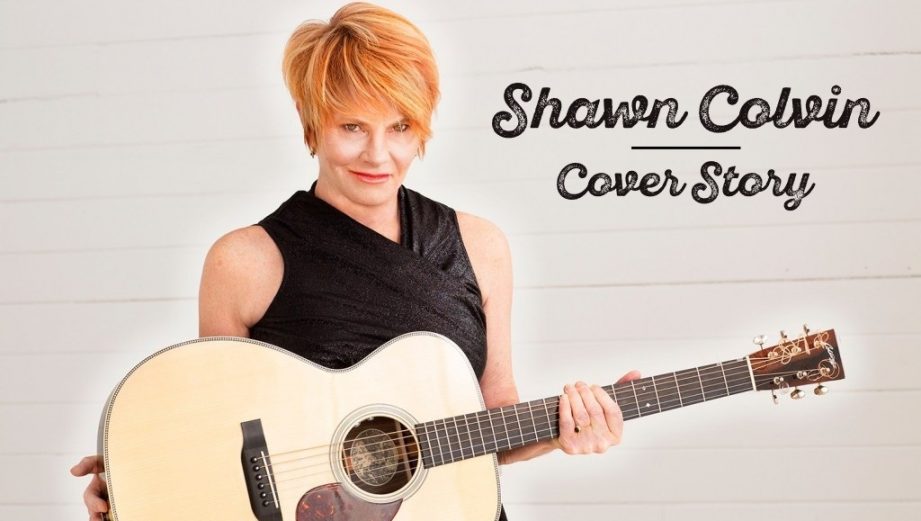
Shawn Colvin’s new album will be intimately familiar to fans who have loved her from the start. To commemorate the 30th anniversary of her landmark debut album, Steady On, Colvin re-recorded the full album acoustically – and she’s posing on the cover with the same guitar strap she wore on the back of the original packaging, too.
Since her auspicious arrival on the scene, Colvin has sold millions of albums and won multiple Grammys, including her first one for Steady On, in the category of Best Contemporary Folk Recording. If you’ve seen her perform over the last 30 years, you’ve certainly heard these songs — “Shotgun Down the Avalanche,” “Diamond in the Rough,” and “Ricochet in Time,” among them. She invited BGS for a hotel room conversation while she was in Nashville for AmericanaFest, where she’s performing the album in its entirety.
BGS: When you went into these sessions, were you hoping to capture a certain sound for this version of Steady On?
SC: No, just an acoustic tone, a stripped-down, non-produced, sort of bare-bones rendition of the songs.
Because you’re so familiar with these songs, were you able to work pretty quickly?
Even though I co-wrote a lot of them with John Leventhal, he would give me pieces of production and I thought, the way I need to figure out how to write is to strip all this production down to just me and a guitar. Almost every song on the record began that way. I stripped it down. It’s the beginning of what became the produced version of Steady On.
I was curious if you wrote most of those songs on the same guitar.
Oh, I think so, yeah. The Martin D-28.
What is it about that guitar that suits you so well?
I bought that guitar in 1974, and it was a 1971. I was 18 and it was my dream to have a Martin guitar. I think I paid $400 for it. And it was just my guitar. I mean, that was a big deal for me to spend that kind of money. I played that guitar on the road I don’t even know how many years. I still have it. It’s pretty beaten up. And I retired it, but yes, in 1988 or ’87 whenever that was, that’s the guitar I was still using.
How many songs had you written up into the songs that were on Steady On?
Maybe three or four.
Wow. So these are some of your earliest songs.
Oh, yeah.
That’s pretty remarkable.
Well, I wasn’t really a songwriter. I wanted to be and I practiced at it, writing lyrics to John’s fully-produced pieces, which were really pop. And I love pop music, but I wasn’t very good at writing lyrics to it. You know, my heroes were all singer-songwriters from the late ‘60s and early ‘70s, Joni Mitchell in particular. Very personal stuff, and that’s not what I had been writing. I realized, I think I have my own story to tell and I opened up to that and then I liked what I was doing.
Were you living in New York at the time?
Yeah.
How did that city shape you as an artist, do you think?
Oh gosh, the city shaped me personally and artistically in a huge way. I underwent a lot of personal changes there, a lot of growing up, a lot of waking up. It’s a dose, as Levon Helm said in The Last Waltz. But I met people I’m still friends with to this day that really nurtured me in my 20s and helped me grow up. My best friend Stokes is still there in New York that I met in 1980. And the music scene was so rich!
I started out in Buddy Miller’s country band. That’s how I got to New York. He hired me to come sing because Julie had left the band. And he needed another, what we called then, girl singer. So I was in a band like that. I played solo acoustic at places like The Cottonwood Cafe and The Bitter End and I did anything I could make a buck at. I was also in a country band with Soozie Tyrell. I did rockabilly bands.
We were just putting together bands piecemeal, you know “Hey, can you make this gig?” Everybody was up for whatever, all the musicians, and you cobbled together a band from gig to gig, whatever you could get, just whatever we could do. So I learned a lot. I played a lot, which is part of my advice to anybody who might want it,who is a young up-and-comer. Play live. Just do it and do it and do it, you know? I think it makes you confident and good and better your craft and you learn. You’re a student.
What was your live show like at that time? Was it just you and the Martin, singing solo acoustic?
Yeah.
You were never intimidated by that?
Nobody ever listened.
What do you mean?
When I was doing bar bands four hours a night in the city, sometimes they did. That was the goal, to play well enough that maybe someone would listen. It’s where I developed this percussive guitar style that I have, because I thought, what can I do to make it sound like more instruments and do something a little bit different? So I made more noise that way. Sort of a rhythmic thing.
I think of that as your signature sound because I haven’t seen a lot of artists doing that.
And that came partly from Joni Mitchell, who made progressive, clicky sounds on the guitar. And I always thought she was using the back of her hand to go against the strings, this fleshy part of your thumb in the back of your hand. I realized later she was using her nails against the strings to give that click. But I developed it my own way.
As a new artist, how did you find your audience? Or how did your audience find you?
I started to make a name for myself a little bit down the Eastern seaboard, Cambridge and DC, New York, and some other areas in Massachusetts, and Philadelphia. So I was getting finally to play listening rooms rather than bars. I had a little bit of a draw. I got to go on college radio stations and they would play cassettes of mine. It was really helpful, especially in Cambridge, so I got some fans that way that weren’t just the New York people. Then when I put out the record, I wasn’t prepared it for what was going to happen. It was on Columbia Records and it was time for the big push. I’m like, “Sure, no problem.” And it was a grassroots global push. So that meant drive-time and morning radio shows, if they’d have me.
And God bless the label reps in all these different cities, which you don’t have anymore. Their job was to take you around the radio and try to get them to listen to you. And they had a reputation so they could usually get you in. Whether the radio station was really interested or not was always sort of up in the air. And then I would do press, anybody that would talk to me, a magazine and a paper — local, big, small, whatever, other radio if I could — and then I’d do a show at night. Sometimes there were 10 people. And I did that a lot. It was a groundswell, I guess you could call it. Radio stations did start picking up songs from the album. And next thing you know, I’d go back to a town like Boulder and people would come.
That is grassroots for real.
Oh yeah, for real. But you know, those people that have been with me from the beginning have stayed. I have a loyal following. It’s fantastic, yeah.
When Steady On was released in 1989, how did you define success at that time? What did success mean to you?
I remember being in Boulder and I had a day off and I like to ski. I was in a rental car and I was driving to… I can’t remember if it was Keystone, someplace close to Boulder, and I heard myself on the radio and I almost went off the road. That was to me a measure of success. Then the Grammy Award of course was pretty cool. Who could have thought that up?
How do you define success now?
I’d say first and foremost, if I write a song that I like, that’s the best feeling. It’s gotten harder to do for me. There’s less time, because there’s so much roadwork. Less drama in my life, to force me to the paper. There’s really not a better feeling than finishing a song. Writing is hard, but the fact that I can still sell tickets, that’s success to me. Not everybody’s in that position. I think those two things — and I can still do it. Physically I can still play and sing as well, in my opinion, as I ever have. So it’s kind of longevity and luck.
Photo credit: Deidre Schoo
BGS 5+5: Amy Speace
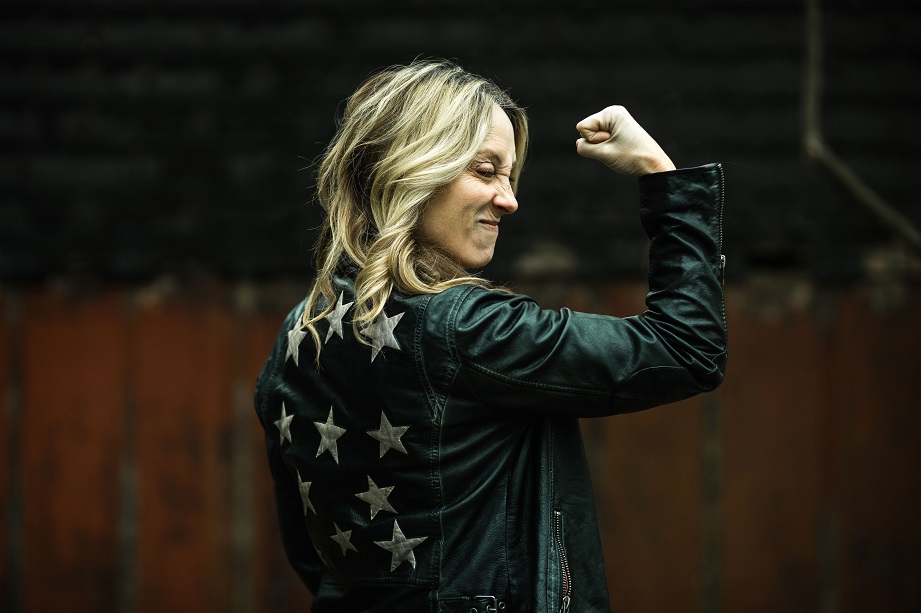
Artist: Amy Speace
Hometown: originally from Baltimore, Maryland. Currently lives in Nashville, Tennessee.
Latest album: Me and the Ghost of Charlemagne
What was the first moment that you knew you wanted to be a musician?
I remember from way back, because I started playing piano at age 3 (or so the story goes) and started formal lessons at 5, that I could disappear into my own world at the piano, inside the sound. I didn’t understand it but inside music was always this safe space for me.
So it’s hard to pinpoint when I wanted “to be” a musician because my earliest memories are that I was a musician. I just understood music from the start. Not that I didn’t have to work and practice, but it just made sense to me. So I’d chase that feeling back to being too short for my feet to hit the pedals practicing scales on my grandmother’s black upright piano.
What other art forms — literature, film, dance, painting, etc — inform your music?
Definitely all forms of storytelling. I didn’t write a song until I was about 28 but all through my childhood, I wrote poetry and stories and plays. I drew and painted. I read everything I could get my hands on. In college, I was a dual major in English and Theater and got obsessed with Shakespeare, Performance Art and Avant Garde Theater and Improv Comedy.
Then I went to NYC after college to study classical acting at The National Shakespeare Conservatory for two years and for the first time in my life started going to art museums and got lost in the big physical paintings of Pollock and Rothko. I lived in the Lower East Side and in Greenwich Village and really really loved living in that kind of Bohemia in my 20s.
I worked three jobs, one of which was as Lainie Kazan’s assistant on Broadway and in her cabaret shows, where I got the chance to meet so many legends of the theater. I hung out with dancers and clowns and actors and musicians and poets and we were all broke and idealistic and scrappy and I went to every show, every concert, every happening I could talk my way into.
I mean, there’s not really an art form out there that hasn’t moved me to tears and to want to create something of my own in response, from seeing Sondheim on Broadway to a poetry slam in the Lower East Side to my friend dancing burlesque. It all kind of informs whatever soup is all up there in my head, processing the pictures and the emotions and the memories. But when it gets down to pen on paper and crafting a song, I think that’s when film is really my guide: I think like a director/screenwriter/playwright. What’s the entry point in the story? What do you see out there? What’s the landscape like.
What’s the toughest time you ever had writing a song?
Easy. That will be the next one I write after I finish this one I’m working on. Because it’s always like starting over at the beginning and I go through all the fears that I’ll never write another good song again and I’ll just sink into the ocean of bad cliches and stolen melodies.
What’s your favorite memory from being on stage?
Probably the earliest, honestly. I was in 8th grade, Curtin Middle School in Williamsport, Pennsylvania. I was a very awkward, permed hair, 14-year-old. Bookworm, nerd, and not really that cool. I had joined chorus for the first time (I didn’t think I was a good singer) because my best friend Laura was a good singer and convinced me to join.
The end of the year the choir did a musical theater revue. I was kind of a class ham, very theatrical, did all the accents, and the choir director gave me a solo doing “Adelaide’s Lament” from Guys and Dolls because I could fake a good thick Bronx accent. I will honestly never forget how I felt when I stepped out onstage and the lights were on me and I disappeared into this character. It felt like the crowd roared and I got a standing ovation and the next day was like a freaking Christmas parade…
I went from being the new kid at school to everyone looking at me as if for the first time. The choir director took me aside and really encouraged me to study voice. She said, “I hear something in there…I think that you have a gift.” And literally, from that moment on, I knew I wanted to be onstage singing. I literally felt like I’d found myself that night.
I’ve had incredible stage moments, like being onstage at Town Hall in NYC opening for Nanci Griffith to a sold-out crowd — and you could hear a pin drop. To playing Gruene Hall with Guy Clark a few years before he died. To the first festival stage I was on at Glastonbury a few years back. Even to some incredible house concerts and small clubs. But that first time, it’s still so present to me, that I think that’s my favorite memory because it was when I first felt that I knew something true about myself.
How often do you hide behind a character in a song or use “you” when it’s actually “me”
Fascinating question. I don’t hide. I bring me into all the he’s and she’s and they’s and you’s in my song. If I don’t understand the characters’ passion, their desire, I can’t write it. So there’s got to be some autobiography in there, even if it’s masked by someone else’s story, even if it just creeps through two words in a bridge.
If I only wrote about my life and what was going on with me, literally, well, I’d have a short catalogue of songs because my life isn’t that interesting to sustain a career of writing about it. I don’t have time to hike the Himalayas or to be the captain of a ship. I’ve got a 16-month-old and an album coming out and I’ve got to get posters out and keep up with FaceTwittInstaHell. I’m tired. All the time.
Plus I have songs that need to get out and I have literally only the 30 minutes when my son may be napping to get a chorus idea down. So I have to find stories in newspapers or thieve parts of conversations I overhear or steal what you say that rhymes that you don’t even hear the rhyme. I’m always listening for ‘language of lyric’ to show up in my life and then, if I’m lucky and I can catch it, I keep it in a notebook for those naptime writing sessions.
So I may not let on that the “you” is actually “me” but it’s always a little bit of me.
Photo credit: Neilson Hubbard
LISTEN: Karen & the Sorrows, “It Ain’t Me”
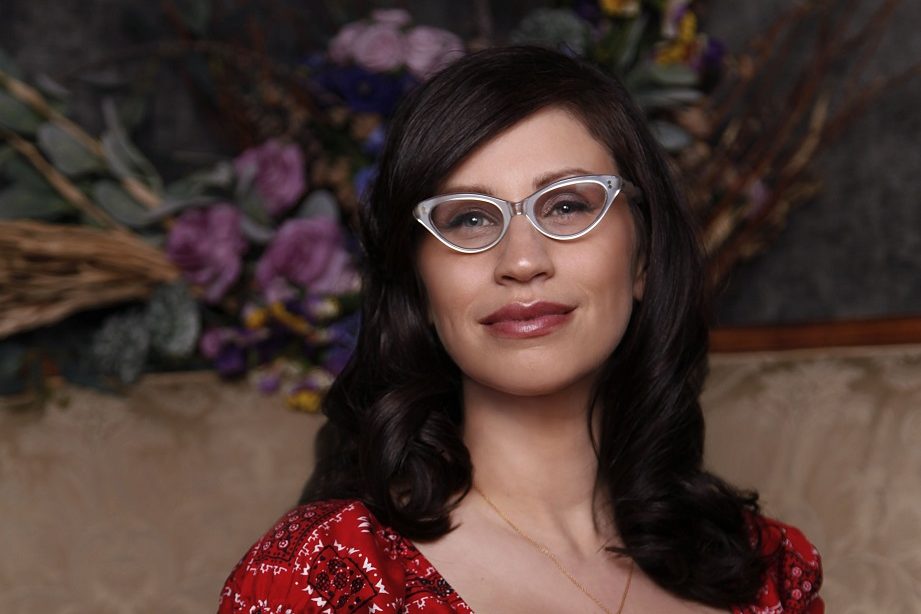
Artist: Karen & The Sorrows
Hometown: New York City
Song: “It Ain’t Me”
Album: Guaranteed Broken Heart
Release Date: October 18, 2019
In Their Words: “I like to say The Sorrows are a full-service heartbreak band. I write songs for all kinds of sad situations! This one is for when your ex first starts seeing someone new, and you can’t stop wondering if they’ll love that new person in all the ways they couldn’t love you.
It also belongs to a genre I often write that I would describe as what-the-country-rock-band-plays-late-at-night-after-everyone-else-left-and-the-bartender-is-mopping-up songs. I’d put a lot of my favorite Tom Petty and the Heartbreakers songs in this imaginary genre too, because to do it right, you need a truly lonesome-sounding Wurlitzer. And nobody does lonesome Wurly like the Heartbreaker’s Benmont Tench! I was definitely hoping to channel a little bit of the Heartbreakers’ twangy, tough despair on this one.” — Karen Pittelman
Photo credit: Leah James
LISTEN: Charlie and the Rays, “Away For The Weekend”
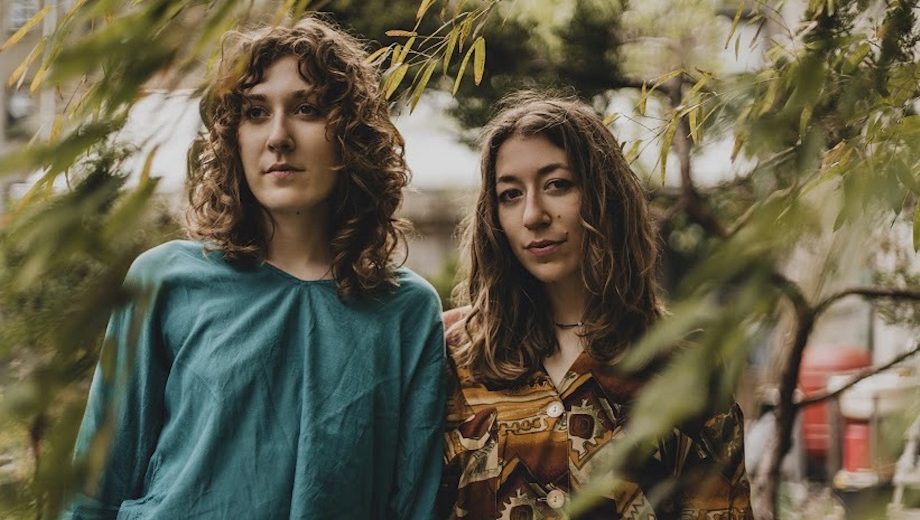
Artist: Charlie and the Rays
Hometown: New York, New York
Song: “Away For The Weekend”
Album: That’s Where You Were Born
Release Date: July 5, 2019
In Their Words: “We had just gotten back from a small tour out to Montana [when] Rebecca heard about a protest in Seattle where some people had been tear-gassed by police. Like so much of the news today, it was deeply upsetting that this event didn’t circulate through the public like we thought it would. This song is the reaction to a seemingly futile social and political atmosphere and our confusion about the best way to create momentum surrounding important civil rights issues. It may seem like a song about heartbreak, because it is. We are heartbroken that school children are continuously being shot up in our country, and that the color of someone’s skin dictates the likelihood of being shot and killed by those who are supposed to be protecting us. We don’t know the answers, but we hope this song can spur conversation and motivate change.” — Jordan Stobbe, Charlie and the Rays
Photo credit: Anna Letson
Wait For Me: Anaïs Mitchell and Hadestown Finally Make It to Broadway
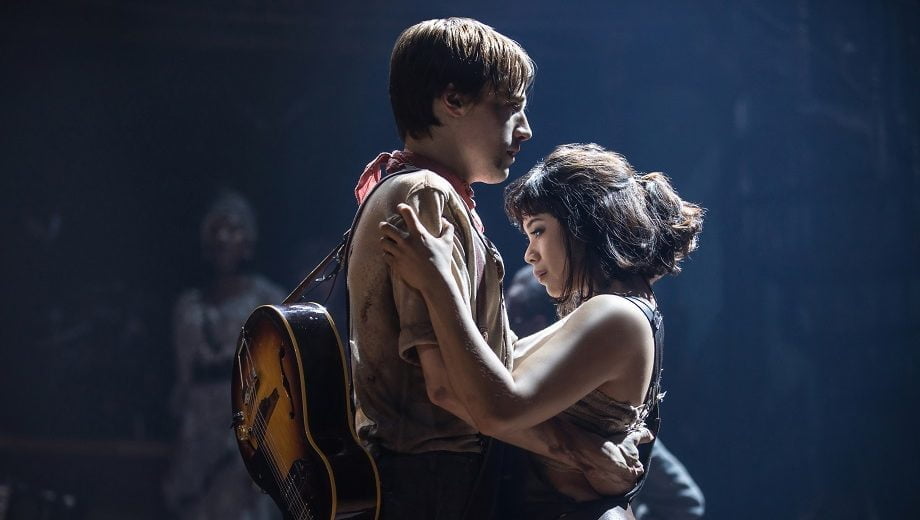
This spring in New York City, Hadestown is being celebrated as a feat of storytelling at the not-obvious-until-now intersection between Broadway, Greek mythology, and folk music. Penned by Anaïs Mitchell, the production is sung-through on a rolling landscape of New Orleans-infused roots music, strung so seamlessly together that it feels like one long song.
It’s been nominated for 14 Tony Awards this year — worth celebrating in the folk world, considering the other accomplishments of its writer include a duo recording of songs from the collection of Francis James Child and a handful of stunning singer-songwriter albums. But what’s folkier than telling a timeless tale in hopes that we can learn something new about where we are and where we’re going? And, like most myths and folk songs, Hadestown seems to have been around almost forever.
“I never dreamed I’d be working on this thing for as long as I have!” Mitchell tells the Bluegrass Situation. “But there have been so many different chapters of it — the early stage show in Vermont, the studio album, the touring of the studio album with guest singers, the six years of development in New York with [director] Rachel Chavkin (and four productions in and out of town). Other artists, designers, actors, have kept the wind in my sails and in the sails of the piece itself.”
She adds, “When I finally had to let go of changing lyrics because we were close to opening night, I was walking outside the theater after a show and saw this crowd of kids waiting at the stage door to talk to the actors, some of them dressed as characters from our show. I had this moment of grace and humility and the deep realization that this thing has never been about me and the writing of it; it has always been so much bigger. The story is older than any of us and resonates in ways I will never understand. So I guess what I’m getting at is, my feeling about the mystery, the muse, the crazy challenging beautiful act of collaboration — all those things are as mystical to me as they’ve ever been.”
The story of Hadestown brings into parallel two love stories from Greek mythology: Orpheus and Eurydice alongside Hades and Persephone. In Mitchell’s narrative, both couples are torn in some way by doubt and fear. Orpheus (Reeve Carney) is the musician working on a song to change the world; Eurydice (Eva Noblezada) is the daring girl who falls in love with him. Hades (Patrick Page) is the king of the underworld and his wife Persephone (Amber Grey) is the plucky goddess who brings the spring and summer before returning to Hades’s side when the seasons change.
Mitchell told an audience recently that the whole thing came to her many years ago, as just “some lyrics [that] came into my head that seemed to be about this story.”
“Orpheus is this impossible optimist,” she explains. “[He’s] this dreamer who believes that he can write a song beautiful enough that he can change the way the world is, can change the rules of the world.”
Hadestown premiered as a community theater production in Vermont in 2006. Four years later, Mitchell made it an album where she sang as Eurydice and Justin Vernon was Orpheus. Greg Brown was Hades, Ani DiFranco was Persephone, Ben Knox Miller was Hermes, and the Haden Triplets were the Fates. As a folk album, Hadestown was anachronistic if not delightfully disorienting. Its songs all stood on their own, especially the lusciously navel-gazing “Flowers” and the provocative, accidentally topical “Why Do We Build the Wall?” They were each arrestingly understated, driven by the turns of the singer’s voice and the prosody in Mitchell’s lyrics.
Mitchell toured around, performing the album with a rotating cast of local singer-songwriters wherever she went. In 2012 she began a collaboration with Chavkin (Natasha, Pierre, and the Great Comet of 1812) and since then Hadestown has journeyed from a small thrust stage at New York Theatre Workshop in the East Village, to a larger proscenium stage in Edmonton, Alberta, then to the National Theater in London, and finally to Broadway at the Walter Kerr Theater.
Tipping a hat to the show’s folksinger origins, Orpheus really plays his acoustic guitar, the Fates wander with fiddle and squeezebox, people step to the mic when they want to emphasize what they’re singing about, and at the top of the second act, Persephone introduces the band. These elements help to set the show apart in a theater world where audiences are used to respecting a hard fourth wall.
“I come from the songwriter/music world,” Mitchell says, “and I’m very comfortable just hanging out for three or four minutes in a song with verses, choruses, maybe a bridge, digging the suspension of time and the cyclical beauty of music. So there’s been a super-slow learning curve for me in terms of how to take a song like ‘Wedding Song’ and put it in service of the kind of moment-to-moment storytelling we desire and expect from the theater. Especially because Hadestown is a sung-through piece, we needed the songs to work harder as scenes with stakes, events, and results for the characters.”
She continues, “Many of the songs for Hadestown existed as a kind of poetic portraiture and it took cracking them open, adding intros, interludes, bridges and outros, check-ins with other characters, to make them do that work. The addition of ‘Come Home with Me,’ which I rewrote one million times, in which Orpheus expresses his mission to ‘bring the world back into tune’ with song, and then especially the interlude where he debuts his ‘Epic’ melody and it has an effect on the world — flower magic! — really helped it feel like, when we got to the end of that song, something had changed. For Orpheus, for Eurydice, and for the audience.”
The Broadway incarnation is replete with these kinds of turning points and bringing them to fruition has meant a lot of rewriting for Mitchell. Thus, some of the songs that made sense on the album are no longer included, and some of the characters have evolved as well.
“I got feedback after almost every production we did about the Orpheus character not being in-focus enough,” Mitchell says. “He’s been the hardest character by far to write, I think because of all the characters in the show, he’s pure, an idealist, a believer, and everyone else has a sort of jaded or ruined quality which is easier for audiences to ‘buy.’ In earlier productions, because he’s this irrationally faithful character, mythologically speaking, and because of how he was written, he came across kind of cocky, overconfident, not the underdog hero we want to pull for.
“Finally, between London and Broadway, I really started massaging him into more of an innocent, naive character, an artist ‘touched by the gods’ who can see the way the world could be but has a hard time living in the world that is. That new character was very intuitive to Reeve [Carney], who is himself a very pure spirit. It felt right for Orpheus to be more of a mentee, an acolyte, a boy ‘under the wing’ of Hermes, the storyteller.
“So Hermes became much more of an uncle figure, more intimately involved in the story and its stakes than before. At the same time Eurydice was becoming more focused — and Eva [Noblezada] also brought so much intuitive toughness and humor to the role — as a runaway, a girl with a past, and demons that won’t leave her be. The Fates became, quite often, the voices in her head. I think those more meta storyteller characters each have a more pointed allegiance [on Broadway] to the character they hope will act out their world views.”
Further, the set has evolved: it is a barroom, a small world that feels both familiar and familial. But when we enter the underworld, the set becomes darker, cavernous. Though it physically expands, the result somehow feels heavier, more enclosed.
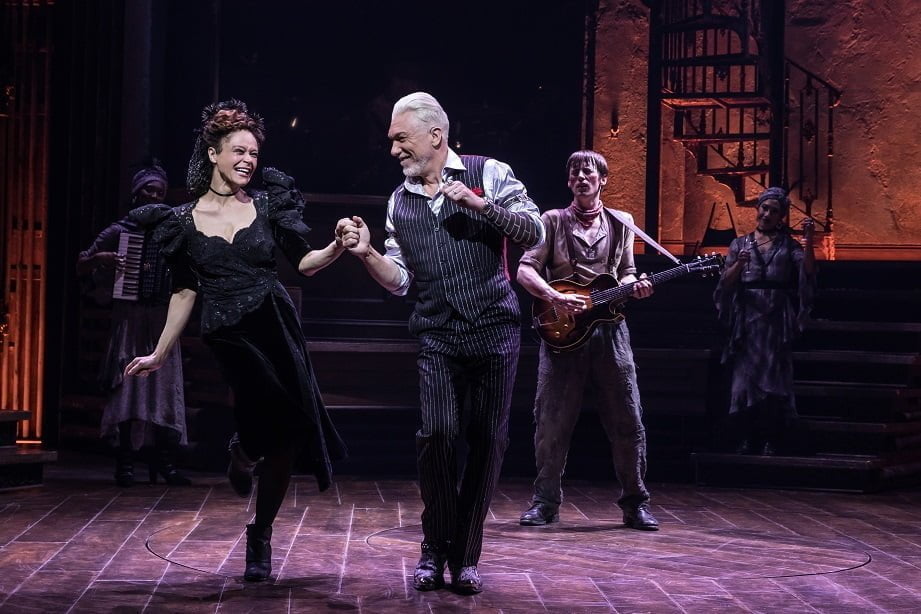
“We could see the effect that Orpheus’s divine music has on the world,” she says. “In the case of ‘Wait for Me,’ … the way to the underworld reveals itself to him. It’s a moment where I feel like all the design departments were bringing so much inspiration. … We go from a very warm, safe, round place, to a place that is suddenly terrifyingly large. It’s all of a sudden cold. There’s steel, those industrial lights go up and up and up. I find it very visually moving every time.”
There’s also a lift and turntable in the stage that add to the journeying portions of the show. Nowhere are the set changes more powerful than in the stunning, breath-stopping delivery of “Wait for Me” and its reprise in Act II. In the latter, Eurydice and Orpheus switch places in their travail of trust and doubt, singing with a workers’ chorus whose presence adds new depth to the show.
“The Workers were always a part of the story conceptually,” Mitchell says, “but at New York Theater Workshop we didn’t have space or budget for an ensemble, so that ‘role’ was taken on by the entire company. When we began to build in the dedicated choral, choreographic presence of the Workers, it really expanded a lot of things. ‘Wait for Me II,’ for example, gains a lot of momentum because suddenly the implications of Orpheus and Eurydice’s walk are bigger than the two of them.”
“Wait for Me II” is where the intersections of song, story, myth, folk tradition, and theatrical allegory become writ-large in the narrative. We’re reminded that a song, created as the expression of an individual, can encourage many others to follow new paths — or as the posters outside the theater say, help us “see how the world can be.”
“People inspire each other in ways no one will ever understand,” Mitchell says. “No one is coming up with any of this shit from scratch. We are standing on the backs of our ancestors and we’re singing to and for each other. The other very meta thing about letting go of the piece for Broadway was [recognizing] nothing is ever perfect. We don’t love Orpheus because he’s perfect. He’s flawed, he falls short, and we love him anyway. We love him for trying. There is goodness in the endeavor itself, whatever the outcome is.”
Lede image: Reeve Carney and Eva Noblezada
Secondary image: Amber Gray, Patrick Page, and Reeve Carney
Photo credit: Matthew Murphy
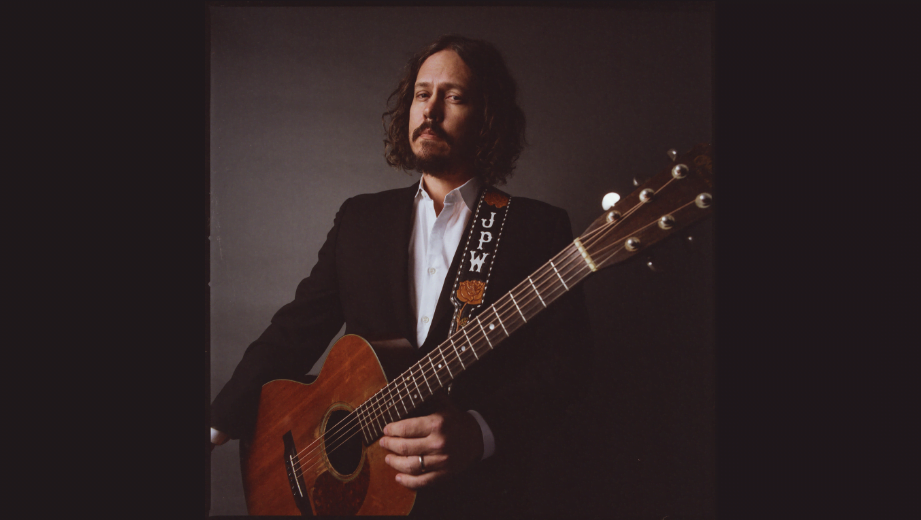
GIVEAWAY: Win Tickets to John Paul White @ Bowery Ballroom (NYC) 5/11
Sometimes It’s a Whisper: A Conversation With Liz Vice
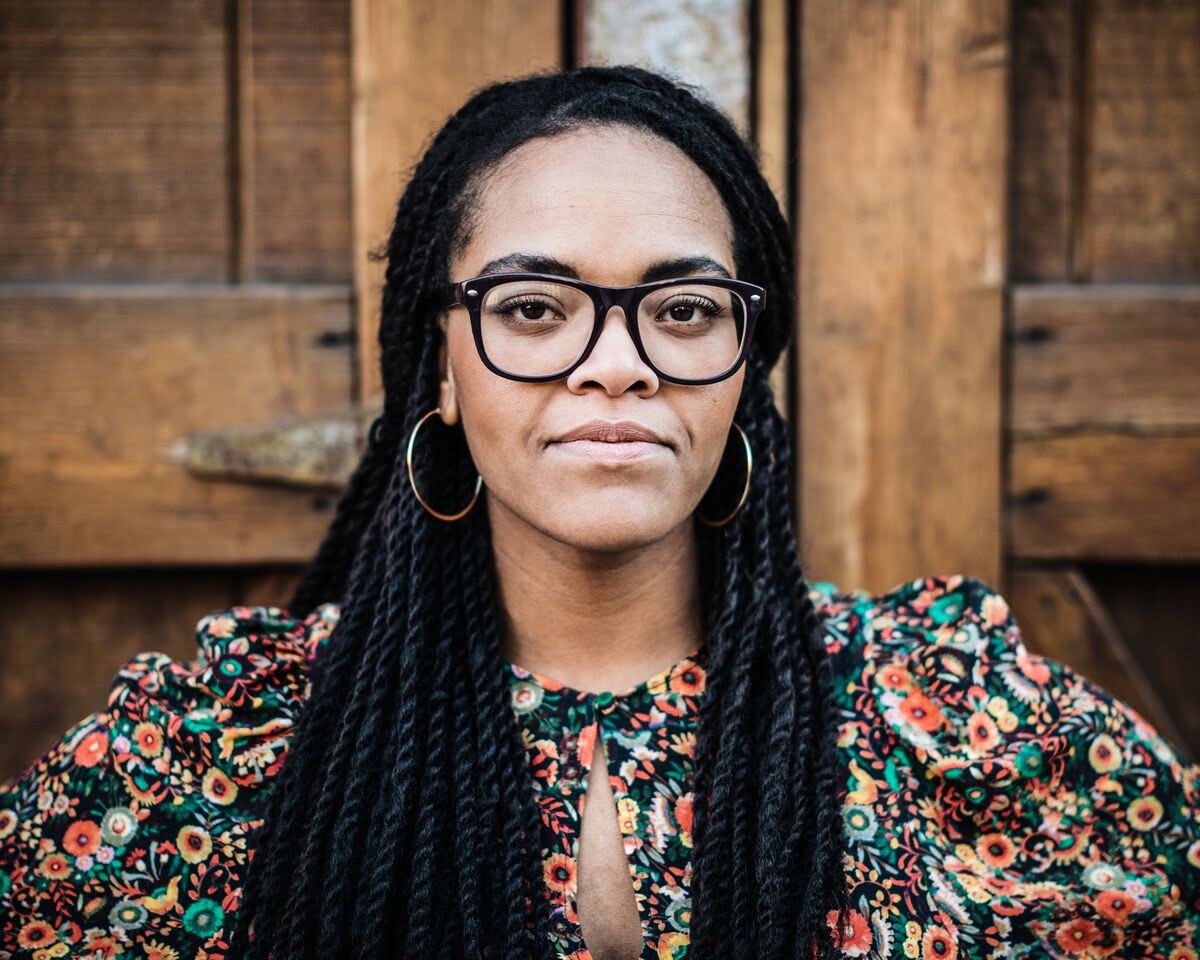
Despite never having desired a musical career, Liz Vice set about answering a higher calling with her 2015 debut album, There’s a Light. She spread a message of inclusivity and love, even while self-doubt, impostor syndrome, and a hellacious tour threatened to upend her very sense of self. Making it to her sophomore album, Save Me, therefore became an incredibly personal celebration—a heady reminder about how faith in something bigger than yourself can serve as a beacon in this messy world.
Across Save Me, she touches on personal topics (the illness that very nearly ended her life when she was younger, the crippling doubt that got in her way at the start of this journey) while looking outward to the community. On “Brick By Brick,” she reminds listeners about the central tenet, “Love thy neighbor,” as a rippling synth takes the brooding gospel track into a clarion call for kindness. No matter what listeners’ relationship with faith, religion, or belief might be, Vice’s message is as old as time – and more necessary than ever.
There’s this saying I’ve always appreciated: “Sometimes the wrong train gets you to the right station.” Here you set out to pursue film production, but life led you to music instead. How do you feel about your journey?
It’s always, “What the hell am I doing? How did I get here?” It’s only been four and a half years; I still wonder. I feel like this record is so different, it’s so much more me because it does involve my storytelling abilities, and working with somebody who’s also a great storyteller—Micah Bourne. I get to use aspects of film—storytelling—but instead of the camera, it’s with a melody. It’s still hard, but I think about, man, production’s really hard. You’re not getting paid much, you still get treated like crap, and I was typically the only brown person on set.
Which has its own complications.
Oh, one hundred percent.
Besides the opening cover song, the other tracks are all originals. What did your writing process look like this time?
I wrote with Micah Bourne, a spoken word artist, and Dana Halferty, who I met on set. I was listening to music, and I was like, “God, I’ve never written a song, and I’m terrified to do this thing that I feel like you’re calling me to do. Am I doing this out of a religious mindset?” Honestly, I don’t think Jesus would be very religious. We can’t earn our way into his good side, so am I doing this because I feel like he’s given me an opportunity to reach people and remind them that they’re loved? Or am I doing this because I feel a sense of religious duty?
Slowly, I feel like He’s been undoing this mindset of religious duty. The first time I ever heard this was when I was playing a blues festival—it was like my fifth show ever playing in front of an audience. This was the first time I got so nervous I cried. I sat on my couch and I felt God say, “I’m not asking you to save them; I’m just asking you to sing over them.” There have been so many shows where people say, “Oh my gosh, like I’m an atheist but I love your message. It’s something we can all relate to.”
You said you got more personal on this album.
“Baby Hold On,” I wrote that after one of the worst tours I’ve ever been on; I was like, “I’m done.” One of my drummers had to be sent back because his mom got sick out of nowhere, and then she ended up dying three months later. Then I fell down the stairs and broke my toe and had to drive three hours to sing in New Hampshire with my foot elevated on Vicodin.
It sounds like a testing ground, like “How much do you want this?”
I’m like, “I don’t want this!” This broken foot, and one of my drummers who I freakin’ adore, his mother passes away. This comes after our suitcases were stolen in San Francisco and then a month prior to that I got in a car accident—my friend’s car was totaled and I had a herniated disc. I’m just like, “God, I don’t want this. You have the wrong person. I told you I wasn’t strong enough, I told you that I didn’t want this bad enough” So having this real Moses moment. I listened to “Baby Hold On” and as soon as the “oohs” came in with the choir I started to cry. Sometimes I feel like it’s the words unsaid that hit me the most.
Even if you have a contested relationship with faith or you don’t believe in anything, there’s such a good message about kindness and community on Save Me.
Right, and I also think that we make God so small. He’s not logical, he’s not realistic. There are things I will never understand, and I have to let myself be OK with that. It’s not just me and God, me and the Bible, it’s me and people around me. … Everyone has a story, and it might not fit into this pretty package that we want it to fit in.
Even [Plato’s] Allegory of the Caves, I love that story. These three men are hanging from shackles and they’re living off the shadows of the world, and then one actually goes in the world to experience it, and he’s like, “Oh my gosh, so that shadow is this, and that shadow is this,” and the other prisoners beat the hell out of him. It’s like, how many times do we choose to live off of the shadows instead of the actual source?
Especially with social media, which might be the biggest metaphor for living off the shadows. What was a big turning point for you on this album, a way out of the shadows into the truth?
I want to be OK in my body. Once I can accept that I am a created being and there’s beauty in all that I am, even my deep voice that sounds like I smoke cigarettes every day and I don’t at all. Once I can love myself for who I am in a whole way, I really do believe, if you love yourself, you can love other people well.
Absolutely. I think that’s where it needs to start. In order to look outward, you need to start inward.
That’s one of the top commands—love God with all your soul and with all your might, and love your neighbor. If you want to love God, you have to love your neighbor. That is a sign you love God because He made them too. I’m not perfect at that, but what does it look like to start the conversation about what it actually means to love your neighbor?
How has your connection to God changed since moving from Portland, Oregon, to New York City?
I love living in New York City, and the reason why is because of something I didn’t necessarily get when I lived in Portland, like diversity.
Yeah, there’s that.
For the lack of nature, people try to tell me, “You can go to this park or that park,” and I’m like I literally lived at the bottom of an extinct volcano [in Portland]. I lived by the Gorge, where you drive 20 to 30 minutes east and you’re seeing waterfalls and canyons. I’ve lived here for a year and half, and already so much has changed since I moved here, so it really is like a constant recalibrating—like GPS—of how do I silence my mind, how do I connect with a spiritual being who doesn’t tend to work in a way that most would want to—with fireworks and earthquakes and raging fires? Sometimes it’s a whisper and you have to lean in more, but you have to position yourself in order to hear the whisper.
It’s got to be an interesting practice to explore. As you said, in the city you have this greater sense of humanity to remind you of something bigger.
No one looks at each other on the subway so it’s perfect for people-watching. I see every shade of people next to each other, and so many different languages, it really feels like heaven to me. Even though this place can be a hot mess, I just look at it and I think, “Man, God is in love with this city.” Even people who don’t even know Him! I love it here. It hurts so good.
Photo credit: Katrina Sorrentin
3×3: Zander Hawley on Books, Boots, and Bruce Springsteen

Artist: Zander Hawley
Hometown: Los Angeles, CA
Latest Album: When I Get Blue
Personal Nicknames: Z
If you could safely have any animal in the world as a pet, which would you choose?
That Melanie Griffith-lion relationship was always super interesting to me, but I’d probably want a lady lion instead of a guy.
Do your socks always match?
Absolutely.
If you could have a superpower, what would you choose?
Whatever gets me on the X-Men.
Which describes you as a kid — tree climber, video gamer, or book reader?
Book reader. Books would distract me from anything I was supposed to be doing — my parents tell me they would come into my room to find that I’d put on maybe half an outfit before the book took over.
Who was the best teacher you ever had — and why?
Vanessa Mancinelli, senior year high school literature teacher, because she had even more fun reading than I did.
What’s your favorite city?
I was born in New York, but only lived there for the first five years of my life, so whenever I go back, I’m always hit by a strong sense of nostalgia. Last time I was there, I saw Springsteen play for the first time, so that pretty much sealed it.
Boots or sneakers?
Boots.
Which brothers do you prefer — Avett, Wood, Stanley, Comatose, or Louvin?
Oh man, can I write in a different set? I’d probably choose the Grimms or the Summers.
Head or heart?
I wish I could say both, but I have to say heart.