Check Out Lucinda’s, a Bustlin’ NYC Honky Tonk

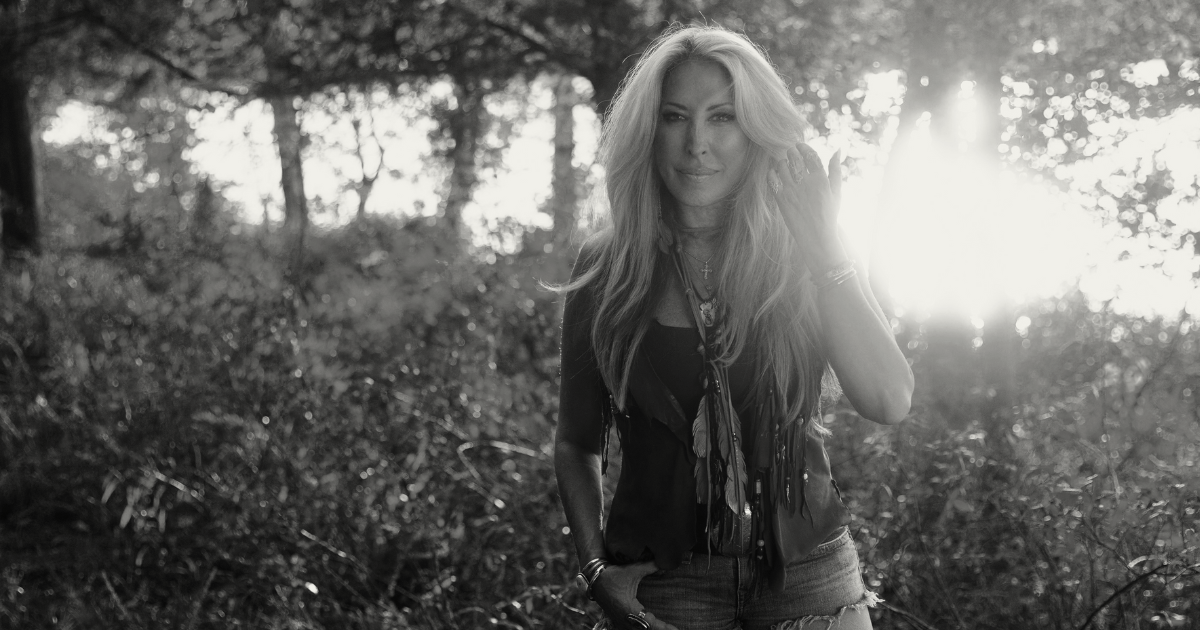
(Editor’s Note: Enjoy our tour of New York City honky-tonk, juke joint, and cocktail lounge Lucinda’s as a special postlogue to our Artist of the Month coverage of Lucinda Williams during March 2026.)

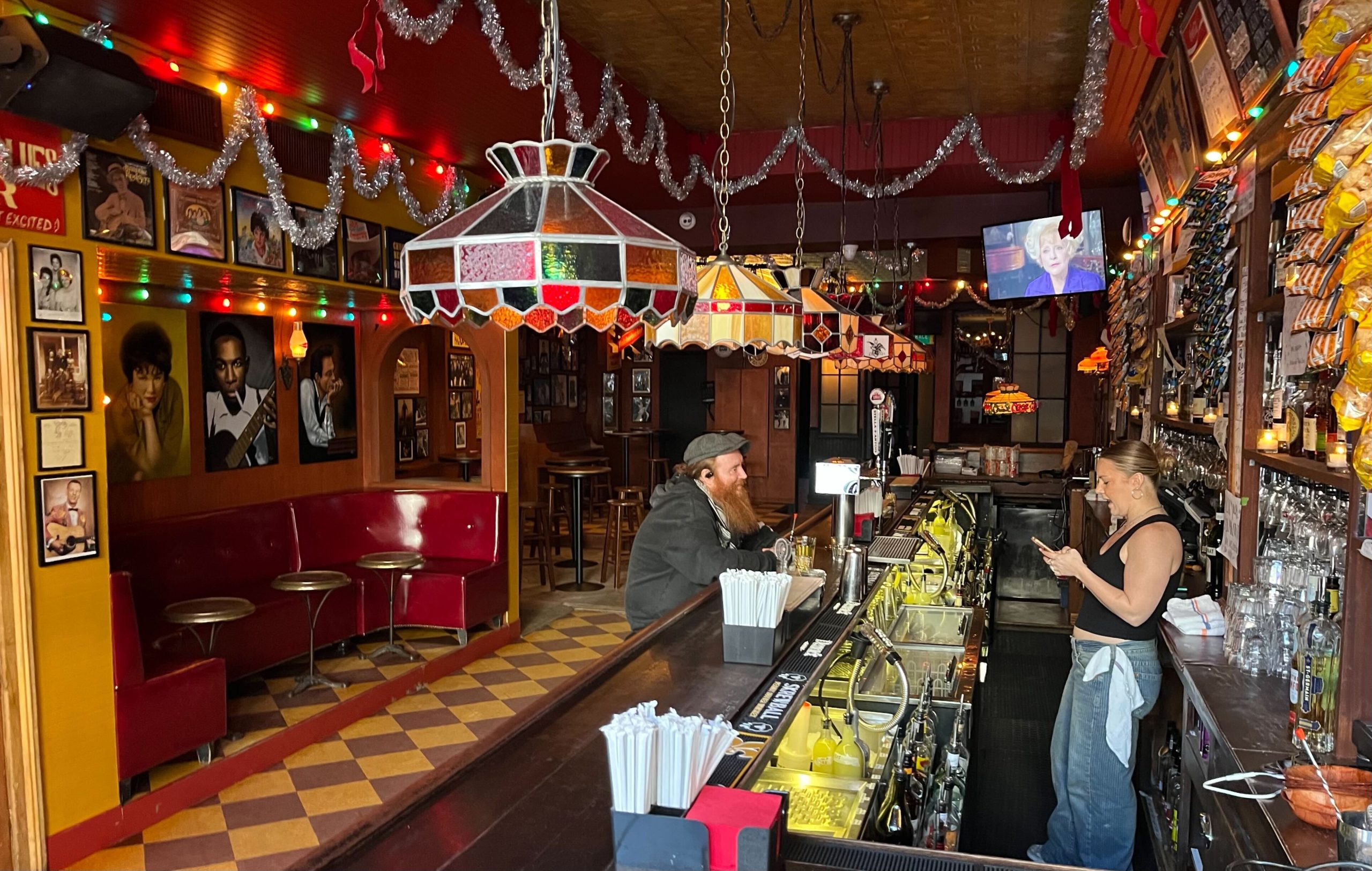
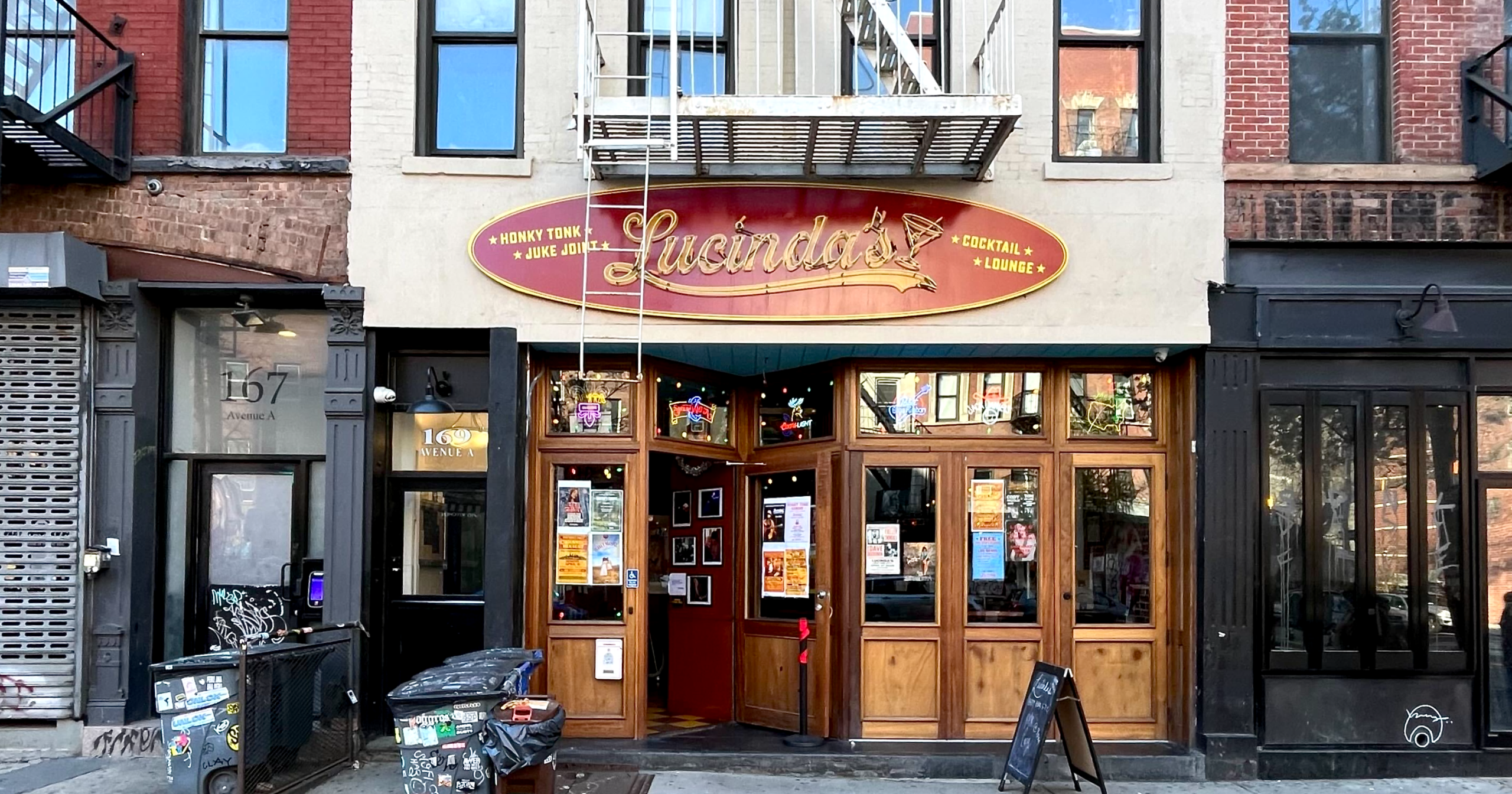
It’s the first springtime Sunday in Manhattan and after a bitter winter, the East Village is humming with human activity. Around the corner from the throng of Tompkins Square Park, where Girl Scouts hawk cookies and roller hockey players clatter their sticks and skates, tumbles of acoustic guitar spill from a storefront, attracting curious passers-by. Some folks pause and lean toward the open windows, and a few cross the threshold to meet wafts of fresh popcorn. Welcome to Lucinda’s.

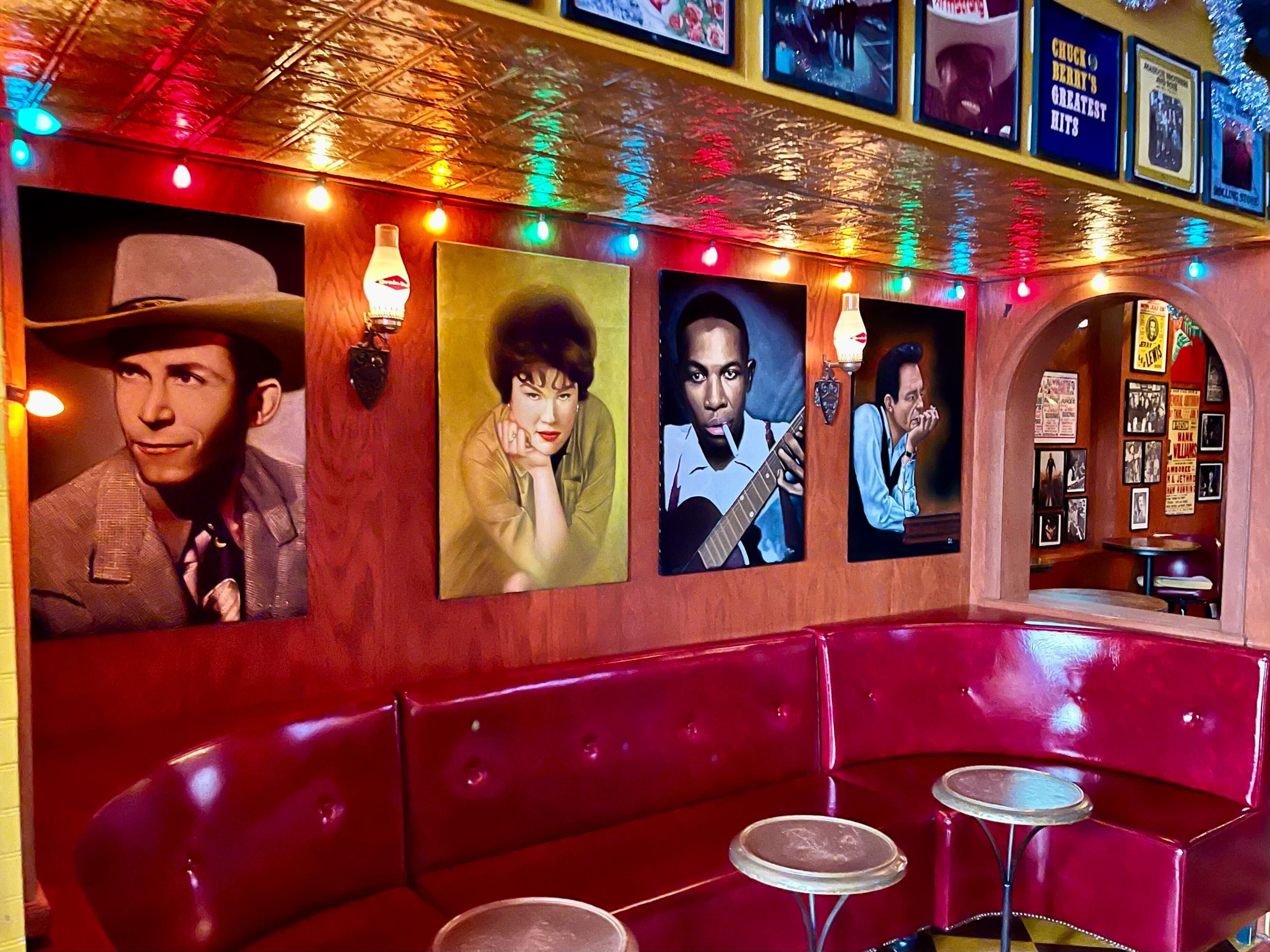
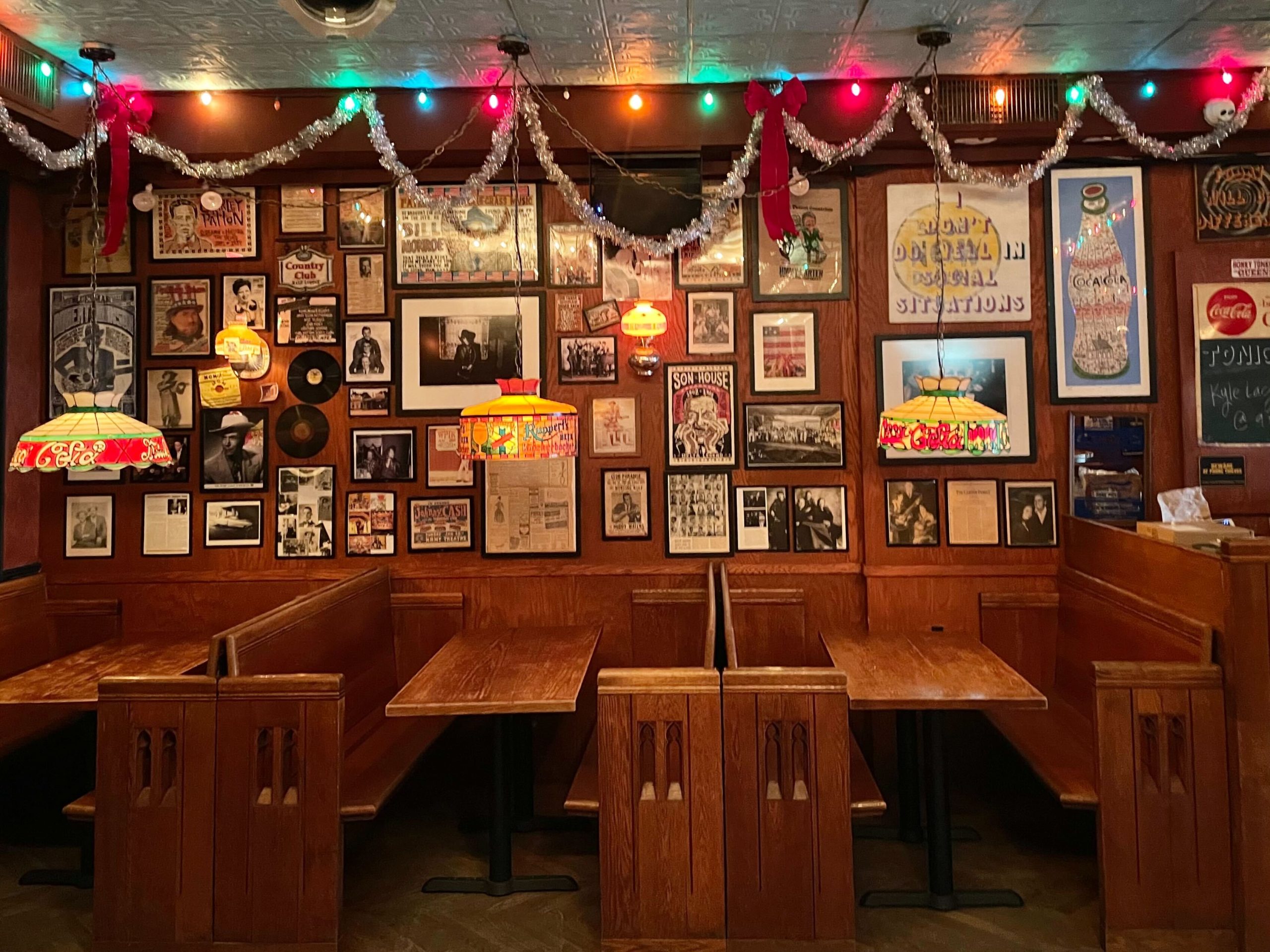
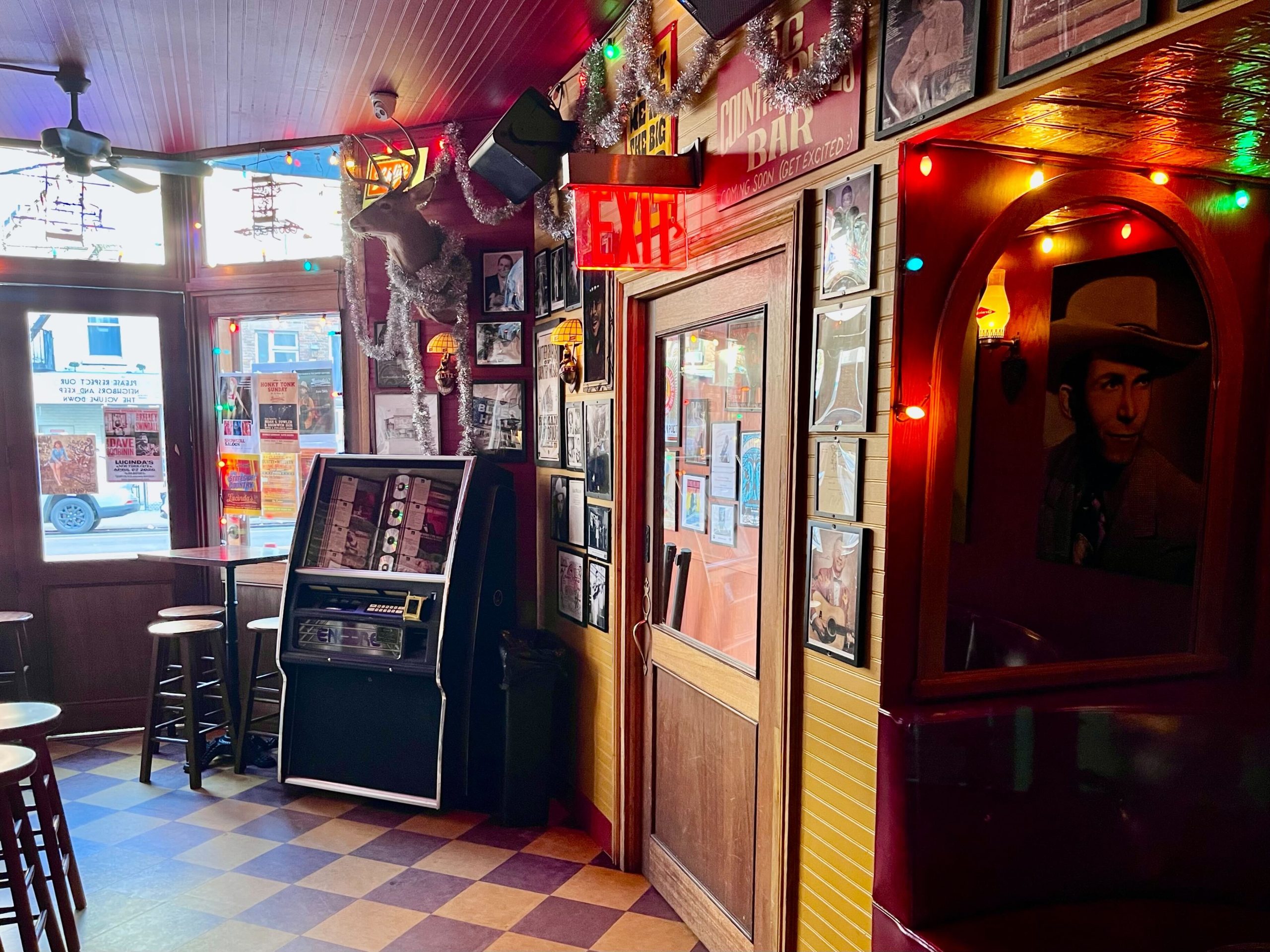
The bar’s tin ceiling interior is catnip to music history aficionados and Americana-kitsch collectors alike, the walls hung with poster prints, vintage memorabilia, and velvet paintings (among them Kitty Wells, Robert Johnson, and Elvis Presley shaking hands with Jesus Christ). There’s a jukebox ready to sling beloved feels-good-to-feel-bad hits, and peanut figurines with Jimmy Carter grinning and holding court over the liquor. These accoutrements all play second fiddle to the spot’s main attraction: live music meant for casual socializing every day of the week.

This robust programming – along with some of the bar’s most prized decorative items – is the work of Kelley Swindall, a musician and New Yorker of 20 years who grew up in Stone Mountain, Georgia. She takes pride in a large round aluminum Coca-Cola sign, an item on “permanent loan” from her family and one of several wall-hung nods to Georgia’s most lucrative liquid export. She’s more proud of filling a void in New York City nightlife. “There’s a lot of Southern people in the city that went to SEC schools that want to have some Southern culture again, like college football, or listening to music that they love and don’t normally hear in New York,” Swindall says.

Though the city has a handful of country-themed, sometimes Western-leaning bars – Williamsburg’s hootin-hollerin Skinny Dennis, the self-explanatory Honky Tonkin’ in Queens, the West Village’s Tex-Mex-y Cowgirl – Swindall wanted to develop a place to celebrate the early country, blues, folk, and other vernacular music that shaped generations of American song. She yearned for the sort of places she knew growing up and got to know as a touring musician, rooms where casual live music fosters socializing instead of hampering it. “That’s what the juke joints and honky-tonks were back in the day – it was live music as the soundtrack of the evening, but you were hanging out, drinking, dancing, and socializing,” Swindall says.

Swindall found a business partner in Laura McCarthy, who has a storied history of her own at 169 Avenue A running prior venues Brownies and Coney Island Baby. The pair found a namesake and patron saint of sorts in Lucinda Williams, with whom they connected through mutual friends. Williams agreed to endorse the place, her multi-stranded artistry anchoring the team’s vision for honoring the deep musical roots of the American South. She christened the stage with a set as part of the bar’s opening-night festivities last July.

On a Saturday night, Lucinda’s is rollicking, packed front to back with revelers before some New Yorkers have even gone to dinner. There’s college basketball on one TV, and The Best Little Whorehouse in Texas on the other. I want to mill around and make conversation, but the bar is thick with boisterous, overlapping shouts converging with mid-1990s Tim McGraw and Shania Twain songs that radiate in my bones.

The mission of Lucinda’s is evidently working. With my elbows pinned to my sides, I chat with Emily from Texas and two girls who rolled up for one of several birthday gatherings in progress. After his friend paws at my unattended leftover garlic knots, Gavin, an Irish ex-pat and country music fan, tells me it’s his first time at Lucinda’s after hearing about it on TikTok. “We were in the neighborhood, and we wanted to come in. We already had plans somewhere else, and we made it our business to come back here,” he says, enthralled with the room’s unique decor. I don’t get a chance to ask his thoughts on the Dolly Parton or Johnny Cash bathrooms before he peels off with drinks in each hand.

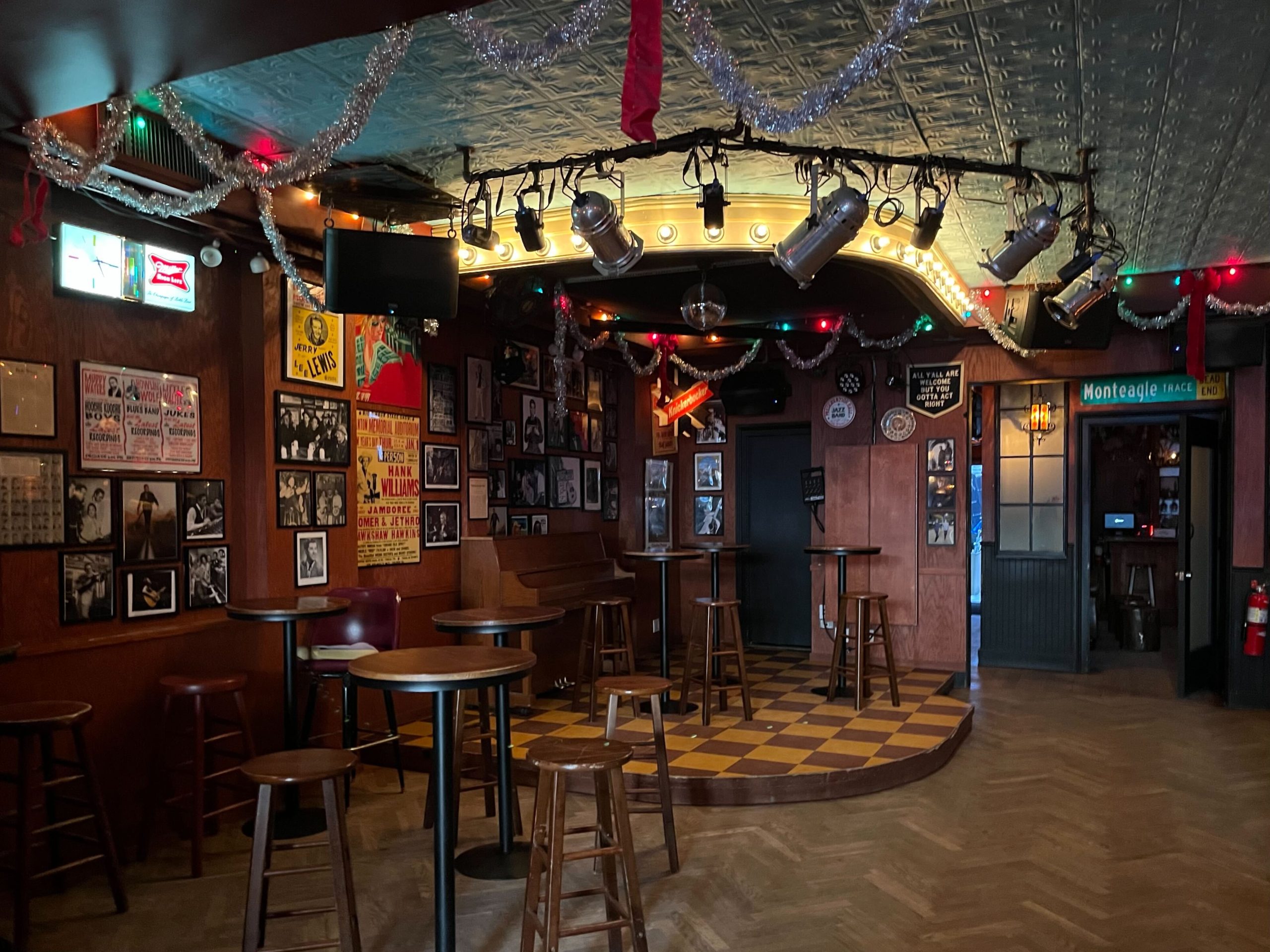
Spirits are high, but by Lucinda’s standards, the fun has barely started: a few musicians are shouldering their way through to the corner stage. Nightly music programming is a staple at Lucinda’s, which Swindall accomplishes with standing residencies and open mics alongside other ticketed events. There’s a loose structure week to week; weekends are for the big sing-along bands, Sunday evenings are for classic country, and bluegrass and some old-time are on Tuesdays. “I was an artist first, and I still am, so I wanted to focus on the kind of music that I’m into,” Swindall says, adding that Thursday night is for two-stepping.

The Sunday open mics are a binding force to Lucinda’s operating concepts. Sign-ups start at 1 p.m. every Sunday, running through the afternoon until another outfit takes the stage for the evening. There are some gentle guidelines (no covers, no backing tracks), aimed toward bringing a pleasant and equitable atmosphere to the gatherings. Swindall prioritizes the artists’ experiences at these weekly forays, remembering open mics as essential to her relationship-building and development as a young musician.

“It’s more important to have people able to come in and play their songs, everyone listen, rather than have a thriving bar culture that day,” she says. Drawing further on her artist’s perspective, Swindall fosters the open mic knowing the challenges of getting a foothold in bigger booking circuits. “A lot of places, they don’t want to book you unless you can bring a crowd or you can show them live footage. It’s really great to give people an avenue to get comfortable on stage and get feedback for their songs,” Swindall says.

Moreover, the shindigs help Swindall expand her pool for her month-to-month bookings, strengthening the network of relationships that are essential to the arts-forward community that McCarthy and Swindall hope to nourish.

Almost a full year in, Swindall is eyeing a steady growth pattern. She worked her way up to music every night of the week and now sometimes has two shows a night; she’s starting to entertain ideas for a small festival. “From a bar point of view, there’s so much to do,” she says.

The space isn’t zoned for a kitchen, but Swindall wants to figure out some kind of food element; in the meantime, patrons can bring in takeout or ask a bartender nicely for a Moon Pie, a bag of Zapp’s chips, or a bowl of popcorn. Swindall will stay busy as she aims to make Lucinda’s even more of a place for the “all” in “y’all.”

Stop in, sit down, shake loose. Connect with a song, or maybe a stranger.


All photos by BGS Staff.

Explore our Artist of the Month coverage of Lucinda Williams here.

Queen Esther Made a Civil War Album Unlike All the Rest

Civil War albums are all too common in roots music, bluegrass, country, and Americana. Usually, these concept projects romanticize and valorize one of the darkest periods in our nation’s history, while cheerfully and cartoonishly detached from reality and untethered from the nuances of this horrifying and violent period of tumult in the U.S. Revisionism and imperialism are enacted by fiddles and banjos in loose, contrived musical period garb.

Audiences seem to devour this kind of idyllic reimagination of the Civil War and the issues that gave rise to it. Though chattel slavery and its foundational role in our economy were central to the conflict, Civil War concept albums rarely interrogate those facts, instead leaning on listeners’ love for story songs and cursory understanding of “brothers against brothers” narrative paradigms to sell records and tickets. The sketchiness of this practice is overlooked across the board, perhaps due to the sheer ubiquity of such efforts.

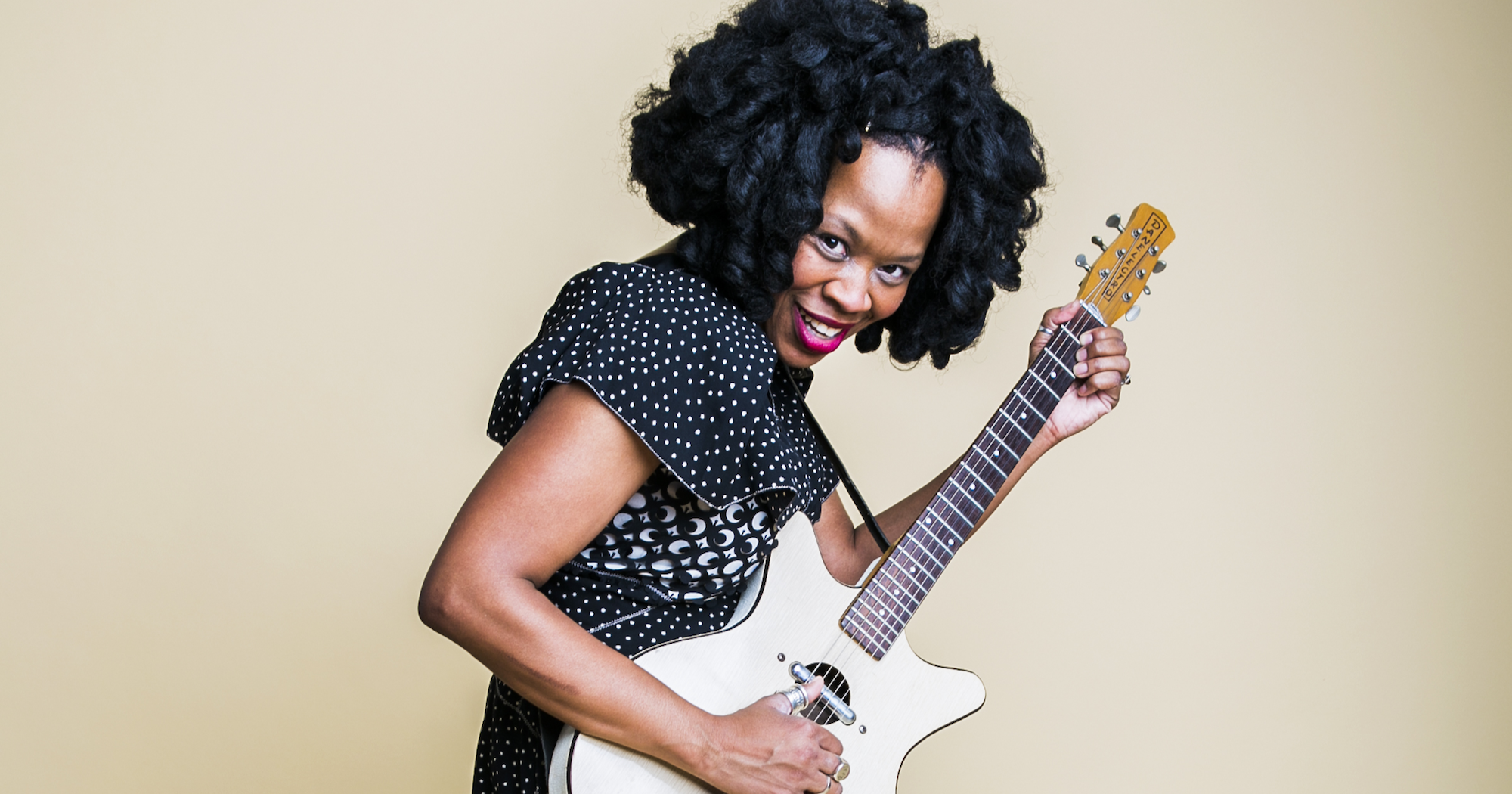
On February 6, artist, musician, songwriter, actor, and playwright Queen Esther released a very different sort of Civil War album, Blackbirding. Enabled by a grant from The National Parks Arts Foundation, Queen Esther worked and lived in residence at Gettysburg National Military Park in Gettysburg, Pennsylvania, for a month in 2020. During that time, she communed with the land, the place, and the losses and griefs seeped into the blood-soaked soil, plumbing stories, myths, memory, and feelings to craft her 12-song reckoning with the Civil War. Original songs, songs from that time period, and fascinating covers combine into a work of roots music and theater, dramatization and storytelling interwoven with knowledge-bearing and memory-keeping.

Queen Esther being a Southern Black feminist multi-hyphenate creative is exactly why Blackbirding stands out among its peers in the curséd Civil War concept album space. There is no idealization or revisionism happening in Queen Esther’s songs. Instead, there’s a tangible humanity and an awe-inspiring alchemy of grief, loss, and crimes against humanity into beautiful, redemptive music.

Queen Esther first brought Blackbirding into the world as a piece of performance art with a staged reading in 2024. Even now, in its LP form, these songs lean forward, doing narrative work perceptible whether on stage or off, and coaxing listeners to abandon passive listening and – as all theater asks – inhabit a third, artistic, creative space together in our interaction with these compositions.

The central point of the album is made over and over again across the 12 tracks and throughout our lengthy and in-depth BGS conversation. “Blackbirding,” the 19th-century practice of kidnapping free Black folks and selling them into slavery or back into slavery, never really went away. The Civil War was not won. Reconstruction failed. Slavery itself was not abolished, but rebranded. As such, Blackbirding, whether from the perspective of its content or its genre aesthetics, isn’t a throwback or time capsule album. This is music made in the present, for the present, about the present, and it calls on all of us – again, in the present – to reckon with and consider how we each contribute to or act in defiance of the continuation of racial apartheid and imperialism in the United States.

Do not fear, though, because Queen Esther’s approach to such musicmaking is remarkably joyous, grounded, and compassionate. It’s clear she’s not only ready to engage in the conversations this music evokes, but that is exactly her purpose. And the ultimate culmination of her many talents. In this way, she yet again distinguishes herself from other such concept albums in Americana.

I’ve been a fan of yours for a few years, ever since we discovered your TED Talk. When I first watched it, it was so revelatory. It felt like you supplied vocabulary – and knowledge and expertise – that I wish I would’ve had my whole life to help describe the multi-ethnic origins of roots music and bluegrass and country. If all of this came from “Scotch-Irish tradition,” then why does bluegrass sound like bluegrass? Why does country sound like country? Why doesn’t it sound like Irish music or Scots music or music from the British Isles? It sounds different.

I just wanted to start by saying thank you for that talk – and thank you for all of the insight, feeling, and emotion that you bring to these intellectual topics that people tend to forget are about real humans, real experiences, and real music.

Queen Esther: Absolutely. I really appreciate you saying that. I think more often than not, Black people have these conversations amongst ourselves. We wait until the door is closed and then we talk. I think we should have more conversations with everyone in the room. As long as they’re willing to listen. That’s a tall order. Much more so than you would think.

I’m really happy about this album, especially because people are starting to have conversations around the songs, topics, and everything that I’m bringing up. The fact is that slavery has never ended. It was just modified. The Civil War has never ended. It just evolved. “Blackbirding” has never ended. It just got a lot more inclusive.

Those three things are standing in the way of America being America. There is the America that is on paper – the one that is in the brochure with the Statue of Liberty, the flag behind it, and mom, and apple pie, and all of this stuff. And none of it is true. It’s all a marketing ploy. The actual America that really exists, that’s the one that Black people have had to endure and survive for hundreds of years. That’s the America that turned its back on us.

You know as well as I do that there are so many Civil War albums in bluegrass, folk, string band music, and Americana. So many are built upon the revisionist history that you’re talking about. The manicured, sanitized “picket fence and 2.5 kids” version of the “American Dream.” So, normally when I get a pitch about an album like this, it just goes straight to my email archive. Knowing you and knowing your work – and especially the way that you bring theater and all of your multi-hyphenate titles into crafting and creating – I was so excited to have a chance to talk about approaching the Civil War and approaching Gettysburg as an inspiration for music.

Blackbirding is set in the present. You’re talking about how slavery never went away, how reconstruction failed, and how the Civil War was not won. You’re contextualizing this art in the present sonically, as well. Because, like you’re saying, the Civil War never ended, slavery never ended, blackbirding never ended. Can you talk a little bit about placing all of this discourse in the present and not just in period garb, as it were?

I have to say perspective is a powerful thing. As a Black woman, as a Southerner, as someone that’s two generations removed from slavery, as a creative, I never heard any of this told from a Black perspective. It was always “the lost cause”: “These Yankees came and they just attacked us from out of nowhere. We were living this beautiful life and they just ruined everything.” When nothing could be further from the truth.

They literally terrorized Black people. They tore us apart, they raped our children. They did all manner of evil constantly, under the guise of Christianity. And it was even uglier than anyone would dare to imagine. Which is why they’re struggling to hide Black history, to hide lost history, to make sure that it stays lost. To not have anyone like me turn over the rock to see what’s underneath.

At the same time, these songs from minstrelsy, these songs from not that long ago, they’re important songs. They should be rediscovered. The problem that I’ve always had is that once you have that technical prowess as a musician and once you plumb the depths with that music, no one was bringing that music forward into the present. Not unless they were … putting it in a historical context, and that’s important, but to bring it into the now [is just as important]. …

Having a sense of intellectual curiosity, it’s really important. It doesn’t matter that you’re not the smartest, but that you are curious intellectually and that you are brave enough to explore that curiosity is way more important. That’s really my bedrock. That’s where I’m coming from now.

I’m a generative performing artist. … We are the ones who generate our work and we perform that work. Some people don’t necessarily perform their work. They just write it or they create it and they’re looking for other people to do the work, to perform the work, so that they can get their work out there. Lots of songwriters like that. Lots of lyricists are like that. That’s beautiful. That’s great. …

The songs would come to me, they would just float up in my head. It’s like a patchwork quilt. You take all these different kinds of fabric and all these bits and pieces. But you’re making this mosaic that turns into this overall image that is bigger than whatever bits and pieces you brought to it in the first place.

Talking about that mosaic, it makes me think that of course we would end up at this point, with a project like this, with a conversation like this, and with a body of work that couldn’t have been made if you had tried to step outside of yourself or your own identity to make it.

Exactly. All of that fueled me. I was reaching out in different genres, not just musically, but in the world. I was doing a lot of alternative theater, I was doing cabaret. I was doing performance art, I was doing solo performance. I was doing storytelling. I’d get up on stage and I would do just about anything. That was a world in and of itself.

Now, after a certain point, when you’re a generative performing artist, you’re looking for grants so that you can develop the work in general. It takes seven to nine years to develop a musical. It takes five to seven years to develop a play. When you see someone go, “Oh yeah, my new play, it’s up.” They put in a heavy grind! That’s five years of rewrites and workshops and readings. Some theater taking them on with their theater company and developing that work until it was ready for a test audience, not even necessarily ready [to open]. It’s just a lot of hard work and a lot of heavy lifting. There are certain grants that make that possible, where you just have to go away and you have to write and create.

I found a grant that would let me do that with this album through the National Park Service. The National Parks Arts Foundation has grants to at least a dozen National Parks. You can go to the park, you can live on the park, and they will pay you.

This project is also a work of theater. What jumped out to me first and foremost in that regard is what you’re talking about – the residency, the grant, being on location. Bluegrass, roots music, country music, they all ask us to be in a place together, but not in the same way that theater does. Theater is very much created so the audience are not passive participants. It actively invites listeners and collaborators and bystanders into a space and into a place.

You are doing that with this body of work – and with your residency at Gettysburg. I thought that was one of the most fascinating things about this project. Using theater, with a capital T, to help do that work of transporting all of us to the battlefield, to Gettysburg, to the geographical place that you are evoking with these songs.

I’ve been doing theater ever since I could stand up straight. Think about the cavemen, just standing in front of their brethren and telling a story about what happened to them that day. If my grandmother were here right now and in on this conversation, she’d tell you that I was telling stories ever since I could talk. I would just make things up. She would be sitting there washing dishes and I would try to distract her by making up something wild or crazy or imaginative. I don’t know, I just gotta say something to make her drop that dishcloth or at least laugh or something. [Laughs]

What is fantastic realism? Fantastic realism is when you have ordinary circumstances and then something extraordinary just pops right in. … So the idea of theatricalizing whatever was happening around me as a little kid, [that’s fantastic realism]. If we were sitting here at a table talking, for example, and then an elephant came along and took the hat off your head – that kind of a thing. Just the outrageous Southern tall tale. Bombastic storytelling is always floating just beyond your reach, I think, as a Southerner. It’s just how we do.

And of course, like everything in the South, this is an African tradition. This is an oral tradition handed down from West Africa. West African traditions [are] something else that people have a really hard time saying out loud and acknowledging. It’s not that other cultures didn’t tell stories, but our influence as Africans, as enslaved Africans, of our African ancestors on the South and on America, is seismic. It’s time for people to make the shift however small, however great, and center that and acknowledge it. They can’t even acknowledge it. …

I’m going to tell you a story. I almost always start [performances] with, “You wanna hear a story? I got a story to tell you.” Sometimes I’ll sing it, sometimes I’ll say it with music happening around me or behind me. But this is a story that you’re gonna want to hear. And every single song on [Blackbirding] is wrapped up in a story. There’s a story that’s around it that’s historical. There’s a story that resonates into the now, and there’s a story that I bring to you as an audience when I’m performing the song itself.

I’m thinking about how there’s so much music made in these genre spaces that is also putting on a costume, or telling a story, or doing theater, but that often isn’t grounded in reality at all. It’s all construction. So where some people might interface with your art and think, “Oh, this is a musical, this is theater, this is going to be a play, this is going to be ‘make believe.’” It’s actually so much further from that.

Oh no, it’s reality!

Exactly. And to me, that’s the whole story here. The thing I wanted to talk about most about Blackbirding is the point that you made right at the top – and that you’ve made throughout this conversation. You’re not talking about something that was happening a while ago and isn’t happening today.

Look, the 13th Amendment said slavery’s over “except.” Except? That’s a gigantic loophole. Except for what? Except for incarceration. That means if you’re incarcerated, you’re a slave. What if someone said to you, “You’re fired except on Tuesdays”? Then I’m not fired. You have to come in on Tuesday for four hours. Other than that you’re fired. You don’t work here. How much sense does that make? No one would hear an employer say that and go, “Am I fired or not?” Am I free or not?

You are free. Except they had to make that exception. They had to. Why? Because when the Civil War ended, this country was in absolute shambles. And because Black people were the actual currency. There were 4 million of us and we were basically worth trillions in today’s money.

We went off and we started our own little hamlets and towns, and we started working for ourselves. Suddenly there was this massive tilt. Black people were the money and had all of these resources, energy, and power. And just by sheer force of will, we started building for ourselves, which is why they started tearing us down. Showing up to each and every single community and just murdering people, burning people [alive] in their homes. Coming up with all of these lies built on pseudoscience to justify all of the things that they did. …

But it never ended. Pulling Black people over on the road, out in the middle of nowhere for no reason whatsoever. Beating them up. Maiming them, murdering them in some instances. This has always been the way. This has always been the case.

I’m imagining you on site at Gettysburg. How do you take that sort of emotional devastation or the intrinsic triggering and challenging nature of these topics and turn them into something beautiful? Do you see them as beautiful to begin with? I’m trying to imagine how you take care of yourself emotionally and psychically as you’re doing this important work. Because I think there must be an emotional toll to it, but you clearly are built for it as well. This feels like your wheelhouse – and the way you talk about it and the comfortability you have in having these conversations.

Simple. I am not an atheist. I am not an agnostic. I believe in God. I believe in Jesus. I’m a Christian, and I know that God is with me. I feel God’s presence upon me. I feel God hovering over me, protecting me divinely. I feel that I’m walking in divine purpose and in divine order. I know that I am divinely protected, that the blood of Jesus covers me everywhere I go. …

There’s this point at which inspiration takes over. There’s a point at which you are no longer there, and inspiration is there instead. An actor prepares– the idea is that you have technique, right? Your technique is there whether you’re playing an instrument or singing or washing the dishes or driving the car.

Let’s say driving the car. I don’t know how to drive. So, every time I get behind the wheel and the car is moving, even if it’s moving slightly, I’m screaming like a banshee. I’m so excited. But when I get in a car [with my partner], he just does what he’s been doing. He doesn’t think about it. He adjusts the window here and he readjusts this here, he puts the key in, and he does all of these dozen or more motions. He just does it automatically.

That’s the idea. When you make art, when you’re on stage, when you’re performing, when you’re creating, there has to be something that takes over. Inspiration takes over. Once you’ve got the technique, set the technique, learning how to drive the car, what do you do? Something else takes over. And I’m telling you, that’s something else for me, personally, is not my ego. For me, that’s the Holy Spirit.

I remember when I got to the house [at Gettysburg], everything was explained to me, and they gave me the keys. I’m sitting there in the parlor, I’m arranging everything, and it’s still light outside. I thought, “You know what? Why not?” I took my camera and I walked to Devil’s Den. The first song that I wrote was “The Devil May Care (But Jesus Knows).” I came back and I wrote that down like I was writing someone a letter. It just poured right out of me.

I can’t even begin to explain the process. I wrote it down and I wrote down the chords. I shaped it around everything that I did and I thought, “This is a complete song.” What is that song about? It’s about Devil’s Den, the Valley of Death, which is what they called that area in between Devil’s Den and Little Round Top. These soldiers would climb into Devil’s Den, which is these hulking, gigantic rocks. There was this big snake that lived there. It was huge. They called it the devil. It was so huge, it was as big around in the middle as a grown man’s waist. There were children that liked to play around that rock, so the townspeople got up the courage and killed it.

They would climb inside of that perfect coverage for a sniper and they would shoot Yankee soldiers that they could [see] from Little Round Top and they would fall into the Valley of Death. That was a run, Plum Creek – a run is a creek – and it was so filled with blood they just called it a bloody run. From where the creek started, all the way past the house that I lived in, all the way through that valley of death, was just nothing but human blood.

To be a soldier caught in [Devil’s Den] meant that you could not be saved. Someone would have to come and get you if you were wounded. More often than not, those soldiers died, not because they were shot and they fell down and they died. They died because no one came to get them. They died because they were wounded and the wounds got infected and they just bled out or [succumbed].

That Valley of Death comes for you, not just at the end of your life. It comes for you at any given moment, at any crisis that you have. Over and over and over again.

Can you talk a little bit about how you approached genre on these songs? Because I really love that you didn’t make a “time capsule” record that’s trying to sound like it came from the 1800s. At the same time, you’re collapsing time musically and creatively so that you can draw on those textures and on those sort of old-timey elements to do that storytelling for you, sonically. How did the production process actually look or feel as you were putting this collection together?

I think that when you have a kid or when you give birth to a kid, you just let that kid be the kid. You’re not sitting there going, “I want this kid to be this,” or “I want this kid to be that.”

That’s a really good metaphor. Just let them be themselves.

And what you’re doing, really, is sitting back and waiting to see what that kid turns into. You have no idea how they got so great at math. This kid is a mathematician. You can’t balance your checkbook. This kid is just explosively running in this whole other direction that you can’t even fathom. You have no idea what your children will do, what they will become. And none of it really has anything to do with you.

It’s the same thing. These songs came to me and when they came to me, sometimes fully formed, I literally wrote down what I heard in my head. And that really is it. Each song is its own world. I just let the song be what it is, whatever it is. However it came to me, I just let it be what it is.

I consider myself to be a transcriber of the song. I’m sitting there. The song is in my head and I’m just writing it down as quickly as possible. I’m someone with a butterfly net chasing the butterfly through the jungle. I’m running after the butterfly and I’m hoping that it doesn’t get away. It’s fluttering. It’s right above my head. Sometimes I capture it, sometimes I don’t. My job as a producer is to make sure that song sounds exactly the way it did in my head.

Even the cover songs, the Olivia Newton John song, “Magic.” When Olivia Newton John is singing that, it’s one way. It’s interesting. But I’m a Black woman and I’m singing that about my ancestors, and my family, and all of us in community. It turns into a completely different song.

You have to believe that we’re magic. Nothing can stand in our way. You have to believe that because, ultimately really, Black people never thought we were supposed to survive any of this.
Toni Morrison says that in an infamous speech that she gave, we were not just supposed to survive any of it. …

When the song comes, it comes as it comes. I knew that I had the goods as a producer, because the song sounded in the room the way they did in my head. That’s the best feeling. But moreover, more than anything else, you have to develop your own aesthetic. You have to know what’s good, what’s not good, and why. You have to know your own mind. You have to know your own aesthetic. And you have to have the courage and the willpower to stand on it.


Photo Credit: Whitney Browne
The Grand Ole Opry Returned to Carnegie Hall

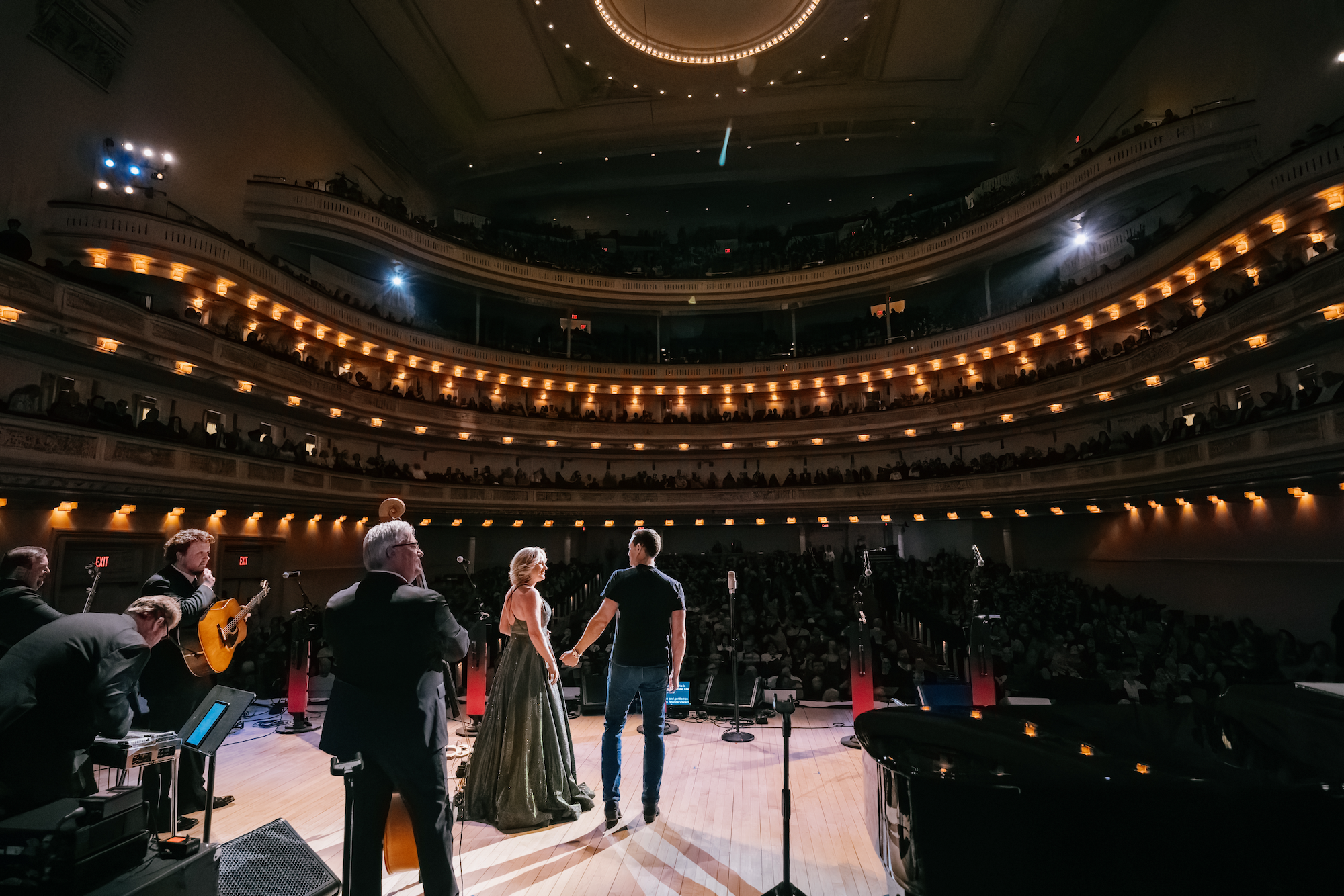
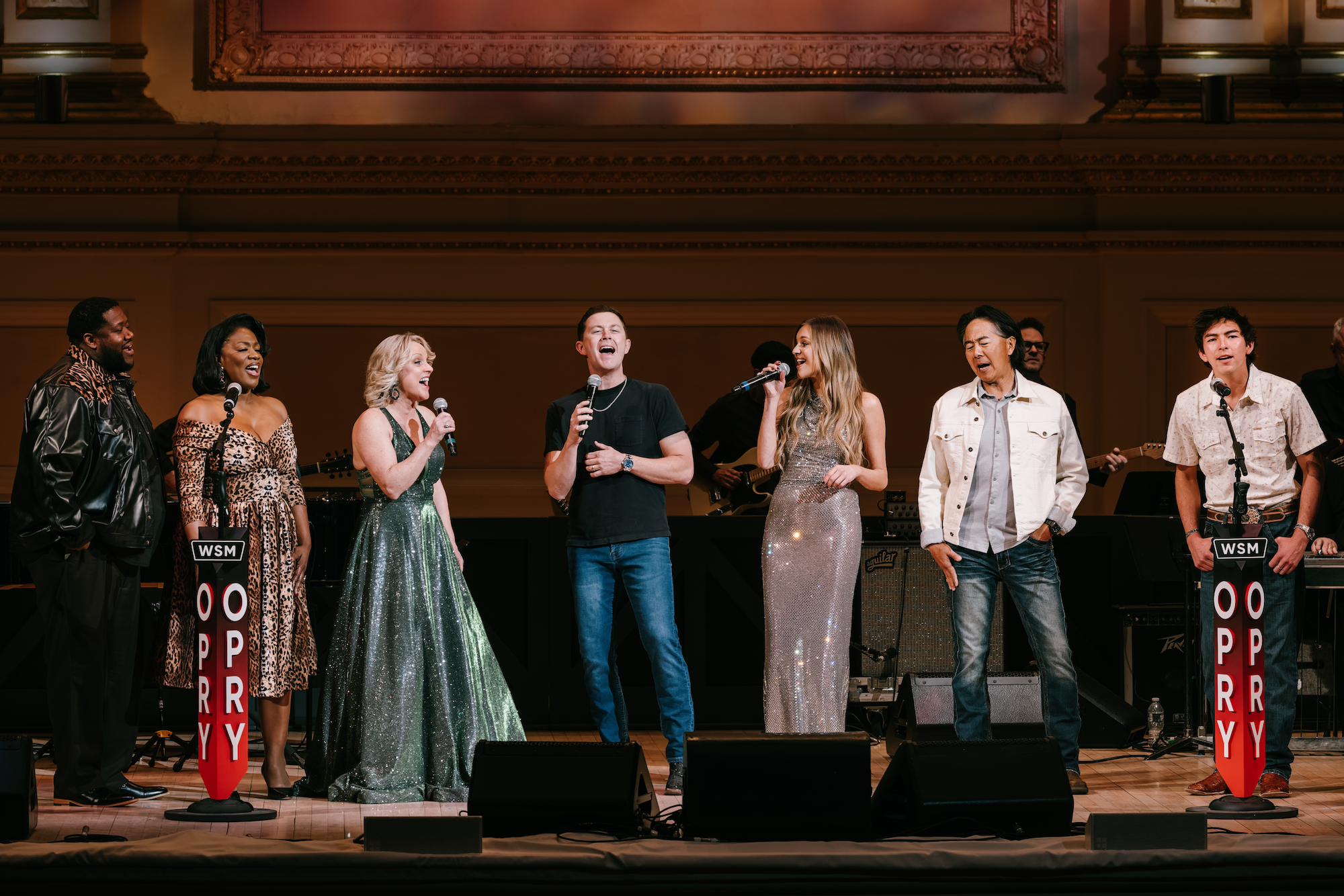
Bluegrass picking, soulful singing, and clever comedy complemented a night of contemporary country music as two of America’s longest-running institutions reunited in New York City on Friday, March 21, 2026 when the Grand Ole Opry returned to Carnegie Hall.

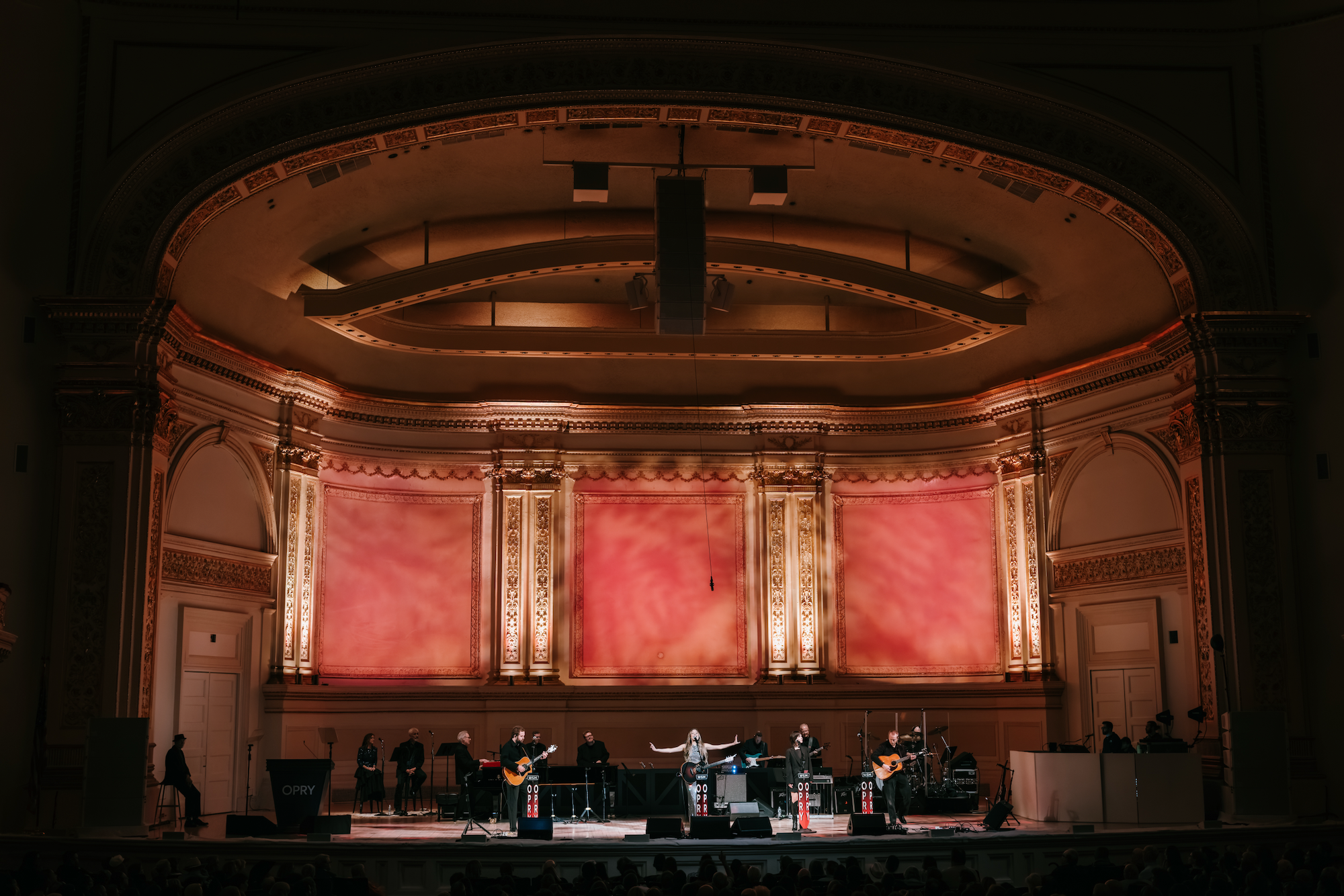
Amidst the elegant surroundings, the evening offered a prestigious Carnegie Hall debut for all six performers: Opry members Kelsea Ballerini, Henry Cho, Scotty McCreery and Rhonda Vincent, and special guests Wyatt Flores and The War and Treaty. Although there wasn’t a barn backdrop or a velvet curtain, the ivory walls were often lit up in red reminiscent of the Grand Ole Opry House in Nashville throughout the night.

Kelsea Ballerini performs with a gorgeous and iconic Carnegie Hall backdrop.

If you poke around long enough, there are hints of Carnegie Hall’s connection to country music – an autographed photo of Emmylou Harris in an upper tier, a souvenir program on display from Johnny Cash’s 1962 debut, and a collage of albums recorded at the venue, including the iconic one from Buck Owens & The Buckaroos in 1966. Of course, bluegrass fans also know that the Country Gentlemen and Flatt & Scruggs recorded landmark live albums from the fabled stage, too.

Scotty McCreery joins Rhonda Vincent & the Rage on stage at Carnegie Hall for “Blue Moon of Kentucky.”

Rhonda Vincent & The Rage carried on that bluegrass tradition by opening the show with a rendition of Bill Monroe’s “Blue Moon of Kentucky.” McCreery also stepped onstage to give an Elvis Presley-inspired performance of the classic song, which Monroe wrote. After some welcoming remarks from Opry host Charlie Mattos, Vincent resumed her energetic performance with “Kentucky Borderline,” a bluegrass cover of Dolly Parton’s “9 to 5,” and a pleasant sing-along version of John Denver’s “Take Me Home, Country Roads.” Keeping with bluegrass tradition, Vincent also introduced her beaming band members: Aaron McDaris on banjo, Adam Haynes on fiddle, Zack Arnold on guitar and vocals, and Mickey Harris on bass.

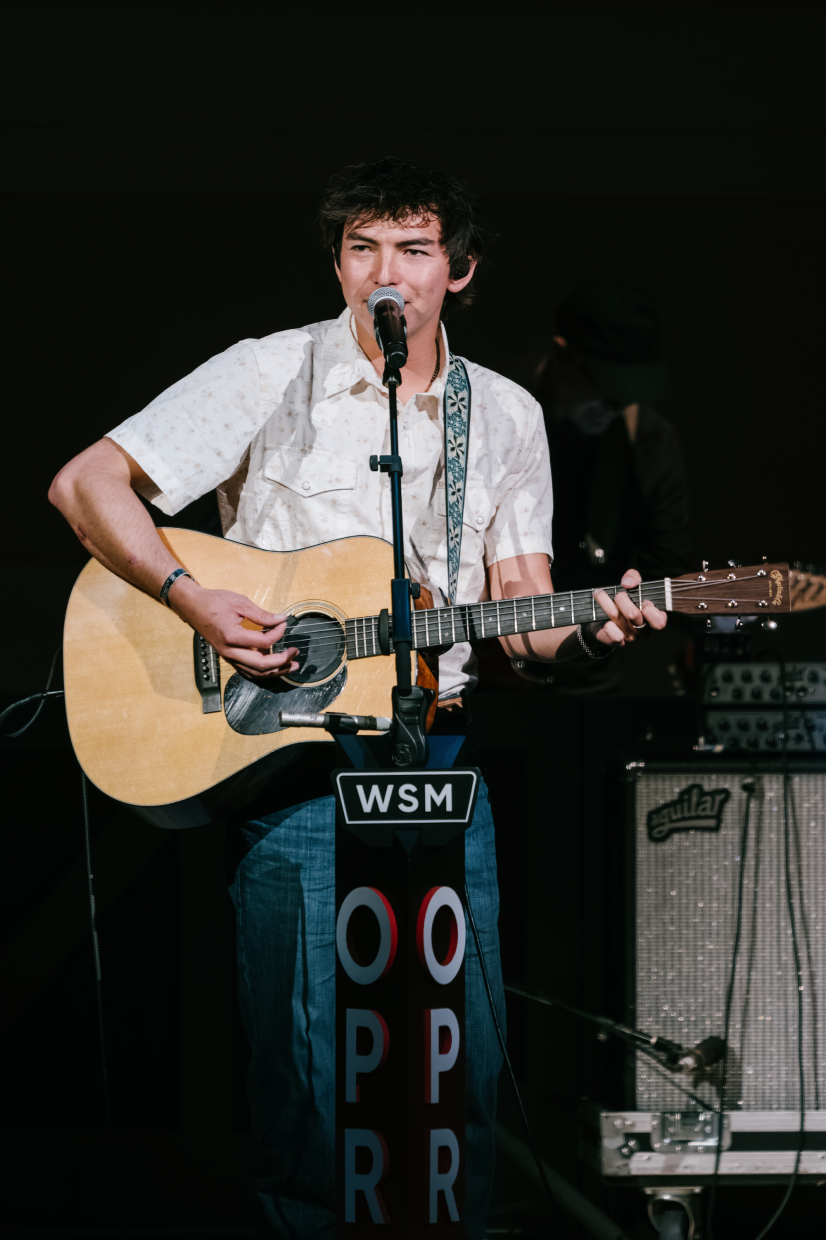
Wyatt Flores made his Carnegie Hall debut.

Wyatt Flores, a fast-rising, 24-year-old newcomer, admitted he was nervous to play Carnegie Hall since many of his favorite live albums were recorded there. However, the raspy-voiced Oklahoma native confidently delivered a well-received set of new songs, including “Runnin’ on E,” “Half the Man,” and “South Dakota.” Flores told the audience he was sharing this career achievement with his parents (on their first-ever trip to New York City) and his girlfriend (the inspiration for “South Dakota”).

The War and Treaty’s Michael and Tanya Trotter lifted up the crowd with “Five More Minutes,” then slowed things back down with an emotional interpretation of Otis Redding’s “Sittin’ on the Dock of the Bay.” Michael Trotter took a few moments to speak about the duo’s musical influences and the artists who inspired them, including Ray Charles, Rissi Palmer, and John Prine. They concluded the first half of the show with strong performances of “Yesterday’s Burn” and “You Can’t Hurt Me Anymore.”

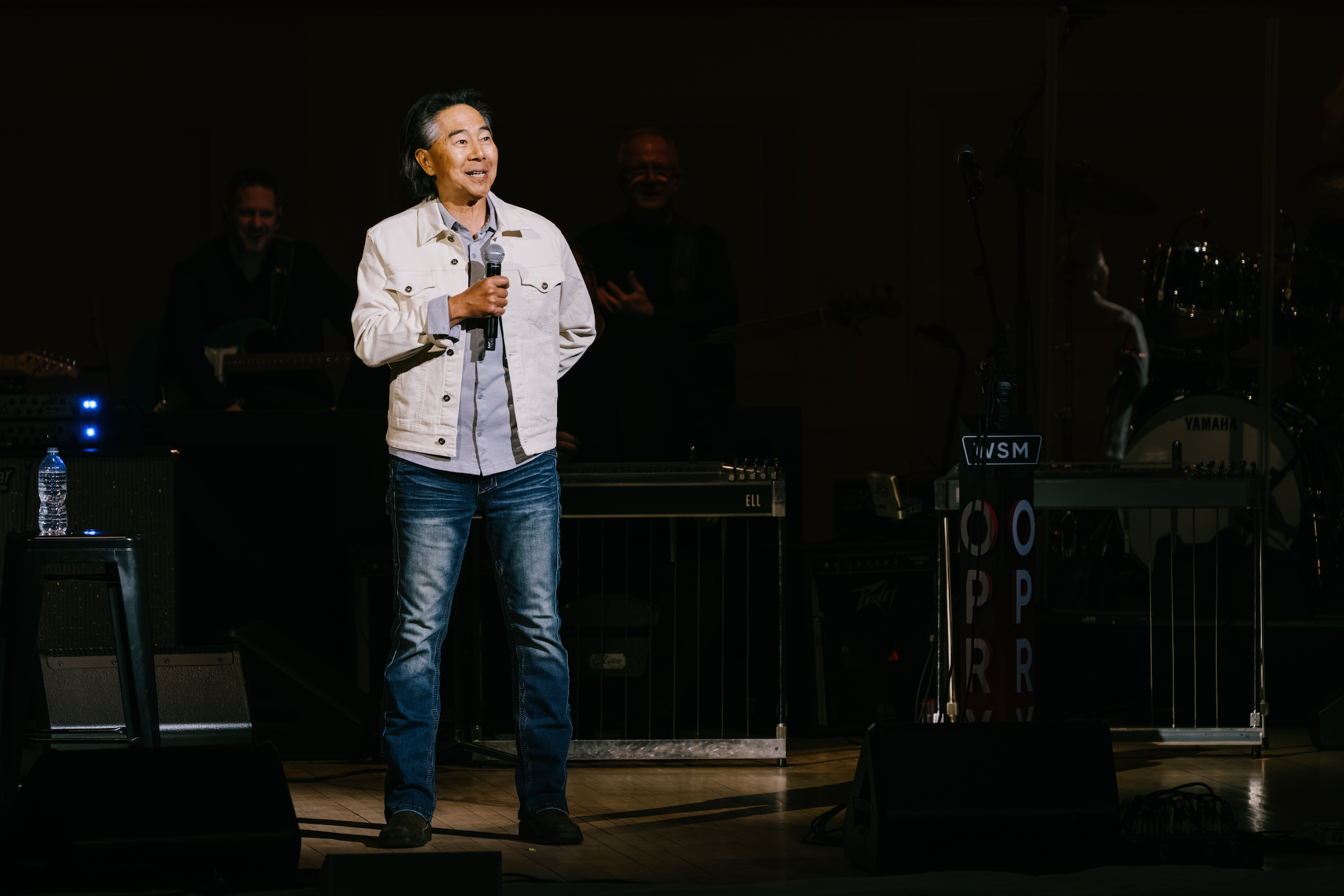
Grand Ole Opry member, comedian Henry Cho performs during the show.

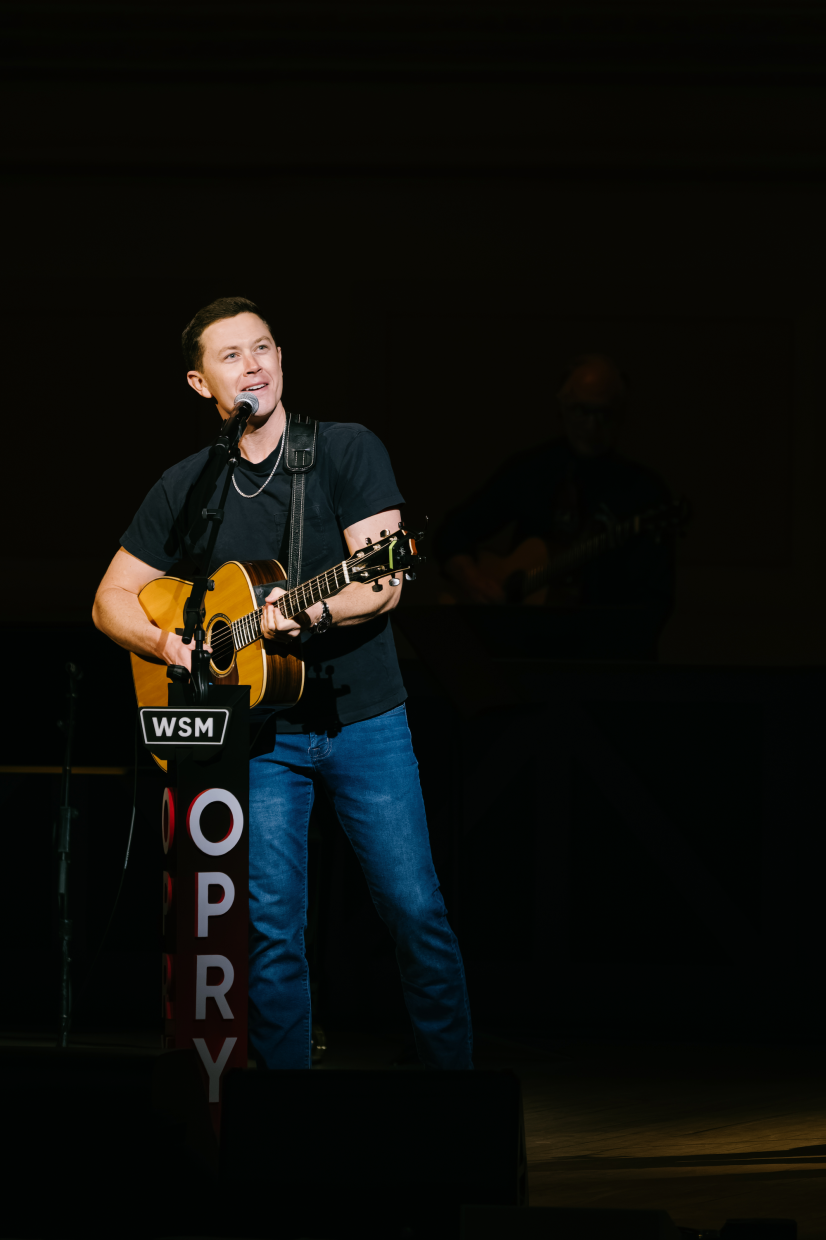
New York City is obviously a comedy town and Henry Cho rose to the occasion with a mix of signature quips and amusing stories about his wife, kids, and friends. Fresh off a European tour, the good-natured Scotty McCreery worked the stage as he sang some of his best-known radio hits, including “It Matters to Her,” “Damn Strait,” “Five More Minutes,” and “Bottle Rockets.” East Tennessee native Kelsea Ballerini closed the evening with conversational banter, an announcement that she’s now living in New York City, and a country-tinged selection of fan favorites, such as “Baggage,” “I Sit in Parks,” and “If You Go Down (I’m Goin’ Down Too).”

‘American Idol’ winner and Grand Ole Opry member Scotty McCreery delighted the NYC audience.

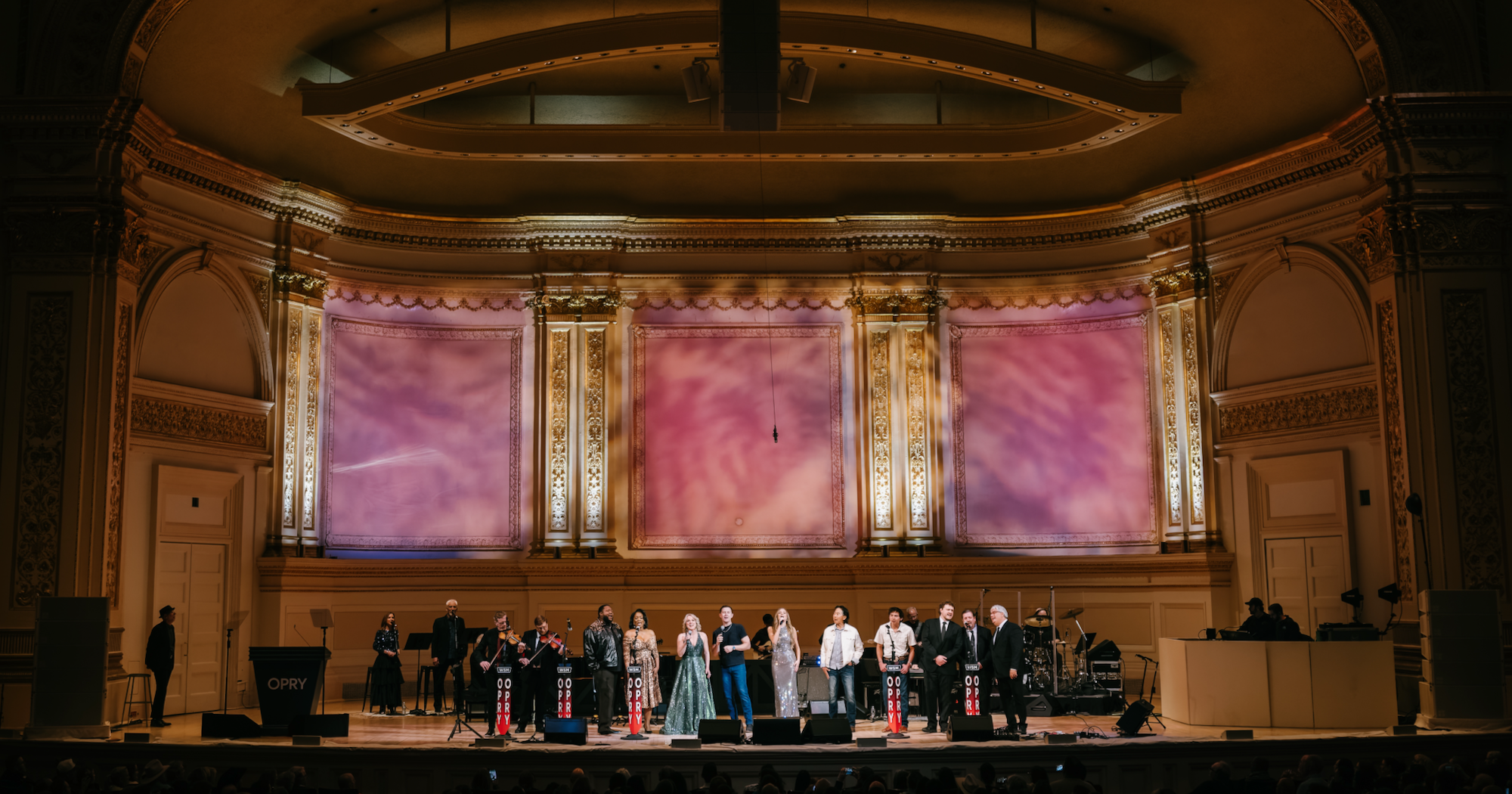
Among the night’s performers, Ballerini has surprisingly been an Opry member the longest. Prior to joining the roster in 2019, she would often sing a country classic during her guest appearances. At Carnegie Hall, she revived “Make the World Go Away,” which she learned from Martina McBride’s 1995 album of country classics, Timeless. She also shared her belief that country music is for everyone, a fitting comment on a night that explored the breadth of the genre. Many of the Opry’s special nights conclude with an all-sing finale of “Will the Circle Be Unbroken,” and this performance was no exception.

The star-studded cast of the Grand Ole Opry at Carnegie Hall sing “Will the Circle Be Unbroken” together to conclude the evening.

During his hosting duties, Mattos mentioned that Carnegie Hall opened in 1891, just one year before the Ryman Auditorium in Nashville, the Opry’s former (and still occasional) home. Yet this is only the show’s fourth time at Carnegie Hall, following visits in 1947, 1961, and 2005. The fortuitous timing for this event is part of Carnegie Hall’s United in Sound: America at 250 series and coincides with the Opry’s 100th year. (The world’s longest-running radio reached that milestone on November 28, 2025.) With country now reaching more listeners than ever before, here’s hoping for a New York City encore as the Opry’s new century begins.


All photos shot by Fadi Khelr, courtesy of the Grand Ole Opry. Lead Image: The entire cast of the evening return to the Carnegie Hall Stage to perform “Will the Circle Be Unbroken” together.

Welcome to Meels’ Critter Country

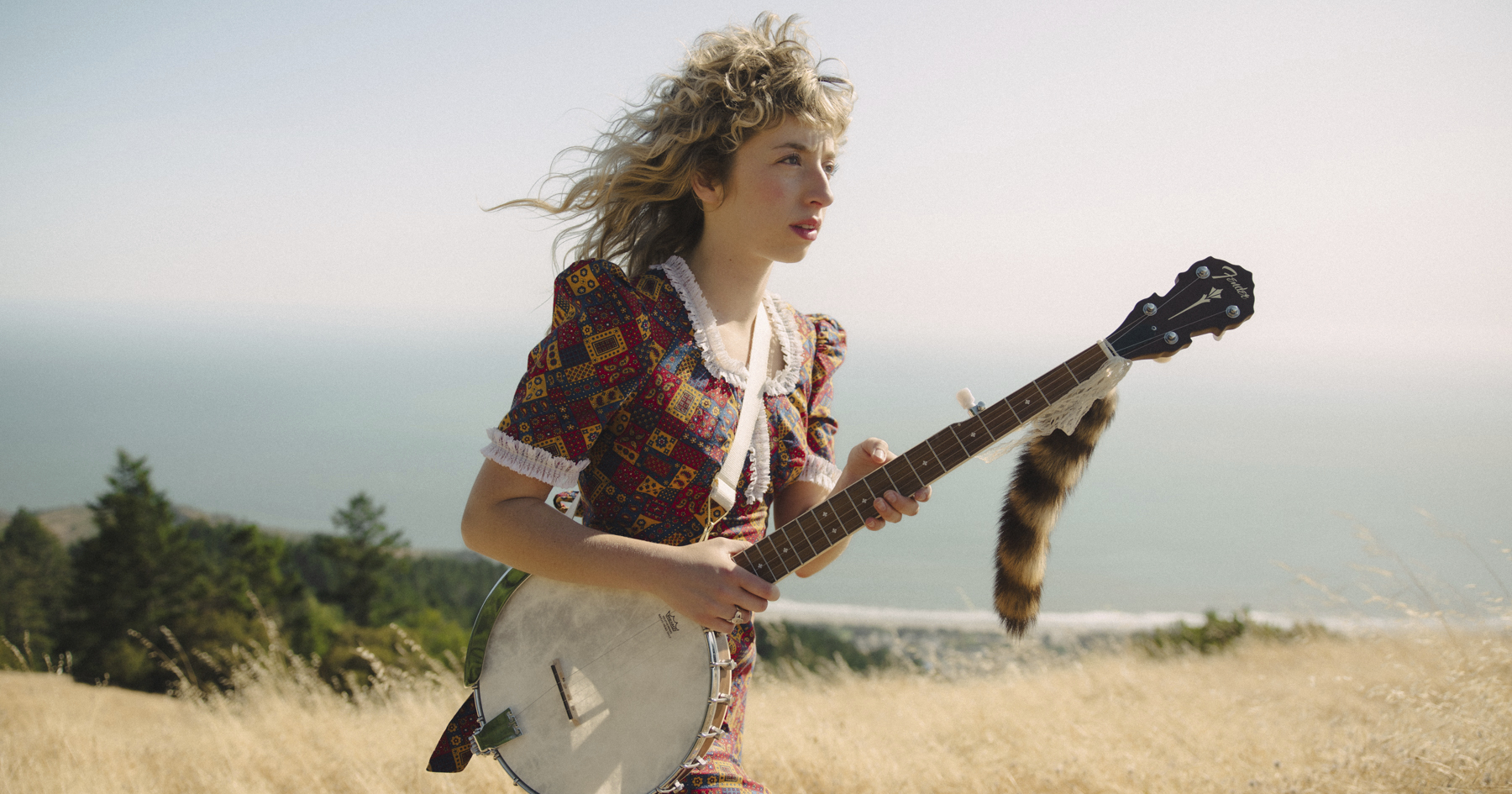
There are plenty of country subgenres out there, but quickly rising up-and-comer Meels has carved out a unique new niche. The California-born singer-songwriter calls her sound “critter country,” a fitting term for her playful but grounded brand of country-leaning roots music, which takes cues from folk of the ‘60s and ‘70s, traditional bluegrass, and classic country a la Loretta Lynn or Willie Nelson.

On her recently released new project, Across the Raccoon Strait, Meels takes listeners on a colorful, far-reaching tour of critter country and in the process announces herself as a fresh, genuinely exciting new voice in the broader roots music ecosystem.

Folks are taking notice – Meels is one of the first handful of artists signed to the newly rebirthed Lost Highway Records, with a legacy of artists like Lucinda Williams, Lyle Lovett, and Johnny Cash, as well as another left-of-center singer-songwriter, Kacey Musgraves, who was announced as the first official signee when the label relaunched last year. Meels has shared stages with artists like Molly Tuttle and Old Crow Medicine Show, and will appear with Margo Price, Carter Faith, and Nitty Gritty Dirt Band this spring.

Below, BGS catches up with Meels about songwriting, “critter country” and signing to Lost Highway.

In the lead-up to releasing Across the Raccoon Strait you shared that this batch of music feels truest, holistically, to who you are as an artist. Can you elaborate on that? What do you think enabled you to express yourself so fully?

Meels: As a writer and a producer and a songwriter and a singer, I really trust my gut and just follow the wave. With these songs, it was just me doing that. A few summers ago, before I made the project, I dove deep into the country classics – like Loretta Lynn and Marty Robbins and Dolly Parton. I got super inspired, the floodgates opened, and I just started writing like crazy. I grew up on a lot of ‘60s and ‘70s folk and my uncle is actually a bluegrass musician. He gigged around town where he lives in upstate New York. So I was already introduced to that world, but I took a deep dive and felt really inspired. The project just kind of poured out of me.

Would it be fair to say you found some unexpected connection points or overlap in those genres – the bluegrass and folk you grew up with, then the classic country you dove into?

Oh, totally. I also was trying out my own take on all of these genres and, again, trusting my gut with production and with the songwriting, to find a space within the genres that felt right for me as an artist.

You describe your music as “critter country,” which I just love. And that seems to encompass more than just your sound, as you’ve developed this really strong visual aesthetic in your videos and artwork, too. How did the concept “critter country” first come to you?

That came naturally, too. I grew up surrounded by a ton of critters in the woods in Northern California and found myself using animals as metaphors for my life. I went to NYU for music, and I took a branding class. I remember all of my peers were coming up with all these cool names for their genre. The teacher was like, “Oh, come up with a name specific to your genre and who you are as an artist.” I was still figuring out who I was as an artist in college and when I was looking through my lyrics and finding all of these “critter” similarities, I was like, “You know what? Critter country, that has such a nice ring to it.”

Take me back to the early days of making Across the Raccoon Strait. Was there a moment or idea that kicked off the creative process for you?

I think it was probably “Out West.” That track, in itself, encompasses the whole idea of the EP. I wrote it in New York when I was still living there and I’d just decided that I was moving back to California, back to my roots. I was just so excited about the idea of moving back out to the West Coast that the song came ripping out of me in my New York apartment. So that was a catalyst for me. I wrote most of these songs – that are about California and about home, actually – in New York when I was in a state of longing for home.

Did having that physical distance from your California home, and maybe the benefit of hindsight, help you write those songs?

I think so. My whole life, I have felt the most creative when I’m in California. New York is very overstimulating and there’s a lot going on all the time. I feel like, when I was living there, I was very much just absorbing everything that I could, but I wasn’t really writing so much until I was like, “Yeah, I’m gonna move back.” Then all of the sudden, I just started writing like crazy.

Something that stands out in your songwriting is how freely you use humor in your lyrics. You tackle some tough subjects, but never shy away from playfulness and to me it makes the stories feel more realistic, because in real life our experiences are often mixed bags. Are you consciously trying to inject some lightheartedness into your writing or does it just happen that way for you?

I don’t know. I do find myself making little jokes in my songs all the time. For example, in “The Wizard” I’m writing about a heavier topic: my struggles with OCD for my whole life. But I’m writing about it in a way that I’m not trying to hide anything. I’m just trying to put it in a way that’s maybe a little more digestible, and a little silly and a little funny, to help myself work through it a little more. And maybe to make it more digestible for my audience, too. Maybe I use humor as a way to cope.

“The Wizard” really does nail that balance of sharing something difficult and vulnerable while giving a little wink and nod to the listener.

I love a wink and a nod.

Speaking of that song, when you do get into vulnerable territory in your writing, do you ever feel fear or hesitation? And if you do, how do you engage with those voices?

To be honest, I feel like when I’m songwriting I’m at my most fearless. Since I was young, it’s been my way to put it all out on the table and not be afraid. I think me writing in these little critter metaphors, or using humor – maybe that’s my fear talking, I don’t know – but when I’m writing I just want to lay it all out on the table. It’s my one true release, so I try to do it without fear.

It sounds like you had a fantastic group of collaborators working with you in the studio. What was your time together like?

It was so wonderful. We recorded at a studio in Oakland called Tiny Telephone [owned by John Vanderslice]. They actually had old telephones that worked all over the studio. And they had everything you could want and more to play with and to get creative with. The space itself was incredible. We had an incredible engineer named Danielle, and she was also so important in the creative process, you know, running the vocal through this weird flanger and making moves that were so creative and so unique and so cool.

I also co-produced it with Peter [Groenwald] and Mark [Campbell], who made my first record with me, so that felt really comfortable and really safe. I knew nothing was off the table. I could bring up any idea, no matter how stupid I thought it was, and we would try it. Sometimes it worked, sometimes it didn’t. But we had such a good, natural flow in the studio. I brought a lot of friends, too, to play in the band, which was just really great.

You can hear the looseness and camaraderie in the music, in a way that I’d assume can’t be replicated without having close relationships with the players.

I’d always wanted to track a whole record live to tape. And we did that with Across the Raccoon Strait. We didn’t use any click [tracks]. It was just like, “Let’s get this next one tight, guys, let’s go.” We were all having a lot of fun with it.

When I’m in the studio, making music is such a collaborative thing. Even if it’s my song, every musician that I bring in is going to bring something unique. I really love to let them loose and let them rip. We can pull back where we want, but everybody in there plays an instrumental – no pun intended – role in making the music great.

This is also the first project you’ve done as one of the initial signees to the newly relaunched Lost Highway Records. How did you get hooked up with them and what does it mean to you to work with such an historic and impactful label?

This record has opened a lot of doors for me. I made it a little over a year ago and I was like, “I’m gonna quit my day job.” I was living with my grandma in Pasadena. She’s 86 and she’s so cool. “Marsha June” was actually written about her. So, I was basically like, “I’m just gonna give this thing a go.”

I sent this record around to literally anybody that would listen to it. I would send it to venues, because I’d just moved to LA. I was like, “Hey, I haven’t played a lot of LA gigs. Here’s my new record. You want to book me?” I was just kind of fearless about that, too. Some artists are so precious with the new stuff and don’t want to send it around. But I was sending these songs around before they were even mastered.

Eventually, I started working with a manager, I started working with an agent, and then I got a lawyer and did the whole thing. I talked to a lot of great labels, but when I met with Lost Highway I knew that it was the right direction. I’m so, so happy that I’m working with them. It really does feel like a family. It’s such a close-knit team and everybody really cares. … So many of my favorite artists have put music out through Lost Highway. Its legacy just runs so deep. I’m the hugest Johnny Cash fan in the world – and a Willie Nelson fan, and Lucinda Williams. It’s kind of absurd to me that my name could be looped in with all of those other names.


Photo Credit: Jim Hughes

Michael Daves Reconstructs R.E.M. Bluegrass Style

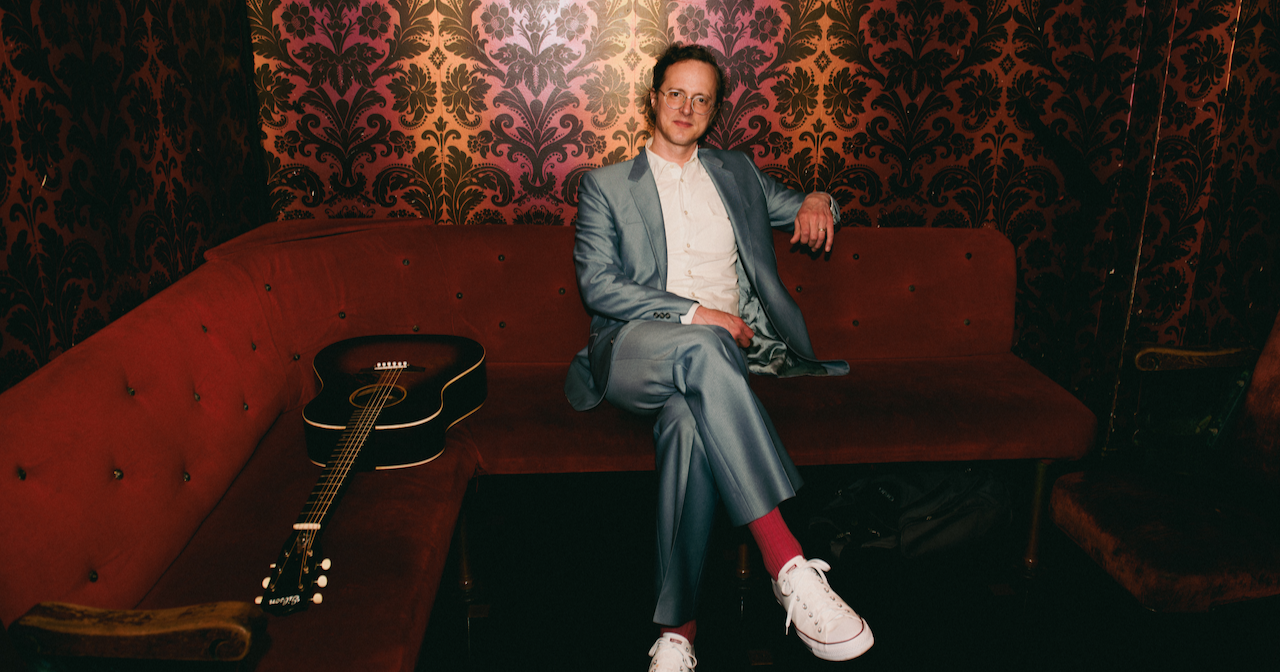
Although he lives in New York now, Michael Daves’ Southern roots permeate his music. That characteristic goes further than ever before on the newly released Fables, a six-song EP that reconstructs songs from fellow Georgia band R.E.M.’s 1985 album Fables of the Reconstruction.

In celebration of the record’s 40-year anniversary, Daves enlisted his longtime quartet bandmates – fiddler Alex Hargreaves (Billy Strings), mandolinist Jacob Jolliff (Béla Fleck, Yonder Mountain String Band) and Erik Alvar (Nefesh Mountain, Billy Strings) – and others to reinvent songs like “Green Grow The Rushes,” “Wendell Gee,” and of course, “Driver 8.” Together, they turn each track on its head, fully leaning into their bluegrass prowess while continuing to hold each song and their original formats in high regard. It’s something that Daves has plenty of experience with, having released the dual acoustic and electric bluegrass covers compilation Orchids and Violence in 2016 and Early Morning Sun – an EP of bluegrass and country standards from Ola Belle Reed, Dolly Parton and others – in August 2025.

“It was really important for me to try to make something that would stand on its own, even if people didn’t have any connection with R.E.M. or don’t even like them,” explains Daves. “I tried to make something that just works by its own logic as much as it’s paying homage to the original.”

During a Zoom call with BGS on release day in December, Daves spoke about his motivation for doing this cover EP, how he decided which songs to include on it, the plans for his label Wild Geranium Records, and more.

What motivated you to not only make an EP of R.E.M. covers, but to do it with songs from Fables of the Reconstruction?

Michael Daves: It’s an album I grew up with. R.E.M. was one of my first musical obsessions. I first discovered them in the late ‘80s at summer camp in Toccoa, Georgia, not too far from Athens where R.E.M. was from. All my camp counselors were [University of Georgia] kids, so I fully downloaded their musical tastes, which fortunately were pretty good.

As far as taking on the Fables thing now, there were a couple inspirations. For one, it’s the 40th anniversary of that record and it’s one that I don’t feel like a lot of younger people have heard or appreciated. People seem to know more of R.E.M.’s pop stuff from the ‘90s and beyond, but that ‘80s stuff was so good and weird. I also have this quartet I’ve led since about 2019 with Alex Hargreaves, Jacob Jolliff, and Erik Alvar in New York. They’re all incredible musicians who are very well versed in traditional bluegrass but also very adept at adapting music from outside the fold. We’d done some other projects over the years – like we did a whole mini set of Jimmy Webb songs one time including “MacArthur Park,” “Wichita Lineman,” and “Galveston” – and they learned that stuff in one rehearsal and just rendered it so beautifully. It made me realize that this is a quartet that really can handle a challenge.

The Fables idea came up because of the anniversary, but also because in August I had done a tribute along with Peter Rowan to the 1973 Muleskinner record that he was a part of. Initially he united with Bill Keith, Clarence White, David Grisman, Richard Greene, and Stuart Schulman to share a TV show with Bill Monroe, but Monroe never showed up. His bus broke down, so they ended up having the whole show to themselves and wound up getting an album deal out of it. Then they made this record that didn’t go anywhere because Clarence White died before it came out.

I taught a class about Clarence’s guitar playing on that record and through that became inspired to do a tribute to it with Peter at Vermont’s Green Mountain Bluegrass & Roots Festival this past August. When studying that Muleskinner record I discovered it had the same producer as R.E.M.’s Fables, Joe Boyd, who’s also worked with everyone from Nick Drake to Fairport Convention and Pink Floyd. That strange coincidence led to a Fables tribute show, which is then where the idea for this EP really came to life.

How’d you go about dwindling the original Fables of the Reconstruction down to the six tracks that are on this EP?

It was an interesting process choosing which songs to do. It was a combination of practical considerations, because when the quartet and I worked up this music for that one-off show in Brooklyn I initially picked songs that I thought were achievable on our tight constraints and would translate well to a bluegrass ensemble. There were definitely other songs on the original record that would have worked, but I’m feeling good about the song choices we made because the original record is sort of sprawling with a lot of digressions. There’s a lot of dreamer logic and a Faulknerian non-linearity in the writing, so to pare that down into what I think works as a distillation of the original recording that probably is more of an interesting statement on the original than if I just recorded the whole thing, you know. As my wife put it, we took it from a sprawling Faulknerian epic to more of a Flannery O’Connor gut punch.

Do you have any specific favorites of the six songs making up this project?

As far as song selection, I kept the first and the last songs from the record in their normal position. The record opens with “Feeling Gravity’s Pull” and ends with “Wendell Gee” so I kept those because the beginning and end of the story just felt right.

There’s something about the song “Good Advices” that just always just gets me with its meditations on mortality. It’s classic R.E.M. in the sense that it can be hard to parse the lyrics because they’re based more in dream logic than confessional writing. However, they still carry a lot of emotional weight and a sense of meaning that’s oftentimes hidden. For some reason, that song is the one that just always gets stuck in my head and gives me all the feels.

Part of this is due to the structure of the song, which is repetitive and drony. The bridge is basically four measures of the G chord and then it’s out, which I think is just brilliant how that works in the song. It was those repeated drone lines that Alex played over while the rest of the band had these repeated melody things going on. For me it’s the quintessential song off of the record. I don’t think it was a hit or anything at the time – that goes to “Driver 8” – which I almost didn’t include because it was the best known song off of that record.

The opening track, “Feeling Gravity’s Pull,” is one that was never my favorite track from the original record, but in rendering it I started liking it a lot more. I particularly like what Duncan [Wickel] brought to it on cello as well as the background vocals on it, especially at the end. That’s Jefferson Hamer from The Murphy Beds and Sean Cahill from The Next Great American Novelist. The parts they added took the song in this almost metal-like direction, which felt really good and different from the original, especially considering we’re all acoustic musicians. The whole experience with that song felt really cathartic. There’s an intensity that I always want out of bluegrass but don’t always hear, so I ended up being really happy with how that one came out.

This is the second release on your own label, Wild Geranium Records. What are your plans with that?

This is the second release on Wild Geranium. The first was my EP Early Morning Sun, which came out in August and was just a solo recording. The third one is coming out in March and is a full-length duo record with me and Jacob Jolliff where we’re paying tribute to Jim & Jesse, [who] are part of the first generation bluegrass legends. But most of what I do under Wild Geranium will be EPs and other shorter recordings.

Do you plan to record other folks on the label, or just your own projects?

It’s intended as a platform for various collaborations that I’ve had as well. All of the releases I’ve put out so far have zero original material, but some of that will be coming soon, too.

You’re also releasing Fables on cassette? What’s behind that decision?

The cassettes were part of the concept of Wild Geranium from the beginning. Cassettes first came back within the indie rock world almost 10 years ago, but to my knowledge isn’t something that’s been done much in the bluegrass world. I’ve had people joke with me and say, “Oh gosh, I’ve got to dust off my ‘78 Dodge Charger to play this!” [Laughs] In the age of streaming, I think having a physical item that is a little more affordable, easier to produce and keep in stock than vinyl is more important than ever.

The idea was to also include at least one song on each cassette release that’s not available digitally. On Fables that’s actually two bonus tracks – a duo version of “Green Grow The Rushes” with me and Jacob Jolliff and the other’s a live version of “Can’t Get There From Here,” which was from a full-band show back in August where we debuted the material. I just wanted to offer something unique and special to the listeners who care. If you get the cassette, you’re gonna have something that no one else is gonna have. It’s not bouncing around the internet, you have to have the physical thing. From a production standpoint, it’s an opportunity to tell a slightly different story than the digital release.

Do you have any other cover EP/album ideas up your sleeves?

Aside from the Jim & Jesse project, I also have some original material on the back burner. It’s fully demoed and is all music connected to Ponce de Leon Avenue in Atlanta where I grew up. It includes some stuff that I’ve written and co-written along with songs by family members and friends from that area and era. I’ve been performing music from that project for quite some time now, but haven’t made the record yet. So that’s something I’m hoping to make happen that would be another full-length, full band record.

What has bringing this R.E.M. covers EP to life taught you about yourself?

This R.E.M. stuff was among my first musical obsessions, so for years that’s just been baked into how I hear music in an uncritical way. So to actually get in there and break down what went into this record and think about how to render it in this other context was really interesting for me and fun to make a statement with that’s not based in nostalgia.

I also enjoyed getting to explore my feelings about how I want string band music to work. On my last full-length record Orchids and Violence I utilized a double-record concept where each disc had the same track list, but the first one was a very straightforward bluegrass record and the second disc is like all electric, experimental rock renderings of the thing. Fables was a little bit more like uniting both sides of Orchids and Violence into a string band expression, which is something I’d be open to doing more of in the future.


Photo Credit: Manish Gosalia

GC 5+5: Jenna Torres

Artist: Jenna Torres
Hometown: New York, New York
Latest Album: Firebird (released December 5, 2025)
Personal Nicknames (or rejected band names): I have been known to answer to JT, Jen, JenJen, Sugar, Honey, and Baby, but my favorite by far is Mom.

If you had to write a mission statement for your career, what would it be?

Living a song-driven life has filled me with a sense of purpose over and over again. It has always been more than a career to me. There is something about being a singer-songwriter that has always felt like a mission. If I have to break it down to a single statement, I would say my mission is to “touch as many hearts as I can.”

What has been the best advice you’ve received in your career so far?

There are a few, but these are my top two. Be you! Be true to your own voice. The world is filled with great artists, but there is only one you. So follow your heartbeat, dance to your own drum, and try not to give too much of a shit about what other people think, because it can get in the way of finding you.

The second piece of advice I got from my A&R person when I signed a fancy deal some time ago. She said, “Celebrate when things are good, because the world of music is full of ups and downs and if you don’t celebrate when things are going well, you will wake up and whatever was worth celebrating will be gone.” Being somewhat superstitious, I missed out on quite a few moments when I could have been having fun. She was right – when things are going well, raise a glass of gratitude and be sure to enjoy the moment!

Which elements of nature do you spend the most time with and how do they impact your work?

I am into human nature. I like to say people are my trees. Growing up in NYC, people have always been my inspiration. My songs are born out of the endless fascination with how we handle what life gives us. I probably get more from riding the subway than a walk in the woods, although there is magic in the woods and the waves. I love to walk down a city street – it inspires me to tell stories.

What’s one question you wish interviewers would stop asking you?

“What or who is your favorite ‘fill in the blank’?” I am kind of an equal opportunity appreciator, if that is a phrase. I do have old favorites, but I seem to have new favorites every day. I am always open to loving something I have never seen, heard, or done before. So yeah – I can’t pick a favorite!

If you didn’t work in music, what would you do instead?

I would be a fortune teller. I love the unseen world. I tend to dig the deep end of the pool, so some helping profession that involves exploring healing from within – which is not that much of a departure from songwriting when you think about it.


Photo Credit: Jon Karr

Hilary Hawke is a Banjoist Who Does It All

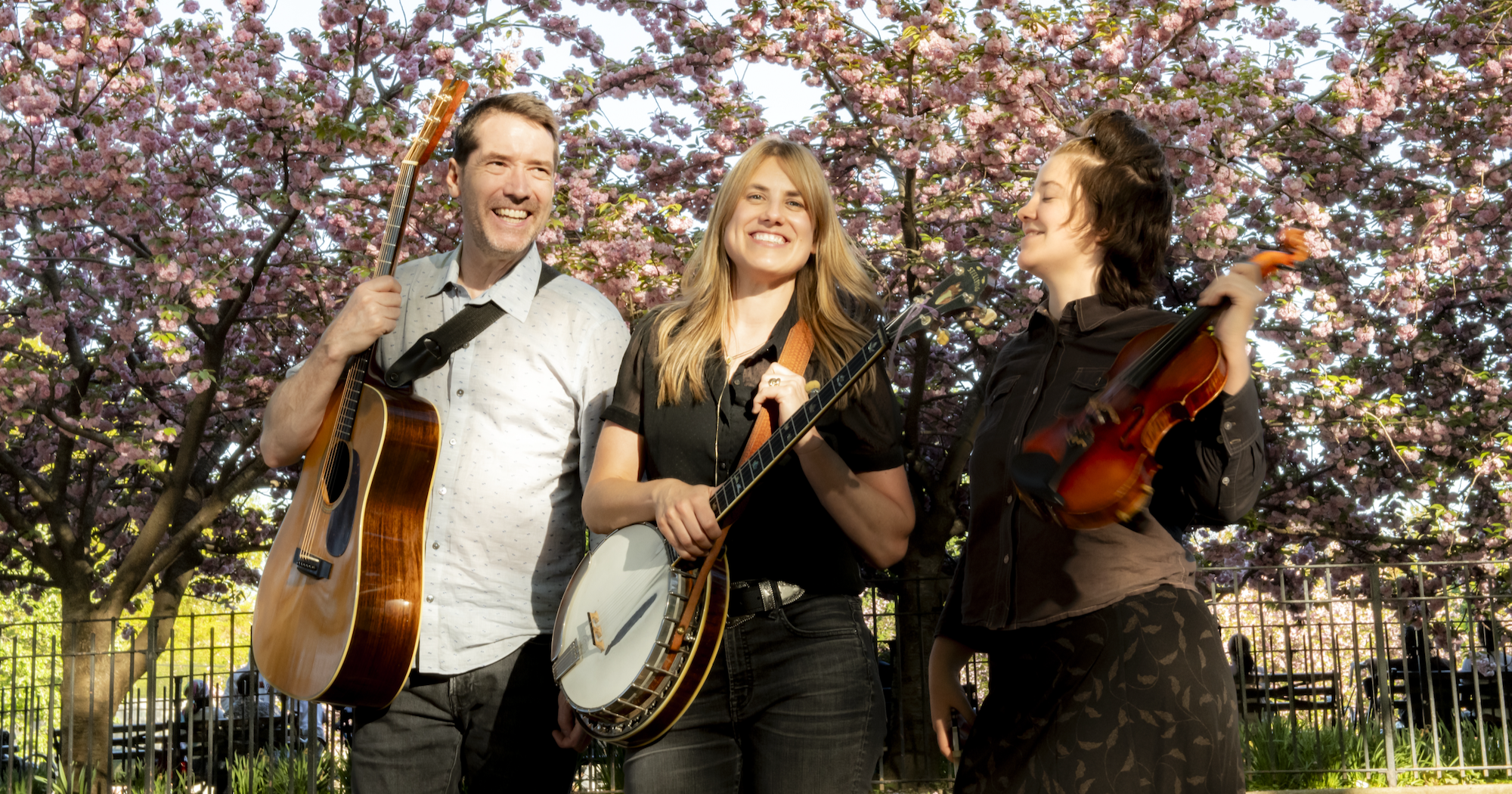
Banjoist, songwriter, and podcaster Hilary Hawke has had a meandering journey with music, starting with guitar and clarinet before finding her musical home in the banjo and “becoming obsessed with it” during her late teens. Inspired by the storied folk tradition of upstate New York, Hawke now makes her home in New York City, where she leads her own bluegrass band and plays for various other groups as part of a close-knit roots music community.

New York City is uniquely ripe with gigs in theater and Hawke has found herself playing on Broadway for musicals such as Oklahoma! and Bright Star and composing music for puppet shows, among many other diverse projects. She has also started her own podcast, Banjo Chat, where she speaks about the banjo and banjo music with folks that love the instrument as much as she does.

BGS connected with Hilary Hawke to discuss the making of her new album, Lift Up This Old World, her time on Broadway, her new job teaching bluegrass at Columbia University, and more.

Can you tell me a bit about how you got started on the banjo?

Hilary Hawke: I actually went to school for classical music on clarinet and guitar, but I realized I didn’t know how I was going to get a job in music or what kind of job I wanted… composition? Teaching? Music therapy? I got to a point where I was like, “This all seems very serious and I’m not actually having much fun with music.”

During that time, I was writing songs on guitar and I just picked up a banjo for fun, to do something outside of school. I grew up in upstate New York and we have a lot of folk music and a lot of great banjo influences up here like Tony Trischka, Béla Fleck, Pete Seeger, the Gibson Brothers. And, honest to God, it was just the thing I started creating music on all the time. I started playing it nonstop. I ended up moving into New York City just on a whim. There were lots of opportunities to perform and I was able to take some lessons with Tony Trischka. New York is like– you just think you’re going to try it out and then suddenly 5 years have gone by.

Influences like the New Lost City Ramblers, Mike Seeger, Bruce Molsky, and Fred Cockerham seem to be threaded through your old-time and bluegrass style. Do you have a specific moment you can remember that sparked your love for these musicians?

I think that it’s always through popular culture that you get inspired to dive into the deeper stuff. Alison Krauss had a record called Too Late to Cry and I remember I heard the banjo on that and was like “What’s that sound?” It was Tony Trischka playing on her record. Similarly, I heard the banjo on the Dixie Chicks’ albums and wanted to know how it worked. Through those more popular bands, I got interested in banjo. And then I went to the festivals and I heard about the old guys. People would give me rides and we’d be listening to their CDs in the car. It was a lot of word of mouth like, “Oh you gotta hear Fred Cockerham and Tommy Jarrell!”

You started teaching banjo in Brooklyn at the Jalopy Theatre back in 2006. How has that community influenced your growth as a teacher and performer over the last 20 years?

I really cut my teeth at Jalopy. I was there for 10 years or so and I was able to develop a curriculum for teaching. I learned how to tear things apart and break them down, as far as playing the banjo. I gained the skills I’m now using to teach at Columbia University. I think Jalopy is a great breeding ground for performers, artists, and teachers to develop. It’s open-minded and exploratory.

Tell me about your new album, Lift Up This Old World. Where does it fall in the trajectory of your music-making?

This is the third album I’ve released under my own name. The first album I made was more of a singer-songwriter album; writing songs was really my entry point into folk music. Then I released an instrumental old-time album. This one combines songwriting and picking, but it is much more bluegrass-forward.

I noticed that you play both clawhammer and bluegrass-style banjo on the record. How do you relate to the two different styles and where do you feel more at home?

I started with fingerpicking and got into bluegrass first, but I just wanted to do it all. I wanted to be involved with a wide range of music. Sometimes a person would ask, “Do you want to come play with my old-time band?” And I had to say no because I couldn’t play that style. I quickly realized I didn’t like to say no! I wanted to be able to do it. So I started learning clawhammer from some Ken Perlman videos and taught myself. Now I feel like they take up an equal amount of space in my life and I pick the style based on the music.

With my original material, I approach the banjo with the kind of song I want to write in my mind, so if I want to write a honky-tonk song I might use fingerpicking, but if I want to do something with a shout chorus, for example, I’ll approach with clawhammer banjo. I listen to a lot of Tim O’Brien and I feel like he does that, too. Being able to play both styles, I have a little bit more of a tool kit for what I want to do.

Tell me about your approach to songwriting. There are a lot of songs about lost love and relationships on this album, some about relationships with people, but even your relationship with New York City. “NYC Waltz” is a track I particularly love. Is there a common theme that you see that brings these songs together?

I think this record is about overcoming struggles in confidence, specifically struggles in the music industry. I had the realization that you have to be your own cheerleader, you have to believe in yourself, and find that happiness in yourself. If you’re doing what you’re supposed to be doing, things are going to happen. Making this album was me having the belief that I could do this thing, overcoming fears and doubts in myself, striving, and coming out on the other side.

The way you recorded this album, it sounds live in a way that is rare for modern recordings. Can you tell me about how the record was made?

We did it live to save money. We started a year and half ago and I didn’t have the resources to do separate tracking, so we rehearsed it for a couple of days and then just went in and tried to nail it. We recorded pretty much the whole thing live with a full band in Williamsburg, one day with each of two fiddle players, Bobby Hawk and Camille Howes, at Waldon Studios in Williamsburg.

Ross Martin [who plays guitar on the album] and I have been playing together for two years as a duo and we have worked up some of these songs over that time. I felt like these album songs were a good representation of the music we have been making for a good while now. “Dreaming of You,” the last song on the record, is the only one that we arranged and tracked out separately; it has a very different feel than the rest of the album.

Yes, I noticed that! It’s a bit orchestral.

Yes, that was all arranged and written out by me. I produced this album myself and I think going forward, I would like to do more collaboration with visionaries and people I trust in the making of a record. I think I learned that it’s great to have another trusted set of ears for a project. It’s hard to step away and see things for yourself. I have a pretty clear vision about what I want things to sound like, but you also have to be gentle and kind to yourself. It’s hard to find that line.

You also have a podcast about the banjo called Banjo Chat. Can you tell me about how that got started and how you’re enjoying it?

It’s good! It started because I had a lot of questions for banjoists about the way they write songs, form solos, and think about music that I didn’t hear asked or answered on other podcasts. Also, I wanted to amplify the voices of people whose playing I loved who were female identifying, queer, gay, minorities, or just didn’t really fit into a bluegrass or old-time genre with their music.

So I started this podcast. I got some new software for editing and now I do the research, recording, editing, and mixing all by myself.

Before I let you go, I wanted to ask you about your time on Broadway. In 2016 you subbed on Broadway playing banjo for Bright Star – a show that brought bluegrass and old-time to the stage in a major way. Looking back, how did that highly choreographed experience change your approach to live shows?

Bright Star does have a huge regional presence. For me, that was my first Broadway subbing gig, subbing for Bennett Sullivan. Being in that environment made me realize that when you play live shows you need to get out of your own head, you can’t just be standing up there not giving any energy out to the audience. You have to have a lot of love to give out and to have your message clear in your head when you’re performing. Be happy to be there.

That’s what I learned from the theater. All these people bought tickets to see the show, they’re here to see a show and have a good time – not to see you in your head worrying about your performance.


Photo Credit: Aidan Grant

Madeline Combs contributed research and interview prep for this feature.

You Gotta Hear This: New Music From Katie Boeck, Ben Garnett, and More

You’ve reached the end of the week and, for your reward, we’ve collected a superlative handful of brand new videos, visualizers, and songs from roots music spheres.

Kicking us off, actor and indie-folk singer-songwriter Katie Boeck puts yearning “almost-love” in the spotlight with “Dust.” It’s a lovely, contemplative track that showcases that Boeck is equally at home in indie-tinged Americana as she is on a Broadway stage. Continuing in a similar context, with tender harmonies and fingerpicking as a sound bed Canadian folk duo Ocie Elliott also consider the messy, uncertain, shifting sands of loving someone and the circular nature of giving of yourself to another in that most intimate way.

Guitarist and composer Ben Garnett announced his upcoming sophomore album earlier this week. Kite’s Keep arrives in October, heralded here with the first single, “Look Again,” and a live performance video of the bustling, prismatic track featuring Brittany Haas on fiddle and Ethan Jodziewicz on bass. It demonstrates the consistently thoughtful and outside-the-box approach Garnett takes in crafting solo acoustic guitar music that bridges jazz, bluegrass, new acoustic, and more.

The Far West, Los Angeles-based country strutters, tapped Dave Alvin as a guest for their brand new track, “Hope I Don’t Bleed.” Dropping next week on August 22, you can get a sneak preview of the vibing, psychedelic LA-canyons-via-swampy-bottoms tune below. And, wrapping us up, singer-songwriter Jon LaDeau draws inspiration from a long New York City to Bristol, Tennessee, drive with “East Tennessee Wrecker.” He’s joined by Emily Jackson on the new single and performance video, which features a lovely stripped down version of the track, unadorned and shining.

Whatever your favorite flavor of country, folk, and roots music, there’s something for you to enjoy herein. You Gotta Hear This!

Katie Boeck, “Dust”

Artist: Katie Boeck
Hometown: San Luis Obispo, California
Song: “Dust”
Release Date: August 15, 2025

In Their Words: “‘Dust’ came out of the ache of almost-love – the kind where someone lingers near your heart, but never fully arrives. I was thinking of the tortoise and the hare, but as a metaphor for emotional pacing between two people. It began as an ultimatum, but ended as an acceptance of what is – without clinging to what could’ve been. I recorded it with Shane Leonard (Anna Tivel, Humbird), a producer I’ve long admired, at his studio in Eau Claire, Wisconsin, live to tape, which was my first experience in that setting. Creatively, it was also an exercise in letting something be what it was in that moment, without all the modern temptations and expectations of perfection.” – Katie Boeck

Track Credits:
Katie Boeck – Vocals, guitars, songwriter
Joe Westerlund – Drums
Pat Keen – Bass
Paul Brandt – Keys
Shane Leonard – Drums, producer, mixing, mastering

Video Credit: Bella Mazzola, Twin Lantern Productions


Ocie Elliott, “By The Way”

Artist: Ocie Elliott
Hometown: Victoria, British Columbia, Canada
Song: “By The Way”
Album: Bungalow
Release Date: August 15, 2025 (single); October 24, 2025 (album)
Label: Nettwerk Music Group

In Their Words: “‘By The Way’ is a song about the beautiful mess of loving someone – choosing love not just in spite of challenging dynamics, but because of them. It’s a recognition that no matter how fleeting and uncertain the unfolding of a story may be, love is the constant that it always circles back to. The song was written after many months away on tour and it was one of the first melodies and chord progressions that came to me once I delved back into writing. Sometimes songs take a while to come into being, but this was one of those tunes that arrived almost fully formed.” – Jon Middleton


The Far West, “Hope I Don’t Bleed”

Artist: The Far West
Hometown: Los Angeles, California
Song: “Hope I Don’t Bleed” featuring Dave Alvin
Album: Everything We Thought We Wanted
Release Date: August 22, 2025 (single); September 26, 2025 (album)
Label: Blackbird Record Label

In Their Words: “I’d been kicking this one around for years, but could never find the arrangement I wanted to suit the lyrics. Aaron, Robert, and Brian really found the swampy vibe I couldn’t seem to. The bass puts this right in the pocket it needed to be, and having Dave Alvin tear a white-hot solo through it made it complete.

“Dave played this solo though my amp, which is a special little factoid for me. The amp is now blessed. My little Fender only has a volume and tone knob, and I used to tape the volume knob down at shows because the vibration of the amp would cause it to turn itself up as it rattled. I took the tape off in the studio. Dave likes things loud and either the amp turned itself up to 10 or he did, either way each take got louder.

“You can hear the amp being pressed to its absolute limit. I know he’s blown some bigger amps on stage, I was surprised my little amp survived. A few months after he laid down this solo, I saw him at the Astro Diner and mentioned we were listening back and ‘we think the amp turned itself up on you during the session’… he just looked at me and said, ‘No it didn’t.’ Anyway, this one is simply about being afraid of experiencing pain at death.” – Lee Briante


Ben Garnett, “Look Again”

Artist: Ben Garnett
Hometown: Nashville, Tennessee
Song: “Look Again”
Album: Kite’s Keep
Release Date: August 12, 2025 (single); October 10, 2025 (album)
Label: Padiddle Records

In Their Words: “‘Look Again’ is the first track on my sophomore studio album, Kite’s Keep. The album title loosely refers to this idea of a child’s inner world – a dreamscape where each song represents a different vignette of imagination.

“With ‘Look Again,’ I wanted the music to feel prismatic. As if to suggest an imaginative universe emerging from an ordinary one. I was interested in exploring, in musical terms, the idea that perception is never fixed. Like the old saying goes, ‘You never step in the same river twice’ – one also never sees the same thing twice. Any time we return to anything, it’s always different, with all things constantly in motion.

“On top of this, I had the immense joy of working with two musicians I deeply adore: Brittany Haas on fiddle and Ethan Jodziewicz on bass. Their performances brought the track to life in ways I couldn’t have imagined.” – Ben Garnett

Track Credits:
Ben Garnett – Guitar
Brittany Haas – Fiddle
Ethan Jodziewicz – Bass

Video Credits: Tessa Cokkinias – Cinematography
Ben Garnett – Video


Jon LaDeau, “East Tennessee Wrecker”

Artist: Jon LaDeau
Hometown: Brooklyn, New York
Song: “East Tennessee Wrecker” featuring Emily Jackson
Album: Chateau LaDeau
Release Date: August 22, 2025
Label: Adhyâropa Records

In Their Words: “‘East Tennessee Wrecker’ is a song that has been picking at me for a long time. Several years ago, I was traveling with my band from Brooklyn, NY to Bristol, TN to play at the Bristol Rhythm and Roots Reunion. It’s about a 10-hour drive and for some reason our navigation system was counting down the hours until we arrived at East Tennessee Wrecker. We didn’t know what that was, but discovered upon arriving in the area that it was a towing service that I believe has since changed names. For some reason that title got imprinted in my mind and as time went by the structure of a song began to reveal itself.

“I recorded the guitars, bass, and drums in my studio in Brooklyn and when the music felt right, I was lucky to have Emily Jackson come by and sing a duet with me to tie it all together. We sang together live into one mic and that’s what you hear on the album. I brought this version of the song to David Butler and he fleshed out the arrangement by adding a second drum set, a drum machine, and some sparse keyboard stuff. I’m really happy with how this one came out and I feel lucky that D. James Goodwin was available to really bring the performances we captured to their full sonic potential by mixing and mastering.

“At the heart of the song it’s really just acoustic guitar and vocals, so I wanted to capture a stripped down version as well. Aaron Cassara filmed Emily and I singing it at The Scratcher here in the East Village, NYC. I’ve been very fortunate to work out a lot of my songs here over the years during their Sunday night music series so it felt natural to capture a version of the song in the same way you would hear it live in a room that means so much to me. This song seems to reinforce the feelings of connection I have to my community. I hope that it lifts up anyone who gives it a listen.” – Jon LaDeau


Photo Credit: Katie Boeck by New Norm Studios; Ben Garnett by Natia Cinco.

BGS 5+5: Cole Quest and the City Pickers

Artist: Cole Quest and the City Pickers
Hometown:
Brooklyn, New York
Latest Album:
Homegrown
Personal Nicknames (or rejected band names): CQCP, incorrectly called: Cole West and The City Slickers. Holding out for Cold Cuts and The City Pickles.

(Editor’s Note: Answers provided by Cole Quest.)

What’s your favorite memory from being on stage?

One of my favorite memories was from our inaugural tour to Germany in 2023. It was a 20+ day adventure and for many in the band it was their first time traveling internationally. I was beyond excited – and equally nervous – leading up to and during the trip, running through the millions of things that could go wrong along the way.

But as we traveled, we were met with packed venues, heartfelt appreciation, and as close to “fandom” as we’ve ever experienced. It was unforgettable.

We closed the tour with four days in the small German town of Rudolstadt, which had swelled to 90,000 visitors and over 20 stages for the Rudolstadt World Music Festival. We played several sets and gave a handful of radio interviews, each appearance building momentum as more fans and followers came out to support us. Our final performance was the big one. Right before we walked on, I gathered the band into a circle and shared a heartfelt moment to thank them for everything that led to us being there. With tear-filled eyes, I stepped on stage just as the emcee finished our introduction to a billowing applause and a spontaneous rendition of “Happy Birthday.” It was my birthday – and I couldn’t have imagined a better way to celebrate it.

What other art forms – literature, film, dance, painting, etc. – inform your music?

I often find it hard to tell where others’ art ends and mine begins. We’re all products of our surroundings and, in my case, those surroundings have always been steeped in art.

My parents had a modern dance company for many years. My grandmother was a founding member of the Martha Graham Dance Company. My grandfather was Woody Guthrie. My great-grandmother, Eliza Greenblatt, was a Yiddish poet. My late aunt Ann Cooper was a painter. The list goes on – and that’s just on my mother’s side.

In our house, many hours were spent discussing what creative expression looks like and the different forms it can take. Having these conversations growing up really pushed my creative boundaries and ways of thinking. I often attribute sounds to colors (chromesthesia) and wonder if that came from these open discussions. I believe all of the art forms influence everything about my life all the time, including my music.

How often do you hide behind a character in a song or use “you” when it’s actually “me”?

I find I actually do the opposite – and quite often. I find myself writing about “me,” putting myself in someone else’s shoes. I find I often use songwriting as an excuse to shift my own perspective – not necessarily to a “better” perspective – but more as exercise to deeper understand things from different angles. For example, “Plane Wreck At Los Gatos” or “Jolly Banker.”

I’m heavily influenced by my grandfather in that way. Growing up, it’s something I’ve always noticed about many of his writings and grew up understanding that to be the norm. It made sense to me, to use songwriting as a tool for greater understanding and gaining a broader perspective.

Since food and music go so well together, what is your dream pairing of a meal and a musician?

I’m not much of a food connoisseur, but I am a fan of good company and good conversation over a slice of cheesecake or a latke. My dream meal would be showing up to downtown Brooklyn’s famous cheesecake establishment, Junior’s, for a late night slice with Stevie Wonder.

To set the scene, Junior’s is basically a classic NYC diner including bright Broadway-style lighting outside, brown and orange vinyl booths, and your food order comes with the best-in-town complimentary beets, coleslaw, and pickles. The main difference is its exceptional desserts and historic presence. Because its location is a central hub of Brooklyn, it’s a true “mosaic of Brooklyn” according to the third-generation owner. The late-night crowd often includes folks coming in after seeing a concert nearby, locals looking to put a few back, families who missed “dinner time,” or the seasoned regulars appreciating a delicious milkshake.

I can’t think of a better spot to sit down and pick Stevie’s brain about all of his songwriting, his lyrical prowess, his thoughts on love, social issues, and anything part of the human experience.

If you didn’t work in music, what would you do instead?

I’ve spent many hours of my life as a computer programmer – and still do – but deep down, I’ve always wanted to drive what I call “the big square.” I want to drive big vehicles: coach buses, school buses, 18-wheelers, and RVs. It’s not that I crave the long hours behind the wheel, which is why I’ve never made it a profession; part of me wants to just spin the big steering wheel and navigate these oversized boxes in narrow and small spaces. I have no idea why.

Between other jobs, I’ve thought about getting my commercial license, but it just hasn’t happened yet. For now, I live vicariously through the 18 Wheeler: American Pro Trucker arcade game.


Photo Credit: Benton Brown

Basic Folk: Olivia Ellen Lloyd

Olivia Ellen Lloyd‘s latest album, Do It Myself, sees the West Virginia-born, Brooklyn-based songwriter reflecting on the powerful imagery of water. She shares how it has been a source of grounding and calmness in her life; from childhood memories spent on the Potomac River to her current love for the ocean, these elements have shaped her artistic journey. In an interesting twist, it was her friends and family that pointed out that she’s always trying to get around water. From there, she reflected on the positive impact that being in and around water has had on her mental state.

LISTEN: APPLE • SPOTIFY • AMAZON • MP3

Olivia also opens up in our Basic Folk conversation about her complex relationship with her hometown of Shepherdstown, West Virginia, where she’s experienced both hardships and good memories (her grandfather was actually the mayor and there’s a street named after him). Ultimately she decided to leave, but she still spends about half the year there. She talks about how, especially on the new album, her sound is impacted by the duality of small-town life versus her evolving relationship with New York City. We also discuss the foundation of her musicality, which was strongly influenced by her late father, who stressed the importance of learning music by ear. As she navigates her identity as an independent woman in the music industry, she discusses the challenges of societal expectations and the importance of self-reliance. With humor and vulnerability, Olivia Ellen Lloyd explores themes of resilience, love, and the struggles many women face in finding their voice and place in the world.


Photo Credit: Joseph Robert Krauss