Bluegrass Memoirs: The First Canadian Bluegrass Festival (Part 1)

The first Canadian festival, a modest affair billed as a “Bluegrass Jamboree,” took place in August 1972. I was involved in its organization and presentation. Subsequently, the Jamboree grew into an annual festival that’s still running. 

The Nova Scotia-based Downeast Bluegrass & Oldtime Music Society’s website reads

The annual family friendly Nova Scotia Bluegrass and Oldtime Music festival is Canada’s oldest, and North America’s second oldest continuously running Bluegrass Festival, and is presented and hosted by the Downeast Bluegrass and Oldtime Music Society, a non-profit organization dedicated to the preservation and promotion of Bluegrass and Oldtime music in Eastern Canada. 

Here’s how it happened. 

By the summer of 1972 I had been living in Canada for four years, working as a professor of folklore and archivist in St. John’s, Newfoundland, at Memorial, the big provincial university.

Deeply immersed in bluegrass, I now stayed in touch with the music I’d left behind via bluegrass friends in the states, I read Bluegrass Unlimited every month, and I got County Sales‘ newsletters and bought new LPs from them by mail.
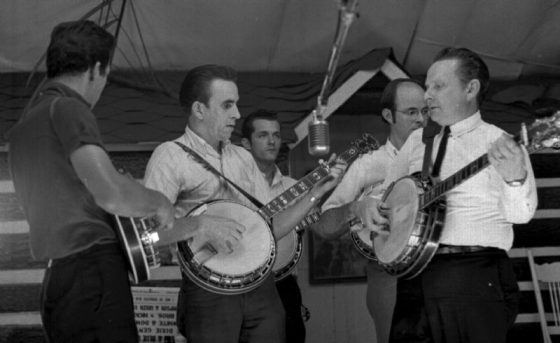
 

June 22, 1968. Banjo workshop at Bean Blossom, IN: Vic Jordan, Bobby Thompson, Dave Garrett, Neil Rosenberg, Ralph Stanley.
(Photo by Frank Godbey)

When I arrived in Newfoundland in September 1968, I’d just published my first academic article — on bluegrass — in the Journal of American Folklore. I’d been writing regularly for Bluegrass Unlimited. That past June, Bill Monroe had included me in a banjo workshop at his Blue Grass Festival in Bean Blossom, Indiana; and a few weeks before coming to St. John’s, I’d been at the Richland Hills fiddle contest near Dallas, Texas, jamming with Alan Munde, Sam Bush, and Byron Berline and the Stone Mountain Boys.
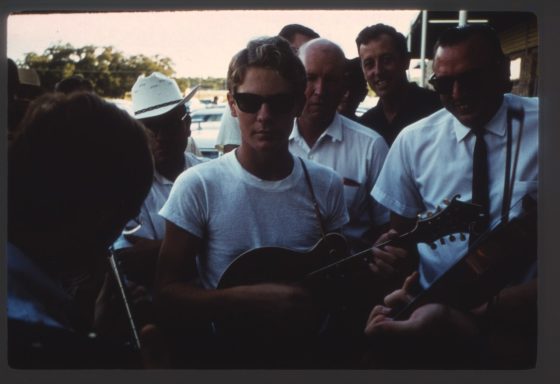
 

August 18, 1968. Richland Hills, TX fiddle contest: Neil Rosenberg
(b), Sam Bush (m), Byron Berline (f).
(Photo by David Stark)

During the late ’60s and early ’70s, bluegrass festivals were proliferating (I wrote about this in Bluegrass: A History, 305-339) and bluegrass was having success in the popular music business (I wrote about that too, 305-339).

By 1972 I was hearing at a distance about the adventures of my friends from the U.S. bluegrass festival scene. Alan and Sam had made a popular instrumental LP. Now Alan was picking banjo with Jimmy Martin and Sam was singing and playing mandolin with the Bluegrass Alliance. And Byron, working as a studio musician in Los Angeles, had recently recorded with The Rolling Stones

As I continued to study and write about bluegrass, I maintained my musical calling, moonlighting in the local contemporary folk and pop music scene. It was several years before I met anyone in St. John’s who played or knew much about bluegrass. 

In 1969, RCA Victor invited me to edit an album in their Vintage series titled Early Bluegrass. Aside from some Monroe LPs, this was the first historical bluegrass anthology. I signed its detailed historical liner notes with “Memorial University of Newfoundland” under my name. It got a good reception in the bluegrass world and introduced me to Canadian bluegrass record buyers. 

In 1971 I signed a contract with the University of Illinois Press to write a volume on bluegrass history in their new Music in American Life series. It was a book that would take years to write, for I had catching up to do. Not only was I out of touch with the bluegrass scene I’d been in before immigrating, I also knew little about the bluegrass scenes in my new home.
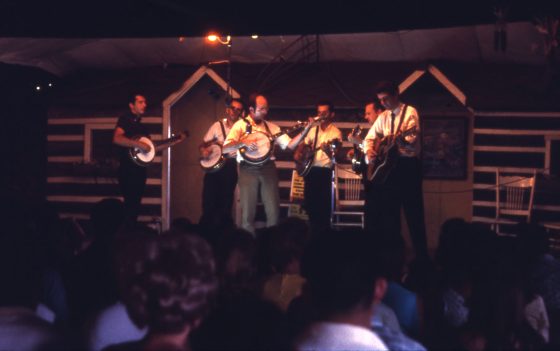
 

June 22, 1968. Banjo workshop at Bean Blossom, IN: Vic Jordan, Bobby Thompson, Neil Rosenberg, Dave Garrett, Ralph Stanley, Larry Sparks. (Photo by Doc Hamilton)

Learning About Canadian Bluegrass 

Even before immigrating to Canada, I knew it had bluegrass, thanks to Toronto’s Doug Benson, who put me on the mailing list of his magazine The Bluegrass Breakdown. The first issue had reached me in spring 1968 while I was still in Indiana. It told of bluegrass scenes in Ontario and Quebec.

En route to Newfoundland in September 1968, we entered eastern Canada via the Maritimes — the provinces of Prince Edward Island, Nova Scotia, and New Brunswick. Picking up our landed immigrant passes from Canadian Customs at the Maine border, we drove through New Brunswick and Nova Scotia, where, in Cape Breton, we caught the night ferry to Newfoundland.

During this trip I got my first taste of Canadian bluegrass in an Antigonish, Nova Scotia motel where we watched Don Messer’s Jubilee, a Halifax-produced CBC weekly TV show starring a fiddler who’d been recording and broadcasting nationally on radio since the 1930s and television later. Messer’s prime-time Jubilee was Canada’s second most-watched show, exceeded only by Hockey Night In Canada.

I was pleasantly surprised to see that Messer’s band included a five-string banjo played bluegrass style! To this immigrant’s eyes and ears, Messer was blending bluegrass into his country and old-time sound. Here’s his performance, taken from Jubilee footage, of “St. Anne’s Reel,” a popular Canadian fiddle tune:

The smiling banjo picker behind Messer was Vic Mullen, the youngest member of his band. Born in 1933 and raised in rural southwestern Nova Scotia, he had been working as a musician since his teens, playing with country bands in the Maritimes and Ontario.

In 1969, Mullen left Messer and began appearing with his own country band, The Hickorys, on another Halifax CBC weekly prime-time show, Country Time. There wasn’t much bluegrass on that show beyond Mullen’s occasional southern-style fiddle pieces.

Getting Acquainted 

My first meeting with a Newfoundlander who shared my enthusiasm for bluegrass came early in April 1971 when I had a letter from record collector Michael Cohen of Grand Falls-Windsor

By the time we met, Michael’s family owned six furniture stores in central Newfoundland. He’d grown up listening to country music on the radio and began collecting records. After attending university in Ottawa, where he’d heard lots of local and touring American and Canadian country music, he returned to Windsor to work in the family business, continue his collecting (he has all of Hank Snow’s recordings) and play in a country band.

He wrote me because he’d been told about me by a friend. “Early bluegrass and string bands … are my main interest,” he said, introducing himself and welcoming me to make tape copies of his rare records.

I wrote back inviting him to visit us on his next trip to St. John’s. This was the beginning of an enduring friendship. Through him I met others interested in bluegrass and Canadian country. The first was Fred Isenor of Lantz, Nova Scotia, a small community north of Halifax, who got my address from Michael and wrote me a few weeks later.
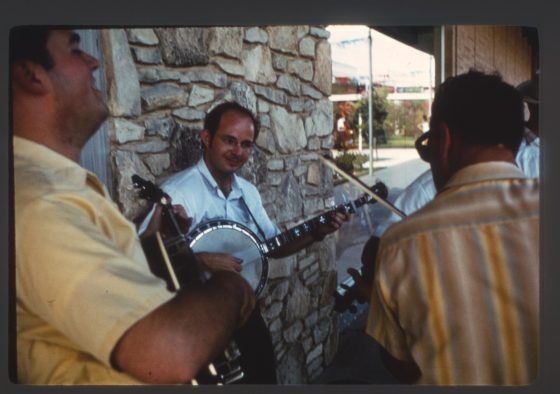
 

August 18, 1968. Alan Munde, Neil Rosenberg, unidentified fiddler.
(Photo by David Stark)

Fred, Vic Mullen’s contemporary and friend, worked at the local brick factory, and had a music store in Lantz. He was a record collector, a Bluegrass Unlimited subscriber, and a musician. He played mandolin and bass in The Nova Scotia Playboys, which he described to me as an “authentic (non-electric) country” band. They had represented Nova Scotia at the 1967 Expo in Montreal.

Fred had purchased his mandolin, a 1920s Gibson F5, for $100 at a Halifax pawn shop in 1960. Only later did he learn that its label, signed by Lloyd Loar, meant that he now owned an instrument like that of Bill Monroe, who’d just been elected to Nashville’s Country Music Hall of Fame. 

Our correspondence began with shared unsuccessful attempts to put together a Bill Monroe tour. I’d planned to speak with Monroe at a New England festival that summer. But the festival was cancelled; that plan fell through. In March 1972, Fred wrote of other plans:

There is a possibility of a one day bluegrass jamboree in Nova Scotia this summer. Not really a festival but if we can put it over it will be a start. Perhaps Michael has mentioned this to you. As you played with Bill Monroe and helped run Bean Blossom [I’d told Michael about this when we first met] I thought possibly you could offer some helpful suggestions, in other words some do’s and don’ts. 

He explained that with a limited budget the event would have to utilize local talent. 

Please do not mention this to anyone as definite … so far Vic Mullen and I just talked briefly about this and will be discussing it further on Monday night. 

He asked if I’d be able to visit him and take part in the program. 

I responded enthusiastically, calling the jamboree a festival, offering my suggestions, and saying I’d be driving through Nova Scotia in August and hoped to visit him then.

Meeting Vic Mullen 

In June 1972, Country Time came to St. John’s to tape some shows. I asked Vic if he’d do an interview, explaining to him that I was working on a book about bluegrass. He agreed. 

Still in his thirties, Vic had been playing country music professionally for a quarter century. He’d mastered instruments — mandolin, fiddle, guitar, five-string banjo — as needed, working on the road with a series of increasingly high-profile bands. Bluegrass chops were just one aspect of his professional tools — a flashy banjo piece, or southern-style hoedown fiddle as part of the show, that kind of thing. He’d worked with some bluegrass bands in Ontario, done TV, etc.

In the late fifties he started his own band, The Birch Mountain Boys. Working at first in southwestern Nova Scotia, he teamed up with Brent Williams and Harry Cromwell, young African Canadians from his home county, Digby. They played bluegrass in the Maritimes for several years before Brent and Harry started playing country and Vic joined Messer. 

Now Mullen was fronting his own national CBC TV country music show. He liked bluegrass and enjoyed playing it, but as a bandleader he chose it rarely. Most people in his audiences didn’t know the word “bluegrass” when they heard it and even if they liked it, it was just nice country music to them. Bluegrass was a niche genre. It had enthusiastic fans and great performers, but they were in a minority.

Vic was supportive of his old friend Fred; he understood Fred’s enthusiasm. He knew about BU and the bluegrass festivals that were happening in the States, but he didn’t think the festivals were going to catch on in Canada. Of Canadian bluegrass fans, he said that: 

Altogether in a group, there’d be a lot of people. But they’re spread out from coast to coast and particularly between here and Ontario … there wouldn’t be enough people for an audience in any one area, it’d be just too far for them to get there. 

Still, he was planning to be at Fred’s Jamboree. In our interview, Vic had given me an insider’s introduction to the world of Canadian country music. From him I heard for the first time many names and facts that would become familiar to me later. I was encouraged that a musician of his caliber, experience, and reputation would be there.

A week after the interview, I wrote Fred and told him I’d be catching the ferry to Nova Scotia on August 1, driving to Lantz the next day and staying to get acquainted. I explained that this was just the start of a crowded trip for “some hurried field research on bluegrass music … in Ohio, Kentucky and Indiana.” I closed by mentioning that I’d had a pleasant experience interviewing Vic. 

Fred’s reply came a few days later. He was looking forward to my visit, he said, and then, referring to my earlier letter, told me the event would be a jamboree — “outdoors, just one evening.” Referring to a nearby farmer who held dances in his barn, Fred explained: 

John Moxom is building an outdoor stage as soon as his hay is made and it appears now that we will be holding it either Friday, August 4th or August 11th. All the local bluegrass musicians are willing to help and take a chance on it being a flop. We hope to find out if there is enough interest to try something bigger and better next year. I know you have a busy schedule but if August 4th turns out to be the date we would sure like to have you present. 

By the end of July 1972, I was headed first to visit Fred in rural Nova Scotia. Then I’d drive to New England, stopping near the border at Woodstock, New Brunswick, to see Don Messer’s Jubilee perform at a county fair, and then going to Vermont where my family was vacationing. After a short rest I’d be heading for West Virginia to join my photographer friend Carl Fleischhauer on the trip we described in Bluegrass Odyssey.

On August 1, I headed for the Canadian National ferry terminal in Argentia, Newfoundland, ready to sail west for some bluegrass. 


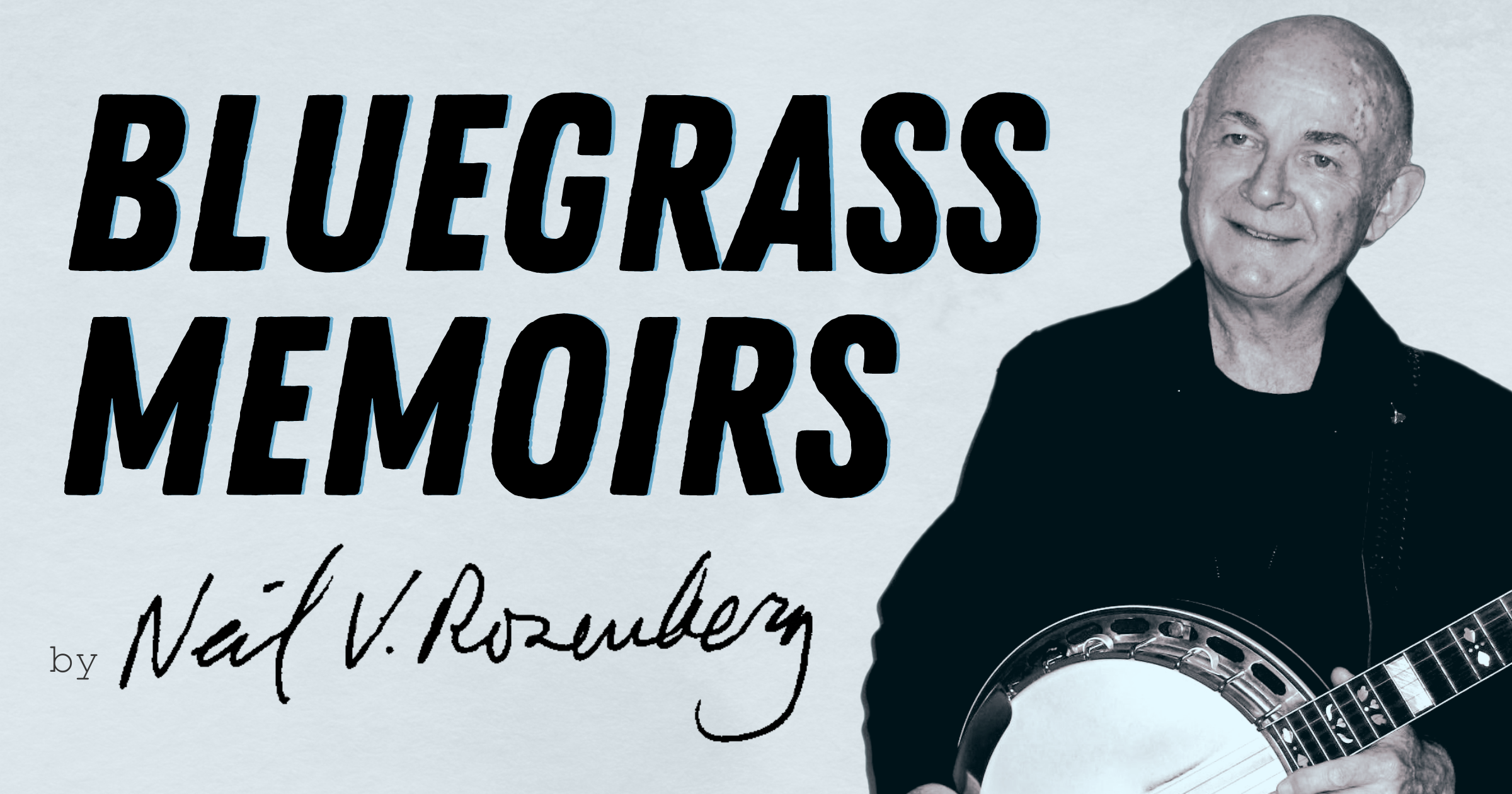
Rosenberg is an author, scholar, historian, banjo player, Bluegrass Music Hall of Fame inductee, and co-chair of the IBMA Foundation’s Arnold Shultz Fund.

Photo of Neil V. Rosenberg by Terri Thomson Rosenberg, all other photos by Neil V. Rosenberg. 

Edited by Justin Hiltner
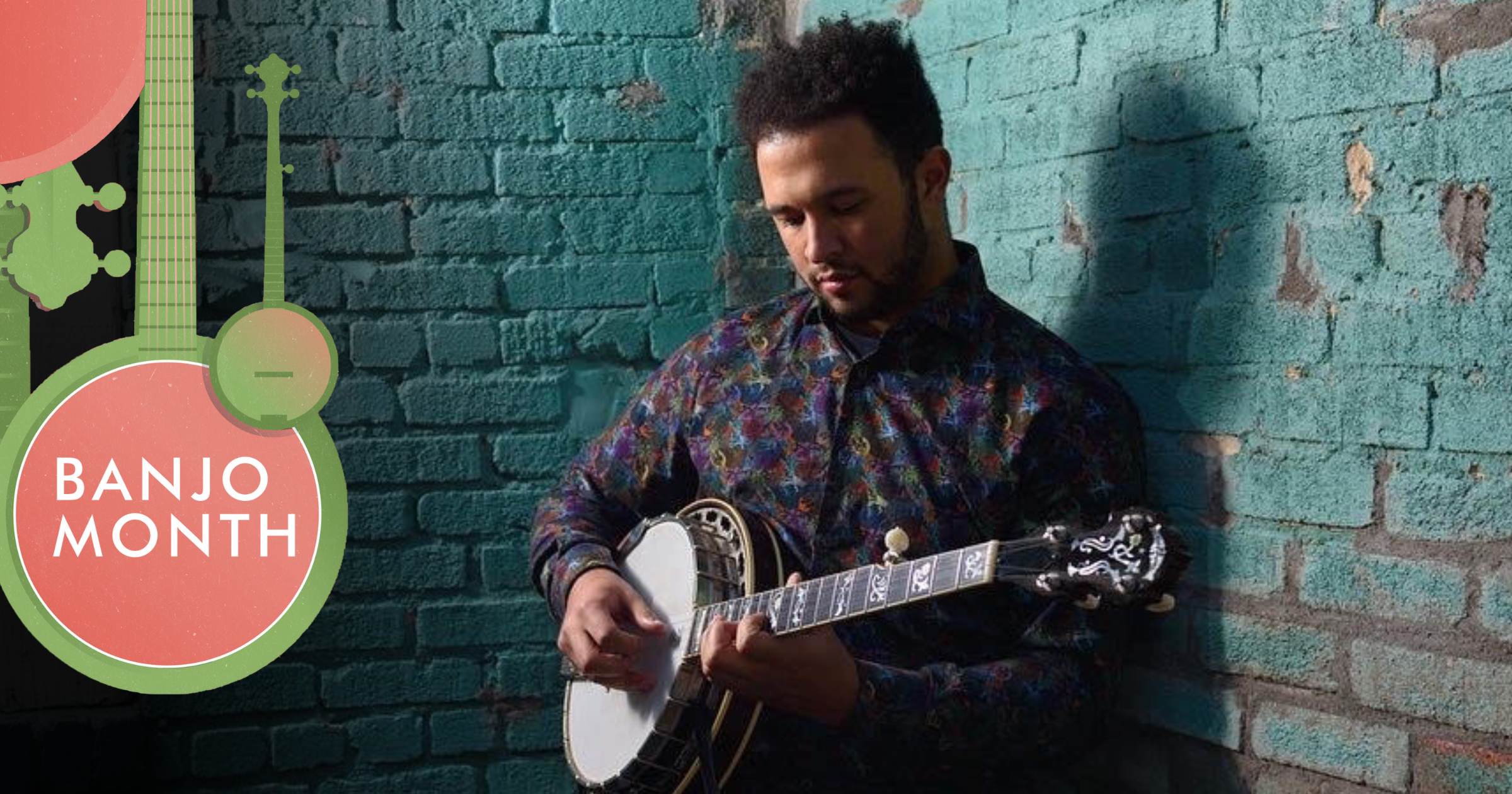
Tray Wellington Shares a List of Banjo Players Thinking Outside the Box

North Carolina musician Tray Wellington is fresh off a nomination for this year’s IBMA New Artist of the Year, following the release of his full-length debut album Black Banjo. Still in his early 20s, Wellington pulls from a myriad of influences — on his latest album he cites jazz as the major influence of his progressive bluegrass style. Many other banjo players of this younger generation are using the influence of genre and blurred genre lines, adapting and subverting narrative and traditions, and utilizing sheer unrestrained creativity to operate outside the traditional confines of the instrument.

In honor of BGS Banjo Month, Wellington gathered a collection of current artists who are thinking outside the box, creating their own voice on the banjo in new and innovative ways, and striving to make the banjo a better-known and appreciated sound.


Photo Credit: Dan Boner

We’re giving away a Recording King Songster Banjo in honor of Banjo Month! Enter to win your very own RK-R20 here.

WATCH: Kasey Chambers, “Lose Yourself” (Eminem Cover)

Artist: Kasey Chambers
Song: “Lose Yourself” (Eminem cover)
Release Date: July 29, 2022

In Their Words: “Eminem has been one of my favourite songwriters for many years. We listen to a lot of him in our house. I’ve been mostly influenced in my life by writers who bravely put fearless emotion into lyrics and no one does that better than Eminem. I don’t really care too much about what genre music fits into, just that the sound comes from a real, authentic place from inside the artist. Eminem makes me feel things when I hear him. Not always the most comfortable things but I’m not sure that music is always meant to make us feel comfortable. I’ve had it in the back of my mind for years that I knew there was a version inside me somewhere of ‘Lose Yourself’ on a banjo (it took Covid lockdown to give me enough time to learn the lyrics properly and write a melody to it) that I wanted to play live but it was really just for the self-indulgent reason that I love the song so much. I had no idea that audiences would respond to it like they have. Something else takes over my body when I play it and I get completely lost in it. I can honestly say it’s the most I’ve ever connected to a performance of a cover song in my life.” — Kasey Chambers


Photo Credit: Samantha Meuleman

Read a Chapter From ‘Rudy Lyle: The Unsung Hero of the Five-String Banjo’

Banjo player Max Wareham is telling the little-known story of a pioneering bluegrass musician in his upcoming book, Rudy Lyle: The Unsung Hero of the Five-String Banjo. Set for publication on August 23, the book features exhaustive and largely never-before-published transcriptions and analyses of every break Lyle recorded with Bill Monroe, the Father of Bluegrass. Lyle’s historical significance is explored in the final interviews given by banjo legends Sonny Osborne and Bill Emerson, as well as interviews with other prominent banjo players and members of Lyle’s family. Beautiful portraits of each interviewee are included alongside several never-before-published photos of Lyle himself.

In addition to the 19 main transcriptions, the book features chapters on Rudy’s style and its historical importance, his approach to backup playing, a thorough comparison of his breaks on every alternate take of Monroe’s classic “Raw Hide,” and several live transcriptions from before and after his time as a Blue Grass Boy. Tony Trischka provides the foreword.

“I began this project as a way to root my own playing more firmly in the tradition,” Wareham says, “but quickly came to realize that despite Rudy’s tremendous influence on the development of bluegrass music, he’s been nearly forgotten.”

To wrap up BGS Banjo Month, the Bluegrass Situation is proud to present an excerpt below from Max Wareham’s Rudy Lyle: The Unsung Hero of the Five-String Banjo.


Illustration by Giselle Harrington. Excerpt reprinted by permission of the author.

Basic Folk – Hannah Read

I have been wanting to talk to Scotland-born fiddler and current New Yorker Hannah Read on the pod for longer than Basic Folk has existed. I met her at the very fun camp Miles of Music in New Hampshire. We laughed our faces off all week and I was truly blown out of the water by her fiddling and singing. She’s just released a new duo album with the Scottish banjo player Michael Starkey, so it seemed like a good time to get Han on.

LISTEN: APPLE • SPOTIFY • STITCHERAMAZON • MP3

She grew up in Edinburgh as well as on the Isle of Eigg, a remote island off the western coast of Scotland, and she talks about how living simply as a younger person has impacted her adulthood. Growing up, there was a lot of music in the house: in terms of both listening and playing. Her mum played cello, sister played fiddle, and there was also a community of musicians on the island playing who she connected very deeply with. She started playing traditional Scottish music at the age of six and cites her biggest influences as the musicians surrounding the trad scene there. She made her way to America to attend Berklee College of Music in Boston and eventually moved to Brooklyn.

Her new album, Cross the Rolling Water, is filled with old-time fiddle and banjo duets with the Edinburgh-based Starkey. The two met at an Appalachian old-time session in Edinburgh in late 2019. She talks about their musical relationship as well as how Michael only has a flip phone, which is always hilarious to hear about from someone who’s on top of technology. Hannah’s hilarious, kind and has an infectious energy that carries from her personality to her music. Enjoy!


Photo Credit: Krysta Brayer

Would you like to help produce Basic Folk? You can contribute here – and you’ll get a ton of exclusive content as well!

Wes Corbett’s Banjo Needs: 10 Songs That Make Him Happy

Wes Corbett is a banjo player who wears many hats. The self-described “musically omnivorous bluegrass musician” is a true multi-hyphenate: 5-string aficionado (having released his solo album Cascade back in 2021), producer, former professor at Berklee College of Music, and musician with the likes of Joy Kills Sorrow, Molly Tuttle, and most recently Sam Bush Band.

Before hitting the road again with Sam Bush, the Washington native shared an exclusive playlist for BGS of “Wes Corbett’s Banjo Needs,” or as he puts it: the official home of all the songs that take him to his “happy place.”

“Fortune” – Adam Hurt


“Sliding Down” – Béla Fleck, Edgar Meyer, Mike Marshall


“Saint Elizabeth” – Kaia Kater


“The Hunt” – Kristin Scott Benson


“Milford’s Reel” – Noam Pikelny


“Your Love Is Like a Flower” – Flatt & Scruggs


“Come Back Darlin’” – The Bluegrass Album Band


“Poe’s Pickin’ Party” – Alison Brown


“The Over Grown Waltz” – Béla Fleck


“Goodbye, Honey, You Call That Gone” – Jake Blount


We’re giving away a Recording King Songster Banjo in honor of Banjo Month! Enter to win your very own RK-R20 here.

Kristin Scott Benson Shares Her Essential ’80s Bluegrass Banjo Tracks

I started playing banjo in 1989 and like most people, once I was hooked, I devoured all the banjo I could find. In my quest for the latest, coolest bluegrass, I ended up covering most of the music recorded in the ’80s. It took years to discover because (brace yourself, kids) there was no streaming or internet to bring it to us. We found music by buying CDs, listening to friends’ CDs, going to shows, and trial and error. In this list, I tried to represent the successful bands and players from the decade, who were recording music just before I fell in love with banjo.

Seeing Scott Vestal with Doyle Lawson & Quicksilver is what made me want to play, so his “Up on the Blue Ridge” is of special significance. I played along with Bill Emerson’s instrumental album, Home of the Red Fox, for countless hours. Sonny’s cut on “Listening to the Rain” (sung by Paul Brewster) is still a bit mystifying. I was sure I had two of these key phrases exactly right, but Sonny never thought I did. Shocking, I know. Thing is, he wasn’t entirely sure how he played them either.

Some of my favorite current music from formative years just missed the deadline, like Alison Brown’s “Simple Pleasures,” which was released in 1990, but I tried to stick with the ’80s only. I love these banjo players, bands, and songs. To this day, if I get sleepy driving in the middle of the night, I can turn on this music and get a second wind. I hope you enjoy these 19 glimpses into the ’80s. — Kristin Scott Benson


We’re giving away a Recording King Songster Banjo in honor of Banjo Month! Enter to win your very own RK-R20 here.

BGS 5+5: Lonesome River Band’s Sammy Shelor

Artist: Lonesome River Band (answered by Sammy Shelor)
Hometown: Floyd, Virginia
Latest Album: Heyday

Which artist has influenced you the most … and how?

Tony Rice. Tony changed the sound of bluegrass music through the 1970s and ’80s with his rhythm and lead guitar. He made rhythm guitar the leader of the band. His album Manzanita was the best practice tool for a banjo player ever. It was a bluegrass album without a banjo so I could play along with it and create my own ideas without being influenced by another banjo. I was fortunate to get asked to play some Tony Rice Unit gigs in the late 1990s and early 2000s. He then did some gigs with Lonesome River Band a couple of years later, and we learned a lot of the early Tony material and Bluegrass Album Band stuff. Nothing more memorable than playing shows with your hero!

What has been the best advice you’ve received in your career so far?

Most of my influences in music became my friends, so I had access to a wealth of knowledge and advice about the business. I would say the best advice was treat your audience with respect on and off stage and make them your friends. They will support you forever.

What was the first moment that you knew you wanted to be a musician?

I started messing with banjo at the age of 5. I learned as much as I could from my grandfather who played and other local musicians. In the 1970s, Wayside Park in Stuart, Virginia, became a really big bluegrass festival and brought in the top names in bluegrass at the time. After seeing bands like the Osborne Brothers, Seldom Scene, JD Crowe & the New South, and many others, I began to dream of doing what they were doing. I spent my teenage years putting in a lot of practice learning from all of those bands and listening to as many different banjo players as possible to learn everything I could.

Which elements of nature do you spend the most time with and how do those impact your work?

I grew up and still live in the rural areas in the Blue Ridge Mountains of Virginia. I can take 10 steps from my house and be in the woods and enjoy walking and taking in all nature has to offer. It keeps your mind from getting cluttered and open to your surroundings. Everything in nature is musical.

What rituals do you have, either in the studio or before a show?

I always try to find some quiet time before a show to get my head together. Then try to warm up on banjo for at least 30 minutes prior. I have two young sons at home, so rehearsal time at the house is nonexistent these days.


Photo Credit: Sandlin Gaither

Can Banjo Transcend Cultural Divisions? Bill Evans’ New Album Makes the Case

As a scholar and a musician, Bill Evans is deeply committed to sharing the complex historical context of the banjo while maintaining a musical style all his own. As a professional player, he specializes in bluegrass music; but one need only talk to him for a few minutes to understand that his influences stretch far and wide, encompassing everything from The Beatles to composer Frank B. Converse.

What started out as the concept for a dissertation became an ever-evolving musical show centered around the five-string banjo as a tool of what he describes as “African- and Anglo-American musical and cultural exchange.” When Evans began working with Tiki Parlour Recordings, this project took on a new form. His Banjo in America project covers more than 200 years of banjo history. Every element of this DVD & CD set honors the complexity of this history. The richly detailed liner notes, the graphic design, the photographs, the wide variety of instruments used, and the track list together form a cohesive package that is a righteous testament to the multifaceted history of the banjo. BGS was honored to talk with Evans about the conversations happening in the roots-music community regarding this instrument.

BGS: When did you start playing music?

Evans: I grew up in Norfolk, Virginia. I had piano lessons from a woman who played organ at the local church, and that laid the groundwork for my understanding of the basic concepts of music. But I usually tell people that the event that changed my life was the Beatles on The Ed Sullivan Show. I was only 8 years old, but I have this vivid memory of the entire world looking different after that, and I was intensely interested in music from that point on. I started looking at acoustic guitars, and back then you could go down to the local music store and get a Peter, Paul and Mary book with guitar tablature. I started that in the fifth grade, and if the chord was too hard for my hands to wrap around, I just didn’t play that chord.

I learned fingerpicking, and then, when I was in high school, a music store opened in Norfolk called Ramblin’ Conrad’s Guitar Shop & Folklore Center. I started hanging out there. You could listen to records, and you could play instruments, and I ended up being mentored by musicians who were all older than me. I had albums to listen to and supportive people and a coffee house on Friday nights where we could go and perform. I was fortunate to have, at a crucial point in my life, a nurturing environment that directed my learning. I was already into bluegrass banjo, and at every folk festival I got exposed to lots of different music. John Jackson. Tracy Schwartz. Mike Seeger. Libba Cotten.

Did you come from a musical family?

No. What got me interested in the banjo was a television show called Hee Haw. It was hosted by Roy Clark and Buck Owens. They had a routine every week where Roy and Buck would play “Cripple Creek” and tell jokes, and they also had a banjo segment. I could see Roy Clark picking, and I could visualize and hear the relationship between what I was doing to what I needed to do. I’ve heard from other banjo players that it was the sound of the instrument that got them; that’s true for me, too.

Having a supportive community to help me to funnel my learning was very helpful. By the time I got to college at the University of Virginia in 1974, I was well on the way and was consumed by it. By then I had a sense of how to seek out sources and make musical connections, both with other students and with the local pickers. There was a coffeehouse in Charlottesville called the Prism. My suitemates were all doing rush for fraternities, but I was hanging out at the Prism, getting to hear all these performers, and working on banjo.

I would spend hours and hours practicing, and then I started working at theme parks. A lot of young players got their first professional experience through those venues. I was pretty much set to be a professional musician. I graduated in 1978 with a degree in anthropology and religion. I played the whole summer with a band based out of Louisville, Kentucky, called the Fall City Ramblers. I was on my way and I’ve never looked back. I’ve made my living and raised my kids by being a professional musician all these years, and I’m almost 66 now, so I feel blessed.

How did the Banjo in America project start congealing into a cohesive form?

I’ve been interested in banjo history for a long time. In the late 1980s and early 1990s, three events were held by the Tennessee Banjo Institute. There have always been specialists in these styles that I’m exploring. There are folks who specialize in “minstrel banjo,” mid-19th-century banjo. Other folks specialize in what we call “classic banjo,” which encompasses the music of the ragtime era. The Institute brought in the experts in those styles. Pete Seeger, Béla Fleck, musicians brought from Africa. A lot of us got exposed to these historic styles and made these connections through the sound of the instruments and the knowledge that these incredible musicians brought to the events.

Early on in graduate school, I was thinking about writing a dissertation on…I’ll use the word “Africanisms.” That dissertation that never got written was on the continuing African influence in all of these banjo styles. There are a lot of things going on with a project like this, but I want to be clear that I’m always recognizing the African and African American influence. This project is coming out at a time when we’ve been talking about this process of appropriation and revitalization for several years, and we’ve got great Black performers playing the banjo and spreading the word about this history.

In the mid-1990s, as a result of the Tennessee Banjo Institute, I bought a mid-19th-century banjo replica. Then I bought an open-back banjo and I started digging into these manuals. And I started accumulating more instruments as I went. It was a continual process of getting instruments, exploring the styles, coming into contact with people at banjo workshops, and continuing to learn, continuing to talk to folks who had written about all this. As time went by, I realized that I needed to make the show more entertaining. I wanted to make it appropriate for a general audience. I try to make it an entertaining show where people can come out having gained an understanding of the complexity of the cultural exchange over hundreds and hundreds of years. In some ways, the story of the banjo is the story of America.

What was your process for contextualizing these tunes and this project?

It’s a wonderful moment right now, the way the younger people who are playing old-time music are looking at this whole process of African and African American and Anglo-American exchange. I think of this as an ongoing dialogue in which we’re all hopefully learning from each other, gaining strength from one another, and being inspired by one another. I’m hoping that this project is a contribution to the dialogue. The more that we can hear these historic styles, the richer our comprehension can be of the nature of the cultural exchange. The more we can understand the history of the banjo and carry that to a broader vision of all of us playing the banjo, all of us celebrating the banjo, and using it to transcend some of our cultural divisions.

In addition to presenting all these historical styles, I play things the way that I play them. Many of the pieces on this recording I’ve been playing for over 30 years, and the whole project is the result of my involvement of over 50 years with this community. If this project can contribute in some way to the dialogue that’s going on about white appropriation of what’s essentially Black music, I will be very happy.

How do the graphic design and visual elements of the album fit in, and how did this aesthetic element come into being?

I let Howard [Rains, the graphic designer] and David [Bragger, co-founder of Tiki Parlour] run with it. There was a tradition in the 1800s of creating a “toy theater” – a very elaborate miniature stage cut out of paper. It’s three-dimensional, and you put actors on the stage, so we started off with that idea. I didn’t have a whole lot of input. I did choose the photographs. They got very excited about it, and I did, too. It’s this blending of sensibilities that is kind of remarkable.

That leads perfectly into my last two questions. First, how many instruments do you play on this project?

Ten, and among the oldest banjos is the zither banjo from England, on track number nine. And the Vega White Lady, which is from 1917. The gourd banjo that starts the project is a modern-day interpretation made by Pete Ross, and the three instruments that I’m using for the mid-19th-century portion of the program are made by Jim Hartwell. So, these aren’t the real deal, but they’re really close in specs and sound to instruments that exist in archives.

Second, what’s your favorite track on the set, if you have a favorite? And why?

“Home Sweet Home,” the sixth track. This is an 1871 arrangement. It’s astounding, the degree of technical expertise that was written into this piece at such an early date. The composer, Frank B. Converse, was partly responsible for bringing fingerstyle playing to banjo music. Louis Gottschalk arranged “Home Sweet Home” and Converse lifted the arrangement. I have added to it as I’ve gotten to be at home with the piece, which is definitely technically demanding. So that’s the piece that I like the most because it encapsulates a lot of things for me…and it’s fun to play.


Photo Credit: David Bragger