The Man That Made All of Us Play the Banjo

(Editor’s Note: For Earl Scruggs’s birthday, Thomas Goldsmith revisits a star-studded bluegrass festival tribute to the banjo legend from 1971 in Camp Springs, North Carolina. The 102nd anniversary of Scruggs’s 1924 birth in Flint Hill, North Carolina, is January 6, 2026.)

Like speakers at a testimonial dinner, each musician strode to the microphone in turn.

But instead of heaping on words of praise, a stage full of well-known pickers and up-and-comers used banjos to pay a lively tribute to Earl Scruggs.

The scene was the 1971 Labor Day weekend bluegrass festival in Camp Springs, North Carolina, at a performance where some of the best banjo players around joined Scruggs on stage. Led by the five-string king himself, banjoists including Sonny Osborne, J.D. Crowe, Bill Emerson, and Alan Munde jointly played Scruggs’s signature tune “Foggy Mountain Breakdown,” some 22 years after its first recording.

The performance is a highlight of the 1972 documentary Bluegrass Country Soul, which enjoyed a 50-year deluxe re-release five years ago. Watch the clip here.
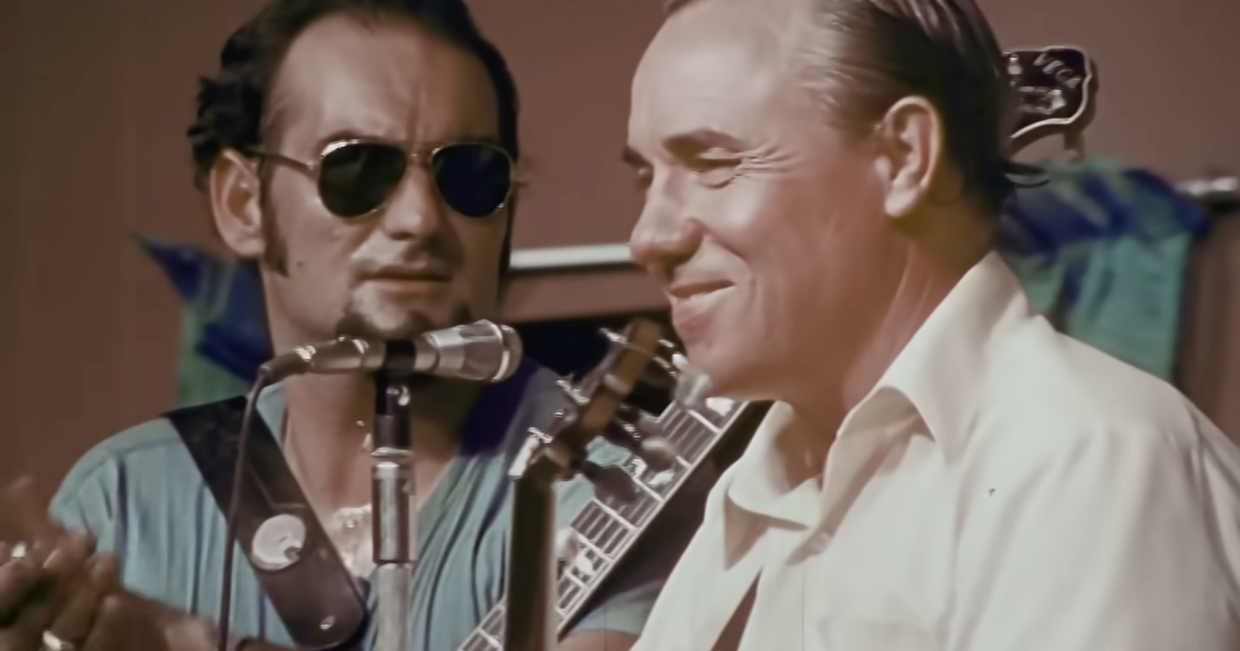
 

Sonny Osborne (left) gets emotional onstage after introducing Earl Scruggs (right). Screenshot from clip courtesy of Bluegrass Country Soul, Inc.

Promoter Carlton Haney invited more than a dozen banjo players on the festival schedule to play along with Scruggs, who was then 47. (A second group performance, of “Dear Old Dixie,” doesn’t appear in the film. And a couple of the “Foggy Mountain Breakdown” performers didn’t make it to the screen.)

Millions of viewers have seen the clip as part of the movie or on YouTube, with Osborne bringing Scruggs on with an introduction that sounds starstruck.

“(It’d) be only right to call out probably the man that has made all of us guys up here play the banjo, or either has been a great influence, as he has in my complete life,” Osborne said. “In my whole banjo-playing ability … I could probably credit to this one man.

“Let’s all give a tremendous welcome to probably the best in the world, Earl Scruggs!”

Scruggs seemed overwhelmed by the audience’s ovation. The cheering feels as though it lasts forever, but took only a minute and a few seconds.

“That really fills my heart with joy,” Scruggs said after Osborne introduced him. “I did want to say one thing: Thank you, and guys like this is what keeps me going, my boys who works with me and you people who keep preaching music.

“I just don’t know what to say, except I’m picking with some guys that plays a tremendous amount of banjo. Don’t underestimate anybody up here. Man, they’re great.”

Earl at a Crossroads

In 1971, Scruggs had only broken up with his longtime duet partner Lester Flatt less than two years earlier. Not even a month before Camp Springs he had recorded along with other greats for Nitty Gritty Dirt Band’s country-roots-popularizing Will the Circle Be Unbroken set. He was venturing into a country-rock sound with his band the Earl Scruggs Revue, along with his sons Randy, Gary, and Steve.

However, Scruggs’s work as a musical innovator remained – and remains – fundamental to the way a large share of bluegrass banjo players address the instrument. That’s true despite the introduction of a single-note style most associated with Don Reno and a chromatic or melodic approach heard in the playing of Bill Keith and Bobby Thompson.

Most of the pickers in the 1971 “Foggy Mountain Breakdown” performance used the three-finger picking style Scruggs introduced in a band with Bill Monroe and Flatt on the Grand Ole Opry in 1945. The exception among the Camp Springs pickers, Rick Riman of the New Deal String Band, caused something of a stir with his chromatic rendition of the tune, not to mention his long hair, full beard, and striped shirt and pants.

How did Riman, who had also studied Scruggs style closely, decide to use the flowing melodic style for “Foggy Mountain Breakdown”?

“I just thought, “OK, let’s see if I can make this work,’” Riman, 83, said on the phone from Denver, Colorado, speaking to BGS in January 2026. “Because I had not prepared anything, and I didn’t even know what was on the program. They just said they want all the banjo players up there to pay tribute to Earl. And I said, ‘OK, I’ll get up there and do it.’”

And what has the reaction been?

“Mostly negative,” he said, with a touch of humor.

“One person said they were really glad to see somebody step out of the standardized [method], and that felt very, very good. Somebody else said, ‘You won’t believe how many people thought that you shouldn’t have been on stage at all.’

“And I get that a lot. That’s mostly the reaction I get, that I shouldn’t have been on stage. I shouldn’t have even been in the parking lot, like the least talented person on the stage and probably the least talented person in the whole park.”

The chromatic style remains one effective tool in the hands of players such as Béla Fleck and Noam Pikelny, but Riman, 28 that day in 1971, has gotten a load of grief over his choice to add some variety to the line of Scruggs-style players. “I would say, over the years, it’s pretty much been like 50-plus years of derision,” he said.

Riman has had one regret. “I should have practiced more,” he said. “I should have been better, but I had no idea.”

Although at Camp Springs he performed in the more recently created melodic and chromatic styles, like everyone on the stage that day in North Carolina, Riman was schooled in the style of the man honored beside them.

“I was really fascinated by Earl and anybody else who played his style pretty well,” he said.
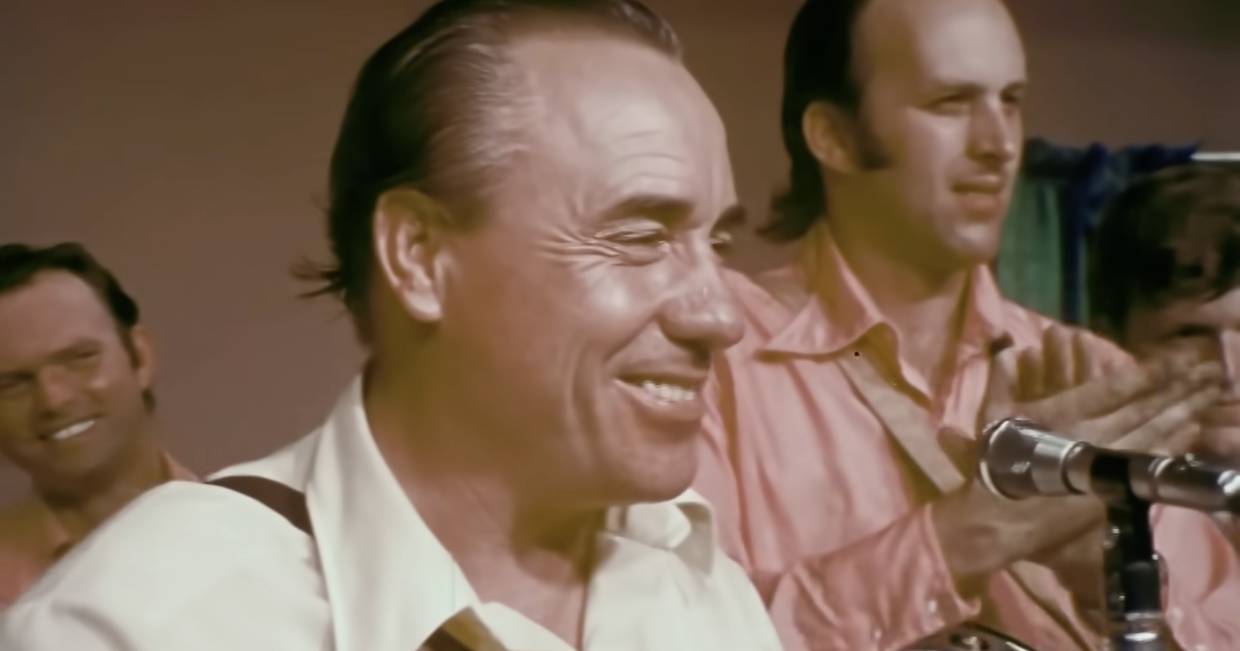
 

Earl Scruggs reacts to his introduction and audience ovation and applause onstage in 1971 in Camp Springs, NC. Screenshot from clip courtesy of Bluegrass Country Soul, Inc.


“Everybody Headed for the Stage”

We were fortunate to reach three of the banjo warriors who performed that day. Sadly, most of the players heard then have since died. Eddie Hoyle, then 14, the youngest of the Camp Springs lineup, is among the survivors and is still actively performing. He talked to BGS on the phone in December from his home in Georgia.

“I was up there playing with Curtis Blackwell and the Dixie Bluegrass Boys and I just remember them telling me that Carlton wanted all the banjo players to come down on the stage and play a tune with Earl,” said Hoyle, now 68. “So I got my banjo out, and everybody headed for the stage.

“I didn’t know if I’d get to take a break or not, but somebody got me in the line that was walking up to the mic. So it was pretty cool. And I remember I was not nervous; OK, probably didn’t know enough to be nervous.”

Most of the players that day stuck fairly close to Scruggs’s own licks on “Foggy Mountain Breakdown,” but Hoyle and others ventured a bit from the classic performance.

“I always tried to learn the right way, as Dad told us to do, but then I would try to put my own twist on it,” Hoyle said.

Nearly half the banjo players that day have been inducted into the Bluegrass Music Hall of Fame. They include Scruggs himself, of course, as well as J.D. Crowe, Bill Emerson, Alan Munde, Sonny Osborne, and Don Stover. Another banjo picker, Saburo Watanabe Inoue, founder of the pioneering Japanese band Bluegrass 45, won the IBMA’s Distinguished Achievement award along with his brother Toshio, in 1995.
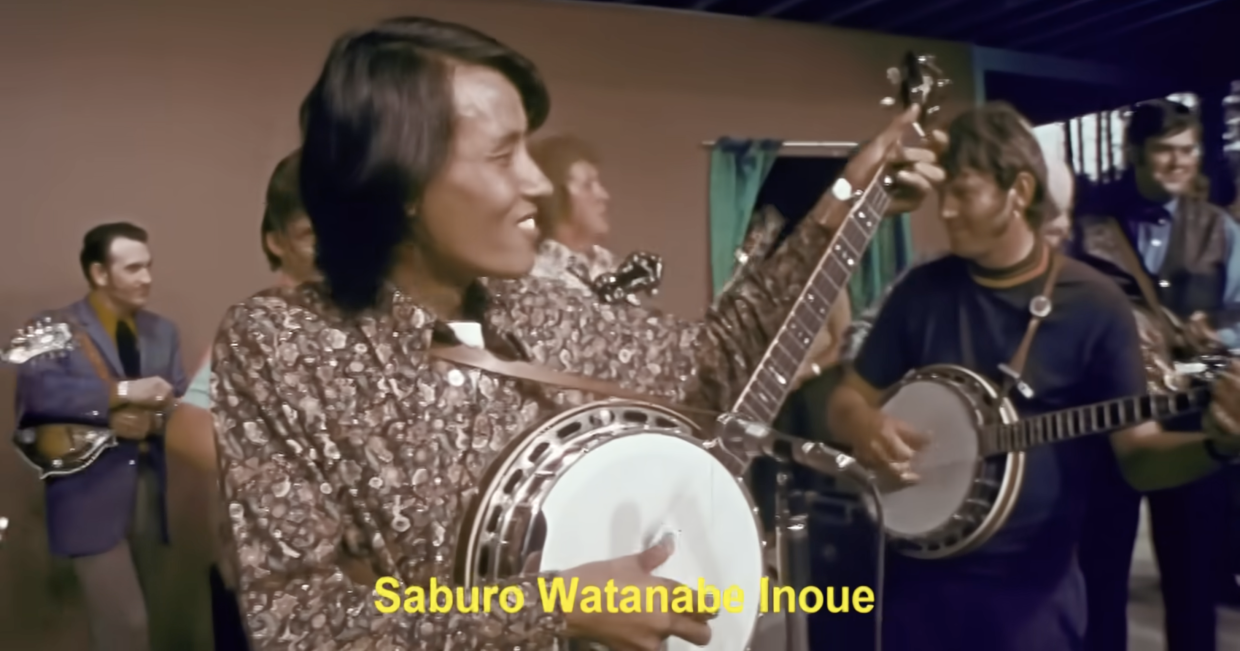
 

Sab Watanabe (who passed away in 2019) of the legendary Japanese band, Bluegrass 45, takes his turn at the mic. Screenshot from clip courtesy of Bluegrass Country Soul, Inc.


Alan Munde Remembers it Well

Munde, 79, still a player and teacher, also spoke to BGS about the experience from his home in Springfield, Missouri. He recalled that he was playing with Jimmy Martin and the Sunny Mountain Boys at the festival and took part in the group performance because Martin wanted him to.

“Thinking back on it and also remembering at the time, I didn’t really want to be a part of it, just because, then and now, I thought I would be so unworthy,” Munde said. “But I think Jimmy wanted me to do it, and you notice he’s there [in the film.] He thought I needed to be there, so I did it.”

Munde remembers the day as a landmark for him, the only time he heard Scruggs play live. Given all the great banjoists and backing musicians including Martin and Charlie Waller, it was an enchanting moment from the sound of Scruggs’s first lick.

“The thing that I remember so much about it is … we’re all standing there and Earl’s talking, and then he’s going to start to play,” he said. “And he, I always call this his ‘chang,’ where he just plays the first, third, and fifth string together and starts into the tune.

“As soon as he did that, I thought, ‘Oh my God, there’s that sound.’ It just was immediately apparent that he was the one.”
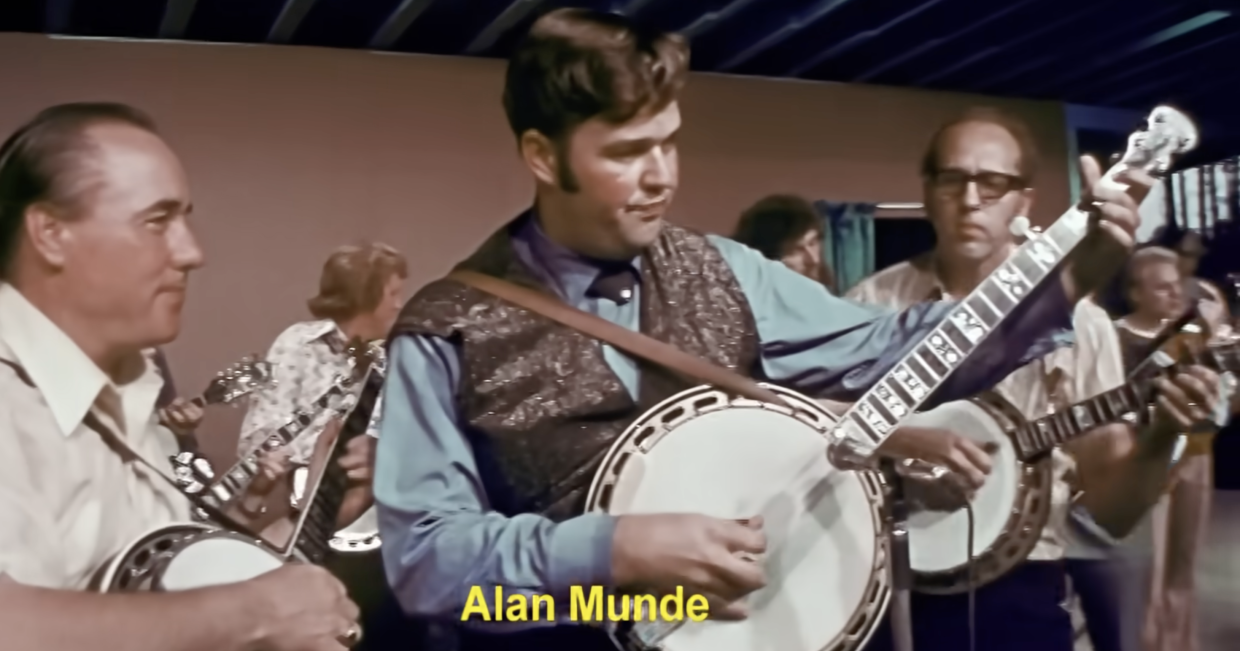
 

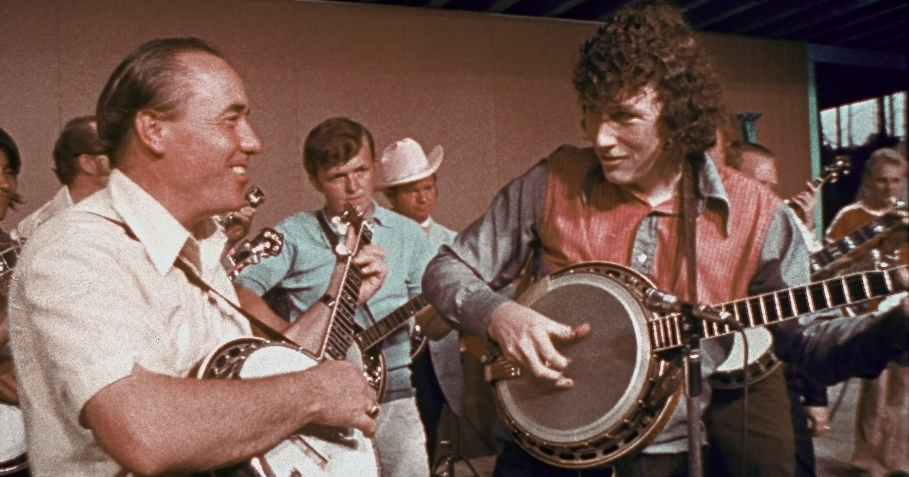
Alan Munde (right) is flanked by Earl Scruggs during the all-banjos jam of “Foggy Mountain Breakdown.” Screenshot from clip courtesy of Bluegrass Country Soul, Inc.

Like the first players to tune into Scruggs’s playing in 1945 and like players from Béla Fleck on, Munde appreciates Scruggs’s sound in a way that seems almost mystical. Scruggs produced something that no other banjo player could.

Jimmy Martin, Munde’s boss at the time, used to tell a story involving the great banjo man Vic Jordan to illustrate the way Scruggs’s beautifully nuanced playing and full tone stood above the crowd of his followers.

“Jimmy was kind of down on Vic Jordan a little bit,” Munde said. “And he would tell this story to show that Vic didn’t know the right way. He said when Vic met Earl, he asked him what kind of microphone he used.

“And Earl said, ‘Sometimes I use those little bitty ones, and sometimes I use those real big ones.’

“And Jimmy’s point was that, in his mind, Vic was asking because he thought it was the microphone. But it didn’t matter. It all sounded like Earl every time.”

And hearing Scruggs’s sound that day at Camp Springs, not through a mic, not on a record, but right there next to him on stage, made Munde think the whole exercise was somehow wrong.

“When he did that pinch, I thought, ‘Oh, God, I don’t want to be a part of this.’ What we should have done is just stood back and listened to him, and then said, ‘Do it again.’”

Despite his misgivings at the time, Munde has wound up glad that he took part in the Earl-fest that day.

“Looking back on it, it’s been nothing but good for me, that I got to be there,” he said. “Here it is, 50 years later, people still bring it up. It’s helped get me a little legacy recognition, that I was there, so that’s been real good.”

A Star-Studded Lineup

The career of Sonny Osborne has been well documented, but Bluegrass Country Soul makes clear his admiration and friendship with Scruggs. During the tumult of applause following his introduction, Scruggs asked if he could say something, and Osborne appears to grin and say, “Not yet.” And Osborne cracks up when Scruggs uses his up-the-neck solo from “Foggy Mountain Breakdown” during the last time around for the tune.

Bill Emerson, whose long career included membership in the Country Gentlemen and much more, was interviewed at the time of the re-release of Bluegrass Country Soul. He talked about the pantheon of great banjo players.

“Don Reno, he had his style on the banjo; Earl Scruggs, he had his style on the banjo; Ralph Stanley, he had a style on the banjo,” Emerson said in the set’s booklet. “And on the radio, I could listen to any of them, just the first few notes of an intro, and tell you who was playing. Just by the style that they were playing, the tone that they had, and the timbre. Most people, when they started out playing the banjo back then, they got a bunch of Earl Scruggs’s records and sat down and tried to learn to play like Earl. But it’s mighty hard to sound like Earl, I can tell you. I was never able to do that, so I just tried to sound like Bill Emerson.”
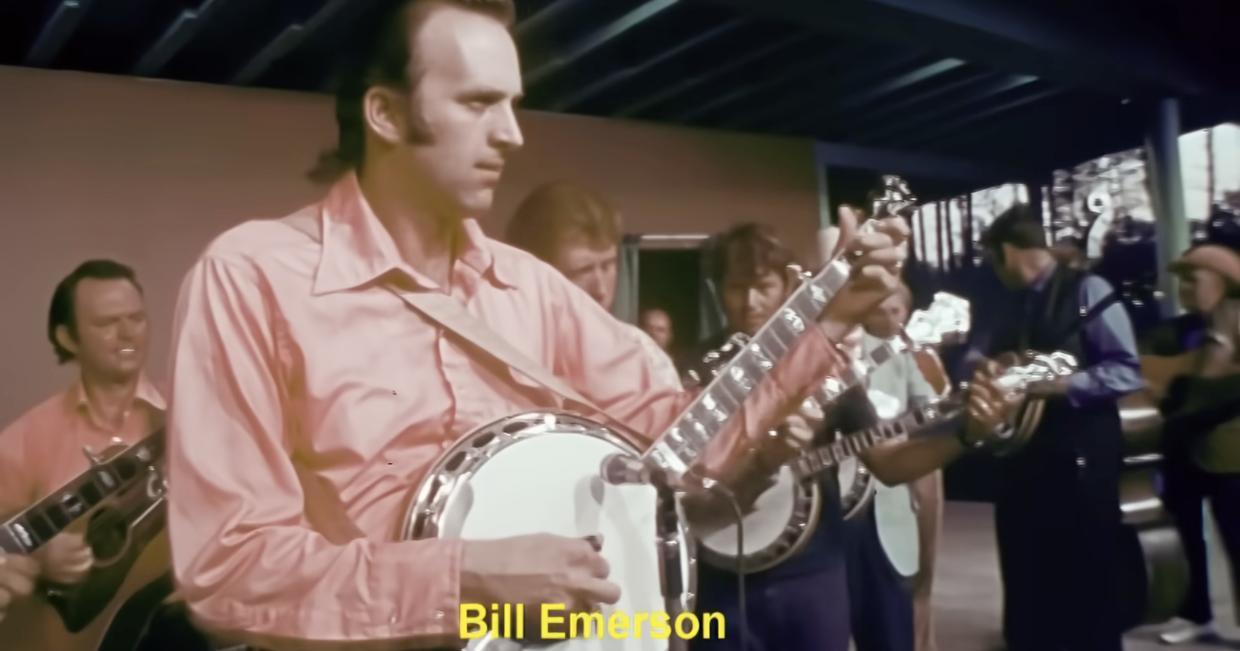
 

Bill Emerson takes his turn playing a solo on “Foggy Mountain Breakdown.” Screenshot from clip courtesy of Bluegrass Country Soul, Inc.

Also on the show was multi-instrumentalist Jimmy Arnold (1952-1992), whose career was one of a kind, including excursions into Southern rock and solo albums on guitar and banjo as well as stints with Cliff Waldron, Charlie Moore, and the New Tradition, according to a 1983 Bluegrass Unlimited story. The article, by Chris Wathen, quoted Arnold on Scruggs: “When you learn all of what you think is hard stuff and then go back and try to play one of his tunes, you find out what the hard stuff really is. It’s his stuff. To play with that much power and volume, you’ve really got to be on top of things.”

Another of the clip’s well-known pickers, Don Stover (1928-1996), had been an early convert to Scruggs style, learning it not long after Scruggs’s first performances with Monroe, according to the Bluegrass Music Hall of Fame.

Stover was known for his work with brothers Bea and Everett Lilly during many years of performances in Boston. He played and recorded as a member of Bill Monroe’s Blue Grass Boys in 1957, even contributing harmony vocals to “In Despair.”

Earl’s son Randy, who appears playing an archtop banjo just before the end of the clip, went on to a distinguished career as a musician, songwriter, and producer.

Doing Their Times

The 55th anniversary of this notable moment in bluegrass will arrive in September. Looking back, the picking ranges from respectable to spectacular, but doesn’t maintain the dead-even tempo that’s supposed to prevail in bluegrass music. Fans remember the story that Earl and brother Horace Scruggs, as boys, used to start playing a tune, then separate to walk around their Flint Hill house in opposite directions. The idea was to check if they were still in time with each other after being out of earshot.

The dozen players on the Camp Springs group number would not have passed this test, based on a stopwatch run-through. While Scruggs’s December 1949 original recording had consistent solos of right at 11 seconds, he started the round robin at about 12.69 seconds and tempos wavered from there.

By the start of Riman’s melodic solo, near the end, the time was more than half a second slower. Randy and Earl Scruggs wrapped things up at roughly the same tempo.

But that’s just a quibble.
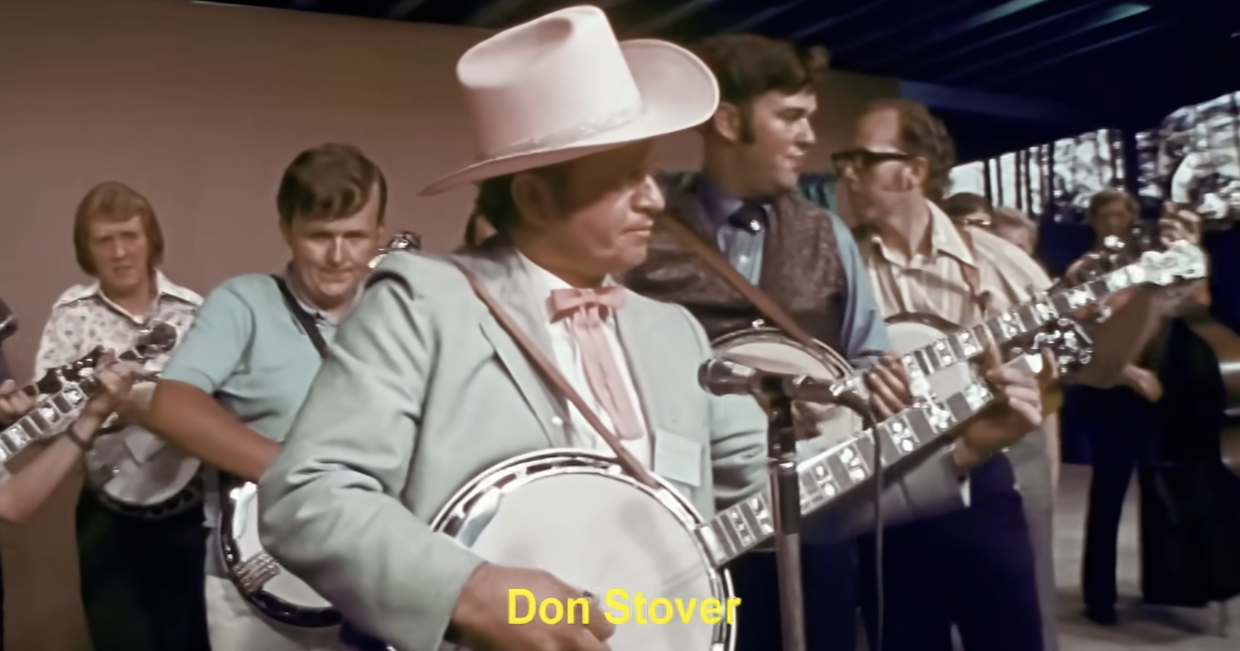
 

A contemporary of Earl Scruggs, Don Stover also performed a rendition of “Foggy Mountain Breakdown” during the jam. Screenshot from clip courtesy of Bluegrass Country Soul, Inc.


Remembering Earl

Bluegrass Country Soul director Albert Ihde did bluegrass lovers a real service by capturing these moments and others at the Camp Springs festival. And promoter Haney had another brainstorm resembling the story, pronounced “stoah-ry,” that he recreated of Bill Monroe and former band members six years earlier at Fincastle, Virginia.

Viewers will keep calling up the video for its closeups of Earl, smiling and even bobbing up and down for his breaks, and for the scenes of several of his outstanding followers, appreciating their moments on stage as they rolled their way through “Foggy Mountain Breakdown.”

Many videos of Flatt & Scruggs can be found on the web that illustrate Earl Scruggs’s unmatched musicianship. In the Bluegrass Country Soul segment viewers can also see a strong memorial to Earl Eugene Scruggs the person, his warmth, humor, and unselfishness as well as his brilliance as a musician.


Thomas Goldsmith is an award-winning journalist based in Tennessee and North Carolina. In addition to producing many hundreds of articles for newspapers and magazines, he edited The Bluegrass Reader and authored Earl Scruggs and Foggy Mountain Breakdown: The Making of an American Classic, both books for the University of Illinois Press.

Learn more about Bluegrass Country Soul and purchase a Golden Anniversary Legacy Edition box set of the film here. Read more about the box set and the making of the film here.

All photos courtesy of Albert Ihde, Ellen Pasternack, and Bluegrass Country Soul, Inc. Lead image: Earl Scruggs (left) and son, Randy Scruggs (right), perform “Foggy Mountain Breakdown” flanked by bluegrass banjo stars of 1971.
You Gotta Hear This: New Music From Seldom Scene, Swearingen & Kelli, and More

You’ve reached the end of the week! For a little treat, how about a few brand new songs and music videos? You Gotta Hear This!

If you’re looking for bluegrass, we’ve certainly got it this week– Chris Jones & The Night Drivers share their first recording of a Tom T. Hall original, “Mama Bake a Pie (Daddy Kill a Chicken),” since their dear friend and Bluegrass Hall of Famer passed away a few years ago. Plus, bluegrass legends Seldom Scene preview their upcoming album, Remains to Be Scene, with a new single, “Last of the Steam-Powered Trains.” And, wrapping up our bluegrass trifecta, banjo player Max Wareham pays tribute to NHL team the Boston Bruins with an excellent shredding instrumental tune, “The Black & Gold.”

From elsewhere across the roots music landscape, duo Swearingen & Kelli offer “Break Me Down,” a powerful acoustic number with plenty of grit, slide guitar, and blues influence. Plus, don’t miss Justin Wells’ new music video for “Sad, Tomorrow,” a contemplative slow burn of a song that focuses on mental health, melancholy, and forging ahead.

It’s a lovely collection of new roots music to take you into the weekend, and you know what we think – You Gotta Hear This!

Chris Jones & the Night Drivers, “Mama Bake a Pie (Daddy Kill a Chicken)”

Artist: Chris Jones & The Night Drivers
Hometown: Nashville, Tennessee
Song: “Mama Bake a Pie (Daddy Kill a Chicken)”
Release Date: January 17, 2025
Label: Mountain Home Music Company

In Their Words: “This is an old and lesser-known Vietnam War-era song of Tom T. Hall’s and the first song of his I’ve recorded since his passing a few years ago. I think I didn’t feel ready to until now. He had a unique ability to incorporate bits of humor into a sad story, and this is definitely one of those. This song is vivid and poignant in a way that is vintage Tom T. I was going to record this several years ago, but when I brought it up to Tom T. and Dixie, they wrote ‘Hero in Harlan’ that very day to give me something new to do instead.” – Chris Jones


Seldom Scene, “Last of the Steam-Powered Trains”

Artist: The Seldom Scene
Hometown: Bethesda, Maryland
Song: “Last of the Steam-Powered Train”
Album: Remains to Be Scene
Release Date: January 14, 2025 (single); March 14, 2025 (album)
Label: Smithsonian Folkways

In Their Words: “This song was written by Ray Douglas Davies and recorded by the rock group The Kinks in the 1960s. The Scene has always looked outside the box for material, and we thought this one fit the bill.” – Lou Reid


Swearingen & Kelli, “Break Me Down”

Artist: Swearingen & Kelli
Hometown: Nashville, Tennessee
Song: “Break Me Down”
Release Date: January 24, 2025
Label: Gone Rogue Music

In Their Words: “I wrote this song a few years back, but it never really got its due. I was also really obsessed with slide guitar at that time. It’s a little gritty, and when Jayne added her vocals on top, I thought, ‘Ok, this is exactly what this song needs.’ I love the discovery process of writing and recording. Sometimes it takes a while to find the exact combination of sounds with an arrangement to tell the story the way you really want to.” – AJ Swearingen

Track Credits:
AJ Swearingen – Guitars, drums, percussion, bass, vocals
Jayne Kelli – Vocals, organ


Max Wareham, “The Black & Gold”

Artist: Max Wareham
Hometown: Boston, Massachusetts
Song: “The Black & Gold”
Album: DAGGOMIT!
Release Date: January 17, 2025 (single); February 21, 2025 (album)

In Their Words: “Sports and music might have more in common than we think – this tune is a tribute to the Boston Bruins’ legendary ’22-’23 season, during which they broke most NHL records. Musically, the A part was inspired by Bill Emerson and the B part is a nod to the style of banjo legend, Rudy Lyle.” – Max Wareham

Track Credits:
Max Wareham – Banjo
Laura Orshaw – Fiddle
Chris Henry – Mandolin
Chris Eldridge – Guitar
Mike Bub – Bass
Larry Atamanuik – Snare


Justin Wells, “Sad, Tomorrow”

Artist: Justin Wells
Hometown: Lexington, Kentucky
Song: “Sad, Tomorrow”
Album: Cynthiana
Release Date: January 15, 2025 (single); February 20, 2025 (album)

In Their Words: “The title of the song comes from a story Nicole Kidman told Marc Maron on Maron’s podcast, WTF. Kidman talked about how she often took her characters home with her, acting in front of a mirror. Her young child had grown accustomed to seeing and hearing her mother work on these roles. A day or so after Kidman’s father died, she was grieving at home, and her kid heard this. Her kid asked ‘Mom, why are you crying?’

“‘Well, I’m crying because I’m sad, because Papaw died.’

“Her child, accustomed to seeing her Mom go in and out of emotions while working on her acting, replied, ‘Well, are you gonna be sad tomorrow?’

“I wanted to write this song about that feeling of helplessness you have when a friend is struggling with depression, when the only thing you can do sometimes is just be there. I ended up asking my dear friend Adam Lee to help me finish it, which was considerably apropos, because we’d both been each other’s therapist through lockdown, when we were kinda losing our minds. Considering all of the above, the song carries an even bigger weight because it’s one of the last songs that my friend Robby Cosenza played on before he passed. Robby was a Lexington icon, playing on hundreds of albums including a Ringo Starr record as well as my debut album, Dawn in the Distance, and he was instrumental in helping me get my legs under me when I started my solo career.” – Justin Wells


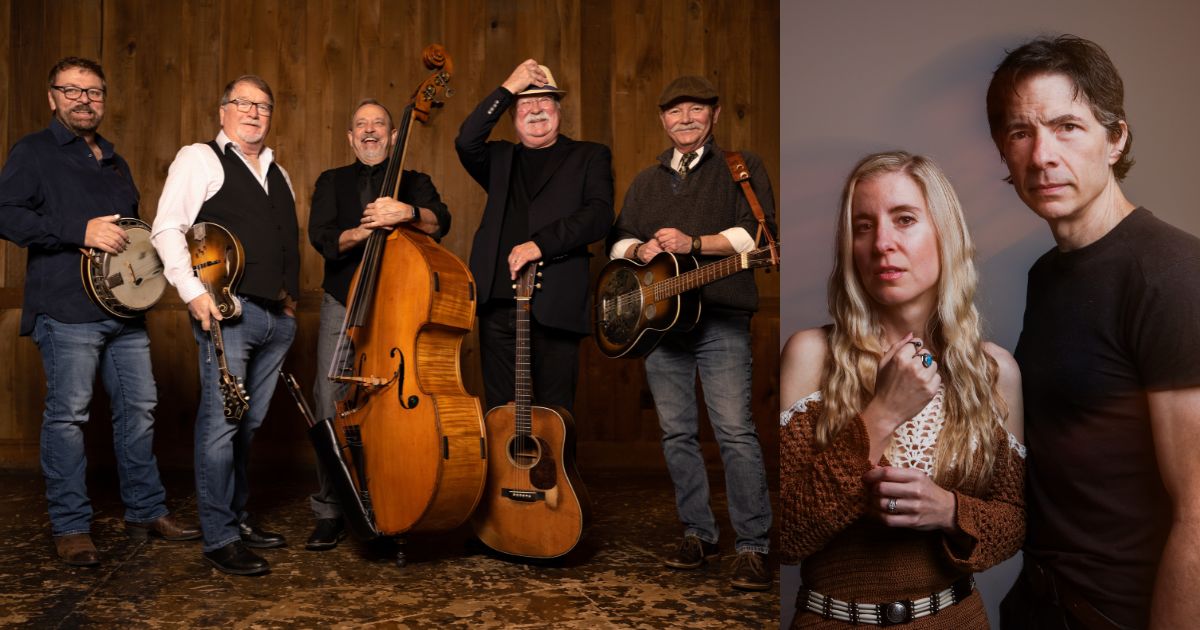
Photo Credit: Seldom Scene by Jeromie Stephens; Swearingen & Kelli by Daniel Shippy.

Kristin Scott Benson Shares Her Essential ’80s Bluegrass Banjo Tracks

I started playing banjo in 1989 and like most people, once I was hooked, I devoured all the banjo I could find. In my quest for the latest, coolest bluegrass, I ended up covering most of the music recorded in the ’80s. It took years to discover because (brace yourself, kids) there was no streaming or internet to bring it to us. We found music by buying CDs, listening to friends’ CDs, going to shows, and trial and error. In this list, I tried to represent the successful bands and players from the decade, who were recording music just before I fell in love with banjo.

Seeing Scott Vestal with Doyle Lawson & Quicksilver is what made me want to play, so his “Up on the Blue Ridge” is of special significance. I played along with Bill Emerson’s instrumental album, Home of the Red Fox, for countless hours. Sonny’s cut on “Listening to the Rain” (sung by Paul Brewster) is still a bit mystifying. I was sure I had two of these key phrases exactly right, but Sonny never thought I did. Shocking, I know. Thing is, he wasn’t entirely sure how he played them either.

Some of my favorite current music from formative years just missed the deadline, like Alison Brown’s “Simple Pleasures,” which was released in 1990, but I tried to stick with the ’80s only. I love these banjo players, bands, and songs. To this day, if I get sleepy driving in the middle of the night, I can turn on this music and get a second wind. I hope you enjoy these 19 glimpses into the ’80s. — Kristin Scott Benson


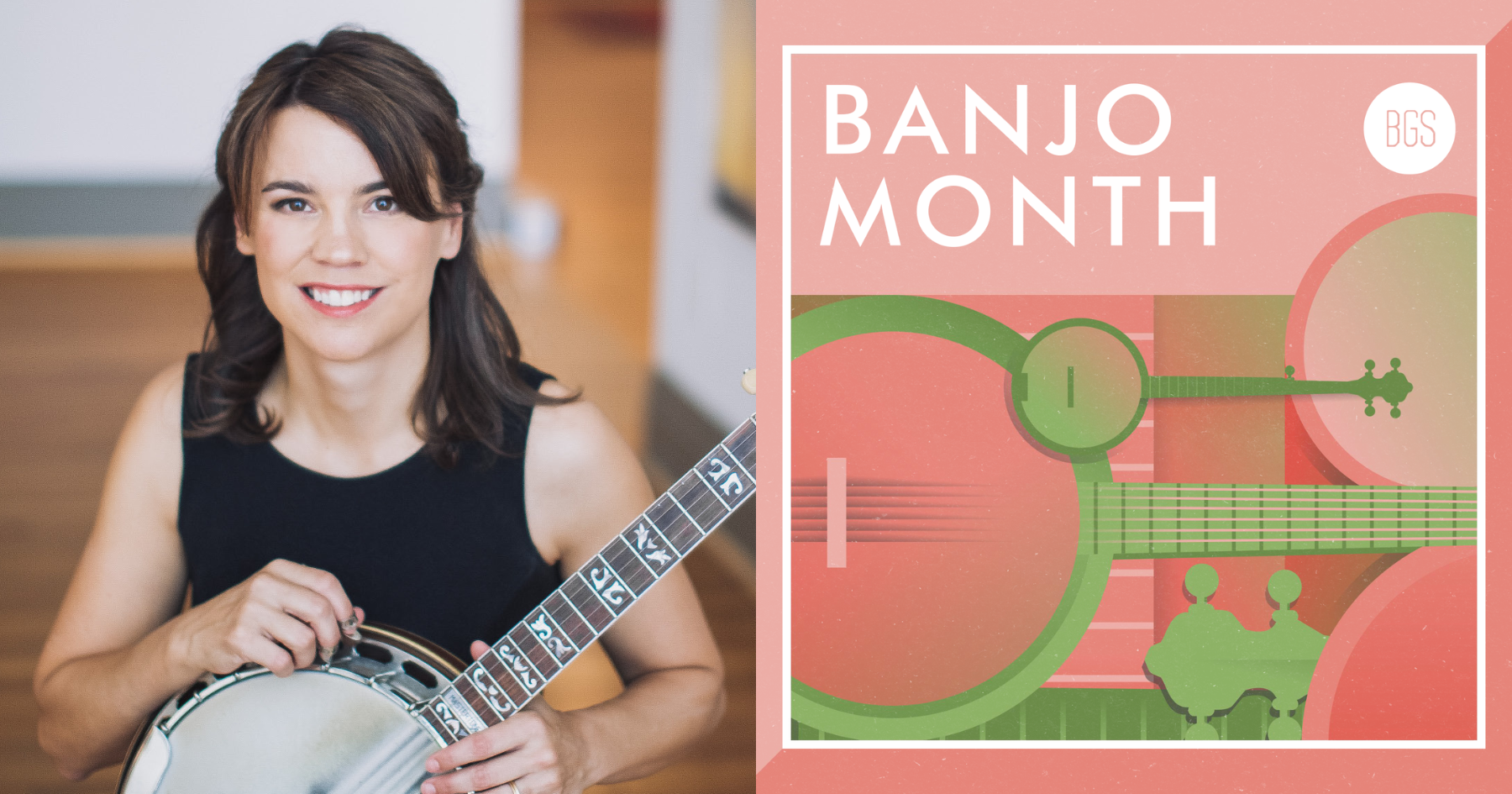
We’re giving away a Recording King Songster Banjo in honor of Banjo Month! Enter to win your very own RK-R20 here.

“The Shorthairs and the Longhairs”: The Story Behind ‘Bluegrass Country Soul’

Bluegrass Country Soul captures one of Carlton Haney’s legendary festivals in Camp Springs, North Carolina, on Labor Day weekend of 1971. It is credited as the first bluegrass documentary, and is essential viewing for both lifelong bluegrass fans and those new to the genre.

This classic film features bluegrass music’s pioneers, as well as those who would take the music into the future. Earl Scruggs, The Osborne Brothers, Ralph Stanley, Chubby Wise, Mac Wiseman, J.D. Crowe, and Jimmy Martin were featured alongside The Country Gentlemen, Del McCoury, Sam Bush, Tony Rice, Ricky Skaggs, Keith Whitley, Alan Munde, and more. The film documents Rice’s last show with The Bluegrass Alliance and his first show with J.D. Crowe & the Kentucky Mountain Boys. Many of the festival’s legendary moments are preserved in color for posterity.

A larger than life figure who is credited as starting the first multi-day bluegrass festival, Carlton Haney organized the weekend’s festival, and serves as the de facto host of the film, sharing thoughts about bluegrass music, bluegrass festivals, bluegrass fans, and the bluegrass “stow-ry.” His passion for the music is evident, and makes for a great depiction of one of bluegrass’s most significant and one-of-a-kind personalities.

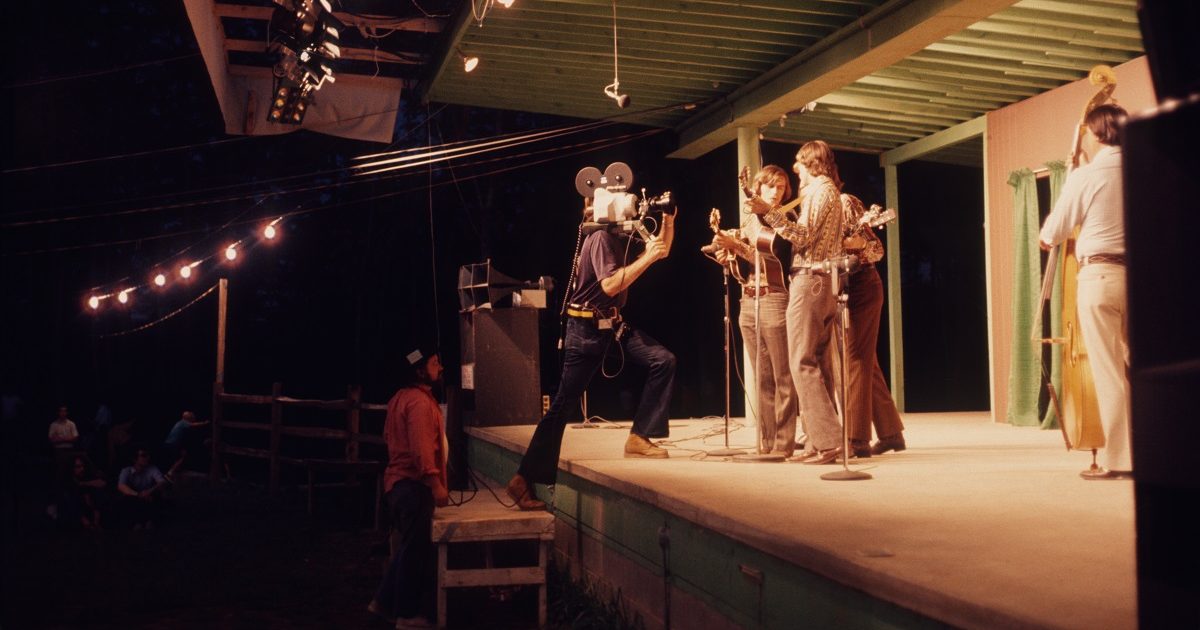
Albert Ihde, the film’s director (pictured below), spoke with BGS about the film and its legacy to commemorate the 50th Anniversary boxed set of the film, released this summer. The special edition set includes the original film, recently remastered and restored; CDs of performances not featured in the film; bonus footage including exclusive interviews with Ricky Skaggs, Bill Emerson, Missy Raines, and more; and a full-color coffee table book about the film.

BGS: How did the opportunity to film Bluegrass Country Soul present itself 50 years ago?

Albert Ihde: It was almost by accident, in a sense. A couple of buddies of mine and I were preparing a screenplay for a company in Washington, D.C. that had hired me to write a film, and then I would direct. The only thing that they insisted on was that it had to be about a Country & Western singer. Now this is 1971, and back then they called it Country & Western. I said, “Okay. Fine. Let me do some research on that.

A buddy of mine, Bob Leonard, and I were out scouting locations in Berryville, Virginia when we saw posters for Carlton Haney’s 4th of July Festival, and Earl Scruggs was going to be playing. We thought, “Well, that looks interesting.” To make a long story short, I got in touch with John Miller, who was the partner of Carlton’s there at Berryville, and John took us on a tour of the sites because I wanted to see what it looked like. It was right on the Shenandoah. Gorgeous location. He gave us passes to the Fourth of July Festival. We had no idea what bluegrass was, compared to country music, and we thought, “This looks like it’ll be fun. We’ll go to see this.”

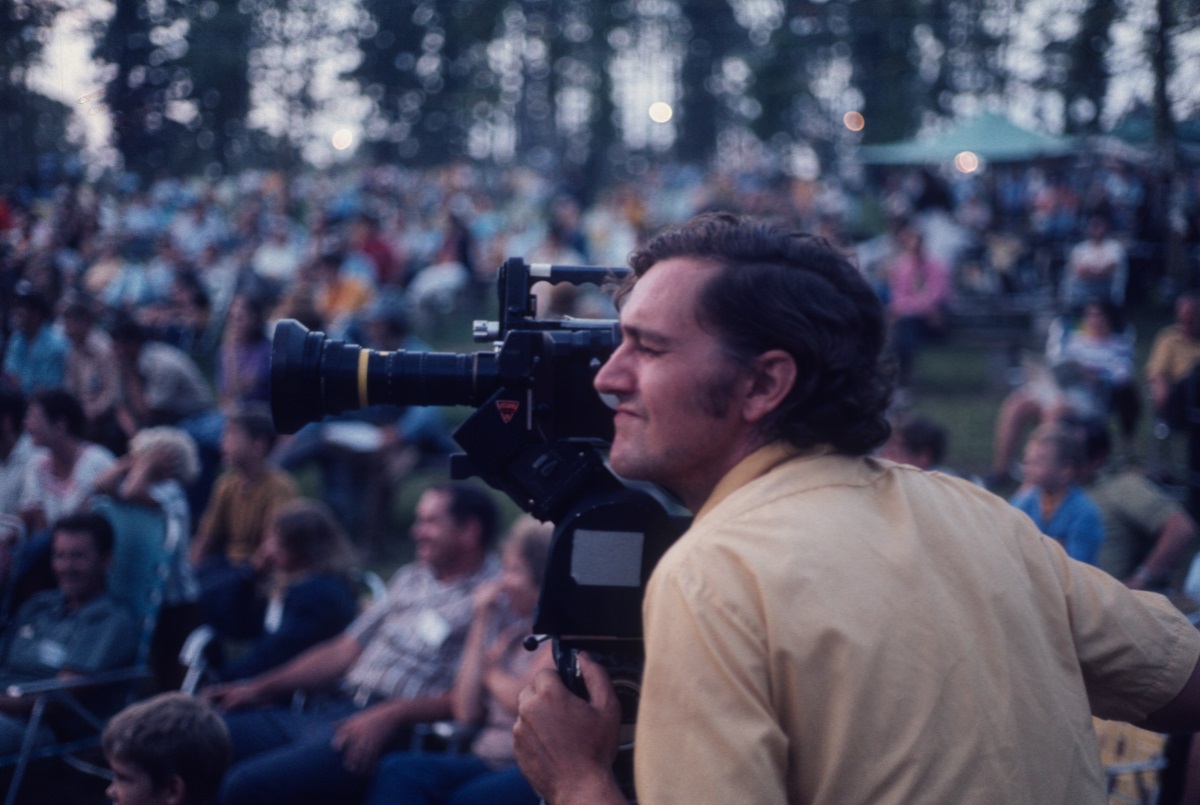
Director, Albert Ihde

A bunch of us got a VW wagon, and my wife hooked up a camper on the back of our car. We went out, and we parked and saw it, and I have to tell you, as soon as I heard that music coming from the stage, we were all hooked. We talked to Carlton. Quite a deal! Talked to Fred Bartenstein (a local disc jockey who helped with the annual festival) and they told us more about what they were doing. I wanted to put Carlton in a film right then and there as soon as I met him.

We got back to D.C. and the company that hired me to write this screenplay, it turned out that they couldn’t raise the money to make the movie. So we took the film and decided we would try and find the money ourselves. Fortunately the first guy that I sent it to called us into his office. He was a major D.C. investor, philanthropist, and owned lots of real estate in D.C. He said that the thing that interested him most about the screenplay was this bluegrass festival out in Berryville. He said, “Why don’t you do a film about that?”

My partner and I looked at him and said it’s gonna be hard to raise money for a documentary, and he said, “How much do you need?” We get our calculator out, we start going through it, and we throw a figure out to him. It’s not gonna be as expensive as the film that’s going to have all the actors that would be taking us six to eight weeks to shoot. This, we could shoot in one weekend. He said, “Listen if you get Carlton Haney to agree to allow you to come and shoot the film at his festival, I’ll go out and find the money.” And we said, “Okay.”

The next day, Bob Leonard and I were on a plane to North Carolina and met with Carlton and Fred, pitched the whole idea to him, and Carlton was on board right at the beginning. He said, “Absolutely. No problem.” I said, “Well, are you gonna get all of these musicians to agree to this?” And he said, “Yes, I can do that.”

We had all of twelve days, two weeks, or something like that, to get the whole thing together to get down to Camp Springs on Labor Day weekend. And we lucked out. We happened to have this incredible festival with all of the pioneers of bluegrass, along with all of the up and coming newgrass guys who were changing the music as we watched. It was a great mix of both the old and the new, and as Carlton called it, “the mixture of the short hairs and the long hairs.”

That was it! You’ve got the hippies sitting right next to the guys right off the farm in coveralls. A guy in a Confederate hat sitting right next to hippie girls. It was a great mix. And everybody got along. And it was at a time in America when the country split. Nixon and the protests trying to bring our troops home from Vietnam. It was a strange time. But the thing that happened at the festival… everybody was getting along all right! Also of course, most of the audience were bluegrass musicians of their own or were learning or wanting to be. So that’s how we got into it.

What were some things about Carlton’s personality that made him such a compelling figure to follow for a film?

A number of people have said he was like the “P.T. Barnum of Bluegrass.” So it was kinda like, just put a camera on him and let him go, because you never know what he’s gonna say! Of course, the great thing about filming is, you can always edit it, and we edited out a lot of Carlton.

At one point, it was towards the end of the weekend, we were filming Carlton out on the lot, and I say “Carlton, we need something to kind of summarize the whole thing, and put a tag on the end of the film.” He said, “Oh, that’s okay. I know exactly what to say. Do you want me to make you laugh or do you want me to make you cry?” And I looked at my cameraman, and Bob was ten years older than me, and he had a lot of experience doing this, and I looked at Bob and I said, “What do you think? Make us cry?” And Bob nodded his head “Yeah, make us cry, Carlton.” And Carlton said, “Okay, start the camera rolling.”

So we started the camera rolling, and Carlton is saying goodbye to the kid who is packing up his gear at the end, and then he turns to the camera and he says, “You know, when people leave, it makes me sad, because all my friends are leaving. But I know that they had a good time, and that they’ll be back again next year.” And tears are coming to his eyes! And he says, “And that’s bluegrass and that’s a bluegrass festival.” And I said “Cut!” Bob and I just burst out laughing, and I said “Carlton, you’re going to get an Academy Award for that!”

To this day, Fred tells me, he runs into people and he says they will quote to him the lines that Carlton had in the film. “The shorthairs and the longhairs,” [and,] “You look down upon the stage and you can hear the soul of man — Ralph Stanley.” They just came out of his mouth!

The other thing was, he could not look at the lens, no matter how hard I tried. [Carlton] had this real shyness problem, and yet you put him on the stage and hand him a mic in front of ten thousand people, he was fine. But put a camera in front of him, he was looking away. Kind of shy and withdrawn. I think he was very concerned about his looks. He had terrible teeth. As somebody once said, that’s part of the times back then when nobody had health insurance or dental insurance… that was the last thing that people spent money on. So I think Carlton was a little shy about the way he looked. But he was an interesting guy.

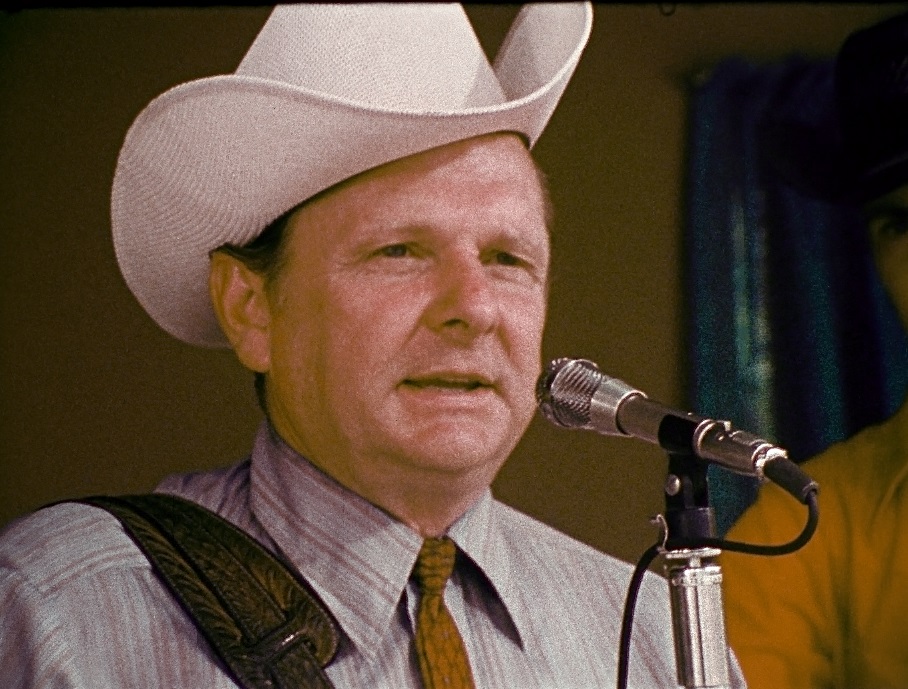
Pictured: Ralph Stanley

You mentioned that one thing that was so compelling about the film, and at bluegrass festivals in general, was seeing people from different walks of life united by this music and finding common ground, even if it was for a weekend. What do you think that message has for us today where we are as divided now as we were fifty years ago?

I hope it has the same result. Every time I have shown the film — and I have shown it to heads of studios in Hollywood, I showed it to corporations up in New York City — no matter where I’ve shown it, people leave the theatre with big smiles on their faces. It’s not necessarily because they’re bluegrass fans, but because they enjoy it. They had fun. They were delighted. Something about that music, about the people playing it, about the commitment that these people have to it. There’s more to it than just country music. I think that’s what Carlton was trying to say about the soul. It’s a commitment to the music that is thorough.

I don’t know whether Carlton told me this or not, but at some point I learned early on: bluegrass music is not commercial country. Meaning, you’re gonna lose your shirts on it, but you’re doing it because you love it. That really says it all, and I think that comes through with music and with Carlton and with all of the people that are on stage in the film and all the people playing out in the field… You see the commitment to the music.

Ellen [Pasternack, the project’s Executive Director and Ihde’s wife] and I have a background in professional theatre, regional theatre around the country, and what you’re always looking for working in theatre are actors who can really commit to doing a performance. It’s that commitment to the art — whether that’s music, theatre, dance, or painting — that’s where you find the joy in the art. And I think that comes through in the film, even if you don’t know anything about bluegrass. I hope that comes through still to this day, and maybe gets people thinking “past the politics” for a moment or two just to look at the music and listen to the music. And to see, “If this was going on back then, why can’t it happen again?”


Photos and trailer courtesy of Bluegrass Country Soul.

MIXTAPE: Mike Barnett’s Favorite Fiddlers

If you want to know who the best fiddlers in bluegrass and old-time are, ask one of the best fiddlers in bluegrass and old-time … right? Here, Mike Barnett rattles off not just a list of songs by great players, but the reasons they are so great. Enjoy his insider’s view.

“Flannery’s Dream” – John Hartford

Records from John Hartford like Wild Hog in the Red Brush and Speed of the Old Long Bow got me really excited about the energy in old-time music. I never got to meet Hartford, but feel a connection to him through his music. He brings a special vibe that I’ve often tried to channel. I’ve heard stories that he used to have a guideline that nobody in his band could repeat their accompaniment/part for more than one section of a song, everyone had to mix up their playing often, which gives his music a certain drive and breath.

“Black and White Rag” – Johnny Gimble

When I heard Johnny Gimble play at Mark O’Connor’s camp maybe 14 years ago, it was so strikingly Texas, so rooted in that tradition. I particularly remember his feel when playing Texas rags captivating me, like here in the “Black and White Rag.” Johnny helped me understand more deeply the true spirit and community of Texas-style music.

“Bound to Ride” – John Hartford, Tony Rice, and Vassar Clements

Vassar Clements invented his own, incredibly unique style of fiddling. The vibrato, silky tone, double stops and slides … it’s like magic whenever he touches the fiddle, and I can tell within two notes if it’s him. This recording of “Bound to Ride” is a great snapshot into Vassar’s unique way of playing around a melody, backing up the vocal, and lifting the energy of a song.

“Dill Pickle Rag” – Buddy Spicher and Vassar Clements

Buddy Spicher is one of the legends, and one of those fiddlers you’ve probably heard but maybe didn’t know it was him. It was Buddy who got me wanting to play second fiddle — the harmony. This recording of Buddy with Vassar on “Dill Pickle Rag” shows some of Buddy’s genius and virtuosity (and Vassar’s!).

“Lonesome Moonlight Waltz” – Kenny Baker

Hard not to mention Kenny Baker here. I listened to his album Kenny Baker Plays Bill Monroe frequently growing up, and I’m still trying to understand those bowings! His playing is so clean, clear, good tone and time, and great melody player.

“Sally Goodin'” – Paul Warren

“Sally Goodin'” was actually the first COUNTRY hit! #funfact It was Tony Trischka who got me listening to Paul Warren when I was about 17. Another one of the legends in bluegrass fiddle, Paul brings a grit and edge that is often lost in modern bluegrass fiddling.

“Estrellita” – Bobby Hicks

Once Bill Monroe was asked if he had a favorite fiddler of those who’d played in his band. Bill said, “I’ve had a lot of fiddlers come through my band, but I believe Bobby Hicks was the truest fiddler I ever had.” Bobby is the double-stop king, and took a lot from what Tommy Jackson did with his single note playing around a vocal and made it his own.

“Back Up and Push” – “Benny Martin

Benny Martin’s double stops, attack, and full-throttle style really resonate with me. The tone he gets in this version of “Back Up and Push” makes it seem as if he’s got a brick tied to the end of his bow. And when he gets to the shuffle, it’s clear that so many contemporary fiddlers have been heavily influenced by how he did it.

“Raggedy Ann” – Curly Ray Cline

If you’re wondering who ever had the most fun playing the fiddle, all you need to do is search “Curly Ray Cline Orange Blossom Special” on YouTube, and you’ll find that it was in fact Curly Ray Cline! He’s most known for his work with the Lonesome Pine Fiddlers and Ralph Stanley and is as much a treat to watch as to listen to. I love his note choice and where he plays in the beat — what he does with the time.

“Fire in the Mountain” – Scotty Stoneman and Bill Emerson

Scotty Stoneman was a wild man of a fiddler. His double stops and slides, and aggressive approach to the fiddle, are some things I’ve always gone and checked back in with in my listening. You can hear some of what I’m talking about with Scotty’s sound in the recording of him playing “Fire in the Mountain.”

“Learnin’ the Blues” – The Del McCoury Band

The Del McCoury Band is one of the finest — if not THE finest — bluegrass bands still in the business. One G run from Del will set you straight for the whole year. Jason Carter has got the old bluegrass sound, and I love how much he digs in and goes for stuff, and pulls so much sound and soul out of the fiddle.

“Pickin’ the Devil’s Eye” – Bruce Molsky

I’ve always loved this recording Bruce Molsky made with Rushad Eggleston, Darol Anger, and Michael Ducé of “Pickin the Devil’s Eye.” The groove masters! Or maestros! Bruce’s propulsive bowing, groove, and reverence for tradition is really remarkable. He’s basically a one man band, and hearing him here is transcendent.

“Buffalo Nickel” – Béla Fleck and the Flecktones

Stuart Duncan has played on countless recordings so it was hard to choose just one, but Béla Fleck’s Bluegrass Sessions was one of the most influential for me, and a major landmark in acoustic music. “Buffalo Nickel” is gorgeous, and Stuart plays the melody with so much taste, tone, feel, soul, intonation … all the good things. To me, Stuart has always been sort of a perfect combination of all the things I love about fiddling.

“Future Man” – Strength in Numbers

Mark O’Connor is one of the most versatile players on the planet, combining so many styles and influences so flawlessly to create his own incredible voice. Telluride Sessions by Strength in Numbers is another must-have album. The way everyone plays together, and Mark’s precision and virtuosity … amazing. His solo here on “Future Man” is a highlight — a glimpse of what Mark is capable of.

“Ducks in the Millpond” – Aubrey Haynie

Aubrey Haynie is the initial reason why I got into bluegrass. His sound made me want to learn how to do that. One of my favorite fiddle albums out there is Aubrey’s The Bluegrass Fiddle Album. I like this cut of “Ducks on the Millpond” — a really cool instrumental that weaves between three sections. Aubrey mostly plays the melody with so much tone and taste, and varies it slightly toward the end.

“Sweet Georgia Brown” – Billy Contreras

Not everyone is familiar with the fiddle stylings of Billy Contreras, as his genius is less substantially documented. I think he is the greatest improviser on the violin to ever live, and a master when it comes to bluegrass, swing, modern jazz… he can do it all. His brilliant, almost mathematical mind for music, combined with his deep heart for it all, is endlessly inspiring.

“Lee Highway Blues” – Darol Anger and Stuart Duncan

Growing up, I listened to so much music that Darol Anger is responsible for: Republic of Strings, duo with Mike Marshall, his own projects, his work with the David Grisman Quintet, etc. Besides his amazing lead playing, he is known for paving new roads for the violin as a rhythm instrument with his infectious groove and development of the fiddle chop. His album, Diary of a Fiddler, has so many thoughtful duets with great fiddlers of different styles.

“It Don’t Mean a Thing” – Stuff Smith

Matt Glaser, who turned me onto so much priceless music during my time at Berklee College of Music, introduced me to Stuff Smith. I love Stuff’s emphasis on groove and blues, and the grit and directness in his sound.


Photo credit: Justin Canerer