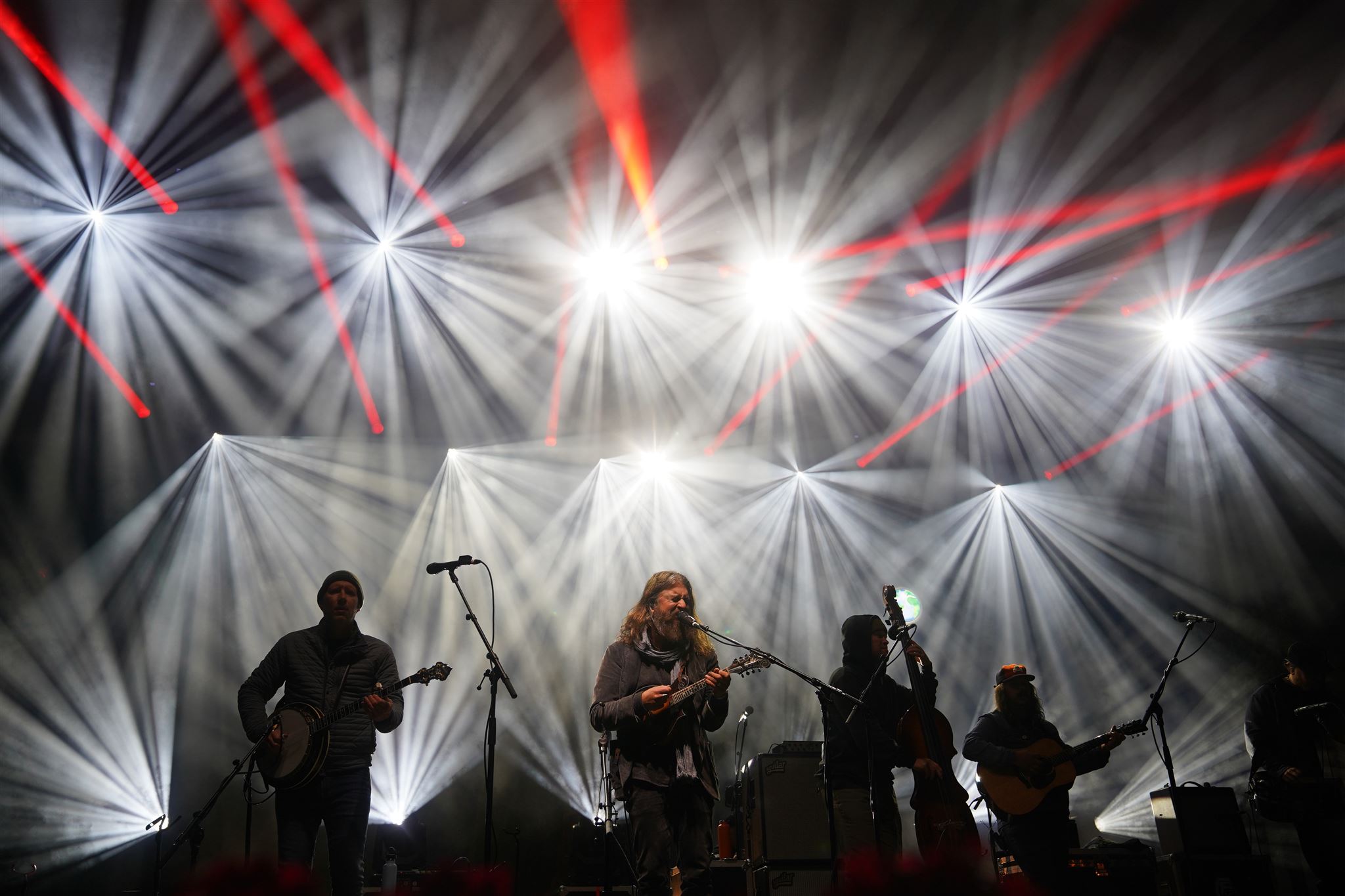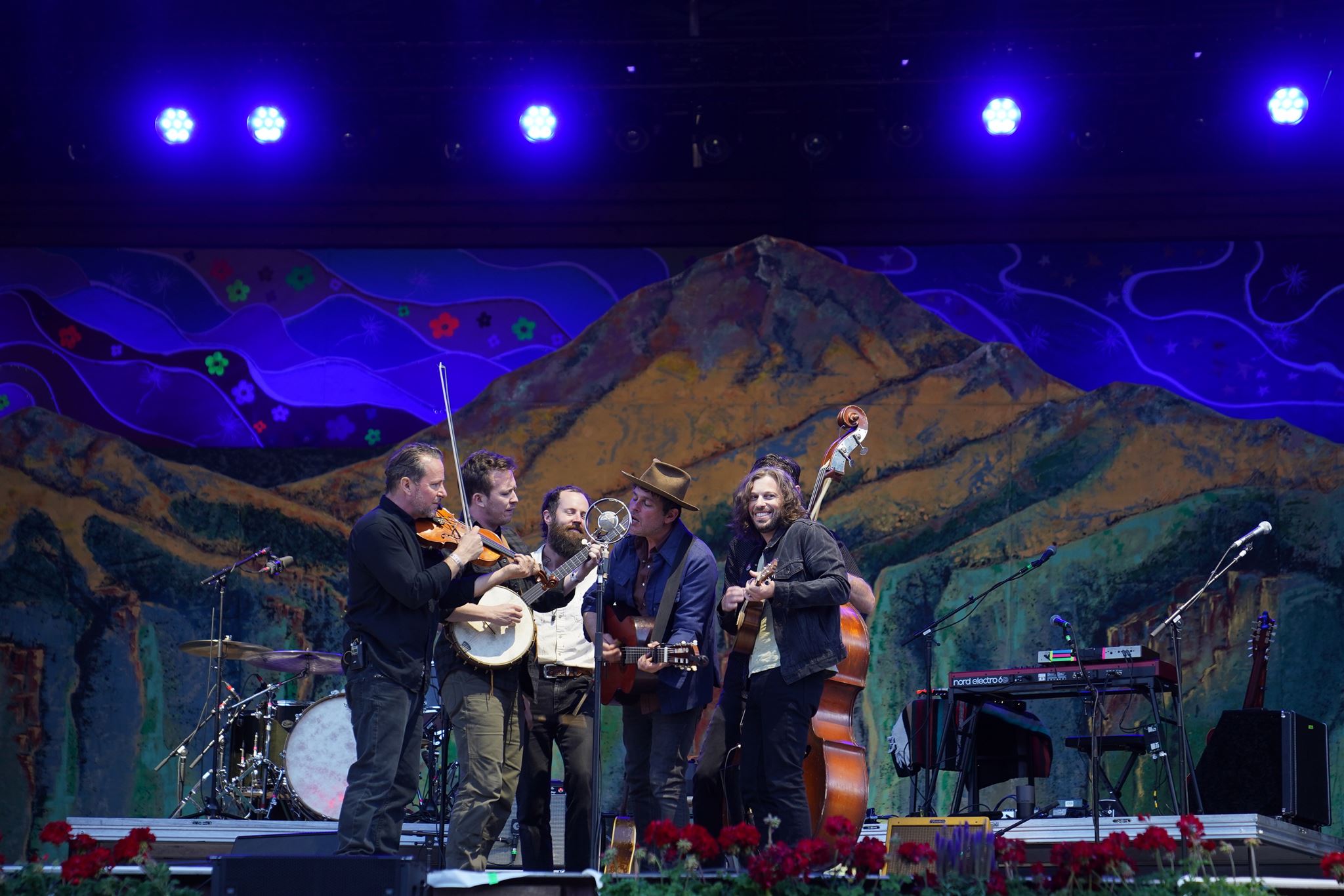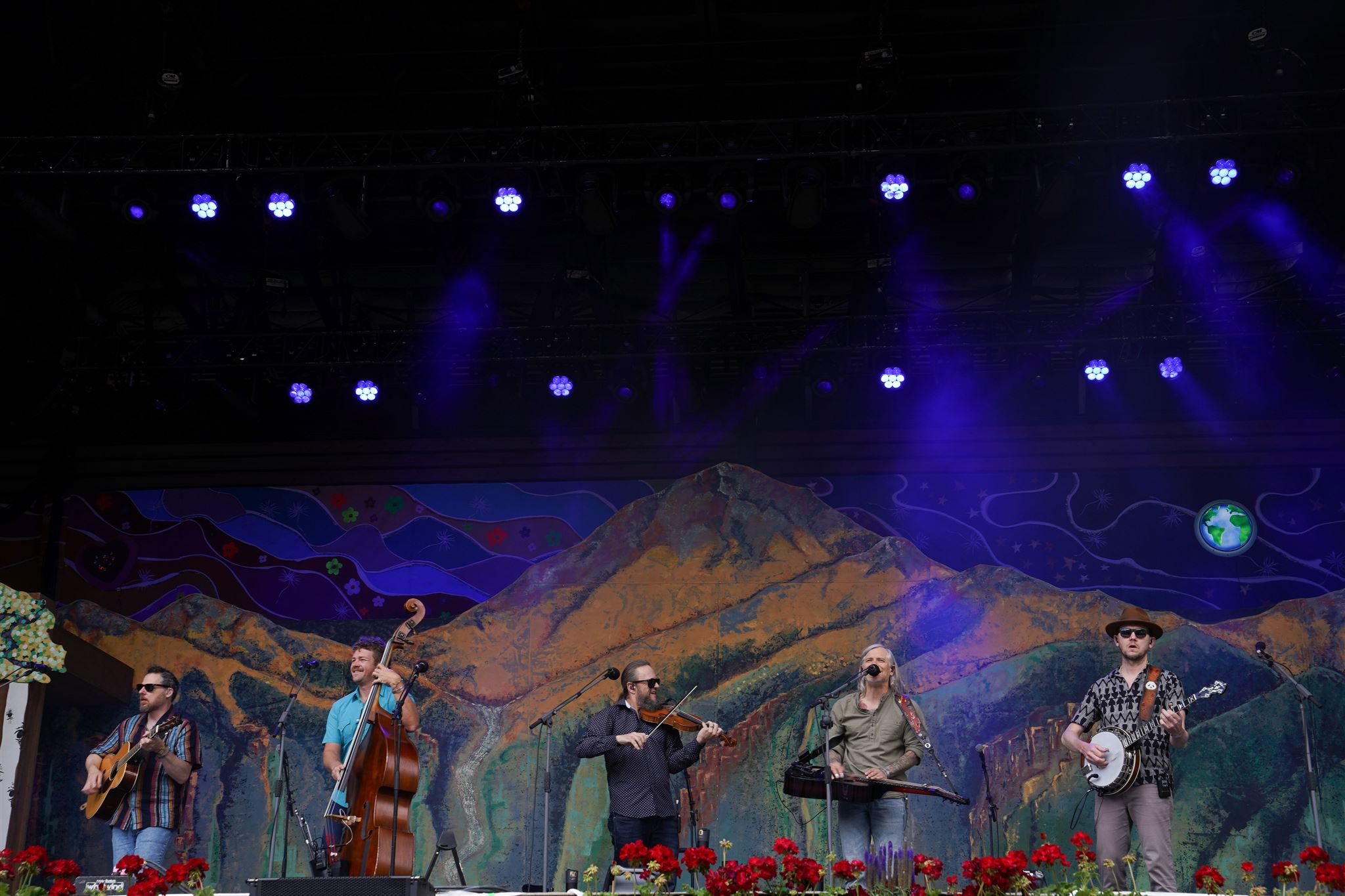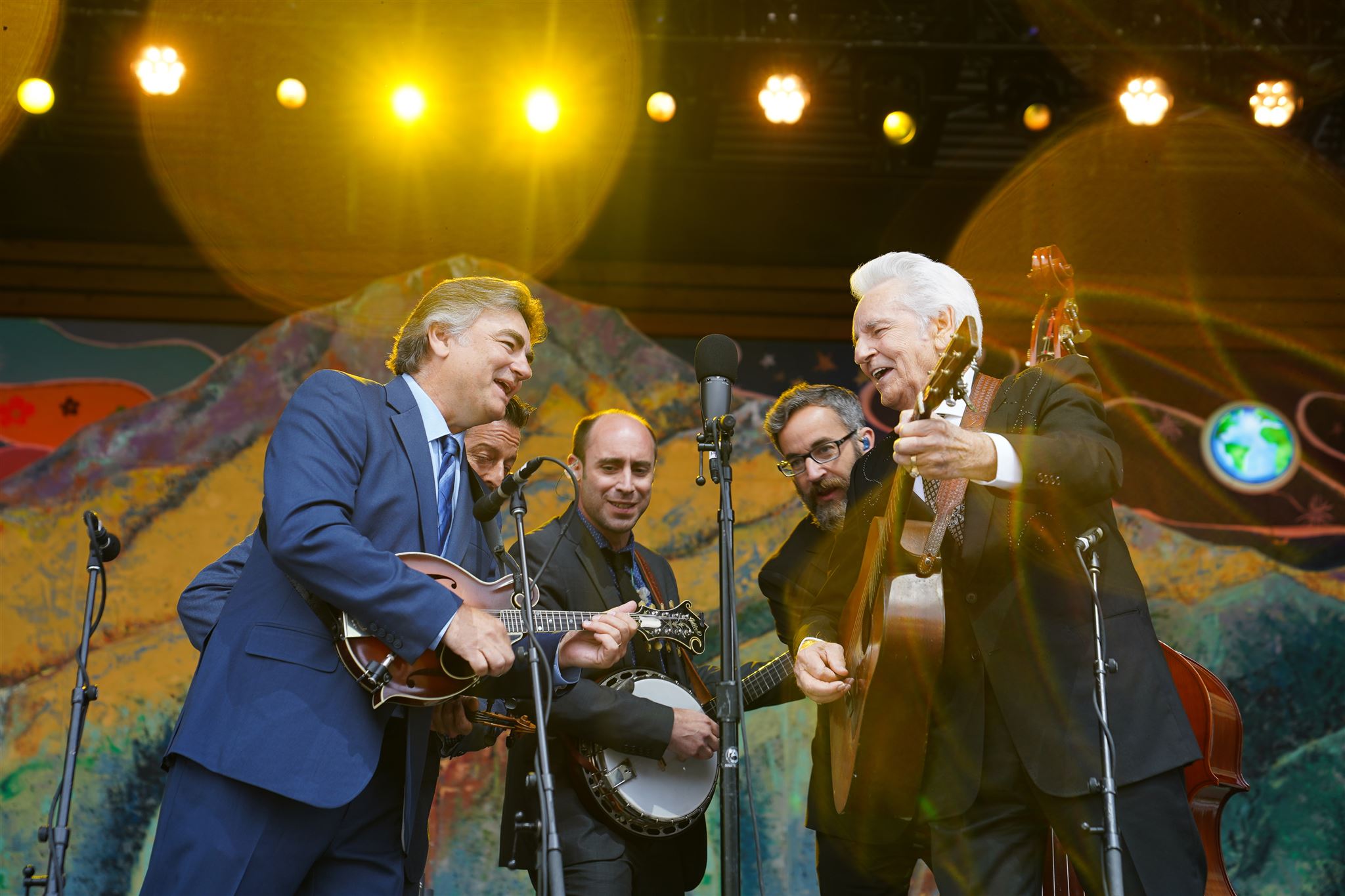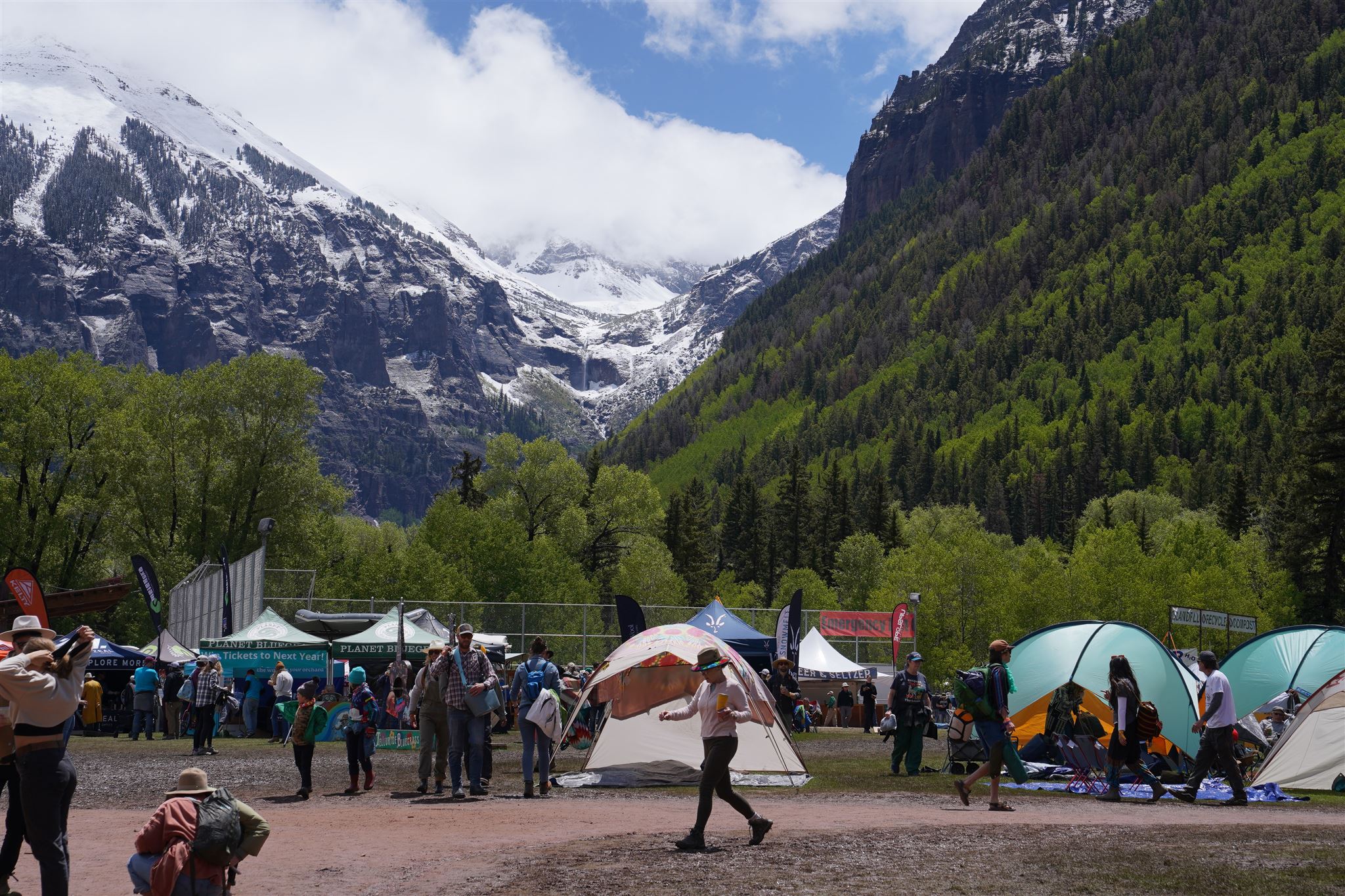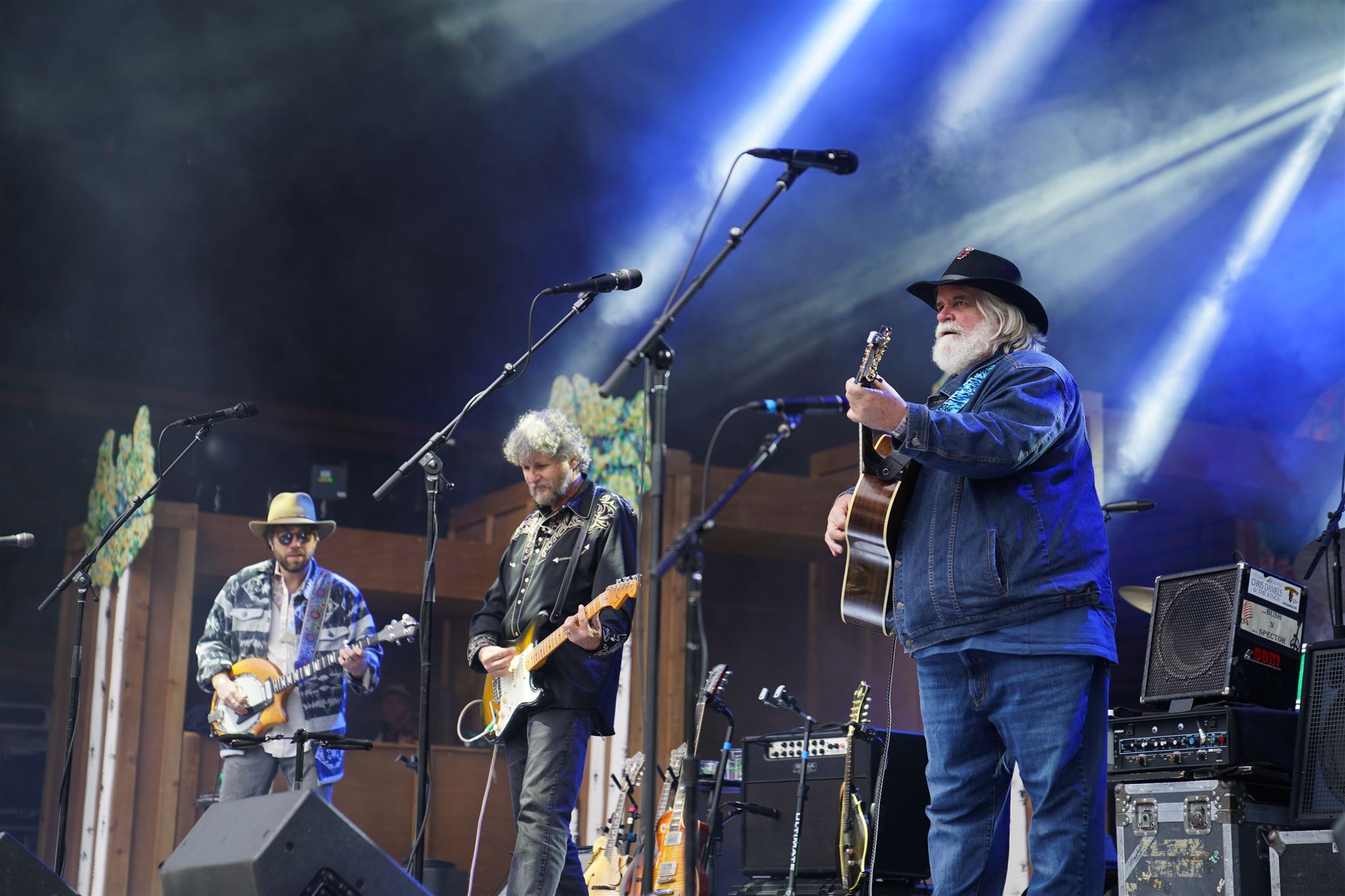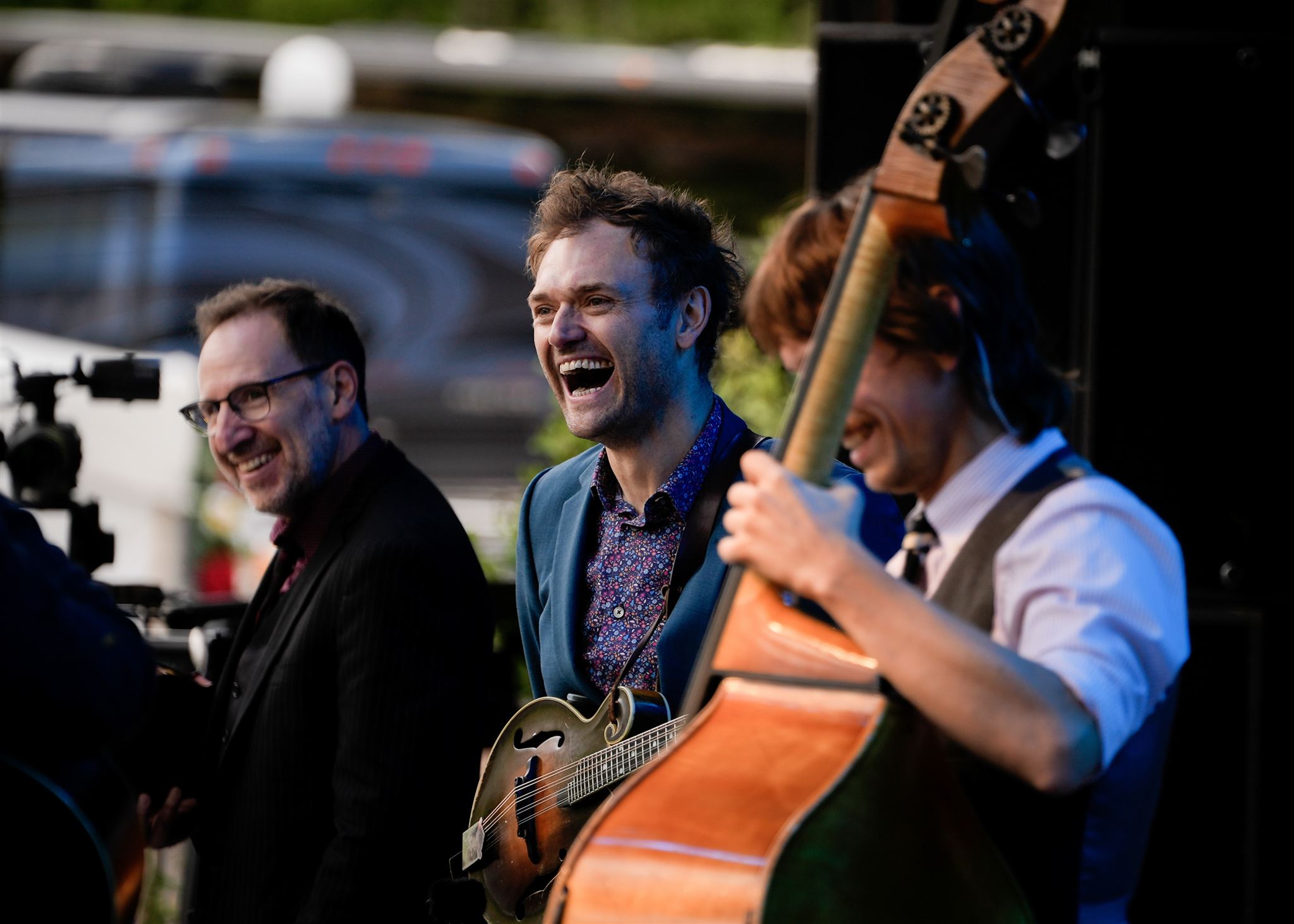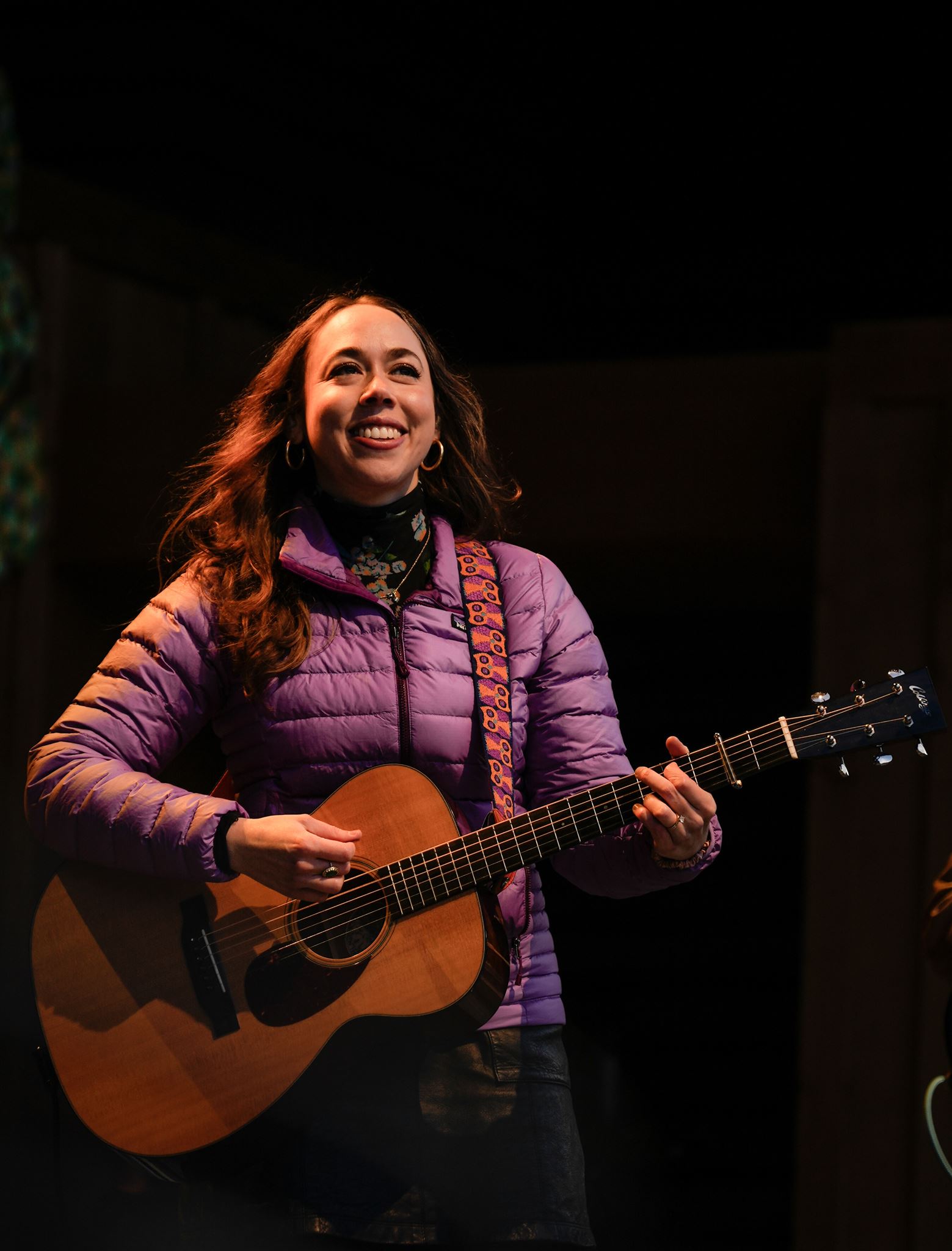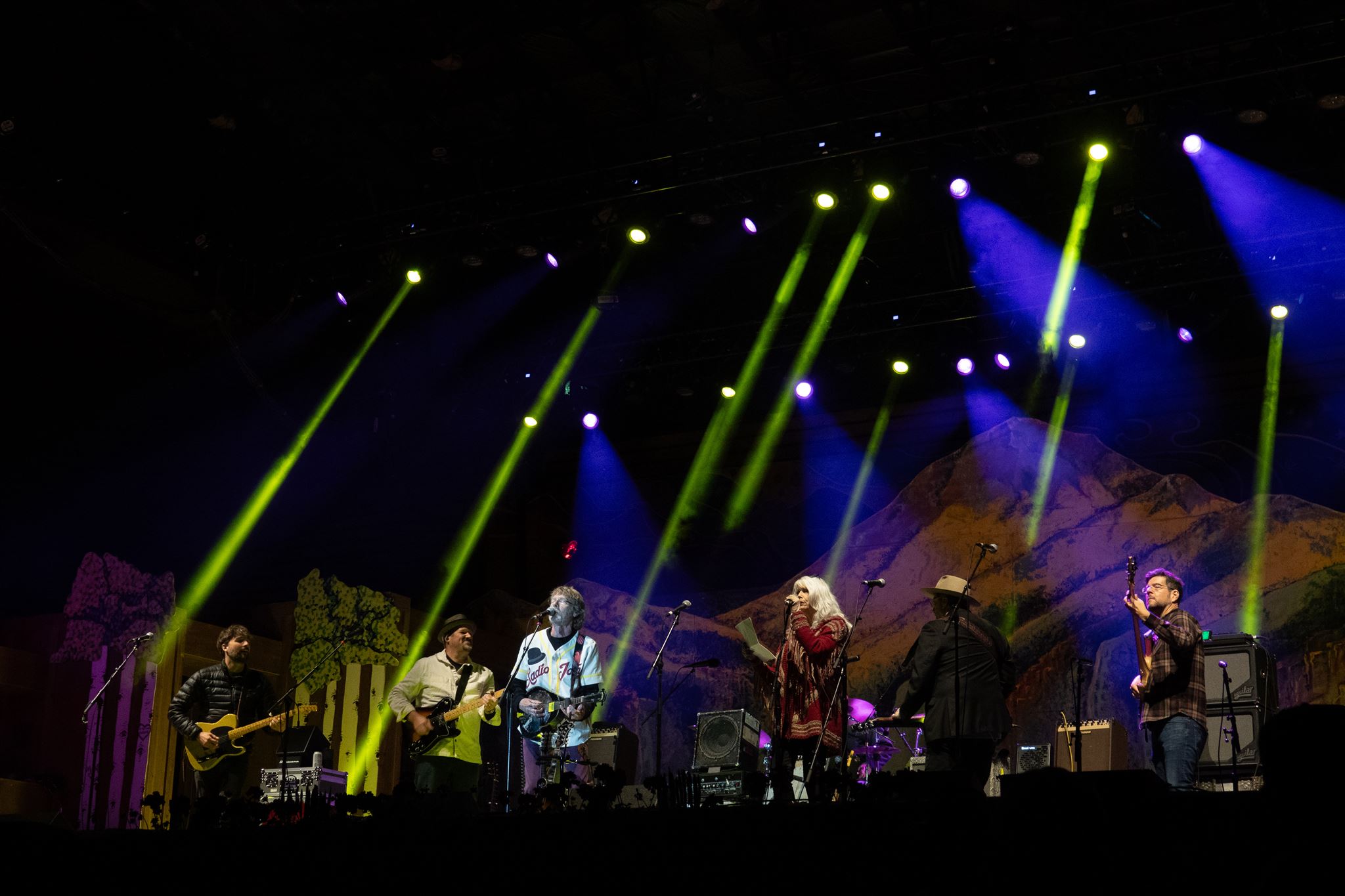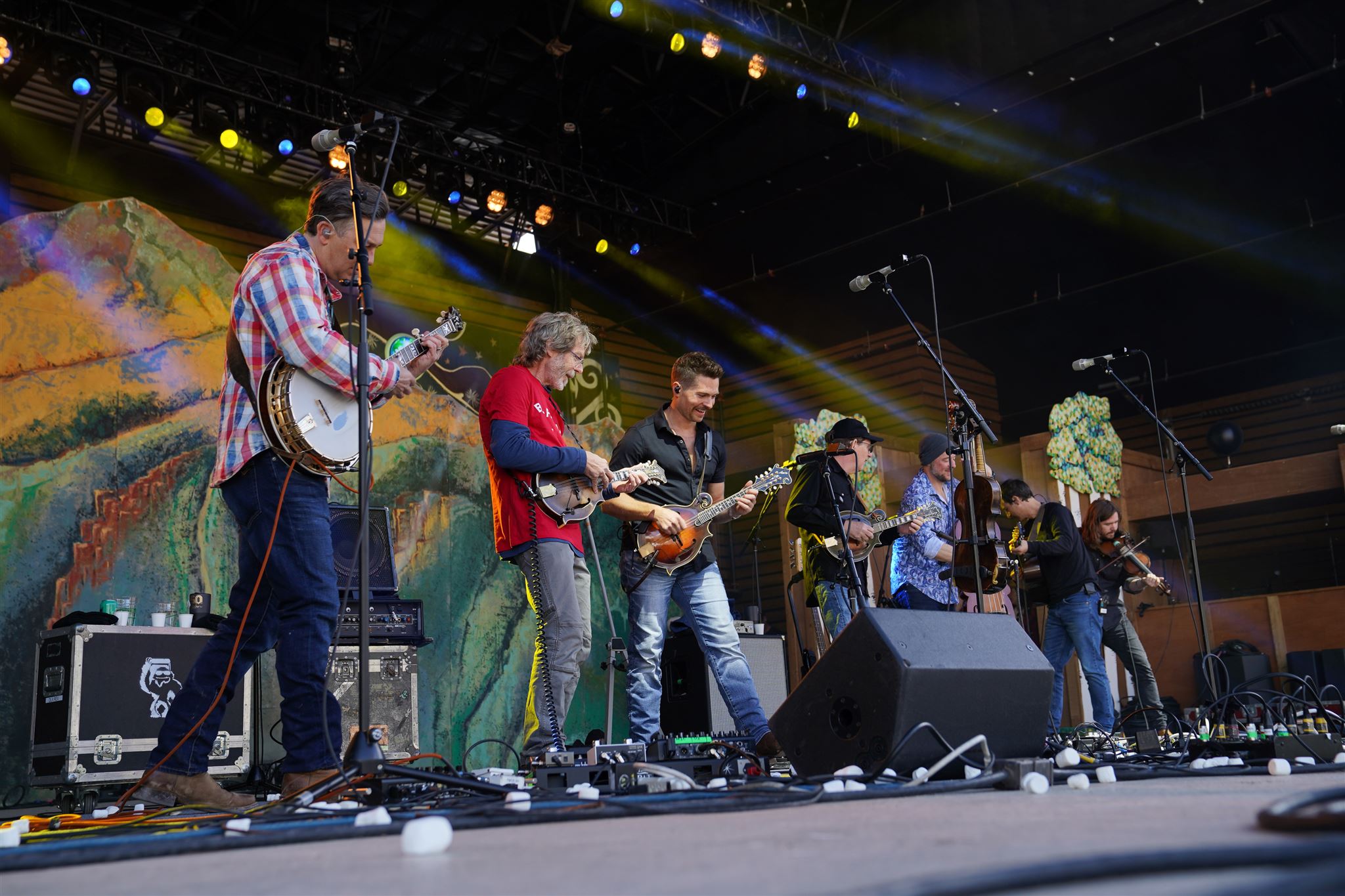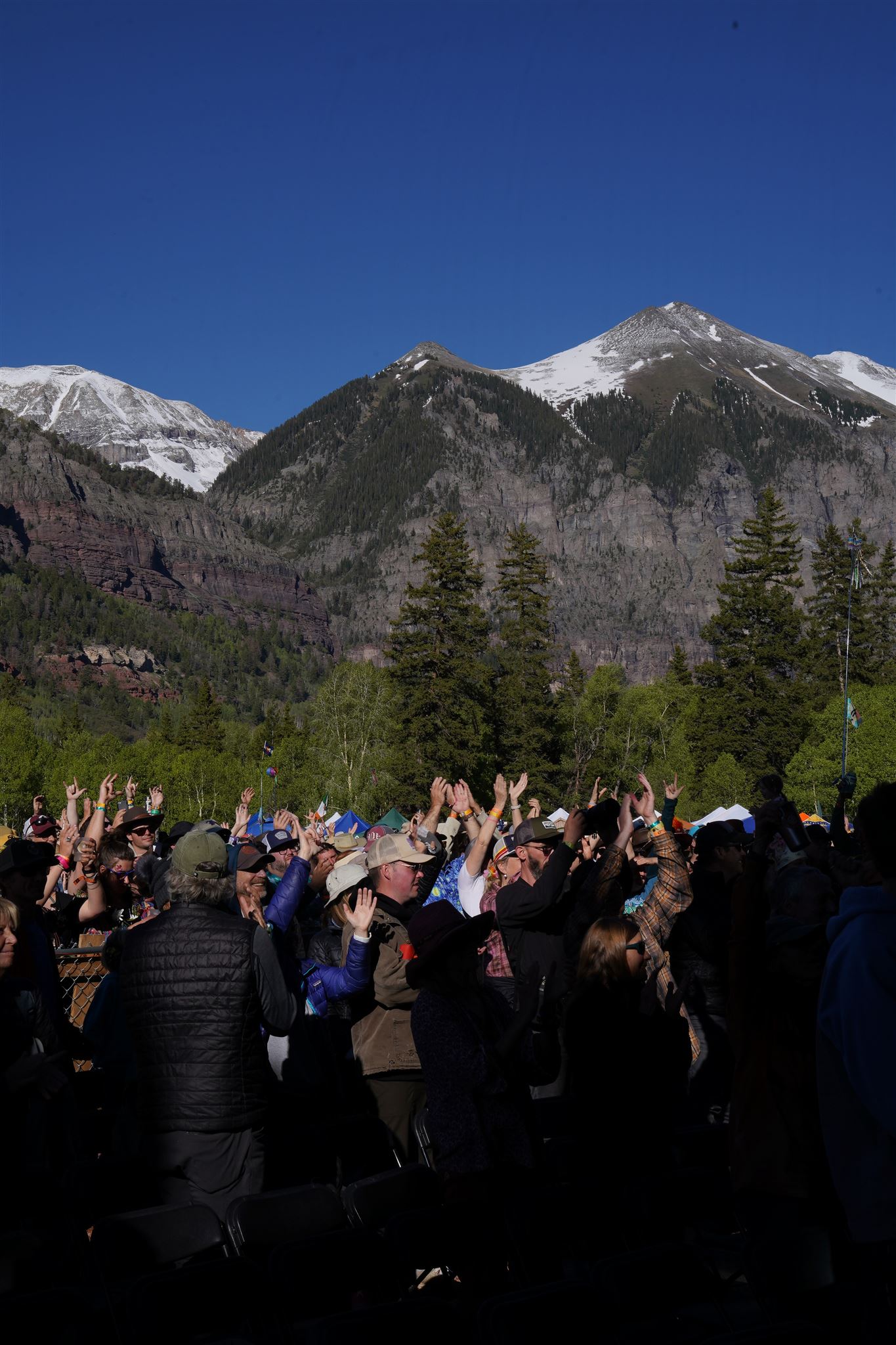
An Oral History of the Infamous Stringdusters

BGS was founded 14 years ago and from the very beginning, we’ve been covering, collaborating with, and cheering on the Infamous Stringdusters. Our first posts about the group published to our site in 2013 – not even a year after our launch – spotlighting banjoist Chris Pandolfi’s Bluegrass Manifesto, the band’s only-four-years-old marquee event The Festy Experience, and their most recent album at that time, Silver Sky. Now, in 2026, they’re not only our Artist of the Month for the second time, they’ll be headlining our stage at Bourbon & Beyond this September, too. But, our love for the band – and the many partnerships we’ve built together – began, like most, back in 2007 with their now iconic debut album Fork in the Road and a banner year for the group at IBMA’s World of Bluegrass and the IBMA Awards.

Back then, when the Stringdusters took home trophies for Song of the Year (“Fork in the Road”), New Artist of the Year, and Album of the Year, perhaps no one – not even the band themselves – would have predicted the seismic, existential impact they would end up having on bluegrass and the as-yet-unnamed subgenre thereof: jamgrass. Twenty years on, the Stringdusters celebrate their duo of decades with 20/20, an album of 20 songs celebrating 20 years of defining and redefining bluegrass and jamgrass.

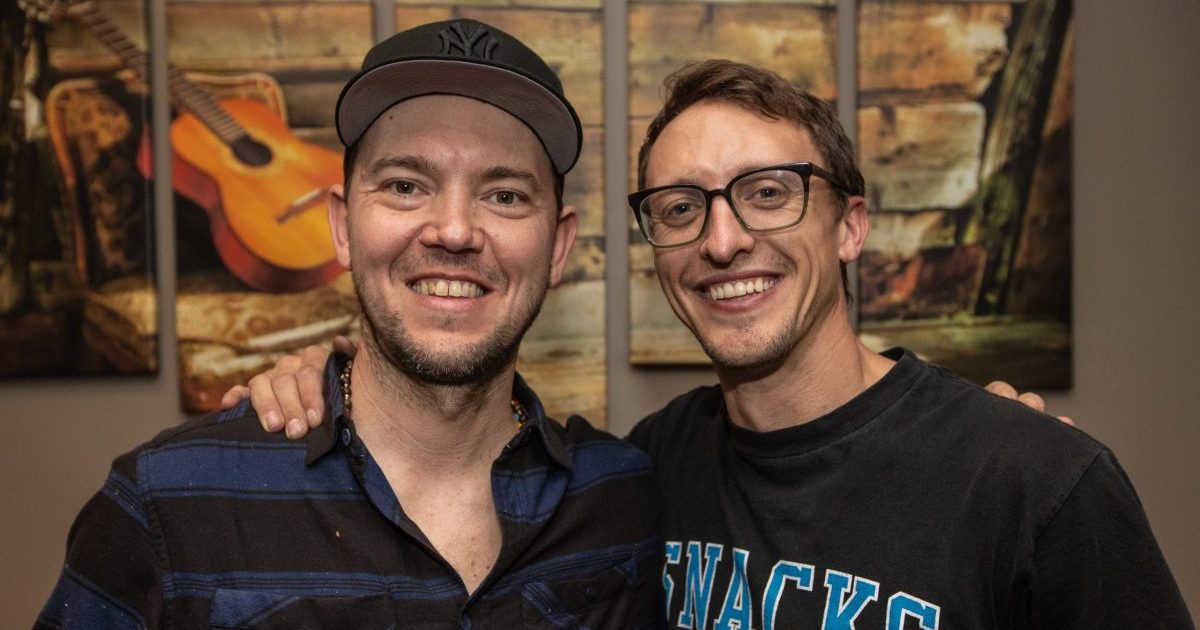
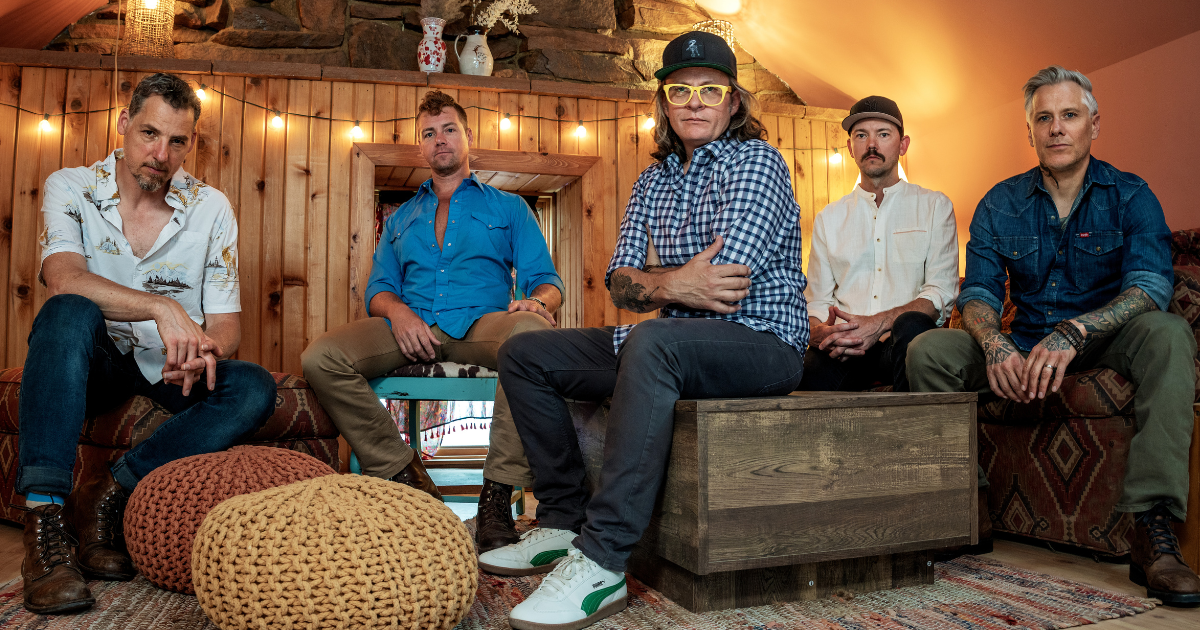
For our Artist of the Month coverage, BGS and Good Country co-founder Amy Reitnouer Jacobs sat down with all five members the Infamous Stringdusters for a wide-ranging conversation of a band that epitomizes bluegrass, jamgrass, and psychedelic string band music in the 2000s.

First of all, again, I wanna just thank you for doing this. We are so thrilled to have you guys as our Artist of the Month and congratulations on 20 years of the ‘Dusters.

I wanna start this with Panda actually, and this is not gonna be just an oral history interview, but I think, looking back on 20 years, it feels appropriate to start from the beginning. So let’s talk about origins and start back at Berklee [College of Music], if that’s cool. Tell us a little bit about the beginning of the band.

Chris Pandolfi: I arrived at Berklee in 2001, which was the year that Andy [Hall] had just left Boston for Nashville. I first met Critter [Chris Eldridge] through Zach Hickman, who was playing in Josh Ritter’s band. He went to Oberlin [University] with Critter. We got together and we were playing, and Zach had some free studio time at a spot in New Hampshire and we were gonna go record some music, just for fun. Our careers were not underway in any way, shape, or form. We didn’t have any grand designs here. We were just gonna go record some music and have some fun.

Then, on the precipice of this recording, we went down to the Cantab Lounge to meet this guy named Andy Hall. We went there and–

Andy Hall: [It was] The Plough and Stars.

CP: The Plough and Stars! Andy was playing–

AH: I don’t remember exactly if I was playing or if you were playing.

CP: And the next day we were in New Hampshire at this recording studio and we made this EP called Stable Horse. Essentially, Andy was already living in Nashville, so around that same time, he had met Jeremy [Garrett] and they were playing together. It was that recording session that got the wheels turning for me. Like, “Oh, we could do this thing with other people our age,” and not fall into the very sort of common thing in bluegrass where you get hired by someone else and you’re essentially a sideman.

We were recording and teeing things up, and we all had other gigs at that time. It was me, Andy, Jesse [Cobb], Critter, and Alan Bartram from the Del McCoury Band. But that was my earliest memory of “We could start a band with our contemporaries.” And Zach Hickman, I give him credit, he facilitated that.

I don’t even think we had the name “Stringdusters” yet. Alan got the offer to go play with Del McCoury and we had met Travis [Book] at IBMA, so we called him up and he came and lived in my driveway for a few months. True story.

Travis Book: You can really get away with a lot if you park your car in someone’s driveway and then try to stay outta the way.

So Andy and Jeremy, what are the origins of you guys starting to play together?

AH: Was it Ronnie Bowman? Was that the first time? I was in Ronnie Bowman’s band and the fiddle player and Ronnie had a bit of a falling out while we were on the road and–

CP: We were all at a festival, so we scooped up Jeremy and he got on the bus with Ronnie Bowman!

Jeremy Garrett: Yeah, I definitely knew about you two beforehand. And, of course, in bluegrass everyone’s a fan of Ronnie Bowman. He’s such a crooner and such a cool cat. I definitely had plenty of experience before, but this was like one of my first major Nashville gigs. And it was eye-opening very quickly that, as a sideman, it’s pretty limiting.

The conversations I remember started happening pretty fast in the back rooms: “Hey, let’s maybe consider doing something of our own. Long-term, how can we make this happen?” But it was just like whispers. I remember going to IBMA – that’s where I met Chris Pandolfi and he blew me away with his melodic banjo playing style and this futuristic sound that he had. I’d really never played with that before, because I came from a very traditional side of bluegrass.

CP: Didn’t I give you a copy of my record? I remember you telling me that.

JG: Yeah. And I listened to that record all the way home from IBMA – I’ll never forget – and my dad was riding with me. I was just like, “This guy’s awesome.” Overall, it felt like all of us coming together through our connection in Nashville and these music parties that used to happen on the reg. I don’t know if they still do. We would have huge jam sessions, especially at Panda’s Pad. There’d be 20-30 people all gathered up in somebody’s backyard, picking. And it was almost every night. So you can’t help but get tight and start seeing the writing on the wall, the possibilities, through those kind of connections.

CP: These days in Nashville are so different. It’s so much “cooler” now. There’s so many young people playing bluegrass and when you hear about a lot of the socializing in Nashville, it’s a lot of young musicians. When we were having these parties, it was a real diverse mix of ages. You had Sam Bush there, you had Scott Vestal, you had Ronnie Bowman, and the McCourys. We were the young cats around and there wasn’t a very vibrant young scene. We were intermingling with a lot of the elder statesmen of bluegrass.

That’s a really special time in Nashville. I can remember that’s when I started hanging out in town and there was like a magic in the air. That intergenerational mix doesn’t organically seem to be happening as much, but maybe it is and I’m just not invited to parties anymore.

So Travis, were you coming to Nashville from Colorado? Where were you before then?

TB: Yeah, I was living in Durango and Anders Beck from Greensky [Bluegrass] and I started playing music together in maybe 2002. There were gigs and we were learning this music and then Andy Thorn and some other friends – that’s Leftover Salmon – they just showed up in a music store one day. Andy was probably 19 on college break and we hung out with him for three days straight. When he went back to North Carolina, we called him up. We’re like, “Dude, you gotta come back! We gotta make a band! We’ll play RockyGrass, you’ll win the banjo contest, we’ll win the band contest.” Anders and I were like, “We can see the future, but we need Andy Thorn,” because he was such a compelling musician and just such a natural. Still is.

We started this band called the Broke Mountain Bluegrass Band with Jon Stickley, who’s also a visionary in our music. We were all picking and almost entering that same path as Leftover Salmon or Yonder [Mountain String Band]. We were already doing this like hippie bro band, just loving playing music and camping and playing festivals and going to hot springs and just fucking around. It was brilliant.

But then we went to IBMA, which at the time was the best way to show off your band and position yourself in the context of the larger [bluegrass] world. Try to get some gigs and go party your absolute brains out for a week. We were pretty rough around the edges, but one night I stepped off an elevator and Chris Eldridge came around the corner. [He] was like, “We need a bass player for this jam. Will you come jam with us?” I went into this little alcove and it was essentially the Stringdusters. It was Critter and Pandolfi and Andy Hall and Jeremy and Jesse Brock. I was just hanging out, holding on for dear life. I’m partying, I have a backpack full of beer, I have no shoes on, and I looked around and all my band mates were just there sitting along the hallway floor listening to the jam.

Andy’s partner at the time, Janice, said, ” Do you ever think about moving to Nashville?” I just laughed. Absolutely not. But I had fixed myself in their mind and once they exhausted all the possibilities of people who could play bass in Nashville – at least this is my understanding – they dug into their collective consciousness and called me up to audition. They’re like, “We think you’re the guy. When can you move to Nashville?” So I went out there to work on Fork in the Road that summer. What was this, 2004? Am I right, guys?

AH: I think that would’ve been 2005.

TB: Yeah, you’re right. 2005. [I] moved out there in September and lived in this guy’s driveway. It was kinda wild.

Falco, I promise we’re getting to you. We’re almost there!

In pretty quick succession though, you’ve got the core crew with Critter and Jesse [Cobb] at that time, you record the album, and get signed to Sugar Hill. And then things just start happening! Can you walk me through the time between recording and the IBMA Awards in ’07?

CP: There’s a lot of extremely disorganized touring. We’re driving around in two cars. I still have the notebook from the gigs – we were getting paid a few hundred bucks a night, maybe a thousand on a good night. Doing everything that we could.

We didn’t have grand designs on anything. The IBMA Awards was a really big moment for our band. Thinking back, it was a moment of legitimacy, of just getting [to] one of the hardest things as a band, which is the collective feeling that this thing is gonna stick together. That’s the peril of starting a band with players who you think are really good: at any time anyone could get hired away for something. But we were playing gigs, we were loving life, we were working on our music, and we were poor as could possibly be. I just remember the IBMA Awards as a big moment of solidity, of that feeling like we could really do this, we could really be in this for a long time.

TB: There was that first summer we had a couple of big anchor gigs, but a lot of it was really just driving around and killing time in between these anchors and hoping that we could reach the right audiences. I think that the big bluegrass scene was ripe for some young pickers who were taking it seriously and committed to each other.

JG: Yeah, getting gas in the tank right off the bat was huge for us, that’s for sure. And we spent a lot of time in between those gigs just going to be in the wilderness and spending time together. I don’t know, for lack of a better way of explaining it, [we were] bonding like a band.

But man, when you’re a real band and you’re not just like a frontman or whatever, you’ve got a real synergy with other guys in a group. It’s special. And I feel like a lot of what brought us together and [what] makes us as tight as we are now was those off times where we were discovering our lives and just doing cool stuff like that. Creating this thing together.

I do need to know who came up with the name. Where did the name come from?

CP: Ben Eldridge.

AH: Yeah!

CP: We were working with a list of pretty mediocre names and Ben came up with “Stringdusters.” After 20 years, I can say there’s a lot of bad band names out there, but the Stringdusters – I think it’s a cool band name and it suits us.

All right. Now we bring Falco into the mix. So how did you get mixed up in all this? Tell us your origin story.

Andy Falco: So, Critter fell off the back of a truck and I got picked up – no! What happened was, I’d known Pandolfi and Andy Hall from the Northeast bluegrass scene. I was playing with this guy, Buddy Miriam, who’s on Long Island, and who actually was friends with Bill Monroe because he got struck by lightning at the Berkshire Mountain Bluegrass Festival, which of course was Grey Fox. And Monroe found out about it and reached out and they became friends. So he learned a lot of mandolin directly from Monroe.

My brother was getting into bluegrass and was like, “You should come to this bluegrass festival.” I went up there and saw Doc Watson and really got into playing bluegrass. ​I moved to Nashville maybe a year after Panda and Critter did. Andy Hall was already playing in Dolly Parton’s band. And I had met Jeremy, actually by accident, at SPBGMA. My first time in Nashville, some guy came up to me and said, “Hey man, how are you doing? How’s everything been?” I was like, “Great. This is my first time in Nashville. Everything’s been great.” Then he stopped and said, “Man, I thought you were someone else.” And he says, “Come meet my son.” That was Jeremy’s dad, and that’s the first time I met Jeremy.

When I moved to Nashville, these guys were starting the band. I was watching them doing their sets at IBMA. It was killer. Then when Critter left, they asked if I’d be in. I wasn’t gonna start until September and one month later was the IBMA Awards. So I just joined the band and here they are, winning all these awards.

JG: I would like to say, I’ll never forget your first gig. You killed it harder than literally anybody I’ve ever worked with to this day. Absolutely stepped into the role and blew it away. And it was very obvious at that moment that he was the right man for the job, for the Stringdusters.

AF: I had big shoes to fill with Critter – and Critter and I were friends. In fact, I knew Critter before I met anybody in the Stringdusters. We met at seven o’clock in the morning on the last day of IBMA, when we’d pick all night and our door was open. And here comes Critter with his guitar.

CP: Critter introduced us.

AF: Yeah.

CP: He said to me, “Do you want to go hear the fastest guitar player alive?” And I said yes.

AF: I worked with Critter, too. Critter was very supportive of coming over when I was preparing to join the band, showing me the parts that he played on the record. So I had a really good foundation, thanks to Critter, of what he had done. Then I was able to put my stamp on it.

So what is that pivot then? You all mentioned the kind of shift that occurred, moving you away from traditional bluegrass and more towards jamgrass. How did you find your own sound? What was the decision to pivot?

AH: I remember a specific show where we decided we were gonna try and extend some [of the] set. I think it was the Animus Theater in Durango and it was a Colorado bluegrass crowd, which was more of a dancing crowd. They were used to more diverse sounds. I don’t remember, we were just like, “Let’s try and put a jam in this one song,” or whatever. So we’re playing, we’re jamming, and we’re extending whatever song it was. The whole crowd was just dancing. The energy was feeding back and forth and it was like, “Whoa! This is so much more exciting,” in contrast to everyone sitting silently and clapping in between songs. We made a choice one night and we saw the crowd just light up and dance and lose themselves in the music, and that fed our energy.

CP: Also, we were into that stuff.

AH: Yeah.

CP: But we hadn’t really made that connection yet. The real moment that I remember is we opened three shows for Railroad Earth. We played the 9:30 Club. We played Theater of the Living Arts and, I think, and we played Burg Williamsburg, when our van broke down and we showed up last minute. Those are the gigs that I referenced in the Bluegrass Manifesto. When I did the IBMA keynote that grew out of that, it really referenced those. I remember a few shows, too, where we would come off stage and we’re like, “Oh my god, that jam. Let’s do that again.”

We played these shows with Railroad Earth and it connected some dots that didn’t connect automatically, even though we had Grateful Dead, Phish, playing all the time. We were really coming from that IBMA buzz and awards. And, like anything, it took some time to discover, [it took] some experience. That was when some real change started happening around our business. Then the music really followed that trend.

JG: I’ll say, you guys, don’t forget about the Zeltfestivals. They were beyond anything that I personally had ever experienced. We went out and these people were going absolutely bonkers for our music – they had barricades out there and stuff. I’d never seen any of that at a bluegrass show. To me, that was fire in the tank.

AF: I think that also a big part of that is just, I know for myself, not growing up playing bluegrass music and then getting turned onto it by Garcia and Grisman and people like that. But I think it was just like when I started learning bluegrass. There’s a way that you have to do it and then, finally, you get to a certain point where all these dots are being connected, where you start to let these other influences come out, because you start to get more comfortable as a band. You start to allow that like, “Yeah, why can’t we do it? Why can’t we mix these things?” Even just as individual players. Why can’t you play this style? Blending these kind of jammy elements and these rock elements and then seeing how it worked.

You all have such varied individual projects and influences. Do you still think that you’re shifting your sound? What are you listening to and is that influencing what you’re doing?

AH: It’s definitely influencing what we’re doing. I think, to Falco’s point, I feel like I’m allowing [in] more and more of my original influences that I grew up with. I was a metal dude in high school. I think the older I get, the more I enjoy letting in who I am.

AF: Getting away from the “that ain’t a part of nothing” bullshit, right? Like, what? Who’s to say, right?

JG: Yeah, at the end of the day it’s art and you gotta let that lead itself, if you’re a true artist. Otherwise, you’re doing a preservation society kind of thing in the bluegrass world. For the longest time, I felt we were all paying homage to this awesome music, but we’re not letting it breathe like it should sometimes. It’s very fun to be an artist and be able to have the permission to just kinda let it flow, which is what we let ourselves do. We let the art dictate what we did, and we were true to ourselves in that way. That was something that served us very well. Still does.

You all live in different places now. I know the band is not as centered in Nashville as it used to be, but you did talk about the off-times and how that bonded the group early on. How do you stay bonded as a band now? How have things shifted? Being a decentralized band, how has the writing recording process changed for y’all over the last 20 years?

JG: I think that’s an important point. Yes, we’ve changed a lot over the years, but we’ve been able to stay tight because of those early formative years when we were all just broke traveling around in a band. I didn’t have any brothers growing up, but these guys are definitely my brothers and they know more about me than anybody else in this world. To allow each one of us to have the freedom to live where we wanna live and come together the way that we want to come together, I think that has been really one of the main things that have kept us together.

Over the years we’ve all developed little side things outside of the band. I think that’s been healthy. For me, I like to do my own solo music, music that I write and I like to perform – and stuff that wouldn’t necessarily fit within the confines of the Stringdusters. But I still want to get that art out there. We continue to challenge each other. Music can be competitive in a not-healthy way. But I feel like we do it in a healthy way, in the sense that we drive each other to just be the best that we can be at what we do.

CP: I got married last fall and in the run up to my wedding, one of my aunts asked me, “Are all your bandmates gonna be there?” In my mind I had this moment where I was like, “Are my band mates gonna be there?” You might as well ask me if my family is gonna be there! It’s just life at this point. After 20 years, it’s cool to observe the level to which you become each other’s family.

That’s the definition of community and you don’t think about these things when you’re going into this life, but there are some incredible unintended consequences. That informs the music and that informs all the life experiences too.

And here we are, 20 years later. That’s pretty cool.


Explore more of our Artist of the Month coverage of the Infamous Stringdusters here.

Photo Credit: Daniel Milchev
Two Decades of ‘Dusters Discography

With over a dozen studio credits and even more EPs and live albums to their name, the Infamous Stringdusters have been one of the most persistent forces in bluegrass and roots music ever since staking their claim with 2007’s Fork In The Road.

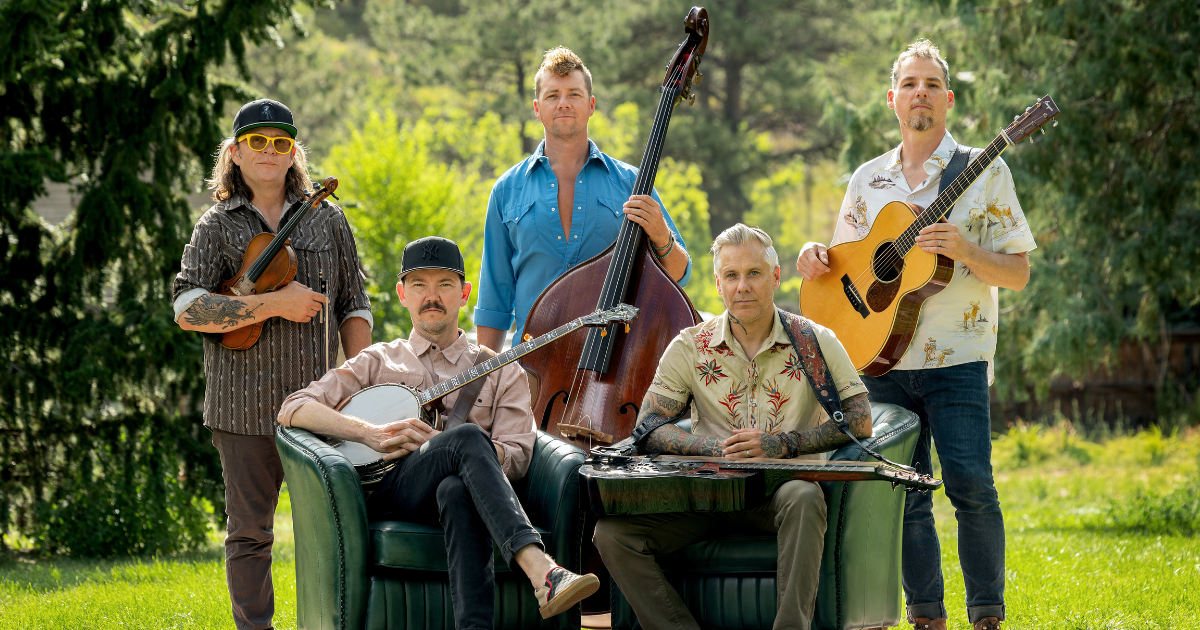
Even as members changed in those early years, the band quickly found its core – Andy Hall (Dobro), Andy Falco (guitar), Jeremy Garrett (fiddle), Chris Pandolfi (banjo) and Travis Book (bass) – and rapidly began homing in on a sound that’s equal parts traditional and progressive bluegrass with a touch of country, jam, and other influences along the way. That variance has led to each of the band’s recordings having a distinctly different flavor than its predecessors, from the harmonious bluegrass symphony of Silver Sky to the feature-rich Ladies & Gentlemen, hope-fueled Laws of Gravity and Rise Sun to the somber Toward the Fray.

“Making a record that sounds like the Stringdusters isn’t the challenge,” Book told me in 2022 for No Depression. “The challenge is seeing just how deep we can get on each song in order to make it the best, most authentic version of itself it can be. This requires us all setting aside our egos, being open to suggestions, and trusting one another to create the best music as possible.”

In celebration of our Artist of the Month, we take a look back on the Stringdusters’ sonic evolution and essential tracks from their two decades in service of bluegrass and the song.

“Fork In The Road” – Fork In The Road (2007)

On their emphatic 2007 debut, Fork In The Road, the band – then comprised of eventual Punch Brother Chris Eldridge (guitar) and Jesse Cobb (mandolin) alongside Book, Garrett, Hall, and Pandolfi – quickly struck a chord with bluegrass aficionados on songs like “No More to Leave You Behind” and the album’s title track. The latter of which positions the band’s fiddle maestro front and center as his high-pitch croon carries the weight of being at a crossroads. Whether it’s a hypothetical take or one rooted in the group’s own musical experiences, it’s safe to say the path the ‘Dusters have taken since has more than paid off with a legacy 20 years strong and counting.

“Magic #9” – Things That Fly (2010)

The band show off their picking prowess on the whimsical “Magic #9,” a track that resulted in their first-ever GRAMMY nomination at the 53rd annual awards in 2011. While the ‘Dusters can thrash and sing bluegrass harmonies with the best of them, songs like this also showcase the group’s knack for crafting their own instrumental compositions. Their tunes pack just as much story and emotion – if not more – into a three-and-a-half minute burst than most of their counterparts with vocalized accompaniment. Coincidentally, the GRAMMY the song was up for was not in a bluegrass category, but rather for Best Country Instrumental Performance. Given the band’s penchant for string music, unreal levels of improvisation, and the consistently inconsistent award nominations process, it’s the least bit surprising, if not even a bit fitting.

“Rockets” – Silver Sky (2012)

The song that first unlocked my captivation for the Infamous Stringdusters (and still my favorite to this day) is “Rockets.” It was around the time the album it’s included on, Silver Sky, dropped that I began seeing the band in concert for the first time and this song was always a staple. The uplifting temperament and optimistic nature of Book’s vocals combined with the meticulous instrumental timing – from Garrett’s fiddle interjections to Pandolfi’s hard-driving banjo backbeat and Hall’s slick Dobro tones – culminate in a joyous, borderline spiritual experience every time I hear it.

Because of this and other tracks on Silver Sky like “Fire,” “Night On The River” and “Walking On The Moon” I consider the record without a doubt their most essential project to date. Although, as you’ll see, the great tunes haven’t slowed down in the years since.

“Still the One” (featuring Nicki Bluhm) – Ladies & Gentlemen (2016)

The ‘Dusters’ 2016 effort Ladies & Gentlemen stood out for many reasons – most notably its more folk-leaning bluegrass numbers and star-studded list of collaborators ranging from Mary Chapin Carpenter and Lee Ann Womack to Sara Watkins and Jennifer Hartswick (Trey Anastasio Band). However, the most frequent collaborator from the record was Nicki Bluhm. Her contribution on “Still The One” blossomed into frequent support songs on the road performing not only that track, but several other cuts from the breakthrough album. It wound up taking the band’s already spectacular knack for partnering with others to another level. As for the song itself, “Still the One” is a powerful rallying cry about a love that persists even when heavy rain, or life’s difficult moments, try to get in between and tear you apart.

“Gravity” – Laws Of Gravity (2017)

After a decade of slinging bluegrass, country, and roots-adjacent bangers, the ‘Dusters finally reached the musical mountaintop with their 2017 album, Laws of Gravity, which earned them their second GRAMMY nomination and first-ever win for Best Bluegrass Album. Central to that accomplishment was the album’s de facto title track “Gravity,” an anthemic adventure.

Similar to the aforementioned “Still the One,” the song focuses on the story of two inseparable lovebirds charting out a future life of memories together, even if they don’t know exactly when, how or why it will all happen. Most important to them though is the memories being made in the current moment, whether that be together, at a Stringdusters show, or something entirely different.

“Rise Sun” – Rise Sun (2019)

With the lead and title track to their 2019 album Rise Sun, the Infamous Stringdusters make a late entry to folk music’s stomp-clap party, combining the early 2010s trend with heated string music like few 2010s contemporaries could muster. The track also features a noticeably hopeful hue set in motion by the metaphor of a rising sun not only spawning a new day, but bringing change and the opportunity for a fresh start, as well. In that sense, the band had no idea how much hope people would need the following year, when COVID shut down the world. The result of which inspired the band’s next original entry to this list. But first, the ‘Dusters pay homage to the father of bluegrass…

“My Sweet Blue Eyed Darling” – A Tribute to Bill Monroe (2021)

The bluegrass ballad in pole position on Bill Monroe’s 1977 album Sings Bluegrass, Body And Soul, was “My Sweet Blue Eyed Darling,” a track that holds the same spot on the Stringdusters’ 2021 recording, A Tribute to Bill Monroe. On it, Pandolfi leads the way with his steady, blistering banjo while Garrett and the others hit home on the signature high and lonesome harmonies that Monroe is legendary for.

Fittingly, this collective album honoring the bluegrass legend wound up earning the ‘Dusters their third GRAMMY nomination in 2022, though they came up short to Béla Fleck’s My Bluegrass Heart. Their foray into recording covers isn’t anything new for the band, who later went on to record a Flatt & Scruggs tribute along with a series of Undercover EPs (more on that later) in addition to weaving other folks’ material into their live sets on a nightly basis.

“Pearl Of Carolina” – Toward the Fray (2022)

While the Stringdusters’ members call many places home, there may not be a more appropriate individual place with which to associate the band than Western North Carolina. Touching on that connection to the Old North State, Book sings about love and longing to return home on “Pearl of Carolina.” The song’s title stems from an intro script he was crafting for his musical talk show podcast, The Travis Book Happy Hour, as a way to describe the region.

In addition to being grounded in a person or place, similar to “Gravity” or “Still the One,” “Pearl of Carolina” is also a reminder to search for the places and small things in life that bring you joy. While much of Toward the Fray takes on a darker tone, “Pearl” stands out as a burst of much-needed normalcy on a project otherwise finding inspiration in a world of disarray.

“Touch Of Grey” – Undercover, Vol. 3 EP (2024)

The band has covered a bevy of artists on their Undercover series of EPs, from Tom Petty to The Highwaymen, The Cure, and ZZ Top, but none fit the band’s style and sound (with the exception of the Monroe and Flatt & Scruggs stuff, perhaps) than their rendition of The Grateful Dead’s “Touch of Grey” on Undercover, Vol. 3. Released in 2024, the ‘Dusters’ take on the Dead’s most commercially successful hit combines the best of both groups, further adding to the song’s timeless nature – a message that, 40 years after its original release, feels just as relatable and relevant as ever.

“Working Man Blues” – 20/20 (2026)

Much of the Infamous Stringdusters’ journey over the past two decades has been inhabiting the role of blue-collar road warriors playing anywhere for anyone who would have them. With that in mind, there’s no more fitting song to kick off their next album, 20/20, than “Working Man Blues.” The band sings about a man clocking in before sunrise and doing hard labor all day before clocking out and heading to the bar in search of fun. It’s a combination of rugged, resistant, and rowdy that embodies the Stringdusters’ entire sound and ethos for 20 years now – and, if we’re lucky, will continue for another 20 more (and then some).


Continue exploring our Artist of the Month coverage of the Infamous Stringdusters here.

Photo Credit: Daniel Milchev
Clay Street Unit Chat Sin & Squalor and Excitement for the Future

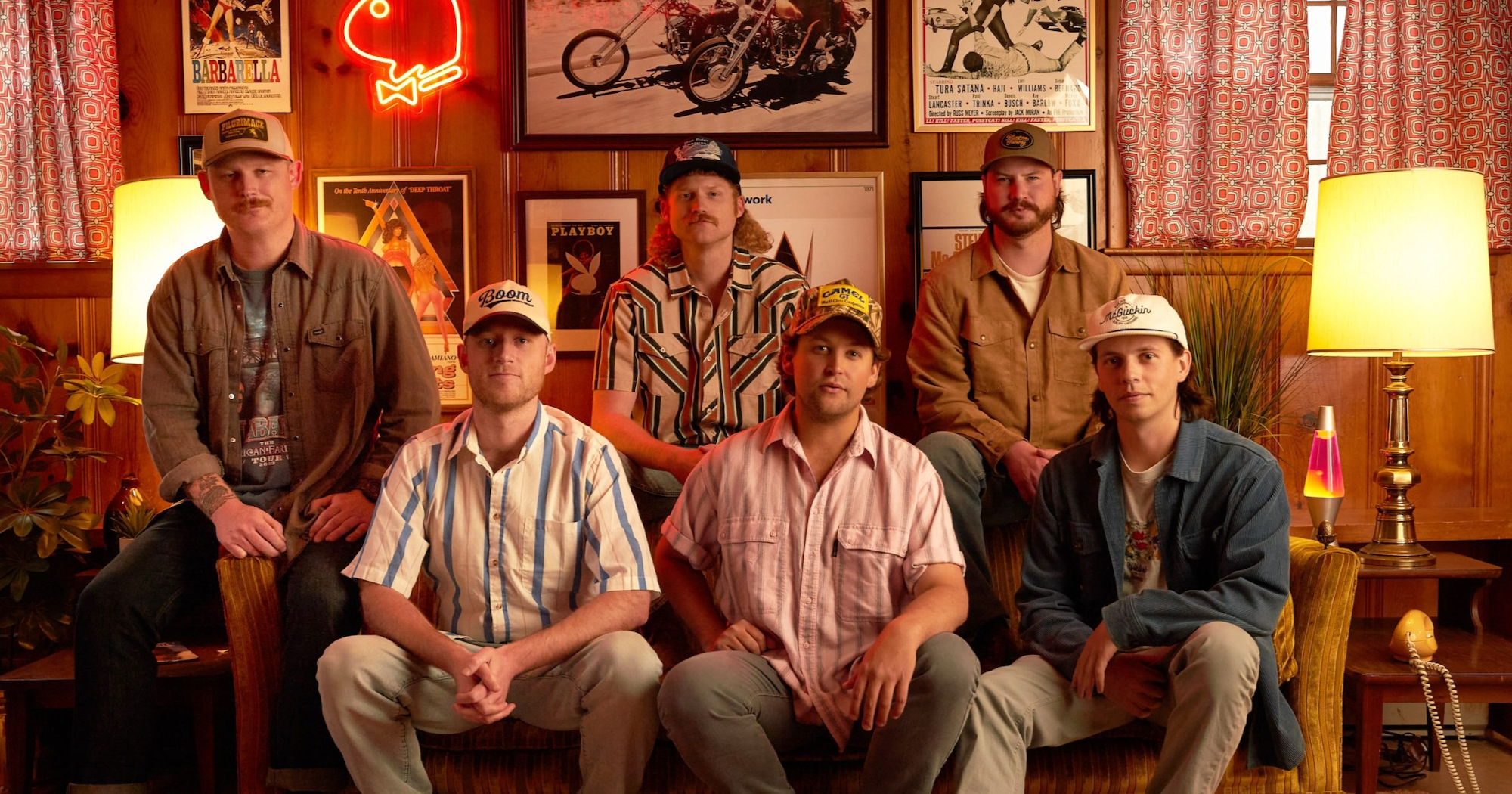
Since their inception in 2021, Clay Street Unit has quickly risen into the national spotlight. The rollicking Americana string band is garnering the frequent tag of “must-see” by their rapidly growing fanbase.

Formed in Denver, Colorado, the sextet is unique in sight and in sound. With a foundation soaked in bluegrass, the ensemble also includes a drummer and a pedal steel player – which often kicks the act into the realms of indie folk and honky-tonk. Ultimately, this lends them to a wildin’ out scene when placed in a packed room of fans and the curious alike, something that has become commonplace as of late.

It’s at this exact juncture – of deeply held dreams and aspirations coming to fruition – that Clay Street Unit will finally release their debut album, Sin & Squalor (out February 13 via Leo33). The 11-song LP is a perfect introduction to this band of melodic pirates as they currently navigate the high seas of the music industry. The record not only captures the essence of the outfit, it’s also impressive in nature, showcasing the vibrant energy of the group’s live show via the studio.

Produced by the Infamous Stringdusters’ Chris Pandolfi, Sin & Squalor is a sonic roadmap to the here and now of where jamgrass stands in the modern era. With members of Clay Street Unit hailing from a variety of places in the U.S. (Alabama, Virginia, Colorado, Pennsylvania, Georgia, Illinois), their multilayered influences lead to traditional acoustic aspects mirrored by modern sounds. Each texture a product of the unique environments from which these musicians proudly emerged.

Catching up with mandolinist Scottie Bolin and guitarist Sam Walker, the duo spoke at length with BGS about the group’s origin, how their sound came to be, and what’s in store for Clay Street Unit. The road seems to be wide open as this troupe has created quite a buzz, coast to coast, coming into 2026.

I was kind of curious about how 2025 wrapped up for y’all.

Sam Walker: I think 2025 was probably the most important year we’ve had yet. It was a huge year for us, as far as crossing off a bunch of big local goals and national goals. We got to play Red Rocks with some of our heroes and buddies, Leftover Salmon and Kitchen Dwellers. We got to play [our] biggest hometown show in Denver at the Ogden Theatre, and had the privilege of selling that place out and playing with our good buddies, Andy Hall and Chris Pandolfi from the Stringdusters. And then, we signed our record deal [with Leo33] and got to plan the rollout for this record and finally get it released.

I would surmise last year will really be setting the pace for 2026, justifying all the blood, sweat, and tears going into this.

Scottie Bolin: Yeah, absolutely. A ton of work went into making the album and getting the songs where you wanted them to be. And finally getting to tour a bunch last year has been really rewarding, getting to play these songs to live crowds and really hitting the road hard.

You guys have had a pretty fast trajectory for five years together. And I was wondering about the background of how the band formed and the timeline of how it all came together.

SW: Our former banjo player, Jack Klein, and I met one night at a brewery in Denver, a couple blocks from Clay Street and the house I was living in at the time. I played some guitar, picked tunes all night at my house, and ended up booking a gig over at that same brewery. It all happened really organically. We weren’t really trying to start a band. It just felt like the right people, right place, right time to try to get something going. We ended up meeting our former drummer and bass player, and then everything kind of picked up steam a little bit quicker than we thought.

We were playing The Patio [at Sloan’s], then [Cervantes’] Other Side, then the [Cervantes Masterpiece] Ballroom. People kept buying tickets, listening, and supporting the music. As things grew, some people weren’t really dedicated to being lifelong musicians in the band. I ended up going on tour and playing with Colorado [jamgrass] band Morsel that our bass player [Jack Kotarba] and Scottie had started. We all became really close buddies over that tour. And things kind of naturally shifted in a different direction for some members. We all kind of crossed paths at the right time.

SB: At the end of the day, we were all just kind of playing music with various groups and side projects in Denver, playing a lot of bluegrass. And things just clicked. Everyone got along really well. The band, at its core, is a group of good friends. And it just snowballed and grew from there.

SW: I moved out here to Colorado eight or nine years ago. And we had this big 4,000-square-foot party house. There were four or five guys living in it at any given time. It was just where everyone would kind of come through and hang, and we would play music all night. It felt like a revolving door of people in there. That house was kind of where everything started.

We got the band going and rehearsed. It felt like the origin of the band. We were listening to a ton of Tony Rice at the time. I kind of came into bluegrass the long way. I didn’t grow up being a huge disciple or anything like that. But, obviously, moving out to Colorado, I got a class in bluegrass culture pretty quick. We were just obsessed with that Tony Rice record, Manzanita.

Was playing in a band something you each wanted to do or is it just the way everything unfolded?

SB: I’m from Charlottesville, Virginia. I started [playing] in college [at the University of Colorado Boulder with] Morsel. We tried to make a go of it. We did a couple tours. [But], the touring lifestyle is hard and takes full dedication from the whole group. Some of the guys [in Morsel] didn’t wanna do that. So, I stepped away from that. Luckily, right around that time, I met Sam and all the Clay Street guys.

SW: I grew up down south in Montgomery, Alabama. I kind of came into it the opposite way. I played in a Widespread Panic/Grateful Dead cover band in college and just sang. Then, I moved out to Colorado and picked up the guitar. I’d always sang and written a few songs and loved live music. But, I really kind of fell into it. It wasn’t something necessarily in my early twenties I expected to be doing for a living.

All the dominoes fell in the right places and I was around the right people that gave me a lot of confidence to push the boundaries of what I was comfortable with. Playing in some side bluegrass bands around town really helped me feel more comfortable about being a part of the Denver music scene. Everything happened step by step. I wasn’t really trying to make it a career, but a few years later, it felt like something that made sense – to take the leap and try to push it as far as we can.

Your band is a huge melting pot of sound. Is that by design or just how it all just came together?

SW: I feel like it’s a little bit of both. We definitely didn’t set out or want to be a traditional bluegrass band. Obviously, when we added the drums and pedal steel and electric bass that decision was kind of made for us. It’s kind of a melting pot of everything we listen to and the music we like.

When Scottie and I go to write a song, we don’t think, “This is a bluegrass tune,” “This is a folk tune,” “This has an indie feel.” We let the music and everybody’s kind of flavor and influence on how the song’s going to sound. We don’t really try to have those guardrails of how it needs to sound or what vibe it needs to be.

When I was listening to the album, I kept thinking how I really want to see you guys live. And I think that’s a real testament to the band, to have that kind of sound radiating out of an album that encourages you to go to the live show, which I think is probably the endgame for you.

SW: Absolutely. At the core of our band, we’re a live band. It’s where we really shine through, and you can just feel the energy up there. We always try to say, “There are only so many Thursday, Friday, Saturday nights,” and we want to elevate that and bring the energy and the emotion and let [the audience] loose – life’s too short to not go out and enjoy live music. We want to make sure at every show we’re bringing that to the table, our full attention to the energy and making sure that everyone’s having as good a time as they can.

Is there any kind of ethos behind the title of the album?

SW: It’s our origin story. [When we started], we didn’t know how to do it or if we were doing it right, and we weren’t doing it with much, just trying to put it together piece by piece. It sounds a little heavy, but it’s more about the beauty of humanity, the nature of [life] we have all been through, and it’s a commonality of everybody. It’s the nature of our music and string instrument music – music that has a little more “down in the holler” feel. It all felt aligned with what we were trying to get out for the first record.

Why was Chris Pandolfi the guy you wanted to produce this?

SB: I had the opportunity to work with Chris before with Morsel, which was a little bit more of an electric rock jam with some bluegrass elements in there. He produced a few albums for [Morsel]. So, I knew what it was like to work with him. I knew that he was just a musical genius and the right guy for setting the vibe and making sure we were comfortable in the studio.

[Chris was] coming in with great arrangement ideas for our band, specifically, and being a great mentor all-around. [Clay Street Unit] actually had the pleasure of being his wedding band this last summer, which was awesome. I feel like the Infamous Stringdusters, Greensky Bluegrass, a lot of those Colorado bands, Leftover Salmon, have really kind of set the tone of what is “allowed” in that genre and for pushing the boundaries of what people want to hear. With the Stringdusters, I’ve seen them live for 10-15 years and they’ve really made a mark on the bluegrass scene, the Colorado music scene, and definitely a big impact on us.

You’re currently hitting the five-year mark together. What does that milestone mean to you right now?

SW: The last five years have been so much of a learning curve and going through so many different stages of figuring out who we are and how we want to operate. I feel like now we’re really starting to get a grasp of what we want to do and who we want to be as musicians, as a band, and as people. The last five years were such a blessing and such a great learning experience, but I think we’re just so excited for the next five years of just pushing this thing to the limit and, and trying to, to make the best music we can and, and really just enjoy every step of it together.

SB: It just takes a long time to get a group of people on a mission aligned and I think we’re finally there. Everyone’s on the same wavelength of what we want to get done and what we want to accomplish. We’ve got a really busy year ahead of us, and it’s kind of the culmination of the last five years of hard work that’s been coming to fruition – we’re pretty excited.


Photo Credit: Lead image by Robert Chavers. Alternate image by Tobin Voggesser.

Artist of the Month: The Infamous Stringdusters

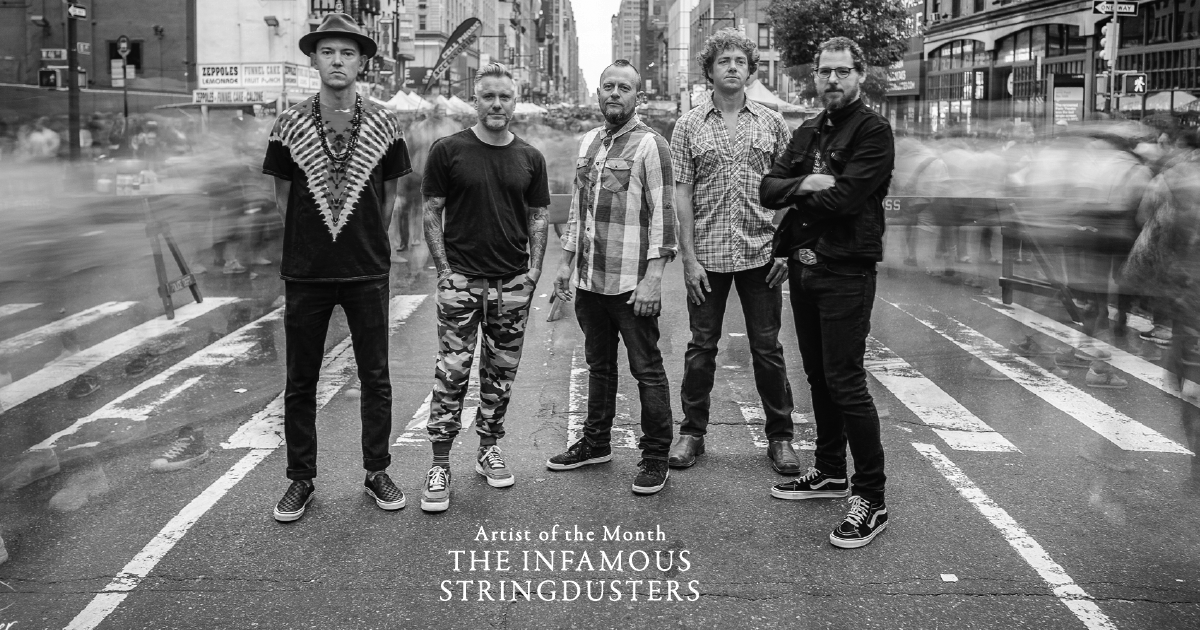
During the Infamous Stringdusters’ recent holiday gig at The Orange Peel in Asheville, North Carolina, the storied venue was packed out with jamgrass freaks, the performance itself a kickoff of sorts for the band’s 20th anniversary in 2026. I found myself standing sidestage when show opener Bronwyn Keith-Hynes came up next to me. A smile emerged on her face taking in the band and the audience.

“The Stringdusters made me want to start a band,” the GRAMMY-winning fiddler said, turning to me. “The Fork In The Road album was the most influential modern bluegrass album for me when I was at Berklee.”

Keith Hynes’ sentiment conjured numerous memories and moments I’ve been lucky enough to be a part of when it comes to the ‘Dusters. The first time I ever laid eyes and ears on them, it was the 2008 Targhee Bluegrass Festival in Alta, Wyoming. I was 23 years old and a rookie reporter for the Teton Valley News, based just down the mountain in Driggs, Idaho. By that point in my life, both personally and professionally, I was diving deep into the jamgrass world – the intersection of ancient tones, psychedelia, improvisation, and a collective love of the Grateful Dead.

The initial spark of the modern jamgrass movement was lit by Yonder Mountain String Band, Leftover Salmon, and the String Cheese Incident, all three acts coming into the national spotlight by the end of the 1990s. A musical template had been formed, and the ‘Dusters would emerge in the early 2000s to throw gasoline onto that melodic fire, ultimately becoming a missing link (alongside Greensky Bluegrass) between jamgrass originators, those ‘90s propagators, and folks currently carrying the torch into new, exciting realms: Billy Strings, Sierra Ferrell, Molly Tuttle, Sierra Hull, and more.

“That’s what’s so beautiful about bluegrass music, in particular,” Stringdusters fiddler Jeremy Garrett told me recently. “You pass it on to the next generation and they take it and they do their thing with it. Luckily for us, we were around at a time that [that] was very important, and a transitional time in the industry.”

In 2010, a couple of years after my introduction to the band at Targhee, when I returned to my native North Country of Upstate New York, I found myself covering a show at the intimate Showcase Lounge at Higher Ground in Burlington, Vermont. I was there to see the ‘Dusters once again. Their sound and energy immediately transported me back to the Rocky Mountains that I missed dearly. (Sharing the bill was another rising jamgrass act, Trampled by Turtles.)

I remember walking away from that gig feeling in awe and refreshed with a genuine feeling that something was happening. Something was on the horizon when it came to bluegrass and string band music. This wasn’t a traditional bluegrass band in matching suits, standing like statues. It was a rock show with acoustic instruments. Baseball caps and long hair, grins ear-to-ear. More provocative than standstill, more vibrant than just going through the motions of what past generations were instructed to do.

“Being able to showcase our own songs, in our own way, [our] writing skills, and making the decisions on what was chosen to play and how to play it [were] foremost for most of us at the beginning,” Garrett says. “Over time, we realized that we were actually growing a community. And after all these years, that honestly has become the most important part, the most important thing that we could possibly do.”

What I witnessed in Wyoming and Vermont years ago is what I’ve continued to experience with the Infamous Stringdusters, in person and in method, from Florida to Colorado and beyond. They set the pace then for where we stand with jamgrass right now, built on a full-throttle approach, one which remains sonically elusive as well as paying homage to the architects of bluegrass and those who broke from the pack and made something all their own.

Aside from the talents of the Stringdusters, either as individuals or the sum of their parts, you also have a unique setup. Alongside founding members, banjoist Chris Pandolfi and Dobroist Andy Hall, who emerged from the prestigious Berklee College of Music in Boston, you have the tradgrass pedigree of Garrett, who was born and raised in a traveling family bluegrass band hailing from Idaho. This fusing of road-tested grit and grace with conservatory-style techniques is at the heart of what this group does best: jam.

All of which circles back to the Asheville Orange Peel performance in late 2025. There were tightly knit melodies and freewheelin’ improvisational explorations. They broke down the invisible walls between themselves and the audience, maintaining a two-way street of momentum, energy, and inspiration from both sides of the microphone – a vortex of sound and scope, all revolving around a deep sense of community.

“The band is stronger than ever and making some of the best music we’ve ever made,” Garrett says. “But, the thing I see that is the most important being carried on is that community factor. We certainly didn’t invent that, but we took note and applied the philosophy to our scene, and hopefully the next generation realizes how important that piece is.”

Ultimately, this 20th anniversary celebration for the Infamous Stringdusters is a culmination of a tried-and-true effort to bring this hallowed music into the unknown and unfolding musical landscape of the 21st century. With their upcoming album, 20/20 (out February 13 via Ameriana Vibes) they continue their efforts to break new ground and forge ahead, together, whatever the next 20 years hold for jamgrass and the ‘Dusters.

The Infamous Stringdusters are our Artist of the Month. Below, enjoy our Essential Infamous Stringdusters playlist and stay tuned as we share brand new and archive content on the ‘Dusters throughout the month of February here on BGS – and across our social media channels. Like our exploration of their 20-year discography or our oral history of the band featuring all five members in conversation.


Photo Credit: Daniel Milchev
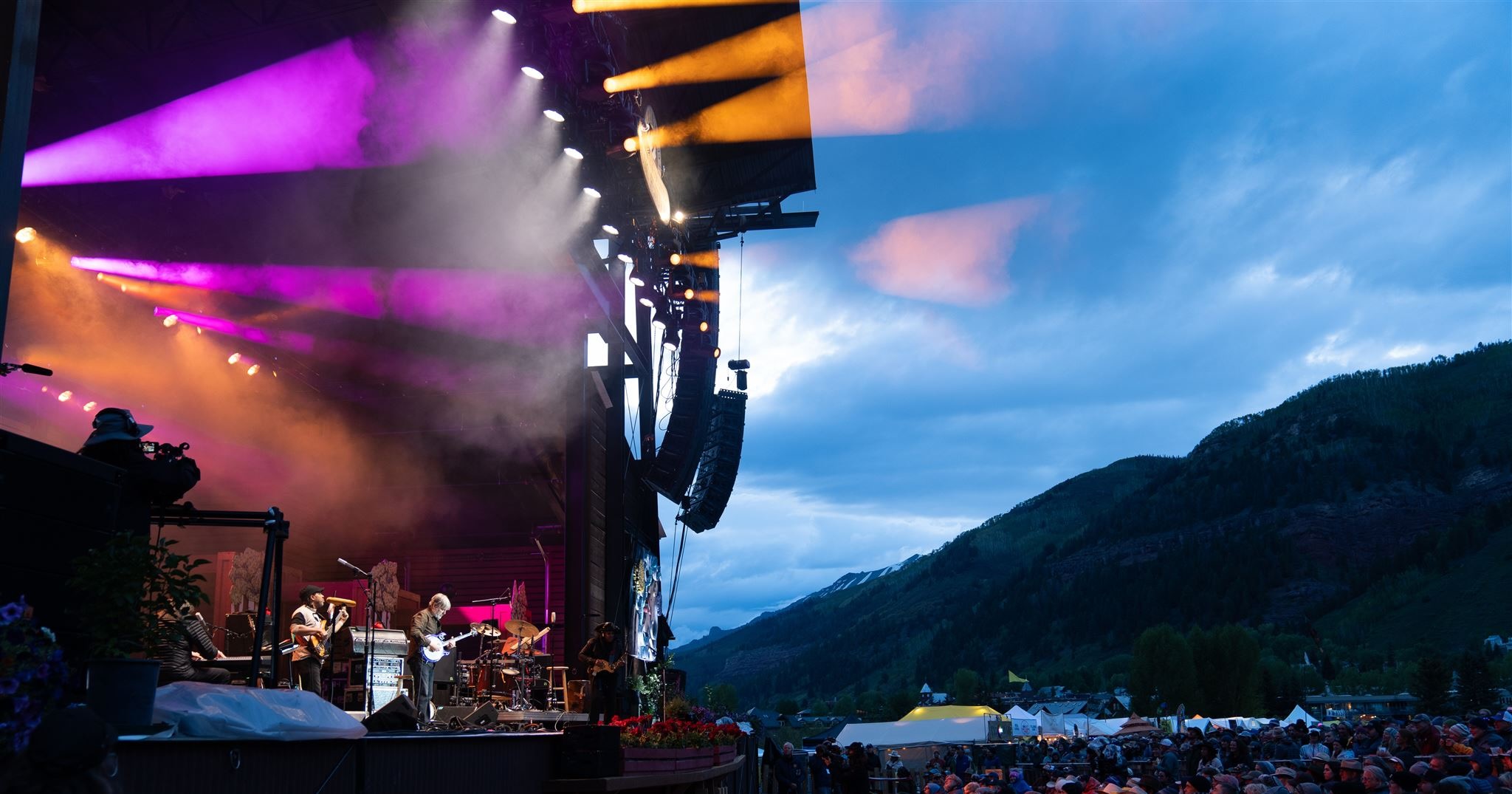
Telluride, the Most Beautiful Bluegrass Festival, Turns 50

(Editor’s Notes: Headline image of Béla Fleck & the Flecktones. Scroll to see a photo gallery.

To mark Planet Bluegrass’s 50th annual Telluride Bluegrass Festival, we asked author and music journalist David Menconi to reflect on its impact – and the vibrant community that’s grown up around this iconic roots music event.)

The circuit of roots music festivals in America has some similarities to the Professional Golf Association. There’s at least one festival as well as one golf tournament pretty much every week of the spring, summer and fall. But a few stand out as special and even career-making – golf’s four major championships, and the handful of prestigious main-event music festivals. North Carolina’s MerleFest is like The Masters, the early-season springtime kickoff each April, while late-season festivals like San Francisco’s Hardly Strictly Bluegrass line up nicely with the British Open.

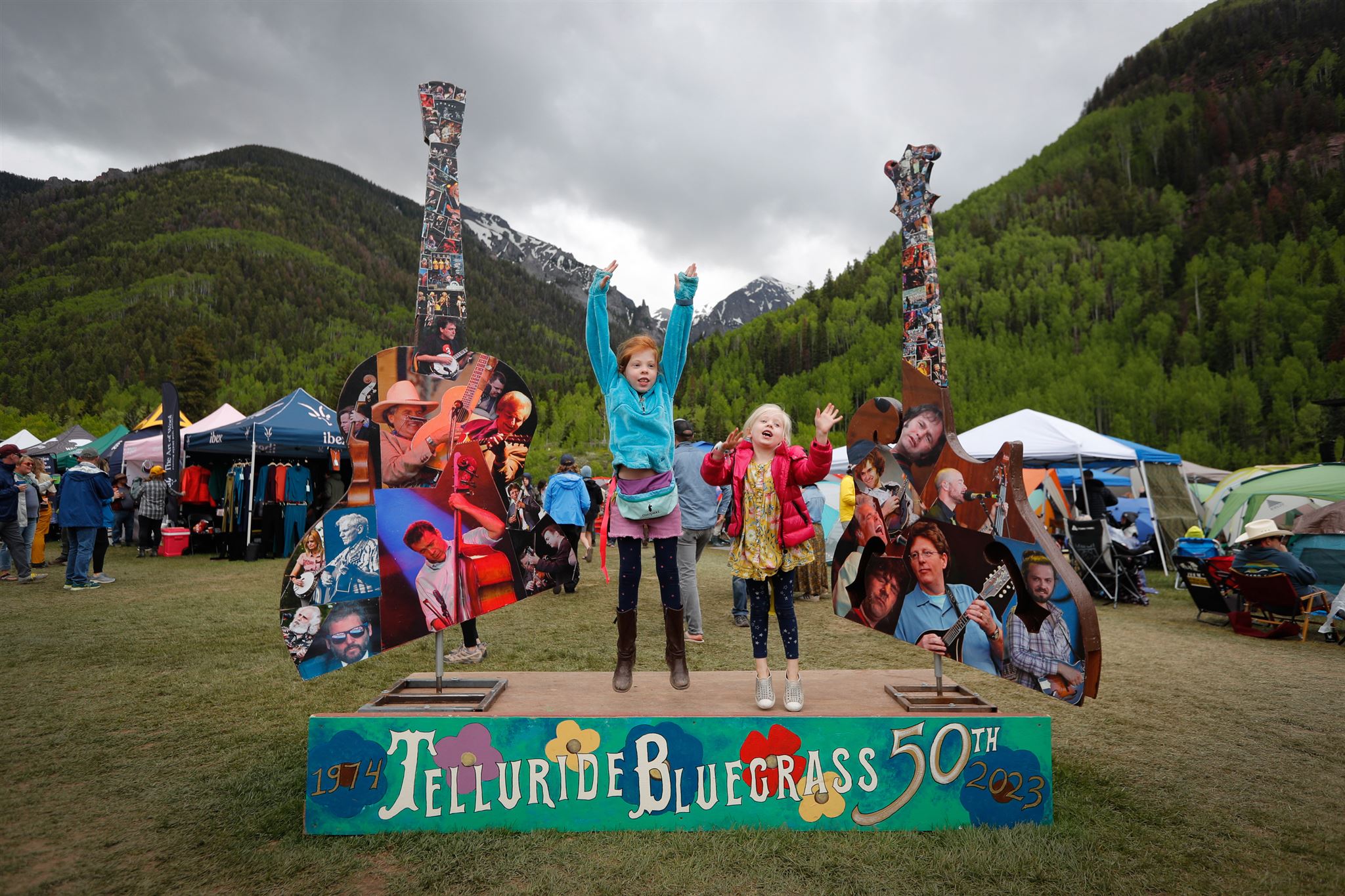
But there’s no question which music festival stands as the summit of the circuit, and not just because it’s in the mountains of Colorado. That’s the Telluride Bluegrass Festival, which marked its 50-year anniversary with the 2023 edition last weekend, June 15-18. The fact that Telluride has prospered for half a century makes Telluride something like golf’s U.S. Open championship, the big one that everybody wants to be a part of. Telluride’s status is something that the musicians who play it are well aware of.

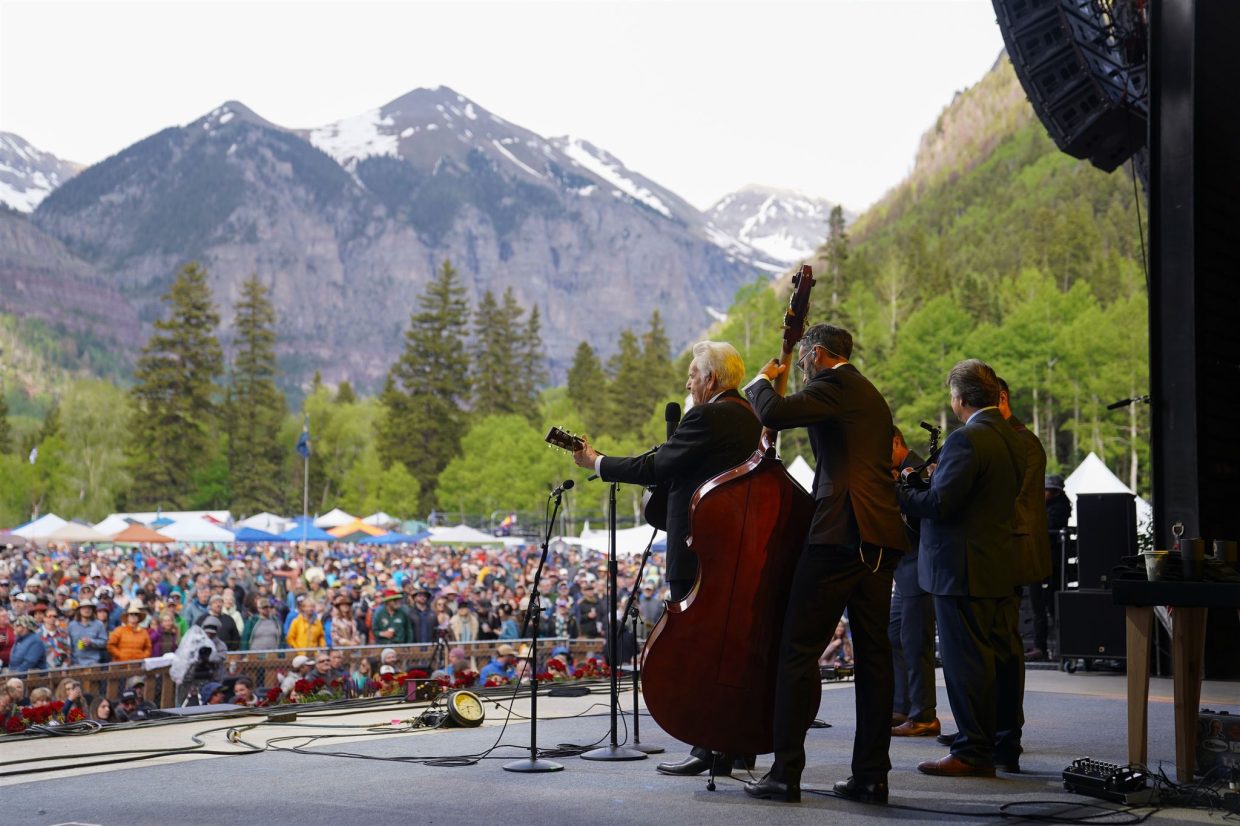
Del McCoury Band performs Thursday, June 15, at the 50th Annual Telluride Bluegrass Festival.

“Festivals and musical trends come and go, and acoustic music has been through some serious peaks and valleys the last 50 years,” says Chris “Panda” Pandolfi, banjo player for Telluride regulars The Infamous Stringdusters, who were on this year’s lineup. “The one mainstay throughout has been Telluride Bluegrass Festival. When we started out, Telluride was the place to be and the definitive crossroads we aspired to, and it still is. Lasting 50 years is an amazing testament to its importance. Bluegrass is more popular than ever now, and Telluride is a big part of that.”

There are literally hundreds of music festivals spanning every style imaginable nowadays, including massive annual gatherings like Bonnaroo in Tennessee and Coachella in the California desert. But there were just a small handful of festivals when Telluride Bluegrass Festival started up in 1973 in the scenic Colorado mountain town that bears its name. And even though Telluride’s daily capacity of 10,000 fans is significantly smaller than a lot of the other major festivals on the circuit, it has still maintained its prestige status.

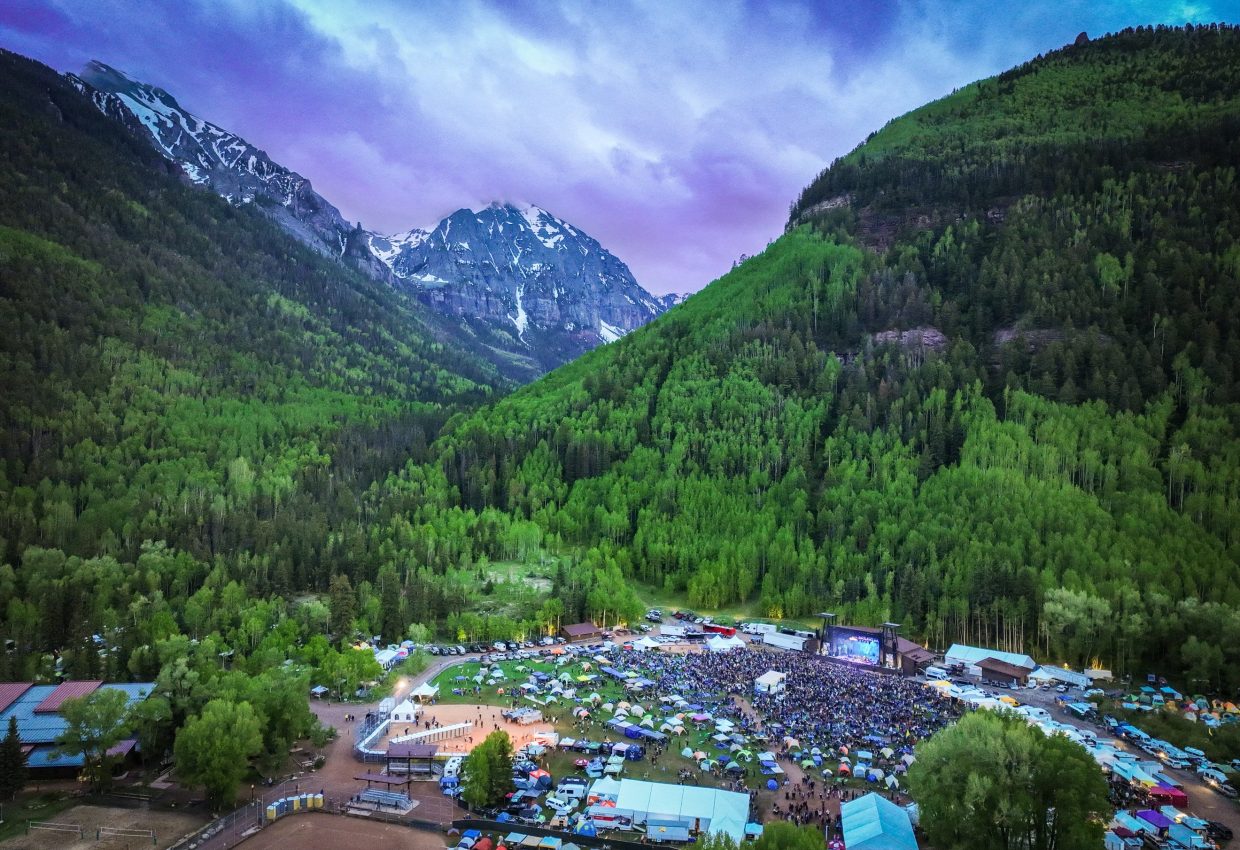
A drone shot of the festival grounds of Telluride Bluegrass Festival.

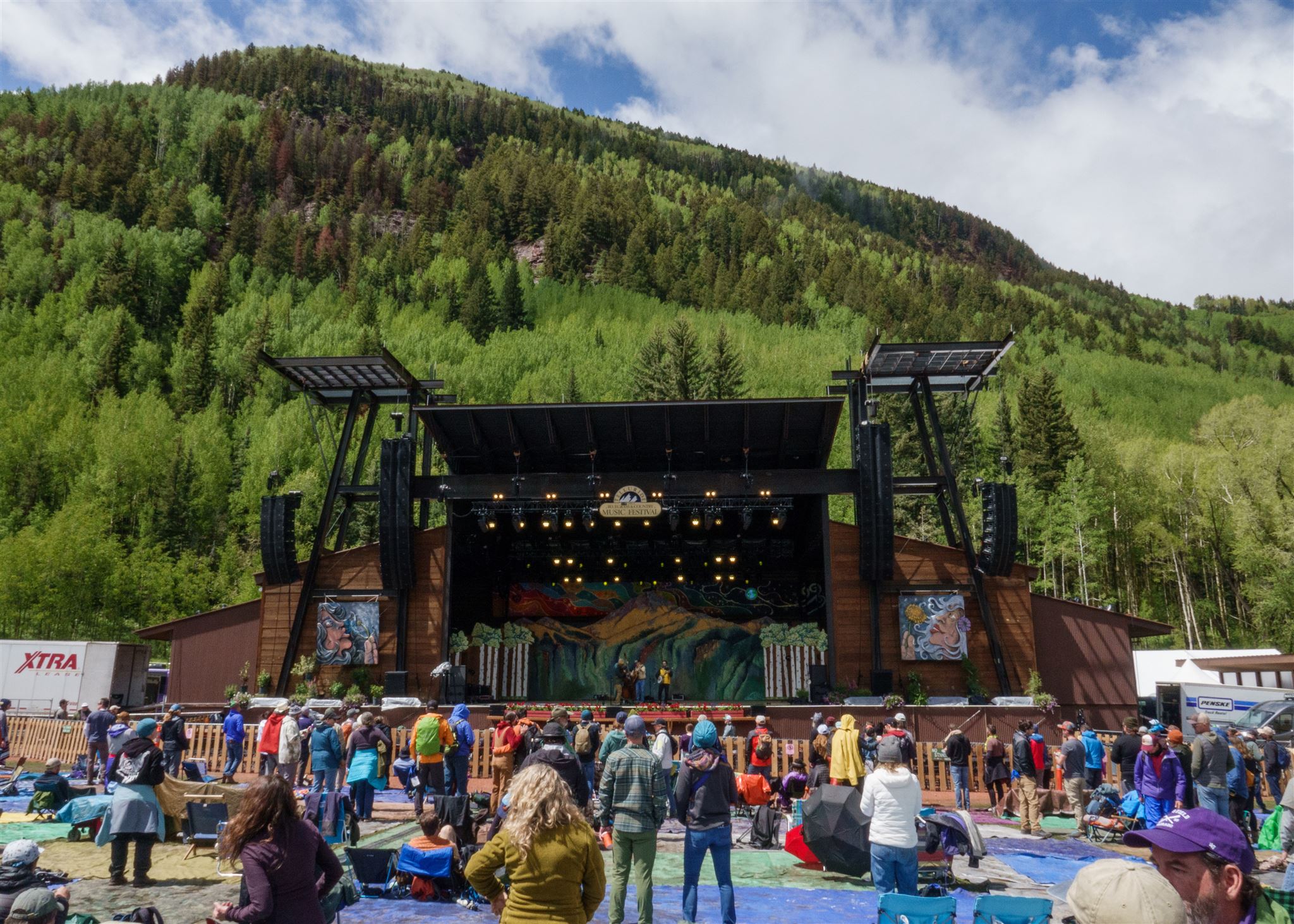
In spite of that smaller size, Telluride does have a few structural advantages that set it apart. One is a picturesque setting of surpassing natural beauty on the western edge of Southwestern Colorado’s San Juan Mountains. For performers as well as attendees, there’s not a better view anywhere than what you see at Telluride.

“The view from the crowd is amazing, but from the stage it’s the most incredible view imaginable as an artist,” says Pandolfi. “It’s this multi-layered inspirational snapshot of some of the best music fans, at the best-run festival, in the most beautiful environment in the world. I think a lot of people have this experience, knowing of Telluride as this iconic festival with an outsized reputation, but it more than lives up to the hype. First time we played there, I remember feeling intimidated because so many heavy-weight players we looked up to were there. But as soon as we got onstage, everything clicked.”

Yasmin Williams performs on Telluride Bluegrass Festival’s main stage – its sole stage.

Another major difference between Telluride and its festival peers is scale, and not just in terms of the size of the crowds. Most festivals cram as many performers onto as many stages as possible, all of them running simultaneously, resulting in sensory overload as well as the fear that you’re missing out on something elsewhere. By contrast, Telluride still has just one stage. Every act gets a solo spotlight at Telluride.

“Every year’s festival lineup is an interesting thing,” says Craig Ferguson, who oversees Telluride Bluegrass Festival under the auspices of Planet Bluegrass. “I’ve always said, just watch and it will book itself, and that’s really true. Our process is unique because we have just the one stage and not a bunch of bands, so everybody in the crowd gets to have the same experience. There’s not 18 different stages, so we can create one festivarian experience that everyone shares. We do the booking one act at a time, and we often wind up with interesting combinations.”

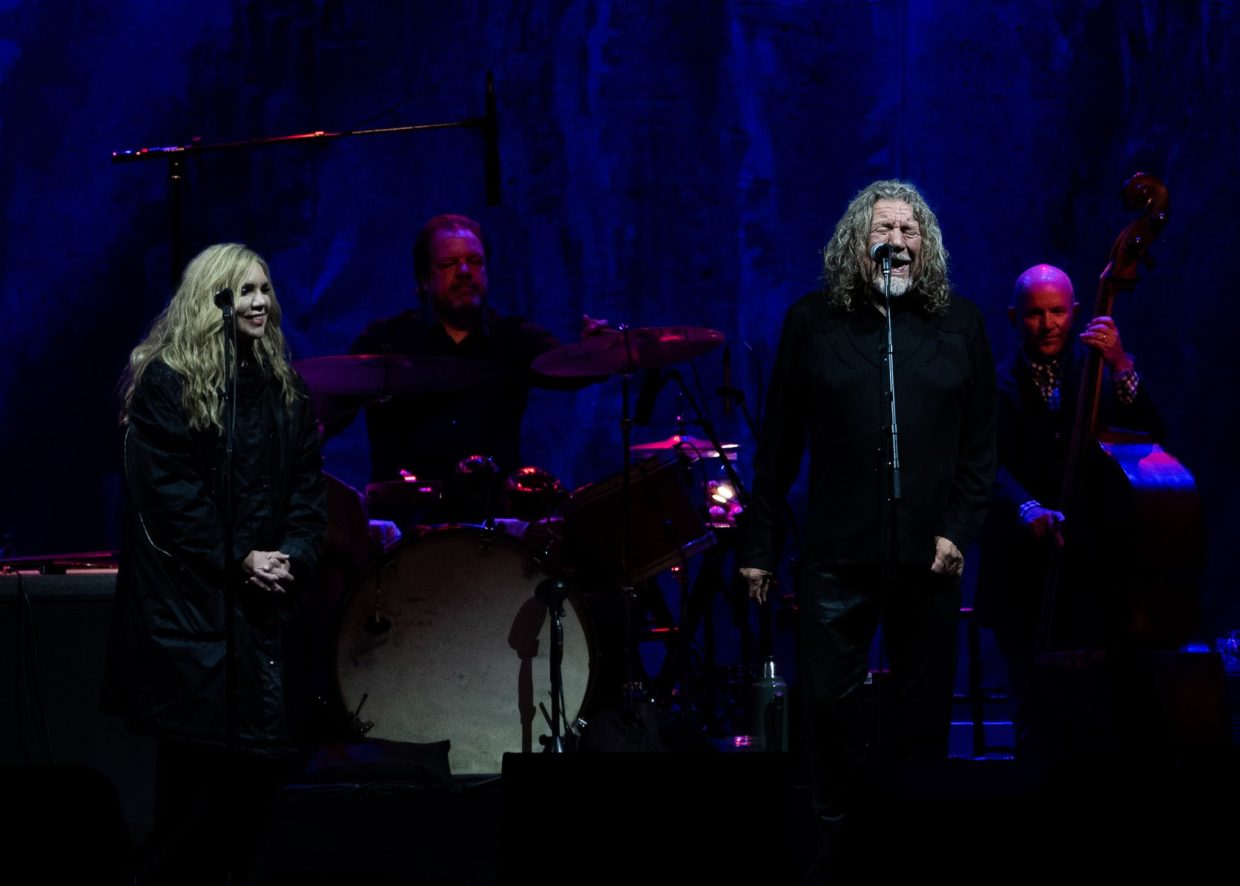
Robert Plant & Alison Krauss perform at Telluride Bluegrass Festival.

Indeed, those interesting combinations can venture well beyond what you see at a typical folk or bluegrass festival. Along with Sam Bush, Emmylou Harris, Peter Rowan, Del McCoury and The Infamous Stringdusters doing a Sunday morning gospel set, this year’s lineup features ringers like the West African ngoni master Bassekou Koyate and the venerable jam band String Cheese Incident. Some of the anomalous acts from previous years include pop-star jazz pianist Norah Jones, the comedic folk duo Tenacious D and even singer/rapper/actress Janelle Monae. Even with the unlikely acts, the Telluride experience sells itself. It doesn’t take much convincing to get any artist to play.

“Janelle Monae was the most interesting person to talk to,” Ferguson says. “I snuck into her RV just as she was sitting down to a meal by herself, and I was able to sit and talk to her for an hour. I think she would’ve signed up to play every year if she could have, she was so enthralled by the fact that there were elk in the park. It was the most wonderful conversation, and she was great. We’re famous for our curveballs and she was the oddest, I’ll give you that.”

BGS’s own Ed Helms with Sam Bush and Jerry Douglas at Telluride Bluegrass Festival.

Apart from the change-ups, multiple generations of musicians in the world of acoustic music count Telluride among their major artistic, career and personal milestones. One of them is Sarah Jarosz, a four-time Grammy winner who first went to Telluride as a fan at age 14 and played it herself for the first time two years later. Telluride is where Jarosz first connected with idols and future peers like Gillian Welch and Abigail Washburn. It’s also where Gary Paczosa saw Jarosz for the first time at her 2007 Telluride debut. He subsequently signed her to Sugar Hill Records and produced her first four albums.

“It’s the quintessential place to see your heroes, and even get to jam with them,” says Jarosz, who is back on this year’s lineup. “You’ll hear, ‘There’s a jam at this house down the street after the shows.’ So I brought my mandolin and before I knew it, Chris Thile was showing up. Also Jerry Douglas, Tim O’Brien. That was really life-changing, this proximity to heroes that allowed me to become friends with them. And even though Telluride is rooted in bluegrass, they always bring in artists from beyond that world – Janelle Monae, Decemberists, Alison Krauss and Robert Plant. It feels like anything can happen, and the audience that goes is very supportive of that.”

The stalwart House Band of Telluride Bluegrass Festival.

Still, no matter how far afield the lineup wanders, Telluride is ultimately rooted in bluegrass.

“Bluegrass is a fable, and a team sport,” says Ferguson. “That informs how we create the lineup. Looking to the future, socially as well as musically, we think of bluegrass as an allegory. It’s a context that is invitational to all these other styles, country or jazz or classical, and it complements all of them. That remains the heart and soul of this festival, surrounding bluegrass with these other complimentary musics. We are fortunate to be of service to the festivarian community. It’s an annual privilege to see how much it brings to people’s lives, the connection to community.”


All photos by Maya Benko, courtesy of IVPR

Tray Wellington Shares a List of Banjo Players Thinking Outside the Box

North Carolina musician Tray Wellington is fresh off a nomination for this year’s IBMA New Artist of the Year, following the release of his full-length debut album Black Banjo. Still in his early 20s, Wellington pulls from a myriad of influences — on his latest album he cites jazz as the major influence of his progressive bluegrass style. Many other banjo players of this younger generation are using the influence of genre and blurred genre lines, adapting and subverting narrative and traditions, and utilizing sheer unrestrained creativity to operate outside the traditional confines of the instrument.

In honor of BGS Banjo Month, Wellington gathered a collection of current artists who are thinking outside the box, creating their own voice on the banjo in new and innovative ways, and striving to make the banjo a better-known and appreciated sound.


Photo Credit: Dan Boner

We’re giving away a Recording King Songster Banjo in honor of Banjo Month! Enter to win your very own RK-R20 here.

Chris Pandolfi and Drew Becker Embrace the Infamous Stringdusters’ Side Hustles

The Infamous Stringdusters have been together for close to two decades, and one big reason for their longevity is that everyone gets the chance to step out with side-hustles and solo projects. Even live sound engineer Drew Becker has one – a side business to market one of his inventions, a device that reduces volume on a vocal microphone when the singer walks away.

“That’s my baby,” Becker says, “and I hope to see one on every stage in the future.”

Multiple Stringdusters members are putting out solo albums this year, including banjo player Chris “Panda” Pandolfi, who also makes soundtrack music. But his primary extracurricular project is a podcast, Inside the Musician’s Brain, currently in its third season on Osiris Media.

“It’s deep-dive interviews, musician to musician,” he says. “Béla Fleck was my last guest and Aoife O’Donovan was the guest before. Billy Strings, Trampled by Turtles, Sierra Hull, too. It’s an awesome outlet to take fans deeper inside the music.”

The band’s 2021 release, A Tribute to Bill Monroe, will compete in the category of Best Bluegrass Album Grammy Award in the ceremonies in Las Vegas on April 3. Meanwhile, to commemorate the release of their new project, Toward the Fray, we’ve been catching up with all of the Stringdusters – our BGS Artist of the Month for March – for a series of three conversations from the road. Read part one with Dobro player Andy Hall and guitarist Andy Falco. Read part two with fiddler Jeremy Garrett and bassist Travis Book. Here is part three with Becker and Panda.

BGS: Drew, how long have you been the Stringdusters’ live engineer?

Becker: Since 2008, the van and trailer days, and we’ve just been working our way up to where it’s logistically easier and more efficient. They were my first professional job outside the bar gigs I’d been working through college going to sound school. We’ve grown together technically through the development process, figuring out ways to put on better shows on a night-to-night basis. It’s a learning process, one puzzle piece at a time. You fix one thing, and that might create something else that needs improvement. I do sound for just the live thing. Early on, I’d hang with them in the studio, too, just because it was awesome and I wanted to absorb anything I could about the process. But studio and live are totally different teams and skill sets. Like spray-painting versus watercolor, both are painting and some of the tools might be the same. But it’s totally different skills.

Panda, we heard you’ve been dealing with banjo issues today.

Pandolfi: It went out during last night’s show! Something was wrong with the pickup within the instrument.

Does that happen often?

Becker: Not often, fortunately. For a pickup to melt down, like three other things have to go wrong before that. This is kind of the worst-case scenario, where it’s not totally dead. It works for soundcheck and maybe even a full show, then presents issues the first song the next night. You spend hours troubleshooting, it solves itself, fails again. Then you call every music store in Atlanta and drive 30 minutes to get the one pickup you need.

Panda: It’s kind of an anomaly. Electronics, nothing to do with the instrument. Part of the bluegrass world we’re in is having to amplify acoustic instruments to create a huge sound. These are instruments that weren’t necessarily designed for that, so it’s an imperfect science with limitations. It takes a lot of time and energy for us to perform bluegrass in big venues for big crowds and we’re always trying to do better at it. Some nights work, some don’t.


Do you have just one banjo you play all the time, or a lot of instruments?

Panda: I collect old Gibson banjos from the 1930s, the heyday. From 1929, when they settled on the modern flathead design most players use, to 1939 when metal had to go into the war effort, and they never regained their former glory. Anything from the 1930s is coveted and I have a bunch of those. Eight right now, I think. It’s always hovering between seven and 10 or 11. I’ll sell one, buy another. I’m not in it to make money, but I love them and know what I’m seeing when I look at one. I like to get them into the hands of younger players who may not be as versed in the marketplace but want these banjos because they’re special.

Who would you both cite as mentors?

Panda: My biggest inspiration is Béla Fleck. I did not know anything about bluegrass before I heard the Flecktones. That’s what introduced me to banjo. I worked backwards from there, to Earl Scruggs and Tom Adams. Those two and Béla are my top three influences. Tony Trischka, Bill Evans and Ron Block are good friends and mentors I call on for advice about music and life. I’m lucky to call those guys friends.

Becker: Early on, a lot of my mentors were in Nashville working with bands in our acoustic genre as we grew. Bands headlining festivals, their engineers mentored me. As I’ve grown in this genre, I’ve looked outside bluegrass to pick up lessons and techniques from rock or electronic music. Learn to understand PA systems and how to optimize musical spaces. It’s a challenge, figuring out how to amplify acoustic resonant bodies on a stage 10 or 15 feet from the PA speaker.

I’ve heard about the show-and-tell sessions with songs before recording. Is there a live-show equivalent to that before tours?

Panda: We go through a big process of arranging songs for the band to make them quintessential Stringdusters songs. The focus first is the studio, making the album. Then there’s usually a long lag time before they come out. They might sit there for a year before we play them live. Then we have to rediscover and relearn the material for the stage, learn what works and how to translate them. I make the set list, divvying up singers and instrumental features with transitions, so there’s a process of understanding how the new songs fit in with the whole other step that happens much later than the record. Drew will have to work to replicate things from the album, and it’s always evolving.

Becker: Throughout my 14 years, some records have come out with material they’d already been playing live for months. That’s not happened for a while. The last few, the band is off recording, and the crew might not even know about it. Then we get the new material and figure out how to pepper it in. I heard this record for the first time in January and it came out in February, so I was studying and taking notes, seeing where effects might translate directly and where we have to improvise. Like if it’s a double-vocal effect from one singer, something impossible to have anyone do live, how do we recreate that? It’s a fun process.

Panda, you do the set list every night?

Panda: I do, though not entirely alone. I’ll get requests, somebody hits me up with, “I really want to do that song tonight.” With a new album, a lot of that stuff comes in night after night. We exist in a world where fans come to multiple shows on a tour, so we never play the same song two nights in a row. That gives a baseline of variety. I’m granted a good amount of autonomy to make the set list and it’s something I put a lot of time into. I’ll consider what we played the night before, also what we played the last time we were in that town. This tour, we have an hour and change every night so it’s a matter of packing in heavy hitters as opposed to pacing out two sets over three hours. A lot goes into it.


Becker: I looked it up and the Dusters have played over 300 different songs since I’ve been with them. It’s quite a list.

Panda: Since our inception as a band, all four members have been very involved in the business and different aspects of making the operation go. Early on, set lists were something that had to get done and I jumped on it for reasons that make sense. I rarely sing lead, so my role is to be impartial in divvying it up between singers so there’s a good balance between voices.

Drew, are you going to the Grammys with the band?

Becker: Not this time. If I ever have an opportunity that makes sense, I’ll go. Maybe it will be worth it to do one time. I had as much fun watching the stream of them winning when I was visiting my parents in Florida. I got to jump up and down with them. That was great.

Panda: My parents have always been supportive but also a little skeptical, like every parent. That questioning feeling about music as a career is not just something you feel from parents; you feel that within yourself, too. We’re ambitious people working hard to achieve goals and the path is not always straight or linear. So, winning a Grammy was a great moment of validation and confidence, something that keeps you going and inspires you. I was proud of not just that album but all the trust and commitment and work it took to get there from the band, team, and crew. That was meaningful validation of a much longer arc of work than the one record. It was an amazing moment that helps fuel the mission you’re on, helps you stay committed.


Want to win tickets to see the Infamous Stringdusters at the Echoplex in Los Angeles? Enter our ticket giveaway.


Photo Credit: Trent Grogan / Mountain Trout Photography

Artist of the Month: The Infamous Stringdusters

The Infamous Stringdusters continue their career ascent with Toward the Fray, a new album that comes on the heels of a Grammy nomination for a Bill Monroe tribute EP and hosting duties at the IBMA Bluegrass Music Awards. Their first new album in three years, Toward the Fray captures the live energy of the band, though all five guys put an emphasis on the lyrics, too. Upon announcing the project, band member Andy Hall stated, “Sometimes the times call for some serious reflection, and these songs really hit home. Get ready to go deep with us!”

As the Bluegrass Situation’s Artist of the Month for March, the ‘Dusters paired off for upcoming interviews, with longtime sound engineer Drew Becker joining the fray. Look for the award-winning band in Colorado later this month before the ensemble travels the West Coast. Then it’s back to Colorado for a stop at Red Rocks Amphitheater just before Memorial Day — another reason to look forward to summer.

Although the world has seen its share of upheaval over the last few years, which is certainly reflected in Toward the Fray, the band lineup has remained consistent: Travis Book on bass, Andy Falco on guitar, Jeremy Garrett on fiddle, Andy Hall on Dobro, and Chris Pandolfi on banjo (and he’s also the only member who doesn’t take a lead vocal). The band released the album on their own label, Americana Vibes.

In our 2019 interview, Book stated, “Our band can be challenging to listen to because it’s not one-dimensional. You’ve got four guys that sing, and every song sounds a little different, and certainly the way I approach every song is as though it’s its own universe. The people who are into our band, they’re ready to go wherever. If you’re into one singer or one style, you’re not going to get very much of that when you come to our show.”

That’s still the case with Toward the Fray, as the band members shuffle the songwriting credits among them, including the exceptional instrumentals. It’s a project that should easily sustain the band throughout the festival season. Keep an eye out for our BGS Artist of the Month interviews in the coming weeks, and meanwhile, enjoy our Essentials playlist.


Photo Credit: Jay Strausser Visuals

Bluegrass is Trance (And Old-Time, Too)

Bluegrass is trance. Old-time, too. 

With a slightly more zoomed out perspective, this fact comes into focus pretty quickly. American roots music and its precursors, especially their string band forms, have been interwoven with dance for eons. Before the advent of recorded music, when the popular musics of the day could often only be consumed by upper classes, dancing and other social group activities were the center places music inhabited. Before radio shaved popular music down into bite-sized, three-minute chunks, the tunes would last as long as necessary to provide a backdrop for a reel, a hornpipe, or a square dance, extending fiddle tunes into ten- to twenty-minute, cyclical, musical meditations. “Turkey in the Straw” as mantra, “Chicken Reel” as a slightly wonky, onomatopoeic sound bed.

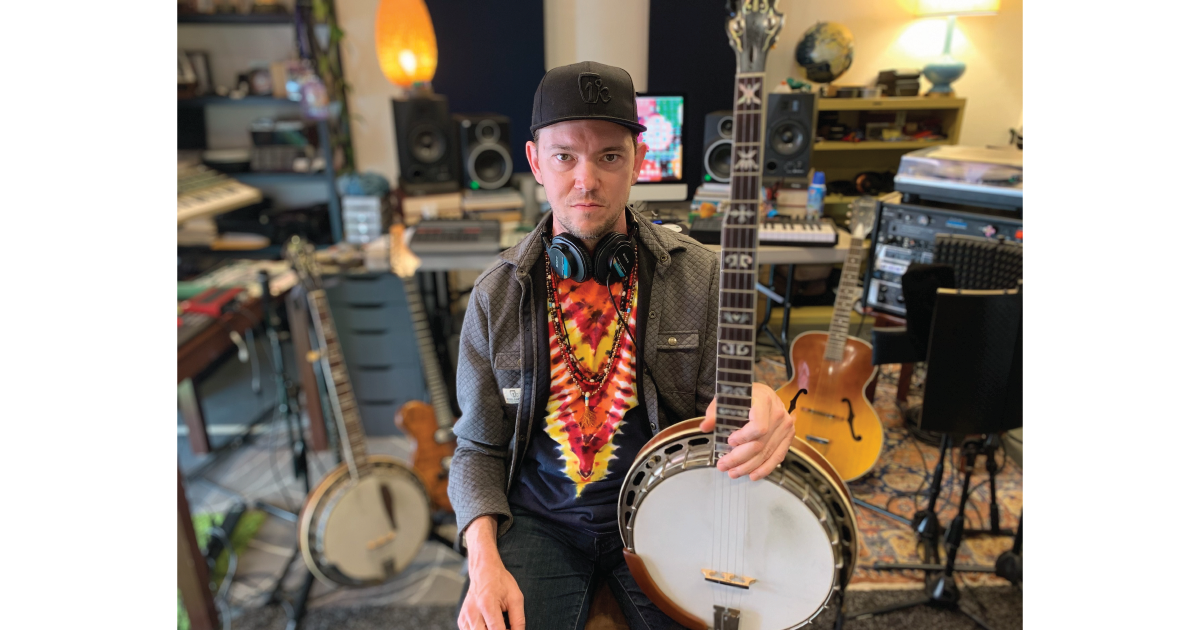
Detached from dance, it’s easy to forget that string band music has been designed with trance embedded within its structures. Chris Pandolfi is a banjo player who’s explored quite a bit in trance and trance-adjacent music with the Infamous Stringdusters, a seminal jamgrass band with a level of bluegrass’s technical virtuosity that’s unmatched in all but a select few ensembles in a similar vein. Pandolfi’s new record, Trance Banjo, which was released under his solo stage name, Trad Plus, moves further and further beyond American roots aesthetics, cementing the banjo and its musical vernacular within trance – the electronica variety as well as the age-old, human kind.

Trance Banjo, and tracks such as “Wallfacer” — whose trippy visualizer music video almost cements this article’s central argument — recalls albums by Scott Vestal, or live shows by post-metal shredders like Billy Strings, or experimental, avant garde compositions by cattywompus flattop mashers like Stash Wyslouch. It’s not just a simple coincidence that so many players from bluegrass and old-time backgrounds find themselves dabbling with trance.

John Mailander, a fiddler who’s toured with Molly Tuttle and Bruce Hornsby and has been hired as a side-musician with many a jamgrass-leaning band, is comfortably uncomfortable in a very similar musical realm as Trance Banjo. On an EP of sketches and improvisations released last summer (from the same sessions and experimentations that became his upcoming album, Forecast) Mailander and his bluegrass-veteran backing band play with trance centered on sparseness, vacancy, and negative space in a way that’s engaging and baffling, both. Mailander’s rubric of vulnerable, emotive, and transparent expression as a foundation for improv is key here.
That personal touch, the personality endemic in these trance experimentations, is certainly what makes them most compelling and it must be, at least in part, what ties these songs to the centuries-old tradition of music as meditation. Rhiannon Giddens and Francesco Turrisi make more than just a musical brand of showcasing their personalities and identities in the music they create, it’s more like a mission statement. Giddens has an incredible aptitude for writing and composing music based on empathy and human connection and Turrisi holds expansive knowledge of world folk music and percussion.

Their compositions and collaborations illustrate that, when we connect our music to dance, percussion, and trance, we’re connecting it to thousands and thousands of years of history — of humans of all ethnicities, cultures, backgrounds, and identities, gathering, connecting, sharing, and loving through music, dance, and trance. On stage, Turrisi and Giddens deliberately connect these dots as well, utilizing stage banter to educate their audiences about these exact connections.

While old-time has held onto its penchant for movement and choreography through the generations, bluegrass continues to grow distant from this and many of the other cultural phenomena that gave rise to it. Trance Banjo, and projects like it, while they seem to gleefully run away from what we perceive as “traditional” aspects of these genres, are in many ways guiding us right back to the very folkways that birthed them. 


Photo credit: Chris Pandolfi by Chris Pandolfi

The BGS Radio Hour – Episode 199

Welcome to the BGS Radio Hour! Since 2017, the show has been a weekly recap of all the great music, new and old, featured on BGS. This week we’ve got everything from quirky pop hooks by Aaron Lee Tasjan to outcries about workers’ rights by the Local Honeys. Remember to check back every Monday for a new episode of the BGS Radio Hour. 

APPLE PODCASTS, SPOTIFY

Black Pumas – “Black Moon Rising”

As we welcome the spring, we bid farewell to our February Artist of the Month – Black Pumas. The duo, up for a total of three Grammy Awards this March with their breakout album, sat down with BGS this month to talk about Black Pumas (Deluxe Edition), and the influences that brought them together.

Terrible Sons – “What A Friend”

From Christchurch, New Zealand, Terrible Sons brings us a song this week from their newly released Mass EP. “The song looks into a life that is unravelling internally and externally, a character who struggles to communicate, someone who’s on the edge,” the duo tells BGS. “We’re really singing about being a failure as a friend, about not being there.”

Aaron Espe – “Take You Home”

February brought many great releases; Aaron Espe’s Rock & Roll Man EP is certainly no exception. As the Nashville-based songwriter told BGS, songs can mean many things to many people, all of which are valid, and shouldn’t be ruined by the songwriter explaining it to them – so best for us not to spoil this one!

Lonesome River Band – “Love Songs”

Steve Martin used to tell a joke about how no one could be sad while playing the banjo. And while the banjo strikes a happy tone, songs from the bluegrass repertoire just aren’t the most optimistic – often, they are about heartbreak, loneliness, or death. In their new single, the Lonesome River Band recognizes that we have to write about what we know – and it ain’t always love songs.

Judith Hill – “Baby, I’m Hollywood!”

For Judith Hill, “Baby, I’m Hollywood!” is a defining statement, summing up the drama, love, and pain that surrounds her life as an entertainer in an epic performance and video.

Cristina Vane – “Prayer For the Blind”

From her upcoming Nowhere Sounds Lovely, Italy-born and Nashville-based Cristina Vane brings us an old-time banjo meditation on finding levity in heavy situations, and the bonds and intergenerational burdens shared between mothers and daughters.

The Wild West – “Better Way”

Women-led upergroup The Wild West strike on uniting us all amongst the differences that divide us – touching the idea of being born with love and without hate, and calling us to find our way back to innocence, understanding, and compassion.

Aaron Lee Tasjan – “Up All Night”

This Nashville artist is no stranger to BGS. Tasjan is his own producer on his newest release Tasjan! Tasjan! Tasjan!, the most-Tasjan album that he’s released so far — quite literally. From deep personal experiences in his writing to silly pop hooks, Tasjan’s newest album is one worth hearing.

Lily B Moonflower – “Midnight Song”

One thing we’re all surely missing is community, be it local jams, concerts, or just visiting with your neighbors. From Lawrence, Kansas, Lily B Moonflower brings us a song inspired by her community coming together through music and love, and the magic that follows on the honky-tonk floor.

Spencer Burton – “Memories We Won’t Soon Forget”

From Ontario, singer-songwriter Spencer Burton joins us for a 5+5 this week – that is, five questions, five songs to go along. From favorite stage memories to a dream musician and meal pairing, our conversation with Burton is one we won’t soon forget.

The Local Honeys – “Dying to Make a Living”

Even while they’re stuck at home like the rest of us, the Local Honeys continue to get their message out to the world. While in past times they’d be touring Europe with Colter Wall or Tyler Childers, the Kentucky-based duet now sit down with BGS to talk about the problems created by extractive industries like coal mining in Appalachia, reflected in their new two-song release.

Chris Pandolfi – “Astral Plane”

From Grammy Award-winning band the Infamous Stringdusters, ‘Panda’ joins us this week on a 5+5 in celebration of his latest album, Trad Plus Presents Trance Banjo. What’s better than banjos, beats, and Stuart Duncan?

Moira Smiley – “Days of War” (feat. Sam Amidon and Seamus Egan)

With the accompaniment of Sam Amidon and Seamus Egan, Moira Smiley brings us “Days of War,” a song written after yet another shockwave of white supremacy in 2017. While Amidon sings the ‘human’ voice in this song, Smiley is the ‘bird,’ who flies and sings in spite of all.


Photos: (L to R) Black Pumas; The Local Honeys by Melissa Stilwell; Aaron Lee Tasjan by Curtis Wayne