The Man That Made All of Us Play the Banjo

(Editor’s Note: For Earl Scruggs’s birthday, Thomas Goldsmith revisits a star-studded bluegrass festival tribute to the banjo legend from 1971 in Camp Springs, North Carolina. The 102nd anniversary of Scruggs’s 1924 birth in Flint Hill, North Carolina, is January 6, 2026.)

Like speakers at a testimonial dinner, each musician strode to the microphone in turn.

But instead of heaping on words of praise, a stage full of well-known pickers and up-and-comers used banjos to pay a lively tribute to Earl Scruggs.

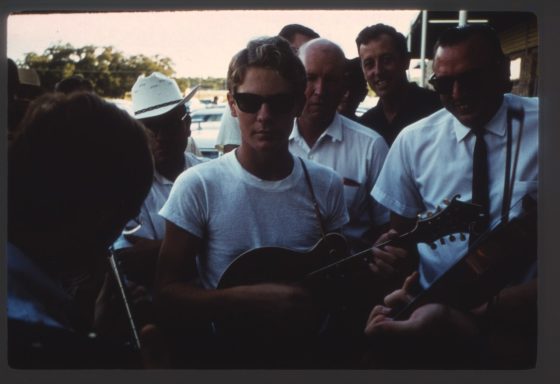
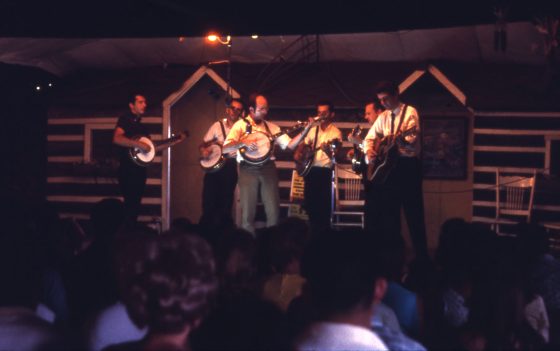
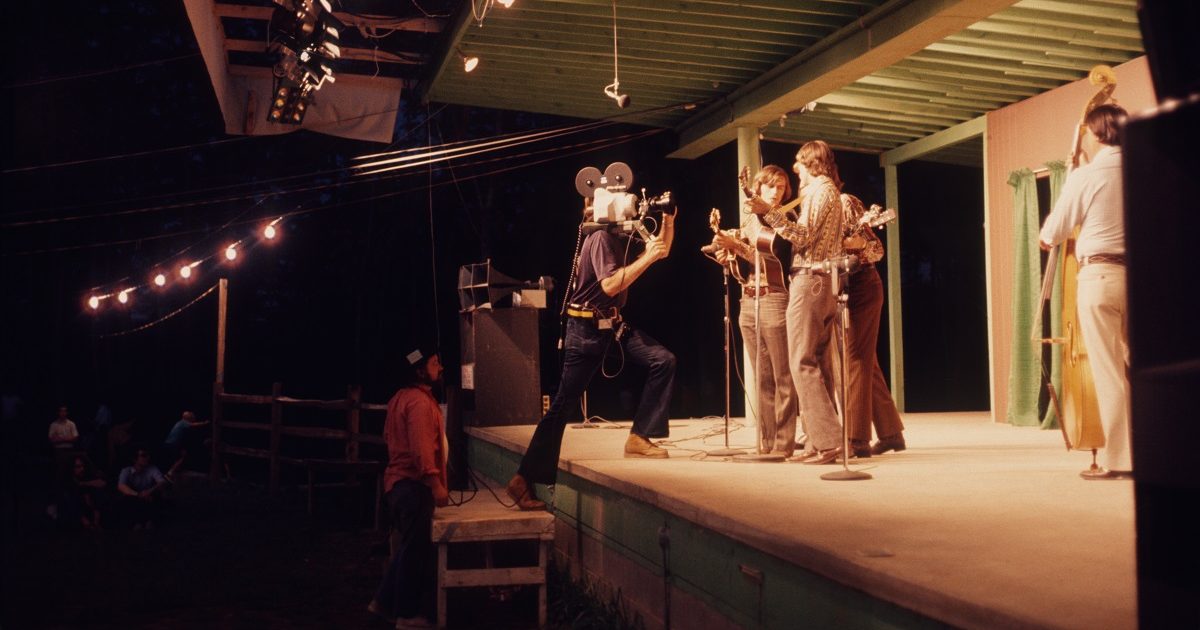
The scene was the 1971 Labor Day weekend bluegrass festival in Camp Springs, North Carolina, at a performance where some of the best banjo players around joined Scruggs on stage. Led by the five-string king himself, banjoists including Sonny Osborne, J.D. Crowe, Bill Emerson, and Alan Munde jointly played Scruggs’s signature tune “Foggy Mountain Breakdown,” some 22 years after its first recording.

The performance is a highlight of the 1972 documentary Bluegrass Country Soul, which enjoyed a 50-year deluxe re-release five years ago. Watch the clip here.
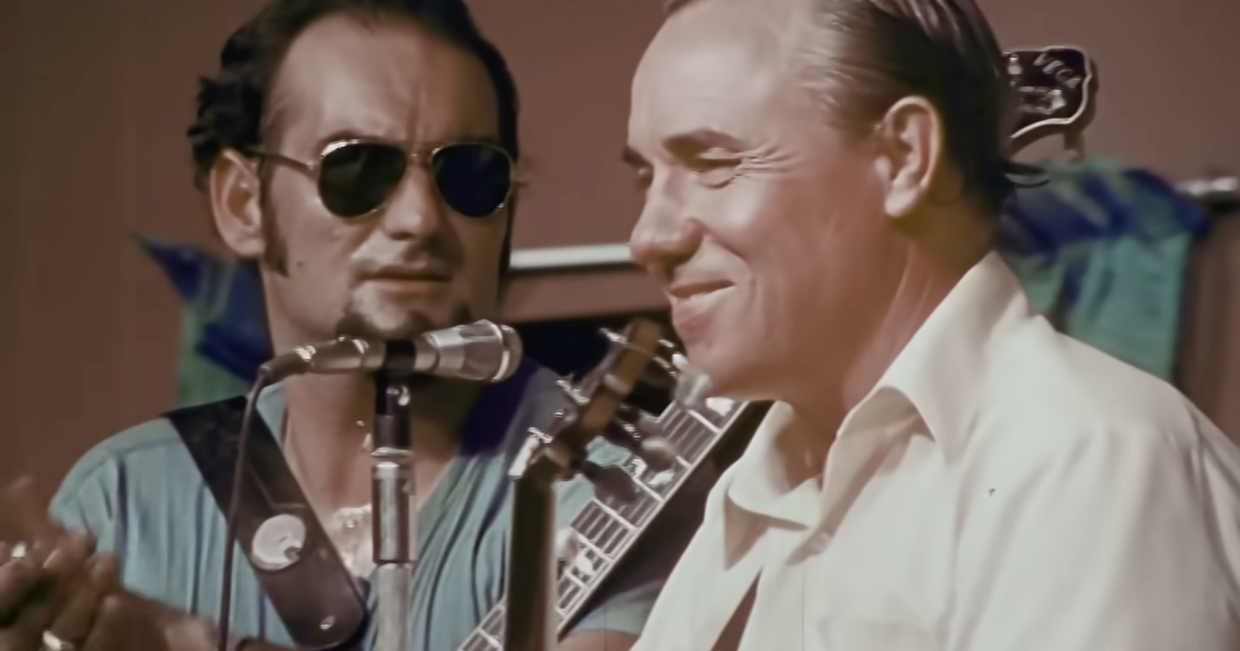
 

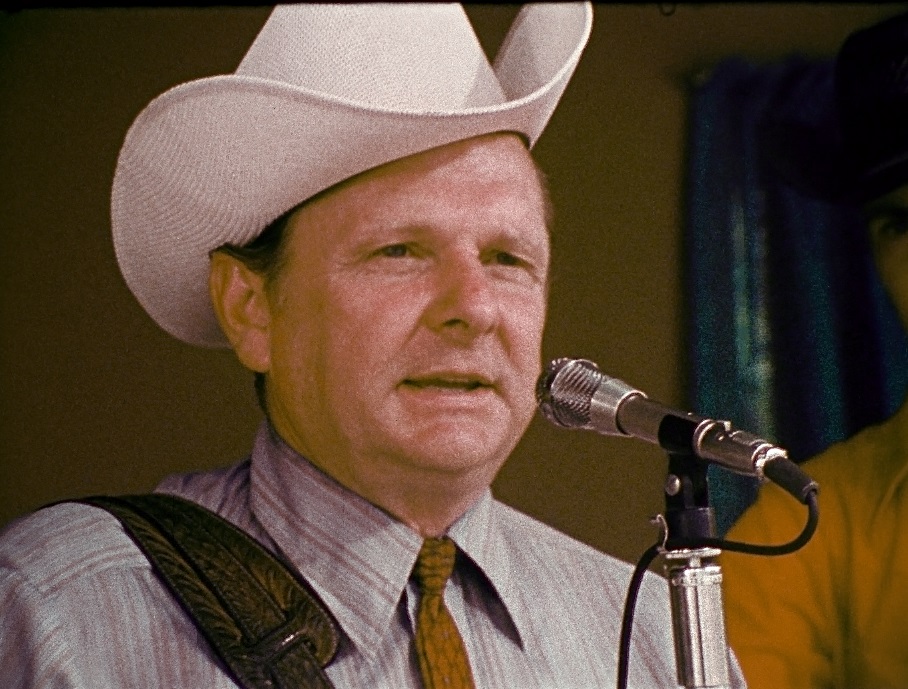
Sonny Osborne (left) gets emotional onstage after introducing Earl Scruggs (right). Screenshot from clip courtesy of Bluegrass Country Soul, Inc.

Promoter Carlton Haney invited more than a dozen banjo players on the festival schedule to play along with Scruggs, who was then 47. (A second group performance, of “Dear Old Dixie,” doesn’t appear in the film. And a couple of the “Foggy Mountain Breakdown” performers didn’t make it to the screen.)

Millions of viewers have seen the clip as part of the movie or on YouTube, with Osborne bringing Scruggs on with an introduction that sounds starstruck.

“(It’d) be only right to call out probably the man that has made all of us guys up here play the banjo, or either has been a great influence, as he has in my complete life,” Osborne said. “In my whole banjo-playing ability … I could probably credit to this one man.

“Let’s all give a tremendous welcome to probably the best in the world, Earl Scruggs!”

Scruggs seemed overwhelmed by the audience’s ovation. The cheering feels as though it lasts forever, but took only a minute and a few seconds.

“That really fills my heart with joy,” Scruggs said after Osborne introduced him. “I did want to say one thing: Thank you, and guys like this is what keeps me going, my boys who works with me and you people who keep preaching music.

“I just don’t know what to say, except I’m picking with some guys that plays a tremendous amount of banjo. Don’t underestimate anybody up here. Man, they’re great.”

Earl at a Crossroads

In 1971, Scruggs had only broken up with his longtime duet partner Lester Flatt less than two years earlier. Not even a month before Camp Springs he had recorded along with other greats for Nitty Gritty Dirt Band’s country-roots-popularizing Will the Circle Be Unbroken set. He was venturing into a country-rock sound with his band the Earl Scruggs Revue, along with his sons Randy, Gary, and Steve.

However, Scruggs’s work as a musical innovator remained – and remains – fundamental to the way a large share of bluegrass banjo players address the instrument. That’s true despite the introduction of a single-note style most associated with Don Reno and a chromatic or melodic approach heard in the playing of Bill Keith and Bobby Thompson.

Most of the pickers in the 1971 “Foggy Mountain Breakdown” performance used the three-finger picking style Scruggs introduced in a band with Bill Monroe and Flatt on the Grand Ole Opry in 1945. The exception among the Camp Springs pickers, Rick Riman of the New Deal String Band, caused something of a stir with his chromatic rendition of the tune, not to mention his long hair, full beard, and striped shirt and pants.

How did Riman, who had also studied Scruggs style closely, decide to use the flowing melodic style for “Foggy Mountain Breakdown”?

“I just thought, “OK, let’s see if I can make this work,’” Riman, 83, said on the phone from Denver, Colorado, speaking to BGS in January 2026. “Because I had not prepared anything, and I didn’t even know what was on the program. They just said they want all the banjo players up there to pay tribute to Earl. And I said, ‘OK, I’ll get up there and do it.’”

And what has the reaction been?

“Mostly negative,” he said, with a touch of humor.

“One person said they were really glad to see somebody step out of the standardized [method], and that felt very, very good. Somebody else said, ‘You won’t believe how many people thought that you shouldn’t have been on stage at all.’

“And I get that a lot. That’s mostly the reaction I get, that I shouldn’t have been on stage. I shouldn’t have even been in the parking lot, like the least talented person on the stage and probably the least talented person in the whole park.”

The chromatic style remains one effective tool in the hands of players such as Béla Fleck and Noam Pikelny, but Riman, 28 that day in 1971, has gotten a load of grief over his choice to add some variety to the line of Scruggs-style players. “I would say, over the years, it’s pretty much been like 50-plus years of derision,” he said.

Riman has had one regret. “I should have practiced more,” he said. “I should have been better, but I had no idea.”

Although at Camp Springs he performed in the more recently created melodic and chromatic styles, like everyone on the stage that day in North Carolina, Riman was schooled in the style of the man honored beside them.

“I was really fascinated by Earl and anybody else who played his style pretty well,” he said.
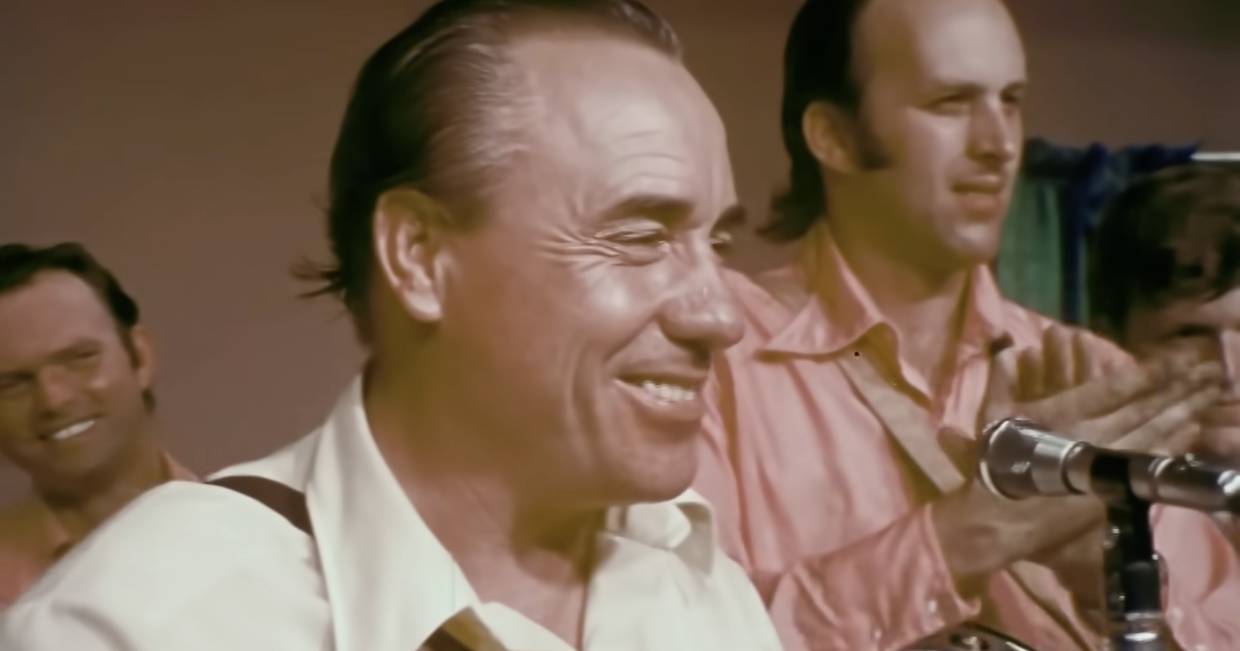
 

Earl Scruggs reacts to his introduction and audience ovation and applause onstage in 1971 in Camp Springs, NC. Screenshot from clip courtesy of Bluegrass Country Soul, Inc.


“Everybody Headed for the Stage”

We were fortunate to reach three of the banjo warriors who performed that day. Sadly, most of the players heard then have since died. Eddie Hoyle, then 14, the youngest of the Camp Springs lineup, is among the survivors and is still actively performing. He talked to BGS on the phone in December from his home in Georgia.

“I was up there playing with Curtis Blackwell and the Dixie Bluegrass Boys and I just remember them telling me that Carlton wanted all the banjo players to come down on the stage and play a tune with Earl,” said Hoyle, now 68. “So I got my banjo out, and everybody headed for the stage.

“I didn’t know if I’d get to take a break or not, but somebody got me in the line that was walking up to the mic. So it was pretty cool. And I remember I was not nervous; OK, probably didn’t know enough to be nervous.”

Most of the players that day stuck fairly close to Scruggs’s own licks on “Foggy Mountain Breakdown,” but Hoyle and others ventured a bit from the classic performance.

“I always tried to learn the right way, as Dad told us to do, but then I would try to put my own twist on it,” Hoyle said.

Nearly half the banjo players that day have been inducted into the Bluegrass Music Hall of Fame. They include Scruggs himself, of course, as well as J.D. Crowe, Bill Emerson, Alan Munde, Sonny Osborne, and Don Stover. Another banjo picker, Saburo Watanabe Inoue, founder of the pioneering Japanese band Bluegrass 45, won the IBMA’s Distinguished Achievement award along with his brother Toshio, in 1995.
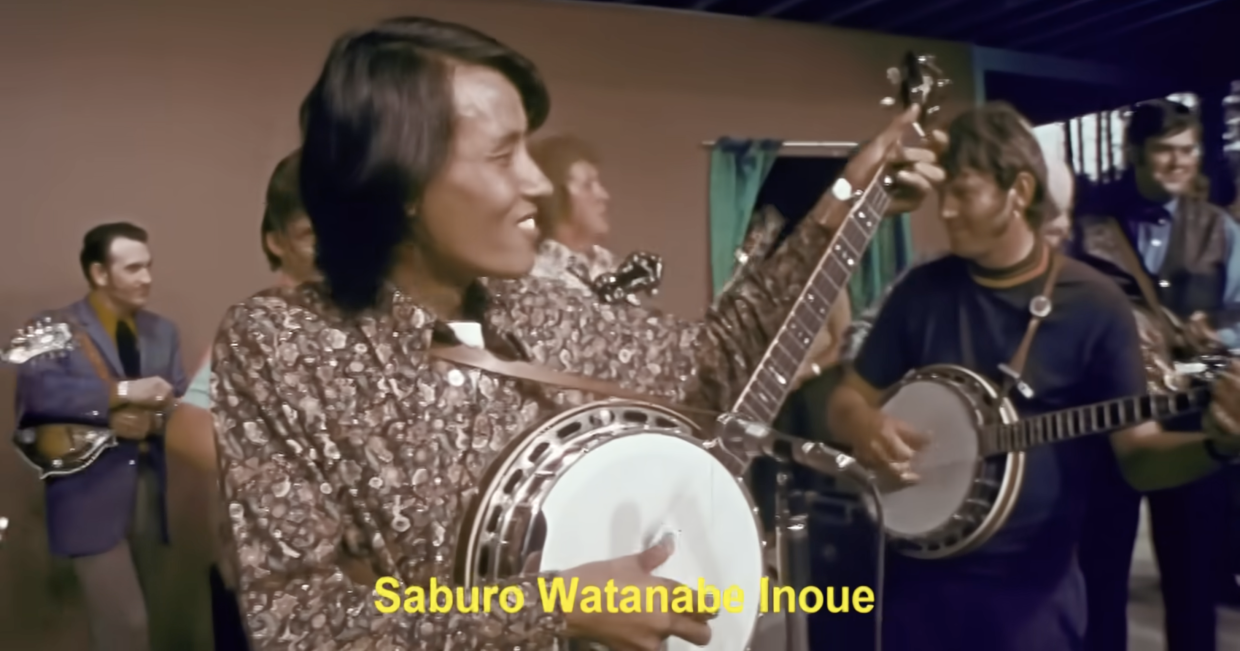
 

Sab Watanabe (who passed away in 2019) of the legendary Japanese band, Bluegrass 45, takes his turn at the mic. Screenshot from clip courtesy of Bluegrass Country Soul, Inc.


Alan Munde Remembers it Well

Munde, 79, still a player and teacher, also spoke to BGS about the experience from his home in Springfield, Missouri. He recalled that he was playing with Jimmy Martin and the Sunny Mountain Boys at the festival and took part in the group performance because Martin wanted him to.

“Thinking back on it and also remembering at the time, I didn’t really want to be a part of it, just because, then and now, I thought I would be so unworthy,” Munde said. “But I think Jimmy wanted me to do it, and you notice he’s there [in the film.] He thought I needed to be there, so I did it.”

Munde remembers the day as a landmark for him, the only time he heard Scruggs play live. Given all the great banjoists and backing musicians including Martin and Charlie Waller, it was an enchanting moment from the sound of Scruggs’s first lick.

“The thing that I remember so much about it is … we’re all standing there and Earl’s talking, and then he’s going to start to play,” he said. “And he, I always call this his ‘chang,’ where he just plays the first, third, and fifth string together and starts into the tune.

“As soon as he did that, I thought, ‘Oh my God, there’s that sound.’ It just was immediately apparent that he was the one.”
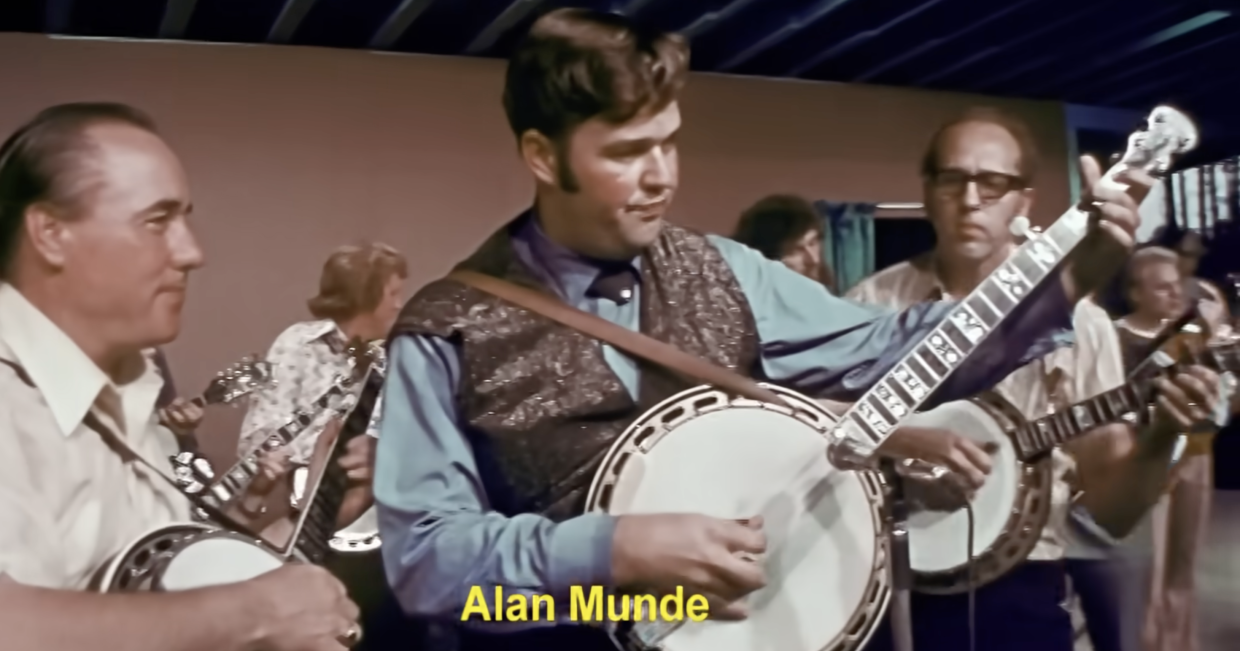
 

Alan Munde (right) is flanked by Earl Scruggs during the all-banjos jam of “Foggy Mountain Breakdown.” Screenshot from clip courtesy of Bluegrass Country Soul, Inc.

Like the first players to tune into Scruggs’s playing in 1945 and like players from Béla Fleck on, Munde appreciates Scruggs’s sound in a way that seems almost mystical. Scruggs produced something that no other banjo player could.

Jimmy Martin, Munde’s boss at the time, used to tell a story involving the great banjo man Vic Jordan to illustrate the way Scruggs’s beautifully nuanced playing and full tone stood above the crowd of his followers.

“Jimmy was kind of down on Vic Jordan a little bit,” Munde said. “And he would tell this story to show that Vic didn’t know the right way. He said when Vic met Earl, he asked him what kind of microphone he used.

“And Earl said, ‘Sometimes I use those little bitty ones, and sometimes I use those real big ones.’

“And Jimmy’s point was that, in his mind, Vic was asking because he thought it was the microphone. But it didn’t matter. It all sounded like Earl every time.”

And hearing Scruggs’s sound that day at Camp Springs, not through a mic, not on a record, but right there next to him on stage, made Munde think the whole exercise was somehow wrong.

“When he did that pinch, I thought, ‘Oh, God, I don’t want to be a part of this.’ What we should have done is just stood back and listened to him, and then said, ‘Do it again.’”

Despite his misgivings at the time, Munde has wound up glad that he took part in the Earl-fest that day.

“Looking back on it, it’s been nothing but good for me, that I got to be there,” he said. “Here it is, 50 years later, people still bring it up. It’s helped get me a little legacy recognition, that I was there, so that’s been real good.”

A Star-Studded Lineup

The career of Sonny Osborne has been well documented, but Bluegrass Country Soul makes clear his admiration and friendship with Scruggs. During the tumult of applause following his introduction, Scruggs asked if he could say something, and Osborne appears to grin and say, “Not yet.” And Osborne cracks up when Scruggs uses his up-the-neck solo from “Foggy Mountain Breakdown” during the last time around for the tune.

Bill Emerson, whose long career included membership in the Country Gentlemen and much more, was interviewed at the time of the re-release of Bluegrass Country Soul. He talked about the pantheon of great banjo players.

“Don Reno, he had his style on the banjo; Earl Scruggs, he had his style on the banjo; Ralph Stanley, he had a style on the banjo,” Emerson said in the set’s booklet. “And on the radio, I could listen to any of them, just the first few notes of an intro, and tell you who was playing. Just by the style that they were playing, the tone that they had, and the timbre. Most people, when they started out playing the banjo back then, they got a bunch of Earl Scruggs’s records and sat down and tried to learn to play like Earl. But it’s mighty hard to sound like Earl, I can tell you. I was never able to do that, so I just tried to sound like Bill Emerson.”
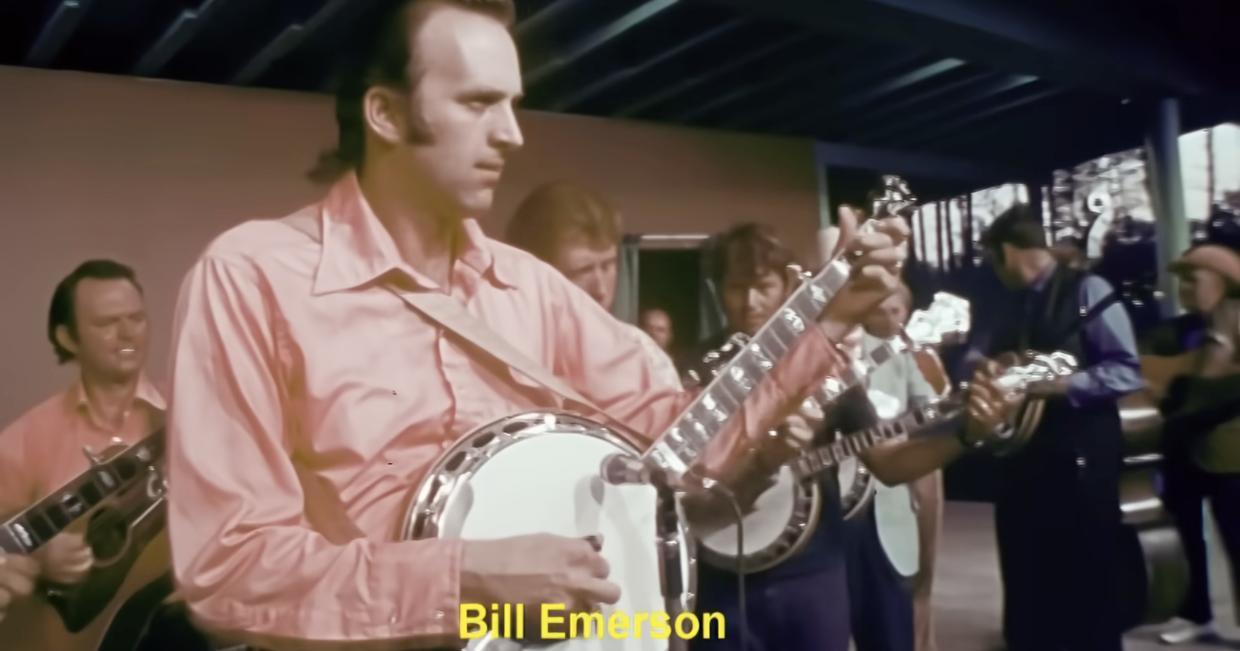
 

Bill Emerson takes his turn playing a solo on “Foggy Mountain Breakdown.” Screenshot from clip courtesy of Bluegrass Country Soul, Inc.

Also on the show was multi-instrumentalist Jimmy Arnold (1952-1992), whose career was one of a kind, including excursions into Southern rock and solo albums on guitar and banjo as well as stints with Cliff Waldron, Charlie Moore, and the New Tradition, according to a 1983 Bluegrass Unlimited story. The article, by Chris Wathen, quoted Arnold on Scruggs: “When you learn all of what you think is hard stuff and then go back and try to play one of his tunes, you find out what the hard stuff really is. It’s his stuff. To play with that much power and volume, you’ve really got to be on top of things.”

Another of the clip’s well-known pickers, Don Stover (1928-1996), had been an early convert to Scruggs style, learning it not long after Scruggs’s first performances with Monroe, according to the Bluegrass Music Hall of Fame.

Stover was known for his work with brothers Bea and Everett Lilly during many years of performances in Boston. He played and recorded as a member of Bill Monroe’s Blue Grass Boys in 1957, even contributing harmony vocals to “In Despair.”

Earl’s son Randy, who appears playing an archtop banjo just before the end of the clip, went on to a distinguished career as a musician, songwriter, and producer.

Doing Their Times

The 55th anniversary of this notable moment in bluegrass will arrive in September. Looking back, the picking ranges from respectable to spectacular, but doesn’t maintain the dead-even tempo that’s supposed to prevail in bluegrass music. Fans remember the story that Earl and brother Horace Scruggs, as boys, used to start playing a tune, then separate to walk around their Flint Hill house in opposite directions. The idea was to check if they were still in time with each other after being out of earshot.

The dozen players on the Camp Springs group number would not have passed this test, based on a stopwatch run-through. While Scruggs’s December 1949 original recording had consistent solos of right at 11 seconds, he started the round robin at about 12.69 seconds and tempos wavered from there.

By the start of Riman’s melodic solo, near the end, the time was more than half a second slower. Randy and Earl Scruggs wrapped things up at roughly the same tempo.

But that’s just a quibble.
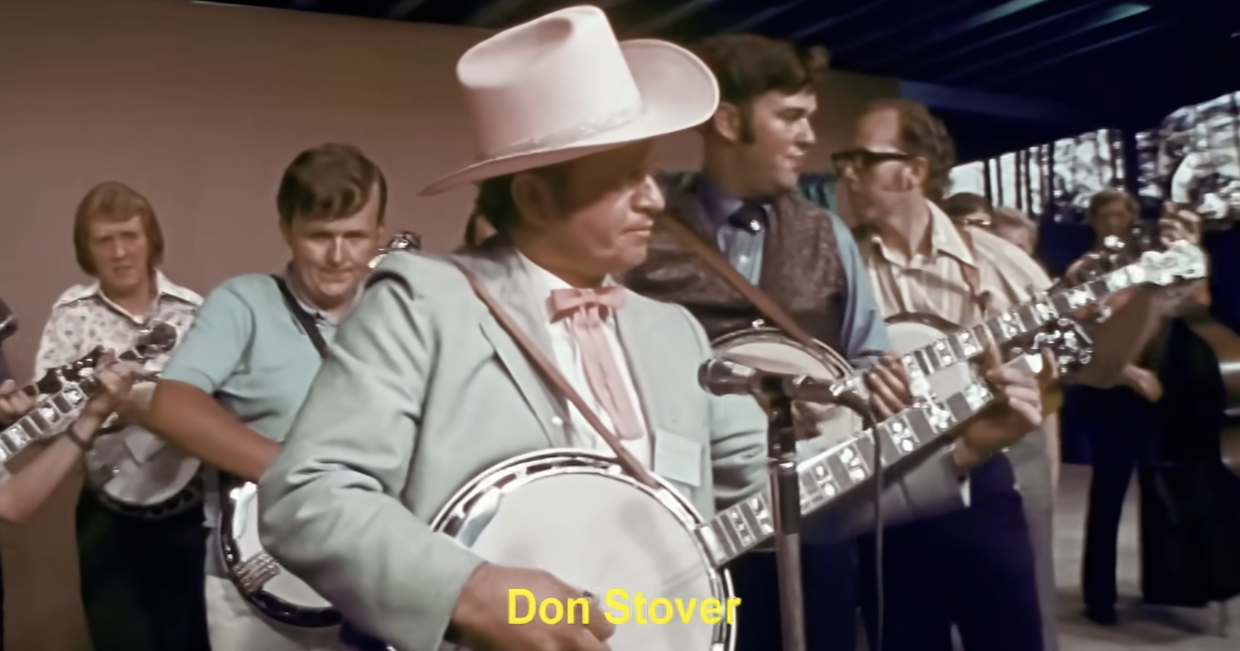
 

A contemporary of Earl Scruggs, Don Stover also performed a rendition of “Foggy Mountain Breakdown” during the jam. Screenshot from clip courtesy of Bluegrass Country Soul, Inc.


Remembering Earl

Bluegrass Country Soul director Albert Ihde did bluegrass lovers a real service by capturing these moments and others at the Camp Springs festival. And promoter Haney had another brainstorm resembling the story, pronounced “stoah-ry,” that he recreated of Bill Monroe and former band members six years earlier at Fincastle, Virginia.

Viewers will keep calling up the video for its closeups of Earl, smiling and even bobbing up and down for his breaks, and for the scenes of several of his outstanding followers, appreciating their moments on stage as they rolled their way through “Foggy Mountain Breakdown.”

Many videos of Flatt & Scruggs can be found on the web that illustrate Earl Scruggs’s unmatched musicianship. In the Bluegrass Country Soul segment viewers can also see a strong memorial to Earl Eugene Scruggs the person, his warmth, humor, and unselfishness as well as his brilliance as a musician.


Thomas Goldsmith is an award-winning journalist based in Tennessee and North Carolina. In addition to producing many hundreds of articles for newspapers and magazines, he edited The Bluegrass Reader and authored Earl Scruggs and Foggy Mountain Breakdown: The Making of an American Classic, both books for the University of Illinois Press.

Learn more about Bluegrass Country Soul and purchase a Golden Anniversary Legacy Edition box set of the film here. Read more about the box set and the making of the film here.

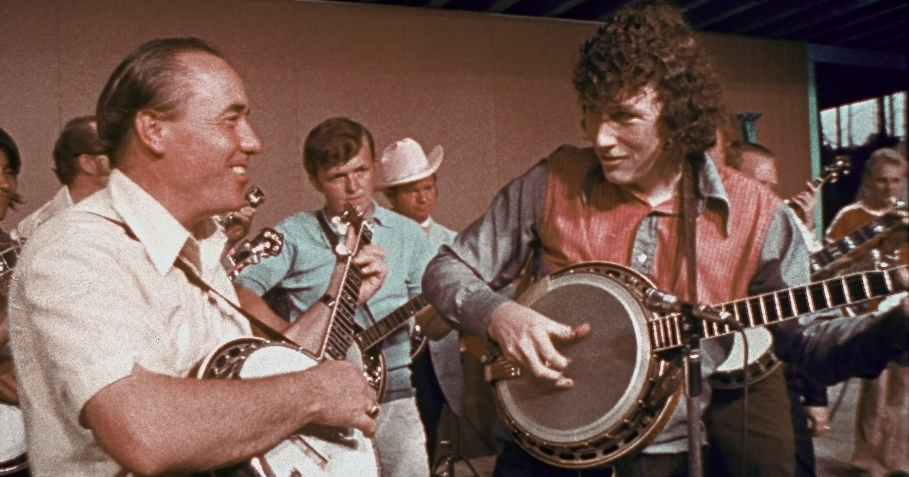
All photos courtesy of Albert Ihde, Ellen Pasternack, and Bluegrass Country Soul, Inc. Lead image: Earl Scruggs (left) and son, Randy Scruggs (right), perform “Foggy Mountain Breakdown” flanked by bluegrass banjo stars of 1971.
See the Winners of the 35th Annual IBMA Bluegrass Music Awards

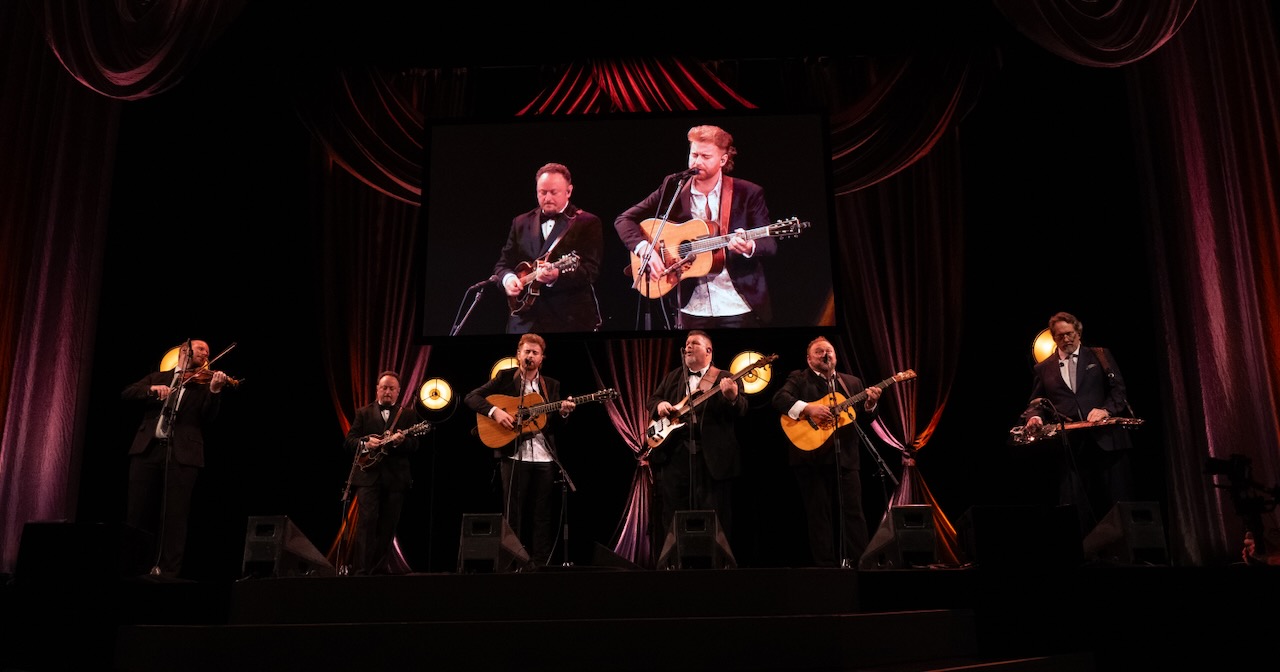
Last night, the International Bluegrass Music Association announced the winners of their 35th Annual Bluegrass Music Awards in Raleigh, North Carolina, the final awards show held in Raleigh before IBMA’s move to Chattanooga, Tennessee next year. The star-studded, three-hour awards show was hosted by bassists John Cowan and Missy Raines and featured performances by many nominees and featured special guests and collaborations.

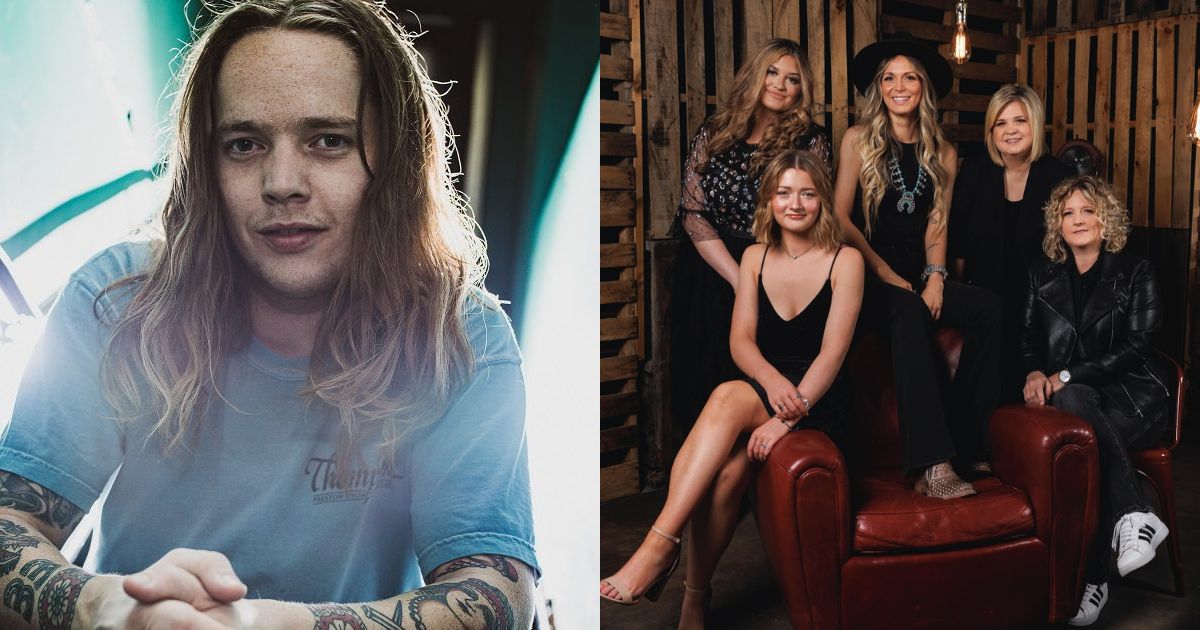
Billy Strings, Sister Sadie, Authentic Unlimited, and Molly Tuttle & Golden Highway lead the nominations going into the evening. Authentic Unlimited walked away with the most trophies, with the group as a whole landing three awards – including a tie for Music Video of the Year with Special Consensus. Molly Tuttle & Golden Highway took home the honor for Album of the Year, while Billy Strings’ sole win of the night was for his feature on Tony Trischka’s collaborative Earl Jam track, “Brown’s Ferry Blues.”

Also honored during the event were this year’s Bluegrass Music Hall of Fame inductees. Entered into the Hall of Fame – the highest honor awarded by IBMA and its membership – were Jerry Douglas, Katy Daley, and Alan Munde.

Find the full list of winners and recipients of this year’s IBMA Awards below. Congratulations to all of the nominees, bands, artists, labels, and industry stakeholders represented at this year’s awards.

ENTERTAINER OF THE YEAR
Billy Strings
Molly Tuttle & Golden Highway
Del McCoury Band
Sister Sadie
The Po’ Ramblin’ Boys

VOCAL GROUP OF THE YEAR
Authentic Unlimited
Sister Sadie
Blue Highway
Del McCoury Band
Molly Tuttle & Golden Highway

INSTRUMENTAL GROUP OF THE YEAR
Billy Strings
Michael Cleveland & Flamekeeper
Travelin’ McCourys
East Nash Grass
Molly Tuttle & Golden Highway

SONG OF THE YEAR
“Fall in Tennessee” – Authentic Unlimited
Songwriters: John Meador/Bob Minner
Producer: Authentic Unlimited
Label: Billy Blue Records

“Willow” – Sister Sadie
Songwriter: Ashley McBryde
Producer: Sister Sadie
Label: Mountain Home

“Too Lonely, Way Too Long” – Rick Faris with Del McCoury
Songwriter: Rick Faris
Producer: Stephen Mougin
Label: Dark Shadow Recording

“Forever Young” – Daniel Grindstaff with Paul Brewster & Dolly Parton
Songwriters: Jim Cregan/Kevin Savigar/Bob Dylan/Rod Stewart
Producer: Daniel Grindstaff
Label: Bonfire Music Group

“Kentucky Gold” – Dale Ann Bradley with Sam Bush
Songwriters: Wayne Carson/Ronnie Reno
Producer: Dale Ann Bradley
Label: Pinecastle

ALBUM OF THE YEAR
City of Gold – Molly Tuttle & Golden Highway
Producers: Jerry Douglas/Molly Tuttle
Label: Nonesuch

Last Chance to Win – East Nash Grass
Producer: East Nash Grass
Label: Mountain Fever

Jubilation – Appalachian Road Show
Producer: Appalachian Road Show
Label: Billy Blue Records

No Fear – Sister Sadie
Producer: Sister Sadie
Label: Mountain Home

So Much for Forever – Authentic Unlimited
Producer: Authentic Unlimited
Label: Billy Blue Records

GOSPEL RECORDING OF THE YEAR
“When I Get There” – Russell Moore & IIIrd Tyme Out
Songwriter: Michael Feagan
Producer: Russell Moore & IIIrd Tyme Out
Label: Independent

“Thank You Lord for Grace” – Authentic Unlimited
Songwriter: Jerry Cole
Producer: Authentic Unlimited
Label: Billy Blue Records

“Just Beyond” – Barry Abernathy with John Meador, Tim Raybon, Bradley Walker
Songwriters: Rick Lang/Mike Richards/Windi Robinson
Producer: Jerry Salley
Label: Billy Blue Records

“God Already Has” – Dale Ann Bradley
Songwriter: Mark “Brink” Brinkman/David Stewart
Producer: Dale Ann Bradley
Label: Pinecastle

“Memories of Home” – Authentic Unlimited
Songwriter: Jerry Cole
Producer: Authentic Unlimited
Label: Billy Blue Records

INSTRUMENTAL RECORDING OF THE YEAR
“Rhapsody in Blue(grass)” – Béla Fleck
Songwriter: George Gershwin arr. Ferde Grofé/Béla Fleck
Producer: Béla Fleck
Label: Béla Fleck Productions/Thirty Tigers

“Knee Deep in Bluegrass” – Ashby Frank
Songwriter: Terry Baucom
Producer: Ashby Frank
Label: Mountain Home

“Panhandle Country” – Missy Raines & Allegheny
Songwriter: Bill Monroe
Producer: Alison Brown
Label: Compass Records

“Lloyd’s of Lubbock” – Alan Munde
Songwriter: Alan Munde
Producer: Billy Bright
Label: Patuxent

“Behind the 8 Ball” – Andy Leftwich
Songwriter: Andy Leftwich
Producer: Andy Leftwich
Label: Mountain Home

NEW ARTIST OF THE YEAR
East Nash Grass
Bronwyn Keith-Hynes
AJ Lee & Blue Summit
Wyatt Ellis
The Kody Norris Show

COLLABORATIVE RECORDING OF THE YEAR
“Brown’s Ferry Blues” – Tony Trischka featuring Billy Strings
Songwriters: Alton Delmore/Rabon Delmore
Producer: Béla Fleck
Label: Down the Road

“Fall in Tennessee” – Authentic Unlimited with Jerry Douglas
Songwriters: John Meador/Bob Minner
Producer: Authentic Unlimited
Label: Billy Blue Records

“Forever Young” – Daniel Grindstaff with Paul Brewster, Dolly Parton
Songwriters: Jim Cregan/Kevin Savigar/Bob Dylan/Rod Stewart
Producer: Daniel Grindstaff
Label: Bonfire Music Group

“Bluegrass Radio” – Alison Brown and Steve Martin
Songwriters: Steve Martin/Alison Brown
Producers: Alison Brown/Garry West
Label: Compass Records

“Too Old to Die Young” – Bobby Osborne and CJ Lewandowski
Songwriters: Scott Dooley/John Hadley/Kevin Welch
Producer: CJ Lewandowski
Label: Turnberry Records

MALE VOCALIST OF THE YEAR
Dan Tyminski
Greg Blake
Del McCoury
Danny Paisley
Russell Moore

FEMALE VOCALIST OF THE YEAR
Molly Tuttle
Jaelee Roberts
Dale Ann Bradley
AJ Lee
Rhonda Vincent

BANJO PLAYER OF THE YEAR
Kristin Scott Benson
Gena Britt
Alison Brown
Béla Fleck
Rob McCoury

BASS PLAYER OF THE YEAR
Missy Raines
Mike Bub
Vickie Vaughn
Todd Phillips
Mark Schatz

FIDDLE PLAYER OF THE YEAR
Jason Carter
Bronwyn Keith-Hynes
Michael Cleveland
Stuart Duncan
Deanie Richardson

RESOPHONIC GUITAR PLAYER OF THE YEAR
Justin Moses
Rob Ickes
Jerry Douglas
Andy Hall
Gaven Largent

GUITAR PLAYER OF THE YEAR
Billy Strings
Molly Tuttle
Trey Hensley
Bryan Sutton
Cody Kilby

MANDOLIN PLAYER OF THE YEAR
Sierra Hull
Sam Bush
Ronnie McCoury
Jesse Brock
Alan Bibey

MUSIC VIDEO OF THE YEAR
“Willow” – Sister Sadie
Label: Mountain Home

“Fall in Tennessee” – Authentic Unlimited
Label: Billy Blue Records (TIE)

“The City of New Orleans” – Rhonda Vincent & The Rage
Label: Upper Management Music

“I Call Her Sunshine” – The Kody Norris Show
Label: Rebel Records

“Alberta Bound” – Special Consensus with Ray Legere, John Reischman, Patrick Sauber, Trisha Gagnon, Pharis & Jason Romero, and Claire Lynch
Label: Compass Records (TIE)

BLUEGRASS MUSIC HALL OF FAME INDUCTEES
Alan Munde
Jerry Douglas
Katy Daley

DISTINGUISHED ACHIEVEMENT AWARD RECIPIENTS
Cindy Baucom
Laurie Lewis
Richard Hurst
ArtistWorks
Bloomin’ Bluegrass Festival


Photo Credit: Authentic Unlimited with special guest Jerry Douglas perform at the IBMA Awards show. Shot by Dan Schram.

35th Annual IBMA Bluegrass Music Awards Nominations Announced

Earlier today, the International Bluegrass Music Association announced their nominees, recipients, and inductees to be honored at the 35th Annual Bluegrass Music Awards show to be held on September 26 in Raleigh, North Carolina. The nominations and honorees were revealed at a radio broadcast at SiriusXM in downtown Nashville, Tennessee that featured live performances by nominees Missy Raines & Allegheny and Authentic Unlimited.

Billy Strings, Sister Sadie, Authentic Unlimited, and Molly Tuttle & Golden Highway lead the nominations. Also announced during the event were this year’s Bluegrass Music Hall of Fame inductees and Distinguished Achievement Awards Recipients. Entering the Hall of Fame – the highest honor awarded by IBMA and its membership – are Jerry Douglas, Katy Daley, and Alan Munde.

Find the full list of nominees, inductees, and recipients below and make plans now to attend the IBMA Bluegrass Music Awards on Thursday, September 26, at the Martin Marietta Center for the Performing Arts in Raleigh, North Carolina during IBMA’s headline event of the year, their World of Bluegrass business conference and Bluegrass Live! festival.

ENTERTAINER OF THE YEAR
Billy Strings
Molly Tuttle & Golden Highway
Del McCoury Band
Sister Sadie
The Po’ Ramblin’ Boys

VOCAL GROUP OF THE YEAR
Authentic Unlimited
Sister Sadie
Blue Highway
Del McCoury Band
Molly Tuttle & Golden Highway

INSTRUMENTAL GROUP OF THE YEAR
Billy Strings
Michael Cleveland & Flamekeeper
Travelin’ McCourys
East Nash Grass
Molly Tuttle & Golden Highway

SONG OF THE YEAR
“Fall in Tennessee” – Authentic Unlimited
Songwriters: John Meador/Bob Minner
Producer: Authentic Unlimited
Label: Billy Blue Records

“Willow” – Sister Sadie
Songwriter: Ashley McBryde
Producer: Sister Sadie
Label: Mountain Home

“Too Lonely, Way Too Long” – Rick Faris with Del McCoury
Songwriter: Rick Faris
Producer: Stephen Mougin
Label: Dark Shadow Recording

“Forever Young” – Daniel Grindstaff with Paul Brewster & Dolly Parton
Songwriters: Jim Cregan/Kevin Savigar/Bob Dylan/Rod Stewart
Producer: Daniel Grindstaff
Label: Bonfire Music Group

“Kentucky Gold” – Dale Ann Bradley with Sam Bush
Songwriters: Wayne Carson/Ronnie Reno
Producer: Dale Ann Bradley
Label: Pinecastle

ALBUM OF THE YEAR
City of Gold – Molly Tuttle & Golden Highway
Producers: Jerry Douglas/Molly Tuttle
Label: Nonesuch

Last Chance to Win – East Nash Grass
Producer: East Nash Grass
Label: Mountain Fever

Jubilation – Appalachian Road Show
Producer: Appalachian Road Show
Label: Billy Blue Records

No Fear – Sister Sadie
Producer: Sister Sadie
Label: Mountain Home

So Much for Forever – Authentic Unlimited
Producer: Authentic Unlimited
Label: Billy Blue Records

GOSPEL RECORDING OF THE YEAR
“When I Get There” – Russell Moore & IIIrd Tyme Out
Songwriter: Michael Feagan
Producer: Russell Moore & IIIrd Tyme Out
Label: Independent

“Thank You Lord for Grace” – Authentic Unlimited
Songwriter: Jerry Cole
Producer: Authentic Unlimited
Label: Billy Blue Records

“Just Beyond” – Barry Abernathy with John Meador, Tim Raybon, Bradley Walker
Songwriters: Rick Lang/Mike Richards/Windi Robinson
Producer: Jerry Salley
Label: Billy Blue Records

“God Already Has” – Dale Ann Bradley
Songwriter: Mark “Brink” Brinkman/David Stewart
Producer: Dale Ann Bradley
Label: Pinecastle

“Memories of Home” – Authentic Unlimited
Songwriter: Jerry Cole
Producer: Authentic Unlimited
Label: Billy Blue Records

INSTRUMENTAL RECORDING OF THE YEAR
“Rhapsody in Blue(grass)” – Béla Fleck
Songwriter: George Gershwin arr. Ferde Grofé/Béla Fleck
Producer: Béla Fleck
Label: Béla Fleck Productions/Thirty Tigers

“Knee Deep in Bluegrass” – Ashby Frank
Songwriter: Terry Baucom
Producer: Ashby Frank
Label: Mountain Home

“Panhandle Country” – Missy Raines & Allegheny
Songwriter: Bill Monroe
Producer: Alison Brown
Label: Compass Records

“Lloyd’s of Lubbock” – Alan Munde
Songwriter: Alan Munde
Producer: Billy Bright
Label: Patuxent

“Behind the 8 Ball” – Andy Leftwich
Songwriter: Andy Leftwich
Producer: Andy Leftwich
Label: Mountain Home

NEW ARTIST OF THE YEAR
East Nash Grass
Bronwyn Keith-Hynes
AJ Lee & Blue Summit
Wyatt Ellis
The Kody Norris Show

COLLABORATIVE RECORDING OF THE YEAR
“Brown’s Ferry Blues” – Tony Trischka featuring Billy Strings
Songwriters: Alton Delmore/Rabon Delmore
Producer: Béla Fleck
Label: Down the Road

“Fall in Tennessee” – Authentic Unlimited with Jerry Douglas
Songwriters: John Meador/Bob Minner
Producer: Authentic Unlimited
Label: Billy Blue Records

“Forever Young” – Daniel Grindstaff with Paul Brewster, Dolly Parton
Songwriters: Jim Cregan/Kevin Savigar/Bob Dylan/Rod Stewart
Producer: Daniel Grindstaff
Label: Bonfire Music Group

“Bluegrass Radio” – Alison Brown and Steve Martin
Songwriters: Steve Martin/Alison Brown
Producers: Alison Brown/Garry West
Label: Compass Records

“Too Old to Die Young” – Bobby Osborne and CJ Lewandowski
Songwriters: Scott Dooley/John Hadley/Kevin Welch
Producer: CJ Lewandowski
Label: Turnberry Records

MALE VOCALIST OF THE YEAR
Dan Tyminski
Greg Blake
Del McCoury
Danny Paisley
Russell Moore

FEMALE VOCALIST OF THE YEAR
Molly Tuttle
Jaelee Roberts
Dale Ann Bradley
AJ Lee
Rhonda Vincent

BANJO PLAYER OF THE YEAR
Kristin Scott Benson
Gena Britt
Alison Brown
Béla Fleck
Rob McCoury

BASS PLAYER OF THE YEAR
Missy Raines
Mike Bub
Vickie Vaughn
Todd Phillips
Mark Schatz

FIDDLE PLAYER OF THE YEAR
Jason Carter
Bronwyn Keith-Hynes
Michael Cleveland
Stuart Duncan
Deanie Richardson

RESOPHONIC GUITAR PLAYER OF THE YEAR
Justin Moses
Rob Ickes
Jerry Douglas
Andy Hall
Gaven Largent

GUITAR PLAYER OF THE YEAR
Billy Strings
Molly Tuttle
Trey Hensley
Bryan Sutton
Cody Kilby

MANDOLIN PLAYER OF THE YEAR
Sierra Hull
Sam Bush
Ronnie McCoury
Jesse Brock
Alan Bibey

MUSIC VIDEO OF THE YEAR
“Willow” – Sister Sadie
Label: Mountain Home

“Fall in Tennessee” – Authentic Unlimited
Label: Billy Blue Records

“The City of New Orleans” – Rhonda Vincent & The Rage
Label: Upper Management Music

“I Call Her Sunshine” – The Kody Norris Show
Label: Rebel Records

“Alberta Bound” – Special Consensus with Ray Legere, John Reischman, Patrick Sauber, Trisha Gagnon, Pharis & Jason Romero, and Claire Lynch
Label: Compass Records

BLUEGRASS MUSIC HALL OF FAME INDUCTEES
Alan Munde
Jerry Douglas
Katy Daley

DISTINGUISHED ACHIEVEMENT AWARD RECIPIENTS
Cindy Baucom
Laurie Lewis
Richard Hurst
ArtistWorks
Bloomin’ Bluegrass Festival


Photo Credit: Billy Strings by Jesse Faatz; Sister Sadie by Eric Ahlgrim.

Acoustic America: Musical Instrument Museum’s Exhibit Gathers Iconic Instruments

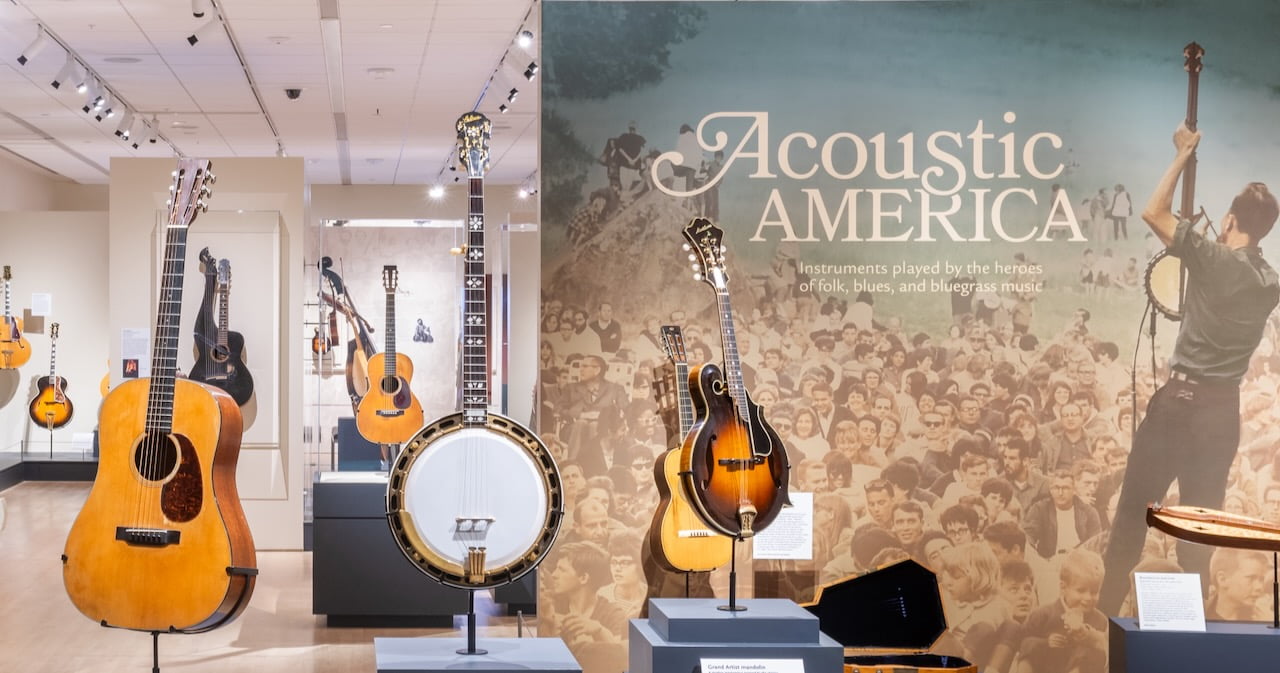
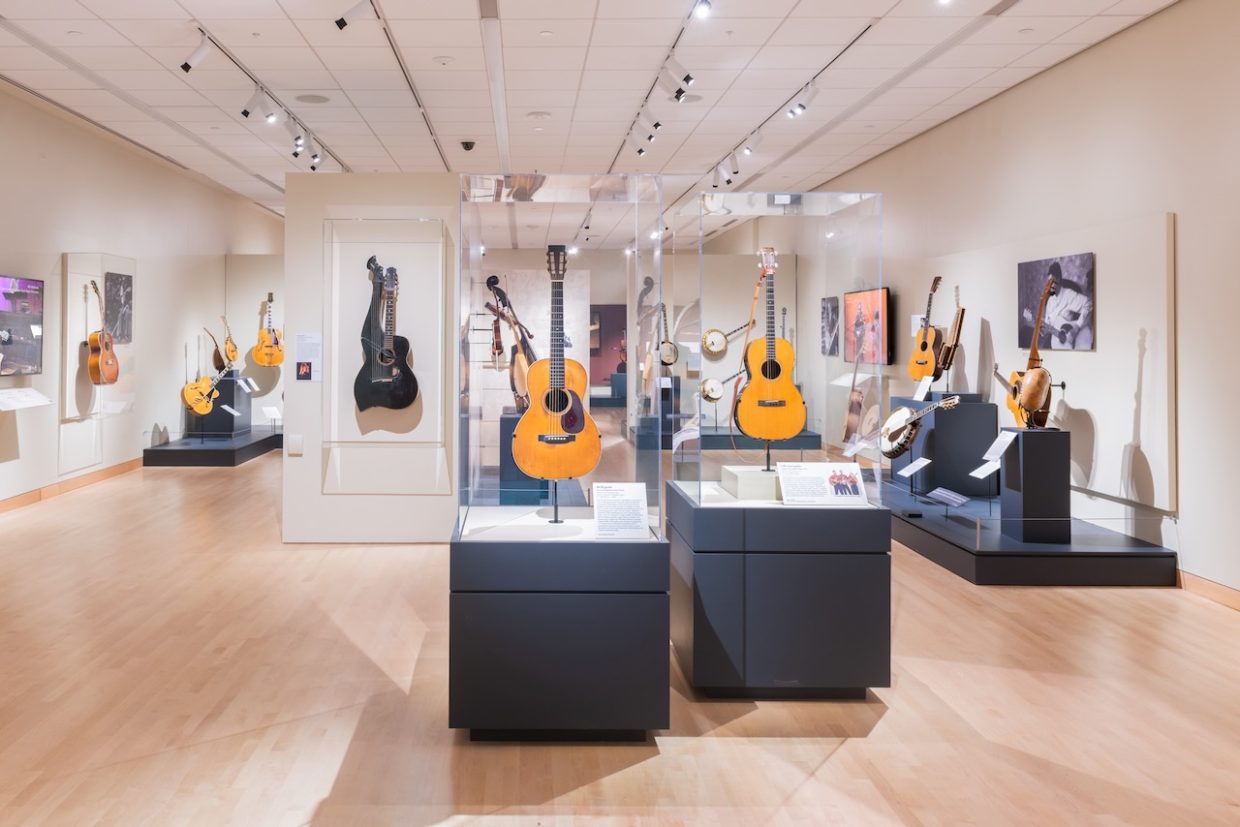
In early November, the Musical Instrument Museum in Phoenix, Arizona unveiled a brand new exhibition, Acoustic America, which celebrates iconic instruments of many heroes of folk, blues, bluegrass, and more. The exhibit is presented in partnership with our Dawg in December Artist of the Month, David Grisman and his record label Acoustic Disc, and showcases a remarkable collection of instruments that the museum states, “Have redefined music not only in the United States, but around the world.” This includes more than thirty instruments on loan from the Dawg himself.

“MIM is honored for this opportunity to collaborate with David Grisman and feature so many prized instruments from his collection,” says MIM senior curator Rich Walter, via email. “And after many years of loving his music, it has been a joy on a personal level for me, too. His influence as a mandolinist, composer, and bandleader is huge, and he absolutely changed the course of acoustic music as we know it today.”

The Acoustic America Gallery at the Musical Instrument Museum in Phoenix, AZ.

Guests of the museum will be able to view storied and legendary instruments formerly owned and played by such luminaries as Earl Scruggs, Elizabeth Cotten, Mississippi John Hurt, John Hartford, Lloyd Loar, and many more. “Beyond the legacies of the individual artists and the beauty of these historic instruments,” Walter continues, “Seeing this collection together in one space is really striking because it reflects a broader American narrative. Exceptional individuals from diverse backgrounds crossed paths and connected their talents in ways that gave us distinctive new traditions that continue to inspire people around the world.”

To celebrate the new exhibition and Dawg in December, we’ve partnered with MIM to bring you these photos of select instruments from Acoustic America. Make plans to visit the Musical Instrument Museum in Arizona now! Tickets are available at MIM.org.

(Editor’s Note: Instrument information provided from the Acoustic America catalog.)

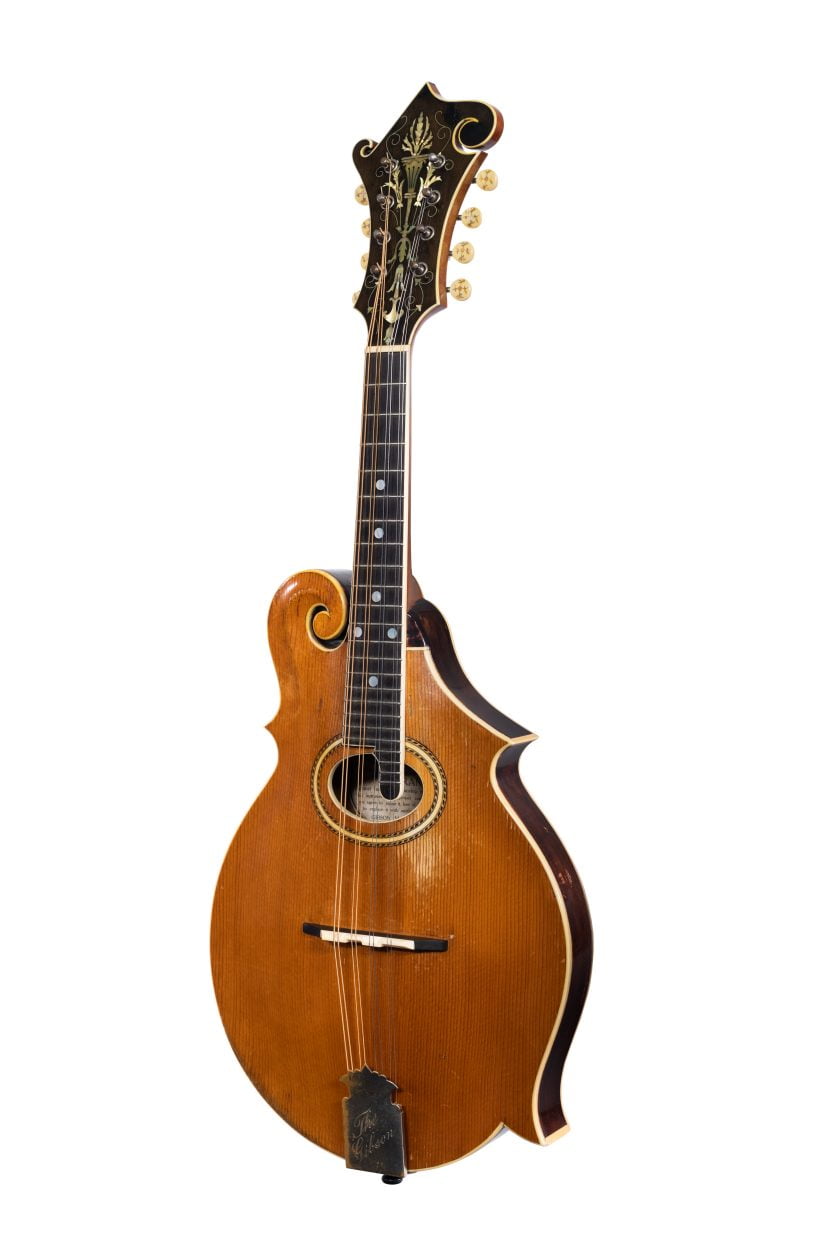
1910 Gibson F-4 Mandolin: Owned and played by David Grisman. Loan courtesy of David Grisman.

The F-4 model was Gibson’s premier mandolin until late 1922, when the F-5 was introduced. In addition to the characteristic oval sound hole and carved scroll, this early example features a three-point body style (note the points protruding from the body), elaborate torch and wire peghead inlay pattern, and special Handel tuning buttons with colorful inlays. David Grisman featured this mandolin on the cover of his first solo album, The David Grisman Rounder Album, and has recorded with it on other projects, including Tone Poems with Tony Rice and Not for Kids Only with Jerry Garcia.

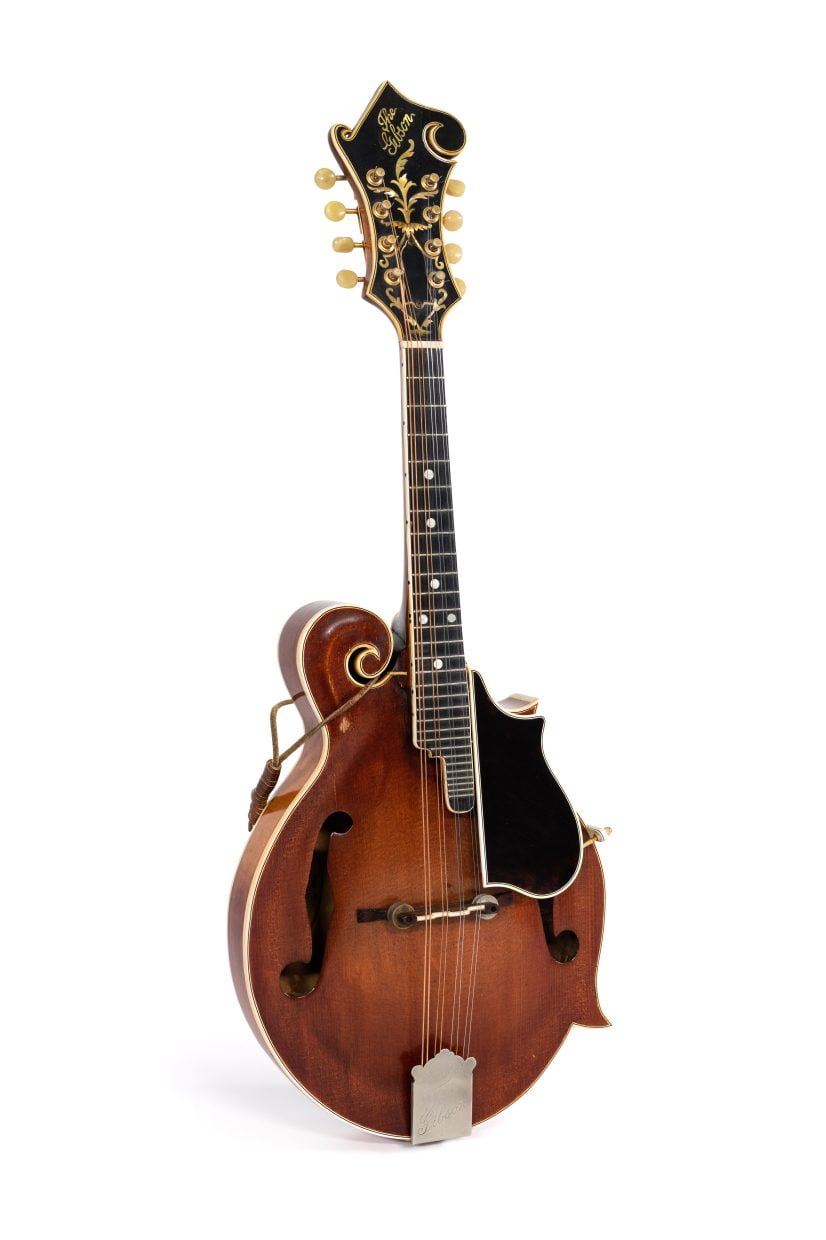
1954 Gibson F-5 Mandolin: Owned and played by Ralph Rinzler. Loan courtesy of David Grisman.

Manager, talented musician, and legendary folklorist Ralph Rinzler (1934–1994) was one of David Grisman’s earliest and most influential mentors. Sharing a hometown of Passaic, New Jersey, Rinzler introduced Grisman to important recordings of folk music and inspired him to play the mandolin. Rinzler played this F-5 mandolin with the Greenbriar Boys, who were the first non-Southern bluegrass band to win at the Union Grove Old Time Fiddler’s Convention in North Carolina. He also managed the careers of Doc Watson and Bill Monroe and was instrumental in creating the first dedicated bluegrass festival in Fincastle, Virginia, in 1965. Two years later, Rinzler founded the Smithsonian Folklife Festival to celebrate and support living cultural heritage from around the world.

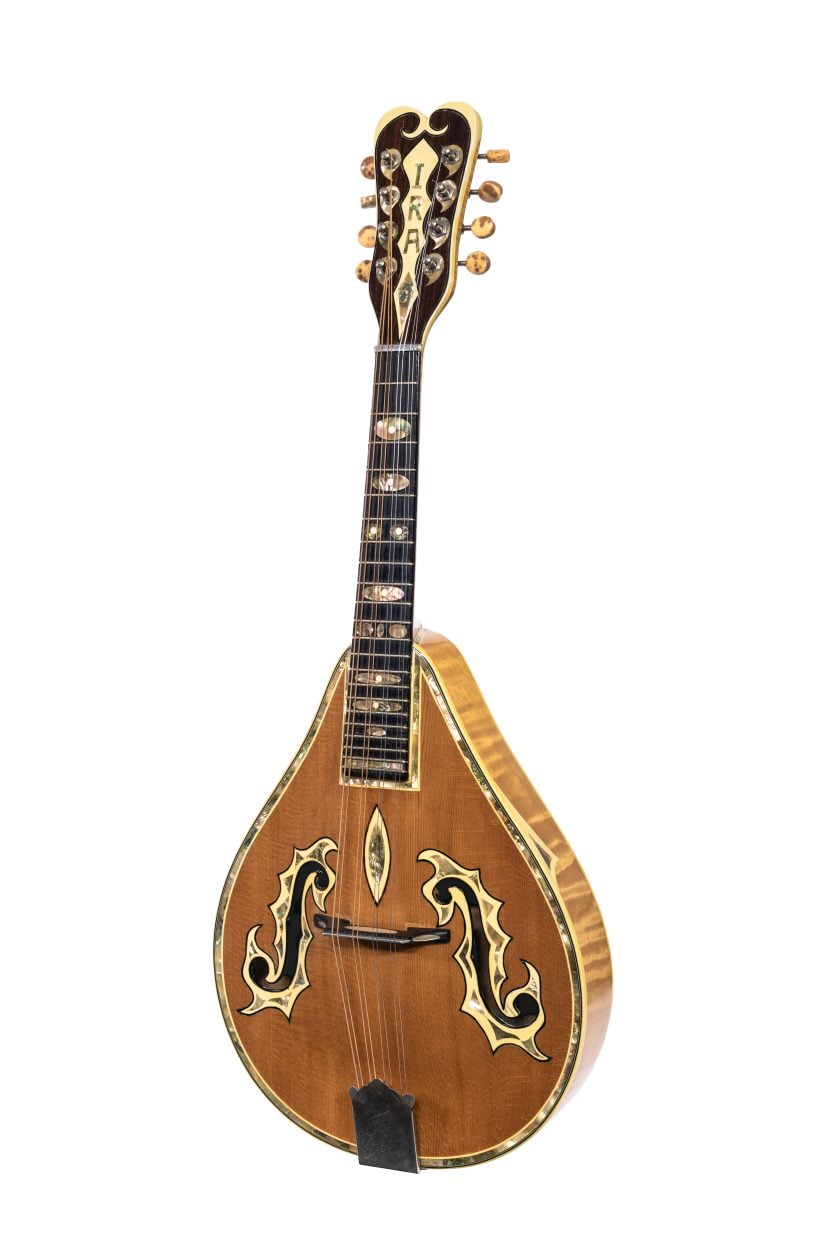
1947 Martin 2-15 Mandolin: Owned and played by Ira Louvin. MIM Collection.

Few brother duet acts in country music were as influential as the Louvin Brothers. Ira and Charlie Louvin were born in Alabama in the 1920s, and their high harmony singing and Ira’s tasteful mandolin playing helped them define a sound popularized through radio broadcasts, commercial recordings, and appearances on the Grand Ole Opry – where they debuted in 1955. Ira customized this one-of-a-kind mandolin in the flashy style of professional country artists and played it extensively, including on the Grand Ole Opry stage. This special piece of mandolin history was also owned by David Grisman for many years.

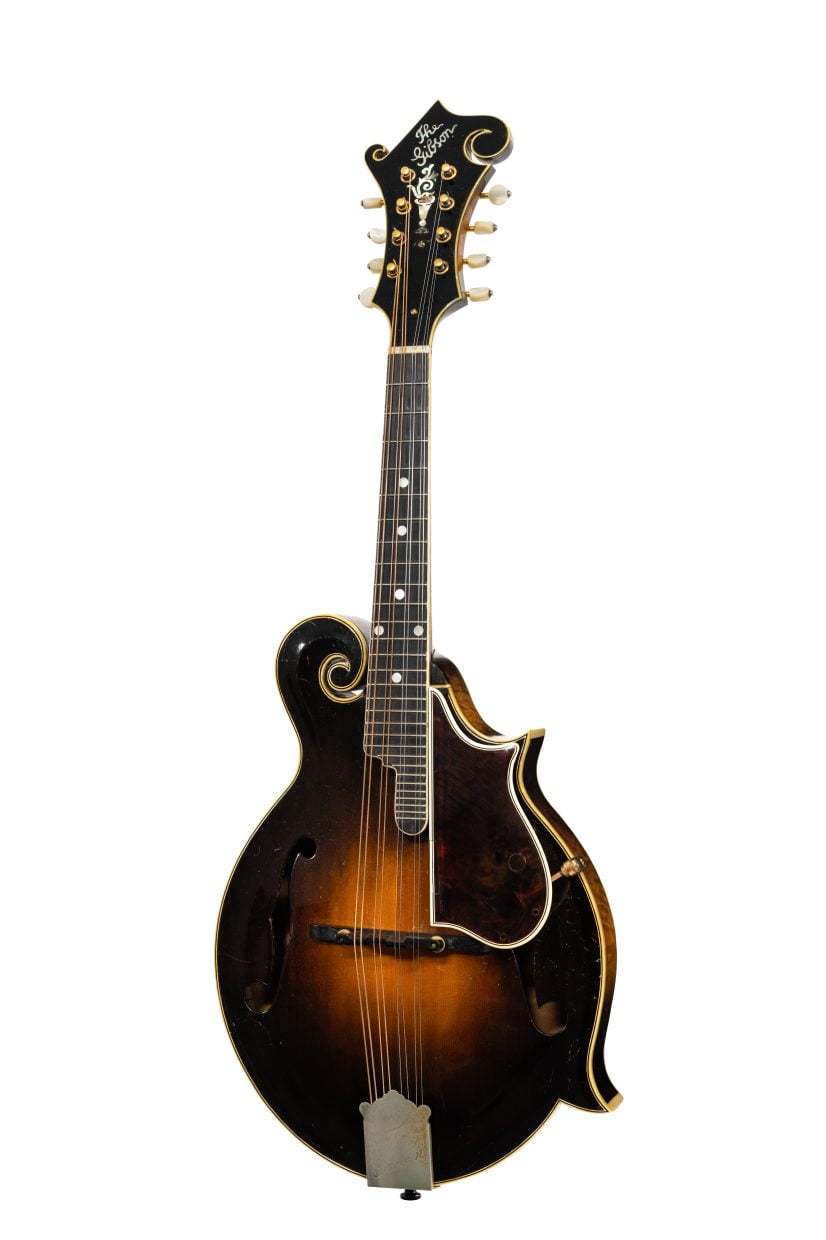
1924 Gibson F-5 Mandolin: Lloyd Loar’s personal F-5 mandolin. MIM collection.

This mandolin — serial number 75315; label dated February 18, 1924 — was the personal instrument of famed Gibson acoustic engineer Lloyd Loar. Loar was impressively inventive and patented designs for keyboard actions and electric instruments, among many others, but the F-5 Master Model mandolin is arguably his most iconic and enduring success. The interior of this mandolin is fitted with an original Virzi Tone Producer. F-5 mandolins with Loar’s signature on the label are the most valuable and sought-after in the world, and Loar F-5s from the batch signed on this date are known to be among the best-sounding. Perhaps it is not surprising that Loar kept this remarkable mandolin for himself!

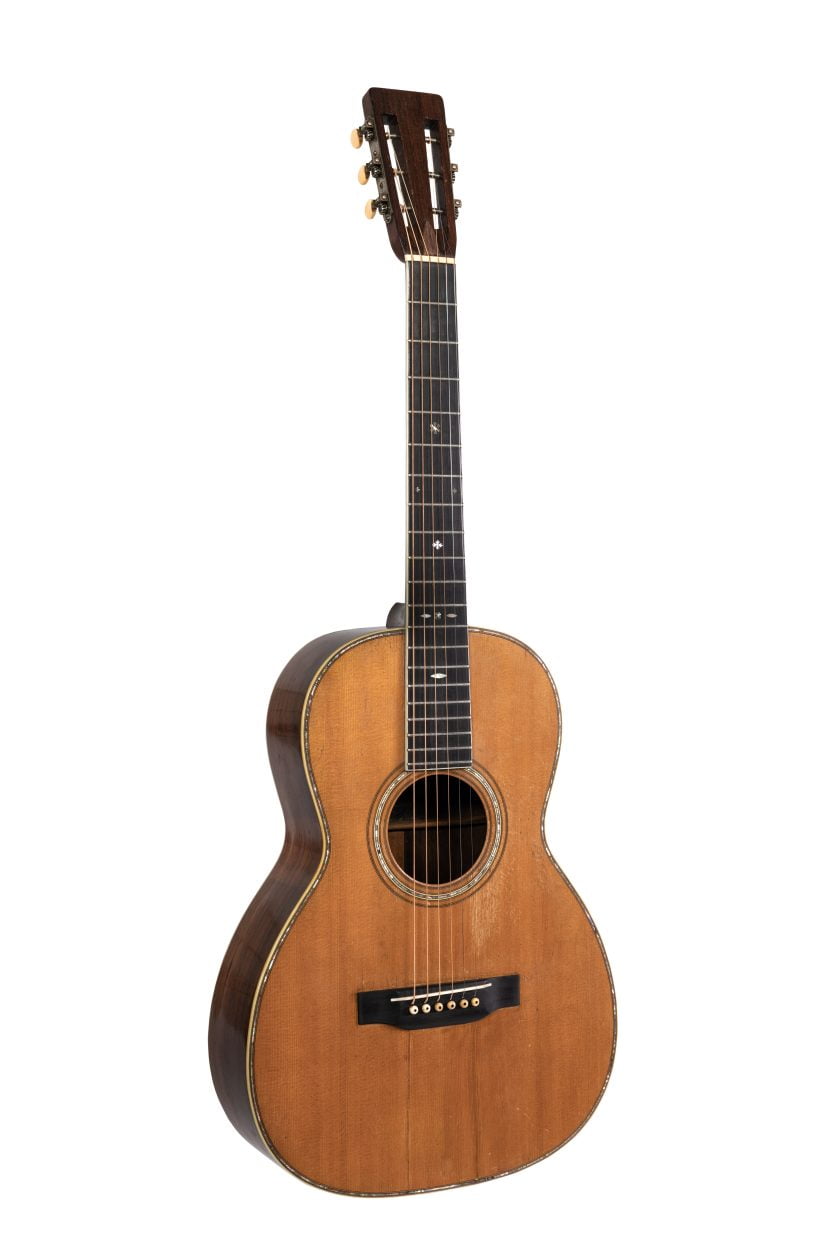
1928 Martin 00-40H Guitar: Played by the New Lost City Ramblers. Loan courtesy of Darrell Scott.

This guitar was played extensively by the New Lost City Ramblers, who were pivotal to the national revival of Southern folk music in the 1950s and 1960s. Founding members John Cohen, Tom Paley, and Mike Seeger were dedicated to authentically reproducing folk traditions for new audiences. The group recorded several albums for Smithsonian Folkways and helped discover, document, and showcase talented artists such as Elizabeth Cotten, Dock Boggs, and Snuffy Jenkins. Prewar pearl-trimmed Martin guitars are among the most desirable acoustic instruments in the world.

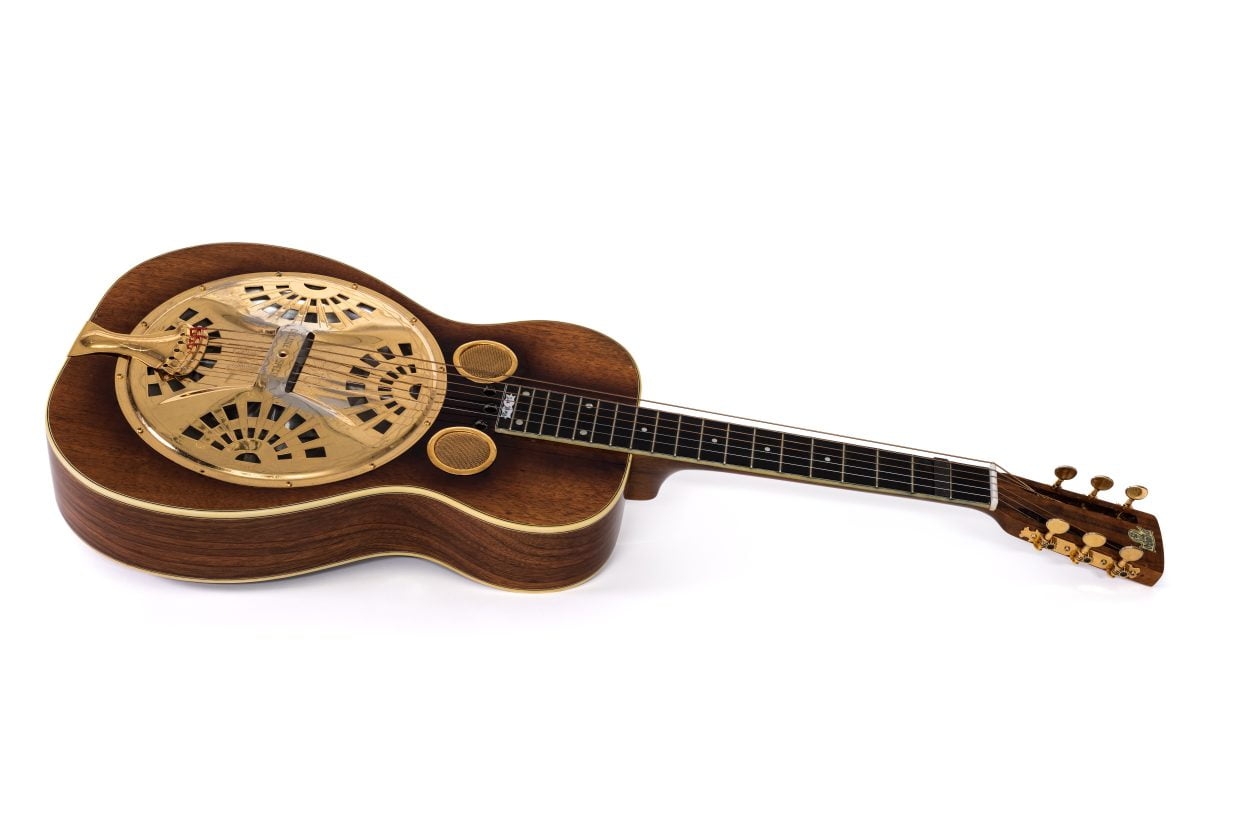
1929 Dobro Model 125 Resophonic Guitar: Owned and played by LeRoy Mack. Loan courtesy of LeRoy McNees.

In 1961, the Kentucky Colonels, led by brothers Clarence and Roland White, performed on The Andy Griffith Show, under the alias “the Country Boys.” The Kentucky Colonels were one of the most exciting and influential bluegrass bands of their era, and their national television appearance would have been much of the United States’ first memorable exposure to bluegrass. Dobro player LeRoy McNees (AKA LeRoy Mack) played this Model 125 resophonic guitar during the show and for many years afterward. After the guitar was damaged at an airport, McNees restored and outfitted it with gold-plated metal hardware.

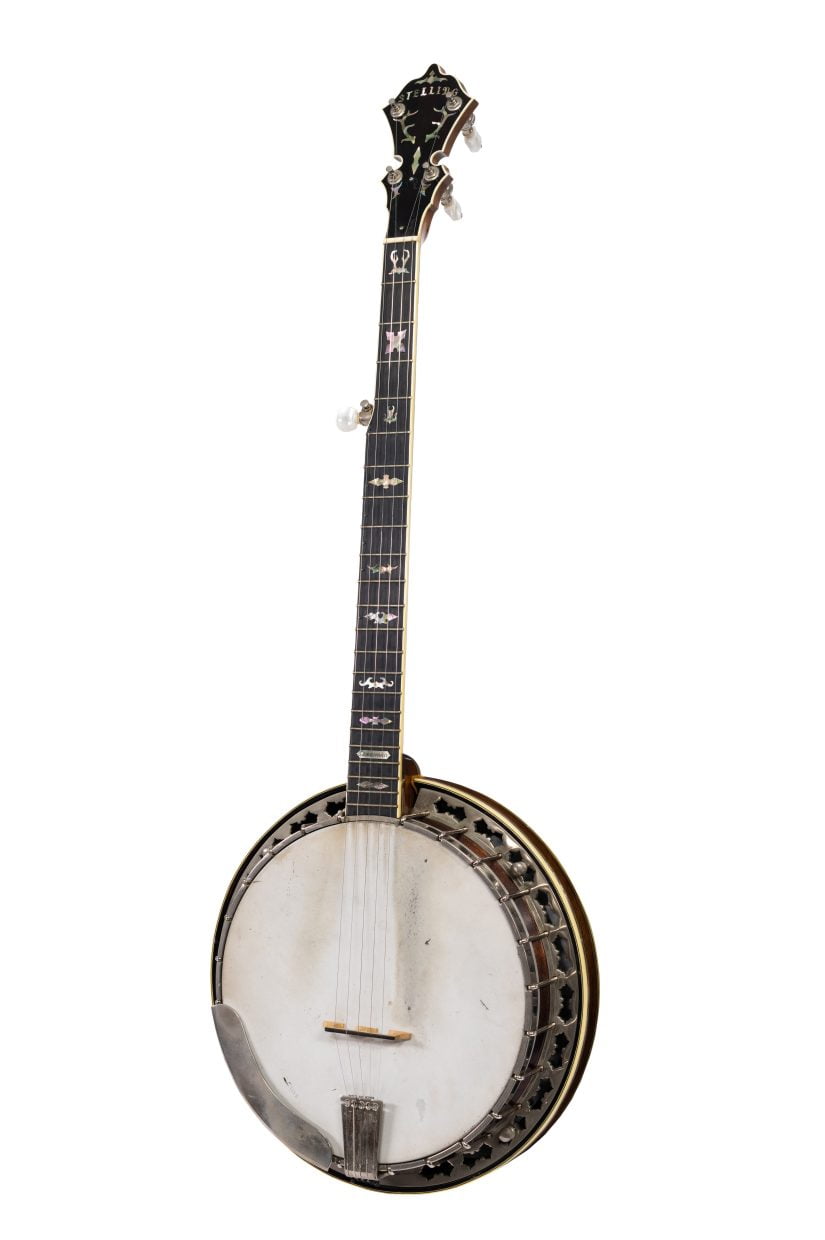
1975 Stelling Staghorn Banjo: Owned and played by Alison Brown. Loan courtesy of Alison Brown.

A young Alison Brown spent her entire savings on this then-new banjo built by Geoff Stelling, hoping to emulate the crisp, solid tone of Alan Munde, an influential older banjoist who played a similar Staghorn model. Brown played this banjo on her first album, 1981’s Pre-Sequel, and she later played it with Alison Krauss’s successful band Union Station. One of the most gifted banjoists in the world, Brown was the first woman voted Banjo Player of the Year by the International Bluegrass Music Association (in 1991). She has also won multiple Grammy awards, founded her own record label, Compass Records, and was inducted into the Banjo Hall of Fame in 2019.

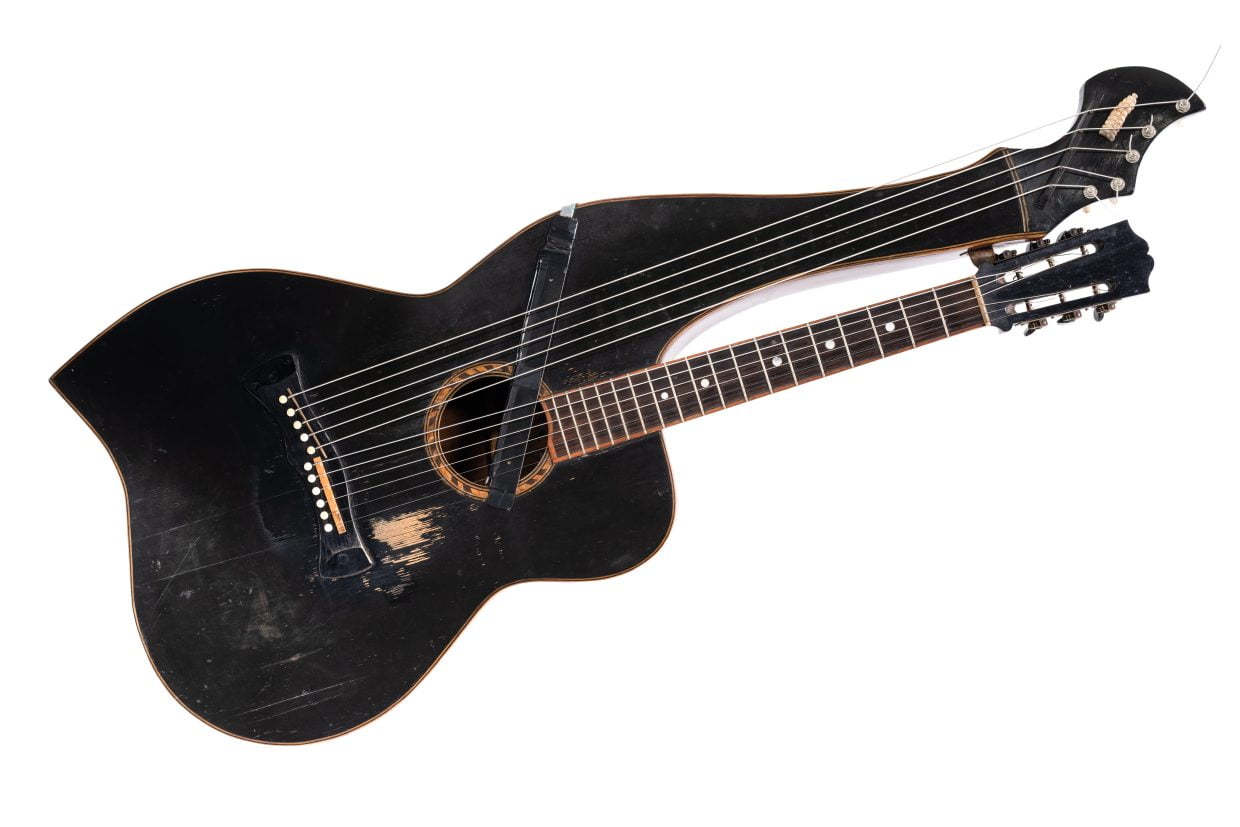
1913 Knutsen harp guitar: Owned and played by Michael Hedges. Loan courtesy of Taproot, LLC.

Guitarist and composer Michael Hedges (1953–1997) used a range of innovative and unconventional playing techniques — such as alternate tunings and percussive tapping on the strings and soundboard — to expand the possibilities of what a solo artist could do. In rediscovering the sound of vintage harp guitars with dedicated sub-bass strings, Hedges reimagined the guitar as a full-spectrum compositional tool. His 1984 album Aerial Boundaries illustrated his astonishing talent and helped define the contemporary new age acoustic music of Windham Hill Records. Hedges nicknamed this favored harp guitar “Darth Vader,” and his use of harp guitars revived interest in these long-obscure instruments.


All photos courtesy of the Musical Instrument Museum, Phoenix, Arizona.

Bluegrass Memoirs: The First Canadian Bluegrass Festival (Part 1)

The first Canadian festival, a modest affair billed as a “Bluegrass Jamboree,” took place in August 1972. I was involved in its organization and presentation. Subsequently, the Jamboree grew into an annual festival that’s still running. 

The Nova Scotia-based Downeast Bluegrass & Oldtime Music Society’s website reads

The annual family friendly Nova Scotia Bluegrass and Oldtime Music festival is Canada’s oldest, and North America’s second oldest continuously running Bluegrass Festival, and is presented and hosted by the Downeast Bluegrass and Oldtime Music Society, a non-profit organization dedicated to the preservation and promotion of Bluegrass and Oldtime music in Eastern Canada. 

Here’s how it happened. 

By the summer of 1972 I had been living in Canada for four years, working as a professor of folklore and archivist in St. John’s, Newfoundland, at Memorial, the big provincial university.

Deeply immersed in bluegrass, I now stayed in touch with the music I’d left behind via bluegrass friends in the states, I read Bluegrass Unlimited every month, and I got County Sales‘ newsletters and bought new LPs from them by mail.


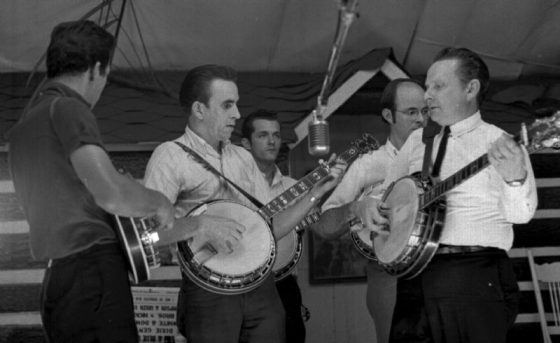
June 22, 1968. Banjo workshop at Bean Blossom, IN: Vic Jordan, Bobby Thompson, Dave Garrett, Neil Rosenberg, Ralph Stanley.
(Photo by Frank Godbey)

When I arrived in Newfoundland in September 1968, I’d just published my first academic article — on bluegrass — in the Journal of American Folklore. I’d been writing regularly for Bluegrass Unlimited. That past June, Bill Monroe had included me in a banjo workshop at his Blue Grass Festival in Bean Blossom, Indiana; and a few weeks before coming to St. John’s, I’d been at the Richland Hills fiddle contest near Dallas, Texas, jamming with Alan Munde, Sam Bush, and Byron Berline and the Stone Mountain Boys.


August 18, 1968. Richland Hills, TX fiddle contest: Neil Rosenberg
(b), Sam Bush (m), Byron Berline (f).
(Photo by David Stark)

During the late ’60s and early ’70s, bluegrass festivals were proliferating (I wrote about this in Bluegrass: A History, 305-339) and bluegrass was having success in the popular music business (I wrote about that too, 305-339).

By 1972 I was hearing at a distance about the adventures of my friends from the U.S. bluegrass festival scene. Alan and Sam had made a popular instrumental LP. Now Alan was picking banjo with Jimmy Martin and Sam was singing and playing mandolin with the Bluegrass Alliance. And Byron, working as a studio musician in Los Angeles, had recently recorded with The Rolling Stones

As I continued to study and write about bluegrass, I maintained my musical calling, moonlighting in the local contemporary folk and pop music scene. It was several years before I met anyone in St. John’s who played or knew much about bluegrass. 

In 1969, RCA Victor invited me to edit an album in their Vintage series titled Early Bluegrass. Aside from some Monroe LPs, this was the first historical bluegrass anthology. I signed its detailed historical liner notes with “Memorial University of Newfoundland” under my name. It got a good reception in the bluegrass world and introduced me to Canadian bluegrass record buyers. 

In 1971 I signed a contract with the University of Illinois Press to write a volume on bluegrass history in their new Music in American Life series. It was a book that would take years to write, for I had catching up to do. Not only was I out of touch with the bluegrass scene I’d been in before immigrating, I also knew little about the bluegrass scenes in my new home.


June 22, 1968. Banjo workshop at Bean Blossom, IN: Vic Jordan, Bobby Thompson, Neil Rosenberg, Dave Garrett, Ralph Stanley, Larry Sparks. (Photo by Doc Hamilton)

Learning About Canadian Bluegrass 

Even before immigrating to Canada, I knew it had bluegrass, thanks to Toronto’s Doug Benson, who put me on the mailing list of his magazine The Bluegrass Breakdown. The first issue had reached me in spring 1968 while I was still in Indiana. It told of bluegrass scenes in Ontario and Quebec.

En route to Newfoundland in September 1968, we entered eastern Canada via the Maritimes — the provinces of Prince Edward Island, Nova Scotia, and New Brunswick. Picking up our landed immigrant passes from Canadian Customs at the Maine border, we drove through New Brunswick and Nova Scotia, where, in Cape Breton, we caught the night ferry to Newfoundland.

During this trip I got my first taste of Canadian bluegrass in an Antigonish, Nova Scotia motel where we watched Don Messer’s Jubilee, a Halifax-produced CBC weekly TV show starring a fiddler who’d been recording and broadcasting nationally on radio since the 1930s and television later. Messer’s prime-time Jubilee was Canada’s second most-watched show, exceeded only by Hockey Night In Canada.

I was pleasantly surprised to see that Messer’s band included a five-string banjo played bluegrass style! To this immigrant’s eyes and ears, Messer was blending bluegrass into his country and old-time sound. Here’s his performance, taken from Jubilee footage, of “St. Anne’s Reel,” a popular Canadian fiddle tune:

The smiling banjo picker behind Messer was Vic Mullen, the youngest member of his band. Born in 1933 and raised in rural southwestern Nova Scotia, he had been working as a musician since his teens, playing with country bands in the Maritimes and Ontario.

In 1969, Mullen left Messer and began appearing with his own country band, The Hickorys, on another Halifax CBC weekly prime-time show, Country Time. There wasn’t much bluegrass on that show beyond Mullen’s occasional southern-style fiddle pieces.

Getting Acquainted 

My first meeting with a Newfoundlander who shared my enthusiasm for bluegrass came early in April 1971 when I had a letter from record collector Michael Cohen of Grand Falls-Windsor

By the time we met, Michael’s family owned six furniture stores in central Newfoundland. He’d grown up listening to country music on the radio and began collecting records. After attending university in Ottawa, where he’d heard lots of local and touring American and Canadian country music, he returned to Windsor to work in the family business, continue his collecting (he has all of Hank Snow’s recordings) and play in a country band.

He wrote me because he’d been told about me by a friend. “Early bluegrass and string bands … are my main interest,” he said, introducing himself and welcoming me to make tape copies of his rare records.

I wrote back inviting him to visit us on his next trip to St. John’s. This was the beginning of an enduring friendship. Through him I met others interested in bluegrass and Canadian country. The first was Fred Isenor of Lantz, Nova Scotia, a small community north of Halifax, who got my address from Michael and wrote me a few weeks later.


August 18, 1968. Alan Munde, Neil Rosenberg, unidentified fiddler.
(Photo by David Stark)

Fred, Vic Mullen’s contemporary and friend, worked at the local brick factory, and had a music store in Lantz. He was a record collector, a Bluegrass Unlimited subscriber, and a musician. He played mandolin and bass in The Nova Scotia Playboys, which he described to me as an “authentic (non-electric) country” band. They had represented Nova Scotia at the 1967 Expo in Montreal.

Fred had purchased his mandolin, a 1920s Gibson F5, for $100 at a Halifax pawn shop in 1960. Only later did he learn that its label, signed by Lloyd Loar, meant that he now owned an instrument like that of Bill Monroe, who’d just been elected to Nashville’s Country Music Hall of Fame. 

Our correspondence began with shared unsuccessful attempts to put together a Bill Monroe tour. I’d planned to speak with Monroe at a New England festival that summer. But the festival was cancelled; that plan fell through. In March 1972, Fred wrote of other plans:

There is a possibility of a one day bluegrass jamboree in Nova Scotia this summer. Not really a festival but if we can put it over it will be a start. Perhaps Michael has mentioned this to you. As you played with Bill Monroe and helped run Bean Blossom [I’d told Michael about this when we first met] I thought possibly you could offer some helpful suggestions, in other words some do’s and don’ts. 

He explained that with a limited budget the event would have to utilize local talent. 

Please do not mention this to anyone as definite … so far Vic Mullen and I just talked briefly about this and will be discussing it further on Monday night. 

He asked if I’d be able to visit him and take part in the program. 

I responded enthusiastically, calling the jamboree a festival, offering my suggestions, and saying I’d be driving through Nova Scotia in August and hoped to visit him then.

Meeting Vic Mullen 

In June 1972, Country Time came to St. John’s to tape some shows. I asked Vic if he’d do an interview, explaining to him that I was working on a book about bluegrass. He agreed. 

Still in his thirties, Vic had been playing country music professionally for a quarter century. He’d mastered instruments — mandolin, fiddle, guitar, five-string banjo — as needed, working on the road with a series of increasingly high-profile bands. Bluegrass chops were just one aspect of his professional tools — a flashy banjo piece, or southern-style hoedown fiddle as part of the show, that kind of thing. He’d worked with some bluegrass bands in Ontario, done TV, etc.

In the late fifties he started his own band, The Birch Mountain Boys. Working at first in southwestern Nova Scotia, he teamed up with Brent Williams and Harry Cromwell, young African Canadians from his home county, Digby. They played bluegrass in the Maritimes for several years before Brent and Harry started playing country and Vic joined Messer. 

Now Mullen was fronting his own national CBC TV country music show. He liked bluegrass and enjoyed playing it, but as a bandleader he chose it rarely. Most people in his audiences didn’t know the word “bluegrass” when they heard it and even if they liked it, it was just nice country music to them. Bluegrass was a niche genre. It had enthusiastic fans and great performers, but they were in a minority.

Vic was supportive of his old friend Fred; he understood Fred’s enthusiasm. He knew about BU and the bluegrass festivals that were happening in the States, but he didn’t think the festivals were going to catch on in Canada. Of Canadian bluegrass fans, he said that: 

Altogether in a group, there’d be a lot of people. But they’re spread out from coast to coast and particularly between here and Ontario … there wouldn’t be enough people for an audience in any one area, it’d be just too far for them to get there. 

Still, he was planning to be at Fred’s Jamboree. In our interview, Vic had given me an insider’s introduction to the world of Canadian country music. From him I heard for the first time many names and facts that would become familiar to me later. I was encouraged that a musician of his caliber, experience, and reputation would be there.

A week after the interview, I wrote Fred and told him I’d be catching the ferry to Nova Scotia on August 1, driving to Lantz the next day and staying to get acquainted. I explained that this was just the start of a crowded trip for “some hurried field research on bluegrass music … in Ohio, Kentucky and Indiana.” I closed by mentioning that I’d had a pleasant experience interviewing Vic. 

Fred’s reply came a few days later. He was looking forward to my visit, he said, and then, referring to my earlier letter, told me the event would be a jamboree — “outdoors, just one evening.” Referring to a nearby farmer who held dances in his barn, Fred explained: 

John Moxom is building an outdoor stage as soon as his hay is made and it appears now that we will be holding it either Friday, August 4th or August 11th. All the local bluegrass musicians are willing to help and take a chance on it being a flop. We hope to find out if there is enough interest to try something bigger and better next year. I know you have a busy schedule but if August 4th turns out to be the date we would sure like to have you present. 

By the end of July 1972, I was headed first to visit Fred in rural Nova Scotia. Then I’d drive to New England, stopping near the border at Woodstock, New Brunswick, to see Don Messer’s Jubilee perform at a county fair, and then going to Vermont where my family was vacationing. After a short rest I’d be heading for West Virginia to join my photographer friend Carl Fleischhauer on the trip we described in Bluegrass Odyssey.

On August 1, I headed for the Canadian National ferry terminal in Argentia, Newfoundland, ready to sail west for some bluegrass. 


Rosenberg is an author, scholar, historian, banjo player, Bluegrass Music Hall of Fame inductee, and co-chair of the IBMA Foundation’s Arnold Shultz Fund.

Photo of Neil V. Rosenberg by Terri Thomson Rosenberg, all other photos by Neil V. Rosenberg. 

Edited by Justin Hiltner

First Generation: Meet the Bluegrass Music Hall of Fame’s Earliest Inductees

Though it’s not that hard to find some who will argue the point, bluegrass is widely held to have originated when banjo phenom Earl Scruggs joined Grand Ole Opry star Bill Monroe’s band in early December, 1945. Bill Monroe and His Blue Grass Boys — the possessive wasn’t just there for show — were already among the anchors of the radio show’s cast, but contemporary accounts (and a handful of bootleg recordings) make clear that, to the ears of an almost instantly enraptured audience, Scruggs’ rapid-fire banjo playing elevated the group’s sound to a new level.

Almost instantly, groups sprang up — or reoriented themselves — in pursuit of the new sound, and although banjo players and fiddlers were the most obvious converts, the truth is that virtually all of the intricacies the band brought to their sound were soon emulated. By the time Scruggs and guitarist/lead singer Lester Flatt left the Blue Grass Boys at the beginning of 1948, the quintet’s live performances and a handful of recordings had already inspired some notable followers, who, out of artistic desire and commercial necessity, quickly busied themselves in developing their own distinctive takes on the sound of the “original bluegrass band.”

As we near the 75th anniversary of this foundational origin story, BGS will be looking back across the sweep of those years — and first up, of course, a clutch of true pioneers that share a common accomplishment: they are the acts honored by induction into the IBMA’s Hall of Fame in its first five years and their plaques proudly hang at the Bluegrass Music Hall of Fame & Museum in Owensboro, Kentucky.


Bill Monroe (inducted 1991)

A complex personality with a skill set that included equal measures of innovation and synthesis, the mandolin-playing Monroe (b. 1911) moved from a mid-1930s duo with his brother to assembling a hot string band during World War II to fronting that original bluegrass band — an achievement which earned him his “Father of Bluegrass” title. Though it’s easy to discern the elements he brought together in that music — old fiddle tunes; Scotch-Irish ballads; African-American blues, jazz and gospel; western swing and more — his creativity extended beyond simply stirring them together and kept him a central figure from its inception until his death in 1996.

Indeed, while his early classics are essential to the bluegrass canon, even his late-life instrumental compositions have enjoyed a growing influence among today’s hottest young players. In fact, he collected his first Grammy for 1988’s “Southern Flavor.” Monroe was inducted into the Country Music Hall of Fame in 1970, and as the composer of “Blue Moon of Kentucky,” he joined the Nashville Songwriters Hall of Fame in 1971, received a Lifetime Achievement Award from the Grammys in 1993, and entered the Rock and Roll Hall of Fame as an early influence in 1997.

Representative tracks: “Blue Yodel No. 4,“I’m Going Back to Old Kentucky,” “Lord Protect My Soul,” “Midnight on the Stormy Deep,” “Southern Flavor”


Earl Scruggs (inducted 1991)

Though he wasn’t yet 22 years old when he joined Monroe’s band at the end of 1945, Earl Scruggs (b. 1924) was ready to step into the spotlight, and, with the exception of a stretch of ill health in the late 1980s and early ‘90s, he never relinquished it until his death in 2012. Unlike many instrumentalists who change their approach according to musical context, Scruggs believed that his picking style — built around right-hand patterns called “rolls” — could fit anywhere, and after his groundbreaking years with Monroe and then Lester Flatt, his career seemed devoted to proving the point.

Having created much of the musical vocabulary for bluegrass banjo picking, he moved on to playing with his sons in the Earl Scruggs Revue, a country-rock-bluegrass fusion band that was arguably more successful — at least in commercial terms — than Flatt & Scruggs had ever been. In the 21st century, Scruggs championed a broad variety of younger musicians while continuing to play those same sweet rolls he’d created as a young man. He was awarded a Lifetime Achievement Award from the Grammys in 2008.

Representative tracks: “Blue Ridge Cabin Home” (Flatt & Scruggs), “Foggy Mountain Chimes” (Flatt & Scruggs), “Travelin’ Prayer” (Earl Scruggs Revue), “The Engineers Don’t Wave From the Trains Anymore” (with Tom T. Hall), “The Angels” (with Melissa Etheridge)


Lester Flatt (inducted 1991)

With an expressive, emotive voice and an impressive array of demeanors that ranged from dry and sly to devout and down-home, rhythm guitarist Lester Flatt (b. 1914) was the perfect musical complement to Earl Scruggs, and their 1948-1969 output was at least as influential as Monroe’s. Flatt & Scruggs won a 1968 Grammy for their classic recording of “Foggy Mountain Breakdown.”

But where Scruggs was not only interested in playing with his sons, but also interested in putting his banjo into a wider range of contexts, Flatt preferred sticking to the country side of bluegrass. In the aftermath of their breakup, Flatt’s drawl deepened and slowed as he presided over a series of gifted lineups that included peers like Josh Graves and Vassar Clements, alongside young up-and-comers from banjoist Kenny Ingram to a teenaged Marty Stuart. Flatt & Scruggs were inducted into the Country Music Hall of Fame in 1985.

Representative tracks: “I’ll Never Love Another” (Flatt & Scruggs), “I’ll Go Stepping Too” (Flatt & Scruggs), “On My Mind” (Flatt & Scruggs), “You Are My Flower” (Flatt & Scruggs), “Gonna Have Myself a Ball”


The Stanley Brothers (inducted 1992)

The career of Ralph Stanley (b. 1927) and Carter Stanley (b.1925) illustrates both the profound impact that the original bluegrass band had on their peers, as well as the complementary artistic and commercial drives that impelled those successors to create their own unique style. In their first recordings, made while Flatt and Scruggs were still Blue Grass Boys, you can hear the Virginia-born Stanley brothers revamp their old-time string band approach into an approximation of the pioneers’ sound, yet within a matter of months, they had found a compelling variant.

The Stanley sound was built in part around Ralph’s stolid but driving banjo and soulful tenor singing, but even more around Carter’s mournful lead vocals and powerful songs. Over the years, while they moved from the Nashville-based Columbia and Mercury labels to scrappy (and multi-racial) Cincinnati indie, King, their sound became even more recognizable, as owner Syd Nathan hectored them into de-emphasizing the fiddle and leaning more into the innovative work of flatpicking lead guitarists like George Shuffler. The brothers’ partnership came to an end in late 1966 with the early, alcohol-related death of Carter; Ralph would continue on with his own twist on the Stanley Brothers’ sound until his death in 2016.

Representative tracks: “The Lonesome River,” “Our Last Goodbye,” “Let Me Walk, Lord, By Your Side,” “I’ll Just Go Away,” “Pig in a Pen”


Reno & Smiley (inducted 1992)

The first banjo player to follow Scruggs, albeit briefly, in the Blue Grass Boys, Don Reno (b. 1926) deliberately sought to create a distinct and instantly recognizable style of his own on the instrument. By the time his partnership with singer-guitarist Red Smiley (b. 1925) had settled into regular recording for King Records in the early 1950s, he had succeeded completely, and for good measure had done the same with flatpicked guitar solos, too. As Grand Ole Opry announcer Eddie Stubbs once put it, Reno & Smiley were a country band with a banjo instead of a steel guitar.

Though Reno could and sometimes would blister a banjo solo, many of the band’s signature numbers were heart songs, country shuffles, earnest gospel outings and more, including occasional flashes of rockabilly and jazz. Reno wrote many of them, sang tenor and occasional leads, and shared the instrumental limelight with their steady fiddler, Mack Magaha, and occasionally with one or another mandolin player, including his son, Ronnie. The partners split for a few years in the mid-‘60s, then reunited for a brief period before Smiley’s death in 1972. Reno continued to record and perform with partners ranging from Bill Harrell to his sons until he passed away in 1984.

Representative tracks: “I’m Using My Bible for a Roadmap,” “I Know You’re Married,” “Little Rock Getaway,” “Please Remember That I Love You,” “Just About Then”


Jim & Jesse (inducted 1993)

Though Jim McReynolds (b. 1927) and Jesse McReynolds (b. 1929) were born just a few dozen miles from the Stanley Brothers, the music of Jim & Jesse could hardly have been a more different kind of bluegrass. The duo’s singing was smooth and refined — especially guitarist Jim’s silvery tenor — while the instrumental sound was driven by Jesse’s innovative mandolin cross-picking and their overall approach by the latter’s eclectic tastes and influences (he appeared, for instance, on The Doors’ 1969 album, The Soft Parade).

The brothers were comfortable in reaching for a more countrified sound, helped by banjo players like Allen Shelton and Carl Jackson, who were adept at playing radio-friendly licks on a dobro-banjo as well as ‘grassier fare when that was called for. Smart businessmen as well, the duo were among the first to appear on television in the early 1950s, recorded an entire album of Chuck Berry songs in the mid-1960s, started their own label in the early 1970s, and remained a popular fixture on the Grand Ole Opry until Jim’s death on the last day of 2002. As of this writing, Jesse McReynolds continues to perform — and to innovate, too, with releases like a 2010 Songs of the Grateful Dead collection.

Representative tracks: “Pardon Me,” “Are You Missing Me,” “She Left Me Standing on the Mountain,” “Cotton Mill Man,” “Memphis”


Mac Wiseman (inducted 1993)

Nicknamed “The Voice With a Heart,” Virginia’s Mac Wiseman (b. 1925) was a founding member of Flatt & Scruggs’ Foggy Mountain Boys in 1948, but soon left to join Monroe (and Don Reno) in the Blue Grass Boys. By the early 1950s, he’d started his own career, recording for Gallatin, Tennessee’s Dot Records — and then going to work for the label. A consummate professional, he also served as a musicians’ union official for a time, and was a founding member of the Country Music Association. He frequently recorded material other than bluegrass, especially when rock ’n’ roll and the pop-country Nashville sound beckoned in the late 1950s and early 1960s, and throughout his career, he was never afraid to use a variety of instruments besides the archetypal bluegrass ones.

Still, as a performer, bluegrass was his bread and butter from the mid-1960s on, and rather than carry a band, he would recruit players from other acts (and occasionally skilled amateurs, too) and lead them on stage with a heavy guitar strum and a quick “watch me, boys!” Wiseman’s songbook included old folk numbers, songs he heard on the radio as a polio-stricken child, big band tunes, Music Row compositions and much more. In later years, he recorded several memorable projects that highlighted songs his mother had taught him and songs that told his life story, before his death in 2019.

Representative tracks: “I Still Write Your Name in the Sand,” “I Wonder How the Old Folks Are at Home,” “Mother Knows Best,” “My Little Home in Tennessee,” “’Tis Sweet to Be Remembered”


The Osborne Brothers (inducted 1994)

Bobby Osborne (b. 1931) and Sonny Osborne (b. 1937) were among the first of what might be called “semi-second generation” bluegrass artists; unlike those who preceded them in the Bluegrass Hall of Fame, neither had performed professionally before 1950. By 1954, though, they’d hooked up with Jimmy Martin for a memorable set of recordings, and 1956 found them signed on to MGM on their own. Together with singer-guitarist Red Allen, the Brothers — Bobby singing lead and playing mandolin, Sonny singing baritone and playing banjo — had come up with an inventive new vocal arrangement that put the spotlight pretty much on them alone.

Lest that sound too cold, it should be noted that they deserved it, for not only was Bobby a formidable lead singer and Sonny brilliant in the support role, but their fearless, try-anything (the two recorded separately with avant-garde jazz vibraphonist Gary Burton in the mid-’60s) instrumental skills were profoundly original. The Brothers joined the Grand Ole Opry and signed with Decca Records in 1964, and spent the next decade fusing bluegrass and country in a way that eventually earned them a CMA Vocal Group award. Irascible, opinionated, and both artistically and commercially successful, the Osborne Brothers were at the forefront of the music until Sonny’s 2005 retirement — and while Bobby continues to perform to this day, the influence of their duo continues to grow, too.

Representative tracks: “Once More,” “The Cuckoo Bird,” “Tennessee Hound Dog,” “Pathway of Teardrops,” “Sweethearts Again”


Jimmy Martin (inducted 1995)

East Tennessee native Jimmy Martin (b. 1927) hungered to perform with Bill Monroe as a youngster, then got his chance in 1949 when Mac Wiseman quit the Blue Grass Boys. As lead vocalist and guitarist, he helped to make some of Monroe’s most memorable recordings, then partnered in various settings with Bobby and Sonny Osborne before taking the helm of his Sunny Mountain Boys in the mid-1950s. A brash, colorful guy who could boast with the best and then back it up, Martin served in the cast of the Louisiana Hayride (alongside Elvis) and the Wheeling (W.V.) Jamboree before a growing bluegrass festival circuit threw him a lifeline in the absence of a Grand Ole Opry membership.

Among early Hall of Fame inductees, he may be considered more influential than most of his peers. Service in his Sunny Mountain Boys constituted the training ground for several generations of musicians, from banjo man J.D. Crowe to newgrass pioneer Alan Munde to Americana favorite Greg Garing — and his appearance on the Nitty Gritty Dirt Band’s Will the Circle Be Unbroken was legendary. Martin was an unstoppable force of nature who knew exactly what he wanted from a musician, yet was unable to clearly explain it. Still, he did well enough that his records are instantly recognizable, even when you’ve never heard them before.

Representative tracks: “That’s How I Can Count on You” (with the Osborne Brothers), “Rock Hearts,” “You Don’t Know My Mind,” “Tennessee,” “Freeborn Man”


Pictured above, first row (L to R): Bill Monroe, The Osborne Brothers, Mac Wiseman, Jim & Jesse; Second row: Reno & Smiley, The Stanley Brothers, Jimmy Martin, Flatt & Scruggs

“The Shorthairs and the Longhairs”: The Story Behind ‘Bluegrass Country Soul’

Bluegrass Country Soul captures one of Carlton Haney’s legendary festivals in Camp Springs, North Carolina, on Labor Day weekend of 1971. It is credited as the first bluegrass documentary, and is essential viewing for both lifelong bluegrass fans and those new to the genre.

This classic film features bluegrass music’s pioneers, as well as those who would take the music into the future. Earl Scruggs, The Osborne Brothers, Ralph Stanley, Chubby Wise, Mac Wiseman, J.D. Crowe, and Jimmy Martin were featured alongside The Country Gentlemen, Del McCoury, Sam Bush, Tony Rice, Ricky Skaggs, Keith Whitley, Alan Munde, and more. The film documents Rice’s last show with The Bluegrass Alliance and his first show with J.D. Crowe & the Kentucky Mountain Boys. Many of the festival’s legendary moments are preserved in color for posterity.

A larger than life figure who is credited as starting the first multi-day bluegrass festival, Carlton Haney organized the weekend’s festival, and serves as the de facto host of the film, sharing thoughts about bluegrass music, bluegrass festivals, bluegrass fans, and the bluegrass “stow-ry.” His passion for the music is evident, and makes for a great depiction of one of bluegrass’s most significant and one-of-a-kind personalities.

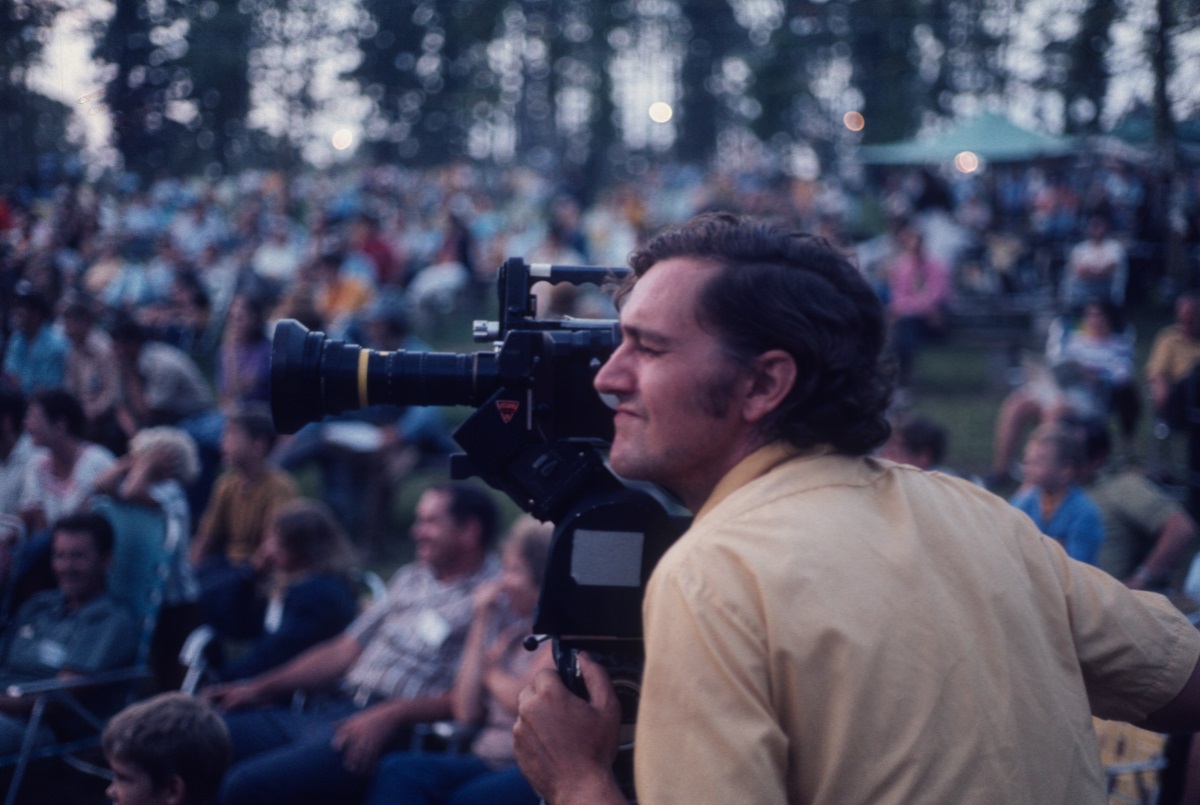
Albert Ihde, the film’s director (pictured below), spoke with BGS about the film and its legacy to commemorate the 50th Anniversary boxed set of the film, released this summer. The special edition set includes the original film, recently remastered and restored; CDs of performances not featured in the film; bonus footage including exclusive interviews with Ricky Skaggs, Bill Emerson, Missy Raines, and more; and a full-color coffee table book about the film.

BGS: How did the opportunity to film Bluegrass Country Soul present itself 50 years ago?

Albert Ihde: It was almost by accident, in a sense. A couple of buddies of mine and I were preparing a screenplay for a company in Washington, D.C. that had hired me to write a film, and then I would direct. The only thing that they insisted on was that it had to be about a Country & Western singer. Now this is 1971, and back then they called it Country & Western. I said, “Okay. Fine. Let me do some research on that.

A buddy of mine, Bob Leonard, and I were out scouting locations in Berryville, Virginia when we saw posters for Carlton Haney’s 4th of July Festival, and Earl Scruggs was going to be playing. We thought, “Well, that looks interesting.” To make a long story short, I got in touch with John Miller, who was the partner of Carlton’s there at Berryville, and John took us on a tour of the sites because I wanted to see what it looked like. It was right on the Shenandoah. Gorgeous location. He gave us passes to the Fourth of July Festival. We had no idea what bluegrass was, compared to country music, and we thought, “This looks like it’ll be fun. We’ll go to see this.”

Director, Albert Ihde

A bunch of us got a VW wagon, and my wife hooked up a camper on the back of our car. We went out, and we parked and saw it, and I have to tell you, as soon as I heard that music coming from the stage, we were all hooked. We talked to Carlton. Quite a deal! Talked to Fred Bartenstein (a local disc jockey who helped with the annual festival) and they told us more about what they were doing. I wanted to put Carlton in a film right then and there as soon as I met him.

We got back to D.C. and the company that hired me to write this screenplay, it turned out that they couldn’t raise the money to make the movie. So we took the film and decided we would try and find the money ourselves. Fortunately the first guy that I sent it to called us into his office. He was a major D.C. investor, philanthropist, and owned lots of real estate in D.C. He said that the thing that interested him most about the screenplay was this bluegrass festival out in Berryville. He said, “Why don’t you do a film about that?”

My partner and I looked at him and said it’s gonna be hard to raise money for a documentary, and he said, “How much do you need?” We get our calculator out, we start going through it, and we throw a figure out to him. It’s not gonna be as expensive as the film that’s going to have all the actors that would be taking us six to eight weeks to shoot. This, we could shoot in one weekend. He said, “Listen if you get Carlton Haney to agree to allow you to come and shoot the film at his festival, I’ll go out and find the money.” And we said, “Okay.”

The next day, Bob Leonard and I were on a plane to North Carolina and met with Carlton and Fred, pitched the whole idea to him, and Carlton was on board right at the beginning. He said, “Absolutely. No problem.” I said, “Well, are you gonna get all of these musicians to agree to this?” And he said, “Yes, I can do that.”

We had all of twelve days, two weeks, or something like that, to get the whole thing together to get down to Camp Springs on Labor Day weekend. And we lucked out. We happened to have this incredible festival with all of the pioneers of bluegrass, along with all of the up and coming newgrass guys who were changing the music as we watched. It was a great mix of both the old and the new, and as Carlton called it, “the mixture of the short hairs and the long hairs.”

That was it! You’ve got the hippies sitting right next to the guys right off the farm in coveralls. A guy in a Confederate hat sitting right next to hippie girls. It was a great mix. And everybody got along. And it was at a time in America when the country split. Nixon and the protests trying to bring our troops home from Vietnam. It was a strange time. But the thing that happened at the festival… everybody was getting along all right! Also of course, most of the audience were bluegrass musicians of their own or were learning or wanting to be. So that’s how we got into it.

What were some things about Carlton’s personality that made him such a compelling figure to follow for a film?

A number of people have said he was like the “P.T. Barnum of Bluegrass.” So it was kinda like, just put a camera on him and let him go, because you never know what he’s gonna say! Of course, the great thing about filming is, you can always edit it, and we edited out a lot of Carlton.

At one point, it was towards the end of the weekend, we were filming Carlton out on the lot, and I say “Carlton, we need something to kind of summarize the whole thing, and put a tag on the end of the film.” He said, “Oh, that’s okay. I know exactly what to say. Do you want me to make you laugh or do you want me to make you cry?” And I looked at my cameraman, and Bob was ten years older than me, and he had a lot of experience doing this, and I looked at Bob and I said, “What do you think? Make us cry?” And Bob nodded his head “Yeah, make us cry, Carlton.” And Carlton said, “Okay, start the camera rolling.”

So we started the camera rolling, and Carlton is saying goodbye to the kid who is packing up his gear at the end, and then he turns to the camera and he says, “You know, when people leave, it makes me sad, because all my friends are leaving. But I know that they had a good time, and that they’ll be back again next year.” And tears are coming to his eyes! And he says, “And that’s bluegrass and that’s a bluegrass festival.” And I said “Cut!” Bob and I just burst out laughing, and I said “Carlton, you’re going to get an Academy Award for that!”

To this day, Fred tells me, he runs into people and he says they will quote to him the lines that Carlton had in the film. “The shorthairs and the longhairs,” [and,] “You look down upon the stage and you can hear the soul of man — Ralph Stanley.” They just came out of his mouth!

The other thing was, he could not look at the lens, no matter how hard I tried. [Carlton] had this real shyness problem, and yet you put him on the stage and hand him a mic in front of ten thousand people, he was fine. But put a camera in front of him, he was looking away. Kind of shy and withdrawn. I think he was very concerned about his looks. He had terrible teeth. As somebody once said, that’s part of the times back then when nobody had health insurance or dental insurance… that was the last thing that people spent money on. So I think Carlton was a little shy about the way he looked. But he was an interesting guy.

Pictured: Ralph Stanley

You mentioned that one thing that was so compelling about the film, and at bluegrass festivals in general, was seeing people from different walks of life united by this music and finding common ground, even if it was for a weekend. What do you think that message has for us today where we are as divided now as we were fifty years ago?

I hope it has the same result. Every time I have shown the film — and I have shown it to heads of studios in Hollywood, I showed it to corporations up in New York City — no matter where I’ve shown it, people leave the theatre with big smiles on their faces. It’s not necessarily because they’re bluegrass fans, but because they enjoy it. They had fun. They were delighted. Something about that music, about the people playing it, about the commitment that these people have to it. There’s more to it than just country music. I think that’s what Carlton was trying to say about the soul. It’s a commitment to the music that is thorough.

I don’t know whether Carlton told me this or not, but at some point I learned early on: bluegrass music is not commercial country. Meaning, you’re gonna lose your shirts on it, but you’re doing it because you love it. That really says it all, and I think that comes through with music and with Carlton and with all of the people that are on stage in the film and all the people playing out in the field… You see the commitment to the music.

Ellen [Pasternack, the project’s Executive Director and Ihde’s wife] and I have a background in professional theatre, regional theatre around the country, and what you’re always looking for working in theatre are actors who can really commit to doing a performance. It’s that commitment to the art — whether that’s music, theatre, dance, or painting — that’s where you find the joy in the art. And I think that comes through in the film, even if you don’t know anything about bluegrass. I hope that comes through still to this day, and maybe gets people thinking “past the politics” for a moment or two just to look at the music and listen to the music. And to see, “If this was going on back then, why can’t it happen again?”


Photos and trailer courtesy of Bluegrass Country Soul.

BGS 5+5: Crary, Evans & Barnick

Artist: Crary, Evans & Barnick
Hometown: Placerville, California
Latest Album: Prime Time
Personal nicknames (or rejected band names): Three Old White Guys in a Folk Trio

What was the first moment that you knew you wanted to be a musician?

Mark Twain said the two most important days in your life are the day you’re born and the day you discover why. For me it was the day in 1952 (I was 12) when I turned on the radio and accidentally heard Don Sullivan, a Kansas City hillbilly country singer on his noon hour live radio show sing twangy songs and play the steel-string guitar. The sound of the guitar that day struck me like something straight from God. I didn’t even know what it was, but I knew I wanted to play one, to hear more of that beautiful noise. — Dan Crary

My life’s direction pretty much came into focus on February 9, 1964, when I was seven years old. After watching the Beatles’ first live U.S. television appearance, the world wasn’t the same for me after that moment. I went to school on that Monday morning knowing that I would be a musician someday. — Bill Evans

During my year spent with the Mobile Riverine Resources/USN/9th Infantry Division Mekong Delta ’68-69, I met a fellow who had purchased a Hi-Fidelity component stereo system from the PX. He set it up in his hootch. He had pals stateside who were mailing him “care packages” containing the latest vinyl LPs by the boxful. Buffalo Springfield, Jeff Beck, Cream, the Doors, etc. When we thought the coast was clear, we’d load up a “bowl” and then listen to those great sounds coming out of those three-way speakers and the music would take us to another place. I did not play any instrument at that time, but I knew right then that I wanted to figure out how to play. All I had to do was get home in one piece. I did, and once stateside I latched on to the bass guitar and have not ever let it go… over 50 years now. — Wally Barnick

Which artist has influenced you the most – and how?

Musicians who were influential: 1) Fritz Kreisler: When I was 5 years old, about 1945 (!) my mom and grandma took me to a concert in the Kansas City Music Hall of violinist Fritz Kreisler. I never forgot it, it’s like yesterday. 2) Bud Hunt, old-time banjo and guitar guy on The Brush Creek Follies, a ’50s Kansas City country music show. My old Webcor wire recorder caught him one night playing “Wildwood Flower.” I had never heard anything like that, changed my life forever. 3) Sabicas, Segovia, Doc Watson: Their brilliant performances made me want to get serious. 4) The Stanley Brothers: Sheer, stunning beauty for the ages. — Dan

I’ve been playing professionally now for over forty years and the people who have had the most influence on me are those who I’ve gotten to know through playing and touring with them in bands or getting to know them as personal friends: folks like Ron Thomason of Dry Branch Fire Squad, Tony Trischka, Alan Munde, Jim Nunally in California and, most of all, Sonny Osborne. And I’ll count Dan and Wally in this group too — I admire what they have both accomplished in their lives and my respect and love for the both of them knows no limits. — Bill

How often do you hide behind a character in song or use “you” when it’s actually “me”?

Seems like they’re all about me, at least the ones about trying to get it right and loving my lady. — Dan

I’m a composer of instrumental tunes, not songs with lyrics. Often, I set out an assignment for myself in order to get the process started, such as composing a melody over a particularly challenging chord progression or modulation, or something that has an Irish flavor, such as “Winston’s Jig” on Prime Time. In this way, I’m assuming a kind of another identity, most definitely. I feel that way about it, at any rate. — Bill

It is typical that I select and attempt singing songs that mean something to me, even when they are written by someone else. So the short answer is… I sing every song like I mean it, as if it’s mine and as if I’m telling my story. — Wally

What’s your favorite memory from being on stage?

In the ’80s a French festival promoter told me on the phone that Byron Berline and John Hickman and I were, because we worked as a trio, “not real bluegrass.” Then, about three days later we three were onstage playing “Gold Rush” to a few thousand fans at the KFC festival in Louisville. Suddenly, with no advance notice, Bill Monroe himself walked on stage with a big smile, sat down with us and we all played the rest of the set together. At one point Bill announced to that audience that, except for his own Blue Grass Boys, we were his #1 favorite bluegrass band! If I live to be a thousand…. — Dan

That’s tough to narrow down to just one memory. Perhaps the most musically revelatory moment for me on stage was hosting an evening in Berkeley at the Freight & Salvage Coffeehouse around the year 2000 with J. D. Crowe, David Grisman, Ron Block, Ron Stewart, Alan Senauke, and Missy Raines. It was an amazing thing to hear Crowe and Grisman experience the groove they created together on stage. Ron Block, who played guitar that night, commented to me after our show had ended that he had never felt such intense rhythm and awareness of musical space on any stage before. Musicians talk about how powerful a player J. D. is and I was lucky to actually experience it very intensely by being on stage with him. — Bill

Probably the first time that I performed a Cream song (“Sunshine of Your Love”) and I discovered that I could sing and play it, remembering all the lyrics and changes, and the (bar) crowd loved it! — Wally

If you had to write a mission statement for your career, what would it be?

Today I will try to be worthy of the guitar. — Dan

Giving back what’s been given to me and giving more, in whatever way that I can. — Bill

If it ain’t fun, skip it. — Wally


Photo credit: Nola Barnick

Laurie Lewis & Friends, “Dear Old Dixie (Live)”

This edition of Tunesday turned out to be an oddly circuitous task. We often take this space to highlight our Artists of the Month, pointing out instrumentals from throughout their catalogs and across their careers, but for singer, songwriter, guitarist, poet, frontwoman, and long-distance hiker Laurie Lewis, the tunes are simply in too-short supply. Not because they don’t exist, but because Lewis’ cosmic level lyricism tends to eclipse her virtuosic command of the majority of bluegrass’s titular instruments. You may most often see her with a dreadnought strapped around her shoulders, but rest a fiddle there instead and you’re bound to enjoy some of the best bluegrass fiddling — with an even sprinkling of contest style, West Coast country, and the melody-driven old-time of the Pacific Northwest throughout.
In this clip from a live performance on The Texas Connection in 1992, Lewis is joined by longtime musical partner and bandmate Tom Rozum as well as Sally Van Meter, Alan Munde, Peter Rowan, Peter McLaughlin, and Cary Black on a sleek and stupefying rendition of “Dear Old Dixie.” It’s a banjo number, naturally, so Munde kicks it off with an uncharacteristically normative, Scruggs-like play through the melody. The remaining bandmates each take a turn, but the fire’s really lit when Lewis saws out her own solo, reminding all of us that she only ends up placing herself behind the guitar more often than not because she chooses to. With slippery, deliciously dissonant double stops she capitalizes upon the signature energy and showmanship concentrated within every note, every bow stroke, and every string pluck she issues.
While a quick stroll through her catalog, especially on streaming platforms, may not immediately land you in a pile of recordings of burning Bill Monroe tunes, or contemplative waltzes, or danceable hornpipes, you’ll probably find yourself confounded by the natural imagery, tender emotion, and raw spiritual power of her lyrics instead. That’s understandable. With a little digging, though, that picture of a legendary artist’s work can be expanded to include lifelong rations of indomitable pickin’ like this, too. And it ought to.

Photo courtesy of the artist.

Bobby Hicks, “Snowflake Breakdown”

In our plaintive annual quest to unearth some semblance of a holiday-themed canon from the bluegrass songbook writ large, a few concessions must immediately be made. As argued in a past wintry edition of Tunesday Tuesday, titles of otherwise wordless and themeless songs are more than enough to justify a tune’s place in holiday and Christmas party playlists — or at least, this writer vehemently believes that they should be. 

That particular context might just be unnecessary, though, because anyone ought to welcome absolutely any excuse or justification to marvel at the sheer magic (holiday and/or otherwise) of Bobby Hick’s fiddling. Yes, this is no more than a contrived set up to allow some unbridled gushing about “Snowflake Breakdown.” The hoedown-style fiddle tune was a cut on Hicks’ 1978 album, Texas Crapshooter, which boasted an A side of all Texas and western swing tunes, featuring Buddy Emmons on pedal steel and Buck White on piano among others, and a B side of his signature bluegrass fiddling style, staffed by Sam Bush, Roy Huskey Jr., Alan Munde, and fellow Bluegrass Hall of Famer Roland White. The “wow, these pickers on this tune are each so unique and genius in their own rights, they’re like snowflakes” metaphor is just a little too irresistible here, so just go with it. 

For us fans of a bluegrass fiddler who plays with a heavy dose of North Carolina by way of Texas and a dash of the best parts of fiddle contests, has an unparalleled pedigree as a Blue Grass Boy with Bill Monroe, and a reputation as one of the most confounding double-stop talents in the universe, all we want for Christmas is (really, truly, honestly) more Bobby Hicks.