
Kronos Quartet Wants You To Know Mahalia Jackson’s Impact

“If Mahalia Jackson were singing right now, I would have figured out a way that we would be able to perform with her,” says David Harrington, co-founder and violinist of Kronos Quartet, an ensemble that in its more than 50 years has consistently set new standards for what a string quartet can be.

He laughs as he leans into the camera on a Zoom from his San Francisco home, his white hair sticking straight up.

“You can count on that.”

Of course, that’s impossible. Mahalia Jackson, the New Orleans-born gospel singer, voice of the Civil Rights Movement, mentor to Aretha Franklin, confidant of and advisor to Martin Luther King Jr., died in 1972 at age 60. But Harrington got close. A little while back he commissioned composer Stacy Garrop to craft musical settings for excerpts from a 1963 interview conversation Jackson did with Chicago radio host Studs Terkel, a longtime friend of hers, and from performances broadcast in 1957.

The result is Glorious Mahalia, a five-part suite and the title piece of a new Kronos Quartet album featuring the ensemble’s recent lineup of Harrington, John Sherba (violin), Hank Dutt (viola) and Sunny Yang (cellos). It’s insightful and bold, the music echoing and enhancing the conversations, at times cordial, but also at times testy between these two friends as Jackson tells Terkel that he can never understand the experience of Black people in America.

And in one segment, Harrington gets right up next to his wish, as Kronos performs to a recording of Jackson singing “Sometimes I Feel Like a Motherless Child.” It is, indeed, glorious.
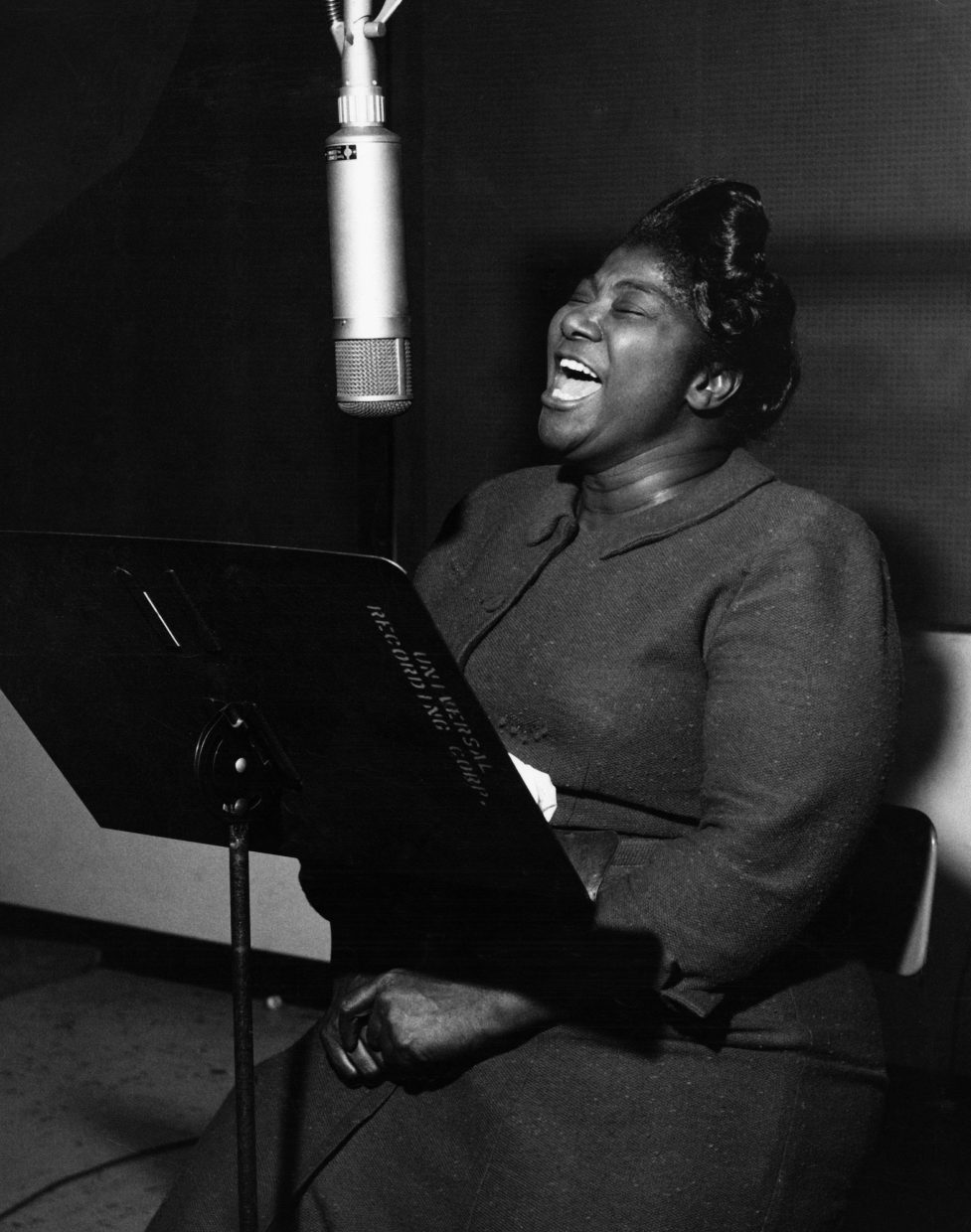
Mahalia Jackson photo by Lacey Crawford (courtesy of the National Museum of African American History & Culture.)

This is complemented by another suite, “Peace Be Till,” commissioned by Kronos from composer Zachary Watkins, incorporating reminiscences by King lawyer and speechwriter Clarence Jones as recorded by Harrington about the friendship between King and Jackson. At its core is the moment in a 1963 rally as he watched Jackson interrupt the written speech King was giving, shouting to him, “Tell them about the dream, Martin,” spurring one of the most impactful orations of modern times, the extemporaneous “I Have a Dream.”

An instrumental arrangement by composer Jacob Garchik of Antonio Haskell’s hymn “God Shall Wipe All Tears Away,” based on a 1937 Jackson recording, serves as a perfect interlude between the suites. Kronos has performed the song for years, including a stunning version with Mali’s Trio Da Kali on the 2017 album Ladilikan.

Kronos has long used spoken oral histories in its vast, wildly eclectic career. There is 1988’s landmark Different Trains, composed for the quartet by Steve Reich, juxtaposing audio accounts from a former Pullman porter and survivors of Holocaust transports, and last year’s Witness, by composer Mary Kouyoumdjian, with audio from survivors of the Lebanese civil war and the Armenian genocide. Glorious Mahalia’s themes of social justice also connect to, among many others, 2020’s Long Time Passing, a celebration of Pete Seeger, and 2022’s My Lai, the Jonathan Berger/Scott Chessman opera about the 1968 U.S. Army massacre of a Vietnam village. The new album follows those latter two as the third Kronos release from Smithsonian Folkways.

Harrington discusses all of this in a generous, wide-ranging chat for BGS, edited for length and clarity.

What were your first experiences with Mahalia Jackson’s music?

David Harrington: I think I heard her on television as a kid. But it was Hank Dutt, our longtime violist, who gave me an LP of hers in the late ‘70s. It just blew me away. Have you seen Summer of Soul, that film [Questlove’s 2021 documentary about the 1969 Harlem Music Festival]? Then you’ve seen Mahalia on that. Our family watched it, my daughter, son-in-law, grandkids, wife, and I watched together. And wow, when Mahalia got on, I said to everyone, “I have never seen a singer with a full-body vibrato before!” [Laughs] That was one of the most amazing performances I’ve seen in my life.

Glorious Mahalia springs from the conversations between Mahalia and Studs Terkel, and then it feels like Stacy Garrop joins the conversations with her music, and then Kronos join in too, all of you in a four-way exchange.

That’s a beautiful expression of it. I’ve never thought of it that way. What I wanted to do was hear all the interviews [Terkel] ever did with Mahalia. And that’s where my conversation started with Stacy Garrop. I think she knew a lot about his work, so it started there, really. We wanted a piece that celebrates their friendship and relationship, and what they brought to our society and our country.

It’s not always an easy conversation between Terkel and Jackson. She pushes back on him, even snaps at him that he can never know what it’s like to be her, to be Black in America. Was that part of your process with this, to consider, culturally and experientially what your place is in terms of presenting her views and experiences?

It gets back to wanting to perform with Mahalia Jackson. [Laughs] It’s like, every once in a while I hear a musician – I’m lucky as an explorer of music – I’ll hear something that is just so amazingly powerful. I want to find a way of bringing it into my own experience and that of the other members of Kronos and of our audience. And so I think I’ve been really consistent about that through the years.

The question is, what gives me the right to do that? I guess I’ve never really asked that question too often, because this is what musicians do. I’m absolutely convinced that if Beethoven would have heard some of the amazing musicians in India or various places around the world in his time, he would have wanted to bring elements of that music into his work in some way or another. Beethoven did a lot of transcriptions of Scottish music!

The first thing we hear on the album is Jackson’s voice, alone, singing the words “hold on.” It’s gripping and powerful, and must be even more so in a darkened theater for both you and the audience, hearing that before you even start playing.

Yeah, it’s about as good as it gets!

And then, from there, your task is to enhance and echo and illustrate the tone of her voice.

We’re also commenting, and our role takes on different kinds of complexities, being there as a platform for [Jackson’s and Jones’s] thoughts and voices to exist.

You have a history of projects that let others tell their cultural stories and experiences, from the oral histories of Different Trains and Witness to working with composers and musicians from many different places and traditions around the globe. This one is more centered on one person, though.

It goes back a long way, and thinking how to present this on a Kronos album – not only the voice, but the personality, the force, just the being of Mahalia Jackson. [That] was what I felt would be a good thing to do. That really came into focus when right around the 50th anniversary of the “I Have a Dream” speech, Clarence Jones was on television and he recounted how the speech became the speech as we know it.

When he described that moment of hearing Mahalia Jackson, someone King relied on in moments of need, Clarence spoke of when she would sing to him on the phone. I mean, when you think of anybody in the universe, a leader like Martin Luther King Jr., a civil rights leader, a spiritual leader, and he’s getting sustenance from a musician!

So then the speech is happening and, from what I can gather, she wasn’t quite hearing what she needed to hear from her friend. And so she called out to him: “Tell them about the dream.” When I heard that story I thought, “Okay, I get it. Mahalia Jackson has defined to me the role of musicians, the musical community in our world.” It was so clear. And what we get to do as musicians is listen. We listen to our inner selves, we listen to our families and our friends and our society.

In this case, Mahalia Jackson used her musical ability and listened to Martin Luther King and then gave him feedback. “Come on. I’ve heard you do better.” Now, am I imagining this? I don’t know if I am. I don’t even care, because it kind of defined something for me about my own role and the role of Kronos and musicians. So at that moment I thought, “I need to get in touch with Clarence Jones.”

This project started a few years back, but it’s coming out as the U.S. celebrates its 250th birthday. How does that timing feel, especially with the current political and cultural climate?

We’re doing a triptych, “Three Bones,” that’s premiering at Carnegie Hall [on April 25]. Part one will [draw on] Indigenous cultures. Part two will be African American, particularly Gullah Geechee [of the Southeastern U.S.]. Part three will be Chinese and Chinese American.

I’d like to make an experience that brings these three essential elements of American society to the stage at Carnegie Hall as our contribution to the 250 years. It’s about listening. It is just growing from listening. That kind of gets back to Mahalia.

Back to the idea of a conversation, it seems like it’s not just with Jackson and Terkel, but with the nation, with the cultures and the experiences, and not a static situation from 60 years ago. Does it feel like your relationship with Mahalia, her music, and her mission is something living and evolving?

I am very happy when Kronos gets to play this music on a college campus and for audiences that maybe never heard Mahalia Jackson, never heard about her, [or heard] that an artist can have very powerful ideas about life and our society. [About] what’s good and what’s right, and can express them as beautifully as Mahalia Jackson and Studs Terkel and Clarence Jones. You put these leaders together and it’s very impressive. And I don’t think there’s an expiration date there.


Photo Credit: Lead image of Kronos Quartet by Lenny Gonzalez. Inset image of Mahalia Jackson by Lacey Crawford courtesy of the National Museum of African American History & Culture.


WATCH: Abby Posner, “Low Low Low” (Featuring Constellation Quartet)

Artist: Abby Posner featuring Constellation Quartet
Hometown: Los Angeles, California
Song: “Low Low Low”
Album: Kisbee Ring
Release Date: November 12, 2021

In Their Words: “Whenever I have an opportunity to collaborate with a string quartet, the experience is transformative. Strings take you to a zen-like space where everything feels just right, perfect for the song, and what I wanted to convey. ‘Low Low Low’ is about depression, anxiety, and learning how to be kinder to the darkness within, so working with Constellation Quartet was the sonic hug this song so desperately needed to feel complete. Constellation Quartet are currently making a name for themselves as both performers and collaborators, working with the best of the Los Angeles musician scene through their residency at the Garden Concert Series in Redondo Beach. The video was shot live during sunset deep in the Malibu hills with a battery-powered setup, hikers passing by, and a reverence for the creative process.” — Abby Posner


String arrangements: Max Mueller (cello). Cinematography: Ian McIntire.
Photo credit: Rollence Patugan

WATCH: Nathaniel Rateliff Adds a String Quartet to “And It’s Still Alright”

Nathaniel Rateliff’s And It’s Still Alright album is the product of a tumultuous time in the writer’s life, but such are the circumstances that yield the most compelling songs, records, and artistic expressions. In this NPR Tiny Desk (Home) Concert filmed at the Mercury Café in Denver, Rateliff performs several songs from the 2020 record, including the title track and “All or Nothing,” a more wistful selection. Since the Tiny Desk shows have reformatted to accommodate for safety, the features have frequently been scaled-back performances, often filmed in the homes of the artists, but in this case, Rateliff adds his band and a string quartet to the studio-like space. The surroundings may not be as iconic as the actual Tiny Desk, but we’re thankful that artists are going above and beyond to give us outstanding mini concerts. This Tiny Desk set is no different, and like the album, it crescendos gradually from an atmospheric, ponderous beginning to a triumphant, boisterous finale with the songs “Redemption” and “Mavis.”


Photo credit: Rett Rogers

WATCH: Rachel Baiman, “No Good Time for Dying”

Artist: Rachel Baiman with Atwood Quartet and Kyshona
Hometown: Nashville, Tennessee
Song: “No Good Time for Dying”
Album: Cycles
Release Date: June 11, 2021
Label: Signature Sounds

In Their Words: “Of all the songs on the record, this one felt the most cinematic, production-wise. Perhaps because I see this as the real story (of my late grandmother) playing out in my head each time I sing it. That’s why it seemed so fitting to collaborate with Atwood Quartet for this special live version of the song. Ben Plotnick wrote the incredible string parts, which both mimic and enhance the original album production. Kyshona was an artist I thought of immediately for the vocal harmonies, because of the quality of her voice and general spirit as a human. I was really grateful that she was up for it! After a year in which we’ve all had to face so much tragic death, this song feels like a reckoning of sorts, and a moment to process and hope for better in the future. I also want to give a special thanks to my neighbor Mike Malkiewicz for letting us transform and use his beautiful backyard stage.” — Rachel Baiman


Photo credit: Gina Binkley

Kronos Quartet and Friends Salute Pete Seeger With ‘Long Time Passing’

“There’s no place like home,” says David Harrington, co-founder and leader of the venerable Kronos Quartet, with a little chuckle.

It’s not just because of the smoke from California fires or the pandemic lockdown at his San Francisco home. With the new album Long Time Passing — Kronos Quartet and Friends Celebrate Pete Seeger, Kronos, after more than 47 years of redefining the very nature of a string quartet through explorations of music traditions and contemporary composers from around the world and, to many ears, exotic, is having something of an Oz moment.

Seeger, of course, was one of the key figures of American folk music, from the early 1950s until his death in 2014 at age 94. The album includes interpretations and adaptations of some of the most beloved songs of the folk canon, among them “Where Have All the Flowers Gone” (which gave the album its title), “Turn, Turn, Turn,” “Kisses Sweeter Than Wine,” “If I Had a Hammer,” and “We Shall Overcome,” which Seeger helped bring to national prominence during the Civil Rights movement of the 1960s. All are transformed through the Kronos prism, which has made magic with everything from Thelonious Monk tunes to Bollywood soundtrack songs to young Iranian and Afghani composers and, spanning decades, an ongoing relationship with American avant-garde composer Terry Riley.

Among the friends on board are young American folk singers Aoife O’Donovan, Brian Carpenter, Lee Knight and Sam Amidon, Spain’s Maria Arnal and Ethiopian-born Meklit. Amidon is making a repeat appearance, having been one of four singers along with Rhiannon Giddens, Natalie Merchant and Olivia Chaney, who joined Kronos for 2017’s Folk Songs album. That collection of American and English-rooted songs is something of a precursor to this new one.

Harrington resists the notion that this is somehow a break from what Kronos has done in the past. “I think all of our work is related,” he says. “For me, Pete Seeger’s work is an extension or a variation of [composer George Crumb’s] ‘Black Angels’” — a keystone in the Kronos repertoire and the work that inspired the group’s formation in the first place — “and Bartók and Beethoven and all kinds of music.”

Making that point emphatically is the piece that is arguably the core of the album: “Storyteller,” a 16-minute sonic collage combining Kronos’ playing with audio of Seeger from interviews and on-stage talk throughout the years, all composed and assembled inventively by Jacob Garchik, a regular Kronos collaborator. The ambitious work made its concert debut last year at Kronos’ San Francisco festival.

“He has been part of our work for probably 15 years,” Harrington says. “It’s so wonderful to see him flower as a musician. Jacob and I have had innumerable conversations about all aspects of music from traditional cantorial music to pygmy songs. It seemed really natural that Jacob would be part of Long Time Passing and that he would make a piece that would bring Seeger to life.”

As well, there is no lack of global cultural reach here. There are songs in Spanish, German, and a South African dialect, plus the instrumental “Raghupati Raghav Raja Ram,” associated with Mahatma Gandhi’s 1930 Salt March protest, which Seeger learned on the instrument bhajan on a trip to India and made a regular feature of his concerts. In one “Storyteller” passage, Seeger himself is heard singing “Where Have All the Flowers Gone?” in German. Arnal sings two songs, recorded in Barcelona last year, one being the Spanish Civil War ballad “Jarama Valley,” a bloody tale of fighting the fascists, written to the tune we know as “Red River Valley.”

And then there is “Mbube,” the South African tune that transformed into the international staple, “Wimoweh/The Lion Sleeps Tonight.” This serves as tribute to Seeger’s lifelong dedication to finding and sharing songs from other cultures, following in the footsteps of his father Charles, a musicologist, folklorist, and composer.

“Alan Lomax [the famed folk archivist and producer] gave him a pile of LPs that they were going to throw out at the Library of Congress,” Harrington said. “Lomax said, ‘I’ve got these LPs from Africa. Would you like to listen to them?’ Seeger comes over and in the middle of the pile somewhere is that song. I mean, what a story! The Weavers [the ‘50s group Seeger was in that launched the folk boom] started singing it. Then the Tokens had the big hit. And then Disney picked it up for The Lion King. I mean, that’s culture. That’s the way it works. But what an ear Seeger had!”

Meklit’s performance is not in Ethiopian. Rather, the Bay Area-based artist was asked to do the elegiac “The President Sang Amazing Grace,” a relatively new song by songwriter Zoe Mulford, inspired by President Barack Obama singing the hymn at the pulpit of the Mother Emanuel American Methodist Episcopal Church in Charleston, South Carolina, shortly after the 2015 mass shooting there.

“I have always been a fan of Pete Seeger and his empathetic yet passionate advocacy for the people,” says Meklit. “This is a song about how music carries us when the limits of language can’t meet our deepest grief, anger, and heartbreak. It’s about a President who understood that and offered us empathy made of melody. It’s about how the violence of racism and white supremacy continue tear at us and cost people their lives. Ultimately I hope the song provides the smallest bit of catharsis in our ongoing season of reckoning with America’s ghosts.”

Having an East African-born singer do this song honoring Obama, with his Kenyan ancestry, brings a lot together, and while it’s the only song on the album that was not part of the Seeger canon, coming after he died, it fits perfectly in his sensibilities.

“There are all sorts of connections,” Harrington says. “They just happen. It’s part of the texture of our society.”

The real magic of the album is finding the new, the current, in the old material, of bringing into vivid life Seeger as an artist, an organizer, an explorer. It’s there from the opening song, “Which Side Are You On?” a question that as much in Kronos’ hands, with Knight almost channeling Seeger, demands a definitive answer. And it’s there in “Garbage,” again with Knight and a child’s chorus, linking today’s concerns with climate change to the environmental concerns Seeger championed through his life, from well before it was a “movement.”

“In terms of the moment in which we live now, obviously Pete’s music and his sensibilities and his spirit came from troubled times,” he says. “He grew up privileged and he knew it. And he paid it back. He was able to adapt throughout his life and address the struggles and issues that were coming in. He saw a real continuity of it. Now we’re talking about civil rights. Not we’re talking about the environment. Now we’re talking about racial divisiveness. It felt like it was all one thread, the same thing. You can see [today’s issues] through that lens, and you can see it through the continuity of what Pete was through his life and what he experienced.”

Harrington stresses that while the album itself seems like something different for Kronos, he can connect it to the very first work written specifically for the quartet back in 1973, “Traveling Music” by composer Ken Benshoof which quoted “Kisses Sweeter Than Wine.” And that is by no means the only thing on this album with which Kronos has history. He notes that his kids and more recently his grandkids have been raised on Seeger recordings, and that a few years ago the group played “We Shall Overcome” for a third-grade class taught by his daughter. But the song has been in their world for much longer than that.

“The idea of doing ‘We Shall Overcome’ is something that we tried out in New York in the early 1980s,” he says. “At that point we did not have the right arranger. I didn’t know how to do it. We tried it, but it didn’t work. But the flame was always there.”

They finally had success with it a few years ago, in a concert that included a piece featuring tapes the voices of gospel great Mahalia Jackson and Chicago writer, labor activist and radio host Studs Terkel, on whose show Kronos had played a few times. Also in that concert was a piece incorporating recordings of Clarence Jones, Martin Luther King Jr.’s lawyer, telling the story of the “I Have a Dream” speech.

“The only thing we could imagine doing as an encore was ‘We Shall Overcome,’” Harrington says.

So yes, Long Time Passing is, for the Kronos Quartet, an act of coming home.


Photo credit: Jay Blakesburg

Not Our First Goat Rodeo, “Voila!”

Reader, I’ve been a musician my entire life, but I must admit I am decidedly green for a music writer. This fact is due in no small part to my young age and by a proper count, my years spent as “journalist” are fewer than a decade. At the end of 2019, as my colleagues were considering the past ten years’ worth of music in hindsight, I realized for me that period of time’s soundtrack was far foggier. To my present self, my memory seemed shockingly barren. The crux being, I suppose, that I hadn’t consumed much music then, and I wrestled with the intention of recalling albums that were significant — culturally or otherwise. 

Except one album, 2011’s The Goat Rodeo Sessions by Yo-Yo Ma, Stuart Duncan, Edgar Meyer, and Chris Thile (and guest Aoife O’Donovan). I had just moved to Nashville, and I remember making a special trip to the FYE in Midtown to buy the album on release day. Out of a decade’s worth of music, that record has rightly been considered among the best — even in my own pothole-filled memories. “Here and Heaven” remains one of Chris Thile and Aoife O’Donovan’s greatest creative feats, but alas, this is Tunesday Tuesday. And this is not 2011. 

Sorry to bring you back to our appalling present, but it’s 2020. And, as if this virtuosic quartet (plus O’Donovan) read all of our collective minds, remembering their album-of-the-decade… Voila! They’ve given us Not Our First Goat Rodeo. And on it, this gorgeous, lilting, Dickensian-folk string quartet, “Voila!” Yes, a string quartet, with Thile setting down the mandolin to play “twin” to Duncan.

For a sophomore album, of course this ensemble feels veteran. This is not their first time riding these goats in this arena. This outing feels more ornery, more confident, brash, and joyously off-kilter. Where these world-class musicians and improvisers have aged since 2011, like this writer, those years have clearly manifested themselves here through a musical wink and a smirk, rather than a frown. Which is reason enough Not Our First Goat Rodeo will probably still be with us ten years on, too.


Photo credit: Josh Goleman

LISTEN: Martin Hayes and Brooklyn Rider, “Jenny’s Welcome Home to Charlie”

Artist name: Martin Hayes and Brooklyn Rider
Hometown: Madrid, Spain (Martin Hayes); New York City and Boston (Brooklyn Rider)
Song: “Jenny’s Welcome Home to Charlie”
Album: The Butterfly
Release Date: August 9, 2019
Label: In a Circle Records

In Their Words: “I was about 14 when I first became familiar with the tune ‘Jenny’s Welcome to Charlie’ from a recording of a fiddler by the name Kathleen Collins. The tune is commonly known in the tradition and is a standard tune that is popular with fiddle players and is not associated with any one regional style. It is alleged that the tune title references Bonny Prince Charlie and his mistress Jenny. I’ve been playing this tune all my life and am very excited to be able to finally release a version that I believe is the first version of this tune to be arranged for fiddle and string quartet.” — Martin Hayes


Photo credit: Erin Baiano