Roots Songs All About Mental Health

May is Mental Health Awareness Month, but for those with lived experience, every day is about mental health awareness. During the most difficult times, many creators and listeners turn to music. It’s where we connect through lyrics and melodies that express the things we so often cannot, will not, dare not say.

The intersection of music and mental health is nothing new. Long before memes and catchphrases about “break the stigma,” Hank Williams did just that with “I’m So Lonesome I Could Cry.” Years later, Porter Wagoner exposed the ugly unspoken truth about “The Rubber Room.” 

Thankfully, through incremental steps, times have changed – although not enough – in terms of media portrayal and public discourse. With great courage, more and more artists are coming forward about their struggles. Dozens of artists and musicians have spoken openly with BGS and Good Country about how mental health challenges move them to create songs and albums that make us all feel a little bit less alone. (Scroll to find our playlist of roots songs all about mental health below.)

Artists and bands like Becky Buller, Courtney Marie Andrews, Sister Sadie, and Tenille Townes give us glimpses at how mental health and self-care inform their creative processes and how they craft their songs, albums, and sets. Groups like Southern Avenue and the Band Loula – who make music built on the sonic and storytelling traditions of the South – subvert regional expectations about what’s “allowed” to be spoken about in the light of day with their approaches to infusing mental health awareness into their songs. Still more conversations with artists like Fruit Bats, Cole Chaney, Emily Scott Robinson, and Chely Wright reinforce that mental health in roots music isn’t a fad or passing trend, it’s an intentional through line. Songwriting and roots music are perfect vehicles for this sort of vulnerability and these once forbidden topics.

The proliferation of YouTube and democratization of music videos in the 2000s and 2010s opened up new dimensions for artists, giving them more formats in which to express themselves, depict their work, and consider mental health. Additionally, of course, it offers live performances that go beyond anything a studio recording can capture.

“I Think It’s Going to Rain Today” – Randy Newman

Randy Newman’s masterpiece has been covered many times, and the internet is full of those recordings – as well as his. This performance, however, at his induction into the Rock and Roll Hall of Fame, may very well surpass them all.

“God, Can You Hear Me?” – Dax

Dax is fearless in addressing the most difficult and “taboo” topics. “God, Can You Hear Me?” asks the unspoken question within the context of a subject that far too many people refuse to address: suicidal ideation. (Content warning: graphic.)

“Let the Circle Be Broken” – Sister Sadie

In genres predicated upon generational legacies and “handing down” tradition, Sister Sadie’s song of release, letting go, and stepping out from underneath the long shadow of generational traumas is more than powerful. By the same token, that it was written and is sung and performed by a band of all women makes it a truly transcendent message. Some circles are meant to remain unbroken, others must be demolished.

“Bench Seat” – Chase Rice

Chase Rice broke down walls and stereotypes and opened doors to discussions about suicide with this multiple-award-winning video. Country needed this. Country needs more of this. (Content warning: graphic.)

“Hurt” – Johnny Cash

Johnny Cash. Enough said.

“I’m Gonna Be the Wind” – Laurie Lewis

Bluegrass legend Laurie Lewis has penned many a fine song tackling issues of mental health, but this is the song for when you’re ready to stride out anew again. It’s a song of strength, resilience, of realizing that often one of the primary forces keeping us down is our own mindset. Tired of being a blade of grass, bent and bruised by the wind? Be the wind!

“Sunday Morning Coming Down” – The Highwaymen

Mickey Raphael described them as “like Mount Rushmore onstage” and called Kris Kristofferson “the Shakespeare of our time.” This is why.

“Will the Sun Ever Shine Again” – Bonnie Raitt

One of the best songs Bonnie Raitt has ever sung and released was recorded for the 2004 animated film Home on the Range. Devastating, endlessly relatable, but ultimately hopeful, the film cut of “Will the Sun Ever Shine Again” is hard to track down on streaming services and online, but it’s truly lovely. A gem of a soundtrack find from an often overlooked Disney children’s movie from the aughts.

“Alone Again (Naturally)” – Gilbert O’Sullivan

In 1971, Gilbert O’Sullivan bravely addressed loss, grief, heartbreak, loneliness, depression, suicidal thoughts, and questions of faith, wrapped them up in a lovely melody, set them to a catchy beat, and rode to the top of the charts with one of the most gutting, most accurate depictions of mental health challenges ever put to song. Decades and numerous cover versions later, stripped down to keyboard and guitar, his voice aged like fine wine, “Alone Again (Naturally)” remains poignantly accurate and relatable.

“Bad Mind” – Erin Rae

A song so perfect in its illustration of how we project and ascribe mental health, onto ourselves and others. We all may know, somewhere inside ourselves, that there is no such thing as a “Bad Mind,” but stigma and internalized expectations leave so many of us feeling broken and “incorrect.” Listening to Erin Rae sing this lovely, devastating song brings an immediate feeling of needing to reassure the singer that there really aren’t bad minds… and thereby the realization we should also apply that grace to ourselves.

Below, you’ll find our full playlist of nearly 8 hours of roots music created by the teams at BGS and Good Country that features some of the many excellent songs that address mental health. For Mental Health Awareness Month and beyond.


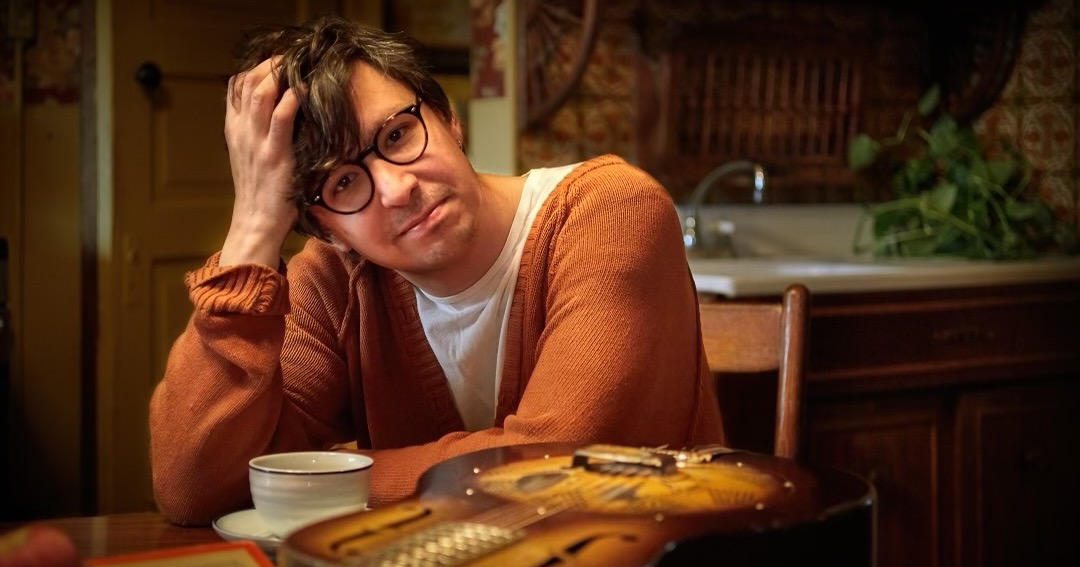
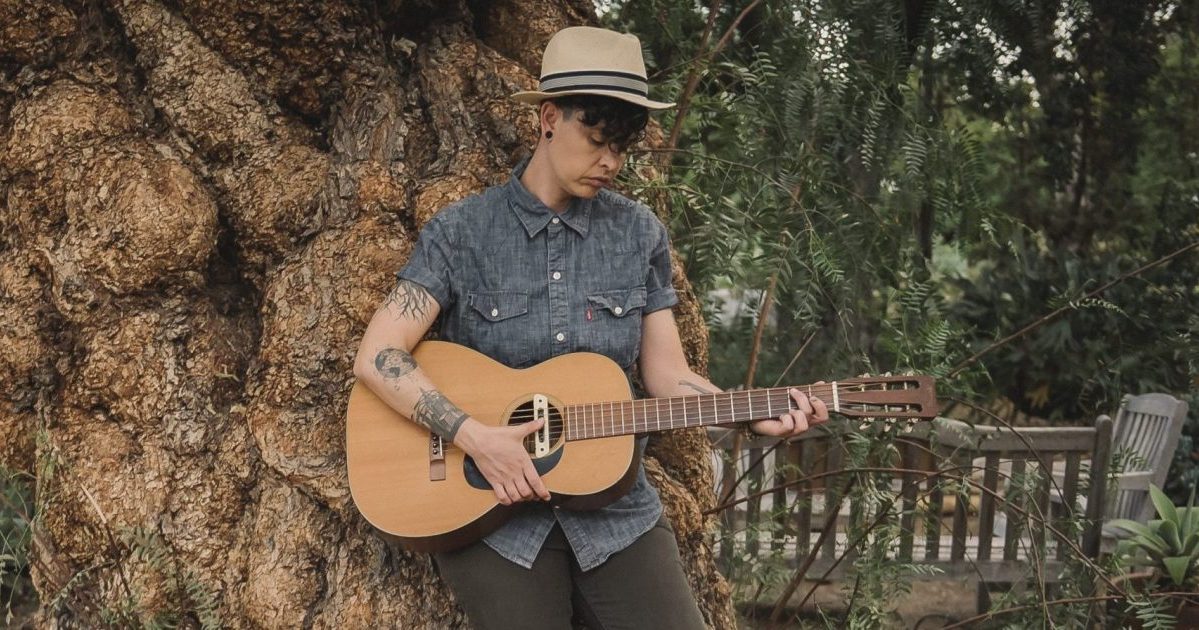
Photo Credit: (L to R) Cole Chaney by Anthony Simpkins; Sister Sadie courtesy of the artist; Dax by Annie Devine.

Additional curation and contributions by Shelby Williamson and Justin Hiltner.
Rapt Reflects On Life’s Many Endings With ‘Until the Light Takes Us’

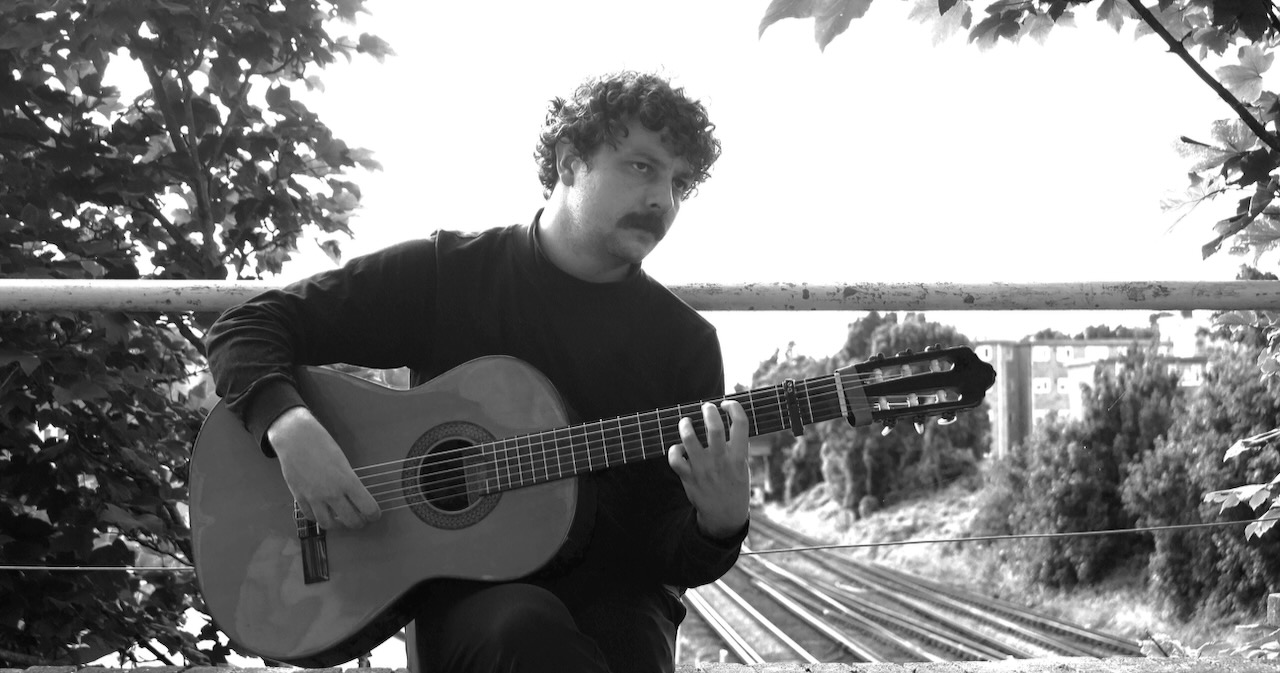
Jacob Ware is a bit of a weirdo. Known onstage these days as Rapt, the singer-songwriter has a way of coming up with an album title and writing the entire record around a central sentiment. His fifth studio album – titled Until the Light Takes Us – serves as a direct response to a 2008 heavy metal documentary of the same name.

“I just thought, Until the Light Takes Us is such an evocative title. A few people have commented on that over the years as being unhinged – that I come up with the album name first and then write the album,” he says, adding that the documentary details “all the horrible shit in the ’90s of the black metal scene in Norway.”

From the gentle trickle of one-minute opener “Over Aged Borders” to the dreamy “Fields of Juniper,” Rapt’s latest album drenches in the notion of endings and existence. Heartbreak. Death. Suffocating blackness. Each song, as heavy as it might be, seems to coat the album with both dark and light – stemming from his confrontation with the end. 

Rapt’s delicately-spun indie-folk is awash in luminescent piano, aching between flaky layers of acoustic guitar. Ware finds himself scattering like a tumble weed, squeezed somewhere between the throaty ache of Carrie Elkin and scratchy pangs of yearning (akin to Bonny Light Horseman in their rawest form). His head swims in thoughts of death, leading his writing to root around in the afterlife. It’s a far cry from his heavy metal days, a sharp red underline to this chapter of his life. “I’m always slightly aware of mortality because I’ve had a lot of health issues, in my teenage years and early twenties, like epilepsy. It’s wild. It pulls the rug out from under your life daily, and you don’t know when the next seizures come in,” he says.

“I haven’t had a seizure for eight years now, so I’m blessed. But that shapes you on a subconscious level,” he adds. “It sets up your foundation to be ready for the next thing to happen. In a way, the next thing that happens is an end of something, so I think my subconscious has always thought about the finality of things. That’s probably where that sort of writing interest has come from. In a way, every single song I’ve ever written is about that. I don’t really know how to move away from that.”

Hopping on a Zoom call, Ware spoke with BGS about the afterlife, how the album grew, and the varied creative fulfillment compared to heavy metal music.

Does writing around a title help you stay focused on what you want the album to be?

Rapt: I think so. I’ve definitely done this where I write that phrase and put it up around wherever I’m living. Even if I’m not listening to music, I’ll walk past the album title a few times a day. The edge of my wardrobe is visible and the title I’m responding to now is written on it. One of the last things I look at at night and one of the first things I wake up to in the morning is… I don’t want to reveal it.

[Until the Light Takes Us] is not a breakup record by any means. I’ve noticed a few bits of press here and there, which may have lent it to being that, but it absolutely isn’t that. I feel like a completely different person to my music. I don’t relate to my own music. I would say it’s an album of endings, really. More so than a sort of breakup album. By the time I’ve finished one thing, something else is usually well on its way. And it’s always been like that for me.

What is your feeling about the afterlife?

I tried to look into religions a few years ago, but I have no faith system. I was brought up in a house without a faith system. It’s very hard for someone to start to believe in something unless it was in their very formative years from a caregiver. I expressed it in the title track. I’ve always thought that the afterlife is a sort of peaceful black. I have a sneaky suspicion that the afterlife is a hell of a lot like what it was like before we were born. I quite like to imagine this sort of sizzle reel, where you hang out with your highlights. That’s what I hope is going on.

Science doesn’t ask, science doesn’t answer everything. There are things that science gets pretty fucking close. But there are things that science can’t touch. I try and be mindful of that; I would call myself an agnostic. I think being 100 percent atheist is actually ignorant. We don’t know – we’re 99.9 percent sure. There’s just that 0.1 percent that I think is worth thinking about sometimes.

That’s touched on in the title track. I don’t know where I’m going, but I know that I’ll see my neighbor and my loved ones. I like to think that there’s a highlight reel. And that’s it, really. I’m talking about this as if I planned to write it. I didn’t. It’s the only successful time I’ve ever managed to just write something without thinking about it and letting my subconscious go. I cannot just open my subconscious.

I find lyric writing takes me months. The title track probably took a year to write. Very occasionally, I can get half a song written in an afternoon, but that happens about once every three years. The song “Until the Light Takes Us” is quite insular, and it’s almost says everything that you could say within a song about the afterlife.

“Until the Light Takes Us” is one of the seven-minute songs on the album. Did you have that intention or did it sort of grow by itself?

I just think I couldn’t make it any shorter. I don’t think I really tried to fight it being seven minutes, but I’m sure that there’s been a longer version of it. I just whittled it down and down, until I couldn’t whittle it down without doing it disservice. And I knew it would suffer for that. I just think that song is destined to be heard when it’s needed.

With endings, there’s always grief. Does that grief still linger with you or has songwriting helped you exorcise that?

That’s hard to answer for me, because I don’t recognize the human that wrote a lot of the songs. I think it might be an epilepsy thing. The medication I take for epilepsy gives me very odd memory and I remember weird little things. I have no memory of so much of my life, and I mean that in the present, as well. The word “remember,” if I really think about that, it’s just like a blur of things. I don’t remember things vividly.

One big thing for me is I cannot paint images in my head. If I shut my eyes and try and picture my best friend’s facial features or a partner’s facial features, or even a fucking apple, at best it’s a Van Gogh-looking painting, so I think it’s quite hard for me to answer that question.

I’m sure it does happen on a subconscious level. I’m sure I do successfully process things through creativity, but it doesn’t help that much. I’ve still got my shit in my head, but a lot of the record is very positive for me. I had depression up until my mid-twenties. I don’t have it anymore. I just don’t. I think life is a beautiful thing. And I think there’s a lot of positive in the record. I think it’s a very odd record in that it’s not… I don’t think it’s depressing and negative. “Until the Light Takes Us” is a positive song. It starts and ends with a letter to myself.

That song is about growing apart from someone because you bonded with them through a shared depression and when one of you isn’t depressed anymore, that bond breaks. That’s what that song is about. But all of this is hindsight. I wrote this in 2022 to 2023. So this all feels very considered and fucking artistic and it’s not. I’m just looking back and trying to work out what the fuck was I was thinking.

Now that you’ve been sitting with the album for a while, what is your takeaway from the creative process?

I guess, just to trust my instincts. I didn’t write it consciously… I think, in a way, I never cared about this record, because I had a lot of stuff going on in my personal life. This was just me keeping the engine going creatively, and then I turned around one day and had a record done. I didn’t know what it was about at the time. I sat on it for a year until I was ready to release it. My biggest takeaway is probably just I don’t fucking care anymore. Just don’t overthink it. If I had to give a tagline to that question: I’m too old to make it as a fucking fresh-faced person and I’m too young to be wise.

I’m right in the middle and when you’re stuck in the middle, you either quit or you just don’t care anymore. And I think I’m in the “don’t care anymore” phase. I’m not going anywhere. The only other takeaway is that I’m not going to do an album for a while. I never thought I’d say that, but I’m going to just do singles for the next two years. I say that, but I’m excited. It feels liberating. When you’re in album land, you’re there at least a year and a half. It’s interesting. I think that might change my writing a bit because I’m not trying to fit a song into a collection of songs.

With your past work being metal, how does the creative fulfillment differ from your current style?

I think metal is very good for connecting with people’s frustrations in life. And it’s good anger management shit. When you’re playing some real heavy fucking music and you slow it right down and you get a groove going, then you look up and the audience are like throwing each other around the room. There’s something cool about that. I think the biggest difference with metal is that the ceiling is a lot lower and reachable with metal. And I think there’s something really special about that.

My biggest thing I enjoy is my audience is far wider in this genre. Metal is very male-dominated and you get used to just looking up mostly at a room full of dudes, beards, and black shirts head banging long hair. And that’s great. That’s a beautiful thing. But I think I slightly prefer the more diverse crowd that I’ve played to. My last thing is also the age thing. There’s a huge age range in the people that turn up at the shows I play now. And that’s a really beautiful thing as well. In France, I had a very elderly lady come up to me and she said, “‘Fields of Juniper’ made me think about something I’ve not thought about in 50 years.” If there’s a reason to keep going, then that’s it.


Photo Credit: David Nix

Mental Health, Healing, and Redemption Flow From Becky Buller’s ‘Jubilee’

With her work as a songwriter and as a sidewoman, Becky Buller made a name for herself long before she became a bandleader. In 2015, after becoming a mother, she realized the need to control her own schedule and reluctantly began a touring career under her own name. But for someone more comfortable outside of the spotlight, the pressure and stress of leading her own project took its toll and in 2020 Buller found herself in a mental health crisis.

Her new album, Jubilee (available May 17), chronicles her journey through depression in the form of a song cycle including instrumental interludes. This project was initially commissioned by the FreshGrass Foundation and was recorded almost entirely live with Buller’s band. The music is beautiful and vulnerable – and the group’s chemistry and musicianship shine.

In a BGS interview, Buller opens up about what triggered her mental health breakdown, about the stigma around mental health care, and how she found her way out of the dark through medication, songwriting, therapy, and prayer.

This album was commissioned as a long form composition by the FreshGrass Foundation for debut at their 2023 Bentonville, Arkansas festival. How was your experience as a writer working in a song cycle/conceptual format, versus previous songs and albums that you’ve written?

Becky Buller: I almost always follow the muse where she leads. Having an assignment generally tends to squelch my creativity. I’m so grateful to the FreshGrass Foundation for commissioning me to write this piece, but I’ll admit, after I hung up the phone last fall, I did panic a little bit. But once I settled on the topic for the cycle and decided that the previously unreleased song, “Jubilee” (co-written with Aoife O’Donovan), would be the seed I would plant and water to cultivate the entire project, the rest of the music came to me pretty quickly.

Tell me about your connection with Aoife – how did that come about, and where did it lead the project?

She and I were talking at the 2019 Newport Folk Festival about writing together at some point. She was there touring with I’m With Her, and I was there with the First Ladies of Bluegrass as part of a historic all-female Saturday night headliner set curated by Brandi Carlile, which included folks like Yola, Sheryl Crow, Linda Perry, and Dolly Parton.

Once I got back home, I ended up sending Aoife the first stanza of “Jubilee” and she said the idea of needing a rest resonated with her. We started writing “Jubilee” just before the pandemic shutdown, finishing it in December. Ironic that we were singing about needing a rest… and then we got one! [Laughs]

[Laughs] You manifested it! But the rest for you – it didn’t really help? From your bio it seems like it caused a crumbling of sorts?

No, I don’t know how to rest.

I’m the same. I find that when I have time to think it can be very confronting.

That totally resonates with me, it exposed all the cracks in my foundation.

I was really interested in the line, “She’s been told that she’s absurd,” as a potential crack in the foundation – the idea of the separation between an artist and a human. That one could feel respected as a musician, but not as a person… where is that line coming from for you?

Or not respected as either…

We all have so many voices and opinions whirling around us. Some louder than others. Some speak honey, some poison. Unfortunately, and more often than not, I tend to fall victim to the poison, trying my best to get others to change their opinion of me. Fruitless, I know.

So you’re speaking about personal and professional critics who you feel don’t respect you and your art, that type of chatter, seeing negative feedback or commentary?

I’ve always been more comfortable in the background.

Interesting! So how did you end up leading a band?

I was terrified of leading a band! There were folks that got mad at me, because I wouldn’t start my own band. I didn’t know how I would fund it. I definitely didn’t think I could handle the stress.

What made you decide to do it in the end?

I was a side person for the first half of my professional career. Wrote a lot of songs cut by colleagues and heroes in the bluegrass industry. In 2011, I took a break from the road. In 2012, Jeff and I were expecting [our daughter] Romy. That fall, I joined up with Darin & Brooke Aldridge’s band and toured with them for two seasons… We had our baby girl in March 2013.

I recorded a solo record, my first in 10 tears and my first with Dark Shaddow Recording. It officially came out October of 2014. By that point, Romy had started walking and Jeff and I determined that I needed to be able to create my own schedule. I was under contract to the label to sell a record, so I needed shows…

So I gave my notice to Darin & Brooke, held my nose, and walked out on the water. I’ve had my own band since 2015.

When I started the band, I also started going to a Christian counselor. I knew the stress of running a band would be too much for me… it helps. It helped untie all sorts of knots in my brain. Even after all of these years, I will wind up in situations where I feel myself leaning in a certain negative way and I’m so grateful when I catch myself and say, “No, I don’t have to think that way anymore.” But the counseling wasn’t enough when the world shut down.

I totally understand what you’re saying about the schedule. It’s so interesting how being a mother in some ways necessitates being a band leader rather than a hired gun on tour. It’s something I think about a lot, because you need control. But also, man, that’s a lot to take on at once!

It is. And I’m so grateful for a tight community of touring mamas who get it. My folks are working on moving to Tennessee, but up ‘til now, they’ve been in Minnesota and unable to help us much. I’m so grateful for the beautiful Tennessee family God planted me in. We also have the best neighbors and church family. I couldn’t do what I do without their love and support.

I wanted to thank you for your openness about mental health on this record. I saw in the liner notes that you said medication has been a really helpful part of your healing. I also take medication for mental health and I feel there’s a lot of stigma around it. Often on the road, I’m surrounded by folks self-medicating with drugs and alcohol who are afraid to take prescribed medication for their mental health issues. How has medication helped for you?

The culture I grew up in was very against prescription medication for mental health. More faith and prayer and less self-pity, that was supposed to take care of things. I’m like the fellow in the Gospel of Mark who fell at Jesus’s feet, crying out “I do believe, help my unbelief!”

Like you, I’ve also been around a lot of musicians who are self-medicating with drugs and alcohol. I never want to wake up not knowing where I’ve been, etc. For these reasons, I was afraid to take medication.

But in mid-2020, I literally felt something in my brain pop. I couldn’t make complete sentences. I couldn’t write my own name correctly. I needed the medicine to help me begin climbing out of the hole I was in.

My doctor is also a musician and understood where I was at. He told me to give him a year and we’d get it sorted out. And he was right. In the late summer of 2021, when we found a medicine that I responded to, it felt as if a cinder block was lifted off of my head. I know getting to debut at the Grand Ole Opry on September 3, 2021, was also a huge validation, and part of my healing journey.

Thanks so much for sharing all of this, Becky! You’ve made a beautiful record and one that I think will help a lot of people feel less alone in facing their own mental health journey.


Photo Credit: Shayna Cooley

WATCH: Davy Knowles, “Speak Softly, Tread Lightly”

Artist: Davy Knowles
Hometown: Isle of Man
Song: “Speak Softly, Tread Lightly”
Album: If I Should Wander
Release Date: August 25, 2023

In Their Words: “I feel the only way to talk about this song is frankly and honestly, as every one of its words is a truth for me.

“I have struggled with depression for a long time, although it’s only in recent history that I’ve accepted that and called it what it is. It was my wife, Amber, who persuaded me to find help and for that (and a million other things), I am so thankful to her. I’m honestly not sure I would be here without her.

“With depression, sometimes it’s hard to look past your own nose so to speak, and to see how the condition may be affecting those closest to you. If and when you do notice, you can then start to feel guilty for feeling the way you do. Thus creating a vicious circle within yourself.

“This song was/is my way of trying to comfort Amber during my struggle, to thank her and to reassure her that she’s perfect the way she is, that this is an internal fight. That I’m the problem, and while I’m learning to navigate it I may need a little extra comforting. It’s also to apologize to her for how this internal fight may materialize on the outside.

“Sounds depressing right? Guess it kind of is. It’s a sad song, written from a loving point of view. Kind of like – ‘Bear with me. You’re perfect, but I’m not right now.'” – Davy Knowles


Photo Credit: Michael Coakes

WATCH: Abby Posner, “Low Low Low” (Featuring Constellation Quartet)

Artist: Abby Posner featuring Constellation Quartet
Hometown: Los Angeles, California
Song: “Low Low Low”
Album: Kisbee Ring
Release Date: November 12, 2021

In Their Words: “Whenever I have an opportunity to collaborate with a string quartet, the experience is transformative. Strings take you to a zen-like space where everything feels just right, perfect for the song, and what I wanted to convey. ‘Low Low Low’ is about depression, anxiety, and learning how to be kinder to the darkness within, so working with Constellation Quartet was the sonic hug this song so desperately needed to feel complete. Constellation Quartet are currently making a name for themselves as both performers and collaborators, working with the best of the Los Angeles musician scene through their residency at the Garden Concert Series in Redondo Beach. The video was shot live during sunset deep in the Malibu hills with a battery-powered setup, hikers passing by, and a reverence for the creative process.” — Abby Posner


String arrangements: Max Mueller (cello). Cinematography: Ian McIntire.
Photo credit: Rollence Patugan

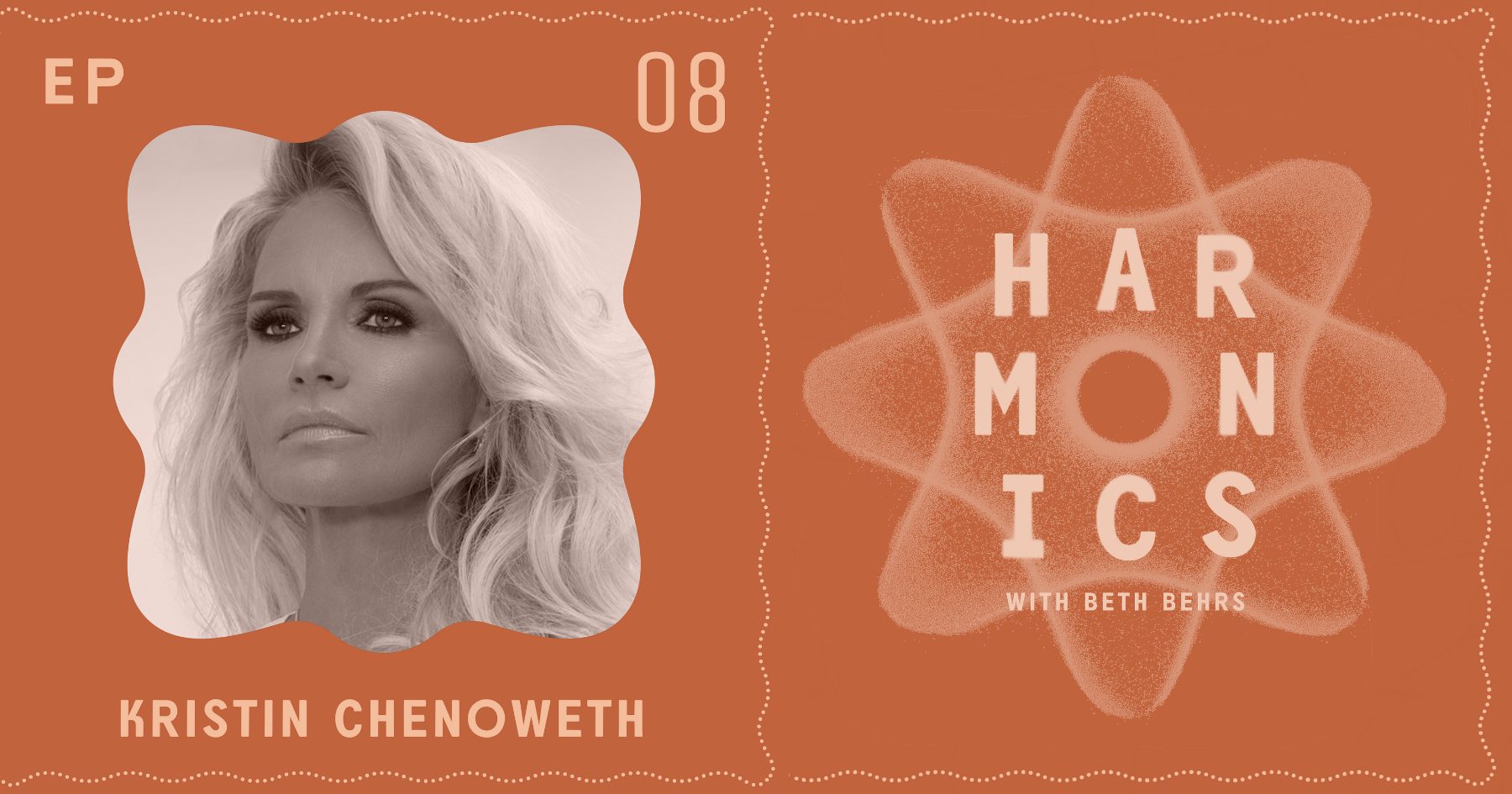
Harmonics with Beth Behrs: Kristin Chenoweth

This week on Harmonics, in honor of Mental Health Awareness Month, we bring you an emotional conversation with Tony- and Emmy-winning actress and singer Kristin Chenoweth.

LISTEN: APPLE • SPOTIFY • STITCHERAMAZON • POCKET CASTS • MP3

Having recently lost a lifelong voice teacher and dear friend to COVID-19 at the time of this interview, Kristin Chenoweth brings a very open conversation about grief and mental health, talking with host Beth Behrs about her struggles with depression and anxiety during the pandemic, and throughout her life — accepting that she does need to acknowledge her mental health struggles, even though due to her public persona, most people expect her to be “rainbows and glitter” 24/7.


Listen and subscribe to Harmonics through all podcast platforms and follow Harmonics and Beth Behrs on Instagram for series updates!

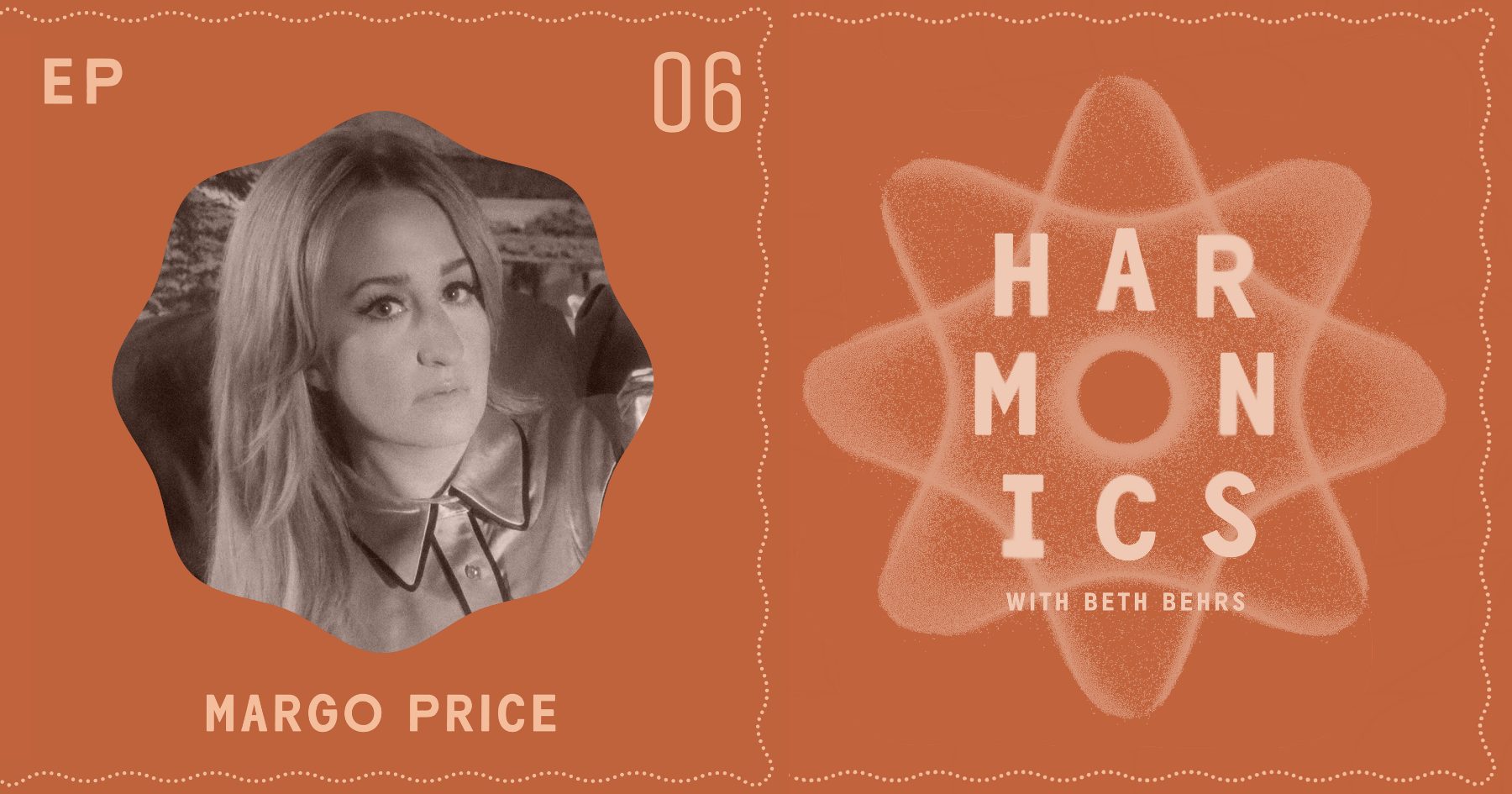
Harmonics with Beth Behrs: Margo Price

It’s Americana April here on Harmonics, and this week brings a conversation with one of host Beth Behr’s all-time favorite artists — Americana or otherwise — Nashville’s very own Margo Price.

LISTEN: APPLE • SPOTIFY • STITCHERAMAZON • POCKET CASTS • MP3

This past year may have temporarily pulled Price off the never-ending road of touring, but that doesn’t mean the pace has slowed down; being a mother is a never-ending rush of another kind. She and Beth talk about this time spent at home, from spending time with her children and attempting to instill in them a respect for the earth and for others, to navigating the complexities of a songwriting relationship with her husband, singer-songwriter Jeremy Ivey.

Price also shares her feelings on becoming the first female artist on the board of Farm Aid (a full-circle, bittersweet moment after her family lost their farm when she was young,) the advice she’s gleaned from the greats like Willie Nelson and Emmylou Harris, working with longtime friend Sturgill Simpson as the producer on her latest album That’s How Rumors Get Started, and so much more.

Hear our first installment of Americana April with last week’s episode featuring Fiona Prine, and stay tuned next week for a conversation with singer-songwriter and poet Courtney Marie Andrews.


Listen and subscribe to Harmonics through all podcast platforms and follow Harmonics and Beth Behrs on Instagram for series updates!

This episode of Harmonics is brought to you by BLUblox: blue light blocking glasses, backed by science. Reclaim your energy and block out the unhealthy effects of blue light on your mental and physical health. Take 15% off your order with code “HARMONICS”

Harmonics with Beth Behrs: Jewel

Welcome to Season 2 of Harmonics! On episode 1 of our new season, we’re kicking things off with the incredible, four-time Grammy-nominated folk singer-songwriter, Jewel.

LISTEN: APPLE • SPOTIFY • STITCHERAMAZON • POCKET CASTS • MP3

Jewel joins host Beth Behrs for an insightful conversation about her experience with mindfulness throughout her life as a response to anxiety. She presents multiple tangible skills she has developed along the way that hopefully anyone can easily apply to their own lives to expand their mindfulness.

Throughout her career, Jewel has brought these skills to struggling children as well, having been an avid advocate for mental health awareness and using her platform to lift others up. Her work through her own Jewel Never Broken program, in conjunction with the Inspiring Children Foundation, has supported so many children with mental health support resources, mentoring, education, and equipping kids with important life skills and tools to earn college scholarships, becoming forces for good in the world.

Jewel’s honesty regarding her own struggles, and how it informs her creativity, her art, and her life, is incredibly inspiring.

In case we haven’t yet convinced you of the wealth of knowledge and wisdom present in this episode — Jewel also gives Beth a personal lesson on how to yodel!!


Listen and subscribe to Harmonics through all podcast platforms and follow Harmonics and Beth Behrs on Instagram for series updates!

Photo credit: Dana Trippe

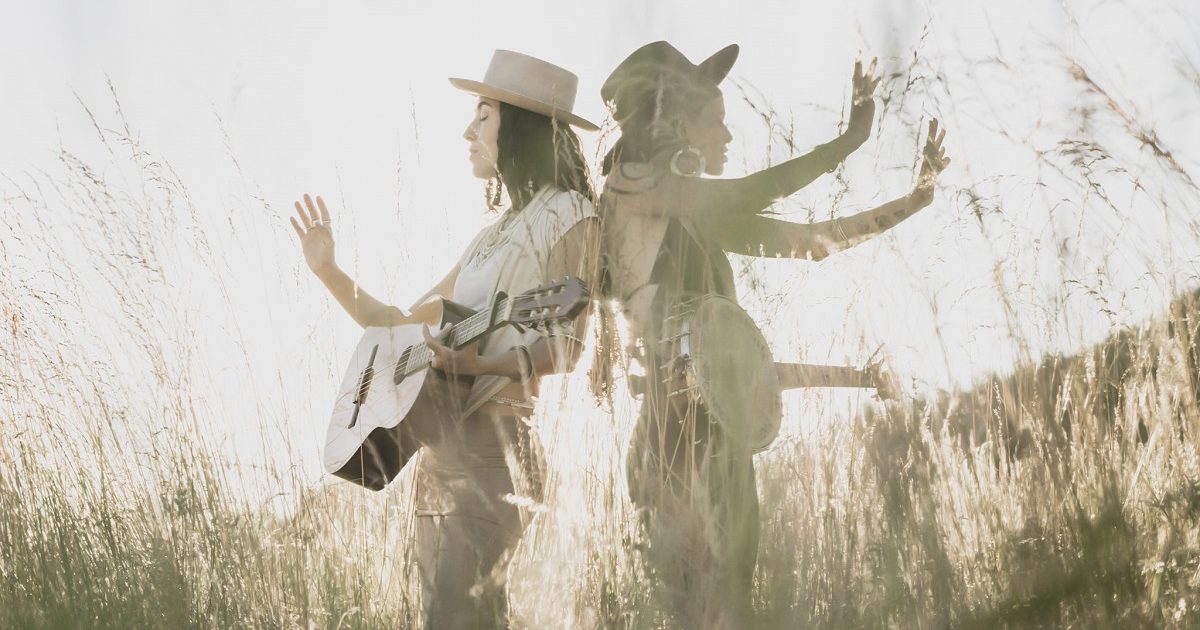
WATCH: Rising Appalachia, “Stand Like an Oak”

Artist: Rising Appalachia
Hometown: Atlanta, Georgia
Song: “Stand Like an Oak”
Release Date: April 22, 2020 (Earth Day)

In Their Words: “I wrote this song for a loved one going through the wave and arc of depression and anxiety, someone whom I wanted to sing a reminder to to find her roots and footing when the wind blows strong. Mental health is a gripping mountain for so many people to climb, and this song honors that journey as well as the people who pull us up out of it. Now, in the time of corona, we are seeing the necessary roles of music and healing practices in our abilities to see through this pandemic and stay steady on our course of compassion and strength. This song sings, like the mighty oaks, of claiming your little piece of earth fiercely when the storms pass through.” — Chloe Smith, Rising Appalachia

“‘Stand Like an Oak’ is a song to remind us of our innate sturdiness and deep roots in this vital dark soil of earth, the innate presence and stability of the oak tree as our model and muse of calmness in the great storms. In a time of so much unknown and anxiety around what is to come we must remember that we always have the tools of the deep ground beneath us, and the ritual for rushing waters to wash away that which does not serve us. Lean into this quiet, earthly realm to fortify and strengthen. ‘Leave it by the angels of the water…'” — Leah Smith, Rising Appalachia


Photo credit: Hemmie Lindholm

Practicing What You Preach: A Conversation with Courtney Marie Andrews

Courtney Marie Andrews has a wish for the world, as large swaths of it hold tight to the isolating practice that is hatred: Be kind. It’s a simple thought, but a complex action, and the inspiration behind Andrews’ new album, May Your Kindness Remain. The title track — like “Irene” from her 2016 breakthrough album, Honest Life — is advice-heavy, but the central tenet is an important one. Bad things will continue to upend your life. Don’t just stay strong in the face of it, stay kind. To emphasize that point, Andrews interlaces her new album with new influences, namely soul, gospel, and blues. As a result, the song resounds like the culmination of an especially fiery sermon — an organ accentuates the folk-rock through-line, while a choir backs Andrews’ expansive vocals.

Where Honest Life found Andrews reckoning with the sacrifices she’d made to pursue her craft, May Your Kindness Remain broadens that vantage point. Andrews culls perspectives from those she met on the road — a place where she has spent the majority of her time since she began touring, nigh on a decade ago — interlacing new characters, settings, and experiences under the umbrella of her voice. The ballad-esque “Rough Around the Edges” puts a name to a feeling — as minimal as malaise, as maximal as depression — that often exists in the shadows, while “Border” reminds listeners to withhold judgment and extend empathy instead. Andrews also pushes her vocal limits, stretching her voice to gospel’s high altar on “May Your Kindness Remain,” and returning it to earth on the sequined-stage country affair “Kindness of Strangers.” Preaching the gospel of kindness may seem like a departure from Honest Life, but Andrews proves there’s much to be gained from stepping outside her supposed stylistic lane. Her emotive voice and illustrative lyricism make her a necessary minister in these modern times.

Depression is a huge topic right now, especially in light of issues like gun control and the opioid crisis, but it continues to carry a stigma. How do we move beyond that kind of shaming?

I think it starts with talking about the issue and also just being open about it. I feel like, of course, there are a lot of things that need to change within the government, like aiding these sorts of things and taking it seriously. People talk about it a lot, but nobody actually makes any changes toward putting money toward research facilities to help guide those problems. My grandmother committed suicide, and the reason that she did is because it was around the time when she was basically a guinea pig for mental illness.

Oh, wow. Was she in and out of a lot of facilities?

Yeah, exactly, and they were giving her way too many pills and shock treatment and that sort of thing. I look at the path which we’ve come from, and it’s gotten better, but it’s been so long. It’s been 40 or 50 years since that happened — we really haven’t made any improvements. I mean we have, it’s just been small. It’s not very much for that long of a period.

Definitely. There’s still a persistent problem of patients not seeming to understand their own bodies. Not to criticize all doctors, but patients still seem to lack authoritative subjectivity over their experience.

Yeah, or that it’s not real because it’s hard to measure, if you can’t see it or feel it, and so many doctors — I, as well, don’t want to criticize all doctors — don’t have the time to really explore what’s the matter. I think it’s multiple things that need to change. Just day to day, one of the themes of the record — kindness, that sort of thing — I feel everybody is capable of changing, but also there are larger obstacles that lie within medicinal fields and the government, as well.

Absolutely. “Rough Around the Edges” is such a powerful way to put it, but it also peels back that layer of otherness. Where did that phrase come from?

That song definitely came from that phrase. When I was bartending a couple years ago, I saw a couple guys at the bar that are these old-timer type guys and not always appropriate, and I thought, “You know, they’re kind of just rough around the edges.” It was that lightbulb moment where I was just like, “Oh man, that is a perfect way to describe somebody who isn’t perfect and maybe knows it sometimes and wants to explain it to their partner.” It is sort of a way of describing depression, as well.

Right, and as you were saying earlier, since it’s so hard to properly convey this experience to someone, it creates a picture that gets us closer to a stronger level of communication.

Yeah, that’s my preferred way of telling.

There was an element of journalism that came to mind with this album — it was mainly the idea that you are reporting from the front lines, so to speak. It got me thinking about whether songwriting could be a new form of journalism by sharing stories that aren’t being covered or circulated in the mainstream press and, in turn, helping us build empathy toward difference.

Especially with this record, I feel like I grabbed from many different stories, and, yeah, it is sort of like journalism. I think songwriters are empathizers for the world, and sometimes a songwriter offers insight and empathy that maybe somebody who is a journalist might not achieve just because they’re trying to get a story as tried and true as possible. They need a story to grasp readers, whereas songs need a feeling to grab listeners. At the end of the day, I guess I’m a short story writer.

You produced your last album because you said you couldn’t find anybody you could trust. What led you to Mark Howard, besides the fact that he’s worked with all the greats?

Well, that’s what sort of led me to him. I kept seeing his name on records that I loved. I actually had booked some time in the studio that I did Honest Life in, and I just had this gut-wrenching feeling — I went in there two months before we were supposed to record in the studio and I was supposed to produce again — and we made a song, and I was just like, “This is cool, but this isn’t what I want.” My whole purpose, as an artist, is to completely explore and shake things up, and I didn’t get into this to have a formula, a 9-to-5 thing, where I’m like, “This is the sound that is me now, and I’m going to do this every time,” which some people might not like. Change scares them.

Anyway, I was driving in a car with my manager listening to, I think it was World Without Tears by Lucinda Williams, and I was like, “I wonder who produced this.” I saw it was Mark Howard, and we sent him a message, and the next day he replied and, all of a sudden, we were making a record in L.A. I like his non-traditional way of working. It’s very inspired. It’s not very thought-out. Most of the stuff you hear on the record is us playing live in a room without a click. It’s us facing each other. We wanted to create a vibe and a mood, and I didn’t want to make Honest Life 2.0.

You mentioned doing some vocal stretching for this project. What kind of soul or gospel singers inspired you?

I’ve always had those influences. I’m a huge fan of Aretha Franklin, Odetta, and blues singers like Big Mama Thornton, and those ‘70s records that have gospel singers on them. I just never used those influences. I was also going to a blues bar in Seattle where they never had a singer, so I started singing for them because it was fun to use my voice that way. I was naturally interested in using my voice that way.

There’s a definite gospel foundation running throughout the album. How do you think that genre, especially, serves as a call for change?

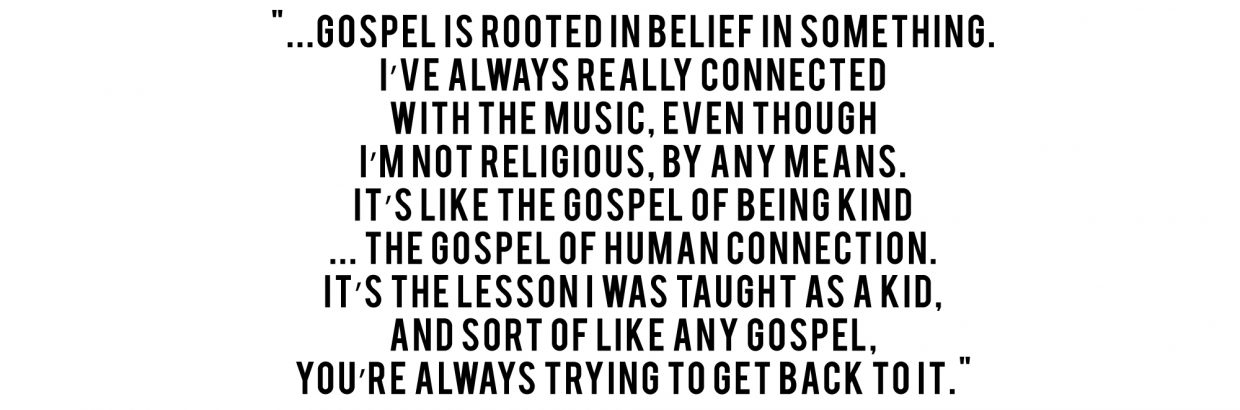
Well, gospel is rooted in belief in something. I’ve always really connected with the music, even though I’m not religious, by any means. It’s like the gospel of being kind, you know? That’s sort of how I look at it. I guess the gospel of human connection. It’s the lesson I was taught as a kid, and sort of like any gospel, you’re always trying to get back to it.

Lastly, I absolutely adore your song “I’ve Hurt Worse.” I think it’s one of the best “love” songs I’ve heard in some time. Where did it originate?

It’s one of those messed up love songs, I guess. A lot of my family members have a knack for choosing the worst partners, and it’s a sort of sarcastic song. It’s just like, you’re so bad at choosing partners, I’ve hurt worse that I’ll choose you because you’re better than the rest, but you’re still kind of bad.

Right, the element of settling runs throughout it, but it’s not even a bargain.

Unfortunately, it’s almost a self-loathing song. You love who you think you deserve. Well, you don’t feel you deserve much, obviously, because you’re going for these people who are terrible partners. I always wanted to write a funny … I feel like so many people just revert to sad and, as great as sad is, I like to add other elements of the human psyche.


Photo credit: Laura E. Partain