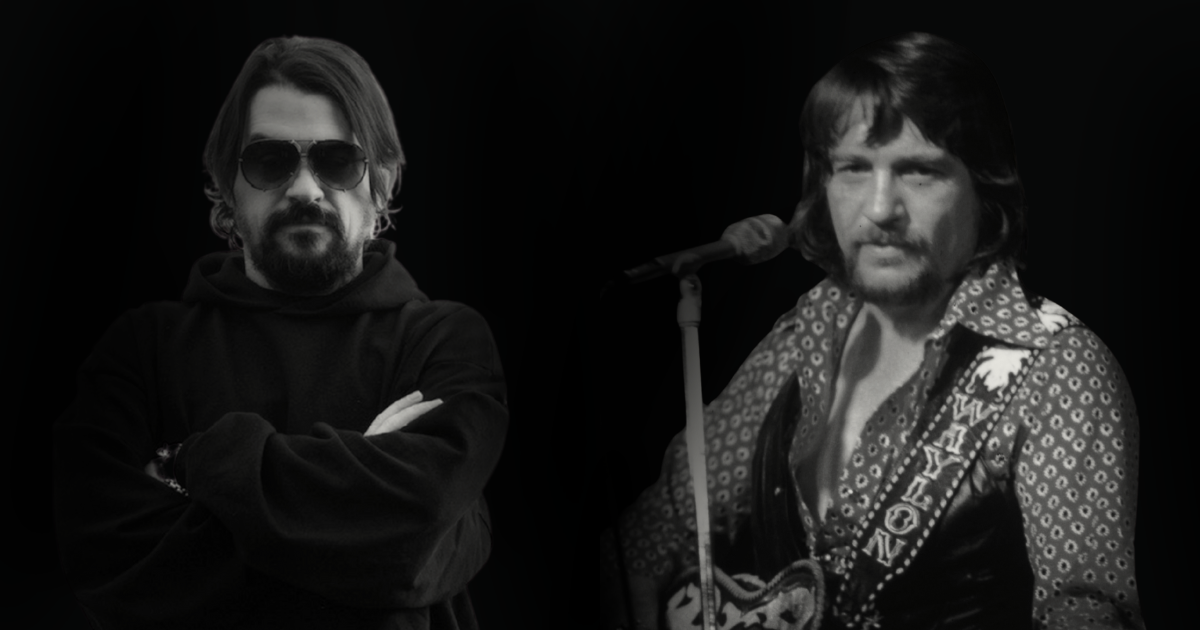
Shooter Jennings’ Heartfelt Tribute to His Legendary Father

Being the son or daughter of a legendary artist can often cause self-esteem and identity problems, especially if offspring choose their famous parent’s profession. But that clearly hasn’t been the case with Waylon Albright Jennings, much better known to music fans as “Shooter.”

The son of greats Waylon Jennings and Jessi Colter, Shooter Jennings has forged an impressive career as a singer, songwriter, instrumentalist, and producer covering over three decades, while displaying an idiomatic flexibility that’s seen him excel with both country and rock projects. Though he never uses the term “prodigy,” he was playing drums at five, taking piano lessons at eight, and sitting in with his father’s band on guitar at 14, while often spending time riding on his dad’s tour bus. Since then, he’s done an array of projects from heading bands to helming sessions, but he’s also always upheld a mantra of his father’s, which is stressing authenticity and passion in whatever he’s doing, writing, or playing.

Towards that end, Shooter’s newest venture both pays tribute to his famous father and reaffirms the musical values both have always championed. That’s the album Songbird (released October 3 via Son of Jessi/Thirty Tigers), which is the first of a planned posthumous trilogy of releases from the famed vocalist, who was one of the most distinctive and dominant voices to emerge in modern country during the ’70s and ’80s. Waylon’s landmark recordings, both as a solo artist and later in collaborations with Willie Nelson, Johnny Cash, Kris Kristofferson, Tompall Glaser and Jessi Colter, not only ushered in the “outlaw country” movement, they signaled a major step forward for artistic independence and creative freedom that resonated across the popular music spectrum.

Waylon Jennings was an innovative and vital figure not only as a performer, but as a personality. His voice and stature helped give gravitas to an otherwise forgettable TV show (The Dukes of Hazzard) and helped fuel a drive for authenticity within country. Still, despite that quest for freshness and originality, Waylon knew how to make hits. He had 16 number one tunes on Billboard‘s Hot Country Songs chart and 11 number one albums on Billboard‘s Top Country Albums chart during his amazing career, while always being a staunch advocate for his view of what constituted country.

Though Shooter has always called himself “an MTV kid who went down the rabbit hole with rock and roll,” he’s also long held a great reverence and respect for country. He began sorting through hundreds of his father’s personal studio recordings during the summer of 2024. Having just begun an exclusive residency at Hollywood’s historic Sunset Sound Studio 3 (which he redubbed “Snake Mountain”), Shooter began examining the tapes with veteran engineer Nate Haessly. Things moved quickly, his initial goal of finding previously lost Waylon songs he could share with the world morphing into instead deciding the best way to present what turned out to be a rich treasure trove of recordings. The material he was hearing was recorded between 1973 and 1984 and featured such guest stars as Tony Joe White and Jessi Colter.

“I started listening to this material last year and knew right away I had to put it out,” Shooter said during a recent phone interview with Good Country. “Once we began thinking about what we would put out there first, ‘Songbird’ just really kind of took over.

“Everyone that I played the song for heard it and they were really emotionally affected. Many broke out in tears the first time they heard it. It was an example of my father’s philosophy about doing songs from other people. Any song that he chose to record he would turn it into his own type of anthem. I really think that was the case with ‘Songbird,’” Shooter continued. “It gives the album a power and special flavor, and I’m really proud of everything on it.”

Songbird was released the first week of October, with Jennings’ evocative and stirring cover of the Fleetwood Mac tune its lead single. It debuted at number six on Billboard‘s Top Album Sales chart and it’s been in either the Top 10 or 20 on a host of other charts as well, representing the highest any Jennings LP has charted in 35 years. The 10-track release contains several other notable singles, most of them already previously complete. But on a couple of cuts, Shooter utilized the talents of surviving members of The Waylors, including guitarist Gordon Payne, bassist Jerry Bridges, keyboardist Barny Robertson, and backing vocalist Carter Robertson to add some spice. Elizabeth Cook and Ashley Monroe were also enlisted to help propel Songbird to new heights. Shooter mixed the songs in a purely analog fashion on Sunset Sound Studio 3’s custom 1976 DeMedio API mixing board.

Another song that’s quite appropriate in these times of extreme social conflict and division is Waylon’s version of Johnny Rodriguez’s “The Cowboy (Small Texas Town),” which finds him urging both cowboys and hippies to direct their ire away from each other and towards those causing greater structural harm to society. Additional recommended cuts include a sizzling Jennings version of Johnny Cash’s “After The Ball” and “I’d Like To Love You Baby” that features Jessi Colter.

Both “Wrong Road Again” and “I’m Gonna Lay Back With My Woman” are trademark Jennings numbers, while his version of Jesse Winchester’s “Brand New Tennessee Waltz” is also solid. The one criticism that some hardcore Waylon fans might make is Songbird doesn’t offer any previously unissued gems that he penned, feedback that Shooter’s been around long enough to anticipate. “What we went through and chose here were numbers that were made memorable through his treatments,” he continued.

“That’s something that my father always talked about and stressed, that whenever you do a song, make sure that you’re not just replicating something else, you’re making your own statement. That’s why Songbird has such an impact and that’s the case with everything on this album. These are songs that he loved from other people and wanted to perform and put his own stamp on them.”

Though born in Nashville, Shooter made the move to Los Angeles in 2001. Since then, he’s comfortably moved back and forth between rock and country. He’s had a mixed amount of success as a performer, cutting 11 albums and EPs in both genres. His biggest country hit came on the 2005 LP, Put The O Back in Country. That album’s lead single, “Fourth of July,” peaked at No. 22. The album version featured a cameo by George Jones, who sang the chorus to his signature song, “He Stopped Loving Her Today,” at the end. Unfortunately that was purged from the radio version, but Jones was credited on the Billboard charts.

The album also spotlighted Shooter’s then-new band, The .357s, which consisted of Leroy Powell on guitar, Bryan Keeling on drums, Ted Kamp on bass, Robby Turner on steel, and backing vocals by Bonnie Bramlett. Later that year his song “Busted in Baylor County” was featured in the 2005 film version of The Dukes of Hazzard. Furthermore, Jennings portrayed his father in the Johnny Cash biopic Walk The Line alongside Joaquin Phoenix and Reese Witherspoon. His rendition of his father’s song “I’m A Long Way From Home” was featured on the film’s soundtrack.

Still, Shooter’s greatest fame has come as a producer for a wealth of recordings. He was introduced to the studio as a child, his earliest exposure being inside Chips Moman’s studio in Nashville. His rock influences come through in his at times freewheeling use of studio technology that wasn’t in general use during his father’s heyday, but on any of his productions he’s never let the artist’s voice be overwhelmed by layers of excessive production or backdrop.

He’s been nominated for five GRAMMYs in that role and won two. A short list of memorable sessions he’s produced include such artists as Brandi Carlile (Best Americana Album GRAMMY), Tanya Tucker (Best Country Album GRAMMY), and American Aquarium, as well as Jessi Colter, Jamey Johnson, Jaime Wyatt, The White Buffalo, Hellbound Glory, The Mastersons, Julie Roberts, Kelsey Waldon, Yelawolf, Marilyn Manson, Jason Boland, Billy Don Burns, Avi Kaplan, Billy Ray Cyrus, and Angry Grandpa. Just this year alone, Shooter Jennings produced acclaimed releases by the Turnpike Troubadours, Charley Crockett, and Jake Owen.

When asked what he enjoys most or looks for in terms of production collaborations, Jennings says, “The people that I truly enjoy working with the most are the ones who have their own ideas of what they want to do, how they want to sound, or what they want to sing. Then they bring those ideas into the studio and we take it from there. I’m not really quite as good when it comes to just taking someone who doesn’t really have a sense of who they are and saying why don’t you try this or try that.

“With Charley [Crockett], for instance, that guy comes into the studio and he’s already got all these things together and we can just hit the road from there and take it forward. A guy like Duff [McKagan], who can just write their ass off, or a group like American Aquarium, I can get really excited. Brandi [Carlile] came to me and wanted me to work with her and that was a fantastic experience. But in general, if you’re someone who has their concept of what they want to do, then we can sit down and really make it work in the studio.”

Shooter also has amassed some good credits in the worlds of broadcasting, film, and television. As well as getting the chance to portray his father in the 2005 film Walk The Line, he has made celebrity appearances on television shows CSI, Marvel’s The Punisher, and American Revolutions, while also playing a gunslinger in the 2013 film The Other Life.

Back in 2009, Shooter participated in a CMT Crossroads session, paired with close friend and fellow musician Jamey Johnson. The evening’s set list consisted entirely of duets, including a cover of “Outlaw Shit” from the Waylon Forever album, two songs from Jennings’s discography – “God Bless Alabama” and “It Ain’t Easy” – and four songs from Johnson’s album That Lonesome Song including “High Cost Of Living,” “Mowing Down The Roses,” “Between Jennings and Jones,” and “In Color.”

Shooter cites Glenn Danzig and the band Oasis as folks that he hasn’t yet worked with whom he’d like to in the future. But right now, his main focus is on the two remaining Waylon Jennings posthumous recordings – though he’s not sure yet exactly when they will come out or what will be on them.

“One thing I can say for sure is that there’s a lot more great music coming,” Shooter concluded. “I was really amazed at how much great stuff is there, and I think the fans are going to really be thrilled when we get these next two out there. My father did a lot of great music before he passed, and we’re going to get as much of it out there as we can.”


Photos courtesy of Shooter Jennings.

Sunny Sweeney’s Musical Full-Circle Moment

Self-producing an album wasn’t something that Sunny Sweeney spent much time pondering – until it happened.

Rhinestone Requiem is the pinnacle of her taking charge, hoeing her own bean row, and flexing her self-determining vigor. It’s just the latest from an artist committed to exploring her imaginative energies on her terms.

“I’m happy with what we ended up with on this project,” said Sweeney. “We could just pay ourselves. Plus we only had to have two opinions [hers and co-producer Harley Husbands’] versus more opinions.”

“Our mentality going in was, ‘We know how to do this and we are going to try it and see what happens.’”

Rhinestone Requiem, released August 1, is pure Sweeney, sharing tales of figures who win hearts readily and whose outlaw lifestyles embody freedom from responsibility. There are songs devoted to romantic quests, the forever keeping on and the forever searching, like such richly rendered titles as “Traveling On” and “Diamonds and Divorce Decrees.”

Most of the album’s tracks are the result of Sweeney’s collaborations with several musicians she has been working with for a number of years. There are also two covers, “Find It Where I Can,” popularized by Jerry Lee Lewis, and “Last Hard Bible” by Sweeney’s friend and mentor Kasey Chambers.

Though she once saw the sharing of songwriting duties from a tentative and even negative point of view, Sweeney wholly embraced the notion of teamwork on Rhinestone Requiem.

“Songs were written with the rest of the people that I have known for a long, long time … I know what I’m going to get when I write with those people. They know their strengths and I know my strengths, and that’s why we continue to write together.

“I used to never collaborate,” she continued. “But now I’m co-writing and thinking this is awesome. I was petrified at first. Songwriting with others forces you to put down all of your worries. A lot of people worry about co-writing. But I see it as a double bonus thing. You hang out with friends and you get to work.”

Rhinestone Requiem is a throwback to Sweeney’s upbringing and all of the earliest things that have had a colossal effect on her: Her father’s records, which she had open access to; listening to Jerry Reed; watching The Dukes of Hazzard; processing the initial songs that jiggled her plaster loose.

Sweeney vividly recalls at age 8 hearing Jessi Colter’s “I’m Not Lisa,” a great example of one of her songwriting paradigms of setting mood and meaning.

“I sat and watched the record play,” said Sweeney, “I remember thinking she sounded really sad, but now I know what she’s talking about. I also remember hearing Jerry Reed’s ‘Amos Moses.’ I thought, man, what type of noise is this? I knew I needed to hear more of it in my life. Waylon Jennings’ ‘Good Ol’ Boys’ theme and I loved The Dukes of Hazzard. I told my mom that I wanted a son and was going to name him Bo and Luke Duke. I loved them both, those Duke boys, and I loved that Telecaster sound.”

The whole fictional gang of rural Hazzard County folks, Bo and Luke and Daisy Duke, mechanic Cooter Davenport, accident-prone though incorruptible deputy sheriff Enos Strate, and others, resembled the classmates, pals, and neighbors who Sweeney was raised with in the Texas countryside.

“Those were the kinds of people that existed in my life,” said Sweeney. “Country boys were dressed like that and they’d drive too fast down the street. I saw Daisy Duke and I wanted heels like that. Daisy Duke. Dolly Parton. Grease. Heels and lipstick. I had seen my future!”

Sweeney was born in Houston, but after her father decided that he no longer wanted to work in the family insurance business, he quit the agency and packed everyone and everything up and drove more than 200 miles north to Longview, where he’d grown up.

“I’m grateful for that small town,” said Sweeney. “I don’t know if I would have ended up in the music business if I wasn’t raised there. There were opportunities for small-town people and small-town interactions, which have shaped the way I feel musically.”

Indeed, the move to Longview would play a decisive role in Sweeney’s relationship with music. There was a low-watt country music station in the town of about 60,000 people featuring a succession of howling DJs who routinely tried to break the songs of lesser-known artists, allowed for call-ins, and welcomed conversations. Sweeney started listening in the third grade and calling in to request Conway Twitty.

After her parents’ divorce, Longview was also where her mother met Paul, the person who would become her stepfather – and, in hindsight, her biggest career influence. Paul and one of his brothers liked to twang the guitar. Nurturing and never hardhearted, Paul slowly and caringly taught Sweeney how to play the instrument. The first guitar that he gave to her was a black composite Martin, “a cheap, old, sentimental thing,” she said. She learned that her grandfather was a member of a big band orchestra. He played the trumpet, drank scotch, and chain-smoked cigarettes. She thought that he was the apex of cool. But the notion of becoming a musician as an occupation seemed, in her words, “far-fetched.” She asked Paul what he thought – and he merely grinned.

Years later, Sweeney, thinking about her stepdad’s tenderness, her grandfather’s stark sense of flair, and some of the songs and musical moments that touched her as a child, she re-examined her intentions.

“I had a college degree and I didn’t want to use it. I wanted to work for myself and wear jeans everyday and be my own boss. That was 20 years ago.”

Sweeney, now 48, lived in Austin for approximately 25 years, going through some precariously bony times, financially. She juggled other jobs while making barely enough to cover bills. At one point, strapped for cash, she pawned the original Martin that her stepdad had given to her. The Chaparral Lounge in South Austin was the very first place that Sweeney performed and several months elapsed before she would muster the courage to return to the stage a second time. That second performance took place in August 2004 at the Carousel Lounge on East 51st Street.

“There was a halfway house across the street and I was not that good,” she said. “My mom said that there were two or three minutes in between each song and lots of discussing how we were going to play it.”

Swiftly, however, Sweeney improved. “I threw myself into it 150 percent.”

She began hustling seven nights a week, performing wherever there was the potential of a free meal or the likelihood of even a single pair of listening ears. At grocery stores, perched on hay bales, in the rutted corners of falling apart parking lots. If the spot had electricity, she would play there. And if it didn’t, she would still sing, at any rate.

“Many nights I played outdoors without lights,” said Sweeney. “We had lights on a stick, two canister lights, before LED lights. At Poodle Dog Lounge, which was a staple in Austin – now Aristocrat Lounge – there was no stage. No credit card machine. No dance floor. There were some chairs, and you were three feet in front of that, standing there. I missed one or two Sundays in three years.”

At Poodle Dog Lounge, Sweeney played her set between 8 and 11 p.m., plenty of shuffles and polkas to satisfy the dancers. Her act was mostly covers, with the occasional original thrown in, hoping that the audience was too sauced or too ebullient to even notice.

Her rewards and incentives, she said, were comparatively picayune. “Eating for free was pretty cool. Not having to get up early. Maybe play at a couple of other nearby towns.”

Things were moving along satisfactorily, if not spectacularly, when she received a message on MySpace from a record producer who told her that he liked what he had heard out of her in a club in Austin one night. He was based in Nashville, and once he learned that Sweeney would be performing there, he showed up. Without delay he offered her a recording contract.

Since then, she has won over a sizable group of listeners with a repertoire of songs that are frank, discerning, and occasionally grief-stricken, teasing, provocative, and ultimately convincing.

@sunnysweeney New song from the new record! You ever tried to get away from a relationship that keeps sucking you back in? #sunnysweeney #countrymusic #foryourpage ♬ original sound – Sunny Sweeney

Co-producer Harley Husbands has worked with Sweeney for about 10 years, his guitar licks always craftily and reliably adding richness to their musical portraits. The pair are so joined at the hip that his contributions to Rhinestone Requiem are virtually indistinguishable from Sweeney’s, their palettes bleeding into a single piece of artistry.

“We live together and work and travel and play together,” said Sweeney. “That forces you to work well together in the studio. We’ve got no time to not work well together. Having a bad day? Too bad.”

Sweeney said that the vocals on the record are about as close to the authentic article as she could deliver, done without any polishing or cleansing or much enhancing. She credits Harley with being the ultimate arbiter, the most prized of assayers. He knows her voice better than anyone. If she didn’t sound right at a particular moment, he made sure to tell her so.

“I’d be in the vocal booth running through songs and he would be in the control room, knowing what I do like hearing out of myself… He knows what I like to hear. If he was not hearing me sing that way, he would know it perfectly. It’s as close to me knowing it on my own as possible.”

Her vocals on Rhinestone Requiem are firm, authoritative, and insightful enough to be considered some of her best work.

“It is not smushed down and compressed,” said Sweeney. “It is as close to sounding as they’ve sounded at the show. I don’t like it when you buy a record and put it on the turntable and it doesn’t sound like what you’ve just heard at a show. I like reaching the high end. It can be shrill. Either people love it or hate it. Harley’s job was mixing me and pulling out my significant sound and frequency, but without squishing what people are already used to hearing.”

By the way, a requiem, by definition, is an action or token of remembrance. It is a word that has generated a bit of droll reaction, Sweeney said. “Some guy just wrote on my page that we need to pick a word that we can pronounce. I laughed my ass off out loud. My sister said that we need to get those boys a dictionary!”

Nevertheless, it is a pleasing and easily engaging listen, whether to devotees or casual fans of clear-cut country. Out of the new songs, “Traveling On” and “Diamonds and Divorce Decrees” are receiving the largest number of spins.

“I hate having to pick songs to release as singles,” said Sweeney. “I think we should release all of the songs and let people pick themselves. There are a couple of deeper ones, like ‘Half Lit in 3/4 Time’ that I’m really liking. ‘As Long as There’s a Honky Tonk’ is going over well at gigs and live is getting a really good response.”

Indeed, the formula of Rhinestone Requiem is the same modus operandi of loving labor, mischievous candor, bittersweet humor, and resolute truthfulness. And it seems to be paying Sweeney impressive dividends.

“Years of wearing myself out and gigs and travel,” said Sweeney. “I’ve started to see people now at every single gig. It’s all starting to feel real now. We’ve been living with these songs for a year, and now other people are now hearing them. The excitement is building.”


Photo Credit: Nash Nouveau