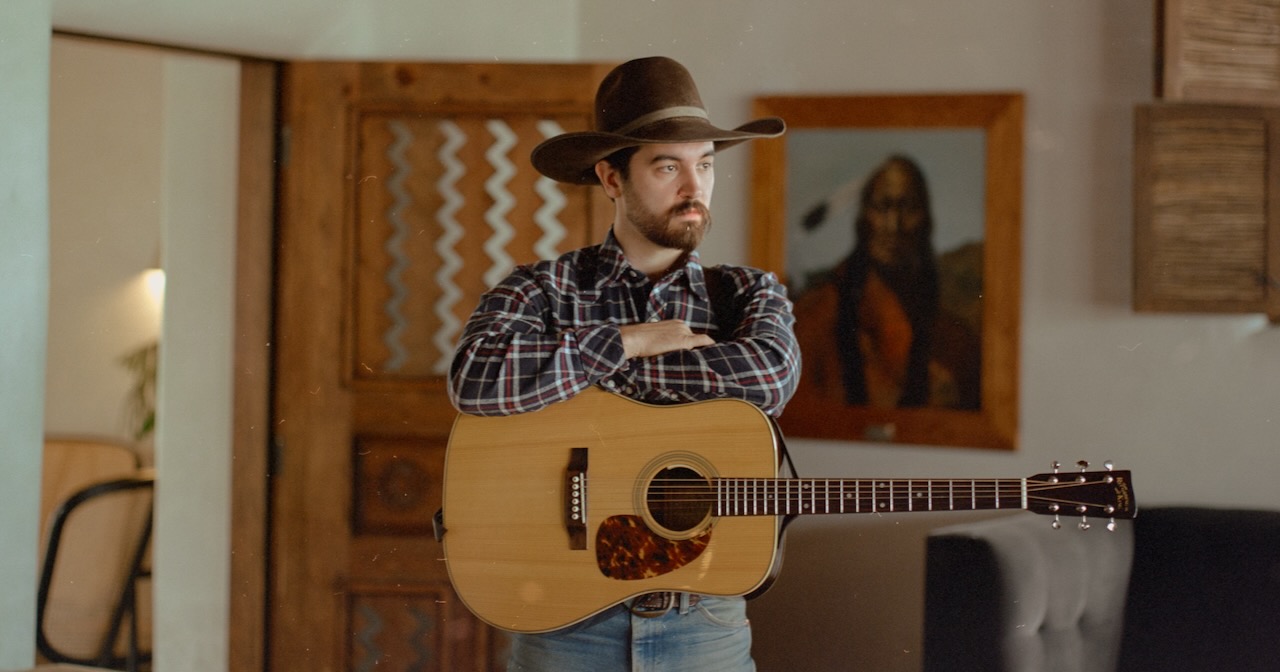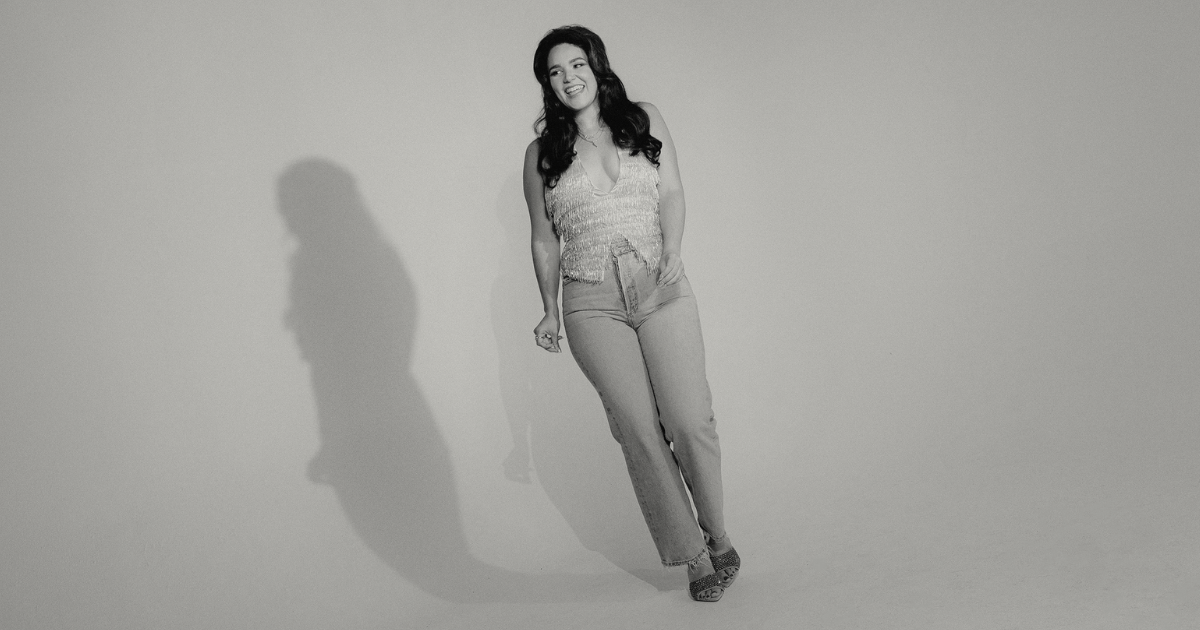
Put Your Movin’ Shoes on and Dance

After spending time On The Ranch in 2022 and hopping in the car for 2024’s Drive & Cry, Emily Nenni now finds herself out on the dance floor with her latest record, Movin’ Shoes. Released May 1, the album is the California-born, Nashville-based singer’s third project in collaboration with New West Records.

It’s also her most ambitious and vulnerable to date, with Nenni singing about everything from feeling comfortable in her own skin (“Livin’ In Shame”) to getting caught up in a heated argument (“You Only Said It To Hurt Me”) and doing what makes you happy (“Not A Winner”). All amid a backdrop of Stax horns, pedal steel, and other accompaniments captured in Memphis with producer John James Tourville (of the Deslondes) and engineer Matt Ross-Spang. The two also worked with Nenni on Drive & Cry, but this time around the setting was at Ross-Spang’s new Southern Grooves studio, which offered up new opportunities to stretch out and experiment musically.

The result is a mix of honky-tonk and Southern soul that invokes Booker T & the M.G.’s and B.B. King (“Movin’ Shoes”); William Bell and Aretha Franklin (“What Have I Done Wrong”); Diana Ross (“Not A Winner”) and the Supremes (“Livin’ In Shame”). Even more crossover moments occur with a bluesy rendition of Paul Simon’s “Tenderness” and a reimagining of Cass Elliot’s (of The Mamas & The Papas) “Talkin’ To Your Toothbrush” that illustrate Nenni’s confidence in full bloom.

“This isn’t strictly honky-tonk like my former records, even though it’s still all the same influences,” Nenni explains. “I’m just drawing from more artists and genres than I have in the past.”

Ahead of Movin’ Shoes’ release, Nenni spoke with Good Country about the evolution of her sound, the relationship she has with her dog Edna (whom she sings about on the song “Home With My Dog”), her reverse lip sync video for “Livin’ In Shame,” and more.

One of my favorite songs from Movin’ Shoes that captures your new sound is “Yes It Hurt.” Did you always plan to incorporate horns in it?

Emily Nenni: “Yes It Hurt” was probably the most outside of what I’ve done on any of my past three records. It was a bit nerve-racking, because I initially just planned to record the phrase “yes it hurt” repeated with some harmonies to use as an interlude. I never envisioned it being a full song, but JJ [John James Tourville] came up with a whole thing around it that I added verses to the day before we went in to record. I didn’t really know what I was doing, but I trusted him, and getting to see three horn players shred on my song made it all worth it. I’ve always wanted horns on my record, but didn’t want it to be such a big departure from what I’ve been doing.

What was the timeline for these songs coming together?

Aside from the covers, the entire record was written over the course of a month and a half. I sent JJ voice memos of most songs about a week before heading into the studio, which left him no time for pre-production. We had been talking, though, and had both the musicians and space to record, so I just trusted it would all come together.

The only song I had to build my lyrics around JJ’s production was on “Take My Money.” I had all the lyrics but no melody, because everything I tried didn’t fit right. Then he went and made it into this really cool and funky honky-tonk type song that has become one of my favorites on the entire record.

Was this your first time recording in Memphis?

Yes. We recorded Drive & Cry at the Creative Shop in Nashville, but it was actually mixed in Memphis with Matt Ross-Spang. When JJ and I drove down there for that I could just tell the two of them would work really well together on a full record, so around six months later I emailed them both asking about it. It was bittersweet because this is the first record where I haven’t worked with Jake Davis as an engineer. That being said, we did capture some vocals for “What Have I Done Wrong” at his house, so he still was able to be part of the mix, which was very important for me.

What led to you making “Movin’ Shoes” the album’s title track?

After I wrote the song I began thinking it would be a good name for the record, because I primarily write for the dancers at our shows – it’s my favorite thing! Some of these songs aren’t in that vein as much, but you can dance to anything.

In the end, the idea of moving and the content of that song touching on how you treat others when you’re out in the world is an overarching theme of not just it, but the record as a whole, which made it a natural fit to place as the title track.

You’ve always been an empathetic songwriter. What made you want to lean into that side of yourself even more on this collection of songs?

I spend a lot of time with myself, especially when we’re off the road. I’ve taken time to sort out my thoughts about the world we’re living in and that can get really heavy. It’s starting to affect the way people are interacting with each other, so with every encounter I have I’m thinking nonstop about the best way to handle it. It’s so important to think about and discuss not just how we’re treating each other, but ourselves too. When you’re in a funky headspace it’s nice being able to put on a song as a reminder for how to exist. Sometimes we need encouragement to be ourselves. My hope is that this album can help to remind folks of that.

You just mentioned spending time alone, which I know is at the center of the song “Home With My Dog.” I also love how it directly follows a cover of Delbert McClinton’s “Honky Tonkin’ (Guess I’ve Done Me Some),” a song about wild nights inside Texas dance halls. Did you notice their contrasting messages when you placed them back to back?

They are very much like two sides of the same coin. I’m only 32 now, but in my early 20s I could go out six or seven nights a week and could get up early the next day with no problems, but nowadays I need five nights’ rest for every night I do make it out of the house. [Laughs]. But aside from that, our dog Edna had some health issues while we were on the road in Europe a couple years ago. So now when I’m off the road I just want to be home with her and that’s all that matters. Even though “Honky Tonkin’” is a cover, it got me thinking about my early days in Nashville, hopping around the bars and in and out of conversation, and what those conversations consisted of. It all made me realize what’s most important, which is being here with our sweet little girl, taking care of myself, and not being out past my bedtime.

I can totally relate. I don’t get out anywhere near as often as I do now. However, I also don’t live in Nashville. I imagine the pressure to make appearances is amplified there with everything going on and the industry so close?

Exactly! We also live really close to Skinny Dennis – which I love – but it’s also really easy to go there and have too much fun and [then I] can’t hang around with anyone for a while. [Laughs] It is wonderful though, so I do remind myself to remain involved in our lovely community here. It’s nice being around so many honky-tonk women and checking in to see how they’re doing or sharing stories. The world is a heavy place right now – from what we see in the news to the realities of life on the road – so being home is a good chance to reset. Even if I do it too much. [Laughs]

You also cover Paul Simon’s “Tenderness” and Cass Elliot’s “Talkin’ To My Toothbrush” on Movin’ Shoes. How do you go about deciding which songs from others to tackle?

I often will come up with a list of potential cover songs before going into the studio, because I always like having one to cover. But with this record we wound up doing three. It’s fun to pick a random song that somebody maybe hasn’t heard, to introduce them to a new artist’s catalog. I decided to cover “Honky Tonkin’” because I couldn’t get enough of it and thought it would be a fun one for the dancers, and the riff is really great. Then with “Tenderness,” lyrically it reflects a lot of the message of this record, which is how we’re treating each other. Sonically, I thought Paul Simon’s recording was a nice combination of country and soul and something I could replicate while also making it my own as well. And with “Talkin’ To Your Toothbrush” I just thought it was a great song that would be fun to cover. Cass has such a dreamy voice, and the Dobro on that song was so good too.

How did you get the concept for your reverse lip sync music video of “Livin’ In Shame,” which reminds me of a similar trick you used a few years ago on a video for “On The Ranch”?

Joshua Shoemaker developed and directed both of those videos! “On The Ranch” is a one-take and “Livin’ In Shame” is multi-take and backwards. This was my third music video with him – he also did “Get To Know Ya” [from Drive & Cry]. For “Livin’ In Shame,” Joshua heard the message clear as day, so it was filmed backwards to convey it. Wiping away makeup and left with just me!

The message of “Livin’ In Shame,” feeling comfortable in your own skin, goes hand-in-hand with another of my favorites on the record, “Not a Winner,” and its declaration of realizing your worth. What are your thoughts on those two songs and how they tie together?

The two songs are big on self-reflection. I have put in a lot of work to be more patient and present with myself and my journey. It’s certainly easier some days than others, and that’s okay. I hope these songs help listeners be kinder to themselves too.

Movin’ Shoes is dropping the same day that you celebrate 12 years in Nashville. What’s the biggest thing you’ve learned from your dozen trips around the sun in Music City?

I’ve just learned to be more confident in my own songwriting and the band I have around me. When recording and collaborating, I’ve also gotten more comfortable contributing my own thoughts. When I first moved to town my lack of confidence had me shying away from putting myself out there and sharing what was on my mind. I’ve got everyone I’ve played with these past 12 years to thank for welcoming and embracing me. They’ve all been very non-judgmental, and that’s made all the difference in the world.

What has bringing this record to life taught you about yourself?

That it is okay to step outside of your comfort zone. Trying new things like using different instrumentation, recording outside of Nashville and being more outspoken about asking for what I want have all helped to build my confidence too. I’m more comfortable than ever with the “new” and with myself, which I think will be very helpful to me in all aspects of life, not just music.

Other than releasing Movin’ Shoes, what’s next for you?

I have already started writing a new record and I’m looking forward to getting back to the studio!


Photo Credit: Emilia Pare
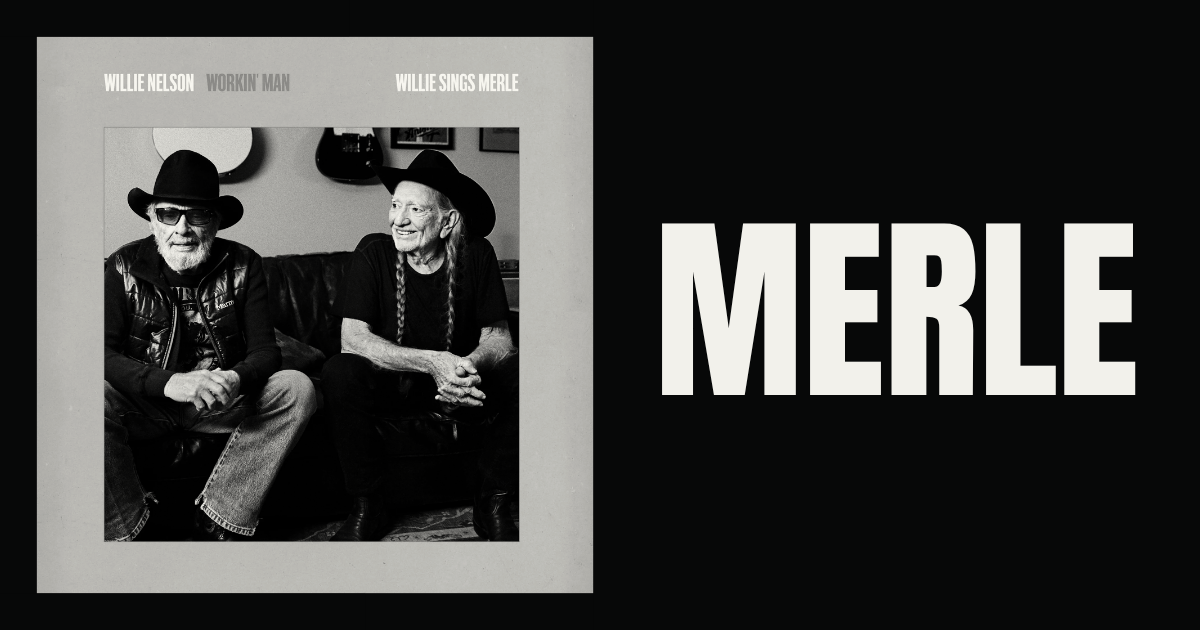
12 Fantastic Merle Haggard Covers

April 6 would have been Merle Haggard’s 89th birthday – and was also the tenth anniversary of his death. So, before these anniversaries get too far in the rearview mirror, I wanted to take a moment to remember one of country music’s all-time legends – and one of the great singer-songwriters in all American popular music.

One lesson of Haggard’s career is that you best honor your musical heroes, not only by playing their records at home or talking up their influence in interviews, but by continuing to perform their songs – on stage and in the studio. Merle released tribute albums to Jimmie Rodgers, Bob Wills, and Elvis Presley, and across his catalog cut at least an album’s worth of Lefty Frizzell songs.

Since his death, it’s been nice to see how often Merle’s musical contemporaries and descendants have taken Haggard’s model to heart, recording his songs and even releasing entire Merle Haggard tribute albums.

In recognition of his ongoing legacy, I’ve chosen 12 of my favorite cover versions of songs by Merle Haggard. I shared a kind of companion piece to this list last week, at No Fences Review, pulling choices from the 20th century only. Now, for Good Country, I’m focusing my dozen picks on Hag covers from this century.

I could assemble similarly strong lists every week for months without running out of possibilities. But these dozen Hag covers are among the very favorites.

“You Don’t Have Far to Go” – Candi Staton (from His Hands, 2006)

Co-written with trucker-song specialist Red Simpson, “You Don’t Have Very Far to Go” was the earliest of Merle’s songs to have legs. Recorded more than a couple dozen times through the years (including three versions from Hag himself), it’s proven a special favorite of first-name-basis country women. Bonnie and Connie, Rosanne and Lucinda, and others all seem to sing the song directly to some toxic asshole: “If I’m not crying, you’re not satisfied.”

My favorite reading of the song in that way is by Candi Staton. She became renowned for her disco and gospel recordings, but when first establishing herself as an R&B star circa 1970, it was with striking country soul takes on hits by Tammy Wynette and Patsy Cline. Decades later, she deploys Merle’s old song to deliver a master class in soulful, thought-by-thought phrasing. Staton sounds fragile and beaten down yet, by the end, her tone hints she may finally have had enough.

“Hungry Eyes” – Leona Williams (from Leona Williams Sings Merle Haggard, 2008)

Leona Williams may be best known as Haggard’s third wife, but she’s a tremendous artist in her own right, a country music lifer who played bass behind Loretta Lynn in the 1960s, enjoyed a solo career worth tracking down, and wrote or co-wrote chart toppers “You Take Me for Granted” and “Someday When Things Are Good” for Merle in the early ‘80s.

Leona’s version of “Hungry Eyes,” from her superb 2008 Haggard tribute, always stops me in my tracks. In the verses, she sounds haunted by her parents’ long-ago struggles. At each chorus, she gulps and springs to the top of her range, once again meeting her mother’s dissatisfied gaze. “She only wanted things she really needed!”

“The Running Kind” – Marty Stuart & His Fabulous Superlatives (from The Marty Stuart Show, c. 2009 or 2010)

“The Running Kind” is both one of country music’s great declarations of independence and, for Haggard, a great self-own: Merle boasts that he’s always on the run from one thing or the other even though, “I know running’s not the answer” to anything. The sentiment can serve as a kind of thesis statement for the Hag’s own restless life and career, so it’s ironic that my favorite version of the song isn’t Merle’s but this live cut from Marty Stuart. From an episode of the singer’s television series, Stuart and his Superlatives rage noisily and headlong, while staying absolutely controlled, through Merle’s tune. The solos from Kenny Vaughan and Stuart are my idea of Telecaster heaven.

“Ramblin’ Fever” – Tanya Tucker (from My Turn, 2009)

My pick for the best-ever “Ramblin’ Fever” is this version by Tanya Tucker. Riding an outlaw thump spiked by country disco high-hat, Tucker honors a musical hero, a former paramour, and a kindred rambling spirit. To that end, she loves it when some good-lookin’ fella rubs her back, but what really turns her on comes in the a.m. when she can drink a cup of coffee before leaving. The series of guitar solos that play out the final 1:20 here sound like she’s already out the door.

“How Did You Find Me Here?” – k.d. lang (from Sweet Relief III: Pennies from Heaven, 2013)

“How Did You Find Me Here?” was among Merle’s finest new songs of this century. From 2010’s I Am What I Am, Merle sings the number like a grim but grateful gospel ballad – his savior has come for him in his grave. “Thank you, Lord,” he prays at the close.

k.d. lang’s spare, ethereal reading feels less straightforwardly religious but, if anything, more spiritual. She’s desperately alone, at her nadir, but now someone – a lover or friend, her sponsor or her community – has seen her for who she is, taken her in. Lang’s contralto sounds bleary-eyed and dumbfounded, but she gains strength as she goes, ready to move on up.

“I Think I’ll Just Stay Here and Drink” – Suzy Bogguss (from Lucky, 2014)

Back in 1989, one of Suzy Bogguss’ earliest charting singles was a cover of “Somewhere Between,” still my favorite version of that great Haggard ballad. So my expectations were unreasonably high for Lucky, a full-length Merle Haggard tribute that she released in 2014. But the album’s a gem straight through, and I especially recommend her take on “I Think I’ll Just Stay Here and Drink.”

Most versions of Merle’s boozy romantic complaint have been done by rowdy dudes who sound like they’re slamming shots while ordering their fourth pitcher ahead of passing out. Bogguss, by contrast, comes off country-jazz cool, sipping a good bourbon and commiserating with herself in some dark corner. Don’t wait up. She’s going to be here awhile.

“Shelly’s Winter Love” – Lonesome River Band (from Turn on a Dime, 2014)

Merle’s most haunting song is about depression: Shelly’s depression each winter, the narrator’s the rest of the year round when the sunshine’s lured her back to town. This Lonesome River Band rendition from 2014 is the most haunting I know. Brandon Rickman sings beautifully but frighteningly too, and LRB’s pacing, like seasonal affective disorder set to a melody, reflects the long, slow days of a long dark winter. Midway through, Sammy Shelor’s banjo plunks a drip, drip, drip, that quickly gathers to a stream. A thaw’s coming; spring is on the way. It won’t be long now…

“A Working Man Can’t Get Nowhere Today” – Rob Ickes & Trey Hensley (from Before the Sun Goes Down, 2015)

This was a savvy cover choice by Rob Ickes, 15-time winner of the IBMA’s Resophonic Guitar Player of the Year award, and Trey Hensley, the association’s pick for Guitar Player of the Year in 2023. For one thing, the song is an underappreciated gem of the Haggard songbook, recorded maybe not even half a dozen times since Merle had a hit with it in 1977. More importantly, this Hag number lets Ickes and Hensley trade elegantly exhausted solos while tapping into a perpetually frustrating and common condition: Working your ass off every day to to put food on the table yet still coming up short. Hensley moans, “I’ll still be deep in debt the day that I fall dead.”

“Some of Us Fly” – Bonnie “Prince” Billy (from Best Troubador, 2017)

Merle’s “Some of Us Fly” served as the concluding track to his underrated release Chicago Wind, from 2005, and featured a guest vocal from Toby Keith. Because both men had already experienced such heights in their career, the message of each chorus – “Some of us fly but all of us fall” – comes off a little like superstars performing their humility. But where Haggard and Keith share hard-won wisdom, Bonnie “Prince” Billy casts a spell. With his duet partner, Irish singer/flutist Nuala Kennedy, he surrenders to a mystery.

On the remarkable 2017 Haggard tribute album, Best Troubador, Billy (AKA indie songster Will Oldham) and Kennedy whisper their way through Merle’s song in cautious harmony, their hands clutched tightly. The whole performance feels so fragile a strong wind might blow it way.

“Today I Started Loving You Again” – Eli “Paperboy” Reed (from Down Every Road, 2022)

Eli Reed specializes in making over all manner of roots-adjacent material into cool, committed soul music. Down Every Road does that for the Haggard songbook with thrilling results straight through. (A duet between Eli and Sabine McCalla on Merle’s most covered song, “Today I Started Loving You Again,” was inspired by a famous, but officially unreleased, 1969 version by Buck Owens and soul singer Bettye Swann.)

I especially appreciate Reed’s take on Merle’s celebratory kiss-off “I’m Bringing Home Good News,” which he relocates from Merle’s dusty, country-rocking San Joaquin all the way down to Louisiana for some funky Tony Joe White-styled swamp.

“Workin’ Man Blues” – Willie Nelson (from Workin’ Man: Willie Sings Merle, 2025)

One of Hag’s signature hits, “Workin’ Man Blues,” is usually framed as a purely blue-collar anthem, but it’s good to remember he identified the song as a blues. Having to work to survive while hoping your body holds out as long as you’ll need it is something to be cursed more than celebrated.

From last year’s Workin’ Man: Willie Sings Merle, a 92-year-old Nelson delivers his friend’s lines with a bit of a slur, weary and resigned but also grateful still to be working, to be on the road again until he runs out of road. Similarly, Willie’s arrangement sheds Merle’s Elvis-y fanfare for some hard, use-it-or-lose-it swing. “Play it, little sister,” he says, introducing one of the hot-jazziest solos in the career of the late Family band pianist Bobbie Nelson. Willie’s solos up top and midway through, meanwhile, are things of singular beauty, guitar work that sounds like play but refuses to hide the callouses and the miles. “As long as my two hands are fit to use…”

“Daddy Tried” – Jade Jackson (single, 2026)

Merle’s “Mama Tried” has been covered well over 100 times since he wrote it for the Killers Three soundtrack in 1968. But the song’s indelible ascending chorus and its universal theme – Merle sings it as if he’s as proud of defying his mom as he is remorseful for disappointing her – have encouraged people to use the song in all kinds of ways. Country comic Don Bowman parodied it as “Pappa Tried” as early as 1969 and more recently Angeleena Presley was clearly in conversation with Merle’s classic when she released “Mama I Tried” in 2017. As was Keith Urban when he sampled its lick for “Coming Home” in 2023.

Jade Jackson grew up in a small Cali town between Bakersfield and the Pacific, and her updated, gender-flipped take on Merle’s tale sounds just like that: Her voice feels a little dusty and a little sunny. Switching out Merle’s locale from “prison” to “Nashville” is funny because those two aren’t at all alike, but also because maybe they’re a little alike. For sure the ache in her voice reveals her as another singer-songwriter in a long line of kindred spirits to Merle; she’s going to go her own way, no matter her dad’s good advice.


David Cantwell is the author of The Running Kind: Listening to Merle Haggard, the co-author of Heartaches by the Number: Country Music’s 500 Greatest Singles and the co-creator of No Fences Review. His byline has appeared at Rolling Stone Country, The New Yorker, Slate, and No Depression, among other publications.

Photo Credit: Workin’ Man: Willie Sings Merle on Legacy Recordings

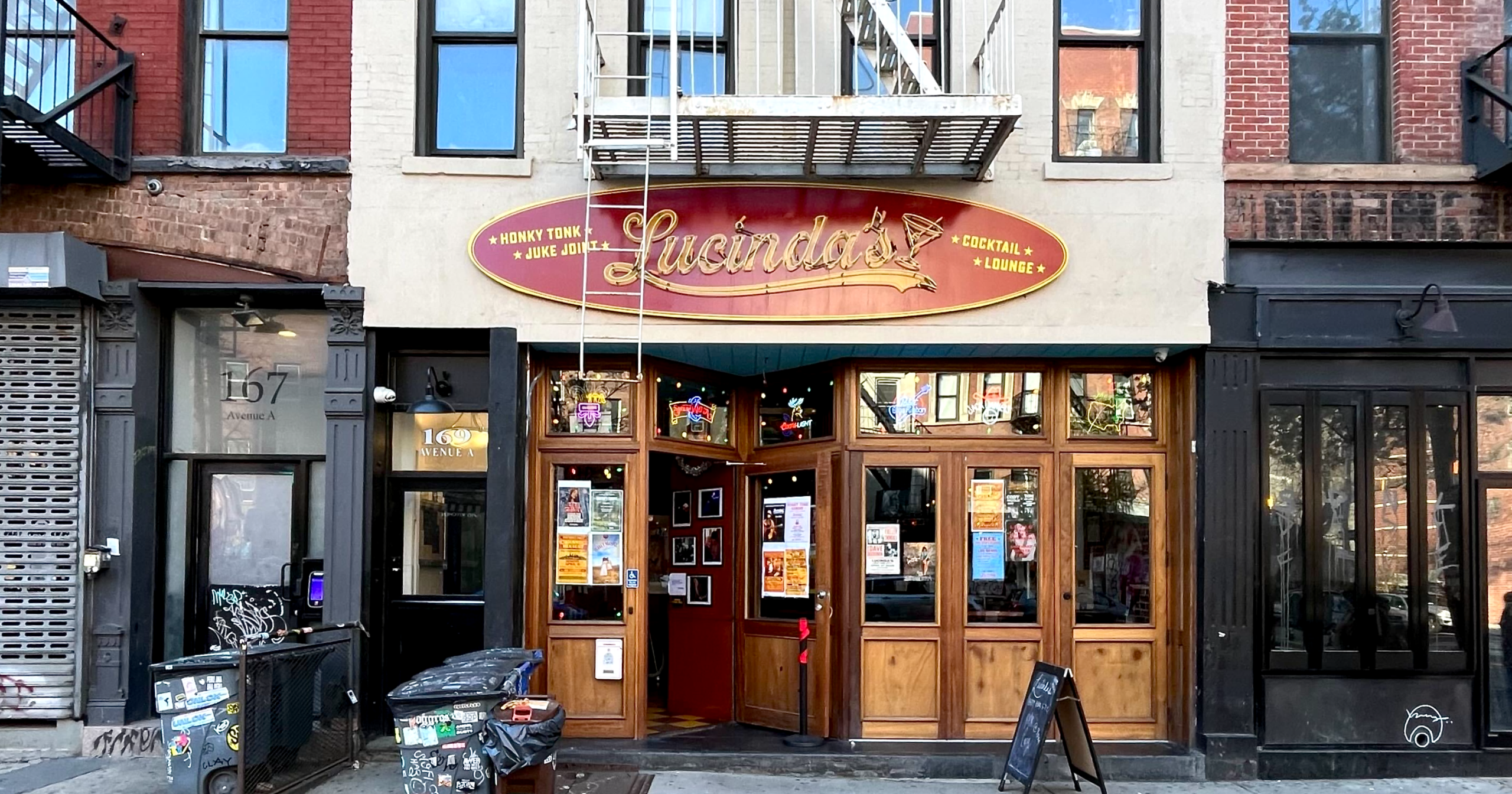
Check Out Lucinda’s, a Bustlin’ NYC Honky Tonk

(Editor’s Note: Enjoy our tour of New York City honky-tonk, juke joint, and cocktail lounge Lucinda’s as a special postlogue to our Artist of the Month coverage of Lucinda Williams during March 2026.)

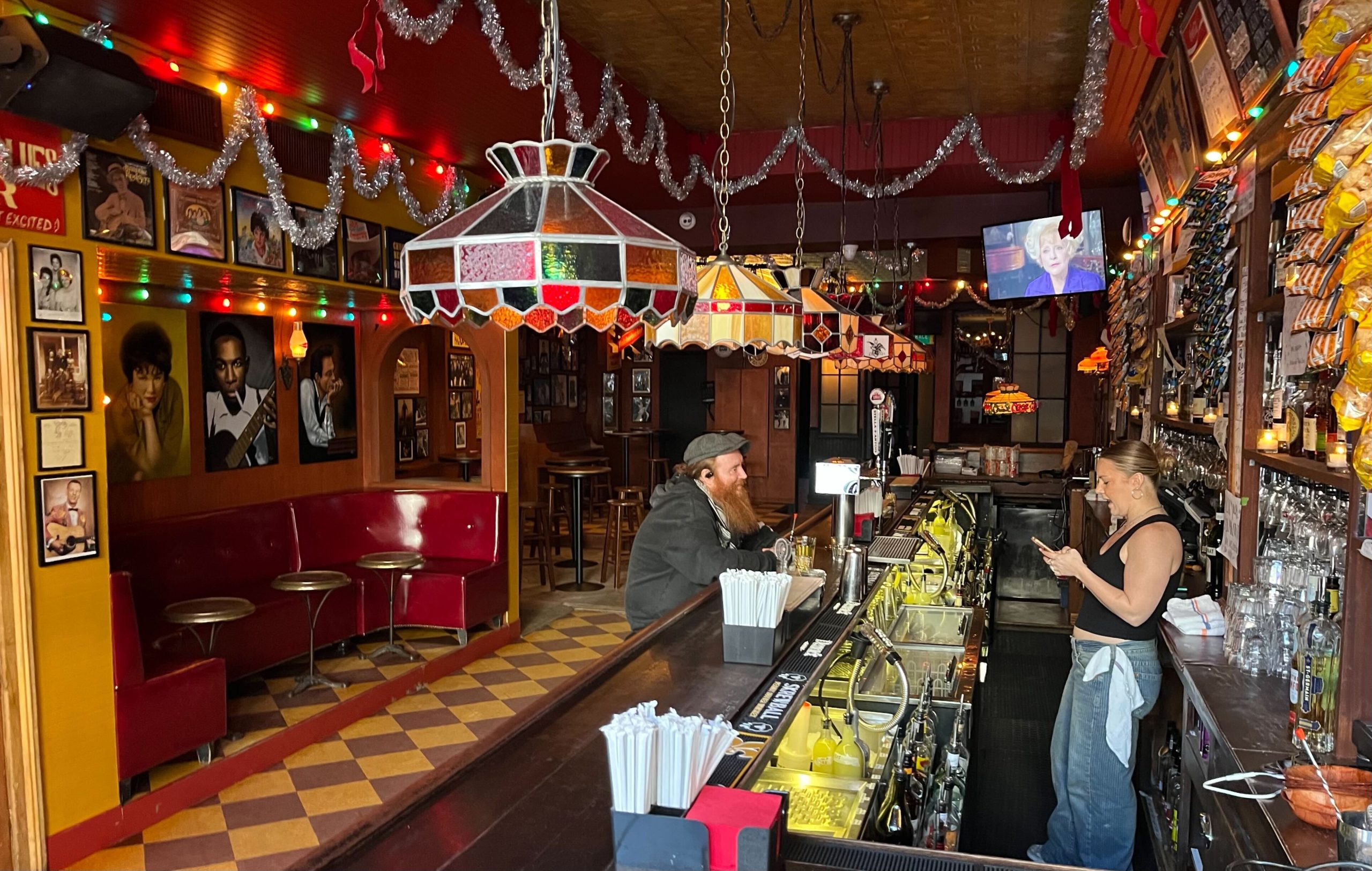
It’s the first springtime Sunday in Manhattan and after a bitter winter, the East Village is humming with human activity. Around the corner from the throng of Tompkins Square Park, where Girl Scouts hawk cookies and roller hockey players clatter their sticks and skates, tumbles of acoustic guitar spill from a storefront, attracting curious passers-by. Some folks pause and lean toward the open windows, and a few cross the threshold to meet wafts of fresh popcorn. Welcome to Lucinda’s.

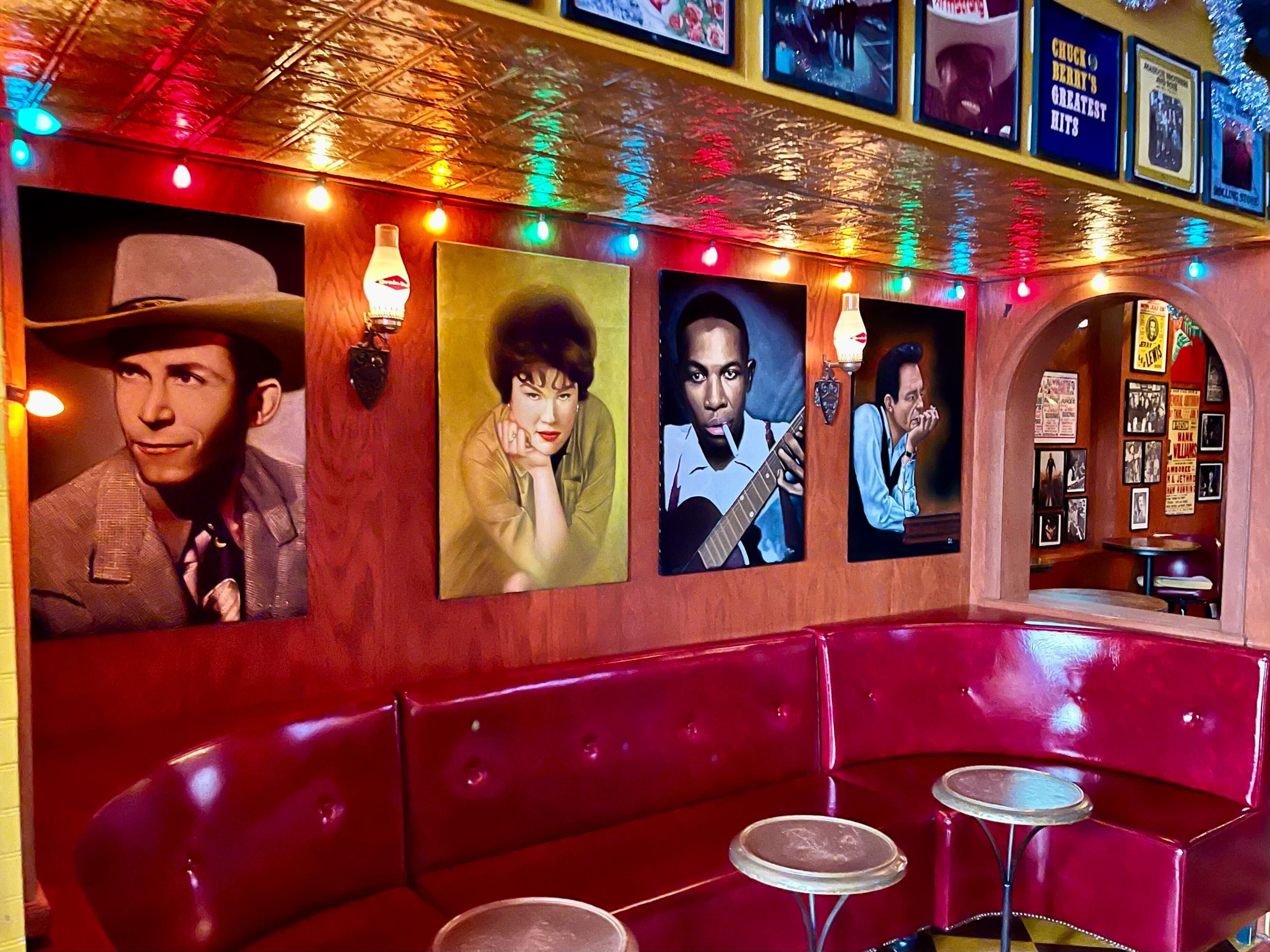
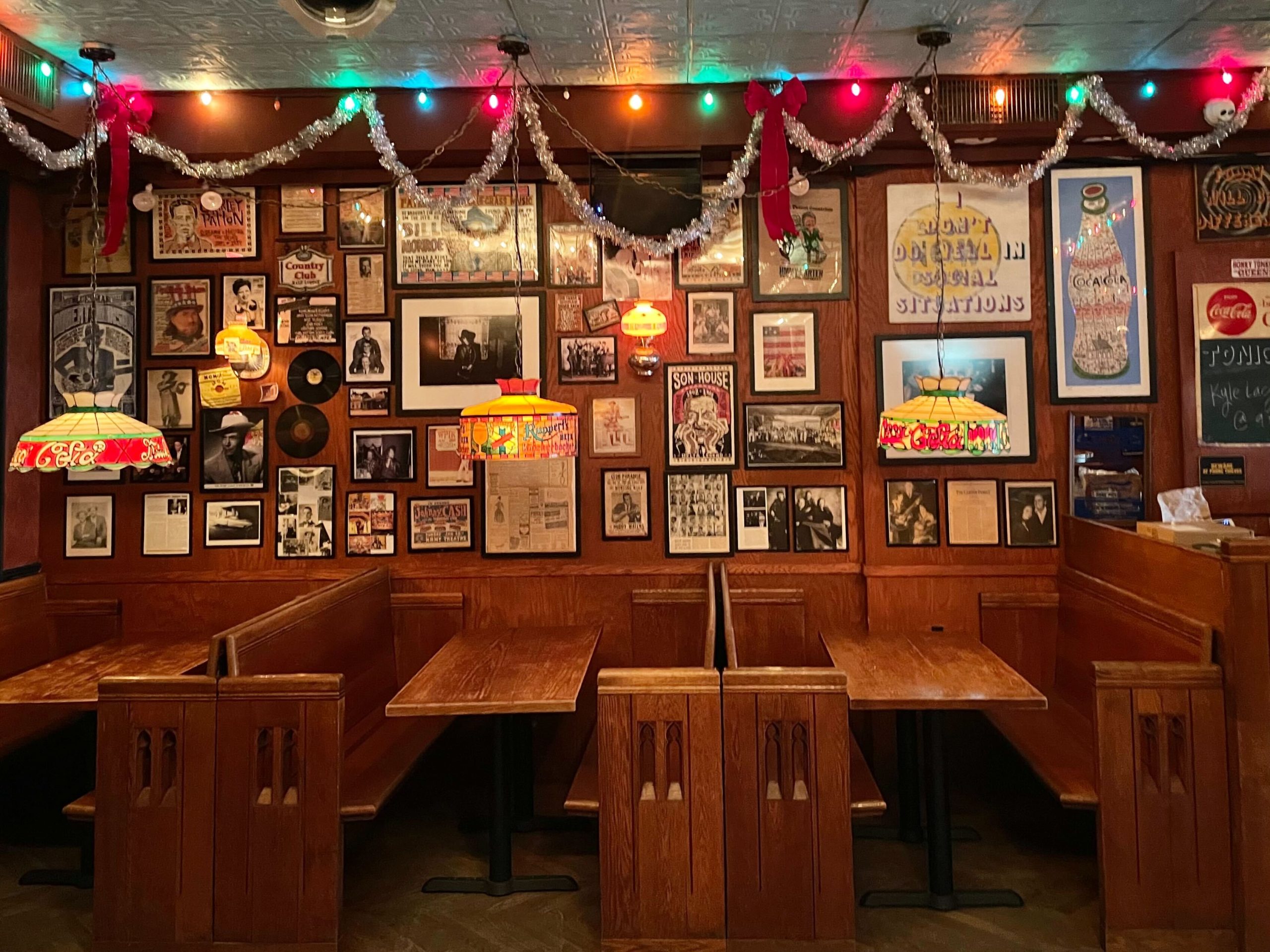
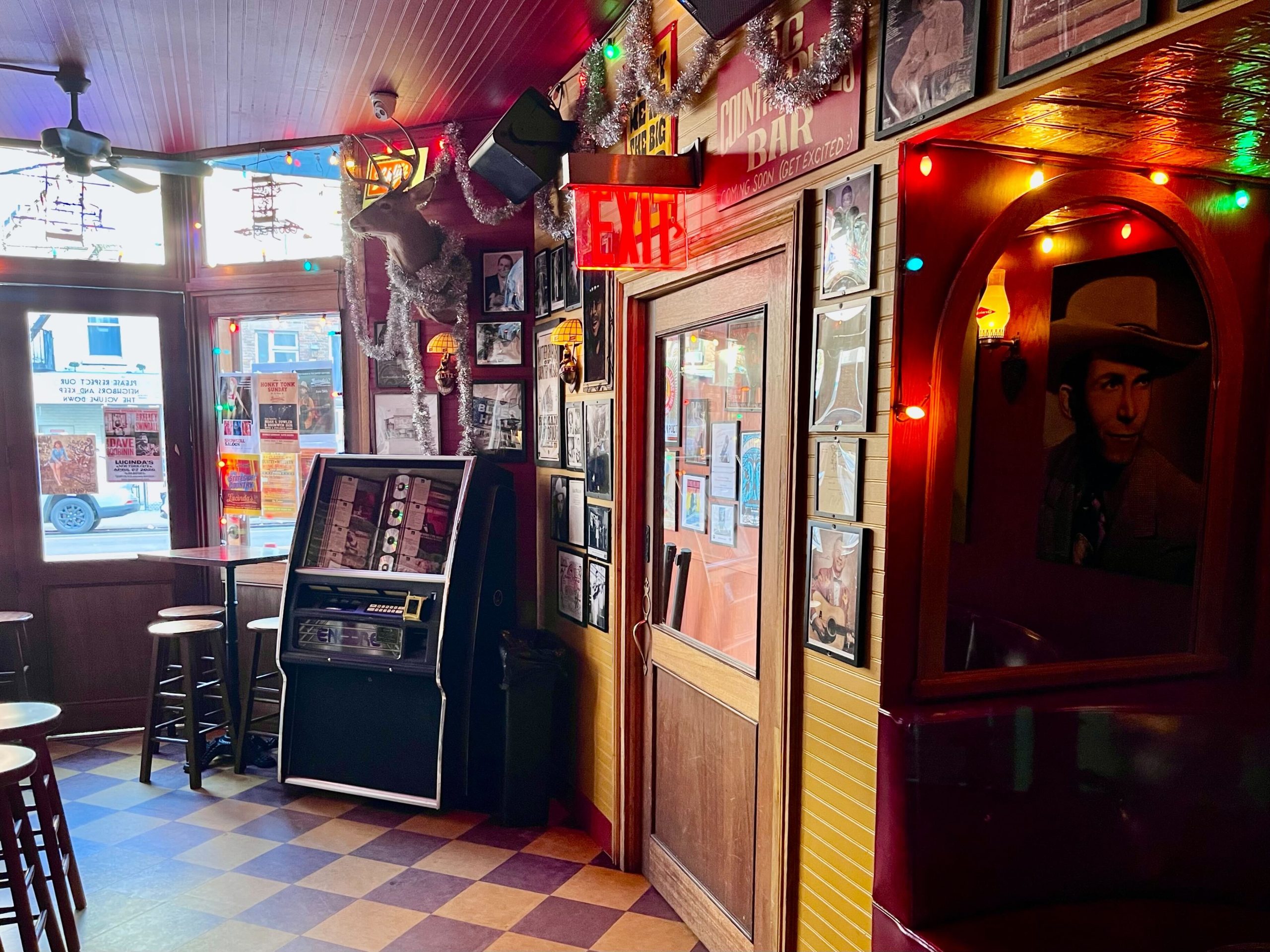
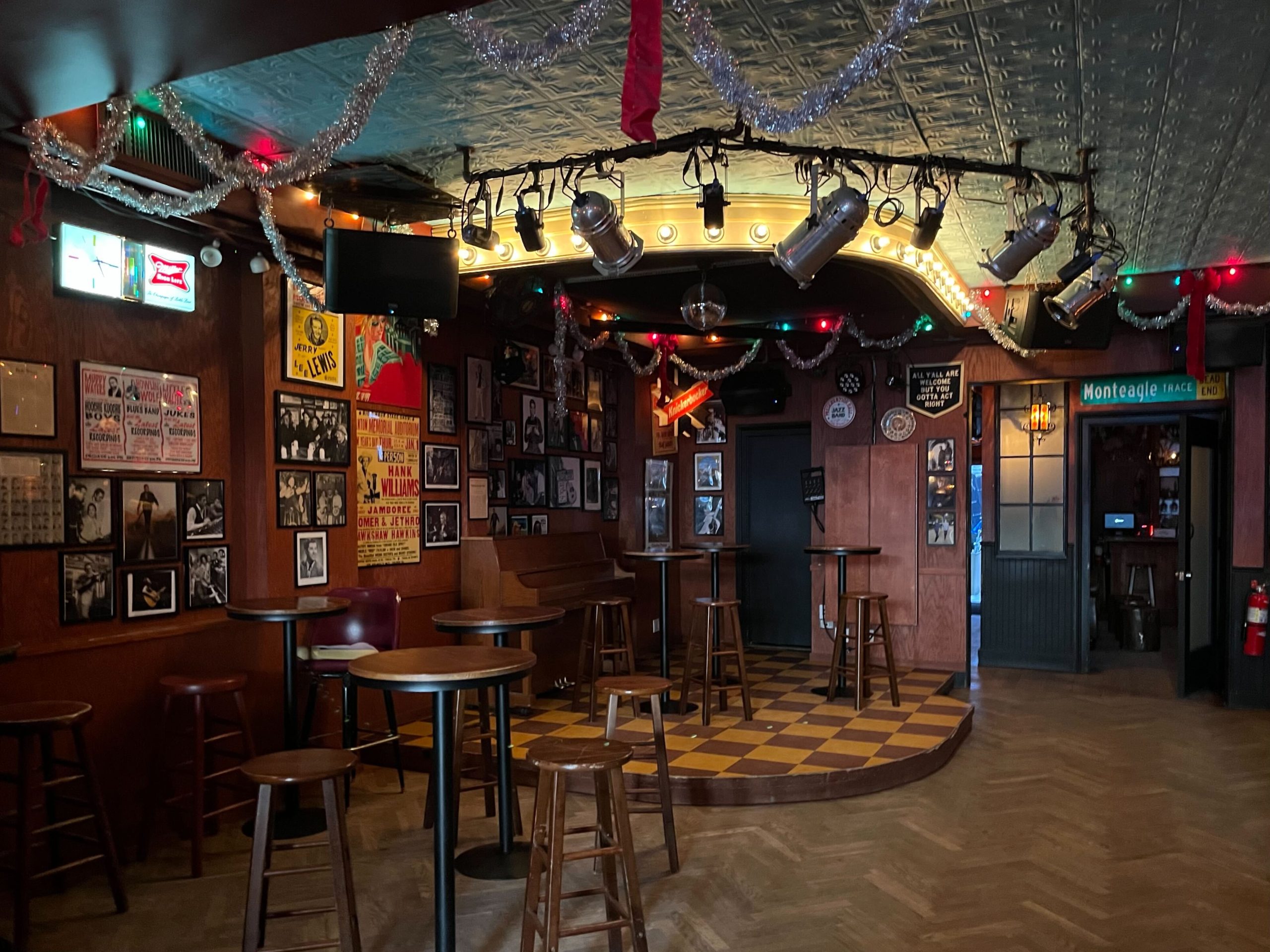
The bar’s tin ceiling interior is catnip to music history aficionados and Americana-kitsch collectors alike, the walls hung with poster prints, vintage memorabilia, and velvet paintings (among them Kitty Wells, Robert Johnson, and Elvis Presley shaking hands with Jesus Christ). There’s a jukebox ready to sling beloved feels-good-to-feel-bad hits, and peanut figurines with Jimmy Carter grinning and holding court over the liquor. These accoutrements all play second fiddle to the spot’s main attraction: live music meant for casual socializing every day of the week.

This robust programming – along with some of the bar’s most prized decorative items – is the work of Kelley Swindall, a musician and New Yorker of 20 years who grew up in Stone Mountain, Georgia. She takes pride in a large round aluminum Coca-Cola sign, an item on “permanent loan” from her family and one of several wall-hung nods to Georgia’s most lucrative liquid export. She’s more proud of filling a void in New York City nightlife. “There’s a lot of Southern people in the city that went to SEC schools that want to have some Southern culture again, like college football, or listening to music that they love and don’t normally hear in New York,” Swindall says.

Though the city has a handful of country-themed, sometimes Western-leaning bars – Williamsburg’s hootin-hollerin Skinny Dennis, the self-explanatory Honky Tonkin’ in Queens, the West Village’s Tex-Mex-y Cowgirl – Swindall wanted to develop a place to celebrate the early country, blues, folk, and other vernacular music that shaped generations of American song. She yearned for the sort of places she knew growing up and got to know as a touring musician, rooms where casual live music fosters socializing instead of hampering it. “That’s what the juke joints and honky-tonks were back in the day – it was live music as the soundtrack of the evening, but you were hanging out, drinking, dancing, and socializing,” Swindall says.

Swindall found a business partner in Laura McCarthy, who has a storied history of her own at 169 Avenue A running prior venues Brownies and Coney Island Baby. The pair found a namesake and patron saint of sorts in Lucinda Williams, with whom they connected through mutual friends. Williams agreed to endorse the place, her multi-stranded artistry anchoring the team’s vision for honoring the deep musical roots of the American South. She christened the stage with a set as part of the bar’s opening-night festivities last July.

On a Saturday night, Lucinda’s is rollicking, packed front to back with revelers before some New Yorkers have even gone to dinner. There’s college basketball on one TV, and The Best Little Whorehouse in Texas on the other. I want to mill around and make conversation, but the bar is thick with boisterous, overlapping shouts converging with mid-1990s Tim McGraw and Shania Twain songs that radiate in my bones.

The mission of Lucinda’s is evidently working. With my elbows pinned to my sides, I chat with Emily from Texas and two girls who rolled up for one of several birthday gatherings in progress. After his friend paws at my unattended leftover garlic knots, Gavin, an Irish ex-pat and country music fan, tells me it’s his first time at Lucinda’s after hearing about it on TikTok. “We were in the neighborhood, and we wanted to come in. We already had plans somewhere else, and we made it our business to come back here,” he says, enthralled with the room’s unique decor. I don’t get a chance to ask his thoughts on the Dolly Parton or Johnny Cash bathrooms before he peels off with drinks in each hand.

Spirits are high, but by Lucinda’s standards, the fun has barely started: a few musicians are shouldering their way through to the corner stage. Nightly music programming is a staple at Lucinda’s, which Swindall accomplishes with standing residencies and open mics alongside other ticketed events. There’s a loose structure week to week; weekends are for the big sing-along bands, Sunday evenings are for classic country, and bluegrass and some old-time are on Tuesdays. “I was an artist first, and I still am, so I wanted to focus on the kind of music that I’m into,” Swindall says, adding that Thursday night is for two-stepping.

The Sunday open mics are a binding force to Lucinda’s operating concepts. Sign-ups start at 1 p.m. every Sunday, running through the afternoon until another outfit takes the stage for the evening. There are some gentle guidelines (no covers, no backing tracks), aimed toward bringing a pleasant and equitable atmosphere to the gatherings. Swindall prioritizes the artists’ experiences at these weekly forays, remembering open mics as essential to her relationship-building and development as a young musician.

“It’s more important to have people able to come in and play their songs, everyone listen, rather than have a thriving bar culture that day,” she says. Drawing further on her artist’s perspective, Swindall fosters the open mic knowing the challenges of getting a foothold in bigger booking circuits. “A lot of places, they don’t want to book you unless you can bring a crowd or you can show them live footage. It’s really great to give people an avenue to get comfortable on stage and get feedback for their songs,” Swindall says.

Moreover, the shindigs help Swindall expand her pool for her month-to-month bookings, strengthening the network of relationships that are essential to the arts-forward community that McCarthy and Swindall hope to nourish.

Almost a full year in, Swindall is eyeing a steady growth pattern. She worked her way up to music every night of the week and now sometimes has two shows a night; she’s starting to entertain ideas for a small festival. “From a bar point of view, there’s so much to do,” she says.

The space isn’t zoned for a kitchen, but Swindall wants to figure out some kind of food element; in the meantime, patrons can bring in takeout or ask a bartender nicely for a Moon Pie, a bag of Zapp’s chips, or a bowl of popcorn. Swindall will stay busy as she aims to make Lucinda’s even more of a place for the “all” in “y’all.”

Stop in, sit down, shake loose. Connect with a song, or maybe a stranger.


All photos by BGS Staff.

Explore our Artist of the Month coverage of Lucinda Williams here.

Dale Watson’s Ameripolitan Today Playlist

Ameripolitan music can be best defined as original music with prominent roots influence, and it has four categories: honky tonk, Western swing, rockabilly, and outlaw. My Mixtape features a song by an artist that represents the roots and then I’ll play a new artist that directly was influenced by them. You can hear the natural growth of country music when you listen to Lefty Frizzell and Merle Haggard or Kitty Wells and Loretta Lynn back to back. (Many of the roots artists had nicknames, I miss that.)

While some may hear an artist’s influence and say they are copying them, I’m of the opinion that John Lennon shared when asked about The Beatles’ influences. He said, and I paraphrase here, “One’s originality comes out in their inability to imitate their influences.” Very well said. – Dale Watson

“Who’s Gonna Take The Garbage Out” – Loretta Lynn, Ernest Tubb

Ernest Tubb had a distinctive voice as you hear on this song he sings with Loretta Lynn. Here’s the Texas Troubadour with the Coal Miner’s Daughter.

“My Wife Thinks You’re Dead” – Junior Brown

And no one is more evidently influenced by him than Junior Brown.

“Undo the Right” – Johnny Bush

Johnny Bush, otherwise known as the “Country Caruso,” was a drummer for Ray Price, the Cherokee Cowboy, before going out on his own. You would definitely hear that influence if you back-to-back Ray Price to Johnny Bush. Both are huge influences to every singer that grew up in Texas.

“Texas Honky Tonk” – Justin Trevino

This young man from Texas is carrying the Bush torch.

“D-I-V-O-R-C-E” – Tammy Wynette

The First Lady of Country Music, Tammy Wynette was married to the Possum, George Jones. She is easily at the top of women that influenced the newer singers.

“Houston Belongs To Me” – Sunny Sweeney

Singing her own divorce song, here’s Sunny Sweeney!

“Big Balls in Cowtown” – Bob Wills & His Texas Playboys

In the Western swing category this is the master, Bob Wills & His Texas Playboys.

“Riding High in Texas” – Asleep at the Wheel, Billy Strings

Though they’ve been around a while, they still burn up the road and proudly wear Bob Wills as their biggest influence. Ian Stewart sings as guest picker Billy Strings shines.

“Here in Frisco” – Merle Haggard

The Hag has influenced generations and even in death he still does. He once told me he forgot he wrote this song and was glad I brought it up so he can add it to his playlist again.

“This Highway” – Zephaniah OHora

Zephaniah OHora is now based in Nashville and he’s got a lot of great original songs. On this song you can hear the Hag in him.

“Bob Wills Is Still the King” – Waylon Jennings

In the outlaw world there is none more influential than Waylon, and in Texas we were all influenced by Bob Wills.

“Long White Line” – Sturgill Simpson

This particular song draws heavily on Waylon’s influence. And I like it.

“Ramblin’ Man” – Hank Williams

Hank Williams’ voice is one of the most recognizable in music. His songs are timeless and still inspire singers and songwriters alike.

“Thunderstorms and Neon Signs” – Wayne Hancock

You can definitely hear Hank in Wayne Hancock, but his own voice is definitely original, too – as well as his great songwriting.

“Guitars, Cadillacs” – Dwight Yoakam

Dwight Yoakam has influenced many a newcomer. Just as he was obviously influenced by Buck Owens. He came along when Nashville needed reminded of its roots.

“Lost in the City Lights” – Johnny Falstaff

Though not well known as of yet, Johnny Falstaff is picking up Dwight’s hat.

“Blue Kentucky Girl” – Loretta Lynn

The Coal Miner’s Daughter definitely left big shoes to fill, but her sassy songs inspired many women artists.

“Don’t You Ever Give Up On Love” – Brennen Leigh

That inspiration can be traced right to Brennen Leigh.

“Good Hearted Woman” – Waylon Jennings, Willie Nelson

Here’s the quintessential outlaw song by the most famously influential artists, the Red Headed Stranger, Willie Nelson, and Waymore, sometimes called Wautawsha, Waylon Jennings.

“Willie Waylon and Whiskey” – Dale Watson

The last song I’ll put in here’s is mine, because with pride I will state, yes, I am heavily influenced by Willie and Waylon. And sometimes whiskey.


Photo Credit: Jacob Blinkenstaff

Clay Street Unit Chat Sin & Squalor and Excitement for the Future

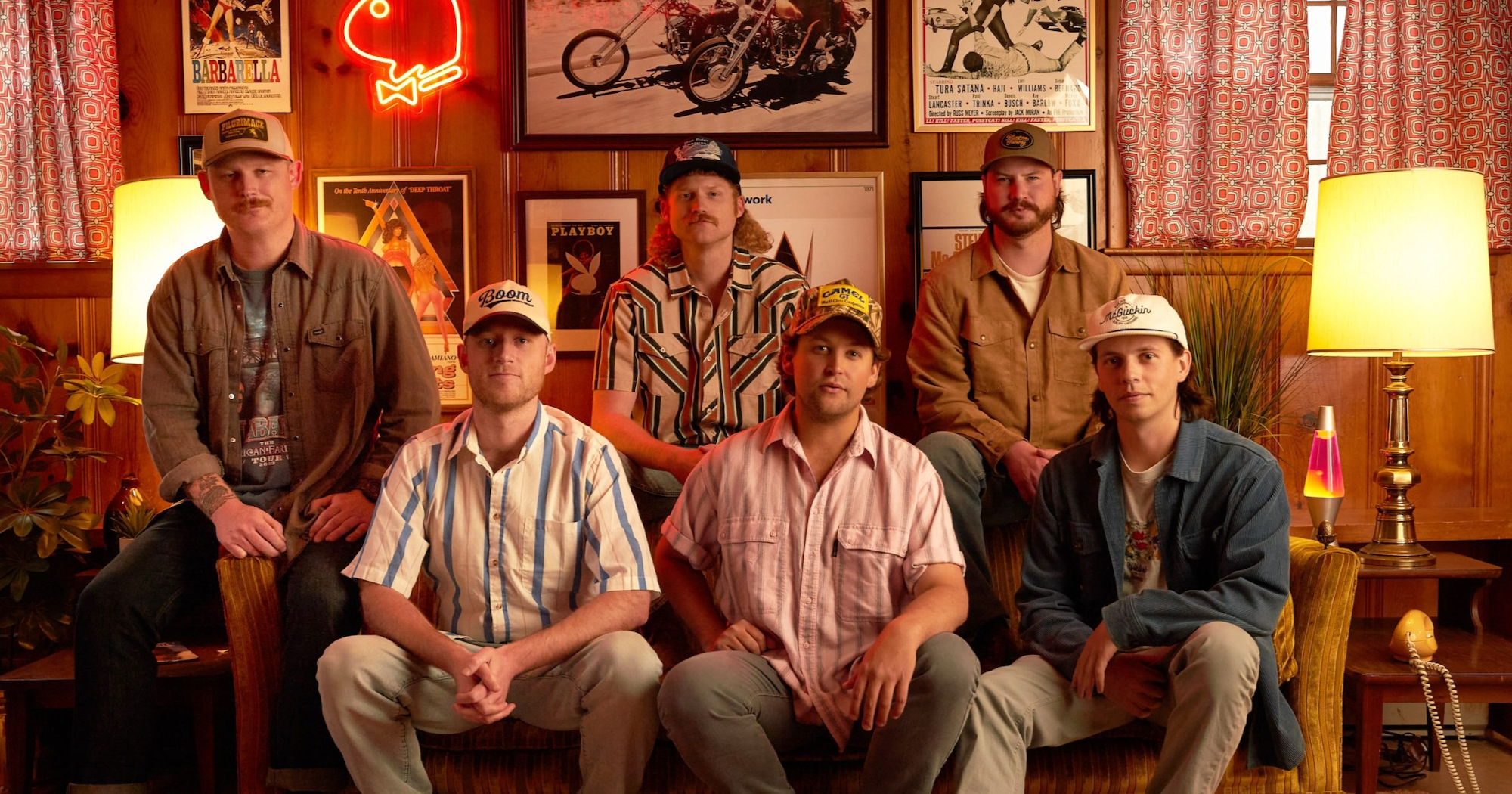
Since their inception in 2021, Clay Street Unit has quickly risen into the national spotlight. The rollicking Americana string band is garnering the frequent tag of “must-see” by their rapidly growing fanbase.

Formed in Denver, Colorado, the sextet is unique in sight and in sound. With a foundation soaked in bluegrass, the ensemble also includes a drummer and a pedal steel player – which often kicks the act into the realms of indie folk and honky-tonk. Ultimately, this lends them to a wildin’ out scene when placed in a packed room of fans and the curious alike, something that has become commonplace as of late.

It’s at this exact juncture – of deeply held dreams and aspirations coming to fruition – that Clay Street Unit will finally release their debut album, Sin & Squalor (out February 13 via Leo33). The 11-song LP is a perfect introduction to this band of melodic pirates as they currently navigate the high seas of the music industry. The record not only captures the essence of the outfit, it’s also impressive in nature, showcasing the vibrant energy of the group’s live show via the studio.

Produced by the Infamous Stringdusters’ Chris Pandolfi, Sin & Squalor is a sonic roadmap to the here and now of where jamgrass stands in the modern era. With members of Clay Street Unit hailing from a variety of places in the U.S. (Alabama, Virginia, Colorado, Pennsylvania, Georgia, Illinois), their multilayered influences lead to traditional acoustic aspects mirrored by modern sounds. Each texture a product of the unique environments from which these musicians proudly emerged.

Catching up with mandolinist Scottie Bolin and guitarist Sam Walker, the duo spoke at length with BGS about the group’s origin, how their sound came to be, and what’s in store for Clay Street Unit. The road seems to be wide open as this troupe has created quite a buzz, coast to coast, coming into 2026.

I was kind of curious about how 2025 wrapped up for y’all.

Sam Walker: I think 2025 was probably the most important year we’ve had yet. It was a huge year for us, as far as crossing off a bunch of big local goals and national goals. We got to play Red Rocks with some of our heroes and buddies, Leftover Salmon and Kitchen Dwellers. We got to play [our] biggest hometown show in Denver at the Ogden Theatre, and had the privilege of selling that place out and playing with our good buddies, Andy Hall and Chris Pandolfi from the Stringdusters. And then, we signed our record deal [with Leo33] and got to plan the rollout for this record and finally get it released.

I would surmise last year will really be setting the pace for 2026, justifying all the blood, sweat, and tears going into this.

Scottie Bolin: Yeah, absolutely. A ton of work went into making the album and getting the songs where you wanted them to be. And finally getting to tour a bunch last year has been really rewarding, getting to play these songs to live crowds and really hitting the road hard.

You guys have had a pretty fast trajectory for five years together. And I was wondering about the background of how the band formed and the timeline of how it all came together.

SW: Our former banjo player, Jack Klein, and I met one night at a brewery in Denver, a couple blocks from Clay Street and the house I was living in at the time. I played some guitar, picked tunes all night at my house, and ended up booking a gig over at that same brewery. It all happened really organically. We weren’t really trying to start a band. It just felt like the right people, right place, right time to try to get something going. We ended up meeting our former drummer and bass player, and then everything kind of picked up steam a little bit quicker than we thought.

We were playing The Patio [at Sloan’s], then [Cervantes’] Other Side, then the [Cervantes Masterpiece] Ballroom. People kept buying tickets, listening, and supporting the music. As things grew, some people weren’t really dedicated to being lifelong musicians in the band. I ended up going on tour and playing with Colorado [jamgrass] band Morsel that our bass player [Jack Kotarba] and Scottie had started. We all became really close buddies over that tour. And things kind of naturally shifted in a different direction for some members. We all kind of crossed paths at the right time.

SB: At the end of the day, we were all just kind of playing music with various groups and side projects in Denver, playing a lot of bluegrass. And things just clicked. Everyone got along really well. The band, at its core, is a group of good friends. And it just snowballed and grew from there.

SW: I moved out here to Colorado eight or nine years ago. And we had this big 4,000-square-foot party house. There were four or five guys living in it at any given time. It was just where everyone would kind of come through and hang, and we would play music all night. It felt like a revolving door of people in there. That house was kind of where everything started.

We got the band going and rehearsed. It felt like the origin of the band. We were listening to a ton of Tony Rice at the time. I kind of came into bluegrass the long way. I didn’t grow up being a huge disciple or anything like that. But, obviously, moving out to Colorado, I got a class in bluegrass culture pretty quick. We were just obsessed with that Tony Rice record, Manzanita.

Was playing in a band something you each wanted to do or is it just the way everything unfolded?

SB: I’m from Charlottesville, Virginia. I started [playing] in college [at the University of Colorado Boulder with] Morsel. We tried to make a go of it. We did a couple tours. [But], the touring lifestyle is hard and takes full dedication from the whole group. Some of the guys [in Morsel] didn’t wanna do that. So, I stepped away from that. Luckily, right around that time, I met Sam and all the Clay Street guys.

SW: I grew up down south in Montgomery, Alabama. I kind of came into it the opposite way. I played in a Widespread Panic/Grateful Dead cover band in college and just sang. Then, I moved out to Colorado and picked up the guitar. I’d always sang and written a few songs and loved live music. But, I really kind of fell into it. It wasn’t something necessarily in my early twenties I expected to be doing for a living.

All the dominoes fell in the right places and I was around the right people that gave me a lot of confidence to push the boundaries of what I was comfortable with. Playing in some side bluegrass bands around town really helped me feel more comfortable about being a part of the Denver music scene. Everything happened step by step. I wasn’t really trying to make it a career, but a few years later, it felt like something that made sense – to take the leap and try to push it as far as we can.

Your band is a huge melting pot of sound. Is that by design or just how it all just came together?

SW: I feel like it’s a little bit of both. We definitely didn’t set out or want to be a traditional bluegrass band. Obviously, when we added the drums and pedal steel and electric bass that decision was kind of made for us. It’s kind of a melting pot of everything we listen to and the music we like.

When Scottie and I go to write a song, we don’t think, “This is a bluegrass tune,” “This is a folk tune,” “This has an indie feel.” We let the music and everybody’s kind of flavor and influence on how the song’s going to sound. We don’t really try to have those guardrails of how it needs to sound or what vibe it needs to be.

When I was listening to the album, I kept thinking how I really want to see you guys live. And I think that’s a real testament to the band, to have that kind of sound radiating out of an album that encourages you to go to the live show, which I think is probably the endgame for you.

SW: Absolutely. At the core of our band, we’re a live band. It’s where we really shine through, and you can just feel the energy up there. We always try to say, “There are only so many Thursday, Friday, Saturday nights,” and we want to elevate that and bring the energy and the emotion and let [the audience] loose – life’s too short to not go out and enjoy live music. We want to make sure at every show we’re bringing that to the table, our full attention to the energy and making sure that everyone’s having as good a time as they can.

Is there any kind of ethos behind the title of the album?

SW: It’s our origin story. [When we started], we didn’t know how to do it or if we were doing it right, and we weren’t doing it with much, just trying to put it together piece by piece. It sounds a little heavy, but it’s more about the beauty of humanity, the nature of [life] we have all been through, and it’s a commonality of everybody. It’s the nature of our music and string instrument music – music that has a little more “down in the holler” feel. It all felt aligned with what we were trying to get out for the first record.

Why was Chris Pandolfi the guy you wanted to produce this?

SB: I had the opportunity to work with Chris before with Morsel, which was a little bit more of an electric rock jam with some bluegrass elements in there. He produced a few albums for [Morsel]. So, I knew what it was like to work with him. I knew that he was just a musical genius and the right guy for setting the vibe and making sure we were comfortable in the studio.

[Chris was] coming in with great arrangement ideas for our band, specifically, and being a great mentor all-around. [Clay Street Unit] actually had the pleasure of being his wedding band this last summer, which was awesome. I feel like the Infamous Stringdusters, Greensky Bluegrass, a lot of those Colorado bands, Leftover Salmon, have really kind of set the tone of what is “allowed” in that genre and for pushing the boundaries of what people want to hear. With the Stringdusters, I’ve seen them live for 10-15 years and they’ve really made a mark on the bluegrass scene, the Colorado music scene, and definitely a big impact on us.

You’re currently hitting the five-year mark together. What does that milestone mean to you right now?

SW: The last five years have been so much of a learning curve and going through so many different stages of figuring out who we are and how we want to operate. I feel like now we’re really starting to get a grasp of what we want to do and who we want to be as musicians, as a band, and as people. The last five years were such a blessing and such a great learning experience, but I think we’re just so excited for the next five years of just pushing this thing to the limit and, and trying to, to make the best music we can and, and really just enjoy every step of it together.

SB: It just takes a long time to get a group of people on a mission aligned and I think we’re finally there. Everyone’s on the same wavelength of what we want to get done and what we want to accomplish. We’ve got a really busy year ahead of us, and it’s kind of the culmination of the last five years of hard work that’s been coming to fruition – we’re pretty excited.


Photo Credit: Lead image by Robert Chavers. Alternate image by Tobin Voggesser.

Honky-Tonkin’ Country with a Bluegrass Approach

For anyone cheering on the mainstream country return of classic roots musicianship, Spencer Hatcher is a name to remember. Joining the likes of Zach Top and even Billy Strings, he’s a new country artist with some decidedly old-school tendencies and a deep foundation in bluegrass.

Having dropped his debut EP, Honky Tonk Hideaway, in November 2025, the Virginia native planted his flag for two-stepping rhythms and hot-blooded twang. Hatcher got his start in a family bluegrass band; over six tracks, his rich Shenandoah Valley vocal stands center stage, flanked by boundless barn-dance energy and timeless emotional heft. But with a thriving TikTok fanbase and a steamy, slow-dancing debut at country radio (“When She Calls Me Cowboy”), his style goes beyond nostalgia. It marks a shift in possibility, with room for roots artists in the commercial country space.

Speaking with Good Country a few weeks into his first promotional radio tour, Hatcher filled us in on his bluegrass beginnings and why they will always be his baseline. Plus, he opens up about the mainstream return of roots country, TikTok-ing back when it was “a dancing app,” and where he sees his music evolving.

Lately it seems like the foundational stuff from bluegrass and classic country is making a mainstream comeback, and you’re part of that. Do you have any sense of what is driving it?

Spencer Hatcher: I think that it’s like anything, I do believe in a full-circle moment – everything comes back into style. In this case, I’m overjoyed that the traditional sound is coming back. I’ve always called that “real country music,” and that’s just the stuff that all my heroes played. Growing up, I didn’t even know what modern country music was. I thought George Jones was modern. I thought that Johnny Cash and Waylon Jennings were modern, and then I found out that stuff was 30 years old 20 years ago.

You grew up on a farm in Virginia, right? Shenandoah Valley?

Yes, sir.

How did you get your country education?

A lot of it was just literally how I was raised. It’s what I lived by. I don’t know if everybody lives by what they sing, but I certainly do. I remember at a very early age, probably 6 or 7 years old, I learned how to drive a tractor and I’d be out in the fields every day working with my dad and running cows, and we had some goats. That’s just been my lifestyle. It’s what I love, still today. Growing up on a farm in the Shenandoah Valley right there at the Blue Ridge Mountains, and coming from a small town, that’s what home is to me. I had a lot of bluegrass around me, of course, in the Blue Ridge Mountains, and a lot of old-style country music. So that’s what we listened to, and sang, and jammed to on Friday nights.

You had a family bluegrass band. What drew you all into that music? I mean, this would’ve been in the 2000s. It wasn’t really in fashion.

It’s a fair statement to say that, in the 2000s, bluegrass was probably at an all-time low as far as popularity goes. But in my hometown, you wouldn’t really know that. There were jams, and what attracted me to it was definitely my dad. I can remember my dad sitting there watching me and my brothers play, and he’d be either playing the guitar or playing the banjo and singing. Growing up, I wanted to be like my dad, and so I picked up the banjo at 12 years old and started playing that, and I was just absorbed in it. That was the moment that music really took me over.

I just wanted to play the banjo, and so that’s what I did for three years straight. Friday night wasn’t spent with my friends at football games. It was at the local jam session where the average age was probably 75 years old. … Then my younger brother Connor decided to pick up the bass fiddle and that was history. From there, we started a band and we started playing everywhere we could.

@spencerhatcher Burnt It! #foryou #foryoupage #country #bluegrass #music #brother @connor_hatcher00 ♬ original sound – Spencer

Early on, you and Connor made bluegrass and country life seem fun on TikTok and you ended up with a pretty big following. What made you want to start posting?

I’d seen some friends do it in college and I admired their confidence. I was never into social media. I had it, but I didn’t post. It wasn’t an interest I had. But after I graduated college in 2019, I decided to move back home in March as COVID had hit, and I said, “I’m going to go back home and see about just playing country music.” I didn’t really know what I was going to do. I had a business degree. I was maybe going to be a financial advisor or something, but music was what I wanted to do. It’s what I did all through college, too. I was in four bands in college, and I just had this infatuation with becoming a country performer. I wanted to add that into my bluegrass shows.

So, I did the only thing I thought I could, and I decided to turn on a camera and sing a song. It took about six weeks for me to work up the courage to finally post that video. … And the fifth one is the one that went viral. It only took five videos and it was insane.

Wow, that’s pretty fast. And I think it’s cool that something so modern as TikTok can have so much fiddle playing and traditional lifestyle on there.

Back then in 2020, TikTok was still a dancing app, and I hadn’t seen any [country lifestyle] stuff on there yet. I was like, “Well, I’m going to show people how we live around here and just be myself.” I would oftentimes just turn the camera on and just let it roll.

Let’s talk about where you’re at now. You’ve got this country career going and it’s a little different from the bluegrass stuff, right? I mean, do you see a difference?

Yes, sir. There definitely is. But I guess you could say [I take] a very bluegrass, old-fashioned approach. I play as many shows as I can, just like the guys in bluegrass do and always have. … Of course, yes, the music is different, but I do believe that you can hear some bluegrass influence in my country music. It’s real country music. What we do in the studio, we can directly replicate on stage, and that’s how it is in bluegrass music. That’s how I wanted my country music to be.

I’ve got a fiddle, I’ve got a pedal steel, I’ve got guitars. Every single show I still play bluegrass. And maybe the difference between country music and bluegrass is that country is a little bit more polished, a little bit more produced. But I don’t like a tremendous amount of production. I don’t have anything faking my songs like bass loops or autotune or anything like that. If you come to a show, you get what you hear online.

Honky Tonk Hideaway is your debut EP. What did you want it to be like?

There was definitely a lot of thought and planning that went into the EP. And the song itself, “Honky Tonk Hideaway,” was a very exciting song. I’ve been calling it a barn burner. It’s one that makes you want to get up and dance, and that’s one thing that I hold pretty highly at my shows. I want people to just have fun and dance and have a good time. They did back in the day – you watch Urban Cowboy and everybody’s dancing, everybody’s cutting up and having fun. I don’t know if that’s been lost over the years, but I know that at my shows, a lot of people feel like they can get up and be themselves.

Did you have much of a hand in the songwriting, or are these outside cuts that you fell in love with?

All of these songs right now have been outside cuts, because basically I came to [Nashville in] July of 2024 and it was immediately like, “We need to get to the studio, let’s start getting some music.” There have been songs floating around Nashville for 30 years and they’re just stacked up – things people wrote years and years ago. There’s a song that I’ve not released yet, but it was written in 2009, so for 16 years it’s just been laying in a folder and nobody’s cut it until I came to town. And I’m like, “Man, I love this. This is country music.”

That’s a lot of what these first couple songs that people are getting to hear are. But since I’ve been in town, I’ve been doing a lot of writing and we’re very excited about the songs that I’ve gotten to write. I think we’re going to see a lot more Spencer Hatcher songs coming in the future.

There’s a lot of gold out there that’s still yet to be mined, I suppose.

Yeah, I mean, it was amazing. My producers would reach out to some of the really big companies and say, “Hey, we’ve got a new artist in town that’s looking for songs like George Strait would cut, or Joe Diffie or Keith Whitley or Merle Haggard, so send us what you got.” And we would get these folders of 50 songs and you just go through it and listen and listen.

Tell me about the single, “When She Calls Me Cowboy.” It’s got some of that Keith Whitley thing going on, in my opinion. Why did you want that to be the first single at country radio?

To me, that’s a very special song. … If anything, I compare it to maybe a Conway Twitty song, because it’s pretty intimate, but it certainly isn’t a Conway Twitty song. … It’s very country, very traditional. I love the melody, I love the words, and it’s relatable. I would say a lot of people can relate to a song like that.

I was thinking the same about “Cold Beer and Common Sense.” I feel like everybody has been saying they wish for more of that these days. What’s the sentiment behind the song?

Man, that message is just so powerful and it’s one I wish the entire world could listen to and live by – and not necessarily the cold beer part. As far as common sense and everybody getting along, regardless of what side of the fence you stand on, regardless of your political party, that’s one thing a lot of people want – to make it about politics. It’s like, “This is not a political song.” You’ve got to listen to the words. It’s about no matter what your beliefs are, everybody should be able to sit at a table and laugh and have fun and get along. I’ve always believed that there needs to be so much more of that in the world. And that’s honestly why I’m in music, is because music spreads joy. It spreads smiles.


Want more Good Country? Sign up to receive our monthly email newsletter – and much more music! – direct to your inbox.

Photo Credit: Riker Brothers

Classic Country
Is Here to Stay

With a new generation boasting unapologetic traditional influence, there’s more classic-sounding country in the mainstream today than in many years before. With his second album, When I Write the Song, Jake Worthington captures one specific aspect of honky-tonk history better than the rest – its sense of humor.

That’s definitely not to say Worthington’s new album is a joke. Far from it. Over 14 songs, the Texas native sinks down into the depths of sorrow and lets his heart believe in miracles all the same. His love of the classic country form is just as authentic as his barrel-chested vocal twang, and with producers Jon Randall and Chuck Ainley joining his team, it gets highlighted with more sincerity than ever. But right from the opening track, Worthington walks in the footsteps of artists like Johnny Paycheck or Jerry Reed; his down-home demeanor is as country as it gets.

Meanwhile, the solo-written title track is almost alarmingly personal and Worthington welcomes Miranda Lambert, Marty Stuart, and Mae Estes as special guests on other tracks. When I Write the Song arrived on September 12 and by touring through the end of the year with both Jon Pardi and Zach Top, Worthington adds even more evidence of an ongoing trad renaissance.

Good Country spoke with Worthington about writing the way he lives and chasing honky-tonk inspiration farther than ever. Plus, he reveals a secret appreciation fans might not suspect.

For fans who don’t necessarily know, you have always been a proud purveyor of the classic country arts. I think that’s pretty fair to say. Are fans going to get more of that on this record or what?

Jake Worthington: Damn right. Yes, sir. I guess that whole narrative don’t ever really change for me. I don’t ever want to make any other kind of music. When somebody listens to a record that I am a part of or put together, I hope they can have a definitive direction to point to and say “That’s what country music sounds like.”

I think that comes across for sure. Now, it’s good timing because there’s kind of a little traditional renaissance going on in the mainstream. Do you agree with that?

Damn right. Absolutely. I’ve never been more inspired in terms of our genre than I am right now. I think a lot of people are writing and singing and recording great country music and I think that folks of all ages are wanting to hear it. Another thing, too, is I don’t think it’s a fad of any sort. I find it interesting – you hear terms like “traditional” or the whole “’90s” deal or whatever. To me, it’s just country music getting made in 2025. I think that’s really exciting, to know that’s the case. It wasn’t like that just a couple years ago.

So you don’t think it’s people cosplaying country?

I know it’s genuine for me. I can’t control what other people do, but hey, if they want to play dress up, that don’t bother me none. I think it’s good for country music. I’m glad that they’re wanting to dress like a grownup.

One thing that I’ve always loved about classic country itself, and something that you do well on this record, is to have a touch of humor. That’s not around as much anymore, but you do that well.

Well, I think it’s funny. I have always struggled with the idea that I never wanted to not be taken serious as a singer or songwriter, but I still like to have fun. I still cut up and it ain’t all rain and storms all the time. I think country music allows room for all of that. There’s definitely a couple songs on this record that is lighthearted, and I guess I was all right with that.

There’s definitely some hardcore heartbreak in here, but the reason I ask is because of the opening track, “It Ain’t the Whiskey.” There are not many songs about getting pulled over and accused of a DUI these days – even fewer that are fun.

Well, some of us write from the research department, I guess. Unfortunately, I was just trying to make light of what was a really shitty situation for me at one point in time in my life. I’ve made some dumb decisions in my adolescence, I guess. That was a good way to look back and laugh at it.

How about “Two First Names”? This one reminds me of a little bit of Joe Diffie and the way he was able to merge classic country and a funny line.

Well, shoot man, thanks. That’s just about a country girl. I’ve got a handful of women I know and love in my life that got two first names and I love that we got away with writing it without ever saying an actual name. … There wasn’t one of us that wrote that song who ain’t from the country, and we’ve all got women we love and know that got two first names. We all love a country girl.

Hell yeah. Now, one thing about this record, you definitely got to work with some big names. You got Jon Randall and Chuck Ainley helping out on production, along with Joey Moi. I wonder with those two guys specifically, Jon and Chuck, did they help you move your sound or your style forward?

Definitely I think. There’s four tracks that I recorded top to bottom with Chuck and Jon … there’s a lot of really awesome things that I got to do through working with Joey. But I think for me, I wasn’t ever totally happy with the way things were ending up sonically. That was my biggest change that I was after, was just kind of where it landed sonically.

Really?

Especially with the vocal. I’m a very imperfect singer. I’m not a perfect singer. I want that to be heard. I don’t want to be masked.

Joey’s amazing, but he definitely comes from a different world sonically, right?

Yeah, and I wanted to work with guys that were making country records that inspired me. But again, I tracked nine of them songs with Joey and man, I love all of it. Chuck wound up mixing the record and Jon come in when we went to track the last four songs and it’s been a dream come true. I get to work with my heroes, man.

You also got to work with Miranda Lambert [plus Marty Stuart and Mae Estes]. Tell me about doing “Hello Shitty Day” with Miranda, it’s a cool broken-hearted waltz. Did you guys get to know each other?

Sure. I mean, I know it sounds a little simple, but she had texted me the song and I asked if I could cut it. She said yes and I said, “Would you sing on it?” And she said, “Hell yes,” so by God, that’s what we did. I don’t know, man. I wasn’t trying to get on the radio with that song. I just thought it was brilliant. I love that song.

One thing I’ve got to ask you, since this is BGS. Do you have any ties to bluegrass, or was that ever a part of what you listened to?

Where I’m from, oddly enough down there in Southeast Texas, we had to go find that stuff. There’s nooks and crannies in East Texas where these cats kinda start out in bluegrass and I think they find it through gospel music and stuff like that. But I wasn’t in the church or nothing – I was baptized in beer and I’m here to testify, you hear me?

Ha!

The great words of Kevin Fowler. But a lot of the stuff I loved the most was coming out of Ohio. When I discovered Dave Evans, that shit knocked me out.

Really?

Oh gosh. There’s something called “99 Years [Is Almost for Life].” One day I’d like to record it, but I understand that bluegrass is just as sacred as country music, so if you’re going to do it, you got to do it right and I think it starts with putting your heart and soul in it.

But I always loved Ralph Stanley. I’ve always loved Flatt & Scruggs and Bill Monroe. I mean, that might sound a little standard, but I love that stuff. Harley Allen’s one of my favorite songwriters and his daddy, Red Allen, I love the records he done. Ronnie Bowman and Lonesome River Band. I like that stuff.

Short answer – yes, sir. Hell yes. I love bluegrass.

That’s amazing. It sounds like you’re deep into it. I mean, maybe it doesn’t show up too much in what you’re doing right now, but maybe one day you ought to do a bluegrass record.

Oh, man. We’ll see, but right now all I want to do is what sounds like country music to me. I think it’s a matter of if you got electrics on it or not. It’s just soul music. It’s gotta come from the heart.

That’s a good segue because I wanted to ask you about the title track, “When I Write the Song,” and writing that solo. You were able to share your pain quite a bit. Where did that come from?

I don’t always wind up writing by myself. I think a lot of us writers sit down and try, and if we could, we would write a lot by ourselves. But that one just kind of fell out. I’d been six, seven years in [to my career] and I don’t know, I think I was a little hurt and kind of angry. I got a whole lot of, “You can’t sing that kind of music. That ain’t never going to work.” Sad songs and waltzes and whatnot. I don’t know why it’s so easy to write about the hard things or the bad things. It seems to be easier than it is to write about the good things sometimes. That’s just kind of where I was at with it.

When I wrote it, I was headed home from some gig and at the time I had been staying at my parents’. They had just got one of them push button door locks to the house with a code on it and I did not remember the damn code. There wasn’t no way I was getting in the house, so I had a guitar and a six pack of beer, a back porch, and plenty of time.

You’re kidding.

That’s what come out of that. I sat on that song for a long time. I was kind of scared of it. I wasn’t sure if it was for anybody. I wasn’t sure if it was any good. But I’m a songwriter and I think that’s just my way of showing it.

That’s real country music to me, so thank you for sharing the story. It’s funny that you got locked out – almost feels meant to be.

I’ve been locked out of a lot of things, hoss.

You’re going to be out on the road with Zach Top and Jon Pardi, right? In their own way, they both definitely inject some classic country into the mainstream, too. Are those tours a good fit for you?

Damn right, man. You tell me anywhere else, you’re going to see three steel guitars and three fiddle players in one stage. … I’m a fan of both of them guys and they know it, and I revere and respect the hell out of them. I’m grateful to get to go work with ‘em. That’s going to be a lot of band, buddy.

All right, Jake, thanks for the time, man. Let me leave you with the big picture. Just tell me what you hope people get from this record.

Well, take away a little piece of my heart while I’m giving it to you. Country music’s here to stay and I don’t think it ever left. I’m just grateful to be a little spoke in the wheels and I hope that when they hear this record, it’s something that they can go to and say, “This is what country music sounds like.”


Photo Credit: Jim Wright

Sunny Sweeney’s Musical Full-Circle Moment

Self-producing an album wasn’t something that Sunny Sweeney spent much time pondering – until it happened.

Rhinestone Requiem is the pinnacle of her taking charge, hoeing her own bean row, and flexing her self-determining vigor. It’s just the latest from an artist committed to exploring her imaginative energies on her terms.

“I’m happy with what we ended up with on this project,” said Sweeney. “We could just pay ourselves. Plus we only had to have two opinions [hers and co-producer Harley Husbands’] versus more opinions.”

“Our mentality going in was, ‘We know how to do this and we are going to try it and see what happens.’”

Rhinestone Requiem, released August 1, is pure Sweeney, sharing tales of figures who win hearts readily and whose outlaw lifestyles embody freedom from responsibility. There are songs devoted to romantic quests, the forever keeping on and the forever searching, like such richly rendered titles as “Traveling On” and “Diamonds and Divorce Decrees.”

Most of the album’s tracks are the result of Sweeney’s collaborations with several musicians she has been working with for a number of years. There are also two covers, “Find It Where I Can,” popularized by Jerry Lee Lewis, and “Last Hard Bible” by Sweeney’s friend and mentor Kasey Chambers.

Though she once saw the sharing of songwriting duties from a tentative and even negative point of view, Sweeney wholly embraced the notion of teamwork on Rhinestone Requiem.

“Songs were written with the rest of the people that I have known for a long, long time … I know what I’m going to get when I write with those people. They know their strengths and I know my strengths, and that’s why we continue to write together.

“I used to never collaborate,” she continued. “But now I’m co-writing and thinking this is awesome. I was petrified at first. Songwriting with others forces you to put down all of your worries. A lot of people worry about co-writing. But I see it as a double bonus thing. You hang out with friends and you get to work.”

Rhinestone Requiem is a throwback to Sweeney’s upbringing and all of the earliest things that have had a colossal effect on her: Her father’s records, which she had open access to; listening to Jerry Reed; watching The Dukes of Hazzard; processing the initial songs that jiggled her plaster loose.

Sweeney vividly recalls at age 8 hearing Jessi Colter’s “I’m Not Lisa,” a great example of one of her songwriting paradigms of setting mood and meaning.

“I sat and watched the record play,” said Sweeney, “I remember thinking she sounded really sad, but now I know what she’s talking about. I also remember hearing Jerry Reed’s ‘Amos Moses.’ I thought, man, what type of noise is this? I knew I needed to hear more of it in my life. Waylon Jennings’ ‘Good Ol’ Boys’ theme and I loved The Dukes of Hazzard. I told my mom that I wanted a son and was going to name him Bo and Luke Duke. I loved them both, those Duke boys, and I loved that Telecaster sound.”

The whole fictional gang of rural Hazzard County folks, Bo and Luke and Daisy Duke, mechanic Cooter Davenport, accident-prone though incorruptible deputy sheriff Enos Strate, and others, resembled the classmates, pals, and neighbors who Sweeney was raised with in the Texas countryside.

“Those were the kinds of people that existed in my life,” said Sweeney. “Country boys were dressed like that and they’d drive too fast down the street. I saw Daisy Duke and I wanted heels like that. Daisy Duke. Dolly Parton. Grease. Heels and lipstick. I had seen my future!”

Sweeney was born in Houston, but after her father decided that he no longer wanted to work in the family insurance business, he quit the agency and packed everyone and everything up and drove more than 200 miles north to Longview, where he’d grown up.

“I’m grateful for that small town,” said Sweeney. “I don’t know if I would have ended up in the music business if I wasn’t raised there. There were opportunities for small-town people and small-town interactions, which have shaped the way I feel musically.”

Indeed, the move to Longview would play a decisive role in Sweeney’s relationship with music. There was a low-watt country music station in the town of about 60,000 people featuring a succession of howling DJs who routinely tried to break the songs of lesser-known artists, allowed for call-ins, and welcomed conversations. Sweeney started listening in the third grade and calling in to request Conway Twitty.

After her parents’ divorce, Longview was also where her mother met Paul, the person who would become her stepfather – and, in hindsight, her biggest career influence. Paul and one of his brothers liked to twang the guitar. Nurturing and never hardhearted, Paul slowly and caringly taught Sweeney how to play the instrument. The first guitar that he gave to her was a black composite Martin, “a cheap, old, sentimental thing,” she said. She learned that her grandfather was a member of a big band orchestra. He played the trumpet, drank scotch, and chain-smoked cigarettes. She thought that he was the apex of cool. But the notion of becoming a musician as an occupation seemed, in her words, “far-fetched.” She asked Paul what he thought – and he merely grinned.

Years later, Sweeney, thinking about her stepdad’s tenderness, her grandfather’s stark sense of flair, and some of the songs and musical moments that touched her as a child, she re-examined her intentions.

“I had a college degree and I didn’t want to use it. I wanted to work for myself and wear jeans everyday and be my own boss. That was 20 years ago.”

Sweeney, now 48, lived in Austin for approximately 25 years, going through some precariously bony times, financially. She juggled other jobs while making barely enough to cover bills. At one point, strapped for cash, she pawned the original Martin that her stepdad had given to her. The Chaparral Lounge in South Austin was the very first place that Sweeney performed and several months elapsed before she would muster the courage to return to the stage a second time. That second performance took place in August 2004 at the Carousel Lounge on East 51st Street.

“There was a halfway house across the street and I was not that good,” she said. “My mom said that there were two or three minutes in between each song and lots of discussing how we were going to play it.”

Swiftly, however, Sweeney improved. “I threw myself into it 150 percent.”

She began hustling seven nights a week, performing wherever there was the potential of a free meal or the likelihood of even a single pair of listening ears. At grocery stores, perched on hay bales, in the rutted corners of falling apart parking lots. If the spot had electricity, she would play there. And if it didn’t, she would still sing, at any rate.

“Many nights I played outdoors without lights,” said Sweeney. “We had lights on a stick, two canister lights, before LED lights. At Poodle Dog Lounge, which was a staple in Austin – now Aristocrat Lounge – there was no stage. No credit card machine. No dance floor. There were some chairs, and you were three feet in front of that, standing there. I missed one or two Sundays in three years.”

At Poodle Dog Lounge, Sweeney played her set between 8 and 11 p.m., plenty of shuffles and polkas to satisfy the dancers. Her act was mostly covers, with the occasional original thrown in, hoping that the audience was too sauced or too ebullient to even notice.

Her rewards and incentives, she said, were comparatively picayune. “Eating for free was pretty cool. Not having to get up early. Maybe play at a couple of other nearby towns.”

Things were moving along satisfactorily, if not spectacularly, when she received a message on MySpace from a record producer who told her that he liked what he had heard out of her in a club in Austin one night. He was based in Nashville, and once he learned that Sweeney would be performing there, he showed up. Without delay he offered her a recording contract.

Since then, she has won over a sizable group of listeners with a repertoire of songs that are frank, discerning, and occasionally grief-stricken, teasing, provocative, and ultimately convincing.

@sunnysweeney New song from the new record! You ever tried to get away from a relationship that keeps sucking you back in? #sunnysweeney #countrymusic #foryourpage ♬ original sound – Sunny Sweeney

Co-producer Harley Husbands has worked with Sweeney for about 10 years, his guitar licks always craftily and reliably adding richness to their musical portraits. The pair are so joined at the hip that his contributions to Rhinestone Requiem are virtually indistinguishable from Sweeney’s, their palettes bleeding into a single piece of artistry.

“We live together and work and travel and play together,” said Sweeney. “That forces you to work well together in the studio. We’ve got no time to not work well together. Having a bad day? Too bad.”

Sweeney said that the vocals on the record are about as close to the authentic article as she could deliver, done without any polishing or cleansing or much enhancing. She credits Harley with being the ultimate arbiter, the most prized of assayers. He knows her voice better than anyone. If she didn’t sound right at a particular moment, he made sure to tell her so.

“I’d be in the vocal booth running through songs and he would be in the control room, knowing what I do like hearing out of myself… He knows what I like to hear. If he was not hearing me sing that way, he would know it perfectly. It’s as close to me knowing it on my own as possible.”

Her vocals on Rhinestone Requiem are firm, authoritative, and insightful enough to be considered some of her best work.

“It is not smushed down and compressed,” said Sweeney. “It is as close to sounding as they’ve sounded at the show. I don’t like it when you buy a record and put it on the turntable and it doesn’t sound like what you’ve just heard at a show. I like reaching the high end. It can be shrill. Either people love it or hate it. Harley’s job was mixing me and pulling out my significant sound and frequency, but without squishing what people are already used to hearing.”

By the way, a requiem, by definition, is an action or token of remembrance. It is a word that has generated a bit of droll reaction, Sweeney said. “Some guy just wrote on my page that we need to pick a word that we can pronounce. I laughed my ass off out loud. My sister said that we need to get those boys a dictionary!”

Nevertheless, it is a pleasing and easily engaging listen, whether to devotees or casual fans of clear-cut country. Out of the new songs, “Traveling On” and “Diamonds and Divorce Decrees” are receiving the largest number of spins.

“I hate having to pick songs to release as singles,” said Sweeney. “I think we should release all of the songs and let people pick themselves. There are a couple of deeper ones, like ‘Half Lit in 3/4 Time’ that I’m really liking. ‘As Long as There’s a Honky Tonk’ is going over well at gigs and live is getting a really good response.”

Indeed, the formula of Rhinestone Requiem is the same modus operandi of loving labor, mischievous candor, bittersweet humor, and resolute truthfulness. And it seems to be paying Sweeney impressive dividends.

“Years of wearing myself out and gigs and travel,” said Sweeney. “I’ve started to see people now at every single gig. It’s all starting to feel real now. We’ve been living with these songs for a year, and now other people are now hearing them. The excitement is building.”


Photo Credit: Nash Nouveau

You Gotta Hear This: New Music From Darren Nicholson, Jackson Scribner, and More

It’s Friday, so we’ve got a passel of new songs and videos just for you. You Gotta Hear This!

Kicking us off, Nashville-based Americana duo Haunted Like Human bring their new single, “Married in Savannah,” about change, growth, and vowing to break generational cycles. It’s a thoughtful track with a beat and vibe that lean forward expectantly – or, perhaps, still hopefully. Meanwhile, Lauren Lovelle shares a song that she released earlier this week, “Anxiously Attached,” a two-steppin’ honky-tonk number about repeated disappointments in love and relationships that’s perfectly lonesome and self-deprecating.

Aptly timed for our current heat wave, Hawaii-born country artist Maoli drops his new album Last Sip of Summer today, and you can hear “Better Off on a Beach” below. While you sweat through these high temps, hit play and lean into his mainstream island-drenched country sounds while you imagine the sand between your toes. Plus, keeping the summer mood going, roots rockers Little Feat have released a brand new video for “4 Days of Heaven 3 Days of Work,” the groovin’ opening track from their new album, Strike Up The Band, which was released last month.  

Mandolinist Danny Roberts shares a new instrumental tune below, too. “Leitchfield” is a pulsing, acrobatic original mandolin composition that pays homage to Leitchfield, Kentucky, a place Roberts calls “the fiddling capital of Kentucky.” (He should know, too, as he holds a Key to the City!) His labelmate and fellow mandolinist Darren Nicholson also has a new single today, “I’ve Got No Tears Left to Cry.” It’s a lonesome fast waltz that follows Marty Stuart’s sage advice to always trust a simple song.

To wrap us up, check out singer-songwriter Jackson Scribner’s “Depression Kids,” the title track for his just-announced album that was unveiled earlier this week. “…Although [depression is] looked at in a negative manner most of the time,” Jackson says, “it’s something that can bring us all together.” Packaged in vibey steel guitar and equal dashes of Americana and indie folk, the song ends up where our collection this week started, finding traces of hope in perhaps unlikely sentiments.

Of course we think this is a lovely round-up of new music, but you ought to decide for yourself. After all, You Gotta Hear This!

Haunted Like Human, “Married in Savannah”

Artist: Haunted Like Human
Hometown: Nashville, Tennessee; originally Fayetteville, Georgia (Dale Chapman) and Milton-Freewater, Oregon (Cody Clark)
Song: “Married In Savannah”
Album: American Mythology
Release Date: June 27, 2025 (single); October 17, 2025 (album)

In Their Words: “‘Married in Savannah’ is a song about growing up and realizing that you’ve grown into someone very different than the people that you thought that you knew. The song unfolds as the narrator looks at their relationship with an old and dear friend that they’ve drifted apart from. She was fiery and passionate and felt stifled by the expectations of the posh Southern family that she came from. The two spent their younger years vowing to break cycles and craft lives of their own, but the narrator now finds that their friend has seemingly become all of the things that she used to hate. Our narrator has to sit with the questions that they won’t ever get answers to, like whether the friend’s spirit was broken or if it was all just youthful naiveté that she set aside as she matured. They mourn the loss of the friend that they knew and the future that she could have had.” – Haunted Like Human

Track Credits:
Byron House – Bass
Paul Eckberg – Percussion
Charlie Lowell – Keys
Eleonore Denig – Violin
Cody Clark – Guitar, vocals
Dale Chapman – Vocals
Engineered and mixed by Mitch Dane.
Mastered by Veronica Conners.


Little Feat, “4 Days of Heaven 3 Days of Work”

Artist: Little Feat
Hometown: Bill Payne – Emigrant, Montana;  Kenny Grandy – Los Angeles, California; Sam Clayton – Fallbrook, California; Fred Tackett – Los Angeles, California; Scott Sharrard – New York, New York; Tony Leone – New York, New York
Song: “4 Days of Heaven 3 Days of Work”
Album: Strike Up The Band
Release Date: May 9, 2025
Label: Hot Tomato

In Their Words: “‘4 Days of Heaven 3 Days of Work’ is the opening track on our new album. The ‘Gonzo Funk’ in the song’s lyrics and groove exemplify our lineup’s take on the classic Feat boogie. It is also the only tune on the album that was co-written by Bill, Tony, and I. All the riffs and lyrical imagery could only have come out of the three of us throwing ideas around together. Once the band got a hold of it, it went to a whole other level. This one was a true collaboration in service of the song.” – Scott Sharrard


Lauren Lovelle, “Anxiously Attached”

Artist: Lauren Lovelle
Hometown: Newton, Kansas
Song: “Anxiously Attached”
Album: Other Dreams EP
Release Date: June 25, 2025 (single); September 9, 2025 (EP)

In Their Words: “[‘Anxiously Attached’ is] about begging for the bare minimum, putting your partner on a pedestal, and in turn, repeatedly disappointing yourself. I find myself laughing during that ‘dammit I gotta work the dinner shift’ line, because I often am playing a gig right after working a dinner shift.” – Lauren Lovelle


Maoli, “Better Off on a Beach”

Artist: Maoli
Hometown: Maui, Hawaii
Song: “Better Off on a Beach”
Album: Last Sip of Summer
Release Date: June 27, 2025

In Their Words: “‘Better off on a Beach’ is such a vibe. There’s something magical about the beach – it’s like time slows down, and everything just clicks into place. Honestly, I don’t know a single person who isn’t better off with their toes in the sand. Being from Hawai‘i, I’ve always felt a deep connection to the ocean. The sound of waves rolling in, the warm sand beneath your feet – it takes you to a different place mentally. This song brings all of that home for me. It’s about letting go of your worries, surrounding yourself with good friends, and soaking up the good times. It’s about leaving your troubles behind… back where the pavement ends.” – Maoli


Darren Nicholson, “I’ve Got No Tears Left to Cry”

Artist: Darren Nicholson
Hometown: Canton, North Carolina
Song: “I’ve Got No Tears Left To Cry”
Release Date: June 27, 2025
Label: Mountain Home Music Company

In Their Words: “I heard Marty Stuart say once that you should always trust a simple song. That stuck with me. So, ‘I’ve Got No Tears Left To Cry’ is just that. It’s a blunt goodbye letter from a jaded lover who is completely over being burned one too many times. It’s a ‘moving on’ song. Musically, it’s a traditional sounding piece that is reminiscent of classic bluegrass and honky-tonk music. It’s written to sing with big harmonies and Kevin and Avery nailed those. I am very proud of this cut and think bluegrass fans will enjoy it!” – Darren Nicholson

Track Credits:
Darren Nicholson – Mandolin, lead vocal
Mark Fain – Upright bass
David Johnson – Acoustic guitar
Deanie Richardson – Fiddle
Avery Welter – Harmony vocal
Kevin Sluder – Harmony vocal


Danny Roberts, “Leitchfield”

Artist: Danny Roberts
Hometown: Nashville, Tennessee
Song: “Leitchfield”
Release Date: June 27, 2025
Label: Mountain Home Music Company

In Their Words: “When I wrote this tune, I didn’t have a title in mind and needed to come up with something to call it. While listening to the song and pondering on a name, I got thinking about the fact that my lifelong friend, Jimmy Mattingly, played fiddle on it. That led me down the path of recalling us growing up on adjacent farms, going to school and playing music together which gave me the idea that it would be cool to have a song named after our hometown of Leitchfield, Kentucky. Leitchfield/Grayson County is the fiddling capital of Kentucky and has produced many fiddlers and other musicians over the years and I’m very proud to call it home. I was honored to receive the Key to the City from Mayor Harold Miller at last year’s Twin Lakes National Fiddler Championship and I’m dedicating ‘Leitchfield’ to all the wonderful folks there.

“It was so much fun getting to record this with some of the greatest musicians I’ve ever picked with – Jimmy Mattingly, Tony Wray, and Andrea Roberts, and I appreciate them helping me bring this tune to life. I hope everyone enjoys it!” – Danny Roberts

Track Credits:
Danny Roberts – Mandolin
Andrea Roberts – Bass
Tony Wray – Acoustic guitar, banjo
Jimmy Mattingly – Fiddle


Jackson Scribner, “Depression Kids”

Artist: Jackson Scribner
Hometown: Melissa, Texas
Song: Depression Kids
Album: Depression Kids
Release Date: June 25, 2025 (single); September 19, 2025 (album)
Label: State Fair Records

In Their Words: “I wrote this song on a bunch of sticky notes on my bedroom floor, thinking about the different ways I feel depression. It occurred to me that no matter what sort of depression people are dealing with, everyone deals with it. Everyone’s in the same giant boat. In a way, although it’s looked at in a negative manner most of the time, it’s something that can bring us all together.” – Jackson Scribner


Photo Credit: Darren Nicholson by Jeff Smith; Jackson Scribner by Brendan Blaney.

BGS 5+5: Sterling Drake

Artist: Sterling Drake
Hometown: Philipsburg, Montana
Latest Album: The Shape I’m In (out May 2, 2025 via Calusa Music/Missing Piece Records)
Personal Nicknames (or rejected band names): “Sterl Haggard”

If you had to write a mission statement for your career, what would it be?

Roots country and folk music have a way of bringing people together. These songs carry the stories and wisdom of those who came before us, reminding us of what we share across generations. Music can open hearts, challenge perspectives, and create space for vulnerability. I’m especially grateful for the chance to use my platform to advocate for the land, the people who depend on it, and the importance of mental health both in rural communities and beyond. Whether playing for a small gathering or a big crowd, I see music as a way to keep these stories alive and inspire connection.

Which elements of nature do you spend the most time with and how do they impact your work?

I live in a small town in Granite County, Montana, where the land is mostly ranches and public wilderness and things are luckily untouched by urban sprawl. The Rockies and the high desert ranges are the place I like to go to in my mind. Although music is my main focus at this time in my life, I spend a lot of time outdoors. Horseback, hiking, camping, skiing, and helping out the neighbor in the branding pen. Being outside is part of my daily life, and it helps keep me grounded.

Genre is dead (long live genre!), but how would you describe the genres and styles your music inhabits?

I consider my music “roots” in the broadest sense. It draws from the deep well of American musical traditions: country, folk, Western, bluegrass, Western swing, and even Irish traditional. At times I may lean more on traditional country and honky-tonk and other times I may feel inspired by something else, and I enjoy the creative flexibility. At its core, it’s about storytelling, connection, and carrying forward the sounds and ideas that have shaped generations before me.

Which artist has influenced you the most – and how?

Willie Nelson has influenced me the most. He pulls from so many corners of American music – jazz, blues, folk, Western swing – but no matter what he’s playing, it always feels country, always feels Western, and always feels like Willie. He never let genres box him in, and that’s something I really admire. His approach to songwriting, storytelling, and even the way he plays guitar has shaped how I think about music.

A close runner-up would be Roger Miller. He had this effortless looseness and wit in his writing that made even the simplest songs feel unique. He never took himself too seriously, but was still a master of his craft. That balance between depth and playfulness is something I aspire to carry into my own music.

What’s one question you wish interviewers would stop asking you?

Interviewers will sometimes ask artists the question, “When did you know you were talented, or when you were a musician?” It makes it sound like creating music is something only a few people are born to do, when in reality, it takes years of work, dedication, and a willingness to keep learning. More importantly, it makes artistic expression seem out of reach for most people, when creativity exists in everything we do. Music isn’t about being chosen, it’s about choosing to put in the time and effort to make something meaningful.


Photo Credit: Taylor Hoover