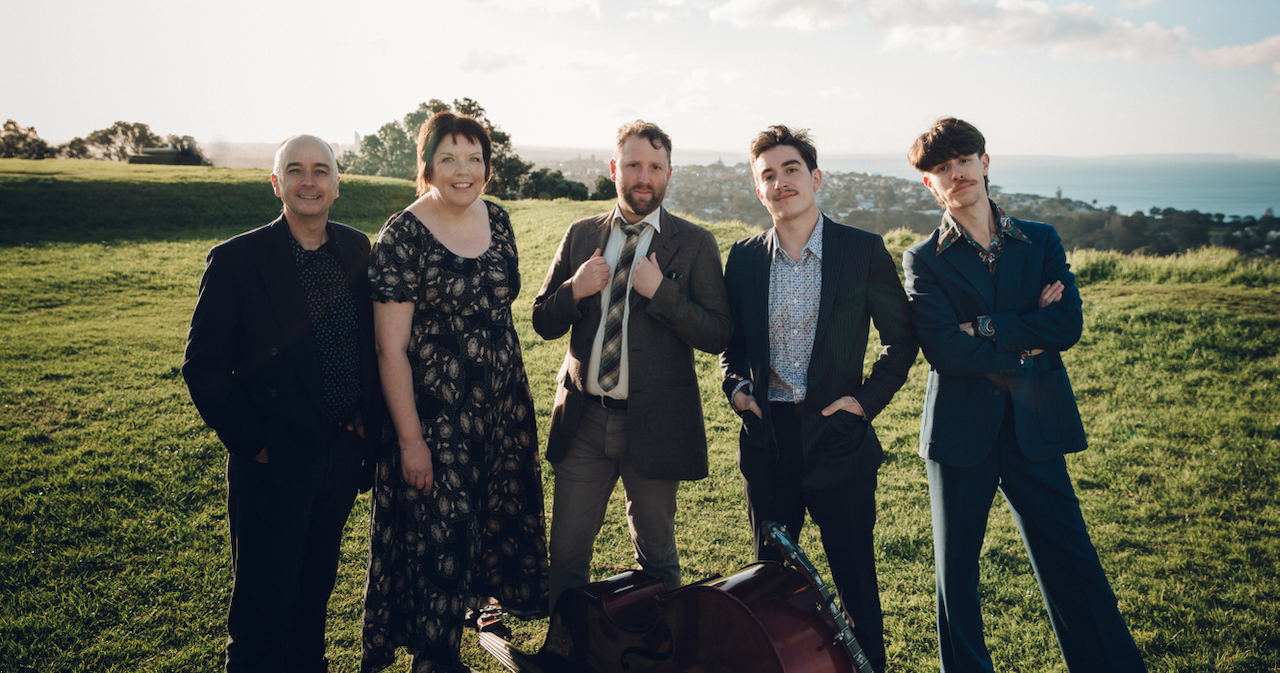
You, Me, Everybody Grow True Roots in Borrowed Soil

Aotearoa (New Zealand) doesn’t have a strong history of bluegrass bands – except one. If you mention bluegrass to New Zealanders, some will have at least heard of the Hamilton County Bluegrass Band. New Zealand has produced some great players, notably fiddle player George Jackson, banjo player BB Bowness, guitarist/singer Cy Winstanley, and bassist/singer Vanessa McGowan. (Now that we write this, these four would make a great NZ bluegrass band!) But while these names are well known in American bluegrass circles, it is fair to say they aren’t known (outside of folk circles) in Aotearoa.

Many of the songs on our new album, Midnight (out January 30, 2026), are situated within a day, or feature characters who are sitting at the cusp of who they have been before delving into something new. That sense of “in-between” also reflects our place within Aotearoa’s musical landscape, where bluegrass arrives without a long local history, but can be shaped in ways that feel natural to how we live and create here.

“Our Kiwi fans know bluegrass from traditional songs and contemporary artists such as Alison Krauss & Union Station, and Billy Strings. But they are more familiar with the other genres that bluegrass sits alongside. We’re also collectively members of the New Zealand folk, country, and jazz communities,” says our bassist, Rob Henderson.

Midnight starts with bluegrass at its core, but gently widens scope, bringing in different genres with their rhythms, broader chord progressions, and influences drawn from our own environment and lives lived in Aotearoa.

Here are the songs and tunes that anchor us in tradition and inspire us to find our own path as the clock strikes twelve. – You, Me, Everybody

“Ain’t No Grave” – Crooked Still

I love groove and the forward motion in all music, so when I heard this tune for the first time I was naturally inspired by the push of the cello part. This feel was a factor in my own bass playing across the album, especially for up-tempo tunes such as “Misdirection.” – Rob Henderson

“Dorrigo” – George Jackson

George Jackson’s tune “Dorrigo” feels friendly and familiar. It’s one of those tunes that will just keep going around and around the jam circle. When the Dorrigo Challenge did the rounds on the internet a couple years ago, it was a reminder of how a tune can bring people together. I had this in mind while writing “Sam’s Tune” on our album. – Sam Frangos-Rhodes

“Wildfire” – Watchhouse

I find when I sit down to write a song, I usually follow the same template or theme. Of course, there is variation in a lot of my songwriting, but I find rhythmically it’s always much of the same thing. A while back I wanted to break that cycle and try to write a more chilled out, slower tempo song, so I wrote “Heart of Stone,” which leads to “Wildfire” by Watchhouse. I enjoy this song because I think it has a very similar vibe to “Heart of Stone.” For me, it captures the same emotion and feeling I was looking for. I find it’s always nice to find what I was looking for in other people’s writing and relate that back to my own music. – Laurence Frangos-Rhodes

“Heart of Stone” – You, Me, Everybody

Laurence originally wrote this while we were producing our previous album, Southern Sky. I love the backbeat to it, but he also writes great chord progressions; they feel natural and authentic to the song and surprising at the same time. I’ve known Sam and Laurence since they were in their early teens and while our audience love our instrumentation, singing harmonies with them feels like home to me. “Heart of Stone” gives us an opportunity to showcase our vocal blend and milk those beautiful chords Laurence gifts to his songs. – Kim Bonnington

“Railroad” – Béla Fleck & Abigail Washburn

When I try to serve the song with three-finger banjo, I frequently look to Béla Fleck’s work with Abigail Washburn. He plays parts and the two of them fill out the texture of a song so well! Ironically, when we arranged “Silver Spoon,” I was hearing Abigail-like clawhammer behind it, so I did my best to provide that kind of sound with three fingers. – Nat Torkington

“A Hundred and Sixty Acres” – Marty Robbins

Our track, “The Ballad of Bubs and Beautiful,” started when I overheard a conversation between two women shearers in a camp ground in Waipukarau. I knew that I wanted to capture their relationship to each other and their working life, all framed within a day. My Dad’s vinyl collection is 50% Marty Robbins and I remembered the picture that “A Hundred and Sixty Acres” colored of a life well lived. That’s why the first line in “Bubs and Beautiful” is, “Up ‘fore dawn to greet the sun.” There’s a tendency for NZ songwriters to still write about American experiences and places due to an inability to describe ourselves that has been labelled “cultural cringe.” But I knew the description of the women was genuine when I heard someone go, “Oh” as we played the last line live for the first time. – KB

“Orphan Annie” – Tony Rice

As a guitarist, I’ve been heavily influenced by Tony Rice – who hasn’t!? Whenever I listen to the Church Street Blues album it leaves me feeling creative and inspired. I love the minimalism; stripped back to one guitar and vocals telling a story. A lot of the songs on Midnight started in this exact same way, guitar and vocals alone. So it only feels appropriate to give credit to Church Street Blues where credit is due. I cannot pick one track from the album as a favorite because they are all great, but here is “Orphan Annie.” – LFR

“Was It You” – Joy Kills Sorrow

“Was It You” is a song I love for how it drives. That rapid mando chop over a fast rolling banjo held down by a thumping bass is a sure way to make a foot stomper. I took a lot of inspiration from Jacob Jolliff’s mandolin playing in “Was It You” when I put together my part for our song, “Busy Without Me.” – SFR

“Busy Without Me” – You, Me, Everybody

Kim writes wonderful slice-of-life songs. The Midnight album has everything from the plight of an unwed mother to mother/daughter sheep-shearers. “Busy Without Me” is perhaps more #relatable, though: we have a short life with ample temptation for busyness, it says, but it’s important to take moments to “sit and breathe and let the breeze wash over me with nothing in my way.” I love the way the busy-ness of the music reflects the lyrics. – NT

“Caleb Meyer” – Gillian Welch

Country/folk/bluegrass songwriters have always done a great job of writing songs about things we won’t talk about, but make us happy to sing about them. Our song “Silver Spoon” was initially written to an Irish jig. But the joyfulness didn’t eclipse the bleakness of the lyrics. At different times when we were arranging it, different band members would say, “What would Caleb Meyer do?” and our producer Rachel Baiman asked exactly the same question when she arrived for our sessions before we recorded. It’s become the quintessential modern murder ballad. – KB

“Distant Sun” – Crowded House

I grew up in ’90s New Zealand with parents who would play in a country band at the local barn dance while my brother was DJing at the rugby club rooms. So while Marty and Merle would be in one ear, Crowded House was in the other. If you think of great bridges in songwriting, “Distant Sun” has one of them. It also has my favorite line ever in a song: “I don’t pretend to know what you want, but I offer love.” The melody lines in our own track, “The Rest of Us,” hark back to years of admiring Neil Finn as a songwriter. – KB

“The Rest of Us” – You, Me, Everybody

When Kim first brought the concept of “The Rest of Us” to the band I was immediately a fan, and thought it would a great fit on the album. Before we went into the studio we all spent some time together to arrange the new material. As a band I feel like we work uniquely well when it comes to putting a song together and it’s one of our biggest strengths. I think “The Rest of Us” is a great example of Kim’s songwriting and a great example of how we function as a band. – LFR

“Natchez Trace” – Béla Fleck

In my mind, this is the classic G minor banjo instrumental, from Béla Fleck’s landmark album, Drive. Recorded with his B string tuned down to B flat, Fleck often plays it live out without the re-tuning. That was the inspiration for me to write my own Gm instrumental for a banjo tuned to open G major. – NT

“What a Fool Believes” – The Doobie Brothers

I wrote “She’s Alright With Me” a few years ago before I joined You, Me, Everybody. At the time, I had been deep diving into a lot of Doobie Brothers music and the moving parts within their songs. When “She’s Alright With Me” was born, it was originally a heavy keyboard driving tune – having written it on an old 1960s Wurlitizer Piano and styled it on some of the Doobies’ keyboard parts. It’s safe to say it’s transitioned a lot as we don’t have a keyboard part, but you can hear the rhythm now being driven in the same way by Laurence’s guitar. – RH

“Old Train” – Tony Rice Unit

Laurence’s epic album-opening “Misdirection” is a straight-ahead driving bluegrass song, which nonetheless has a few surprise chords in it. For some reason that reminds me of this epic Tony Rice track. – NT

“Misdirection” – You, Me, Everybody

“Misdirection” fits nicely as the opener on our album. It’s a fun example of progressive bluegrass while still staying true to its roots. “Misdirection” is my favorite track on the album and I would like to think the amount of fun we had recording this song is reflected in the final result. – SFR


Photo Credit: Ebony Lamb
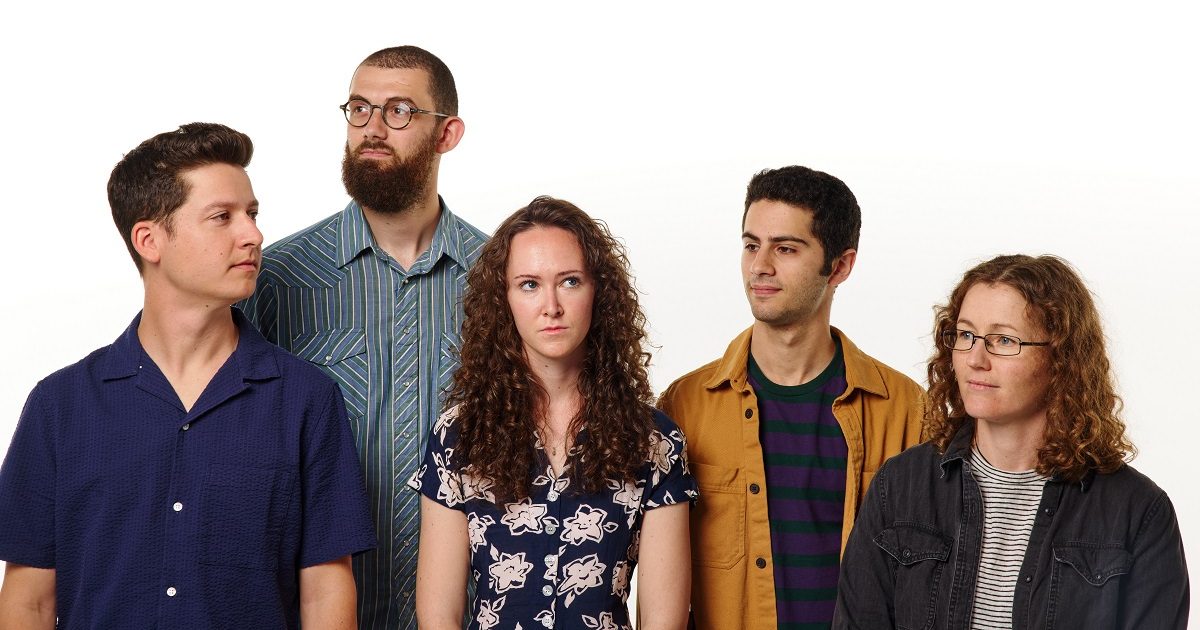
MIXTAPE: Mile Twelve’s Favorite Short Story Songs

Songs can be truly short short stories. There is so little time, so little space to convey a complete narrative. That challenge has always thrilled us when crafting our music. When we were asked to create a themed playlist for The Bluegrass Situation, I thought through our own songs that formed the new album Close Enough to Hear (out February 3) and wondered what common thread tied them together. Many of them really are conveying a story, something with a beginning, middle and end. We all went back to our favorite short story songs and marveled at the writers’ ability to forge a genuine drama, with a plot and characters, inciting events and climaxes, in just a few short minutes. It’s a high wire act, where every single word counts and nothing can be wasted. Here’s a list of our favorite short story songs. — Evan Murphy (acoustic guitar), Mile Twelve

Bruce Molsky (Molsky’s Mountain Drifters) – “Between the Wars”

This song makes me emotional every time I hear it. Bruce delivers this Billy Bragg song so powerfully and honestly, giving it a distinctly American flavor. – Nate Sabat (upright bass)

Bobbie Gentry – “Papa, Won’t You Let Me Go to Town With You”

I was recently turned on to Bobbie Gentry through the Cocaine and Rhinestones podcast by Tyler Mahan Coe (highly recommended) and stumbled on this song while checking out her catalog. She’s done such an incredible job painting a musical representation of that longing, wishing feeling of wanting to be included. And on a dorkier note, listen to how the phrasing of the hook is different on line one of the chorus than it is on line four. So, so good. — Nate

Cy Winstanley – “Little Richard Is Alive and Well in Nashville, TN”

Our good friends of the duo Tattletale Saints are excellent songwriters from New Zealand, now based in Nashville. This song about Little Richard has beautiful, clear imagery that pulls you right into the song. It’s a mellow performance, not trying too hard and resulting in a memorable story about a unique Nashville music legend. – BB Bowness (banjo)

Jean Ritchie – “West Virginia Mine Disaster”

This haunting a cappella song written by Jean Ritchie is sung from the wife’s point of view as she awaits news of her husband’s fate down in the mine. The song captures the anxiety and uncertainty she feels while she imagines a possible future without her husband. — BB

Jason Isbell – “Speed Trap Town”

A dozen cheap roses in a shopping cart, veins through the skin like a faded tattoo. Isbell’s tight, sparse images bloom into vignettes which form a complete story by the end of this song. A man has reached the limits of his patience with a stagnant life. His father lays dying in the ICU, he has no prospects, nothing to stay for. After long years, he finally decides to pack it up and break free. When I am in a period of writing I actually can’t listen to songs this good. They torment me with their lean, sinewy perfection. To use Isbell’s own language, there is no fat on these lyrics. Everybody knows you in a speed trap town. — Evan

Bruce Springsteen – “Highway Patrolman”

“My name’s Joe Roberts, I work for the state” might as well be “Call me Ishmael.” For me, this is the quintessential short story song. There are major motion pictures with plots less deep. It’s the struggle between two brothers, Joe and Frankie, one a state trooper and the other a struggling veteran who can’t seem to stay out of trouble. “I got a brother named Frankie, and Frankie ain’t no good,” sings Joe. Maybe it’s the fact that I have two older brothers, but when Joe watches Frankie’s taillights disappear across the border I cry, even after hundreds of listens. “I musta done a 110 through Michigan County that night.” How desperate was Joe to catch Frankie, to save him from himself? This song has taught me so much about musical storytelling. Springsteen is larger than life, for me and so many others. I wish I could open the back of his head and see how he does it. Thank God we have his music, it’s sacred. — Evan

Gillian Welch – “Caleb Meyer”

“Caleb Meyer, he lived alone in them hollerin’ pines” opens this exquisitely brutal ghost story. Gillian Welch has reshaped the very structure of modern folk songwriting. She and David Rawlings prove that when the song, the vocals and the playing are flawless you really don’t need anything more. “Caleb Meyer” is a haunting murder ballad. A woman fights for her life, finding a broken bottle to slash the throat of her would-be rapist. I am in that room with her when I listen to this, the hair standing up straight on the back of my neck. It’s a full-fledged Western, and she does it in three damn minutes. She is a force of nature. — Evan

John Prine – “Hello in There”

The lives of Prine’s characters are smaller and simpler than the legends of epic folk ballads. There’s no steam drill, no six shooters, no gallows at dawn. It’s just Loretta, Davie and Rudy, a back porch, a TV that plays the same old news. This is Prine’s genius, making the mundane transcendent in its beauty and its tragedy. It’s like watching modern human life itself dancing on top of his gorgeous finger-picked eighth notes. He was one of our great American prophets, observing, critiquing, reflecting, teaching. He is missed so dearly. — Evan

Josh Ritter – “The Temptation of Adam”

“‘If this was the Cold War, we could keep each other warm,’ I said on the first occasion that I met Marie.” Ritter is a favorite of novelist Stephen King. It’s not surprising, given the literary grandeur of his songwriting. The strange, post-apocalyptic tale of Marie and the missile silo transfixed me when I first heard it. It’s more mesmerizing with each repeat listen. How does someone create a world so fully realized, so convincing, with such simple tools at their disposal? What a gorgeously weird tale. — Evan

Cindy Walker, recorded by Bob Wills – “Dusty Skies”

When I was younger, I had four or five Bob Wills CDs that were pretty much on repeat for my whole childhood. This Cindy Walker song was on a couple of them, and every time I heard that fiddle intro, it would stop me in my tracks. I’d sit there completely absorbed in the stark, dusty imagery. This song is lyrically and musically as simple as it gets, but it packs a heavy emotional punch. When this song was recorded by Bob in 1941, the Dust Bowl was barely history, and I can feel the pain it caused in every beat. You don’t always need fancy chords and poetry to make a statement—sometimes you just need a semi-natural disaster. — Ella Jordan (fiddle)

Joni Mitchell – “The Last Time I Saw Richard”

How can you have a playlist without a Joni Mitchell song? The oppressively ordinary yet starkly evocative imagery in the second half (only Joni can put a dishwasher in a song) somehow reminds me a little of some of Lucia Berlin’s writing. This is one of those songs that if you had never heard anybody sing it and you just read the lyrics, it would still be a beautiful poem. One that takes you on a journey, and makes you feel things. One that makes you question your life choices. We all hope it’s only a phase, these dark café days…. – Ella

Randy Newman – “Dixie Flyer”

This is one of my favorite songs from Randy Newman. He sings about traveling around the United States as a child of a Jewish immigrant family in an attempt to find a home and live the American Dream. He deals with themes such as privilege and the issue of losing one’s culture while assimilating. This is the story of many families during the end of the 19th century and beginning of the 20th and continues to be a relatable topic today. – Korey Brodsky (mandolin)

Songwriter Unknown, Recorded by Hazel & Alice – “Two Soldiers”

The story of two Union soldiers during the Civil War who promise each other they will bring news back to their families if one of them does not make it through the battle. The imagery of war is vivid and the storytelling is masterful. Hazel & Alice bring this one to life in their incredible version. — Korey


Photo Credit: Dave Green Photography

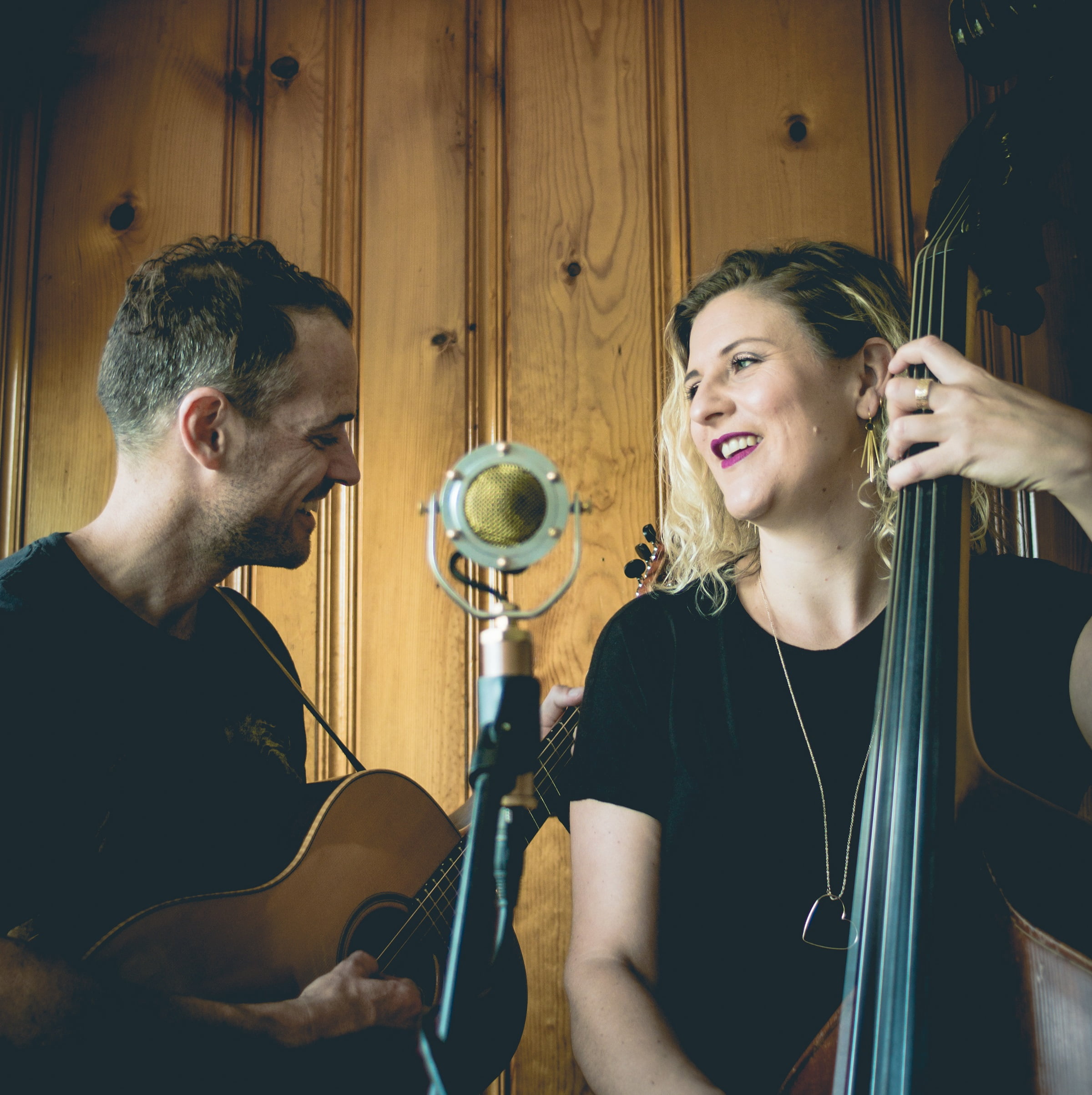
BGS 5+5: Tattletale Saints

Artist: Tattletale Saints
Hometown: Nashville, Tennessee via Auckland, New Zealand
Latest album: Dancing Under the Dogwoods (January 24, 2020)
Personal nicknames (or rejected band names): Broken Bells (rejected name). Cy is trying to nurture the nickname “Big Daddy C,” but it’s struggling to catch on.

Answers by Cy Winstanley

Which artist has influenced you the most … and how?

It’s no secret, but I love the music and lyrics of Paul Simon. As a jazz kid growing up, his use of varied harmony and its tasteful symbiosis with vivid and often impressionistic, poetic lyrics just blew my mind. His themes too, there are so many dimensions to them — I just get lost in his stories.

What other art forms — literature, film, dance, painting, etc. — inform your music?

I’m an avid reader and like to start my day with non-fiction and close my day with fiction. The more regular I am with that, the more those colors run through my writing. I tend to go through phases with the kind of books too: one of my fav authors is Roberto Bolano; after I read his oeuvre, I cycled through his contemporaries, influences, and other South American authors.

What was the first moment that you knew you wanted to be a musician?

I think as soon as I started playing guitar as a 13-year-old I just loved it so much that I knew it would be a big part of my life. But it wasn’t until later when I developed carpal tunnel in my hands that I had to stop playing guitar, then it was songwriting that became the focus.

What’s the toughest time you ever had writing a song?

Every song feels like the toughest time! It’s very rare that they just ‘fall out’. But perhaps those that are directly about my life are the hardest, because I want to be as faithful to the memory as possible and am constantly fighting with myself over what I want to present.

Which elements of nature do you spend the most time with and how do those impact your work?

Being from New Zealand and also being a long distance runner have given me a pretty strong connection to being outside. When I’m in nature, there is a calmness, and sense of earthly perspective and belonging that pervades my every waking moment.


Photo credit: Natia Cinco

WATCH: Tattletale Saints, “Bobby Where Did You Learn to Dance”

Artist: Tattletale Saints
Hometown: Nashville, Tennessee
Song: “Bobby Where Did You Learn to Dance”
Release Date: October 29, 2018
Label: Old Oak Music

In Their Words: “I began writing ‘Bobby’ after a show in Austin, Texas. We were drinking at The White Horse, a local honky-tonk and dance spot when the band on stage started jamming a Cajun groove. I knew my friend Bobby, who is legally blind, had learned to two-step at this very bar, and while reminiscing on the story I started singing the main hook along with the band and the song was born! The song kinda wrote itself and we tracked it live in Nashville with Oliver Craven (Stray Birds) on mandolin and Matty Alger on drums.”— Cy Winstanley, Tattletale Saints


Photo credit: Kaitlyn Raitz