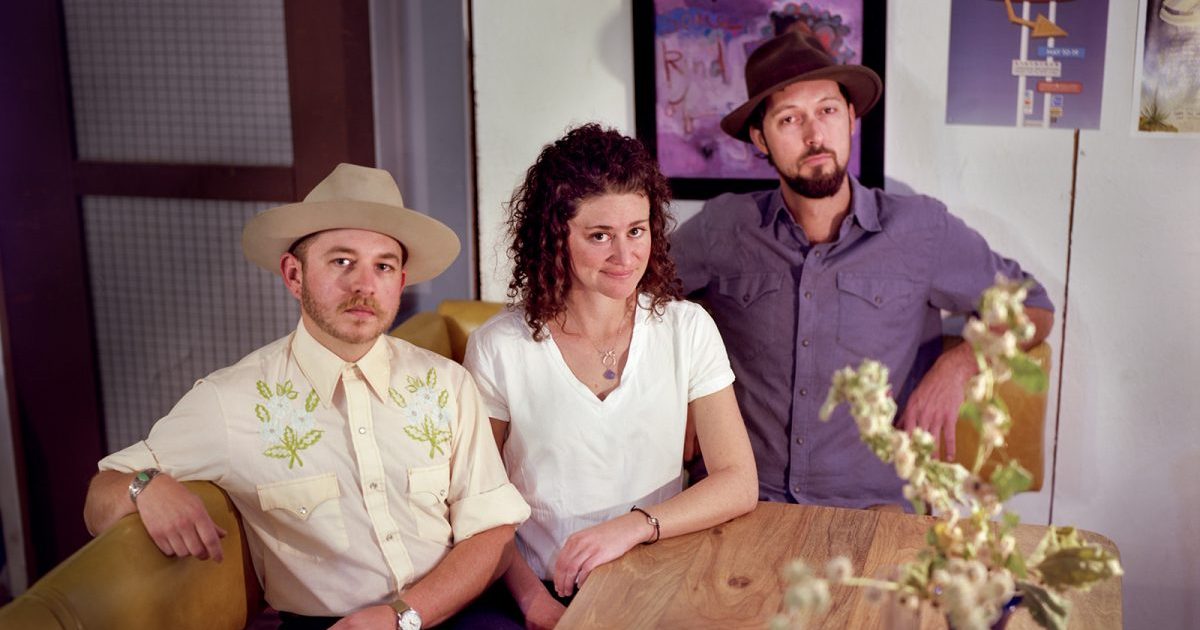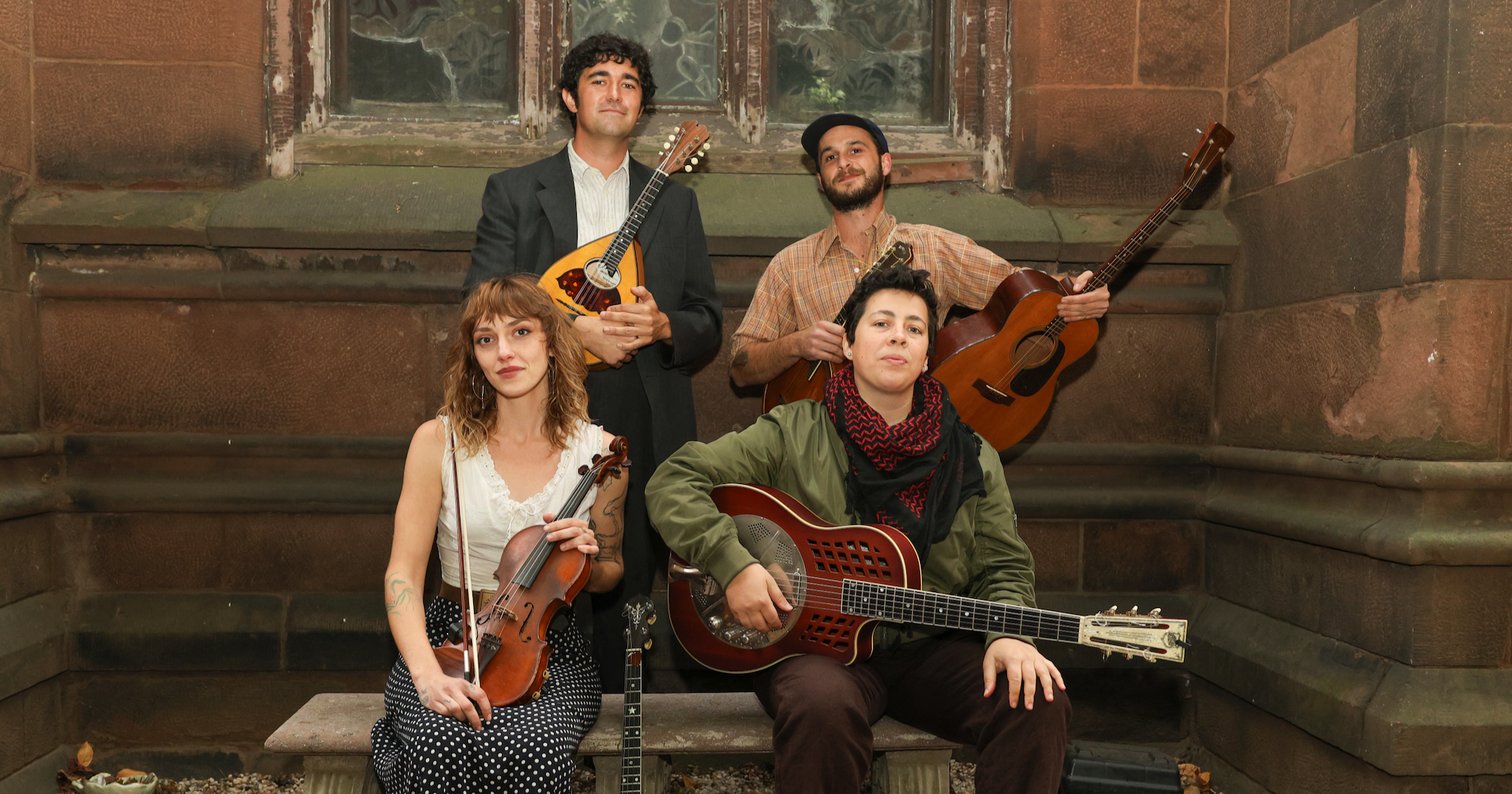
Vaiano’s Paisanos Valsa Continental Playlist

Honestly, I think the reason I am a nerd about string band music is that it offers a beautiful way of thinking about how music moves – not just through instruments traveling, but also through melodies, rhythms, and ideas making their way through people and place and time.

Maybe that means across the globe, but it could mean between a dining room and a basement, whatever the dialogue. The tracks in this playlist are a winding path through a tiny subsection of this sonic world. – Rachel Meirs, fiddle, Vaiano’s Paisanos

“Rosa Negra Vals Venezolano” – Orquesta De Lionel Belasco

“Rosa Negra Vals Venezolano” comes from Lionel Belasco, a Trinidadian-Venezuelan pianist and composer whose recording career spanned five decades. This waltz is a really joyous piece recorded by Belasco’s orchestra, who recorded an incredible number of sides for Columbia Records in New York City in the late ’20s and early ’30s. An iteration of a calypso band with piano, woodwinds, strings, and syncopated rhythms that all give a hint to which version of the journey this waltz form took to arrive.

“Para Mi y Para Mi Novia (Vals Foxtrot)” – El Ciego Melquiades

“Para Mi y Para Mi Novia (Vals Foxtrot)” comes from El Ciego Melquiades, “The Blind Fiddler,” who recorded in San Antonio. It sounds like a Tex-Mex fiddle tune, since that’s the way he plays it, but the most compelling thing about it is how unintuitive it is. I could never figure out why its form and melody were so strange, but a friend recently tipped me off that it’s his take on “For Me and My Gal,” a 1917 pop song (later popularized by Judy Garland), which also made the song title make more sense.

“Rolling Mill Blues” – Peg Leg Howell

Discovering the origins of “For Me and My Gal” brought to mind this Peg Leg Howell recording from 1927. I loved his recordings with Eddie Anthony on fiddle, but when I heard “Rolling Mill Blues” I remember thinking it was beautiful and strange. Instead of Eddie Anthony’s driving country-blues style fiddle, the violin’s counter-melody takes on an almost ethereal tone. I don’t know if it is a coincidence or not how much that melody calls to mind the pop song, “Tonight You Belong to Me,” which was first recorded in 1926.

“Smart (Tango Argentino)” – Kostas Bezos, Loudiana, Aspra Poulia

On the theme of the crazy routes music takes, I think saying that this next one, “Smart (Tango Argentino)” comes from Kostas Bezos, who led a Hawaiian band in 1930s Athens, is sufficient!

“Cariño” – Cuarteto de Cuerdo de F. Facio

Orquestas de cuerdas were small string bands that played for dances and social functions in Northern Mexico. The entire Arhoolie compilation Orquestas de Cuerdas: The String Bands: The End of a Tradition 1926-1938 is worth listening to, but “Cariño” from Cuarteto de Cuerdo de F. Facio has always stood out to me for what I think is a cello or bowed bass in addition to violins and bajo sexto. This adds a significant low-end to an already dramatic song – this one goes through a lot of emotions.

“Valsa Continental” – Abrew’s Portuguese String Trio

This next one comes from another compilation series I recommend for anyone looking to deep dive into this music across even more territory. Check out Pat Conte’s anthology series, The Secret Museum of Mankind (now on our label, Jalopy Records, since 2021.) Another waltz, which I named this playlist for, “Valsa Continental” comes from Abrew’s Portuguese String Trio. Composer, violinist, and bandleader Augusto Abreu led this Cape Verdean trio from New England who recorded four discs for Columbia Records in 1931.

“Abrew’s Portuguese Jazz” – Vaiano’s Paisanos

It’s hard to say, but since Abrew’s Portuguese String Trio is one of my favorite bands, and because the recordings are still hard to find digitized, this next one is our band Vaiano’s Paisanos take on “Abrew’s Portuguese Jazz.” Our version keeps the violin part, but instead of guitar and cavaquinho, we have mandolin adding harmonies and rhythm, and tenor guitar playing the melodic runs that make up the tune’s backbone and bass line.

“Quisiera Olvidarte” – Pastorita Huaracina

This style of melodic accompaniment reminds me of the relationship between a country-blues fiddle line and a song’s vocal melody (for instance “Rolling Mill Blues,” on this playlist) is one of my favorite things to hear. Maybe that’s why I have listened to “Quisiera Olvidarte” by Pastorita Huaracina so many times in a row. This track comes from another great Arhoolie compilation, Huayno Music of Peru, Vol. 1.

“Il Mio Cuore E Tuo” – Giovanni Gioviale

I knew I wanted to include a track to represent some of the Italian-American music of the era. For many of the tracks on this playlist, I have been trying to decide between polkas, mazurkas, waltzes, foxtrots, and tangos, a reminder many of these groups were dance bands. The mazurka form comes from Poland, a dance in 3/4 or 6/8. This mazurka comes from Giovanni Gioviale, a mandolin virtuoso from Sicily who recorded in New York between 1926 and 1929. “Il Mio Cuore E Tuo” features Gioviale on the tenor banjo– another marker of combined musical histories.

“Black Mountain Mazurka” – Gu-Achi Fiddlers

The next tracks have us following mazurkas to the Southwest. “Black Mountain Mazurka” is Gu-Achi fiddle from the Tohono O’odham people of Southern Arizona. This Southwest fiddle sound is made even more distinct with the addition of drums and very sweet harmonies.

“Bailando en Phoenix” – Lone Piñon

Staying nearby but jumping ahead into this century, Lone Piñon (also on our label, Jalopy Records), plays New Mexican string band or “orquesta típica” music. “Bailando en Phoenix” shows both the amazing energy and musicianship of the whole band. Their whole album is a beautiful tribute to their attention to learning, playing, and performing this musical style.

“Tarantella” – Magic Tuber Stringband

One more modern band, to remind ourselves that we are all participating in the process of reimagining music across time and space. And we will be for as long as we engage with these old traditions and continue to make music. The cross-tuned fiddle on North Carolina-based Magic Tuber Stringband’s “Tarantella” so effectively calls to mind the droning sound of a zampogna (an ancient bagpipe played in southern and central Italy), and the track fades to a fitting end for this playlist.


Photo Credit: Brian Geltner

Adam Hood on Only Vans
with Bri Bagwell

Today on Only Vans, we’re in the mountains of New Mexico with one of my most talented friends, Adam Hood! We get to talk about balancing being a songwriter and a road dog, building a home, and the motivation of writing a song as well as publishing deals, re-recording an album, and being an introverted artist.

We also talk with Charlie and Nicole, the organizers of the 8750′ Festival in Red River, New Mexico.

LISTEN: APPLE • SPOTIFY • AMAZON • MP3

What an honor it is to have my friend from Alabama, Mr. Adam Hood, on the podcast today coming to you from the really incredible 8750′ Festival we both played in Red River, New Mexico back in August. Peeking at his tour schedule, Adam is going to IL, WI, TX, MS, AL, TN, MD, and more, so be sure to check his tour schedule, because he is a must-see live act!

During the episode we talk a lot about publishing deals, because Adam and I both had them – and if you don’t know, a publishing deal is when you’re considered a full-time writer for a company. That is a uniquely hard place to be in, being a road dog and an employed staff writer was very busy and stressful – and also a freaking amazing – time in my life. I’m glad we dove in on that and, even though we talk about how hard it was, I know we both loved it and were lucky to be in that position.

We also talk about resistance from the book, War of Art (gifted to me by Wade Bowen actually), that is a must read for artists. Adam re-recorded one of his records to own the masters and it sounds great. Shoutout, again, to Gordy Quist and The Finishing School studio in Austin, Texas. And, to clarify, I did not do my own drywall in my house. That’s a lie, I don’t know why I said that.

Thank you to one of our favorite places, The Motherlode Saloon in Red River, NM for letting us film the pod there.


BGS 5+5: David Berkeley

Artist: David Berkeley
Hometown: Santa Fe, New Mexico
Latest Album: A Pail Full of Fire
Personal Nicknames (or rejected band names): The only time I really had a nickname was when I was teaching in a public middle school in Bushwick. The kids called me Shaggy.

What’s the toughest time you ever had writing a song?

I gave up on my song “This Be Dear to Me” probably a dozen times. I began writing it as an exercise in positivity after Trump got elected. Instead of lamenting all the things I feared would be ruined, I decided to try to write a list of what I loved. That’s where it started. Pages and pages of places I found beautiful, people I cared about, lists of what I valued. I guess I wanted to unite people who were behaving like they had nothing in common by reminding them (us) that there are lots of things we all love. Like, here are some things we all must hold dear, right? Rivers and trees, the autumn, the moon, our children. If we remember that then maybe we stop fighting about less important things?

But I didn’t want it to be heavy-handed or preachy. And I didn’t want it to be too syrupy. Eventually, I had the list and I shaped it into maybe forty verses. That felt like a few too many, though, so I spent a long time whittling. I got it down to three. At first the chorus was just an extended Amen. “Ah ah ah ah… men.” But that seemed like a cop out. So I ultimately added a lyric, which wasn’t easy to write. It appeals to Adonai to help remind us what is worth fighting for. That also felt like a risk. I’m Jewish, but I rarely reference my Judaism in my music. Finally, I had this idea that the song should lift and modulate as it progresses, so the lyric would feel more urgent and the music could soar. But I also knew that I wanted it to feel cyclical and to come back home at the end. So then it became almost like a puzzle. Could I move through several keys and return to where we began? That’s ultimately where the song landed. It’s the hardest I ever worked on a song, but it’s also probably the most powerful to sing live.

Which elements of nature do you spend the most time with and how do those impact your work?

I never had a dog growing up. In fact, I never really liked dogs. I pretended to like your dog if we met. But really I was a little afraid of her/him. And I never understood dog people. I’m a father of two boys. And when people talked about their dog like a child, I bristled. But we got a puppy during COVID. Her name is Mali, and I love her. Like I really love her. She’s changed my whole world. Don’t tell my boys, but I often miss Mali more than my kids when I’m on tour. She certainly seems happier to see me when I come home than they do.

This all to say, I spend a lot of my time hiking with her in the Sangre de Cristo mountains above Santa Fe. You’re far more likely to run into me hiking up Picacho or on the backside of Sun Mountain than anywhere else in town. You can see a hundred miles from up there. And I normally bring a blank book with me. I start a lot of songs on those hikes. And I try my melodies out on Mali. She has better ears than humans do, so I think it’s fair to trust her reaction.

How often do you hide behind a character in a song or use “you” when it’s actually “me”?

I wouldn’t call it hiding, but I use characters more and more in my writing to express certain ideas or emotions that might be clearer through the eyes or mouth of someone else. My song “Omaha,” for example, is a song about a guy trying to reunite with a lost love. That’s not autobiographical at all, but it’s honest.

And of course in my duo project, Sons of Town Hall. My partner and I have created a whole mythic backstory. My name in that project is Josiah and every song is sung from within that fictitious world. We’re now rolling out a comedy-fiction podcast series called Madmen Cross the Water that tells the stories behind the songs on our new album. But just like in my solo work, even though there is a character I’m writing for it doesn’t compromise the honesty. In fact, sometimes I think we can be more honest and open when we are wearing a kind of mask.

If you didn’t work in music, what would you do instead?

I’d go back to the Salmon River in Idaho and try to get my old job back as a river guide. I love playing music, but it isn’t an easy career and there’s a lot of it I don’t like – promoting myself, for example, or sound checking, or all the travel. But I liked every bit of being a river guide back in the day.

Since food and music go so well together, what is your dream pairing of a meal and a musician?

I’d like to travel back with Anthony Bourdain on a food tour of Italy. And after eating our way through the country for a few weeks, we end up in Rome. We head to the Pantheon one night under a big moon. It’s all barricaded off, but we’re ushered in. It turns out that Neil Young is there (but it’s 1971 Neil). He’s got a pipe organ in there and a few guitars. They serve us plates of cacio e pepe and glasses of cold Frascati and he basically plays the Massey Hall set for maybe fifty of us.


Photo courtesy of the artist.

Josh Grider on Only Vans with Bri Bagwell

(Editor’s Note: Only Vans with Bri Bagwell is the latest addition to the BGS Podcast Network! Read more about the podcast coming on board here. Find our episode archive here.)

Josh Grider is a successful songwriter and touring musician, as a solo artist and as half of the Topo Chico Cowboys. We also happen to share a hometown in Las Cruces, New Mexico. We talk about the desert we were raised in, New Mexico food, not being qualified for real world jobs, and much more in this hilarious episode of Only Vans.

LISTEN: APPLE • SPOTIFYAMAZON • MP3

Find Josh Grider’s music, tour dates and merchandise here.

Thanks to our sponsors for this episode, The MusicFest at Steamboat, Lakeside Tax & CH Lonestar Promo!


LISTEN: Eliza Gilkyson, “Here Comes the Night”

Artist: Eliza Gilkyson
Hometown: Taos, NM
Song: “Here Comes the Night”
Album: Home
Release Date: June 23, 2023
Label: Realiza Records

In Their Words: “With the encroaching reality of global warming and extreme natural disasters I find comfort in knowing that the Earth is more resilient than human beings at their worst. Even if I don’t live to see things turn around after they fall apart, I do feel hopeful about the Earth’s supreme thrust to create life in all its myriad forms. I wrote this song just to conjure up some courage to get my emotional ‘sea legs’ in the light of what’s coming within my lifetime, and to find some element of redemption in all of it. Musically, I wanted to keep it all upbeat rather than gloomy, to convey a combination of apprehensive and hopeful feelings. My brother Tony Gilkyson delivered just the kind of twang-and-grit guitar to accomplish that, and I think it pairs well with Don Richmond’s cascading mandolin parts.” – Eliza Gilkyson


Photo Credit: Robert Jensen

LISTEN: Esther Rose, “Dream Girl”

Artist: Esther Rose
Hometown: Born in Detroit, raised in Columbiaville, Michigan
Song: “Dream Girl”
Album: Safe to Run
Release Date: April 21, 2023
Label: New West Records

In Their Words: “This song is for anyone who’s been made to feel less than their male counterparts. Don’t listen to them, dreamgirl! About halfway through making the album in New Mexico, producer Ross Farbe and I took the songs back to New Orleans. We recruited Silver Synthetic to be my backing band on a couple of songs. It feels like a sonic bridge, connecting my past to my present. I am a huge fan of this band and it was dreamy to hear my songs come to life with their soft rock vibes.” — Esther Rose


Photo Credit: Brandon Soder

LISTEN: Jono Manson, “Make It Through to Spring”

Artist: Jono Manson
Hometown: New York City (currently living in Santa Fe, New Mexico)
Song: “Make It Through to Spring”
Album: Stars Enough To Guide Me
Release Date: March 31, 2023
Label: Blue Rose

In Their Words: “The seed for this song came in the depths of last winter, during a particularly cold spell while I was bundled up, taking our dog for her morning walk. While passing along the banks of the Santa Fe river, I noticed water still flowing, under the ice. I took this as a reminder that even in the darkest days of winter new life lies waiting, under the ice, beneath the frozen ground. I wrote most of the lyric that day. I then sent what I had to my long-time collaborator George Breakfast who lives in London, and we passed it back and forth until the song was done.” — Jono Manson


Photo Credit: William Coupon

BGS 5+5: Cahalen Morrison

Artist: Cahalen Morrison
Hometown: Tierra Amarilla, New Mexico
Latest Album: Wealth of Sorrow
Personal Nicknames: Hank

Which artist has influenced you the most … and how?

Probably Tim O’Brien. My dad was a big Hot Rize fan when I was a kid, so that’s the one voice that I really grew up on. Later on in my musical life I found myself doing a lot of things that at least reminded me of Tim. His loose and expressive touch on all the instruments he plays, and he really just lets his voice ring out of his head like a bell. So I think I had subconsciously been modeling a lot of what I did on a lot that he does.

What other art forms — literature, film, dance, painting, etc. — inform your music?

Literature is a big one for me. Both poetry and prose. I guess I’ve even ‘borrowed’ lines from movies, too. When I’m reading a book by a great writer, I love the way it feels to live inside their language. Not only the story, but the rhythm and the tone of their prose as well. It has really helped me craft songs the way that I want to, and find my own, comfortable voice for getting ideas and images out that I want to.

What’s the toughest time you ever had writing a song?

I recently wrote a story song about someone, which I haven’t actually ever done. I really wanted to get the story across, all the darkness and the beauty, but I don’t like to put people in the spotlight. So, I worked on it for quite a while, trying to highlight all that is human about it without having it be too on the nose, and I think I got somewhere that worked. But I guess there’s only one person who can tell me, so we’ll see.

What has been the best advice you’ve received in your career so far?

The late, great Kelly Joe Phelps was a great mentor to me and my career. He always was pushing me to just do what I actually wanted to do, not to do what I think people want from me. Maybe not the best advice to hit the Billboard charts (which I actually did, because I think my record was the only “bluegrass” record to come out for a week during Covid…), but damn good advice for keeping yourself motivated and happy about the work that you’re creating and performing.

Which elements of nature do you spend the most time with and how do those impact your work?

I spend a lot of time walking and hiking, and it certainly has had a big impact on what I write. And it really is all the cliché stuff that people say about it. Noticing the small things, the interconnectedness of all the elements no matter how big or small, and what effects we and all that surrounds us has on it. And plus, what greater source of beautiful and poignant metaphor could there be?


Photo Credit: Archie MacFarlane

BGS 5+5: Esther Rose

Artist: Esther Rose
Hometown: New Orleans, Louisiana, and sometimes Taos, New Mexico
Latest album: How Many Times
Personal nicknames: Dayfire, Wild Rose

What’s your favorite memory from being on stage?

Seeing as how there haven’t been any stages as of late, my favorite recent performance was singing “Handyman” with my nephew Cedar. Cedar is three years old and he knows every single word.

What was the first moment that you knew you wanted to be a musician?

The moment that I knew I wanted to be a guitar player/songwriter was on my 28th birthday when I wrote a song called “The Game” on piano. ‘Til then I had been a supporting member of my partner’s band, but that morning I wrote a breakup song. I remember thinking I need to learn how to play the guitar immediately and I did.

What rituals do you have, either in the studio or before a show?

In the studio I set up a good-luck altar with little treasures from the past year; pretty rocks from significant places, jewelry, photos, whatever has been close to me for the past year of songwriting I will take off and turn it over to the altar. It is grounding to look over and be reminded of why I wrote the songs, or where I was, or who I was with. I keep a candle burning the entire time. It gives me great satisfaction to blow out the candle at the end of a long day, signifying that the work is over.

What’s the toughest time you ever had writing a song?

Writing “When You Go” was tough. My songwriting golden rule is “no bullshit.” I will write and scratch out lines to get closer to what’s really going on. With this song, I wrote the first verses and then froze. The song starts as this kind of self-assured, “I’m getting over you” song. I was scared to go to the no bullshit place to see what was below the surface. I sent it to my best friend and songwriter soulmate Julia and she urged me to finish it. The next day I wrote the chorus and I remember crying, crying, crying and then crying some more. It’s a very primal feeling; please take me with you.

Since food and music go so well together, what is your dream pairing of a meal and a musician?

I want to have a glass of wine and a cigarette with Joni Mitchell. I don’t even smoke anymore.


Photo credit: Akasha Rabut

WATCH: Stillhouse Junkies, “Mountains of New Mexico”

Artist: Stillhouse Junkies
Hometown: Durango, Colorado
Song: “Mountains of New Mexico”
Album: Calamity

In Their Words: “‘Mountains of New Mexico’ is an old-school murder ballad about misunderstood victim vs. outlaw, but it’s also an ode to the great wildernesses of the American West and their ability, even in the Information Age, to humble us as they have since the beginning of time. And what better backdrop for this kind of tale than northern New Mexico’s Bisti Badlands, a sun-scarred, alien landscape of hoodoos, gullies, and maze-like washes. The August sun limited our video shoot schedule to early morning and sunset, and the light was nothing short of magical; the song’s windswept climax came to life in a way we had scarcely imagined. ‘Mountains of New Mexico’ is a reminder that trading one kind of trouble for another doesn’t always work in our favor.” — Cody Tinnin, Stillhouse Junkies


Photo credit: Renee Anna Cornue