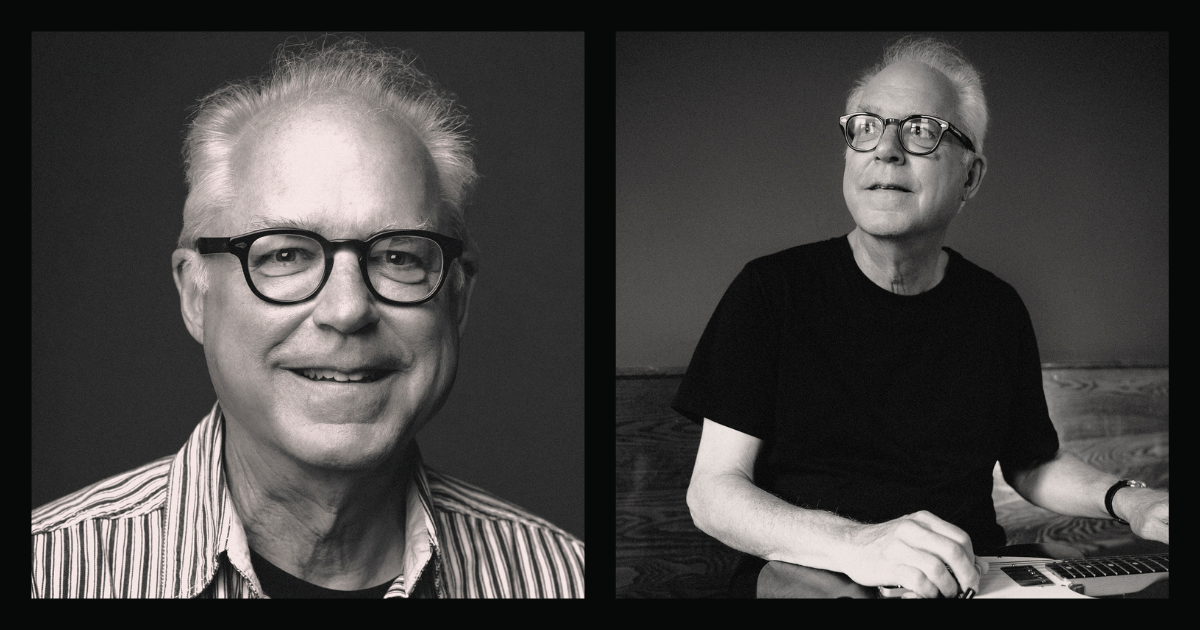
The first time Bill Frisell played guitar in front of an audience was typical for the time. It was the summer of 1965 and he was 14. He’d saved up money from a paper route in his Denver-area neighborhood so he could buy his first electric.
“Oh man, I can still just…” He pauses, lost in nostalgic reverie, on a Zoom chat from his now-home in Brooklyn.
“I opened the case and I can just smell it,” he says. “It’s amazing.”
His face bears a beatific smile, his voice a genial, gentle tone – things that he’s known for nearly as much as his astonishing musical talents.
“I got a Fender Mustang and a Fender Deluxe amp,” he continues. “And then my other friend, he got an electric guitar and this other guy across the street played drums. We learned like three songs. And then within a couple of weeks we were playing for a party in somebody’s basement.”
He’s not sure what they played – “probably ‘Louie Louie’ and I don’t know what else.” But the feeling?
“I guess in a way, that’s kind of what I kept on doing,” he says. “Get with my friends, learn a couple of songs and then go play for people. And that’s all I’ve done ever since.”
It’s exactly what he did on a recent Wednesday at the new Blue Note jazz club in Hollywood at the start of a several-week “75th Birthday Celebration” tour, that milestone coming on March 18. The friends joining this night were bassist Luke Bergman and drummer Tim Angulo.
The set was more than three songs, of course, played, as is his frequent style, in a continuous, hour-long stream, moving through originals, jazz standards, and movie score themes, as well as an ethereal “Moon River,” a tremolo-inflected “Shenandoah” and, closing, Burt Bacharach’s ever-timely “What the World Needs Now Is Love.” Wrapping it up was a somber yet hopeful encore of “We Shall Overcome.” Throughout the show, he and his trio-mates play with remarkably fluid connections. The approach could be delicate or heavy, buoyant or somber – or somehow all at once.
And with each note, even amid immeasurable harmonic complexities, melodic sophistication, and the nimble skills he’s gained through the decades, there was that kid from 1965, his beaming smile and twinkling eyes revealing his utter, still-fresh delight.
Frisell approached every measure as fresh territory, ripe for discovery, for exploration, curious where an old melody might reveal something new, reveling in its beauty or finding richness in dissonance he adds. Sometimes he’d play around with a short, simple phrase for a bit, like a new toy. Occasionally he’d fiddle with effects to enhance his pointillistic Telecaster touch (he moved on from the Mustang years ago). He throws in a cluster of sonic fireflies here, some “backwards” sounds there. He even giggled a little once when he hit a bad note.
“It’s weird,” he says in conversation a few days before the concert. “I still feel like I’m just beginning. And I’m not kidding. I mean, I know I’ve been playing for a while, but it’s still that feeling [that] never goes away. I’d be fooling myself if I thought … “
He paused again, looking for the right words.
“You just can’t feel as it you finished anything.”
This all comes through profoundly on his new album, In My Dreams, his 45th (plus many dozens of collaborations, group, film and TV scores and sideman projects), released on February 27. It also features a trio (longtime collaborators Thomas Morgan on bass and Rudy Royston on drums joining him) plus a string trio (violinist Jenny Scheinman, violist Eyvind Kang and cellist Hank Roberts), as well.
The title references an actual dream he had years ago in which a group of mysterious, cloaked figures allowed him to experience things beyond our normal perception. First they showed him colors – intense and beautiful – and then music in which all the things he’s loved, from Nino Rota to Hank Williams to Jimi Hendrix to Thelonious Monk, lived together as one glorious sound.
The album, mostly recorded live in three concerts last summer, shows him pursuing that sound himself, with approaches that might be termed jazz, classical, and folk-Americana braided through originals sometimes tender, sometimes dark and intense. Also included are interpretations of the Duke Ellington/Billy Strayhorn classic “Isfahan,” Stephen Foster’s “Hard Times” and, to close, “Home on the Range.” The latter is previewed earlier in the album with his own fantasia on themes from the song that he calls “Give Me a Home.” And for the title song, fittingly, he created an anxious soundscape inspired in part by Bernard Herrmann’s Alfred Hitchcock scores.
Still, the dream remains a dream for him, something ever out of reach, but ever-alluring.
“I don’t even know when it was, 30 years ago when I had it or more,” he says. “And music in general is always something that you can’t quite…. “
He stops to choose his words again.
“It’s always a little bit past what you can get to,” he says. “But the dream was like that. It’s like, I don’t know if I’ll ever get there, but just keep trying.”
In My Dreams is a hearty grab at that ring, though that very elusiveness is a key part of his art.
“With these people, we’ve been playing together so long,” he says, noting that Royston and the string players all were together on his 2013 album Big Sur. “There’s this thing that started happening quite a while back where, for me, I just love the line between arranging and orchestration and composing. The lines get all sort of blurred. We’re all seeing the same information, like what I write could look like a piano score or something. And we figure out some stuff, but basically everyone is free. The cello doesn’t always play what’s on the bottom and the violin doesn’t always play what’s on the top. And there’s a thing that happens spontaneously amongst them, amongst all of us, dropping out or coming in or switching parts that’s really the exciting part of it for me.
“So it’s like you’re improvising with the whole texture of everything. It’s not like they’re playing some part and then I’m playing a solo on top of it. Ideally it’s like an ongoing conversation amongst all of us. I never want it to be predictable. Hopefully it’s always in a state of uncertainty. I mean, I want it to be strong, but at the same time I want everyone to feel safe that they can fall off the edge, and then we’ll come back and pick it up, because that’s where the good stuff happens.”
That, of course, goes back to the avant-garde settings in the New York downtown scene of the 1980s and ‘90s, where he made a name as part of boundary-pushing sax player John Zorn’s unpredictable jazz-metal ensemble, Naked City. But the sensibility remains core to him even in his frequent trips into folk, Americana, movie scores, and unabashedly romantic pop-rooted material. His 1992 album, Have a Little Faith, a musical portrait of America spanning from Foster and Sousa to Ives and Copland, from Muddy Waters and Sonny Rollins to John Hiatt and Bob Dylan to Madonna, remains a landmark in his vast catalog. And he’s recorded and performed with many Americana singer-songwriters including Paul Simon, Lucinda Williams, Joe Henry, Bonnie Raitt, Buddy Miller, and Shawn Colvin. He simply loves a good song with a good melody.
“I can’t help it,” he says. “I was born in 1951 and I grew up in Colorado, just as television and rock ‘n’ roll were all happening. It’s not a conscious thing. [But] at a certain point, I realized, ‘Wait a minute, I gotta not be afraid to show that that’s where I come from.’ I think when I was younger I was more worried about, ‘Oh, are people going to think this is not cool?’ But then after a point it’s like, well, wait a minute. This is what I am. This is where I came from. And if I’m really honest, I do like that melody. I like when Burt Bacharach wrote a really beautiful song and it’s not corny if you look at it a certain way.
“I think I learned that from the people I thought were the coolest, like Sonny Rollins. He would play songs that he heard when he was a kid, or that he saw in a Broadway show or whatever. And I realized he’s doing that because that’s his experience and his life. So it’s okay for me to play a Beach Boys song or a Beatles song, because that’s what I heard when I was growing up. And ‘Home on the Range,’ I mean, [I] probably heard it when I was in my mother’s womb or something, you know?”
Arguably, the latter is the emotional keystone of In My Dreams, particularly in tandem with his “Give Me a Home” musings on its melodic theme earlier on the album, the strings following him as he steps through and around the familiar melodies, clearly with Copland hovering over.
“I was messing around with ‘Home on the Range,’ I wrote all these different versions and then that particular one, it’s just a phrase from the song, doesn’t even get through the whole song. And then the title.” He laughs.
“When you think of what’s going on in [the world]. I mean, we play ‘Hard Times’ on there, too. It’s like, folks without a home. Where are we now? What is going on around here?”
Those questions come to the fore again on the full “Home on the Range” later. The song starts relatively straightforwardly, but after a couple of minutes it goes into a dark, abstract zone. That is how the album ends.
“I didn’t have that planned out,” he says. “The stuff just happens organically and then we piece it together, and that’s what it is. But then you see how the music reflects the place we’re at. I didn’t have a preconceived idea. It’s always easier after the fact to make a story out of it somehow.”
The story of Bill Frisell, inevitably, touches on his generous, easygoing manner. It seems to be mentioned every time someone talks or writes about him. Does he ever get tired of people saying how nice he is?
He hesitates.
“No,” he says, sheepishly. “I don’t know if I’m really that nice. I try to be a good person, but I don’t know. I mean, there’s a lot going on underneath the surface.”
He laughs, clearly uncomfortable with the topic.
“I get upset,” he says. “I have to wake up and look at the news every day and that doesn’t help, you know?”
He pauses one more time.
“But I guess that’s all the more reason for us to try to be good to each other.”
Photo Credit: Marko Mijailovic