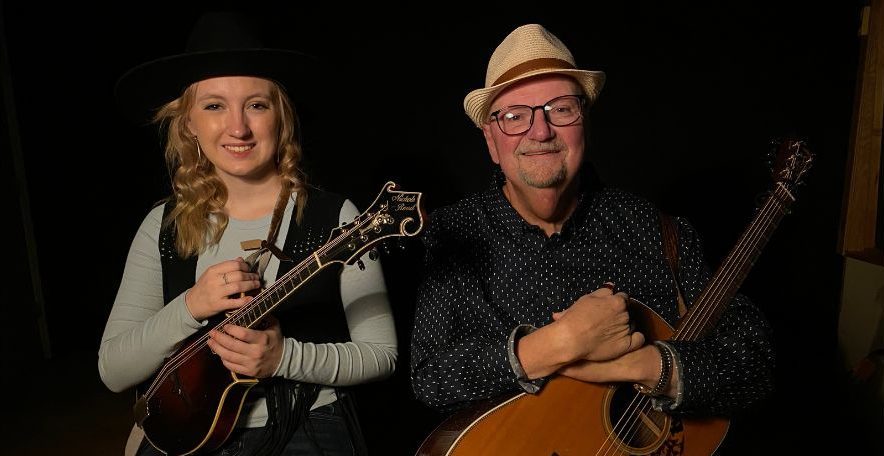
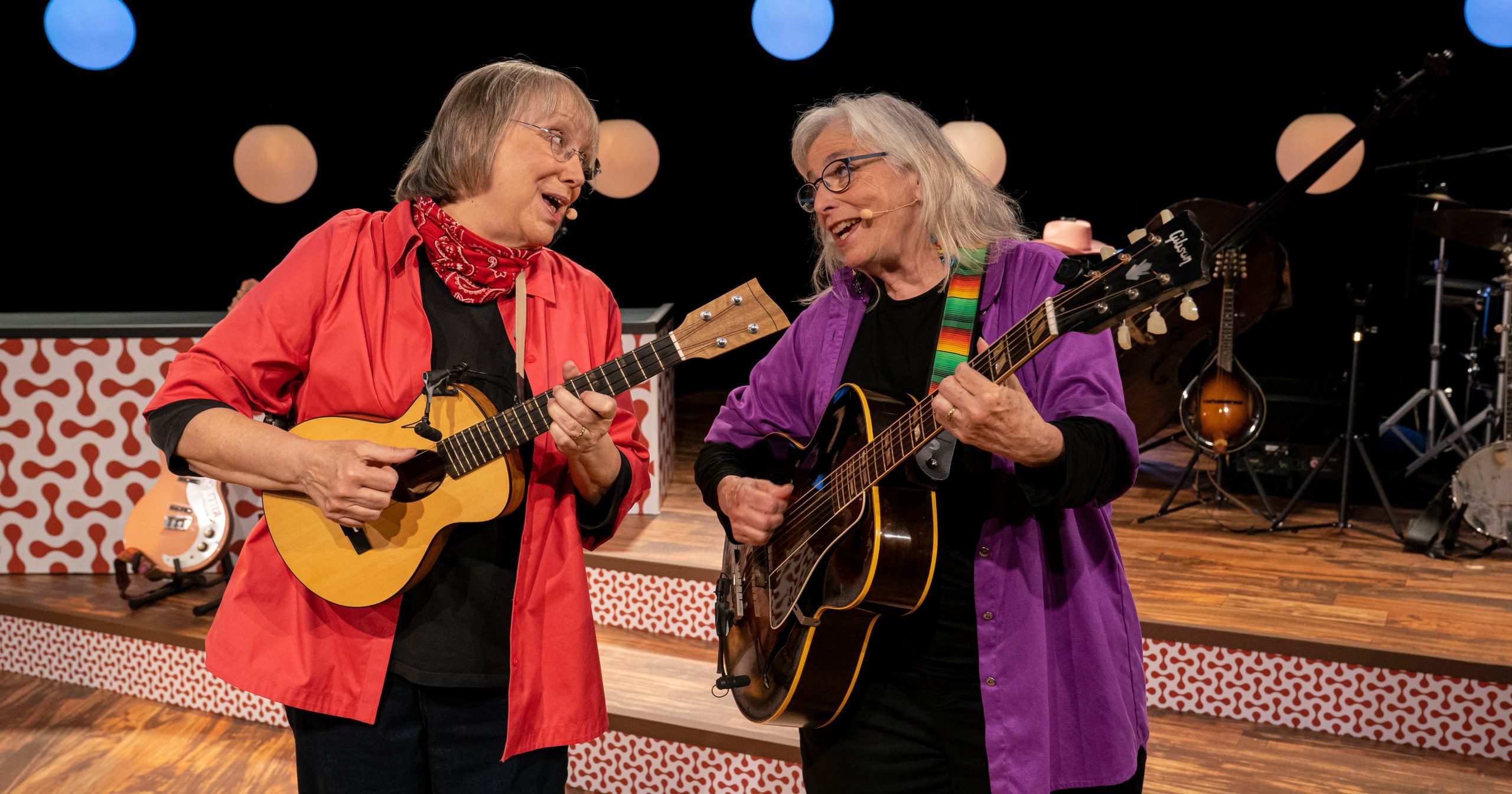
There is hardly a sphere of the music industry that musicians and community builders Cathy Fink & Marcy Marxer have not conquered, from bluegrass and folk music to children’s music and the Grammys. Now, these multi-hyphenate musical polymaths have set their sights on a new medium through which they can create, storytell, and connect with audiences: film.
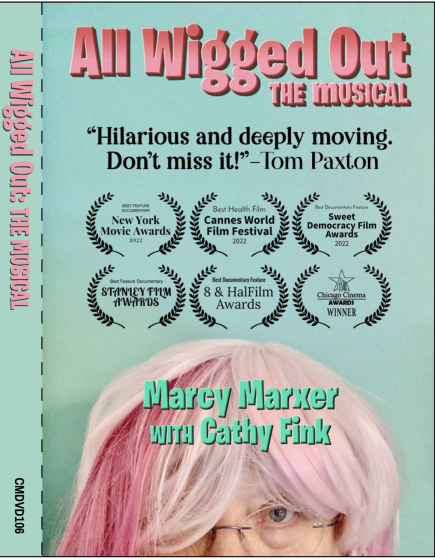
All Wigged Out is a documentary musical film that tells the story of Marxer’s journey through breast cancer diagnosis, treatment, and recovery. The film, which will be available on demand May 16 on Amazon, Google, and many more, utilizes musical mastery, eclectic wit, storytelling, and comedy to share the poignant, bittersweet, hopeful, and downright zany tale spun together from Marxer’s unique perspective, writing style, and multi-instrumental approach. On April 28, an album of the catchy, hilarious, and touching songs from the musical – entitled, All Wigged Out: Songs from the Musical – will be available wherever you download and stream music. (Pre-order on Bandcamp). Watch a trailer for the film:
“[All Wigged Out] is a way to entertain people, but educate at the same time – educate patients and caregivers,” Marxer explains via phone. “Not educating in a condescending way, but there were just so many things that I could not expect, that I didn’t know how to deal with. This is just a way of sharing my experiences – which is just one experience – and help folks to live life one day at a time, doing your best with what you’ve been given to make decisions and move forward. And the next day, when everything changes, you still just make the best decisions that you can at that moment. Then you can live life with no regrets.”
“And don’t lose your sense of humor!” Cathy adds from the background – they both laugh.
Over the course of their widely variable careers, Fink and Marxer have certainly never lost their senses of humor – cancer or not. Together and separately, their careers have exceeded four decades in folk music, old-time, bluegrass, children’s music, and so many other realms of the entertainment industry. It comes as no surprise, that despite not having any prior experience writing, producing, and staging a musical documentary film, that they were able to leverage their personal and professional communities, teach themselves these often punishing skill sets with steep learning curves, and put together a film that’s musically engaging, humorous, joyful, and actually says something. All at a markedly clean-and-crisp, professional level.
All Wigged Out also shines a spotlight on Cathy & Marcy’s relationship, the way they rely and depend on each other not only in their musical careers, but also in their personal lives. They demonstrate, through this film and in all their efforts, that their penchant for community and community building starts at home. They’re committed leaders, mentors, and friends to all in the roots music industry and beyond, so it feels absolutely grounded and genuine to see them both expand their vision for community to include cancer support groups, associations, and all kinds of organizations with missions of supporting and uplifting folks who have had cancer touch their lives.
With no shortage of laurels and film festival accolades, All Wigged Out is certainly poised to bring Fink & Marxer and their community-minded music to so many new audiences within and outside of the music community, especially with their activist and organizing experience. They’ve taken All Wigged Out to screenings, talk-backs, fundraisers, discussions, and panels, often partnering with Cancer Support Communities and Gilda’s Clubs, as well as making appearances at the NC Museum of Art, Silicon Valley Chamber of Commerce, American Nurses Association, National Women’s Music Festival, and so many more.
This week, in celebration of the film’s release, they’re partnering with Ebeauty on a film screening and panel that features Marxer, her surgeon, and a representative from Ebeauty, which is a non-profit organization that facilitates cancer patients obtaining wigs and other cancer resources. During the event, Marxer will donate the film’s titular wig to Ebeauty, which will use the hair piece to train wig technicians and cosmetologists on wig styling for patients, then the wig will be passed along to another cancer patient facing hair loss as part of Ebeauty’s wig exchange program. This is just one example of the many ways this film and its music can touch folks’ lives and help them on their own journeys back to health and wellness.
Whether teaching ukulele, competing in local fiddler’s conventions, participating in diversity, equity, and inclusion efforts, or just camped out in a festival parking lot picking, Cathy Fink & Marcy Marxer lead by example, putting their hearts and souls into everything they make and by doing so, they open a wide, hospitable door to anyone and everyone they meet. The connection, compassion, and poignance of All Wigged Out will make this task even easier, despite its often challenging or bittersweet subject matter. The joy – and the belly laughs – in this film are second only to what we love most about Cathy & Marcy to begin with: their music.
Working in two separate bluegrass bands, Kristin Scott Benson and Wayne Benson normally stay busy on the road with about a hundred shows a year. However, when the COVID-19 pandemic hit, the pause on all live performances “created an opportunity as far as time for the two of us,” Wayne said.
Kristin, who has been named the IBMA’s Banjo Player of the Year five times, plays with the Grascals, while Wayne is the longtime mandolinist for Russell Moore & IIIrd Tyme Out and runs a YouTube educational channel called Wayne’s World of Mandolin. The couple, who have been married for more than two decades, have rarely shared the same stage, nor have they done much recording together. Their packed schedules, plus raising their son, didn’t leave a lot of time and headspace to think about collaborating and even talking much about music.
“So all of a sudden, we’re at home and we just started talking about different songs and who we thought would be a good voice for that song,” Wayne continued. “And the next thing you know, there was enough discussion that there was a record there.”
A melding of the artists’ styles and taste, that record is the couple’s first full-length creative project together and their debut as Benson. Kristin said the project pushed each of them artistically, in the best kind of way, and gave them the chance to record songs and try things they might have not gotten to otherwise.
“We’re dyed-in-the-wool, traditional bluegrass players at our heart, that’s our deepest roots,” Kristin said. “But his instrumentals can lean very forward and be a little bit more on the progressive side than the ones I typically write — I’m more of a traditional-style banjo player. So if you look at this record, it’s a balance between who he is and who I am.”
BGS: How did the collaboration, which began while in pandemic isolation, take shape?
WB: It would just happen in moments when the subject would come up and we would talk about it. We never really scheduled time that we were going to put into it, never had to. If we were trying to make it and there had never been COVID, it would have been more of a process. But it just fell into place. A lot of it did, [including] the album cover, that “pick your poison” thing that’s on the window right behind where I’m sitting. And when we looked at those pictures that day, it was like, that’s got to be the name of the record because it is about musical diversity.
It has this song “Red Mountain Wine,” which is like a straight-ahead, you know, three chords and a cloud of dust kind of song. And then there’s the far more contemporary-sounding things. And then some of the instrumentals that I wrote are right outside the edge of the bluegrass umbrella. We talked about how we felt like all of that could come together because we live in a world now where most people are never going to purchase a physical copy of the record. People stream what they want to hear. So I think you can get by with this kind of an approach more so now than ever before.
Was that desire for a diverse array of music there from the beginning or did that evolve as things went on?
WB: I think it was inevitable because we have different tastes in music and different things that we feel comfortable with, and finding something that works that we felt like it was in our wheelhouse.
KSB: I’ve done banjo records; some were all instrumental and some also had vocals, like the last record I did was called Stringworks and it was half and half. Then Wayne has a mandolin CD of all original instrumentals. And if you look stylistically at those records, this album is a little bit in between, and part of the difference is just creatively.
WB: We each stretched in different directions, more so than if I would have been doing just a solo project for myself. I would have recorded all instrumentals. And Kristin has this real gift for finding material and then pairing it with a singer that would be comfortable with the particular song.
The first single released from the album was “Conway,” an instrumental written by Wayne years ago. Tell me about the story behind that song and why that was the tune to lead with in announcing this new creative endeavor.
WB: I was really surprised [the record label Mountain Home] wanted it to be an instrumental. But I think it was a good thing to warm people up to the project. And it’s really weird because I wrote that tune probably 15, maybe even more, years ago. Conway, South Carolina, is the town that that tune is named after, like in the tradition of Bill Monroe, when you have “Louisville Breakdown” or “Pike County Breakdown,” all these tunes that are basically just a location that they happen to be in, or that it reminded them of, or whatever. It was, to me, a little bit scary for that to be the first thing because it was something from so long ago. The energy of writing that or pouring anything into it, I had totally forgotten about, where normally when you’re recording something you have these recent memories of caring about it that much. And all of a sudden, this song is going to be the flagship.
KSB: It’s a groovy track though. Wayne said that I had a knack for finding vocal songs that worked well with bluegrass. Well, I think Wayne has a knack for creating simple, hummable melodies, and then arranging those, employing them in a way that you can stretch out and play different things. One of the things that I like about musicianship is when you can grow a simple idea and do a lot of different things with it. And if you take “Conway,” for instance, it was a pretty happenin’ little demo that he did. The nugget is approachable and accessible to anybody’s ears… It’s the simple melody, but a lot of groove and is super fun to play, that stuff when it’s all about the feel. I had a ball [playing it]. And as for the first song released, I hope it makes people feel good. And it’s been interesting to get to pull some of these tunes that Wayne wrote long ago and get to play them.
WB: That was written not too long after [our son] Hogan was born. That tune is the spirit of that season; having a baby that’s that small and everything that that brings out emotionally. And tunes should represent those seasons of your life.
The second single from the album was a cover of Matthew West’s “Oh Me of Little Faith,” featuring your church friend Heath Williams on vocals. Why did you want to include this song and how does it speak to each of you?
KSB: This was my favorite song.
WB: It’s my favorite track, too.
KSB: I lost a first cousin, and he was not much older than me. At the funeral, they played a Matthew West song. I’m tuned into some contemporary Christian music, but Matthew West was new to me. I loved the song they played, so I started listening to his music. And as soon as I heard this song, I knew that I had to record it somewhere. It has a wonderful tempo and feel to play the banjo on. The message in the song also really spoke to me because I had always thought of the section of the Bible where the desperate father goes to Jesus and says, “Lord, I believe, but help my unbelief.” I always thought, well, I need a lot more than that. It’s a song about doubt and grace. And if I had the gift of writing lyrical content, I would have written a song like that because it was a sentiment that I had related to for years. When I heard it, it just spoke to me in a powerful way.
What’s another track you’re excited about on the album and want to give some love to?
KSB: I really like the track “Look at Me Now.” We’re both huge New Grass Revival fans. And later in their career, like right before they broke up, they had a lot of mainstream-feeling country songs still with the brilliance of Sam Bush, Béla Fleck, Pat Flynn, John Cowan and others. The songs were just remarkably good and commercially accessible. To me, “Look at Me Now” is a bit patterned after that, whether we meant for it to be or not. But it’s a ’90s country song that I heard when I was a young teenager, and even then I identified the chord progression as clever; it has some interesting chord changes and I thought it was a neat song. So I just filed it away. That’s what inevitably happens for musicians; you are constantly listening to music with an ear toward what might work for you. That song just stayed with me always. We took a page out of the New Grass book when we play the chorus and it’s the full 4/4 feel.
What are you each listening to at the moment?
WB: I’ve actually been into bluegrass lately, which typically I’m not. I’m a mandolin geek, for sure. I like everything under the mandolin umbrella. But I go through phases of what I listen to and a lot of times it’s classic rock n’ roll music. But last night, I was listening to some early Doyle Lawson & Quicksilver.
KSB: He’s listening to more bluegrass now than I remember ever.
WB: Part of that, I think, is because, again, the pandemic changed so many things… We would listen to bluegrass on the bus and I think it’s that void of not listening to bluegrass with the guys in the band. Because it just makes you feel good to hear it. When I listen to Bill Monroe or Flatt & Scruggs from the 1950s, it just relaxes me to hear it.
KSB: For me the ultimate wake-up call if I’m getting sleepy and trying to stay awake is Doyle Lawson & Quicksilver because that’s the music that made me want to play bluegrass, and there’s nothing that inspires you more than the music that made you want to play in the beginning.
[Editor’s note: All photos by Carl Fleischhauer, except publicity shot of Esco Hankins]
On the afternoon of Sunday, August 13, 1972, Carl Fleischhauer and I were in Jackson, Kentucky, at the finale of Bill Monroe’s Kentucky Bluegrass festival where we’d been since Friday. In my notes, I wrote:
We left after talking briefly with Monroe (I bought his new LP [Bill Monroe’s Uncle Pen] and latest single [“My Old Kentucky and You”] from him) and drove [85 miles northwest] to Lexington where we got a motel — the Flora — run by an 85-year-old lady who liked Bill Monroe and told us that Uncle Dave Macon stayed in the Flora whenever he visited Lexington. Dinner late on the [U of KY] campus or near at an Italian restaurant — snuck in leftover wine and had ravioli. Sure was good to bathe and sleep in an air-conditioned room.
Monday morning after breakfast downtown and some cursory hunting in record cut-out bins, we headed to the Esco Hankins Record Shop. Tennessean Hankins, a Roy Acuff-style singer, began his recording career in 1947. He settled in Lexington in 1949 and performed for years on WLAP with his wife Jackie and his band, which included Dobro player Buck Graves. He also performed weekly on The Kentucky Mountain Barn Dance, which started in Lexington in 1949 and was broadcast on WVLK.
Jackie and Esco Hankins publicity photo, original date unknown.
Flatt & Scruggs joined the Kentucky Mountain Barn Dance cast that year, influencing both Graves – to whom Earl taught his right hand, three-finger roll – and young J.D. Crowe, who was a regular in the audience and often went with his dad to observe Scruggs rehearsing with Flatt for their radio shows at WVLK. In 1950, at age 13, inspired and informally tutored by Earl, J.D. got his first banjo and began practicing what he’d seen watching Earl in action.
Esco Hankins Record Shop, Lexington, KY, April 1972.
Hankins held amateur country music contests, and at one he discovered teenager Crowe, who soon became part of his band. Marty Godbey’s Crowe On The Banjo: The Music Life of J.D. Crowe (2011) is a fascinating biography that narrates in great detail much of the story I would hear in my interview with Crowe that day in 1972. Early on, Godbey quotes from one of her interviews with J.D.: “I played for him quite a bit, it was my first paying job.”
Esco Hankins in his record shop in Lexington, KY, August 1972.
I knew nothing of Crowe’s connection with Hankins on that morning when we walked into Esco’s shop. We browsed, bought some records, and then got into a conversation with him about country music history. He generously gave me a number of old songbooks and then, when we mentioned our interest in interviewing Crowe, he phoned Lemco, the Lexington record company with whom Crowe had recently made three albums and several singles, to get J.D.’s number. My notes:
…he ended up calling first Lemco and then J.D. Crowe and then handing the phone over to me to talk with J.D. — I thought it was still Lemco and went into a long rap about my project and what I was doing and how I would appreciate if they could put me in touch with J.D. — and the voice said, “This is J.D.” and I was embarrassed but maybe it was a good thing…anyhow we made an appt. for 3:00…
Esco Hankins in his record shop in Lexington, KY, August 1972.
Today, Crowe is best remembered as the banjo picking leader of the progressive New South, whose 1975 Rounder 0044 album with Skaggs, Rice, Douglas and Slone has become a modern bluegrass icon. He also was, in 1980, a founding member of the bluegrass supergroup The Bluegrass Album band, playing solid, perfectly timed, and driving banjo based on the style of Earl Scruggs and singing the harmony parts he’d learned with Jimmy Martin. He died on Christmas Eve, 2021.
When I interviewed him in 1972, he’d been living in Lexington, his birthplace, since returning in 1961 after a five-year stint with Jimmy Martin and the Sunny Mountain Boys. For the next seven years he’d worked day jobs (with a couple of brief stints back with Martin) while playing in local taverns with his group, The Kentucky Mountain Boys.
In 1968 they began appearing six nights a week at the Red Slipper Lounge in the Lexington Holiday Inn. It was a change from his former blue-collar tavern milieu – lots of young college students in the crowds. This gig was going strong when Carl and I visited him.
The Holiday Inn, Lexington, KY, April 1972. Featured at the Red Slipper Lounge at the motel that night was J.D. Crowe and Kentucky Mountain Boys.The Holiday Inn, Lexington, KY, April 1972. Featured at the Red Slipper Lounge at the hotel that night was J.D. Crowe and the Kentucky Mountain Boys. Left to right: Larry Rice, Bobby Slone, Tony Rice, J.D. Crowe, and Donnie Combs.
J.D. was now working full-time at his music. A number of notable musicians had worked for him in The Kentucky Mountain Boys, like Doyle Lawson and Red Allen. At this point, in 1972, his band consisted of Larry Rice, mandolin, Tony Rice, guitar, Donnie combs, drums, and Bobby Slone, bass. He had just changed the name of the group to the New South.
I had first seen Crowe in April 1960 when I went to Wheeling, West Virginia, with a couple of college friends. A month earlier we had opened for the Osborne Brothers at Antioch College. Bobby Osborne had urged the audience to come see them at the Wheeling Jamboree at WWVA. We took him up on it at spring vacation.
We drove down from Ohio and took a cheap room in a hotel close to the Virginia theater where the Jamboree was held. That evening we saw the Osborne Brothers as expected, but just the two of them were there. Bobby played guitar and sang “Down The Road” while Sonny picked the five. Good music, but no band! We enjoyed some of the country acts like Rusty and Doug and the fiddling of Buddy Durham. But we weren’t expecting any more bluegrass when Jimmy Martin and the Sunny Mountain Boys were introduced. It was the most memorable moment of the evening for us.
The four-piece band – Jimmy Martin, Crowe, mandolinist Paul Williams, and fiddler Johnny Dacus – bounded up to the mic from backstage and opened with Crowe’s the up-the-neck single-string banjo intro to “Hold Whatcha Got,” Martin’s latest single.
The audience, which included a bunch of young women seated up front who had cowbells and knew how to use them, went bananas. It was a tight band, thought by many to be Martin’s best, and we were very impressed. Crowe’s banjo break was amazing. It marked him as a unique stylist.
Thereafter, when talking with fellow banjo pickers, I identified this single-string work as “J.D. Crowe style.” The success of “Hold Whatcha Got” led Martin to record several more using the same rhythm and banjo break style.
Following our experience in Wheeling, we began listening to Martin’s late Saturday night show, after the Jamboree, on WWVA. The live sound of new songs like “My Walking Shoes” – driving, up-tempo stuff with Crowe’s banjo out front – caught our ear.
J.D. told Marty Godbey about watching Earl rehearse: “I was more interested in trying to learn the breaks to songs and backup than instrumentals.” His work on Martin’s Decca recordings was definitive; Martin’s banjoists were told to play it like J.D.
He began to record on Lemco with the Kentucky Mountain Boys in 1969 when the band included Doyle Lawson and Red Allen. This was the most recent Crowe recording I’d heard at the time of our August 1972 interview.
That afternoon Carl and I drove to his trailer park home. We set up my cassette recorder and mic, and I began the interview with a few ethnographic questions: “Let me ask you just some of the basic things, like how old you are and where you were born and so on.”
J.D. Crowe home, Lexington, KY, April 1972.
He was 34 and told of childhood with country music on a farm six miles outside of Lexington. Then he described how his musical calling emerged in the fall of 1949 after Lester Flatt and Earl Scruggs came to town.
I saw them in person before I ever heard their records. Cause, the first record I heard of them was one called “Down The Road.”
“Down The Road” was Lester and Earl’s newest record release in October 1949.
His family were regulars in the audience at the Kentucky Mountain Barn Dance.
And I saw, they came here — fact, I never heard of ‘em!
They was there one night, and they was so well received that they was hired.
His first banjo was a 39-dollar Kay, but within a year he’d moved up to a Gibson. Scruggs was his informal mentor. At fifteen he was playing dances and at sixteen Jimmy Martin hired him after hearing him playing on the radio with Hankins. “Hankins?” I asked.
Yeah, I guess that was the first person I worked with professionally.
J.D. Crowe at home in Lexington, KY, August 1972, during a visit and interview with Neil V. Rosenberg (left).
After five years working full-time in Martin’s band – in Detroit, Shreveport, and Wheeling – J.D. quit. It was 1961, he was twenty-four.
I think I just, a, kindly got tired, I mean, you know, wanted to try something different.
This was a phrase he used several times in the interview: I just wanted to try something a little different, he said later, speaking of the band he started. Moving back to Lexington, he got a day job, and formed The Kentucky Mountain Boys, who played five nights a week in local clubs until 1968. Then the Holiday Inn gig came along:
I give up my job and I’ve been doing it full-time ever since.
As a bandleader, he stressed the hard work involved in building a career:
…you know how the music goes, unsure, you know. Which anything is, really when you get down to it. It’s just what you want to make out of it, and how hard you want to work… And a, believe me, it’s, it’s rough. A lot of people, you know, think it’s a lot of, a bowl of cherries, you know, just have a good time, but it’s not like that.
“I suppose the picking is only the small part,” Isaid.
That’s just the smallest part of it, really.
J.D. explained how his full-time band operated – fall, winter, and spring they played six nights a week at the Holiday Inn. Then they took the summers off:
Work road shows.
He told me about his band members — mandolinist Larry Rice, his brother Tony, and Bobby Slone — and explained about the Rices’ California connection:
They were born in Danville, Virginia, but … they went to California when they were just little shavers and they lived out there I guess ten or twelve years in Los Angeles. And that’s where Larry came from, he was living there at the time… Bobby Slone, our bass player, he’s been with me I guess about six years. Well, he used to live in California also, and he had worked with them when they was growing up and so he told me about them. And of course, Tony I met after Larry joined me. He moved back to North Carolina and he came up.
His band were all veterans of the late ’60s LA scene where folk-rock and country-rock had blended with bluegrass. That musical mindset had a kind of creative vision that Crowe could empathize with.
I used to be, if it didn’t have a banjo in it, then I’d cut it off. But now, with the exception of rock and roll and blues. I’ve always liked it. I used to listen to blues, just all the time. I like the style of B.B. King, of course he’s still going, you know, and, a Fats Domino, Little Richard, you know … they was in the fifties. And there’s just a lot of ‘em, and of course the rock changed you know, course what they call country rock, which is good, I like that. In fact, we do quite a few numbers of that ourself.
I asked: “When you were leaving Jimmy Martin, were you thinking of putting some of that into your music?” He explained:
That wasn’t out yet … I didn’t have too much choice. You (could) only do country, do bluegrass, or you just do hard rock. But now there’s so much new stuff’s out that it’s just endless, to what you can do, and take over songs and adapt them over, your own little thing, in style.
You can take with what you had and combine it with a couple other forms of music and come up with a little different gimmick, a little different style. That’s the whole thing, that’s what you got to have.
Perhaps the most novel aspect of the New South sound at this time was the fact that since the prior September – almost a year before – they had been playing electrified instruments.
I had the idea, you know a, maybe that might be the answer, because, like I say, like we couldn’t get any records played on country stations.
The Osborne Brothers had gone electric in 1969; J.D. said their example had influenced him “a little bit.” Also in 1969, Earl Scruggs had begun playing an electrified banjo with his sons in the Earl Scruggs Revue. Jim & Jesse had done an electric album in 1971. I asked J.D. if he’d recorded with his electric group.
The latest single is. Course I use a steel and a piano and a drummer, the whole works on that. In fact I didn’t play too much banjo, on account, if there’s a lot of banjo, some things, they won’t even, some stations won’t play it.
At J.D. Crowe’s home in Lexington KY, August 1972, during a visit and interview with Neil V. Rosenberg (right) as reflected in a mirror that also caught photographer Carl Fleischhauer.
We’d just been at a festival; I wanted to know what he thought about festivals. Had they helped his music?
The festivals have helped to a certain extent. You know. Right now, they’re trying, they’re getting too many of them, in my opinion. Cause you can over do a good thing, you know and, which I know we worked some of ‘em that didn’t turn out so good … most of ‘em, though, we’ve worked this year have all been great big ones, I mean a lot of people. And I figure they will probably continue having that kind of a crowd. And I think that it’s, it’s helped.
“Is it a different kind of crowd than the country music crowd?”I asked.
A, not really, I’d say a people that go to bluegrass festivals would also go to see Porter Wagoner and Conway Twitty and Merle Haggard — Nashville, you know. They like it, course they like bluegrass too. A lot of your country people, you know, like other types. There’s — they like it, but they won’t come out to see it, you know, they don’t like it that good. They can take it or leave it, in other words. That’s what you got to get to, those people, the general public. You know, cause there’s a lot of people come to the festivals and — but you know if you figure, the population of the world and you know, don’t look, it’s not too good a’ odds, so…
An experienced observer of the ongoing bluegrass scene, J.D. was keenly involved in his music business. He spoke of recording studio dynamics, record company practices, broadcasting politics, fan magazine reviews, and other factors in running a band.
At that point I turned off the recorder and asked if he would show me his electrified banjo. When I turned the recorder on again, he was giving me the history of his banjo, starting with the neck:
This, this is original here, this part as you can see was pieced from a tenor, you turn it over and it’s a great job — see, that’s been pieced.
(N:) Oh, yeah.
(J.D.:) From there up. They matched it perfect, see, you can tell, right there, it starts up on the neck, go right in there, or right here, you can see its smaller up the neck.
(N:) It’s a splendid job.
J.D. Crowe at home in Lexington KY, August 1972.
J.D. had seen a lot of old Gibson Mastertones over the years. He knew chapter and verse about wood types and design details. But I wanted to know about his electric setup. I knew nothing about electric instruments, which were anathema to the ’50s folk revival I’d grown up in. He spent some time showing and explaining the details of his still-experimental pickup system (Godbey describes it well, p. 110). Carl asked if he could take a picture, J.D. politely told him no.
He told me what it was like to be playing electric, with the strings closer to the fretboard (“low action”) than on an acoustic:
(N:) Can you do licks that you wouldn’t otherwise do?
(J.D.:) Yeah. You can do a lot of stuff that holds, you know, you can get a sustain. That’s what nice about it.
Then he announced what he was hoping on for the future:
I’ve got a six-string ordered.
In 1970 Sonny Osborne had added a sixth bass string to his five-string; it was part of a lush sound – string sections, twin steels, etc. – on their latest recordings. J.D. liked the possibilities the added string would enable, especially because he, like Sonny, was playing an electrified instrument. He’d even had to cancel a contract for a bluegrass festival that didn’t allow electric instruments. He told them:
Hell no! We’re gonna play electric…. We played up here electric for nine month and [then] we played acoustical; I sounded like I was playing a two-dollar Kay. Cause your hearing gets accustomed to that volume. And it’d take me three or four months to get back on the acoustical route.
Our interview ended there. Afterward I evaluated it in my notes:
Interview with J.D. Crowe — nothing spectacular, your hr.’s worth of history, but attitudes and early learning gone into pretty carefully. Very friendly but reserved in a reassuring way. Carl busy snapping away.
J.D. Crowe at home in Lexington, KY, August 1972.
We left Lexington immediately, heading for Louisville, where we were to stay with friends of Carl’s. Consequently, I didn’t get a chance to see J.D. and his New South in action at the Red Slipper Lounge.
In 1973, the electric edition of the New South recorded an album in Nashville for Starday. Titled J.D. Crowe and the New South, it was issued on CD in 1997 under the title Bluegrass Evolution. Crowe played his 6-string on two of its ten cuts. Here’s one, “You Can Have Her.”
The album wasn’t released until 1977, two years after they stopped playing electric. In 1975 when Larry Rice left the group, J.D’s new mandolin player, Ricky Skaggs, had insisted on “acoustical.” By then J.D.’s vision of “something a little different” was working just fine without the extra electricity; Rounder 0044 came soon after.
The Holiday Inn, Lexington, KY, April 1972. The Red Slipper Lounge featured J.D. Crowe and Kentucky Mountain Boys; including Tony Rice (back to camera), Larry Rice (barely visible behind Tony Rice), J.D. Crowe, Bobby Slone (hidden), and Donnie Combs, drums.The Holiday Inn, Lexington, KY, April 1972. J.D. Crowe and the Kentucky Mountain Boys; Tony Rice (back to camera), Larry Rice, J.D. Crowe, Bobby Slone (partly hidden), and Donnie Combs, drums.
That day I wished we’d taken the time to catch the band in action, but we had only five more days for our bluegrass field trip. Kentucky was just the start; our next planned stops would take us to Ohio, Indiana, and Illinois. Recently, a recording of an evening at the Red Slipper was uploaded to YouTube. Here’s the 1972 sound of the electrified New South (with drums):
A small, enthusiastic audience of first arrivals chat in excited, hushed tones as they listen to Hubby Jenkins soundcheck into a pair of Ear Trumpet Labs microphones in the ballroom at Fort Worth, Texas’s Southside Preservation Hall. It’s an unseasonably cool Saturday afternoon in March, with crystal blue skies and wispy clouds backgrounding the historic Fairmount-Southside district. Over the next nine hours, ten musical acts will grace the stage. Many of them are already in the room, contributing to the light buzz and chatter; this already feels like a generative space.
In its third year, the Fort Worth African American Roots Music Festival (known lovingly as FWAAMFest) has a very specific vision within the Americana/folk/old-time/bluegrass festival space: to highlight the depth and breadth of contemporary African American roots music and, by doing so, underscore the seminal, vital contributions of Black folks to every single roots genre in this country. Presented by Fort Worth-based non-profit Decolonizing the Music Room (who BGS has collaborated with on multiple occasions), the event carries forward the organization’s mission, explained artfully and succinctly by DTMR founder Brandi Waller-Pace as she kicks off the day introducing Hubby Jenkins: “To center Black, brown, Indigenous, and Asian voices in music and related fields.”
“There are so many eyes and ears on culture and the arts in Fort Worth,” she continues. “And I want Fort Worth to be at the forefront of the conversation…”
Hubby Jenkins began the day’s many conversations with a couple of banjo tunes, because, he admitted, “I’m a little nervous and [banjo tunes] make me feel cozy.” It was indeed a lovely, cozy easing into the day’s marathon lineup of music and presentations. During his set Jenkins picked guitar, banjo, bottleneck slide guitar, and played bones. And, he plays the festival’s first of many gospel numbers, “Jonah in the Wilderness,” inviting the audience to sing along, grounding his performance in the history of the Southside Preservation Hall space and these rootsy genres’ origins.
Kicking off the day with a gospel-filled set in a historic former church made so much sense, calling each of us as listeners to be active participants in the day’s festivities and also in its mission: to recenter these community-based musics on the folks who gave rise to each of them, reminding us we each have a role to play in telling a fuller, more just history of these musics.
Next up on the lineup is Justin Golden, who jokes that he and Hubby run into each other on gigs constantly and have the same repertoire, but from the outset his similar-seeming act couldn’t have felt more different. Working within the same vernacular and with such broad overlap, Golden and Jenkins are each still so distinct and unique – and illustrate the wide variety intrinsic to Black and African American roots musics, even within one form. Golden’s first number is an original, “I Hate When She Calls.”
He peppers older, classic Texas blues numbers – though he admits this is his first time in Texas – throughout heartfelt, poetic, and direct originals. His music’s foundation is fingerstyle blues, but with modern crispness, timeless touches, and a crystalline, focused singing voice.
Festival-runner and founder Brandi Waller-Pace stepped back on stage, this time as performer, for the next set of the day with songwriter, composer, and banjoist Kaïa Kater as the debut performance of their duo, Sable Sisters. They swap out banjos and guitars and a bass, singing folks songs and originals with nearly familial harmonies. A double clawhammer banjo cover of Stevie Wonder’s “Happier Than the Morning Sun” is their set’s highlight, with the legendary Justin Robinson’s guest appearance to play a set of old-time tunes ranking an honorable mention. Other festivals would be wise to consider booking Sable Sisters; if duo supergroups were a thing, this is one. Superduo? You get my meaning.
Between each set of music, as the stage was changed over, representatives from partner organizations, sponsors, and community leaders spoke to the audience, which slowly grew from a couple dozen into a small-but-mighty one to two hundred attendees. Tables in the lobby featured literature, information, and calls to action for DTMR, FWAAMFest, and these partner orgs – and from the back of the ballroom wafted the tantalizing aromas of Lil Boy Blue BBQ. (If only all music festival barbeque offerings were this legit.)
After Sable Sisters’ set concluded, the next event was a live podcast taping featuring a collaboration between Rissi Palmer, of Color Me Country Radio on Apple Music, and Garrett McQueen of Trilloquy Podcast. The conversation was titled “Redefining ‘Classic’” and featured Palmer, McQueen, and their FWAAMFest lineup-mates Jake Blount, Demeanor, Hubby Jenkins, and Dr. Angela Wellman. Palmer and McQueen took turns prompting their panelists to consider ideas around canon, genre lines, what terms like “classical” really mean, and so much more.
A theme that emerged throughout the taping was how often there aren’t hard, fast, concrete answers to these big, zoomed out questions about justice, representation, art, creation, space/placemaking, and community building. The panelists and hosts encouraged and challenged each other and themselves, reminding all of us that engaging in these kinds of conversations is part of the process and having the space – like FWAAMFest – to engage, build, and hold community like this is so important.
It’s not lost on myself or perhaps anyone else in attendance just how much gratitude each of these participants have at being enabled to be in this FWAAMFest space. Each of the performers and speakers, in their own way and in their own words, effortlessly carried the event’s mission with them as they brought themselves to the space, wholly and vulnerably and powerfully.
The podcast recording gear struck, rapper and banjo player Demeanor took the stage for his first ever full-band set – and it was revolutionary. During the Trilloquy x Color Me Country conversation Demeanor (given name Justin Harrington) stated so eloquently that “Rap is folk music, because hip-hop is an indigenous Black American art form… From the porch to the stoop.”
He and his band immediately and indelibly illustrated his point with an energized, powerful set based on sometimes spitfire, other times free flowing rap lyrics with poppy, sung verses and choruses. It’s lyrical, content rich, witty and sharp. Demeanor’s writing and production style are full of forward motion, punctuated by arena rock guitar and Wooten-like bass lines. While often centered on banjo, the five-string is not the only way roots music oozes from these songs. Their lyrics and hooks are sharp and the vocals are strong – his singing isn’t an afterthought or simply in service of a hook. Several songs were from an upcoming unreleased album, including one stand-out track said to feature Rhiannon Giddens (his aunt) and Charly Lowry.
The delight of Demeanor gave way to the delight of dance and musical dialogue, as longtime friends and jaw-dropping collaborators Jake Blount and Nic Gareiss took the stage. Blount began the set solo, accompanied starkly by low, droning synth sounds gently, languidly warbling through half tones as he sang, dirge-like, above the sound bed, commanding silence. Blount brings us back to gospel, again looking backward to look forward, and in just a couple numbers the droning synth gives way to droning fiddle.
Gareiss and his singular approach to percussive dance and traditional step-dancing injects energy and joy into the crowd, who’ve been listening and engaging for almost six hours now. Audience members are on their feet, often with phones out, disbelieving the stunning musicality of Blount and Gareiss together, sixteenth notes perfectly, bafflingly in sync.
Nic dancing to Jake’s fiddle recalls the interconnectedness of Irish step dance and Black percussive dance traditions. Where cultures, practices, and folkways overlapped at the lowest of classes in America’s urban centers, dance flourished and Irish step dance cross pollinated with Black movement traditions and Appalachian and southern steps. Over the past century and more, movement and roots music have often been compartmentalized, privatized, and sequestered from each other. Bringing them back together in this intentional way is not just a radical act given the identities represented – in this duo and in this day of programming – but simply by existing together, with intention, Blount’s and Gareiss’s talents underline what these musics were initially created to do, say, and be.
The vibe in the Southside Preservation Hall ballroom at this point was reaching “full blown party,” and when the first of the festival’s headliners, Tray Wellington Band, took the stage the energetic momentum was raised further still. For all intents and purposes a straight-ahead bluegrass band, Tray Wellington’s four-piece group demonstrated this IBMA Award winner has found his voice. His critically-acclaimed album Black Banjo certainly feels mature and fully-realized, but this was the first this writer had caught Wellington’s band since long before that record was released. The growth they’ve sustained, musically and as a unit, in the interim is remarkable. They execute chamber music level virtuosity, but with bluegrass bones. With Katelynn Bohn (bass), Josiah Nelson (mandolin), and Nick Fallon Weitzenfeld (guitar), Tray references Dawg, Béla, New Grass Revival and many more, but with an underpinning that feels as bluegrass as Appalachia – say Johnson City, TN, where he’s from.
They play a Kid Cudi cover, which is promised to be on an upcoming release, and the audience descends into mayhem as the melodic hook is slowly recognized in ripples throughout the crowd. Whether covering hip-hop or playing an old-time tune, these pickers demonstrate amazing soloing: modern, in-the-moment musical ideas without ego or self-absorption. And with Tray’s right hand anchoring all of the above, it reminds of Earl Scruggs in his Revue days – solidly bluegrass, but intimating musical ideas that come from so far afield, way beyond what we consider bluegrass territory.
Chambergrass, or whatever you want to call it, is seen as more “high-brow” or “intellectual” given its adjacency to conservatories and storied music schools, but this style of virtuosic playing is so well placed within the musical vocabularies of people from the region that birthed string band traditions. And in this context it can be executed with equal ease, aplomb, and athleticism, and with a much more grounded approach.
A quiet, slightly exhausted euphoria tingles through the stalwarts of the crowd who remain for Jackie Venson’s no-holds-barred FWAAMFest finale. Waller-Pace returns to the stage one final time to introduce the night’s last headliner, with her daughter Sparrow (who waits patiently to get her Jackie t-shirt signed at the end of the night.)
Venson is accompanied only by drummer Rodney Hydner – and her signature DJ sampler that allows her to play along with tracks, sound beds, background vocals, and play solos over loops. Even with just a two-person act, her trademark joy immediately washes over the entire room and re-energizes the crowd. Venson’s songs are soaring, anthemic, and huge, matched only by her broad grin as she smirks and laughs at herself and her own playing like it’s an inside joke.
Perhaps the best guitarist of her generation, certainly the best rock-blues guitarist of the past thirty years, the internet is in a four to six week feedback loop of discovering and rediscovering Venson’s playing at the moment, with her Tweets and TikToks seemingly going wildly viral about once a month. She’s been retweeted and signal boosted by a who’s who of Twitter personalities and musicians, and it’s all because hers is a singular voice, perspective, and skill.
Watching her improvise over each song recalls Nic Gareiss’s dancing from earlier in the evening. When you’re watching something so visceral and in the moment, you can’t help but inhabit that moment with them. And many of us do inhabit these moments with Venson by moving, standing, dancing, reveling in the ever-present joy of her music.
Venson’s brand of modern blues is unconcerned with divorcing itself from the blues of the past (and of the present) that some feel is stoic, stuffy or dusty, and out of step with modernity. Her brand of blues, no matter how distant it has traveled from its roots, still honors the sounds of old-time and ragtime and down home blues, because it knows where it came from and to what it’s connected. Venson’s connections to Texas and Austin further reinforce this point – and help place Venson and her style of playing squarely within “guitar culture,” too.
At one point during her performance Venson marveled at how the FWAAMFest gathering was, in her words, “Pretty legendary!! You’re going to be talking about this in 10 years, telling people you saw everybody on this lineup here today.”
It was a feeling that began creeping up much earlier in the festival, that what we were present for wasn’t just a community music festival, it was so much more.
Black, Brown, Indigenous, Asian, and Disabled folks – artists and creators and movers and musicians – continue to offer and model ways to hold the past within ourselves while looking ahead to the future, a duality that modernity and westernism struggles to acknowledge or inhabit. What’s striking about this conglomeration of creators and musicmakers on this lineup at this festival is that they make it look easy. It seems effortless to understand, uplift, and uphold a mission like FWAAMFest’s. Partly because the participants all are stakeholders in that mission to begin with! With their music, their insights, and their storytelling these musicians and thinkers demonstrate the past is the future and the future is the past. Roots music – the kinds that center the experiences, stories, and seminal contributions of Black, Brown, and Indigenous folks – can spotlight and move through this dichotomy better than so many art forms, while remaining grounded firmly in the present.
FWAAMFest’s success wasn’t simply because it’s a festival with a novel, substantive mission. It was a soaring, generative, forward-looking success because it focuses on what “the mainstream” perceives as a niche within a niche within a niche – African American roots music – and shows all of the possibilities, all of the many universes of artistic expression endemic to such a niche. The specificity here is not prohibitive or exclusive, it’s unfailingly, infinitely expansive. In sound, genre, content, tradition, and beyond.
As Jackie Venson said, we all will still be talking about 2023’s Fort Worth African American Roots Music Festival for many years into the future.
Editor’s note: Follow Decolonizing the Music Room on social media to catch footage from FWAAMFest 2023 as it’s released and make sure to DONATE to support their mission and future FWAAMFests!
Artist:Leftover Salmon Hometown: Boulder, Colorado Song: “Blue Railroad Train” (Feat. Billy Strings) Album:Grass Roots Release Date: May 19, 2023 Label: Compass Records
In Their Words: “We had a good time making this record. Compass Records has a great studio in Nashville, where some great records have been made. Let’s just say Aereo-Plain by John Hartford was recorded there and Outlaw Country was born there. It’s a good place to make an album about roots, which is what we were after on this one. We cover the music that inspired us to be on this Polyethnic Cajun Slamgrass highway all these years. With guests Billy Strings, Oliver Wood and Darol Anger, we stop in on visits with Bob Dylan, David Bromberg, Link Wray, Dock Boggs and more of the sounds that made us who we are. Hope you enjoy our Grass Roots.” — Vince Herman, Leftover Salmon
BGS is thrilled to announce the full lineup for our fifth-ever bluegrass stage at Bourbon & Beyond 2023, held at Highland Festival Grounds of the Kentucky Expo Center in Louisville.
In addition to main stage headliners including Billy Strings, Brandi Carlile, The Avett Brothers, The Black Keys, Jon Batiste, and many more, BGS will once again be taking over the Bourbon Tent from September 14-17, presenting some of our favorite bluegrass and Americana acts for fans to enjoy, all while sipping samples from over twenty distilleries.
Two Runner | Clay Street Unit | Myron ElkinsFRIDAY The Lil’ Smokies | The Cleverlys Twisted Pine | Lola Kirke | Armchair BoogieSATURDAY Town Mountain | Della Mae Armchair Boogie | Sunny War | Lindsay LouSUNDAY Dan Tyminski | Frank Solivan & Dirty Kitchen The Arcadian Wild | Lindsay Lou | Pixie & the Partygrass Boys
Artist:Anthony Howell Hometown: Kosciusko, Mississippi Song: “Salt River Canyon” Album:Hold Back the Dawn Release Date: March 14, 2023
In Their Words: “I first heard this song a few years ago, when I was working with Williamson Branch. It’s off of a solo album that Kevin Williamson released in 1993 called Write Between The Lines. Kevin’s a great songwriter, and I tend to think that this is one of his best! I love this song because it really paints a picture. When you listen to the song, it speaks of the Salt River Canyon at night. Imagining the canyon at night with a full moon and stars, shining into the Salt River, would be a beautiful sight to see. With the unique chorus melody, and the harmony stack, I fell in love with the song, and I’m very excited to have recorded the song myself. I loved the song so much that I wanted to release it as the leading single from my new album. I actually used a line in the third verse for my album title, Hold Back The Dawn. This track features Kevin Williamson on lead vocals, Shawn Lane on tenor vocals, and myself on baritone vocals and all of the instruments.” — Anthony Howell
Artist:Stillhouse Junkies Hometown: Durango, Colorado Song: “1963” Album:Small Towns Release Date: April 7, 2023 (vinyl) Label: Dark Shadow Recording
In Their Words: “‘1963’ was written only a few months after I moved to Durango, Colorado, from New England where I had left behind a high school teaching career. I was feeling nostalgic and more than a little uncertain about what my new life would look like in the mountains, and tried to tap into that feeling to write one of the earliest Stillhouse Junkies songs. It’s the story of someone who, looking back at the ups and downs of life, is OK with what was and what never came to be, and has made peace with lost love. The song is also a not-so-subtle tribute to single malt whiskey in all its glorious complexity. Like a 15-year-old Scotch, life does seem to become richer with age and experience and that has been something of a mantra (and consolation) for me as I’ve navigated a new life in music.” — Fred Kosak, Stillhouse Junkies
Which artist has influenced you the most … and how?
Obviously as a flatpicker, Tony Rice. But maybe even more so, I’d have to say John Coltrane. For someone who lived such a short life, his trajectory as an artist and as a human is really beyond incredible. His recordings have influenced me in terms of specific language but also just the raw truth and honesty you can hear in the sound he got out of the instrument.
What was the first moment that you knew you wanted to be a musician?
I don’t think of it as just one moment; maybe three vignettes (for brevity). First, watching the Dineh punk band Blackfire play at the Grassroots Festival of Music and Dance when I was 14. The intensity of their performance was electrifying to see as a young person. Second, a few years later, seeing jazz guitarist Pat Martino play at Birdland in NYC. I remember leaving that show with my Dad and feeling like Pat’s 8th note lines had been fused to my brain. Last, my first real jam session and the first time I felt the moment of completely losing myself in the music. It’s an incredible feeling and so many of us are chasing it down!
Which elements of nature do you spend the most time with and how do those impact your work?
I used to be really into the “nature connection” world, animal tracking, bird language, plant identification, etc. At the core of a lot of these skills is a heightened awareness towards the ever-unfolding drama of the “natural” world. For a long time, I had kept the natural world completely separate from my musical world. I felt as though the two were somehow at odds or incompatible. In the last year or so I’ve been starting to realize just how intertwined they truly are. There is no music without nature, no nature without music and it’s a lot more fun like that.
What has been the best advice you’ve received in your career so far?
The best musical advice I ever got was from my grandpa, maybe about 10 years ago, before he passed. He knew I played a lot but that I was mostly keeping the music to myself (it’s always been a deeply personal thing for me). He told me that I needed to share the music, I needed to play WITH people and I needed to play FOR people. After he passed, I realized the value of what he told me and ever since, I’ve been trying to share music with more and more people!
If you had to write a mission statement for your career, what would it be?
I see my musical purpose as expressing myself in the truest way possible. I have this feeling/thing I’m trying to communicate, something I’m unable to say with just words, and each time I play my instrument or sing I’m getting a little closer to really expressing what that is. I think it’s the duty of a musician to try their best to express that mysterious feeling within them and at the same time, transform that feeling into something beautiful for the world to behold and enjoy.
At your average live music event on the folk and bluegrass circuit, the stage isn’t the only place where great performances are happening. There’s the campfire and parking lot picking scene at the big outdoor festivals, of course. But a lot of it goes on out of sight backstage, too, when musicians who don’t often see each other come together to play with and for each other. A close approximation to listening in on that is Mighty Poplar (Free Dirt Records), the self-titled first album by the group of the same name.
The bluegrass world’s newest supergroup, Mighty Poplar is a five-piece band centered around three virtuoso players from the Punch Brothers orbit — banjo player Noam Pikelny, guitarist Chris “Critter” Eldridge and original Punch Brothers bassist Greg Garrison, currently in the band Leftover Salmon. Out front as primary vocalist is Watchhouse mandolinist Andrew Marlin, with well-traveled fiddler Alex Hargreaves (currently knocking ’em dead in Billy Strings’ touring band) filling out the lineup. Over the years, various subsets of this quintet would cross paths out on the road and jam, generally falling back on the old numbers everyone knew as a common language. That’s how Mighty Poplar began to coalesce.
“There’s a pretty complex web of relationships between all five of us that began with a lot of hanging out,” says Pikelny. “There’s this beautiful thing about bluegrass, the amazing music and all the shared songs. There’s a great social component that can exist with the music if you let it, and it became a reason to get together and have fun.”
While none of Mighty Poplar’s members come from acts you’d really call “bluegrass,” you could say they’re all at least bluegrass-adjacent. And none of them have ever come down as top-dead-center old-school bluegrass as on Mighty Poplar. The album’s 10-song tracklist draws material from A.P. Carter, Bob Dylan, John Hartford and Leonard Cohen, with songs made famous by the likes of Hazel & Alice, Uncle Dave Macon and Bill Monroe fiddler Kenny Baker.
Monroe, the Father of Bluegrass, also figures into the proceedings in terms of inspiration for the ensemble’s name. Proposing Mighty Poplar as a moniker was Marlin, someone who definitely knows his way around names involving wordplay (witness the original name of Watchhouse: Mandolin Orange).
“I was listening to a Bill Monroe and Doc Watson live recording where they were about to kick off ‘What Would You Give in Exchange for Your Soul?’” Marlin recalls. “Bill said he and Charlie recorded it in ’19-and-36’ in Charlotte and it had been ‘mighty poplar down through the Carolinas.’ We had a huge text thread already going about band names, where my phone was always going BING at 2:30 a.m. So many names we considered, but everybody thought Mighty Poplar was a good awning to stand under.”
While Mighty Poplar is only now coming out in the spring of 2023, the album has actually been in the can for a couple of years. It might never have happened without the Coronavirus pandemic shutdown of 2020-21, which took everyone’s regular bands off the road for an extended period of time.
In isolation, everyone felt drawn toward bluegrass as the musical equivalent of comfort food. So they took this on as a pandemic project, convening with engineer Sean Sullivan at Nashville’s Tractor Shed for a brisk three-day session in October of 2020.
“There was a sense that we were getting away with murder, traveling across the country and podding up while everything was closed up,” says Pikelny. “There were logistical hurdles and we had three days, so we had one shot to get it all at once. So we worked out as much as we could ahead of time, even the sequence. The concept, if there was one, was that this was the closest thing to a real-deal, traditional, classic bluegrass project any of us have done in a long time, maybe ever.”
As lead vocalist on six of the album’s 10 songs, Marlin is the primary out-front voice of Mighty Poplar. But he felt like he had to step up his game on the instrumental side, to keep up with his bandmates.
“It was intimidating, but not because those guys are intimidating,” Marlin says. “As a musician, I’ve had to figure out how to feel like I can express myself in front of people I look up to. But that’s on me for projecting my own shit onto them, because they don’t wear that. So ‘Grey Eagle,’ an instrumental fiddle tune Alex brought forth, I was kind of sweating that one in the studio. That kicked off at 150 beats per minute and everybody else is just looking around, casually exploring the nooks and crannies of the tempo while I’m popping a vein and kind of being drug behind the horse. But I managed to keep it together. Ultimately all those guys still love a great song as much as anyone. There’s something about simple songs that leave it up to the player to bring whatever they want. I love it when the song’s not telling you how to play it, and I feel lucky that they were down to explore that approach.”
Song choice was pretty casual, mostly in favor of material from a bit off the beaten path. Even with a Hall of Fame list of songwriters, they focused on less-well-known songs from the repertoire of each — Dylan’s take on the A.P. Carter tune “Blackjack Davy” rather than “Will the Circle Be Unbroken,” or Hartford’s Mark Twang riverboat song “Let Him Go On Mama” rather than “Gentle On My Mind.”
“It all happened pretty organically,” says Eldridge. “In the initial text volley about what to do, there were a lot of songs we would’ve been happy to cut. It’s hard to say why we landed on these particular songs other than that they felt right. I would not say there was an overarching concept beyond good songs that felt right.”
While they considered including some originals, ultimately they decided to stick with covers, mostly of older vintage (the most recent song on it is Montana singer/songwriter Martha Scanlan’s “Up on the Divide,” from 2012). In that way, Pikelny looks at Mighty Poplar as a classic folk record.
“In other genres, people might call this a ‘covers album,’” says Pikelny. “But if you record solo Bach compositions, that’s not ‘Bach covers.’ It’s repertoire, reinterpretations of classics to pass down. It was born of a desire, almost a need for all of us, to gather around a bluegrass project. And it was such a joyous process. It felt like coming home for Thanksgiving or Christmas and being around family you’ve not seen in a while, in the home you grew up in with a turkey in the oven. It was that kind of comfort, the warm fuzzy feelings of gatherings like that.”
It went so well, in fact, that they were in no hurry to get around to the detail work of mixing and mastering the record after they finished tracking. Pikelny says they felt almost paranoid about not wanting to touch it, for fear of messing up a good thing.
“We’ve been sitting on this for so long because it felt like such a special session,” Eldridge says. “So effortless and deeply joyful. Magical, even. We didn’t want to let it go because it felt like all we could do was ruin it. But I kept coming back to it, listening now and then and thinking, ‘I really like this. We have to share it, plus it’s a good excuse for us to get together again.’ It’s ironic that we’ve not actually played it live yet, and we’re already kind of getting the next batch together.”
Indeed, Mighty Poplar’s first real touring commences in May. With Hargreaves busy playing arena-sized venues with Strings for the foreseeable future, John Mailander will stand in for him on the first leg of touring. And all the principles are cautiously optimistic that Mighty Poplar’s first album won’t be its last. Pikelny likens their hoped-for trajectory to Tony Rice and J.D. Crowe’s Bluegrass Album Band, which periodically convened to make albums and tours through the 1980s and into the ’90s.
“Bluegrass Album Band was never a full-time group for any of those guys, it was a very sustainable side project whose records served as homecomings,” says Pikelny. “They’d go off to do whatever else and then come back for another edition. It’s a celebration of our love for bluegrass. As long as it stays as effortless as this felt, I think we’ll keep doing it when we can.”
Photo Credit: Brian Carroll
This website uses cookies to improve your experience. We'll assume you're ok with this, but you can opt-out if you wish.AcceptRejectRead More
Privacy & Cookies Policy
Privacy Overview
This website uses cookies to improve your experience while you navigate through the website. Out of these, the cookies that are categorized as necessary are stored on your browser as they are essential for the working of basic functionalities of the website. We also use third-party cookies that help us analyze and understand how you use this website. These cookies will be stored in your browser only with your consent. You also have the option to opt-out of these cookies. But opting out of some of these cookies may affect your browsing experience.
Necessary cookies are absolutely essential for the website to function properly. This category only includes cookies that ensures basic functionalities and security features of the website. These cookies do not store any personal information.
Any cookies that may not be particularly necessary for the website to function and is used specifically to collect user personal data via analytics, ads, other embedded contents are termed as non-necessary cookies. It is mandatory to procure user consent prior to running these cookies on your website.