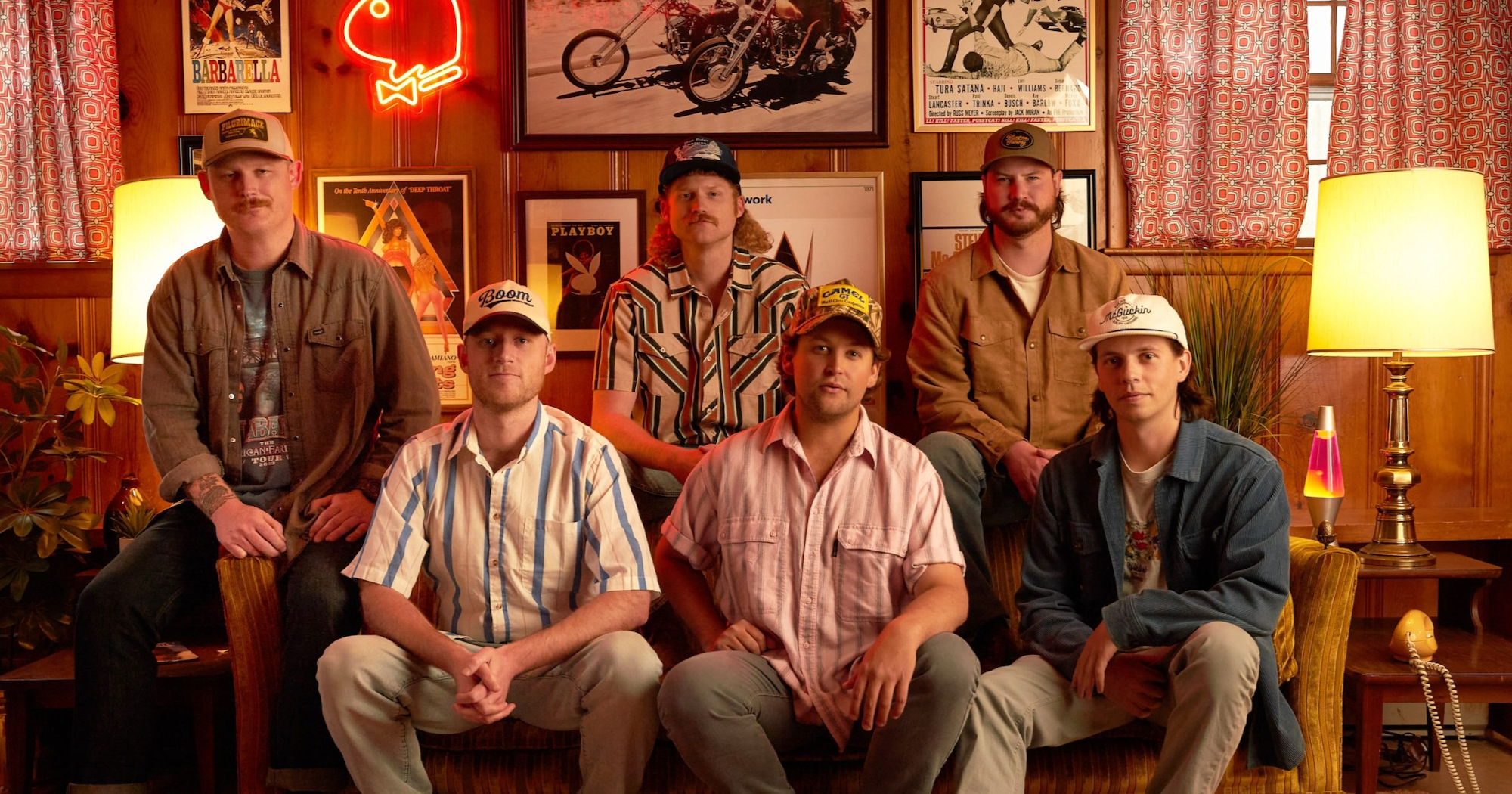
Since their inception in 2021, Clay Street Unit has quickly risen into the national spotlight. The rollicking Americana string band is garnering the frequent tag of “must-see” by their rapidly growing fanbase.
Formed in Denver, Colorado, the sextet is unique in sight and in sound. With a foundation soaked in bluegrass, the ensemble also includes a drummer and a pedal steel player – which often kicks the act into the realms of indie folk and honky-tonk. Ultimately, this lends them to a wildin’ out scene when placed in a packed room of fans and the curious alike, something that has become commonplace as of late.
It’s at this exact juncture – of deeply held dreams and aspirations coming to fruition – that Clay Street Unit will finally release their debut album, Sin & Squalor (out February 13 via Leo33). The 11-song LP is a perfect introduction to this band of melodic pirates as they currently navigate the high seas of the music industry. The record not only captures the essence of the outfit, it’s also impressive in nature, showcasing the vibrant energy of the group’s live show via the studio.
Produced by the Infamous Stringdusters’ Chris Pandolfi, Sin & Squalor is a sonic roadmap to the here and now of where jamgrass stands in the modern era. With members of Clay Street Unit hailing from a variety of places in the U.S. (Alabama, Virginia, Colorado, Pennsylvania, Georgia, Illinois), their multilayered influences lead to traditional acoustic aspects mirrored by modern sounds. Each texture a product of the unique environments from which these musicians proudly emerged.
Catching up with mandolinist Scottie Bolin and guitarist Sam Walker, the duo spoke at length with BGS about the group’s origin, how their sound came to be, and what’s in store for Clay Street Unit. The road seems to be wide open as this troupe has created quite a buzz, coast to coast, coming into 2026.
I was kind of curious about how 2025 wrapped up for y’all.
Sam Walker: I think 2025 was probably the most important year we’ve had yet. It was a huge year for us, as far as crossing off a bunch of big local goals and national goals. We got to play Red Rocks with some of our heroes and buddies, Leftover Salmon and Kitchen Dwellers. We got to play [our] biggest hometown show in Denver at the Ogden Theatre, and had the privilege of selling that place out and playing with our good buddies, Andy Hall and Chris Pandolfi from the Stringdusters. And then, we signed our record deal [with Leo33] and got to plan the rollout for this record and finally get it released.
I would surmise last year will really be setting the pace for 2026, justifying all the blood, sweat, and tears going into this.
Scottie Bolin: Yeah, absolutely. A ton of work went into making the album and getting the songs where you wanted them to be. And finally getting to tour a bunch last year has been really rewarding, getting to play these songs to live crowds and really hitting the road hard.
You guys have had a pretty fast trajectory for five years together. And I was wondering about the background of how the band formed and the timeline of how it all came together.
SW: Our former banjo player, Jack Klein, and I met one night at a brewery in Denver, a couple blocks from Clay Street and the house I was living in at the time. I played some guitar, picked tunes all night at my house, and ended up booking a gig over at that same brewery. It all happened really organically. We weren’t really trying to start a band. It just felt like the right people, right place, right time to try to get something going. We ended up meeting our former drummer and bass player, and then everything kind of picked up steam a little bit quicker than we thought.
We were playing The Patio [at Sloan’s], then [Cervantes’] Other Side, then the [Cervantes Masterpiece] Ballroom. People kept buying tickets, listening, and supporting the music. As things grew, some people weren’t really dedicated to being lifelong musicians in the band. I ended up going on tour and playing with Colorado [jamgrass] band Morsel that our bass player [Jack Kotarba] and Scottie had started. We all became really close buddies over that tour. And things kind of naturally shifted in a different direction for some members. We all kind of crossed paths at the right time.
SB: At the end of the day, we were all just kind of playing music with various groups and side projects in Denver, playing a lot of bluegrass. And things just clicked. Everyone got along really well. The band, at its core, is a group of good friends. And it just snowballed and grew from there.
SW: I moved out here to Colorado eight or nine years ago. And we had this big 4,000-square-foot party house. There were four or five guys living in it at any given time. It was just where everyone would kind of come through and hang, and we would play music all night. It felt like a revolving door of people in there. That house was kind of where everything started.
We got the band going and rehearsed. It felt like the origin of the band. We were listening to a ton of Tony Rice at the time. I kind of came into bluegrass the long way. I didn’t grow up being a huge disciple or anything like that. But, obviously, moving out to Colorado, I got a class in bluegrass culture pretty quick. We were just obsessed with that Tony Rice record, Manzanita.
Was playing in a band something you each wanted to do or is it just the way everything unfolded?
SB: I’m from Charlottesville, Virginia. I started [playing] in college [at the University of Colorado Boulder with] Morsel. We tried to make a go of it. We did a couple tours. [But], the touring lifestyle is hard and takes full dedication from the whole group. Some of the guys [in Morsel] didn’t wanna do that. So, I stepped away from that. Luckily, right around that time, I met Sam and all the Clay Street guys.
SW: I grew up down south in Montgomery, Alabama. I kind of came into it the opposite way. I played in a Widespread Panic/Grateful Dead cover band in college and just sang. Then, I moved out to Colorado and picked up the guitar. I’d always sang and written a few songs and loved live music. But, I really kind of fell into it. It wasn’t something necessarily in my early twenties I expected to be doing for a living.
All the dominoes fell in the right places and I was around the right people that gave me a lot of confidence to push the boundaries of what I was comfortable with. Playing in some side bluegrass bands around town really helped me feel more comfortable about being a part of the Denver music scene. Everything happened step by step. I wasn’t really trying to make it a career, but a few years later, it felt like something that made sense – to take the leap and try to push it as far as we can.
Your band is a huge melting pot of sound. Is that by design or just how it all just came together?
SW: I feel like it’s a little bit of both. We definitely didn’t set out or want to be a traditional bluegrass band. Obviously, when we added the drums and pedal steel and electric bass that decision was kind of made for us. It’s kind of a melting pot of everything we listen to and the music we like.
When Scottie and I go to write a song, we don’t think, “This is a bluegrass tune,” “This is a folk tune,” “This has an indie feel.” We let the music and everybody’s kind of flavor and influence on how the song’s going to sound. We don’t really try to have those guardrails of how it needs to sound or what vibe it needs to be.
When I was listening to the album, I kept thinking how I really want to see you guys live. And I think that’s a real testament to the band, to have that kind of sound radiating out of an album that encourages you to go to the live show, which I think is probably the endgame for you.
SW: Absolutely. At the core of our band, we’re a live band. It’s where we really shine through, and you can just feel the energy up there. We always try to say, “There are only so many Thursday, Friday, Saturday nights,” and we want to elevate that and bring the energy and the emotion and let [the audience] loose – life’s too short to not go out and enjoy live music. We want to make sure at every show we’re bringing that to the table, our full attention to the energy and making sure that everyone’s having as good a time as they can.
Is there any kind of ethos behind the title of the album?
SW: It’s our origin story. [When we started], we didn’t know how to do it or if we were doing it right, and we weren’t doing it with much, just trying to put it together piece by piece. It sounds a little heavy, but it’s more about the beauty of humanity, the nature of [life] we have all been through, and it’s a commonality of everybody. It’s the nature of our music and string instrument music – music that has a little more “down in the holler” feel. It all felt aligned with what we were trying to get out for the first record.
Why was Chris Pandolfi the guy you wanted to produce this?
SB: I had the opportunity to work with Chris before with Morsel, which was a little bit more of an electric rock jam with some bluegrass elements in there. He produced a few albums for [Morsel]. So, I knew what it was like to work with him. I knew that he was just a musical genius and the right guy for setting the vibe and making sure we were comfortable in the studio.
[Chris was] coming in with great arrangement ideas for our band, specifically, and being a great mentor all-around. [Clay Street Unit] actually had the pleasure of being his wedding band this last summer, which was awesome. I feel like the Infamous Stringdusters, Greensky Bluegrass, a lot of those Colorado bands, Leftover Salmon, have really kind of set the tone of what is “allowed” in that genre and for pushing the boundaries of what people want to hear. With the Stringdusters, I’ve seen them live for 10-15 years and they’ve really made a mark on the bluegrass scene, the Colorado music scene, and definitely a big impact on us.
You’re currently hitting the five-year mark together. What does that milestone mean to you right now?
SW: The last five years have been so much of a learning curve and going through so many different stages of figuring out who we are and how we want to operate. I feel like now we’re really starting to get a grasp of what we want to do and who we want to be as musicians, as a band, and as people. The last five years were such a blessing and such a great learning experience, but I think we’re just so excited for the next five years of just pushing this thing to the limit and, and trying to, to make the best music we can and, and really just enjoy every step of it together.
SB: It just takes a long time to get a group of people on a mission aligned and I think we’re finally there. Everyone’s on the same wavelength of what we want to get done and what we want to accomplish. We’ve got a really busy year ahead of us, and it’s kind of the culmination of the last five years of hard work that’s been coming to fruition – we’re pretty excited.
Photo Credit: Lead image by Robert Chavers. Alternate image by Tobin Voggesser.