Phillip Phillips’ Songs for Curing (or Wallowing in) Homesickness

This Mixtape sits in that space between where you came from and where life has taken you, full of memories, change, and longing for home. Songs like “Old Friends” by Ben Rector and “Rivers and Roads” by The Head And The Heart reflect on growing up and holding onto the people who shaped you, while “Fast Car” and “Clocks” capture that pull between escape and comfort.

At the center is my song, “Homesick,” written from the tension of chasing a dream while missing the people I love most. It’s about time passing, love deepening, and the quiet ache of being away from home. I’m excited to be touring later this year and releasing more music, and this playlist feels like a piece of that journey I get to share. – Phillip Phillips

“Old Friends” – Ben Rector

I love how this song connects the dots of those friends you grew up with and where you are as you’re older with them. Things change. Life goes on. But the memories and things you shared growing up with someone you’ll always remember. I love the lyric, “But I’ve never seen their parents’ back porch…” Such a real thing.

“Clocks” – Coldplay

Timeless song. You feel as though you need to be somewhere that gives you comfort if things start to feel uneasy or too much.

“Home” – Phillip Phillips

It’s me. Take it as you will and have your own meaning!

“Fast Car” – Tracy Chapman

Such an emotional song about needing to get out of the place that feels like it’s suffocating you. Sometimes the places we come from can feel that way.

“Rivers and Roads” – The Head And The Heart

For me it’s feels like time passing. Longing for the little moments that made life feel slow. I have kids now and it hits that much harder. To go the distance to see the ones you love just one more time.

“To Build a Home” – The Cinematic Orchestra, Patrick Wilson

I cry every time I listen to this song. So pure and raw. “Emotional” is an understatement for this one. It’s hard to listen to sometimes for me.

“Homesick” – Phillip Phillips

This is my newest song. I love it so much. I travel a lot and I get to do something I love, but I also have to sacrifice, spending time away from the people I love more than anything. I wrote this while my son was napping. Knowing that I was going to leave for another trip soon. I love playing music, but I love to be home to change the dirty diapers and take the trash out. Playing in the mud. I hope you love it as much as I do.

“Danny’s Song” – Loggins & Messina

Love over money. Always the goal. I love this classic song. Makes me think about being with my wife before getting married and having kids. How special those times are when you’re building a foundation in a relationship.

“The Book of Love” – The Magnetic Fields

I didn’t hear this song until later in life and it hit me like a train. Gets me emotional every time. Saying that love is boring and long. Which it really can be at times, and that’s okay. Loving someone is difficult. And for me, this song speaks to all relationships. Not just a husband or wife. I have flashbacks of my life when listening to this song.

“Livers and Onions” – Aaron Espe

My good friend wrote this song and when I first heard it, it made me think of growing up and being with my uncle Joey and my dad and thinking about my relationships as a kid with my cousins and family. Such a great song.

“Father and Son” – Yusuf / Cat Stevens

This song is just everything. I can only dream to write a song half as good as this. Makes me cry. Makes me think of being a father to my son and my relationship with my father.


Photo Credit: Sean O’Halloran

Ber Is No Longer Hiding Her Folk Elements

When you think of common musical touchpoints for young roots artists, the Shrek movies’ soundtracks likely don’t come to mind. But those compilations, beginning with the first film in 2001 and continuing through a handful of sequels in the aughts and ‘10s, feature an impressive if surprising roster of artists, including Rufus Wainwright, Tom Waits, Frou Frou, and David Bowie.

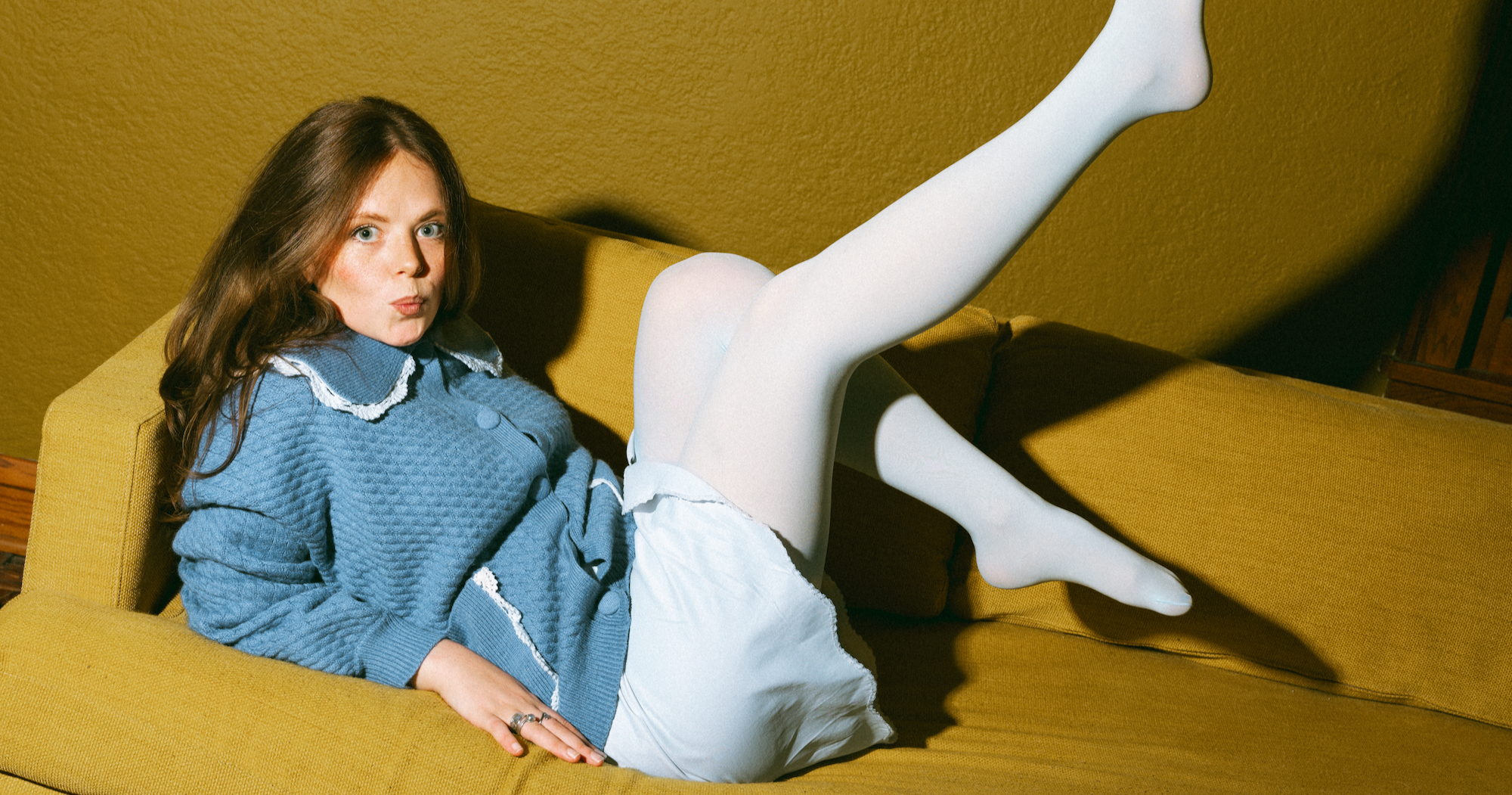
Quickly rising singer-songwriter Ber laughs as she reveals her penchant for those soundtracks, but her affection is sincere. On the Minnesota-born artist’s first full-length album – the newly released Good, Like It Should Be – she turns that winking sincerity inward, writing a dozen songs about opening up to love despite the real risk of heartbreak.

Ber wrote and recorded the bulk of the LP with close friends and collaborators Rob Milton, Austin Ward Sherman, and Bradley Hale, who joined her on a writing trip to Pepin, Wisconsin, and helped deepen both the record’s narrative vulnerability as well as its sonic range. The resulting songs are self-assured and lived-in, with an emphasis on melody and emotional tension that lets her agile, nuanced vocal shine.

Below, BGS catches up with Ber the day before Good, Like It Should Be releases, chatting about songwriting, a-ha moments and, yes, everyone’s favorite big green ogre.

Tomorrow – or in just a few hours, really – you’ll release your new album, Good, Like It Should Be. What are you feeling in this last stretch as you get ready for folks to listen to the project in its entirety?

Ber: It’s a little crazy. I think it’s actually out in Australia already. Maybe this slow burn of me realizing, all day, that it’s just gradually coming out will make it a little less overwhelming. But I would say overwhelming is the default nature of the last month. Coming up to this April 3 date has been challenging but also really exciting, and something I’ve tried to accept and just be really happy about, because it’s really crazy to be putting a whole album out. It feels really, really wild. I’ve never done that before. It’s new territory. We’ve been rolling out singles for six months, and I’ve been listening to the whole album for like a year, so really it’s not going to hit me that other people haven’t sat with it yet until tonight. I’ve been crying a lot, mostly happy tears. But it’s definitely a little bit of a release, emotionally, too. So, it’s a weird one to have to process.

To your point about living with this music for so long, do you feel like your relationship to the music has shifted in that time? Has any new meaning or insight been revealed to you?

It feels really solid. I don’t think it’s shifted so much outside of maybe me reaching for songs for the month of November, and then kind of getting sick of that one so then going for another one. I think I’ve sat with all of it in different ways. I haven’t been doing loads of writing in this period of releasing the album, so this is really the stuff that exists for me right now. And it is where I am still, which I think is really fun. We were pretty careful about choosing what the singles would be, so that there was still some magic in the unreleased tracks that people could hopefully discover when the whole album came out.

Let’s talk about the early days of the record. As you mentioned, this is your first full-length album. Did you originally set out to write a full LP?

Definitely. When I decided that it was going to be an album, there was a moment where I shocked myself that I even felt capable of that. But we definitely were like, “Okay, this is going to be a full-length record. We’re going to do 12 songs.” It was pretty concise in the planning that way, but I didn’t realize I was writing it at the time. The first songs from the album were just moments where I was pulling from things and writing for fun. I hadn’t really signed up to the task yet, so I think that’s really fun.

The first song that was written for the album is called “Smooth Ride.” I wrote that in my second EP cycle, in 2021 or 2022, with Rob Milton and Benjamin Francis Leftwich, who are just great. It was the first day we had all met and it was the first day I met Rob, who since then has been this really sturdy and really inspiring collaborator. We wrote that song and I didn’t like it then, so it got tabled. It’s something we revisited last summer, and I was like, “Oh, it lives on the album. It’s here. It’s time. I wasn’t ready for this yet, but now I am, and I love it now.” It’s one of my favorites…

The rest of it all came in a window of eight months of really intentional writing towards the album and trying things with different people, being in London or going back to Minnesota, going on this writing trip with my friends Brad and Austin [Ward Sherman] to this Airbnb in Pepin, Wisconsin. We wrote eight songs in three days and five of them shaped what the album ended up sounding like and feeling like and being about. It was the glue for all these other songs that I’d been working on in my own time with Brad. So, it was really like a puzzle to piece it all together and to choose the track list. There were probably 50 songs that we whittled down to 12.

To write eight songs in three days, you must have a special creative relationship with those friends. Do you know what it is about your working relationship that makes it so fruitful?

I just trust them implicitly. They both know so much about me and I think that trip really cemented our relationship as a collaborative team. We had been working together for a few years at this point, but Brad, who produced the record, is one of my dearest friends… It’s a really specific thing to be able to sit in the studio with someone and just make eye contact and go, “So that’s what this is.” Or, “Oh no, that’s not what you’re trying to say.” He could call my bluffs a lot and tell me to chase something, and I could follow that direction, because I trust him and I love him.

Then bringing Austin into that, too, was so fun, because he’s brilliant and he suggests things that I would never in a million years think of. He has a very band-y sensibility about his production and his vision for music and I really loved that… When you do a writing session with someone, you basically spill your guts for a few hours. You have to be really honest with yourself and with the people around you, otherwise the thing you make is gonna sound like trash. With the album, I really wanted to make something that felt true to where I was at the moment, and I was falling in love. I had to be really vulnerable with them about the things I was feeling and the way I would possibly describe it.

It is indeed a very personal record, so it makes sense to hear you are so close with your collaborators. When you write songs grounded in your own experience, do you end up understanding yourself or your place in those experiences better?

Absolutely. It’s a point of reflection for me, often. I used to journal a lot. I’ve been doing that a little bit less recently, which is something I want to pick back up. But when we were writing these songs, regardless of what we would walk into the room with, as you’re writing about it and sitting there with music around you, you’re thinking about how it actually feels. You’re putting down words onto paper and it is a very telling experience, because you find stuff and you write words in an order and it moves you, and you go, “Oh, my God. I didn’t even think that I felt this way about that.”

“Good, Like It Should Be,” I cried after writing that song. We all did. I’m tearing up thinking about that moment. That song was about getting out of your own way and letting something just be good, because it is good and you don’t have to question everything being good. At that point, I don’t think I even realized that I was suppressing so much.

There’s a line in there that’s like, “I know it’s a choice, I can be sturdy/ Let it be good, good, like it should be.” And I was like, “Oh, wow, that explained it to me. Actually, this new love, this letting something be good, this is actually a decision for me. Not only is it natural, but I have to also accept it and come to terms with this.” It was such a big moment that was like a light bulb for the entire album, and for what I had been writing about for a year at this point. Writing these songs revealed pieces of me that I didn’t really know were in there, and that’s such a treat. It’s exhausting emotionally, but in the good type of way where you feel like you walk out of it learning something new about yourself. It’s like tarot, getting you toward those subconscious things that need to come up.

The production is so lush and intricate, and really gives a fullness of emotion to the lyrics you wrote. Could you hear a fleshed-out version of a song in your head as you were writing it, or did they find that fullness in the studio?

Probably both in different situations. I’m so pleased with the production. It was really fun to sit with Brad and to sit with Rob, and not only watch them create magic but also be able to listen to it and partake and play these instruments. We played all of the guitars. I got to play tambourine on a lot of stuff. Brad took it upon himself to teach me how to engineer a little bit while he was recording all the drums in our basement, which was really fun. And it gave me the itch to get into more production.

But yeah, when we wrote them, there were some songs that just had to be the way they are. “Forget Me Not” was like, “Okay, we should essentially just do a demo. This is so touching and beautiful.” When we did that writing trip, we just brought this one Korg eight-track recorder and that was all we were allowed to use. So, we did a lot of in-the-room recordings of the six songs that ended up on the album from that trip. “Hey, Bluebird” and “Give It All Away” both have samples from those demo recordings in the final product. We wanted to hold on to the energy…

With other songs that are a little bit more produced, like “Cool, Boy,” I did that one with Rob and he had just gotten off of vacation. He was like, “I am only listening to Clairo and I absolutely love the beach, and I think we should do something beachy and flirty and fun.” And I was like, “Bet, that sounds cool. Let’s just see what’s up.”

In addition to Clairo, what were you listening to or feeling inspired by while you were making the record?

You might laugh, but I pretty much exclusively listened to the Shrek soundtrack. It’s brilliant. There’s just bangers on there. “I Need a Hero,” the Frou Frou version, is amazing. We were referencing Counting Crows. I also am a massive Kacey Musgraves fan. I grew up on Mumford & Sons, and the Decemberists, and Kings of Convenience, and some really rootsy stuff my parents turned me onto.

For a long time, at the start of me writing songs on my laptop and posting them and putting EPs out, I was really hiding from this folk element that I knew I had in me. But I wasn’t ready to touch it yet. I decided with the album we’d just really dive deep and let it be good. It’s some of the stuff I resonate with the most. But yeah, Clairo has been a huge indie inspiration. I love everything she does. And, again, it was Shrek that really did it.

You spent a lot of time figuring out the record’s sequence. How did you eventually settle on a final track list?

There were, like, 40 iterations of the track listing. It was the bane of my existence for a long time. And I actually really credit my manager for putting up with me for that window of time. Honestly, I love where it landed, but it was never my first choice. All I knew was that I wanted to sandwich the entire album between “Good, Real” and “Good, Like It Should Be,” that was my non-negotiable. So, it was like a deck of cards, sort of feeling it out.

I know a lot of people like to try and tell a story through the songs, but as I was listening to them, the story was just me. These are all things I felt and there wasn’t necessarily an order or a rhyme or a reason to it other than I made them. I would be remiss to say it was purely artistic.

My team was pretty heavy on the idea of most of the singles landing on side A of the record. And I hated that. I was so angry at the time, because what do you mean we’re gonna prioritize how an album feels on a streaming platform, of all things? It genuinely drove me over the edge for the longest time. But then I got to this point where I was like, “Maybe it’s not that deep.” … I wanted to have the journey of listening to the album feel like you land somewhere at the end, and it’s like a soft pillow. I think with where it’s landed, that’s the experience I at least have. You get to boogie a little bit in the first few and then I slowly go through the motions.

You’ve already been out playing shows around the record and you have more dates coming up later this month. What are you enjoying and looking forward to most about playing this new music?

These songs are where I feel I resonate the most at the minute anyway, so what a treat to be able to push these and to sit in them and sing them for people. I love my first three EPs and I have a lot of empathy for the girl who wrote them. I love those songs and how far they’ve reached people, and I definitely will never just let them go, but I think it’s going to be so special to be able to sit down and sing most of these songs at, like, First Avenue in Minneapolis. I’ll probably cry so much that day.

I’ve been testing the waters on these last two tours. I’ve been so lucky to fill the first quarter of my year with touring with SYML in the EU and then touring now with Callum Scott on the West Coast in America. It’s given me the opportunity to sing acoustic versions and the response I’ve gotten has been amazing… It’s really wild, I think artists are constantly releasing and performing behind themselves, in the sense that you grow so much in the time that it takes to put out an album. So often, that album and that album cycle exists in a year or two years before the person you are when you’re actually performing them and talking about it to people. But in this moment, it feels true to me and it feels really exciting to talk about still. It’s very cathartic.


Photo Credit: Tom Thornton
Clay Street Unit Chat Sin & Squalor and Excitement for the Future

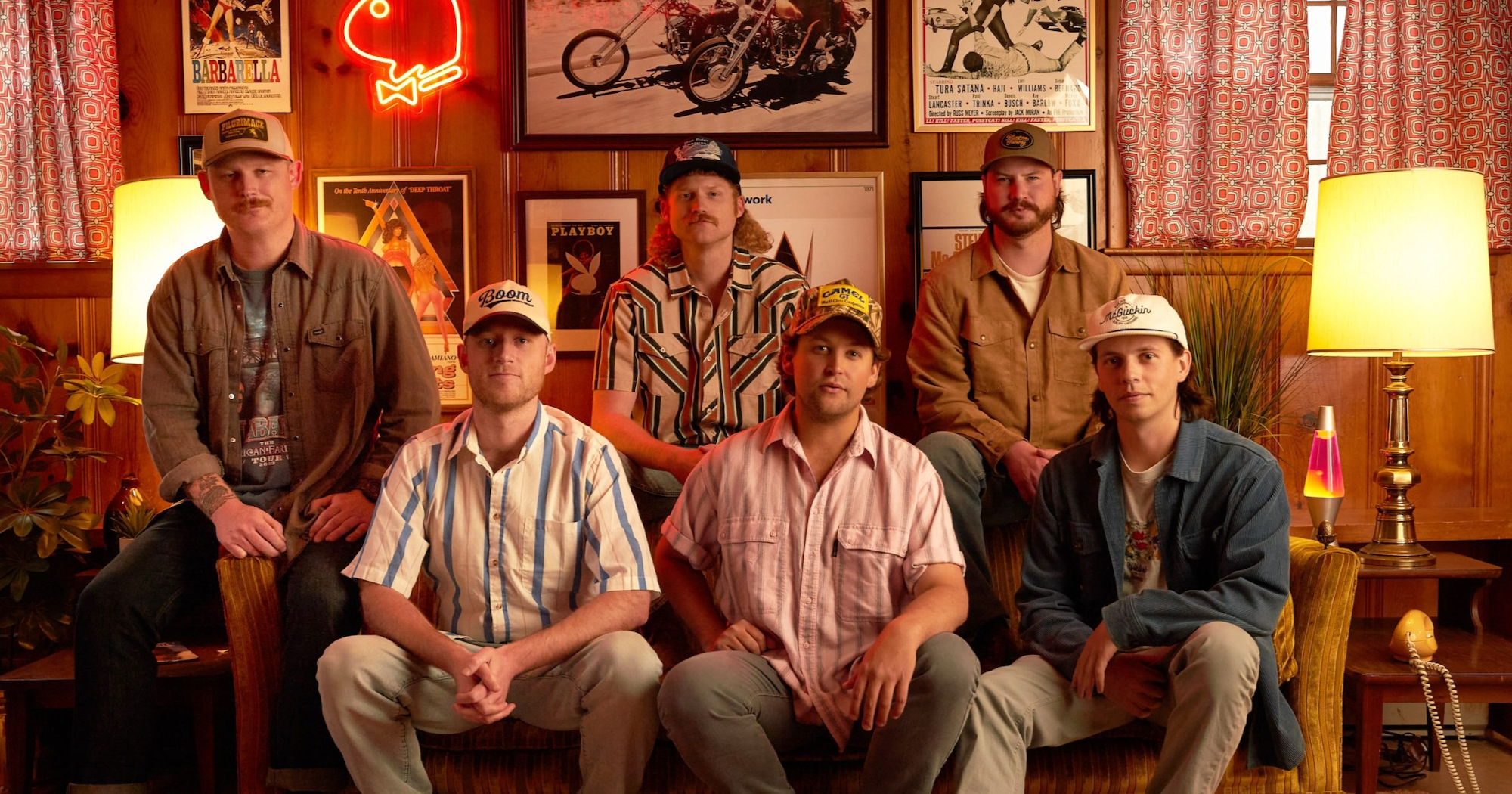
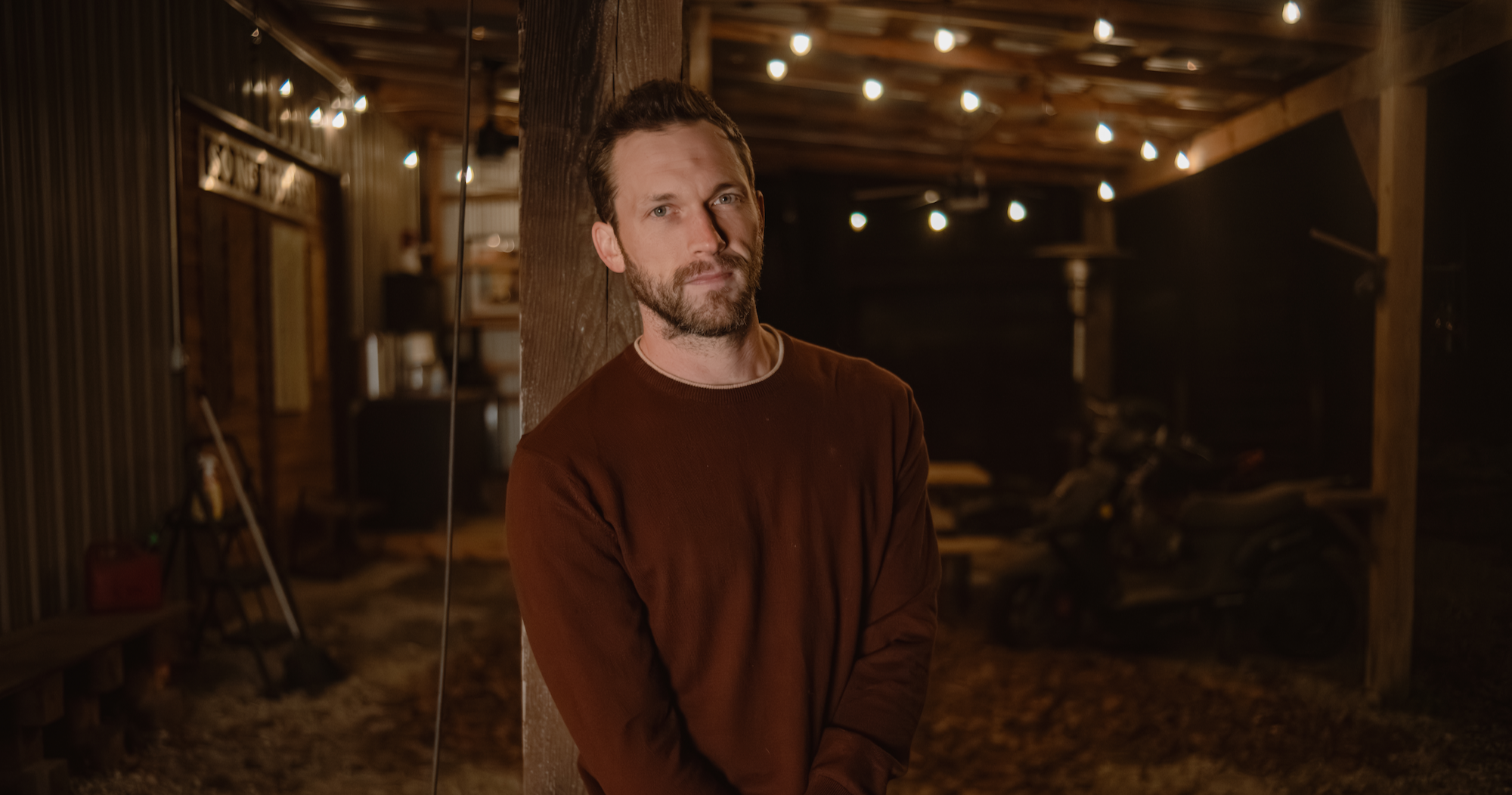
Since their inception in 2021, Clay Street Unit has quickly risen into the national spotlight. The rollicking Americana string band is garnering the frequent tag of “must-see” by their rapidly growing fanbase.

Formed in Denver, Colorado, the sextet is unique in sight and in sound. With a foundation soaked in bluegrass, the ensemble also includes a drummer and a pedal steel player – which often kicks the act into the realms of indie folk and honky-tonk. Ultimately, this lends them to a wildin’ out scene when placed in a packed room of fans and the curious alike, something that has become commonplace as of late.

It’s at this exact juncture – of deeply held dreams and aspirations coming to fruition – that Clay Street Unit will finally release their debut album, Sin & Squalor (out February 13 via Leo33). The 11-song LP is a perfect introduction to this band of melodic pirates as they currently navigate the high seas of the music industry. The record not only captures the essence of the outfit, it’s also impressive in nature, showcasing the vibrant energy of the group’s live show via the studio.

Produced by the Infamous Stringdusters’ Chris Pandolfi, Sin & Squalor is a sonic roadmap to the here and now of where jamgrass stands in the modern era. With members of Clay Street Unit hailing from a variety of places in the U.S. (Alabama, Virginia, Colorado, Pennsylvania, Georgia, Illinois), their multilayered influences lead to traditional acoustic aspects mirrored by modern sounds. Each texture a product of the unique environments from which these musicians proudly emerged.

Catching up with mandolinist Scottie Bolin and guitarist Sam Walker, the duo spoke at length with BGS about the group’s origin, how their sound came to be, and what’s in store for Clay Street Unit. The road seems to be wide open as this troupe has created quite a buzz, coast to coast, coming into 2026.

I was kind of curious about how 2025 wrapped up for y’all.

Sam Walker: I think 2025 was probably the most important year we’ve had yet. It was a huge year for us, as far as crossing off a bunch of big local goals and national goals. We got to play Red Rocks with some of our heroes and buddies, Leftover Salmon and Kitchen Dwellers. We got to play [our] biggest hometown show in Denver at the Ogden Theatre, and had the privilege of selling that place out and playing with our good buddies, Andy Hall and Chris Pandolfi from the Stringdusters. And then, we signed our record deal [with Leo33] and got to plan the rollout for this record and finally get it released.

I would surmise last year will really be setting the pace for 2026, justifying all the blood, sweat, and tears going into this.

Scottie Bolin: Yeah, absolutely. A ton of work went into making the album and getting the songs where you wanted them to be. And finally getting to tour a bunch last year has been really rewarding, getting to play these songs to live crowds and really hitting the road hard.

You guys have had a pretty fast trajectory for five years together. And I was wondering about the background of how the band formed and the timeline of how it all came together.

SW: Our former banjo player, Jack Klein, and I met one night at a brewery in Denver, a couple blocks from Clay Street and the house I was living in at the time. I played some guitar, picked tunes all night at my house, and ended up booking a gig over at that same brewery. It all happened really organically. We weren’t really trying to start a band. It just felt like the right people, right place, right time to try to get something going. We ended up meeting our former drummer and bass player, and then everything kind of picked up steam a little bit quicker than we thought.

We were playing The Patio [at Sloan’s], then [Cervantes’] Other Side, then the [Cervantes Masterpiece] Ballroom. People kept buying tickets, listening, and supporting the music. As things grew, some people weren’t really dedicated to being lifelong musicians in the band. I ended up going on tour and playing with Colorado [jamgrass] band Morsel that our bass player [Jack Kotarba] and Scottie had started. We all became really close buddies over that tour. And things kind of naturally shifted in a different direction for some members. We all kind of crossed paths at the right time.

SB: At the end of the day, we were all just kind of playing music with various groups and side projects in Denver, playing a lot of bluegrass. And things just clicked. Everyone got along really well. The band, at its core, is a group of good friends. And it just snowballed and grew from there.

SW: I moved out here to Colorado eight or nine years ago. And we had this big 4,000-square-foot party house. There were four or five guys living in it at any given time. It was just where everyone would kind of come through and hang, and we would play music all night. It felt like a revolving door of people in there. That house was kind of where everything started.

We got the band going and rehearsed. It felt like the origin of the band. We were listening to a ton of Tony Rice at the time. I kind of came into bluegrass the long way. I didn’t grow up being a huge disciple or anything like that. But, obviously, moving out to Colorado, I got a class in bluegrass culture pretty quick. We were just obsessed with that Tony Rice record, Manzanita.

Was playing in a band something you each wanted to do or is it just the way everything unfolded?

SB: I’m from Charlottesville, Virginia. I started [playing] in college [at the University of Colorado Boulder with] Morsel. We tried to make a go of it. We did a couple tours. [But], the touring lifestyle is hard and takes full dedication from the whole group. Some of the guys [in Morsel] didn’t wanna do that. So, I stepped away from that. Luckily, right around that time, I met Sam and all the Clay Street guys.

SW: I grew up down south in Montgomery, Alabama. I kind of came into it the opposite way. I played in a Widespread Panic/Grateful Dead cover band in college and just sang. Then, I moved out to Colorado and picked up the guitar. I’d always sang and written a few songs and loved live music. But, I really kind of fell into it. It wasn’t something necessarily in my early twenties I expected to be doing for a living.

All the dominoes fell in the right places and I was around the right people that gave me a lot of confidence to push the boundaries of what I was comfortable with. Playing in some side bluegrass bands around town really helped me feel more comfortable about being a part of the Denver music scene. Everything happened step by step. I wasn’t really trying to make it a career, but a few years later, it felt like something that made sense – to take the leap and try to push it as far as we can.

Your band is a huge melting pot of sound. Is that by design or just how it all just came together?

SW: I feel like it’s a little bit of both. We definitely didn’t set out or want to be a traditional bluegrass band. Obviously, when we added the drums and pedal steel and electric bass that decision was kind of made for us. It’s kind of a melting pot of everything we listen to and the music we like.

When Scottie and I go to write a song, we don’t think, “This is a bluegrass tune,” “This is a folk tune,” “This has an indie feel.” We let the music and everybody’s kind of flavor and influence on how the song’s going to sound. We don’t really try to have those guardrails of how it needs to sound or what vibe it needs to be.

When I was listening to the album, I kept thinking how I really want to see you guys live. And I think that’s a real testament to the band, to have that kind of sound radiating out of an album that encourages you to go to the live show, which I think is probably the endgame for you.

SW: Absolutely. At the core of our band, we’re a live band. It’s where we really shine through, and you can just feel the energy up there. We always try to say, “There are only so many Thursday, Friday, Saturday nights,” and we want to elevate that and bring the energy and the emotion and let [the audience] loose – life’s too short to not go out and enjoy live music. We want to make sure at every show we’re bringing that to the table, our full attention to the energy and making sure that everyone’s having as good a time as they can.

Is there any kind of ethos behind the title of the album?

SW: It’s our origin story. [When we started], we didn’t know how to do it or if we were doing it right, and we weren’t doing it with much, just trying to put it together piece by piece. It sounds a little heavy, but it’s more about the beauty of humanity, the nature of [life] we have all been through, and it’s a commonality of everybody. It’s the nature of our music and string instrument music – music that has a little more “down in the holler” feel. It all felt aligned with what we were trying to get out for the first record.

Why was Chris Pandolfi the guy you wanted to produce this?

SB: I had the opportunity to work with Chris before with Morsel, which was a little bit more of an electric rock jam with some bluegrass elements in there. He produced a few albums for [Morsel]. So, I knew what it was like to work with him. I knew that he was just a musical genius and the right guy for setting the vibe and making sure we were comfortable in the studio.

[Chris was] coming in with great arrangement ideas for our band, specifically, and being a great mentor all-around. [Clay Street Unit] actually had the pleasure of being his wedding band this last summer, which was awesome. I feel like the Infamous Stringdusters, Greensky Bluegrass, a lot of those Colorado bands, Leftover Salmon, have really kind of set the tone of what is “allowed” in that genre and for pushing the boundaries of what people want to hear. With the Stringdusters, I’ve seen them live for 10-15 years and they’ve really made a mark on the bluegrass scene, the Colorado music scene, and definitely a big impact on us.

You’re currently hitting the five-year mark together. What does that milestone mean to you right now?

SW: The last five years have been so much of a learning curve and going through so many different stages of figuring out who we are and how we want to operate. I feel like now we’re really starting to get a grasp of what we want to do and who we want to be as musicians, as a band, and as people. The last five years were such a blessing and such a great learning experience, but I think we’re just so excited for the next five years of just pushing this thing to the limit and, and trying to, to make the best music we can and, and really just enjoy every step of it together.

SB: It just takes a long time to get a group of people on a mission aligned and I think we’re finally there. Everyone’s on the same wavelength of what we want to get done and what we want to accomplish. We’ve got a really busy year ahead of us, and it’s kind of the culmination of the last five years of hard work that’s been coming to fruition – we’re pretty excited.


Photo Credit: Lead image by Robert Chavers. Alternate image by Tobin Voggesser.

Photos & Memories: Remembering Roots Music Troubadour-Poet, Michael Hurley

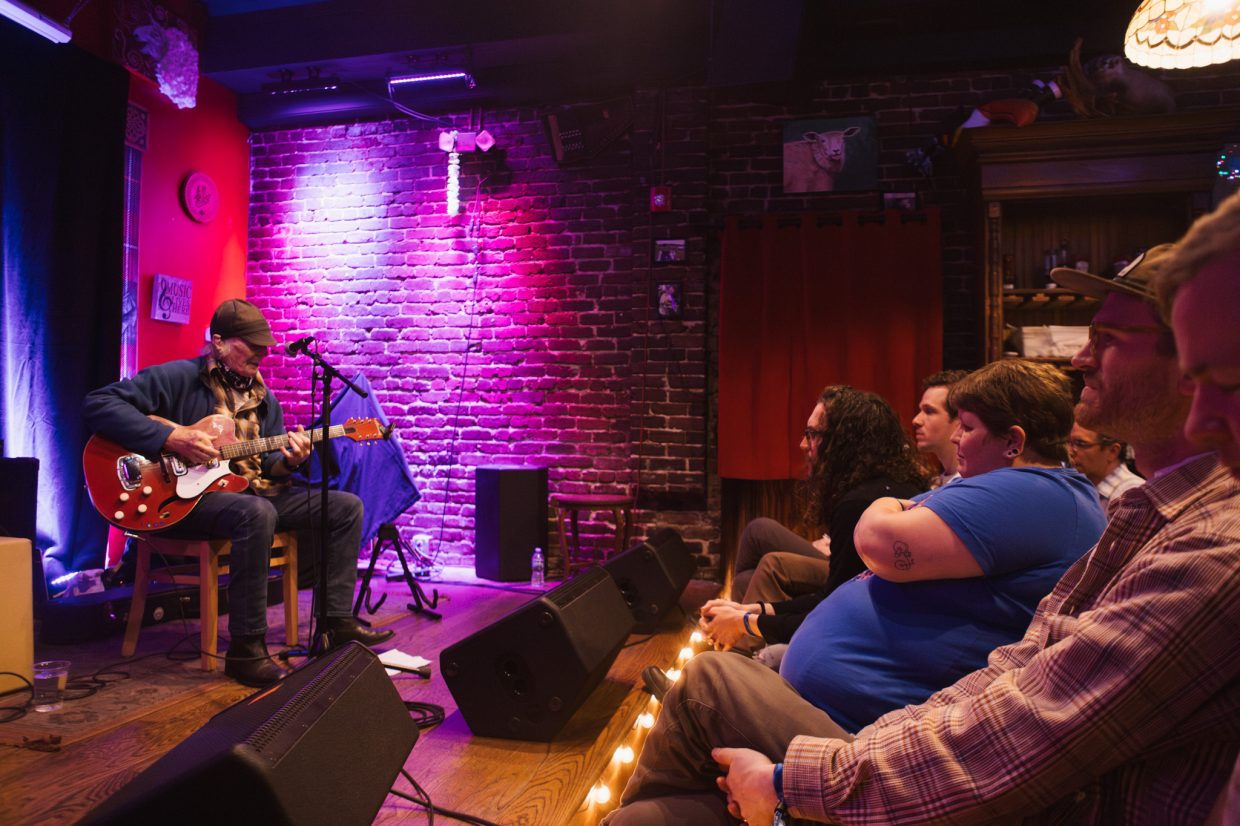
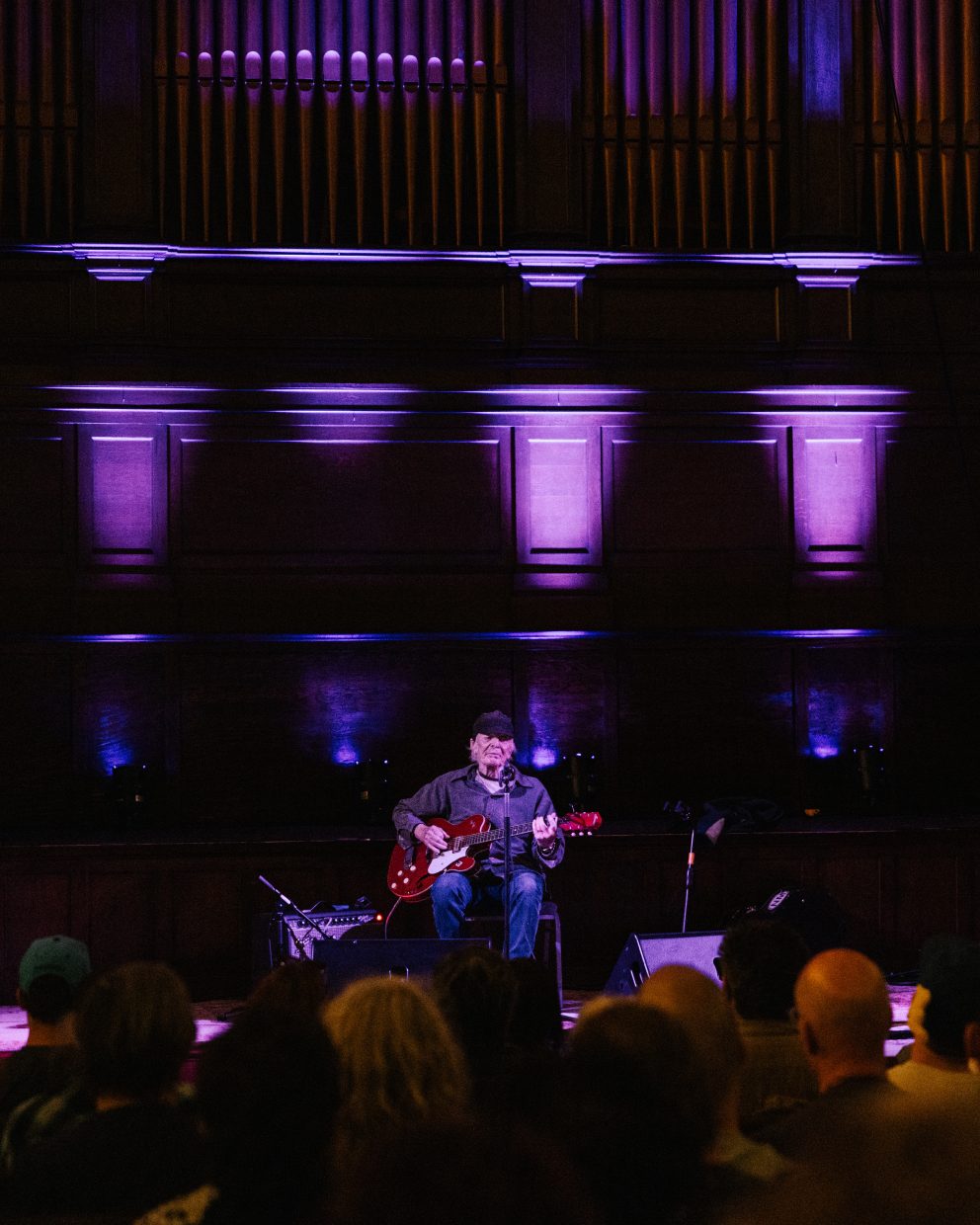
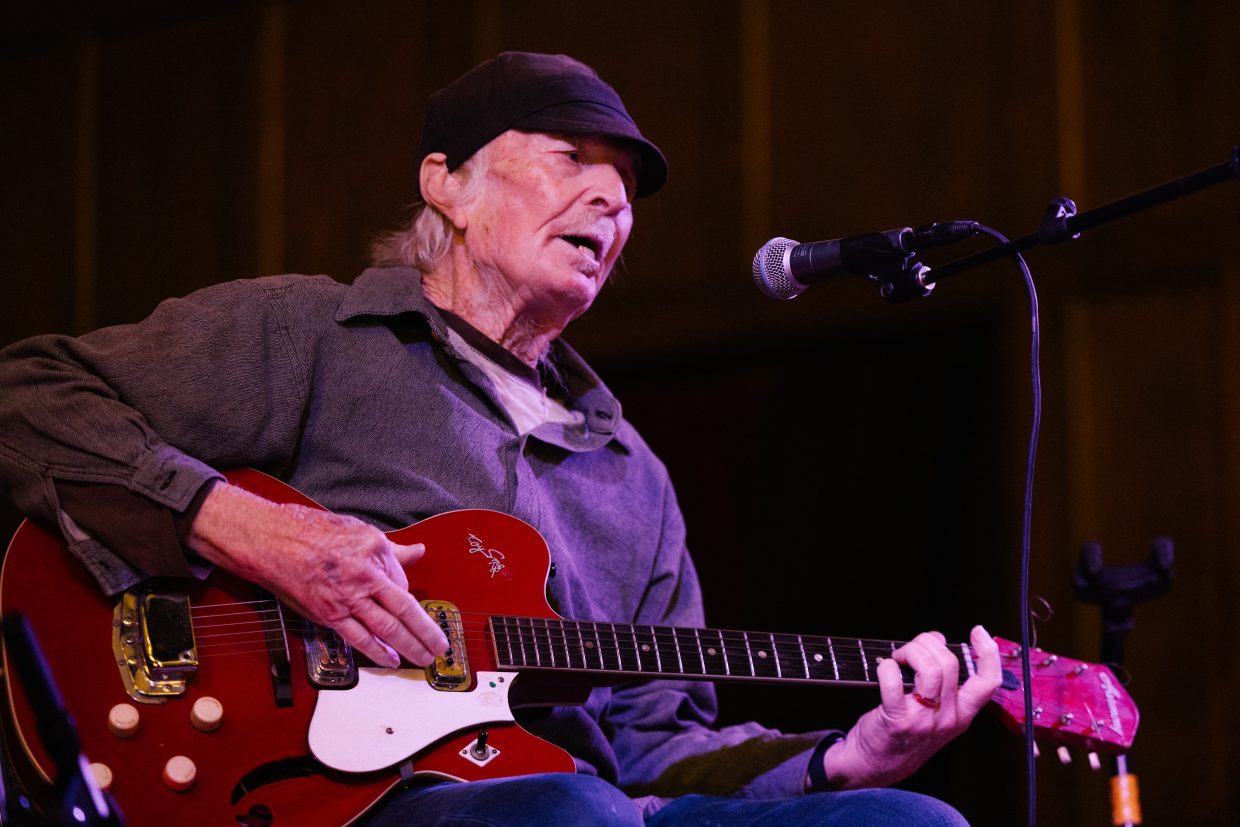
(Editor’s Note: Thanks to our friends at Big Ears Festival, held at the end of March in Knoxville, Tennessee, we’re able to share these photos of revered folk icon Michael Hurley taken during what the world would later realize were two of his final performances, captured shortly before he passed on April 1, 2025. 

To honor Hurley’s incredible legacy and his indelible impact on roots music, we’ve paired the photographs from Big Ears with a heartfelt remembrance by longtime Hurley acolyte and BGS contributor Dana Yewbank.

Our hearts go out to Michael Hurley’s friends, family, loved ones, and collaborators as we all grieve this humble-yet-towering figure in our corner of the music world; our gratitude goes out to Big Ears for sharing these intimate and lovely time capsule photographs.)

I first encountered Michael Hurley – the influential singer-songwriter who recently passed at the age of 83 – in a room painted like a 1960s rendering of a time machine. Big black-and-white spirals looped around the floor of the stage, awash in a moody, pink glow.

The show was at the Woodland Theater in Seattle, Washington, in 2018. I was there with friends – a ragtag group of fellow musicians who’d all been inspired by Hurley’s music in one way or another. My friend Bobby wore a shirt from Oakland’s Burger Boogaloo festival, which rings like the name of a Michael Hurley song that never was.

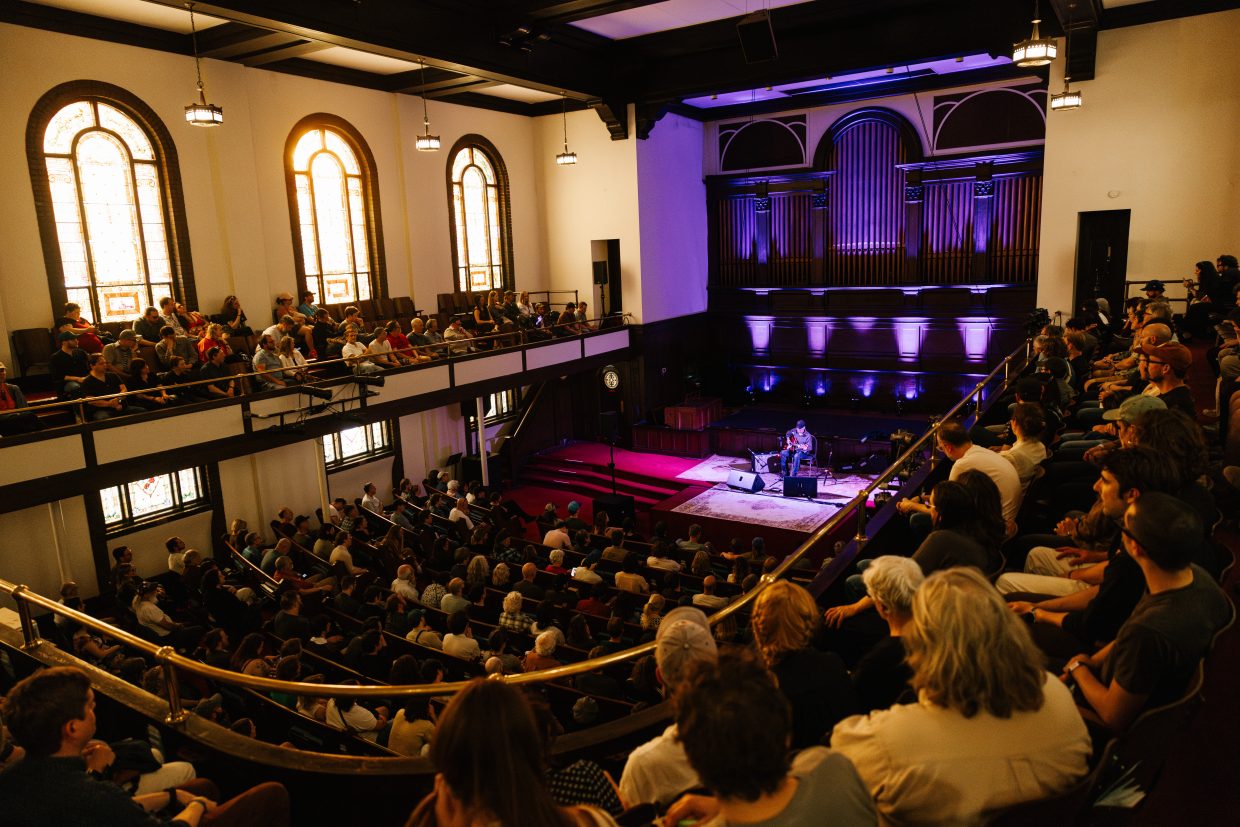
Michael Hurley performs for his official Big Ears appearance to a packed house at the Point in Knoxville, TN. Photo by Andy Feliu.

We got there early. In a performance space the size of a small café, Hurley was sitting in the corner next to the stage, quietly playing a worn piano. My friends and I exchanged looks of mild wonder, realizing we had walked in on something unexpectedly intimate. Quietly finding seats among the folding chairs, we soaked in the scene as the room filled up. Throughout the night, we interacted with Hurley in passing as if we were all just milling about someone’s living room. He attentively watched all the opening sets. Bobby showed him where the bathroom was. Hurley never acted like a living Americana legend, even though he was one.

Raised in Bucks County, Pennsylvania, and an eventual cultural fixture of Astoria, Oregon, Michael Hurley wrote and recorded surreal, folk-esque blues and Americana songs across seven decades. He also made comics, self-published several art zines, and made an unspeakable impression on the broad world of American folk music. He continued to perform up until his death, which came suddenly the day after his final performance. Michael Hurley spent his last evening on earth playing his timeless, effervescent songs at the AyurPrana Listening Room in Asheville, North Carolina.

Michael Hurley also wowed a small audience at a surprise Big Ears performance at Boyd’s Jig & Reel, a small Celtic pub. Photo by Joeleen Hubbard.

My doorway into the world of Michael Hurley was First Songs, a lo-fi collection of recordings published by Folkways in 1963. The songs on that album have a subtle, somber quality that’s harder to find on Hurley’s later, more jovial records. Listening, it feels like taking a long, slow walk through a deep forest at dusk. Less sunshine and laughter than Have Moicy! or Long Journey, but as a sad, confused 20-something, the mist and mystery of First Songs drew me in. “Animal Song” will always be the sound of being 24, reluctantly living back in my small Northwestern hometown, not far from the place Hurley would eventually call home.

But melancholia is far from what Michael Hurley became known for. Instead, his music is beloved for its surrealism, lightheartedness, and humor. Hurley sang about aliens, ghosts, werewolves, and potatoes. His songs abound with clever turns of phrase and humble imperfection, offering a sort of unselfconscious freedom to listener and musician alike.

That night at the show in Seattle, a 76-year-old Hurley played for an impressive two-and-a-half hours, never seeming to lose steam. He must have played through at least 50 songs by the end of the night, which doesn’t even touch the several hundred he wrote and recorded throughout his life.

The magical Michael Hurley, mid-surprise appearance at Boyd’s Jig & Reel. Photo by Joeleen Hubbard.

Despite being called the “godfather of freak folk,” Michael Hurley never fancied himself a folk musician. Most of his influences fit squarely in the world of jazz and blues: Lead Belly, Lightning Hopkins, Fats Waller. He even cited country songwriters like Hank Williams, but rarely any notable folk artists. His eclectic influences make sense: Hurley’s songs have an unpredictable liveliness to them. They jump and wander, following a path seemingly guided by Hurley’s creative intuition alone.

But when it came to how he approached his life and career, Hurley lived fully into the folk tradition. He made his own album art, released some of his own records, and toured with zero frills. He also had a salt-of-the-earth political ethos and didn’t shy away from using music as activism. In 2014, Hurley assembled a compilation of “anti-Monsanto songs” and released them for free on Bandcamp.

Michael Hurley performs at the Point at Big Ears Festival. Photo by Andy Feliu.

Hurley (or Elwood Snock, as he liked being called) was a musician of the people, only ever taking himself just seriously enough, unafraid of welcoming play and spontaneity into his work. His legacy has a lot to teach us about just how essential these qualities are to the creative process — because if making art isn’t a form of play, then what is it?

That unbridled, unbothered element makes Hurley’s music deeply comforting and grounding. It roils and pops like a low fire you can warm yourself by. It’s trustworthy and safe, emerging from the endless present moment, bubbling up like a fountain from which we can all drink.

Michael Hurley by Andy Feliu.

Honey, honey, honey,
have you ever blowed bubbles
underwater when you’re feeling bad?
You let your lips begin a-buzzin’
the bubbles rush up like mad.
Right there you’ve got somethin’
to help you out
when you ain’t got nothin’
to brag about.

– from “Driving Wheel,” Sweet Moicy! (1976)

Hurley frequently collaborated with other artists – from his Unholy Modal Rounders to Marisa Anderson and Kassi Valazza – and he continued to make new connections well into his final years. Adrianne Lenker, who counted Hurley as a friend, recently credited him as one of the reasons Big Thief became a band, in a post memorializing Hurley on Instagram.

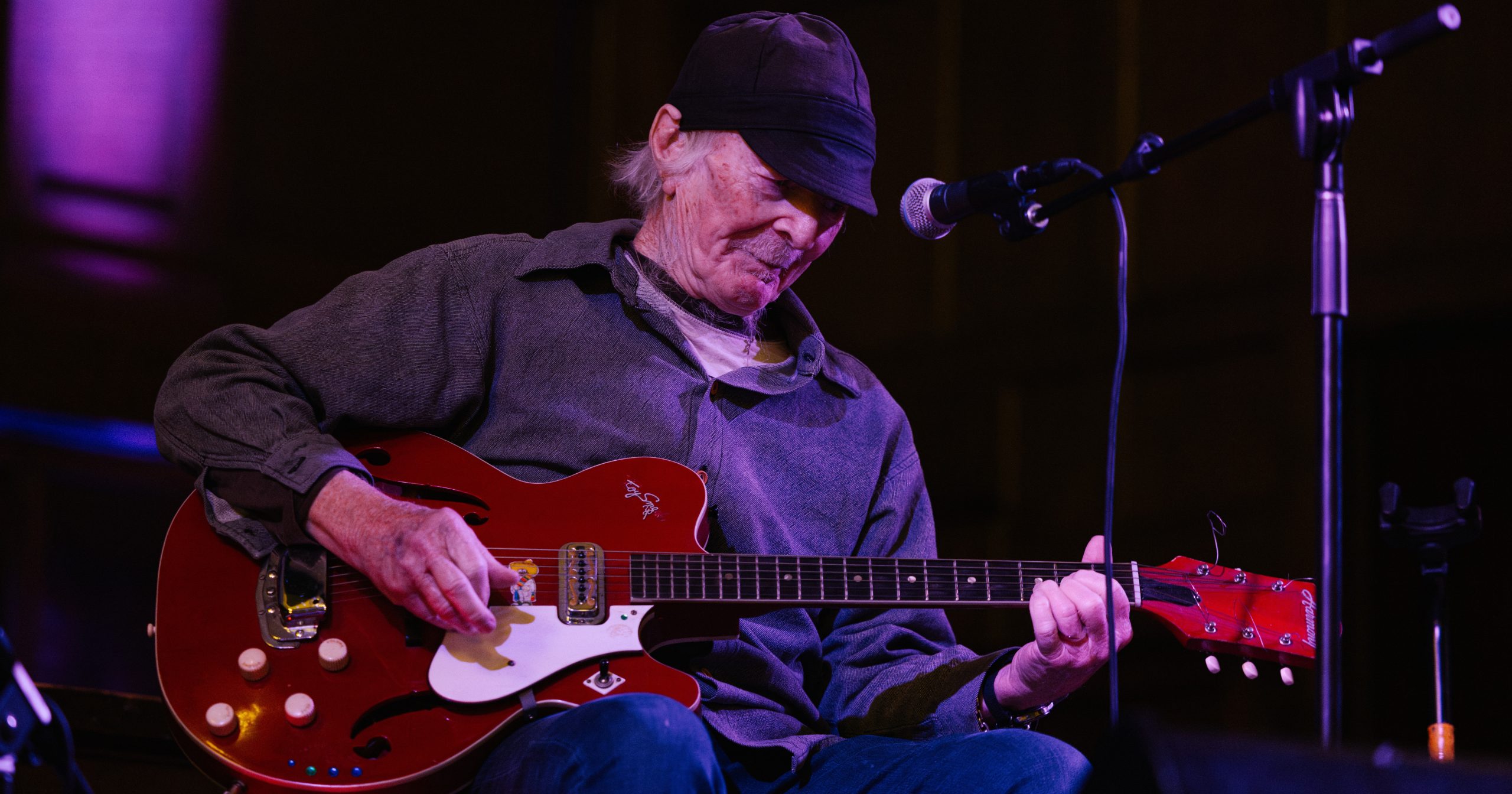
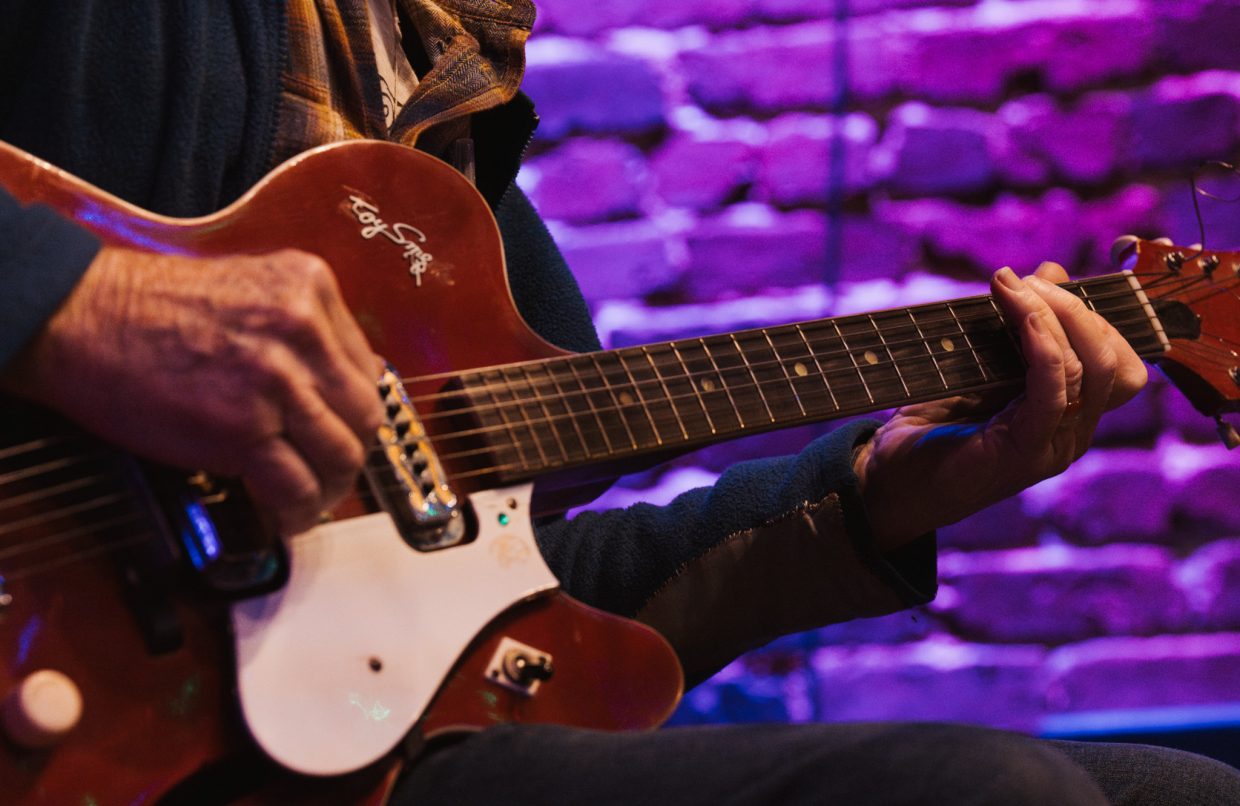
Michael Hurley’s red Harmony Roy Smeck guitar. Photo by Joeleen Hubbard.

Infinite rivulets flow out from Snock’s work, watering seeds of creativity wherever they go, rippling and rolling over the landscape much like Hurley did – from Jersey City to Vermont to Astoria.

Michael Hurley passed on April Fool’s Day, which is painfully fitting. He loved a good joke, taking things that might otherwise feel heavy and heartbreaking and peppering them with levity and brightness. Now, in his absence, we can let his songs buoy us through dark times, of which there are too many, and laugh alongside us in the light.


All photos courtesy of Big Ears, shot by Joeleen Hubbard and Andy Feliu as credited. Lead Image: Andy Feliu. 

BGS 5+5: Amistat

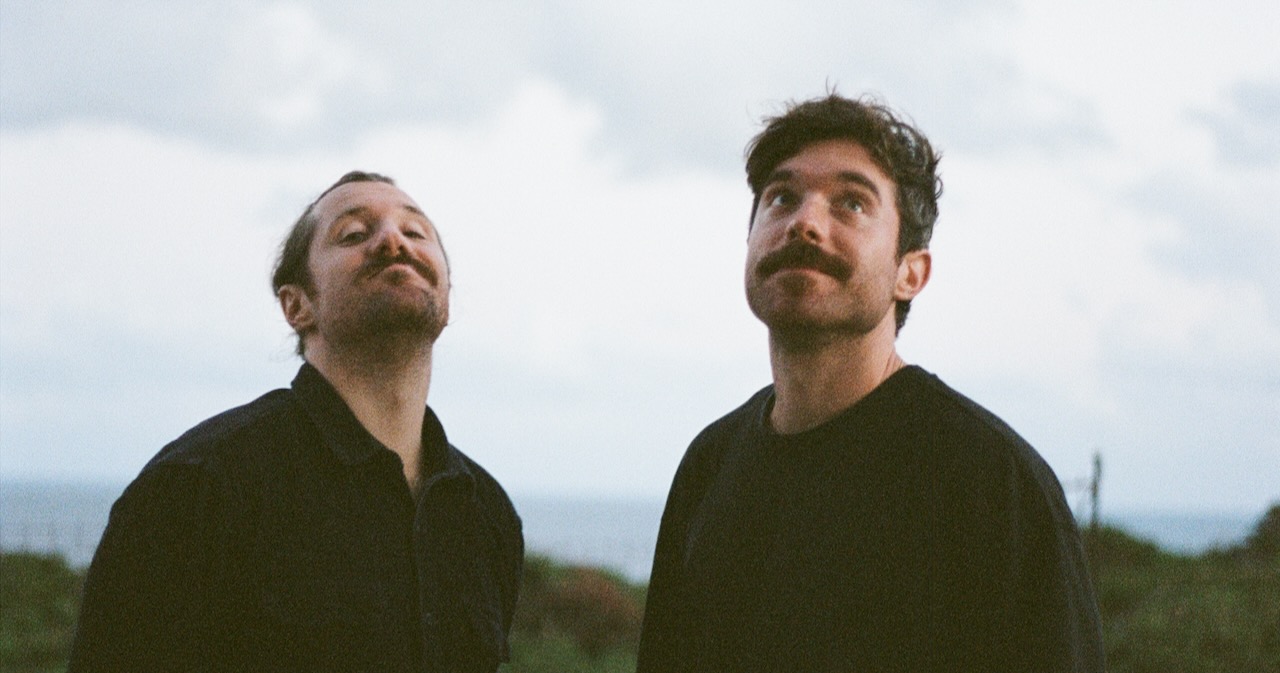
Artist: Amistat
Hometown: Rosenheim, Bavaria, Germany
Latest Album: What We Are EP (releasing March 21)

Which artist has influenced you the most – and how?

The godfather of indie-folk, Ben Howard! When we first started out as Amistat playing and writing music back in 2012, his album Every Kingdom had just come out. It was the first time ever that we had heard a sound like his. His lyrics, melodies, especially the style of guitar tuning, and the way he used his guitar as a percussive element, captured us and had us mesmerized. It’s to this date the most inspiring piece of music we’ve ever come across and we listen to it on repeat, still.

What rituals do you have, either in the studio or before a show?

The last hour before going on stage is holy to us and very important for us to get in the zone. We meditate for about half an hour (individually), then Josef runs through his vocal warm up routine (15 minutes). We brush our teeth (most important!) and just before going on stage we have this ritual that the entire team meets backstage for a toast – it’s actually reciting an old Irish poem. Every day someone else gets to take the lead on it:

“There are good ships and wood ships, ships that sail the sea, but the best ships are friendships and may they always be.”

What’s the most difficult creative transformation you’ve ever undertaken?

We started out as buskers on the streets of Melbourne. We did that full time for about 7 years. After that time we felt like nothing is really changing and that in order to grow we needed to change something again. We moved to Brighton, England, and wanted to try busking there. After about three weeks and 24/7 of rain we decided to move to Berlin. There we had to kind of rethink the whole busking thing and came up with the idea of putting on small house shows in people’s living rooms. That’s what we did and lived of for about two years. Then COVID hit and everything kind of stopped. During that time we honed down on the social media content and it all grew from there.

What’s one question you wish interviewers would stop asking you?

“What’s it like being twins?”

If you didn’t work in music, what would you do instead?

Jan would be a golf professional, Josef would be soccer professional.


Photo Credit: Anja Kaufmann

Rapt Reflects On Life’s Many Endings With ‘Until the Light Takes Us’

Jacob Ware is a bit of a weirdo. Known onstage these days as Rapt, the singer-songwriter has a way of coming up with an album title and writing the entire record around a central sentiment. His fifth studio album – titled Until the Light Takes Us – serves as a direct response to a 2008 heavy metal documentary of the same name.

“I just thought, Until the Light Takes Us is such an evocative title. A few people have commented on that over the years as being unhinged – that I come up with the album name first and then write the album,” he says, adding that the documentary details “all the horrible shit in the ’90s of the black metal scene in Norway.”

From the gentle trickle of one-minute opener “Over Aged Borders” to the dreamy “Fields of Juniper,” Rapt’s latest album drenches in the notion of endings and existence. Heartbreak. Death. Suffocating blackness. Each song, as heavy as it might be, seems to coat the album with both dark and light – stemming from his confrontation with the end. 

Rapt’s delicately-spun indie-folk is awash in luminescent piano, aching between flaky layers of acoustic guitar. Ware finds himself scattering like a tumble weed, squeezed somewhere between the throaty ache of Carrie Elkin and scratchy pangs of yearning (akin to Bonny Light Horseman in their rawest form). His head swims in thoughts of death, leading his writing to root around in the afterlife. It’s a far cry from his heavy metal days, a sharp red underline to this chapter of his life. “I’m always slightly aware of mortality because I’ve had a lot of health issues, in my teenage years and early twenties, like epilepsy. It’s wild. It pulls the rug out from under your life daily, and you don’t know when the next seizures come in,” he says.

“I haven’t had a seizure for eight years now, so I’m blessed. But that shapes you on a subconscious level,” he adds. “It sets up your foundation to be ready for the next thing to happen. In a way, the next thing that happens is an end of something, so I think my subconscious has always thought about the finality of things. That’s probably where that sort of writing interest has come from. In a way, every single song I’ve ever written is about that. I don’t really know how to move away from that.”

Hopping on a Zoom call, Ware spoke with BGS about the afterlife, how the album grew, and the varied creative fulfillment compared to heavy metal music.

Does writing around a title help you stay focused on what you want the album to be?

Rapt: I think so. I’ve definitely done this where I write that phrase and put it up around wherever I’m living. Even if I’m not listening to music, I’ll walk past the album title a few times a day. The edge of my wardrobe is visible and the title I’m responding to now is written on it. One of the last things I look at at night and one of the first things I wake up to in the morning is… I don’t want to reveal it.

[Until the Light Takes Us] is not a breakup record by any means. I’ve noticed a few bits of press here and there, which may have lent it to being that, but it absolutely isn’t that. I feel like a completely different person to my music. I don’t relate to my own music. I would say it’s an album of endings, really. More so than a sort of breakup album. By the time I’ve finished one thing, something else is usually well on its way. And it’s always been like that for me.

What is your feeling about the afterlife?

I tried to look into religions a few years ago, but I have no faith system. I was brought up in a house without a faith system. It’s very hard for someone to start to believe in something unless it was in their very formative years from a caregiver. I expressed it in the title track. I’ve always thought that the afterlife is a sort of peaceful black. I have a sneaky suspicion that the afterlife is a hell of a lot like what it was like before we were born. I quite like to imagine this sort of sizzle reel, where you hang out with your highlights. That’s what I hope is going on.

Science doesn’t ask, science doesn’t answer everything. There are things that science gets pretty fucking close. But there are things that science can’t touch. I try and be mindful of that; I would call myself an agnostic. I think being 100 percent atheist is actually ignorant. We don’t know – we’re 99.9 percent sure. There’s just that 0.1 percent that I think is worth thinking about sometimes.

That’s touched on in the title track. I don’t know where I’m going, but I know that I’ll see my neighbor and my loved ones. I like to think that there’s a highlight reel. And that’s it, really. I’m talking about this as if I planned to write it. I didn’t. It’s the only successful time I’ve ever managed to just write something without thinking about it and letting my subconscious go. I cannot just open my subconscious.

I find lyric writing takes me months. The title track probably took a year to write. Very occasionally, I can get half a song written in an afternoon, but that happens about once every three years. The song “Until the Light Takes Us” is quite insular, and it’s almost says everything that you could say within a song about the afterlife.

“Until the Light Takes Us” is one of the seven-minute songs on the album. Did you have that intention or did it sort of grow by itself?

I just think I couldn’t make it any shorter. I don’t think I really tried to fight it being seven minutes, but I’m sure that there’s been a longer version of it. I just whittled it down and down, until I couldn’t whittle it down without doing it disservice. And I knew it would suffer for that. I just think that song is destined to be heard when it’s needed.

With endings, there’s always grief. Does that grief still linger with you or has songwriting helped you exorcise that?

That’s hard to answer for me, because I don’t recognize the human that wrote a lot of the songs. I think it might be an epilepsy thing. The medication I take for epilepsy gives me very odd memory and I remember weird little things. I have no memory of so much of my life, and I mean that in the present, as well. The word “remember,” if I really think about that, it’s just like a blur of things. I don’t remember things vividly.

One big thing for me is I cannot paint images in my head. If I shut my eyes and try and picture my best friend’s facial features or a partner’s facial features, or even a fucking apple, at best it’s a Van Gogh-looking painting, so I think it’s quite hard for me to answer that question.

I’m sure it does happen on a subconscious level. I’m sure I do successfully process things through creativity, but it doesn’t help that much. I’ve still got my shit in my head, but a lot of the record is very positive for me. I had depression up until my mid-twenties. I don’t have it anymore. I just don’t. I think life is a beautiful thing. And I think there’s a lot of positive in the record. I think it’s a very odd record in that it’s not… I don’t think it’s depressing and negative. “Until the Light Takes Us” is a positive song. It starts and ends with a letter to myself.

That song is about growing apart from someone because you bonded with them through a shared depression and when one of you isn’t depressed anymore, that bond breaks. That’s what that song is about. But all of this is hindsight. I wrote this in 2022 to 2023. So this all feels very considered and fucking artistic and it’s not. I’m just looking back and trying to work out what the fuck was I was thinking.

Now that you’ve been sitting with the album for a while, what is your takeaway from the creative process?

I guess, just to trust my instincts. I didn’t write it consciously… I think, in a way, I never cared about this record, because I had a lot of stuff going on in my personal life. This was just me keeping the engine going creatively, and then I turned around one day and had a record done. I didn’t know what it was about at the time. I sat on it for a year until I was ready to release it. My biggest takeaway is probably just I don’t fucking care anymore. Just don’t overthink it. If I had to give a tagline to that question: I’m too old to make it as a fucking fresh-faced person and I’m too young to be wise.

I’m right in the middle and when you’re stuck in the middle, you either quit or you just don’t care anymore. And I think I’m in the “don’t care anymore” phase. I’m not going anywhere. The only other takeaway is that I’m not going to do an album for a while. I never thought I’d say that, but I’m going to just do singles for the next two years. I say that, but I’m excited. It feels liberating. When you’re in album land, you’re there at least a year and a half. It’s interesting. I think that might change my writing a bit because I’m not trying to fit a song into a collection of songs.

With your past work being metal, how does the creative fulfillment differ from your current style?

I think metal is very good for connecting with people’s frustrations in life. And it’s good anger management shit. When you’re playing some real heavy fucking music and you slow it right down and you get a groove going, then you look up and the audience are like throwing each other around the room. There’s something cool about that. I think the biggest difference with metal is that the ceiling is a lot lower and reachable with metal. And I think there’s something really special about that.

My biggest thing I enjoy is my audience is far wider in this genre. Metal is very male-dominated and you get used to just looking up mostly at a room full of dudes, beards, and black shirts head banging long hair. And that’s great. That’s a beautiful thing. But I think I slightly prefer the more diverse crowd that I’ve played to. My last thing is also the age thing. There’s a huge age range in the people that turn up at the shows I play now. And that’s a really beautiful thing as well. In France, I had a very elderly lady come up to me and she said, “‘Fields of Juniper’ made me think about something I’ve not thought about in 50 years.” If there’s a reason to keep going, then that’s it.


Photo Credit: David Nix

MIXTAPE: Denison Witmer and the Meaning of “Home”

What does “home” mean?

Answering this question became one of the main themes in my lyrics over the last several years – especially on my new album, Anything At All. After touring consistently for the first 15-20 years of my music career, I finally bought a house in South Philadelphia. Ten years later, my family and I relocated to my hometown, Lancaster, Pennsylvania. Before moving back to Lancaster, most of the places I lived felt kind of like a coat rack. Sure, most of my belongings were there, but I knew I’d be traveling again soon – things that felt centering or “home-like” to me existed outside of the confines of a space.

My current life is a lot different than that time. Now I am a husband, a dad of two young kids, a carpenter, and a part of my local community. I spend a lot of time trying to build a comfortable and consistent home life for myself and my family. My idea of what a home means is changing yet again. I’ve compiled a few songs that encompass the various meanings of “home” to me. – Denison Witmer

“Homesick” – Kings of Convenience

I think this is one of the best opening tracks on any album. The way the two guitars immediately start walking down the scale is captivating. My favorite lyrics are the last few: “A song for someone who needs somewhere to long for/ Homesick because I no longer know where home is…” It makes me think about the many days I’ve spent in headphones traveling in trains or tour vans, leaning my head against the window and listening to music that made me feel at home.

“Rene And Georgette Magritte With Their Dog After The War” (Original Acoustic Demo) – Paul Simon

I put this song on almost every mix I make. This is Paul Simon at his finest – just him and a guitar. In this story we follow Rene and Georgette Magritte as they reflect on the differences between their time in New York City and their lives in Europe during WWII. Ordinary moments like opening dresser drawers or window-shopping trigger memories of home.

 “Just A Song Before I Go” – Crosby, Stills, & Nash

Starting with a crash cymbal and leading right into a fuzzy guitar riff, this song has an instant warm vibe. I’ve always loved the way Graham Nash leans into writing about his life as a musician/songwriter. There’s a risk that it might not be relatable to a wider audience, yet he always finds a way to make the feeling universal. The lyrics “When the shows were over/ We had to get back home/ When we opened up the door/ I had to be alone…” connect deeply with me.

There were a lot of times on tour that I felt like I was turning into a ghost – passing through towns and people with no real sense of deeper connection or longevity. No real sense of home. Sometimes weeks would pass with mostly small talk and I would lose sight of who I was. Finally getting home, dropping my bags, closing a door behind me, and spending a week alone in silence was just what I needed to recoup.

“In Tall Buildings” (Live) – Gillian Welch

A lovely song written about returning to and centering your life around the things that really matter to you. I love the lyrics “When I’m retired/ My life is my own/ I made all the payments/ It’s time to go home/ And wonder what happened/ Betwixt and between/ When I went to work in tall buildings.” It’s a beautiful reflection on the things that we leave behind either knowingly or unknowingly when we get swept up in the paths our lives take. Gillian Welch’s vocal delivery is always beautiful. The way she can take any song and filter it through her own style with honesty and sincerity is incredible.

“A House With” – Denison Witmer

Yes, adding one of my own songs here. It fits with the theme. Mid-COVID lockdown, my wife and I got really into two things: birding and plants. We did everything we could to get birds to visit our yard. We did everything we could to green the outside and inside of our house. This led to hanging bird feeders all over the place and planting everything from shrubs to trees to lots (and I mean lots) of indoor plants.

This song started as kind of a joke. I often walk around my house playing a small classical guitar and making up goofy songs to make my wife and kids laugh. This song started that way — I was watching the birds on our feeder and naming them as I saw them, then I went from room to room naming the plants we have in our window sills. I recorded an iPhone voice memo and forgot about it. I’m not sure what motivated me to share it with Sufjan (who produced my new album and this track), but I think it was because I knew he is a fan of concrete nouns and words that are interesting phonetically. He ended up choosing this from the batch of demos I presented to him. I am glad he did, because it’s one of my favorite songs on the album.

Sufjan didn’t like the original lyrics of the last verse… I remember him saying, “In the first two verses you are telling us what you are doing and how it fills your heart, but you never tell us why. You should try to answer that question for yourself.” I rewrote the ending and it was at that moment that things clicked into place for me.

“Take Me Home, Country Roads” – John Denver

You can’t really go wrong with the earnest nature of John Denver. I love the lilting quality of this song – lyrics about longing juxtaposed against the happy upbeat sound. It’s a love song to a place. I have a lot of respect for John Denver, because he was always unapologetically himself. He talked about how he wanted to not just entertain people, but also touch them. I think he understood the magic of music and connection. Listening to John Denver also makes me think about my dad because he was his favorite musician.


Photo Credit: Lindsay Elliott

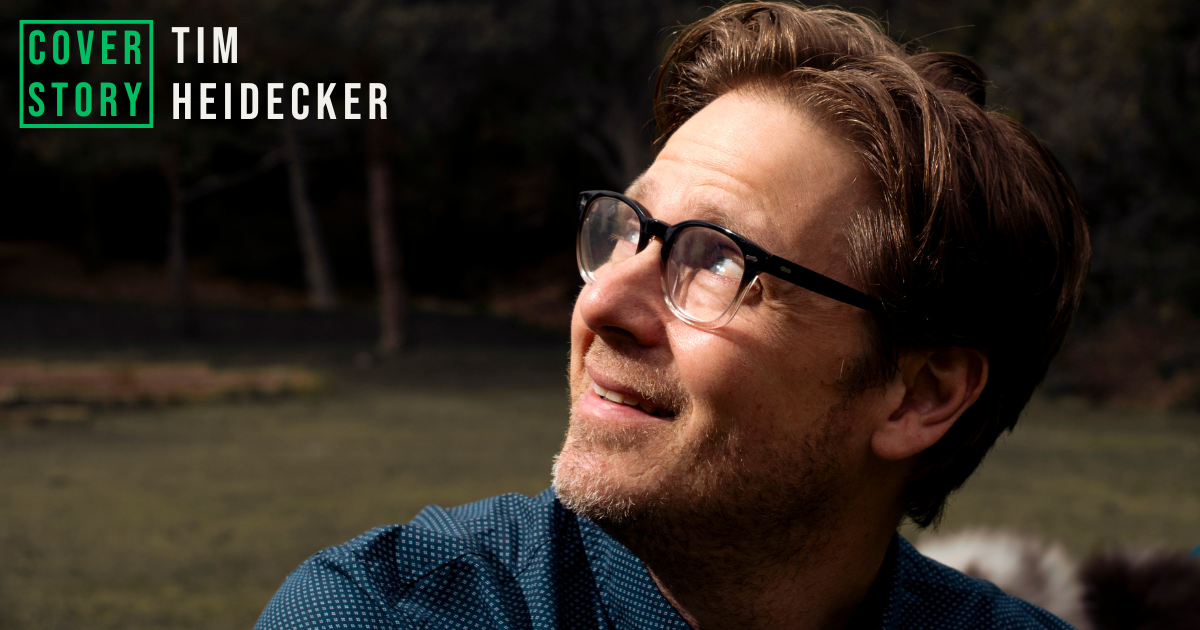
Tim Heidecker on the Battle of Life and Everything ‘Slipping Away’

Sitting in a Nashville hotel room one recent morning, Tim Heidecker is awaiting his Americanafest showcase. It’ll take place later that evening at 3rd & Lindsley. And Heidecker’s dreading the gig. Not because he doesn’t enjoy the act of performance. It’s simply the format in which the show will be set up: solo.

“It’s not my preferred way of presenting my songs,” Heidecker says. “I just came off the road with my band. Playing every night for two weeks. I’m a little road tested and warmed up. But, these songs benefit from other people playing them with me.”

That sense of vulnerability and, perhaps, a slight fear of what may or may not lie just around the corner of the grandiose ether surrounding all of us are core themes at the heart of Heidecker’s latest album, Slipping Away.

Though many may know Heidecker for his comedic brilliance – as part of innovative comedy duo Tim & Eric, on an array of beloved TV shows or across the big screen in major Hollywood films – he’s also been a lifelong singer-songwriter. And a damn fine one, too.

Now 48, Heidecker offers Slipping Away (available October 18 via Bloodshot Records) as a genuine snapshot of a human being wrestling with middle age and the intricacies of daily life. Just like many of us in the same boat of age and awareness.

Sonically, Slipping Away straddles psychedelic alt-country, surf rock, and indie folk. The ethereal attitude and lyrical ethos flows in the same river as Pavement and Wilco, with hints of Guided By Voices and They Might Be Giants felt throughout.

In an era of doom and gloom, Heidecker’s humor and zest are much needed – the notion that sometimes all you can do is laugh in pure amazement at the absurdity of what’s outside your front door.

“They say that Jesus Christ is coming back some day/ But if I were him, I think I would stay,” Heidecker sings during “Bows and Arrows.” “Up in the clouds, hanging out with dad/ Cuz things down here, things are going bad.”

In truth, much like his comedy, Tim Heidecker’s music is aimed at the idea of connectivity. Finding common ground with you and me. And his constant yearning to expose the lunacy and mysteries of one’s existence within the cosmic universe is why we’ve come to turn to Heidecker for comfort and solidarity in uncertain times.

I replayed the album this morning while having coffee with my girlfriend. And, in a good way, I started having existential thoughts. It made me think, “This is an honest snapshot of someone on the cusp of 50, who’s looking at the chaos of their youth in the rearview mirror and looking at the unknowns of growing older through the windshield.”

Tim Heidecker: That’s beautifully put. Can I use that? [Laughs] I mean, yes, I agree with that. It’s funny, you writers, critics and journalists are always better at vocalizing what I’m trying to say than I am. And I appreciate it. These things come from such a subliminal place for me that it’s nice to hear how it’s received or how it’s perceived. A lot of the writing of this record came right after the pandemic. There was this real, palpable feeling of an apocalyptic kind of mentality happening.

It still feels like that every day, though. That’s the world we live in now.

Yeah, for sure. And it was very crisp in 2020, 2021, 2022. In my comedy, I’ve tried a few different times to write shows about that. I’ve had a couple of projects that didn’t go very far, that were sort of about the end of the world. So, it’s been on my mind for a while and I wanted to do a record with that sort of concept or theme. And I started writing songs, letting the record be this way of getting those ideas out of my head.

With the title, Slipping Away, is that a reference to how fast time goes?

Picking the title of a record is always a pain and challenge to crystallize it. But, to me, there’s two meanings. The first half of the record is maybe a little more upbeat and positive and there’s this feeling of being content or being happy. Then, it can also mean things falling apart and disintegrating [in the second half]. There’s Slipping Away Side A and there’s Slipping Away Side B.

There’s also a very ethereal vibe to the album, too, where it’s like a dreamlike state.

Mm-Hmm.

With the song “Hey, Would You Call My Mom for Me,” was that a real encounter you had with somebody?

It was. We were on tour up in Vancouver. They have a big area of Vancouver that’s kind of been surrendered to addicts. They call it “Zombie Town.” I was walking around there and a kid asked me that. It was early in the morning and it took me off guard. I gave him 20 bucks and was like, “Sorry, I can’t.” I just couldn’t get involved. But, I came back to that line of, “Hey, would you call my mom for me?” Especially after the pandemic and living in Los Angeles, seeing a lot of people on the street. I felt like I wanted to capture that moment. Little journalistic songwriting there.

I’ve read that you’re an atheist/agnostic. And I wonder – with the pandemic and just life in general – if you’ve started to have maybe a crisis of faith or identity as you’ve gotten older?

I wouldn’t say crisis.

Recalibration, maybe?

Recalibration is fair. Honestly, I’m fairly firm in my agnosticism. I wouldn’t consider myself an atheist. I think it’s kind of an irrelevant question for me [about] what’s going on outside of reality. But, I’ve started therapy and working on some personal issues, health issues and stuff this past year. I don’t want to say midlife crisis. But, it’s this feeling of like, “Alright, I’ve been kind of coasting on my instincts for a long time. And it’s gotten me to where I am, which is a pretty good place. But, I’d like to figure out how I’m going to spend the rest of my life here – maybe a little happier, a little less anxiety-ridden, easier to be around.”

It’s been a couple years of taking the old car into the shop and getting it adjusted for long-term use. I mean, I’ve been touring with this band for the past couple years. And part of me is like, “Man, love this so much. How many more of these am I going to get to do? How many more of these runs where you’re just on the bus and you’re playing every night?” It takes a lot of work to get to that place where things are going well.

There’s the line on the record – I think it may be my favorite line on the record – [in the song “Something, Somewhere”] that goes, “There is a feeling I get, when things are going good but it’s coming to an end.” You’re at that place where things are working, something you’re working on or a project where you see the end. It’s that end of summer melancholy feeling. And I think you can zoom out and look at your life a little bit that way, too.

I couldn’t find much about your early music years. And I was curious about where music begins for you, and as somebody like yourself who came of age in early 1990s Pennsylvania. Was music just something that was always there?

Yeah. I came from a very musical family. My grandmother was very religious. She could play piano and she could play by ear. So, she could sit at the piano and figure out songs. My mom loved music and my dad was a big classic rock guy. He had a great record collection, then he updated his record collection to tapes as we were driving around in the ’80s. He would play the golden oldies and the best of the Beatles, [those] red and blue compilation [albums] a lot. I was always very performance driven, dressing up and doing shows and playing from as far back as I can remember. We had a piano in the house, and eventually a guitar came around. It was just something my parents really encouraged, I guess. My sister took piano lessons. It was just part of our education. I went to Catholic school, so there was a lot of singing. Just a lot of music around all the time.

Eventually, that led to bands being formed. My cousin had a hardcore punk band. And I gravitated towards those kinds of people who were also into music. I had an uncle who had really great taste in music and turned me on to all kinds of artists in the ’80s and ’90s [like] Billy Bragg. I remember him being a big fan of [Billy]. And it was fairly easy to put a band together. We all wanted to be on TV or make movies or create stuff. But, the band was the thing that you could put together after a good Christmas of getting a practice amp and a starter guitar. Your friend has a drum set and you could go into a basement and make something. We used to rent four-track tape recorders from the music store and make demos.

I hear a lot of influences on Slipping Away – indie rock, folk, alt-country. I hear a lot of stuff, too, that I grew up in the ’90s loving. I hear some Pavement influences. With Pavement, they always came across as a band where you could do whatever you wanted, and a song can be whatever you want it to be – something I always loved about them.

I loved Pavement. In fact, they’re a really important band for me, because when I was in high school my head was really firmly in the classic rock ’60s and ’70s world. I didn’t really connect to anything modern. I didn’t like pop punk music. I mean, it was okay. But, I didn’t really like the hardcore scene, the emo scene. I found it really boring and exhausting to listen to, and I couldn’t hear what they were saying. I didn’t like a lot of hip-hop. Whatever was happening in the early ’90s, I was not connecting with it.

And then I heard [Pavement’s] Crooked Rain, Crooked Rain record. I remember hearing the drumstick in [opening track] “Silence Kid.” And I was really into Exile on Main St. by The Rolling Stones, so it was a connection, a through line from the Stones to Pavement, where it felt like, “Oh, these guys are happening now.” That opened me up to Guided By Voices, The Jon Spencer Blues Explosion, Yo La Tengo, and that Matador Records scene. I was like, “Oh, I am of my age now. I’m of my time.” [Laughs]

When you’re touring, is it weird people may have preconceived notions of what to expect and expectations that aren’t accurate?

Yeah. I mean, that’s diminishing a little bit now. I think people are getting the message. There’s still people that are confused. They’re waiting for the punchline to drop. It took me a while to figure out how to behave as a performer when I’m doing my music. I’ve found this little sweet spot, where I can still be funny and I can still be myself. I don’t have to pretend to be this pretentious singer-songwriter, because I’m not. I’m just me. I don’t want to keep it too serious, so I lighten the mood enough where people get a little bit of both – they get the full picture, they get the full version of me.

One of the songs on Slipping Away is “Dad of the Year,” where you sing about how you had all these expectations growing up and conquering the world, as we all do. And now you’re in your late forties and you’re like, “Well, that didn’t really happen. But, in this other way, I’m actually really happy with where I landed.”

For sure. The goal is to get to that place where you’re content and satisfied with wherever you are. And in the way the world is, it’s very hard to not compare yourself to everything else that’s going on, to people you don’t know. Why do people care about Ben Affleck and J. Lo? [Laughs] When I see a picture of them, there’s this intrusive thought of, “Why aren’t they taking pictures of me?” And if you really are honest, I think everybody has varying degrees of that. And that’s the battle of life – to find ways of knowing how to be happy with where you’re at. But, don’t squash ambition, because ambition is very important, too.

To that, it does feel like you’re in a good place right now.

I’m in a great place. I’m in Nashville. I’m excited for the record to come out. I hope people sit with it. Some records you just need to sit down and listen to. I mean, Slipping Away is only 30 minutes. [Laughs] This isn’t coffee shop music.


Photo Credit: Chantal Anderson

BGS 5+5: Max McNown

Artist: Max McNown
Hometown: Bend, Oregon
Latest Album: Wandering
Personal Nicknames (or rejected band names): Almost went by Max Winter (Winter is my middle name)!

What rituals do you have, either in the studio or before a show?

My pre-show rituals remain somewhat consistent from show to show. I stay hydrated throughout the day leading up to soundcheck and I typically take it easy on my voice while I rehearse the songs (because I haven’t warmed up at that point). Post-soundcheck, I rest in the green room and use a steam inhaler to clear my sinuses before letting my vocal cords cool down from the heat for at least 30 minutes. After that, I kill time until around 30 minutes before I hit the stage, occupying myself with iPhone games to distract me from the pre-show nerves. At 20 minutes before the show I do a 10 minute vocal routine. At the 10 minute mark I call a circle with my band and say a prayer of thankfulness, asking that whatever happens, we impact the crowd for good. Minutes before stepping on the stage I conduct a box breathing exercise to slow my heart rate, and I’m off to the races!

If you had to write a mission statement for your career, what would it be?

Growing up, I leaned on music to get me through some of my most difficult moments. If I could summarize my “mission” it would be to return that healing… To repay what music has done for me to those who hear my own songs.

How often do you hide behind a character in a song or use “you” when it’s actually “me”?

Considering nearly all my songs are directly influenced by my own life, I hide behind characters often. I purposefully keep it vague when discussing which lines in which songs are fully “true stories.” Some of the most impactful films of my life are “based on a true story” and I take that knowledge into every writing room. Occasionally I take liberties when storytelling, but a lot of my work is pretty accurate to my own life journey.

Does pineapple really belong on pizza?

Considering Hawaiian-style pizza is one of my favorite foods, I strongly believe if you enjoy the taste, you can put whatever you want on pizza!

If you were a color, what shade would you be – and why?

If I were a color I’d have to think I’d be my favorite one, forest green… Simply because of my upbringing in the lush Oregon trees, my green eyes, and my love for nature!


Photo Credit: Benjamin Edwards

One to Watch: Viv & Riley Are Much More Than Just Old-Time or Americana

Comprised of singer-songwriters and instrumentalists Vivian Leva and Riley Calcagno, Viv & Riley are an up-and-coming musical duo that defy definition. Their new album, Imaginary People, is a masterful blend that weaves together their shared reverence for traditional Appalachian music alongside indie-folk, pop-leaning adornments. The result is an emotionally potent 10-track album that covers a vibrant range of personal and universal truths — from the bittersweet nostalgia of visiting a beloved childhood hideaway decades later, to the poignant curiosities that accompany reckoning with climate grief.

Based out of the dynamic music scene in Durham, North Carolina, this duo is currently on tour across North America. With their insightful explorations of the past and creative probings of the future, Viv & Riley uncover rich and complicated explorations of what it means to be alive in this precise moment.

So how did the two of you first start making music together?

Vivian Leva: Well, we first started making music together when we first met in 2016, the summer after we both graduated high school. I grew up in Lexington, Virginia, and Riley grew up in Seattle, Washington, and we just happened to meet at a camp in Port Townsend, Washington. It’s one of those camps that has weeks back to back — there was a vocal week that I was teaching with my mom, and then Riley came to teach fiddle the following week. We happened to overlap by a few days, and Riley was there with his band The Onlies. The first night we met, we played music together all night! After that, I joined the band, and we also started playing together as a duo and writing songs.

Riley Calcagno: The origin of our sort of band, our duo, came later that year, in the fall. We had been communicating and texting some music back and forth, and then Viv invited me down to Asheville to play a gig with her and her dad. I was a fan of her dad, James Leva, for his fiddle and singing, so we did that gig. But we thought it’d be also fun to try out some duo material while we were down in the same place, even though we had never played songs just the two of us. We emailed a venue in Asheville called Isis Music Hall, which was a prominent venue there at the time. Somehow they slotted us in, on a Wednesday night, into this big hall that they had — 200-person capacity, maybe bigger. We had never played music together going into that, but we put together some material and we enlisted some friends to play with us. It was a bold move! Talk about faking it until you make it. Only about 15 people came out to the show, and I’m sure it sounded terrible. But it was fun!

That sounds amazing. So how would you describe your musical chemistry? What is it like playing together?

VL: ​​Well, I think our initial musical chemistry initially came from our shared background in old time music and traditional music. That first night that we met, we played a lot of fiddle tunes, old music, and traditional songs. So it kind of began from a place of excitement about being exactly the same age, having never before met, and somehow both being raised around this same music that we have a shared respect and love for. So that was the initial spark of actually finding another young person who’s into the same niche genre and community. But since then it’s totally stretched into other realms. We are both so open to other kinds of music, and we have very similar tastes and aesthetics. It’s very easy to create music together because we come to it from a similar place.

RC: One of our dynamics in making music together has also been sharing our individual strengths with the other person. When we first started playing together, I couldn’t really sing harmony or find a harmony part. Vivian was very patient with me and helped me learn, and I still feel like I’m getting better all the time. That’s exciting!

VL: I just play guitar, and Riley plays every other instrument. He’s a great fiddler, guitar player, banjo player, mandolin player— instrumentally he brings so much to the table. And I feel I bring a lot of singing and songwriting-focused material to the table. We stretch each other, fill in the gaps for each other, and learn from each other.

What a beautiful thing! So what do you each feel like the biggest difference in your respective musicianships is?

RC: Viv is a very natural musician. She grew up traveling around with her parents as they toured, sitting in on harmonica at her dad’s gigs when she was only three or four. I also was born and raised around music, but it was a bit more formalized, whereas Viv’s music just comes very naturally and it’s not forced in any way. She does what she does super well and consistently and steadily, and I’m a bit more erratic. I take chances and get obsessed with things and take big leaps that sometimes fall flat. Every time she steps on stage, Viv can knock out a great performance, and I feel more streaky.

VL: But he tries lots of different things! And like he mentioned, Riley has a more formal background in music. He took lessons, he learned how to read music, he knows music theory, he did classical violin. So I think a big difference is that he technically knows what’s going on, whereas I don’t have the language or skills that he has. I’m definitely more intuition based than technically based.

You really balance each other out! So your new album, Imaginary People, just came out on September 15, and I’m wondering how your songwriting, as it appears on this album, has shifted since you first began as a duo.

RC: Well, in the past, before we started writing music for this record, we were living in different places so it was a lot of collaboration from afar. A lot of the songs on our last record came from texting voice memos back and forth. And you know, it’s not utterly different to work on them in person, but some of these new songs came out playing them together in the moment.

VL: Another big difference is Riley has started writing way more. So I think there’s more of an equal voicing on this record than in the past. There’s more of his perspective in it. And I think now that we’re living in the same place it’s also allowed us to write about a more diverse range of things. We’ve written a lot of intense emotional, romantic songs in the past, but in this recent past couple of years, we’re more interested in other things, like our shared experiences about other parts of life.

RC: And it’s also partly stylistic. Our last record was pretty much a country record. During that time, I was listening to a lot of classic country music, and this time we were listening to a wider range of things. Having a broader array of influences definitely helped us push the narrative forward.

What are you each proudest of on the album?

VL: I think what I am most proud of isn’t a specific track or anything — mostly it’s this feeling that I unlocked something. I think I let go of some fears in the process of making this record. I felt more free to just say yes to trying new things and became less concerned with things like what genre it was going to be considered, or if the people who liked our last record would like this record… and so on. I stopped worrying about categories like, “This doesn’t sound traditional enough,” or “This isn’t country enough,” or “That’s too rocker or indie.” Instead, I was able to adopt the mentality of “Hmm, that sounds interesting, let’s try and just do what feels fun!” I think I’m most proud that I was able to do that. It felt amazing to take things a little lighter and to roll with ideas that felt a little outside of the mold.

RC: When you start making music, being young musicians, you get immediately labeled. It’s not something that I think either of us necessarily anticipated, but when that first record got classified, people said it was Appalachian and classic country. And then the next one was classic country and Americana. Like “Hits-the-Spot Americana,” whatever that means. And I think there’s an urge for musicians, when you get labeled as something, to keep reproducing it. There’s this toothlessness to the modern Americana music label— it’s the creation of music that is literally meant to sound like other music under a category. I don’t have a problem with genre or specifications, I think it’s oftentimes useful, but it’s [useful] when you’re trying to reproduce sounds so that you can cater to an audience, it’s like you’re trying to sell something in a market that’s already been created. I think that can be the “dampification” of art. And while I think there’s been so many amazing things created within the Americana industry, I also think it often leads to less creativity and less interesting music.

Coming out of our last record, we had some buzz in the Americana world, and it would have been easy for us to make another “Hits-the-Spot Americana” record. But I don’t think that we did that, and I feel proud of that. Like Viv was saying, we didn’t just do what we were supposed to do. You know, there’s synthesizers, but there’s also a fiddle track, and personally, I think it all works together. So maybe if you’re an Americana devotee, you’re not going to love this album, but that’s okay with me. I think there’s a power in making an album that the machine doesn’t really know what to do with. The machine can make up albums and spit them out, but I feel proud that this one isn’t something that can just be spit out because of how we combine traditional and non-traditional music. For example, there were super organic moments where we all stood around one mic and sang together, coupled with other moments where we had things locked in, produced, and added synths because a particular song called for it. Making those two things coexist in the same ecosystem was definitely a challenge, but listening to the record, I think it all makes sense together.

It’s an album full of teeth! Now, before we wrap up, I have to ask: you’re our One to Watch, but who are you watching right now? Any creatives, musical artists, or otherwise that are inspiring you right now?

RC: One is our neighbor in Durham, North Carolina, Alice Gerrard. She’s almost 90, and she’s putting out a record on this indie label from the area called Sleepy Cat. She’s collaborating with a bunch of young people and their art for the record, like making these amazing videos. It’s a really cool thing! People around here are really conscious and thoughtful about aesthetics and sound and ethos. Everything is done with integrity, so it’s a cool scene around here in that way. Alice makes amazing music, I’m really excited for her upcoming record — I think we’ll all be glued to it once it comes out. Another one is our friend who we wrote two songs with on our previous record, “Love and Chains” and “Time Is Everything”— often people’s favorite songs of ours. I just had the honor of producing his upcoming record under his band’s name, Preacher & Daisy. I love the music, so I definitely want to give them a bump! The fun thing is that all this music is sourced locally from the Durham, North Carolina area, where we’re based.

VL: Some folks I’m enjoying listening to right now, not that they’re not already being watched, are: KC Jones, Canary Room, Dori Freeman, Alexa Rose.


Photo Credit: Libby Rodenbough