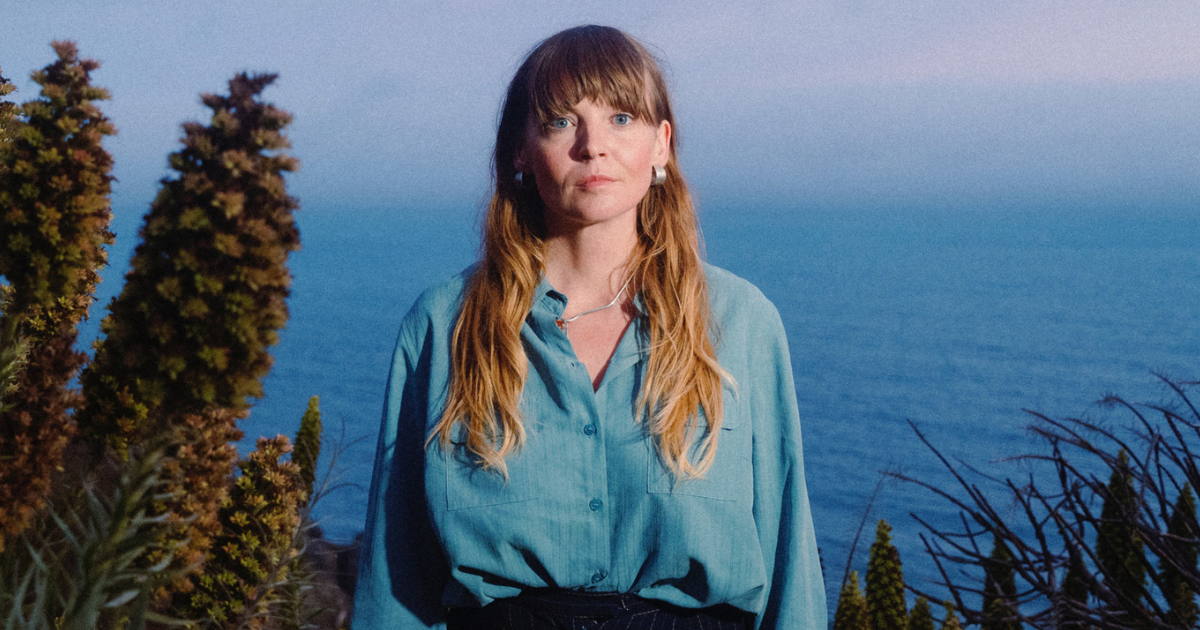
On singer-songwriter Courtney Marie Andrews’ upcoming album Valentine, you can hear her letting go.
It’s a process she ostensibly started – at least, musically or outwardly – on 2022’s Loose Future, a collection on which Andrews also reckoned with being in a period of transition, personally and professionally, letting go of former five- and 10-year plans and recentering in the present.
Approaching four years since that most recent studio album, with Valentine it seems Andrews is intent on reinforcing and revisiting the same lessons she taught us and herself on Loose Future. The new album, which will be released on January 16 by Thirty Tigers, begins with a grand, tone-setting opener, “Pendulum Swing.”
Reminiscent of ‘60s pop-folk and rich with arpeggiated 12-string guitars, Andrews vocally soars into the verses and murmurs each contemplative chorus:
If I get what I want
Gotta let the pendulum swing
Can’t be good for too long
Let the pendulum swing…
It doesn’t exactly strike a listener as the sort of Loose Future Andrews formerly envisioned, but the song also doesn’t seem to wallow in the apparent feeling of impending doom, or the instinct that imbalances of “good for too long” must be righted. Instead, to this writer, it rather sounds like she’s focusing on the instinct itself. On her belief, conscious or subconscious, active or passive, that “karma” or “deserving” necessitates inevitable negative responses to anything positive.
As with all of her impeccable albums, Valentine finds love as a frequent subject – as well as community, perception, expectations, and how all of these topics touch on or intersect with existential dread. But Andrews seems to be letting go of her ideals of what love is or what it can be, as well. Thankfully, her perspective on the subject is always expansive, never simply reduced to just romance or sex or heteronormativity – or some slurried combination thereof. But Valentine is more direct in its approach to love than some of her LPs.
“[Valentine is] a record in pursuit of love,” Andrews explains via press release. But that love “is a lot more than I gave it credit for,” she continues. “It’s built over years, it’s built with trust, with changes, it becomes something new and unrecognizable, the deeper you go.”
Songs like “Keeper,” “Cons and Clowns,” and “Everyone Wants to Feel Like You Do” follow in tight formation behind Andrews’ past songs on love, connection, and romance – especially the masterful album, 2020’s Old Flowers. But other tracks, perhaps chief among them “Best Friend,” indicate that expansion on love as an idea and point back to the creative process here also being one of letting go.
You can sense that surrender, the gradual unclasping of fists and de-whitening of knuckles, in almost every aspect of Andrews’ creative output. It has, after all, been quite a few years since she last released an album. Her prior rhythm of abject road-dogging and releasing LPs every year or two has been replaced by much more thoughtful and intentional tours, performance forays, and product launches. She’s leaned more into another medium, painting, and has gone full-bore as a published poet, too. She’s released two collections of poetry – Love Is a Dog That Bites When It’s Scared having arrived this past August – and has built up her creative, community infrastructure to feed more than just her itinerant musical pursuits and former wall-to-wall, year-round tour schedule.
It’s almost like you can hear the retooling of Andrews’ idea of success happening in real time, from Loose Future through to Valentine. Like you can hear her realizing that giving up the version of herself who existed on Honest Life (2017) through May Your Kindness Remain (2018), and the version of herself from Old Flowers and Loose Future, doesn’t ever mean net loss. Like being on the road less means one could grow flowers, feed stray cats, and build a support system in her new home of Nashville that, especially as an only child and retired nomadic busker, she’s always craved.
The sense of letting go was perhaps infused into Valentine by the specific circumstances that gave birth to these songs. “I was in one of the darkest periods of my life,” Andrews continues in the project’s album bio, “and songs were the only way I could reckon with it.”
“I felt cursed, and the only mental cure felt like songwriting and painting.”
It’s why this album, like almost all of her prior releases, also feels as self-directed as it is outward-facing and primed for wide audiences. Andrews has learned that letting go – of control, of her past self, of expectations, of legalism around or criteria for love, of the “power” (and curse) of individualism, of freneticism and frantic ladder-climbing, or of life itself – is a process we don’t ever graduate from. We never muster out. We have to return to ourselves, to introspection, to the very constructions of our selfhoods over and over again to do that work.
The redemption and sheer beauty of this album are not because Courtney Marie Andrews has found her Valentine, but because she can hold up her wants, needs, and dreams as valid and wholesome goals on one hand, while stripping – and re-stripping – them of any power they may hold over her on the other. It’s an impressive duality, one that wouldn’t be nearly as successful without Andrews already having done so many reps in finding herself and of letting go.
Andrews is our January 2026 Artist of the Month, an auspicious start to a brand new year of roots music. Here, you can read our feature interview with Andrews all about Valentine, its making, and the unique way she and her collaborators went about recording these fantastic songs. Below, enjoy our Essentials Playlist and tune in on social media as we dip back into the BGS archives throughout the month to share all things Courtney Marie Andrews.
Photo Credit: Wyndham Garnett