From Lonesome, Gorgeous Texas Hill Country
to the World

There’s little to no stage banter when the Droptines play a show, with the Austin, Texas-based band sometimes cramming 30 songs into a 90-minute set. However, as their new album, Drought Flower proves, they still have plenty to say. Their original songs touch on broken relationships (“Old Tricks”), family grief (“Mamaw,” featuring Sarah Jarosz), and losing loved ones to addiction (“What Ate My Friend”). As a nod to classic country, there’s often a little bit of clever wordplay to offset the drama, too.

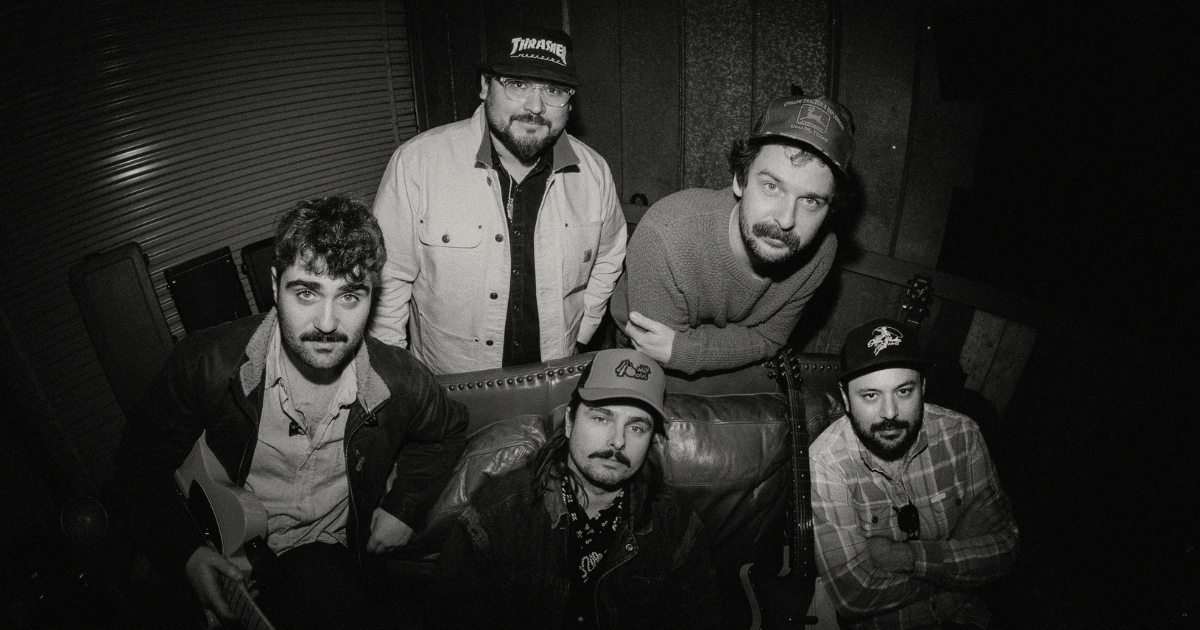
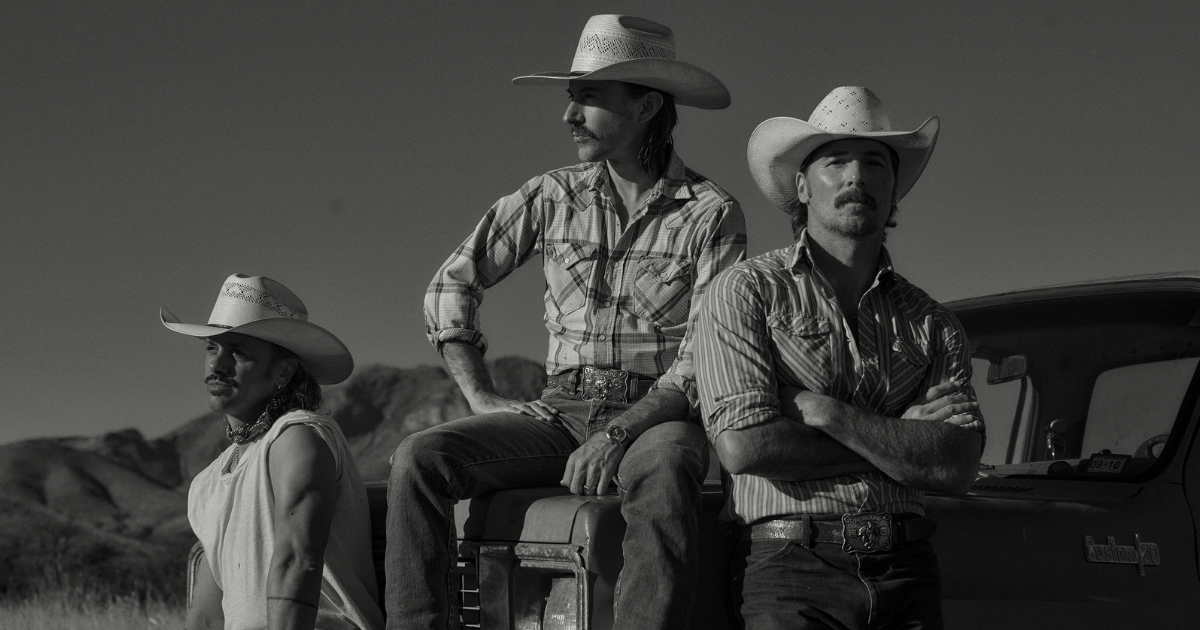
Named for the downturned deer antlers that are prized by hunters, the Droptines (rhymes with “stop signs”) first took shape with an EP release in 2019. Lead singer-songwriter Conner Arthur has since guided the group through indie albums, relentless touring, and now their debut set on Big Loud Texas, the label founded by Miranda Lambert and Jon Randall. The five-piece band hasn’t yet moved into a tour bus, though. Instead, they travel in a retrofitted school bus with upgrades that would impress any road musician. (It sleeps 10 people and has a bathroom, two air conditioners, and a built-in trailer space.)

Growing up in the Texas Hill Country town of Concan, Arthur watched countless musicians play at his family’s venue, House Pasture Cattle Company, during the summer season of city folks floating the Frio River. But the rest of the year, when nothing was really going in town, influenced him just as much.

“I learned how to be alone in Concan,” Arthur says. “I learned how to clear my mind and ignore my hunger pangs. But I would always watch and study people. Especially because if you’re driving through Concan in, say, January, and you see a car that you don’t recognize or someone you don’t recognize, you’re shocked and you want to go talk to them. You’re just caught in your own little village for so long. Having an outside perspective from my little narrow worldview was very, very important to me.”

A few days ahead of a full slate of tour dates (and just before stocking the school bus), Arthur called into Good Country to talk about what inspired the new music.

For people who haven’t been to the Texas Hill Country, how would you describe it?

Conner Arthur: The drama of the limestone bluffs, the crystal clear waters of the Frio River – man, it’s hard not to have a religious experience every other day. Especially when it rains and the floodwaters start moving. Everything there is so dramatic and explosive and chaotic. From the summer to the off-season, you have three months of complete and utter chaos, then the rest of the year is just silent. There are some days where I’d walk out and just sit there looking at River Road waiting for a car to drive by. And I was starting to freak out, thinking that I was the last person on Earth.

More than likely I think that made its way into my personal life. It’s just a large juxtaposition, and a dichotomy of high highs and low lows. But I learned how to handle it, growing up there. We didn’t get internet or cell phone service until 2012, and that’s a great way to grow up. My backyard was 200,000 acres. I could ride horses without hitting a fence line for miles. I wish that more people had that upbringing. I wish that I could provide that for my kids.

If you didn’t get the internet until 2012, then you got to experience live music at your family’s venue before the cell phones in the air and people documenting every show.

Oh yeah. The funny thing about House Pasture is [that] it’s changed hands but it stayed in the family. My biological father and my uncle started it. They failed, so my grandpa bought it from them. And then it was kind of a “break even” type of venue. It was just an addendum for someone who’s gonna go down to Concan and float the Frio anyway. Like, “Oh, we can go see so-and-so.” I mean, I’ve got scars all from being this tall and women ashing cigarettes out on my collarbone. Not on purpose!

I learned more about what I didn’t want to be, seeing the evolution of the Texas country scene come through there. I saw that evolution get commercialized in the mid-2000s, like 2005 and 2006. But when I was a little guy, I got to see the Great Divide. I got to see Gary P. Nunn. I got to see John Conlee. I got to see Earl Thomas Conley. I got to see all these really high-class acts. Reckless Kelly is still one of my favorites from that era. Robert Earl Keen, the list goes on. Even if I didn’t like it, the song’s going to be in my head. It is still red dirt Texas country. I still know every word to all these other musicians’ stuff that I’m not a fan of, because it’s just ingrained in you. You can’t avoid it in that environment.

What were you doing before you jumped into music?

I was in construction throughout high school and I’ve gone back and forth over the years when I needed money. But when I was 18 years old, my mom pretty much gave me an ultimatum. She said, “If you don’t go to college, you’re cut off.” And I was like, “Well, I don’t really care. I don’t like ultimatums.” So I grabbed my banjo and I hitchhiked the country for about a year and a half.

I got back home, and that was like going 90 miles an hour into a brick wall. The fantasies in my head were dashed out by my mom’s disappointment. She said, “You’re gonna have to get a job.” So I went back to construction for a little bit, then I joined up in the oil field. I was an oil field mechanic for about two years, and I said, “I’m not going to die out here in the Eagle Ford Shale.” So I made a decision. Just to give me some more confidence, I went to the bluegrass program in Levelland, Texas, at the [South Plains] College. I did that for two years and went home and knocked out our first EP with David Beck.

I knew you played the banjo, but I didn’t know that you had studied bluegrass.

Dillon [Sampson], our bass player, and I both went to South Plains and he’s way more of a bluegrass cat than I, but my story about how I got into playing banjo is just kind of happenstance. My older brother came into some money when we were young, and I won’t go into the details on how he got it, but it was burning a hole in his pocket. He bought this Deering Goodtime open-back banjo and it was sitting in the back of his truck. I was about 14 and I had plenty of guitars floating around the house. And I had a piano, but I never really broke through on it because it was just an instrument for me to get a song out.

I don’t know if it was the open tuning or just the fact that it’s hard to not have a good time playing banjo, but I broke through on it. I could start developing an understanding of music theory and scales. I don’t know why it made sense in my mind that it was less intimidating than 72 keys or six strings. You go down that road, and then are you a gimmick banjo player or are you good? That’s what led me to South Plains. I’m not going to disrespect the institution of bluegrass or the instrument of banjo. I’m going to do my best to play it. But I need to play more. I need to stay on it, because that is not a bike. Your agility and endurance of playing the banjo collapses if you’re not tickling it once or twice a day.

Is that the same for writing with you? Do you need to consistently write, or can you put that away for a while and come back to writing?

I’m always kind of writing in my head and building concepts, then I’ll scribble it down. I’ll more than likely lose the piece of paper I scribbled it down on, but I’ve always said if it’s worth remembering, then I’ll remember it. But I probably lost a thousand songs that way. It’s like a floodgate. I sit around and I’ll have an idea, and I’ll get a quarter way through it, blah, blah… But it’s not until the band all sits down in a room and we all have the intention to write, and these things just… “Boom!” There goes the dam.

In several of your songs, there are references to pills or addiction. On this record, you have “What Ate My Friend.” That’s a reality for a lot of people. When you’re tackling a heavy topic like that, how do you get into that headspace, knowing you’re going to jump into something serious?

A lot of that, it’s lived in for sure. I’ve had men that came before me that did it so I didn’t have to. Back to, I know what not to do now. And my brother Landry being one of them. I lost him to all that shit a couple years ago. He and I were Irish twins. The same thing happened to my biological dad’s brother. At the same age, the same exact circumstance, and they both died on their birthday.

“What Ate My Friend,” I can’t even remember writing that one, but I know that I showed up with all of it, and that’s rare. I have this band to lean on, but I showed up with every bit of that. This was all here. It’s not just about my brother, but a couple friends I have. Just like, “I know you’re on meth, dude, but why is it making you a liar?” Like, you can be honest with me, just tell me. It’s getting in the way of our friendship if you’re going to turn into a liar.

I thought there was a nuance, kind of, what I refer to as the days of country gold, the wordplay of like, “She’s Acting Single (I’m Drinking Doubles).” That’s so important in country and bluegrass music – that play on words – and that one is like, “Hey man, what’s eating at you?” All right, what’s the extreme of that? “What ate my friend?” I thought it was pretty decent, but yeah, that’s a rough one, you know, but it’s real, unfortunately. It’s real for a lot of people. And I hate that. I hate that anybody has to suffer.

You’ve been around music from the time you’re a kid, and now you’re doing this full time. What has surprised you the most about this career path that you’re on?

The main one is that there’s viability. I said this in an interview before, but I just thought playing music was a good excuse to be a loser. And then to see it all pan out! It starts to feel like work, but work is good, especially if it bears fruit, which it is, and it’s starting to even more so. But to be able to build a foundation for my future family off of the back of these songs, that right there is top tier, number one, the most important thing. I can’t be more grateful for that and the blessings that God’s given us. Just having people come religiously to your shows, and singing words, it gives you faith in live music, for sure. It is a little shocking to me, at the end of the day that I didn’t make all this up.


Want more Good Country? Sign up to receive our monthly email newsletter – and much more music! – direct to your inbox.

Photo Credit: Jessie Addleman

Hudson Westbrook Is Ready for What’s Next

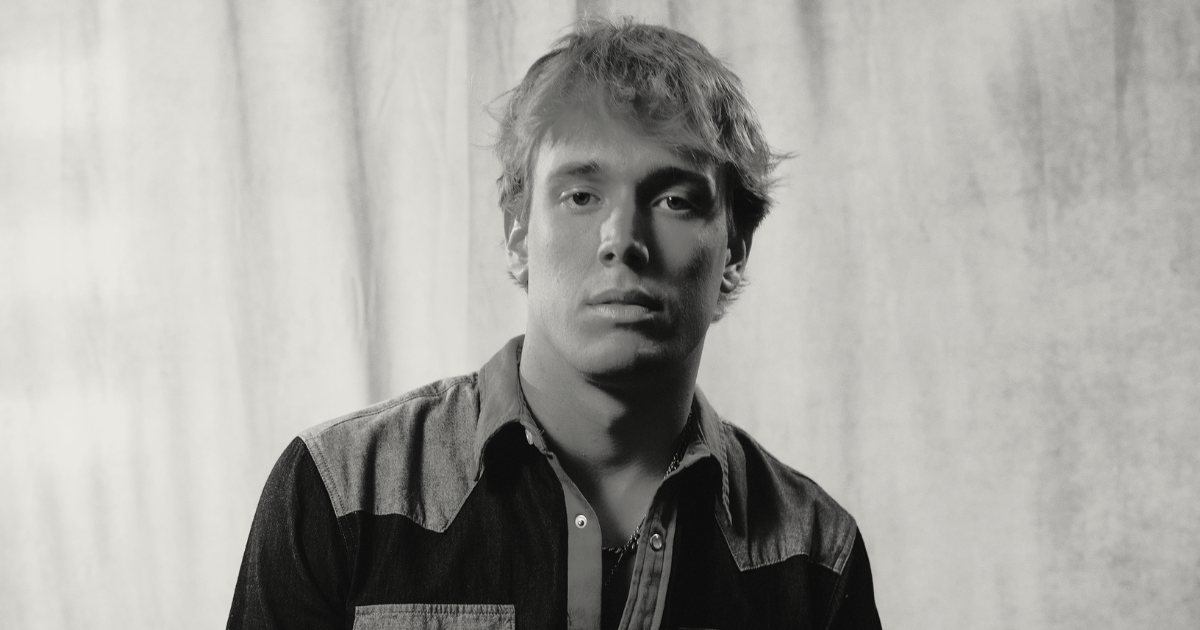
It was not so long ago that Hudson Westbrook was in college at Texas Tech. But today, he’s one of the most promising and hard-to-pin-down young acts in country, helping pull Texan artistic independence into the mainstream.

Joining trailblazing stars like Cody Johnson and Parker McCollum, Westbrook celebrated his first Number One in February after finding a home for “House Again” on the Mediabase country radio chart. Also certified Platinum by the RIAA, it’s more evidence of a shift away from cookie-cutter tailgate anthems: an emotionally complex ballad rooted in the experience of a kid watching the fallout of their parents’ divorce.

Westbrook paired raw lyrical nerve with a soulful, tender touch, helping the newcomer tally one billion streams in 18 months, with an exponential growing profile – and then he switched things up.

His recently released Exclusive EP features five tracks awash in rootsy R&B, proving the 21-year-old won’t be held to a narrow interpretation of Red Dirt musicality. But he’s not satisfied there, either. His new radio single “Painted You Pretty” (from the debut album Texas Forever) matches country simplicity with an earnest romantic hook, and this summer he’ll tour arenas and stadiums with Bailey Zimmerman, Morgan Wallen, and one of his heroes, George Strait.

Speaking with Good Country at an East Nashville coffeeshop – just one day after meeting a pig on the podcast of his other hero, Tracy Lawrence – the fresh-faced star looks ahead to new music and shares his impression on what’s driving the Texas-and-traditional country resurgence. Barely two years into a rocket ride of a professional career, he’s still learning the ropes, and sometimes, the lingo. But Hudson Westbrook has all the artistic confidence he’ll ever need.

We last talked in 2024 and at the time you were just out of college. The only thing you had released was “Take It Slow,” and then “House Again” came out. How have things changed?

Yeah, I was working at that feed store and it wasn’t that long ago. I’d written “House Again” and then I just remember I was so confused as to what was going on. Now I look up and I’m like, “I was blowing up the whole time.” I didn’t realize how big it was getting. It’s hard to feel it. I’d be like “Hey y’all, is 5,000 tickets good here?” And they’re like, “Do you realize what you just did?” And I’m always like “… No.” [Laughs]

I’m getting bigger and bigger and bigger and bigger. I want to keep getting bigger, but I want to keep it small. So [lately] it’s just really been focusing on doing that. Not losing yourself. Focusing on grounding myself right now, making sure I’m calling my family and whatever it might be. And then also it’s celebrating it, too.

You just had the Number One [with “House Again”]. What’d you do to celebrate?

We were in Hawaii, so we drank – I don’t know – 15 margaritas? [Laughs] The coolest part about that song is it was my second co-write and I was like, “Yo, I don’t know what I’m doing.” [Co-writers Dan Alley and Neil Medley] said, “Well, what’s your hook?” I said, “What’s a hook?” And they started laughing. I’m like, “Bro, I don’t know what the hell that is, but I had this idea.” …

So it just blew up. And I was so scared, just because it’s saying goodbye to a lot of stuff, honestly. It all happened so fast. If anyone had to have someone explain to them how to deal with a fast moment, I’d say if their songs are working, slow down.

Really? What do you mean?

Because that was a song that was for me. I was like, “I’m writing these songs I love and they’re ready by the time that we need them, so throw them out there.” And, “I’m already in Nashville, so let’s film the music video.” We never really planned on dropping anything, which is kind of crazy. I wish I would’ve slowed down a little bit and then realized what was happening so I could soak it in. It’s still happening. It’s still great. But I would just tell people, maybe slow down if it’s happening that fast. I feel like a lot of times I didn’t know who Hudson Westbrook was when I put songs out. And now I’ve sat down and we recorded four songs on Monday and I’m like, “This is the vibe. This is what we’re doing.” It’s so refreshing.

You’re going to be sharing a stadium stage with George Strait [at Jones AT&T Stadium in Lubbock, Texas on April 25]. That’s a homecoming show and I know he means a lot to you, so how does that make you feel?

That’s where I went to college. I sat on the 50-yard line since I was 7 years old, watched every single football game at [Texas] Tech, watched every single concert, listened to George Strait since I was in the womb. It was “Check Yes or No.” It was “Troubadour.” It was “The Fireman.” All that was in my house from an early age. So I don’t know, it’s just crazy. It’s a little nerve-wracking, like who knows what’s going to happen? I’ve also never played a stadium yet. All my friends are going to be there. It’s just going to be weird.

I would say there are some similarities between you and George Strait and maybe that’s just because of your background. You’ve been traveling around, have you noticed a difference in country music depending on where you are?

I go to Florida and [the fans are] screaming the most Texas country song I have. And Texas country just means that production. It’s a view of writing and it’s a perspective. I use real drums. The biggest country music artists in the world don’t use real drums right now. That changes everything. And so now we got to be like, “How can we be different than everything else?” I think that’s by being natural, in a sense.

There’s definitely a moment happening for Texas country, bluegrass, and traditional roots, with Zach Top and some more of your peers. Is it just perfect timing for you?

I think we’re pushing it into that direction because I think we’re trying to get back what we wanted to hear. I know if I talk to Zach, he’d be like, “Yeah, dude, I want acoustic and drums and a shaker and I want it all to be in there.” I feel like we make country music and it sounds like the show. You could literally put a band on stage and play it with no auto tune, no tracks. And that’s what makes it unique for us, because it’s like no one’s ever going to play the same thing twice.

What’s coming next, though? The Exclusive EP is out now and it’s definitely different than Texas Forever.

To be honest, I was like, “I want to try a bigger sound, something more mainstream.” And so I chased it – but I did not give up on the songwriting. My songwriting was very intentional and it was very love story-based [on Exclusive].

I love them, but I’m going back to my Texas country sound. We just recorded a song called “Hey Dallas,” which is really cool. Then we did a song called “Backwards,” which is really cool. And then I don’t know, I’m leaning in to John Mayer production a bit – but no crazy guitar solo. [Laughs] I was like, I ain’t doing none of that.

I can say, definitely some more soul and a bit of R&B in there, for sure. It’s electric guitars driving the whole thing – and I love electrics and baritones. I want that to drive all my stuff from now on. My voice just sounds better with it to me.

So it’s going to be like a whole new fresh album?

Totally new. I have like 120 songs and a lot of them are pretty good. I’m not saying they’re all for me, but I finally did what I should have done and that was sit back, find my key, find the way I like to write, really be intentional about what I’m writing. I wrote a song called “Nowhere Bound” that is probably one of my favorite songs. It’s like, I never stop in any city and don’t ever slow down.

When are you all going to be sharing new stuff?

Next month. I’m dropping “Slow Hand” by Conway Twitty [on Gavin Adcock’s Country Never Dies project, March 13]. His voice is incredible. I ain’t going to lie. It was not easy to cover that shit. [Laughs] He’s got just some weird things and then you’re like holding this note out for 10 minutes. [Laughs]

To be honest, dude, even if none of that stuff [I wrote] is usable, my goal this year is to do something that no one’s ever done and create a freaking path so far into my own lane that’s nothing like anybody else that … it’s undeniable, because I’m going to do what I want.

I feel like right now I’m growing and I’m learning and I’m doing whatever, but now it’s like, “How do I take it to the next level?” I think the way you take it to the next level is just getting deeper into yourself and telling [the fans] more.


Photo Credit: Peyton Dollar

‘Welcome to the Plains’ and to the Red Dirt Universe of Wyatt Flores

Each year, the country music machine and its many fans and acolytes turn over, again and again and again, the quintessential question of “What is authenticity?” We’ve asked that very question quite a few times on Good Country over the last year ourselves, and we know as long as roots music and folk music are made, listeners will continue to ponder what is or isn’t “real,” “raw,” or… “authentic.”

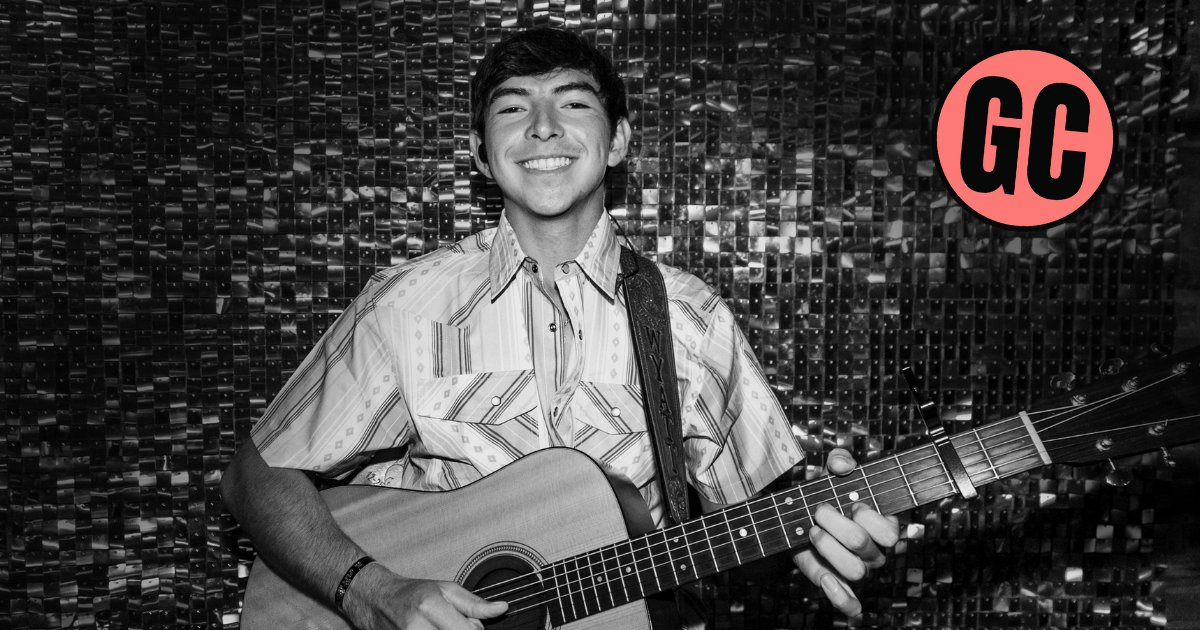
Wyatt Flores has been chosen as authentic. Country Music has spoken, and this quickly skyrocketing young artist has been riding a wave lately surfed by folks like Sierra Ferrell, Tyler Childers, Colter Wall, and Zach Top. Like these real country “poster children,” Flores’ music is realistic and grounded. It isn’t idealized revisionism in outlaw trappings. His songs never attempt to sugarcoat or mythologize, paving over the complications of rural life, red dirt realness, or the gritty patina of a rural places – like his homeland of Oklahoma.

Flores’ new album, Welcome to the Plains, is decidedly and delightfully trad country with nearly universal critical and listener acclaim. He currently racks up 3.5 million streams a month on Spotify alone, bolstered by a series of incredibly popular and consistently viral singles and EPs leading up to this, his full-length debut. For so many writers, diehard fans, and critics, Flores has long been “one to watch,” but that visibility stretches further and wider, to listeners across the country and around the world from so many different backgrounds and starting points.

Part of the reason why such a young artist with a relatively nascent career could have already amassed such a coalition of followers is that realistic, unguarded, “I know who I am, even though I’m still figuring out where I’m going” approach. It’s evident in his artistry, his performing prowess, and his skill for songwriting – all of which are evidenced prominently across this album.

Welcome to the Plains is one of the most remarkable records of 2024; it continues a tone long set in Flores’ career and music, even before this current inflection point and its substantial momentum. Wyatt Flores is bound for longevity, for many more successes, for many more millions of plays, as long as he remains exactly who he is: Wyatt Flores.

Your music has such a strong sense of place, so I wanted to start by talking about Oklahoma and growing up there. You’re down to earth in the way that you talk about Oklahoma from the beginning of the album, from the first notes of the title track. You’re viewing it in a very realistic way, not just in an idealized way. Can you talk about how Oklahoma inspired the album and what “home” means to you?

Wyatt Flores: When you think about Oklahoma, you have to [barely] scratch the surface to know that the history behind it is pretty screwed up, how Oklahoma came about, and we’re not one of the best states, if that makes sense? We’re 49th in education. And we’ve got a lot of people from California moving there just because it’s cheaper and everything else, but to live in Oklahoma, you gotta bear through the weather.

Then also, every year is a coin toss if things are going to grow, right? This year’s been a struggle up until this past couple of weeks, [during] which we just got like a foot of rain. But yeah, it’s been one of the hardest places to really build. And the people are so damn nice in Oklahoma, but it’s a tough place to live. Most people don’t want it. But I love it. “Welcome to the Plains,” it’s trying to describe [Oklahoma] … in the verses I really wanted to try and find more of a nature side to it, and then by the chorus just really tell the truth about it.

It feels really authentic and grounded, but you can still hear that you love Oklahoma in it, too. I think that’s a really interesting combination. Country is really good at rural America propaganda – and I love rural America, so I’m for it, to a degree – but to me, your album doesn’t feel like it has to close an eye to the history of Oklahoma to love it.

Yeah, it was a fun journey to try. I was sitting there just trying not to write songs about the road, because that was the only thing that I was doing. I was like, “This is the only life I’m living.” And not many people know what it’s like to be on a bus or on tour – at that time we were still in the van. It was more so daydreaming about home, missing the place, and then just trying to find the memories to piece everything together.

And I had a lot of weird influences, like “Little Town,” I was really trying to find the same feeling as listening to “Pink Houses” by John Mellencamp. I don’t write too many happy songs, and I was not in a good headspace in that time period. For some reason, I guess I was just daydreaming of a better life, and I kept writing about home, but in a different format of not always missing it.

Another song that really captures this topic is “Stillwater.” I love that it has this sort of dark, contemplative tinge and it feels gritty. Could talk a little bit about writing “Stillwater” and about your relationship with “home” and the construction of “home”? That’s such a country tradition as well, not just talking about home and missing it, but understanding that home is a nebulous, intangible thing, even if it literally exists.

There’s a lot of bands that say they come from Stillwater, but they really just started in Stillwater and they came from a different area, since it is a college town. But I was born and raised there in Stillwater. All my life the college has been my backyard. When I wrote that song in the summer of ’22, I had my guitar player with me and my fiddle player’s husband and we sat down to write that. It was more so just trying to give people a different perspective on what it’s like to actually grow up in a college town, because it’s a vicious cycle of the same shit – like, no one else sees it, because they’re living inside of the four years of going [to college].

And me also being a college dropout, I never got to actually go to [Oklahoma State University]. I went to OSUIT in Okmulgee, Oklahoma. And that did not last long. [Laughs] But yeah, I was like, “No one’s ever actually talked shit on a hometown and actually put the name in it.” So I was just being ballsy with it. I had to change quite a few lyrics, because I kind of went a little too far. I probably would have pissed a lot of people off.

The song was intentional. I don’t know, [I wanted to] make people think differently. Because that is my home. A lot of times, you just see people take advantage of the town, and the town keeps growing. Every single time I come back home now, there’s another chicken place and another damn car wash. I was like, “How many do we need?” Good lord. I was really pissed off in the mindset of it. I’m glad that we captured it, because for a while, I was scared to release it just because I was like, “People are gonna think that I hate Stillwater.” But really, it’s still a love song towards it.

It feels like you’re loving Stillwater, you’re loving Oklahoma, but your love for it requires you to look at it through an accurate lens and not an idealized version of it.

And it’s a relationship. My relationship with that town has just been back and forth. You’ll have that resentment, and you’ll have that frustration with it, but you still love it. It’s crazy to think about it that way, through that lens, but that’s what it is.

You touched on your co-writing process and I was excited to see how forward your own writing and your own perspective is on this album. Can you describe your co-writing and collaboration process for these songs? I noticed, too, that Ketch Secor co-wrote the title track.

When I wrote with Ketch, that was super cool. ‘Cause I had just gotten done watching Killers of the Flower Moon. I was already so inspired by that and wanting to really speak some truth. But not just by absolutely laying into people on the bad shit that’s going on – you can’t force-feed people. When we sat down [to write, Ketch] said that he wanted to write shit about Oklahoma and I was like, “That works out great!” The song just came together and it was it’s one of the coolest things, because I didn’t know how to feel about it quite yet. I was like, “This has some good shit in there…” and then when we went to record it, I was like, “Here it is! This is the way it’s supposed to go.”

But with the writing of this entire album, I was scared shitless. I didn’t think I was good enough, and I didn’t think these songs were good enough for an album. I started overthinking the entire thing. People can get mad at me all they want for doing co-writes, but I’m still writing. It’s not like I just sit in there and wait for these people to write these songs for me. This is all me.

The other thing is, my music taste [has] so much variety that I think it’s only better if I sit down with other people that have other strengths, to get to where I want to go – into these different styles of songs. I don’t want to do the same song, different chords, you know what I’m saying? I wanted it to be so unique and to keep it the way that I’ve always done it, which is to have different styles of songs. For that, I feel like you have to have different songwriters come in and give you different pieces.

I also have to ask you about bluegrass. One of the first things that we shared on our site of yours was a Tyler Childers cover that you recorded with Sierra Hull at Red Rocks. Our audience loved it so much. I think part of why your music resonates across diehard country fans to indie fans to bluegrass fans is that you’re not just a performer and a songwriter, but you’re a picker, too. What is your relationship like with bluegrass music? Is it something that’s prominent in your listening and in your influence?

So, I will first and foremost say this: I am not that good of a picker. [Laughs]

That stuff, that is something that I love. That is a different art. That is so beautiful. But my love for it– everyone in Oklahoma started listening to Tyler Childers and that’s when he came around, I want to say in my high school days. That’s when everything took a shift. I was like, “I don’t know what this is…” because we all grew up listening to red dirt [country], which is what I am. But my influence has really changed. In the summer of ‘22, Laurel Cove Music Festival was the first time that I had seen Nicholas Jamerson, Charles Wesley Godwin, Sierra Ferrell, Cole Chaney. That changed everything for me. It changed the entire way that I looked at music, and from that point on I started listening to every single one of those artists. It just led to more.

I love bluegrass and I try to have a couple songs [in that style], but I can’t call myself bluegrass. As much as I love what they’re doing and I try, I have my influences, I’m still red dirt. The way that those artists do what they do, it’s because they are them. I have my influences, but I am still just me. So whatever comes out, it’s just me loving and respecting it. But I can’t fully call myself a bluegrass musician, because I’m not. I’m jealous of it though, I’ll tell you that much. I’m jealous, I wish!

The production style and the different aesthetics that you’re utilizing on the album feel like classic country and old country plus dashes of country & western. There are moments that are really rocking and there are moments that are really subdued. It’s also really modern and crisp. How much of that is coming from you or from the ensemble and how much is coming from your producer, Beau Bedford?

A lot of that was Beau. I learned so much from him. [Before,] I really didn’t ever get the experience of being in a studio with musicians that are just wizards. Beau really took care of me.

It was a challenge, because we recorded in three different places. We were in Nashville, in North Carolina, in LA, and then we finished in Nashville. We were scared that it wasn’t gonna flow together, being in these different studios and then also just having this [group] of songs. Luckily, it all came together and as different as they do sound, they still flow. That was all just luck. We’re all we’re all sitting there going, “Huh? Hope this goes right!” I had my doubts, too, and [Beau] goes, “Wyatt, everything’s gonna be all right, because you are the main character that runs through this entire thing.”

That’s the constant throughout the entire project. I’m just lucky that it worked. When you go from different styles of songs – red dirt, and then you got this beachy [thing], old-time. It’s just crazy how they all go along together. Then it goes into this weird psychedelic rock and “Falling Sideways.” It was a wild adventure, and I’m so grateful for it. I just can’t believe the way that it turned out.

I ask this last question often, especially with people like yourself who are so effortlessly traditional country. There are a lot of folks out there who are excited about you – and artists like Zach Top and Tyler Childers and Zach Bryan – because these listeners sense that there’s this “new movement” that’s going to save country music, that’s going to renew country. That country is going to be what it used to be before “murder on Music Row.”

I wondered what your thoughts and feelings are on that paradigm? Because I sense that you don’t care so much about what is or isn’t traditional or what is or isn’t “inside” country. Does country music need to be saved? Do you see yourself as part of that saviorship? Do you care?

There’s something to be said about it, because yeah– I have my opinions about commercial country. There’s some really good songs and then I also think there’s some songs that say absolutely nothing. I guess as a songwriter, my goal is to keep writing about real shit and keep expressing myself with vulnerability. And to still write good songs.

I have a very important person in my life who’s been a mentor to me; his name’s Shane Lamb. I used to talk about writing these super-poppy melodies. And he goes, “Yeah, it’s because it’s popular music. … Who are some of your favorite artists?” We started going through Tyler Childers, early on in the days of me being in Nashville. [Shane] was like, “Listen to the fucking melody, Wyatt. It’s a pop melody. It’s for popular music. That’s why it works. But his arrangement is country.”

And I was like, “Oh… when you think about it that way, yeah, I guess you’re right.” So, I do try to have poppy melodies as much as I can, but I still try and keep my verses very needy, if that makes sense. I like putting a whole bunch of detail and really trying to focus in on the verses and let the chorus speak for itself.

That’s so perfectly put; yes, country has always been popular music. It’s one of my favorite Tyler Mahan Coe quotes, the creator of Cocaine and Rhinestones, the podcast and the book. He talks regularly about how country music has always been popular music. That’s not to say that fact absolves Music Row and Music City from all the truck and beer songs, but it certainly helps remind us that hand-wringing over “Is country music going to be okay?!” is not something that’s ever going to go away, but it’s also not something we really need to worry about.

And I think for the first time ever with social media, people are able to find new music that’s always been there. They’re just now finding out about it for the first time, because the radio stations aren’t playing it. That’s its own deal. But now they’re able to find all this new music and I feel like country is still going to be country. Like you said, when it comes to beer and truck songs, I think the thing that’s missing is them not explaining what they love about it. They’re just talking about it, not being vulnerable with it.

I think about “Drive” by damn Alan Jackson, dude. That is just talking about driving. That’s really all it is, but the sentiment is there, because it has to do with the father and the son. And then, all of a sudden, there’s the father and the daughter – that is fucking awesome country music that I still absolutely love! I wish that I could do that, like that Zach Top thing. I told him that whenever I met him, I was like, “Dude, I wish I could do it.” I really do. ‘Cause he’s fucking killing it. There’s so many different styles of music and I’d rather just do what I want to do, which is all of them, rather than just settle for one sound.


Photo Credit: Natalie Rhea