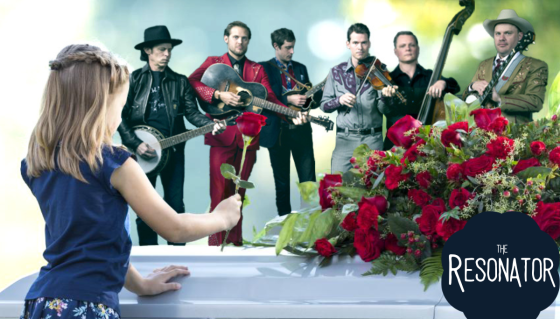
More than any of the world’s music, the songs of America are a reflection of a national identity and character. We are our songs.
Distilled into a few memorable minutes go the nation’s hopes and aspirations, the glories and tragedies of her past, and the promises of her future. This American canon is as diverse and vast as the country itself – our blues, breakdowns, or corridos are as different as prairies are from coastlines, as the Appalachians are from the Rockies. And yet, somehow, still our sound is a commonwealth, a singular voice rising from the chorus of many just like our national motto purports: “E Pluribus Unum.”
250 years is not a long time in the global scheme, and neither is 28 years of Old Crow Medicine Show‘s reign as an Americana string band. But somehow it is the vigorous and youthful American voice/song/songwriter/band (and not our transoceanic elders) that can best capture the world’s heart and soul in just a few minutes.
In this Mixtape, I’m proud to share some examples of this powerful artistry. You might already know every word to some of these songs while others you may have never heard, yet each is stitched together with a cloth of commonwealth that can only be found of uncommon ancestry. Though the singers may be perfect strangers, the songs that bubble up from our national cauldron are enough to nourish each and all. – Ketch Secor, Old Crow Medicine Show
“Howdy Do America” – Old Crow Medicine Show, Jesse Welles
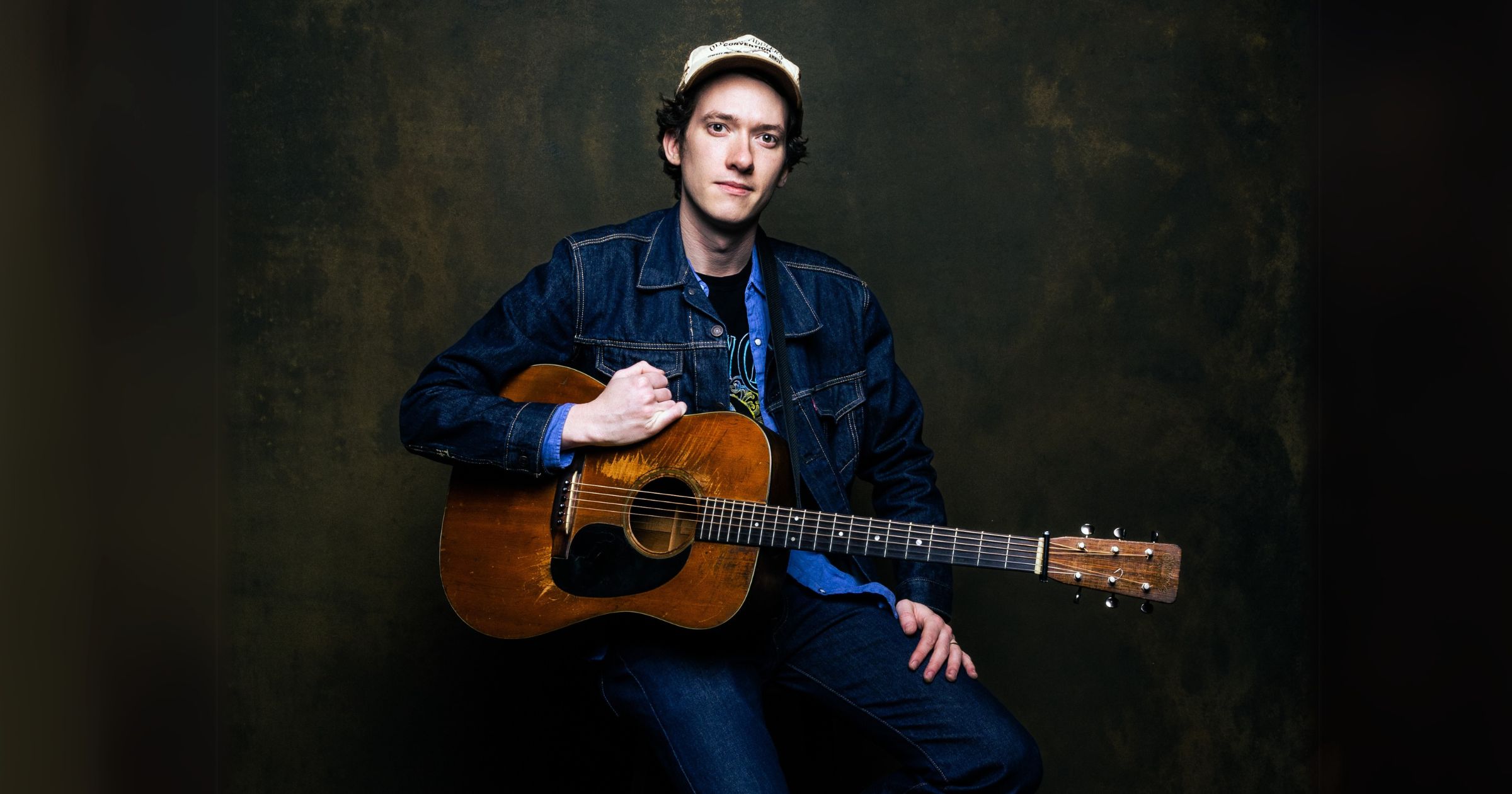
Jesse Welles came whirling into the studio the other day and helped put a spit shine on this love song about the 50 states. I wondered if he was gonna get excited when he sang “Arkansas” and brother, he did not disappoint. Love this cat. He’s a brother, and I expect we’ll all be singing his tunes for years to come.
“Golden Rocket” – Jim & Jesse
I had the privilege of knowing Jesse McReynolds, even traveling and performing with him, and buddy there’s no wonder why Jerry Garcia thought he was the best of the bluegrassers.
“Field of Opportunity” – Neil Young
I was raised on Neil Young’s unique brand of tall prairie country rock. This track features the great Cajun fiddler Rufus Thibodeaux.
“Heaven Help Us All” – Joan Baez
Joan’s a real hero of mine. She’s like that tree planted by the water we all sing about, unmovable. Of all the singers on this playlist, I can say without a doubt if more people could be like Joan Baez, then this world would be a better place.
“I Wanna Go Country” – Otis Williams & the Midnight Cowboys
I love this Motown singer turned country crooner, and the world would have too, if Nashville hadn’t been so narrow-minded.
“Beautiful Land” – Old Crow Medicine Show, Maggie Rose, Lee Oskar
I wrote this one with a Baháʼí faith elder named Eric Dozier just down the street from the Tennessee State Capitol building. Sometimes politics feel like a fortress. But music has a way of wandering through the keyhole of even the most impenetrable door.
“There’s a Star Spangled Banner Waving Somewhere” – Elton Britt
I played this one for my kids on Memorial Day. They sat through it start to finish, and you should, too. It’s easy to get complacent about the sacrifice our grandparents and great-grandparents made in the 1940’s for each of us. Don’t do it.
“Oasis” – Molly Tuttle
Molly’s my favorite American singer. Here’s one of our travelogue-style songs. I had it stuck in my head all last week at the Tico Time Bluegrass Festival in Aztec, New Mexico.
“The Green Rolling Hills of West Virginia” – Hazel Dickens & Alice Gerrard
These girls rip. Back at MerleFest in the year 2000, I filled out Old Crow’s first ever W-2 form and gave it, with a shaky hand, to the great Alice Gerrard.
“How’s About You” – Dave Rawlings Machine
The Great Depression gave the world some of its most powerful songs. And even generations later, the events of the 1930s remained powerful enough to inspire music like this.
“Rock of Chickamauga” – Jimmie Driftwood
Songs about the Civil War are some of my favorites in the national cannon. Jimmie Driftwood is one of my favorite songsmiths. He’s an absolute master of the historical ballad.
“Across The Great Divide” – Kate Wolf
I am awestruck by the landscape of the West, and few songwriters can take you there better than the amazing Kate Wolf.
“What Did You Learn in School Today?” – Tom Paxton
I’ve been singing this one since I was a youngin. When I was 12, I discovered my uncle’s weathered copy of Vanguard’s album Newport Broadside: Topical Songs at the Newport Folk Festival 1963, and that was my introduction to Tom.
“The Tramp on the Street” – Molly O’Day
Born in Pike County, Kentucky, she’s one of my favorite bluegrass singers. She first heard this song from Hank Williams on a Birmingham radio station, and it became her signature song. American music has a way of championing the underdog better than most.
“Shenandoah” – Bob Dylan
I think I was 15 when I first heard Bob singing this gem, hidden in the ruffles of one of his more questionable ’80s albums. I thought, “Damn, Bob knows where I’m from.”
“Corrido de John F. Kennedy” – Los Reyes del Corrido
My band has been dabbling in conjunto for two decades now. We got to learn this one for next time we play the big D (Dallas).
“Which Side Are You On” – The Weavers
No collection of American songs is complete without a protest piece from the labor movement, the first dark corner where the full power of American music was unleashed.
“The City of New Orleans” – Arlo Guthrie
When we play Chicago, I always talk about Steve Goodman, who wrote this song. I sure would have liked to have known the guy. Thankfully his music will last forever.
“Cowboy National Anthem” – O.B. McClinton
O.B. left this world before he was fully known by the country music fanbase that would soon send black country singers consistently to the top of the charts. He was a man before his time, but the music he made reminds us that, just like Ray Charles said, “Country music is black music.”
“Deportee (Plane Wreck at Los Gatos)” – Old Crow Medicine Show
We love Woody Guthrie, and this is one of the numerous songs of his we’ve recorded through the years. In a nation of immigrants (I’m a French Huguenot), it’s hard to imagine how we could exist without a steady flow of new members to our American family.
“Big Backyard” – Molly Tuttle
When Molly and I wrote this, it was on account of having a massive vacant lot behind the house we were composing in. Now that same lot is full of little yellow flags and “coming soon” signs. Yet still we sing, louder this time.
“For What It’s Worth” – Buffalo Springfield
A few years back, I had the distinct pleasure of sharing an elevator with Stephen Stills, author of this earthquaking song which Buffalo Springfield recorded in 1966 – and we covered this year on our new album, Union Made. I wanted to tell him thanks, gush, and get my picture made. Instead, I stood quietly until he rasped, “I heard your soundcheck. Great band you got there. Keep ‘em together if ya can.” Thanks, I will Stephen.
“Louder Than Guns” – Old Crow Medicine Show
This summer, PBS stations across the country are broadcasting the film we spent three years making in a half-dozen tour stops along our travels. It’s a movie about bringing together the disparate ends of the 2nd Amendment debate during an era in which guns kill innocent Americans at shocking rates. It’s a tall order, coming together to flatten the curve, seeing past our silos and personal politics, but in town after town I watched people listening across the divide. As easy as it is to be hopeless, the film has made me hopeful we’ll get beyond this impasse and prioritize the safety of our communities. This song is the theme of this film.
“American Tune” – Allen Toussaint
I’m glad you made it through to the end. Old Crow opened up for the great Allen Toussaint in the Berkshires back around 2011. The record featuring this song had just come out and when he launched into it, I was nearly knocked off my feet. So powerful. So simple. Says it all.
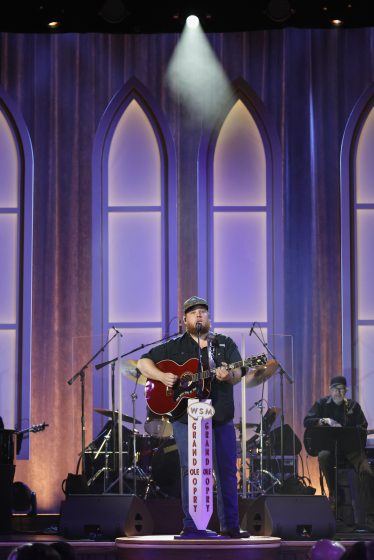
In an all-star acoustic tribute, the timeless music of O Brother, Where Art Thou? rambled across the Grand Ole Opry airwaves for a 25th anniversary celebration on Saturday, February 28.
In some ways, this night in Nashville felt different from a typical Opry show – no drum kit, no square dancers, and not a lot of commercials. On the other hand, it would be hard to find a more suitable place to stage a salute to O Brother than on the world’s longest-running radio show.
The GRAMMY-winning, 8-times platinum soundtrack was performed in its entirety by Opry stars such Alison Krauss, Emmylou Harris, Del McCoury, Old Crow Medicine Show, and the Whites, as well as guest performers like the Alaskan Sunnyside Sisters, the Fairfield Four, the Fisk Jubilee Singers, and Colin Linden alongside contemporary masters like Sarah Jarosz, Billy Strings, and Molly Tuttle. (To put the time frame in perspective, Jarosz was 9 years old when the soundtrack was released, Strings was 8, and Tuttle was 7.)
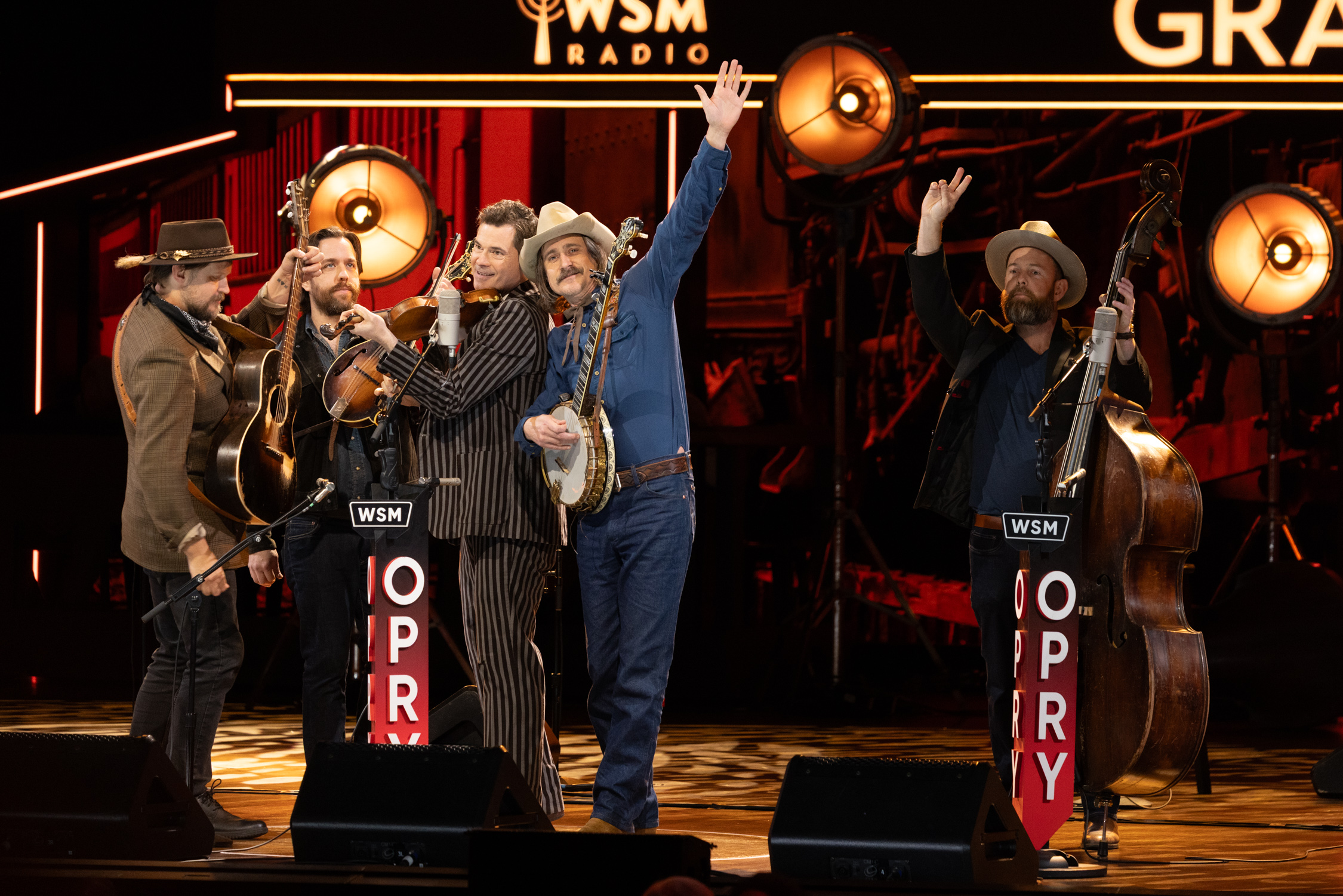
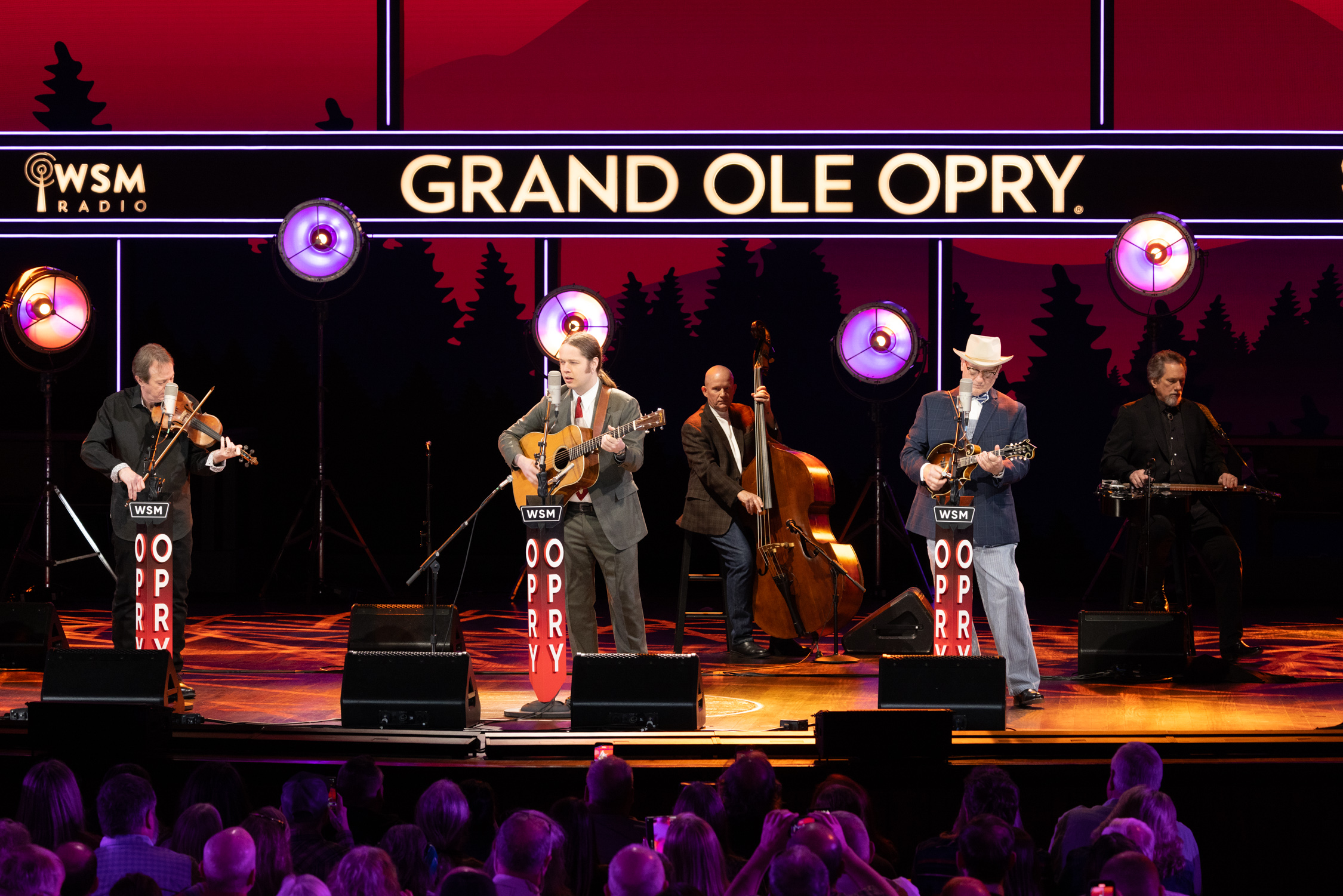
Old Crow Medicine Show perform during the Opry’s tribute to ‘O Brother, Where Art Thou?’
In addition, Chris Thomas King and Tim Blake Nelson also reprised their performances from the film, while the A-list house band was composed of Mike Compton on mandolin, Dennis Crouch on bass, Jerry Douglas on Dobro, Stuart Duncan on fiddle. And what O Brother tribute would be complete without Dan Tyminski delivering “I Am a Man of Constant Sorrow”?
As a bonus selection not included on the landmark collection, Krauss and the Fairfield Four opened the special evening with a lively rendition of “Every Time I Feel the Spirit,” which immediately immersed the audience in that same spirit. After Krauss stepped away, the Fairfield Four performed the soundtrack’s original opener, “Po’ Lazarus,” accompanied only by hand claps. Old Crow Medicine Show roused the crowd with “Big Rock Candy Mountain,” an enthusiastic choice that fit their high-energy demeanor. Bandleader Ketch Secor also co-hosted the event alongside Opry announcers Bill Cody and Mike Terry.
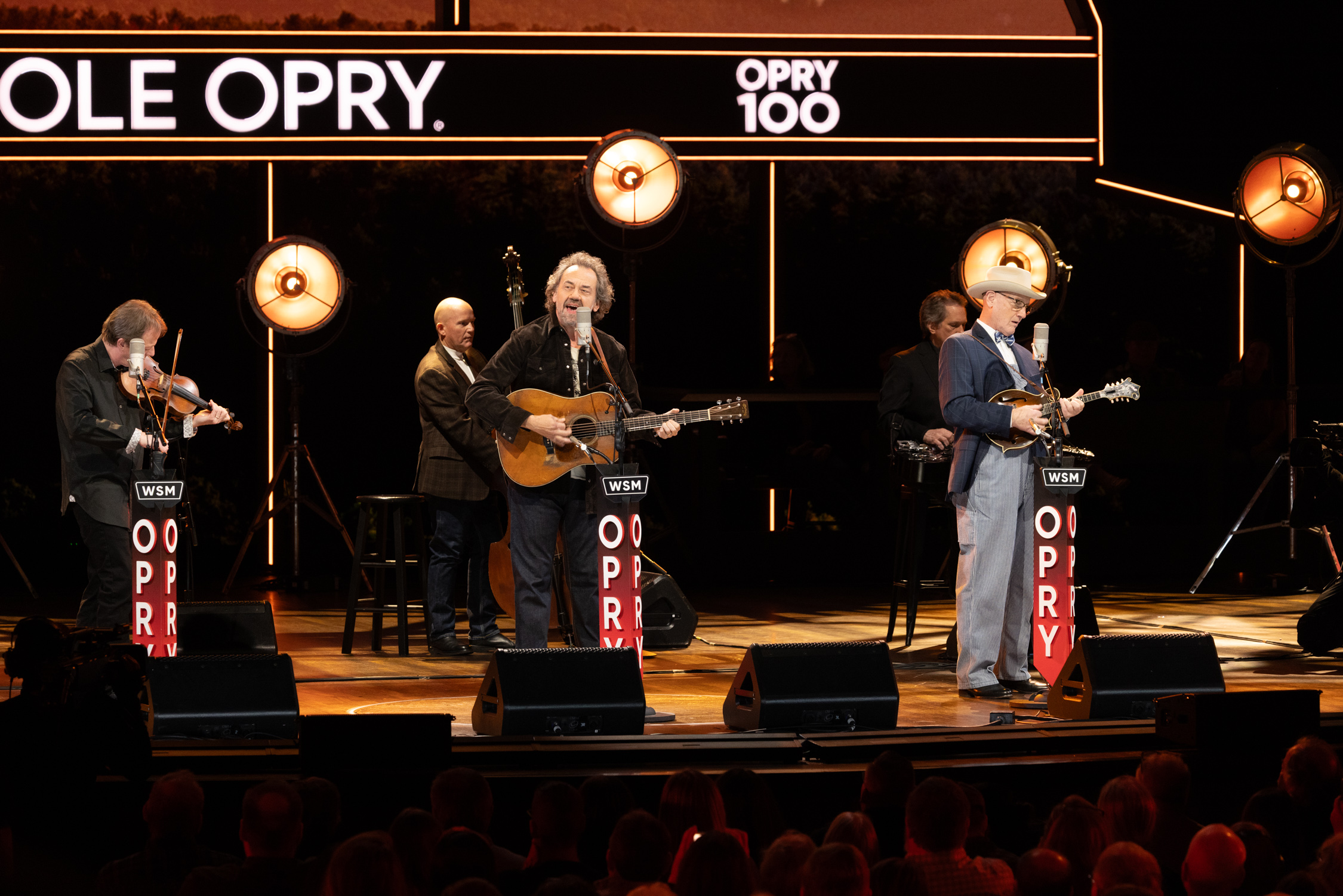
Dan Tyminski sings “I Am a Man of Constant Sorrow” with the evening’s house band.
Backed by the house band, Jarosz engaged the audience to sing along with a perennial favorite, “You Are My Sunshine,” and the sold-out Opry House was happy to oblige. Krauss returned with the Fisk Jubilee Singers for a sterling performance of “Down in the River to Pray,” where the audience sat almost perfectly still in reverent silence. Following the song, Krauss was presented with a commemorative scarf designed by the famed clothier Manuel; all Opry members are receiving the scarf as part of the Opry 100 celebration. The house band then shared an instrumental version of “A Man of Constant Sorrow,” which was a nice touch referencing the handful of variations of the song on the soundtrack.
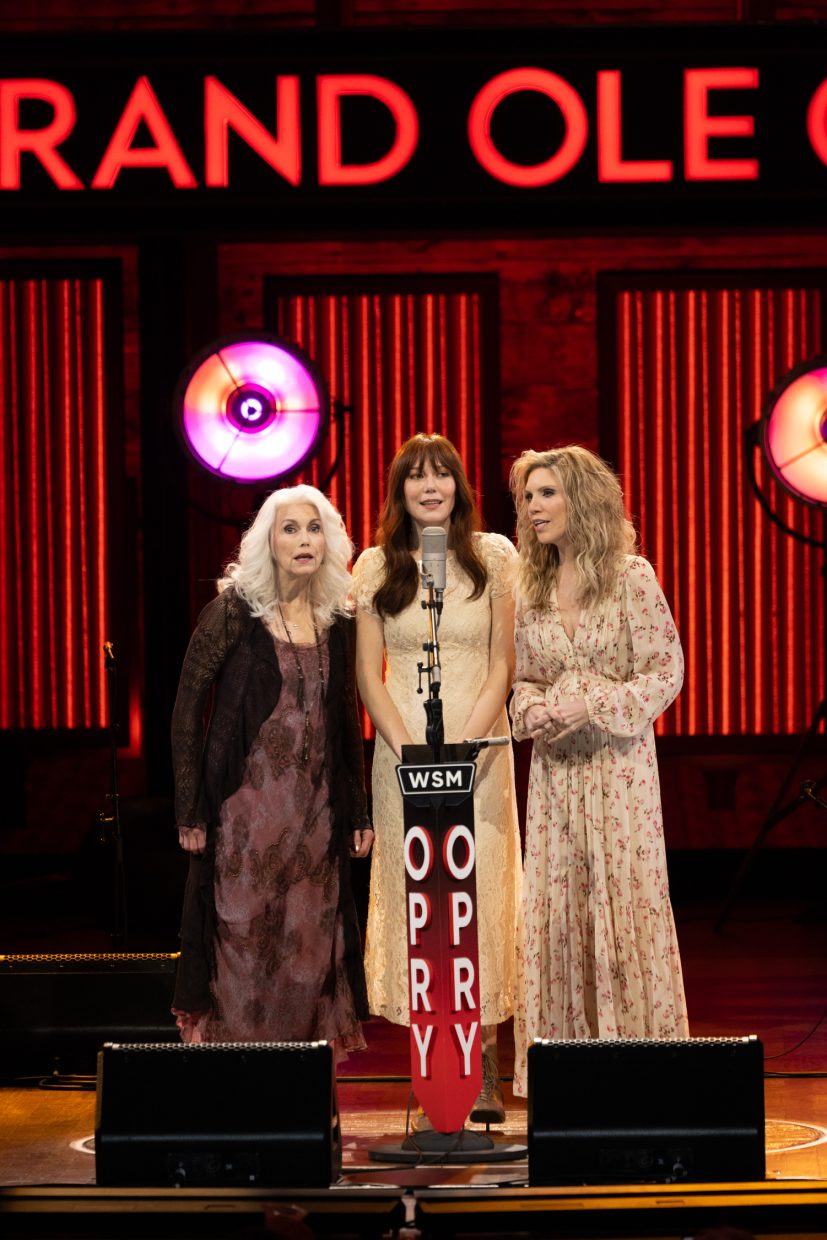
That soundtrack practically came to life with Colin Linden and Chris Thomas King’s “Hard Time Killing Floor Blues” and The Whites’ “Keep on the Sunny Side.” Jarosz on mandocello and Molly Tuttle on guitar teamed with the house band for a wonderful take on “I’ll Fly Away.” Emmylou Harris and Alison Krauss then stood on either side of Tuttle for a trio rendering of “Nobody But the Baby.” (Gillian Welch, who sang with Harris and Krauss on the original album, was unable to participate in the show.)
Emmylou Harris and Alison Krauss, both of whom appeared on the soundtrack, are joined by Molly Tuttle for an a capella rendition of “Nobody But the Baby.”
Folks, that’s only the first half!
After decades away from the spotlight, the Peasall Sisters returned to the stage to introduce “In the Highways,” the song they recorded as children; on this night, it was sung by an endearing kid quartet – and viral internet sensations – the Alaskan Sunnyside Sisters. Molly Tuttle returned for the emotional “I Am Weary (Let Me Rest),” which led into bluegrass phenomenon Billy Strings singing “Wild Bill Jones,” which appeared on the 2000 O Brother concert album, Down From the Mountain. Strings then welcomed Dan Tyminski for a duet of “O Death,” which was sung by the late Doctor Ralph Stanley on the soundtrack. (Incidentally, Stanley joined the Opry cast the same year the O Brother soundtrack was released on Lost Highway Records. The newly resurrected label co-presented the show with the album’s award-winning producer, T Bone Burnett.)
Billy Strings takes the stage to sing “Wild Bill Jones” with the house band.
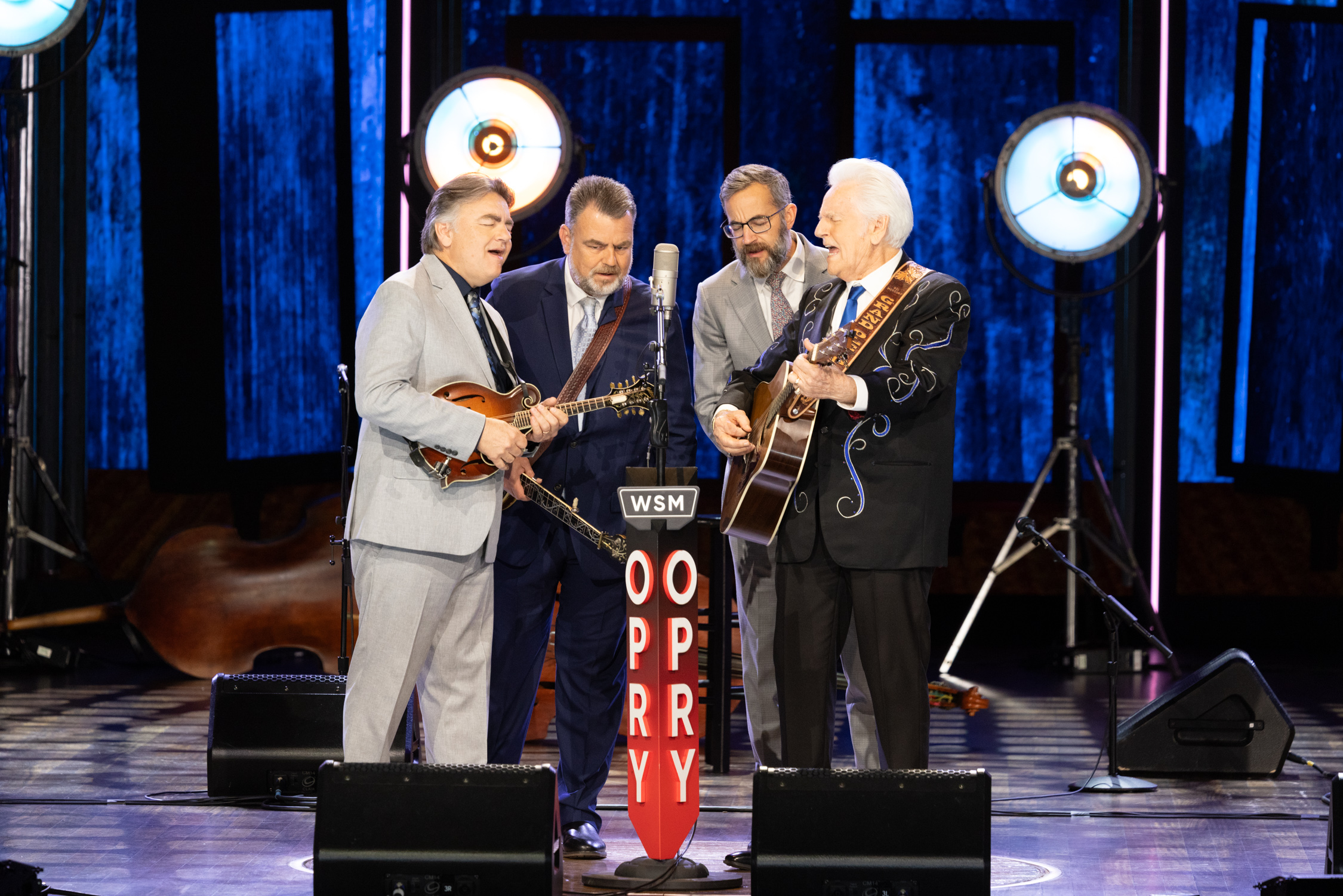
The audience especially loved seeing and hearing one of the film’s stars, Tim Blake Nelson, revive “In the Jailhouse Now” on the Opry stage. Tyminski (who voiced George Clooney’s singing in the film) naturally brought the house down with “I Am a Man of Constant Sorrow,” then Old Crow Medicine Show offered the vivacious “Indian War Whoop,” recorded by John Hartford for the original project. The Fairfield Four also returned to the stage to sing “Lonesome Valley” just ahead of Del McCoury Band’s performance of “Get Down on Your Knees and Pray.” (That one’s not in the film, but it was a terrific addition.)
The Del McCoury Band sing “Get Down on Your Knees and Pray” before leading a sing along with the entire cast of performers.
In his brief remarks, Burnett took a moment during a brief speech to acknowledge Denise Stiff, a visionary Nashville manager who recruited many of the musicians for the soundtrack back in the day. But of course, it wouldn’t be a tribute without everyone coming back on stage and singing at the end – in this case, “Angel Band” and a reprise of “I’ll Fly Away.”
Twenty-five years ago, the O Brother soundtrack brought old-time and bluegrass music into the national spotlight. This long-awaited encore underscored the staying power of this classic album.
Photo Credit: All photos by Chris Hollo for the Grand Ole Opry.
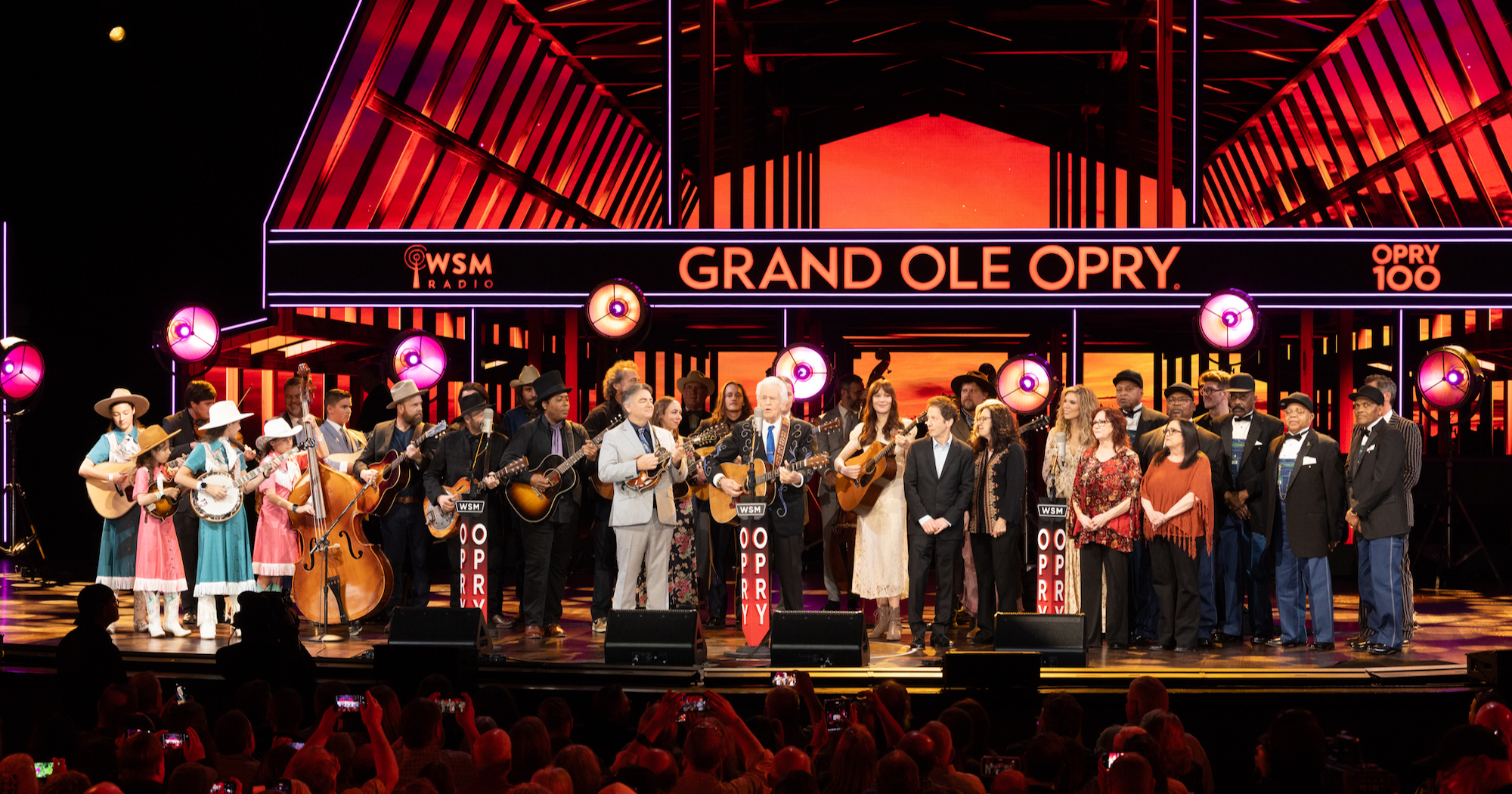
Lead Image: The entire cast of the Opry’s O Brother, Where Art Thou? tribute show take the stage to sing “Angel Band” and “I’ll Fly Away” to conclude the evening.
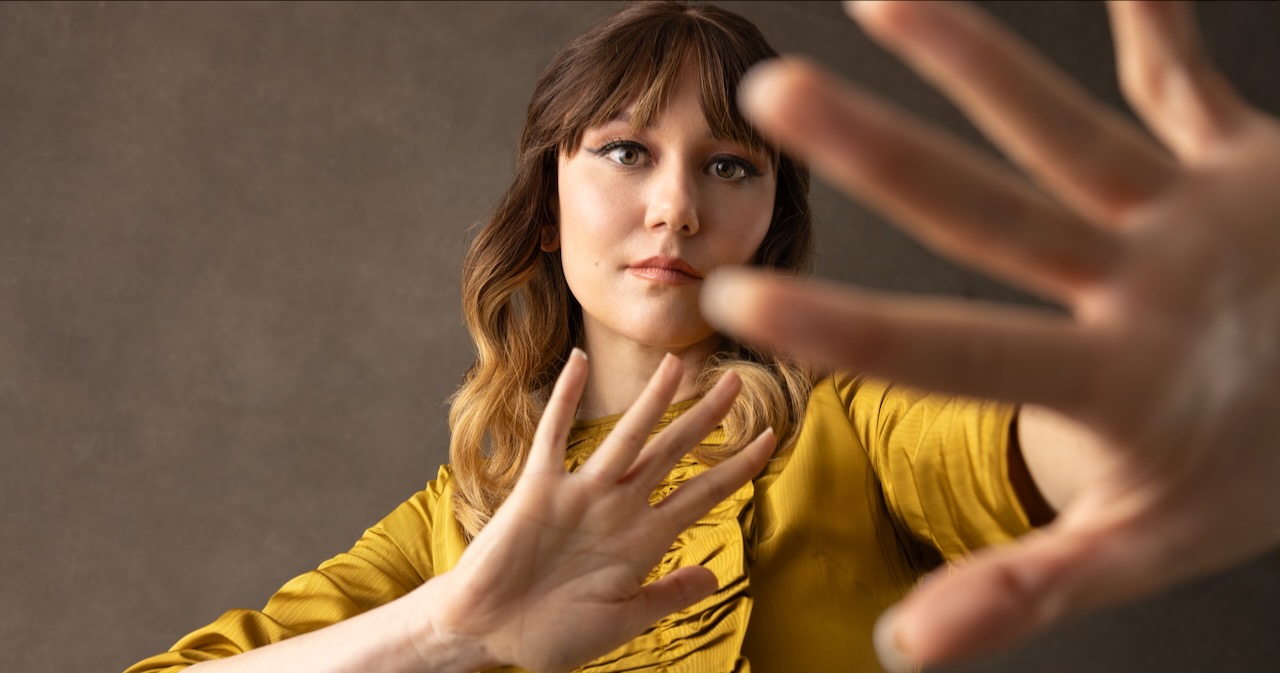
Fresh off two back-to-back GRAMMY-winning albums, guitar virtuoso, songwriter, and artist Molly Tuttle is heading in bold new directions with her fifth solo release, So Long Little Miss Sunshine. A California native now based in Nashville, Tuttle embodies many sides of herself while staying rooted in where she comes from – both musically and geographically.
Already highly decorated as an instrumentalist (including two International Bluegrass Music Association awards for Guitar Player of the Year and the Americana Music Association’s Instrumentalist of the Year), Tuttle continues to captivate with her signature tone while stretching the boundaries of the genre that launched her. And she does it all with reverence and a playful sense of self-exploration.
From the scorching opener “Everything Burns” to the crush-worthy pop bop “That’s Gonna Leave a Mark” (co-written with Better Than Ezra frontman Kevin Griffin), the album weaves together personal reflections and observations of the world around her. It’s a colorful puzzle that reveals the many pieces of Tuttle.
When BGS sat down with her to discuss the album via Zoom, it was clear that her boundless curiosity about life and what’s next musically fuels everything she does. She spoke about her songwriting process, her reverence for her roots, the inspiration behind the album’s visual aesthetic, and how she’s already working on her next project.
You’ve called this record a departure, but to me it also feels like a distillation of all the people you’ve been, all the places you’ve gone, and all of who you are. Even though you’re experimenting with different genres, it feels cohesive—like you’re telling a story about yourself over a really diverse musical bed. Almost as diverse as the wigs on the cover of the record. Was there a lightbulb moment when this project came to life for you, or was it more of a gradual process?
Molly Tuttle: It was kind of a gradual idea. About a year ago, I was finishing the songs for this record. The first one I wrote was “Golden State of Mind,” a few years back, but for a long time, I just had this big batch of songs that didn’t feel like a cohesive grouping. Then last year, there was a light bulb moment where suddenly the songs really started flowing again, and it felt like I’d found this new voice – though it still connected to earlier songs like “Golden State of Mind” and “Everything Burns.” I reworked those older ones and then wrote about two-thirds of the record in the last year.
Making Crooked Tree and City of Gold helped me gain the confidence to do something different this time and not feel tethered to any particular style or genre. Those bluegrass records were me paying tribute to the music I grew up with, and once I did that, I felt free to branch out—try something bold and ambitious sonically while still tying it back to where I came from. I wanted to tie it to my past work but also really spring forward and try something new.
Did you have any trepidation about that shift?
I wasn’t really nervous, but we did have a lot of conversations about it – mainly between me and Jay Joyce, who produced the record. He first saw me play at the Ryman with Golden Highway, which was a bluegrass show, though we always stretched the boundaries a bit. The next day, he called me and said, “I think we should still incorporate your banjo playing and some acoustic elements.” That’s when we brought in Ketch [Secor] to play fiddle, banjo, and mandolin.
We wanted to make sure it didn’t feel like too far of a departure and that it still sounded like me. So we decided to make this a guitar record. Every song has guitar solos and I’m the only soloist on the album. That was new for me, and really exciting.
How did you end up working with Jay? Did you seek him out? Were you a fan of his work?
I actually wasn’t super familiar with him at first. I’d heard music he’d produced, but hadn’t connected it to him by name. During the pandemic, my manager, Ken Levitan, suggested I meet with Jay. Ken thought we’d work well together since Jay’s not only a producer, but also a great guitarist.
I played him some songs and liked his vibe, but at the time, I felt pulled to make Crooked Tree because I had those songs ready to go. Still, I always kept Jay in the back of my mind and really wanted to work with him eventually. Last year it fell into place: I sent him my new songs, we met again, and then started pre-production in the fall. I’m glad that I’d had that rapport with him for the last few years rather than just meeting him when we started making the record.
What was the studio experience like? Did it feel different from your past records?
Very different. We spent so much time on pre-production – more than I ever had before. We worked on arrangements, added solos, and rewrote bridges. By the time we brought in the band for a week of tracking, we already had these really fleshed-out demos. I’d played and sung a lot of my parts. Jay had been programming and I think Ketch had even played some of his parts already. We had a ton of tracks ready to go when we went into record.
Some of my demo takes even made it onto the final record, because I was just so relaxed, not feeling the pressure of having a set number of days to get it all done.
Much of this album was co-written with your partner, Ketch. What does writing with someone who knows you so well unlock for you?
Over time, we’ve developed a shared voice that feels like both of us. Earlier songs sometimes sounded more like his voice or mine, but now it feels like ours. He sees my daily life, so he can suggest ideas I might not have thought of, and that keeps the process flowing and honest.
Are you approaching the tour for this record differently than past tours?
It is going to be a little different. We’ve got some amazing special guests and openers joining us, and I’m excited to collaborate with them onstage.
The band is also super versatile: Ellen Angelico plays pedal steel, Dobro, banjo, and more, and Mary Meyer plays fiddle, mandolin, keys, and guitar. That range allows us to move between full-on rock moments and stripped-down acoustic sets, which fits perfectly with the mix of songs from this new record and my older ones.
The visual aesthetics of this record are striking. How did you land on the album cover concept?
Honestly, I didn’t have an idea at first. I was brainstorming on Pinterest and even asked a friend to pull tarot cards about it. She told me, “I think you already know the cover in your mind – you just need to uncover it.” Around that time, my friend Fletcher Moore sent me this grid of women with different hairstyles, and I was also looking at Let It Be by the Beatles. I thought, “What if I did something like that?”
This is the first time I’ve appeared without a wig on an album cover. I’ve worn wigs on all my past covers, but I wanted this one to feel more personal, like, “Hey, this is the real me.” At the same time, wigs are still a part of who I am. I wear them often, sometimes multiple in a day if I’m going to different things. What once felt like a source of insecurity when I was a kid now feels like a source of creativity.
So that inspired the cover, along with my song “Old Me, New Wig.” We had fun tying different hairstyles to songs – like a hippie look for “Summer of Love,” a goth look for “The Arsonist,” and even a Dolly Parton-inspired one. It was really fun but at the same time, I’m always nervous. I don’t want to distract from the music by making it all about the hair, but I like to have fun and experiment with it. It is something that feels unique to who I am.
That’s amazing. What inspired you musically and otherwise while making this record?
Playing with people like Sheryl Crow and Dave Matthews over the past few years has been hugely inspiring. I think you can hear echoes of artists like them.
As for books, I love California literature and that ends up inspiring some of the songs on the record. Angle of Repose [by Wallace Stegner] inspired some of this record and City of Gold. Joan Didion is another big one for me – her writing about California is just gorgeous.
You’re clearly prolific. Are you already working on what’s next?
After I finish a record, I usually take a little break from writing, just to focus on preparing the new music for live shows. But now I’m back at it – I’ve got about two-thirds of another record written already. I love being in the studio and I’m always chasing that feeling of making an even better record than the last. Touring slows down my writing a bit, but when I’m home, I’m already dreaming about what’s next.
Last question: from what I can tell, some fans feel a sense of ownership over your bluegrass identity. How has the reaction been to this new music?
Mostly supportive and loving, especially when I play the songs live. But yeah, when I released the first single, “That’s Gonna Leave a Mark,” probably the poppiest track on the record, some people online were like, “Oh my God, Taylor Swift!”
And it is not like I am never playing bluegrass again. Our shows are still half, if not more, bluegrass! I’ve stopped looking at online comments, because it’s not a real snapshot of what people are thinking and feeling.
But this is what I wanted to do. I wanted to shake things up. I feel like this record is full of little surprises. And if people are talking, that means they are paying attention. It means they care. If nobody said anything, I would be worried.
You know what you need? You need a roundup of brand new roots music!
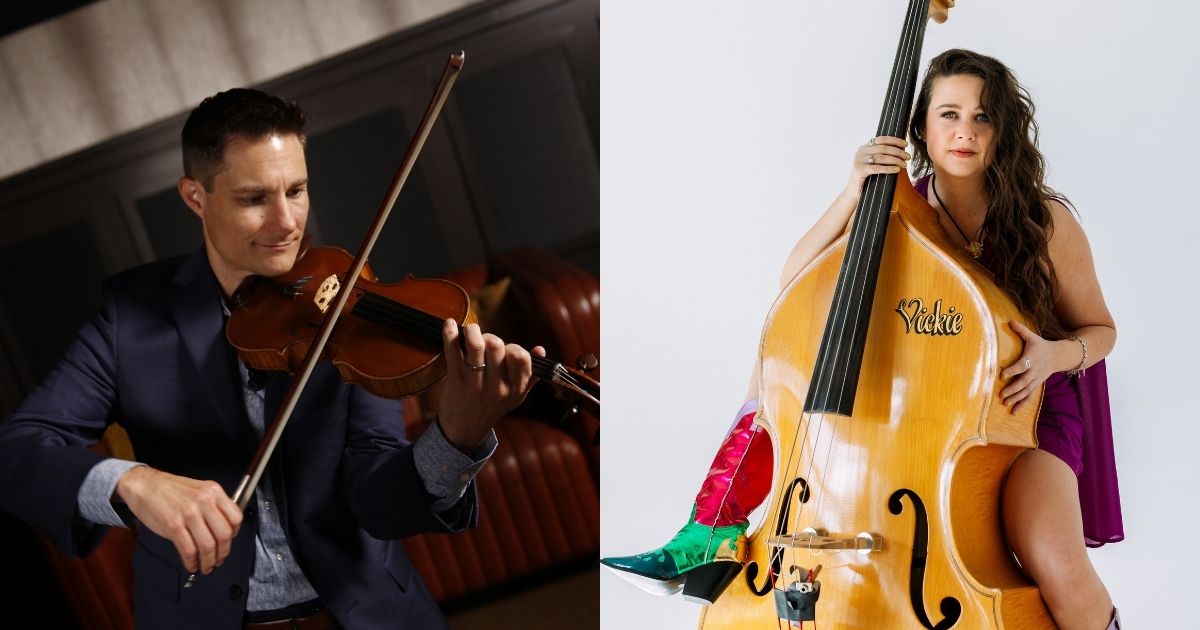
In this edition of our weekly collection, Andy Leftwich kicks us off with a frequent fiddle contest selection, “Tom and Jerry,” giving an appropriate Texas swing treatment to the classic tune. It draws from his childhood growing up performing and competing at contests. A couple of Leftwich’s labelmates on Mountain Home Music are included below, as well. North Carolina’s Unspoken Tradition call on Danny Paisley, Jason Carter, and Bronwyn Keith-Hynes to guest on “I’ll Break Out Again Tonight.” Below, the group’s bassist Sav Sankaran gives us some insight on who inspired their cover of the track and how they chose their special guests. Plus, bassist and singer-songwriter Vickie Vaughn, also on Mountain Home, releases her most vulnerable original track to date, “Mama Took Her Ring Off Yesterday.” Written with Deanie Richardson, who produced Vaughn’s upcoming solo debut, it’s a song about grief, loss, and how life always marches on.
In a similar sonic space to our bluegrass selections, Old Crow Medicine Show have pitched in for John McCutcheon’s upcoming album that pays tribute to the seminal 1925 Mountain City Fiddlers Convention to mark the year of its 100th anniversary. The album, Long Journey Home: a Century After the 1925 Mountain City Fiddlers Convention, was produced by McCutcheon and features an incredible varied roster of artists and pickers rendering songs that pay homage to the important East Tennessee gathering. OCMS perform “Whatcha Gonna Do with the Baby,” which McCutcheon has set to photos from the album’s star-studded recording sessions.
Also below you’ll hear Amanda Pascali combine cultures and sounds from Sicily and the American South on “Amuri,” a brand new song from her upcoming album, Roses and Basil. It’s a delightfully cross-genre track, with touches of cumbia, Latin folk, Texas, Sicily – of course – and beyond. You won’t want to miss new music from Queen Bonobo (AKA Maya Goldblum), either. “Waiting Tables” is the indie-alt-folk artist’s Saturn Return song, about manifesting success and chasing dreams.
It’s a lovely collection of new songs and videos and you know what we’re gonna say… You Gotta Hear This!
Andy Leftwich, “Tom and Jerry”
Artist:Andy Leftwich Hometown: Carthage, Tennessee Song: “Tom and Jerry” Release Date: July 25, 2025 Label: Mountain Home Music Company
In Their Words: “This song brings back so many memories for me. I grew up competing in fiddle contests all around the southern region of the United States where I met some of the best fiddlers of our day and was introduced to the style of Texas fiddling. ‘Tom and Jerry’ is an anthem and you’ll hear it played in just about every fiddling contest and Texas jam session there is. This arrangement is a development of those experiences and pays homage to my upbringing, reminding me of where I started. It’s hard to describe the feeling you get when you play these tunes with those incredible passing chords along with the Texas swing feel. It’s just so much fun!” – Andy Leftwich
Track Credits: Andy Leftwich – Fiddle, mandolin Byron House – Upright bass Cody Kilby – Acoustic guitar
Old Crow Medicine Show, “Whatcha Gonna Do with the Baby”
In Their Words: “Old Crow Medicine Show probably wouldn’t be a band if it weren’t for the time we spent around Johnson County, Tennessee, in the late ’90s. It was there that we learned to love the plain affairs of simple living in the hills, where country music was born. Fiddlers like JB Grayson were an early inspiration to us and the legend of the 1925 Mountain City Fiddlers Convention loomed large, even 75 years later. Now 100 years have passed since this, the first of the big national old-time music conventions, and we are mighty proud to have played a role alongside the great John McCutcheon in bringing this album to fruition.
John first approached me a year ago with the exciting news that he was embarking on a tribute to the Mountain City Fiddlers convention, the event that was so instrumental to the development of the Upper East Tennessee region’s identity as the national headwaters for hillbilly music. I immediately jumped in headfirst, bringing along Old Crow as the first act to sign up for the project. Many of the recordings we helped John make at our own Hartland Studio in East Nashville and now we are honored to finally be able to express our gratitude to Johnson County, Tennessee, an inspirational community for our band.” – Ketch Secor
“I first heard about Mountain City, Tennessee, as a teenager just beginning to play the banjo. I heard the Folkways album Old Time Music at Clarence Ashley’s and it changed the way I thought about the banjo and music as a whole. When I was finally lucky enough to get to Mountain City – doing a concert – I realized how important this little town and its heritage was. When the centenary of the 1925 fiddlers convention was rolling around, I called a bunch of my musical pals and invited them to join me in celebrating this event and, at the same time, benefit the fledgling arts center the town had started. My only request of the musicians was: Don’t make these museum pieces. Own them. I want to hear your fingerprints all over the music. And it turned out way cooler than I ever imagined.” – John McCutcheon
Amanda Pascali, “Amuri”
Artist:Amanda Pascali Hometown: Houston, Texas Song: “Amuri” Album: Roses and Basil Release Date: July 23, 2025 (single); September 12, 2025 (album) Label: Amanda Pascali & the Family/Missing Piece Records
In Their Words: “‘Amuri’ is the first song off my new record, Roses and Basil. The song opens the album with a Leonard Cohen-esque guitar part and a stanza of ancient Sicilian verse: ‘Amuri, amuri, chi m’hai fattu fari? M’hai fattu fari ‘na granni pazzia.’ (‘My love, my love, what have you made me do? You’ve made me go mad.’) These centuries-old lines, interpreted by many artists over time, tell the story of someone so overtaken by love that they forget the way to the church. In my version, that sense of losing the path becomes a metaphor for drifting away from what once felt like absolute truth, all in the name of love.
“The song quickly shifts from that quiet opening into a vibrant cumbia rhythm, inspired by the Latin sounds I grew up with in Texas. A spaghetti western-style electric guitar, 1960s and ’70s Italian lounge piano and vibraphone, and the figure of the priest reimagined as a Southern preacher man all come together to bridge my two worlds: Sicily and the American South.
“Though ‘Amuri’ borrows its opening from the past, the song itself is entirely my own. It sets the tone for the album: anchored in tradition, but reimagined for today. How strange and beautiful that something so old can still feel so relatable.
“The album was recorded at Niles City Sound in Fort Worth, Texas. The day before we recorded this song, my producer Robert Ellis came over to the place where I was staying, with a second-hand nylon string guitar he had bought that very same day. He sat at the table with me at golden hour and as the sun shone through the windows, he played the song in a way that resembled Leonard Cohen’s ‘Master Song.’ The wheels started spinning at that moment.” – Amanda Pascali
In Their Words: “‘Waiting Tables’ is my Saturn Return song. It’s about envisioning how I want my life to be and letting go of all that’s not serving me. I’ve been in the service industry since I was 14 years old and this song is my slightly sassy and soothing way of manifesting success in my music career. We all deserve safety, peace, and for our dreams to be actualized.” – Queen Bonobo
Track Credits: Maya Goldblum – Guitar, vocals, producer Joe Kaplow – Drums, percussion, engineer Joel Ludford – Stand-up bass Kyle Knadinger – Pedal steel Neil Burns – Keys
Unspoken Tradition, “I’ll Break Out Again Tonight” featuring Danny Paisley
Artist:Unspoken Tradition Hometown: Western North Carolina Song: “I’ll Break Out Again Tonight” featuring Danny Paisley Album:Resilience Release Date: July 25, 2025 Label: Mountain Home Music Company
In Their Words: “‘I’ll Break Out Again Tonight’ was one of the first bluegrass songs I ever learned, largely inspired by the captivating rendition of the song by Danny Paisley & The Southern Grass. It has long been one of my favorite old country ballads to sing and to honor my Mid-Atlantic bluegrass roots and collaborate with Danny on this song is a dream come true. Danny is my all-time favorite bluegrass vocalist, and has been an inspiration to me since I was a child. I’m so excited to have Unspoken Tradition’s version of this classic out in the world, and even more excited to share the track with my bluegrass hero!” – Sav Sankaran
Track Credits: Audie McGinnis – Acoustic guitar Sav Sankaran – Bass, lead vocal, harmony vocal Tim Gardner – Fiddle, harmony vocal Zane McGinnis – Banjo Ty Gilpin – Mandolin Danny Paisley – Lead vocal, harmony vocal Jason Carter – Fiddle Bronwyn Keith-Hynes – Fiddle
Vickie Vaughn, “Mama Took Her Ring Off Yesterday”
Artist:Vickie Vaughn Hometown: Nashville, Tennessee Song: “Mama Took Her Ring Off Yesterday” Release Date: July 25, 2025 Label: Mountain Home Music Company
In Their Words: “I was having lunch with Mama at a Mexican restaurant in Paducah, Kentucky, one day about three months after my father’s unexpected passing. In her charming and sneaky lil way, she wiggled the fingers of her left hand past the chips toward me. (She’s always had a soft/sweet way of breaking strange news to me and my brother.) I saw that her wedding ring was off, a final signal to me, my brother, and her that life goes on after tragedy. The whole situation struck me so much that I had to write this song with Deanie Richardson about the day we found out Mama took her ring off.” – Vickie Vaughn
After a quarter century fronting the frenetic bluegrass and jug band outfit Old Crow Medicine Show, Ketch Secor is finally breaking out on his own with his solo debut Story The Crow Told Me. The retrospective record looks back on the past few decades, from his own journey to stardom spurred by a chance encounter with Doc Watson to the certified platinum hit “Wagon Wheel,” through the lens of a soundtrack that’s equal parts bluegrass and contemporary country.
“Because the band [recently] celebrated 25 years, I was already in the mindset of a retrospective look,” Secor tells BGS. “I was thinking about everything that’s happened and transpired over that time and started writing about it. In fact, at first I really thought it was going to be a spoken word record before the music eventually took over.”
Talking over the phone, Secor spoke about the timing for his debut project, its connections to both Old Crow and contemporaries like Dierks Bentley, becoming the new host of Tennessee Crossroads on Nashville PBS, and more.
You mentioned this album was initially envisioned as a spoken word compilation. What led to its transformation into a fully realized album?
Ketch Secor: I was working with Jody Stevens. We had written a couple songs that were largely based around spoken word and others we were looking to add background sounds on. Those sounds started getting more and more like what I already do, which is writing songs with choruses and verses and hooks. It just evolved out of the beat poetry version of the album, which was probably a little less listenable but closer to what I was striving for. The musicality of it is a bit of a compromise to be like “Well, I’m going to make this an actual record people might want to listen to” because the spoken word records I enjoy are not highly listened to.
I recently was trying to find them again since my record collection got lost in the 2010 floods we had in Nashville. I went on Spotify, which I’d never used before, to find all these songs in my head like Amiri Baraka’s “It’s Nation Time” or Moondog – a 1950’s renegade beat poet from New York – in trying to get an understanding of how the spoken word music I heard as a kid was being utilized today. It quickly became clear that nobody listens to that stuff anymore. [Laughs] So it seemed like making it musical would make it more fun for people.
It seems a bit ironic that you had to look up all these songs – many of which would be considered part of the Great American Songbook – on a digital streaming platform like Spotify. Talk about two very different worlds colliding!
I talk a little bit about that phenomenon on the song “Junkin’.” A lot of the experience of making music with Old Crow, especially in the beginning when we were still developing a canon, was about music’s physical form. When the band first started the internet was still new and we were still selling cassettes. The last time I made a solo record was on tape, the band didn’t have a website and none of us even used email when all of this started. It meant that searching for the physical was really important.
There’s another song on the album called “Thanks Again” that highlights the personal relationships that you develop out on the road – these chance encounters that are very much real and put the wind in your sails. There’s something to be said about having to come of age in a time when information was so tactile and often involved a human touch.
With the emergence of the internet and things like streaming and social media it really is an entirely different world for artists to navigate nowadays.
I realized that I had a kind of time capsule in my mind I had yet to crack open in the days before going in to make this record, which was done quickly and often with me writing the songs as we were recording them. Opening it up was really cathartic and essential for me to process and move past because the experience of coming to Nashville when we did and the kind of band we were in was, at times, slightly traumatic. It was a very intense quest similar to a military deployment, being a minor league ball player fighting your way through the ranks or even being a teenage whaler in Moby Dick. You end up leaving everything else behind in search of this one pursuit.
It’s not unique to come to Nashville to make it big, but what made our experience unique was that we were trying to do it with these traditional sounds in an era in which technological changes were happening as we were doing it. It was almost like we were going against the literal tide with our choices and artistic motivation.
You just mentioned writing these songs as you were recording them. Is that something you’d done before?
That was a very new way of going about things. I understand that record-making has changed a lot since we first started – our most popular Old Crow records that gave us a career were the early ones we made with Dave Rawlings on analog tape that we cut with a razor blade. Making a record the way Gillian [Welch] and Dave do is very studious, labor and time-intensive. But now the technology exists to do it super fast.
This record almost felt like a throwback to the seminal recordings of the 1920s and ‘30s that are the headwaters of our sound. Those records were made in three minutes oftentimes without knowing what the arrangements would be. Three minutes wasn’t the time frame of hillbilly music until the record company said it was – they just sat there, watched the light turn on and played. Writing a song and building a track like that actually felt really on par with what it would have been like going to Camden, New Jersey, in 1928 on a train when you’d never left your county before that. The challenge is keeping one foot in the past and one in the present. When you play fiddles and banjos and blow harmonica for a living the instrument kind of does it for you.
You name dropped Jody Stevens a few minutes ago. How’d y’all come together and what was it like working with him?
We met through my publishing company. I was going to do a co-write with him and knew he’d written a lot of songs for contemporary country artists, so I brought my bag of tricks that I bring out when I try to pretend I’m going to write the next big, top 10 country smash, except for this one time with Darius [Rucker]. I love country music even though I feel that in the past 25 years I have a whole lot less in common with it than I did when I was a kid, in terms of what it sounds like today in its mainstream output versus when I was singing along to Jo Dee Messina when I was 19. It was interesting to circle the wagons with Jody because he brought such a unique perspective in record making that comes from contemporary country music even though his roots are in hip-hop.
The other thing that brought us together was that Jody had seen Old Crow a lot, especially in our early days from 2000-2005, which is the sweet spot I try to explore on this record. He’d been there at the Station Inn and the festival Lightning 100 used to do downtown and some of these other places that have since been replaced by high rises. The fact that he had been a first-account witness to the band was really helpful to bounce ideas off of. His sister was also a big Old Crow fan and even though I’ve never met her I thought about her as my target demographic – someone who saw us back in 2001 and wanted to know what that time capsule looked like.
The fact that Jody had done all this work with people that rapped – only to find that 25 years later the tapes and demos he’d made with Jelly Roll were now part of a pop culture consciousness that hadn’t been there when he first started working on them – gave him a similar orientation to country music that I have about Americana. When I got started there was nothing called Americana and nobody lived outside of contemporary country music unless you were alt-country. Coming into this period of time in Nashville where it wasn’t yet determined that anyone with a banjo could make it that wasn’t bluegrass is another place where Jody and I shared commonality. The rap game has since become a massive component to contemporary country music similar to how Americana has become the tastemaker for anything roots-related.
In terms of the sound on this record, the way you move between more Old Crow-esque bluegrass and those pop country flavors reminds me a lot of Dierks Bentley, another person who excels at showcasing the best of both sides of roots music.
I came up with Dierks and remember witnessing his arrival. Before [“What Was I Thinkin’”] came out there was an issue of CMA Up Close that had a story about us on the page opposite one about Dierks and I thought to myself, “Well, if a guy named Dierks Bentley can make it, then probably a guy named Ketch Secor can, too.” Surely Nashville has the appetite for two oddly-named boys. [Laughs] Then I went on and took a moniker that wasn’t my name. Because of that I feel very much like a brand-new artist now and have developed a strong sense of empathy for the young guns who are out there trying to put their stuff out for the first time, because it’s so much harder now than when I was a kid.
What are some of those major hurdles you’ve noticed for new artists today compared to what you first encountered with Old Crow?
Now the way you stand out in a crowd is through visual means that often require the least amount of artistic acumen and the most amount of social media acumen. So far, I’m not sure it’s helping the cream rise to the top, though. The skill set should be how good can you pick a banjo, not how good can you pick the keypad on your iPhone, even though you have to do both to be successful today. When I was a kid it was about making these connections with people, knocking on doors so many times that every time something good came to me [it did] on account of me showing up and being in the right place at the right time.
Seeking a viral moment has an undue effect of potentially limiting the number of new entrants into the arena. For one generation, what was once divinized is now digitized. I’m sure that if there’s a God above that He or She can use the binary code to reach people and connect their children. I can pick up The New York Times and feel like there’s a closeness with the loss in Texas right now, which is only amplified by me having swam in the Guadalupe before and having a personal connection to the area. If you’ve plunged in the waters yourself then you’ll share something so much more vital with those who are experiencing the loss.
It’s really a metaphor for how we all have a shot at playing the Grand Ole Opry or going from the Station Inn to the Ryman like I did. There’s a turnstile in front of that and I want to see it spinning wide so that artists of all stripes can find their way up to that stage where they belong. As a steward of those stages, I want to see the people show up who have found music as the great connector that, regardless of the speed of the computer in your pocket, the speed of music breaks all other forms of sonic barriers.
In terms of personnel, what motivated you to bring in past and present Old Crow members like Willie Watson, Critter Fuqua, and Morgan Jahnig to record these songs with?
I really wanted to have all the past members of Old Crow on the record, because it felt like a bit of an offering to the gods to say “thanks.” So I really wanted a little bit of all their spirits on it. Not only that, but I read through a lot of old journals and called up some people I’d met hitchhiking, but hadn’t talked to in 25 years. I went and visited the guy who coined the term “Wagon Wheel,” because that song was always called “Rock Me Mama” until I met James Sizemore – a wonderful rascal and drug-dealing Vietnam vet.
I went to see him on his deathbed and recorded phone conversations late at night with old friends. While none of that stuff is necessarily on the record in its physical form, it all went into the process of trying to bake something that really felt like I was living in the past and bringing it to the present through these songs. I think a lot about cairn stones that the Inuit people up north call inuksuit, which are like sign posts that tell you where to turn, but they’re also spiritual. So imagine a road sign that could say “300 miles to Memphis,” but also told you the ancestral route of the settlers who first brought buffalo down 7,000 years ago, sort of like the duality of a time signature.
That duality of time reminds me of one of the album’s songs, “What Nashville Was,” which highlights how much Nashville has changed over the decades while also highlighting how no matter how many venues are replaced with condos, music will always be the city’s heartbeat.
A lot about the way Bob [Dylan’s] record Nashville Skyline had a way of pointing out Nashville for the first time to anyone who didn’t live in the South or listen to country music. He was really pointing to Nashville from a unique perspective and certainly Bob Dylan’s Nashville was the kind of Nashville that I was looking for when I first started playing on the street corner there in 1996.
Similarly, I was also looking for Dolly Parton’s Nashville. I wanted the Nashville that Dolly got when she stepped out of the pickup truck and married the first guy that honked his horn at her, the kind of Nashville where Willie Nelson was laying down in the street in front of Tootsie’s thinking he’s gonna kill himself because nobody wants his songs.
I used “Girl From The North Country” as the template for a love letter to a changing place and a cityscape that has gone on to do so much stuff that it itself is largely oblivious to the price it pays for its constant reinvention. And the price is that who we’re ushering in … is probably because you were on a reality TV show more consistently than because you had a song that people couldn’t stop singing at summer camps. Not that those things are good or bad, they just change. But we’re at a point now where the legend and lore of Nashville has grown so much that we’re at risk of the bubble bursting and it being something like Seattle after grunge or Austin after it wasn’t weird anymore – which is a glass, monolithic, industry executive business center. Oftentimes those forces stand in opposition to the ability of songwriters, hucksters, showmen, and the survival spirit that goes into creating the next Bob Dylan of a generation. I’m hoping that we, the architects of Nashville, can endeavor to build a place that still allows a hearty hero or heroine to come through the gates just like Loretta Lynn or Jack White did.
You were recently named the new host of Tennessee Crossroads on Nashville Public Television. How’d that opportunity come about and what’s it mean to you?
When PBS called me about this unique role that had come available with the sudden and sad loss of Joe [Elmore] – who ran the show for 30 or so years – it only made sense to find someone else to step in who’s also run a business for around 30 years that’s similar to Tennessee Crossroads. Old Crow Medicine Show has been criss-crossing the American south getting inspired by quilters, gee-haw whimmy diddles, carvers, and folks that plant by the lunar signs – those are the kind of folk heroes that go into our music. They’re also the same kind of stories that this show loves to tell.
I love public broadcasting and care a lot about access to it in this country. I made my television debut on our local PBS affiliate up in the Shenandoah Valley of Virginia when I was in fifth grade. I fell in love with my own backyard because Ken Burns showed me what was so rich about it and so frightening and tragic, which was the bones of the Union and Confederate armies right here, just past the fence. Ken Burns really illuminated that for me and ever since I’ve been the biggest fan of public broadcasting.
What has the process of bringing this record to life taught you about yourself?
I was born about 35 miles outside the birthplace of Walt Whitman and always wondered why I like the guy so much. Then I recently rode my bicycle there and thought, “God, this guy’s place is really popular!” There were people sleeping on a stoop and waiting for a free sandwich in the parking lot. And it turns out where Walt Whitman used to live is like the center of the drug-addled corpse that is parts of Camden, New Jersey. It looks a bit like the Dickerson Road corridor, at least as it was in about 1999.
I feel like Walt really said it best when he said he contains multitudes on “Song Of Myself, 51.” I feel as a picker of banjos and fiddles and guitars and dulcimers and auto harps; and a blower of jugs and juice harps and harmonicas; and a singer of ballads and lamentations pretty songs; and [an attender of] corn shuckins, frolics, and cotillions, that I am like you, a container of multitudes.
After a three-year run with revered bluegrass troupe Old Crow Medicine Show, Mason Via is breaking off on his own and returning to his roots on his new self-titled, 10-song album.
Out April 25 via Mountain Fever Records, the record finds Via toeing the line between the worlds of old-time and progressive bluegrass with hints of jamgrass mixed in, no doubt an homage to his father, revered picker David Via. Via initially presented nearly 100 songs for consideration to producer Aaron Ramsey – among them a bevy of solo cuts, along with co-writes from the likes of Boy Named Banjo’s Barton Davies, and Christian Ward, the newly minted fiddler for the Del McCoury Band and the Travelin’ McCourys – before whittling the material down to a fraction of that to actually record.
The resulting songs serve as a continuation of what fans heard from Via with Old Crow, particularly the band’s 2023 album Jubilee, where he wrote or co-wrote seven of the 12 tracks – including “Allegheny Lullaby,” “I Want It Now,” and “Belle Meade Cockfight.” According to Via, many of these new songs were even written with Old Crow in mind before he made the decision to step away and release them under his own name.
“This is an album full of stuff that, for the most part, I wanted to do while I was in Old Crow but never got around to,” Via tells BGS. “That being said, I was excited to get to put them on my album because these tunes are a deep dive into who I am as a songwriter from my time spent living in Nashville.”
Ahead of the album’s release and amid a run of shows through the Midwest and Southeast with Logan Ledger, Via spoke with BGS by phone about his path to Old Crow Medicine show, how a Virginia festival changed his entire career trajectory, how he came to love co-writing after moving to Nashville, and more.
You were joined by a trio of bluegrass royalty – Rhonda Vincent, Junior Sisk, and Ronnie Bowman – on the songs “Oh Lordy Me” and “Mountain Lullaby.” What did it mean to you having them join you on those songs?
Mason Via: It was very validating, because I’ve always felt that I circled around bluegrass and navigated on the outskirts or fringe of it, so to have those torchbearers of the genre sign off on this meant a lot. I didn’t know Rhonda as well, but Junior and Ronnie are old family friends. I hate when artists have other people as features, but they’re not really featured – it defeats the purpose of it all. Because of that I really wanted to go out of the way to showcase everyone. For instance, on “Oh Lordy Me” we all take turns singing lead on verses before coming together for the chorus [with Bowman and Sisk], whereas “Mountain Lullaby” is trio harmonies the whole way through [with Bowman and Vincent].
You mentioned Junior and Ronnie being old family friends. Is that a connection through your father, who was a bluegrass picker himself?
It is, they all go way back. They used to have big pickin’ parties every Tuesday at dad’s house in Dry Pond, Virginia, that they called The Blue Room. They’d pick all day and night, with the last person left awake taking home the coveted Bluegrass Buddy Belt, a WWE-style belt, for bragging rights.
In addition to growing up around them, Ronnie also cut a couple of my dad’s songs and Junior was often around Galax and the fiddlers conventions I grew up going to, which the song “Oh Lordy Me” is sort of an homage to.
Speaking of home, you returned to Floyd, Virginia, to record this new album. After spending time in Nashville in recent years, what made you want to go back there?
Floyd is about an hour from where I grew up. I remember going to the Floyd Country Store when I was younger and playing up there and it being like a little mountain getaway, which is exactly what going back to the area to record felt like. It was a bit more secluded than when I recorded in Nashville and elsewhere previously, which forced all of us – myself, producer Aaron Ramsey and all the players – to be in it all the way from start to finish.
However, people will soon be able to hear those different approaches when I release alternate versions of a few of the songs on this album that I recorded in Nashville before this bluegrass record deal happened. Two of them, “Falling” and “Melting the Sun,” are psychedelic indie rock ‘n’ roll – think War On Drugs meets the Foo Fighters – whereas “Hey Don’t Go” is one I released alongside my departure from Old Crow with pedal steel, drums, keys, and electric guitar. We also recorded a version of “Wide Open” with similar arrangements in the same session that we’ll be releasing soon as well.
Sounds like we have a lot to look forward to!
Sticking on the topic of Floyd, I remember seeing you for the first time at FloydFest in 2019 with your band, Hot Trail Mix, which finished runner-up at the gathering’s On-The-Rise band competition that year. What has that moment – and the festival in general – meant to your music career and trajectory?
I’d just gotten out of college and was working as a substitute teacher at a military academy when the opportunity to perform in the FloydFest competition came about. I grew up going to the festival, so finishing runner-up and getting invited back to play the main stage was a moment where I started to realize I should take this more seriously. Since the next year was 2020 that show never happened, so my next time back at FloydFest was actually in 2021 when I played the main stage on Saturday night with Old Crow.
So the festival played a role in you linking up with Old Crow then. How did that opportunity come about?
Ashby Frank, a great bluegrass musician, suggested me to Donica Elliott, who worked with the band at the time, who then passed my information onto Ketch [Secor]. Eventually I got a call from him asking to come audition, so a couple weeks later I drove out there for a casual jam session where we played a bunch of old-time pickin’ tunes from fiddlers conventions with a couple of Old Crow’s songs sprinkled in. I came back and did the same thing the next day followed by [going to] Ketch’s house the day after to help move some furniture, which led to us writing the song “I Want It Now” [from Old Crow’s 2023 album, Jubilee]. I wound up getting the gig and next thing I know we’re recording an album. Even my first gig with them was the Grand Ole Opry – I was thrown into the fire, but loved every minute of it!
I had a great run with Old Crow, but the big reason for leaving the band was to pursue this album, because unfortunately you can’t do both. It feels a little like starting over, but I couldn’t be happier with where I am now. And who knows, 10 years from now I could be back in the band – the world is very cyclical like that. I saw Chance McCoy is back with them and they’ve been touring with Willie [Watson] again, which got me thinking about how the band is an ever-changing cast. We left on pretty amicable terms, so I think there’s definitely room for potential collaboration or a reunion in the future.
During your three-year run with Old Crow, what’s the biggest piece of music-related advice you learned from them?
I like to tell people that I think of my time with Old Crow as getting a Master’s degree in music. They taught me that you don’t need to play the craziest solo in the world or sing the wildest riff, you just need to be distinctly, uniquely you. I’ve been trying to lean into that more in my new material including this new album, which I think is some of my most personal material yet.
I know one thing you started doing a lot more with Old Crow that’s a regular part of your repertoire now is co-writing. What’s it been like opening yourself up to more of those opportunities lately?
When I first moved to Nashville, I’d never really co-written before, but when you get here you realize really quickly that that’s a huge part of the community there, similar to jamming with your buddies. It’s a great way to connect with friends and something I really enjoy because you don’t always get to do something like that on such a deep level. I’m also a very ADD type of person so I love the aspect of being intentional with your time and what you hope to create within it like that.
One of the people you co-wrote for this record with was Zach John King, who you first met in 2021 during your stint on American Idol. Tell me a little about your partnership with him that led to your songs “Wide Open” and “Fireball.”
We were set up to have a conversation together on camera for the show. That’s how we were first introduced and we’ve since gone on to become buddies long after Idol. When I got the Old Crow gig he reached out and said he was thinking of moving to Nashville and if he could stop by to ask me some questions about my journey and the process of going from American Idol to what I’m doing now. I was a mentor there for a second, but now it’s the other way around since he just signed a deal with Sony Music Nashville [in January]. He’s already got some songs doing well in the pop country world and is really about to take off. Connections like the one with Zach are reminders of just how small the music industry really is.
What do you hope people take away from listening to this collection of songs?
Every song is its own kaleidoscopic spectrum of emotions that I’ve felt in one way or another. I hope you can laugh and cry and dance and feel every emotion the whole way through, which I think is a trademark of a good album or show. Pairing those emotions with the feeling of what it was like for me growing up in the Blue Ridge Mountains with all my influences, from rock and roll to country or the string band music that was always present during my raising, was a special experience and something I hope folks enjoy listening to over and over again.
What has music, specifically the process of bringing this new album to life, taught you about yourself?
I love how [music] takes you places, it makes you feel like an astronaut or something. You get to travel to different worlds, get outside yourself and figure out who you are. Each song is like its own barn quilt that showcases the different patchwork that holds a place in my heart.
If you missed the Grand Ole Opry’s no-holds-barred 100th birthday party and live television broadcast extravaganza on NBC, we’ve got your recap right here on BGS.
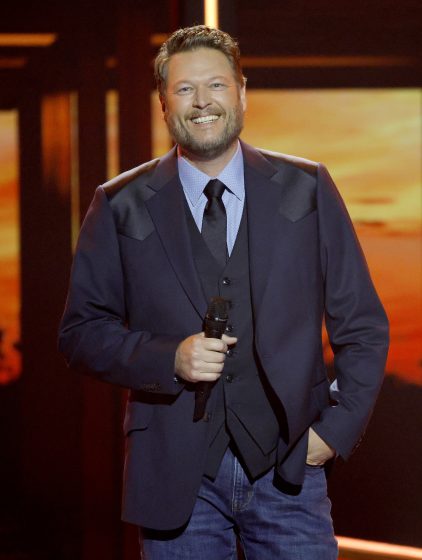
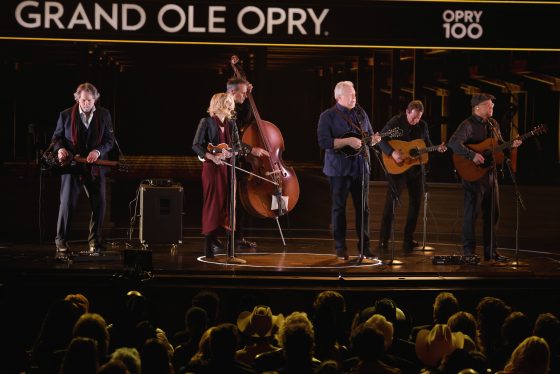
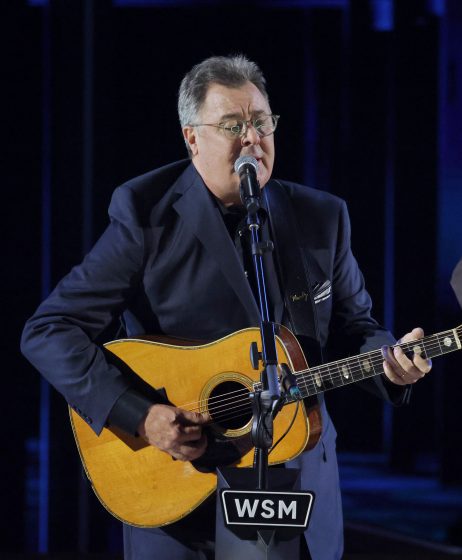
Hosted by Blake Shelton at the historic Grand Ole Opry House in Nashville, Tennessee, Opry 100 included performances by artists like Vince Gill, Alison Krauss & Union Station, Lainey Wilson, Brad Paisley, Ashley McBryde, Reba McEntire, Dierks Bentley, Garth Brooks, Trisha Yearwood, and many more. The primetime broadcast and streaming concert is just one event among an incredible, chocked-full effort by the Opry to celebrate their centennial – officially November 28, 2025 – throughout the entire calendar year.
Over the two-hour broadcast, there were dozens of show-stopping moments, from the brash, bold, and sensational to tender, intimate, and heart-wrenching performances. Good country of all varieties was on display from a wide array of artists at all levels of notoriety.
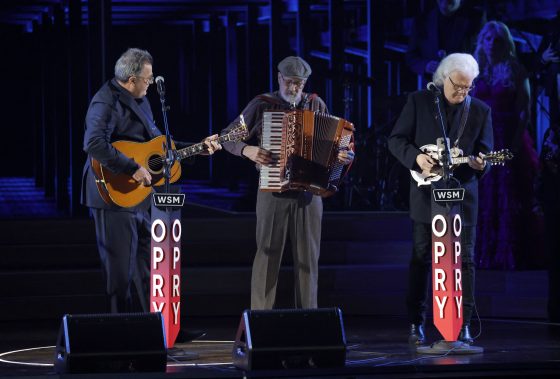
The War and Treaty sang alongside Steven Curtis Chapman and Amy Grant; Vince Gill reunited with his old pals Jeff Taylor and Ricky Skaggs; Ashley McBryde brought the house down alongside superstar country newcomer Post Malone and elsewhere in the show, ’90s stalwart Terri Clark; Lainey Wilson shared the stage with country picker and renaissance man Marty Stuart; husband-and-wife Trisha Yearwood and Garth Brooks were on hand; and Brad Paisley and Alison Krauss reunited for their 2003 smash hit duet, “Whiskey Lullaby.”
The show wrapped with a stunning full cast tribute to Dolly Parton, who greeted the Opry House audience via video and gave her sincere regrets for not being able to appear at the event. (Parton’s husband of 58 years, Carl Dean, recently passed away.) Dozens of the evening’s star artists took to the stage to pay tribute to Parton by singing her most famous hit, “I Will Always Love You,” a perfect, soaring sing along to close the momentous show.
There are truly too many once in a lifetime collaborations, songs, moments, and performances from Opry 100 to list, but we’ve collected a few of our favorite moments so you can relive this once-in-a-lifetime – or once-in-a-century – show! Get your fix by traveling through a few of our own favorite moments from Opry 100: A Live Celebration below.
Blake Shelton Hosts
Country superstar, award winner, and television personality Blake Shelton was a more than qualified host for Opry 100: A Live Celebration. Of course, he also gave a rousing performance of Joe Diffie’s “Pickup Man” to the delight of everyone in the crowd who find somethin’ they like in a pickup man. It wouldn’t be a celebration of country or the Opry without a truck mention.
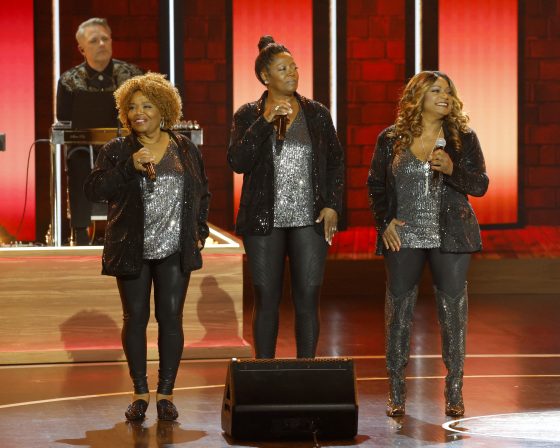
Nashville’s Own, the McCrary Sisters
Nashville’s favorite, in-demand singing siblings, the McCrary Sisters were on hand for Opry 100, too. It’s certainly not their first time on the hallowed Opry stage, but in the centennial context their appearance reminds of the legacies of similar groups who blazed trails at the Opry before them – like the Pointer Sisters – and those who’ve followed in their footsteps, like the Shindellas and Chapel Hart.
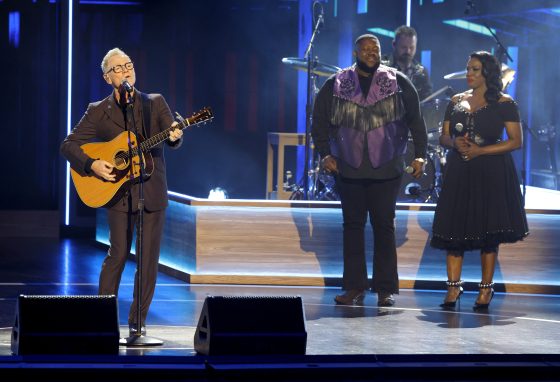
Steven Curtis Chapman and the War and Treaty Share a Sacred Moment
Grand Ole Opry member and contemporary Christian singer-songwriter Steven Curtis Chapman was joined by Americana/soul/country duo the War and Treaty for his performance on Opry 100.
Lainey Wilson and Hall of Famer Marty Stuart Duet
One of the biggest names in country at the moment, former GC and BGS
Artist of the Month Lainey Wilson was joined by bluegrasser, fiery picker, and Country Music Hall of Famer Marty Stuart backing her up on mandolin. They perform “Things a Man Oughta Know” from her huge 2021 album, Sayin’ What I’m Thinkin’, which many regard as her breakout release.
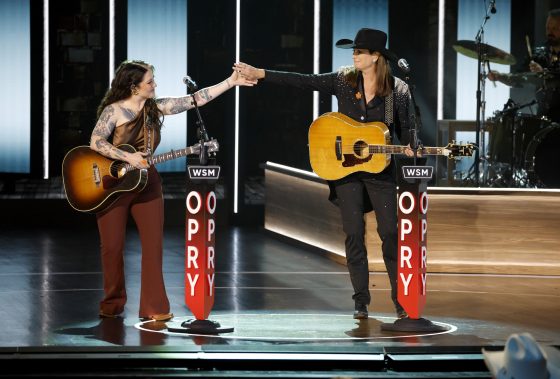
Ashley McBryde with Post Malone and Terri Clark
Ashley McBryde had multiple stellar moments during Opry 100, including these two prime duo performances. One with ’90s country star Terri Clark and another with a superstar newcomer to the genre, Post Malone. Her song selection with Postie was impeccable, too, taking the Opry 100 down to “Jackson” to mess around.
Trisha Yearwood with Garth Brooks and Reba McEntire
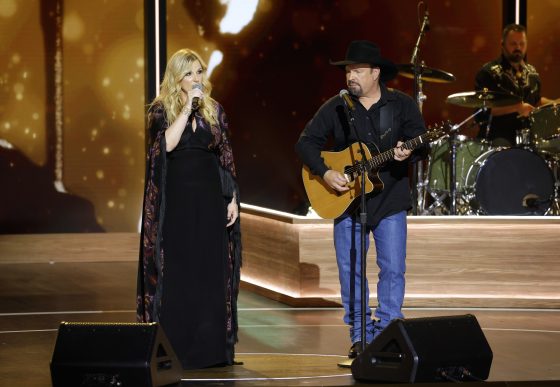
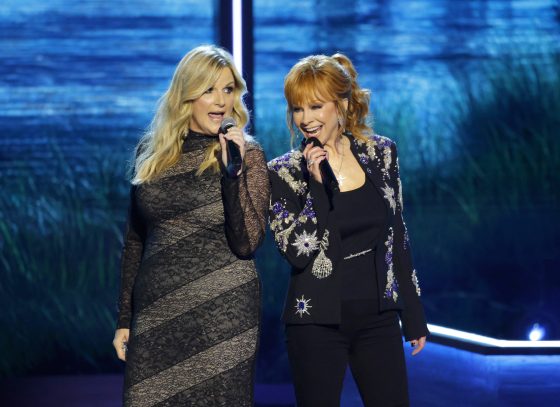
Country has boasted many amazing artist couples, but who better to take the Opry 100 stage than Trisha and Garth? Trisha also appeared with Reba McEntire to perform “The Night the Lights Went Out in Georgia,” a track that has been a huge generation-spanning hit for McEntire.
Brad Paisley and Alison Krauss Reunite
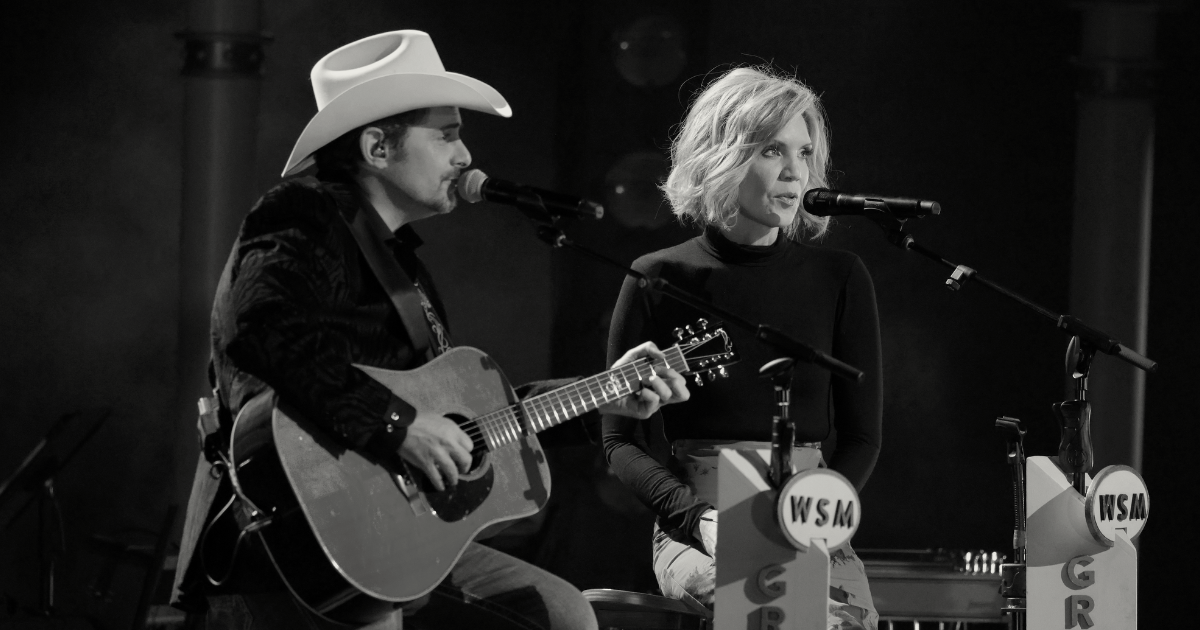
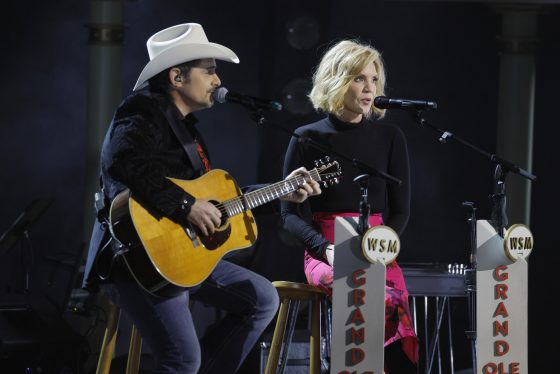
An iconoclastic example of a tear-jerker country story song, Paisley and Krauss’s recording of “Whiskey Lullaby” was released in the 2000s, but has had immense staying power. It shines from the Opry 100 stage in its simple and stripped-down styling. Is anyone a better duet partner and harmonizer than Alison Krauss? Perhaps not. Certainly a highlight among all of the many highlights of the broadcast
Alison Krauss & Union Station Perform, Too
On the precipice of their first album release in over 14 years, Alison Krauss also brought her band Union Station – including newest member,
– to the Opry 100 stage. Introduced by the Queen of Bluegrass, Rhonda Vincent, AKUS performed a hit from a prior era, “Let Me Touch You for Awhile” off 2001’s New Favorite. Their brand new project, Arcadia, releases March 28.
Country Music Hall of Fame Inductee, Vince Gill
It wouldn’t have been a complete lineup for Opry 100 without Vince Gill! The Country Music Hall of Famer was joined by his old friends Jeff Taylor on accordion, Sonya Isaacs, and fellow inductee Ricky Skaggs, to sing perhaps his most famous song, “Go Rest High on that Mountain.” An impactful and inspiring number, the original has been a comfort to thousands of fans and listeners experiencing their own losses and grief. Of his deep-and-wide catalog of music, there’s not a better choice for an evening like Opry 100.
Ketch, Dierks, and Jamey
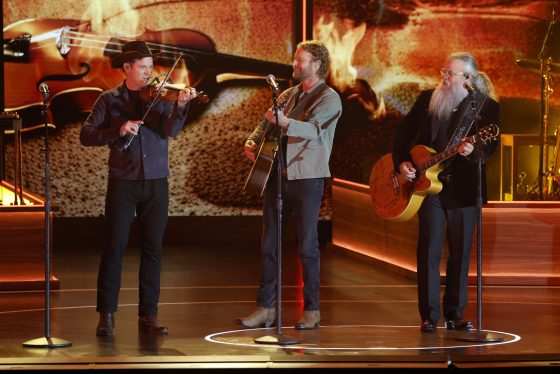
An Opry member trifecta, Dierks Bentley, Jamey Johnson, and old-time and bluegrass fiddler Ketch Secor (of Old Crow Medicine Show) paid tribute to the Charlie Daniels Band with a perfectly honky-tonkin’ medley of “Drinkin’ My Baby Goodbye” and, of course, “The Devil Went Down to Georgia.” From the sidewalks of Lower Broadway to the Grand Ole Opry stage, Charlie Daniel’s impact on country is indelible.
Luke Combs’ Mother Church Moment
From the hallowed stage of the Ryman Auditorium, the most famous former home of the Grand Ole Opry, one of the most popular singers in all of country, Luke Combs, performed George Jones’ “The Grand Tour,” as well as “Hurricane,” for Opry 100. With more than 800 million streams (on Spotify alone), “Hurricane” is one of his biggest hits from his 2017 album, This One’s For You, which has been certified double platinum by RIAA.
This long list of our favorite Opry 100 moments is still, somehow, merely the tip of the country iceberg. Stay tuned as the Grand Ole Opry continues their 100th birthday celebration all year long.
All photos courtesy of the Grand Ole Opry; credit Getty/Jason Kempin.
Lead image: Brad Paisley and Alison Krauss perform “Whiskey Lullaby” live at Opry 100.
Want more Good Country? Sign up to receive our monthly email newsletter – and much more music! – direct to your inbox.
Each year, the country music machine and its many fans and acolytes turn over, again and again and again, the quintessential question of “What is authenticity?” We’ve asked that very question quite a few times on Good Country over the last year ourselves, and we know as long as roots music and folk music are made, listeners will continue to ponder what is or isn’t “real,” “raw,” or… “authentic.”
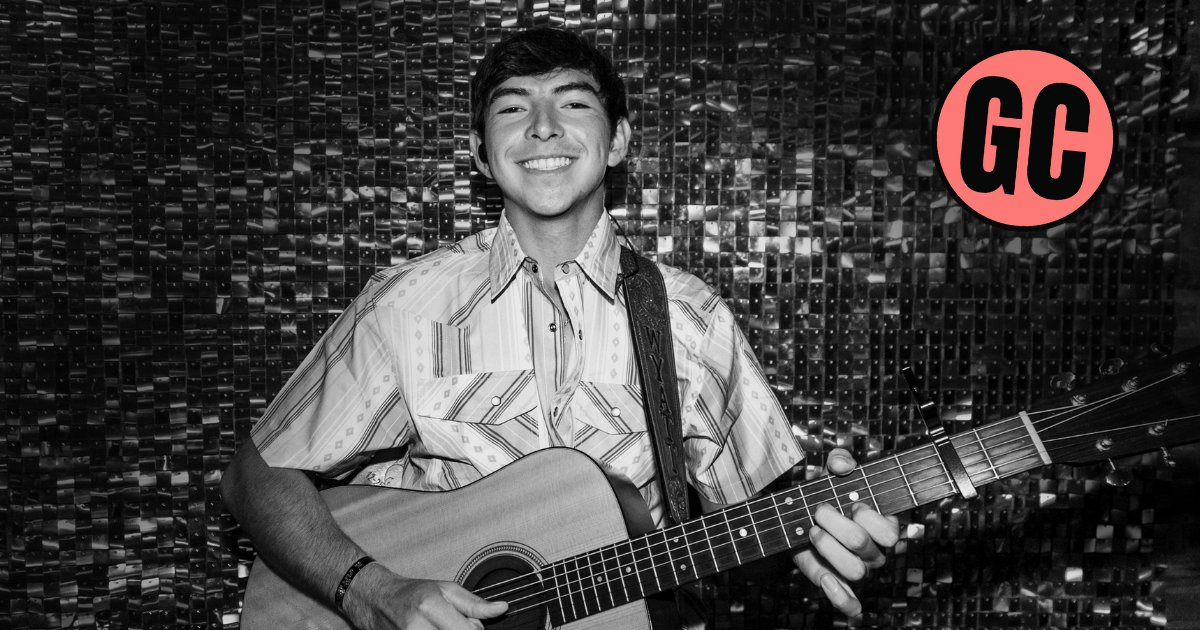
Wyatt Flores has been chosen as authentic. Country Music has spoken, and this quickly skyrocketing young artist has been riding a wave lately surfed by folks like Sierra Ferrell, Tyler Childers, Colter Wall, and Zach Top. Like these real country “poster children,” Flores’ music is realistic and grounded. It isn’t idealized revisionism in outlaw trappings. His songs never attempt to sugarcoat or mythologize, paving over the complications of rural life, red dirt realness, or the gritty patina of a rural places – like his homeland of Oklahoma.
Flores’ new album, Welcome to the Plains, is decidedly and delightfully trad country with nearly universal critical and listener acclaim. He currently racks up 3.5 million streams a month on Spotify alone, bolstered by a series of incredibly popular and consistently viral singles and EPs leading up to this, his full-length debut. For so many writers, diehard fans, and critics, Flores has long been “one to watch,” but that visibility stretches further and wider, to listeners across the country and around the world from so many different backgrounds and starting points.
Part of the reason why such a young artist with a relatively nascent career could have already amassed such a coalition of followers is that realistic, unguarded, “I know who I am, even though I’m still figuring out where I’m going” approach. It’s evident in his artistry, his performing prowess, and his skill for songwriting – all of which are evidenced prominently across this album.
Welcome to the Plains is one of the most remarkable records of 2024; it continues a tone long set in Flores’ career and music, even before this current inflection point and its substantial momentum. Wyatt Flores is bound for longevity, for many more successes, for many more millions of plays, as long as he remains exactly who he is: Wyatt Flores.
Your music has such a strong sense of place, so I wanted to start by talking about Oklahoma and growing up there. You’re down to earth in the way that you talk about Oklahoma from the beginning of the album, from the first notes of the title track. You’re viewing it in a very realistic way, not just in an idealized way. Can you talk about how Oklahoma inspired the album and what “home” means to you?
Wyatt Flores: When you think about Oklahoma, you have to [barely] scratch the surface to know that the history behind it is pretty screwed up, how Oklahoma came about, and we’re not one of the best states, if that makes sense? We’re 49th in education. And we’ve got a lot of people from California moving there just because it’s cheaper and everything else, but to live in Oklahoma, you gotta bear through the weather.
Then also, every year is a coin toss if things are going to grow, right? This year’s been a struggle up until this past couple of weeks, [during] which we just got like a foot of rain. But yeah, it’s been one of the hardest places to really build. And the people are so damn nice in Oklahoma, but it’s a tough place to live. Most people don’t want it. But I love it. “Welcome to the Plains,” it’s trying to describe [Oklahoma] … in the verses I really wanted to try and find more of a nature side to it, and then by the chorus just really tell the truth about it.
It feels really authentic and grounded, but you can still hear that you love Oklahoma in it, too. I think that’s a really interesting combination. Country is really good at rural America propaganda – and I love rural America, so I’m for it, to a degree – but to me, your album doesn’t feel like it has to close an eye to the history of Oklahoma to love it.
Yeah, it was a fun journey to try. I was sitting there just trying not to write songs about the road, because that was the only thing that I was doing. I was like, “This is the only life I’m living.” And not many people know what it’s like to be on a bus or on tour – at that time we were still in the van. It was more so daydreaming about home, missing the place, and then just trying to find the memories to piece everything together.
And I had a lot of weird influences, like “Little Town,” I was really trying to find the same feeling as listening to “Pink Houses” by John Mellencamp. I don’t write too many happy songs, and I was not in a good headspace in that time period. For some reason, I guess I was just daydreaming of a better life, and I kept writing about home, but in a different format of not always missing it.
Another song that really captures this topic is “Stillwater.” I love that it has this sort of dark, contemplative tinge and it feels gritty. Could talk a little bit about writing “Stillwater” and about your relationship with “home” and the construction of “home”? That’s such a country tradition as well, not just talking about home and missing it, but understanding that home is a nebulous, intangible thing, even if it literally exists.
There’s a lot of bands that say they come from Stillwater, but they really just started in Stillwater and they came from a different area, since it is a college town. But I was born and raised there in Stillwater. All my life the college has been my backyard. When I wrote that song in the summer of ’22, I had my guitar player with me and my fiddle player’s husband and we sat down to write that. It was more so just trying to give people a different perspective on what it’s like to actually grow up in a college town, because it’s a vicious cycle of the same shit – like, no one else sees it, because they’re living inside of the four years of going [to college].
And me also being a college dropout, I never got to actually go to [Oklahoma State University]. I went to OSUIT in Okmulgee, Oklahoma. And that did not last long. [Laughs] But yeah, I was like, “No one’s ever actually talked shit on a hometown and actually put the name in it.” So I was just being ballsy with it. I had to change quite a few lyrics, because I kind of went a little too far. I probably would have pissed a lot of people off.
The song was intentional. I don’t know, [I wanted to] make people think differently. Because that is my home. A lot of times, you just see people take advantage of the town, and the town keeps growing. Every single time I come back home now, there’s another chicken place and another damn car wash. I was like, “How many do we need?” Good lord. I was really pissed off in the mindset of it. I’m glad that we captured it, because for a while, I was scared to release it just because I was like, “People are gonna think that I hate Stillwater.” But really, it’s still a love song towards it.
It feels like you’re loving Stillwater, you’re loving Oklahoma, but your love for it requires you to look at it through an accurate lens and not an idealized version of it.
And it’s a relationship. My relationship with that town has just been back and forth. You’ll have that resentment, and you’ll have that frustration with it, but you still love it. It’s crazy to think about it that way, through that lens, but that’s what it is.
You touched on your co-writing process and I was excited to see how forward your own writing and your own perspective is on this album. Can you describe your co-writing and collaboration process for these songs? I noticed, too, that Ketch Secor co-wrote the title track.
When I wrote with Ketch, that was super cool. ‘Cause I had just gotten done watching Killers of the Flower Moon. I was already so inspired by that and wanting to really speak some truth. But not just by absolutely laying into people on the bad shit that’s going on – you can’t force-feed people. When we sat down [to write, Ketch] said that he wanted to write shit about Oklahoma and I was like, “That works out great!” The song just came together and it was it’s one of the coolest things, because I didn’t know how to feel about it quite yet. I was like, “This has some good shit in there…” and then when we went to record it, I was like, “Here it is! This is the way it’s supposed to go.”
But with the writing of this entire album, I was scared shitless. I didn’t think I was good enough, and I didn’t think these songs were good enough for an album. I started overthinking the entire thing. People can get mad at me all they want for doing co-writes, but I’m still writing. It’s not like I just sit in there and wait for these people to write these songs for me. This is all me.
The other thing is, my music taste [has] so much variety that I think it’s only better if I sit down with other people that have other strengths, to get to where I want to go – into these different styles of songs. I don’t want to do the same song, different chords, you know what I’m saying? I wanted it to be so unique and to keep it the way that I’ve always done it, which is to have different styles of songs. For that, I feel like you have to have different songwriters come in and give you different pieces.
I also have to ask you about bluegrass. One of the first things that we shared on our site of yours was a Tyler Childers cover that you recorded with Sierra Hull at Red Rocks. Our audience loved it so much. I think part of why your music resonates across diehard country fans to indie fans to bluegrass fans is that you’re not just a performer and a songwriter, but you’re a picker, too. What is your relationship like with bluegrass music? Is it something that’s prominent in your listening and in your influence?
So, I will first and foremost say this: I am not that good of a picker. [Laughs]
That stuff, that is something that I love. That is a different art. That is so beautiful. But my love for it– everyone in Oklahoma started listening to Tyler Childers and that’s when he came around, I want to say in my high school days. That’s when everything took a shift. I was like, “I don’t know what this is…” because we all grew up listening to red dirt [country], which is what I am. But my influence has really changed. In the summer of ‘22, Laurel Cove Music Festival was the first time that I had seen Nicholas Jamerson, Charles Wesley Godwin, Sierra Ferrell, Cole Chaney. That changed everything for me. It changed the entire way that I looked at music, and from that point on I started listening to every single one of those artists. It just led to more.
I love bluegrass and I try to have a couple songs [in that style], but I can’t call myself bluegrass. As much as I love what they’re doing and I try, I have my influences, I’m still red dirt. The way that those artists do what they do, it’s because they are them. I have my influences, but I am still just me. So whatever comes out, it’s just me loving and respecting it. But I can’t fully call myself a bluegrass musician, because I’m not. I’m jealous of it though, I’ll tell you that much. I’m jealous, I wish!
The production style and the different aesthetics that you’re utilizing on the album feel like classic country and old country plus dashes of country & western. There are moments that are really rocking and there are moments that are really subdued. It’s also really modern and crisp. How much of that is coming from you or from the ensemble and how much is coming from your producer, Beau Bedford?
A lot of that was Beau. I learned so much from him. [Before,] I really didn’t ever get the experience of being in a studio with musicians that are just wizards. Beau really took care of me.
It was a challenge, because we recorded in three different places. We were in Nashville, in North Carolina, in LA, and then we finished in Nashville. We were scared that it wasn’t gonna flow together, being in these different studios and then also just having this [group] of songs. Luckily, it all came together and as different as they do sound, they still flow. That was all just luck. We’re all we’re all sitting there going, “Huh? Hope this goes right!” I had my doubts, too, and [Beau] goes, “Wyatt, everything’s gonna be all right, because you are the main character that runs through this entire thing.”
That’s the constant throughout the entire project. I’m just lucky that it worked. When you go from different styles of songs – red dirt, and then you got this beachy [thing], old-time. It’s just crazy how they all go along together. Then it goes into this weird psychedelic rock and “Falling Sideways.” It was a wild adventure, and I’m so grateful for it. I just can’t believe the way that it turned out.
I ask this last question often, especially with people like yourself who are so effortlessly traditional country. There are a lot of folks out there who are excited about you – and artists like Zach Top and Tyler Childers and Zach Bryan – because these listeners sense that there’s this “new movement” that’s going to save country music, that’s going to renew country. That country is going to be what it used to be before “murder on Music Row.”
I wondered what your thoughts and feelings are on that paradigm?Because I sense that you don’t care so much about what is or isn’t traditional or what is or isn’t “inside” country. Does country music need to be saved? Do you see yourself as part of that saviorship? Do you care?
There’s something to be said about it, because yeah– I have my opinions about commercial country. There’s some really good songs and then I also think there’s some songs that say absolutely nothing. I guess as a songwriter, my goal is to keep writing about real shit and keep expressing myself with vulnerability. And to still write good songs.
I have a very important person in my life who’s been a mentor to me; his name’s Shane Lamb. I used to talk about writing these super-poppy melodies. And he goes, “Yeah, it’s because it’s popular music. … Who are some of your favorite artists?” We started going through Tyler Childers, early on in the days of me being in Nashville. [Shane] was like, “Listen to the fucking melody, Wyatt. It’s a pop melody. It’s for popular music. That’s why it works. But his arrangement is country.”
And I was like, “Oh… when you think about it that way, yeah, I guess you’re right.” So, I do try to have poppy melodies as much as I can, but I still try and keep my verses very needy, if that makes sense. I like putting a whole bunch of detail and really trying to focus in on the verses and let the chorus speak for itself.
That’s so perfectly put; yes, country has always been popular music. It’s one of my favorite Tyler Mahan Coe quotes, the creator of Cocaine and Rhinestones, the podcast and the book. He talks regularly about how country music has always been popular music. That’s not to say that fact absolves Music Row and Music City from all the truck and beer songs, but it certainly helps remind us that hand-wringing over “Is country music going to be okay?!” is not something that’s ever going to go away, but it’s also not something we really need to worry about.
And I think for the first time ever with social media, people are able to find new music that’s always been there. They’re just now finding out about it for the first time, because the radio stations aren’t playing it. That’s its own deal. But now they’re able to find all this new music and I feel like country is still going to be country. Like you said, when it comes to beer and truck songs, I think the thing that’s missing is them not explaining what they love about it. They’re just talking about it, not being vulnerable with it.
I think about “Drive” by damn Alan Jackson, dude. That is just talking about driving. That’s really all it is, but the sentiment is there, because it has to do with the father and the son. And then, all of a sudden, there’s the father and the daughter – that is fucking awesome country music that I still absolutely love! I wish that I could do that, like that Zach Top thing. I told him that whenever I met him, I was like, “Dude, I wish I could do it.” I really do. ‘Cause he’s fucking killing it. There’s so many different styles of music and I’d rather just do what I want to do, which is all of them, rather than just settle for one sound.
Willie Watson has been a solo act for well over a decade, since leaving Old Crow Medicine Show way back in 2011. And while he’s put out records since then, in many ways his self-titled third release marks a new beginning. A lot of that comes from the fact that it’s Watson’s first solo work with original material, following two volumes of Folk Singer albums drawing from The Great American Folk Song book.
Watson worked with a co-writer on the original songs on Willie Watson, Morgan Nagler from Whispertown 2000, and the results sound like the sort of songs you’ll hear traded around folk festival campfires for years to come. The co-production team of former Punch Brothers fiddler Gabe Witcher and Milk Carton Kids guitarist Kenneth Pattengale capture the tracks in spare, elegantly understated arrangements with the spotlight firmly on Watson’s voice.
The album begins with a literal trip down to hell on “Slim and The Devil” (inspired by 2017’s white supremacist riots in Charlottesville, Virginia) and ends with “Reap ’em in the Valley,” an autobiographical talking gospel about Watson’s own long, strange trip. In between are songs about love, fear, the occasional murder. One of them is another cover, Canadian folkie Stan Rogers’ stately “Harris and the Mare,” and you’ve never heard a song that’s both so beautiful and so horrific.
BGS caught up with Watson on the eve of his album’s release.
So after so many years playing old folk songs, what got you into writing your own?
Willie Watson: I’ve always written songs, but never thought of myself as a “real” songwriter, like Gillian Welch or Dylan or Ketch [Secor]. That just didn’t seem like what I was engineered toward. I wanted to be that kind of songwriter, but told myself I didn’t measure up. So I got into traditional music. When I’d get together with friends at parties, I’d be more likely to sing songs that were traditional or someone else’s. Being in Old Crow was great, because I got to write with other people, mostly Ketch. Co-writing was easier on me.
Once I found myself on my own, I was very scared to write by myself. Being completely responsible for everything is scary and for whatever reason I could not bring myself to do that. Now I understand that no matter how simple, complicated, mature, childish or anything else I put into a song might be, it’s okay. I don’t have to tear apart and criticize, say terrible things about it before I’ve even written it down on the page. Left on my own, that’s typically what I’d do. It’s only now at age 44 that I can get past that. What a long road.
Do you remember the first song you ever wrote?
“Roll On” when I was 15 or 16. It was wintertime at my house in Watkins Glen, late one night when everybody else was asleep. I went out to smoke in the back yard and it was quiet. As I looked at the nighttime winter sky, I had this story come into my head about a cowboy in an old town. I wrote the words out quick, almost as I would have been playing it. Just looked up at the sky and thought of it and it washed over me fast. It was a pretty powerful first song, but I ignored it and have the most regret about that. For whatever reason, there was something in my life that made me not give it enough credit.
How did you connect with your co-writer, Morgan Nagler?
She’s a great songwriter who has made a few records, does a lot of co-writing with people you know. You’ve heard songs on the radio that she co-wrote. I was afraid to sit down on my own and write, and Dave Rawlings said I should call her. I was apprehensive about presenting ideas and words and parts of myself to a person I didn’t know, but it was immediately fruitful. The first day, four hours later we had a song I really liked, “One To Fall” – it’s on this record. That we came up with something I felt strongly about right a way got me fired up, so we kept going. Every time we got together we wrote a good song.
What was it like to appear in the Coen Brothers movie, The Ballad of Buster Scruggs?
It was amazing. They had me audition for another movie I did not get the part for, but they already had me in mind for the one after that. But it was terrifying. Little cameras scare me enough and the big gigantic ones are even scarier. Like a gigantic eye and you’re not supposed to look at them even when they’re right in your face. I’m no actor. I knew my lines, but did not know what to do. I called Joel [Coen] a month before to ask if there was anything he could tell me to prepare me. “The only thing I’ll tell you is your first instinct is probably right,” he said. Which didn’t help at all. On-set, I was still scared. I had to learn to get on the wrong side of the horse because of the camera shoot, which was awkward. So I was not knowing what to do until they took me to wardrobe. Once I had on the costume and the hat and looked in the mirror, I suddenly knew exactly what to do. When I saw how I looked, it all made sense: Just go out and be Clint Eastwood.
Fear, even terror, seems like a recurrent theme in your life as well as your work.
It’s a recurring thing for every human, if they’ll admit it. It’s so freeing to admit I don’t know what’s going on, I’m scared, I need help. So much of the time I’ve done the opposite and gotten nowhere. The only person making my life hard was me. Touring with different people, I see them get into stressful situations and I think, “It must be hard to be them today.” I was just like that for a long time, tearing through things everywhere I went. I was afraid and my way of dealing with that was to try and control things. A lifetime of that proved disastrous.
I got to the point of trying other things and eventually learned about humility. That started me changing and growing and recognizing that the only reason I made my life so hard was being afraid of everything. It’s so risky doing this and I am scared of it. I’m apprehensive about even saying that. The public wants you to be confident onstage and I am that. Sometimes not, though. It’s hard to put it out there and not be afraid. I’m gonna cry a lot in front of people onstage, and that’s brave and good for me. This record is me understanding that there’s power in those uncomfortable moments, and embracing them. There’s a lot of healing in being able to go ahead and do that.
Who are you dancing with in the video to “Real Love”?
That’s my wife Mindy and the song’s about her. Once we got together, it went quick with us. But there was not romantic interest when we met, we were just working together. She’d quit her job as a fast fashion designer wanting to do something fun, cool, more fulfilling. A mutual friend was trying to get us together, knowing she was interested in getting into denim work and that’s what I do. The friend knew I needed help. So she started as an apprentice, got good fast, and we ended up working together. For a year we sat and sewed together and became best friends, she’s the best I ever had.
I was careful about that relationship, didn’t want to ruin it. So that song’s about how it started and what it meant, how true our love feels. It outdid everything else I’ve experienced my whole life. It shows how every other relationship I’ve ever had, I wanted the wrong things and, I daresay, they all wanted the wrong things from me, too. It went both ways. I’m not even talking about romantic love. It ends up being about everyone in my life. The story of my love life is the story of my life, love in all its forms. It’s a bold statement that she is the only real love in my life so far.
How did you come to know Stan Rogers’ “Harris and the Mare”?
I’m a Stan Rogers fan and that song comes from Between The Breaks, a live album recorded at McCabe’s in Santa Monica. I was thinking, “Do I want to put this on a record with my songs?” I’d written simple rhymes, couplets that are almost kinda childish – and I’m gonna put them next to a well-crafted song by a master songwriter? But Kenneth and Gabe had heard me sing that one at shows for a while and really wanted it on tape, and I guess I did, too. And after the recording came out so awesome, how could it not be on the record? I found out it did tie into my life. We made this record and I was unsure if any of it made any sense. Once it was sequenced and I lived with it for a month or two, it came into focus. That’s a violent song about a man who doesn’t want to be angry and violent. And I’ve been that man in my life. I relate to this guy.
The other cover, “Mole in the Ground” – did you know that one from Anthology of American Folk Music?
Yes. I love Bascom Lamar Lunsford, he’s so weird and interesting to listen to. Those old recordings, I can’t listen to a lot of Carter Family or Blind Willie McTell. Three or four songs and I don’t want to hear more. But Bascom, I can listen to a good 30 minutes and that says a lot. Like “Harris,” that was a big puzzle piece where I was unsure how it would fit. What made it were the string arrangements. That tied it in with “Harris” and “Play It One More Time.” Gabe directed the string arrangement, but let them find their own way. It was a cool every-man-for-himself arrangement.
The closing song, “Reap ’em in the Valley,” really tells a lot about how you came to be who and where you are, describing an early encounter with a singer named Ruby Love.
I’ve always talked too much at my shows. But being alone onstage, I had to find ways to make it more interesting. Switching from guitar to banjo is a great tool in the arsenal, but people still got bored of that. Folk singers traditionally tell stories and lead sing-alongs. So I learned how to talk to people in a real personal way about mundane things, relating our lives to find common ground rather than tear each other apart. Just me up there, whether it’s in front of 15 or 50 or 1,500 people, it becomes a battle if it’s not working. Me against them. Sometimes it was a disaster, when I was not speaking from experience or the heart, places I knew. But once I started telling stories about me simply walking down a country road, they’d perk up and listen. So I became a storyteller. I figured I’d put one on this record, and that was one Kenneth and Gabe really wanted me to do.
I hope it translates. It’s my experience of looking back at evidence of what I call God in my life, how you can’t deny it. What I am now, Mr. Folksinger. That’s what people recognized me as, the place I ended up. It could have gone differently, but this is what I’m here for. Those impactful moments. I didn’t think much about Ruby Love over the years, until I started thinking more realistically and honestly the further I got from it. Meeting Ruby Love when my heart was so broken and how that felt, that’s what I never forgot about that night.
That’s the thing that stayed with the picture of it all, like a scene in a movie. That’s what vivid memories look like, movies. All that imagery rattling around my head. I relate a lot of that to the nature of God and God’s power in my head. It goes hand in hand with the moon and lake and sky, and how the moon affected Ruby Love. What Ruby Love did for that party and what the orchard did for his guitar.
Whether you’re desperately scrambling for a karaoke number or seeking an anthem to unite your politically-opposed family this election season, Old Crow Medicine Show’s 2004 hit “Wagon Wheel” has been a safe bet for nearly two decades.
However, despite its widespread appeal, we’ve curated a list of scenarios where this ubiquitous ditty might do more harm than good. Here are five times you should firmly resist the urge to play it:
At the North American Cartographer’s Convention
Suggesting a westward journey through the Cumberland Gap will land a trucker in Johnson City, Tennessee is geographic heresy that will incite blind fury from the map-making community. Johnson City lies east, you directionally-challenged jackwagon. Prepare for fisticuffs.
During Daycare Center Staff Training
Regaling childcare workers with tales of rocking children “any way you feel” in “the wind and the rain” is a surefire way to get your facility’s license revoked.
As the Climactic Closing Argument in the Luciano Crime Family’s RICO Trial
Defending your allegedly innocent client by randomly bursting into a tune about boxcar-hopping and ramblin’ is a strategy that will absolutely undermine their chances of avoiding jail time. Your client is already a flight risk — don’t give them any ideas.
Over the Commlink During a Navy SEAL Covert Op
It turns out that the terrorists can win against an elite force’s meticulously-planned stealth mission when this ill-timed, rousing chorus echoes through the halls of whatever compound they are infiltrating.
At a Funeral for Your Stepdad Who Died Getting Crushed by His Own Station Wagon
You never liked your mom’s third husband Keith, but kicking off your eulogy by cheerfully strumming “Headed down South to the land of the pines” might miss the solemnity mark. Especially since it was an actual wagon wheel that took him.
Greg Hess is a comedy writer and performer in Los Angeles. His work has been featured in The American Bystander, The Onion, Shouts & Murmurs, Points in Case, and he cohosts the hit satirical podcast MEGA.
This website uses cookies to improve your experience. We'll assume you're ok with this, but you can opt-out if you wish.AcceptRejectRead More
Privacy & Cookies Policy
Privacy Overview
This website uses cookies to improve your experience while you navigate through the website. Out of these, the cookies that are categorized as necessary are stored on your browser as they are essential for the working of basic functionalities of the website. We also use third-party cookies that help us analyze and understand how you use this website. These cookies will be stored in your browser only with your consent. You also have the option to opt-out of these cookies. But opting out of some of these cookies may affect your browsing experience.
Necessary cookies are absolutely essential for the website to function properly. This category only includes cookies that ensures basic functionalities and security features of the website. These cookies do not store any personal information.
Any cookies that may not be particularly necessary for the website to function and is used specifically to collect user personal data via analytics, ads, other embedded contents are termed as non-necessary cookies. It is mandatory to procure user consent prior to running these cookies on your website.