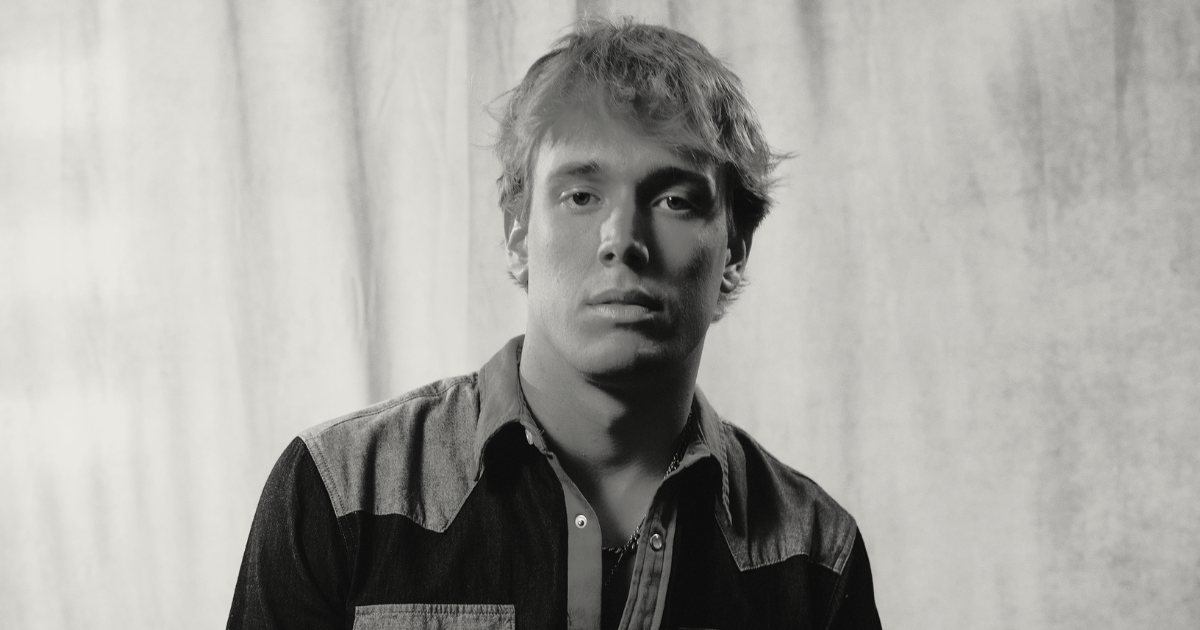
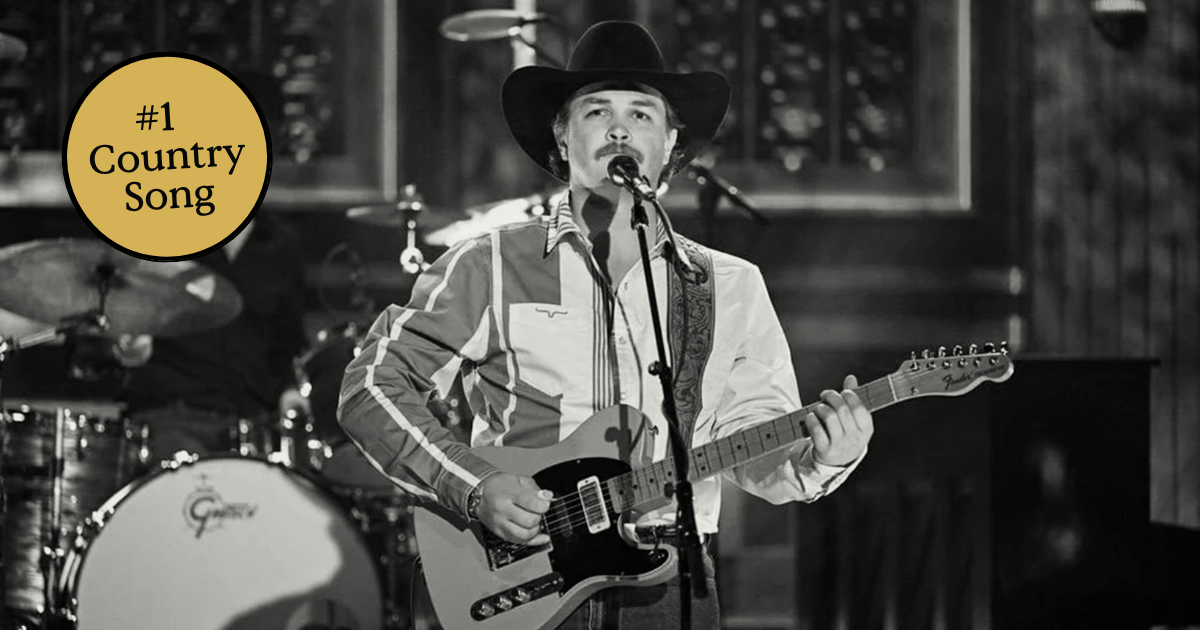
It was not so long ago that Hudson Westbrook was in college at Texas Tech. But today, he’s one of the most promising and hard-to-pin-down young acts in country, helping pull Texan artistic independence into the mainstream.
Joining trailblazing stars like Cody Johnson and Parker McCollum, Westbrook celebrated his first Number One in February after finding a home for “House Again” on the Mediabase country radio chart. Also certified Platinum by the RIAA, it’s more evidence of a shift away from cookie-cutter tailgate anthems: an emotionally complex ballad rooted in the experience of a kid watching the fallout of their parents’ divorce.
Westbrook paired raw lyrical nerve with a soulful, tender touch, helping the newcomer tally one billion streams in 18 months, with an exponential growing profile – and then he switched things up.
His recently released Exclusive EP features five tracks awash in rootsy R&B, proving the 21-year-old won’t be held to a narrow interpretation of Red Dirt musicality. But he’s not satisfied there, either. His new radio single “Painted You Pretty” (from the debut album Texas Forever) matches country simplicity with an earnest romantic hook, and this summer he’ll tour arenas and stadiums with Bailey Zimmerman, Morgan Wallen, and one of his heroes, George Strait.
Speaking with Good Country at an East Nashville coffeeshop – just one day after meeting a pig on the podcast of his other hero, Tracy Lawrence – the fresh-faced star looks ahead to new music and shares his impression on what’s driving the Texas-and-traditional country resurgence. Barely two years into a rocket ride of a professional career, he’s still learning the ropes, and sometimes, the lingo. But Hudson Westbrook has all the artistic confidence he’ll ever need.
We last talked in 2024 and at the time you were just out of college. The only thing you had released was “Take It Slow,” and then “House Again” came out. How have things changed?
Yeah, I was working at that feed store and it wasn’t that long ago. I’d written “House Again” and then I just remember I was so confused as to what was going on. Now I look up and I’m like, “I was blowing up the whole time.” I didn’t realize how big it was getting. It’s hard to feel it. I’d be like “Hey y’all, is 5,000 tickets good here?” And they’re like, “Do you realize what you just did?” And I’m always like “… No.” [Laughs]
I’m getting bigger and bigger and bigger and bigger. I want to keep getting bigger, but I want to keep it small. So [lately] it’s just really been focusing on doing that. Not losing yourself. Focusing on grounding myself right now, making sure I’m calling my family and whatever it might be. And then also it’s celebrating it, too.
You just had the Number One [with “House Again”]. What’d you do to celebrate?
We were in Hawaii, so we drank – I don’t know – 15 margaritas? [Laughs] The coolest part about that song is it was my second co-write and I was like, “Yo, I don’t know what I’m doing.” [Co-writers Dan Alley and Neil Medley] said, “Well, what’s your hook?” I said, “What’s a hook?” And they started laughing. I’m like, “Bro, I don’t know what the hell that is, but I had this idea.” …
So it just blew up. And I was so scared, just because it’s saying goodbye to a lot of stuff, honestly. It all happened so fast. If anyone had to have someone explain to them how to deal with a fast moment, I’d say if their songs are working, slow down.
Really? What do you mean?
Because that was a song that was for me. I was like, “I’m writing these songs I love and they’re ready by the time that we need them, so throw them out there.” And, “I’m already in Nashville, so let’s film the music video.” We never really planned on dropping anything, which is kind of crazy. I wish I would’ve slowed down a little bit and then realized what was happening so I could soak it in. It’s still happening. It’s still great. But I would just tell people, maybe slow down if it’s happening that fast. I feel like a lot of times I didn’t know who Hudson Westbrook was when I put songs out. And now I’ve sat down and we recorded four songs on Monday and I’m like, “This is the vibe. This is what we’re doing.” It’s so refreshing.
You’re going to be sharing a stadium stage with George Strait [at Jones AT&T Stadium in Lubbock, Texas on April 25]. That’s a homecoming show and I know he means a lot to you, so how does that make you feel?
That’s where I went to college. I sat on the 50-yard line since I was 7 years old, watched every single football game at [Texas] Tech, watched every single concert, listened to George Strait since I was in the womb. It was “Check Yes or No.” It was “Troubadour.” It was “The Fireman.” All that was in my house from an early age. So I don’t know, it’s just crazy. It’s a little nerve-wracking, like who knows what’s going to happen? I’ve also never played a stadium yet. All my friends are going to be there. It’s just going to be weird.
I would say there are some similarities between you and George Strait and maybe that’s just because of your background. You’ve been traveling around, have you noticed a difference in country music depending on where you are?
I go to Florida and [the fans are] screaming the most Texas country song I have. And Texas country just means that production. It’s a view of writing and it’s a perspective. I use real drums. The biggest country music artists in the world don’t use real drums right now. That changes everything. And so now we got to be like, “How can we be different than everything else?” I think that’s by being natural, in a sense.
There’s definitely a moment happening for Texas country, bluegrass, and traditional roots, with Zach Top and some more of your peers. Is it just perfect timing for you?
I think we’re pushing it into that direction because I think we’re trying to get back what we wanted to hear. I know if I talk to Zach, he’d be like, “Yeah, dude, I want acoustic and drums and a shaker and I want it all to be in there.” I feel like we make country music and it sounds like the show. You could literally put a band on stage and play it with no auto tune, no tracks. And that’s what makes it unique for us, because it’s like no one’s ever going to play the same thing twice.
What’s coming next, though? The Exclusive EP is out now and it’s definitely different than Texas Forever.
To be honest, I was like, “I want to try a bigger sound, something more mainstream.” And so I chased it – but I did not give up on the songwriting. My songwriting was very intentional and it was very love story-based [on Exclusive].
I love them, but I’m going back to my Texas country sound. We just recorded a song called “Hey Dallas,” which is really cool. Then we did a song called “Backwards,” which is really cool. And then I don’t know, I’m leaning in to John Mayer production a bit – but no crazy guitar solo. [Laughs] I was like, I ain’t doing none of that.
I can say, definitely some more soul and a bit of R&B in there, for sure. It’s electric guitars driving the whole thing – and I love electrics and baritones. I want that to drive all my stuff from now on. My voice just sounds better with it to me.
So it’s going to be like a whole new fresh album?
Totally new. I have like 120 songs and a lot of them are pretty good. I’m not saying they’re all for me, but I finally did what I should have done and that was sit back, find my key, find the way I like to write, really be intentional about what I’m writing. I wrote a song called “Nowhere Bound” that is probably one of my favorite songs. It’s like, I never stop in any city and don’t ever slow down.
When are you all going to be sharing new stuff?
Next month. I’m dropping “Slow Hand” by Conway Twitty [on Gavin Adcock’s Country Never Dies project, March 13]. His voice is incredible. I ain’t going to lie. It was not easy to cover that shit. [Laughs] He’s got just some weird things and then you’re like holding this note out for 10 minutes. [Laughs]
To be honest, dude, even if none of that stuff [I wrote] is usable, my goal this year is to do something that no one’s ever done and create a freaking path so far into my own lane that’s nothing like anybody else that … it’s undeniable, because I’m going to do what I want.
I feel like right now I’m growing and I’m learning and I’m doing whatever, but now it’s like, “How do I take it to the next level?” I think the way you take it to the next level is just getting deeper into yourself and telling [the fans] more.
The 2026 GRAMMY Awards were handed out on February 1, 2026, by the Recording Academy at the Crypto.com Arena in Los Angeles, California. Broadcast live on CBS, the primetime awards show is now viewable on demand on Paramount+. Earlier in the afternoon, the GRAMMY Premiere Ceremony, which was streamed via the GRAMMYs website and on YouTube, was held at the Peacock Theater, handing out dozens and dozens of additional awards across fields and categories.
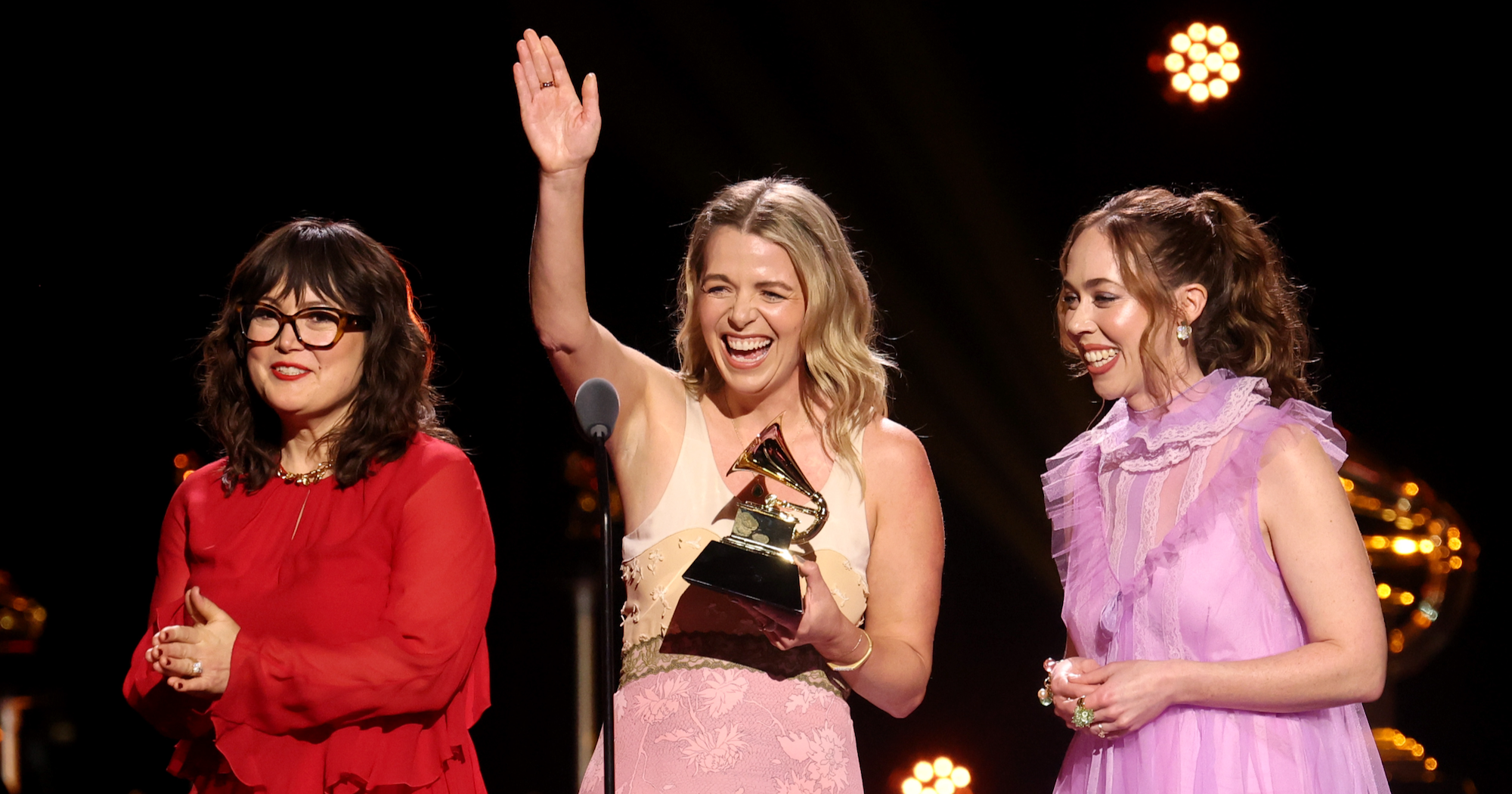
Best Bluegrass Album was announced during the Premiere Ceremony. This year, nominees included Michael Cleveland & Jason Carter (Carter & Cleveland), Sierra Hull (A Tip Toe High Wire), Alison Krauss & Union Station (Arcadia), the SteelDrivers (Outrun), and Billy Strings (Highway Prayers). Strings took home the award, racking up his third gramophone in the category. While Hull, who was nominated in four categories, including Best Bluegrass Album, did not take home any GRAMMY Awards yesterday, she was featured during the Premiere Ceremony as a presenter and she made an appearance on the red carpet for the primetime awards show. Roots/bluegrass/folk supergroup I’m With Her – featuring Sarah Jarosz, Aoife O’Donovan, and Sara Watkins – were nominated and won twice, taking home the Best Folk Album trophy for Wild and Clear and Blue and the award for Best American Roots Song for “Ancient Light.”
Tyler Childers, who was nominated in four categories this year, received his first-ever GRAMMY Award for Best Country Song for “Bitin’ List,” a viral sensation from his critically acclaimed 2025 album, Snipe Hunter. The LP had been nominated for Best Contemporary Country Album – in one of the much buzzed-about split categories of Best Contemporary Country Album and Best Traditional Country Album – but the trophy went to Jelly Roll’s Beautifully Broken instead. In the other split category, upstart fan favorite Zach Top took home the Traditional Country honor for his sophomore release, Ain’t In It For My Health. It marks Top’s first GRAMMY Award.
Of course, beyond the Country & American Roots Music field, folk and roots music were represented in peak form across the many genres and categories of the 68th Annual GRAMMY Awards. Album of the Year was awarded to Bad Bunny’s DeBÍ TiRAR MáS FOToS, one of the best roots projects of last year as selected by the BGS Class of 2025. From the Premiere Ceremony and Best Bluegrass Album to the primetime broadcast and Album of the Year, roots music is and always has been a keystone of the biggest night in music.
Below, find the complete list of winners (in bold) from the Country & American Roots Music field, plus select categories featuring roots musicians, artists, and projects from across the various other GRAMMY fields and categories.
Country & American Roots Music
Best Country Solo Performance
“Nose On The Grindstone” – Tyler Childers “Good News” – Shaboozey “Bad As I Used To Be” – Chris Stapleton “I Never Lie” – Zach Top “Somewhere Over Laredo” – Lainey Wilson
Best Country Duo/Group Performance
“A Song To Sing” – Miranda Lambert, Chris Stapleton “Trailblazer” – Reba McEntire, Miranda Lambert, Lainey Wilson “Love Me Like You Used To Do” – Margo Price, Tyler Childers “Amen” – Shaboozey, Jelly Roll “Honky Tonk Hall Of Fame” – George Strait, Chris Stapleton
Best Country Song
“Bitin’ List” – Tyler Childers, songwriter. (Tyler Childers) “Good News” – Michael Ross Pollack, Sam Elliot Roman, Jacob Torrey, songwriters. (Shaboozey) “I Never Lie” – Carson Chamberlain, Tim Nichols, Zach Top, songwriters. (Zach Top) “Somewhere Over Laredo” – Andy Albert, Trannie Anderson, Dallas Wilson, Lainey Wilson, songwriters. (Lainey Wilson) “A Song To Sing” – Jenee Fleenor, Jesse Frasure, Miranda Lambert, Chris Stapleton, songwriters. (Miranda Lambert, Chris Stapleton)
Best Traditional Country Album
Dollar A Day – Charley Crockett American Romance – Lukas Nelson Oh What A Beautiful World – Willie Nelson Hard Headed Woman – Margo Price Ain’t In It For My Health – Zach Top
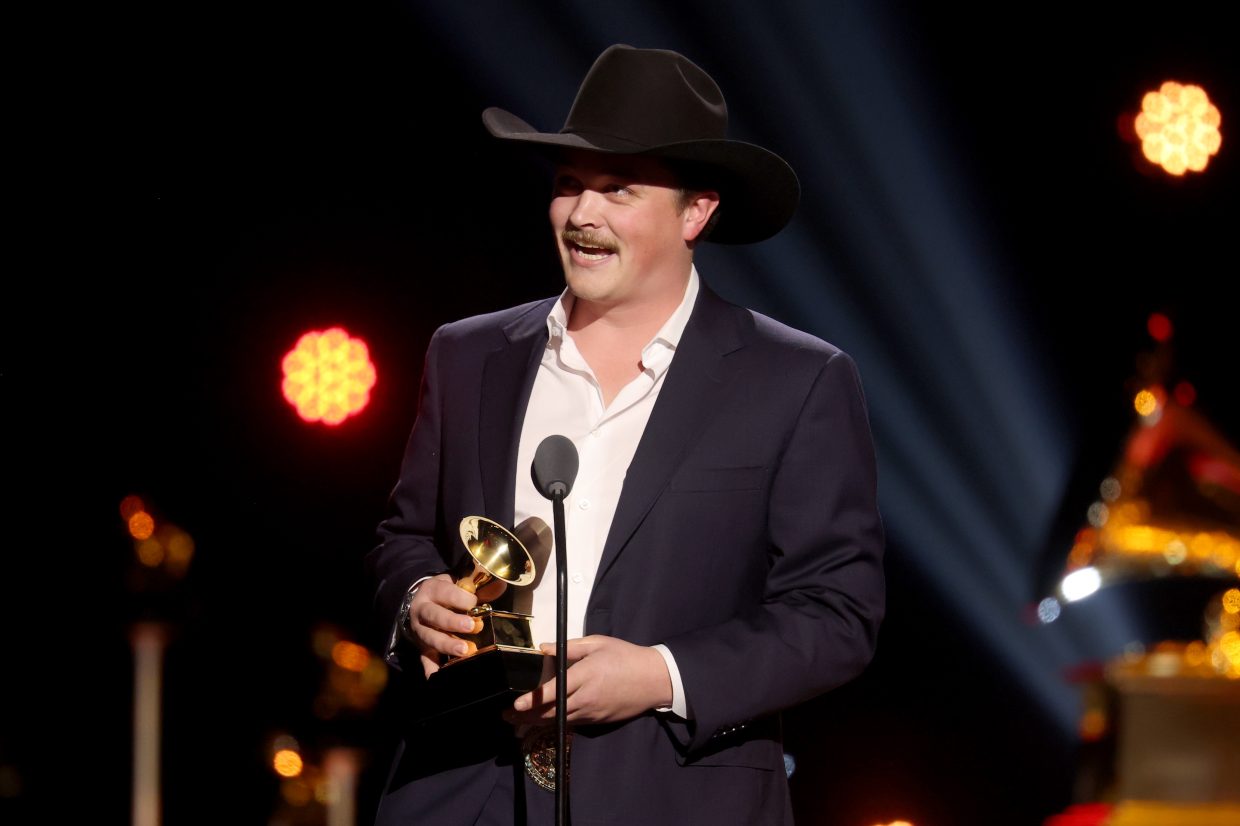
Zach Top accepts the Best Traditional Country Album award for ‘Ain’t In It For My Health’ during the 68th GRAMMY Awards Premiere Ceremony. (Photo by Matt Winkelmeyer/Getty Images for The Recording Academy.)
Best Contemporary Country Album
Patterns – Kelsea Ballerini Snipe Hunter – Tyler Childers Evangeline Vs. The Machine – Eric Church Beautifully Broken – Jelly Roll Postcards From Texas – Miranda Lambert
Best American Roots Performance
“LONELY AVENUE” – Jon Batiste, Featuring Randy Newman “Ancient Light” – I’m With Her “Crimson And Clay” – Jason Isbell “Richmond On The James” – Alison Krauss & Union Station “Beautiful Strangers” – Mavis Staples
Best Americana Performance
“Boom” – Sierra Hull “Poison In My Well” – Maggie Rose, Grace Potter “Godspeed” – Mavis Staples “That’s Gonna Leave A Mark” – Molly Tuttle “Horses” – Jesse Welles
Best American Roots Song
“Ancient Light” – Sarah Jarosz, Aoife O’Donovan, Sara Watkins, songwriters. (I’m With Her) “BIG MONEY” – Jon Batiste, Mike Elizondo, Steve McEwan, songwriters. (Jon Batiste) “Foxes In The Snow” – Jason Isbell, songwriter. (Jason Isbell) “Middle” – Jesse Welles, songwriter. (Jesse Welles) “Spitfire” – Sierra Hull, songwriter. (Sierra Hull)
Best Americana Album
BIG MONEY – Jon Batiste Bloom – Larkin Poe Last Leaf On The Tree – Willie Nelson So Long Little Miss Sunshine – Molly Tuttle Middle – Jesse Welles
Best Bluegrass Album
Carter & Cleveland – Michael Cleveland & Jason Carter A Tip Toe High Wire – Sierra Hull Arcadia – Alison Krauss & Union Station Outrun – The SteelDrivers Highway Prayers – Billy Strings
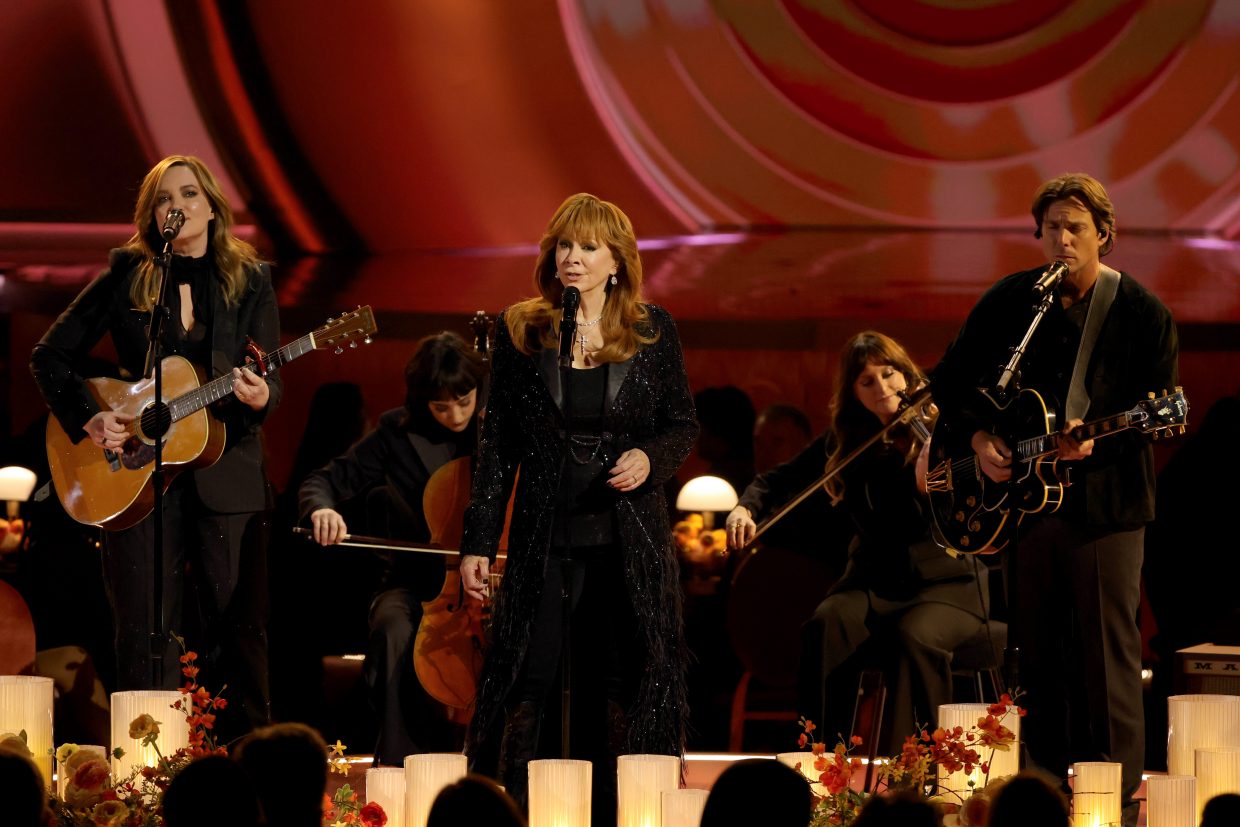
(L-R) Brandy Clark, Reba McEntire, and Lukas Nelson perform onstage during the 68th GRAMMY Awards. (Photo by Kevin Winter/Getty Images for The Recording Academy.)
Best Traditional Blues Album
Ain’t Done With The Blues – Buddy Guy Room On The Porch – Taj Mahal & Keb’ Mo’ One Hour Mama: The Blues Of Victoria Spivey – Maria Muldaur Look Out Highway – Charlie Musselwhite Young Fashioned Ways – Kenny Wayne Shepherd & Bobby Rush
Best Contemporary Blues Album
Breakthrough – Joe Bonamassa Paper Doll – Samantha Fish A Tribute To LJK – Eric Gales Preacher Kids – Robert Randolph Family – Southern Avenue
Best Folk Album
What Did The Blackbird Say To The Crow – Rhiannon Giddens & Justin Robinson Crown Of Roses – Patty Griffin Wild And Clear And Blue – I’m With Her Foxes In The Snow – Jason Isbell Under The Powerlines (April 24 – September 24) – Jesse Welles
Best Regional Roots Music Album
Live At Vaughan’s – Corey Henry & The Treme Funktet For Fat Man – Preservation Brass & Preservation Hall Jazz Band Church Of New Orleans – Kyle Roussel Second Line Sunday – Trombone Shorty And New Breed Brass Band A Tribute To The King Of Zydeco – Various Artists
Molly Tuttle walks the red carpet at the 68th GRAMMY Awards. (Photo by John Shearer/Getty Images for The Recording Academy.)
General Field
Producer of the Year (Non-Classical)
Dan Auerbach Cirkut Dijon Blake Mills Sounwave
Jazz, Traditional Pop, Contemporary Instrumental & Musical Theater
Best Jazz Performance
“Noble Rise” – Lakecia Benjamin, Featuring Immanuel Wilkins & Mark Whitfield “Windows – Live” – Chick Corea, Christian McBride & Brian Blade “Peace Of Mind / Dreams Come True” – Samara Joy “Four” – Michael Mayo “All Stars Lead To You – Live” – Nicole Zuraitis, Dan Pugach, Tom Scott, Idan Morim, Keyon Harrold & Rachel Eckroth
Best Jazz Instrumental Album
Trilogy 3 (Live) – Chick Corea, Christian McBride & Brian Blade Southern Nights – Sullivan Fortner, Featuring Peter Washington & Marcus Gilmore Belonging – Branford Marsalis Quartet Spirit Fall – John Patitucci, Featuring Chris Potter & Brian Blade Fasten Up – Yellowjackets
Best Alternative Jazz Album
honey from a winter stone – Ambrose Akinmusire Keys To The CityVolume One – Robert Glasper Ride into the Sun – Brad Mehldau LIVE-ACTION – Nate Smith Blues Blood – Immanuel Wilkins
Best Traditional Pop Vocal Album
Wintersongs – Laila Biali The Gift Of Love – Jennifer Hudson Who Believes In Angels? – Elton John & Brandi Carlile Harlequin – Lady Gaga A Matter Of Time – Laufey The Secret Of Life: Partners, Volume 2 – Barbra Streisand
Best Contemporary Instrumental Album
Brightside – ARKAI Ones & Twos – Gerald Clayton BEATrio – Béla Fleck, Edmar Castañeda, Antonio Sánchez Just Us – Bob James & Dave Koz Shayan – Charu Suri
Sierra Hull speaks on stage during the 68th GRAMMY Awards Premiere Ceremony. (Photo by Matt Winkelmeyer/Getty Images for The Recording Academy.)
Gospel & Contemporary Christian Music
Best Roots Gospel Album
I Will Not Be Moved (Live) – The Brooklyn Tabernacle Choir Then Came The Morning – Gaither Vocal Band Praise & Worship: More Than A Hollow Hallelujah – The Isaacs Good Answers – Karen Peck & New River Back To My Roots – Candi Staton
Latin, Global, Reggae & New Age, Ambient, or Chant
Best Música Mexicana Album (Including Tejano)
MALA MÍA – Fuerza Regida, Grupo Frontera Y Lo Que Viene – Grupo Frontera Sin Rodeos – Paola Jara Palabra De To’s (Seca) – Carín León Bobby Pulido & Friends Una Tuya Y Una Mía – Por La Puerta Grande(En Vivo) – Bobby Pulido
Best Global Music Performance
“EoO” – Bad Bunny “Cantando en el Camino” – Ciro Hurtado “JERUSALEMA” – Angélique Kidjo “Inmigrante Y Que?” – Yeisy Rojas “Shrini’s Dream (Live)” – Shakti “Daybreak” – Anoushka Shankar, Featuring Alam Khan, Sarathy Korwar
Children’s, Comedy, Audio Books, Visual Media & Music Video/Film
Best Song Written For Visual Media
“As Alive As You Need Me To Be” [From TRON: Ares] – Trent Reznor & Atticus Ross, songwriters. (Nine Inch Nails) “Golden” [From KPop Demon Hunters] – EJAE & Mark Sonnenblick, songwriters. (HUNTR/X: EJAE, Audrey Nuna, REI AMI) “I Lied to You” [From Sinners] – Ludwig Göransson & Raphael Saadiq, songwriters. (Miles Caton) “Never Too Late” [From Elton John: Never Too Late] – Brandi Carlile, Elton John, Bernie Taupin & Andrew Watt, songwriters. (Elton John, Brandi Carlile) “Pale, Pale Moon” [From Sinners] – Ludwig Göransson & Brittany Howard, songwriters. (Jayme Lawson) “Sinners” [From Sinners] – Leonard Denisenko, Rodarius Green, Travis Harrington, Tarkan Kozluklu, Kyris Mingo & Darius Povilinus, songwriters. (Rod Wave)
“First Snow” – Remy Le Boeuf, composer. (Nordkraft Big Band, Remy Le Boeuf & Danielle Wertz) “Live Life This Day: Movement I” – Miho Hazama, composer. (Miho Hazama, Danish Radio Big Band & Danish National Symphony Orchestra) “Lord, That’s A Long Way” – Sierra Hull, composer. (Sierra Hull) “Opening” – Zain Effendi, composer. (Zain Effendi) “Train To Emerald City” – John Powell & Stephen Schwartz, composers (John Powell & Stephen Schwartz) “Why You Here / Before The Sun Went Down” – Ludwig Göransson, composer. (Ludwig Göransson, Featuring Miles Caton)
Photo Credit: All photos by Getty Images for the Recording Academy, courtesy of the Recording Academy. Photographer credits as marked.
Lead and Alternate Images: I’m With Her, (L to R) Sara Watkins, Aoife O’Donovan, and Sarah Jarosz, accept the GRAMMY for Best Folk Album. Shot by Matt Winkelmeyer/Getty Images for the Recording Academy.
On November 19, 2025 the 59th Annual CMA Awards were broadcast live on ABC from Bridgestone Arena in Nashville, Tennessee. Hosted by Lainey Wilson for the second year in a row, the primetime awards show is now streaming on Hulu for any viewers who were unable to tune in live. Wilson not only hosted, she also dominated the awards, taking home trophies for Album of the Year, Female Vocalist of the Year, and the evening’s top honor, Entertainer of the Year. The Louisianan country sensation has now won 12 CMA Awards out of 25 nominations in just four years of eligibility – including two Entertainer of the Year wins.
The other standout award recipient of the night was “you look like you love me,” a viral hit for mainstream country stars Ella Langley & Riley Green. The track garnered trophies for Single of the Year, Song of the Year, and Music Video of the Year. Meanwhile Post Malone, who has now been nominated for CMA Awards five times over the past two years, landed his very first CMA Award for Musical Event of the Year for his song, “Pour Me A Drink,” featuring Blake Shelton. Bluegrass-steeped country phenomenon Zach Top also received his first CMA Award – for New Artist of the Year – after two huge, breakout years for everyone’s new favorite neo-traditionalist.
The broadcast included live performances and exciting collaborations from artists like Wilson, Top, Kenny Chesney, Chris Stapleton, Luke Combs, Miranda Lambert, Shaboozey and Stephen Wilson Jr., the Red Clay Strays, Tucker Wetmore, and many more. Legendary country, bluegrass, and Americana multi-hyphenate Vince Gill was honored with the Willie Nelson Lifetime Achievement Award – the presentation featuring a surprise appearance by last year’s awardee, George Strait. Gill’s longtime pal and collaborator, pedal steel guitarist extraordinaire Paul Franklin, took home the award for Musician of the Year.
Chesney, who recently released a best-selling book, Heart Life Music, performed a medley of “American Kids” and “When the Sun Goes Down.” to mark his induction into the Country Music Hall of Fme, and to celebrate his fellow newly minted Hall of Fame members June Carter Cash and Tony Brown, too. Brandi Carlile and Patty Loveless joined together to honor Gill with a rousing performance of “When I Call Your Name,” a No. 2 Billboard hit for Gill that shone and sparkled on the CMA stage with rich, reedy harmonies by Carlile and Loveless.
Fans can stream the CMA Awards Show now on Hulu. Find the full list of nominees and winners (in bold) for the 59th Annual CMA Awards below:
ENTERTAINER OF THE YEAR
Luke Combs Cody Johnson Chris Stapleton Morgan Wallen Lainey Wilson
SINGLE OF THE YEAR
“4x4xU” – Lainey Wilson Producer: Jay Joyce Mix Engineers: Jason Hall, Jay Joyce
“Ain’t No Love In Oklahoma” – Luke Combs Producers: Luke Combs, Chip Matthews, Jonathan Singleton Mix Engineer: Chip Matthews
“Am I Okay?” – Megan Moroney Producer: Kristian Bush Mix Engineer: Justin Niebank
“I Never Lie” – Zach Top Producer: Carson Chamberlain Mix Engineer: Matt Rovey
“you look like you love me” – Ella Langley & Riley Green Producer: Will Bundy Mix Engineer: Jim Cooley
ALBUM OF THE YEAR
Am I Okay? – Megan Moroney Producer: Kristian Bush Mix Engineer: Justin Niebank
Cold Beer & Country Music – Zach Top Producer: Carson Chamberlain Mix Engineer: Matt Rovey
F-1 Trillion – Post Malone Producers: Louis Bell, Charlie Handsome, Hoskins Mix Engineer: Ryan Gore
I’m The Problem – Morgan Wallen Producers: Jacob Durrett, Charlie Handsome, Joey Moi Mix Engineers: Charlie Handsome, Joey Moi
Whirlwind – Lainey Wilson Producer: Jay Joyce Mix Engineers: Jason Hall, Jay Joyce
SONG OF THE YEAR
“4x4xU” Songwriters: Jon Decious, Aaron Raitiere, Lainey Wilson
“Am I Okay?” Songwriters: Jessie Jo Dillon, Luke Laird, Megan Moroney
“I Never Lie” Songwriters: Carson Chamberlain, Tim Nichols, Zach Top
“Texas” Songwriters: Johnny Clawson, Josh Dorr, Lalo Guzman, Kyle Sturrock
“you look like you love me” Songwriters: Riley Green, Ella Langley, Aaron Raitiere
FEMALE VOCALIST OF THE YEAR
Kelsea Ballerini Miranda Lambert Ella Langley Megan Moroney Lainey Wilson
MALE VOCALIST OF THE YEAR
Luke Combs Cody Johnson Chris Stapleton Zach Top Morgan Wallen
VOCAL GROUP OF THE YEAR
Lady A Little Big Town Old Dominion Rascal Flatts The Red Clay Strays
VOCAL DUO OF THE YEAR
Brooks & Dunn Brothers Osborne Dan + Shay Maddie & Tae The War And Treaty
MUSICAL EVENT OF THE YEAR
“Don’t Mind If I Do” – Riley Green (featuring Ella Langley) Producers: Scott Borchetta, Jimmy Harnen, Dann Huff
“Hard Fought Hallelujah” – Brandon Lake with Jelly Roll Producer: Micah Nichols
“I’m Gonna Love You” – Cody Johnson (with Carrie Underwood) Producer: Trent Willmon
“Pour Me A Drink” – Post Malone (feat. Blake Shelton) Producers: Louis Bell, Charlie Handsome
“You Had To Be There” – Megan Moroney (feat. Kenny Chesney) Producer: Kristian Bush
MUSICIAN OF THE YEAR
Jenee Fleenor – Fiddle Paul Franklin – Steel Guitar Brent Mason – Guitar Rob McNelley – Guitar Derek Wells – Guitar
MUSIC VIDEO OF THE YEAR
“Am I Okay?” – Megan Moroney Directors: Alexandra Gavillet, Megan Moroney
“I’m Gonna Love You” – Cody Johnson (with Carrie Underwood) Director: Dustin Haney
“Somewhere Over Laredo” – Lainey Wilson Director: TK McKamy
“Think I’m In Love With You” – Chris Stapleton Director: Running Bear
“you look like you love me” – Ella Langley & Riley Green Directors: Ella Langley, John Park, Wales Toney
NEW ARTIST OF THE YEAR
Ella Langley Shaboozey Zach Top Tucker Wetmore Stephen Wilson Jr.
In 1925, world leaders were signing the final treaties coming out of WWI; Congress authorized work on Mt. Rushmore as a national memorial; the Scopes Trial was held in Tennessee; and the first patent on radio transmission was only 28 years old.
And, in 1925, WSM first broadcast its barn dance – soon to become the Grand Ole Opry.
One hundred years later, the Grand Ole Opry is the world’s longest-running radio program. After a century that saw changes unparalleled in world history, audiences are still drawn to the Opry. Every week thousands make the pilgrimage to the Grand Ole Opry House in Nashville while others tune in around the world. The show continues to inspire new generations of performers to aspire to step “into the circle” on the Opry House stage.
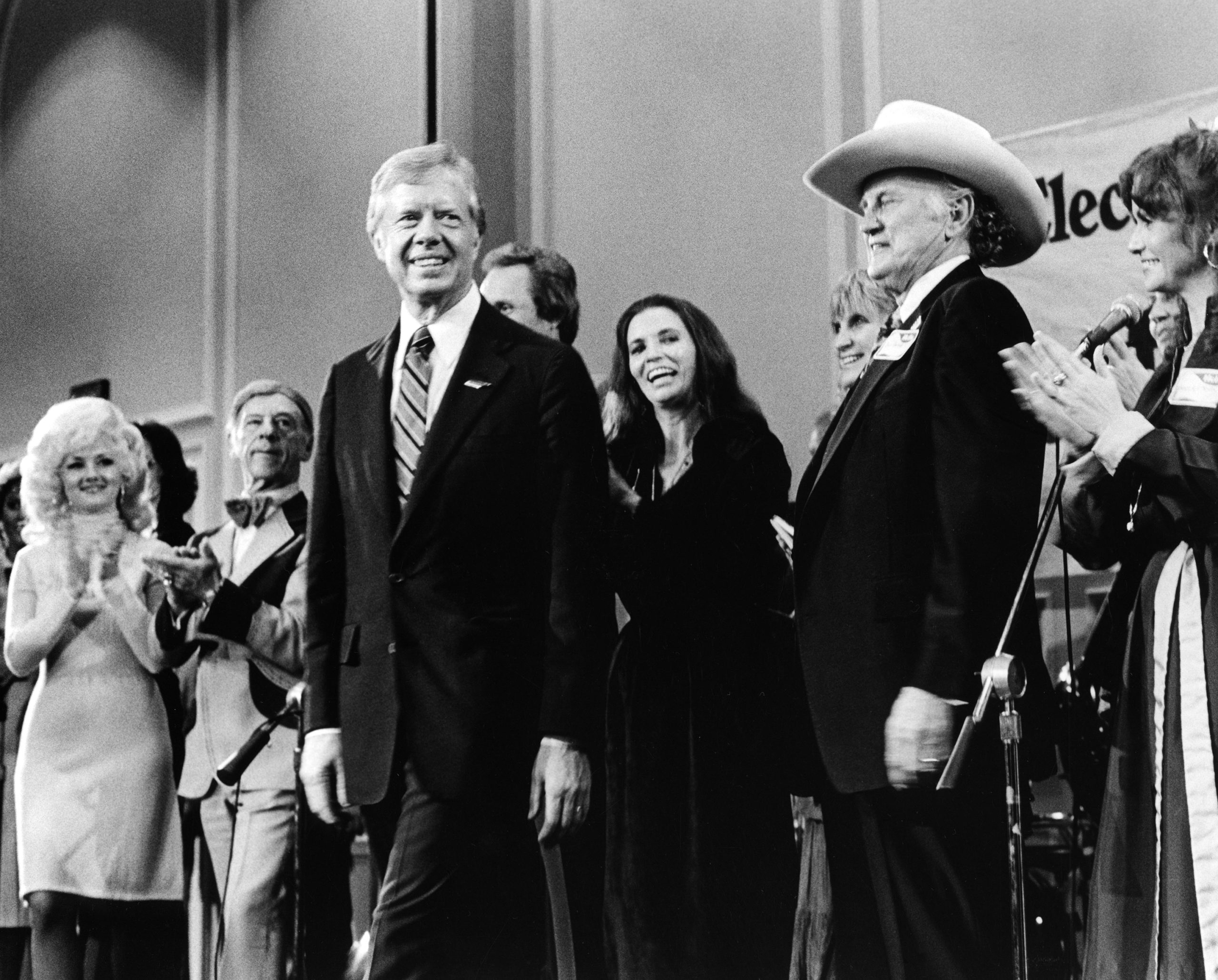
President Jimmy Carter on the Grand Ole Opry stage with Kelly Foxton, Hank Snow, Mel Tillis, June Carter Cash, Skeeter Davis, Bill Monroe, Jeannie C. Riley, and others on October 9, 1980. Photo courtesy of Ryman Hospitality Properties.
In The Beginning Was Insurance
In the 1920s, Edwin Craig was watching radio stations emerge across the nation – and seeing the money-making potential for sponsors and owners. He convinced Cornelius Craig, his father and founder of the National Life and Accident Insurance Company, that a radio station could sell a lot of insurance.
Soon, the fifth floor of the company’s downtown Nashville building held a radio studio. The call letters WSM stood for “We Shield Millions,” the company’s motto. A program that would become the lifeblood of country music started as a way to promote life insurance.
The hiring of George D. Hay away from Chicago’s WLS was the beginning of the WSM Barn Dance. The 30-year-old who called himself The Solemn Old Judge and started every show with a steamboat whistle would set the tone for much of the Opry’s 100 years – including its name.
Which all started with a clash of cultures.
Some upper-crust Nashville residents complained the only radio they could hear on weekends was string band programming from the dominant WSM station. In response, WSM began carrying the syndicated “Music Appreciation Hour.”
The Barn Dance slot followed the classical program, and Hay, not one to pass up a good line, said, “For the past hour, we have been listening to music largely from Grand Opera, but from now on, we will present ‘the Grand Ole Opry.”
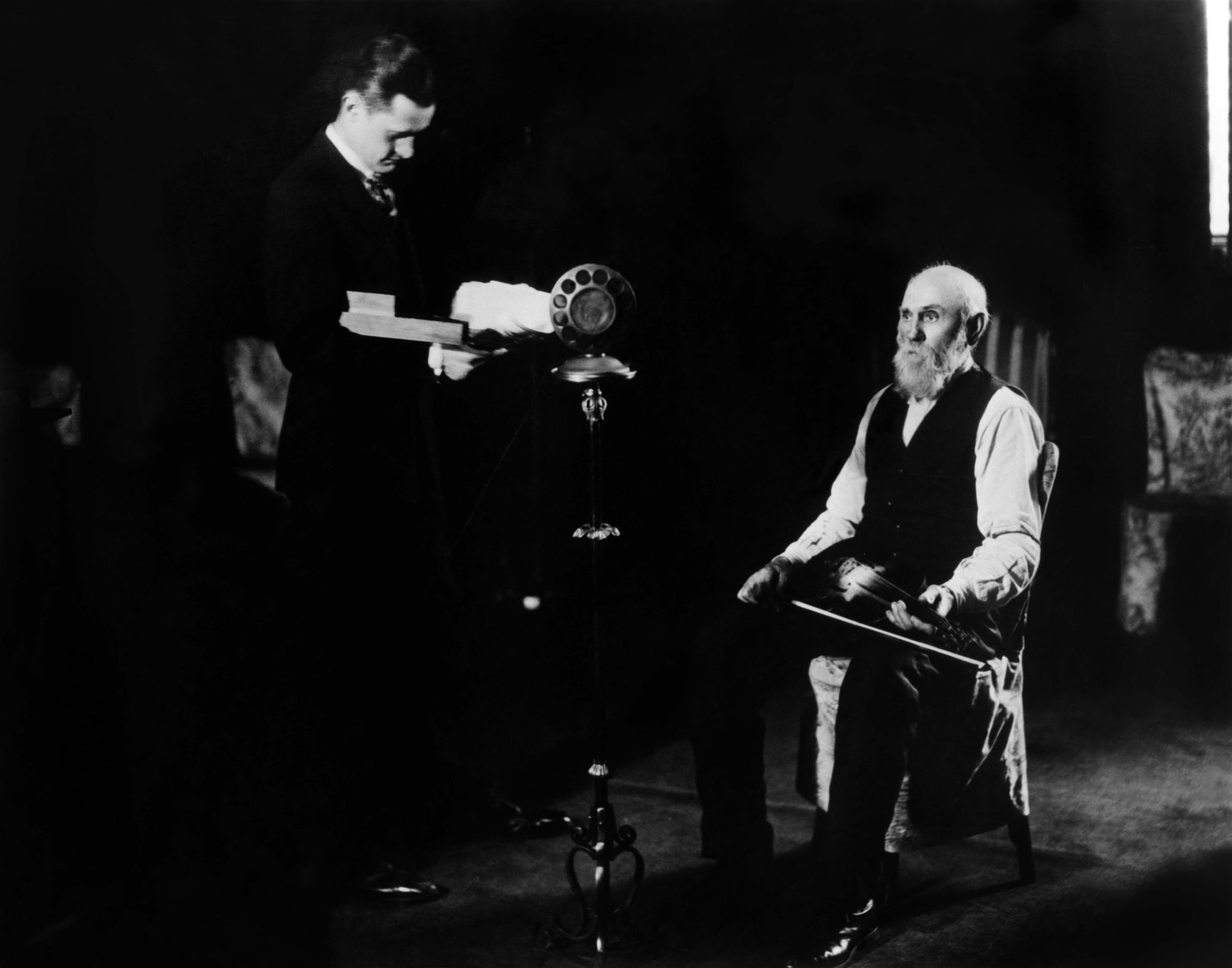
George D. Hay is pictured at microphone with a whistle and Uncle Jimmy Thompson is seated in this 1925 photograph from when the Grand Ole Opry was still the WSM Barn Dance. Photo courtesy of Ryman Hospitality Properties.
For years, the Shield Men – door-to-door National Life and Accident insurance salesmen carrying the company’s shield logo – introduced themselves as representing the Grand Ole Opry. They would even listen outside windows to see who was tuned in to the Opry – and who would be a likely customer.
The earliest WSM shows relied on local talent, running heavily toward fiddlers and string bands. But Hay would invite whoever he thought the audience would like.
DeFord Bailey, a Black musician grounded in both the blues and old-time string band music, became a regular, wowing audiences with his harmonica. Kitty Cora Cline, the first female soloist, performed on hammered dulcimer, and Fred Shriver played the accordion. Uncle Dave Macon on his banjo with Sid Harkreader on fiddle and guitar set the stage for the comedy that would remain central to the Opry’s success, with songs like, “Keep My Skillet Good and Greasy.”
A Beacon
As the recording industry grew, the variety of musicians available to the Opry grew, as well. The show began featuring brother duets, cowboy music, Western swing and solo crooners. Bill Monroe & the Blue Grass Boys were featured stars for decades.
Opry singers expressed the joys of new romance, the happiness of Sunday dinner on the lawn, the sorrow of lost love, and the loneliness of leaving home. Audiences across America listened – and related. The Opry became a focus of family life.
Dolly Parton, like many rural listeners, grew up without electricity. Her family faithfully listened to the Opry on a battery-powered radio. Waylon Jennings’ dad would hook their radio to the car battery. Jeannie Seely’s family would pile in the car and drive up a hill until they could get the signal. Opry history is filled with stories of musicians who listened as children – and dreamed of growing up to perform, like their idols, on the iconic stage.
Opry member Dierks Bentley, who gracefully moves between country and bluegrass, told BGS, “Being invited to join at all is the biggest honor – especially for me, personally. I grew up listening to all the Opry greats on the radio with my dad, so becoming a member is like having the ultimate backstage pass to see the best musicians in the world. And to be invited by Marty Stuart … hands down, it was one of the coolest nights of my life.”
Dan Rogers, the Opry’s senior vice president and executive producer, said the Opry has always been a place to celebrate the good times and be uplifted during the tough times. “Think about,” he said, “the folks who tuned in on Saturday nights during World War II. That was their only source of entertainment throughout the week.” Minnie Pearl, with her signature “How-dee,” and Roy Acuff gave them respite from war news.
On the first show after the 9-11 attacks in 2001, Rogers said, “Our background singers sang an a cappella version of ‘God Bless America.’ And one by one, the people in the audience stood and sang along. And I remember thinking, I bet everybody tuned in across the country is singing along to ‘God Bless America.’”
The Opry’s response to the COVID-19 crisis created desperately needed connection during a frightening time of isolation.
Just a week after deciding that live audience shows weren’t safe, Opry staff arranged a pared-down streaming production with no audience and a skeleton crew. Longtime cast members Bill Anderson, Jeannie Seely and Connie Smith held down the first night alongside Mandy Barnett, Michael Cleveland & Flamekeeper, and Sam Williams.
For the second weekend of restrictions, veterans Vince Gill, Marty Stuart, and Brad Paisley sat on stools spread out across the stage and pulled off what Rogers called “a beautiful, beautiful show.”
Watching from his office, Rogers started reading comments from grateful listeners. For months, people marked their calendars to tune in. They wrote, “I’m in Europe. I set my alarm. It’s 2 a.m. here, but I wanted to experience this with a community.”
Marty Stuart, Vince Gill, and Brad Paisley perform for an empty Grand Ole Opry House during the COVID-19 lockdowns in 2020. Photo by Chris Hollo, courtesy of Ryman Hospitality Properties.
Kathy Mattea, the newest Opry inductee, feels those connections whenever she performs there.
People may have sung along to her hit “18 Wheels and a Dozen Roses” in their car or in the shower, but at the Opry, she says to BGS, “Here’s your chance to sit with an audience and sing this song that everybody knows. Nobody knows who the person next to them voted for and it doesn’t matter at that moment.”
“The Ellis Island of Country Music”
In the early days of radio, what was called hillbilly music was as limitless as the range of a 50,000 watt radio station. And the Opry remains dedicated to maintaining those wide open spaces.
Garth Brooks and Trisha Yearwood, in their forward to the book 100 Years of the Grand Ole Opry, refer to the show as the “Ellis Island of Country Music – a place where all are welcome.”
Contemporary country often has been accused of being homogenous and limited. But despite the factors that have controlled commercial country, the Opry maintains its open-arms attitude. Rogers said, “The two core tenets of an Opry show are celebrating the past, present, and future of country music, and also showcasing multiple genres under the country music umbrella.”
In any show, he said, “You might have something that’s on the top 20 of the country charts today. And you’ll have country classics. You might have a contemporary Christian song, Americana string music, or even something from outside the genre by somebody who just happens to be a country music fan or was influenced by country music.”
In 1974, the R&B-oriented Pointer Sisters included an original country song, “Fairytale,” on their second album. The cross-over hit earned them an invitation to the Opry stage, where they became the first Black group to perform.
Ringo Starr appeared for the first time in 2025 and James Taylor’s debut on November 11 will be remembered as a big part of the 100th anniversary celebration.
And, Rogers said, “Because we can do it, it’s fun to take a chance on a new artist.”
Before his first Opry appearance in July 2022, Zach Top had no hits to his name. But Rogers remembered the programming team saying, “You don’t see an artist like that every day. It sure feels to us like our audience would absolutely eat that guy up!” Today, Top’s music is everywhere.
Bluegrass has been a staple since before it had a name and it has never lost its place on the stage. Bentley and Del McCoury played “Roll on Buddy, Roll On” when the Grand Ole Opry House first reopened after the 2010 flood closed its doors for months.
Charlie Mattos is a 10-year veteran Opry announcer and longtime co-host and producer of WSM’s morning show. He said that on any given night, a portion of the Opry House audience “may truly have never seen a bluegrass band play.”
“And when Del McCoury and the boys finish with an incredible instrumental,” Mattos continued, “or Sister Sadie blisters the stage … the enthusiasm that comes out of that crowd, the immediate standing ovation for the insane musicianship that they have just witnessed …” Mattos said, “it blows their minds.”
Mattea said, “Bluegrass is front porch jazz – the virtuoso playing and the vocals and the harmonies and the trading off of licks. That’s how I fell in love with bluegrass.” And the Opry exposes millions to that brilliance.
A Good-Natured Riot
The Opry show is a complex set of acts and sets requiring precision planning, flexibility, and good nature on the part of the announcers – and commitment on the part of the performers. Rehearsals are brief or non-existent. Timing is everything.
Borrowing a phrase from George D. Hay, the Opry is still sometimes called a “good-natured riot.”
Mattos said, “When you come to see the show live, you see it all. The set changes. The artists leaving as the announcer sends them off. You can see the stage crew out there and usually in 90 seconds they can completely swap things around.”
But while reading a commercial during set changes, Mattos may notice the stage manager giving the “stretch” signal. He might have to keep talking for as long as four minutes – a millennium in radio time.
Sometimes the commercials themselves become the entertainment.
The first time Glad Wags sponsored an Opry segment, Chuck Morgan was announcing. While he stood off-stage reading the dog food commercial, house bassist Bill Linneman came up behind him and started barking. “By my last year there, there were like 20 people behind me going at it,” Morgan said. (The consensus is that Connie Smith does a great chihuahua imitation.)
A Family
Jeannie Seely – who racked up nearly 5,400 performances on the Grand Ole Opry before her passing in August 2025 – remembered it was more than the music that fueled her desire to join the Opry: “That’s hearing these people, like Mr. Acuff and Minnie [Pearl] and Jimmy Dickens and all of them, coming together every week,” she says in 100 Years of the Grand Ole Opry. “They always sounded like they were so glad to be together. They picked on each other and joked, and I thought, that’s just like a family.”
And they were family. When the plane Jim Reeves was aboard crashed in a wooded Nashville suburb, Marty Robbins and Ernest Tubb joined the search party, as did the elegant Nashville socialite Sarah Ophelia Colley Cannon – known as Minnie Pearl.
Opry star Jean Shepard was expecting her second child with husband Harold “Hawkshaw” Hawkins when Hawkins died in the plane crash that also killed Patsy Cline and Cowboy Copas. After months feeling adrift, as Shepard was quoted in the 100 Years book, “I looked down my driveway one day and here come two big black limousines full of the so-called ‘higher-ups’ from the Grand Ole Opry. They said, ‘We want you to come back to the Grand Ole Opry.’ And it really meant a lot to me.”
The family feeling is no accident. In earlier years, Opry members had to perform a specified number of Saturday nights a year. While there’s no set number today, Rogers said they look for a sense of commitment in new members. “It truly is about that relationship,” he said.
Rogers quoted Mattea, upon her invitation to become a member, saying, “These people treat you like family, no matter what.”
One of Mattea’s favorite Opry memories involves a bass player who toured with her. “He was sitting on a stool, playing and singing some old Western swing chestnut, and suddenly Riders in the Sky leaned into the dressing room in full regalia and started singing harmony.
“He was gobsmacked. He felt it was the highlight of his life,” she said.
Bluegrass performer Kody Norris’ music is influenced heavily by first- and second-generation bluegrass. But the band’s preference for flashy suits dates back to a family-friendly welcome Norris received 25 years ago.
His parents took nine-year-old Kody backstage at the Opry, “and I met Bill Anderson. And he had on a red rhinestone suit. That’s the first one I ever saw up close, where I could touch it.”
Later that day, upon meeting his equally rhinestone-clad hero, Porter Wagoner, young Kody got so excited he spit out his chewing gum. Wagoner graciously grabbed two Opry-logoed napkins, one of which the little boy used for his gum. The other one the grown Norris still keeps in perfect condition.
The Circle is Unbroken
In 1974, the Opry left its revered home of decades, the Ryman Auditorium, to move to the deliciously air-conditioned 4,400-seat Grand Ole Opry House.
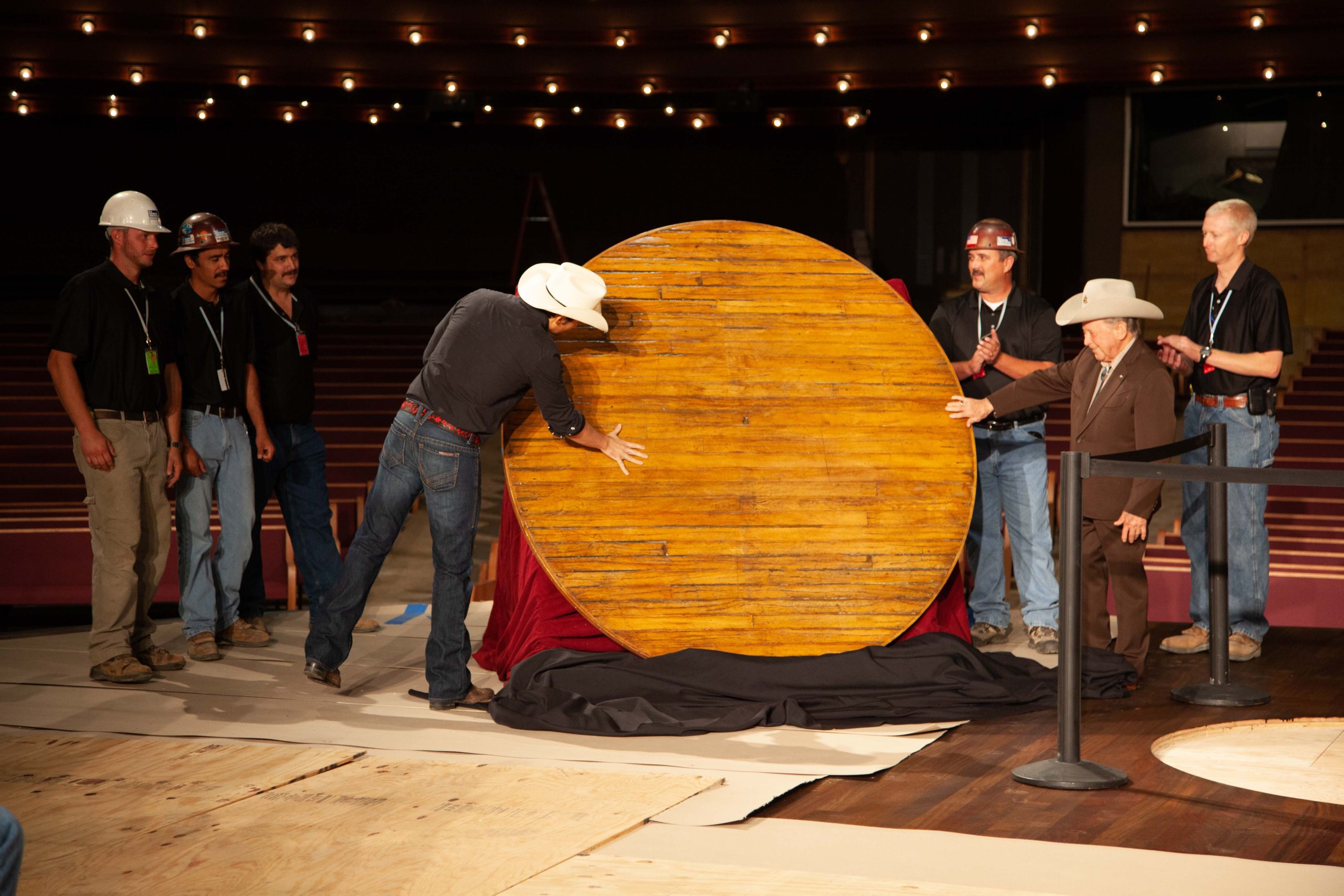
To honor its longtime home, the Opry crew cut a circle out of the Ryman stage and inset it in the new Opry House stage. The circle symbolizes the Opry’s continuity, respect for the past, and optimism for the future.
Mattea experienced that sense of a completed circle on the day she became an Opry member.
“Suzy [Bogguss] was there. We’ve toured together and sung on each other’s records. She’s my closest artist friend, and she was the only one at the ceremony who was not a member. And I thought how generous it was of her to be there.
“So, while I was overflowing with celebration, to get to invite my friend to the party publicly in the name of the Opry was the sweetest gift. It was a moment I’ll never forget, and I’m going to be there for her induction, too.” Bogguss will officially be inducted as an Opry member in early 2026.
Braid Paisley and Little Jimmy Dickens return the Circle to the Opry stage after the 2010 flood. Photo courtesy of Ryman Hospitality Properties.
Join The Celebration
There’s nothing low-key about the Grand Ole Opry – so in the classic Opry spirit, fans have had plenty of opportunity to celebrate the centennial all year long.
Earlier this year, NBC broadcast a three-hour anniversary special, with dozens of stars ranging from Reba McEntire to Jelly Roll to The War and Treaty. The Opry also took the show to London’s Royal Albert Hall for the very first time. You can stream clips of these and other Opry events on YouTube and social media.
With the Virgin Music Group, the Opry has produced the album Opry 100, Country’s Greatest Songs (released November 7). Among the unforgettable recordings are Vince Gill singing his heart-rending “Go Rest High on That Mountain,” Dolly Parton singing “I Will Always Love You,” and Ashley McBryde covering the classic “Your Cheatin’ Heart.” You can order the album from the Opry site.
Craig Shelburne, Brenda Colladay, and Opry members and employees collaborated on 100 Years of the Grand Ole Opry, a book filled with anecdotes and photos that vividly illustrate the Opry’s remarkable history. And to teach your children well, there’s also a new childrens’ picture book written by Emily Frans and illustrated by Susanna Chapman. Find them in your local bookstore.
And, on November 28, 2025, the official 100th anniversary of the Grand Ole Opry we all hold dear, the Opry is celebrating with two huge birthday party shows featuring country stars and Opry members like Vince Gill, Ricky Skaggs, Trace Adkins, Dailey & Vincent, Bill Anderson, Jamey Johnson, Marty Stuart, and many, many more. Tickets are available here.
Of course, the celebrations will continue in 2026.
“The Opry is the core and soul of country music,” Bentley said. “It’s a place where the past, present and future of our genre all come together. There isn’t anywhere else like it.”
All photos courtesy of Ryman Hospitality Properties, credits and attributions as marked. Lead image: Bill Monroe & the Blue Grass Boys and the Opry Square Dancers take the Opry stage at the Ryman Auditorium in the 1960s.
With a new generation boasting unapologetic traditional influence, there’s more classic-sounding country in the mainstream today than in many years before. With his second album, When I Write the Song, Jake Worthington captures one specific aspect of honky-tonk history better than the rest – its sense of humor.
That’s definitely not to say Worthington’s new album is a joke. Far from it. Over 14 songs, the Texas native sinks down into the depths of sorrow and lets his heart believe in miracles all the same. His love of the classic country form is just as authentic as his barrel-chested vocal twang, and with producers Jon Randall and Chuck Ainley joining his team, it gets highlighted with more sincerity than ever. But right from the opening track, Worthington walks in the footsteps of artists like Johnny Paycheck or Jerry Reed; his down-home demeanor is as country as it gets.
Meanwhile, the solo-written title track is almost alarmingly personal and Worthington welcomes Miranda Lambert, Marty Stuart, and Mae Estes as special guests on other tracks. When I Write the Song arrived on September 12 and by touring through the end of the year with both Jon Pardi and Zach Top, Worthington adds even more evidence of an ongoing trad renaissance.
Good Country spoke with Worthington about writing the way he lives and chasing honky-tonk inspiration farther than ever. Plus, he reveals a secret appreciation fans might not suspect.
For fans who don’t necessarily know, you have always been a proud purveyor of the classic country arts. I think that’s pretty fair to say. Are fans going to get more of that on this record or what?
Jake Worthington: Damn right. Yes, sir. I guess that whole narrative don’t ever really change for me. I don’t ever want to make any other kind of music. When somebody listens to a record that I am a part of or put together, I hope they can have a definitive direction to point to and say “That’s what country music sounds like.”
I think that comes across for sure. Now, it’s good timing because there’s kind of a little traditional renaissance going on in the mainstream. Do you agree with that?
Damn right. Absolutely. I’ve never been more inspired in terms of our genre than I am right now. I think a lot of people are writing and singing and recording great country music and I think that folks of all ages are wanting to hear it. Another thing, too, is I don’t think it’s a fad of any sort. I find it interesting – you hear terms like “traditional” or the whole “’90s” deal or whatever. To me, it’s just country music getting made in 2025. I think that’s really exciting, to know that’s the case. It wasn’t like that just a couple years ago.
So you don’t think it’s people cosplaying country?
I know it’s genuine for me. I can’t control what other people do, but hey, if they want to play dress up, that don’t bother me none. I think it’s good for country music. I’m glad that they’re wanting to dress like a grownup.
One thing that I’ve always loved about classic country itself, and something that you do well on this record, is to have a touch of humor. That’s not around as much anymore, but you do that well.
Well, I think it’s funny. I have always struggled with the idea that I never wanted to not be taken serious as a singer or songwriter, but I still like to have fun. I still cut up and it ain’t all rain and storms all the time. I think country music allows room for all of that. There’s definitely a couple songs on this record that is lighthearted, and I guess I was all right with that.
There’s definitely some hardcore heartbreak in here, but the reason I ask is because of the opening track, “It Ain’t the Whiskey.” There are not many songs about getting pulled over and accused of a DUI these days – even fewer that are fun.
Well, some of us write from the research department, I guess. Unfortunately, I was just trying to make light of what was a really shitty situation for me at one point in time in my life. I’ve made some dumb decisions in my adolescence, I guess. That was a good way to look back and laugh at it.
How about “Two First Names”? This one reminds me of a little bit of Joe Diffie and the way he was able to merge classic country and a funny line.
Well, shoot man, thanks. That’s just about a country girl. I’ve got a handful of women I know and love in my life that got two first names and I love that we got away with writing it without ever saying an actual name. … There wasn’t one of us that wrote that song who ain’t from the country, and we’ve all got women we love and know that got two first names. We all love a country girl.
Hell yeah. Now, one thing about this record, you definitely got to work with some big names. You got Jon Randall and Chuck Ainley helping out on production, along with Joey Moi. I wonder with those two guys specifically, Jon and Chuck, did they help you move your sound or your style forward?
Definitely I think. There’s four tracks that I recorded top to bottom with Chuck and Jon … there’s a lot of really awesome things that I got to do through working with Joey. But I think for me, I wasn’t ever totally happy with the way things were ending up sonically. That was my biggest change that I was after, was just kind of where it landed sonically.
Really?
Especially with the vocal. I’m a very imperfect singer. I’m not a perfect singer. I want that to be heard. I don’t want to be masked.
Joey’s amazing, but he definitely comes from a different world sonically, right?
Yeah, and I wanted to work with guys that were making country records that inspired me. But again, I tracked nine of them songs with Joey and man, I love all of it. Chuck wound up mixing the record and Jon come in when we went to track the last four songs and it’s been a dream come true. I get to work with my heroes, man.
You also got to work with Miranda Lambert [plus Marty Stuart and Mae Estes]. Tell me about doing “Hello Shitty Day” with Miranda, it’s a cool broken-hearted waltz. Did you guys get to know each other?
Sure. I mean, I know it sounds a little simple, but she had texted me the song and I asked if I could cut it. She said yes and I said, “Would you sing on it?” And she said, “Hell yes,” so by God, that’s what we did. I don’t know, man. I wasn’t trying to get on the radio with that song. I just thought it was brilliant. I love that song.
One thing I’ve got to ask you, since this is BGS. Do you have any ties to bluegrass, or was that ever a part of what you listened to?
Where I’m from, oddly enough down there in Southeast Texas, we had to go find that stuff. There’s nooks and crannies in East Texas where these cats kinda start out in bluegrass and I think they find it through gospel music and stuff like that. But I wasn’t in the church or nothing – I was baptized in beer and I’m here to testify, you hear me?
Ha!
The great words of Kevin Fowler. But a lot of the stuff I loved the most was coming out of Ohio. When I discovered Dave Evans, that shit knocked me out.
Really?
Oh gosh. There’s something called “99 Years [Is Almost for Life].” One day I’d like to record it, but I understand that bluegrass is just as sacred as country music, so if you’re going to do it, you got to do it right and I think it starts with putting your heart and soul in it.
But I always loved Ralph Stanley. I’ve always loved Flatt & Scruggs and Bill Monroe. I mean, that might sound a little standard, but I love that stuff. Harley Allen’s one of my favorite songwriters and his daddy, Red Allen, I love the records he done. Ronnie Bowman and Lonesome River Band. I like that stuff.
Short answer – yes, sir. Hell yes. I love bluegrass.
That’s amazing. It sounds like you’re deep into it. I mean, maybe it doesn’t show up too much in what you’re doing right now, but maybe one day you ought to do a bluegrass record.
Oh, man. We’ll see, but right now all I want to do is what sounds like country music to me. I think it’s a matter of if you got electrics on it or not. It’s just soul music. It’s gotta come from the heart.
That’s a good segue because I wanted to ask you about the title track, “When I Write the Song,” and writing that solo. You were able to share your pain quite a bit. Where did that come from?
I don’t always wind up writing by myself. I think a lot of us writers sit down and try, and if we could, we would write a lot by ourselves. But that one just kind of fell out. I’d been six, seven years in [to my career] and I don’t know, I think I was a little hurt and kind of angry. I got a whole lot of, “You can’t sing that kind of music. That ain’t never going to work.” Sad songs and waltzes and whatnot. I don’t know why it’s so easy to write about the hard things or the bad things. It seems to be easier than it is to write about the good things sometimes. That’s just kind of where I was at with it.
When I wrote it, I was headed home from some gig and at the time I had been staying at my parents’. They had just got one of them push button door locks to the house with a code on it and I did not remember the damn code. There wasn’t no way I was getting in the house, so I had a guitar and a six pack of beer, a back porch, and plenty of time.
You’re kidding.
That’s what come out of that. I sat on that song for a long time. I was kind of scared of it. I wasn’t sure if it was for anybody. I wasn’t sure if it was any good. But I’m a songwriter and I think that’s just my way of showing it.
That’s real country music to me, so thank you for sharing the story. It’s funny that you got locked out – almost feels meant to be.
I’ve been locked out of a lot of things, hoss.
You’re going to be out on the road with Zach Top and Jon Pardi, right? In their own way, they both definitely inject some classic country into the mainstream, too. Are those tours a good fit for you?
Damn right, man. You tell me anywhere else, you’re going to see three steel guitars and three fiddle players in one stage. … I’m a fan of both of them guys and they know it, and I revere and respect the hell out of them. I’m grateful to get to go work with ‘em. That’s going to be a lot of band, buddy.
All right, Jake, thanks for the time, man. Let me leave you with the big picture. Just tell me what you hope people get from this record.
Well, take away a little piece of my heart while I’m giving it to you. Country music’s here to stay and I don’t think it ever left. I’m just grateful to be a little spoke in the wheels and I hope that when they hear this record, it’s something that they can go to and say, “This is what country music sounds like.”
On Monday, September 8, 2025 the Country Music Association announced the nominees for the 59th Annual CMA Awards. With six nods a piece, country stars Lainey Wilson, Megan Moroney, and Ella Langley tied each other for the lead in total nominations at the longest-running country music awards show. The CMA Awards will be broadcast live from Nashville’s Bridgestone Arena on Wednesday, November 19 at 8 p.m. EST on ABC and will be available to stream the next day on Hulu.
Following Wilson, Moroney, and Langley in nominations is a quickly rising star at the very top of most listeners’ minds these days, Zach Top, who will vie for awards in the Single of the Year, Album of the Year, Song of the Year, Male Vocalist of the Year, and New Artist of the Year categories. Fiddler Jenee Fleenor, a five-time winner of Musician of the Year, is nominated again in the category this year, alongside guitarists Brent Mason, Rob McNelley, and Derek Wells and pedal steel genius Paul Franklin.
In addition to Top and Fleenor other notable nominees from the bluegrass and Americana worlds include the War and Treaty (Vocal Duo of the Year), Chris Stapleton (Entertainer of the Year, Male Vocalist of the Year, Music Video of the Year), and the Red Clay Strays (Vocal Group of the Year).
Shaboozey is nominated for the second year in a row for New Artist of the Year, and relative newcomer to the genre Post Malone gained two nominations this year (remarkably, one less nomination than in 2024), for F-1 Trillion (Album of the Year) and “Pour Me A Drink” featuring Blake Shelton (Musical Event of the Year).
It’s clear that whatever your preferred subspecies of country music, this year’s batch of nominees for the CMA Awards holds more than enough variety to satisfy your tastes. From the most polished radio-ready pop country to gristly full-bore rock and roll, from high femme glamor bops to ’90s vocals (and of course the hairstyles, too), there’s plenty of Good Country to be found among this year’s nominations.
Find the full list of nominees for the 59th Annual CMA Awards below:
ENTERTAINER OF THE YEAR
Luke Combs Cody Johnson Chris Stapleton Morgan Wallen Lainey Wilson
SINGLE OF THE YEAR
“4x4xU” – Lainey Wilson Producer: Jay Joyce Mix Engineers: Jason Hall, Jay Joyce
“Ain’t No Love In Oklahoma” – Luke Combs Producers: Luke Combs, Chip Matthews, Jonathan Singleton Mix Engineer: Chip Matthews
“Am I Okay?” – Megan Moroney Producer: Kristian Bush Mix Engineer: Justin Niebank
“I Never Lie” – Zach Top Producer: Carson Chamberlain Mix Engineer: Matt Rovey
“you look like you love me” – Ella Langley & Riley Green Producer: Will Bundy Mix Engineer: Jim Cooley
ALBUM OF THE YEAR
Am I Okay? – Megan Moroney Producer: Kristian Bush Mix Engineer: Justin Niebank
Cold Beer & Country Music – Zach Top Producer: Carson Chamberlain Mix Engineer: Matt Rovey
F-1 Trillion – Post Malone Producers: Louis Bell, Charlie Handsome, Hoskins Mix Engineer: Ryan Gore
I’m The Problem – Morgan Wallen Producers: Jacob Durrett, Charlie Handsome, Joey Moi Mix Engineers: Charlie Handsome, Joey Moi
Whirlwind – Lainey Wilson Producer: Jay Joyce Mix Engineers: Jason Hall, Jay Joyce
SONG OF THE YEAR
“4x4xU” Songwriters: Jon Decious, Aaron Raitiere, Lainey Wilson
“Am I Okay?” Songwriters: Jessie Jo Dillon, Luke Laird, Megan Moroney
“I Never Lie” Songwriters: Carson Chamberlain, Tim Nichols, Zach Top
“Texas” Songwriters: Johnny Clawson, Josh Dorr, Lalo Guzman, Kyle Sturrock
“you look like you love me” Songwriters: Riley Green, Ella Langley, Aaron Raitiere
FEMALE VOCALIST OF THE YEAR
Kelsea Ballerini Miranda Lambert Ella Langley Megan Moroney Lainey Wilson
MALE VOCALIST OF THE YEAR
Luke Combs Cody Johnson Chris Stapleton Zach Top Morgan Wallen
VOCAL GROUP OF THE YEAR
Lady A Little Big Town Old Dominion Rascal Flatts The Red Clay Strays
VOCAL DUO OF THE YEAR
Brooks & Dunn Brothers Osborne Dan + Shay Maddie & Tae The War And Treaty
MUSICAL EVENT OF THE YEAR
“Don’t Mind If I Do” – Riley Green (featuring Ella Langley) Producers: Scott Borchetta, Jimmy Harnen, Dann Huff
“Hard Fought Hallelujah” – Brandon Lake with Jelly Roll Producer: Micah Nichols
“I’m Gonna Love You” – Cody Johnson (with Carrie Underwood) Producer: Trent Willmon
“Pour Me A Drink” – Post Malone (feat. Blake Shelton) Producers: Louis Bell, Charlie Handsome
“You Had To Be There” – Megan Moroney (feat. Kenny Chesney) Producer: Kristian Bush
MUSICIAN OF THE YEAR
Jenee Fleenor – Fiddle Paul Franklin – Steel Guitar Brent Mason – Guitar Rob McNelley – Guitar Derek Wells – Guitar
MUSIC VIDEO OF THE YEAR
“Am I Okay?” – Megan Moroney Directors: Alexandra Gavillet, Megan Moroney
“I’m Gonna Love You” – Cody Johnson (with Carrie Underwood) Director: Dustin Haney
“Somewhere Over Laredo” – Lainey Wilson Director: TK McKamy
“Think I’m In Love With You” – Chris Stapleton Director: Running Bear
“you look like you love me” – Ella Langley & Riley Green Directors: Ella Langley, John Park, Wales Toney
NEW ARTIST OF THE YEAR
Ella Langley Shaboozey Zach Top Tucker Wetmore Stephen Wilson Jr.
This feature ought to start with a laundry list of our subject’s accomplishments, but rootsy country hitmaker Dierks Bentley’s résumé and inventory of accolades, awards, and trophies would be far too long to include. After 30+ years in Nashville, Bentley has more than made it and his particular brand of country – down-to-earth approachability, bro-ey (while remarkably non-toxic) good-time vibes, honeyed crackling vocals, an unwavering sense of humor, and fierce love for bluegrass virtuosity – has now gained such a strong gravitational pull, it continues to shift Music Row. (For the better, of course.)
In June, Bentley released his eleventh studio album, Broken Branches, and launched an eponymous continent-spanning tour with everybody’s favorite, fellow trad country lover Zach Top, and swampgrass North Georgia duo the Band Loula in tow. Broken Branches features guests like Miranda Lambert, Riley Green, John Anderson, and more and – like all of the albums in his expansive Dierkscography – quite a few string band- and bluegrass-inspired moments, as well.
The Broken Branches Tour, which has been clipped and shared thousands and thousands of times on social media over the past several weeks, includes many hits, striking sets and theatrical tech, cameos from the infamous Hot Country Knights, and, yes, plenty of bluegrass. On the set list, Bentley and Top duet on an incredible “Freeborn Man” – we’re leaving out spoilers here so you can catch the tour’s scant remaining dates yourself and still be delighted. Bentley also performs the title track from his hit bluegrass album, 2010’s Up On The Ridge, and Logan Simmons and Malachi Mills of The Band Loula join him elsewhere in the set for a delicious bit of church.
Singing a Bill Monroe bluegrass gospel number in tight, intricate three-part harmony may seem like an odd choice for a big mainstream country arena show, but longtime fans and listeners of Bentley will know this is no aberration. This is the norm. Whatever the sonics of his music, from the most poppy and radio-ready country to the more Americana-coded to straight-ahead bluegrass, classic rock, and New Orleans grooves (and back again), Bentley brings bluegrass with him everywhere he goes. He brings its pickers, legends, and unsung heroes, too, uplifting them for all to enjoy.
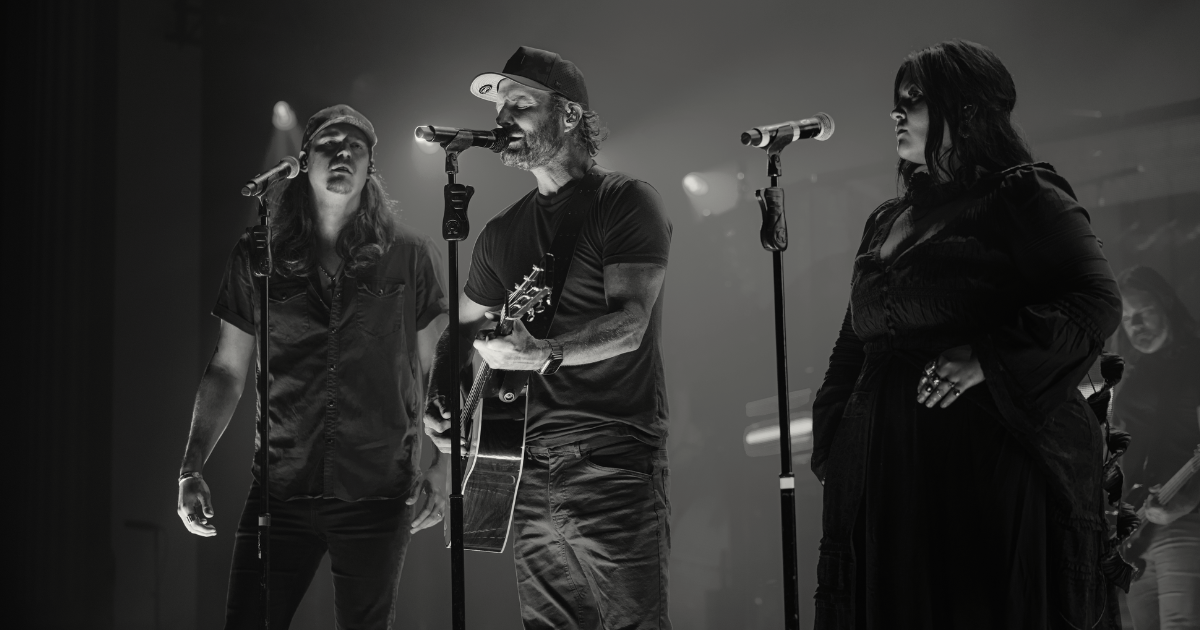
When Mills, Simmons, and Bentley step to the center stage of an enormous auditorium or amphitheater to sing “Get Down On Your Knees and Pray,” depicted behind them on towering LED screens is a little log cabin dive bar with a neon cross steeple and a flickering “open” sign. As they lead the audience in the stark, convicting, hair-raising number – with grit and heart and endless spirit – you realize, yes, this is church. This is gospel. This is country and bluegrass, front porch music and arena music. This is Saturday night and this is Sunday morning.
It’s hard to imagine all of these intricate roots music details not only being palpable in a show of this scale, but they’re also measured, vulnerable, and intimate – traits not known as hallmarks of either country or bluegrass. It’s here that we find exactly the conglomeration of reasons why Bentley retains such widespread appeal and adoration from fans of all entry points. While neither he nor any other artist is universally loved, Dierks Bentley accomplishes being the modern country “everyman” not by diluting himself and his personality beyond recognition, but by purposefully, creatively, hilariously – and spiritually! – putting all of himself on the line in his music.
Before the Broken Branches tour launched earlier this summer, Good Country sat down backstage with Dierks Bentley and the Band Loula during a break from tour rehearsals, after the trio had just run through “Get Down On Your Knees and Pray.” We spoke about what bluegrass means in a country context, the appeal of gospel to folks of any (or no) faith, tent revivals and camp meetings, the joys and vulnerabilities of singing harmony, and much more.
Obviously, Dierks, across your entire career you’ve had a relationship with bluegrass. And not just Up On The Ridge, which we just heard you rehearse a bit of for the Broken Branches Tour. You’ve got records and posters on the wall at the Station Inn here in Nashville, you namecheck Keith Whitley on the new album. You’ve worked with the McCourys over and over, Charlie Worsham, an excellent bluegrass picker, is in your band. There are so many more bluegrass touchpoints. Your bluegrassy CMA Awards show appearance last year was very popular with our audience.
And for y’all, the Band Loula, you call yourself “swampgrass.” The harmonies clearly have the grit and the gospel of bluegrass and the timbre of how your voices blend together reminds me of bluegrass.
It might be an obvious question to ask, but I figured we could go around the circle here and get each of your takes on what does the genre mean to you? What’s your relationship with bluegrass? What does bluegrass mean to you in the constellation of country music that you make now?
Dierks Bentley: When I think about bluegrass, obviously it’s the music and all that, but really it’s just people with acoustic instruments gathering to play and sing together. I never really did a lot of stints on my own, solo. Probably I’m not good enough, but bar gigs where I was just doing cover songs never really interested me. I always liked being in a band. I love the way this instrument talks to that instrument, this voice talks to that voice, and this voice gets added and– “Whoa!”
Like the Osborne Brothers, they’re switching harmonies. Sonny is singing the high tenor, then the next thing you know, he is on like a low baritone part. The voices, the way they move around. That’s the main thing, that’s what drew me in when I walked into the Station. And there were guys my age. I always thought bluegrass was kinda like Hee Haw stuff. I walked in and I was like, “Oh my God, there’s guys my age.”
It was about just playing songs together. And they were doing a lot of Merle Haggard songs, George Jones songs mixed in. Johnny Cash songs mixed in with Stanley Brothers, the Osborne Brothers, and all that too. So it was just, “Wow.”
It’s more about the community of people congregating through and with their instruments. And using those to have fun – and drinks as well. [Laughs] Lotsa drinks, a lot of moonshine back then. The real stuff! No label on it.
Not 30 proof. [Laughs]
DB: That’s what it means to me and that’s what I hear in [The Band Loula’s] music, a lot of, if you want to call it, “front porch” picking music. Picking their roots – you know, deep, Southern gospel-y kind of roots, the mixing of that, and those voices together.
That’s what bluegrass has always been to me. It’s about the community as much as it is about the instrumentation and the bands. It’s the great community of people.
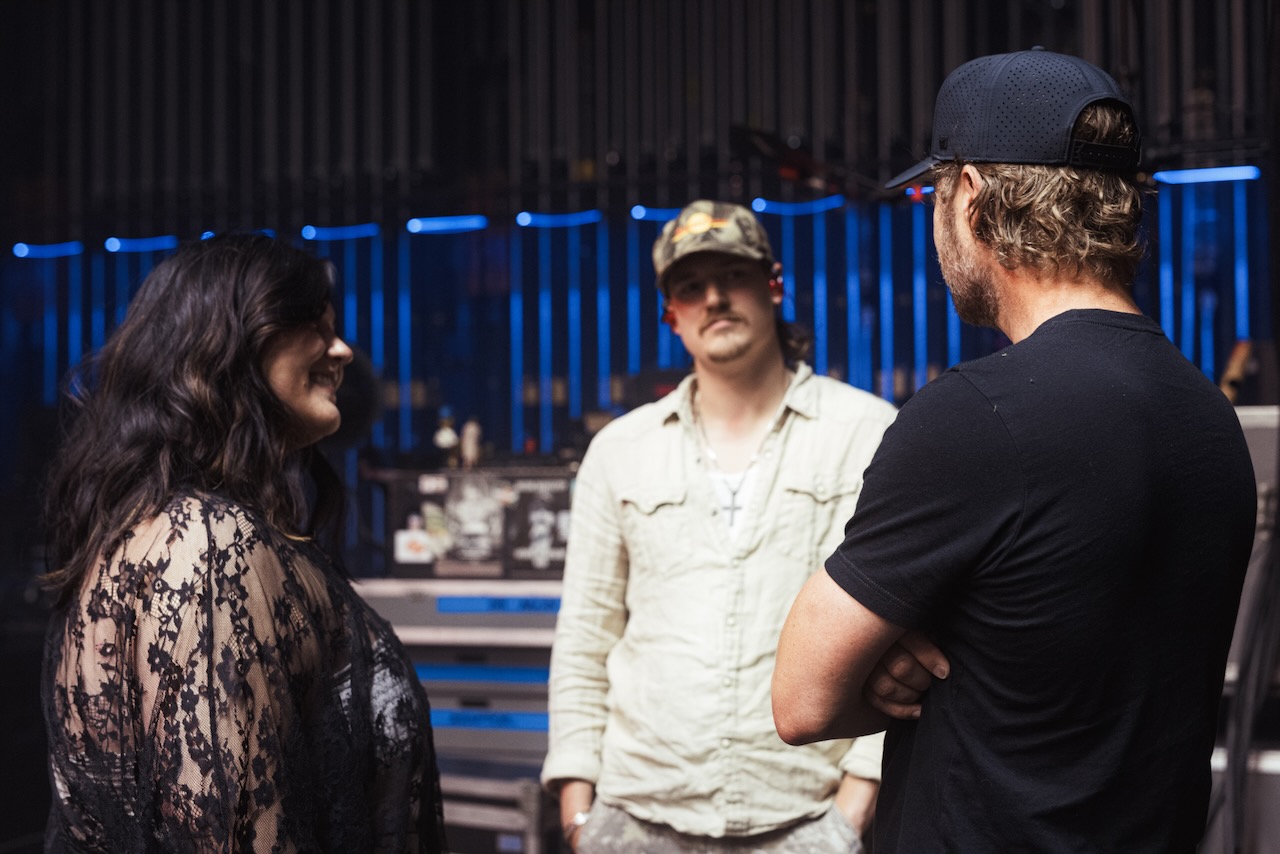
(L to R): Logan Simmons and Malachi Mills (of the Band Loula) confer with Dierks Bentley during rehearsals for the Broken Branches Tour. Photo by Zach Belcher.
Logan Simmons: I’ll say something that comes top of mind for me. I spent my whole life going to tent revivals. It’s not just, “I go and it’s summer camp, ’cause somebody made me.” It’s like the pinnacle of who I am.
I really believe that it’s the pillar of my family. We go for about 10 to 15 days every year. It’s beside my nanny’s house, and all it is, red-back hymns and bluegrass. The service happens every night and you go for about an hour and a half before service starts, before preaching starts, to hear bluegrass, gospel bands.
That’s how I learned harmonies, hearing all my godmothers and aunts sing the wrong ones around me. [Laughs] And you’ll hear somebody over there, Linda’s like [sings operatically and off-tune] and she’s not on it at all. But I was at least learning something and I feel like with my roots in general, it already infused that bluegrass sound into my life.
Then when Malachi and I became friends and started making music together. He has a lot of Motown roots. I think, blended together, the blues and bluegrass just made something beautiful. And, on top of that, the family harmony we have together. We’ve been friends forever, half our lives.
Malachi Mills: It all comes back to blues, yeah. And just like you said, that cross-pollination of the different genres. North Georgia is like the southern point of Appalachia. Like she said, it really influences the music we make by our harmonies. That’s the biggest thing we take from it. I love bluegrass music, but I’m not like a bluegrass buff. I would lose at bluegrass trivia. [Laughs] But it’s just in our bones and in the harmonies that she was talking about. Growing up in church and everything influences the way that we sing together and the notes that we pick whenever we’re singing harmonies. One of the biggest things that I love about bluegrass is the rhythm and pocket. And the intonation of the instruments. Bluegrass players choose to be intentional about [all of] it, the pocket, the timing, the tuning. It’s all so dead on. The details matter when you’re making records.
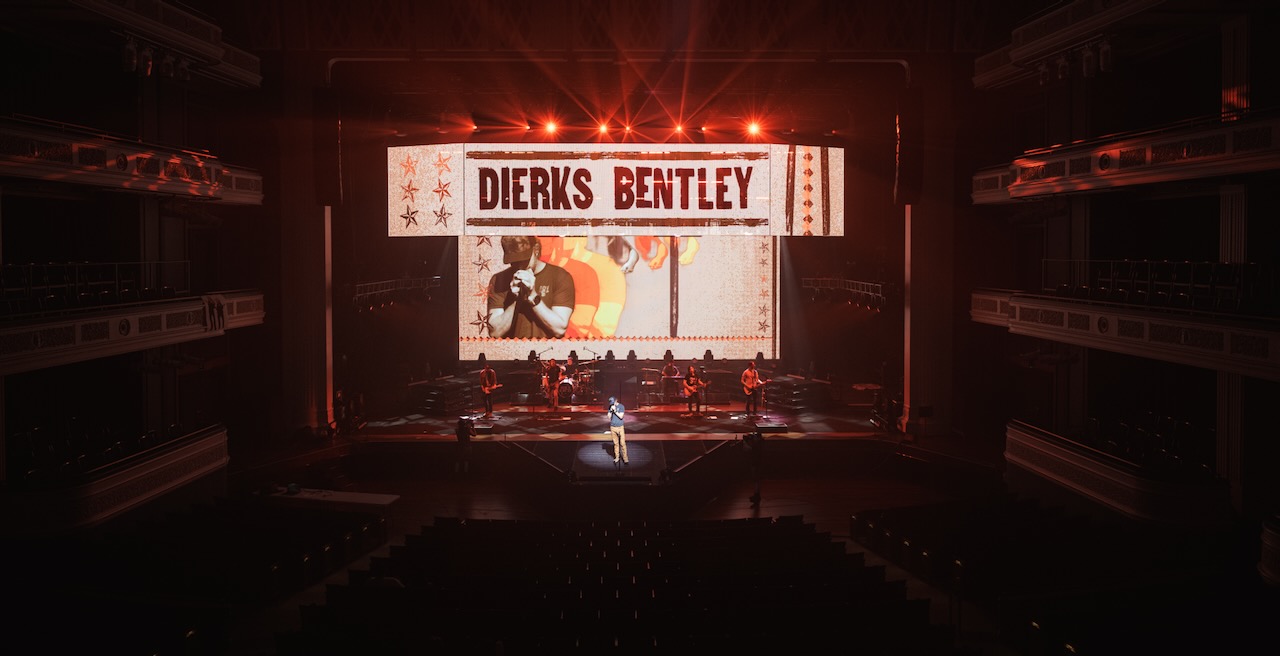
Dierks Bentley and band give Good Country and members of the media an exclusive sneak peek at their Broken Branches Tour set at rehearsals in May 2025 in Nashville. Photo by Zach Belcher.
I think that’s one of the reasons why it’s striking that y’all have this bluegrass song as part of this big, arena-sized stage show. Because for me, translating those details in such a big space and in such a broad format could be really hard.
Then I hear and see y’all singing in three parts with a neon cross behind you and suddenly yes, this is church. This is what it is. Any close-singing harmony vocals are great, but when it really sounds like bluegrass to me is when you can hear the reeds of your voices match up when you’re harmonizing. That was a really beautiful moment.
Could you talk a little bit about capturing those details for a big audience in big rooms like this – or even outside, in amphitheaters. How do you take a Bill Monroe gospel song and translate it to that space?
DB: Well, there’s “Bluegrass” Ben Helson out there walking the hallways. Ben and a couple other guys in the band have played with Ricky Skaggs. Ben played with Ricky and Tim [Sergent] still plays with Ricky. I always say, if you can graduate from the Ricky Skaggs school of bluegrass and country music, you’re probably a pretty good musician. He also played with Rhonda Vincent.
I’m a big Del McCoury fan. They did [“Get Down on Your Knees and Pray”] and Del has such a cool version of it. We were just kinda thinking of songs to do with these guys that would be great using their voices. Like [they] said, they’re the blues and bluegrass. I’m still trying to figure out their sound. It’s such a unique mixture; it’s so Americana in the way that in this country we have this melting pot of stuff. We thought it would be cool to do a little three-part thing, so that one came up.
Marty Stuart also did a really cool version of that song. But Ben [Helson], our guitar player really came up with that [arrangement], leaning into the swampy stuff they do. Gave it that feel, a little Southern – I don’t know what the vibe is there, but that telecaster is playing and it just has a cool kind of dirty, bluesy vibe to it. Then working up the harmonies, there’s just something about hearing a cappella bands.
I remember seeing Billy Strings at a bluegrass festival years ago and the band all stopped – no one knew who he was back then. Bryan Sutton had told me who he was, so I was where he was. He played like a Thursday set in the middle of the day. They had just done three songs and then they stopped and did a four-part harmony thing. There’s just something about it that’s so powerful. It goes straight to your soul.
The oldest version of entertainment there was was probably harmonizing. Finding people, seeing how your voices sound together, it’s a weird, cool thing. Singers talk about it all the time, in any genre of music about how seeing how we sound together is an intimate thing.
It’s vulnerable and it’s immediately establishing that community that you’re talking about. “We may not be a band, but now we’re a thing.”
DB: I feel like I blend well with anybody, because I’m like the condition. I sing it pretty straight here and allow the people around me to really do their stuff. I’m just gonna hold the line. There’s like nothing special about my voice, but it’s good to blend with ’cause other people have these amazing voices. They can do a lot of movement and a lot of great vibrato. I’m like the dumbest Del McCoury School of Bluegrass [student], just find that note and put everything into it. [Laughs]
Not to mention, introducing people to bluegrass as well – I love that. You have a chance to be a bridge to your heroes and that is always fun. People have been that to me, Marty Stuart probably the biggest. You get into Marty Stuart’s music and you find out who he likes, and then, whoa! He brings you back there. So [I hope] this turns somebody onto Bill Monroe. That’s pretty cool.
Dierks Bentley has a quiet moment on stage during rehearsals for the Broken Branches Tour. Photo by Zach Belcher.
Country – a lot like blues, R&B, and the early days of rock and roll – it has this often tempestuous and inspiring relationship between the fun of Saturday night and the conviction of Sunday morning. So seeing y’all sing that song in front of the depiction of a church as a dive bar, complete with a neon cross and a flickering “open” sign – to me that’s “a little bit holy water, a little bit Burning Man” epitomized. You guys are embodying that relationship between the sacred and the secular here. And that duality is all over your new album, too, Dierks.
MM: I’ll say, I think that one of the biggest things that contributes to that is the goosebump, hair-standing-up-on-your-arm feeling. It’s knowing that you have a part in something and whenever you sing and play bluegrass music together, you have to give way to one another on stage. So it’s the whole stage saying we’re doing this very intentionally in unity, in harmony.
And everybody in the crowd, whether they know that or not, they feel it. That’s what I think people feel. Even if you’re not a believer and maybe the message that’s being said [doesn’t apply], but you still resonate with serving each other. With being present, which is a strong energy. I think that’s what makes me excited about playing this song. I don’t know what’s gonna happen emotionally for me whenever that moment happens, ’cause it’s gonna be so much of that unified energy.
DB: Unified energy is a good way of putting it. It’s unified and it really is energy.
We’re pretty involved with the church. I have an older daughter who’s involved in the church and another middle daughter who doesn’t believe it like I did. But there’s something divine that you just can’t ignore, whether you believe it or not – just look at a sunset, look at a flower, look at a fish, look at so much unnecessary beauty in the world. There’s just some energy that exists and you can’t deny it when you sing a song like this. It just taps [something] on anybody. Recognizing how small you are in this world and the power of whatever version of prayer you do.
LS: I liked how you said it joins secular and holy together and that actually made me think of the tent revival, as well. I think growing up in Appalachia, like Malachi said – I wish I could just teleport you there so you could experience!
DB: That would be cool, a tent revival – I can’t even imagine.
I haven’t been to a camp meeting or revival in so long!
LS: Everybody’s invited to camp meeting. I don’t know if you’d love it. Our tent – I say tent, it’s like a shack on a square, it’s like a big square, four sides. So we’ll say, “Are you on the upper line or the lower line?” We’re on the upper line, which is not a good thing. It’s like you think upper line is like uppity people or something, but it’s not. Our shack is the oldest and [most] untouched of the whole campground. It was built in 1846.
DB: Wow!
LS: So there’s holes in the roof and like, my bunk bed, I get water drops on my head if it rains. There’s hay floors, there’s no air, and there’s a lot of us, so it’s all packed in there. But camp meeting is where I learned my first Bible verses and where I smoked my first joint. [Laughs] So it all marries together how you said, like holy and secular at the same time. I think of that picture of going to the gospel tent revival, going to camp meeting, singing those red-back hymns, doing all those things – but then also learning the grit of growing up.
I just loved when you said joining those things together, because that was such a representation of my upbringing. Yeah, it’s a little bit holy water, a little bit Burning Man. It’s definitely Saturday nights and Sunday mornings – and the tent revival is where I feel like those two worlds are so evident.
Dierks, in all you’ve done across your career there are all these bluegrass moments. The country that you “grow,” it’s mainstream, it’s radio-ready, but it’s like there’s bluegrass in the “soil” you grow it in, so you can always taste bluegrass in everything you do. Like on the new record, “Never You” with Miranda Lambert feels that way and “For As Long As I Can Remember”–
DB: There’s a little “Circles Around Me” by Sam Bush [reference] there at the top of that song.
Oh my gosh, yeah! Exactly what I’m talking about.
You said a little bit earlier turning people onto your heroes always feels great, but for you, from your own perspective being that guy that used to just hang out at the Station Inn and now being the Dierks Bentley and going on tour in sheds and arenas and amphitheaters… Why do you keep bluegrass with you?
Dierks Bentley: It is selfish in a lot of ways. I have such a great band and I just take so much joy watching them do cool stuff that I can’t do. It’s like our guitar player, Ben, he’s just an unbelievable flat picker. Charlie Worsham’s in our band and Charlie won the CMA Musician of the Year. He is just an incredible musician. Dan [Hochhalter] is an incredible fiddle player. Tim is so underutilized. Our steel guitar player – who plays banjo and everything else – he’s one of the best singers to me. Hearing him is like hearing Merle Haggard. He sings like nobody else, but he’s also so underutilized. And Steve’s been playing with me since 1999.
It’s just a great group and we love bluegrass music, featuring that, and having the music part of the show. I like being in a band setting, so just getting to be around it and hear these instruments swirling around me playing, I think it’s just cool.
I got a chance to play ROMP Festival last year and I feel lucky to be friends with guys like Jerry Douglas and Sierra Hull and have them come up on stage and play with us. I still think bluegrass music is the punk rock of country. It’s just the coolest genre of music there is.
It’s gotta be centering or grounding to a certain degree just to have that as something you can go back to, to feed yourself and fill yourself back up even while you’re touring.
DB: Absolutely. In the show we go from playing Tony Rice to John Michael Montgomery. We play bluegrass with the Hot Country Knights with costumes on. It’s just it’s all very selfish! It’s like, “How can I have a lot of fun in the next 90 minutes?”
I wanna do our radio country. I want people singing songs back, because that’s a great feeling. I want to get a little bluegrass in there. Just see if we get away with that. Then, can we try to get canceled on the way out? [Laughs] I dunno. It’s really fun for me. And having these guys [out with us] and getting to harmonize with them, it’s gonna be really fun. Check back in a few months, see how it turned out.
Want more Good Country? Sign up to receive our monthly email newsletter – and much more music! – direct to your inbox.
In 1994, a not yet 20-year-old Dierks Bentley threw all caution to the wind when he packed up his dorm room at the University of Vermont with hopes to never return. Bentley’s relocation would not only forever change the course of his life – it would go on to catalyze his tremendous impact on roots music at large.
After a trip with his father to Nashville made quite the impression, Bentley decided to complete his college degree at Vanderbilt, dedicating his studies to English (the major most proximal to songwriting). After graduating, Bentley continued to foster both his musical education and career; his day job entailed archiving old country performances at The Nashville Network (in fact, his diligent field work even got him banned temporarily from the Grand Ole Opry), while his evenings were filled with bar gigs and songwriting sessions. After five years of grunt work, 2003 saw Bentley release a self-titled album with Capitol Records. His first single, “What Was I Thinkin’,” made waves on the country charts. Since then, Bentley has been responsible for the release of 20 No. 1 country singles and 10 additional studio albums, the latest of which, Broken Branches, arrived in June.
While Bentley’s career has seen major commercial country success, his deep respect for expansion and immersion has made him a beloved fixture within bluegrass, as well.
Of his instrumental move to Nashville, Bentley has shared, “I moved to Nashville in 1994 – I was trying to find that seed of truth, that authenticity, that thing ‘country music’ that I had in my head. And I got here and it was definitely different than I expected it to be. It’s big business, a lot of money.
“Luckily, for me, I found a little bar called the Station Inn where bluegrass music existed – and I found what I was looking for. Just the sound of a five-piece bluegrass band blew my mind. And they’re not trying to take meetings all the time and meet producers, and get their foot in the door. It’s funny, I moved to Nashville looking for country music, but I found bluegrass.”
Whether it’s his proclivity for cross-genre conversation, songwriting prowess, or patinaed tenor delivery, Dierks has proved himself a mainstay favorite for country, Americana, and bluegrass fans – here at Good Country and BGS, and beyond. In honor of his recent album release and his huge Broken Branches tour with Zach Top and the Band Loula concluding this month, we present you with our Dierkscography, a non-comprehensive compilation of more than 15 songs meant to show off some of our favorite Dierks gems from across genres sampled from the many years of his remarkable career.
“Never You” featuring Miranda Lambert, Broken Branches (2025)
Dierks’s new album, Broken Branches, arrived fresh off the press with a slew of impressive collaborators, from Riley Green to Stephen Wilson Jr. Dierks fondly calls the record a “special” display of “making music in the studio with our buddies.” Country giant and longtime collaborator Miranda Lambert joins Bentley on this banjo-driven track, with the pair’s velvety duet vocals imbuing tenderness and warmth into one of the album’s only love songs.
“High Note” featuring Billy Strings, Gravel & Gold (2023)
This rip-roaring tune off of Bentley’s tenth studio album features a whole handful of bluegrass greats. Not only does Billy’s high tenor soar above Dierks gravelly tones during choruses, his famous flatpicking joins the likes of Sam Bush, Bryan Sutton, and Jerry Douglas for a superjam ending.
Of the collaboration, Dierks recalls, “Bryan Sutton first tipped me off to Billy Strings about seven years ago, mentioning that the future of bluegrass was in good hands. I was totally blown away the first time I saw him. I’ve cut songs like these since my first record, and I knew I wanted to have him on this one, I’m such a huge fan. It was a lot of fun to have him, Jerry, Sam, and Bryan all passing licks around – having them all on this record means a lot to me personally.”
“American Girl” (2024)
Who doesn’t love an Americana “American Girl”? Bentley delivers this country-fied Tom Petty classic alongside some BGS favorites, including Chris Eldridge on guitar and Noam Pikelny on banjo. Dierks reprised the hit single joined by Bronwyn Keith-Hynes, Sierra Hull, and Molly Tuttle on stage at the 2024 CMA Awards, bringing down the house.
“For As Long As I Can Remember,” Broken Branches (2025)
The country canon has seen its fair share of heartache, murder, trains, and drinking. Also on his latest release, “For As Long As I Can Remember” shirks these motifs in favor of something a little more wholesome – a warm and adoring ballad dedicated to the strength of enduring familial bond. An ode to his brother and father, Dierks reminds that respect and love can be country, too.
“Train Travelin’,” Dierks Bentley (2003)
With many of his nascent Nashville days edified by nights at the Station Inn and in the surrounding bluegrass scene, iconic bluegrass family the McCourys quickly became repeat collaborators for Dierks. Their features pepper many of his earlier albums, dating all the way back to his debut self-titled release in 2003. “Train Travelin’” would become the first of many, with other gems such as Good Man Like Me (Modern Day Drifter, 2005) and Last Call featuring Ronnie McCoury (Feel That Fire, 2009) dotting the road to Bentley’s eventual bluegrass-centric album, Up On The Ridge.
“Up On The Ridge,” Up On The Ridge (2010)
The titular track off of Bentley’s bluegrass-inspired album is thrumming with energy, both quickly-paced and haunting with its descending melodic hook. Up On The Ridge was Bentley’s fifth studio album, featuring a star-studded list of bluegrass collaborators including Alison Krauss, Punch Brothers, Chris Stapleton, Tim O’Brien, Sam Bush, and beyond. Del McCoury even joins forces with Bentley and Punch Brothers to deliver a deliciously grassified cover of U2’s “Pride (in the Name of Love)” further evidencing the album as a culmination of both tradition and innovation.
“Freeborn Man,” (Live, 2025)
Another of our favorite timeless covers, Dierks has been adorning his Broken Branches Tour this summer with his vigorous take on “Freeborn Man.” This rendition includes a fiery feature by Zach Top, nearly toppling the stage with talent.
“Hoedown for My Lowdown Rowdy Ways” featuring Dierks Bentley, Lowdown Hoedown (Jason Carter, 2022)
With Jason Carter fiddling his heart out on Dierks’ records since 2003, it’s of course a polite roots custom for Dierks to return the favor. Released as part of Carter’s second solo album, Lowdown Hoedown, “Hoedown for My Lowdown Rowdy Ways” has Dierks singing harmony and strumming away on the bluesy breakdown. Lowdown Hoedown also features a tender Jamie Hartford number, “Good Things Happen,” that Dierks Bentley covered on his 2005 album Modern Day Drifter, yet another frame of conversation between the two artists.
“Prodigal Son’s Prayer” featuring The Grascals, Long Trip Alone (2006)
This acoustic tune features the bluegrass sensibilities of the Grascals, a long-running group lauded for their instrumental prowess. The song loosely follows the parable of the prodigal son, ultimately centering themes of repair and reconciliation. The song also features the stomps and hums of incarcerated individuals from Charles Bass Correctional Complex, who had been in Bentley’s producer’s Bible studies course at the time.
“Free and Easy (Down The Road I Go),” Long Trip Alone (2006)
From the same release, this breezy banger remains a hallmark of Bentley’s career, even after nearly two decades since it dropped. The fifth of his singles to top Billboard’s Hot Country charts, “Free and Easy (Down The Road I Go)” lures in listeners with its fast-paced country twang and life-affirming sentiment.
“Beautiful World” featuring Patty Griffin, Feel That Fire (2009)
No stranger to incredible collaborators, Dierks Bentley asked iconic folk and country singer-songwriter Patty Griffin to accompany him on this track, gushing, “Her voice is one of a kind and she’s such an important figure in the American music scene… She’s just amazing. And so I asked her.”
The result is a tender homage to the beauties of the world, largely inspired by his wife, who was pregnant with their daughter at the time of the song’s conception. “You hear people sometimes say, ‘Man, I can’t imagine bringing a child into this world. It’s so bad.’ That’s just such a negative outlook,” Dierks says. “You cannot live your life with that viewpoint of the world. Yes, there are a lot of things that are wrong, but it is a beautiful world, and you need to find the positive in it.”
“Heart of a Lonely Girl,” Home (2012)
From Bentley’s sixth studio album, Home, comes this spirited, emotionally deep number. The narrative song was penned by the infinitely talented Charlie Worsham, who would go on to join Bentley’s touring band a decade later – and you can currently see him on stage each night during the Broken Branches tour.
“Trip Around the Sun,” featuring Dierks Bentley, I Built a World (Bronwyn Keith-Hynes, 2024)
Fiddler Bronwyn Keith-Hynes first connected with Bentley through Molly Tuttle & Golden Highway, the popular bluegrass group that opened for him several times on tour. She’s also married to Jason Carter, so Dierks wasn’t just a professional collaborator, but a member of her personal Nashville network, as well. It’s no surprise, then, that she’d end up on stage with him at the CMA Awards and, in the same year, he would guest on her acclaimed and GRAMMY Award-nominated album, I Built a World.
“Mardi Gras” featuring Trombone Shorty, Black (2016)
Soaked in Louisiana charm, this tune was inspired by Dierk’s 2015 galavant on a Mardi Gras parade float. Featuring the indelible hornsmanship of Trombone Shorty, the track grooves along with bluesy undertones. “Getting Trombone Shorty to do his thing on it, what a great guy. I love working with him. He is so laid-back and so good at what he does,” Bentley boasts of his collaborator.
“Travelin’ Light” featuring Brandi Carlile, The Mountain (2018)
Featuring the powerhouse vocals of Americana giant Brandi Carlile, this tune appears on Bentley’s 2018 album, The Mountain. The collaboration between the two icons came to fruition after Bentley saw Brandi perform at Telluride Bluegrass Festival, inspiring him to approach her about dueting on the track.
“Sun Sets in Colorado,” Gravel & Gold (2023)
Written reflecting his pandemic move to Colorado (though he has since returned to Nashville), Bentley released this tune on Gravel & Gold. The song shouts out New Grass Revival and Telluride in a verse: “Sing an old new grass song with me/ Telluride along with me,” while also featuring New Grass Revival founding member Sam Bush on mandolin. Bryan Sutton also joins in on the studio recording, yet another sparkling collab with bluegrass greats.
Want more Good Country? Sign up to receive our monthly email newsletter – and much more music! – direct to your inbox.
If it seems like Zach Top has been everywhere lately, it’s because he has. Not only because he and his band are staring down a packed summer full of tour dates all across the country, but he’s also coming off of his first Academy of Country Music Award win – snagging the New Male Artist of the Year trophy while also being nominated for Album of the Year – and then immediately turning around to perform on The Tonight Show Starring Jimmy Fallon. The appearance was his late night television debut, after his stunner of a traditional country album, Cold Beer & Country Music, was released to widespread acclaim – from critics and audiences alike – just over a year ago in spring 2024. The project continues to build momentum and gain thousands and thousands of new listeners for the picker-songwriter-upstart.
Top and band performed “I Never Lie” on Fallon, certainly the viral hit sensation of Cold Beer & Country Music. Shortly after his television appearance, the track, which is already RIAA certified Platinum, topped the country charts, becoming the number one country single in the country (and Canada) according to Mediabase. It’s Top’s very first number one.
“I Never Lie” is a classic yet modern take on a well-known country songwriter trope, the “of course I’m not lying” or “opposite day” type of rhetorical device that’s been employed by country artists and songsmiths since the genre began. Top’s spin on this iconic sort of country song setup is almost divine in its execution, as evidenced by his audiences – from humble honky-tonks to packed rodeo arenas – shouting along with the song at the tops of their lungs each and every time it’s performed.
This will surely not be the last television appearance or country award for Top, who leverages his bluegrass family band upbringing and longtime idolization of heroes like Tony Rice and Keith Whitley to craft a style of Good Country that’s forward-looking and timeless at the same time. With a wink, a smile, a first-rate mustache-mullet combo, and a “Zach Top Hop,” this still-fresh country superstar is sure to continue making an impact all across roots music well into the future. From country to bluegrass and back again.
We hope you enjoy Zach Top’s performance of “I Never Lie” on The Tonight Show. Don’t forget to make your plans now to catch Top and his incredible band on their mighty summer tour, too.
From the onset of the Chatham Rabbits‘ new record, Be Real With Me, the North Carolina-based husband and wife duo are at a crossroads of sorts.
On one hand, its opening track, “Facing 29,” is filled with the despair of growing older, but on the other it also relishes in the wisdom and knowledge that comes with making it another year around the sun, as one half of the pair Austin McCombie sings of “Grabbing 30 by the strap of his boots.”
That relationship with age, the maturity that (typically) accompanies it, and the people that come and go along the way are a constant through line of the album in what Sarah McCombie describes as a journey of self discovery. “This is very much a millennials record,” she says.
Their fourth album, Be Real With Me is the duo’s most personal and vulnerable yet, a touch that’s already resonated well for them through things like 2020’s COVID-inspired 194-show Stay At Home Tour and an appearance on PBS’ limited series On The Road. “I strongly believe that putting the fans first, instead of the industry or the mystique of being an artist, has been what’s carried us to where we are now and keeps us motivated,” Sarah asserts.
The album is also set to be their most sonically diverse to date, with drum machines, synthesizers, pedal steel, and other new layers being brought into the mix. Ahead of its release, we spoke with the McCombies about the varying means of growth and evolution within it, how a pen pal inspired one of its songs, the family farm that keeps them grounded when not touring, and more.
You mentioned this being a very “millennial” record due to the heavy themes of growing up and growing away from certain people or things. Are there any other big themes that help to tie these songs together?
Sarah McCombie: Another thing that came up a lot when I was writing the songs for this record is the way we often tell others we’re doing the best we can even when we’re not, which is the case on songs like “Collateral Damage” and “Gas Money.” Sometimes you’re just completely maxed out with nothing left to give a situation other than just being a hindrance to yourself.
I thought about that a lot on “Matador,” which I wrote from a place of repeating the patterns of trusting people too fast or getting into situations that aren’t healthy, ignoring red flags along the way. Looking back, if I slowed down or was more mature I never would’ve found myself in those situations in the first place.
It all ties into the overarching theme of growing up, looking yourself in the mirror, and having these real, maturing moments. Sometimes we have to go through tough experiences to come out the other side. Where we’re at now, in our late 20s and early 30s, is when you typically come to grips with a lot of that and being real with yourself, like the album title suggests, so you can move forward in an authentic way.
Speaking of moving forward in an authentic way, your song “Gas Money” came about through an organic exchange with a longtime fan of the band that has evolved into your close pen pal. Care to explain?
SM: In the past, I’ve overcommitted or maxed myself out with friendships due to music, moving, or other circumstances that I can no longer be there for in the way I used to be. So when my pen pal Eve, who’s going to be 87 this year, sent me one of her letters containing a card with an orange sticky note with a $20 bill on it that said “for gas money for the long road home,” I knew I had to get it in a song. It’s such a cool line that reminded me of Patty Griffin’s “Long Ride Home” and turned into a story about wishing you could give more or that a friendship could be more, but you’re just maxed out at your current life stage and cannot possibly give more to that relationship.
Whether it’s pen pals like Eve or just the personal way you interact with your fans in general, it seems like both have gone a long way in pushing your career forward, in some cases almost more than the songs themselves.
SM: I couldn’t agree more. We draw so much inspiration for our music from our fans. None of what we do would be possible without them keeping us going. In addition to “Gas Money,” there’s a song on our 2022 record called “You Never Told Me I Was Pretty” that a fan also inspired.
Regarding “Gas Money,” I think there’s also a beauty in not wanting to over promise and under deliver in a relationship while still wanting to make a connection or stay in touch. And what kinder thing [is there] to do than pop a $20 in the mail in a letter to say, “Hey, I’m reaching out because you mean something to me”? I remember sending Eve the press release for the song when it came out to let her know how she inspired the chorus and to invite her to our next show in Charlottesville near where she lives. She got back to me saying she’d love to, but she’s already committed to a date that night. I thought it was so sweet how she let me down respectfully and had her boundaries about it, because that is something that’s a big part of this record as well.
Another big part of not just this record, but your lives as a whole is the family farm you live on in North Carolina. Mind telling me about that and how your work on it inspires and informs your music?
SM: The farm has been in my family since 1753, but we bought it from my grandfather a couple years ago, right before he passed away. It used to be 640 acres, but is 65 now; we still own the original cabin and home site, horses – it’s like its own entity.
It’s taught me that working really hard feels really good on a blood, sweat, and tears level. Moving fences, hauling water, and other physical work feel great to accomplish, but so do the aspects of planning ahead and working with others to build a vision. It’s very similar to how we collaborate in the band with other musicians or with graphic artists and other creatives. On that note, we work with another couple who are Angus beef farmers to help keep up our property, because it’s so much land and we’re gone so much of the time. No matter what though, the intentional behavior of putting time and effort into something, whether that be our land and the farm or songwriting and interacting with our fans, is definitely a place where you reap what you sow.
In addition to what we’ve already discussed about the record’s themes of growth, I’ve also seen you describe this project as a “new chapter” for the band. How so?
SM: We’re writing a lot more about ourselves and present-day experiences and less about older stories from our family. I went through a big phase earlier on writing Civil War-era ballads, but now we’re getting more comfortable being vulnerable with our fans and writing about our relationships and what we’re individually going through, which is huge.
Sonically, we’ve had the pleasure of working the last two years with Ryan Stigmon, an incredible pedal steel player who now tours with Zach Top. Getting to play with the pedal steel and its ambient sounds overlaid on guitar and banjo was really fun, new, and different for us. We also brought in a keys player on this record and have been touring with one as well. And “Gas Money” is an example of where we used a drum machine for the first time. We were taking a lot of ’90s pop influence from artists like Robyn and Annie Lennox. It’s led to us becoming more aware of how people are coming to see our shows and like our music because of the song, not because of the genre. We don’t care about labels, we just want to write what feels good.
Another new route y’all take on this album is with the song “Big Fish, Small Pond,” the band’s first instrumental. What led to its creation?
SM: Austin came up with the melody and we tracked it completely live in the studio, Small Pond, that we named the song after. We had an octave mandolin, banjo, guitar, and upright bass on it that we jammed on after popping gummies one night sitting around our microphones. It was around midnight or so and we got into this state and played through it a bunch of times until we got the right take.
It never had any lyrics – an instrumental is just something Austin and I had always wanted to try. We both typically just get by playing our instruments and take much more pride in our songwriting, but we still wanted to try our hand at it and challenge ourselves to place in the middle of the record that would be a breather – or intermission – from everything else we’re singing about.
Since you just mentioned that song being like an intermission, tell me about the song sequencing and how that’s helped to shape this record?
Austin McCombie: We’re really diligent about the song order. It’s not a perfect chronological order, but it does start with the first song written for this record, “Facing 29,” which helps to set the tone of getting older. As the record goes on, we also strategically placed the instrumental in the middle as a breather followed by some heavier songs like “Did I Really Know Him,” “One Little Orange,” and “Pool Shark’s Table.” It was a fun way to show how after all this reflection, we can still look in the mirror and acknowledge that we’re young, have problems, and may not be ready to change it all yet. Sometimes you have these heavy conversations where you leave trying to work on yourself and other times you table things because you aren’t ready for it, and that’s fine too.
What has the process of bringing Be Real With Me to life taught you about yourselves?
AM: It’s pushed me to realize I have more musical ability than I thought, in terms of co-producing and playing so many different instruments. In our genre you have the Andrew Marlins and Billy Stringses of the world and other folks who absolutely rip, but Sarah and I don’t really fit into that category. While that’s still true, it’s been fun to push ourselves with this record, which has given me more motivation to continue leaning into our songwriting in a deeper, more meaningful way than just a fun story about our family members. There’s still room for that, but clearly the magic is happening for us when we dig deeper.
SM: It’s taught me how to confront things I’m uncomfortable with and to not hold back as much. For instance, the song “Collateral Damage” starts with me singing, “I want my freedom and I want a baby.” It makes me cringe just saying it, but that song and phrase has wound up being a big talking point amongst fans and one of our most well-received songs during shows.
What do you hope others take away from listening to this record?
SM: I hope this record feels relatable to people in our age demographic and others wanting to look back on that time in their own lives, serving as a reminder that we’re all just trying to figure things out. It may be difficult, but if we can be real, honest and vulnerable with each other then it will ultimately help us be in a better place.
Photo Credit: Samuel Cooke
This website uses cookies to improve your experience. We'll assume you're ok with this, but you can opt-out if you wish.AcceptRejectRead More
Privacy & Cookies Policy
Privacy Overview
This website uses cookies to improve your experience while you navigate through the website. Out of these, the cookies that are categorized as necessary are stored on your browser as they are essential for the working of basic functionalities of the website. We also use third-party cookies that help us analyze and understand how you use this website. These cookies will be stored in your browser only with your consent. You also have the option to opt-out of these cookies. But opting out of some of these cookies may affect your browsing experience.
Necessary cookies are absolutely essential for the website to function properly. This category only includes cookies that ensures basic functionalities and security features of the website. These cookies do not store any personal information.
Any cookies that may not be particularly necessary for the website to function and is used specifically to collect user personal data via analytics, ads, other embedded contents are termed as non-necessary cookies. It is mandatory to procure user consent prior to running these cookies on your website.