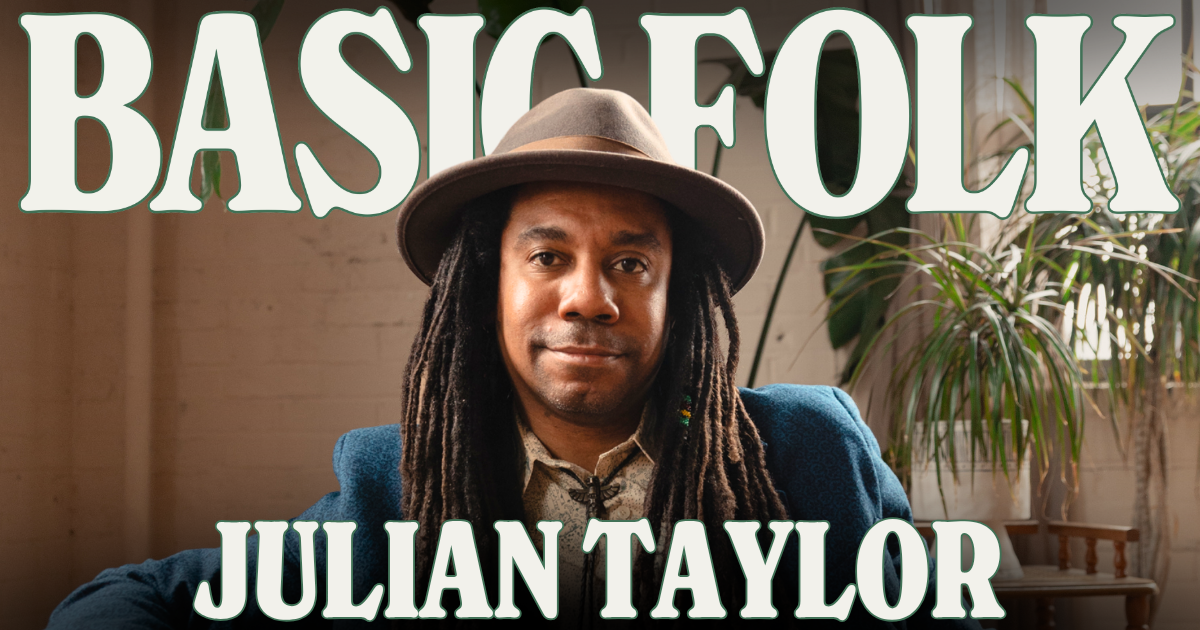
One of the things I really enjoyed about interviewing Toronto-born singer-songwriter Julian Taylor is his relationship with the truth. He has a really peaceful attitude towards learning and sharing new information. For example, at the beginning and the end of our interview, there were biographical facts about him that I had gotten wrong in my research. Gently and matter of fact he fact-checked me and we just moved on. It was such a cool example of, “Oh, you’ve got this a bit wrong and it matters that we get it right,” but nothing about that is personal. In an era of misinformation and alternate facts, it feels really grounding to have an hour-long conversation with someone who really cares about getting it right. That shows through in his songs and in his storytelling.
Julian experienced an eclectic musical upbringing thanks to his classical-and-gospel musician father, his mother’s love of Motown and folk, and wide influences from pop to blues. Oral tradition in his family shaped how he tells a story. Especially on his mother’s side with his Mohawk grandfather, a pastor who told incredible stories. He also discusses being pigeonholed by race and genre. Oftentimes, people will think that he performs a certain type of music because he looks a certain way. He mentions that audiences can be shocked when he pulls out a country song while sporting hair that looks more reggae than Johnny Cash. Taylor discusses his breakthrough 2020 album, The Ridge, he talks about his writing process (often starting with lyrics), and the intent behind his latest release Anthology: Volume Two – including “Hunger,” “Don’t Let ’Em” (with Jim James), “Dedication,” and “Weighing Down” – addressing mental freedom, identity politics, and self-forgiveness.
At BGS, we seek out roots music from all corners — for those readers encountering us for the first time, we’re not “just bluegrass.” With our annual year-end list, we’ve shaken off the “best of” title and instead gathered 20 recordings that inspired our staff and contributors. For many reasons (but especially the long-awaited return of live music and festivals), we look ahead to 2021, but first… here are the albums and songs that inspired us in 2020.
Courtney Marie Andrews – Old Flowers
Courtney Marie Andrews couldn’t touch my heart deeper. Her music has been the healing salve for the wounds of 2020. To me, she’s the true definition of an artist: A songwriter, a musician, a painter, a writer, a singer, a poet, an activist. My favorite song on her magical 2020 album is “Old Flowers.” It’s the perfect metaphor of resilience and rebirth after suffering, both in love and in life. Becoming whole again. If that ain’t a theme we could all grow from this year, I don’t know what is! – Beth Behrs
Anjimile – “Maker (Acoustic)”
Anjimile’s Giver Taker was the album I can’t stop (and won’t stop) telling people about in 2020. The full version of their single, “Maker” was a beautiful amalgamation of cultures and influences synthesized by an artist not constrained by cultural and creative preconceptions. To me, Anjimile’s acoustic version of the lead single distills the brilliance of their songwriting into its purest form. – Amy Reitnouer Jacobs
Danny Barnes – Man on Fire
Danny Barnes’ Man on Fire was a worthwhile gift to us all this year. Over the last couple of years, I’d heard chatter of a project in the works with names like Dave Matthews, John Paul Jones, and Bill Frisell involved. I am constantly in awe of what Barnes can create using the banjo as a pencil. This record was no exception, combining his unique style and songwriting with an electrified crew. – Thomas Cassell
Bonny Light Horseman – “The Roving”
There’s an odd bit of sorcery in the first measures of “The Roving,” a new version of an old folk tune on this supergroup’s debut. It opens tentatively, the instruments falling into the song like autumn leaves: First an acoustic guitar, then cymbals, then piano, all coalescing into a windblown arrangement that’s both understated and sublime. – Stephen Deusner
Bob Dylan – Rough and Rowdy Ways
Packed with jumbles of historic/cultural references and tall tales, bluesy swagger and prayerful romance, and climaxing with the shattered-mirror JFK assassination epic “Murder Most Foul,” Dylan’s first set of originals in a decade is breathtakingly masterful. It’s also, often, hilarious. Nearing 80, the Bard’s as playful as ever. And as poignant. And, justifiably, as cocky. – Steve Hochman
To me, Bob Dylan’s best era started in 1989 with his 26th studio album, Oh Mercy, and continues to this day with his 39th, Rough and Rowdy Ways. “Murder Most Foul” shows us that the master of his generation is as much in control of his folktale troubadour craft as he’s ever been. – Chris Jacobs
Justin Farren – Pretty Free
Knowing nothing about Justin Farren, I was immediately sucked into his evocatively detailed story-songs that involved returning diapers to Costco, getting a “two-paycheck ticket” while trying to impress a girl, and (in the all-too-appropriately-titled for-2020, “Last Year Was The Best Year”) a wild Disneyland adventure. Full of humor, sorrow, regrets and hope, Pretty Free was a musical world I visited often this year. – Michael Berick
Mickey Guyton – “Black Like Me”
Mickey Guyton’s lyrics illuminate the individuality and dilemma of any non-white vocalist in country music, and in particular the difficult journey of Black women in the field. Her performance is gripping and memorable, paying homage to many others who’ve faced ridicule and questions about why they’re daring to perform in an idiom many still feel isn’t suited for their musical style. – Ron Wynn
Sarah Jarosz – “Pay It No Mind”
Atop a Fleetwood Mac-style groove, Sarah Jarosz imagines the advice a distant bird might offer. But her songbird is no sweet, shallow lover. She comes with the weight and wisdom of something more timeless. Jarosz lets her fly via mandolin-fiddle interplay that personifies the tension between the endless sky and the “world on the ground.” – Kim Ruehl
Lydia Loveless – Daughter
“I’m not a liberated woman,” Lydia Loveless declares on her fifth album, “just a country bumpkin dilettante.” Don’t you believe it. Written in the shadow of her 2016 divorce and beautifully sung in a voice both epic and straightforward, Daughter finds this Americana siren at the height of her formidable powers. – David Menconi
Lori McKenna – The Balladeer
Lori McKenna‘s singular talent for capturing the joy in everyday details is on full display, from the church parking lots and hometown haunts of “This Town Is a Woman” to the stubborn tiffs and make-up kisses on “Good Fight.” But The Balladeer acknowledges the hard-as-hell times, too. With gentle accompaniment, commanding melodies, and McKenna’s signature lyrical wit, The Balladeer showcases a modern songwriting master. – Dacey Orr Sivewright
Jeff Picker – With the Bass in Mind
I love “new acoustic music,” but am often afraid I’ll be disappointed by it. Jeff Picker’s With the Bass in Mind immediately eases those worries by offering music that is creative, thoughtful, unexpected, and virtuosic while still feeling grounded and musical. All while effortlessly answering the once-rhetorical question: “What would a solo bluegrass bass album even sound like?” – Tristan Scroggins
William Prince – Reliever
William Prince‘s Reliever feels like the best pep talk I’ve ever had. In particular, “The Spark” finds him astonished with loving a partner who loves him back, no matter his own perceived flaws. As a whole, the album explores complicated emotions with a comforting arrangement (with duties shared by Dave Cobb and Scott Nolan). Sung with assurance by Prince, almost like he’s confiding in you, Reliever is both encouraging and excellent. – Craig Shelburne
Scott Prouty – Shaking Down the Acorns
We’d be remiss in our jobs as procurers of roots music culture to not include this stoically beautiful record on our year-end list of the very best. A hearty collection of 24 (mostly solo) old-time fiddle and banjo songs, there is something ever-present, comforting, and timeless about Prouty’s playing, and I have no doubt this is a record I’ll be revisiting like an old friend for years to come. – Amy Reitnouer Jacobs
Emily Rockarts – Little Flower
Montreal-based songwriter Emily Rockarts’ debut album Little Flower is one to remember. Produced by Franky Rousseau (Goat Rodeo Sessions), the album features lilting cinematic ballads punctuated with dance-in-your-room indie anthems. Rockarts’ musicianship is undeniable; her stunning melodies and refreshingly earnest lyrics make for a remarkable combination that is unlike anything else I’ve heard. Run, listen to Little Flower now! – Kaia Kater
Sarah Siskind – Modern Appalachia
Sarah Siskind brought her luminous, Nashville-honed songwriting back home to North Carolina a few years ago and let the mountains speak through her. Leading an all-star Asheville band live off the floor at iconic Echo Mountain studio, she’s made a heart-swelling set of songs that gather her special melodic signature, her meticulous craft, and her insight into how a rich musical region is evolving. – Craig Havighurst
Emma Swift – Blonde on the Tracks
Emma Swift reminded the music world of the power that artists have to control their work when she self-released Blonde on the Tracks, an eight-song collection of Bob Dylan covers. Her interpretations are as powerful and innovative as her methodical and thoughtful initial distribution sans streaming services. – Erin McAnally
Julian Taylor – The Ridge
Mohawk singer-songwriter Julian Taylor resides in what is now referred to as Toronto, but his masterful country-folk record, The Ridge, hits your ear as if plucked directly from Taylor’s childhood summers spent on his grandparents’ farm in rural British Columbia. Refracted through Taylor’s crisp, modern arrangements and undiluted emotion, The Ridge seamlessly bridges the elephant-in-the-2020-room chasm between rural and urban — musically, familially, lyrically, and spiritually. – Justin Hiltner
Molly Tuttle, “Standing on the Moon”
2020 has handed us its fair share of cover albums, with stay-at-home orders urging many to reach for the familiar — but none have meshed a variety of musical sources so creatively as Molly Tuttle’s whimsical …but i’d rather be with you. Her version of “Standing on the Moon” is the nostalgic and homesick, Earth-loving galactic trip of my pedal steel-obsessed, Deadhead dreams. – Shelby Williamson
Cory Wong – Trail Songs (Dawn)
A record that I didn’t know I needed came in early August when Vulfpeck guitarist Cory Wong released Trail Songs (Dawn). A change of pace for Wong, it features predominantly acoustic instrumentation and organic sounds. The album kicks off with “Trailhead,” which sounds like a Dan Crary instrumental until the groove drops in the second verse. BGS standbys Chris Thile and Sierra Hull make appearances as an added bonus. – Jonny Therrien
Donovan Woods – “Seeing Other People”
We may seem unsentimental, stoic, unemotional — especially when faced with something like a partner moving on, or a breakup, when it may be easier to seem fine, have a pint, and download Tinder. Donovan’s gift in this song is to show those complicated “yes, and” internal thoughts and emotions. It is beautiful. – Tom Power
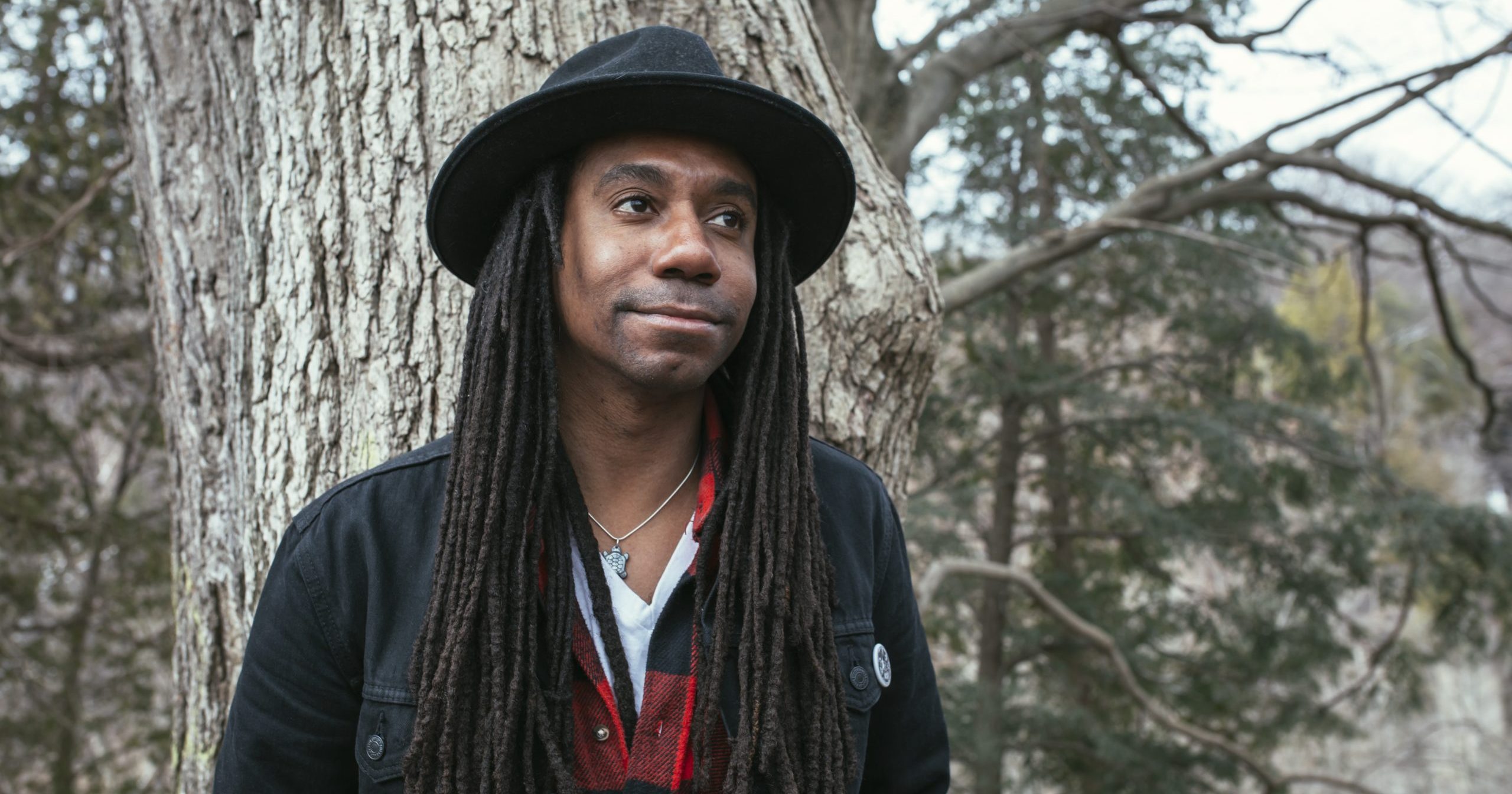
Canadian singer-songwriter Julian Taylor didn’t set out to make a country record with The Ridge, but the album oozes with authentic tinges of the vibrant, pan-Canadian roots music scene. Based for most of his career in Toronto, it’s not surprising that the album (produced by Saam Hashemi) feels crisp, modern, and listenable, but its inextricable linkage to place — namely, the titular Maple Ridge, British Columbia, where Taylor summered on his grandparents’ farm as a child — ensures the folky, rootsy facets of the album feel entirely intuitive, raw, and perfectly placed.
Of course, Taylor is quick to point out that the pre-genre, elemental quality of The Ridge not only stems from his decades in music or geography alone, but from his family, their shared musical connections, and his Indigenous roots. His grandparents and family members feature heavily across the eight original songs’ lyrics, and cousins Gene and Barry Diabo join the band on drums and bass, respectively, literally underpinning the entire project with a sonic connection to Taylor’s Mohawk and West Indian roots. That The Ridge is a critically-acclaimed, stunning work of country-folk is due entirely to his commitment to compassion, empathy, family, and letting all of the above stand on their own merits.
BGS connected with Taylor via phone ahead of his Shout & Shine livestream performance, available to watch live on BGS, our Facebook page, and YouTube channel on November 11 at 7pm ET / 4pm PT.
BGS: I wanted to start by asking you about The Ridge’s connection to place, because it sounds like your story is a pretty classic, roots music/country story — spending your summers on your grandparents’ farm in British Columbia — and the title track evokes the western wild of Canada. Can you talk about the geographical spaces you’re evoking on the album and the longing I hear for them?
Taylor: When I think about Maple Ridge, BC, we’re going back now probably thirty-five years. It’s almost as if, when I close my eyes, I can see the road leading up to the house. There’s a big hill, and my grandfather used to like old cars — it’s funny, I say “old cars,” but I suppose back then they weren’t. So there’d be a big old Buick, a Mustang, and I remember taking the Buick up that hill. You’d have to get the mail way down the driveway, literally a city block’s distance, where everybody had a mailbox and you’d grab the mail, go back up the path, past these two huge trees. I don’t know if you’ve ever been to British Columbia, but I came from Toronto going to visit my grandparents, and I was always in awe of how big everything was. The trees were bigger, the mountains were there, everything was bigger. Even the slugs were bigger! [Laughs]
[My grandparents] lived in a wonderful house, a couple of wonderful places actually, one of them backed up to the Alouette River and you could see the salmon spawn. They had farmland where they had horses and a chicken coop by the horse’s stables, fields where the horses could graze, and in the basement of the house they bred boxers — the dogs. My life would’ve been composed of getting up in the morning with my grandmother, taking care of the horses, my grandfather would take me swimming because he liked to do that at the community pool in town. After that it’d be fishing, hiking, farming, and just a lot of nature. That’s what we did.
To me, the way you’re describing it with so much imagery, it’s really clear that these memories are indelible for you. I think that comes through the music — it’s not just that you’re text-painting to check the boxes of what a country aesthetic is, you’re painting a literal picture you see in your head.
This is true, I didn’t set out to create a country record. I didn’t, I just wrote these words and those were the melodies and arrangements that came to my mind. It was certainly, for me, more of a folk element than a country one.
This record feels like it bridges the gap between your life in Toronto and your experiences in British Columbia, and I mean in the way it sounds, its production, its arrangements. The music is crisp and clean and feels very polished, but there’s still this raw, sort of natural element that I feel like is the mixing of rural and city. Do you agree or disagree?
Now that you mention it, I can hear it and I know what you’re talking about. Before you had mentioned it, I didn’t. It’s a very interesting thing, because I would say the rawness of it is because these are takes that are completely right off the floor, there’s no overdubs except for when we added the fiddle, the pedal steel, and the girls’ voices. Those were the only overdubs, because we couldn’t fit everybody in the room. My cousins Gene and Barry, they’re from Kahnawake, the Indian reservation close to Montréal, so we’d go and play, jam at the campfire, jam on the back porch, jam in the garage, and we’ve been doing that for years.
So when I asked them to be part of this record, I deliberately only sent them songs that were acoustic-based, and didn’t really tell them what I wanted, because I wanted this rawness and I wanted to sing the songs as they were. That’s why I think that particular [sound is evident], it’s a family affair, there’s a conversation between the core band that’s happening anyways. Saam Hashemi, who co-produced and engineered the record, he’s from the UK originally, he’s now Canadian, and we’ve worked together before. His production style is very pristine, the way that he captured it. That’s not deliberate, but it’s a wonderful hybrid for you to pick up on it. I hope others did and after this I hope that more do!
To me, part of this record sounding so country comes out of that Western Canada, American Midwest, Great Plains tradition of Indigenous country music and country bands that come from that region. Is that a community you operate in or interact with? Was that an influence for you, pulling from the generations-long tradition of hardscrabble, garage band, Saturday-night-at-the-local-bar Indigenous country bands of the rural Canadian and American west?
Absolutely, I wouldn’t say that it’s the West or Midwest, for me, because it directly comes from the East, actually, oddly enough! My family are East Coast Indigenous people, my mom’s family is from Kahnawake. It does come from that kitchen party, grab-your-guitar, grab-whatever-you-got — doesn’t matter if it’s a pot or a pan. It comes from that aesthetic, for sure. Absolutely! When you research that aesthetic, it’s not necessarily a country feel, either. It has elements of country and blues. Blues is very big in that, too. The way that my cousins are playing on The Ridge, there’s a gentle sort of shuffle that’s very indicative of what we’re talking about, yet it has this kind of swing to it at the same time. It’s like a country swing. That happens on a lot of the tracks where you can really feel it. On “Ballad of the Young Troubadour,” on the conga and upright bass you can feel it really strongly, as well. It’s a garage band aesthetic, for sure.
It’s a very Indigenous thing! If you go back and watch movies like Rumble: The Indians Who Rocked the World it’s interesting because the history of American roots music — in my personal opinion, I’ve read books on this and stuff, I know others think differently — without Indigenous people and without Black people we wouldn’t have roots music at all.
Yep. Full stop. It’s that simple.
[Laughs] Yes! Full stop. Exactly. It’s interesting to see so many new Americana artists that are Indigenous and Black, I’m really so honored to be even considered in that group of people!
I wanted to ask you about “Human Race,” because I think that song pretty clearly lays out a framework for creating empathy and understanding and I wanted to ask you where that comes from, within you, specifically. Empathy is such an individual thing, I’m always interested in how people take it from being intensely individual and personal and turn it into something universal and relatable. What is that process like for you? Especially in writing “Human Race?”
That empathy comes across and feels universal because I know someone who is deeply close to me that has suffered from mental disabilities and mental illness and it has affected me and my family. You learn from a very young age, even before you know exactly what it is, that you have to be quiet and patient. You have to be strong, yet at the same time very gentle. You have to allow these loved ones’ triumphs and their dreams to be bigger than anything that you can possibly imagine, just so that they have an opportunity to express themselves in a way that makes them feel important. In writing the song, my message to this particular person was that I believe in them, their strength, and their pain — and to acknowledge that I go through all of those feelings too, just like they do. That’s how that song became so universal, by allowing myself to let go and also praise someone that I absolutely adore.
What have listeners’ or fans’ reactions to “Human Race” been like?
When I first posted it I think people really were shocked and gravitated to it in such a way that I didn’t realize would happen. This is the song that led me to believe I had to put this record out earlier than I was intending to. It was around the time the pandemic lockdown here in Canada started, so it touched a lot of souls. I was very pleased that it did. I think the aspects of the song about inner peace and overcoming challenges resonate with people.
It feels like “It’s Not Enough” is a song about grace, about how we all are enough, but through the opposite lens. So I wanted to ask you about the idea of applying grace to ourselves, especially right now when that feels so much more difficult.
Applying grace to ourselves is such a difficult thing to do, but such a necessary thing to do. People who think and think a lot, other people don’t realize just how much work that is and how tiring it is to try to figure out what’s on your mind, just as simple as that. I’m a person who feels compassion for other people and myself, but I’m also extremely difficult on myself and hard on myself — as most people would say, we are our own worst critics in a lot of ways. I’m trying to be a little less critical with myself and, in turn, with others. I’m trying to accept what is. I think this song, “It’s Not Enough,” in a way is insinuating that for humans to not to believe that is kind of an insidious frame of mind.
Can you tell me about the final track, “Ola Let’s Dance?” There’s a meditative quality to the refrain that resonates with me, the way it’s almost like a mantra, really intentional in the way you’re delivering it. Where does that song come from?
Well, I was thinking about beats in my attic where I do a lot of my demos. The beat came first, I just held onto it forever and ever and ever and ever and ever, just sitting. When my grandmother had passed away, and my grandfather had passed years before, we had to go out and collect all of her stuff. I was the one that inherited most of it. It’s sitting in my attic as we speak. Just rummaging through memories and stuff I found poetry that was written by my grandfather. The poem I recite in “Ola Let’s Dance” was not written by me; it was written by my grandfather, John Thomas Skanks. I just loved it so much, I had to try to write it into a song. I came up with the guitar part — it was very tribal, I wanted the whole thing to feel very tribal. It’s probably the furthest thing from a country or folk song on the record, yet it comes out like that anyway. [Laughs] It’s really bizarre!
The amalgamation of my maternal grandparents is what that song exemplifies, to me. I was trying to sing it, trying to put a melody to it, ‘til one day I just said, “Why don’t I just recite it and see what happens?” [Laughs] I did it and everyone was like, “YUP! That’s how it’s going to go.” My maternal grandmother’s name was Ola. She taught dance at the University of Buffalo for a little while. She raised four girls on her own, doing what she could to survive, and ended up teaching dance. So the song, in my heart, is both the meeting and separation of my grandparents, which brought me to life.
This website uses cookies to improve your experience. We'll assume you're ok with this, but you can opt-out if you wish.AcceptRejectRead More
Privacy & Cookies Policy
Privacy Overview
This website uses cookies to improve your experience while you navigate through the website. Out of these, the cookies that are categorized as necessary are stored on your browser as they are essential for the working of basic functionalities of the website. We also use third-party cookies that help us analyze and understand how you use this website. These cookies will be stored in your browser only with your consent. You also have the option to opt-out of these cookies. But opting out of some of these cookies may affect your browsing experience.
Necessary cookies are absolutely essential for the website to function properly. This category only includes cookies that ensures basic functionalities and security features of the website. These cookies do not store any personal information.
Any cookies that may not be particularly necessary for the website to function and is used specifically to collect user personal data via analytics, ads, other embedded contents are termed as non-necessary cookies. It is mandatory to procure user consent prior to running these cookies on your website.