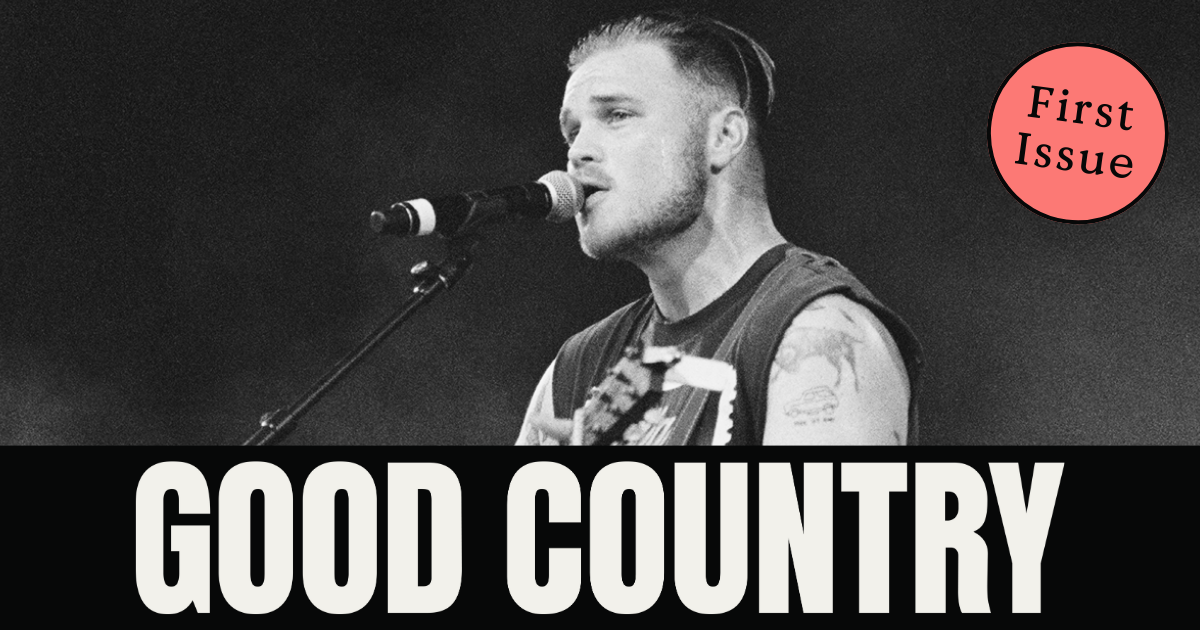
Same Twang, Different Tune

(Editor’s Note: Sign up here to receive Good Country issues when they launch, direct to your email inbox via Substack.)

Few words stir up conflict in country music circles the way “authenticity” does. While debates over authenticity rage within every corner of the arts, the tension is especially potent in country, whose unofficial tagline is, after all, a commitment to honest simplicity: “Three chords and the truth.” While “truth” can be a broad umbrella to work under, within country music it tends to encompass a longstanding commitment to sharing the stories and experiences of everyday people, in particular those of the rural working class.

Accordingly, an adherence to and celebration of the very concept of authenticity – nebulous as it may be – is as baked into country music culture as an anti-establishment sentiment is inherent to punk music. Listen to country radio, though, and you might have a hard time finding it, particularly as the bro country of the mid-teens, though finally waning in popularity, still dominates the majority of terrestrial country airwaves.

It’s 2024, though, and it’s way past time to declare that country radio is irrelevant. Glance at Billboard’s Hot Country Songs chart, which includes sales and streaming data alongside airplay, and you’ll see the top spot isn’t occupied by one of the usual radio favorites like Luke Bryan, Morgan Wallen, or even Luke Combs, the latter of whom has notably found a way to straddle the line between commercial success and critical acclaim.

Rather, at the time of this writing the number one country song in America is “I Remember Everything,” a duet between the relatively new artist Zach Bryan and one of the genre’s more adventurous stars, Kacey Musgraves. As a song, “I Remember Everything” isn’t necessarily groundbreaking. Bryan’s and Musgraves’ voices play nicely off one another, with his achy grit contrasting sweetly with her smooth twang. The production is simple, underdone even, and lyrically the track travels well-trod territory: romantic heartbreak.

So, what, then, has kept “I Remember Everything” firmly situated in that top spot for 14 straight weeks (and counting)?

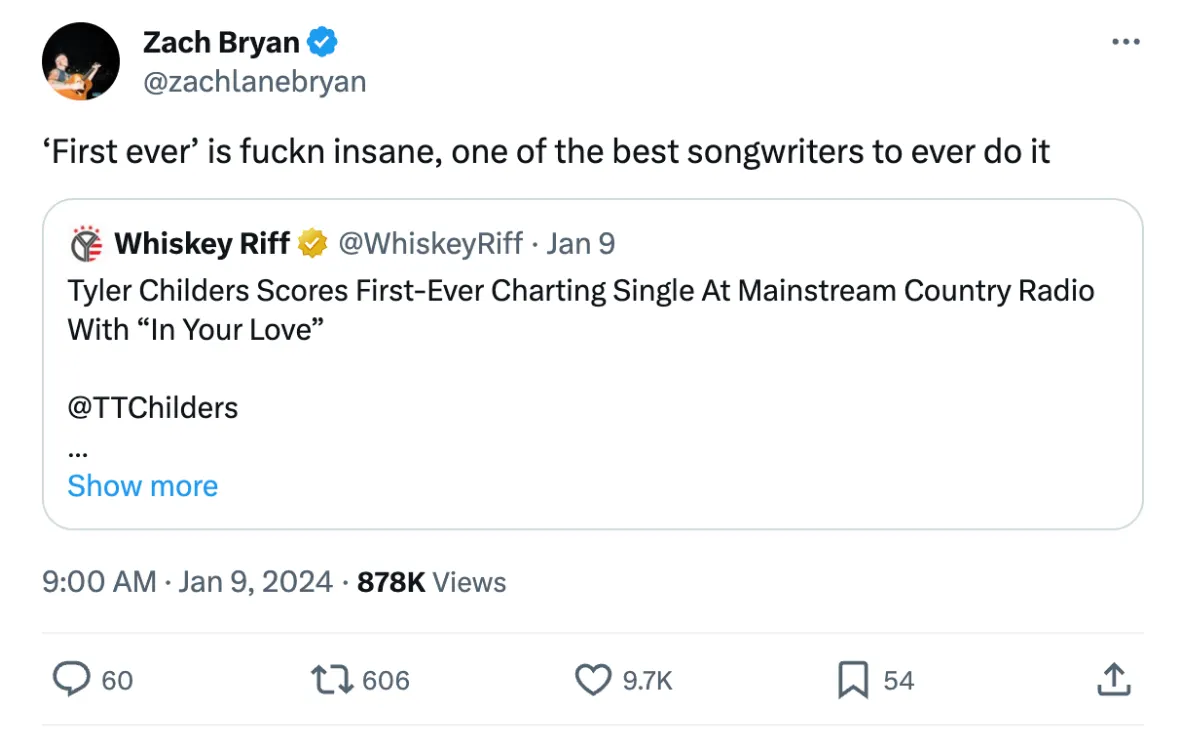
If you’ve paid even the least bit of attention to country music in the last couple of years, you’ve no doubt encountered Zach Bryan and his genuinely singular approach to the genre. With his raw sound, confessional lyrics, and decidedly DIY approach to business, Bryan radiates the kind of authenticity that fans crave. He joins a host of other recently established and emerging artists – including but not limited to Tyler Childers, Lainey Wilson, Colter Wall, and Billy Strings – who found success by foregoing the traditional route to country stardom, one that typically involves following an out-of-date formula honed over time by profit-driven record labels.

Zach Bryan debuted with DeAnn in 2019, finding an audience online thanks to the viral success of “Heading South” on DeAnn’s follow-up Elisabeth. He quickly built a fanbase on TikTok and YouTube before releasing his 2022 breakout LP, American Heartbreak, which had more opening week streams than any other country album that year. In the lead-up to American Heartbreak, Bryan, who served as an active-duty member of the U.S. Navy for eight years, was honorably discharged in 2021 so he could pursue music in earnest.

In addition to topping charts, American Heartbreak set itself apart from the rest of the year’s crop with its unadorned production, heavily narrative songwriting, and sheer ambition – the record clocks in at a lofty 34 tracks, with less filler than one would anticipate. The album’s biggest single, “Something in the Orange,” earned Bryan a Grammy nomination for Best Country Solo Performance and, for a time, landed him atop Billboard’s Top Songwriters chart.

That record, along with a handful of EPs and loosies released in between, teed Bryan up for his 2023 self-titled LP, a much more focused effort (a mere 16 tracks!) that found Bryan firmly situated as a real-deal country star, one who can tap the likes of Musgraves, the War and Treaty, Sierra Ferrell, and the Lumineers to come join the proceedings. While it no doubt shows the depth of his rolodex, that guest roster also points at the breadth of Bryan’s influence, as each artist comes from a different part of the broader country/Americana ecosystem.

And while he considers himself a country artist, Bryan’s roots are more indebted to the folk-rock revival of the late-aughts and early teens, when acoustic acts like Mumford & Sons and the Lumineers grew so big as to cross over into Top 40, eventually helping spur an explosion in popularity for Americana and roots-adjacent music. It’s fitting, then, that the Lumineers feature on Zach Bryan, joining on the track “Spotless” so seamlessly it isn’t always easy to tell who is singing: Bryan or Lumineers frontman Jeremiah Fraites.

It’s on these collaborations, in particular, that you can hear Bryan’s joy at being able to do what he loves. His vocals are raw, but never phoned in; in fact, sometimes he seems to be straining so hard to communicate a particular emotion that you worry his voice will give out. It never does.

In other words, Bryan is a fan’s musician, one who geeks out about his favorite artists the way his own fans do about him. In a post about the duo the War and Treaty, who joined Bryan on the standout Zach Bryan cut “Hey Driver,” he writes, “I can tell you the first time I heard War and Treaty live and I looked to the person next to me and said, ‘Are you hearing this?’ I talked to them later that night and they were the kindest couple I’d ever met.” In the same post, he says of the Lumineers, “I can tell you about how when my Mom went on home I got the Lumineers tattoo on my tricep after hearing ‘Long Way From Home’ for the first time and how Wes [Schultz] and Jeremiah are some of the most welcoming humans I’ve ever met.”

This post points to a major piece of both Bryan’s appeal and the air of authenticity that surrounds him: His direct line of communication with his fans. He manages his social media accounts himself and is no stranger to getting vulnerable in his messaging, often posting progress updates on new songs he’s working on or taking a moment to express gratitude for his success. For fans, it’s almost like there are no barriers between them and Bryan, which reinforces the relatability at the core of his music.

The beating heart of Zach Bryan, for me, is “East Side of Sorrow,” a song that grapples with hope and religious faith by connecting the grief Bryan felt after losing his mother to his time being shipped overseas while serving in the Navy. Despite – or perhaps because of – these vivid references to specific experiences, like being “shipped… off in a motorcade” and losing his mother “in a waiting room after sleeping there for a week or two,” the song is deeply emotional and relatable, a wrenching but empowering anthem encouraging the hopeless to try to keep it moving. These days, you’d be hard-pressed to find someone who couldn’t use such a message, this writer included – Apple Music tells me it was my most-played song of 2023.

It would be – and for a lot of folks, already is – easy to accept Bryan’s every word, to believe that his hardscrabble songs about “rot-gut whiskey” and manual labor are honest reflections of the life he’s lived and the person he is. Then there’s the cynical interpretation, that Bryan’s anti-marketing is, actually, still marketing, that a young musician could only know so much of the realities of the struggle of the working class, that it’s the same twang to a different tune. Bryan has, after all, had a few bumps along his road to fame, including some less than flattering encounters with police that negate his humble personal.

But the truth, as it so often is, is likely somewhere in the middle. With such personal material, it’s easy to trace one of Bryan’s songs to its point of inspiration – “East Side of Sorrow,” for example, is undoubtedly ripped right out of his lived experience. And Bryan isn’t afraid to admit the gaps in his experience, like when on “Tradesman” he sings, “The only callous I’ve grown is in my mind.” Compare that to, say, the sheer tone deafness of a song like Blake Shelton’s “Minimum Wage” and Bryan’s instances of stretching the truth feel trivial.

Bryan is only the latest in a long line of country artists for whom authenticity is both a blessing and a curse. Genre giants like Johnny Cash and Waylon Jennings are often held up as unimpeachably authentic pillars of the genre, despite weathering their own brushes with the authenticity police earlier in their careers. And these debates, which tend to center white, straight, cisgender men, aren’t nearly as hostile in their scrutiny as they are for marginalized artists, against whom the idea of authenticity is typically wielded as a gatekeeping weapon.

Wherever you fall on Zach Bryan, it’s hard to deny that the gravel-voiced, baby-faced boy from Oklahoma has changed the very fabric of contemporary country music. What he does with that power moving forward could break the genre open for good, making space for artists with unusual paths, atypical backgrounds and a disregard for the flavor of the week. If Zach Bryan is who he says he is, he may very well do it.


Sign up here to receive Good Country issues when they launch, direct to your email inbox via Substack.

Photo Credit: Louis Nice

LISTEN: JD Graham, “West Virginia”

Artist: JD Graham
Hometown: Yukon, Oklahoma
Song: “West Virginia”
Album: A Pound Of Rust
Release Date: June 23, 2023

In Their Words: “Growing up in rural Oklahoma, I was surrounded by all things oil field. I used to watch my friends roughneckin’ the rigs before they were old enough to buy smokes. By the the time they were 18, they were chasin’ money and workin’ 80 hours a week or more. The relationships they had with friends and lovers took a back seat. Years later the regret set in and they started to look back at what they missed. The character in this song wants another chance at the love he left behind and wonders if she has moved on.” – JD Graham 


Photo Credit: Alex Chacon

LISTEN: Carter Sampson, “Can’t Stop Me Now”

Artist: Carter Sampson
Hometown: Oklahoma City, Oklahoma
Song: “Can’t Stop Me Now”
Album: Gold
Release Date: April 7, 2023
Label: Horton Records

In Their Words: “About six months into the pandemic I began to feel like I hadn’t felt in a long time. There was this sense of being stuck, physically and mentally. Pre-COVID, I was living a life that I had worked for years to create, busy playing music all over the place and doing what I love. It felt like all of a sudden that life was erased and I was feeling those teenage feelings again. I had to remind myself that I had put all this hard work in and that nothing was going to stop me. I wrote ‘Can’t Stop Me Now’ to tell myself and others to not give up.” — Carter Sampson

hortonrecords · CARTER SAMPSON – Can’t Stop Me Now

Photo Credit: Doug Schwarz

Embracing Tulsa Time, John Fullbright Finds Inspiration in a Farmhouse Studio

Yes, artists tend to be insecure. Still, it’s surprising to hear John Fullbright admit he steeled himself for bad reviews after releasing his third studio album, The Liar, in October. In fairness, though, he does have a higher-than-average bar to meet.

When the Bearden, Oklahoma, native released his studio debut, From the Ground Up, 10 years ago, what was essentially a collection of demos earned him a Grammy nomination, Americana Honors & Awards nods for Album and Emerging Artist of the Year, the ASCAP Foundation’s Harold Adamson Lyric Award (presented by another home-state hero, Jimmy Webb) and inclusion in the Rock and Roll Hall of Fame’s tribute to Chuck Berry — where his blues-drenched, Leon Russell-infused delivery of “Ain’t Nobody’s Business” stole the show.

He was 24. At 26, he released an even more powerful album, Songs, which charted in the U.S. and U.K. Journalists again showered the pianist, guitarist and harmonica player with praise, expressing eagerness to follow his career evolution.

They weren’t expecting to wait eight years, but Fullbright was, indeed, busy evolving. He moved from Bearden (population: 133) to Tulsa (population: 411,401), where he was welcomed into a supportive music community and thriving creative scene. He embraced “Tulsa time” — a laid-back vibe he characterizes as “that JJ Cale attitude” — and discovered he loved jamming as a sideman instead of always having to carry the show.

As his already prodigious skills expanded, his confidence skyrocketed, which loosened him up on stage and in general. It’s made him a better performer, one who willingly unspools stories behind songs and engages audiences with more finesse than he already had. It also led him to seek other new experiences — like producing American Aquarium’s 2018 album, Things Change, and making his acting debut in pal Sterlin Harjo’s Hulu series, Reservation Dogs.

“It was pretty fun,” he says of his cameo as a salvage yard worker. But he has no more desire to pursue acting than he did to turn From the Ground Up’s momentum into a push for fame.

Fullbright finally got around to recording The Liar because he wanted to use the late Steve Ripley’s farmhouse studio, a replica of the one Ripley owned for 20 years in Tulsa: the famed Church Studio formerly owned by Leon Russell. Fullbright had watched Ripley painstakingly re-create the Church’s fabled Big Room (the original, now a National Historic Landmark, is considered the birthplace of “the Tulsa Sound”), but the engineer died before he could use it.

When Fullbright heard Ripley’s widow was considering selling the place, he asked if he could record something before she did.

“I gathered the guys I’ve been playing with for years now, and we went and stayed out there for a few days,” Fullbright says. “We just hung mics all over the room and started playing. I came in with a handful of finished songs and a handful of unfinished songs, and we started kicking around ideas. … It very organically came together. Next thing we knew, we had 12, 15 songs recorded. A lot of these tracks are live.”

Over four days, Fullbright discovered the joy of collaborating, particularly with Jesse Aycock (guitar, pedal steel) and Patrick Ryan (drums, percussion, cover art). He also enlisted his partner, Anjelica Baca, to sing on three tracks, including the pretty near-duet “Lucky,” and the standout “Safe to Say.”

On that one, Fullbright steers his Wurlitzer from a bluesy groove into Memphis/Muscle Shoals R&B/soul territory, singing, “I’m not talking about eyes or oceans / Smiles or sunsets / This seems stranger / I locked my heart up / Kept it company / I didn’t know I was even in danger.” Gaining thrust as he heads for the high notes, he finally shouts “I’m in lo-o-o-ve!” “I’m in lo-o-o-ve!” over a gospel chorus, seemingly ready to escape gravity altogether — until he deftly pulls back on the throttle, coming in for a landing so gentle, it’s as if that dramatic flight never occurred — except for listeners left gasping for breath from that rocket ride.

“I was going for, like, Otis Redding; start out really, really soft, and just build it as big as you can,” Fullbright explains. “I listen to a lot of R&B, and I have found that the more patient you are, the more tension there is, and the more tension there is, the bigger the payoff. It’s also a risk; sometimes it doesn’t work. But when it does, it’s great. I can go back and listen to that song and still get chills.”

Except for a few overdubs, the song was captured in one take. As for that gospel chorus, they just gathered everyone around a single mic. The same technique was used for “Poster Child,” another Fullbright-Dustin Welch cowrite in the Kurt Weill-ish vein of their darkly satiric “Gawd Above.”

On The Liar, Fullbright also includes a charming version of “Where We Belong,” by the late Tom Skinner, a founding father of Stillwater, Oklahoma-spawned red dirt music.

“We’ve been playing that song a lot live just because it’s just a really honest country song, and those are hard to come by sometimes,” says Fullbright. “And it’s an homage to Tom because he was my friend. He showed me the ropes when I first started playing music in front of a microphone.”

Fullbright was a still a teen when his performance at the Woody Guthrie Folk Festival (aka WoodyFest), Okemah, Oklahoma’s annual celebration of its most famous resident, generated some big buzz. From there, he made his way to Oklahoma City’s Blue Door, Greg Johnson’s iconic listening room. Johnson was so impressed by Fullbright’s skills, he did something he’d never done in all his years of showcasing talent: he offered to become Fullbright’s manager.

Neither had planned for such a quick take-off. As Fullbright’s career unfolded, it flipped into some bizarro Cinderella story — one in which the glass slipper gets dumped because it’s too shiny and uncomfortable.

Fullbright doesn’t like limelight; he actually left college in part because he was too shy to raise his hand in class or speak to groups. But his talents still drew attention, despite his discomfort (which may or may not be referenced in The Liar’s booze-centric “Social Skills” and the definitely not autobiographical, Tom Waits-inspired title track, written over coffee around 9 a.m.).

An early hint of his trajectory came when he won the Bugle Boy Foundation Talent Trust Award at 23, which funded From the Ground Up. But he declined to finance a Grammy vote-gathering campaign; he has little interest in music-biz politicking. Though he has a distribution agreement with Thirty Tigers, he’s never signed with a label; all of his albums have been released on his own Blue Dirt Records label.

After the 2014 release of Songs, Fullbright knew he didn’t want to engage in extended touring indefinitely. The move to Tulsa gave him more reason not to: being close to a major airport made it easier to do short hops and one-off appearances, and in-between, he could stay home and play.

“I’m still shy,” admits Fullbright, who pre-signed discs for a recent performance so he wouldn’t have to interact at the merch table. “But I definitely feel a lot less like an outsider looking in. One of the things about being in this particular community is, it’s nothing for somebody to just text and say, ‘Hey, man, I can’t make it to this show. Would you mind filling in?’ And ‘Hey, would you mind letting my dog out?’ ‘Would you mind watching my kids for a couple hours?’ To me, that’s what’s really cool about it. We don’t just get together and play music.”

Now, he splits his time between Tulsa and the Bearden farmhouse in which he was conceived. In the city, he has a community, grocery stores and garbage pickup. In the country, he has … stars.

That glittering night sky inspired what’s widely regarded as Fullbright’s magnum opus: “Stars” — finally recorded for posterity after years of only live performances. It’s a stunning work, a sweeping epic addressing loneliness, love, loss, life, death and God in six simple stanzas. Nearly every already-glowing review singles it out for effusive praise (so much for those fears of panning). Under a video of Fullbright performing the song, former Austin American-Statesman critic Peter Blackstock wrote, “I did not hear a better new original song than this from anyone in the past decade.”

That led to John Legend’s so-far-unreleased recording. Potential mailbox money aside, it really should be Fullbright’s version lodging in the memory of everyone who hears it.

He wrote it after playing at a close family friend’s funeral. The night before, he recalls, “It was a very clear night, and I was in a very bad mood. I was angry because John was gone. But I have a tendency, when I walk from the car to the back porch, just to look up and stare at the stars for a minute, get my bearings. That night, I was doing my star gazing and I just went, ‘Man, if you’re just gonna die, what is the point?’ I was in a dark place.

“The next day, I played John’s memorial service and hung out with the family all day,” he continues. “We laughed and cried, and I came back to the house and looked up at the sky. Same stars. And I was filled with this sad joy, like, ‘What was I thinking last night? Life is something to take very, very seriously. It’s very precious. And it’s very short.’ I walked inside and wrote the song; it all just came out at once. That so rarely happens. The whole thing got written in one sitting and recorded onto my phone, and that was it. I went to bed.”

Fullbright may have turned his back on potential stardom, preferring an ember’s steady glow to the quick fade of flashy fireworks. He’s never had a hit, but he’s already written several songs that deserve to be considered classics. “Stars” outshines them all, though. It truly is one for the ages, from an outstanding talent who, ideally, won’t wait another eight years to give the world more songs that shine even half as brilliantly.


Photo Credit: Jackson Adair

LISTEN: The Great Divide, “Into the Blue”

Artist: The Great Divide
Hometown: Stillwater, Oklahoma
Song: “Into the Blue”
Album: Providence
Release Date: October 28, 2022

In Their Words: “This song was written in 2009 in a flurry of songs that came to me over the course of a few evenings. The songs were longings for a love that didn’t quite exist yet for me. I knew it was out there, and I knew it wasn’t what I had. ‘Into the Blue’ is speaking to that love as though it already existed, and in a way, it did. We just hadn’t found each other yet.

“The overall arc of the record is dealing with time; it asks how much time we have left in our lives and how we want to spend the remaining years. It’s about admitting the areas where work is needed and putting in the effort to do something about it. There is a coming full circle aspect for us as a band; as performers and people. Everyone is bringing their best to the table for the first time in years, and when that happens, The Great Divide is a force. This album brings with it a certain hope.” — Mike McClure, The Great Divide


Photo Credit: Sierra Haney

LISTEN: Wood Willow, “So Much Runnin'”

Artist: Wood Willow
Hometown: Oklahoma City, Oklahoma
Song: “So Much Runnin'”
Album: Southern Intentions
Release Date: April 22, 2022

In Their Words: “A few months after recording, in February of 2021 there was a massive snow storm. The temperature was in the negatives for days and snow was at least a foot deep. Lucas Gillette, our bass player, had hung out with us during pretty much the whole pandemic, and one day that it wasn’t actively snowing we all decided it’d be a good idea to shoot a music video out in the elements. Joel and Lucas were the main creative minds behind the concept. We all brainstormed and came up with the idea to shoot out at some abandoned trains outside of town. We thought that the setting matched the drifter/rebellious nature of the song perfectly. We got dressed and bundled up as best we could and made the trek across town to shoot our first music video (don’t try this at home, kids). The video was shot by Lucas all on his iPhone over the course of probably five extremely cold hours. I remember the high that day was only 8 degrees, and that’s definitely something we aren’t used to.

“Lucas was originally supposed to be included in the video, but apparently our camera work wasn’t as good as his, because we didn’t get any usable footage of him. Thankfully one of the three of us could work the camera! We shot at a couple different locations, including a park, and even in the car for a few scenes. While we were on the trains we had to take pretty frequent breaks and warm up in the car during the process. I think it was one of the coldest days I had ever experienced, but it was well worth it. About halfway through the day we shot, Joel asked us if we were crazy or if it would even turn into anything cool. This video was our first true music video (excluding live performances) to shoot, and one of the first that Lucas had ever shot on his own. We have always been more of a DIY band, and to see the finished video turn out like it did made us pretty proud of ‘So Much Runnin’.’” — Becca Herrod, Wood Willow


Photo Credit: Molly Herrod

LISTEN: Kaitlin Butts, “It Won’t Always Be This Way”

Artist: Kaitlin Butts
Hometown: Tulsa, Oklahoma; now Nashville, Tennessee
Song: “It Won’t Always Be This Way”
Album: What Else Can She Do
Release Date: April 15, 2022

In Their Words: “For a long time, my mom and I were going through some hard times. She was going through a divorce, and we kept getting what I like to call ‘clotheslined’ by life. We kept trying to be positive and we’d say ‘it won’t always be this way’ and by the time we’d get some traction again, we’d get the rug pulled out from under us again. That pattern took place for a pretty long time, but the phrase ‘it won’t always be this way’ remained. We said it so often without things changing for the better, that it became this really sad thing we would say. So I wrote this song about wanting to, but not seeing the light at the end of the tunnel. Taking my personal experience out of it, the song is about a mother wanting to take her daughter out of a bad situation. The depression and uncertainty that all of that comes with. The promise to her daughter that it won’t always be this way.” — Kaitlin Butts


Photo Credit: Mackenzie Ryan

BGS 5+5: Jason Scott & The High Heat

Artist: Jason Scott & The High Heat
Hometown: Oklahoma City, Oklahoma
Latest Album: Castle Rock
Rejected Band Names: Dad Behavior, The Big City, The High Diamonds

Which artist has influenced you the most … and how?

Tough question, but probably John Prine. He can really put a song together. I love how simply he weaves his words. It’s hard to write simply, nobody does it better than John to me.

What’s your favorite memory from being on stage?

We played the Tower Theatre in July of 2021, a bunch of our friends were in attendance, and the energy was just incredible. We shot a video and released a couple songs from that night, it was that special to us.

What’s the toughest time you ever had writing a song?

I think “Sleepin’ Easy” was the toughest on this latest record. It took several years to write, probably because I had to go through more shit before I could finish it. I think I’ve got several other verses for it somewhere. It can probably be rewritten a million times.

If you had to write a mission statement for your career, what would it be?

Just keep working, and asking questions. I’m learning every day, and that’s largely due to the company I hang around. Hopefully I can keep that going, and we all make it haha!

Since food and music go so well together, what is your dream pairing of a meal and a musician?

The garlic chicken at El Siboney with John Prine, RIP. I’m sure I speak for most when I say we miss the hell out of you. That’d be a pretty amazing night, especially with good friends and family.


Photo Credit: Brittany Phillips

WATCH: Jason Boland & The Stragglers, “Restless Spirits”

Artist: Jason Boland & The Stragglers
Hometown: Harrah, Oklahoma; now based in Austin, Texas
Song: “Restless Spirits”
Album: The Light Saw Me (produced by Shooter Jennings)
Release Date: December 3, 2021
Label: Thirty Tigers

In Their Words: “This tune was written by the great Bob Childers, and he once told us, ‘All my songs are love songs.’ We feel so honored to have known him and to have this song make its way into the story of The Light Saw Me. The line ‘her eyes were closed but still they held the light’ made me rethink what this song could mean as an emotional point in this tale. Plus, in the way that Willie Nelson’s Red Headed Stranger had ‘Blue Eyes Crying in the Rain,’ I wanted to include a classic on this concept album. The deeper meaning of the material is ‘meaning’ itself. When faced with the stoic realities of our collective fate, love is the source of the power that can keep us going.” — Jason Boland

“Jason is one of my dearest friends and, in my opinion, one of the smartest and coolest dudes I know. This album isn’t just another album from Jason & The Stragglers. It’s a magnum opus of the highest creative order, which in turn I take as a very serious honor to be able to be a part of its inception.” – Shooter Jennings


Photo Credit: Rico Deleon

LISTEN: CJ Garton, “I’m Talking to Ghosts”

Artist: CJ Garton
Hometown: Bristow, Oklahoma
Song: “I’m Talking to Ghosts”
Album: Tales of the Ole West and Other Libations to Please the Palate
Label: G-Bar Records/Cowboy Carnival Publishing
Release Date: September 16, 2021 (vinyl); January 14, 2022 (digital album)

In Their Words: “‘I’m Talking To Ghosts’ is one of those kind of songs you hear and you just feel it. It leans on that edge of life and death and the unknowing of what lies beyond. It’s fascinating how much we still don’t know or understand, it peaks our curiosity and invites our imagination to play in that realm even for just a few minutes as it carries us deep into the catacombs of our subconscious.” — CJ Garton


Photo credit: Ty King/G-Bar Films