Need some new music in your life? You Gotta Hear This!
This time, our weekly roundup is kicked off – pun intended – by mandolinist and singer-songwriter Ashby Frank, who has just released “Stokes County Buck Dancing Man.” Written with Mason Via, the track pays tribute to the tradition of flatfooting and buck dancing at fiddlers conventions, old-time jams, and bluegrass festivals – especially giving homage to Todd “The Bod” Inman of Galax Old Fiddler’s Convention fame. It’s modern bluegrass with plenty of fun, down-home, mountain music infusions. Also in bluegrass, Daniel Grindstaff & the Uptown Troubadours have a brand new self-titled album out today. To celebrate, we’re sharing their cover of “Denver,” a song written by the legendary Larry Gatlin. Whatever the genre, whomever the artist, the song certainly shines; Grindstaff and company do it justice.
Old-time, Cajun, and Americana musician Dirk Powell shares a new lyric video with us today, as well. “Down The Line” captures the musical itinerant lifestyle and career Powell has made for himself, reflecting on the journeys he’s taken from his home in Louisiana to points all over the map – but especially Powell’s beloved Southwest. From West Virginia, singer-songwriter Brad Goodall draws from the river town vibes of his native Huntington for “River Water.” Found at the confluence of clean, manicured soft rock and gritty Americana folk rock, Goodall plays with themes well-placed in roots music: home, belonging, leaving, staying, and – eventually – coming to terms with all of it.
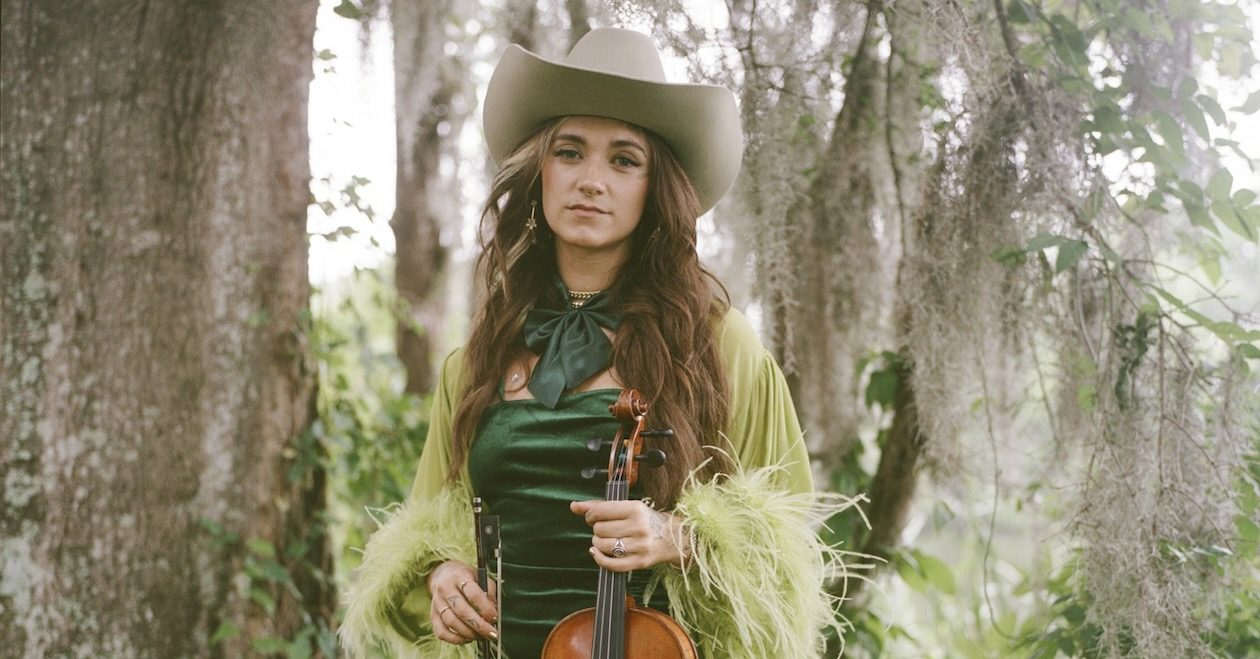
Texan artist, songwriter, and cowgirl Candace Hastings has brought us her new song, “Loving Cowboys,” today as well. It’s a song about being left behind by the person you love, watching the dust kick up from their truck tires as they head off to make their living. Jazzy and swinging, it’s country steeped in the “& western” most of the genre has long since dropped, but Texas keeps well alive for all of us to enjoy. To wrap us up, SUSTO’s acoustic iteration, Susto Stringband, team up with Morgan Wade for “Hard Drugs,” off an upcoming second volume of Susto Stringband. The group wasn’t originally planning to include this song on the project, but were convinced by Wade – to the benefit of each of us.
There’s so much to check out and enjoy below! You Gotta Hear This…
Ashby Frank, “Stokes County Buck Dancing Man”
Artist:Ashby Frank Hometown: Nashville, Tennessee Song: “Stokes County Buck Dancing Man” Release Date: March 20, 2026 Label: Mountain Home Music Company
In Their Words: “I wrote this song with my buddy Mason Via. We both attended fiddlers conventions and bluegrass festivals in North Carolina and Virginia when we were kids and, of course, flatfoot buck dancing and clogging are a big part of these events. There were always so many great musicians and dancers there, as well as some larger-than-life personalities, but Todd ‘The Bod’ Inman from Stokes County, North Carolina, might have been the biggest and brightest character of them all.
“We wrote this song as a tribute to Todd and we were able to send him a work tape version of it before he passed away from cancer in 2024. He loved being the life of the party and the star of the show and he seemed to really get a kick out of our song about him. Galax Old Fiddler’s Convention will never be the same without his iconic dance moves and sense of humor. I was so pleased that Mason agreed to sing harmony with me on this track and I’m so very proud of how it turned out. This one’s for The Bodman!” – Ashby Frank
Track Credits: Ashby Frank – Mandolin, lead vocal Seth Taylor – Acoustic guitar Travis Anderson – Bass Matt Menefee – Banjo Tony Creasman – Drums Mason Via – Harmony vocal Jim VanCleve – Fiddle
Daniel Grindstaff, “Denver”
Artist:Daniel Grindstaff Hometown: Elizabethton, Tennessee Song: “Denver” Album:Daniel Grindstaff & The Uptown Troubadours Release Date: March 20, 2026 (album) Label: Bonfire Music Group
In Their Words: “‘Denver’ lyrically paints a picture and tells a story of heartbreak set against the backdrop of the Rockies. Written more than 40 years ago by legendary songwriter Larry Gatlin, I felt it was the perfect time to introduce ‘Denver’ to a new bluegrass audience. There’s so much about the song that I loved when I first heard it – the melody, the storyline, and the vocal lift in the chorus all grabbed me. Being a huge fan of Larry Gatlin’s songwriting and the music of the the Gatlin Brothers, it’s an honor to put our spin on this great song and show how incredible lyrics and melodies can move through genres and generations and stand the test of time.” – Daniel Grindstaff
Brad Goodall, “River Water”
Artist:Brad Goodall Hometown: Huntington, West Virginia Song: “River Water” Album:Hometown Release Date: March 20, 2026 (single); May 1, 2026 (album)
In Their Words: “Biographical in nature, this song pulled from me a lot of the bittersweet feelings I have regarding my surroundings. ‘You can leave it, it’ll be there when you need it,’ in the hook. West Virginia isn’t going anywhere, and it’s home, but finding my own brand of happiness here took a lot of maturing, because I spent much of my twenties confused, frustrated, and wanting out. As my values changed, my outlook on it brightened.
“This song became more than I imagined in the initial demos. The record version scratches my soft rock itch and even leaves room for a hypothetical live jam in the instrumental bridge section – both of those qualities are pure to me. I was also lucky to have found a defining riff song, which has blossomed again in trending indie and folk songs of today’s landscape. ‘River Water’ is a personal favorite of mine for another reason, it’s malleable. On the road last year and now, I’ve played it as a solo piano ballad, which has brought me close to the tune in inspiring new ways.” – Brad Goodall
Artist:Candace Hastings Hometown: San Marcos, Texas Song: “Loving Cowboys” Release Date: March 26, 2026
In Their Words: “I’ve loved a lot of leavers in my life. ‘Loving Cowboys’ is for all of us who stay home and watch the truck kick up dust on the way out of the gate at sunrise or the ship pull away from the dock for yet another six-month tour. It’s about loving someone with a divided heart, a touchstone for those of us who are left behind – how much are we willing to give up of ourselves to make someone else’s dreams come true? ‘Loving Cowboys’ is a song that gets folks to push back the tables in a crowded bar and dance in the dark. It’s a late-night, jazz-tinted country ballad you can’t help but sway to, a dive bar classic jukebox tune that closes out the night for every lonely heart in the joint. So close the blinds and turn down the lights – it’s time to dance.” – Candace Hastings
Track Credits: Candace Hastings – Vocals, guitar Lloyd Maines – Guitar Glen Fukunaga – Upright bass Chris Gage – Piano Pat Manske – Drums
Dirk Powell, “Down The Line”
Artist:Dirk Powell Hometown: Lafayette, Louisiana (Born in Oberlin, Ohio into a family with deep Kentucky roots.) Song: “Down The Line” Album:Wake Release Date: April 17, 2026 (album) Label: The Last Music Company
In Their Words: “Softly rolling banjos, stark guitars, and distant fiddles paint pictures of journeys from my home in Louisiana through places that have inspired me to lay everything on the line – and given me settings in which to do so. West. South. I’ll take either one, but both at once makes the blood rise in my chest. To feel the moisture of the Gulf give way to chaparral, then to scrubby plains, and finally to the bright desert. Danger and its opposite.” – Dirk Powell
Susto Stringband, “Hard Drugs” Featuring Morgan Wade
Artist:Susto Stringband Hometown: Asheville, North Carolina Song: “Hard Drugs” featuring Morgan Wade Album:Susto Stringband (Volume Two) Release Date: May 29, 2026 (album) Label: Missing Piece Records
In Their Words: “‘Hard Drugs’ was written in the early days of SUSTO, shortly after the release of our self-titled debut. It’s a song about loss, and performing it for years has always taken me back to the moment when it was written. It’s one of the songs from our catalog that people have really latched on to over the years and I’m glad to have been able to revisit it for Susto Stringband (Volume Two). I wasn’t originally planning on including this track for the record, but after chatting with Morgan [Wade] about doing a feature for the album, she requested this one in particular and I’m really glad she did. Morgan’s vocals, along with the string band reimagining of the song, have really breathed new life into it for me and reminded me that songs written from the heart can continue to transcend when presented in new light. I’m so grateful for Morgan adding her voice to this song and the stories it represents, and I’m extra glad to finally share it with the world!” – Justin Osborne
Photo Credit: Dirk Powell by Karen Cox; Daniel Grindstaff courtesy of Bonfire Music Group.
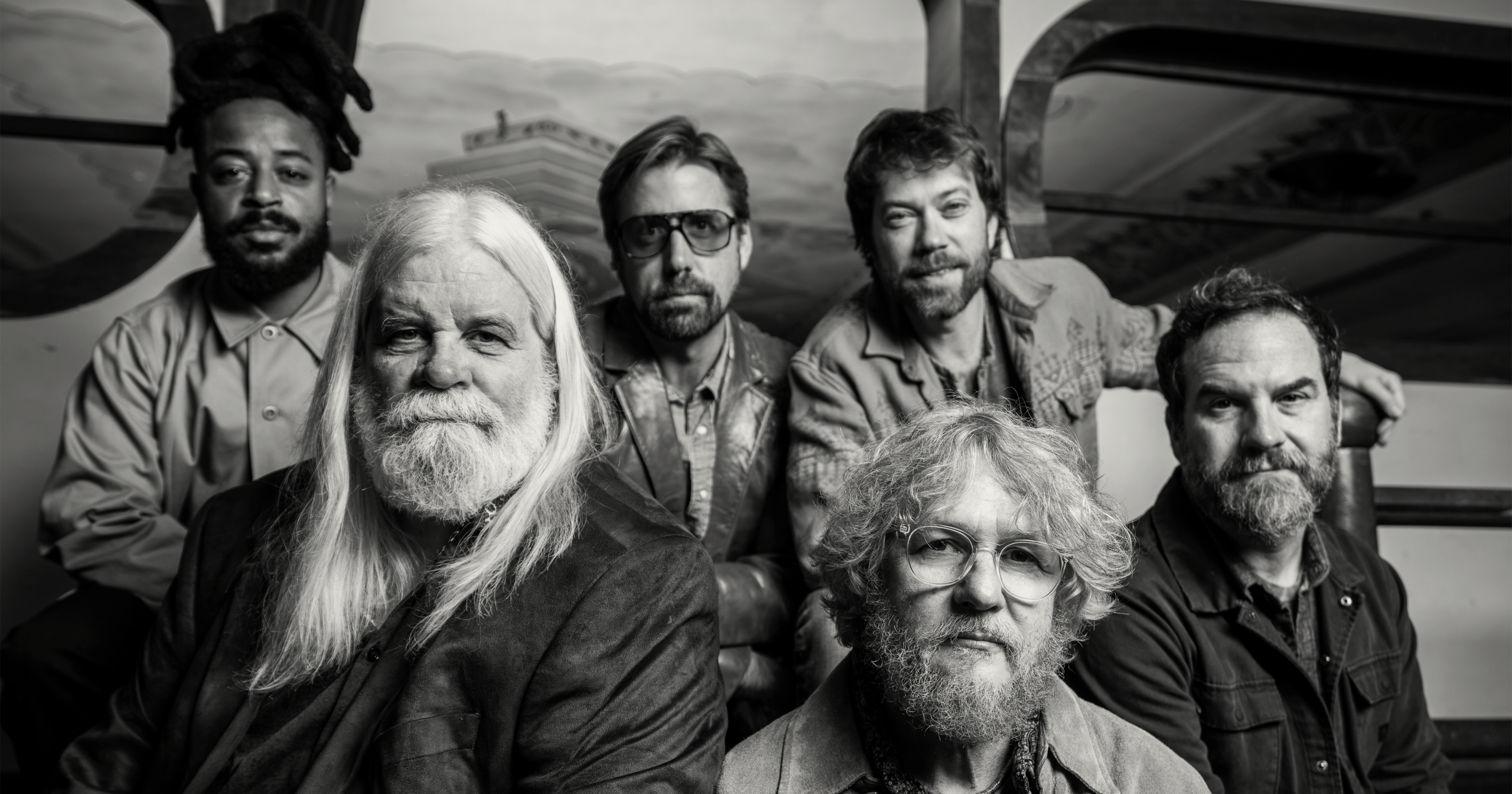
When it comes to the rich, vibrant musical landscape that is American music, few bands have the sonic range, technical capabilities and curious prowess as that of Leftover Salmon — bluegrass to blues, country to Cajun, rock to roots, jazz to jam.
And it’s that jam element at the melodic core of Salmon. They jam under the cascading snowflakes atop a Colorado ski slope or with beads of sweat rolling down their faces in the backwoods of Florida. They jam early in the morning or way late into the night. They jam for massive crowds or simply for themselves. What matters most is the music and where it can take you, onstage and on the road.
Though Salmon is in the midst of its 35th anniversary celebration, the actual timeline goes back four decades, where, in 1985, a young guitarist named Vince Herman took off from West Virginia in search of the “mythical bluegrass scene” in Colorado.
His quest eventually led him to a bar in Boulder one night, the same evening a talented multi-instrumentalist, Drew Emmitt, was performing onstage in the Left Hand String Band. The sign on the door said “Live Bluegrass Music Tonight,” so Herman strolled in.
From there, the duo became inseparable, ultimately joining forces in 1989 to play a New Year’s Eve gig in Crested Butte under the name Leftover Salmon (a combination of Emmitt’s band moniker and Herman’s short-lived Colorado group The Salmon Heads).
With Salmon’s latest album, Let’s Party About It, the outfit once again rises to the occasion, providing soothing, feel-good tunes that radiate gratitude, graciousness, connectivity and compassion in a modern era of uncertainty, confusion and fear.
Backstage before a show in Asheville, North Carolina, Herman and Emmitt talked at length about the road to the here and now. In simplest terms, Leftover Salmon is currently riding a big wave of popularity and cultural importance — a high-water mark of its legend, lore and legacy.
What spurred you to go to Colorado in 1985?
Vince Herman: It was fall [in Morganton, West Virginia]. It was getting cold in this place I was living, which was in an attic of a house that we were remodeling. It didn’t have any heat. I went to college there [at the West Virginia University] and had six credits to go. I kind of ran out of motivation and it was getting cold. We just figured it was time to do something else.
Why Colorado?
Well, it was the bluegrass scene there. I was playing a lot of old-time and some bluegrass in West Virginia. And I knew there was a progressive bluegrass scene based around the Telluride Bluegrass Festival. The band Hot Rize was in Boulder, which was a major influence on me. So, I figured Boulder would have a good progressive bluegrass scene. And it sure did, proven by pulling up and seeing a “Live Bluegrass Music Tonight” sign [at a bar].
Did you drive across the country by yourself?
No, I came across with a guy named Lou Pritchard. There’s all kinds of Pritchards in the music business. He’s a teacher [now] in southern West Virginia. So, I threw the dice and sold a guitar to make the trip. We lived the first week in a storage shed. We rented it. It was a storage shed, but hell, it had power, you know? [Laughs] The plan was, “Let’s go to Colorado and see what happens.” Lou was thinking about starting a brewery because small breweries were just made legal. I ended up getting a job cooking in a restaurant and just playing tunes on the Boulder Mall. [Back in West Virginia], I was playing for free beer and somebody’s wallet, played a little bit in a Grateful Dead band called Nexus. But nothing professional in any way.
Were there aspirations to start a band and really give it a go?
Yeah, definitely. It was, “Go to Colorado and find like-minded players.” I didn’t know for sure whether I’d have a music career, but other things were totally unsatisfying. I’ve had a lot of jobs, man. I’ve been a cook, bartender, fisherman, roofer, painter, landscaper. I’ve done all the jobs you can imagine. But this is by far the best.
So, your first night in Boulder, the stars align. You walk in on a bluegrass jam and run into Drew, who’s been with you since that moment.
VH: Yeah, it’s been 40 years. I said hello [to Drew] that night and, I guess, it was probably six or nine months later I was in the Left Hand String Band. I did about a year there, and then they got a better guitar player. So, I started The Salmon Heads after I got kicked out of Left Hand. [Laughs]
You told me one time that if you tried out for Salmon now, you wouldn’t get in.
Oh, for sure. Definitely. My philosophy has always been to be the worst player in any band I’m in. So, it has served me well over the years. [Laughs]
So, New Year’s Eve 1989, you form Leftover Salmon.
We went through every combination of those two band names — Left Hand String Band and The Salmon Heads — and stuck with Leftover Salmon for the first night, never knowing it would be any more than one night of a gig [in Crested Butte]. The older the tune, the more the bluegrass stomp kind of thing would go on, people would slam dance. We were like, “Something’s good about this.” And we had a bunch of gigs the next morning. All the bar owners talked to each other. There was no plan [to form a group], but we got all those calls the next morning to book the band.
[Drew Emmitt enters the backstage area and sits down.]
What about for you, Drew? You and Vince have been together for 40 years. What was it about Vince that you felt this was a guy you wanted to play with?
Drew Emmitt: Well, I came from more of a bluegrass-serious kind of world. And I always loved the lightness that Vince always brought to the music, all the fun. Playing music with him was always fun, and singing with him. He’s got a very powerful voice. We both sing kind of loud, so we sing well together. The lightness and the fun factor — that’s what, in so many ways, has driven this band. It’s just always been fun. I can’t tell you how many times I’ve been onstage just laughing hysterically because there’s so much madness going on.
I’ve been following you guys for almost 20 years and, no matter what kind of day your day is, you’ll always have fun at a Salmon show. And it seems, lately, that there’s a reinvigoration in the band, a few more logs being thrown on the fire.
VH: Absolutely. Jay Starling on keys, dobro and lap steel adds a great element to it, you know? And [drummer] Alwyn [Robinson] and [bassist] Greg [Garrison] together in the rhythm section. It just brings such energy to it. And Drew, [banjoist] Andy [Thorn] and I just get to ride on that stuff.
What is it about Drew that works for you?
VH: He’s relentless, man. (Turns to Emmitt). You hit that mandolin and just get that tremolo going — nobody like it. It sure gets a crowd riled up.
You have a new album out. What does it mean that people still believe in what the band is and what the band does?
VH: Hot Rize was a real major influence. I saw Tim [O’Brien] and was like, “Okay, so we’ll be in this little musical niche.” It’s never going to be the Rolling Stones or Pink Floyd level kind of stuff. But, it could be this niche that I could age in and stay in, and be able to do it for a long time. That’s kind of what the folk/bluegrass world looked like to me. I just feel very lucky to have kind of imagined that so many years ago, and to have actually lived it. It’s pretty unusual and I’m incredibly grateful.
What’s been the biggest takeaway from this journey thus far?
DE: The fact that people are still coming to see us. And it’s still working, and actually working better than it ever had. The fact that we can keep playing this and that it’s still relevant. And there’s this scene that has built up around this music. There’s a lot of different bands out there that are building the momentum, [with] probably the main driver of that would be our buddy, Billy Strings.
And you guys blazed a lot of that path Billy’s walking on.
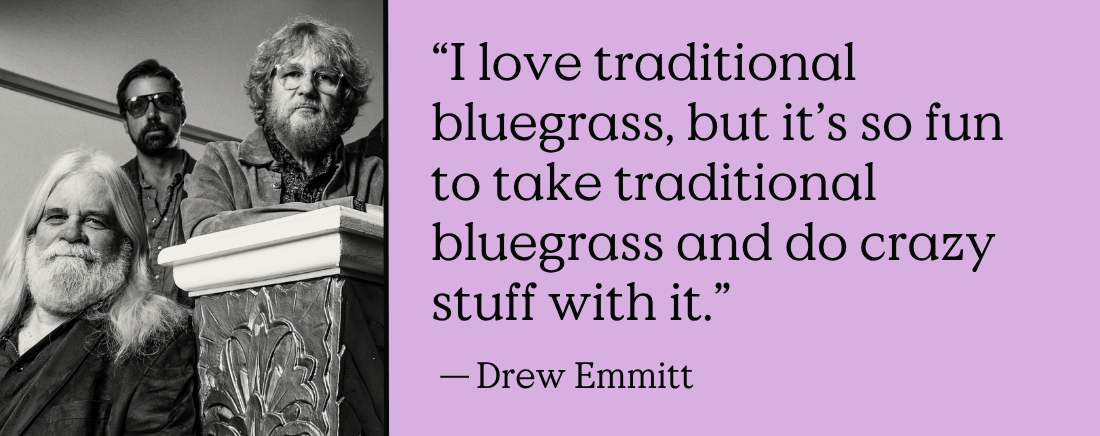
DE: And we followed in a blazed path. We came up behind the people that blazed it for us. And then we contributed our part of it, which was maybe adding a little more rowdiness, a little more rock and roll. But, keeping with that progressive thing that we learned from Hot Rize, New Grass Revival, Nitty Gritty Dirt Band, Old & In the Way — bands that were pushing the limits of bluegrass. I love traditional bluegrass, but it’s so fun to take traditional bluegrass and do crazy stuff with it.
Traditional bluegrass gives you the tools to do whatever you want.
DE: Exactly. Because it’s an art form, and you’ve got to learn it if you want to play bluegrass, which I’m still working very hard at, trying to learn to how to do it. What this band has brought to the scene is a levity, a fun factor. Over the years, so many of these amazing musicians have sat in with us, and they always have such a good time because it’s just wide open. Like, for instance, when Sam Bush sits in with us, he has such a good time ‘cause we just let him go.
Is that by evolution or by design, that ethos?
VH: I guess it has a lot to do with the Grateful Dead. You know, really saying, “It’s okay to have fun with music.” Go out looking for stuff in the middle of a jam. It gave us permission to do that, and [the Dead] brought so many people to bluegrass.
DE: And I hope we can keep doing it for a while. I hope that I can keep looking across the stage and seeing Vince for a long time. I’m glad to still be onstage with this guy. [Turns to Herman]
VH: I just keep being reminded of the importance of community, and helping us all get by with this [music]. Thank God we have music in the midst of all this chaos [of modern society], something that brings people together under a positive banner, and reinforces the humanity in all of us — there ain’t nothing better than music to do that.
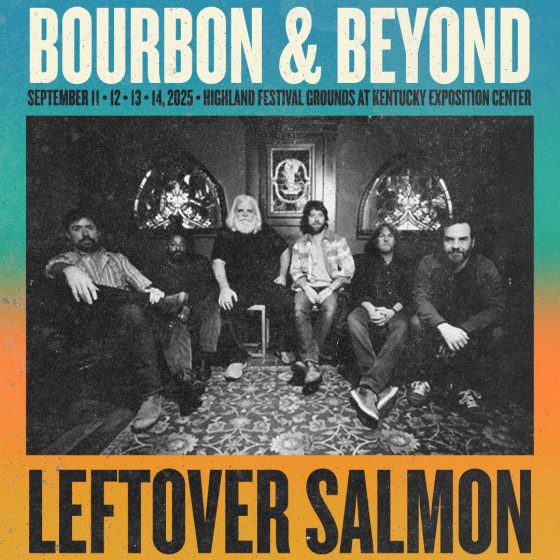
Editor’s Note: Don’t miss Leftover Salmon and so many other great artists on the BGS stage at Bourbon & Beyond 2025. More info at bourbonandbeyond.com.
In the wake of several viral country songs released in 2023 – most notably the ill-conceived pair of Jason Aldean’s “Try That in a Small Town” and Oliver Anthony’s “Rich Men North of Richmond” – renowned author and country journalist David Cantwell penned an essay for TIME magazine with an absolutely stunning (while quite simple) observation included. Cantwell considered place, citizenship, and ownership. To whom does the “small town” belong?
“…For most of today’s country fans that small town isn’t TV’s tiny Mayberry; it’s a suburb or exurb of some decent-or-giant-sized metro,” Cantwell explains. “I wish more country songs would talk about that proximity, how city folk and small-town folk flow back and forth for work and fun – and are very often the same people.”
And are very often the same people. Humans don’t live their lives along strict, black-and-white boundaries and borders – no matter how often society attempts such demarcations. Our lives are lived in the gray, in the blurry in-betweens, as collections of many disparate and often dichotomous parts.
Singer-songwriter Olivia Ellen Lloyd is just such a person, caught up in the nebulous purgatory between rural and urban, city folk and country folk, doing it for herself and doing it for ambition. Her brand new independent album, Do It Myself, finds Lloyd with a sense of confidence that could only be earned through a hard-working, bootstraps approach to making music – a mindset that, whether within or outside the arts, is well known to West Virginians like herself.
After a stint living in Nashville, Lloyd returned to New York City, following up 2021’s fantastic Loose Cannon with the heartfelt, sensitive, and often point-blank songs of Do It Myself. Like Loose Cannon, this material is danceable, country, honky-tonkin’, and bluegrassy while it boasts deft and majestic moments of WV DIY, punk, and rock and roll. After crisscrossing the country proffering her art, Lloyd seems to have realized that being both a city person and a country person is never a drawback, it’s a superpower. Having her feet in NYC, her heart in West Virginia, and her work anywhere and everywhere, Lloyd has clearly determined it’s not a dilution of the “authentic” or roots-music-ready facets of herself to straddle these arbitrary borders and own that duality.
As a result, Do It Myself is remarkably successful. Like Hazel Dickens in D.C. or Dolly Parton in Nashville or Tina Turner in Memphis, Lloyd has found her voice and found herself not by running from who she thinks she can’t be anymore, or editing out the parts of herself that don’t seem to “fit” with country tropes and perceptions of good ol’ American rurality. Instead, she’s reached this current era of music making by resting easy – or not so easy, at times – in the knowledge that the best she can do as a singer-songwriter-artist is to be herself, whoever that is, in the truest format possible at any given time.
We began our BGS Cover Story interview by discussing that ongoing search for herself and how that particular journey shows up throughout Do It Myself – in the lyrics, sonics, and beyond.
It feels like your music in general, whether we’re talking about Loose Cannon or the new album, Do It Myself, you’re most often turning over the idea of finding yourself – and not that that’s a static thing to be found. It’s not that you find it once and you’re done finding it. Your music orbits around these questions of, “Who am I? Is this me?” I feel that really strongly in this record. So, as you’re releasing this album I wondered, who is the self you have found? And how goes the search for yourself?
Olivia Ellen Lloyd: I think what’s really interesting is I don’t know that I would’ve put a finger on that until recently. I’ve also come around to the understanding that that is what my music has done, which is help me come back to myself and find myself. I would say it’s currently going pretty well, but boy it has been a journey to get there.
I think writing this record, I was much closer to her – to me – when I started writing this record, but I wasn’t as close as I thought I was. It’s taken not only writing it and realizing that I wanted to put it out and all that stuff, but also deciding to self release it and deciding to continue to champion my own work where I’ve truly found that. That, “Oh there she is!” [feeling]. I feel very recently like I have arrived at the person that I’ve been looking for and that’s exciting and also really scary, because boy, has most of my work orbited around, “What the fuck happened? How did we get so lost?”
I once was lost, but I’m pretty found lately.
How do you feel about writing songs that are so personal and that are so much about growth, introspection, and questioning and then having to carry them around on your back for a year or two or three on tour – or for the rest of your life! How does that process feel to you or that emotional or mental understanding?
Interestingly, at least with my first record, I think I wrote often with no aim, so there were no expectations. I mean it’s funny, Justin, because you are one of the few people in the music industry and in my music world who knew me when I was writing many of these songs, but not performing often. The process of writing was very much a way to try and tune into this inner voice that I’ve been learning to listen to. It was an attempt to get in touch with myself, which I really have struggled to do for various reasons throughout my life.
I think I’m also quite an impulsive person, historically, and I have a lot of tattoos – a lot of stupid tattoos – and I kind of think of these songs, especially the personal ones that no longer represent [me like tattoos.] I don’t drink anymore really – I wouldn’t say that I’m sober, but drinking is not a big part of my life anymore – and all of Loose Cannon and much of this record involves talking about those moments in my life. But I have this tattoo of a possum drinking a High Life. That’s not who I am anymore, but that was a part of how I got here. When I think about these personal songs that involve a lot of myself and a lot of what’s really going on I think, “Well, that’s a part of the patchwork,” but it doesn’t have to be – luckily – the whole story or the end of the story, either.
The way that you’re utilizing so many different roots styles, it’s disarming of a listener, so you can have a danceable, honky-tonkin’ track that’s still lonesome as fuck, tear in your beer. It feels like it can still be very country, very Americana in the way that it is melodramatic, but it still feels grounded in reality.
I think that playing with genre in the same way that we experiment with different sidemen and co-writers is just another tool that we can use. I see a lot of artists, especially right now, there’s just so much pressure to hit. There’s so much pressure to hit on a vibe, hit on a moment. Part of the joy of this is playing in those in-between spaces and finding something unexpected.
Come on, if we’ve got Dolly and Patsy and Loretta, they did a lot of the groundwork so we should get to play around that space! We’re not gonna outwrite or outsing those women, we simply cannot, so the opportunity we have is to explore. I don’t wanna go back. I don’t wanna go back to any type of past anywhere. The future is scary for me, but I’m really curious about what could come next, after those things, and how we can develop those sounds.
You’ve spoken on social media and on microphone about your approach to genre and how so much of it comes from growing up in West Virginia having this agnostic approach to genre aesthetic, on a practical day-to-day level. You’re doing West Virginia music, you’re bringing in Nashville, you’re bringing in New York City. Can you talk a little bit about that?
For the first record I got the feedback that you can hear the country and the city kind of intermingling together and someone was like, “This [new] record feels like so much more New York.” I think I understand where people are coming from, but actually I think what’s happened is I built a musical community in New York City around bluegrass, which I think is one of the great community music forms. It is a great way to bring people together. I’m so grateful that I knew a bunch of those songs and then I got better with those songs and then I met people who were passionate about that music. But actually, this record was more about digging into the sounds that I grew up with. I grew up going to DIY punk shows, I grew up with my dad listening to the Grateful Dead, the Band, some Jerry Jeff Walker, Nitty Gritty Dirt Band.
I think this record really returns to a landscape that’s more true to how I was raised, which was eclectic, a little bit daring, and a little bit more rock influence. I think I’ve been quoted once and I’ll say it again, I think the reason that the places in West Virginia gravitate more towards that kind of music is because music got gentrified and country became this bizarre fascist, patriotic propaganda wing of the Republicans and of government.
If you are not one of those things, if you were not a kid who could afford to go to Berklee and you were not somebody who was all that proud to be a fucking American in the 2000s, you likely grew up listening to a lot of that. Especially in rural places, you likely grew up listening to a lot of punk, a lot of rock, a lot of indie pop. Like many people do, I walked way far away from that stuff and dug into the roots of country and folk and bluegrass. I swirled around in that stuff for so long, and then I came back to myself; I came back to the first music that really inspired me and felt less academic.
In my opinion, the most interesting part is all of those genres coming together. I do think that I’m very wary of anybody who talks about “good folk music” or “real bluegrass” or anything like that, because typically some very nice man in a fisherman sweater in New England has told them [to think that way]. I learned to like music the way that most normal people learn, I just listened to it and I didn’t worry about whether I was listening correctly or not. I think we gotta return to that.
Community has come up multiple times already in our conversation and I know how important community is to you – how pivotal it’s been in your musical career. How do you balance the “doing it for yourself” with the “doing it with community”? How do you do it for yourself and trust yourself and give yourself permission to be who you are and take up space to do it your own way, while also being a member of a community and doing it for the collective at the same time?
Have you been listening to my therapy conversations? [Laughs] I struggle with deep individualistic tendencies. I have a tendency to be like, “Fuck it.” That can also be bad. Notably, have yet to accomplish a successful relationship, because of this thing I do. “Fuck it, I’ll deal with it myself. I’ll just do everything myself. I will stop relying on you. I don’t need to rely on anybody for anything.”
I hope it comes through in the music that many of my songs, including “Do It Myself,” include enough self-awareness to know that I’m talking about choices that I’m making and things that I’m doing and they are not always the healthiest choice or the best choice. That’s okay. I think there’s a side of this where, yeah, I have been way too [self-reliant]. As I sit here selling shows out, opening for Jeff Tweedy, and unable to get a booking agent or a manager. Yes, I have isolated myself a little bit too much for people to be paying close attention.
Certainly “doing it myself,” in this context, many people told me to wait to put this record out. Maybe that would’ve made sense for a more reasonable person, but I think this is really important: Your community is everything. You need to be able to trust that the people around you are people who are willing to let you show up like however [you are]. In the last two years, I have focused so hard on surrounding myself with people who I know I can trust to both keep me honest and on my shit and love me through mistakes and they will engage in conflict resolution. They will be gentle with me and like I can do the same for them.
It’s not possible to be self-sufficient, emotionally, creatively, if you do not have a community that supports that in you.
I love that on the album you have “Live With It” back-to-back with “Do It Myself.” I think it’s pretty striking, they’re kind of a reaction or a response to the other – and vice versa. That line, “If this don’t kill me…” feels like such a natural lead in to “Do It Myself.” I wanted to ask you about “Live With It” and also about that placement of those, like bookends.
Thank you for asking about “Live With It.” My producer Mike Robinson is gonna be so happy and that’s his favorite song on the record. I mean, that’s my pandemic [song]. The chorus of that song I wrote during the pandemic. Looking back, it was probably also the worst point in my life for my drinking. I was at a point where I was not in control. Things were so bleak that it was like, what’s the point of trying to slow down or get a handle on it? There was no future to look forward to.
But by the time I finished the song, what I really hoped to accomplish is [communicating that] there are many times in our life where we have a pessimistic view on our own personal outcomes. We’re not really convinced that things could get better and yet there is an interesting tendency with human beings, we just keep going anyway most of the time. I find that to be both very curious and also something that is inspirational in its own way. We can continue to live and survive through unsurvivable things, even when we don’t know entirely why or how. That’s what “Live With It” is about. It’s four people experiencing something that they, for whatever reason, don’t see why they have to live through it or how they’re going to, but they do.
I also love the feel change in “Every Good Man.” So good. It’s nasty. That song is a bit like “Stand By Your Man,” playing with country tropes in a really fun way, but that feel change – I think I made a stank face just listening to it. Can you talk about that one a little bit?
Once again I just have to say, I think a lot of what you hear and the really cool musical stuff is owed to the creative partnership that Mike Robinson and I have. I can’t say enough good things about him. I met Mike at a fucking bluegrass jam and he was playing the banjo, which is like his fourth instrument, you know? I think these days he mostly makes money as a pedal steel player. Everyone is sleeping on his ability to play the acoustic guitar. Like, truly.
I met Mike six years ago now and out of the blue he coached me into a music career. He would deny that, but that is 100% what happened. He bullied me into it. And something I really love is that I can bring songs to him and he finds exactly [how it should sound], especially when he’s excited about the songs. Both “Every Good Man” and “Live With It” were definitely high on his list of loves. He finds these like beautiful moments and we have such a similar [approach], we were raised on the same music. For “Every Good Man,” that feel change came from some moment in a John Prine song.
Another song that I really like – it might be my favorite – is “Knotty Wood.” It feels like country. It feels like church. The lyric, “Who says memories can’t be bought? We always sold ours for a song…” grabbed me. You’re talking about how we compare and contrast and measure ourselves against other people and our perceptions of other people’s lives. “Don’t they look good when you paint over the pain and knotty wood?” It’s such a great hook. I love the imagery of it. I love that it takes me to my grandma’s house. But I feel like it begs the question: Do you ever worry that in synthesizing your experiences, putting them into songs, and taking them to the world that there’s any part of that process that is also “painting over the knotty wood”?
Yes, and my mother would definitely say yes. The genesis of that song actually came from my mother and I growing up in the same small town. I grew up a mile from [where she grew up] and from our home to her childhood home it was less than a mile. That house, my grandparents’ house, I spent probably two days a week there and almost every day after school I walked from my elementary school to my grandparents’ house. It was my home, too.
It got sold after he died, we couldn’t hang onto it. It got sold again during the pandemic by an actually really lovely woman. She started renovating it on Instagram and I watched this place that held generational memories be stripped in some cases to the studs and rebuilt. It was pretty public. I felt a sense of ownership of our place – that I do not factually own and never have – that got me. Being curious about place and home made me think about the journey my grandparents went on to become property owners and to become middle class. And about that moment in the height of prosperity in the ‘50s, all the things my grandparents sacrificed.
I think the song is about thinking about those generational ties, thinking about the things my grandparents sacrificed, and did not sacrifice or did not give away. I’m also thinking about how, especially right now in this weird American moment – “Don’t other people’s lives look good when you paint over the pain and knotty wood” – how many people want to talk about their humble, hardscrabble beginnings without having to actually live them.
There are so many other reasons why it’s taken me so long to get here, why it’s taken me so long to put my songs out. But it all revolved around the generational trauma of growing up relatively poor and with people who had to give up everything in order to get anything.
You can’t have it both ways. You can’t have the small-town, Appalachian upbringing and also have the confidence and gumption of [privilege]. I mean, it’s rare. It happens, but you don’t often then also come equipped with the gumption to believe that you have the right to be a fucking artist. All my grandparents wanted was just a nice home in a small town.
I’ve been hustling, self-promoting my own art and music, and in a desire to attain the things that the people I’m criticizing have attained, we get to the third verse. … The crux of that song is, I think, a way more interesting story than “rags to riches.” It’s middle class to rags.
I mean, my grandparents went to war so they could get an education, right? My grandfather’s nickname was “Bones,” because he was so thin he looked like a bag of bones. The trajectory of their lives into middle class comfort is astounding, and the way that his grandchildren and children are sliding back into poverty is much more so. It’s much more true to what is happening in this country than this “rags to riches” bullshit that we are still being asked to sell, but it’s trickier to talk about.
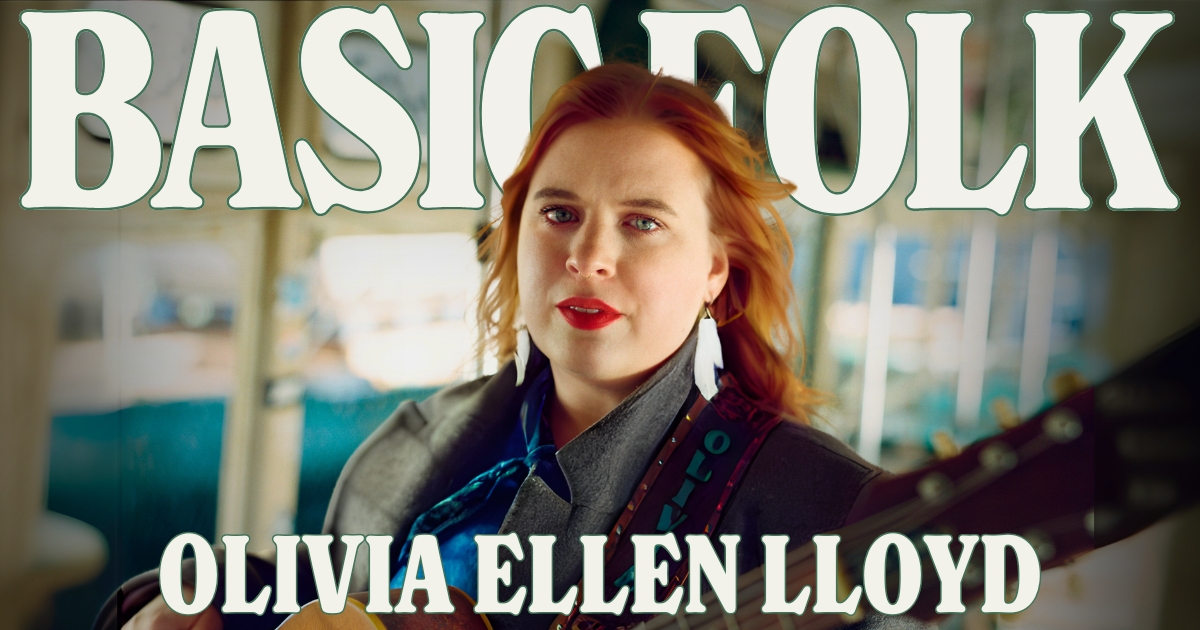
Olivia Ellen Lloyd‘s latest album, Do It Myself, sees the West Virginia-born, Brooklyn-based songwriter reflecting on the powerful imagery of water. She shares how it has been a source of grounding and calmness in her life; from childhood memories spent on the Potomac River to her current love for the ocean, these elements have shaped her artistic journey. In an interesting twist, it was her friends and family that pointed out that she’s always trying to get around water. From there, she reflected on the positive impact that being in and around water has had on her mental state.
Olivia also opens up in our Basic Folk conversation about her complex relationship with her hometown of Shepherdstown, West Virginia, where she’s experienced both hardships and good memories (her grandfather was actually the mayor and there’s a street named after him). Ultimately she decided to leave, but she still spends about half the year there. She talks about how, especially on the new album, her sound is impacted by the duality of small-town life versus her evolving relationship with New York City. We also discuss the foundation of her musicality, which was strongly influenced by her late father, who stressed the importance of learning music by ear. As she navigates her identity as an independent woman in the music industry, she discusses the challenges of societal expectations and the importance of self-reliance. With humor and vulnerability, Olivia Ellen Lloyd explores themes of resilience, love, and the struggles many women face in finding their voice and place in the world.
Born out of humble beginnings in 1983, Mountain Stage has blossomed to become not just one of Appalachia’s most sought after musical platforms, but one of all of Americana and roots music’s most cherished stages. Broadcasting bi-monthly to nearly 300 NPR stations nationwide, the program has welcomed everyone from John Prine to Wilco, Wynonna Judd, and even Widespread Panic during its historic 40-year run. To celebrate the achievement, Mountain Stage and Oh Boy Records have partnered to release the 21-song Live On Mountain Stage: Outlaws and Outliers (released April 19).
According to Larry Groce — Mountain Stage host from 1983 to 2021 and one of the compilation’s curators — distilling 40 years of music into one album was quite the task. Deliberations began with a list of over 150 songs before landing on the 21 that made the album.
“At first we just looked at the artist named and began to narrow it down from there,” Groce describes the process to BGS. “After several narrowings we began listening to some of them, getting the list down to about 30 before cutting it further down to the 21 that made the album.”
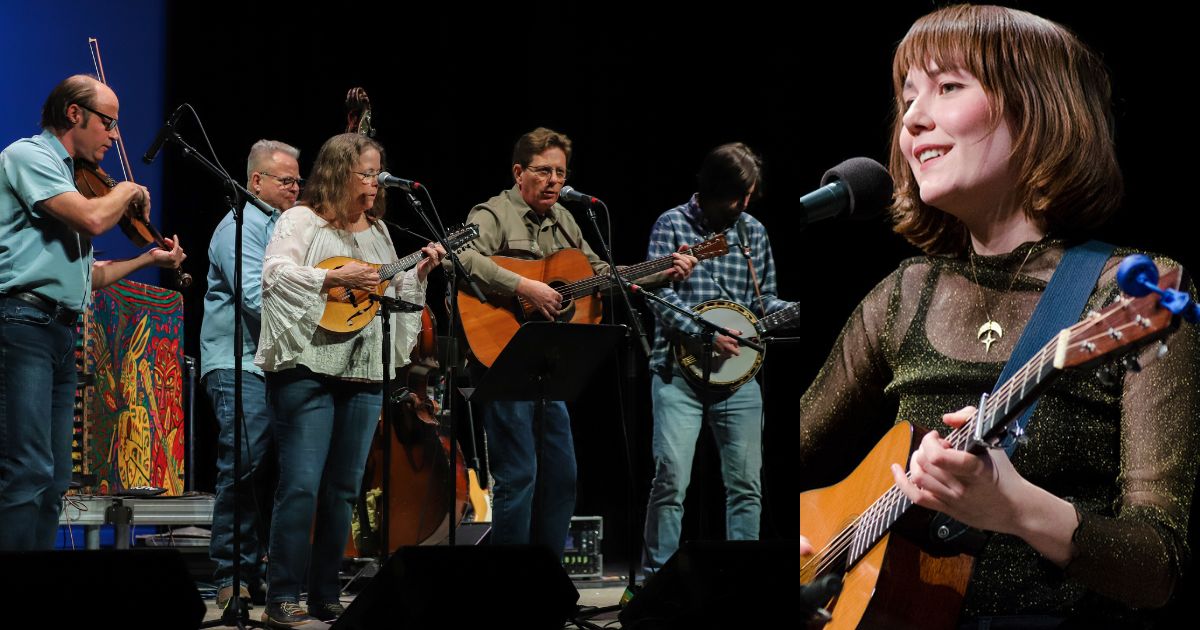
Sticking close to the country, folk, and bluegrass sounds of the show’s West Virginia home, the album includes performances from Appalachia’s own – like current Mountain Stage host Kathy Mattea, Tyler Childers, Sierra Ferrell, and Tim O’Brien alongside A-listers like Prine, Eric Church, Alison Krauss, and Jason Isbell. Helping to attract and keep such a diverse array of talent returning has been the program’s artist-first approach, which caters to the performers and platforms great songs over all else.
“We’re not trying to be trendsetters and we aren’t trying to be hip,” asserts Groce, who broke onto the scene as a singer-songwriter with his song “Junk Food Junkie” in 1976. “We try to look at things in the long run by booking talent we think will last. Our goal has always been to put the artist at the center of the show rather than myself, the program, or anyone else. There’s people that would argue that we should always be pushing the brand, but that’s not the way we — or anyone else — operates in West Virginia.”
One of the many artists appreciative of that approach is Molly Tuttle, who last appeared on Mountain Stage in 2023 to support her album City Of Gold, which has since earned her a second Grammy win for Best Bluegrass Album. Born in California, Tuttle didn’t become aware of the show until moving to Nashville in 2015. She’s gone on to play the show three times, the first being a visit in 2018 that provided the performance of “You Didn’t Call My Name” that made the compilation.
Of the show, Tuttle says what she’s cherished most about her time on it is the chance to collaborate and catch up with her colleagues.
“It’s one of the few places where you get to meet, converse and collaborate with other musicians, which typically only happens for us on the road at music festivals,” explains Tuttle. “That really speaks to the trust Larry Groce and the entire Mountain Stage team have in giving the artists freedom to do what they want. What results is a well curated show that’s become one of the most important showcases around for this kind of music.”
In agreement with Tuttle is Tim O’Brien, a native West Virginian who made his Mountain Stage debut in the late ’80s with Hot Rize, an occasion he credits to his mother that has sparked too many follow-up visits to count.
“She called my sister and I — who were living in Colorado at the time — to tell us about it after hearing about it on the local radio back home,” recalls O’Brien, whose song “Cup Of Sugar” from a 2021 appearance is featured on the record. “She immediately thought we’d be a good fit for it, so she wrote them a postcard one day asking when they were going to get Hot Rize on. It was a good fit the first time, and always has been.”
“I remember writing her back saying ‘Your son’s band is much more famous than we are,” Groce jokes as he looks back on the moment. “The question is, does he want to go on the show, not whether we’ll have him or not. And sure enough, we booked Hot Rize shortly thereafter.”
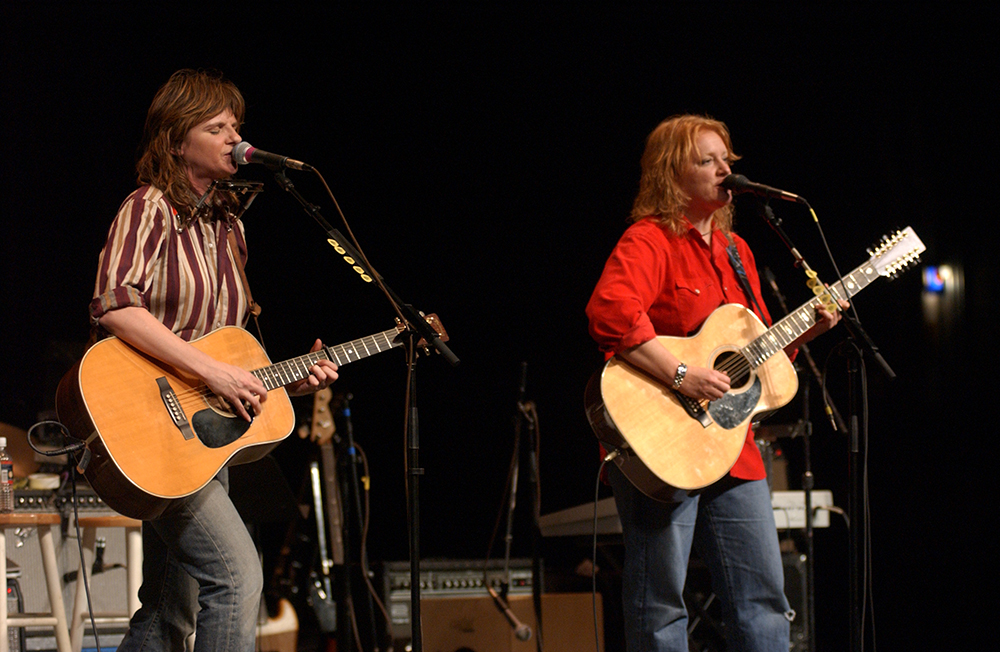
The Indigo Girls perform on Mountain Stage. Photo by Brian Blauser.
It’s that attitude of never feeling above anyone or anything that has helped Mountain Stage to excel and have the lasting legacy that it does. It captures its home region of West Virginia and Appalachia better than most any other music-related program does, both in sound and in sentiment. It’s the latter that’s arguably been the biggest asset in attracting bigger names as the show taps into the majestic mountains around them.
“There’s many different kinds of people that live in Appalachia, but one thing that’s really bedrock is supporting one another, and that shows with Mountain Stage and how they put the program on,” reflects O’Brien. “It’s intimate and friendly, just like the state.”
Photo Credit: Tim O’Brien Band performing on Mountain Stage by Chris Morris; Molly Tuttle performs on Mountain Stage by Josh Saul.
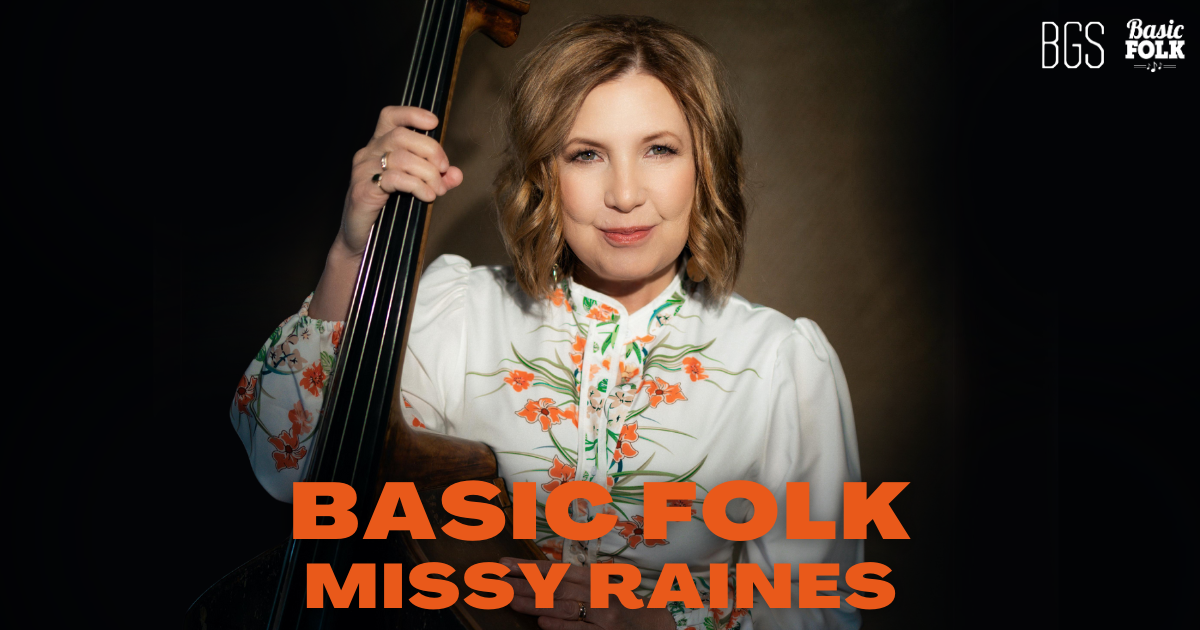
Acclaimed bluegrass musician Missy Raines is also a very cool and funny lady, originally from West Virginia – not far from the Maryland border and the city of Cumberland. First of all, I had questions for her about why people from West Virginia are so into their state. She gets into that and also explores the influence of the vast and varied bluegrass music scene she found there, as well as the scene in nearby Washington, D.C..
Raines has made a significant impact on the genre, earning 14 International Bluegrass Music Association awards, including 10 for Bass Player of the Year. Her latest album, Highlander, showcases Raines’ mastery of the bass alongside an ensemble of top-tier musicians from Nashville – her home base for the last 34 years – and plenty of special guests, too, blending traditional bluegrass with innovative twists.
Throughout our conversation, Raines reflects on her deep connection to Appalachian culture and the Appalachian Mountains, which have profoundly influenced her music. We explore her experiences performing live at music festivals and the evolution of bluegrass music as a genre and community. We recount the passion her family felt for music, touching on the story of her mom and aunt crying their eyes out over John Duffey leaving their favorite bluegrass band, The Country Gentlemen.
Raines also talks about taking care of her late brother Rick, who died of HIV-AIDS in 1994 at the age of 39. Through that experience, she was empowered to help others whose loved ones were also dying and suffering from HIV and AIDS. With her unique blend of banjo and fiddle music, and her activism in a normally conservative genre, Raines continues to push the boundaries of the genre while staying true to its roots, making her a trailblazer in the world of Americana and folk music. Our conversation was in depth, fun and enlightening – I had high hopes for this one and I was not disappointed!
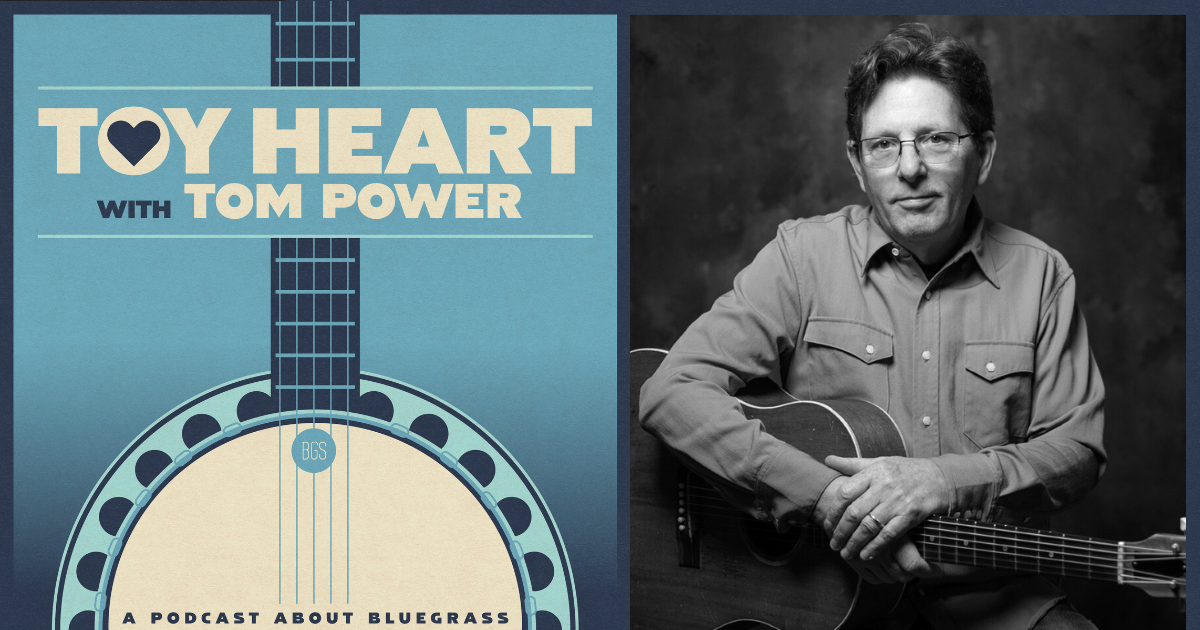
Our latest guest on Toy Heart is bluegrasser, multi-instrumentalist, and songwriter Tim O’Brien. His conversation with host Tom Power begins by remembering the music of his childhood, growing up in Wheeling, West Virginia listening to Chubby Checker on his crystal radio set and attending the nationally renowned country variety show and radio broadcast, the Wheeling Jamboree. Encountering the music of Merle Haggard and Doc Watson via local radio and television, he fell in love with music as a kid before a few friends introduced him to Bill Monroe’s mandolin playing while smoking a post-gig joint as a teen.
After dropping out of college, O’Brien hitchhiked west to Wyoming, before landing in Colorado and eventually founding Hot Rize in the mid to late ‘70s with newly married and relocated Dr. Banjo himself, Pete Wernick. Over the course of their winding and dense conversation, Power and O’Brien chat about Gibson mandolins, the burgeoning Colorado string band scene, working with Bill Monroe, and the strange, circuitous story of his fiddle’s provenance.
O’Brien’s career, as multifaceted as it has been, is a wellspring of stories, anecdotes, and yarns about the bluegrass scene of the ‘80s and ‘90s, Irish music, writing hit country songs, working with and alongside so many first generation bluegrass legends, and the inception of Hot Rize’s alter ego band, Red Knuckles & the Trailblazers. Having recorded and performed with the Chieftains, Darrell Scott, the Transatlantic Sessions, and so many others, Tim O’Brien’s career is a melting pot of styles and sounds with one primary throughline: the true originality of his own musical vocabulary. As Power puts it, “I couldn’t tell you what Tim O’Brien sounds like, but I know Tim O’Brien when I hear it.”
Our Toy Heart episode examines O’Brien’s expansive and impressive career at a fascinating juncture in its span, as he shifts from being a bluegrass and Americana workhorse to a forebear, mentor, and roots music elder to entire generations of young musicians.
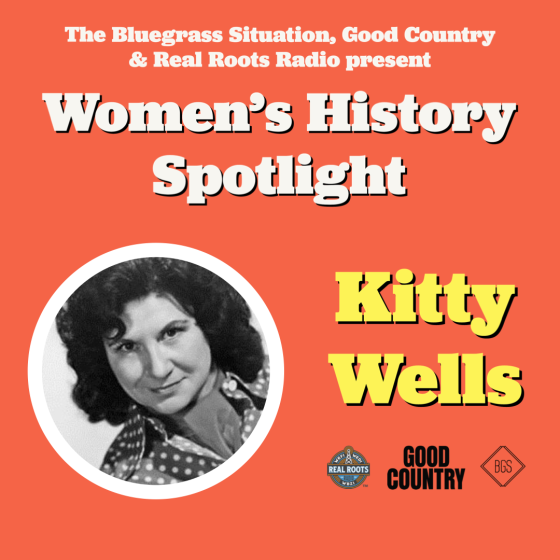
March is Women’s History Month, and BGS, Good Country, and Real Roots Radio have partnered to highlight a variety of our favorite women in country, bluegrass, and roots music with our Women’s History Spotlight.
Each weekday in March at 11AM Eastern (8AM Pacific) on Real Roots Radio, host Daniel Mullins will be celebrating a powerful woman in roots music during the Women’s History Spotlight segment of The Daniel Mullins Midday Music Spectacular. You can listen to Real Roots Radio online 24/7 or via their FREE app for smartphones or tablets.
Then, we will have a Friday recap here on BGS featuring the artists highlighted throughout the previous week. No list is comprehensive, but we hope to feature some familiar favorites as well as some trailblazers whose music and impact might not be as familiar to you.
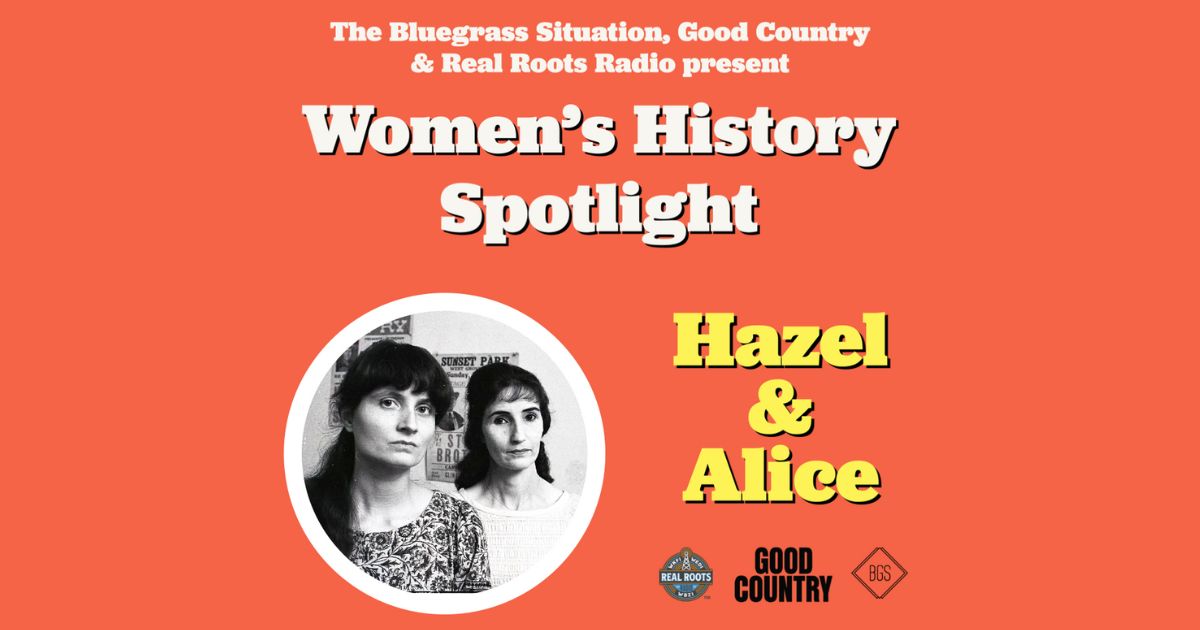
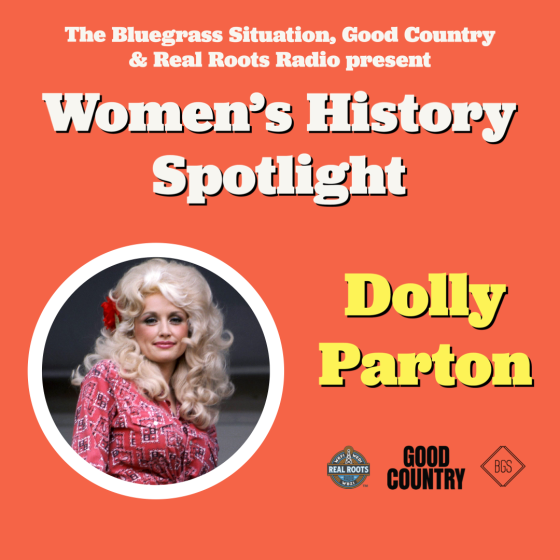
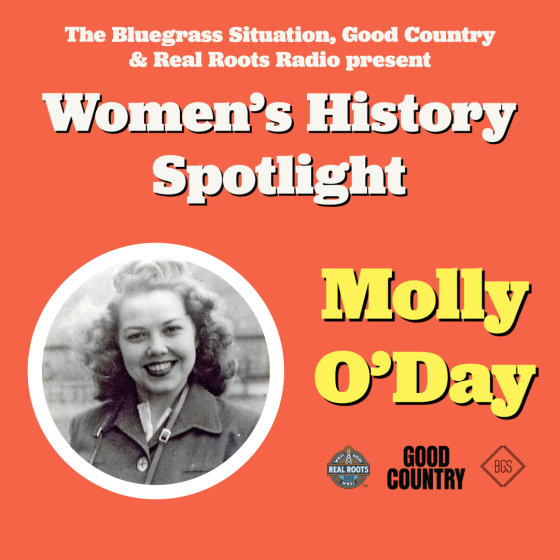
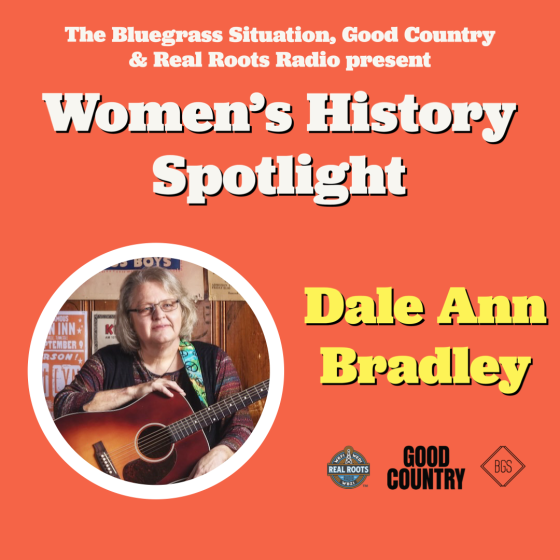
This week’s edition of our Women’s History Spotlight features musicians and artists like IBMA Award winner Dale Ann Bradley, the legendary Dolly Parton, Bluegrass Music Hall of Fame inductees Hazel Dickens & Alice Gerrard, early country hitmaker Kitty Wells, and Kentuckian-West Virginian Molly O’Day. Tune in next week for the final installment of our Women’s History Spotlight!
Dolly Parton
You knew it was coming. You can’t tell the story of country music (or American pop culture) without Dolly Parton. Growing up in Sevier County, Tennessee, she is not just the Queen of the Smoky Mountains, but quite possible the Queen of the Universe (if there was such a ridiculous title). Her rags-to-riches story will continue to be told and re-told for generations. Aside from her beautiful voice and philanthropic work (the millions of books that she gives to children through Dolly Parton’s Imagination Library is her proudest achievement), there are numerous other aspects about Dolly Parton that are remarkable.
Her business acumen is frequently praised, but it still bears repeating. Aside from her numerous endeavors (including Dollywood), it’s often worth remembering that she fought to regain control of her own career and decision-making from Porter Wagoner after her star began shining brighter than his scope of influence. (Remember, it was the ending of this business relationship that was the impetus behind Dolly writing one of her most famous songs, “I Will Always Love You.”) Call it a business decision or just genius, but Dolly’s ability to juggle embracing her role as an undeniable sex symbol and avoiding being labeled as “unwholesome” by conservative crowds has to be one of the most difficult tightrope walks in American entertainment.
Vanity Fair’s 1991 article “Good Golly, Miss Dolly“ did a deep dive into the dichotomy of Dolly’s role as a sort of clean sex symbol: “Dolly, in her openness, demystifies sex. ‘One of the things that makes the image work is that people understand that I look one way, but am another, that there’s a very real person underneath this artificial look,’ she theorizes. ‘It’s not like I am a joke. People can laugh at me, but they don’t make fun.’ … Indeed, Dolly Parton has become the billboard for sex without being the product itself.”
It is the way that she ensures that the “very real person” that is Dolly Rebecca Parton doesn’t get lost in the glitz, glamor, and boob jokes that is part of the reason why she is so endearing and universally beloved by folks from all walks of life; in a world where polarization is en vogue, Dolly is one of the few topics on which everyone agrees! She epitomizes the best of us.
Hazel Dickens & Alice Gerrard
Members of the Bluegrass Music Hall of Fame, Hazel Dickens & Alice Gerrard were an unlikely pair who blasted down doors for women in bluegrass. Hazel hailed from the mountains of West Virginia, while Alice was from across the country in Seattle, Washington. Alice attended Antioch College in Yellow Springs, Ohio, where she was exposed to folk and bluegrass music. While a student there, she helped coordinate bringing The Osborne Brothers to the Antioch campus, making history as the first major bluegrass concert held on a college campus! After college, she wound up in the D.C. area, becoming active in their flourishing bluegrass scene, where she became friends and musical partners with Hazel Dickens – who had moved to the region with her family to find factory work years earlier.
Hazel & Alice became some of the first female bluegrass bandleaders and recorded some classic albums for Smithsonian Folkways and Rounder Records before embarking on successful solo careers by the mid-’70s. With Hazel’s mountain sound and Alice’s more folk-oriented sensibilities, their music appealed to both traditional bluegrass fans and those who were being introduced to the genre via the Folk Revival. Their original material which highlighted a woman’s perspective were critical in bringing a voice to women in the bluegrass canon. Decades later, their music and legacy is still rippling across American roots music, with artists as diverse as Rhiannon Giddens and Dudley Connell still celebrating their influence and impact.
Molly O’Day
Born Lois LaVerne Williamson, country pioneer Molly O’Day was born in Pike County, Kentucky. She would become a popular radio star in West Virginia by the early 1940s, eventually leading Molly O’Day & The Cumberland Mountain Folks. Her band crossed paths with Hank Williams on the radio circuit and Molly even sang quite a few of his songs on radio and later in the recording studio. Molly learned “Tramp On The Street” from Hank Williams and it would land her a recording contract with Columbia Records. (Fun Fact: Her band at the time of her first Columbia recording session featured a young Mac Wiseman on bass!)
In an era when the term “hillbilly music” was still commonly used, Molly’s music, retroactively, could have country and bluegrass labels applied to it. Her powerful voice felt just as at home on an ancient balled like “Poor Ellen Smith” as it did on soul-stirring gospel songs like “Matthew 24.” By the early 1950s, Molly and her husband grew weary of life in the limelight and essentially retired from the music business, both dedicating their life to ministry. She would record a few gospel albums for some small record labels in the ensuing years, but her final album was released in 1960. She would pass away in the late 1980s, but she left a mark on country music and earned the respect of her peers at a time when the list of female country pioneers was relatively short.
Dale Ann Bradley
Revered as one of the most heartfelt bluegrass singers of her generation, this Kentucky songbird’s career started in earnest as a member of the Renfro Valley cast in her home state of Kentucky. The Renfro Valley Barn Dance was an extremely popular barn-dance style radio program in the 1930s and it spurred the creation of Renfro Valley as a country music entertainment destination in Kentucky. This helped kickstart the careers of folks like Steve Gulley, Jeff Parker, Dale Ann Bradley, and more by the 1990s.
While at Renfro Valley, Bradley would eventually join The New Coon Creek Girls, one of bluegrass’s only “all-girl” bands at the time, and aptly named after The Coon Creek Girls, a pioneering female string band of the 1930s who also started on The Renfro Valley Barn Dance.
Dale Ann’s soulful voice, largely influence by the Primitive Baptist tradition which she grew up around, quickly gripped the bluegrass world, leading to a successful solo career for the last three decades. In addition to recording songs that hearken to those familiar with mountain people and mountain ways, the appeal of Dale Ann’s voice has led her to adapt songs from outside of the genre to her style of bluegrass, tackling tunes from Tom Petty, Bobbie Gentry, The Grateful Dead, Jim Croce, and everyone in-between! Her diverse material has led me (and many others) to the conclusion that no matter the material, if Dale Ann is singing it, I already know I’m going to like it!
Kitty Wells
Hailed as the original Queen of Country Music, Kitty Wells hit a massive reset button on the role of women in country music after the massive success of her breakthrough hit, “It Wasn’t God Who Made Honky Tonk Angels.” Written by J.D. Miller, it was penned as the antithesis of Hank Thompson’s hit, “The Wild Side of Life.” After writing the song, the search began for a woman to sing it. Kitty Wells had pursued a country career, to little avail, and had essentially consented that maybe it wasn’t in the cards for her, when she was contacted to record the song. “It Wasn’t God Who Made Honky Tonk Angels” would become the first Number One hit by solo female in country music history, and its status as one of the most iconic country songs of all time only grows.
This explosion of success led to many other hit records by Kitty Wells, and opened the doors for those who would follow in her wake like Jean Shepard, Loretta Lynn, Dolly Parton and more! You can’t celebrate Women’s History Month without honoring the gal who famously sang the line, “It’s a shame that all the blame is on us women!” (Still kind of bummed that Margot Robbie didn’t sing that line in Barbie. Seems like a missed opportunity to me!)
As an added bonus, here’s another cool version from 1993, where Dolly Parton, Loretta Lynn, and Tammy Wynette recruited Kitty Wells to join them on a new version of this country classic on their collaborative album, appropriately entitled Honky Tonk Angels.
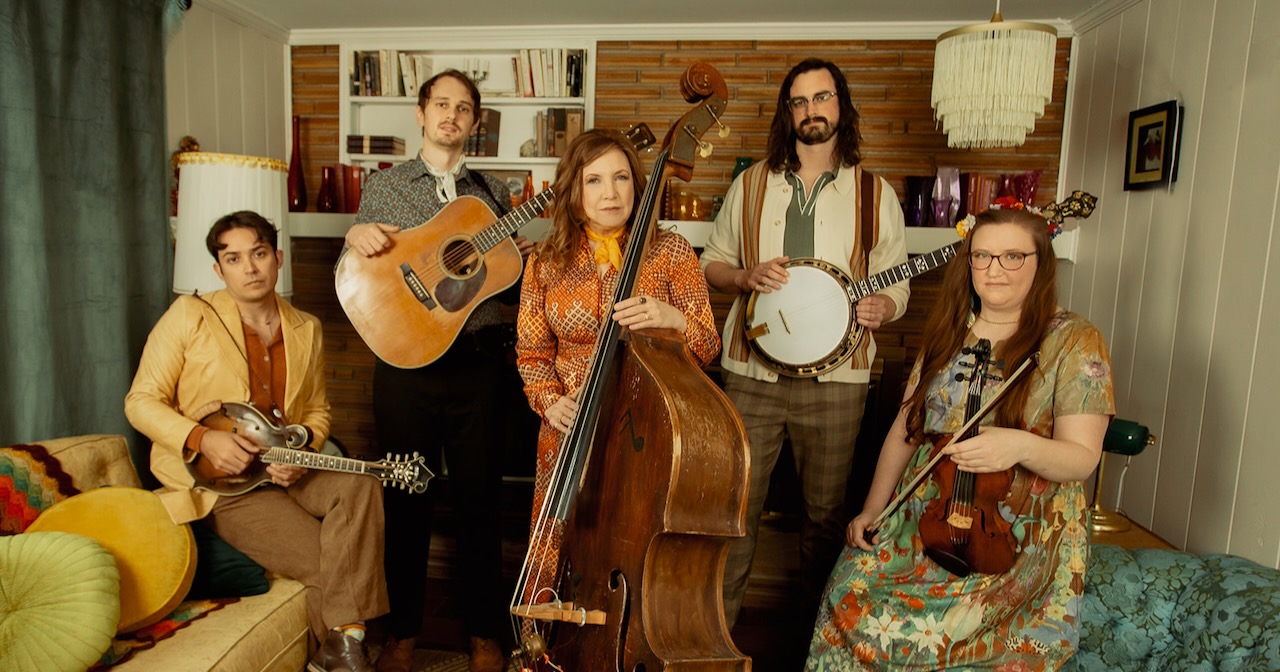
Missy Raines is one of the winningest musicians in the 30+ year history of the International Bluegrass Music Association’s annual awards. She’s a 10-time recipient of the Bass Player of the Year trophy and has taken home a couple of Collaborative Recording of the Year and Instrumental Recording of the Year awards, too. She’s been an omnipresent creative in bluegrass, in Nashville, and in American roots music as a whole for the majority of her life. Even so, many are heralding her new album, Highlander, made with her new band, Allegheny, as a “return to bluegrass.” The thing is, Raines never left.
It’s true that she spent more than a handful of years touring with an experimental, new acoustic-inflected string band, The New Hip, intentionally devoting more than a decade to highlighting her songwriting, her role as front person, and her smoky, patina-ed alto. Throughout that time, no matter how far afield the music may have explored beyond the stone walls and steel bars of bluegrass, Raines always had both feet firmly planted in the genre. While fronting and touring the New Hip, she remained a mainstay at bluegrass and acoustic camps across the country, founded and performed with several bluegrass and old-time supergroups, and “moonlit” as a bassist-for-hire for a laundry list of notable bluegrass, country, and Nashville stars.
So, however exciting it may be – and, it is truly, very exciting – that Raines and Allegheny have intentionally guided her sound back to traditional, straight ahead, mash-tastic bluegrass for her new album, Highlander, it’s important to remind Raines’ audience, the new initiates and diehards alike, that whatever music may emanate from the strings of her upright bass or from her tender and expressive voice, she has always been and will always be bluegrass. And effortlessly so. Highlander isn’t so much a return to the genre as it is a reminder that Missy Raines’ goal in music, first and foremost, is to make great bluegrass music for great bluegrass folks – her kind of folks.
This is your first album with the new band and I wanted to talk about how your creative process and how your collaboration process looks nowadays. I sense a lot of changes in how you’ve approached making music as an ensemble, but I wonder how it has felt to you, on the inside of the sonic and lineup shift from the last album to this new lineup, with Missy Raines & Allegheny?
Missy Raines: The collaboration process we have within this band, Allegheny, and for this album is the collaboration process that I’ve always dreamed of and wanted to have in a band setting. You know, I wanted to have my own band for years and years and then, after I waited a really long time, when I finally did do it in like 2009, I had in my mind that it would be like this, that it would be this collaborative thing and I’d have people who were invested. The short story is that I have that now, and that’s the beauty of it.
In the past, I did have elements of that, for sure. There were definitely folks who came into the different configurations that I had who were invested and collaborative. [That] was definitely there, but I will say, to have a moment in time when you have actually like five people sitting in the room and they’re all equally invested – that is pretty magical.
So yeah, the process for this record was very different than for Royal Traveller, because on Royal Traveller I didn’t really have a band when I started that recording. I was sort of ending the New Hip and I knew that that record wasn’t going to have the sound that the New Hip had, it was going to be very mixed, in terms of styles. There were all these different guests on every single song and there was no one solid backing band, because I actually wasn’t touring at the time. All of the main decisions and stuff were basically made by me and [producer] Alison Brown.
I think part of why this album feels so strongly like a band album is not just because of the Missy Raines & Allegheny rebrand, but also because you’ve been playing with this lineup – Ben Garnett, Eli Gilbert, Ellie Hakanson, and Tristan Scroggins – now for several years. This project feels like it was made by a band. And I think part of that feeling comes from you having worked together for as long as you did before you made the album.
I think it does. I don’t know if it also has anything to do with the fact that me, just by default– yes I’m the leader, but I’m also a bass player and my tendency and my way of thinking about any band is I come into it as a support player, because that’s what I’ve done all my life. This came up the other day online, because we’re getting lots of really great reviews from the record. Like one reviewer called my “backing” band “magnificent.” They are magnificent, but I don’t think of them as a backing band. I told them that and of course, Tristan said, “Well, that’s what we are.” And I was like, “No!” I still don’t think of [the band] that way. I don’t know if it’s just because I’m maybe still a little uncomfortable being out front, or it’s a combination of things.
It’s also just been this bass player mentality that – not that bass players can’t be out front, it’s just like, “No, we’re making this stuff together. We’re making this together.” And so I don’t see it as me standing up there doing something and they’re backing me up. I feel that if I’m not playing with them and they’re not playing with me, then we have nothing.
What was the process like as you sat down with this sequence of songs and were imagining who you wanted to have guest on the album? How did you navigate that with your producer, Alison Brown? This is a stout lineup of special guests appearing with you and Allegheny.
The only thing I knew in the very beginning, before I even talked to Alison about making the record, was that I wanted to do “These Ole Blues” with Danny Paisley. [Laughs] That was already in my head. I had this vision, I heard Loretta Lynn’s version of it and then I also knew that I wanted to change it a bit to make it more bluegrass. And it came out exactly the way I was hoping. I wanted to sing it with Danny Paisley. That was an easy one. Well, all of them were easy, because when we sat down we just listened, thought about the song, and thought who would be the right singer. And, who would also represent what it was that I was trying to say with this record.
Like, Dudley Connell on “Ghost Of A Love.” Of course, he’s playing with the Seldom Scene these days – he’s just so good that he can do anything. And no one loves the Seldom Scene more than me, but what I was looking for was Johnson Mountain Boys Dudley. [The Seldom Scene] was one of the big inspirations to this band, but so were the Johnson Mountain Boys and nobody captures that better than Dudley.
And I did want to say something about Laurie Lewis, too.
I wanted to ask you about “I Would Be a Blackbird,” the track that features Laurie, so yes, please, let’s definitely get into that!
So, Nathan Bell, he’s a friend, a great songwriter, and he wrote “American Crow” [from 2013’s New Frontier]. He wrote “I Would Be a Blackbird.” He’s written several songs with bird themes, but this song, he actually sent to me literally years ago and I loved it, but I couldn’t make it happen before, because it just didn’t fit whatever I was doing at the time. But it found its way to this band and it felt right.
Then again, when we thought about who I should sing with it, I thought of Laurie Lewis and it was perfect. I also really wanted Laurie to be part of this record because she was so much a part of Royal Traveller, she wrote “Swept Away” and it was like the star of that album. Laurie said to me, “You need to record ‘Swept Away,’ you should do that! It would be a great song for you.” So that felt extra special, that she thought of me for that.
When I was just starting out to play, when I was a teenager and stuff, I didn’t really know much about her music, because at that time I was such an east coaster and she was such a west coaster. I didn’t really know much about what was going on out there. But then soon after that, when I started hearing more of her music, got to meet her, and heard Love Chooses You, that was one of the first moments that I had in my mind that made me go, “Oh, you know… I would like to do something like this on my own someday.”
And then she became a really dear friend! Anyway, it was just really important to have her on this record.
I wanted to ask you about “Who Needs A Mine?” Not only because of Kathy Mattea joining you on that track, but also because of your ties to West Virginia and the very ideas behind Highlander. When I first heard you play that song probably a year and a half ago now, I think my jaw hit the floor. It’s such a perfect song and it’s so clearly in this tradition of women songwriters from West Virginia, from Central Appalachia, and the Mid-Atlantic who use folk songs and folk lyrics as a vehicle to speak truth to power. For me, it’s the focal point of the record. I think it’s one of the best socially aware and politically aware bluegrass songs that’s ever been written, in my humble opinion.
Wow. Well, your humble opinion means a lot over here. So, thank you.
I definitely thought of Kathy immediately, because of the West Virginia part, but also because she has championed this drug crisis for a long time. Her own life has been affected by it, personally, with family members. She speaks openly about that and has done a lot of really great things. That resonated with me.
One of the really extra special things that happened the day that Alison brought us together in the studio, I walked in and [Kathy] was there and she looked at me and she said, “I really, really love this song.”
I felt the sincerity in her voice. Like she said, it is really, really meaningful and powerful. I was just overwhelmed with that. Then she also said, “And it’s really nice to hear another alto singer!” [Laughs] I thought, “Well, that’s cool that you would even put me in the same breath as you.” I’ve always been drawn to singers like her, with the range of her voice and stuff. It seemed like a very natural fit for the song.
And as for me wanting to write it, I’ve been thinking about this song for probably the last five, six years or maybe a little bit more. I tried to write this song on my own, right from the beginning, but I realized that I was just way too close to it and I needed to have some perspective. I still wanted to have a bit of control over it, because I knew what I wanted from it. But I realized I also needed somebody to give me some perspective. So, I thought of who I knew that I would like to write with and who would get it and come from that same place, and I very wisely chose Randy Barrett. He was absolutely perfect to help me write that.
Of course, you know I cited Hazel, because she’s such a hero and my ties to West Virginia will be forever. I honestly don’t ever see myself living back there ever again, but on the other hand, I will always cherish all the things precious from my early life there. This issue is just so incredibly important to me and the reasons it happened – that people can Google, as to why this is such a horrific and atrocious thing. And it wasn’t just by accident, [opioid marketing] was actually targeted.
I’m glad you bring up Hazel. I think she is such an important touch point for this song. And I also think of Jean Ritchie, but there’s also this current moment happening where songwriters and roots musicians from rural places are taking up similar issues in their music. I’m thinking of Dori Freeman’s “Soup Beans Milk and Bread,” of Willi Carlisle’s “When the Pills Wear Off.” I think that there’s this really important moment of songwriters telling stories about these regions that are critical and that are seeking justice and a better future, but are also approaching it from love.
There’s something really interesting about “Who Needs A Mine?” because it feels like there’s some sarcasm and sass in it, but I still sense that the song is very, very loving – even in the way that there’s bitterness and anger in it. Do you see that too?
I love that you bring that up, because I was just sitting here thinking that I grew up listening to Hazel and hearing her songs, mostly about poverty and about mining and black lung and all of the travesties that came with the mining industry. While I knew that was part of my state’s history, it really wasn’t part of my own story, because my family weren’t miners. They were farmers and they were railroad men, but they weren’t actually miners.
The part of West Virginia where I grew up had more strip mining than it did deep coal mining. And so there was some level of understanding for me, but at the same time, I was fascinated. When I was a teenager, I used to read all the stories about the mines and unionization – and Mother Jones. I was really into that. And again, one of the reasons that I loved Hazel is because she championed all of that so much. At the same time, it wasn’t my story. When I started becoming emotionally involved with what was happening in the world today, seeing the West Virginia that I knew and the devastation when I go back home to see my family. I hear the stories about the drug infestation and all that. I see the poverty and see the children and all those things. Then I started getting angry and started getting upset about it. I realized this is my story. This is my time. This is what’s happening now. We all thought that the mines were going to be the worst thing that ever happened to us, but we at least kind of lived through that. And in many ways, we triumphed through that. But now, this is more powerful – a pill that makes you feel like nothing, a pill that takes you out of reality is way more powerful than anything else.
I love the joke going around regarding this lineup of your band being “Mashy Raines.” I think it’s hilarious.
[Laughs] Thank you.
I think it’s interesting, because it seems like people use that joke to note how trad this band sounds, because you’ve spent a lot of time dabbling on the fringes of bluegrass. So it’s notable that you’re making bluegrass straight down the middle with this lineup. I think part of why it works so well is because you’re using this really trad aesthetic with such emotionally intelligent songs.
That is exactly what I was trying to go for, to have this hopefully artistically and intellectually interesting subject matter on top of really traditional sounds and aesthetic. That’s the most fun in the world to do, and hopefully you get some messages across without folks even knowing it.
I understand why some people might think this is new for me or something, the mashing thing, but we, of course, know that it’s not. I’ve been doing this for a long time, but it’s just that a lot of the mashy stuff or the real traditional stuff I started out with. I was doing it back then, you know, when not everything that anyone ever did was recorded and put online. There’s so much of that in my history that only the people who were there will remember. When I finally did start to make records and stuff, either on my own or with other people, yeah, it tended to be a lot more explorative, for sure. I had already played a lifetime of traditional bluegrass before I even made my first album.
The New Hip was bluegrass, but I never tried to make it be bluegrass. I just knew that I was bluegrass and I was a bluegrass bass player and I was playing this other kind of music. The entire time, I was thinking of all of it as a bluegrass bass player. In my mind, I never left bluegrass, but I do understand how it was perceived that way by some.
When Highlander started coming out, I started seeing the stuff being written and they were using this “return to bluegrass” thing. I fought it a little bit, at first. But now I’m like, “It’s okay, because you’re right.” This is unique. This band and this sound, it is unique. In that regard, it is a definite return to something that I haven’t done for a long time – with a specific sound that we have now. It’s exactly what I was looking for, but because of the people involved, it’s better than I ever imagined it could be.
With a brand new, to-be-announced album coming in 2024, Americana singer, songwriter, and “musical vagabond” Sierra Ferrell has released “Fox Hunt,” a galloping, gothic track with a storybook-style animated video. (Watch above.) It’s one of her most sonically mainstream single releases to date, reminding of groups like the Lumineers — a shimmering polish on the deeply patina-ed, gritty sounds drawn from her West Virginia raising.
Ferrell is one of the fastest rising stars in American roots music, with a tour schedule and dance card filled to bursting. Listeners place her in musical constellations with such high energy and “back to basics” artists like Billy Strings, Molly Tuttle, Zach Bryan, Margo Price, and more – many of whom she calls friends and collaborators. But Ferrell, in a twist of homophonics, brings a feral and untethered mastery into her music, a quality that continually has fans begging for more. Her performance of femininity – and as often, her subversion of it – recalls other mountain music mavens like Dolly Parton, Ola Belle Reed, Wilma Lee Cooper, and Loretta Lynn, but with their often aspirational facades – qualities of each of their professional brands – exchanged for a devil-may-care attitude that’s just as deliberate and intentional. It’s as much an extension of Ferrell’s agency as any of the women who came before her donned their own rhinestones, big hair, and striking make-up as representations of their individuality.
2024 will undoubtedly find Sierra Ferrell notching many more career milestones as her ever-growing audience will be hanging on for every rollicking, frolicking note.
Photo Credit: Bobbi Rich
This website uses cookies to improve your experience. We'll assume you're ok with this, but you can opt-out if you wish.AcceptRejectRead More
Privacy & Cookies Policy
Privacy Overview
This website uses cookies to improve your experience while you navigate through the website. Out of these, the cookies that are categorized as necessary are stored on your browser as they are essential for the working of basic functionalities of the website. We also use third-party cookies that help us analyze and understand how you use this website. These cookies will be stored in your browser only with your consent. You also have the option to opt-out of these cookies. But opting out of some of these cookies may affect your browsing experience.
Necessary cookies are absolutely essential for the website to function properly. This category only includes cookies that ensures basic functionalities and security features of the website. These cookies do not store any personal information.
Any cookies that may not be particularly necessary for the website to function and is used specifically to collect user personal data via analytics, ads, other embedded contents are termed as non-necessary cookies. It is mandatory to procure user consent prior to running these cookies on your website.