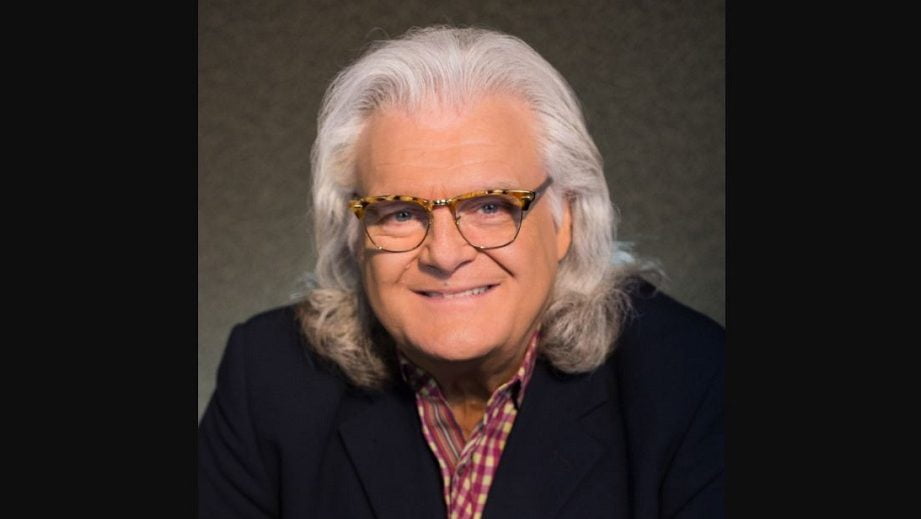
Though he’s just now hitting nominal retirement age, Ricky Skaggs has been a virtuosic presence in the worlds of bluegrass, country, and Americana music for close to 50 years. With his childhood friend, Keith Whitley, he began touring and recording with Ralph Stanley while still in high school; by the time he turned 21, he had done a stint with the Country Gentlemen and become a member of the J. D. Crowe & The New South lineup whose eponymous 1975 album was (and is!) so influential that it’s been known for more than 40 years simply by its catalog number, Rounder 0044.
From there he moved on to intensive studio work; partnering with Jerry Douglas in Boone Creek; a stretch with Emmylou Harris’s Hot Band; and then, in 1981, launching a country career so meteoric that he earned, within four years of his debut recording, the Country Music Association’s top Entertainer of the Year award. Fifteen years later, he returned to bluegrass in spectacular fashion with the album Bluegrass Rules!
It’s no wonder, then, that he’s a newly minted member of the Country Music Hall of Fame and the Bluegrass Music Hall of Fame, though it’s a nifty kind of surprise that he was inducted into both this year — and, while it’s less widely known, he hit the trifecta when he was inducted into the Fiddlers Hall of Fame, too. In short, if you were to call 2018 the Year of Ricky Skaggs, it would be hard to mount a real counter-argument.
A conversation with Skaggs is always a journey through a myriad of subjects, and this one was no exception; we touched on many topics, from his nearly complete recovery from shoulder troubles to his recollection of a conversation with Art Satherly, the legendary producer who worked with Bob Wills, Bill Monroe, and many others. Still, a couple of themes emerged, and it’s fitting that one began with an examination of his under-appreciated role as a fiddle player.
It occurred to me that there are fiddle players in the Bluegrass Hall of Fame already—Chubby Wise, Paul Warren, Kenny Baker, Benny Martin, Bobby Hicks—but there are some other members, like John Hartford, who folks might not think of first as a fiddler but who were players, and that led me to you. I think there’s a whole generation of fans and musicians who might not realize how much you’ve done on the fiddle. Is that something you still do from time to time?
When we went out on the Cooder-White-Skaggs tour, I played quite a bit of fiddle, because we were doing so many country things, like Hank Snow’s “Now And Then (There’s A Fool Such As I),” that Chubby Wise played on, and Ry wanted that fiddle. Sharon did songs that I’d play on, and I played swing fiddle on “Sweet Temptation.” So I played quite a bit on that tour. But I haven’t taken it as seriously as I should have, especially in the last 20 years; I just haven’t kept up on it. And you know, when you do pick one up and it sounds like a cat killing, you start thinking, maybe my days are over on this.
But I’ll tell you, when I was just a kid, and I decided I wanted to play another instrument besides the mandolin, my dad got a guy named Santford Kelly to come over to our house, and he recorded him playing—because especially when it came to playing fiddle, he wanted me to sit at the feet of some old cats that he knew. And now, I’ll play something by Santford Kelly for Andy [Leftwich], or now for Mike [Barnett], and their eyes are as big as silver dollars, and they say, “Oh, my god, will you please teach me how to play that? That doesn’t need to die with you—that sound and that bowing style, and that stuff from the mountains of Appalachia, that’s got to live on.”
When that happened a couple of times, I started really seeing how important it was. I’m always thinking maybe too much about perfection, and I’ve gotta tell you, when I heard Santford Kelly—he was 84 or 85 at the time, and he was scratchy. But it didn’t bother me that he was a little flat and sharp here and there, and a little scratchy on the bow. It was what was coming out of him that went into my heart, that moved me deeply. I thought, this is like Elijah coming off the mountain. This man is carrying something.
So I’ve kind of been saying, well, I’m not really up on it, but I need to shut that crap up. I just do need to play more of that.
You’ve entered three halls of fame this year, so maybe this is a good time to look back. One of the things I’d like to get your impression on is the idea that tradition is not a style, but a way of learning. And you did that, learning directly from older guys like Santford Kelly and Ralph Stanley, but it seems like there’s less of that these days. From the beginning of your return to bluegrass, you’ve made having young people in your band a priority. When you talk about Mike or [banjo player] Russ [Carson] hearing these things, is that something you feel is important — to mentor young musicians, be an active transmitter?
It absolutely is. To me, it’s vital — it’s necessary for the journey, it truly is. It’s manna, it’s food. In the tabernacle of David, where there were four thousand musicians and two thousand singers, you didn’t just fall off a turnip truck and then decide, hey, I’m going to be a musician. No! King David said, “My fingers are trained for battle.” To me, there is training that goes into perfection, goes into your craft. There is something that is really spiritual about this; it’s part of our spirit, it’s part of our nature to be trained.
And that’s truly part of what makes my heart beat, is to train up and to pour into young musicians — and not just men. Like Sarah Jarosz told me one time, “Thank you for letting me get up on stage and play with you when I was 12 years old in Austin.” Or Sierra Hull, or how my music affected Alison [Krauss] in her teenaged years — listening to J. D. [Crowe]’s records, and Boone Creek, and my early country stuff, the harmony singing and just the musicianship, how that encouraged her. I was talking to Becky Buller at the IBMA Red Hat [Amphitheatre], and she talked about how influential the music has been, too.
One of the things that I learned from Ralph was to play it like it was recorded. I remember one time, I’d been listening to Jimmy Gaudreau and some of the other mandolin players of that time a little bit, and one night I played a solo that was a little bit out of the ballpark for the Stanley sound. And I caught Ralph’s face move just slightly over toward me. He didn’t eyeball me, he just kind of turned to the right and listened to me. And when we got off he said, “Rick, you know what I do, when I take breaks, I play it just like I sing it. I want them people to know that when I played that break, they didn’t have to hear me sing, they knowed what that song was. That’s the way I do it.” He didn’t say, the way you did it was not cool, or out of bounds. He did not teach that way; it was so soft, and so nurturing.
And now, I’m always showing Mike stuff — even from the first time I met him, when he auditioned. We sat down and I played him the Stanley Brothers’ Starday recording of “Little Maggie”— one lick, one phrase, after [fiddler] Ralph Mayo’s first solo. Ralph kicks it off, sings one verse, and then Ralph Mayo takes a solo. Well, it’s that next verse, on the line “pretty women are made for lovin’,” on the word “lovin,” Mayo plays this counter-note that’s not even in B, where Ralph’s at. That thing came out of him, and that one note just spoke so loudly right there for me. When I really heard that, I thought “What did he just play!?” and it just lifted my heart to such a place. It was something. And I played it for Mike, and he said “play it again,” and I thought, all right, he’s going to get this job, I know. He’s hearing what I heard, so I knew he was the right one for the job. He heard what Mayo was playing, and he heard my passion for it. And those are the kind of things I want to teach.
Looking at your career, the frequency of your record releases seems to have slowed down. And it seems to me that the recorded end of the business is almost going back to the 50s. Are you just too busy to get into the studio, or is it a lower priority because the business is heading away from that?
Well, as a record company owner, it’s become a financial issue. Having a studio of my own, you’d think that I could do records so much cheaper, but it’s just a fact that the numbers just don’t work when I look at putting $30,00 or $40,000 into a CD and the chances of getting it back in the next three or four years. And I’ve got a big name! I don’t know how, well I guess I do know how, a lot of these record companies do them for $10,000. I would feel really bad about having to do a Kickstarter for Ricky Skaggs. But there’s so much music in my heart that I really want to go in the studio and make, and make it with this incredible band.
But here’s what we’re thinking: I guess I’ve probably got nearly every show that I’ve done in the last four or five years—and recorded on separate tracks, where they could be remixed. So I’ve got a ton of stuff. We’ve got Cooder-White-Skaggs, we’ve got Skaggs and Hornsby stuff, we’ve got Ricky Skaggs with Cody Kilby, Bryan Sutton, all kinds of guests that we’ve had. We’ve got all that recorded. So I really do believe there’s ways of doing it, and I don’t have to own everything; I could just have part ownership.
And I just want to get the music out. I want the world to be able to hear Mike Barnett and Jake Workman, Jeff Picker and Russ Carson. And of course Andy, or hearing Jake playing mandolin or banjo. We’ve got all that stuff, and maybe perfection doesn’t matter so much. I can get stuck in thinking about what used to happen in my life, and what used to be—and here again, I’m figuring out it doesn’t have to be that way. There’s a feel thing that we can miss by having endless tracks on ProTools, endless chances to go back and get another take; usually the first thought that comes into your mind on almost anything is the right one. It’s our stinking thinking that gets involved, and we get to overanalyzing stuff when the spirit is saying, “This is the right way, this is what I put in your mind at that time.” Sometimes you’re better off to just go with that.