High Fidelity: A Natural Feel for Traditional Bluegrass

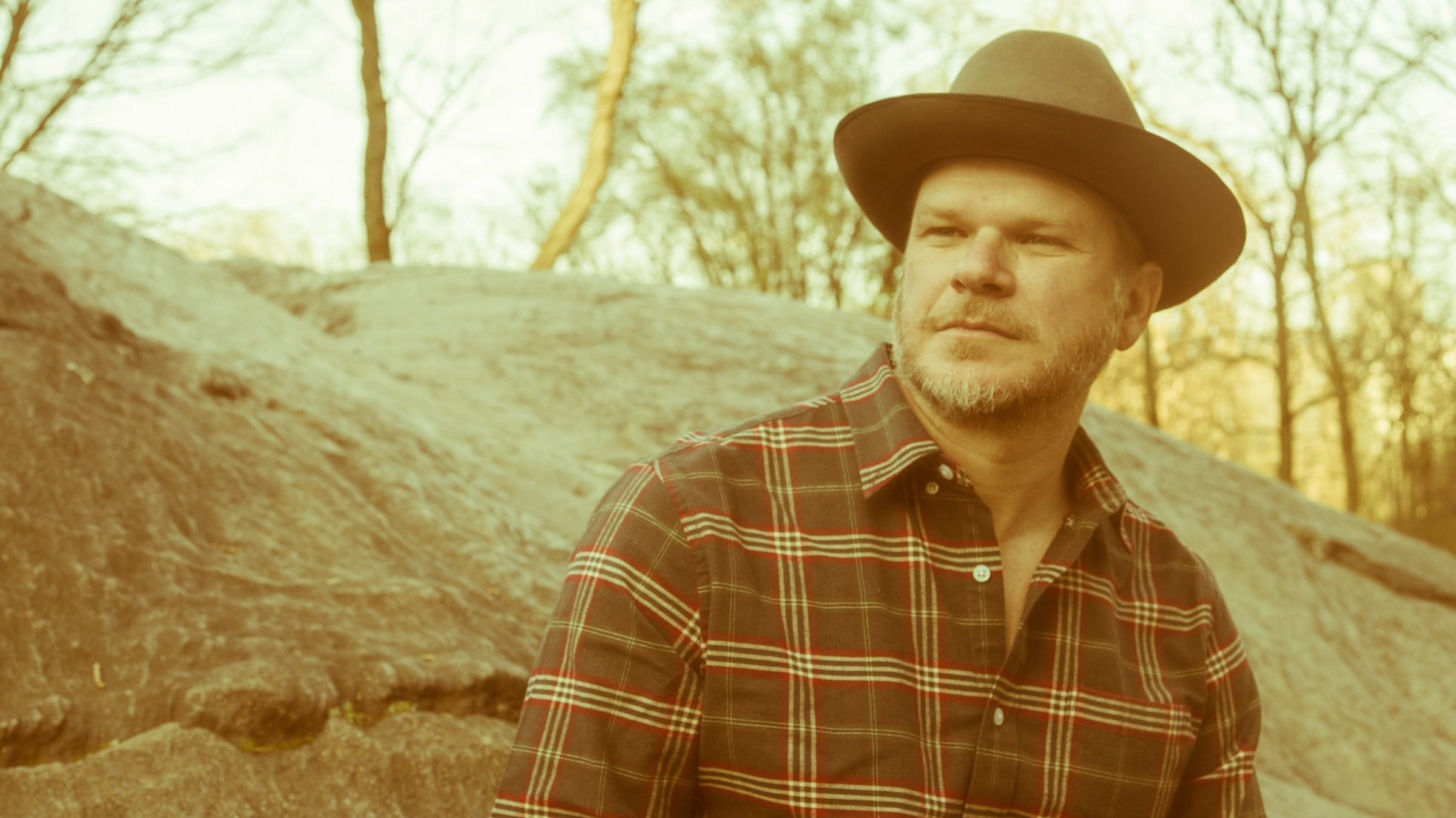
It must be closing in on ten years since I first met Corrina Rose Logston Stephens, when she and I were both recruited into Retro & Smiling, a band devoted to the musical legacy of first generation Bluegrass Hall of Famers Don Reno and Red Smiley and their Tennessee Cut-Ups. Soon after that, the southwest Illinois native entered the music business program at Nashville’s Belmont University and began to establish herself as a formidable talent in the city’s bluegrass community.

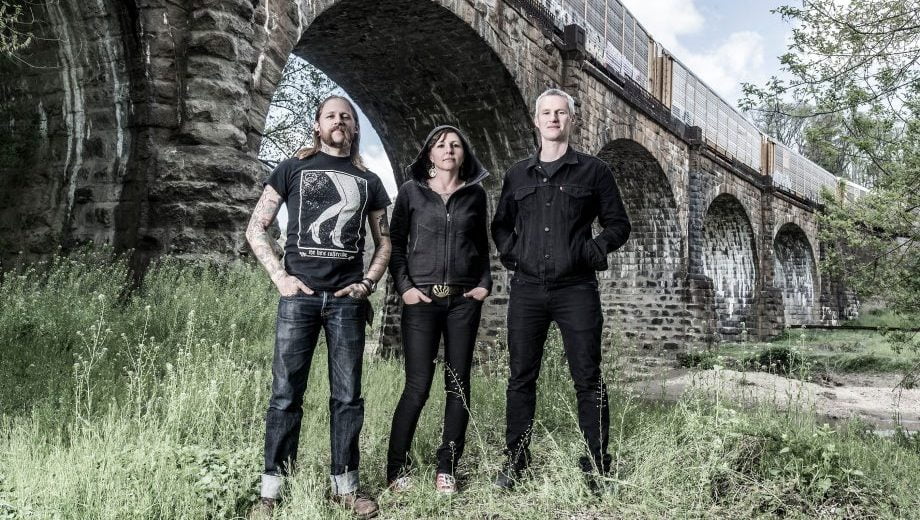
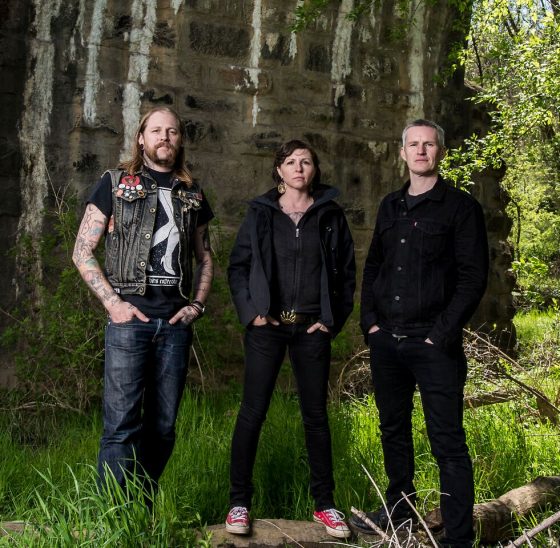
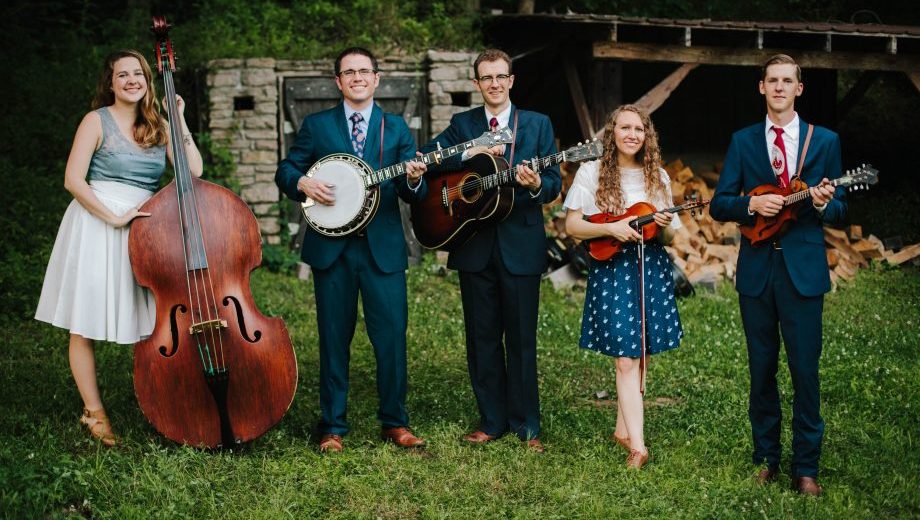
In 2014, while working with a variety of bluegrass acts, including pioneering mandolinist (and Hall of Fame member) Jesse McReynolds, she and a couple of favorite colleagues—multi-instrumentalists Jeremy Stephens (whom she married that April) and Kurt Stephenson—did a little recruiting of their own in order to enter the long-running band competition at the Society for the Preservation of Blue Grass Music in America’s annual confab. With the addition of yet another multi-instrumentalist, Daniel Amick, and bassist Vickie Vaughn, High Fidelity won the contest, and a self-released album followed in 2016. The next year, the quintet signed with Rebel Records, and has now released their label debut.

Hills And Home is a stunning collection that, perhaps more than any other self-described traditional project, reveals the breadth of bluegrass music’s early years; it even features twin banjos, a rarity last featured a decade ago on Tony Trischka’s award-winning Double Banjo Bluegrass Spectacular, but once favored by artists like the Osborne Brothers and Eddie Adcock & Don Reno. And while there are a few familiar numbers, much of the album consists of relatively obscure works, like the Lilly Brothers & Don Stover’s “I Would Not Be Denied,” all rendered with an exquisite attention to detail that amplifies, rather than stifles, the fresh and compelling energy of High Fidelity’s approach.

As an enthusiastic fan of Corrina’s playing, I was curious to know whether she was wholly devoted to older styles of bluegrass, or whether the originality that was at the center of her senior thesis recording was still on her mind—and that’s where our conversation began.

You made an album of your own while you were at Belmont called Wind Caught My Bike, that was mostly originals written and played in a contemporary vein. And your album after that, Bluegrass Fiddler, was traditional. So are you still writing in a less traditional, more contemporary vein?

I am, I definitely am. But being a stylist in the sense of being able to separate styles and articulate those styles accurately has always been important to me, and something that I’ve admired. The person who I’d say is my biggest mentor, Jim Buchanan, he’s excellent at doing that; he can play like Jascha Heifetz, and then play Stéphane Grappelli, and then play some hoedown—and it all sounds different. Seeing that, being around people like him and Jeremy and Kurt made me want to do that. I wanted everything I did to be authentic, and only when I wanted to blend them, then I wanted that to happen; I didn’t want to be some mish-mash of things just because of my carelessness. But when I write, it’s just an outflow of [who] I am—a combination of all those influences. And there are no limitations on it, unless I want there to be.

Many of the musicians featured on the Bluegrass Situation are very eclectic, and it feels natural for these musicians to take elements from different kinds of music and put them together. And what I hear you saying is that you’re oriented more toward feeling that you want to be respectful of the integrity of a style; that’s what I hear you saying when you talk about being authentic. It’s a way of putting yourself into, rather than drawing from, that style. What’s attractive about that for you?

I am extremely detail-oriented. Everybody has to reign me in! So I think, why does this sound like this era of bluegrass and this person playing it, and why does that not necessarily. And if I want to convey a sound, then I have to abide by its specifics. I feel there’s a lot of power in being able to understand and articulate those things. You have people like Chris Thile, who understand those things and choose to put them together—as I do, in different situations—but I was always attracted to the first generation stuff, just probably because of how I grew up. And as I became closer friends with Kurt and Jeremy—I was 14 when I started playing in 2004, and I met Kurt in 2007 and Jeremy in 2009, and we were friends before we got serious dating—I saw them being able to segment that stuff, and that was always appealing to me.

High Fidelity is doing all old songs, but they’re by artists who sounded different from each other. Where do you locate yourselves between reinterpreting the song, which could be anything, and recreating the record?

I think the biggest thing is that there’s no formula, it’s all a feel thing. Somebody said—it could have been Chris Thile—that if you want to copy somebody, you should try it and see what happens, because you’re not going to end up sounding exactly like them. I, and I’m sure Kurt and Jeremy, have been in that place where you’re thinking, “I’m going to sound exactly like them.” Which is way harder than just saying, “Oh, this sounds like that to me.” So in High Fidelity, when we do “I Would Not Be Denied,” I’m not trying to sound exactly like the Lilly Brothers, or sing exactly like them, but I listen to what they’re doing, and I pull the highlights out of it.

High Fidelity’s sort of the convergence of that with many other added things, because Daniel and Vickie come from totally different places. Kurt and Jeremy and I grew up listening to it, and then Daniel and Vickie grew up listening to and playing music, too, but not the dyed-in-the-wool traditional bluegrass. And so they pull things out of different places. I think it’s a natural process, where you take in those influences, but you don’t obsess over sounding exactly like them, but you allow them to inform what you’re doing—and with your own constraints imposed of what you believe traditional bluegrass from that era sounds like, then something comes out that’s really interesting.

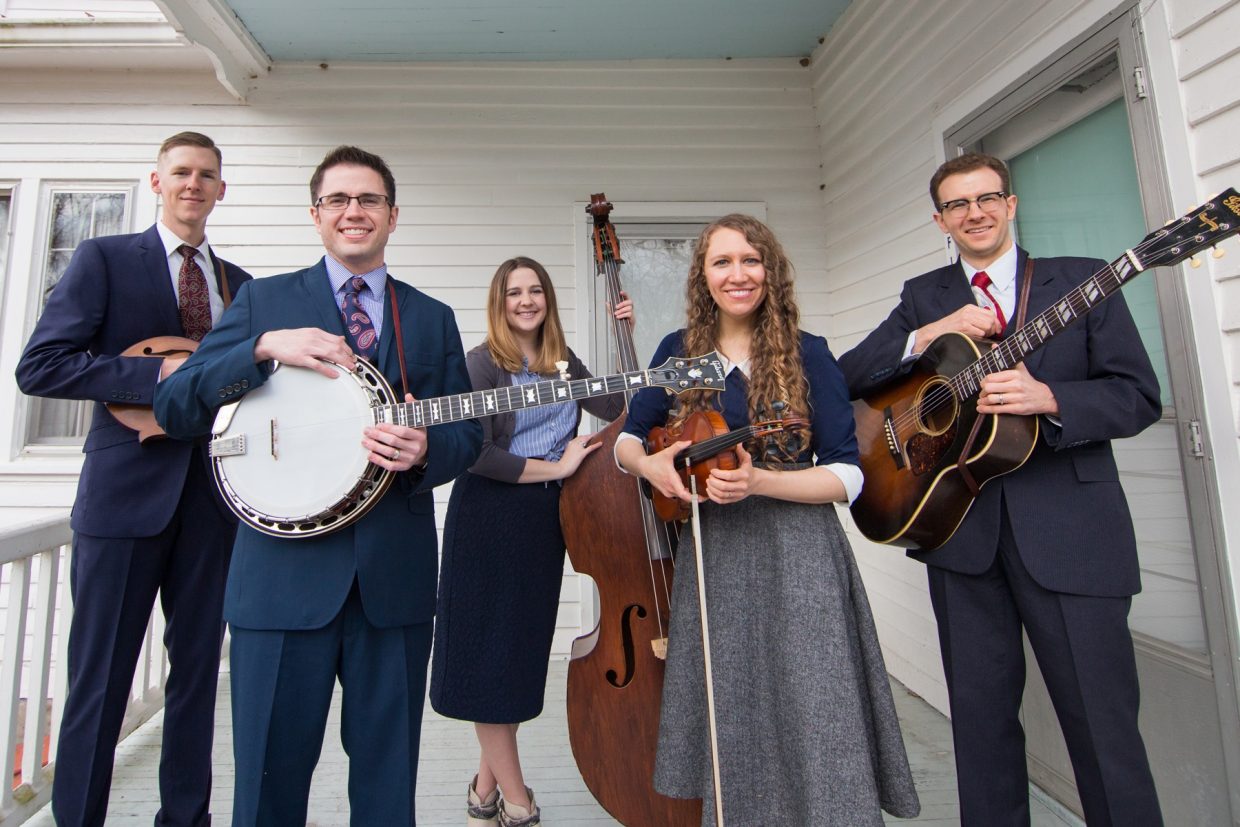
I feel blessed that High Fidelity has found this in a really natural way. I’ve never tried to sound like a man when I’m singing, but I listen to the timbre of the tenor singers’ voices, and I see that I need to push more with High Fidelity—much more than I do when I do my own thing. When I do my own thing, it’s just a natural outflow. So what ends up happening is that I don’t sound like I’m trying to sound like a man, but I’m trying to tap into the essence of bluegrass tenor singing. And then people are like “whoa, this is a girl singing this,”—and there are lots of things in High Fidelity that are interesting elements. Like when you look at a picture of us and then you listen to the music, there are some mind things that happen!
You’re strong in your faith, and in your musical preferences, and yet you guys are very much a part of a bigger musical and social community that’s built around bluegrass and the like.

Musically, that doesn’t ever seem like it’s an issue, because we each have a very diverse palette of what we like. Kurt plays with his wife, Andrea, and they do much more contemporary music—and of course, the things that I do are off the spectrum of insanity! Jeremy is also really rooted in old-time music, and he’s done a lot of commercial stuff with Ray Stevens, and things like that. I think there’s a stigma of, if you’re a traditional band, you don’t like any of that other stuff. But that’s not us at all. We went and played ROMP last year, and that was awesome; we didn’t feel weird there. We were proud and honored to be ambassadors for traditional music that day. So I don’t think we feel awkward about that; we love all these things.

And as far as our faith is concerned, the fact that we are all Christian people was just a coincidence that happened in putting the band together, and it was really cool. Because we were, wow, we can all approach these songs of the same mind. Which, other than Jeremy working with the Chuck Wagon Gang, is something that we had never really experienced in bluegrass band situations.

So the fact that we’re all Christians, and our example is Jesus…Jesus was out there doing stuff with everyone. There was nobody that was off-limits to him. And he said to go out there in the world and do stuff; be an example. That is a motivator for us, because we see ourselves as being a young traditional band, that are Christian, that are out there doing what we feel we’re called to be doing—being out there in the world. That’s what we feel the Bible says we’re supposed to do. So none of that ever really feels awkward as far as being part of the greater music community.

What do you guys hope that releasing this record will do for you?

The cool thing is that we started off doing what High Fidelity does because we just wanted to do it. We didn’t care what anyone thought. We thought it would be a sideline, cool, fun project, a recreational thing to supplement our musical endeavors. We never thought we were going to have a second record. And then people responded to it, and Rebel Records approached us, and we were like, wow, maybe we should do this.

Believe it or not, we had an existential crisis before this record. We felt like we’d pulled all the stops for the first one. Jeremy had had his little keepsake pile of songs forever, and he was like, “I’ve used all the gems, what are we going to do?” So we got to digging through stuff, and we amassed a bunch of stuff and sorted through it.

I say all that to say, we’ve really come with no expectations but to do what we wanted to do. And we’re satisfying ourselves musically in that way. One thing we never really focused on was putting ourselves out there. That’s always the burden of the musician, to have to do the business things. I love independently releasing things, and that’s very satisfying, but I know there’s a lot of things that come with having a record company behind you. Rebel has been amazing and I’ll never look at any of this the same way again. So I hope that the record gets us out there for people to know who we are, and I hope High Fidelity continues being a thing that grows. Before, it was a sideline thing, but it never stayed there. It just went like a rocket ship, and I hope the trajectory continues.


Photo credit (lead image): Warren Swann
Photo credit (within story): Russ Carson
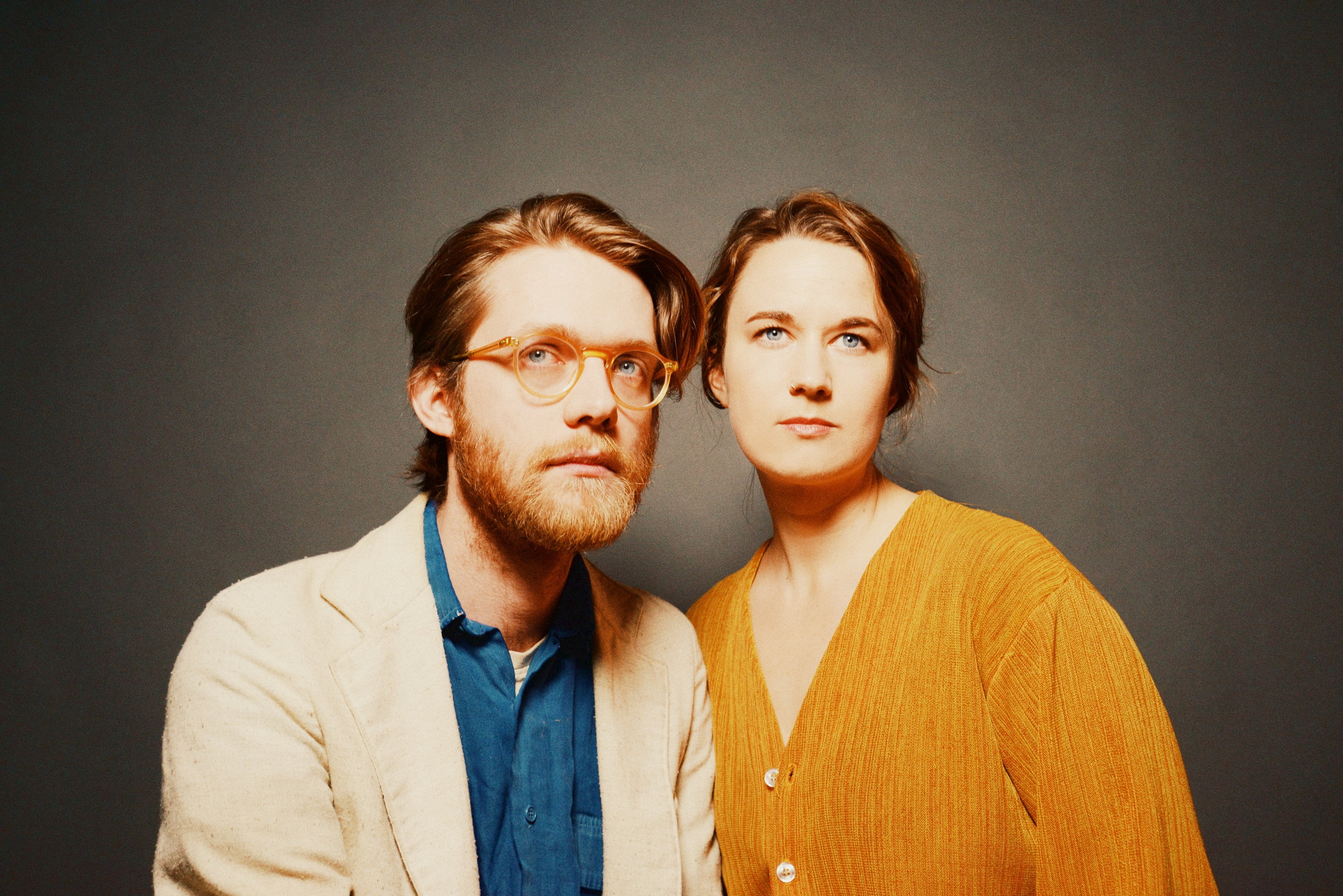
 

LISTEN: Courtney Hartman & Taylor Ashton, “Better”

Artist: Courtney Hartman & Taylor Ashton
Hometown: Brooklyn, New York
Song: “Better”
Album: Been on Your Side
Release Date: August 31, 2018
Label: Free Dirt Records

In Their Words: “Courtney and I and about 25 other songwriter friends around the world had an email thread going last year where we had a weekly deadline to send in a new song, as an exercise in mutual encouragement to keep in the practice of writing. One week I forgot about it until 1 a.m. on the night of the deadline, and even though I had a gig at 9 a.m. the next morning, I spent a couple hours with my banjo and “Better” came to me. It took a second to arrive at the first line and the rest all sort of fell into place. At some times in my life I’ve been attracted to the idea that you can’t force inspiration, and that it chooses when to strike. But this is an example of a time where if I hadn’t been holding myself to some arbitrary deadline I would definitely have just fallen asleep and never written this song.

The voice in the song is sort of an amalgam of myself and of a lot of people in my life so it feels good to sing it with Courtney — it brings it into a cool middle ground for me, between a specific personal sentiment and a more universal one. And to me it feels good to sing about your personal flaws in harmony with somebody else. I think the chorus is something we all want to cry out at certain times in our lives.” — Taylor Ashton


Photo credit: Shervin Lainez

Jason Eady: Down to a Single Point

There are two songs about dying on Jason Eady’s new I Travel On, but he insists this isn’t a downer album. Neither the contented “Happy Man” nor the rambunctious “Pretty When I Die” flinch as they depict the end of life, but Eady says the songs “put a positive spin on it. I think they’re both very positive songs. Live life to the fullest. Leave it all on the table when you go.”

Positivity was the conscious theme of the Fort Worth-based singer-songwriter’s seventh record, yet these songs aren’t naïve or blindly, blandly uplifting. What makes I Travel On so poignant and so memorable is Eady’s willingness to look something like death right in the face and find that silver lining. “It’s going to happen to everybody, so why not talk about it? It doesn’t have to be this unspoken thing that’s sad and depressing. Life is life and death is just a part of it. That shouldn’t be ignored.”

It helps that those two songs, along with every other one on the album, are expertly and even jubilantly picked and strummed and bowed and plucked and sung by Eady’s road-hardened touring band, with special guests Rob Ickes and Trey Hensley. “This album,” Eady explains, “is very specific to our last year. We traveled so much during that time, and we listened to Rob and Trey’s two records, which were a big part of our lives at that time. So it seemed like the perfect thing to call them up and see if they wanted to be on the record. These two guys were with us out on the road, even if they didn’t know it.”

Just as Eady writes within the parameters of positivity on I Travel On, the band played only acoustic instruments: guitars, bass, drums, Dobro. Their limited arsenal forced them to be more creative, to find new ways to use their instruments. As a result, the playing on these songs is somehow both loose and tight, technically precise yet lively, focused but eclectic. “We all sat down, miked everything up, and just went for it. There are no punches, no overdubs, nothing. When you hear something on the record, that’s what happened.”

The record is a document of getting lost out in America, gauging the climate of the country touring out-of-the-way places like Calaveras County, California, which gets its own song. It’s about finding silver linings in the gray clouds overhead. It’s about traveling on. And it has one of the finest album covers of the year: an evocative and psychedelic image that was one of many subjects he discussed with the Bluegrass Situation.

First of all, can you tell me about “Calaveras County”? What about that place inspired you to write that song?

That song is a mixture of some things that happened last year and another thing from my childhood that I always wanted to get into a song. We played a festival there last summer, which was the first time I had been there. I fell in love with the place. We were touring up the California coast, and every place was blazing hot. But it was breezy and nice and the weather was beautiful. The people were great. We had a chance to catch our breath and relax. The night before the show we had a big bluegrass jam. When we were leaving, it just struck me how awesome the place was.

Of course, the name Calaveras County doesn’t hurt. It just sounds good. I wrote the song when I got off the road. I can’t really write much on the road, so I just collect notes and thoughts. When I get home, I sort it all out. And the first thing I did after that tour was sit down and write that song.

What’s the other story? The one from your childhood?

There’s a verse about the man in the multicolored Volkswagen bug. That’s a true story from my childhood. I was maybe 6 or 7 and my dad was driving us through the Mojave Desert. We had run out of gas, and it was thirty miles to the next gas station. This was before cell phones, not that cell phones would have done us any good out there. So my dad had to hitchhike to get gas, while we sat in the pickup on the side of the road. People just kept flying by him and flying by him.

The guy who finally stopped was an old hippie who looked like Santa Claus. He was driving a Volkswagen bug and every single panel on the car was a different color. He gave my dad a ride into town, and then he gave him a ride back and wouldn’t take any money for gas. This guy goes sixty miles out of his way just to get us a tank of gas! That always stuck with me. My dad called me the other day and told me he couldn’t believe that I actually remembered that story.

How could you forget something like that?

It was my first experience of not judging people on appearances. This guy was nothing but helpful. Completely selfless. I’ve always wanted to get him into a song. I tried before to find ways to mention that story, but it never fit until now. It just went with the spirit of “Calaveras County.” The people up there had a similar spirit to them: Anything you needed, they would run into town to get it. They would do anything to make sure you enjoyed your stay in their town. The song fell into place pretty quickly.

I get the sense that most of these songs were written pretty quickly.

I did something this time around that was pretty terrifying. We booked the studio before I had the songs. So I gave myself a deadline to write this record. We got off the road in October, then we went into the studio in December. I wrote them all in those two months in between. It was a challenge, but I’ll tell you what I love about it: This is a very intentional album. These songs were all written in the same space, so it makes for a very cohesive record. I didn’t have to just take the best twelve songs I’d written in the last two years. Everything was written to be on this record.

A lot of the songs relate to things we did over the last year. I didn’t realize that until later. I called it I Travel On because that’s what we did. That’s where the spirit of the record comes from, and I think every song is about getting from one place to another, whether it’s physically traveling or mentally shifting ideas. “Always a Woman” is a good example. It starts off very tongue-in-cheek, very dark, but by the end of the song you’ve traveled from that idea to a very different idea. You’re using the same words but putting a positive spin on them. You move from one position to another in that song.

It inverts the country convention of the woman doing wrong to a man.

Well, I didn’t want to be negative on this record. That’s not where I’m at in my life, and the world doesn’t need any more of that right now. I wanted this to be a positive record. With that song, I didn’t know where it was going after that first verse, but I knew I wanted to take it somewhere different. I didn’t want it to be a dark song, so I had to find some way out of that.

You’ve mentioned that you recorded these songs completely live in one take, with no overdubs. Was that a difficult process? Were there any songs that proved especially hard to get through?

“Always a Woman” for sure. It’s a one-chord song, and I knew when I wrote it that it was going to be tricky. How do you make a one-chord song interesting for four minutes? I just do the same picking pattern for four minutes. Who wants to hear that? For that reason it was the last song we recorded. It was a daunting thing, but I think they all did an unbelievable job of finding ways to change it from verse to verse and add dynamics. Kevin Foster on fiddle did these things where he muted the strings but still rubbed the bow against them. Rob Ickes did something similar on Dobro. It sounds like a distorted electric guitar. I think some people just assume that’s what it is, but it’s all acoustic. I think everybody thrived under that constraint. It made us all more creative.

Way off topic, but this is one of my favorite album covers of the year. What can you tell me about that image?

It’s one of my favorite things I’ve done since I’ve been working in music. For years I had this concept, but I’m not a visually creative person. I can barely draw a stick figure. But I had this idea and I took it to a couple of graphic artists. It’s this universal concept: Everything starts from many, then filters down to a single point, then explodes back out to many again.

You’re going to have to elaborate for me.

Genetics is an example. It took an infinite number of people to get to me being here right now, and from here I’ll have offspring who’ll have offspring and it multiples back out. Events are the same way. All of these events in the history of everything have made this conversation we’re having right now possible, and then from this conversation will come other things that will spread back out. It’s a universal idea. It applies to everything.

But the only visual idea I could come up with was an hourglass, which I didn’t want it to be. But then Casey Pierce, who did the video for “Why I Left Atlanta” and documented the sessions for I Travel On, he’s a graphic artist and his work is very abstract. That’s exactly what I was looking for. I explained the concept to him and what you see on the cover is his first draft. As soon as I opened the email, I couldn’t believe it. It’s the coolest thing I’ve ever seen. He got it all. He got the vagueness of it.

It’s very different from your typical country album cover.

Yes, but Casey made it look like a road, like you’re going down the road and these clouds are in front of you. The road is disappearing into the horizon, which goes along with the title of the record. That’s the beauty of what he did. There’s a lot going on inside of it. It’s art.


Photo credit: Scott Morgan

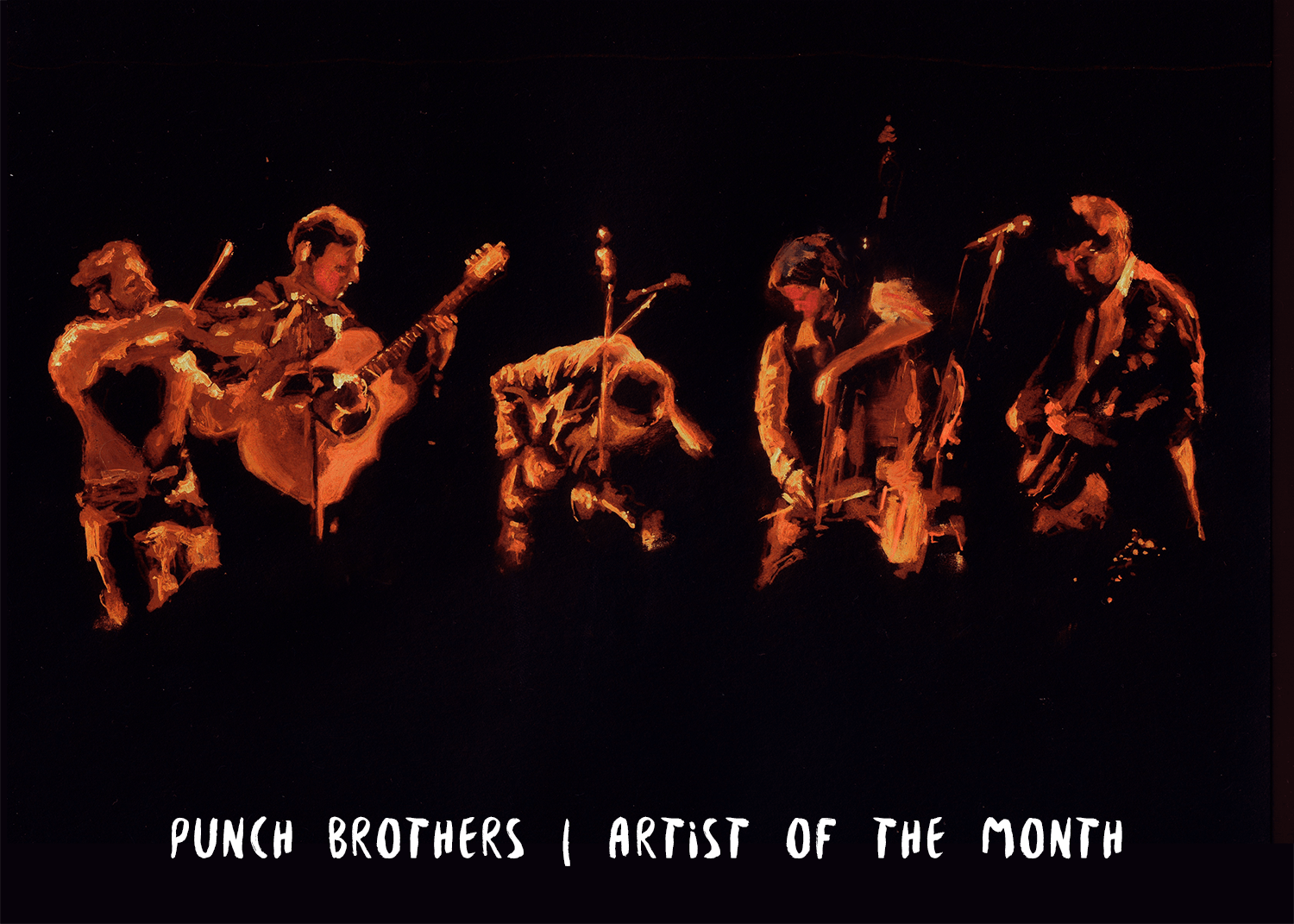
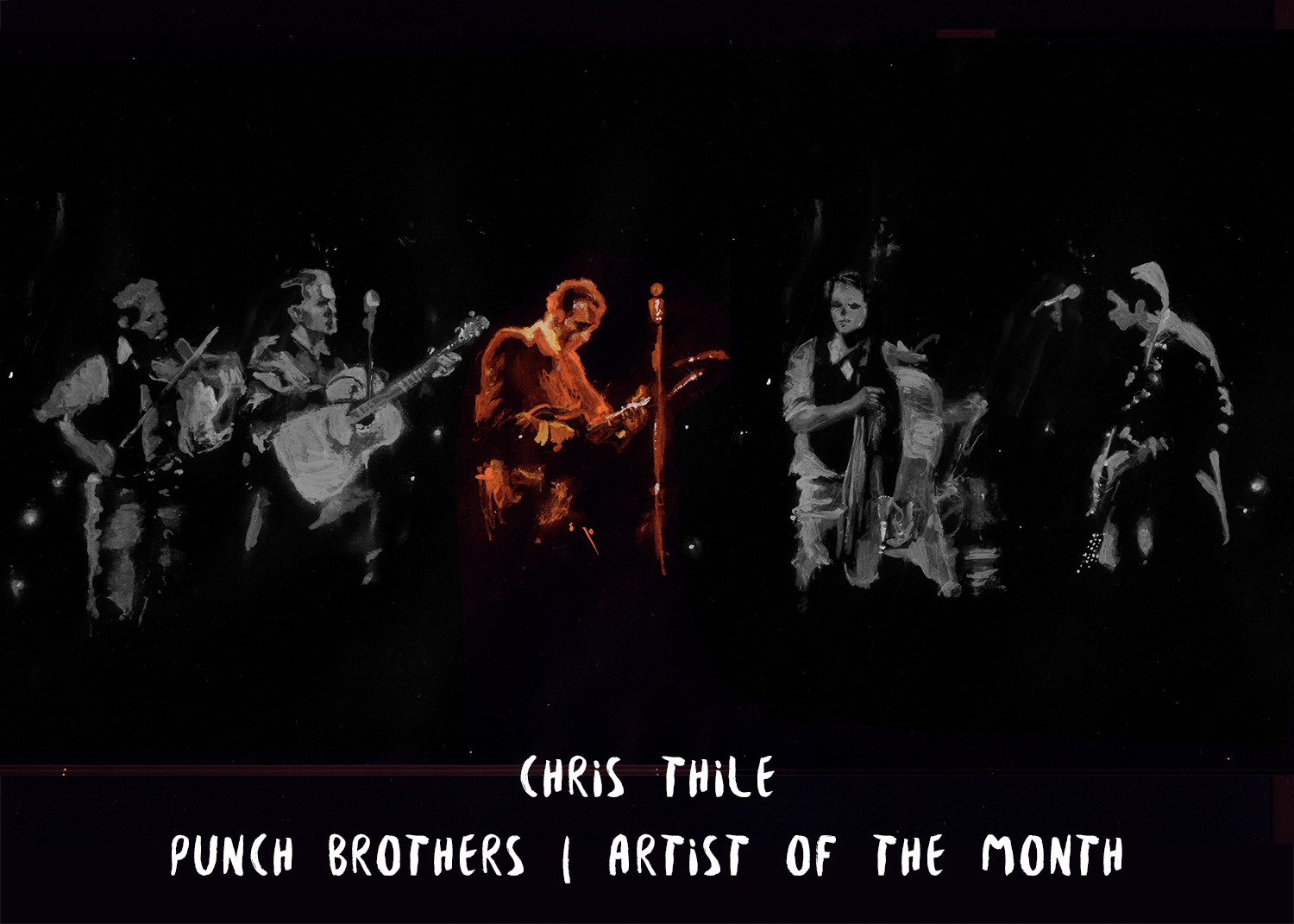
Artist of the Month: Punch Brothers

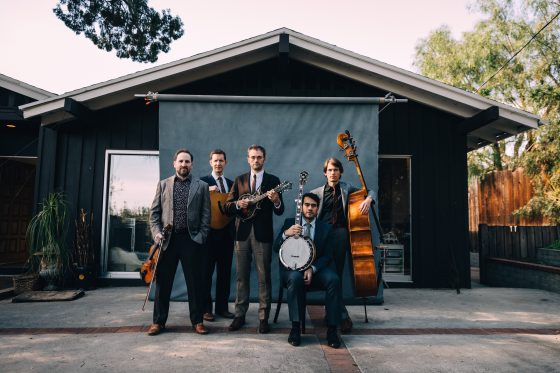
To celebrate our Artists of the Month and their brand new album, All Ashore, we interviewed each individual member of the Punch Brothers, exploring the processes, circumstances, and factors that led to the creation of this latest crop of songs. The themes and responses are just as diverse as the five men themselves and their musical approaches.

Gabe Witcher, the fiddle player – and some might say secret weapon – in Punch Brothers, has been a performer for nearly his whole life. As a kid, he toured the Southwest playing bluegrass with his family’s band; that’s how he met Chris Thile, forming a musical friendship that has spanned more than three decades. Though his stage presence is low-key, his musicianship is undeniable, playing as joyously or mournfully as a song requires. This is also true on All Ashore. [Read Gabe’s interview]

Paul Kowert came on board as bassist for the Punch Brother about 10 years ago, stepping into a band of musicians he knew casually but admired greatly. In the following decade, he’s gained even more visibility in the world of acoustic music through his band Hawktail and a gig as bassist for David Rawlings Machine. His versatility is reflected in the list of bassists he cites as influences: Edgar Meyer, Mark Schatz, and Roy Milton “Junior” Huskey. He’s quick to admit that he’s not a lyricist, yet his musical contributions definitely shape the undercurrent of the new record. [Read Paul’s interview]

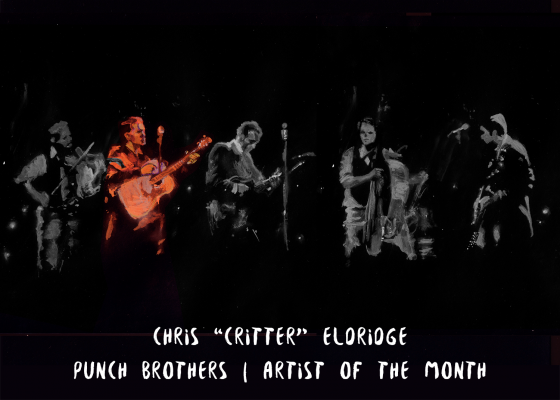
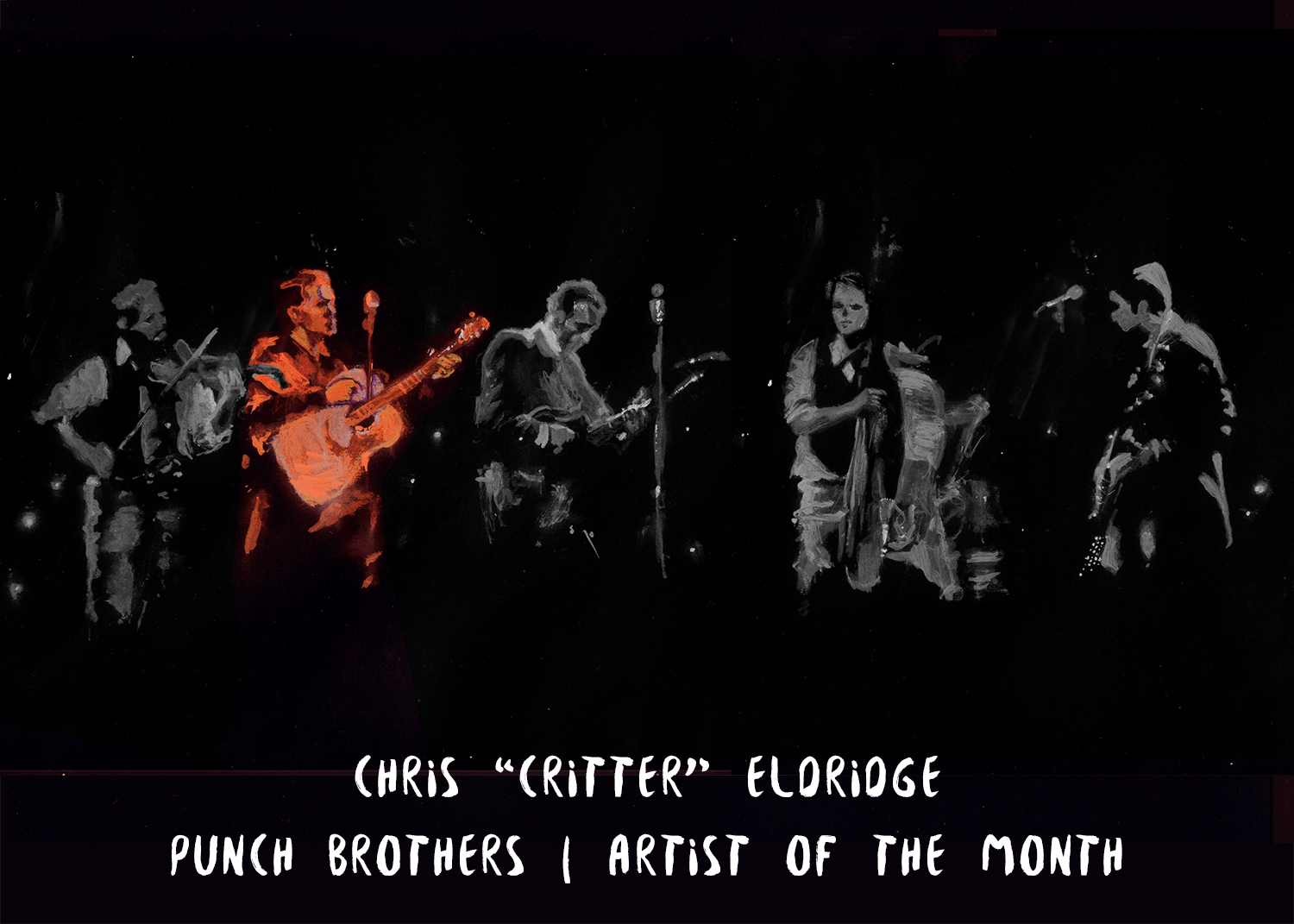
Chris Eldridge, the good-natured guitarist for Punch Brothers, comes by his bluegrass pedigree honestly. As a young man, he attended innumerable shows by Seldom Scene, a pioneering ensemble whose lineup included his father, banjo player Ben Eldridge. After studying at Oberlin Conservatory, he co-founded the Infamous Stringdusters, which won three IBMA Awards following their 2007 debut project, Fork in the Road. Indeed that album title proved auspicious, as Eldridge took a different path with the formation of Punch Brothers – a rewarding partnership that a decade later has yielded their newest project. [Read Chris’s interview]

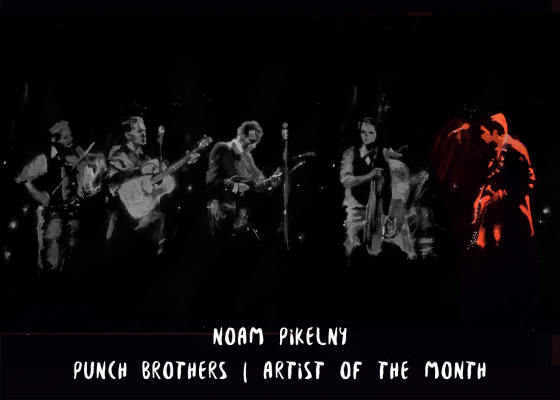
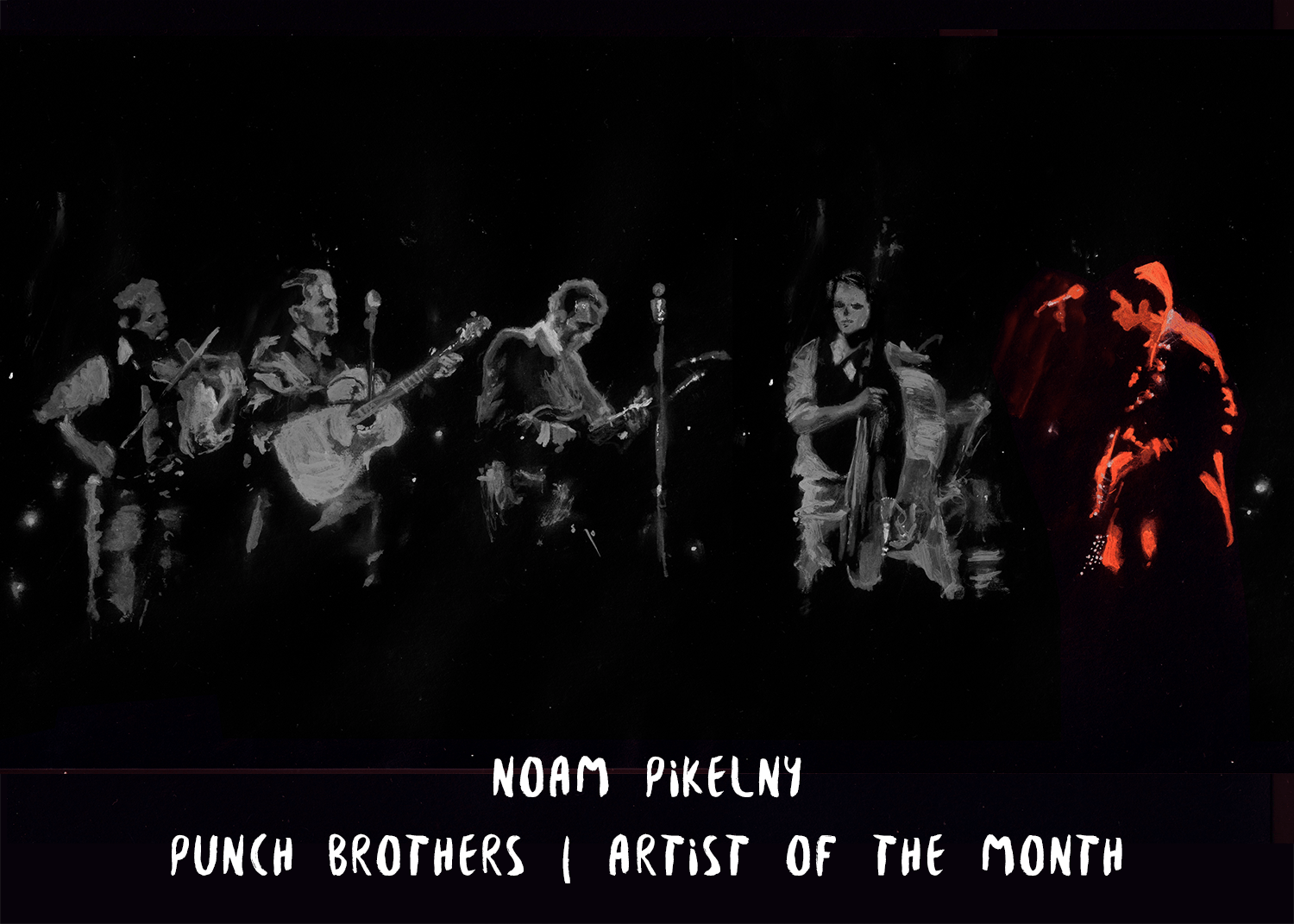
Noam Pikelny has a dry delivery only when he’s joking around. But as the banjo player in Punch Brothers, his playing is crisp, inventive, and in step with his colleagues. This is especially true on All Ashore, which explores the personal challenges of relationships as well as the growing political divide in America. This year he’s nominated for IBMA Banjo Player of the Year, while his two previous solo albums earned Grammy nominations. His Twitter bio sums it up: “Widely considered the world’s premier color blind banjoist. Punch Brother.” [Read Noam’s interview]

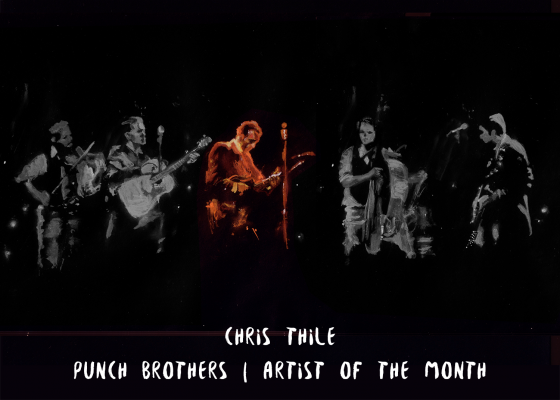
Chris Thile is walking briskly into the venue while chatting agreeably about Punch Brothers’ new album. He’s used to multi-tasking, of course. In addition to kicking off an extensive tour with that eclectic band, he hosts the public radio show Live From Here, and he’s also a husband and father with a lot on his mind – particularly when it comes to the state of the world. [Read Chris’s interview]


Illustrations by Zachary Johnson

LISTEN: The Devil Makes Three, “Pray For Rain”

Capturing your band’s live sound in the studio is right up there with writer’s block as one of the most common challenges you can face as an artist—particularly if, like The Devil Makes Three, your live shows are your bread and butter.

The California trio, whose high-energy tours and festival appearances attract a fiercely dedicated fan base, have already released a couple live albums. But as they were writing Chains Are Broken, Pete Bernhard, Lucia Turino and Cooper McBean made a conscious effort to further capture their live instrumentation in the studio by inviting their touring drummer, Stefan Amidon, to record with them.

“We recorded with a [session] drummer who we really liked on our last album, Stranger, and it was just fun,” Bernhard says. “It gave us a lot more, I dunno, freedom I guess. There’s a certain freedom in playing as a string band too, but it was a different kind of freedom. But yeah, we’ve been playing with [Stefan] for years. Sometimes people see us play and they’re really shocked that we have a drummer, but that usually means that they haven’t seen us in like three or four years.” He laughs. “So we wrote a lot of the songs including drums, so when we went into the studio, it seemed like the natural progression to have him play.”

However, that doesn’t mean drums are a permanent addition to the band’s setup.

“I don’t like to predict the future,” he says. “I think that maybe we’ll use him if we think the song is appropriate, and if we write a song that’s just like a guitar and a bass, then we’ll do that. The main thing I like to do is just approach it like there really aren’t any rules, you know? And if the song wants drums and it wants a bass clarinet, then that’s what we’re gonna do. And if it doesn’t want that, if it wants like an electric guitar and standup bass and vocals and nothing else, then that’s what we’ll do.

“We still play without a drummer sometimes, it just really depends on the gig. But for us it was really exciting to do it and just try it because we hadn’t done it before. But yeah, for the next record, maybe we won’t. Maybe we’ll use drums on some songs like we did on Stranger and not on others; maybe we won’t use them at all. I think it really depends on what we’re excited about writing. There are no hard and fast rules.”

That lack of rules when it comes to their recording process led them to venture out to Texas for a new sort of studio experience as well, working on Chains Are Broken at the Sonic Ranch, the largest residential recording studio complex in the world.

“I’d never been to a recording studio like that before,” Bernhard says. “I’d never done like a live-in sort of studio. It was really cool. It was a very strange experience. You live at the studio, and there’s a lot of other people recording there too, so it’s kind of like—I don’t know, I don’t know how to describe it. It’s like band camp or something. Because while we were there, there’s like a jazz artist next door who’s recording, and there’s a rock group, and then there was Tito & Tarantula, which is a little more on the punk side of things, and it was really cool and very, very different. We’re used to sort of going into a city and recording in a studio and kind of spending a lot of time someplace in the middle of everything, and this could not be further away from that.”

He adds, “It was incredibly isolated. It was down by the Mexican border. It was really, really pretty and really quiet and really peaceful, and we just focused on playing every day for a couple of weeks and before we recorded the record, we sort of hung out and played the songs and talked about how we wanted to change them, things we liked, things we didn’t, and it was like we got so much more space and time to work on the record than we ever have before. It was really cool. It’s kind of creepy out there though…It’s the desert, you know? And I think that kind of influenced the sound of the record too. Just sort of the environment is very kind of empty and really pretty but also a little bit lonely.”

You can hear that influence on tracks like “Can’t Stop,” a deceptively upbeat song with dark lyrics that only reveal themselves if you’re listening closely. Bernhard says it’s about the pitfalls of being an artist.

“I think mainly for me it’s just a song about being an artist of any sort—a musician or a visual artist—and what I think is sometimes necessary to be an artist. When I wrote the song I was thinking a lot about how a lot of artists kind of finish their lives in a terrible way, you know?” he says. “Like someone like Hemingway, he was given electroshock therapy and he basically drank himself to death, and somebody like Townes Van Zandt also met with a sad end. I was reading James Baldwin and he was talking about how being an artist is one of those things where instead of you choosing to do it, it’s one of those things where you can’t help doing it. You have to do it. And you don’t have a choice whether you do it or not, and you do whatever’s necessary in order to make that happen.”

He continues, “And sometimes that’s kind of not that great. But people who are artists and feel they have a vision that they want to see happen and that they’re driven to are willing to do that. And I think that was the inspiration for the song, you know, really not being able to stop. You might want to, but you can’t. And I think that’s sort of a part of the life of being an artist or a creative person in any way, and it is kind of dark sometimes. I think it’s a really great thing and it’s a wonderful gift to be given, but at the same time, yeah, it can be kind of a dark thing. And just that feeling of not being completely in control, I think that that’s part of being an artist of any kind. You kind of give yourself over to that, and it takes you wherever it’s gonna take you, and sometimes where it takes you isn’t that great, but that’s part of the ride.”

Sonically, Chains Are Broken is a heavier record as well—a natural progression stemming from the band’s live show.

“I think it actually sort of unfolded in the live show over the years, playing with a drummer, and everybody in the band is really into heavier music,” Bernhard explains. “It’s pretty funny, actually, if you like go around the room and ask the band what kind of music everybody’s listening to right now, the answers you get back are really hilarious for the kind of music that we play. We all started out in the punk scene, and as we’ve gotten older, I think Cooper especially got really into sort of slow metal and a lot of experimental music, like drone music.

“So yeah, we definitely made the album heavier just out of our music getting heavier over the years onstage. I think it’s just kind of happened naturally. And it’s also so fun to play like that. I think we’ve always tried to emulate that, even when we were just three people playing acoustic instruments. We always tried to play as fast and hard as we possibly could, so it’s sort of a continuation of that.”

But like their live show, no Devil Makes Three record is immune from being tweaked with and evolving, and Bernhard says the group is eager to see how Chains Are Broken shifts as they take it on tour.

“I think the thing that happens for us, you know, we write a record, we’re excited about it, we go out on the road, and then a lot of times we change it.” He laughs. “We change how we play the songs. We like to do them in a different way, we might change the tempos of them, it’s like things evolve and we find a certain way that we really like to perform stuff. I mean, I think that’s part of why you want to see a band live, too. Just sort of to see the different songs and see how things evolve.”


Photo credit: Jay Westcott

Punch Brothers’ Chris Thile: Escapism and Clarity

Chris Thile is walking briskly into the venue while chatting agreeably about Punch Brothers’ new album, All Ashore. He’s used to multi-tasking, of course. In addition to kicking off an extensive tour with that eclectic band, he hosts the public radio show Live From Here, and he’s also a husband and father with a lot on his mind – particularly when it comes to the state of the world.

This interview is the fifth and final installment in a series saluting the Bluegrass Situation’s Artist of the Month: Punch Brothers.

I want to ask about “All Ashore” being the first song on here. Do you feel like it sets the tone for this album?

I do! It sort of introduces, through a fog, a lot of the content that we are mulling over the course of the record. It feels a little bit like a curtain is rising. I like starting with the nebulous imagery. It felt right.

I looked up the phrase “man of war” and found out that it’s an armed ship, which is an interesting image to start that song.

Yeah, I saw that character as moving forcefully through her environment, with conviction, with authority, with purpose … brushing aside the distraction, getting straight to business. I don’t know remember why “man of war” got stuck in my head, but just that ship, if you’ve seen a picture of one, you can tell it means business. So I felt like it was a good way to introduce people to that character.

Maybe I’m thinking too much into this song, but I like that long intro to the song because it reflects a tense relationship. It’s like, “Is someone gonna say something here?” Was that intentional?

[Laughs] Oh yeah, absolutely, yeah it’s a prelude to the record. The record was designed as a whole, as a piece of music, almost like a nine-movement piece of music. And while we hadn’t originally intended for “All Ashore” to be the first movement of it, you have to go with your material as a composer – or in our case a five-headed composer. Eventually “All Ashore” just could not be denied as the opening gesture, in large part due to that kind of prelude. It felt like a beginning. It felt like a nice way to say hello. …

I think of a sunless dawn, I think it’s overcast, I think there’s fog. But one thing I love about music is it means those things to me, and those are the pictures I get in my head, but you might get something entirely different. Is it almost two minutes before any singing anything happens? I think it might be.

It’s pretty close.

Yeah. So I love the idea that people would be in their own heads, forming their own image, and then those first lines of the lyric basically start a dance with whatever people have started to see – whatever sort of concept people are starting to get. And then basically a ship moves on the horizon, in the form of the character of Mama. You start wondering who’s telling the story, who’s the guy that comes into the song in the second verse, and what they’re all up to.

I found on this record that your stories kind of reveal themselves over time. I felt like there are narratives in these songs and it’s a pretty complete statement. Do you look at it as a concept album?

Sure, but I also think an album that is void of concept should be regarded with high suspicion. I think any album worth listening to is a concept record. You know, I understand what people mean by “concept record,” almost like a piece of musical theater, without acting or whatever. While I don’t feel like there is a linear narrative, there is absolutely a narrative that is meant to be heard from start to finish, in sequence. We wrote it that way.

We also pointedly wanted to make sure that it still made sense in vignettes, which is how most people listen to things these days. They put their phones on shuffle or whatever. Just because that’s not the way I like to listen to music doesn’t mean that’s not the correct way to do it. So we wanted to make sure that the songs could stand on their own, but I think when experienced together, they might add up to a little bit more than when they’re listened to in short bursts.

How do the instrumentals kind of factor in this? If I’ve learned anything from your Ryman show, I need to find the recipe for the Jungle Bird and Three Dots & A Dash. Tiki drinks, right?

Yeah, Tiki culture has been one of my muses for a couple of years now but this is the first record where it’s really come to the fore. There are two different rum references in the lyrics, one in “All Ashore,” one in “Jumbo.” And of course “Three Dots & A Dash” and “Jungle Bird” are a great old-school Tiki cocktails. I feel that basically the relation is two-fold. One is that Tiki culture represents one of America’s most shameless escapist gestures. It doesn’t pretend to solve anything; it just spirits you away, no pun intended.

But what I find, ironically, is that it’s in the midst of one of those escapist gestures that I find myself able to start thinking clearly about some of the things that are troubling me. And I think my bandmates would agree. A lot of people start getting to the meat and potatoes of a topic, in communion with their fellow man, right around when the second round hits the table.

You’ve made that initial escape to the point that you can actually see your life, and our lives as a society, with a little bit of perspective. You can get a little distance from it and might actually start being able to see it for what it is, and start asking yourself the harder questions. Not that you are expecting answers, but to even just ask the question, I think, and to discuss the various questions turning over in your collective minds is a worthy exercise. So all of these lyrics are the result of that kind of conversation. And so, naming those two instrumentals after Tiki drinks is symbolic of those conversations.

I like the fact that you sing in falsetto, because it can really expand where you go with your vocal, and the melody too, for that matter. Why does that falsetto voice appeal to you with the music you are making?

We’re chasing achieving the melodies we hear. If we limited the melodies that we wrote to what fits in my vocal range, my full-voice vocal range, we’d be far more limited than if we expanded to include falsetto. Something like the “Angel of Doubt” melody, for instance, we didn’t start that off going, “Yeah, you know what would be cool is if you sang about half the time in falsetto.” It’s just that’s where the melodies were headed. Also I think there’s a sensitivity and an intimacy to falsetto, to my ear. It’s almost like a request to come closer. A sort of intimacy to it that even if the melody starts taking us thither, then maybe I’ll start considering what lyrics are going to be sung in falsetto. Like if I’m going to deliver this in falsetto, then that comes in a certain character.

I find that interesting that you mentioned character. That must be refreshing to sometimes write from a perspective that isn’t necessarily yours. Is that the case?

Oh, I find it necessary to my sanity. I feel like if I were invariably seeing the world from my own perspective, it’s experientially incestuous or something. I crave seeing the world through other people’s eyes. To me, good art always lifts me out of my experience of the world and places me in someone else’s. And then I see things a little bit more clearly with each great piece of art that I encounter. That the lyric changes the perspective, even within the songs, I think that exposes a certain preference on my part, I’ll say. Or a certain hunger for multiple perspectives.

Even like “Jumbo,” for instance, even though that is satire, clearly, it’s trying to make a point. I think it’s a fairly clear indictment of the perspective from which it’s coming. Even still, part of that is an attempt to understand where that perspective is coming from.

That song went over pretty well at the Ryman. How is “Jumbo” treating you out on tour? Are people responding to it well?

[Laughs] I think so. I think it is probably difficult to get all the words, live, so it’s always amusing to see what people react to. And sometimes I think they might be reacting to something that if they were to see the lyric on paper, or what the actual statement is, maybe they might still laugh but they wouldn’t whoop and holler about it. It’s interesting how much tension is in the air right now. For us, as a society, there’s so much tension in the air you can cut it with a knife. And so a song like “Jumbo,” or “Just Look at This Mess,” and maybe “It’s All Part of the Plan” as well, it lets some of the tension out. Hopefully it can be cathartic for people who are completely mystified by the state of our country and our world right now.


Illustration: Zachary Johnson
Photo credit: Josh Goleman

WATCH: The Unseen Strangers, “Church Street Blues”

Artist: The Unseen Strangers
Hometown: Toronto, Ontario
Song: “Church Street Blues”

In Their Words: “We are massive Norman Blake fans in the Unseen Strangers and are always working up different songs of his. I started listening to this one when I first got into bluegrass guitar and digging into the music of Tony Rice, so there’s quite a bit of his version in there. ‘Church Street Blues’ is certainly a flatpicking classic and we are excited to share our arrangement with this video. It was recorded live in the Back 40 forest at the Tottenham Bluegrass Festival in Ontario. When we can’t agree on what song to play next we always just play this one.” — Adam Shier


Photo credit: Emma-Lee

WATCH: The Earls of Leicester, ‘Long Journey Home’

Artist: The Earls of Leicester
Hometown: Nashville, Tennessee
Song: “Long Journey Home”
Album: The Earls of Leicester Live at The CMA Theater in The Country Music Hall of Fame
Release Date: Sept. 28
Label: Rounder Records

In Their Words: “In the bluegrass canon, the song ‘Long Journey Home’ has appeared under many alternate titles for different artists. Yet I’ve always felt Earl Scruggs’ banjo raised the Flatt and Scruggs version to a higher level. When planning our live record, we wanted to have a few fast tempo songs that we could count on to raise the blood pressure for both the listeners and our own. The tempo and fire that this song brings through Charlie Cushman’s banjo as well as Shawn Camp and Jeff White’s vocals made it an easy choice, and a welcome new entrant into the Earls repertoire.” – Jerry Douglas


Photo credit: Patrick Sheehan

Punch Brothers’ Noam Pikelny: Getting Inside the Story

Noam Pikelny has a dry delivery only when he’s joking around. But as banjo player in Punch Brothers, his playing is crisp, inventive, and in step with his colleagues. This is especially true on All Ashore, a new release that explores the personal challenges of relationships as well as the growing political divide in America. This year he’s nominated for IBMA Banjo Player of the Year, while his two previous solo albums earned Grammy nominations. His Twitter bio sums it up: “Widely considered the world’s premier color blind banjoist. Punch Brother.”

This interview is the fourth of five installments as the Bluegrass Situation salutes the Artist of the Month: Punch Brothers.

When I was at your show at the Ryman, you were usually turned toward the band but I could never tell if you were singing. Do you sing with the guys on the songs?

I sing on a few things, but not much on this record. I actually don’t think I sing any harmony on this record.

Is that by choice or have they tried to convince you otherwise? Why is that?

Usually, like when I’m singing at all, it’s because we have like five part harmony going on. And I think it has to do with my range. I have the most limited vocal range of anybody in the band. But that was how I was born. I was born that way, it’s not my fault! … And then on the one song I sang on, on the last record, they invited everybody else in the universe to sing on it. On the song “Little Lights” that was on The Phosphorescent Blues. And so I think it essentially the policy that if Noam is allowed to sing, then everybody is allowed to sing. It’s only fair to have a one-hundred person overdub. I can’t hear myself because of all these people.

A couple of you have mentioned what’s going on in the country right now as inspiration. I think it’s on everyone’s mind, but why does it seem like a good inspiration for a song? Like “Jumbo,” for example. Why do you think it lent itself to writing a song?

Well, I think on a more macro level, I think it’s really important to be sticking to your guns. I think a lot of people are demoralized and questioning whether what they’re creating or what they’re doing for a living is valid in times when it seems like a lot of them are under assault. I know for me personally that having an opportunity to make music with musical co-patriots was very crucial. I feel like there’s such division right now in this country. I think people are thriving on families being alienated from each other. You think of the Thanksgiving dinner that becomes so troublesome. Friends are becoming alienated through all kinds of political differences and I feel like our sense of community and our sense of comradery as a whole is kind of under assault.

I think parsing through what’s going on in our lives right now, a solo project can be quite lonely. I think we find strength in working with each other and we have the ability to hone our thoughts with each other around, as far as what’s important to us and what we want to say. For “Jumbo” in particular, why does this make for good music? Or why is this musical inspiration? I ultimately thought that these people are like the protagonists that are Jumbo and his cohorts, they spend most of their time celebrating themselves. And we just wanted to get in on the action and celebrate them as well. So it’s really a celebration, more than anything.

It’s a fun melody if you just listen at the surface level. How’s it going over live? It seems like one that people would be responding to?

I think people are responding to a lot of it. [Playing live] is a huge component of the musical journey of this music. Making a record is obviously the most concrete and typical manifestations of the music. But the journey really is just beginning once that’s finished and we start playing it live, getting audience feedback, and shaping the song for the live experience. We’re flattered that people are enjoying it and starting to know the words.

Gabe that told me that you have a good story from being on Letterman. Do you have a minute to tell that story?

Oh, I’m not sure exactly what he’s referring to. I mean we got to go on Letterman about eight to nine years ago and play with Steve Martin. He announced that he was doing this yearly banjo award – it seems like a long time ago, it was nine years ago now. So, it was one of the more surreal experiences of a lifetime, getting to be up there with Steve Martin and Dave Letterman.

You were the first one to get that award. I remember when that started. Since then, a lot of your peers have been recognized. This sounds like a weird question, but is there like a banjo community or like an instant friendship when you meet another banjo player?

Um, there’s a secret banjo cult that meets in a cave in Horse Mouth, Kentucky, on the third Saturday of every month. And everyone’s totally cloaked and in these robes that are covered in banjo tablature… No, there’s no secret society – or if there is, I haven’t been invited yet which probably makes sense. But I think there’s an instant kinship with anybody else who’s pursuing music as their life’s work. And I think any instrumentalist, you always want to pow-wow and talk about their techniques and who they studied with, so I think there’s an extension in that way.

I wanted to ask you about songwriting collaboration. The way I understand is that everybody wrote the music together and then crafted the stories on top of the music. Is that pretty accurate? What was the process like?

We write the music instrumentally first, as a band, and that’s often with the five of us in the room. Oftentimes, Thile will be kind of singing, just gibberish, or a few words he has stuck in his head that associates with that music. Sometimes, those couple words will become the kernel of the song, and we’ll shape it around that. He often goes off and starts writing lyrics and brings it back for collective input, and we’ll help edit and shape the lyrics.

Sometimes we’ll have late-night discussions over cocktails or a drink, talking about what’s going on in our lives, whether it’s our familial environment or what’s going on in the world right now, and he’ll go off and try to capture that collective thought into a lyric. So it’s always different, but interestingly in Punch Brothers, the lyrics almost always come last. We write placeholder lyrics first, then that’s the final but obviously very crucial element.

Are you a good lyricist? Do you enjoy contributing in that way?

I don’t consider myself a true lyricist. I really do enjoy the process of working with the lyricist. And I feel it’s an effective kind of partnership to them to have Thile leading the charge in that way, but then having this kind of counsel for feedback that can be brutally honest.

You just got married this year right?

Correct. A few months ago.

So this album has a song like “All Ashore,” which is about a relationship falling apart, but then you’re a newlywed. In order to get into a character, do you have to set your personal life out of mind when you perform a song like that? How do you separate the two?

Well, no, I think “All Ashore” isn’t about the collapse. It’s more about the challenges. It’s the struggle and the ups and downs, the ebb and flow, to quote the song itself. But you know, when we get up and play a song like “Molly and Tenbrooks,” which is a racehorse song, I don’t feel like I have to identify personally with the jockeys or the horses … but I think it’s really important to get inside the story of the song and as you perform it, you can really deliver the intent of it.

And so there might be a difference of whoever is the lead singer. You’d have to ask Chris how it’s different, whether it’s sung from the first person, or a narrator, or an actor. All of those roles probably come into play on different material and especially on covers that we do. … I think you can emphasis the story even if you don’t see yourself in that story. That’s the case in music and in real life. I think being an instrumentalist, I’m trying to support the singer by helping him deliver the intent of the song. I make the story more vivid through the way that I play it.


Illustration: Zachary Johnson

Punch Brothers’ Chris Eldridge: Influences and Integrity

Chris Eldridge, the good-natured guitarist for Punch Brothers, comes by his bluegrass pedigree honestly. As a young man, he attended innumerable shows by Seldom Scene, a pioneering ensemble whose lineup included his father, banjo player Ben Eldridge. After studying at Oberlin Conservatory, he co-founded the Infamous Stringdusters, which won three IBMA Awards following their 2007 debut project, Fork in the Road. Indeed that album title proved auspicious, as Eldridge took a different path with the formation of Punch Brothers – a rewarding partnership that a decade later has yielded their newest project, All Ashore.

This interview is the third of five installments as the Bluegrass Situation salutes the Artist of the Month: Punch Brothers.

When I saw you guys at the Ryman, I noticed you were wearing a Hawaiian lei, so I take that as a sign that things are going well on the tour. What’s the vibe so far?

The vibe has been really fun and it’s great because the band’s back together, as they say. We’ve been connected, all of us in various ways, even in this time off from the band. I see Thile a bunch because I’m usually playing guitar on Live From Here. Paul lives really close to me, so I see him like every other day in Nashville. And Noam is close, and I see Gabe, but to have all of us in the same place out on the road for me is a really fun thing because one of the real privileges of my life is getting to play music in Punch Brothers, getting to be the guitar player in a band with those guys.

One of my favorite songs on this record is “The Gardener.” I feel like it sets a nice tone and tells a hopeful story. Tell me what the band was hoping to capture with that song.

Well, the music was started on that years and years ago, probably in 2012. We were in London doing a thing with T Bone Burnett for a movie and this simple melody kinda just sprung up. We were trying to brainstorm some stuff for this movie and it almost sounded like a Christmas carol. And so it was this thing that we always really liked, and we didn’t give it to that project that we were there working on. We wanted to hold it close to our chest and keep it ourselves. It was something that we had sitting around, even for The Phosphorescent Blues, but we just didn’t develop it into anything.

And then Thile had come up with that kind of weird, modulating, tonally ambiguous guitar that starts the song. He showed that to me and it was really cool. The way it works for us is, we always work on music before there’s any content, in terms of story. That’s pretty much how it tends to progress for the band. We’re definitely a music-first band. So it was a matter of making both of those ideas interesting. And the original idea from 2012, the Christmas carol idea, was really neat and we really liked it but it had a limited amount of development. A lot of Punch Brothers music, the song will have to have a certain amount of development. It’ll tend to go places. Usually we won’t just repeat a thing over and over.

And as we were trying to develop that, someone had the idea, “What happens if we do that crazy, weird, finger-picked guitar thing — the ambiguous tonal thing – and pop it together?” We had to change the key around a little bit but we found a key relationship that worked and it solved this problem.

So then it’s a matter of figuring out what the song is going to be about. Thile had this idea about a gardener, some guy kinda tending. You know, because the music is not lonely exactly but there’s like a forlorn imagination, like optimistic vibes, that are encoded into the sound of that melody. So it was trying to find a story to go along with it. And it dovetailed with a lot of the things that we’ve been thinking about and talking about as a band, in terms of society today. People who have things and people who don’t have things. People who feel protective of themselves and their tribe. It’s a meditation on a lot of those kinds of thoughts. I’m barely touching on them, but that’s kind of where it came from.

You guys would make a pretty cool Christmas record. Has that ever come up?

We’ve talked about it before. I don’t know if we’ll ever do it, but I think that would actually be really fun. There are so many cool, beautiful songs. Really timeless, gorgeous melodies. There is some solid music there in that canon of holiday music. It’s so hard to get everybody’s schedules to align now. People have three children in the band at this point, and three wives, and essentially all of us are in completely and deeply committed relationships … and we’re all older. The band can’t sit totally in first place anymore, which is necessitated by having families and that’s now the most important thing. So we really have to be deliberate about our time and it means that we don’t do as much stuff together – but when we do, we try to really make it count. That being said, I would love to make a Christmas record.

I thought with your connection to Seldom Scene, I’d ask if you knew John Duffey well.

I didn’t know him that well, but I certainly grew up around him. John didn’t really know how to relate to little kids. I have a lot of memories of being around John, just being around the band, but I didn’t really interact with him much until towards the very end of his life. We’re talking probably the last less-than-six months he was alive really. He started to acknowledge me because I was probably 13 or 14 years old. I was just getting to the age where he related to me as more than just a small child. I was starting to feel a little more like someone he could relate to.

I remember the last time I saw him alive. I was sitting backstage at the Birchmere. They have these big chairs and I was sitting in one of them. He came up behind me and just scruffed me by the hair and said, “Hey there, guy.” That’s kind of where the story ends but I was just so blown away, like, “Whoa! John Duffey just talked to me!” That was an amazing thing!

I have very clear memories of the sound of his voice. I probably went to hundreds of Seldom Scene shows and I heard those guys play hundreds of times when I was a kid and the sound of Duffey’s tenor, the sound of his mandolin playing, the sound of Mike Auldridge’s Dobro bouncing off the walls. That stuff is burned so deeply within me. I’m so thankful and grateful for that. It’s this crazy privilege that I was just born to have those experiences. As I get older, I appreciate more and more how cool it was. But I don’t think I ever really took it for granted. I loved the music, I loved the sound of that band from the time I was a boy.

I know that Tony Rice is one of your heroes too. How has his music shaped the music that you’re making now?

Oh man, profoundly. He provided such a great example of musical integrity. In terms of rhythm, not just rhythm guitar playing, but actual timing, his sense of time and elegance and grace and power and intelligence – all these things that I really try to emulate. The goal was never to be a clone of Tony. I mean, it’s easy to learn the note that he plays. It’s not that hard but I feel like once you do that, then the real learning begins. What’s he doing with those notes? Why is it so good when he plays them? What’s going on there? That to me is when the rubber hits the road and that has everything to do with his musicianship and his sensibility. And so those are the lessons that I studied so hard and it affected my outlook and approach to how I want to present music on acoustic guitar. And just music in general.

But I would argue that Tony had strong ideas about that and his enormous integrity to those kind of musical values was really influential to everybody in the acoustic music community. His high level of musicianship – and how he retains some of the essence of bluegrass, the rhythmic essence – sets the stage for a lot of the modern music that we like. And certainly Punch Brothers. Certainly all of us were deeply influenced by that example of musicianship.


Illustration: Zachary Johnson