The Man That Made All of Us Play the Banjo

(Editor’s Note: For Earl Scruggs’s birthday, Thomas Goldsmith revisits a star-studded bluegrass festival tribute to the banjo legend from 1971 in Camp Springs, North Carolina. The 102nd anniversary of Scruggs’s 1924 birth in Flint Hill, North Carolina, is January 6, 2026.)

Like speakers at a testimonial dinner, each musician strode to the microphone in turn.

But instead of heaping on words of praise, a stage full of well-known pickers and up-and-comers used banjos to pay a lively tribute to Earl Scruggs.

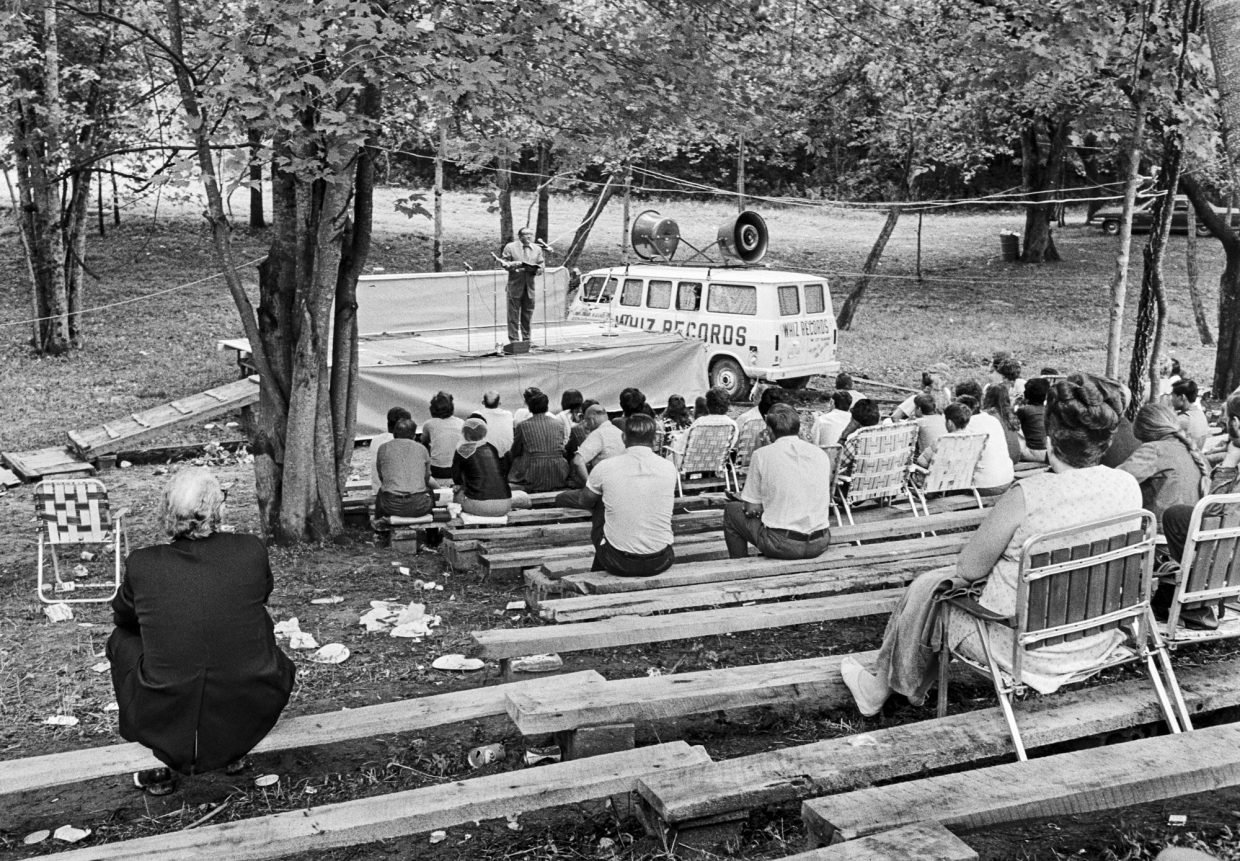
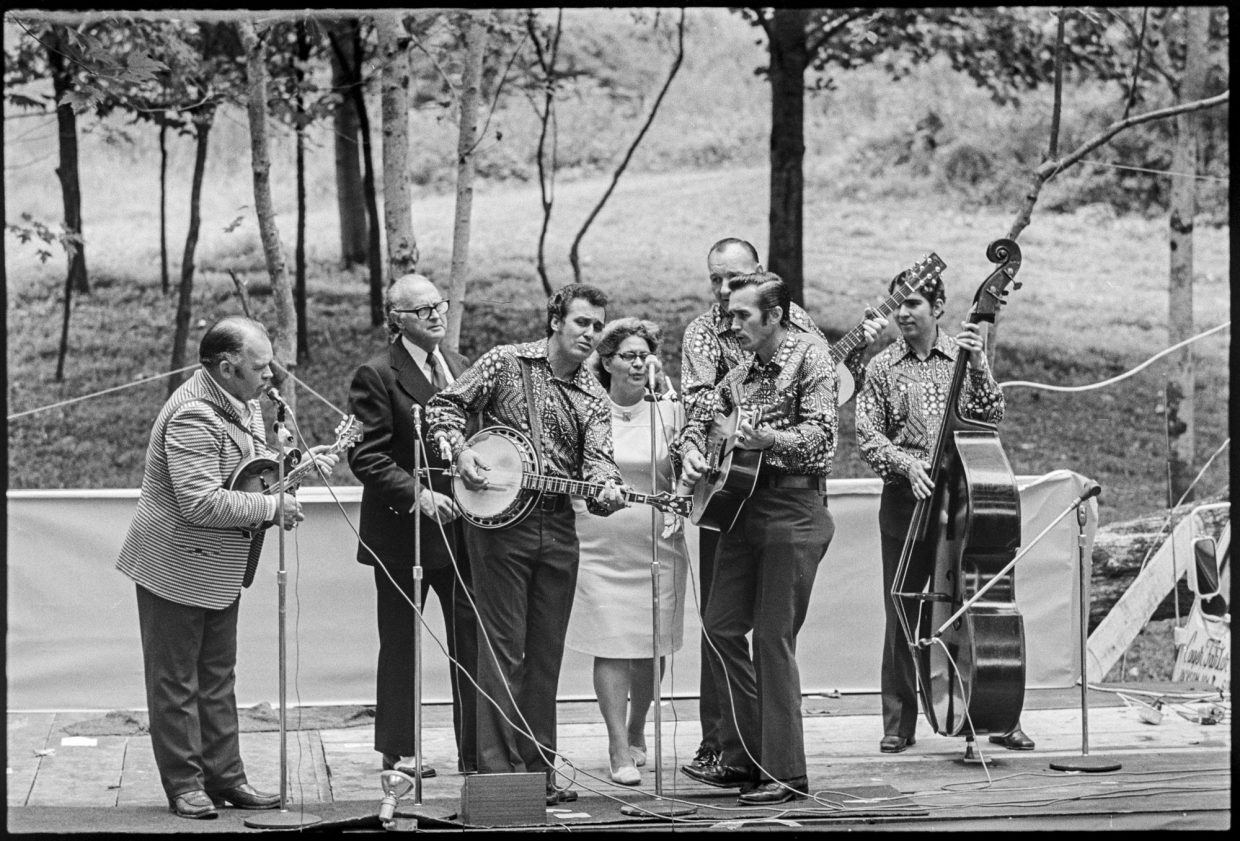
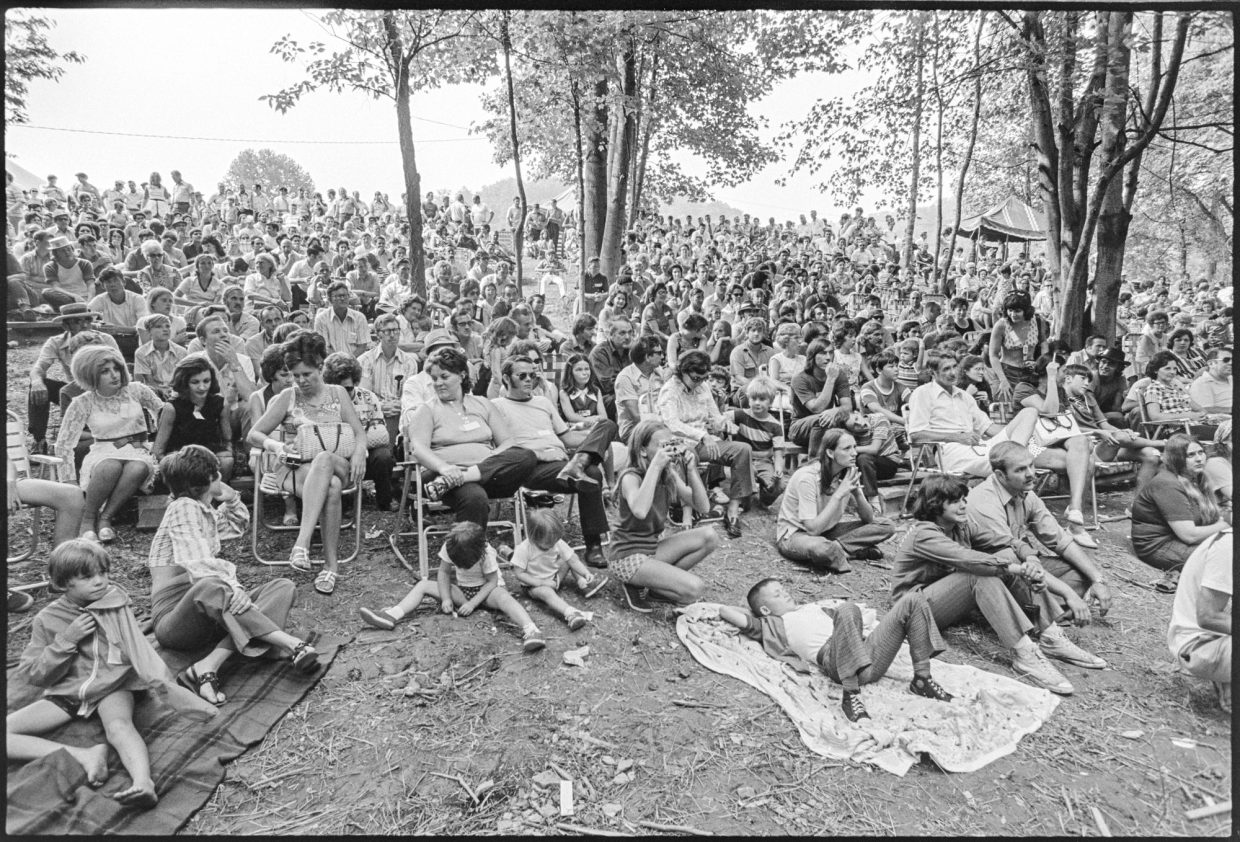
The scene was the 1971 Labor Day weekend bluegrass festival in Camp Springs, North Carolina, at a performance where some of the best banjo players around joined Scruggs on stage. Led by the five-string king himself, banjoists including Sonny Osborne, J.D. Crowe, Bill Emerson, and Alan Munde jointly played Scruggs’s signature tune “Foggy Mountain Breakdown,” some 22 years after its first recording.

The performance is a highlight of the 1972 documentary Bluegrass Country Soul, which enjoyed a 50-year deluxe re-release five years ago. Watch the clip here.
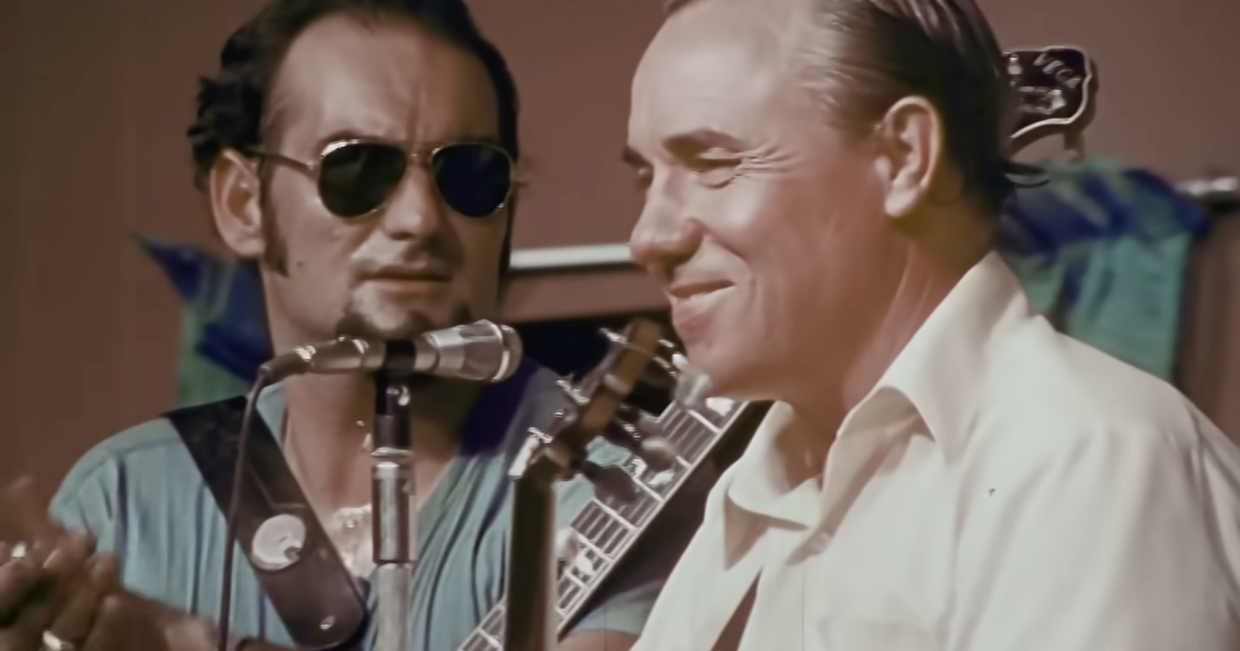
 

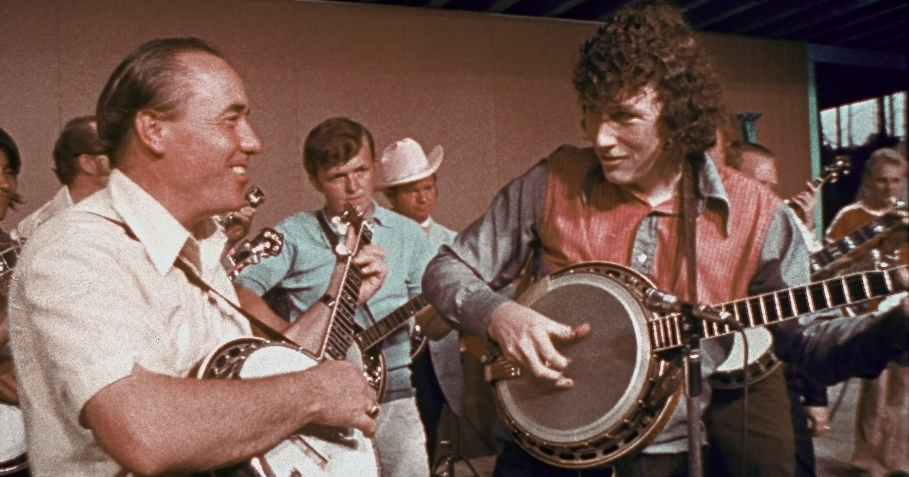
Sonny Osborne (left) gets emotional onstage after introducing Earl Scruggs (right). Screenshot from clip courtesy of Bluegrass Country Soul, Inc.

Promoter Carlton Haney invited more than a dozen banjo players on the festival schedule to play along with Scruggs, who was then 47. (A second group performance, of “Dear Old Dixie,” doesn’t appear in the film. And a couple of the “Foggy Mountain Breakdown” performers didn’t make it to the screen.)

Millions of viewers have seen the clip as part of the movie or on YouTube, with Osborne bringing Scruggs on with an introduction that sounds starstruck.

“(It’d) be only right to call out probably the man that has made all of us guys up here play the banjo, or either has been a great influence, as he has in my complete life,” Osborne said. “In my whole banjo-playing ability … I could probably credit to this one man.

“Let’s all give a tremendous welcome to probably the best in the world, Earl Scruggs!”

Scruggs seemed overwhelmed by the audience’s ovation. The cheering feels as though it lasts forever, but took only a minute and a few seconds.

“That really fills my heart with joy,” Scruggs said after Osborne introduced him. “I did want to say one thing: Thank you, and guys like this is what keeps me going, my boys who works with me and you people who keep preaching music.

“I just don’t know what to say, except I’m picking with some guys that plays a tremendous amount of banjo. Don’t underestimate anybody up here. Man, they’re great.”

Earl at a Crossroads

In 1971, Scruggs had only broken up with his longtime duet partner Lester Flatt less than two years earlier. Not even a month before Camp Springs he had recorded along with other greats for Nitty Gritty Dirt Band’s country-roots-popularizing Will the Circle Be Unbroken set. He was venturing into a country-rock sound with his band the Earl Scruggs Revue, along with his sons Randy, Gary, and Steve.

However, Scruggs’s work as a musical innovator remained – and remains – fundamental to the way a large share of bluegrass banjo players address the instrument. That’s true despite the introduction of a single-note style most associated with Don Reno and a chromatic or melodic approach heard in the playing of Bill Keith and Bobby Thompson.

Most of the pickers in the 1971 “Foggy Mountain Breakdown” performance used the three-finger picking style Scruggs introduced in a band with Bill Monroe and Flatt on the Grand Ole Opry in 1945. The exception among the Camp Springs pickers, Rick Riman of the New Deal String Band, caused something of a stir with his chromatic rendition of the tune, not to mention his long hair, full beard, and striped shirt and pants.

How did Riman, who had also studied Scruggs style closely, decide to use the flowing melodic style for “Foggy Mountain Breakdown”?

“I just thought, “OK, let’s see if I can make this work,’” Riman, 83, said on the phone from Denver, Colorado, speaking to BGS in January 2026. “Because I had not prepared anything, and I didn’t even know what was on the program. They just said they want all the banjo players up there to pay tribute to Earl. And I said, ‘OK, I’ll get up there and do it.’”

And what has the reaction been?

“Mostly negative,” he said, with a touch of humor.

“One person said they were really glad to see somebody step out of the standardized [method], and that felt very, very good. Somebody else said, ‘You won’t believe how many people thought that you shouldn’t have been on stage at all.’

“And I get that a lot. That’s mostly the reaction I get, that I shouldn’t have been on stage. I shouldn’t have even been in the parking lot, like the least talented person on the stage and probably the least talented person in the whole park.”

The chromatic style remains one effective tool in the hands of players such as Béla Fleck and Noam Pikelny, but Riman, 28 that day in 1971, has gotten a load of grief over his choice to add some variety to the line of Scruggs-style players. “I would say, over the years, it’s pretty much been like 50-plus years of derision,” he said.

Riman has had one regret. “I should have practiced more,” he said. “I should have been better, but I had no idea.”

Although at Camp Springs he performed in the more recently created melodic and chromatic styles, like everyone on the stage that day in North Carolina, Riman was schooled in the style of the man honored beside them.

“I was really fascinated by Earl and anybody else who played his style pretty well,” he said.
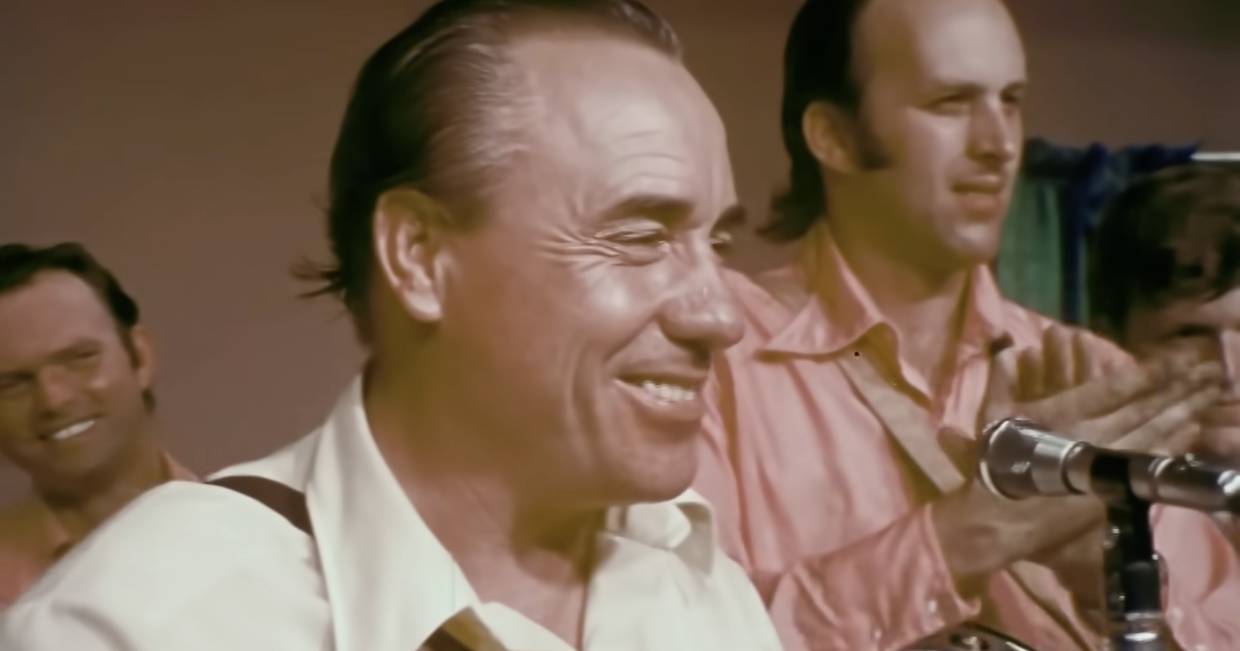
 

Earl Scruggs reacts to his introduction and audience ovation and applause onstage in 1971 in Camp Springs, NC. Screenshot from clip courtesy of Bluegrass Country Soul, Inc.


“Everybody Headed for the Stage”

We were fortunate to reach three of the banjo warriors who performed that day. Sadly, most of the players heard then have since died. Eddie Hoyle, then 14, the youngest of the Camp Springs lineup, is among the survivors and is still actively performing. He talked to BGS on the phone in December from his home in Georgia.

“I was up there playing with Curtis Blackwell and the Dixie Bluegrass Boys and I just remember them telling me that Carlton wanted all the banjo players to come down on the stage and play a tune with Earl,” said Hoyle, now 68. “So I got my banjo out, and everybody headed for the stage.

“I didn’t know if I’d get to take a break or not, but somebody got me in the line that was walking up to the mic. So it was pretty cool. And I remember I was not nervous; OK, probably didn’t know enough to be nervous.”

Most of the players that day stuck fairly close to Scruggs’s own licks on “Foggy Mountain Breakdown,” but Hoyle and others ventured a bit from the classic performance.

“I always tried to learn the right way, as Dad told us to do, but then I would try to put my own twist on it,” Hoyle said.

Nearly half the banjo players that day have been inducted into the Bluegrass Music Hall of Fame. They include Scruggs himself, of course, as well as J.D. Crowe, Bill Emerson, Alan Munde, Sonny Osborne, and Don Stover. Another banjo picker, Saburo Watanabe Inoue, founder of the pioneering Japanese band Bluegrass 45, won the IBMA’s Distinguished Achievement award along with his brother Toshio, in 1995.
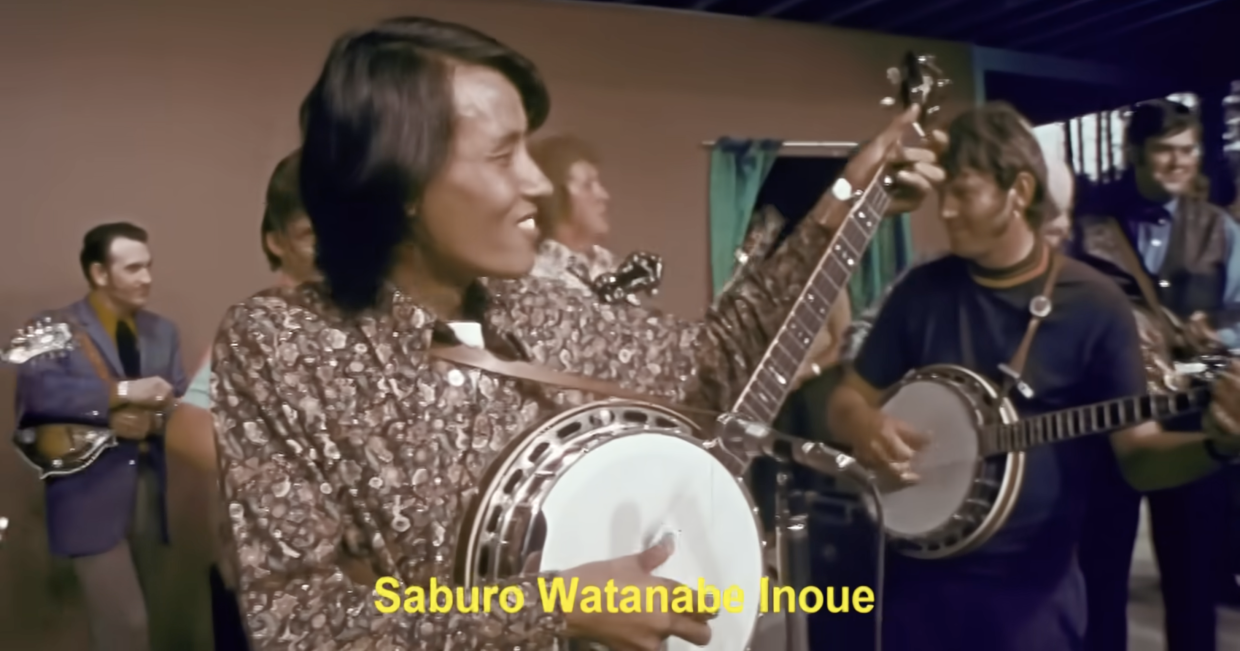
 

Sab Watanabe (who passed away in 2019) of the legendary Japanese band, Bluegrass 45, takes his turn at the mic. Screenshot from clip courtesy of Bluegrass Country Soul, Inc.


Alan Munde Remembers it Well

Munde, 79, still a player and teacher, also spoke to BGS about the experience from his home in Springfield, Missouri. He recalled that he was playing with Jimmy Martin and the Sunny Mountain Boys at the festival and took part in the group performance because Martin wanted him to.

“Thinking back on it and also remembering at the time, I didn’t really want to be a part of it, just because, then and now, I thought I would be so unworthy,” Munde said. “But I think Jimmy wanted me to do it, and you notice he’s there [in the film.] He thought I needed to be there, so I did it.”

Munde remembers the day as a landmark for him, the only time he heard Scruggs play live. Given all the great banjoists and backing musicians including Martin and Charlie Waller, it was an enchanting moment from the sound of Scruggs’s first lick.

“The thing that I remember so much about it is … we’re all standing there and Earl’s talking, and then he’s going to start to play,” he said. “And he, I always call this his ‘chang,’ where he just plays the first, third, and fifth string together and starts into the tune.

“As soon as he did that, I thought, ‘Oh my God, there’s that sound.’ It just was immediately apparent that he was the one.”
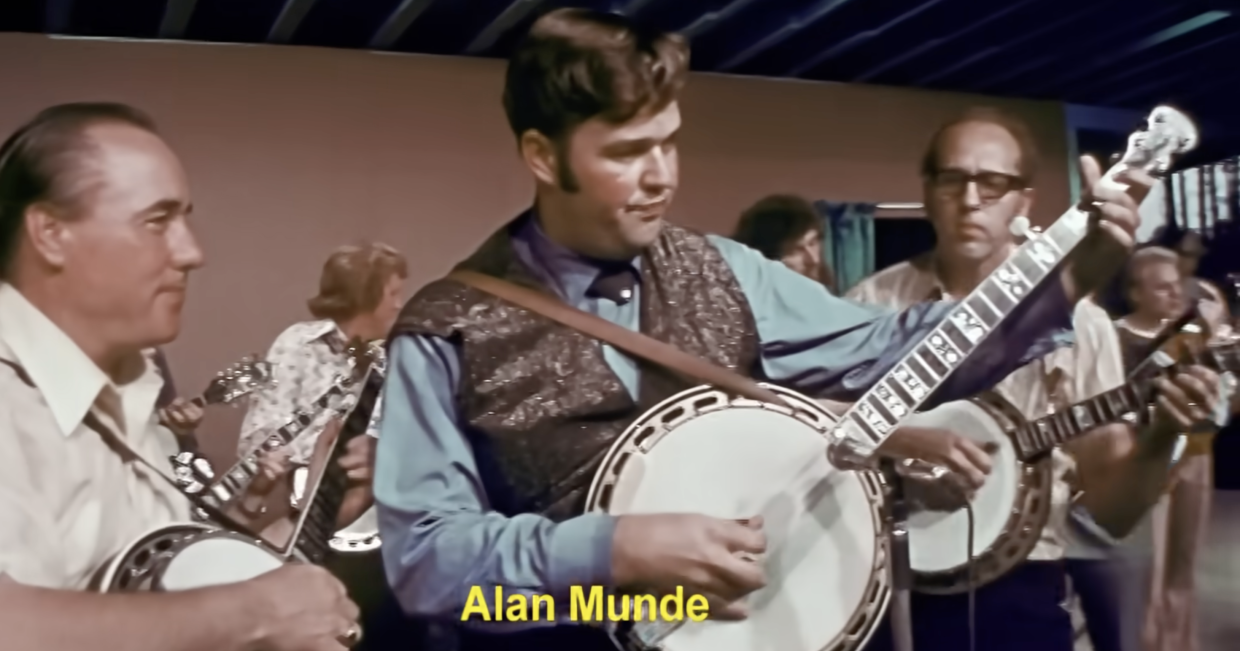
 

Alan Munde (right) is flanked by Earl Scruggs during the all-banjos jam of “Foggy Mountain Breakdown.” Screenshot from clip courtesy of Bluegrass Country Soul, Inc.

Like the first players to tune into Scruggs’s playing in 1945 and like players from Béla Fleck on, Munde appreciates Scruggs’s sound in a way that seems almost mystical. Scruggs produced something that no other banjo player could.

Jimmy Martin, Munde’s boss at the time, used to tell a story involving the great banjo man Vic Jordan to illustrate the way Scruggs’s beautifully nuanced playing and full tone stood above the crowd of his followers.

“Jimmy was kind of down on Vic Jordan a little bit,” Munde said. “And he would tell this story to show that Vic didn’t know the right way. He said when Vic met Earl, he asked him what kind of microphone he used.

“And Earl said, ‘Sometimes I use those little bitty ones, and sometimes I use those real big ones.’

“And Jimmy’s point was that, in his mind, Vic was asking because he thought it was the microphone. But it didn’t matter. It all sounded like Earl every time.”

And hearing Scruggs’s sound that day at Camp Springs, not through a mic, not on a record, but right there next to him on stage, made Munde think the whole exercise was somehow wrong.

“When he did that pinch, I thought, ‘Oh, God, I don’t want to be a part of this.’ What we should have done is just stood back and listened to him, and then said, ‘Do it again.’”

Despite his misgivings at the time, Munde has wound up glad that he took part in the Earl-fest that day.

“Looking back on it, it’s been nothing but good for me, that I got to be there,” he said. “Here it is, 50 years later, people still bring it up. It’s helped get me a little legacy recognition, that I was there, so that’s been real good.”

A Star-Studded Lineup

The career of Sonny Osborne has been well documented, but Bluegrass Country Soul makes clear his admiration and friendship with Scruggs. During the tumult of applause following his introduction, Scruggs asked if he could say something, and Osborne appears to grin and say, “Not yet.” And Osborne cracks up when Scruggs uses his up-the-neck solo from “Foggy Mountain Breakdown” during the last time around for the tune.

Bill Emerson, whose long career included membership in the Country Gentlemen and much more, was interviewed at the time of the re-release of Bluegrass Country Soul. He talked about the pantheon of great banjo players.

“Don Reno, he had his style on the banjo; Earl Scruggs, he had his style on the banjo; Ralph Stanley, he had a style on the banjo,” Emerson said in the set’s booklet. “And on the radio, I could listen to any of them, just the first few notes of an intro, and tell you who was playing. Just by the style that they were playing, the tone that they had, and the timbre. Most people, when they started out playing the banjo back then, they got a bunch of Earl Scruggs’s records and sat down and tried to learn to play like Earl. But it’s mighty hard to sound like Earl, I can tell you. I was never able to do that, so I just tried to sound like Bill Emerson.”
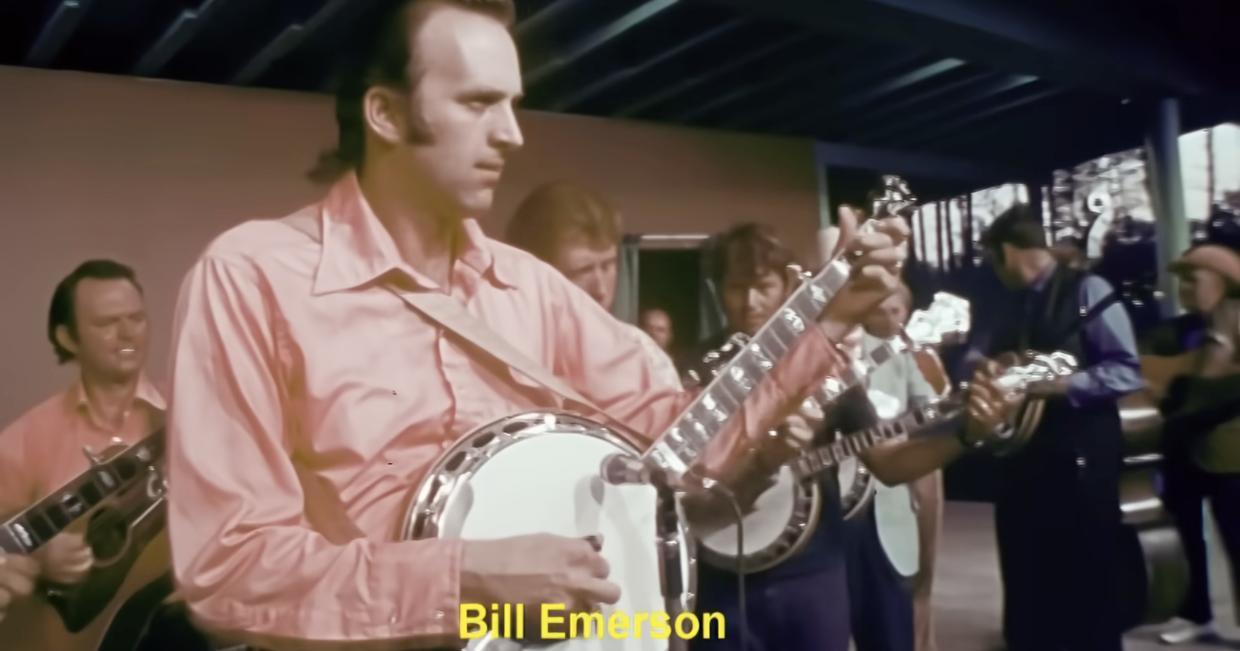
 

Bill Emerson takes his turn playing a solo on “Foggy Mountain Breakdown.” Screenshot from clip courtesy of Bluegrass Country Soul, Inc.

Also on the show was multi-instrumentalist Jimmy Arnold (1952-1992), whose career was one of a kind, including excursions into Southern rock and solo albums on guitar and banjo as well as stints with Cliff Waldron, Charlie Moore, and the New Tradition, according to a 1983 Bluegrass Unlimited story. The article, by Chris Wathen, quoted Arnold on Scruggs: “When you learn all of what you think is hard stuff and then go back and try to play one of his tunes, you find out what the hard stuff really is. It’s his stuff. To play with that much power and volume, you’ve really got to be on top of things.”

Another of the clip’s well-known pickers, Don Stover (1928-1996), had been an early convert to Scruggs style, learning it not long after Scruggs’s first performances with Monroe, according to the Bluegrass Music Hall of Fame.

Stover was known for his work with brothers Bea and Everett Lilly during many years of performances in Boston. He played and recorded as a member of Bill Monroe’s Blue Grass Boys in 1957, even contributing harmony vocals to “In Despair.”

Earl’s son Randy, who appears playing an archtop banjo just before the end of the clip, went on to a distinguished career as a musician, songwriter, and producer.

Doing Their Times

The 55th anniversary of this notable moment in bluegrass will arrive in September. Looking back, the picking ranges from respectable to spectacular, but doesn’t maintain the dead-even tempo that’s supposed to prevail in bluegrass music. Fans remember the story that Earl and brother Horace Scruggs, as boys, used to start playing a tune, then separate to walk around their Flint Hill house in opposite directions. The idea was to check if they were still in time with each other after being out of earshot.

The dozen players on the Camp Springs group number would not have passed this test, based on a stopwatch run-through. While Scruggs’s December 1949 original recording had consistent solos of right at 11 seconds, he started the round robin at about 12.69 seconds and tempos wavered from there.

By the start of Riman’s melodic solo, near the end, the time was more than half a second slower. Randy and Earl Scruggs wrapped things up at roughly the same tempo.

But that’s just a quibble.
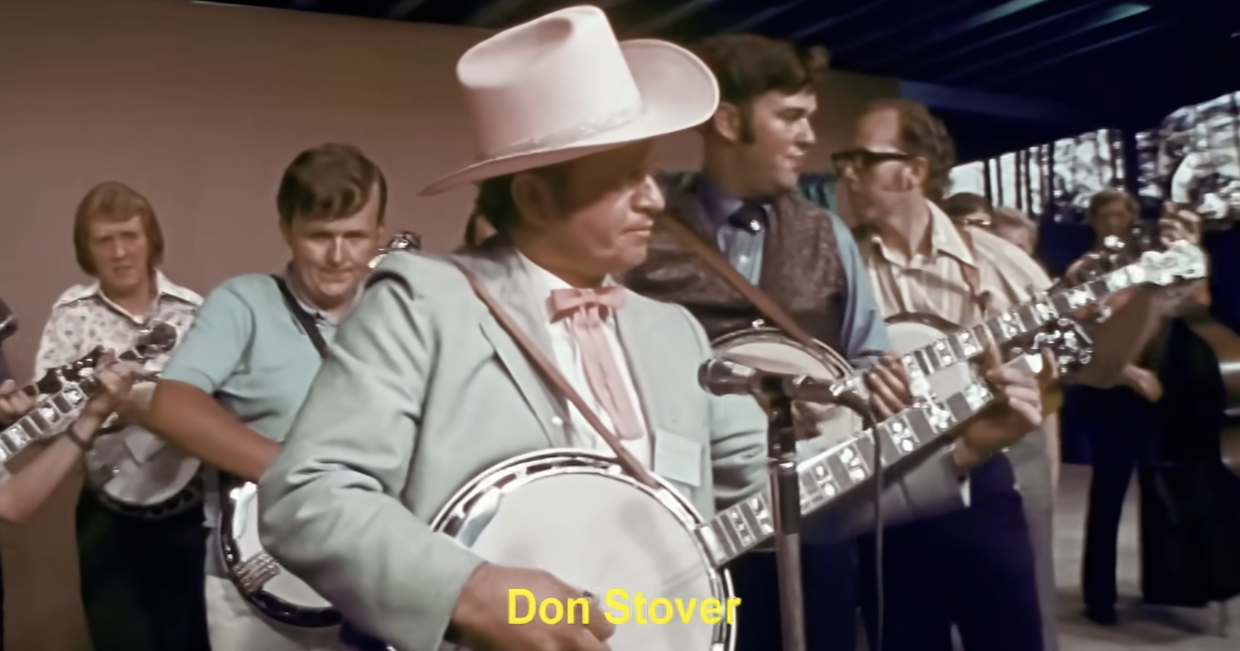
 

A contemporary of Earl Scruggs, Don Stover also performed a rendition of “Foggy Mountain Breakdown” during the jam. Screenshot from clip courtesy of Bluegrass Country Soul, Inc.


Remembering Earl

Bluegrass Country Soul director Albert Ihde did bluegrass lovers a real service by capturing these moments and others at the Camp Springs festival. And promoter Haney had another brainstorm resembling the story, pronounced “stoah-ry,” that he recreated of Bill Monroe and former band members six years earlier at Fincastle, Virginia.

Viewers will keep calling up the video for its closeups of Earl, smiling and even bobbing up and down for his breaks, and for the scenes of several of his outstanding followers, appreciating their moments on stage as they rolled their way through “Foggy Mountain Breakdown.”

Many videos of Flatt & Scruggs can be found on the web that illustrate Earl Scruggs’s unmatched musicianship. In the Bluegrass Country Soul segment viewers can also see a strong memorial to Earl Eugene Scruggs the person, his warmth, humor, and unselfishness as well as his brilliance as a musician.


Thomas Goldsmith is an award-winning journalist based in Tennessee and North Carolina. In addition to producing many hundreds of articles for newspapers and magazines, he edited The Bluegrass Reader and authored Earl Scruggs and Foggy Mountain Breakdown: The Making of an American Classic, both books for the University of Illinois Press.

Learn more about Bluegrass Country Soul and purchase a Golden Anniversary Legacy Edition box set of the film here. Read more about the box set and the making of the film here.

All photos courtesy of Albert Ihde, Ellen Pasternack, and Bluegrass Country Soul, Inc. Lead image: Earl Scruggs (left) and son, Randy Scruggs (right), perform “Foggy Mountain Breakdown” flanked by bluegrass banjo stars of 1971.
The Five Pillars of Doc Watson’s Legacy

What a difference a Doc made.

Lots of people would like to think their lives have made a difference – whether through their family life, or work, or some sort of creative endeavor.

However, even to approach the enduring heritage of the great musician Arthel “Doc” Watson, a person would have to achieve lifetime landmarks as imposing as the North Carolina Appalachian mountains that were his home. During a lifespan from his birth in 1923 until his death in 2012, Watson created a legacy of music, folklore, and goodwill that no one has entirely equaled.

First a little background: Arthel Lane Watson was born March 3, 1923, near Deep Gap – he is not from Asheville – in Western North Carolina. An audience member suggested the nickname “Doc” when his given name was found less than compelling for an entertainer.

His life story before and after becoming an admired folk musician has been often told, notably in Doc Watson: A Life in Music, a 2025 biography by Eddie Huffman published by the University of North Carolina Press.

Blind since infancy, Watson started to develop life skills and musical ability from an early age. He learned both formal and popular styles when sent to the state’s school for the blind in Raleigh at about age 10.

The boy was consumed by music and persistent in getting better at it. Watson had learned both the rudiments of harmonica and a few banjo tunes from his father, General Watson, before he went off to Raleigh. While living within the strict environment of the school for the blind, Watson learned braille and grew familiar with classical and church styles of music taught there. Perhaps as strong an influence as that education was fellow student Paul Montgomery, the talented friend from whom he learned guitar chords. Young Watson and Montgomery, later a well-known Raleigh pianist and children’s show host, shared enthusiasm for the popular music of the day, including jazz and big-band sounds.

His parents, Annie and General Watson, taught the boy skills of growing crops and basic carpentry, and he contributed to the family despite his blindness.

After years of mostly local performances back in Western North Carolina, it wasn’t until the early 1960s, when East Coast musician and historian Ralph Rinzler tuned into and promoted his far-reaching ability as a singer and picker, that Watson’s name gained national, then international attention.

According to an account at the Blue Ridge Heritage Area website Watson recorded over 50 albums and was honored with “the National Medal of Arts, a National Heritage Fellowship, the North Carolina Folk Heritage Award, seven GRAMMY Awards, and a GRAMMY Lifetime Achievement Award.”

As fans know, Doc Watson contained multitudes of skills, a breadth of ability that inspired this list of the five pillars of his musical and artistic legacy.

The King Flatpicker

Watson largely created the challenging fiddle-inspired guitar style that led many followers along a flatpicking trail.

It was during the 1950s, when playing an electric Gibson Les Paul in the local Jack Williams Band, that Watson developed a style that would transform the way the guitar was played in folk and bluegrass music.

Generally, earlier acoustic guitarists in roots-derived styles used a flatpick to create basic “boom-chuck” back up, perhaps throwing in some fills and Jimmie-Rodgers-style bass runs.

But when dancers at Williams’s gigs wanted music for square-dancing, Watson worked up single-note versions of fast fiddle tunes such as “June Apple” and “Bill Cheatham” on his Les Paul. This approach enables lead guitar pickers to achieve the same flowing, rapid attack that fiddlers used for tunes, many of which had come over from the British Isles in past generations.

It’s not possible to say that Doc Watson was the first guitarist to flatpick fiddle tunes. After all, it wasn’t until Watson emerged as a folk artist in the 1960s that the broader music scene caught on to his musicianship. And high achievers such as Arthur Smith on “Guitar Boogie,” Don Reno on “Country Boy Rock ‘n’ Roll,” and Bill Napier on the Stanley Brothers’ “Mountain Dew” – along with some jazz and blues players – all recorded hot-licks acoustic soloing before Watson did. Joe Maphis was also cranking out ultra-fast flatpicking numbers in the 1950s.

But it was Watson’s 1960s performances that created a precedent for a wave of guitarists who had to muscle up to the speed and dexterity he displayed.

A long line of guitarists at the top of the field – from Clarence White to Tony Rice, from Bryan Sutton to Billy Strings – all show Watson’s clear influence not just in recreating fiddle tunes, but also in rapid-fire picking and clean sound on a broad range of material.

Player and educator Alan Barnosky wrote in “An Exploration of Doc Watson’s Innovative and Joyful Guitar Stylings” for Acoustic Guitar in 2023 about the spread of this kind of playing.

“Watson amazed folk fans in the early 1960s by taking tunes typically reserved for the fiddle and reworking them for the acoustic with speed, clarity, and flash,” he wrote. “He never claimed to be the first to play fiddle tunes on a guitar, but for the majority of listeners at the time it was an entirely novel and groundbreaking approach.”

Another world-class, tradition-based player, Earl Scruggs, praised Watson’s adaptation of fiddle tunes as the two were joined by Ricky Skaggs for the 2003 The Three Pickers performance and album.

“He was the first man I ever heard on the guitar that was fooling with tunes like that,” Scruggs said in a Three Pickers introduction. “You had all these good G-C-D pickers – that’s chord positions – but I had never heard anybody that actually took over a lead like a banjo or a fiddle or a mandolin and do those tunes. He could do it.

“And what amazed me about Doc Watson’s picking, and still does, is he’s got that – I call it ‘mountain sound’ to his picking, and he’s one of the best to keep it in that mode of sound.”

New generations of players have immersed themselves in Watson’s style. When I interviewed him for a Bluegrass Unlimited article, leading guitar picker and multi-instrumentalist Bryan Sutton talked about being captivated by Watson’s playing during Sutton’s youth on Western North Carolina.

“Doc and Dan Crary were the first great influences on me,” he said. “Doc Watson was one of the first professional musicians/guitar players that I ever saw. He doesn’t live too far from Asheville, so I saw him play some different festivals and at Maggie Valley. So, he was the first one to really catch my ear as far as what you could do with the flatpick.

“My right hand – it may not as much anymore – but I remember at one time it was kind of like Doc’s. It’s kind of like the way Sam Bush plays, using the whole forearm and wrist involved in the playing, whereas with jazz players or Tony Rice it’s more of a wrist thing. I think I’ve got a little bit of both now.”

Billy Strings, the artist who’s likely doing the most to promote Watson’s legacy in the 21st century, sounded almost evangelical during a September 2025 interview for NPR’s Fresh Air.

“He’s like the ground upon which I stand, you know?” Strings said. “My dad played his music all around the house growing up. And by the time I could play guitar, you know, 5, 6 years old, I was learning those tunes, too. I might’ve been able to play some of them before I knew how to tie my shoes or something, you know?

“It was like, I was learning how to speak and talk and walk, and I was learning all these Doc Watson tunes at the same time. And it was just, like, a religion in my house, you know? His music is just – it’s the best.”

To see some of the top pickers in the field paying tribute, check out this video shot at the Merle Watson Memorial Festival – what would become MerleFest – in Wilkesboro, North Carolina, in 1992.

A Model Fingerpicker

From his first albums on, Watson regularly also played guitar with a thumbpick and index finger. As he noted with his customary self-deprecating humor in the DVD “Doc’s Guitar: Fingerpicking & Flatpicking,” “See, I just play with one finger and a thumb. I don’t use the sensible three-finger method that you should use on finger-style guitar.” (Watch below.)

Watson sounded great with that approach, making finger-picked tunes such as “Deep River Blues,” “Nashville Blues,” “Omie Wise,” and “Doc’s Guitar” fan favorites and objects of long study. For every striving guitarist who practiced hard on his fiddle-tune adaptations, plenty of pickers also worked on showcases such as “Windy and Warm,” with its alternating bass, pull-offs, note bending, and a jazzy minor sixth chord at its conclusion.

Watson’s fingerpicking often showed off his acquaintance with diverse approaches, as in “Deep River Blues,” with an E diminished as its second chord. It also illustrates the way he put his touch on existing pieces such as 1933’s “Big River Blues” by the Delmore Brothers, who played with flatpicks.

“There were two guitars, a tenor – a little four-string, and the regular flattop, and I never could get my guitar to sound like both of theirs did,” Watson said. “Then I began to hear brother Merle Travis, the late Merle Travis, on the radio. And I thought, Now, wait a minute. If I can steal me a lick off brother Travis, maybe I can learn ‘Deep River Blues.’”

Multi-talented Kentuckian Merle Travis (1917-1983) popularized a style in which the thumb plays an alternating bass on the guitar’s lower strings while picking the melody on treble strings. Watson also studied the work of the great guitarist Chet Atkins. The picking buddies released the album Reflections in 1980.

The centuries-old, transatlantic ballad “Georgie” would have once been sung unaccompanied, leaving Watson and others free to craft a brand new style of guitar back up. With no clear precedent on guitar, he might employ the flowing, almost classical patterns that became popular among folk revivalists.

And fingerpicking became the tool Watson used to play the blues that he loved and drew on so deeply, music he followed from the time he heard Mississippi John Hurt on the family’s disc player in childhood.

In the end, there’s no easy way to pin down the many elements Watson brought to his picking, musical points of view that enriched his listeners along the way.

A Standout Singer

Doc Watson’s vocal abilities don’t generally get as much attention as his top-drawer chops as an instrumentalist. However, he was also a tuneful singer with a natural, angelic mountain baritone.

Watson came along during an era when rougher-voiced vocalists such as Hobart Smith, Dock Boggs, and his picking buddy Clarence Ashley represented mountain singing to a growing audience. And Watson’s less mannered style likely contributed to acceptance among listeners less familiar with the high lonesome sound. His direct vocal approach was often heard in performances with no instrumental backing.

It’s useful to remember that Watson also enjoyed the smooth country vocalist Eddy Arnold so much that his son Merle Eddy Arnold was named not just after fingerpicker Merle Travis, but also for Arnold.

Tunes from the Tennessee Plowboy’s repertoire such as “Tennessee Stud,” “I Couldn’t Believe It Was True,” and “Anytime” also showed up in Watson’s repertoire. These were only a few examples of the eclectic side of Watson’s vocal approach, with emphasis on great material over genre labels.

Given his broad taste, Watson at times put some extra grit into his singing on a number such as “Blue Suede Shoes” from his Jack Williams days of the 1950s, later a concert favorite. But more often he sang songs straight, even on one like “Nights in White Satin,” a 1967 pop hit by British rockers the Moody Blues. With waltz-time guitar and plain singing, Watson makes the song come across as relevant to himself and listeners as songs by the Delmore Brothers and Jimmie Rodgers.

Watson’s first memories of vocal music came in church, and he prized the straightforward, no-vibrato sounds that carved such songs in his memory.

“If you love music, you have to listen from the time you’re big enough to notice music,” he told me when recording his 1991 GRAMMY-winning CD On Praying Ground.

“If you’re looking for old-time material in songs, those old songs that you heard when you were young were the easiest to put down.”

From his first commercial recordings on, Watson featured gospel numbers such as the a cappella version of “Talk About Suffering” from 1964 and “Down in the Valley to Pray” from 1966. Both radiate belief and unornamented clarity.

More recent listeners may know the latter song as “Down in the River to Pray,” as it was opportunistically relabeled to match a scene in the 2000 hit film, O Brother, Where Art Thou?.

Always A Song Man

Doc Watson had an impressively broad range of musical interests, perhaps markedly so, given the period in which he came along.

Country or folk music didn’t start appearing on commercial records until Watson was about two years old. In childhood he listened to down-home picking as well as church and gospel songs. It wasn’t until the 1930s that the family owned a radio that let them hear music beyond their 78-rpm record collection.

Virtually every great musician is a song collector at heart. And like Bob Dylan, Watson took on songs from tradition and added new elements. Take the mournful ballad “Omie Wise,” based on a North Carolina murder from the early 19th century.

In the 1920s notable old-time artists G.B. Grayson and Clarence Ashley recorded it with modal accompaniment that was neither truly major nor minor. When Watson recorded in the 1960s, he ventured into folky, arpeggiated picking that put it squarely into minor-chord territory, opening up the song to young folkies who couldn’t play fiddle like Grayson or banjo like Ashley.

In fact, Watson’s playing on “Omie Wise” occupied the same guitar realm as folk star Joan Baez’s playing on “East Virginia” and other traditional songs.


He also tuned into compositions by folk musicians Bob Dylan (“Don’t Think Twice It’s All Right), Tom Paxton (“The Last Thing on My Mind,” “Leavin’ London,” and “Bottle of Wine”), and Townes Van Zandt (“If I Needed You”).

Watson isn’t chiefly known as a songwriter, but he enjoyed notable success with “Your Lone Journey,” which he wrote with wife Rosa Lee. The starry duo of Led Zeppelin frontman Robert Plant and bluegrass’s own Alison Krauss released it as “Your Long Journey,” leading to what biographer Huffman called significant royalties for the family.

Watson’s greatest legacy in songs may have come with the wealth of lasting favorites – just a few are “Deep River Blues,” “I Am a Pilgrim,” “Banks of the Ohio,” “House Carpenter,” and “Shady Grove” – that made their way into the folk, old-time and bluegrass repertoire and could otherwise have been forgotten.

Ambassador for the Old-Time Way

This role for Watson may be the hardest to pin down, as it overlaps with almost all the others. By cleaving to his Appalachian heritage while also making the most of decades of change, Doc Watson was able to introduce countless fans to a rich, living culture.

“I don’t live in the past,” Watson told me in 1991. “I still burn wood in a furnace at the house, but I have heat ducts and a blower on it just like an oil furnace.

“I love to burn wood and I love to split wood. There’s a few of the old-timey things I love to do. I like good dried-apple pie and I like ‘leather britches’ beans.

“And I like to be at home, dadburn it. I hate the road.”

Watson’s long career of traveling to take his music to listeners, often in the company of his beloved son, Merle, nourished their taste for music that he built upon sold timbers of musical tradition.

Wade Smith, a legendary Tar Heel lawyer, told me once about his first experience of hearing Watson, at a small coffeehouse in downtown Raleigh in 1965.

“What word would I choose to describe how I felt?” Smith said for a later Raleigh News & Observer story. “Electrified, stunned at the speed of his fingers and the way he played single strings, and the clarity of the sound. Each note was like a piece of gold, so amazing.

“We stayed to the last note. When we left, I remember thinking that I had never heard anything like it and that in some way I had been changed by it, that I was in an altered state of existence.”

Watson’s national and international impact becomes more impressive given that he wasn’t heard outside his North Carolina stomping grounds until his late 30s. That’s when he honed his broad range of expertise into a mountain-based style that captivated and often amazed listeners at first hearing.

When the Society for American Music, a distinguished non-profit scholarly and educational organization, made Watson an honorary member in 2012, musicologist and musician Greg Reish paid tribute to Watson’s broad impact.

“As I discovered more of America’s traditional musical styles through my teenage years, Doc Watson always seemed to be at the core, an entrée into both older and newer styles,” Reish wrote. “Through Doc’s music I found my way to the pre-war music of the Carter Family, Jimmie Rodgers, and the Skillet Lickers; to the first-generation bluegrass of Bill Monroe and Flatt & Scruggs; to the classic country of Merle Travis, Chet Atkins, and Eddy Arnold; to the country blues of John Hurt and Frank Hutchison; and to the contemporary and progressive flatpicking of Clarence White, Norman Blake, and Tony Rice.”

Huffman’s book quotes the great bluegrass musician Roland White as he talked about the way his guitarist brother Clarence was caught up in Watson’s flatpicking after hearing him at California’s Ash Grove club.

“After seeing Doc, his picking became an obsession, an everyday part of everyday life. To play music and practice every day. Whether we played gigs or not, he was always playing music.”

Sixty years after White’s epiphany, Doc Watson’s music continues to gain and inspire new followers, whether through the picking and testimony of contemporary players such as Sutton and Springs, or through his own dozens of albums and videos. His legacy of tradition and innovation still flows like one of the ancient streams that nourish his cherished mountainsides.


Thomas Goldsmith is an award-winning journalist based in Tennessee and North Carolina. In addition to producing many hundreds of articles for newspapers and magazines, he edited The Bluegrass Reader and authored Earl Scruggs and Foggy Mountain Breakdown: The Making of an American Classic, both for the University of Illinois Press.

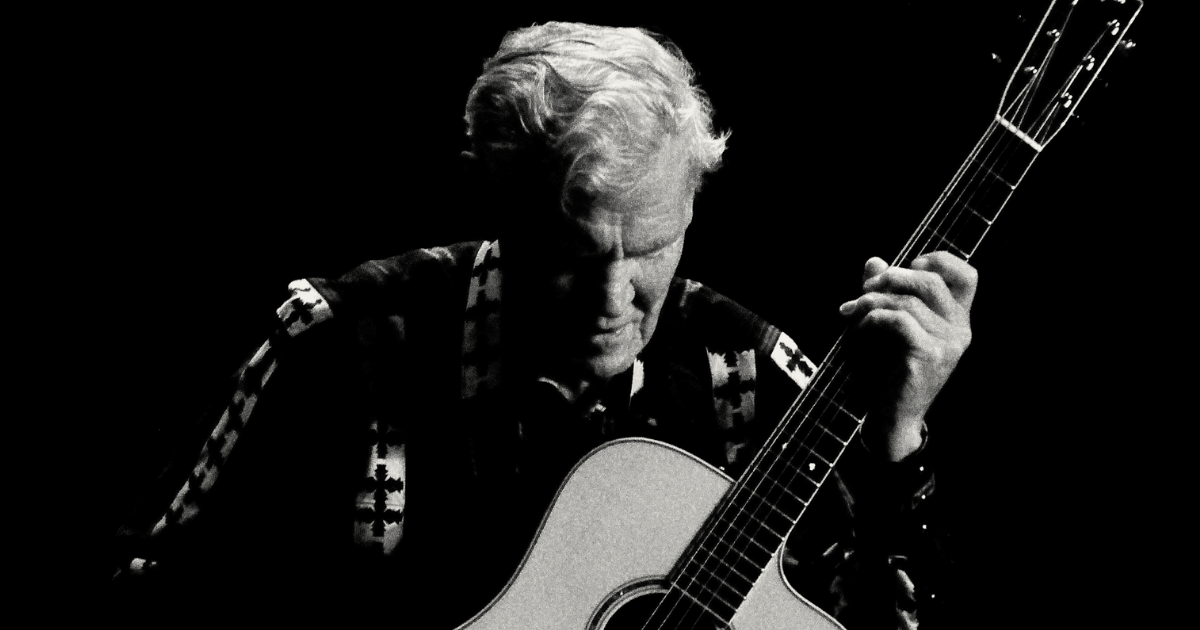
Lead image courtesy of MerleFest.

Explore more of our Doc in December Artist of the Month series here.

9 Bluegrass Covers of Grateful Dead Classics

It’s certainly true that the Grateful Dead were never a bluegrass band, starting with the fact that their lineup had not just one drummer, but two. And yet it also can’t be denied that the group’s musical DNA has a wide streak of bluegrass deep within, both in terms of licks and improvisational flair.

In large part, that’s due to the late Jerry Garcia – “Captain Trips” – who started out as a banjo player before finding his most famous calling as the Grateful Dead’s lead guitarist. Before that, Garcia played in folk circles for years, and his many extracurricular collaborators included David Grisman, Peter Rowan, Don Reno, Chubby Wise and other titans of the genre. More than a quarter-century before O Brother, Where Art Thou? took bluegrass to the top of the charts, Garcia’s 1973 side project, Old & In the Way, stood as the top-selling bluegrass album of all time.

Garcia and the Dead’s bluegrass bona fides are solid indeed, as shown by artifacts like the Pickin’ on the Grateful Dead series (not to mention Grass Is Dead, a tribute act). But maybe the strongest testament to the strength of the Dead’s bluegrass-adjacent side is what other artists have made of their catalog. Countless bluegrass musicians have covered Dead songs in ways that would appeal to even the staunchest chair-snapping purists. Here are some of the best.

“Friend of the Devil” – The Travelin’ McCourys (2019)

This rounder’s tale is the granddaddy of ’em all, a bluegrass staple from almost the moment it appeared on the Dead’s 1970 proto-Americana classic, American Beauty. Long a picking-circle staple at festivals, it’s been covered by everybody from Tony Rice to Elvis Costello. But here is a fantastic cover by one of the finest family bands in all of bluegrass, captured onstage at the Grey Fox Bluegrass Festival in 2019. In contrast to the manic pace of the original, this version proceeds at more of an elegant glide. But it’s still got plenty of get-up-and-go, with killer solos over walking bass and a great Ronnie McCoury lead vocal.

“Dire Wolf” – Molly Tuttle (2022)

Among the most acclaimed young artists in bluegrass, Molly Tuttle is a two-time Guitar Player of the Year winner from the International Bluegrass Music Association. She also won IBMA’s Album of the Year trophy for 2022’s Crooked Tree, which included the 1970 Workingman’s Dead standard “Dire Wolf” as a bonus track. Equal parts folk fable and murder ballad, it’s something like “Little Red Riding Hood” with an unhappy ending. And Tuttle’s vocal is even more striking than her guitar-playing.

“Wharf Rat” – Billy Strings (2020)

Possibly even more acclaimed as a guitarist is William “Billy Strings” Apostol, another IBMA Awards fixture (and multiple Entertainer of the Year winner) who is frequently likened to Doc Watson. But few guitarists have ever conjured up Garcia’s sound, spirit, and all-around vibe as effectively as Strings. A song about a lost soul in a seaside town, “Wharf Rat” first came out on the Dead’s eponymous 1971 live album. Strings’ 2020 live version from the Capitol Theatre in Port Chester, New York, is amazing, as Strings doesn’t sing it so much as inhabit it. The money shot is his guitar solo that begins just after the five-minute mark.

“Scarlet Begonias” – The Infamous Stringdusters (2020)

Gambling is one of the Dead’s recurrent tropes and “Scarlet Begonias” gives it a playful spin with a loping guitar riff. The original dates back to 1974’s From the Mars Hotel and it’s been widely covered in oddball styles by the likes of electronic duo Thievery Corporation and the ska band Sublime. But “Scarlet Begonias” has never had it so well as in this excellent bluegrass version by The Infamous Stringdusters, shot onstage at Seattle’s Showbox just ahead of the pandemic in early 2020.

“Ripple” – Dale Ann Bradley (2019)

More often than not, vocals tended to be the Dead’s weak link. But that is not a problem for Kentucky Music Hall of Famer and five-time IBMA Female Vocalist of the Year Dale Ann Bradley. The elegiac “Ripple” began life as the B-side to the “Truckin’” single and was also a show-stopper on the Dead’s 1981 acoustic live album, Reckoning. Bradley covered it on her 2019 LP, The Hard Way, with Tina Adair providing truly lovely vocal harmonies.

“Uncle John’s Band” – Fireside Collective (2022)

One of the Dead’s folksiest numbers, “Uncle John’s Band” kicked off Workingman’s Dead at an easy-going amble – a clear departure from the psychedelic excursions of the Dead’s earliest work. This live version by the young Asheville, North Carolina, band Fireside Collective reimagines “Uncle John’s Band” as sprawling jam-band fodder.

“Cassidy” – Greensky Bluegrass (2007)

“Cassidy” first appeared on-record as a Bob Weir solo tune on his 1972 side-project album, Ace, but it’s been on multiple Dead live albums over the years. It’s always been something of an enigma, inspired by a young girl as well as Neal Cassady. Michigan jamgrass ensemble Greensky Bluegrass gets to its beat-poet heart on this version from 2007’s Live at Bell’s.

“Tennessee Jed” – Front Country (2018)

A frequent theme for the Dead was being in motion, whether traveling toward something or running away from it. So it follows that homesickness would be an aspect of their music, perhaps most overtly on this wistful song from the double-live LP, Europe ’72. California’s Front Country put “Tennessee Jed” through its paces in this 2018 version from their “Kitchen Covers” series.

“Touch of Grey” – Love Canon (2014)

If the Dead wasn’t a bluegrass band, they most definitely weren’t a pop band, either. But the group had occasional brushes with the Hot 100, most famously with the 1970 statement of purpose “Truckin’” and its “what a long strange trip it’s been” tagline (even though the group had only been together about five years by then). “Truckin’” stalled out at No. 64 and was later eclipsed by its 1987 sequel “Touch of Grey” – an actual Top 10 hit with its bittersweet conclusion, “We will get by, we will survive.”

From Charlottesville, Virginia, Love Canon strips away the ’80s pop keyboards and covers the song well as straight-up bluegrass on 2014’s “Dead Covers Project.”


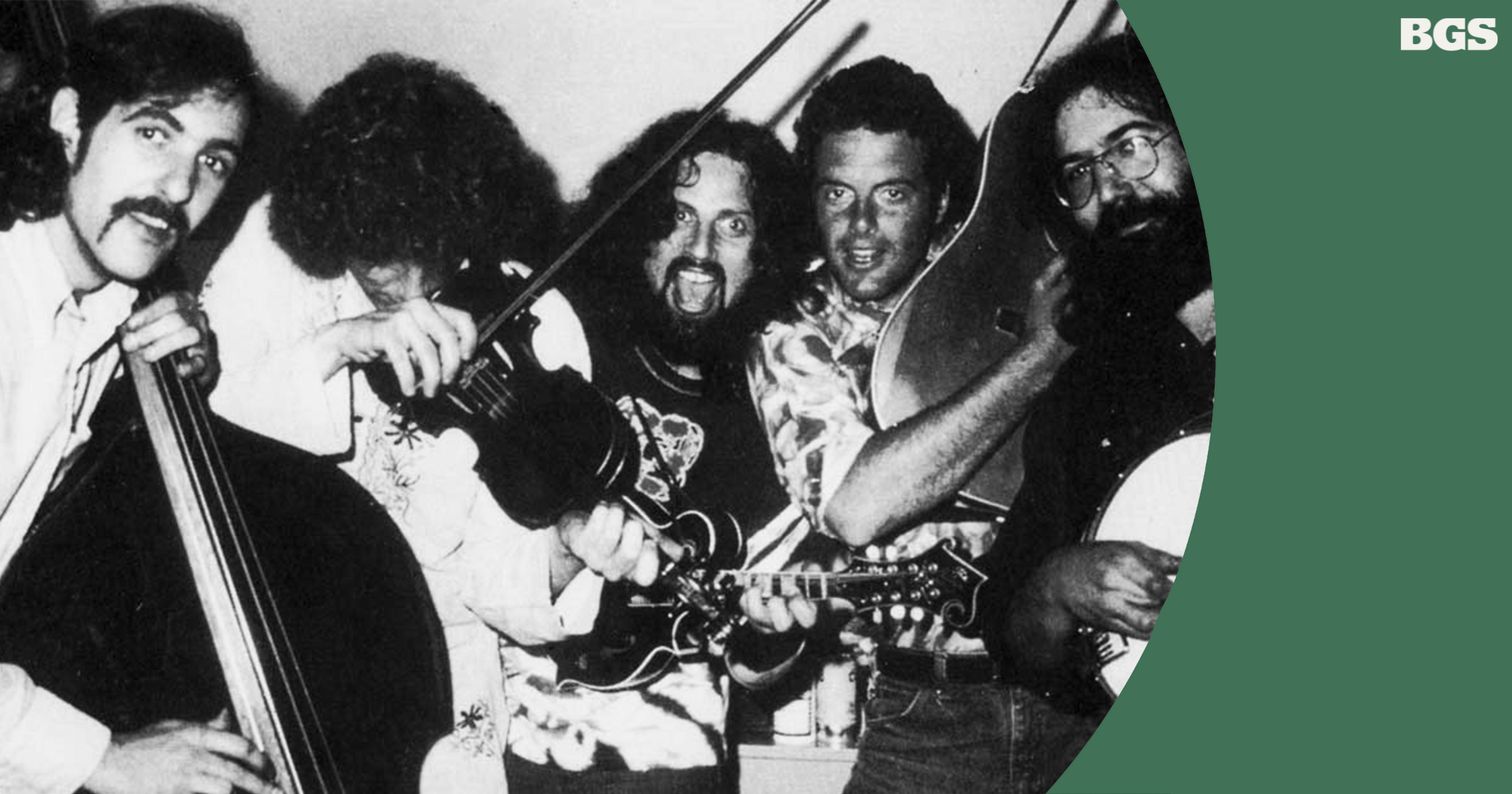
Photo Credit: Old & In the Way, courtesy of Acoustic Disc.

WATCH: Steven Moore & Jed Clark, “New Camptown Races”

Artist: Steven Moore & Jed Clark
Hometown: Jed Clark lives in Nashville, Tennessee, originally from Searcy, Arkansas; Steven Moore lives in Saint Clairsville, Ohio, originally from Bethesda, Ohio.
Song: “New Camptown Races” (by Frank Wakefield)
Release Date: June 26, 2024 (video)

In Their Words: “We are very excited to share our music video of ‘New Camptown Races,’ a tune by the late Frank Wakefield (June 26, 1934 – April 26, 2024) that has become a bluegrass standard. The idea for this video began at SPBGMA 2023, when we jammed to ‘New Camptown Races’ with both of us playing it in B-flat without using capos. We laughed and agreed that we needed to record it and maybe do a video shoot of it someday. It wasn’t until a year later at SPBGMA 2024, when we met up again, that we really solidified plans to make the video happen. Our hopes were to record the video and put it out on June 26, 2024 in honor of Frank’s 90th birthday. Unfortunately, the world lost Frank two months before he turned 90, but we decided to still aim to put out the video on what would have been Frank’s 90th birthday, in his memory.

“Frank’s prowess on mandolin, evident by his years performing with bluegrass legends like Red Allen and The Kentuckians, Jimmy Martin, the Stanley Brothers, and Don Reno, is often not discussed nearly as much as his personality. Frank was known for having an off-kilter approach to everything, from how he talked to how he approached the mandolin. Stories about Frank spray painting his mandolin red (an irreplaceable 1923 Lloyd Loar signed Gibson F-5) as well as baking that very mandolin in an oven in an attempt to enhance its tone are just a couple examples of his unconventional character. Our attempt to play this tune in B-flat without capos on guitar and banjo is a bit unconventional as well, and we hope that Frank would have liked it. Thanks, Frank, for the music, the stories, and this great tune!” – Steven Moore


Video, Audio, and Video Still Credits: Daniel Kelley and Bethany Kelley of Octopus Garden Studios.

Bluegrass Memoirs: Jackson, Kentucky Bluegrass

[Editor’s note: Photos by Carl Fleischhauer]

On Monday August 7, 1972, with fresh memories of Maritimes old-time and bluegrass, I drove from New Brunswick to New England to join my wife and kids, who were house-sitting for my in-laws in Norwich, Vermont. 

On Thursday the 10th I headed south. A fourteen-hour drive brought me to Morgantown, West Virginia, the home of my friend and partner in research, photographer and film-maker Carl Fleischhauer, then employed at West Virginia University. We’d known each other for twelve years. (Our stories are in Bluegrass Odyssey: A Documentary in Pictures and Words, 1966-86 [U of IL Press 2001]). We were about to embark on fieldwork.

During the preceding year, when I began planning for the book Bluegrass: A History, I asked Carl to help me think about photos. In addition to documenting bluegrass festivals and other venues he, with Sandy Rothman, had recently looked for traces of earlier days in a field trip to the old Monroe home in Rosine, Kentucky. Now, we made plans for our own field trip. Carl would take photos. I would make notes and do interviews. 

We spent that Friday in Morgantown looking at Carl’s photos and films and listening to LPs as we prepared for the research. At the end of the evening, my notes say,

Did some picking.

Early Saturday morning we piled in my new Toyota with our gear (cameras, tape recorder, axes, tent, sleeping bags) and headed southwest, crossing into Kentucky from Huntington, WV and snaking down through the mountains to Jackson, the seat of Breathitt County. Three hundred miles; we arrived around 2 o’clock.

There we headed just outside of town for Bill Monroe’s Second Annual Kentucky Blue Grass Festival. When I went to Canada in 1968, Bill Monroe had one festival a year at Bean Blossom in Indiana. Now he was running a bunch in other states, as were other artists. Festivals were the big news in bluegrass music in 1972. We sought to document the bluegrass festival experience.

Later others would write about this, like Bob Artis (“An Endless Festival” in Bluegrass [1975]) and Robert Owen Gardner (The Portable Community [2021]). Here’s how my notes from Jackson begin:

West of town on main hwy, down short steep road. Paid camping & Sat. fees, never did pay for Sunday. Parked & walked down to the stage area — tent set up, natural amphitheatre, uncovered stage, bad sound. Lots of cops around on Saturday.

Made contact with Pete & Marion Kuykendall, and agreed to move in next to them to camp. Set up tent, attempted to speak to Monroe but he was busy coping with the Goins Bros. problem of being hassled by the cops for drinking. Later Kuykendall said that cops had asked Monroe for $ (3 or 6 hundred) and he had refused to pay off so they were taking it out in fines. Lots of racing around on Sat. with flashing lights et al, but they stayed away on Sunday.

Listened then to IT’S A CRYING TIME, hot & exciting Japanese bluegrass band. Then back to Kuykendall’s bus/home whatall. Thunderstorm; discovery that cassette recorder didn’t work on batteries because plug distorts switch; got it running eventually. Oldest Kuykendall girl Sam/Ginger comes in with bass player of above-mentioned Japanese band, then leaves. Kuykendalls are a bit worried about this but Carl & I both notice later that a number of young girls (McLain girls, for example) are hanging around, with this group.

Dinner with Kuykendalls. Frank & Marty Godbey come in and are around for the rest of the evening. Mostly we sit & talk, though I went down to the amphitheatre to catch Jim & Jesse and the Japanese bands. Came back, then returned to catch Monroe. Afterwards listened to picking group in tent near us. Did mainly Emerson & Waldron, Newgrass Revival, Bluegrass Alliance, Gentlemen, etc. Chromatic banjo. Noisy night in Carl’s tent, as sessions went on late and busses started early. I got a spider bite.

Bill Monroe (center) and the Blue Grass Boys at the Second Annual Kentucky Bluegrass Festival, Jackson KY, Saturday, August 12, 1972. Bandmembers include Monroe Fields, bass; Jack Hicks, banjo; Joe Stuart, guitar (hidden); Monroe, mandolin; and Kenny Baker, fiddle.

I’d known the Kuykendalls since 1966. Pete, a 1996 inductee to the Bluegrass Hall of Fame, was a musician, record collector, producer, publisher, and, since 1970 owner-editor of the first and leading bluegrass monthly Bluegrass Unlimited.

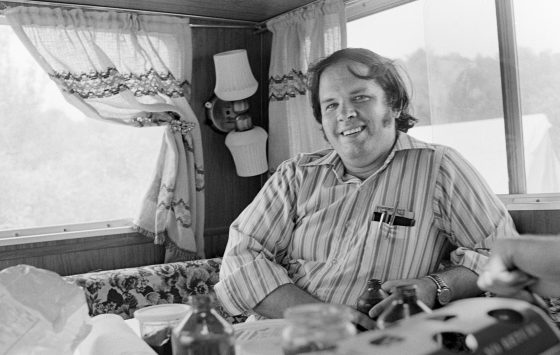
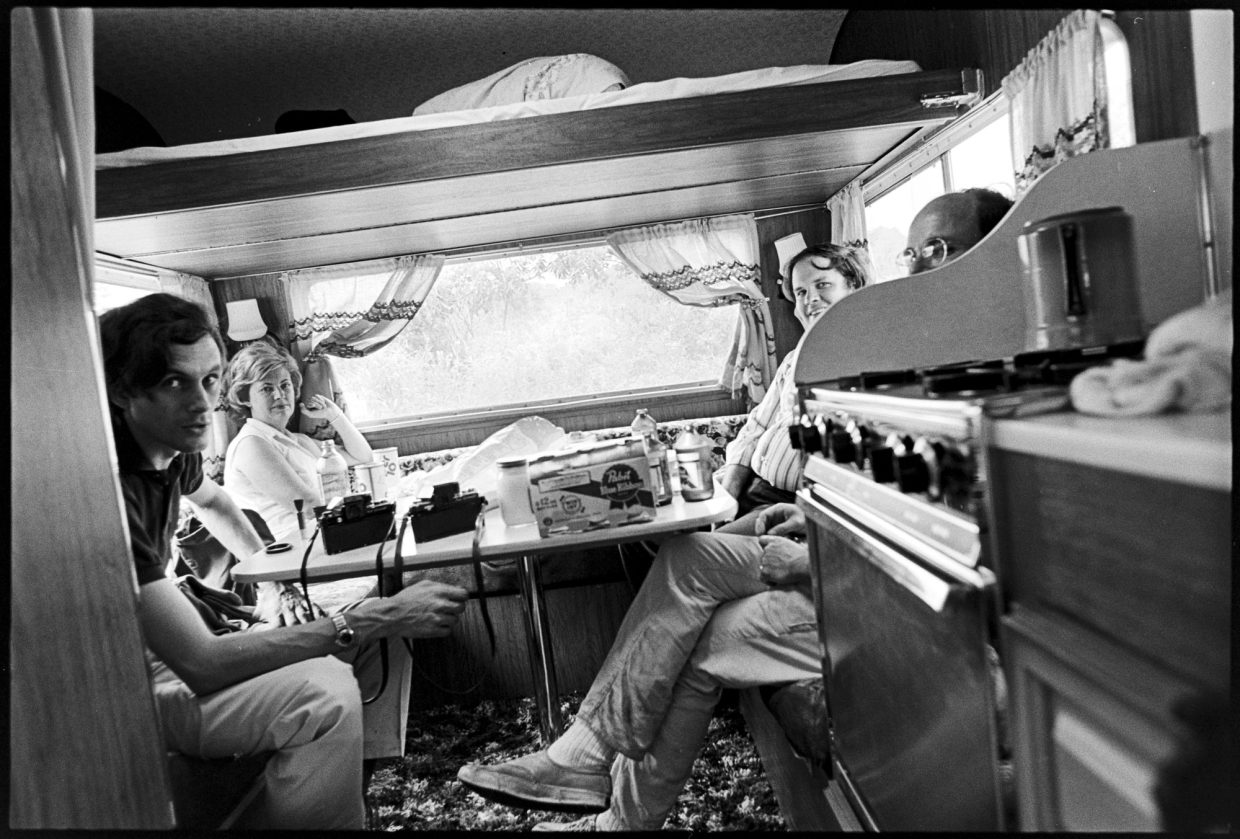
Pete Kuykendall, editor of Bluegrass Unlimited, in his RV parked in the camping area at the Second Annual Kentucky Bluegrass Festival, Jackson KY, Saturday August 12, 1972.

Pete and I had already been corresponding about bluegrass history when we met on Labor Day weekend 1966 at the second Roanoke Bluegrass Festival. Subsequently, I visited the Kuykendalls in Virginia where Pete encouraged me to write for the then all-volunteer magazine he would later own. I began with a review of the festival, published the following January — the first of eight articles I did for BU in 1967.

Photo made by Pete Kuykendall’s son Billy with one of Carl Fleischhauer’s cameras. Carl is seated at left with two other cameras on the table. This photo was made at the time of Neil Rosenberg’s (top of head above stove) interview of Pete Kuykendall, editor of Bluegrass Unlimited, in his RV at the Second Annual Kentucky Bluegrass Festival, Jackson KY, Saturday, August 12, 1972. In the background, at left, is Pete’s wife and Bluegrass Unlimited co-manager Marion Kuykendall.

By 1970 Pete and Marion were running BU full-time; I’d done an article for them earlier in 1972 (eventually I would write a monthly column) so we had been in touch recently by mail and phone. Conversations with Pete were never brief! He loved to share the business scuttlebutt and he had plenty since they were selling the magazine at festivals every weekend and had just launched BU’s own annual festival. 

I think this may have been the first time I met the Godbeys. From Lexington, and before that, Columbus, Ohio, they had been following the bluegrass scene for a decade. Frank is a musician who is still performing these days. By 1972 he and Marty had begun writing and publishing photos in BU. For them, as for me, hanging out with the Kuykendalls was a good way to keep up on the bluegrass news. People were already talking about starting an industry association, though that — the IBMA — wouldn’t happen until 1986. Pete was one of its founders.

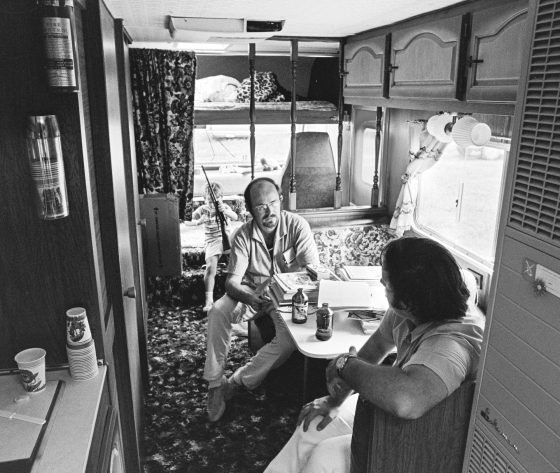
Neil Rosenberg (facing camera) interviewing Pete Kuykendall, editor of Bluegrass Unlimited, in his RV parked in the camping area at the Second Annual Kentucky Bluegrass Festival, Jackson KY, Saturday, August 12, 1972. In the background, with an air rifle, is Pete’s son Billy Kuykendall.

With the growth of the festivals came clubs, newsletters, and magazines. Bluegrass enthusiasts (many of them musicians) followed their favorites to festivals and other venues. Paths crossed; networks grew. The politics of bands was a favorite discussion topic.

Over the course of the festival, I made note of gossip about the always changing bands. Ricky Skaggs had just left Ralph Stanley — there were rumors about where he was headed next. Was Bill working to get Ralph Stanley on the Opry? Some thought so. The II Generation was said to be splitting up. Stories were told of bluegrass festival camp followers. 

At this Jackson, Kentucky festival were a bunch of bands that had been appearing at Bill Monroe’s other 1972 festivals — Monroe, Jim & Jesse, Flatt, Reno & Harrell, the Goins, Ralph Stanley — mature musicians who’d been working with this music for a substantial period of time and who stuck close to the early models of which they were, often, the authors. Classic bluegrass, one could say. 

What the audience didn’t hear was the kind of stuff we’d heard from the jammers late Saturday night, like “One Tin Soldier,” The Bluegrass Alliance’s cover of a song popularized in the film Billy Jack. Their bluegrass version, with Sam Bush’s lead voice and Tony Rice’s harmonies and guitar work, was a hit, a big step on the road to newgrass.

The Japanese bands were new to the scene. Japanese bluegrass began in the early sixties. In 1971, Bluegrass 45 came from Kobe, Japan, with the sponsorship of their label, Rebel, to tour U.S. bluegrass festivals. They made a big hit at Monroe’s Bean Blossom festival with their showmanship and musical savvy. This year they were back, along with another Japanese outfit, It’s A Crying Time.

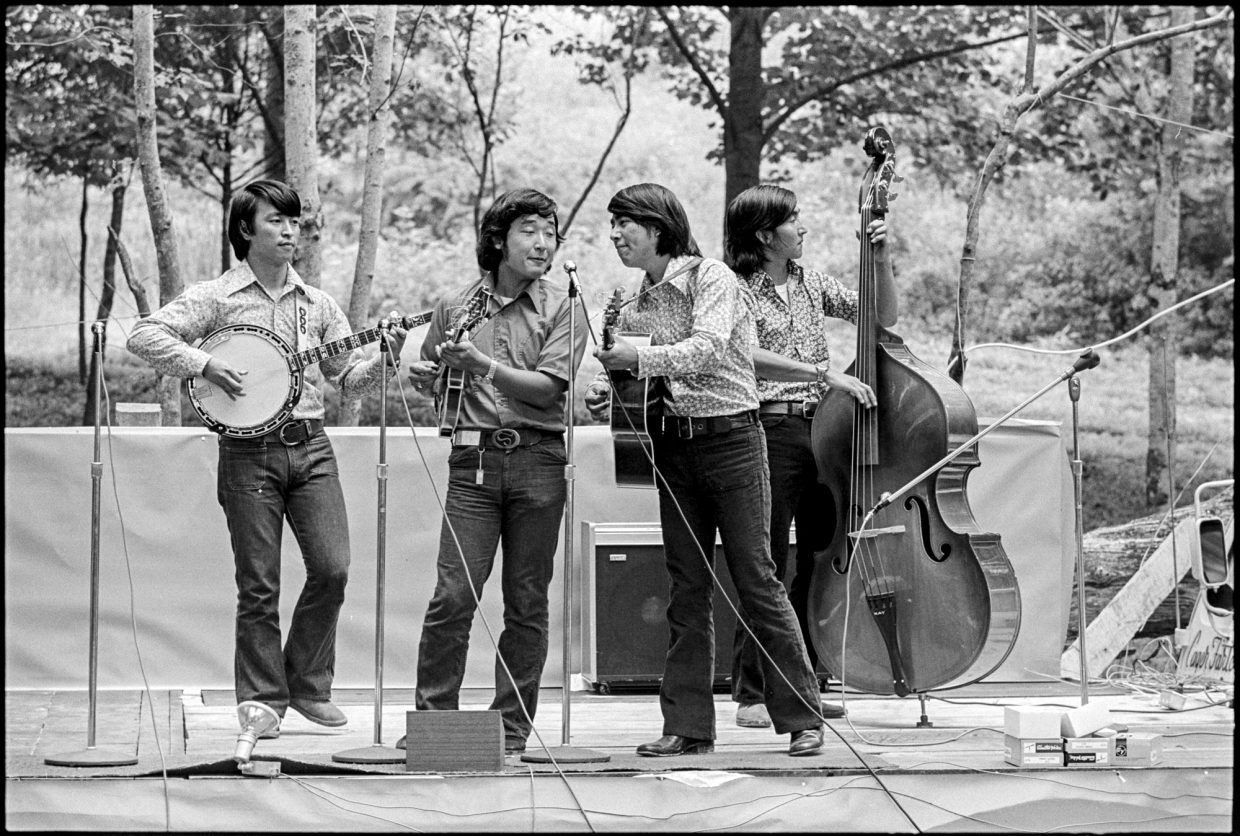
Visiting from Japan, the band It’s a Crying Time performs at the Second Annual Kentucky Bluegrass Festival, Jackson KY, Saturday, August 12, 1972. Band members include Eiichi “Ei’ Shimizu, banjo; Kazuyoshi “Kazu” Onishi, mandolin; Satoshi “Sato” Yamaguchi, guitar; Akira “May” Katsumi, bass.

Monroe had booked the Japanese bands as a novelty, something you couldn’t see just anywhere in the bluegrass world. As I mentioned in my field notes, I found It’s A Crying Time’s music “hot & exciting,” and I was not the only one in the audience reacting this way. They came to the attention of Lester Flatt, who, after watching them rehearse, invited mandolinist Kazu Onishi to join him on stage at his final set. 

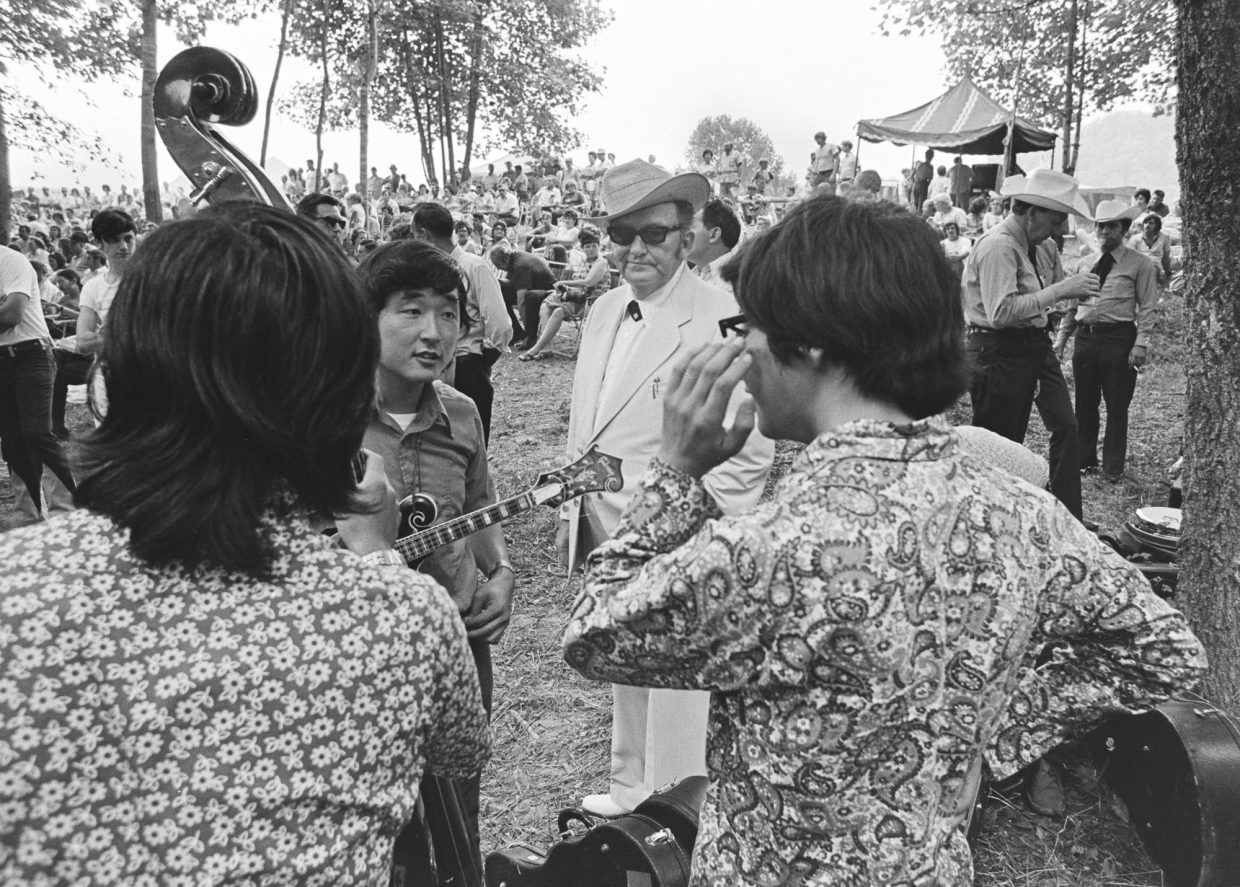
Backstage moment at the Second Annual Kentucky Bluegrass Festival, Jackson KY, Saturday, August 12, 1972. Akira Katsumi, Kazu Onishi,
Lester Flatt, and Akira Otsuka. Otsuka was Kazu’s friend from the Japanese scene, a member of the Bluegrass 45.

This video comes from the Bluegrass 45’s appearance at Carlton Haney’s Camp Springs festival:

They are announced at the beginning of the video by emcee, writer, and DJ Bill Vernon. Vernon was here at Jackson, as I learned Sunday morning when I went down to the early morning gospel show. Pete Kuykendall introduced me to Bill there, and we had a long chat about the politics of the bluegrass industry. I wrote in my notes:

A very loquacious and complex person.

At that morning’s gospel show, the music came to a stop as a fundamentalist preacher began his sermon. At that point, I noted:

Bill Vernon cut out from the morning sermon, he’d had enough…

During the preacher’s sermon at the gospel program at the Second Annual Kentucky Bluegrass Festival, Jackson KY, Sunday, August 13, 1972. Bill Monroe (wearing a black suit) is seated in the audience area at left.

I stayed and heard some good music, noting:

The gospel section’s high point was when the Goins Bros. did “Somebody Touched Me” and Eleanor Parker came on stage & started clapping hands and singing; Monroe caught on and came up to join in too.

During the gospel program at the Second Annual Kentucky Bluegrass Festival, Jackson KY, Sunday, August 13, 1972. When the Goins Brothers band performed “Somebody Touched Me,” they were joined on stage by Eleanor and Rex Parker and Bill Monroe. Eleanor and Bill joined the Goins trio at the main microphone while Rex sang and played mandolin at the “stage right” microphone.

This kind of spontaneity, which gave festivals their appeal, was not there all the time. Jim & Jesse, I wrote, had:

A good show, with Jim Brock sounding especially good, but … a cut and dried quality to it all.

Describing Lester Flatt and his Nashville Grass, I concluded:

To me the whole band sounded tired, lackluster.

But Flatt’s final set was enlivened when It’s A Crying Time mandolinist and tenor Kazu Onishi came on stage to sing “Salty Dog Blues” with him. 

During my times around the stage area, I had a chance to talk with Monroe and with some of the musicians I’d gotten to know during my years as a backstage regular at Bean Blossom, like Birch Monroe, Joe Stuart, and Roland White.

I arranged with Birch, who was busy helping Bill run the festival, for an interview, to take place later in the week at his home in Martinsville, Indiana.

Joe Stuart offstage at the Second Annual Kentucky Bluegrass Festival, Jackson KY, Saturday, August 12, 1972.

Joe told me about his experiences playing bluegrass in Canada with Charlie Bailey. He’d even appeared in Newfoundland.

Roland, whom I’d known since his days as a Blue Grass Boy, was now playing with Lester Flatt. He told me they were working solid, playing festivals every weekend.

Here’s what I wrote about the audience:

Audience — bluegrass die-hards from Ohio, Ky., D.C., Carolinas. Few freaks. Appear to be about 50% campers, 50% local people. Certainly no more than 1500-2000, on Saturday, though figure of 3000 was bandied about. Bill moved his Ky festival to Jackson from Ashland this year because the turnout at Ashland was dropping. Fact, bluegrass ain’t as popular in Kentucky as it is elsewhere — Ohio, D.C.

Audience on the hillside natural amphitheater at the Second Annual Kentucky Bluegrass Festival, Jackson KY, Saturday, August 12, 1972.

The festival closed with a finale, orchestrated by Monroe. At the first festivals in the mid-60s, which were created to honor Monroe, such events were somewhat spontaneous, but by now, seven years after the first one, these events were highly ritualistic. By the time it happened, I noticed that the Kuykendalls had left. They were not the only ones.

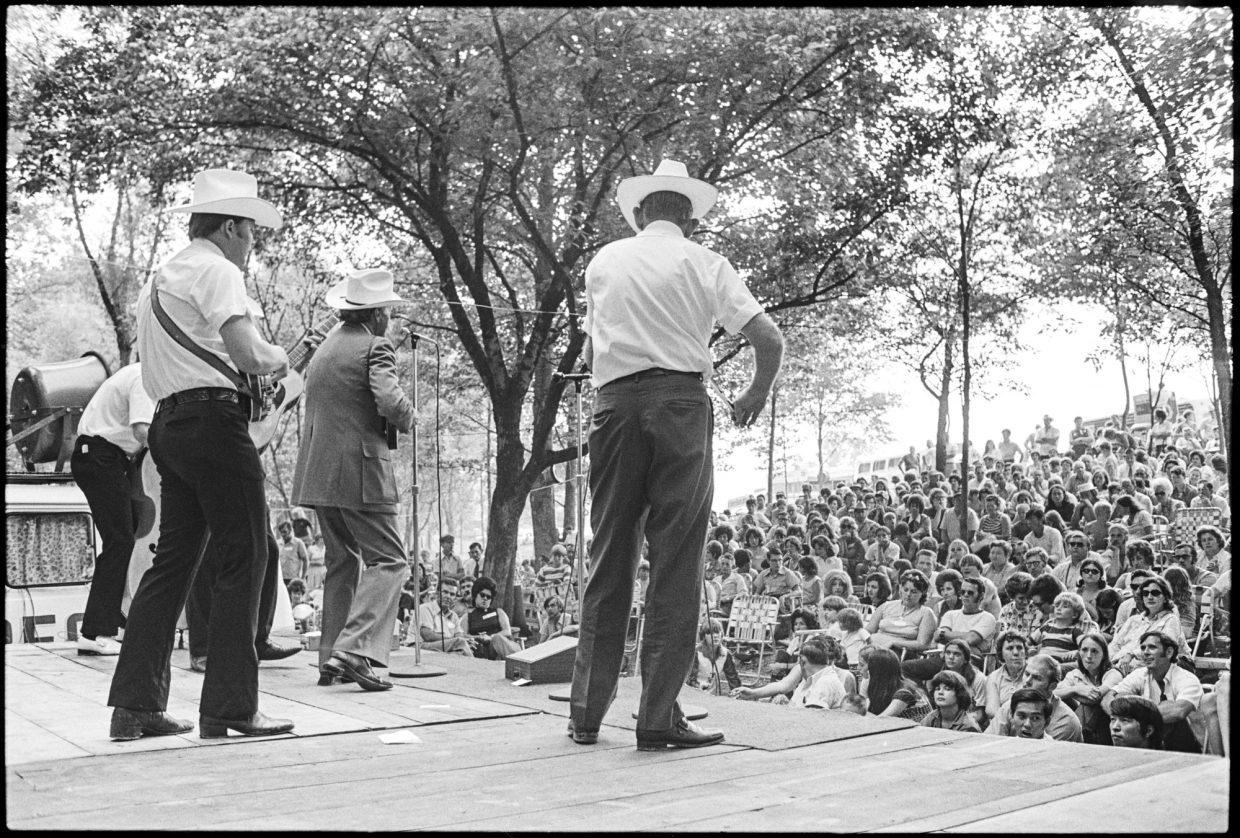
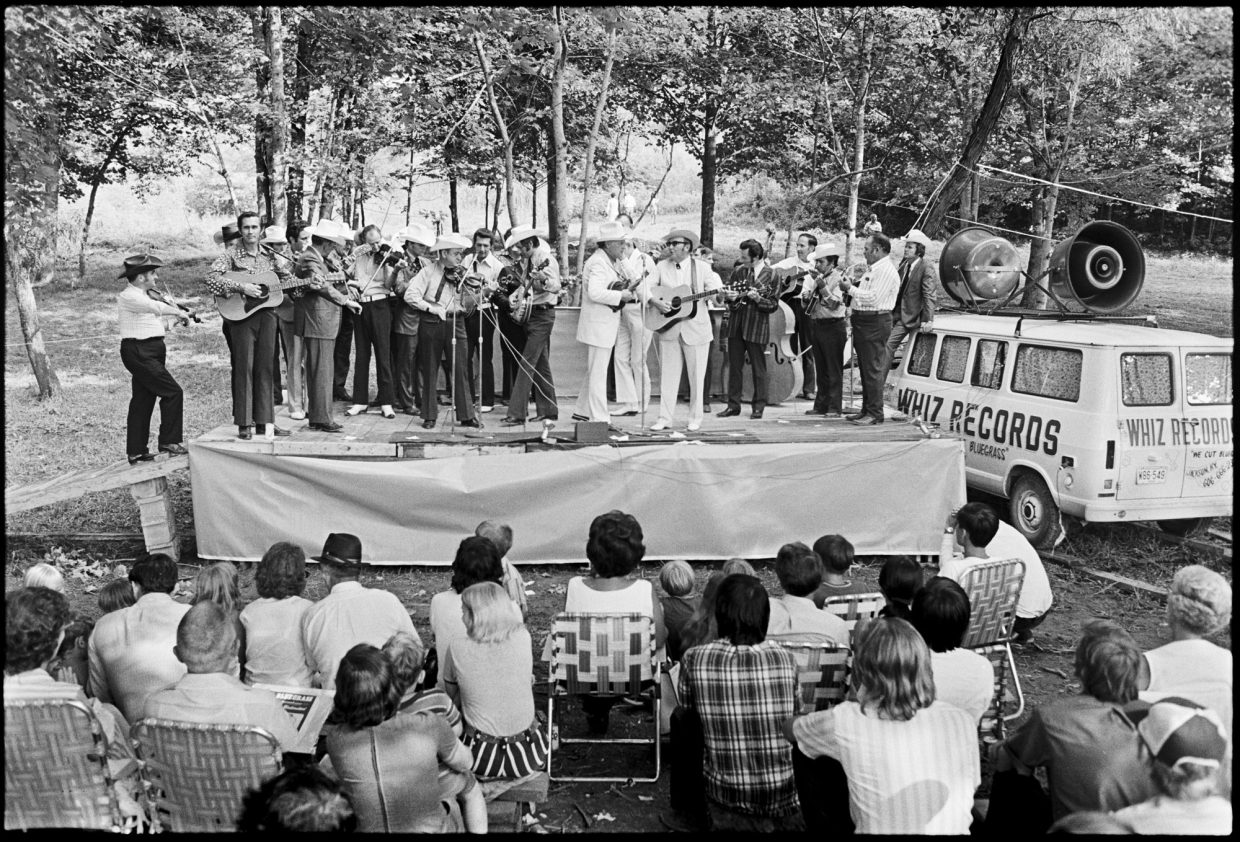
The finale performance at the Second Annual Kentucky Bluegrass Festival, Jackson KY, Sunday, August 13, 1972. At the center, in white suits, are Bill Monroe and Lester Flatt. Here are a few of the other performers, left to right: Curly Ray Cline (on the ramp), Melvin Goins (guitar, facing camera), Kenny Baker (fiddle, white hat, wearing a suit), Joe Stuart (just behind Baker, partly hidden), Buck Ryan (fiddle, white belt), Jack Hicks (banjo, white hat, wearing suit), Paul Warren (fiddle, white hat, at microphone), Vic Jordan (banjo, facing forward), Ralph Stanley (banjo, dark suit, hidden behind McCormick), Haskell McCormick (banjo, in profile), Monroe and Flatt with Don Reno (wearing white) partly hidden behind them, Raymond W. McLain and sister Alice McLain (hidden behind Flatt), Jesse McReynolds (mandolin, wearing striped jacket), Ruth McLain (bass, behind McReynolds), Raymond K. McLain (guitar, no hat), Roland White (mandolin, white hat), Rex Parker (mandolin, striped shirt), and Monroe Fields (leaning on van).

We packed up soon after and headed west for Lexington. I was hoping to interview J.D. Crowe.

[To be continued]


Thanks to Akira Otsuka and Carl Fleischhauer

Rosenberg is an author, scholar, historian, banjo player, Bluegrass Music Hall of Fame inductee, and co-chair of the IBMA Foundation’s Arnold Shultz Fund.

Photo of Neil V. Rosenberg by Terri Thomson Rosenberg.

Edited by Justin Hiltner

Bluegrass Memoirs: ‘Industrial Strength Bluegrass’ and the Dayton Bluegrass Reunion (Part 3)

(Editor’s Note: Read part one of our series on the Dayton Bluegrass Reunion here. Read part two here.)

Working on CityFolk’s Dayton Bluegrass Reunion, I heard local terminology for the culture in which this music grew. “Industrial working-class Appalachian migrants” was rarely spoken. “Hillbilly” was said sometimes with disdain, sometimes with pride. The preferred in-group term was “briar.” Briars came from the Appalachian hills, transplants proud of their continuing organic down-home connections. I was told that the call letters of WPFB, where Moon Mullins had represented bluegrass for two and a half decades, stood for “We Play For Briars.”

Don Baker’s introduction to the second act of the reunion framed a dramatic shift of scene from Mullins’ milieu to a younger Dayton band: The Hotmud Family.

Inspired by the New Lost City Ramblers, this band began in 1970 playing old-time music based on pre-war hillbilly recordings. The band included Suzanne Thomas Edmundson, Dave Edmundson, and Rick Good, along with a succession of bassists. Suzanne, born in Dayton of Kentucky parents, was a second-generation briar. According to Jon Hartley Fox the Hotmuds were “perhaps the most significant band to emerge from the vibrant scene of the 1970s in southwestern Ohio” (Industrial Strength Bluegrass, 140-1). 

They began including bluegrass in their sound during a 1974 appearance at the Mariposa Folk Festival. In blending old-time and bluegrass, they placed special emphasis on vocal harmonies, something many old-time bands overlooked. Between 1974 and 1981 they made eight albums and appeared widely at bluegrass and folk festivals. Here’s their 1975 bluegrass/old-time blending of “Weary Blues,” a song originally recorded in 1929 in Atlanta by Chattanoogan Jess Young’s Tennessee Band as “Old Weary Blues”:

The Hotmud Family came to be associated with Dayton’s Living Arts Center, described by Hotmud banjoist Rick Good in Industrial Strength Bluegrass (153-57). Established in 1967 by the Dayton Board of Education, this facility offered after-school instruction in the arts for grades 5-12 students in East Dayton. 

In 1975 it began providing programs aimed at the local Appalachian-based culture. It turned to the Hotmud Family, now a nationally known band with an enthusiastic local fan base from their weekends at Sam’s Bar and Grill. At the Center, Hotmud gave lessons, ran a song circle, and led informal jam sessions. Once a week they held a live Country Music Jamboree, which was broadcast over WYSO, the Antioch College radio station. The Center closed in 1977, but the Jamboree continued with other performers at other local venues until 1986. 

Act Two of the Dayton Bluegrass Reunion opened with a solo rendition of “Red Rocking Chair” by former Hotmud lead vocalist Suzanne Thomas Edmundson. Then came the group’s reunion, when Thomas was joined by the other founding Family members Dave Edmundson and Rick Good along with bassist Gary Hopkins. They did three pieces and an encore. During the 1980s the band gave occasional reunion performances. This was one of their last.

For Act Three, Baker’s stage directions began: “Beer Sign On.” 

A borrowed neon sign hung onstage now lit up for the reunion of a band associated with Dayton’s bluegrass bar scene, the Allen Brothers.

Formed in the late ’60s to back their father Red Allen, they began performing without him and were touring in 1974 when brother Neal died. After a brief hiatus, the three other brothers (Harley, Greg, and Ronnie) carried on into the early ’80s, recording Rounder and Folkways albums. The new Smithsonian/Folkways album Industrial Strength Bluegrasswhich just won Album of the Year at the 2021 IBMA Bluegrass Music Awards — includes Harley Allen’s “Suzanne,” first recorded by the Allen Brothers in 1982, here recreated by Mo Pitney and Merle Monroe:

They continued to play together in the Dayton area into the mid-’80s, but by then Harley had begun a solo career, first joining banjoist Mike Lilly in a band Jon Hartley Fox calls “one of the best bluegrass acts Dayton ever produced” (Industrial Strength Bluegrass 136). In 1985 the Allen-Lilly Band closed a set at the Berkshire Mountain Bluegrass Festival. Harlan County native Lilly led the way into “Little Maggie” with coon dog and motorcycle as Frank Wakefield watched: 

Harley went on to a Nashville career as a singer-songwriter, winning two Grammys and singing on the O Brother, Where Art Thou? soundtrack hit “I Am a Man of Constant Sorrow” before dying at the age of 55. 

At the Reunion, the Allen Brothers put together a band with Harley on mandolin, Greg on banjo, and Ronnie on bass, with Wendell Barrett on guitar, and David Harvey on fiddle.

Here’s how they sounded with a similar band (different fiddler and mandolinist), with Monroe’s “Uncle Pen” enlivened by guitarist Harley Allen’s transformation of Jimmy Martin’s “G run” and a fancy ending, followed by a bluegrass trio rendition of the Paul Siebel’s classic “Louise.”

At the Reunion, they did three tunes and an encore. Then it was intermission time.

The second half began with Baker introducing Act Four, the Dry Branch Fire Squad. This band was led by mandolinist Ron Thomason, a Virginian who had migrated to the region as a child. Around since the mid-’70s, it’s still active today. Thomason came up in Dayton’s regional scene in the ’60s, working in bar bands and on the road with Ralph Stanley. 

Committed to traditional bluegrass, Thomason, now living in Colorado, has had many talented musicians in his band. He is famous for his emcee work, which regularly grows into humorous monologue. Baker’s directions for this act listed two pieces (including one gospel song), separated by:

“Rap — Ron Thomason”

Here’s a sample of Ron’s “rap” — a comic speech from a 2007 California festival:

At the time of The Dayton Bluegrass Reunion, Dry Branch had four albums on Rounder, the start of a long string with that label. Like the Hotmud Family, they were folk and bluegrass festival regulars. 

The band this evening consisted of Ron on mandolin, John Hisey on banjo, Mary Jo Leet on guitar, and Charlie Leet on bass. In 1987 a similar lineup recorded “Aragon Mill,” a Si Kahn song that Ron had learned while working at coal miner’s union rallies with Hazel Dickens:

Act Five brought on another performer still active today, Larry Sparks and the Lonesome Ramblers. Sparks had come up in the Dayton bar scene at about the same time as Ron Thomason. He worked with the Stanley Brothers and Ralph Stanley at the end of the ’60s and made his first album on his own in 1970s. He became a member of the Bluegrass Hall of Fame in 2015 and has a new album out on Rebel. 

At this concert his Lonesome Ramblers had a reunion dimension. Mandolinist and singer Wendy Miller, who’d played on Larry’s earliest recordings and was with the band through most of the ’70s, was back for this evening’s concert. Also in the band were banjoist Barry Crabtree and Larry’s son, Larry Dee, on bass. 

They did three songs: “Dark Hollow,” “Face in the Crowd,” and “Kentucky Chimes,” all regulars from his albums and concerts. He closed with an eight-tune medley of his other hits. There are many videos of Larry’s great singing and lead guitar work. Here’s one of my favorites:

Acts Six and Seven dramatized the transformations of Dayton’s foundational 1956 band — The Osborne Brothers and Red Allen.

Act Six was all reunion. Red Allen had been officially retired since 1984, although he’d recently recorded four tracks on Home Is Where The Heart Is, David Grisman’s new Rounder album, joined on these tracks by son Harley and banjoist Porter Church, who’d been in his band The Kentuckians. 

Red started this band in 1959 with mandolinist Frank Wakefield. In November 1961, in Nashville for the D.J. Convention, they cut six classic tracks at Starday with top bluegrass musicians of the day: Don Reno on banjo; Chubby Wise on fiddle; and John Palmer on bass. The whole great session is on YouTube: 

Sierra Hull reprises Wakefield’s “Mountain Strings” on the new Smithsonian/Folkways album Industrial Strength Bluegrass. The track was nominated for IBMA’s 2021 Instrumental Recording of the Year.

In the early ’60s Wakefield and Allen worked out of the D.C. area, with a radio show in Wheaton, Maryland. In 1964 they did a Folkways album in New York, produced by David Grisman and Peter Siegel. 

Soon after, Wakefield, whose innovative music is discussed by Ben Krakauer in Industrial Strength Bluegrass (182-183), began working with New York band The Greenbriar Boys and later he relocated to Saratoga Springs, New York. Here’s how he sounded in 2008 — still pushing the boundaries:

Red kept the Kentuckians going in the mid-’60s with a succession of great sidemen, among them banjoist Porter Church and mandolinist Grisman, who produced two albums of the Kentuckians on the County label.

In 1967 Red worked briefly for Bill Monroe and took Lester Flatt’s place in the Foggy Mountain Boys when Flatt had heart surgery. The next year he was in Lexington working with J.D. Crowe and Doyle Lawson.

By the early ’70s he was back in Dayton, working with his sons and playing locally what Rick Good calls “bargrass” (Industrial Strength Bluegrass 156). For tonight’s concert Red and Frank’s Kentuckians included Porter Church on banjo, Buddy Griffin on fiddle, Ron Messing on Dobro, and Larry Nager on bass. 

During Red’s four-song set, Red Spurlock and Noah Crase, banjoists who’d played with Red during his early years, sat in for choruses with the band. A reprise of Wakefield’s famous “New Camptown Races” brought guest David Harvey, son of Dorsey Harvey, another influential mandolinist, to play harmony.

The final segment, Act Seven, featured Dayton’s Grand Ole Opry stars, the Osborne Brothers. Two days before the concert the Dayton Daily News said the Osbornes had “achieved the greatest fame of those taking part in this tribute to the flowering of bluegrass music in Dayton.” It would be hard for anyone to follow them. After joining the Opry in 1964 they’d moved from Dayton to Nashville. During the late ’60s and early ’70s, a string of country hits (“Rocky Top” is the best known today) led to industry awards for their vocal work.

With this success the Osbornes’ recordings moved toward a contemporary country radio-friendly sound, mixing pedal steel, piano, fiddle, drums, and electric bass alongside their bluegrass banjo and mandolin. Their live sound also changed. In 1967 they added electric bass; in the early ’70s, a drummer. Next came electric pickups on banjo and mandolin. They did this to make themselves heard in the big country package shows they were playing, where all the other acts were highly amplified. Their “going electric” was viewed with alarm in the acoustic-oriented bluegrass festival world, but it only lasted for a few years.

Throughout these years, their unique vocals remained a constant. They continued to record and tour. Their repertoire drew largely from decades of recordings along with newer material. They now carried a straight-ahead bluegrass band including fiddle and acoustic bass.

This evening, playing with the Osborne Brothers were Paul Brewster on guitar and third voice in the trio, Terry Eldredge on bass, and Steve Thomas on fiddle.  They did four songs, all favorites from their earlier recordings, including a version of “Kentucky,” the Blue Sky Boys hit of the ’30s that they’d recorded for Decca in 1964 and which remained in their repertoire right up until Sonny’s 2005 retirement. Here’s an early ’90s Opry performance of it, introduced by Bill Anderson. The band includes future Grascals member Eldredge on guitar and third voice and Terry Smith on bass, along with second guitarist (and bus driver) Raymond Huffmaster, Dobroist Gene Wooten, and fiddler Glen Duncan. 

According to Baker’s stage directions, the closing act consisted of:

“Music — Medley”

An earlier draft reads:

“[medley in B natural: each unit from each of the 7 segments chooses a song which they play when their turn comes]”

My memory of this is vague, but I think that’s just how the Dayton Bluegrass Reunion ended, in B natural. But it wasn’t over quite yet. In that day’s Dayton Daily News columnist Nick Weiser had announced: 

“Following the Dayton Bluegrass Reunion at Memorial Hall, the Canal Street Tavern, located at 308 E. First St., will have a reception for the audience and the participants of the Bluegrass Reunion Show. Mark Bondurant will open the show at 9:30 with a reception to follow after the show. Many of the musicians from the Memorial Hall show are scheduled to get together and jam at the Canal Street Tavern reception. Admission is $1 at the door.”

I went with my camera…  Next time!

(Editor’s Note: Read part one of our series on the Dayton Bluegrass Reunion here. Read part two here.)


Neil V. Rosenberg is an author, scholar, historian, banjo player, Bluegrass Music Hall of Fame inductee, and co-chair of the IBMA Foundation’s Arnold Shultz Fund.

Photo of Neil V. Rosenberg: Terri Thomson Rosenberg.

Neil would like to thank Tom Duffee, Rick Good, and Al Turnbull.

Jeremy Stephens’ Old School Banjo Approach Is Made for the Present

Jeremy Stephens might be the most-featured musician in the history of this column. We’ve featured his band High Fidelity, IBMA Best New Artist nominees once again in 2021, twice over the past few years. Now he’s released a solo project entitled How I Hear It on Rebel Records.

How he hears it is how he plays it. Stephens’ banjo playing – and for that matter, his flattop guitar, archtop guitar, mandolin, bass, and beyond – is all at once effortlessly timeless and firmly grounded in the present. With acts like High Fidelity (which he founded with his wife and musical collaborator Corrina Rose Logston), the Chuck Wagon Gang, Jesse McReynolds, the Lilly Brothers, and others Stephens continually demonstrates a commitment to traditional bluegrass from long before the Bluegrass Album Band, Tony Rice, the Country Gentlemen, and other second- and third-generation groups began to eclipse their more old-timey, homespun, and gritty forebears. He has a penchant for Don Reno’s outside-the-box pickin’, and the chord-based licks, steel guitar phrases, and electric guitar back-up that were Reno’s signatures. 

Even with this perspective on the music — the earliest days of bluegrass being the string band aesthetic that resonates with him the most — his playing is neither antiquated nor backwards. At times, the most striking quality of his approach to the instrument is how in-the-moment it is. His techniques and musical vocabulary are couched so firmly in the past, yet never feel as if he isn’t expressing himself wholly in each and every musical and creative decision he makes. This fact remains true whether he’s playing something well-rehearsed, replicable, and measured or something purely improvisational. 

Though this column does focus on instrumental music — there are several astounding, hoot-worthy, slapdash, and gorgeous tunes on How I Hear It — it should be noted that Stephens can be just as present and in-the-moment with his banjo playing and improvisation instrumentally as when he’s singing harmony or lead, often a rare skill in banjo players. Anyone who’s enjoyed a performance by Stephens, the duo with his wife (billed tongue-in-cheek as The Stephens Brothers), High Fidelity, or any of the many bands that have featured Stephens as a sideman, will know just how jaw-dropping this talent of his can be. Acrobatic, nearly impossible Don Reno licks spat out rapid fire from his fingers while singing or playing syncopated against himself – it’s a sight and sound to behold. 

How I Hear It tracks “Sockeye,” “Lady Hamilton,” “The Old Spinning Wheel,” and “The Bells of St. Mary’s” perfectly capture the energy and ethereal quality of Stephens’ live playing in a way many more sterile bluegrass albums, and purposefully more modern sounding records, can only aspire to. With backing musicians such as Logston, David Grier, Mike Bub, Hunter Berry, and more, the entire project is the perfect vehicle to highlight and showcase this truly idiosyncratic — yet diversely and expertly pedigreed — style of banjo playing that’s all at both unapologetically old school and well-suited for a long, long lifespan into the future.


Photo credit: Amy Richmond

Double the Banjos, Double the Fun!

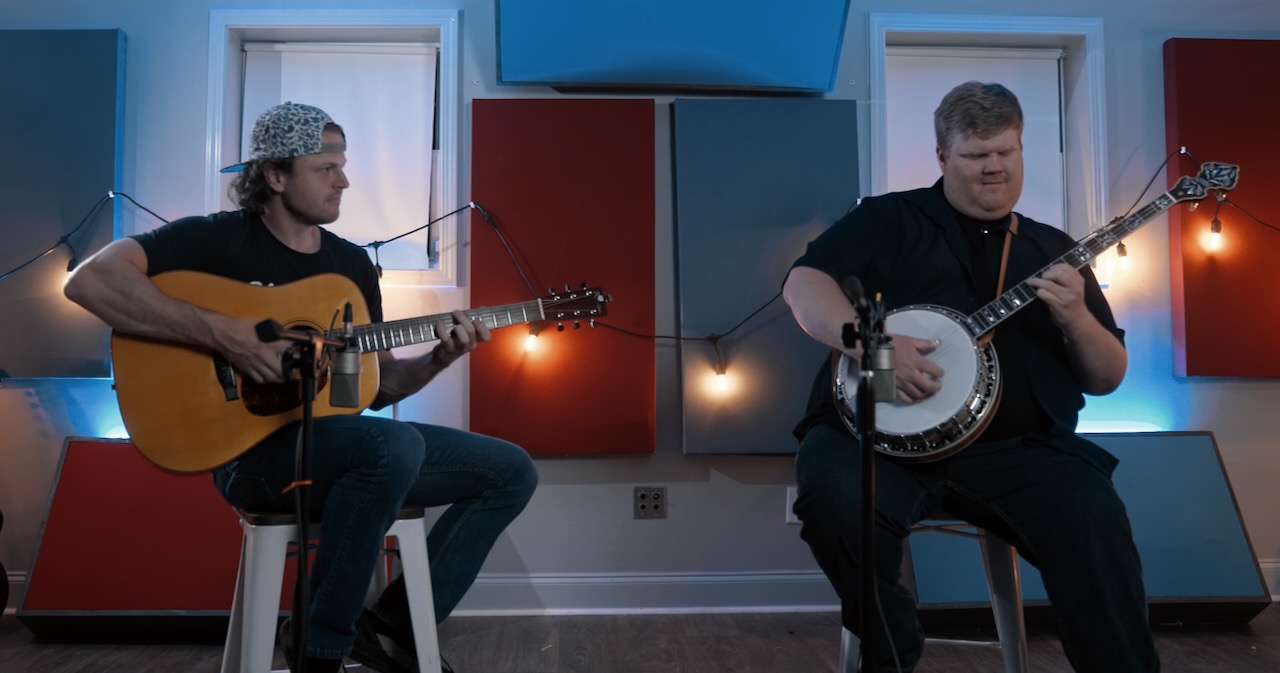
Twin fiddles are the bluegrass instrumental duo that get all the attention, but double banjos are really where it’s at. (Is this writer a banjo player? Why, yes. Is this writer biased? Why, of course!) It makes sense that twin or triple fiddling would end up more popular than double or triple banjos, given that fiddles are sounded by bows, so the melodic contours are more like vocal harmony, often longer phrases and bow strokes languidly and charismatically laced together. Banjos, with their rapid-fire sixteenth notes and syncopated, idiosyncratic rolls, are just more difficult to sync up. Hundreds – if not thousands – of banjo jokes devoted to rhythm and timing will certainly back that claim up.

But double banjo is an art form as old as bluegrass itself – and older, by quite a few dozen decades, if you count early American popular music, banjo orchestras, minstrel and vaudeville songs that all centered banjos before and during the turn of the 19th to 20th century.

In bluegrass, twin five-strings are at their most astounding in jaw-dropping and acrobatic contexts such as High Fidelity’s incredible rendition of the Don Reno classic instrumental, “Follow the Leader.” Famous for his steel guitar and chicken-pickin’ Telecaster licks transferred to banjo, Reno’s harebrained and wonky turns of phrase might seem like the last musical context in which one should attempt perfect synchronization, especially on banjo, but Jeremy Stephens and Kurt Stephenson defy reason, logic, and surely physics with their buttery, seamless, double banjo blend. The track perfectly encapsulates the “WHAT IS THAT!?” quality of five-string, three-finger banjo – raised to the second power.

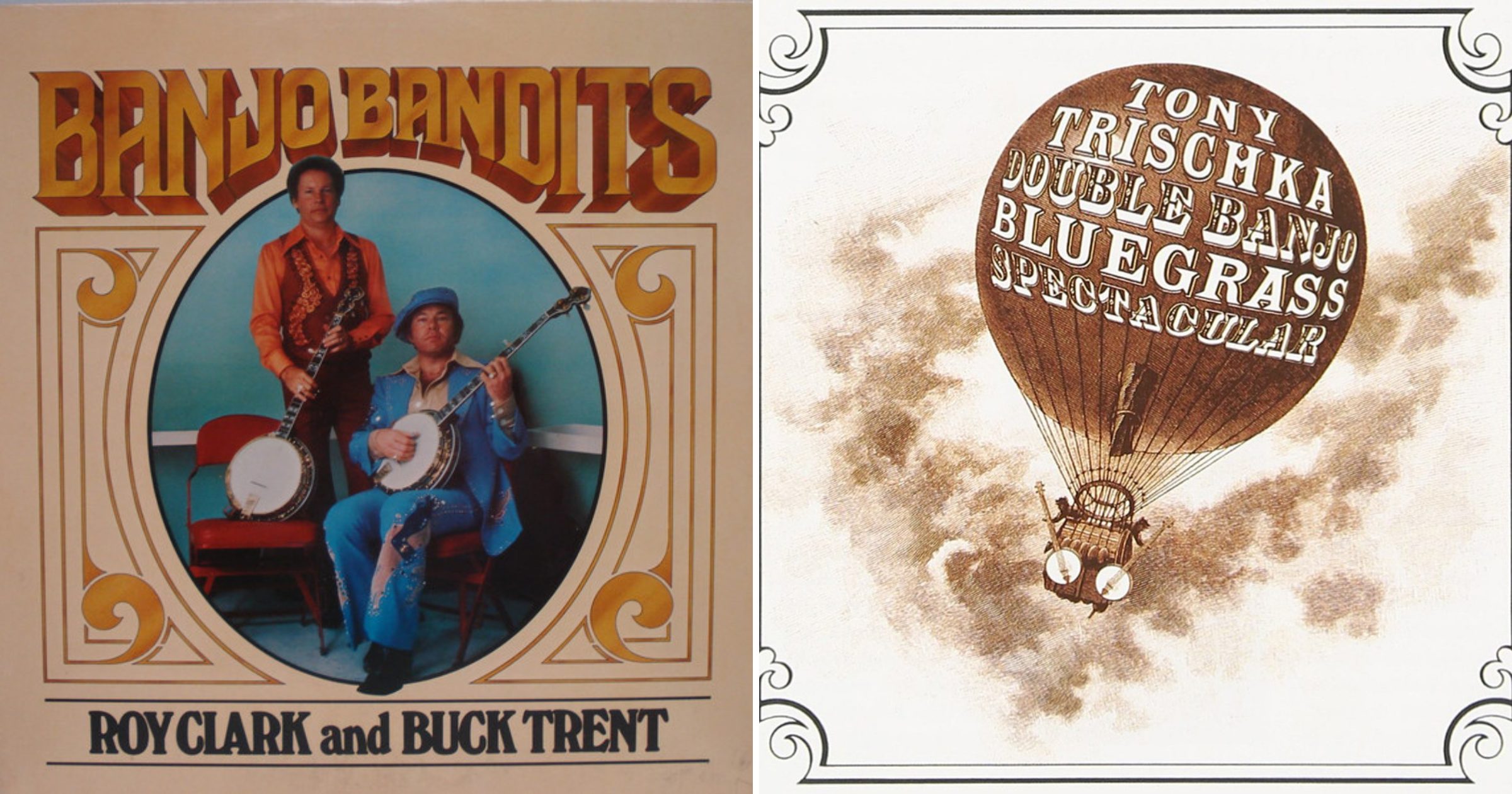
Anyone who grew up tuning in to or has ever binge-watched reruns of Hee Haw knows the beauty of a good double, triple, quadruple, quintuple banjo number, a common feature of the homespun country, comedy, and pickin’ variety show. Roy Clark, the Hee Haw host who could tear through almost any instrument in any style, released an entire album of double banjo music with regular Hee Haw guest Buck Trent in 1978 called Banjo Bandits. “Down Yonder” kicks with all-too-rare (and certainly delicious) bluegrass piano, a delightful intro to a bluegrass, old-time, and American songbook standard that almost sounds like a carnival merry-go-round thanks to the effect of the banjos “in stereo.” Banjo Bandits is something like a bluegrass and country double banjo primer, every track a stunning example of the form.

Like twin fiddling, double banjo lends itself so intuitively to the collaborative, community quality of bluegrass music. Through many a duo album and “featured artist” slot pickers have been using double banjo tunes to bring in their favorites, their mentors, their heroes, and their peers to swap licks, rising and falling, rolling and tumbling in breakneck unison. Alison Brown’s first Grammy Award was won for “Leaving Cottondale,” her double banjo instrumental with Béla Fleck from her also-nominated 2000 record, Fair Weather. In 2007, modern banjo hero Tony Trischka released a 14-track album of all twin banjo tunes entitled Double Banjo Bluegrass Spectacular. Its roster included Earl Scruggs, Brown, Fleck, Noam Pikelny, Steve Martin, and more. On “Doggy Salt,” a silly, winking instrumental that reconfigures the classic chord progression of “Salty Dog,” Scott Vestal joins Trischka, leaning into the humorous, comedic quality of these sorts of duets — a quality we see in Banjo Bandits and “Follow the Leader,” too.

Do not be mistaken, though, putting together a banjo duet isn’t just a comedic or intra-bluegrass activity! Cross-genre double banjo forays are certainly just as delightful, if not rarer and even more difficult to lock into rhythmic synchronization. Those that can mesh together three-finger’s rolling right hand with clawhammer and frailing’s loping, looser right hand are true virtuosos, defying not one but two genre’s expectations that banjos are intrinsically arhythmic and constantly rushing. Old-time players like Allison de Groot, Cathy Fink, Mark Johnson, Victor Furtado, and others all make it look and sound easy, matching their bluegrass compatriots’ rhythms and syncopations with ease and not just blending in, but counterpointing tastefully as well. One such recording, “Cluck Old Hen” from Pikelny’s Beat the Devil and Carry a Rail project, features Steve Martin, once again, on clawhammer. A less traditional approach, the two play with textures and senses, not striving for perfect unison, but rather exploring what an old-time-and-bluegrass dialogue can look and sound like, expanding our ideas of what twin banjo can be.

No matter the context, genre, roster of pickers, or style of playing, this fact remains true: more banjos equals more fun. (To this writer, at least.)


Bluegrass Memoirs: The Earl Scruggs Celebration (Part 2)

(Editor’s note: Read part 1 of Neil V. Rosenberg’s series on the 1987 Earl Scruggs Celebration here.)

My diary for Saturday September 26, 1987 — Earl Scruggs Celebration day at Gardner-Webb College in Boiling Springs, North Carolina — begins with an entry on foodways:

I meet Tom (Hanchett) and Carol (Sawyer) at 7:30 and we walk to the Snack Shop. As Joe had predicted the night before there were lots of pickups outside and quite a few people inside having breakfast. I asked the waitress for livermush and she told me they didn’t have it, that sometimes they did but today they were out of it. It wasn’t on the menu. 

After breakfast we walked over to G-W’s Dover Library, Celebration headquarters. Horace Scruggs was there.

Outside Horace took me over to meet his banjo player, and he asked me to play a tune or two. I did “Cumberland Gap” and some other simple tune. The picker then played a lot of fancy stuff and told me about his two banjos. 

Inside, people were setting up displays in preparation for the 10:00 opening. It was part museum, part market.

various people were doing crafts; [an] instrument maker was there with his wife, who played guitar, and his young son (maybe 10) who was a good Scruggs-style banjo picker and played non-stop all afternoon long. They were selling cassettes of him.

Also on sale were books, including my Bluegrass: A History.

Horace had brought in two banjos which Earl had loaned him to be displayed at the Celebration. One was a new Gibson Earl Scruggs model, and the other was the old banjo which had belonged to their father and which Earl had had repaired back in the fifties in Nashville.

Later, Tom would be installing storyboards about the connection between country music and the textiles industry in the Piedmont.

After Horace had set up his display Joe suggested he take us on a tour of the area where the Scruggses grew up. So, Tom, Carol, Joe, and I set out in Horace’s Fury.  

‘Earl Scruggs and the 5-String Banjo’ page 147 shows the Scruggs homeplace

He took us past the Flint Hill Church, their birthplace (depicted in the above photo from p. 147 of Earl Scruggs and the Five-String Banjo), and the house they’d moved to after their father’s death in 1930 (seen below, from p. 150). 

The house has the same chimney as in the picture, but the upper part has been rebuilt with brick. A “beware dogs & keep out” sign was posted. Horace said that the family had decided to get rid of the house, but he wished they had kept it. This is the house he and Earl would walk around when practicing time — they would start a tune and each would walk in a different direction playing softly, to see if they could keep their time so they would be together when they met at the back. The right front room, visible from the road, was the one Earl went in when he figured out how to use the third finger in his banjo style.

‘Earl Scruggs and the 5-String Banjo’ page 150 shows three Scruggs brothers, posing in front of their home

Then Horace took us down to the nearby Broad River to point out the site of Earl’s first professional gig, Ollie Moore’s fish camp.

At 10:00 the Celebration began out in front of the Library. I noted: A beautiful sunny day which was to get up into the low 80s by the feel of it. The president opened the festivities and then Horace and his bandmates in Riverbend performed a few songs. 

At last night’s dinner I’d gotten to know a couple from Raleigh, Margaret and Wayne Martin

Both were old-time musicians. In 1984 they’d joined with two others to found PineCone, the Piedmont Council of Traditional Music, “an organization that would help support traditional roots artists and present their music to the public in a professional and respectful manner.”

An experienced teacher and performer, Margaret was scheduled to workshop with Etta Baker. This was one of the high points of the Celebration.

At 10:30 Margaret Martin set up with Mrs. Etta Baker in the Library lobby and did an hour-long workshop which was very nice. Mrs. B. played banjo some of the time, showing how her daddy picked 2-finger style; then she played the guitar, a D-18 with a built-in pickup, and did her “hits” like “Railroad Bill” and “John Henry” and also some nice Piedmont-style blues like, she said, her sons played. She was low-key but relaxed and effective as a performer, and Martin ran a good workshop, assisting musically but not getting in the way.

In the middle of this Snuffy Jenkins, Pappy Sherrill and the Hired Hands arrived and were standing at the back of the crowd in the lobby. I had a good talk with both of them, trying to give some idea of what I wanted on the workshop. 

Banjoist Jenkins and fiddler Sherrill began their careers in the ’30s playing a blend of old-time and country. Snuffy played 3-finger style even before Earl, who acknowledged his influence. Still active after nearly fifty years, they were living history. They’d watched bluegrass develop. What could they say about that? Also, I was particularly interested in having them demonstrate the kind of shows they’d done in their early years — the radio pitches and Snuffy’s baggy-pants comedy. 

Unfortunately, Snuffy hadn’t brought along his rig for the full comedy routine but they said they would do some comedy.  

I pursued a bit of tune research, wondering about a tune Earl Scruggs had played in his 1945 audition for Monroe. I’d heard that Earl learned it from Snuffy.

I asked Snuffy about “Dear Old Dixie,” which he did play. He told me he learned from a Rutherford County fiddle band, the Barrett Brothers — a group they always beat in contests, he said. 

It was noon; Carol and Tom and I took a lunch break. As the afternoon began: 

We sat out on the campus green, a broad sloping lawn with a stage at the lower end, and listened to Snuffy Jenkins and Pappy Sherrill along with their band. 

The Hired Hands, all younger South Carolinians, included guitarist Harold Lucas; his son Randy, who played banjo and guitar; and Frank Hartley on bass. After a 10-song set, a young guest, Philip Jenkins, was introduced. Philip’s father Hoke was Snuffy’s nephew, a good banjoist who’d recorded with Jim & Jesse in the early ’50s. Philip, playing his dad’s fancy old Gibson, did “Train 45” and “Sally Goodin.” 

Snuffy closed out the show by bringing out his “confounded contraption,” a washboard fitted with cowbell, frying pan, wooden block, and an old bicycle horn, on which he played rhythm with eight sewing thimbles as Pappy fiddled “Chicken Reel” and “Alabama Jubilee.”

Snuffy Jenkins & Pappy Sherrill on the cover of their Rounder release, ’33 Years of Pickin’ and Pluckin”

Other bands followed. I wandered around at the back of the crowd, taking in the music from different perspectives and meeting fans. Around two I went back to my room, picked up the tape recorder and headed for the seminar room in the library where the workshop was to be held. 

I used the recorder, a Sony Walkman Pro cassette machine with an external mike and a C90 cassette, to record the workshop. What follows is based on a table of contents drafted soon after the event. The tape itself, like most of my research materials, is now in Memorial’s archives, out of reach at the moment. 

We began at 3:00 with an introduction by Dr. Brown and a speech of welcome from G-W’s Vice President for Academic Affairs. The band opened up with their theme tune, the old fiddle tune “Twinkle Little Star.” Dr. Brown introduced me and I began in emcee style to introduce the band, a leisurely process involving a bit of humor and local place names. Although this was a workshop, Pappy and Snuffy treated it as a show, offering comic relief and virtuoso instrumentals at regular intervals.

I spoke briefly about the band as living history, mentioning that Pat Ahrens, a writer from Columbia, South Carolina, their base of operations, had written a nice little book about them, with photos, and a discography. 

I told how the word “bluegrass” had taken on a musical meaning following Earl Scruggs’ years with Bill Monroe and his Blue Grass Boys, and then asked Snuffy to talk about his early history. It was a question he’d been asked before. He and Homer were prepared. Their response was pretty much like the one on this YouTube clip, recorded in 1988 at the Tennessee Banjo Institute:

In 1939 Jenkins and Sherrill came together at a radio station in Columbia, South Carolina, as members of the WIS Hillbillies, a band led by Byron Parker, formerly the Monroe Brothers’ emcee and bass singer. 

Byron Parker and His Mountaineers, a lineup that included Pappy and Snuffy.

Their regular radio shows enabled them to make the bookings that sustained their early career at the small rural schools dotting the countryside around Columbia. Sponsored on the radio by Crazy Water Crystals, a laxative, they recorded 16 tunes and songs — eight 78s — for RCA Victor in 1940 as Byron Parker and His Mountaineers, with fiddle, guitars, mandolin, banjo and Parker’s bass vocal on the hymns. Their broad repertoire included “Up Jumped The Devil” on which Snuffy took banjo breaks which today sound very bluegrassy:

After Parker’s death in 1948, Pappy and Snuffy took over the band and changed the name to The Hired Hands.

Pappy Sherrill was the band’s emcee. He told the history of the band, calling their records “old timey stuff, no extra notes.” Many of their songs and tunes would find their way into bluegrass repertoires. I asked Homer for an example; he played “Carroll County Blues,” the fiddle classic from Mississippians Narmour and Smith that they’d recorded in 1940:

After demonstrating Snuffy’s banjo work, the band did several songs. Here’s how they sounded doing “Long Journey Home” in 1990: 

On this song, Snuffy takes all the lead breaks and can also be seen playing clawhammer backup. Regrettably, Homer’s fiddle is in the background here; he usually played lead breaks. Randy Lucas brings in the fingerstyle guitar demonstrated earlier by in the day by Etta Baker. After they’d played four pieces, I posed a question to the band members — what’s the difference between old-time and bluegrass? 

Lead singer Harold Lucas began with a joke: “there’s a fine line between old-time and not being able to play at all.” Then, referring to his son Randy, a master of new styles, he described the interplay between old and new generations. 

Pappy spoke about growing up listening to the radio. To him, old-time is easier. Bluegrass is fast, with high-pitched singing — not the same. He stressed the importance of duets in old-time.

Randy said “it takes old fellows to play old-time music” and that he got his inspiration from Pappy & Snuffy — “they make music fun.”

As far as he was concerned, said Snuffy, “Ain’t no difference — slow and fast.” He joked about his own “mellow voice — over ripe, almost rotten.”

Returning to the question I’d posed, Pappy and Randy Lucas, now playing banjo, demonstrated the differences between old-time and bluegrass. Pappy fiddled the venerable “Leather Britches” as an example of old-time. Then Randy demonstrated bluegrass with a recent, fancy banjo piece, Don Reno’s “Dixie Breakdown.” Fluent in both styles, each took breaks on both tunes.

I asked about comedy. Pappy described the skits that were an integral part of the Hired Hands show. He said they had a writer, Billy F. Jones, who scripted their comedy pieces, making parts for each member of the band. They weren’t set up to do a skit today, but they did an old traditional musical comic dialogue that originated in 19th century theater, “Arkansas Traveler.” In 1960 the Stanley Brothers had a big record hit with a version that combined the traditional dialogue with new music, titled “How Far to Little Rock”:

Afterward Snuffy and Pappy spoke of their comedy work in the early years — making up, getting into costume, pratfalls, and so on. 

Then, after Randy had played “There’s An Old Spinning Wheel in the Parlor” demonstrating his mastery of contemporary banjo styles, Snuffy responded to a request and brought out his “confounded contraption,” the washboard, to play along with Pappy on the popular fiddle favorite, “Down Yonder.” Here’s how Snuffy looked playing washboard on another fiddle favorite, “Alabama Jubilee,” at a festival in 1989:

Pappy reminded the audience that they had mostly played as small local schools with audiences all ages. Their show was for the whole family. “No smut.” 

Nearing the end of the workshop, I called for questions. A number came in from the audience — asking about their sponsor, the history of Snuffy’s washboard, other touring bands, and their Columbia, South Carolina, base. 

Finally, Pappy explained that their shows always included hymns; he had a box full of Stamps-Baxter and Vaughn gospel quartet songbooks, and taught the parts to the group from them. They were complex, responsorial. Here’s an example from their 1940 RCA sessions, “We Shall Rise,” with Byron Parker singing bass.

On this afternoon, Pappy closed with a simpler hymn, “What a Friend We Have in Jesus” played on the fiddle.

Afterwards he thanked the audience. I concluded with remarks about the band’s role in the change from old to new in folk traditions, and the transition from home and neighborhood to stage and radio.

Just before Dr. Brown formally ended the workshop, well-known local banjoist Dan X Padgett presented a gift — a hat — to Snuffy. I did not note what the hat looked like, and that detail has escaped my memory. But there’s more coming about Dan X Padgett and the rest of the Celebration in Part 3 of this memoir.

(Editor’s note: Read part 1 of Neil V. Rosenberg’s series on the 1987 Earl Scruggs Celebration here.)


Neil V. Rosenberg is an author, scholar, historian, banjo player, Bluegrass Music Hall of Fame inductee, and co-chair of the IBMA Foundation’s Arnold Shultz Fund.

Photo of Neil V. Rosenberg: Terri Thomson Rosenberg

First Generation: Meet the Bluegrass Music Hall of Fame’s Earliest Inductees

Though it’s not that hard to find some who will argue the point, bluegrass is widely held to have originated when banjo phenom Earl Scruggs joined Grand Ole Opry star Bill Monroe’s band in early December, 1945. Bill Monroe and His Blue Grass Boys — the possessive wasn’t just there for show — were already among the anchors of the radio show’s cast, but contemporary accounts (and a handful of bootleg recordings) make clear that, to the ears of an almost instantly enraptured audience, Scruggs’ rapid-fire banjo playing elevated the group’s sound to a new level.

Almost instantly, groups sprang up — or reoriented themselves — in pursuit of the new sound, and although banjo players and fiddlers were the most obvious converts, the truth is that virtually all of the intricacies the band brought to their sound were soon emulated. By the time Scruggs and guitarist/lead singer Lester Flatt left the Blue Grass Boys at the beginning of 1948, the quintet’s live performances and a handful of recordings had already inspired some notable followers, who, out of artistic desire and commercial necessity, quickly busied themselves in developing their own distinctive takes on the sound of the “original bluegrass band.”

As we near the 75th anniversary of this foundational origin story, BGS will be looking back across the sweep of those years — and first up, of course, a clutch of true pioneers that share a common accomplishment: they are the acts honored by induction into the IBMA’s Hall of Fame in its first five years and their plaques proudly hang at the Bluegrass Music Hall of Fame & Museum in Owensboro, Kentucky.


Bill Monroe (inducted 1991)

A complex personality with a skill set that included equal measures of innovation and synthesis, the mandolin-playing Monroe (b. 1911) moved from a mid-1930s duo with his brother to assembling a hot string band during World War II to fronting that original bluegrass band — an achievement which earned him his “Father of Bluegrass” title. Though it’s easy to discern the elements he brought together in that music — old fiddle tunes; Scotch-Irish ballads; African-American blues, jazz and gospel; western swing and more — his creativity extended beyond simply stirring them together and kept him a central figure from its inception until his death in 1996.

Indeed, while his early classics are essential to the bluegrass canon, even his late-life instrumental compositions have enjoyed a growing influence among today’s hottest young players. In fact, he collected his first Grammy for 1988’s “Southern Flavor.” Monroe was inducted into the Country Music Hall of Fame in 1970, and as the composer of “Blue Moon of Kentucky,” he joined the Nashville Songwriters Hall of Fame in 1971, received a Lifetime Achievement Award from the Grammys in 1993, and entered the Rock and Roll Hall of Fame as an early influence in 1997.

Representative tracks: “Blue Yodel No. 4,“I’m Going Back to Old Kentucky,” “Lord Protect My Soul,” “Midnight on the Stormy Deep,” “Southern Flavor”


Earl Scruggs (inducted 1991)

Though he wasn’t yet 22 years old when he joined Monroe’s band at the end of 1945, Earl Scruggs (b. 1924) was ready to step into the spotlight, and, with the exception of a stretch of ill health in the late 1980s and early ‘90s, he never relinquished it until his death in 2012. Unlike many instrumentalists who change their approach according to musical context, Scruggs believed that his picking style — built around right-hand patterns called “rolls” — could fit anywhere, and after his groundbreaking years with Monroe and then Lester Flatt, his career seemed devoted to proving the point.

Having created much of the musical vocabulary for bluegrass banjo picking, he moved on to playing with his sons in the Earl Scruggs Revue, a country-rock-bluegrass fusion band that was arguably more successful — at least in commercial terms — than Flatt & Scruggs had ever been. In the 21st century, Scruggs championed a broad variety of younger musicians while continuing to play those same sweet rolls he’d created as a young man. He was awarded a Lifetime Achievement Award from the Grammys in 2008.

Representative tracks: “Blue Ridge Cabin Home” (Flatt & Scruggs), “Foggy Mountain Chimes” (Flatt & Scruggs), “Travelin’ Prayer” (Earl Scruggs Revue), “The Engineers Don’t Wave From the Trains Anymore” (with Tom T. Hall), “The Angels” (with Melissa Etheridge)


Lester Flatt (inducted 1991)

With an expressive, emotive voice and an impressive array of demeanors that ranged from dry and sly to devout and down-home, rhythm guitarist Lester Flatt (b. 1914) was the perfect musical complement to Earl Scruggs, and their 1948-1969 output was at least as influential as Monroe’s. Flatt & Scruggs won a 1968 Grammy for their classic recording of “Foggy Mountain Breakdown.”

But where Scruggs was not only interested in playing with his sons, but also interested in putting his banjo into a wider range of contexts, Flatt preferred sticking to the country side of bluegrass. In the aftermath of their breakup, Flatt’s drawl deepened and slowed as he presided over a series of gifted lineups that included peers like Josh Graves and Vassar Clements, alongside young up-and-comers from banjoist Kenny Ingram to a teenaged Marty Stuart. Flatt & Scruggs were inducted into the Country Music Hall of Fame in 1985.

Representative tracks: “I’ll Never Love Another” (Flatt & Scruggs), “I’ll Go Stepping Too” (Flatt & Scruggs), “On My Mind” (Flatt & Scruggs), “You Are My Flower” (Flatt & Scruggs), “Gonna Have Myself a Ball”


The Stanley Brothers (inducted 1992)

The career of Ralph Stanley (b. 1927) and Carter Stanley (b.1925) illustrates both the profound impact that the original bluegrass band had on their peers, as well as the complementary artistic and commercial drives that impelled those successors to create their own unique style. In their first recordings, made while Flatt and Scruggs were still Blue Grass Boys, you can hear the Virginia-born Stanley brothers revamp their old-time string band approach into an approximation of the pioneers’ sound, yet within a matter of months, they had found a compelling variant.

The Stanley sound was built in part around Ralph’s stolid but driving banjo and soulful tenor singing, but even more around Carter’s mournful lead vocals and powerful songs. Over the years, while they moved from the Nashville-based Columbia and Mercury labels to scrappy (and multi-racial) Cincinnati indie, King, their sound became even more recognizable, as owner Syd Nathan hectored them into de-emphasizing the fiddle and leaning more into the innovative work of flatpicking lead guitarists like George Shuffler. The brothers’ partnership came to an end in late 1966 with the early, alcohol-related death of Carter; Ralph would continue on with his own twist on the Stanley Brothers’ sound until his death in 2016.

Representative tracks: “The Lonesome River,” “Our Last Goodbye,” “Let Me Walk, Lord, By Your Side,” “I’ll Just Go Away,” “Pig in a Pen”


Reno & Smiley (inducted 1992)

The first banjo player to follow Scruggs, albeit briefly, in the Blue Grass Boys, Don Reno (b. 1926) deliberately sought to create a distinct and instantly recognizable style of his own on the instrument. By the time his partnership with singer-guitarist Red Smiley (b. 1925) had settled into regular recording for King Records in the early 1950s, he had succeeded completely, and for good measure had done the same with flatpicked guitar solos, too. As Grand Ole Opry announcer Eddie Stubbs once put it, Reno & Smiley were a country band with a banjo instead of a steel guitar.

Though Reno could and sometimes would blister a banjo solo, many of the band’s signature numbers were heart songs, country shuffles, earnest gospel outings and more, including occasional flashes of rockabilly and jazz. Reno wrote many of them, sang tenor and occasional leads, and shared the instrumental limelight with their steady fiddler, Mack Magaha, and occasionally with one or another mandolin player, including his son, Ronnie. The partners split for a few years in the mid-‘60s, then reunited for a brief period before Smiley’s death in 1972. Reno continued to record and perform with partners ranging from Bill Harrell to his sons until he passed away in 1984.

Representative tracks: “I’m Using My Bible for a Roadmap,” “I Know You’re Married,” “Little Rock Getaway,” “Please Remember That I Love You,” “Just About Then”


Jim & Jesse (inducted 1993)

Though Jim McReynolds (b. 1927) and Jesse McReynolds (b. 1929) were born just a few dozen miles from the Stanley Brothers, the music of Jim & Jesse could hardly have been a more different kind of bluegrass. The duo’s singing was smooth and refined — especially guitarist Jim’s silvery tenor — while the instrumental sound was driven by Jesse’s innovative mandolin cross-picking and their overall approach by the latter’s eclectic tastes and influences (he appeared, for instance, on The Doors’ 1969 album, The Soft Parade).

The brothers were comfortable in reaching for a more countrified sound, helped by banjo players like Allen Shelton and Carl Jackson, who were adept at playing radio-friendly licks on a dobro-banjo as well as ‘grassier fare when that was called for. Smart businessmen as well, the duo were among the first to appear on television in the early 1950s, recorded an entire album of Chuck Berry songs in the mid-1960s, started their own label in the early 1970s, and remained a popular fixture on the Grand Ole Opry until Jim’s death on the last day of 2002. As of this writing, Jesse McReynolds continues to perform — and to innovate, too, with releases like a 2010 Songs of the Grateful Dead collection.

Representative tracks: “Pardon Me,” “Are You Missing Me,” “She Left Me Standing on the Mountain,” “Cotton Mill Man,” “Memphis”


Mac Wiseman (inducted 1993)

Nicknamed “The Voice With a Heart,” Virginia’s Mac Wiseman (b. 1925) was a founding member of Flatt & Scruggs’ Foggy Mountain Boys in 1948, but soon left to join Monroe (and Don Reno) in the Blue Grass Boys. By the early 1950s, he’d started his own career, recording for Gallatin, Tennessee’s Dot Records — and then going to work for the label. A consummate professional, he also served as a musicians’ union official for a time, and was a founding member of the Country Music Association. He frequently recorded material other than bluegrass, especially when rock ’n’ roll and the pop-country Nashville sound beckoned in the late 1950s and early 1960s, and throughout his career, he was never afraid to use a variety of instruments besides the archetypal bluegrass ones.

Still, as a performer, bluegrass was his bread and butter from the mid-1960s on, and rather than carry a band, he would recruit players from other acts (and occasionally skilled amateurs, too) and lead them on stage with a heavy guitar strum and a quick “watch me, boys!” Wiseman’s songbook included old folk numbers, songs he heard on the radio as a polio-stricken child, big band tunes, Music Row compositions and much more. In later years, he recorded several memorable projects that highlighted songs his mother had taught him and songs that told his life story, before his death in 2019.

Representative tracks: “I Still Write Your Name in the Sand,” “I Wonder How the Old Folks Are at Home,” “Mother Knows Best,” “My Little Home in Tennessee,” “’Tis Sweet to Be Remembered”


The Osborne Brothers (inducted 1994)

Bobby Osborne (b. 1931) and Sonny Osborne (b. 1937) were among the first of what might be called “semi-second generation” bluegrass artists; unlike those who preceded them in the Bluegrass Hall of Fame, neither had performed professionally before 1950. By 1954, though, they’d hooked up with Jimmy Martin for a memorable set of recordings, and 1956 found them signed on to MGM on their own. Together with singer-guitarist Red Allen, the Brothers — Bobby singing lead and playing mandolin, Sonny singing baritone and playing banjo — had come up with an inventive new vocal arrangement that put the spotlight pretty much on them alone.

Lest that sound too cold, it should be noted that they deserved it, for not only was Bobby a formidable lead singer and Sonny brilliant in the support role, but their fearless, try-anything (the two recorded separately with avant-garde jazz vibraphonist Gary Burton in the mid-’60s) instrumental skills were profoundly original. The Brothers joined the Grand Ole Opry and signed with Decca Records in 1964, and spent the next decade fusing bluegrass and country in a way that eventually earned them a CMA Vocal Group award. Irascible, opinionated, and both artistically and commercially successful, the Osborne Brothers were at the forefront of the music until Sonny’s 2005 retirement — and while Bobby continues to perform to this day, the influence of their duo continues to grow, too.

Representative tracks: “Once More,” “The Cuckoo Bird,” “Tennessee Hound Dog,” “Pathway of Teardrops,” “Sweethearts Again”


Jimmy Martin (inducted 1995)

East Tennessee native Jimmy Martin (b. 1927) hungered to perform with Bill Monroe as a youngster, then got his chance in 1949 when Mac Wiseman quit the Blue Grass Boys. As lead vocalist and guitarist, he helped to make some of Monroe’s most memorable recordings, then partnered in various settings with Bobby and Sonny Osborne before taking the helm of his Sunny Mountain Boys in the mid-1950s. A brash, colorful guy who could boast with the best and then back it up, Martin served in the cast of the Louisiana Hayride (alongside Elvis) and the Wheeling (W.V.) Jamboree before a growing bluegrass festival circuit threw him a lifeline in the absence of a Grand Ole Opry membership.

Among early Hall of Fame inductees, he may be considered more influential than most of his peers. Service in his Sunny Mountain Boys constituted the training ground for several generations of musicians, from banjo man J.D. Crowe to newgrass pioneer Alan Munde to Americana favorite Greg Garing — and his appearance on the Nitty Gritty Dirt Band’s Will the Circle Be Unbroken was legendary. Martin was an unstoppable force of nature who knew exactly what he wanted from a musician, yet was unable to clearly explain it. Still, he did well enough that his records are instantly recognizable, even when you’ve never heard them before.

Representative tracks: “That’s How I Can Count on You” (with the Osborne Brothers), “Rock Hearts,” “You Don’t Know My Mind,” “Tennessee,” “Freeborn Man”


Pictured above, first row (L to R): Bill Monroe, The Osborne Brothers, Mac Wiseman, Jim & Jesse; Second row: Reno & Smiley, The Stanley Brothers, Jimmy Martin, Flatt & Scruggs