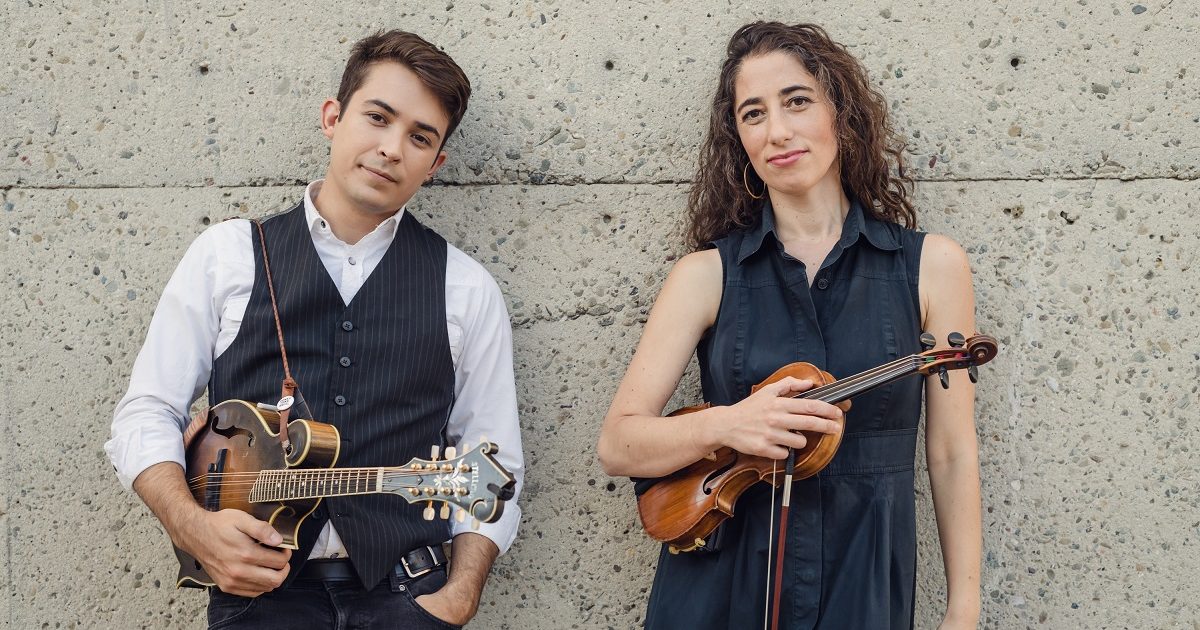
Artist: Scroggins & Rose
Hometown: Oakland, California
Latest Album: Curios
Release Date: June 26, 2020
Personal nicknames (or rejected band names): We’re not really the nickname types. haha I think for a while we thought of calling ourselves Spiral or something like that, but we landed on Scroggins & Rose pretty quickly.
What other art forms — literature, film, dance, painting, etc. — inform your music?
Alisa Rose: I believe any art that I experience influences what I create. I love the floaty mysticism of Chagall’s paintings, the elegant structure in Martha Graham’s dances, the lyricism of Morrison’s books, and the beautiful details of Proulx’s stories. I hope a bit of all of these seep into what I create.
Tristan Scroggins: I’ve always loved paintings and have been inspired by how they can convey so much meaning and emotion through things other than the picture itself. The brush strokes and colors and style all tell their own story without necessarily being the center of attention and I try to incorporate that idea into my playing as much as I can. With composition I/we draw inspiration from a lot of different sources. One of my favorite writing games we did while writing the tunes on this album was listening to an album of tongue twisters and trying to write tunes based on the rhythm of certain ones.
What was the first moment that you knew you wanted to be a musician?
AR: When I was 6, I read a story about Paganini and how he played the violin so beautifully that he made people cry. I was really struck by the power of music, and from then on I thought I would like to be a violinist.
TS: I grew up listening to my dad play the banjo but it had never crossed my mind to play music until I was 8 years old. I was watching my dad perform and was overcome with a sense of pride and I asked him to teach me to play. It was never a conscious decision after that to be a musician. I always just assumed that I was going to do that.
What rituals do you have, either in the studio or before a show?
AR: Before a big show I like to have a few hours of relaxed practice with some slow work on intonation, basics, and the pieces I’m going to perform. I also try to eat well (I like lots of protein before a performance) and go on a walk or a run in nature if possible. With Scroggins & Rose performances it’s important for us to improvise and warm up together as well to make sure we are both attuned to each other and able to connect well on stage.
TS: For a long time I would do confidence exercises/meditations. I’m pretty shy in everyday life so I had to consciously embody the persona of someone who wanted to be the center of attention. For Scroggins & Rose shows we usually warm up together and will do some improvisation games so that we can get in the mindset of reading body language and musical cues on stage.
Which elements of nature do you spend the most time with and how do those impact your work?
AR: I spend as much time as I can walking through redwoods and exploring the rocky dramatic Californian coastline near my home in the Bay Area. For me, music is deeply associated with my experiences in the natural world and many of my tunes are inspired by the feeling of specific places I’ve been to. For instance, “Wisconsin Wayside” is about driving through beautiful green rolling hills and cornfields on winding country roads in Dane County where I grew up. I also spend a lot of time thinking about melodies I’m working on while I hike; the melodies often find their own path while I’m walking on one.
TS: I spend a lot of time looking at nature but not really being a part of it. I’ve gotten to see lots of really beautiful things but usually through a car windshield. Those sceneries and landscapes are often used as inspiration for textures and moods in composition (such as the “wide-open” feeling of tunes like “the French Cowboy” or “Wyoming”). I also find myself writing about birds a lot. I wouldn’t call myself a “bird watcher,” but I do spend a lot of time watching birds and I have written a number of tunes about birds.
How often do you hide behind a character in a song or use “you” when it’s actually “me”?
AR: Although the music I write has no words, to me the tunes are often about a character or story that is not my own. I feel music is a powerful way for people to connect to each other around the shared experience of listening, even if what each of us hears is unique. To perform a tune, like an actor, I find I need to experience the story and emotions as my own, even if they were not originally conceived that way.
TS: I think this is a really interesting question as someone who mostly writes instrumental music, because I think the answer is “always.” Or at least almost always. Whenever I write a tune about a personal event or feeling I don’t feel the need for any restraint because, ultimately, people are going to interpret the tune in their own way. That’s the nature of instrumental music. It’s like a magic trick where the interesting part of the performance is only happening in the viewer’s mind. Of course I can lead the audience’s interpretation by telling them what I wrote it about before it’s played, but even then what each note means to me will be different from what it means to them.
Photo credit: Lenny Gonzales