Chris Thile Infuses Himself Into Bach’s Partitas and Sonatas

How many years does it take for a musician to master the music of Johann Sebastian Bach? This isn’t the start to a joke, but the answer to the question can be a bit amusing considering that, for Chris Thile, there’s no such defined number of years or fixed amount of time.

It’s an apropos viewpoint for the GRAMMY-winning mandolinist, composer, vocalist, and collaborator to have, given that Thile is reviving a Bach-related pursuit he began more than 12 years ago. In January 2013, Thile recorded three of the six works that make up Bach’s Sonatas and Partitas for Solo Violin. That August, he released Bach: Sonatas and Partitas, Vol. 1. The logical question following the record’s release and enthusiastic public praise was, “When would volume 2 arrive?”

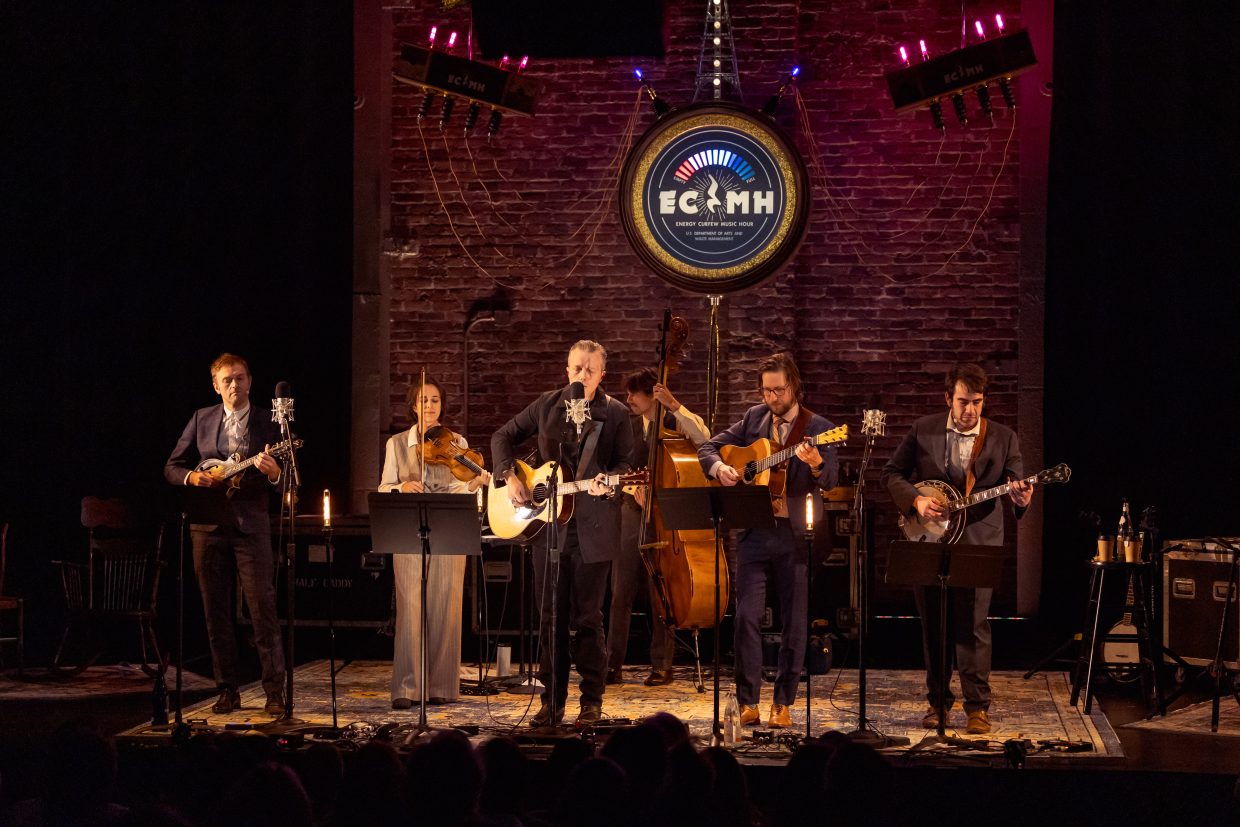
There’s no disputing the abundance of professional endeavors and musical collaborations that Thile dove into since then, recording with the likes of Yo-Yo Ma, Brad Mehldau, Edgar Meyer, Punch Brothers, and Nickel Creek; winning a MacArthur “Genius” Grant; hosting Live From Here; releasing other solo albums; and even creating a new musical variety show with Claire Coffee, The Energy Curfew Music Hour, which just released its second season on Audible. The extended wait has been understandable. Still, it became difficult not to wonder if Bach’s sonatas and partitas would ever see completion in Thile’s extensive and stylistically diverse discography. Thankfully, Thile renders the other half of the collection on a new solo recording, Bach: Sonatas and Partitas, Vol. 2, released November 7.

The undertaking sounds simple enough: record the remaining two partitas and one sonata. However, Thile embraces Bach’s work with a completely different aim from the first volume. Vol. 1 stayed true to Bach’s written intentions as much as possible. Now, Thile has allowed himself to consider his inner desires for what he feels the music needs – particularly where his music-making process is concerned.

The result is music that is not only pristinely performed, but also offers moments that occur naturally as Thile puts each piece together. Whether that means the ethereal decay of an individual harmonic, harnessed and expanded to ignite a particular feeling between movements I and II of Partita No. 3 in E major, or listeners’ ears traveling from one place to another as a piece blends audio from two completely different settings – like a concert hall, public park, or Blackberry Farm. Vol. 2 is an enlightening peek into Chris Thile’s mind and a bit of a walk in his shoes. In fact, he goes so far as to say that the process of learning Bach’s music is eternal, ongoing, and personal to every musician.

“It’s never done,” he says. “I think you could keep living and growing with Bach forever. But god, what a rewarding process!”

Chris Thile spoke to BGS on a call from Ann Arbor, Michigan, amid a cluster of solo tour dates. He reflects on the different ways musicians become inspired to explore Bach’s music, some of the very subtle but unrelenting dissatisfaction he encountered during the recording process, how practicing Bach is like practicing yoga, and much more:

Given the profundity you view Bach’s music as having, how did you negotiate its iconic place in music history with your desire to explore the possibilities you feel when listening to it, learning it, and making it part of yourself?

Chris Thile: I think that almost every ambitious musician’s relationship with Bach begins when someone tells them they should check it out, you know? Some of us just encounter it in the wild and have a major moment with it, but for me, my grandmas on my mom’s side – my grandma and my step-grandma – they both are excellent pianists and taught piano, performed a bunch, and both are gigantic Bach fans. When they realized their little mandolin-playing, bluegrass grandson was pretty serious about music, they were like, “Well, this boy needs to know about Bach!”

Sometimes it takes an expert to tell you that something is amazing and that you should see what’s there in it for you. And, sometimes, you’re just intrinsically aware of the thing’s value. I think mine was kind of both that helped. Having these women in my life who were so important to me tell me that this guy was really, really good helped [foster curiosity].

When [my grandma Sal] sat me down with Bach, it was with Glenn Gould’s second recording of The Goldberg Variations. She was also underlining that Gould’s performances of the music were more notable. That, I think, impressed itself on me, too; that we don’t have recordings of Bach playing Bach. So someone makes those for us or we make them for ourselves. Then it introduces this other music-making entity into the equation.

That’s a big and very long transition going from “Bach, the Almighty” to Bach, a human being whose music I am interested in having a real relationship with. And by “real relationship,” I mean a two-way, back-and-forth conversation. Yes, the text is fixed, but you can still have a living, growing relationship with it. And it takes a long time to learn how to do that. I think it’s lovely to have people giving you advice along the way.

You’ve said that practicing Bach “is like practicing yoga” and that it’s something you do everywhere you can. What does that mean for you?

Being someone who plays Bach and being someone who does yoga, I did want to figure out a way that the recording could represent that [connection] – the living, changing, growing, aspect of being someone who interacts with this music regularly. That these pieces could go from one place to another, potentially mid-movement. And then realizing that would also potentially mirror my experience of playing the pieces.

Because it’s not like I’m only playing them in my workspace. I might play them at the Elbphilharmonie in Hamburg and then a couple months later be at a Hampton Inn in Carbondale, Illinois. Or, it’s just too nice outside and I gotta practice outside today. So, multiple locations ended up serving two ends: wanting to be able to utilize the studio and [all that’s] possible when you’re recording music, to trying to figure out a way to sonically represent that life of practicing Bach.

Did you have a lot of thoughts on Bach going through your mind even while planning Season 2 of the Energy Curfew Music Hour?

Yeah! That was all happening concurrently. Every now and then, Punch Brothers would be in a practice room and I’d show my bandmates something, [asking,] “What do you think of this random thing I’m trying to do with the C major Fuga?” Just trying to get a read on people and playing a little bit of it on the side, to see if I can gauge a natural reaction to it and see if that gives me any ideas for future shenanigans. And it definitely did.

You’ve said that once you hear something in your head and enjoy it, you have to chase it until your ears tell you differently. That making peace with that aspect of your musicianship “is actually kinda the B story of this whole record.” What does it mean for you to “make peace” with this facet of your artistic spirit?

I am compelled to make this music. I don’t always understand the nuts and bolts of why I think it’s important to do it. First and foremost, I love the music. I love hearing other people play it. I love it on the page, I love the physical sensation of playing it, and I love the sound of me playing it.

But then, as is my custom, I’m voice memo-ing myself playing [the sonatas and partitas]. I heard the voice memos back and did not like how it sounded. There was something insincere about it. It was very, very strange, like something reflexive. It was almost the sensation of seeing video of me back and having some sort of physical mannerism that I was unaware of and not liking it. Or like, hearing the tone of my voice on a recording and thinking, “That’s what I sound like?” I think we’ve all had that sensation before.

So it was really disorienting and vexing, my perception of what was happening: the music that was actually being made was so off and somehow struck me as inauthentic and non-additive – and like regurgitation. So I had to do something.

The thought struck me, “I’m not ready to make this record.” The way I approach making music has changed over the last 12 years. I went back into this music thinking that my methods from when I was 31-32 were gonna be great and yield a good result. I just like to get my hands dirtier these days. The musician that I am takes everything down to the studs and blends it with everything else that’s swirling around in my musical life. That’s what I do. That’s how I make music. It’s how I write music and it’s how I approach performing any other music besides Bach. I think my reverence and awe that I hold [Bach’s] work in was preventing me from actually engaging with the music the way that I do with every other piece of music in my life.

It was scary for me, because I’m not any less reverent of what Bach did. I don’t love it any less. I don’t think it needs to be different. But when it’s me playing it, it has to go through my process, like everything else does, or else it doesn’t sound sincere and doesn’t sound authentic. That was an almost painful realization to have, and to have to basically scrap an approach and build a whole new approach to working on this music. But again, it wasn’t a new approach. It was just applying everything I know about music to Bach for the first time.

What was your intention when you decided to record in different settings – New York City’s Reservoir Studios and Tomkins Square Park, Tennessee’s Blackberry Farm, and Farrell Recital Hall at Murray State University – as well as choosing to merge audio together?

The different locations thing was part of the initial impulse, in terms of turning the thing into an actual record. It was a fairly radical move – to go from just recording in a nice studio or nice hall and getting a great sound and letting that be the sound and playing the music.

There were two reasons to do it: One of them is that, increasingly, I feel if you’re going to make a record, you should utilize the studio as an instrument. You should make sure that you’re using the medium. I guess it’s not a “should.” You can utilize the medium. For me, I’ve made a lot of archival records where really it’s just, “This is what happened in the room. Enjoy!” But I’ve realized about myself that often, when I’m listening to an archival recording, I have FOMO or something. I wish I were there, because clearly this happened in a room just like this and imagine if you had been there when it happened.

Whereas, I don’t have that when I’m listening to something that’s really taking advantage of the tremendous tool that the recording studio can be. For example, a record like Radiohead’s Kid A, where it’s something that can’t happen live. If you had been there in the room, it would have been really interesting to hear them discover the sounds. But then the flight that performance takes in the hands of a great engineer, who’s been set free in terms of exercising their own creativity in the mix environment, or artists who are very hands-on during that part of the process.

Again, it’s like a performance that’s happening over the course of months, even years at times. What happens live in the room is part of it. And then what happens in the editing booth is part of it, and what happens in the mixing room is part of it. If you’re going to make a record, it’s just interesting to note the difference. You can use the studio as an instrument or it can merely be the camera with which you’re taking the snapshot of where you’re at with a piece of music at a given time. I wanted to mess around with the former on this album.

The more I listened to something like that in my head, the more I liked it. The more committed to it I became, the more I considered, “[What if I] allow myself to record these things in multiple locations and even stitch performances together from from very tangibly different environments?” Really, sort of leaning into the surrealism of it. Now you’re in a studio and now you’re in a corner of Tomkins Square Park in the East Village. If I’ve allowed myself to do something like that, then what wouldn’t I allow myself to do?

Track 10, the first movement of Partita No. 3 in E major, I. Preludio, ends with nearly 13 seconds of ominous, rising, distorted feedback that pivots right into the clean first notes of movement II. Loure. What role is that very intentional ending meant to play?

It wasn’t something I knew that I needed until I had everything quote-unquote “done.” And then it was like, these moments in this medium need a little extra something. To give the [Partita No. 3 in E Major II.] Loure this kind of psychodrama towards the end of it was important to me. And then to prepare that [piece] with that crazy delay loop, grabbing that last harmonic [in the first movement, Preludio] was also important to me. So I asked my mixing engineer, Joseph Lorge, to find something. Bless him, I love what he found. That is almost like the harbinger of what’s going to happen on the Loure. What happens during the Loure was really important to me, artistically. But then I wanted there to be some sort of trumpet call like, “Hey, look out. Something’s coming.”

What stands out as something unique about making Bach’s music more your own this time around, especially knowing this is a solo endeavor?

There’s so much in today’s society about “Be yourself!” “Follow your dreams!” I’m talking about how important it is for me to have a two-way conversation with this music and not just revere Bach to the point that I’m taking myself out of the equation as a creator.

But we are so “Me, me, me, me” now. “This is me, just deal with it.” It can be really interesting to consider, “What happens when you expose yourself to the taste of other people?” It’s ultimately going to happen anyway, but what if there’s a practical concern? Can you go through that kind of exercise? It’s one of the reasons I love being in bands. In Punch Brothers, for instance, I need [all four of my bandmates] to be as happy with the music as I am. It’s not done until then. When I make music by myself, I have to figure out ways to trick myself into considering more than just me while I’m doing it.

[However,] you do have to make sure that you’re pleasing the only ears that you actually have any control over pleasing, which are your own. That’s first and foremost. But yeah, you’re always looking for any way to give shape to the very nebulous process of creating something from nothing.

What do you think musicians and composers of today can learn from Bach’s approach to music that would bring today’s songs, performances, and practice mentality closer to the timeless, ever-insightful, and continually inspiring nature of Bach’s work?

One thing that I keep trying to learn from Bach, just as someone who does try and write music or make it all the time, is how much of his art was happening anonymously. He had his professional duties – as he was a court composer and then he was a church composer – so there were those things, where he was writing music for very definite purposes with very definite deadlines. A ton of it was really theoretical and him working on the craft without any promise of getting a reaction out of his fellow humans – really his own curiosity and work ethic and desire to know and discover.

So I’m constantly thinking about, “Are people going to like this? Is it going to help me grow my audience? Is it going to help me make rent? Pay the mortgage?” Of course, [Bach] had those kinds of concerns. I think human beings in the early 1700s were not immune to ego. It’s not like Bach didn’t care what people thought of him – I’m sure he did. But I’m also sure that [thought process] took a very different form in those days and I think being able to make music – just for the love of it and with the patience that it takes to really explore your materials – is a thing that I at least keep trying to learn from Bach.


Photo Credit: Josh Goleman
Chris Thile Dives Into New Audible Variety Show, ‘Energy Curfew Music Hour’

Punch Brothers’ new audio-based variety show, The Energy Curfew Music Hour, takes listeners to a fictitious, not-so-distant future where, as the show materials describe, “diminishing resources and extreme weather have ushered in a worldwide effort to ration electricity. America has instituted a weekly ‘energy curfew’ where the power grid goes down completely and we all live electricity-free for 24 hours. The Energy Curfew Music Hour hits the airwaves an hour before the lights go out while the nation tunes in and turns off together before the Dark Day.”

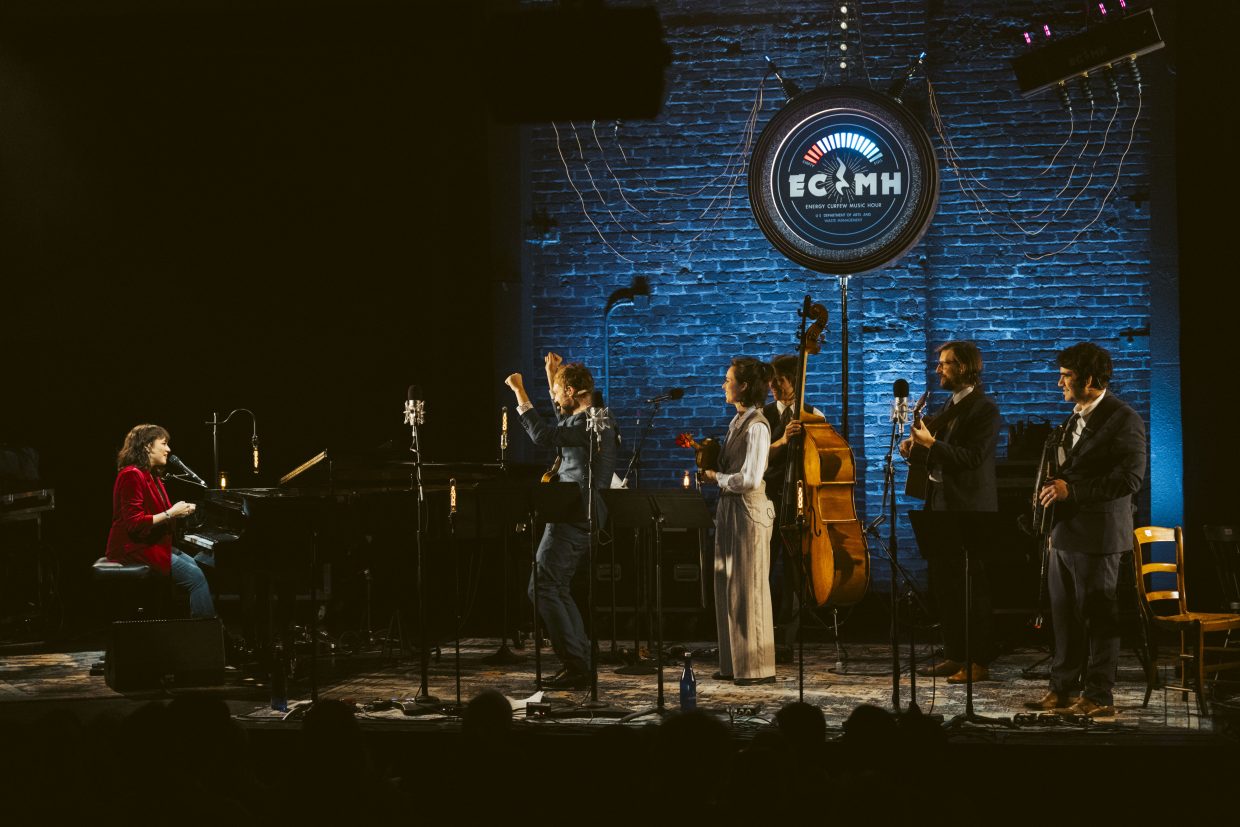
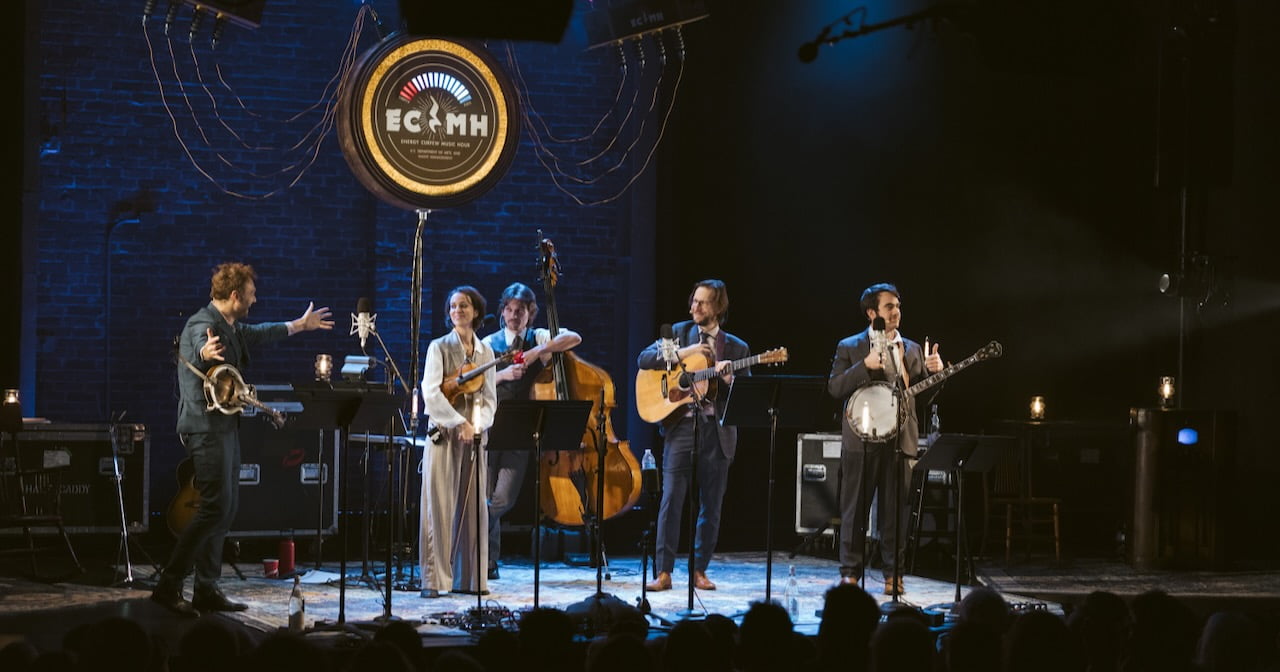
The Audible exclusive, eight-episode series was recorded in front of a live audience at the Minetta Lane Theatre in New York in early 2024 and features a cavalcade of all-star performances backed by Punch Brothers, who serve as co-hosts and house band.

BGS executive director Amy Reitnouer Jacobs spoke to Punch Brothers’ frontman Chris Thile about the show and what’s next for the band.

What a good way to start my week, chatting with you! I’d love to start by hearing how The Energy Curfew Music Hour started.

Chris Thile: [My wife, Claire Coffee] and I came up with the idea a long time ago… originally it was like a show within the show for Live From Here.

We always thought maybe two-thirds of the way in the show, we would all of a sudden flash-forward to a future that was like this. And we’d gather round one microphone, because I’ve always loved the sounds of those old variety shows and their campy-ness.
And then of course, practically speaking, there’s not much of a platform for acoustic music out there. That was the thing I missed the most on Live From Here: I was obliged to at least try to concern that show with the width and breadth of the music being made in the world, regardless of aesthetic.

Norah Jones joins Punch Brothers on stage at Energy Curfew Music Hour at Audible’s Minetta Lane Theatre in New York City.

There’s something in what you mentioned about old-time radio shows with one microphone. When you think about when those were popular, it was the Dust Bowl, the Depression, a time that was really hard for most people. And the radio brought everyone together. So, in an age where we are so splintered as a society, I find [Energy Curfew Music Hour] very comforting. But there are elements of dark humor throughout too… am I reading too much into it?

Oh, no you’re right on it. There’s a certain aspect we always talked about, trying to strike the balance between shameless optimism and at the same time as I think it is really staring the monster [of reality] in the face. The extent to which we’ve imagined life has changed in a very short amount of time is huge. None of us have pseudonyms. We’re all [playing ourselves], so it can’t be that far in the future.

The extent to which we’ve imagined that life has changed is dramatic and potentially traumatic. And there’s some gallows humor throughout that. But despite taking place in this “dystopian future,” there’s nothing actually futuristic about the show. We wanted it to feel like a little bit of escapism, but a little bit real too.

Yeah, we know that change happens very fast in our world today. It’s not that hard to put yourself in those shoes when you’re listening.

That’s good to hear. Claire and the band and I keep talking about the increased emphasis on collaboration, compared with Live From Here, which was more just “Here are some acts that we love…” But those acts coexisting or working with me or the band … those were few and far between on that show, whereas on this show, it’s every episode. That’s also something of an analogy for the kind of thing we have to do just as human beings, not just as musicians, to effect the kind of change that we’re all hoping to see [in the world].

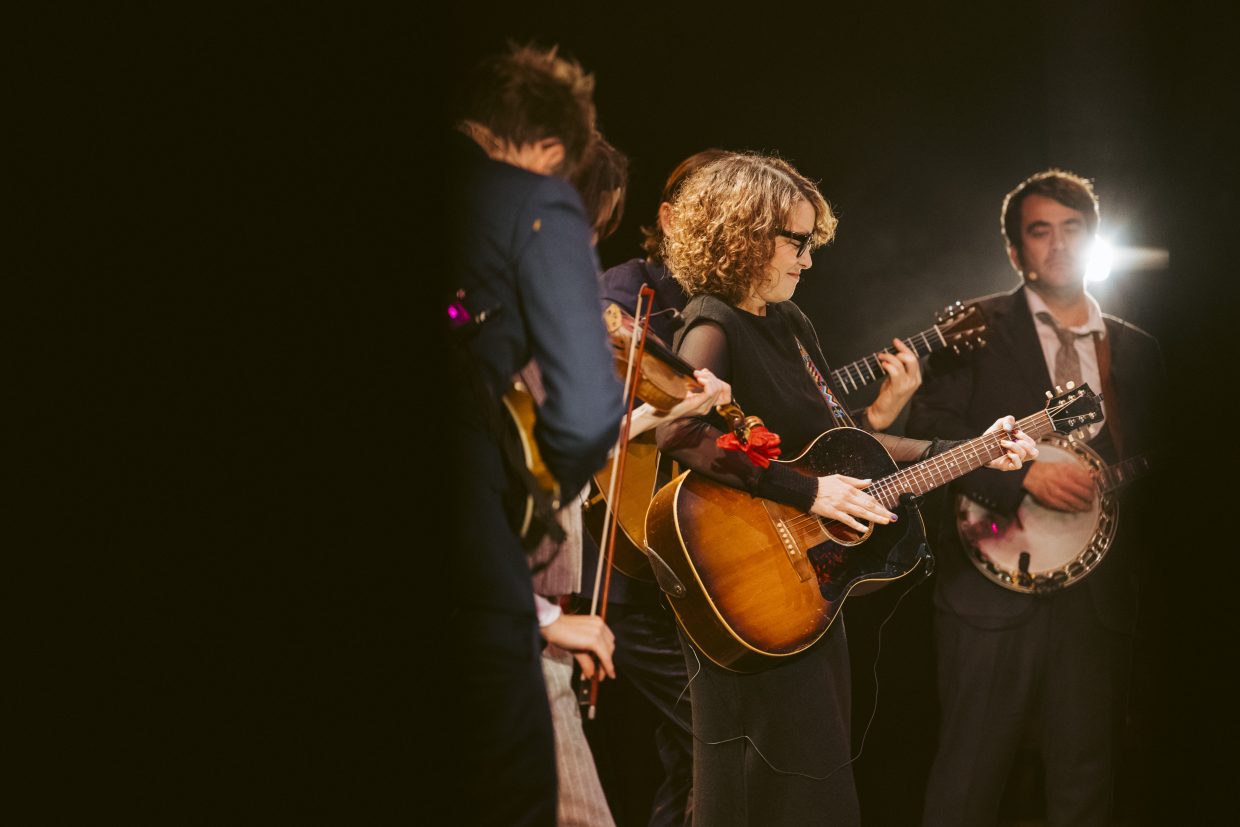
Gaby Moreno guests with Punch Brothers during the Energy Curfew Music Hour.

Can you talk a little more about working with Claire? I know you guys have worked together on Attention!, [a new narrative live show for mandolin and orchestra], which you’re taking more places now. What is your process like being married and collaborating?

I think I realized [during the pandemic] how shamelessly I had used Claire’s incredible taste as a sounding board for just about everything I’d done since we met. So I hired her to produce the solo record I made, Lay Songs. Then I hired her for Attention! and she helped me tell the story of how I met Carrie Fisher on a rooftop bar in San Diego in my mid-twenties, in what ended up being a really silly story, but also a very foundational experience for me in many ways.

When you’re telling a story like that – really when you’re working on any art – you get so inside of the thing, it’s very difficult to know how it’s coming across or if any of the stuff that’s so clear to you is landing with any other human. Claire is one of the very few people in my life who has absolutely no problem telling me when I’m full of shit, and it can be intense, but it invariably yields a better result.

So, when a couple people had asked me whether I wanted to do something like Live From Here again, I thought about it for a little while and remembered Claire’s and my idea for a show within a show. I asked Claire whether she would be interested in trying to make that a whole show and then fairly soon after that, the idea of Punch being the house band and co-hosts with me materialized and it was really off to the races.

It all felt very comfortable and natural. Claire is not a musician by trade; she’s an actor and writer and now director, and she’s always been the person that all her writer friends go to for their first round of notes. She has an extraordinary ability to strip away and identify what’s in between the writer and their audience – of what’s getting in the way. We’ve benefited a lot from that.

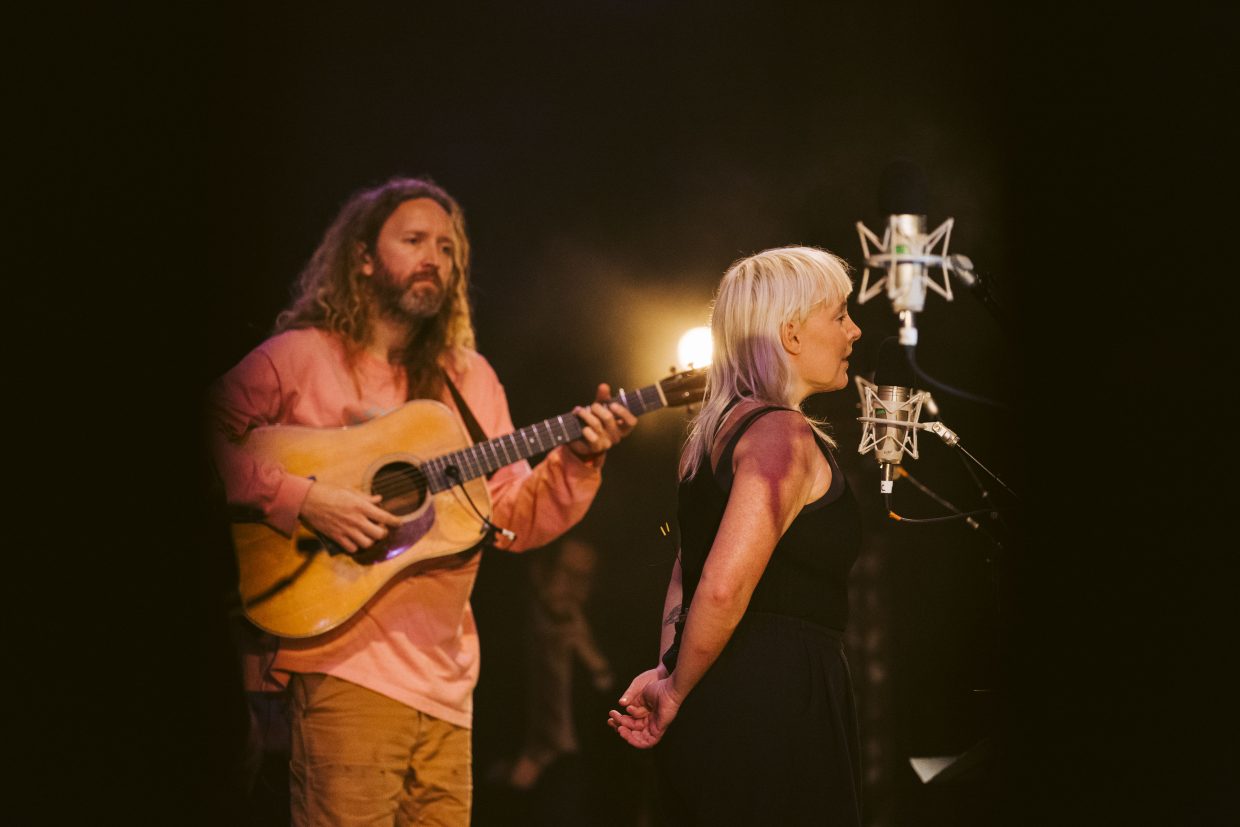
Sylvan Esso perform during a taping for Energy Curfew Music Hour episode 5 at Audible’s Minetta Lane Theatre in New York City.

You’ve got some incredible names in this first season as guests – Norah Jones, Lake Street Dive, Jon Batiste, Kacey Musgraves, and James Taylor, just to name a few. Who brought the most surprising acoustic performance to the show?

Sylvan Esso came in and were really excited to not do what they normally do. To be there with them using Punch Brothers, wielding us like a laptop and basically muting and unmuting us, but all in analog! I think that was a moment of proof-of-concept for me. When we did that, I found myself cackling with surprise and delight. I hadn’t suspected that it would crack the show open to a whole other level.

You’re premiering some new Punch Brothers songs on the series too. Is there something else cooking for the band? What’s ahead now that you’ve added Brittany Haas to the lineup?

The band feels very, very new. We’re in uncharted territory and it’s so interesting. Four-fifths of the band is the same. You change one component and it feels completely new in the writing room, in the rehearsal room, and on stage. At this stage in the band’s career, that’s really interesting. So yes, there are new Punch Brothers songs and they’re being written specifically for Energy Curfew now, but of course, with an eye towards whatever’s coming next.


Season One of The Energy Curfew Music Hour is out now via Audible and is available to stream for free for Amazon Prime members. Discover more about the show here.

Photo Credit: All photos by Avery Brunkus, courtesy of Audible.

Brittany Haas Joins Punch Brothers Just in Time for the Energy Curfew

I first encountered Brittany Haas when I was 14 years old, attending the Mark O’Connor Fiddle Camp outside of Nashville. Brittany was only a few years older than me, but she was miles ahead of me musically and professionally, already gigging with some of the best traditional musicians around. I bought a copy of her self-titled CD and learned every single track on it. When I would meet other fiddle players my age, we would often bond over this recording and its shared influence on our playing.

Haas went on to join Boston-based band Crooked Still, one of the most influential string bands of the last 20 years. In the small community of acoustic music makers and lovers, Crooked Still was the kind of iconic band – much like Nickel Creek and Punch Brothers – that created a hundred baby bands in its wake, each inspired by the reinvention of traditional song in modern and exciting ways. There was even a period of time when seemingly all of the young women involved in the folk and bluegrass scene (myself included) began dressing like Haas, wearing messy buns in their hair and colorful leggings under short boho dresses.

Following her time with Crooked Still, Haas went on to play with Gillian Welch and Dave Rawlings, in the house band on Live From Here, and with her own genre-bending quartet, Hawktail – among many other projects. Unlike other powerhouse women instrumentalists like Missy Raines, Molly Tuttle, and Sierra Hull, who have carved out career paths by leading their own bands, Haas has stayed largely under the radar to the wider public, working primarily as a collaborator or band member.

As my own musical interests have grown and changed, I have found myself feeling guilty at times for not putting my focus on being an improvisational instrumentalist, fearing that I’m taking a too traditionally female path as a songwriter, and reenforcing gender expectations. But as Brittany has kicked through ceiling after ceiling as an instrumentalist, I’ve thought “Hey, it’s OK, Brittany is so good that nobody will ever doubt that a woman can do it!” For years, Haas has been a pinnacle, an example for the rest of us female instrumentalists. So, you can imagine the thrill that I felt when it was announced that Haas would be the newest member of Punch Brothers, a band that is representative of the highest caliber instrumental prowess in today’s acoustic music scene.

Haas’ first gigs with the band have been as part of The Energy Curfew Music Hour, a live radio-style show created by Claire Coffee and Chris Thile in collaboration with Audible. The show features Punch Brothers along with special guests like Jason Isbell, Gaby Moreno, and Sylvan Esso among others.

BGS had the opportunity to ask Brittany Haas a few questions about her career and her hopes for joining the band in the lead up to a handful of Energy Curfew Music Hour shows in New York City this month at Minetta Lane Theater.

Chris Thile & Punch Brothers perform at Energy Curfew Music Hour with Jason Isbell in December. Photo by Rebecca J Michelson.

You’ve had a lot of experience working with various members of Punch Brothers in different bands and formats over the years, what about the particular aesthetic and ambition of Punch Brothers made you want to accept the gig?

I’ve been a fan of the band for a long time – I guess as long as they’ve been a band. So the idea of joining was very exciting. I think any fan would tell you that there’s something about the band – the expansive nature of their approach to writing and arranging music – that is really unique. They’re making music that doesn’t sound like anything else. Getting to jump into something that’s been evolving and expanding into and beyond itself for so long is really cool. And as an instrumentalist in this “new acoustic” musical universe, it’s basically a dream gig, joining four incredibly talented and smart people and making music through which I know I will grow as an artist.

You’re known as a fiddle player that’s rooted in old-time traditions, but also improvisationally virtuosic. Do you feel like your background in old-time will bring a different flavor to the band moving forward?

Old-time is a genre in which I feel a lot of joy and comfort, so it’s always nice when that can be utilized in service of a tune or a song. Lately, in playing with my sister and with Hawktail, I also feel that my voice is strongly Celtic and Scandinavian – basically a combination of the genres I grew up around at fiddle camp and got obsessed with. I think that stuff will come out naturally no matter what new music we’re creating and perhaps some of the music will be written in that direction.

When stepping into a role that has been created and maintained by one specific fiddle player for so many years (Gabe Witcher), how much freedom do you have to remake the parts for the older material in your own voice?

I think this is true in many areas of life– the more deeply you know something, the more you can put yourself into it. Once you know intimately how it goes, you can be freer and more artful and playful with it while staying true to its nature. So that’ll be a journey for me with the back catalog material. Also, sometimes the parts he played were just the best thing that could happen in that musical moment. Some of the parts are more written than textural/improvised, so in those cases I will need to stay true to what he played. And I love his playing! Playing like Gabe is fun for me, because it stretches me in a different way than I normally go.

What made you want to wear a suit for this gig?

I’d never worn a suit before joining the band, so I saw it as an opportunity to try that. I always thought that the women I saw wearing pantsuits looked awesome. Plus it’s great having so many pockets for mic and in-ear packs. The other part of my thought process was, this is a band and I want to integrate into it, so it makes sense to wear the uniform. No one said I had to wear a suit. I’m sure it would be cool with everyone if one of them wanted to start wearing dresses, so it’d be cool for me to do that too, and maybe I will at some point.

You’ve made incredible records in a lot of different fiddle genres at this point, is there any uncharted territory that you hope to explore in the future?

The depths of my own mind! I’m partially kidding; I do want to write more music. But there is always uncharted territory! Darol Anger is an inspiration in this – he never stops practicing and devising new ideas for getting around the fiddle. I hope to keep learning tunes from different musical traditions. Lately I’ve enjoyed learning conjunto music and I’d like to spend more time with Eastern European folk music, getting comfortable in different time signatures, etc.

What is a record that has been inspiring you lately?

James Taylor’s album Hourglass from 1997. We learned a few of those songs to play with him on the show and I fell in love with them. Also Alasdair Fraser’s album Dawn Dance, which I returned to recently after first being obsessed with it about 25 years ago. It is still as lovely as I remembered.

What is your process for preparing to play with so many different guest artists on the show – how do you approach constructing fiddle parts?

Mostly listening. Generally, when we get together with the guest artists that’s when most of the decision making about parts happens. So my job is just to show up being familiar with the music. Sometimes there are more specific string-oriented parts to play.

You’ve been a part of the Live From Here house band in the past, how does the vision and format for the Energy Curfew shows differ from that show?

The format feels similar, although there is more of an air of collaboration, because there is a bit more time for creation and also the same core band for every show. And, the premise of the show centers on the idea of it being purely acoustic music, so that’s mostly what it is with some inventive ways around that rule when needed.


Photos courtesy of Audible. Lead image by Avery Brunkus; inset image by Rebecca J Michelson. 

For Chris Thile, Instrumental Music Excels in the Cracks of Language (2 of 2)

Chris Thile has always woven religious references into his songwriting, but never so much as on Laysongs. Recorded in solitude in an old church with just a mandolin and a sound engineer, the new album offers lyrics that question our impulses and references that span the Bible (“Ecclesiastes”), Hungarian composers (a take on Bartok’s “Sonata for Solo Violin, Sz. 117: IV. Presto”), and bluegrass legends (a cover of Hazel Dickens’ “Won’t You Come and Sing for Me”) in service of a higher truth.

Here, in the second installment of a two-part interview, BGS catches up with Thile about co-producing an album with his wife, finding inspiration in good wine, and why great instrumental music should emulate a warm dinner conversation.

Read the first half of the BGS Artist of the Month interview with Chris Thile here.

BGS: Your wife, [actress Claire Coffee], co-produced this album with you. What did that lend to the final product, and how did it influence the process?

Thile: Pretty much since we met, she’s graciously been my unofficial editor. It was high time to just formalize that. [Laughs] When you’re doing something like this — a pure solo record, no overdubs, absolutely nothing between me and your ears — it really helps to have someone involved who is absolutely 100 percent unimpressed with you. She has heard every one of my tricks and can see straight through them, can hear straight through them.

As an actor and someone who’s made a lot of film and television, Claire cuts straight to the chase: “Is this meaning something? Does one and one equal two here? Are we starting somewhere and ending somewhere — and how is the ride between those two points? Are we engaged? Is this clear enough, and does it ever get too painfully clear? Are we leading the witness, are we telling people the punchline before we give them the setup?” I can really gild the lily when left to my own devices. Musically, I can sort of be the guy in the theatre, like, elbowing you — like I’ve seen it six times and I’m like, oh, you’re going to love this part! And so Claire, I think, is so good at being like, “Hey. Don’t do that.” [Laughs]

And perhaps, also, letting you know when it’s warranted.

Right. Sometimes I won’t pull the trigger on what would be a really interesting decision because I’m worried that I’m just swinging too hard. I sort of gingerly put the idea of doing the fourth movement of Bartok solo violin sonata. Thinking, well, this is kind of a bridge too far. I sent it to Claire like, “What if I learned this on the mandolin?” and she was like, “Absolutely. Do that. That’s gonna be amazing.” Which was just so shocking to me! I thought I had probably lost my mind. [Laughs]

It was also her idea to put it after “Salt (in the Wounds) of the Earth.” I mean, I feel like everyone thinks they’re gonna get a big ol’ chance to exhale after “Salt (in the Wounds) of the Earth,” and instead… I mean, think of it like these Peloton instructors: You think, “Surely, surely this is it. Surely this is the hardest I’m gonna have to go.” And they’re like, GIVE ME FIVE MORE ON YOUR RESISTANCE!!

I feel like it’s that kind of move, going from “Salt (in the Wounds) of the Earth” to the fourth movement of the Bartok sonata. It’s as if the demon in “Salt (in the Wounds) of the Earth” just took my mandolin from me. But that’s the kind of perspective someone who loves you—but isn’t taking any of your shit—can help you with, especially someone who also has a deep and wide skill set that is compatible with mine. It was so fun to work with her on that.

You’ve always got multiple projects going. Is there anything you learned specifically from performing in groups and making music in that atmosphere that you feel gave you an advantage when you set out to record an album alone?

The accountability — the musical accountability, artistic accountability — that you feel in a collaborative context is noticeably absent in a solo context, so you need to pick up the slack there. You need to start roleplaying those people in your life who hold you artistically accountable. Thank God I had Claire involved in this project, but on the deep I-dotting and T-crossings that you encounter at every step along the way of the record-making process, I would also assume the role of an Edgar Meyer or Gabe Witcher or a Sara Watkins. I’d tease out a little fake conversation between myself and them, all by myself in the practice room. “In what way am I not being clear enough right now? In what way am I being self-indulgent right now?”

There are so many things that you learn from the people around you. But there are also things that you can learn in the silent retreat of making music solo. There are things that I can take back to each of those projects — things I can take back to Punch Brothers, or Nickel Creek, or the Goat Rodeo Sessions — that I think could be illuminative in those contexts.

Do you enjoy talking about religion outside of your art?

People have such strong feelings about religion. You wanna bust open a conversation, bring up God — like, in a real way. People are gonna quit mincing words and they’re gonna start talking about shit. I love that. I really love talking to people about that kind of stuff, from wherever they are. I find it endlessly instructive in my own journey. I find someone’s total disinterest in it just as interesting as total interest in it. If I bring up God and you’re like, “I don’t wanna talk about that shit, come on,” then I love you for that. Let’s go with that. Let’s talk about that.

And if I bring up God and you’re like, “Ugh, you know what? I was just praying about that this morning, I feel like the Lord brought you to me,” I’m in. Let’s go there. Why do you feel that way? Let’s go there. At this point, I have no reservations about bringing up God. It’s always been an instinct of mine to infuse whatever I’m thinking about with a little of that kind of imagery and language and thought, and so this was cathartic for me to just turn all the taps on and let it run.

You push beyond your own religious upbringing, too — you also included a song, “Dionysus,” named for the Greek god of grapes and wine. What inspired you to write about that figure?

I’m always looking for encouragement, as a human being, about human beings. We see a lot of evidence of our failings right now, and I want to see evidence of our success. Wine — the existence of good wine — is evidence of our success as a species. That is a beautiful relationship with the earth. We have occasionally exploited that relationship, but the best wine comes from the healthiest relationship with the soil. The best winemakers have this beautiful balance of science and mysticism. It sounds silly, but I find the whole thing very inspiring.

Ecclesiastes 2:24 seems like it’s along those lines, too: “Nothing is better for a man than that he should eat and drink, and that his soul should enjoy good in his labor. This also, I saw, was from the hand of God.” Why express that instrumentally rather than through lyrics?

Think about the last great dinner that you had with friends. Could you really, with words, describe to me why it was so great? Could you say, “And then we talked about this” or “Next, we gossiped about that”? When you walk me through that, or when I walk you through the last dinner I had, it’s gonna sound trite. And yet, there was something holy about it, you know? Maybe there was a new person that you sat next to, and you got a little light into a different corner of life that night. But could you say with words what that was? I don’t think you could, necessarily, say what can be so transcendent and transportive about a great dinner with friends. That’s where instrumental music excels — in the cracks of language. What language is incapable of properly expressing, instrumental music steps up and says, “I got this.”


Photos: Josh Goleman

Chris Thile Considers His Community and Christian Upbringing in ‘Laysongs’ (1 of 2)

For a while, Chris Thile might have been the busiest man in bluegrass. The former public radio host has snagged four Grammy awards and a prestigious MacArthur “Genius Grant,” all the while maintaining his status as a founding member of Punch Brothers, the Goat Rodeo Sessions, and Nickel Creek, collaborating with plenty of other Americana firebrands along the way. But on his latest album, Laysongs, Thile slowed down.

A solo album in the truest sense — it’s just Thile and a mandolin, after all — the album was recorded by engineer Jody Elff at Future-Past, a studio housed in an old church in Hudson, New York. The setting was a perfect match for the religion-influenced album, which ranges from the biblical passages of Thile’s Christian upbringing to mythological ideas about gods and gathering from the Greeks and the Romans. Below, in the first of a two-part interview, BGS caught up with Thile about recording the new album, finding inspiration in memories from his adolescence, and the dearly missed joy of a packed concert hall.

BGS: You recorded this album in a church in upstate New York. What did that atmosphere lend to the album, whether purely sonically to the recording or more generally as inspiration?

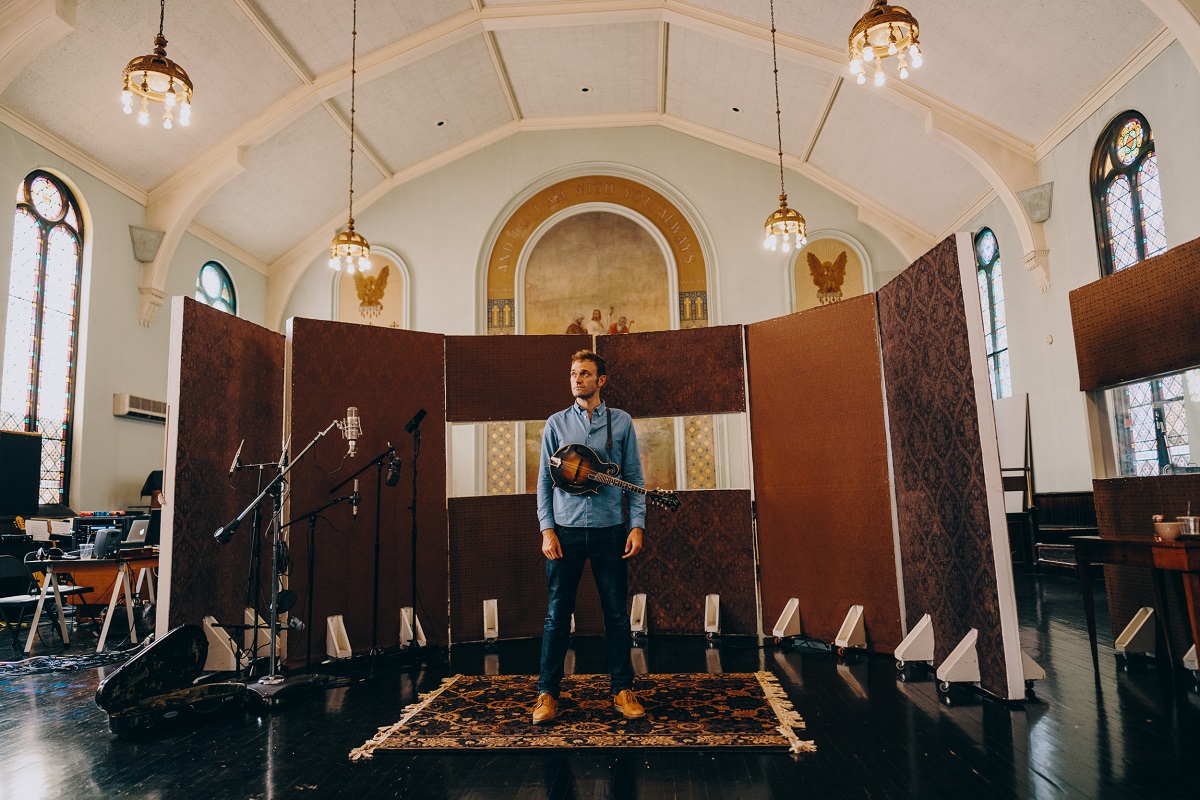
Thile: That was such a stroke of luck in a time that felt like it was a little thin on luck overall. [Laughs] We were weathering the earlier stages of the pandemic in Hudson, New York, and someone told me about a church right in the middle of town that had been converted into a studio. I went and checked it out and played a few notes in there and absolutely loved it. It’s not the most awe-inspiring church, but there were stain-glassed windows and very odd paintings that all brought me right back to my childhood.

I never attended a grand, elegant church growing up. This was still a beautiful church, but it was helpful that it wasn’t, y’know, St. Patrick’s in downtown New York — that it had a whole lot of that whole human-beings-just-trying-to-do-the-best-with-what-they-have kind of a vibe. Getting to be there was really helpful in terms of getting into character for the songs that I was recording. So much of the record comes from solitude… Actually, the solitude of the pandemic felt a lot like the solitude of spending one’s adolescence in a church pew.

What do you mean by that?

I spent so much of my adolescent time in church wondering if I was the only person there who was doubting the existence of God, or who couldn’t not think about how attractive the girl two pews over was. “Wait, I’m going to hell now probably, right?” Or, “Wait, is there hell? What is going on?” The pandemic thrust me and a lot of other people that I know back into that sort of lonesome, existential monologue: “Has every single choice I’ve made up to this point been wrong, perhaps?”

The sort of strange dialogue that we have with ourselves late at night started reminding me of those weird dialogues I would have with myself in church. I could well imagine at 16 years old sitting in this pew at Christian Community Church in Kentucky. I could well imagine there was a little angel and devil on my shoulder kind of duking it out. The centerpiece of the record, “Salt (in the Wounds) of the Earth” is very much a grown-up version of that feeling—but you know, also, how grown-up, really? I’m 40 now, and so much of the time, this felt like a rebirth right back into adolescence, smack in the middle of the most awkward period of our lives.

I loved being in that church for all those reasons. It was so easy to put myself in the headspace I was in when I had written the lyrics or when I discovered the power of those songs that I didn’t write that are on the record. It just lent a certain weight to those performances.

Why did it feel like the right time to approach religion specifically here? Was there anything you felt you had to tread carefully around?

If there’s a silver lining of this whole incredibly disorienting and distressing affair, it’s the chance to gain a little context: to have been forced to take a massive step back and to take a look at our lives, whether we wanted to or not. One of the things I saw, in the midst of missing the community that I’d inserted myself into, was that community often ends up acting in ways that are similar to my experience of organized religion.

How so?

A lot of people who grow up with religion and veer away from it at a certain point are veering away from what they — what we — perceive to be a poisonous exclusivity, or habitual exclusionism. I think that’s one of the main turn-offs for my generation on organized religion. You start meeting people who aren’t welcome in the flock, and you start wondering why. Having taken a step back, I see the same kind of exclusionary behavior in my current community. If you take a look at your own community, it’s probably full of people who think a lot like you do, and who feel very similar to the way that you do about whatever’s going on right now, and who live in a very similar way. I worry that we, as human beings, are trading one messed-up thing for another messed-up thing.

I adore community. I love it so, so much. For instance, the Telluride Bluegrass Festival: I feel like those are the high holy days of my acoustic music-making community, and to be deprived of them is so painful. You feel cast adrift, untethered. I can’t wait to get back and I’ll never take that for granted again. But I also want to go back there with my eyes wide open as to whom I have habitually not welcomed into that community. What barriers am I being a part of unknowingly placing between people and that community that I love so much? And what harm is that doing that community?

Tell me about how that harm appears on the record.

There’s a lot in the record about coming together, but there’s also a lot in the record about our compulsive need to compare ourselves favorably to other people. In an effort to feel better about ourselves, we look for someone to feel better than. That’s what “Salt (in the Wounds) of the Earth” is about. I took a look at this thing that had been a big deal for me in my adolescence, The Screwtape Letters by C.S. Lewis, and I was wondering: What would those demons be up to with me, right now? They would be preying on this compulsive desire to feel good about myself. One of the easiest, dirtiest ways to feel better about yourself is by looking at someone else and going, “Well, I’m better than that guy.”

In “Laysong,” the lyrics mention “drown[ing] out the enemy.” It made me wonder what it is that you consider the enemy — maybe it’s this comparison trap, maybe not — and how you drown it out.

When I wrote that lyric, the enemy was he or they that would talk loudest regardless of whether they had the best idea. “I’m gonna say whatever I have to say louder than anyone is saying anything else, and therefore it will be all that’s heard, and the discussion will be on my terms.” That felt like the enemy. And at that moment, in that lyric, I had to write it. It fit with the shape of the melody. The idea of drowning out the enemy — I couldn’t shake it, even though it’s not what I believe to be right. [Laughs] Hopefully you can get a sense of that in the performance, that it’s coming from an angry and not altogether balanced place. In that moment, I was pursuing the idea of drowning out the enemy with beauty, with restructuring, with anything, really. Let’s get a love song, let’s get a hard-times song, anything but a song about the front page of the newspaper.

The record starts there and ends with the Hazel Dickens song, “Won’t you come and sing for me.” When I get back into the concert hall, there’s no way I’m not ending my solo set with that song, the performance is going to be sincere—especially at the end of all this solitary music-making. [Laughs] But “Laysong” is very much like an altar call for the record. “Here’s what we’re gonna discuss.” Who knows where we’re gonna come out? I know that when I listen to a record, there’s a collaboration that starts there. I would love to imagine that happens when people listen to my records, too—that it starts a conversation. I can’t wait to feel that in the concert hall. No piece of music is done until you [the audience] hear it. And I am so dearly looking forward to that completion of this little bit of work.

Editor’s Note: Read the second half of the BGS Artist of the Month interview with Chris Thile.


Photos: Josh Goleman

Artist of the Month: Chris Thile

Chris Thile found solace during the pandemic in a church — more specifically, a remodeled one that now houses Future-Past recording studio in Hudson, New York, where he and his family were temporarily living in the summer of 2020. “I went in there to look at the space and instantly felt so at home,” Thile said upon announcing his new album, Laysongs. “I loved the amount of sound around the sound. I had two sonic collaborators on this record: the tremendous engineer Jody Elff and that church.”

With a suggestion from Nonesuch Records’ Chairman Emeritus Bob Hurwitz to make a record that was both spiritual and a snapshot of the pandemic, Thile decided to pursue the idea, putting together six originals and three covers with only his voice and his mandolin. In April, he introduced the project with the lead single, “Laysong.” As he noted, “It is a lifelong obsession of mine, even post-Christianity, what the impact of that kind of devotion to any organized religion is.”

Laysongs offers the three-part “Salt (in the Wounds) of the Earth,” which was inspired by C.S. Lewis’s The Screwtape Letters; a song Thile wrote about Dionysus; a performance of the fourth movement of Béla Bartók’s Sonata for Solo Violin; “God Is Alive, Magic Is Afoot” based on Buffy Sainte-Marie’s adaptation of a Leonard Cohen poem; a cover of bluegrass legend Hazel Dickens’ “Won’t You Come and Sing for Me;” and an original instrumental loosely modeled after the Prelude from J.S. Bach’s Partita for Solo Violin in E Major. Thile’s wife, actor Claire Coffee, serves as co-producer.

It’s the latest creative endeavor from the MacArthur Fellow, whose exceptional career spans far beyond his solo work. From Nickel Creek and Punch Brothers to a pair of Goat Rodeo albums and the much-missed Live From Here series, Thile remains one of acoustic music’s most visible figures. You can read part one of our Artist of the Month interview here. Read part two here. Meanwhile, enjoy our BGS Essentials playlist, a tip-of-the-iceberg hint at the remarkable breadth of this masterful musician.


Photo credit: Josh Goleman