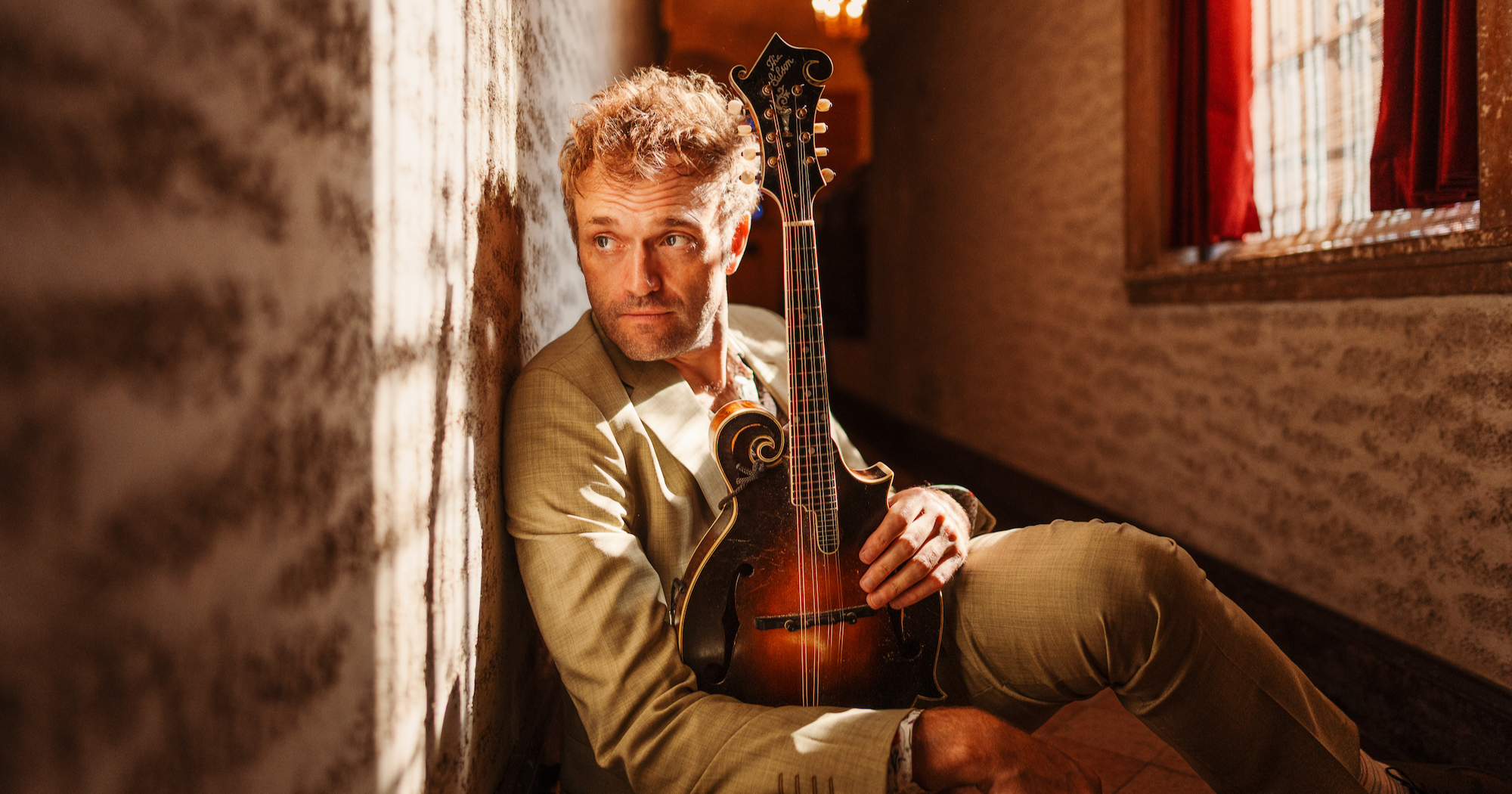
Chris Thile Infuses Himself Into Bach’s Partitas and Sonatas

How many years does it take for a musician to master the music of Johann Sebastian Bach? This isn’t the start to a joke, but the answer to the question can be a bit amusing considering that, for Chris Thile, there’s no such defined number of years or fixed amount of time.

It’s an apropos viewpoint for the GRAMMY-winning mandolinist, composer, vocalist, and collaborator to have, given that Thile is reviving a Bach-related pursuit he began more than 12 years ago. In January 2013, Thile recorded three of the six works that make up Bach’s Sonatas and Partitas for Solo Violin. That August, he released Bach: Sonatas and Partitas, Vol. 1. The logical question following the record’s release and enthusiastic public praise was, “When would volume 2 arrive?”

There’s no disputing the abundance of professional endeavors and musical collaborations that Thile dove into since then, recording with the likes of Yo-Yo Ma, Brad Mehldau, Edgar Meyer, Punch Brothers, and Nickel Creek; winning a MacArthur “Genius” Grant; hosting Live From Here; releasing other solo albums; and even creating a new musical variety show with Claire Coffee, The Energy Curfew Music Hour, which just released its second season on Audible. The extended wait has been understandable. Still, it became difficult not to wonder if Bach’s sonatas and partitas would ever see completion in Thile’s extensive and stylistically diverse discography. Thankfully, Thile renders the other half of the collection on a new solo recording, Bach: Sonatas and Partitas, Vol. 2, released November 7.

The undertaking sounds simple enough: record the remaining two partitas and one sonata. However, Thile embraces Bach’s work with a completely different aim from the first volume. Vol. 1 stayed true to Bach’s written intentions as much as possible. Now, Thile has allowed himself to consider his inner desires for what he feels the music needs – particularly where his music-making process is concerned.

The result is music that is not only pristinely performed, but also offers moments that occur naturally as Thile puts each piece together. Whether that means the ethereal decay of an individual harmonic, harnessed and expanded to ignite a particular feeling between movements I and II of Partita No. 3 in E major, or listeners’ ears traveling from one place to another as a piece blends audio from two completely different settings – like a concert hall, public park, or Blackberry Farm. Vol. 2 is an enlightening peek into Chris Thile’s mind and a bit of a walk in his shoes. In fact, he goes so far as to say that the process of learning Bach’s music is eternal, ongoing, and personal to every musician.

“It’s never done,” he says. “I think you could keep living and growing with Bach forever. But god, what a rewarding process!”

Chris Thile spoke to BGS on a call from Ann Arbor, Michigan, amid a cluster of solo tour dates. He reflects on the different ways musicians become inspired to explore Bach’s music, some of the very subtle but unrelenting dissatisfaction he encountered during the recording process, how practicing Bach is like practicing yoga, and much more:

Given the profundity you view Bach’s music as having, how did you negotiate its iconic place in music history with your desire to explore the possibilities you feel when listening to it, learning it, and making it part of yourself?

Chris Thile: I think that almost every ambitious musician’s relationship with Bach begins when someone tells them they should check it out, you know? Some of us just encounter it in the wild and have a major moment with it, but for me, my grandmas on my mom’s side – my grandma and my step-grandma – they both are excellent pianists and taught piano, performed a bunch, and both are gigantic Bach fans. When they realized their little mandolin-playing, bluegrass grandson was pretty serious about music, they were like, “Well, this boy needs to know about Bach!”

Sometimes it takes an expert to tell you that something is amazing and that you should see what’s there in it for you. And, sometimes, you’re just intrinsically aware of the thing’s value. I think mine was kind of both that helped. Having these women in my life who were so important to me tell me that this guy was really, really good helped [foster curiosity].

When [my grandma Sal] sat me down with Bach, it was with Glenn Gould’s second recording of The Goldberg Variations. She was also underlining that Gould’s performances of the music were more notable. That, I think, impressed itself on me, too; that we don’t have recordings of Bach playing Bach. So someone makes those for us or we make them for ourselves. Then it introduces this other music-making entity into the equation.

That’s a big and very long transition going from “Bach, the Almighty” to Bach, a human being whose music I am interested in having a real relationship with. And by “real relationship,” I mean a two-way, back-and-forth conversation. Yes, the text is fixed, but you can still have a living, growing relationship with it. And it takes a long time to learn how to do that. I think it’s lovely to have people giving you advice along the way.

You’ve said that practicing Bach “is like practicing yoga” and that it’s something you do everywhere you can. What does that mean for you?

Being someone who plays Bach and being someone who does yoga, I did want to figure out a way that the recording could represent that [connection] – the living, changing, growing, aspect of being someone who interacts with this music regularly. That these pieces could go from one place to another, potentially mid-movement. And then realizing that would also potentially mirror my experience of playing the pieces.

Because it’s not like I’m only playing them in my workspace. I might play them at the Elbphilharmonie in Hamburg and then a couple months later be at a Hampton Inn in Carbondale, Illinois. Or, it’s just too nice outside and I gotta practice outside today. So, multiple locations ended up serving two ends: wanting to be able to utilize the studio and [all that’s] possible when you’re recording music, to trying to figure out a way to sonically represent that life of practicing Bach.

Did you have a lot of thoughts on Bach going through your mind even while planning Season 2 of the Energy Curfew Music Hour?

Yeah! That was all happening concurrently. Every now and then, Punch Brothers would be in a practice room and I’d show my bandmates something, [asking,] “What do you think of this random thing I’m trying to do with the C major Fuga?” Just trying to get a read on people and playing a little bit of it on the side, to see if I can gauge a natural reaction to it and see if that gives me any ideas for future shenanigans. And it definitely did.

You’ve said that once you hear something in your head and enjoy it, you have to chase it until your ears tell you differently. That making peace with that aspect of your musicianship “is actually kinda the B story of this whole record.” What does it mean for you to “make peace” with this facet of your artistic spirit?

I am compelled to make this music. I don’t always understand the nuts and bolts of why I think it’s important to do it. First and foremost, I love the music. I love hearing other people play it. I love it on the page, I love the physical sensation of playing it, and I love the sound of me playing it.

But then, as is my custom, I’m voice memo-ing myself playing [the sonatas and partitas]. I heard the voice memos back and did not like how it sounded. There was something insincere about it. It was very, very strange, like something reflexive. It was almost the sensation of seeing video of me back and having some sort of physical mannerism that I was unaware of and not liking it. Or like, hearing the tone of my voice on a recording and thinking, “That’s what I sound like?” I think we’ve all had that sensation before.

So it was really disorienting and vexing, my perception of what was happening: the music that was actually being made was so off and somehow struck me as inauthentic and non-additive – and like regurgitation. So I had to do something.

The thought struck me, “I’m not ready to make this record.” The way I approach making music has changed over the last 12 years. I went back into this music thinking that my methods from when I was 31-32 were gonna be great and yield a good result. I just like to get my hands dirtier these days. The musician that I am takes everything down to the studs and blends it with everything else that’s swirling around in my musical life. That’s what I do. That’s how I make music. It’s how I write music and it’s how I approach performing any other music besides Bach. I think my reverence and awe that I hold [Bach’s] work in was preventing me from actually engaging with the music the way that I do with every other piece of music in my life.

It was scary for me, because I’m not any less reverent of what Bach did. I don’t love it any less. I don’t think it needs to be different. But when it’s me playing it, it has to go through my process, like everything else does, or else it doesn’t sound sincere and doesn’t sound authentic. That was an almost painful realization to have, and to have to basically scrap an approach and build a whole new approach to working on this music. But again, it wasn’t a new approach. It was just applying everything I know about music to Bach for the first time.

What was your intention when you decided to record in different settings – New York City’s Reservoir Studios and Tomkins Square Park, Tennessee’s Blackberry Farm, and Farrell Recital Hall at Murray State University – as well as choosing to merge audio together?

The different locations thing was part of the initial impulse, in terms of turning the thing into an actual record. It was a fairly radical move – to go from just recording in a nice studio or nice hall and getting a great sound and letting that be the sound and playing the music.

There were two reasons to do it: One of them is that, increasingly, I feel if you’re going to make a record, you should utilize the studio as an instrument. You should make sure that you’re using the medium. I guess it’s not a “should.” You can utilize the medium. For me, I’ve made a lot of archival records where really it’s just, “This is what happened in the room. Enjoy!” But I’ve realized about myself that often, when I’m listening to an archival recording, I have FOMO or something. I wish I were there, because clearly this happened in a room just like this and imagine if you had been there when it happened.

Whereas, I don’t have that when I’m listening to something that’s really taking advantage of the tremendous tool that the recording studio can be. For example, a record like Radiohead’s Kid A, where it’s something that can’t happen live. If you had been there in the room, it would have been really interesting to hear them discover the sounds. But then the flight that performance takes in the hands of a great engineer, who’s been set free in terms of exercising their own creativity in the mix environment, or artists who are very hands-on during that part of the process.

Again, it’s like a performance that’s happening over the course of months, even years at times. What happens live in the room is part of it. And then what happens in the editing booth is part of it, and what happens in the mixing room is part of it. If you’re going to make a record, it’s just interesting to note the difference. You can use the studio as an instrument or it can merely be the camera with which you’re taking the snapshot of where you’re at with a piece of music at a given time. I wanted to mess around with the former on this album.

The more I listened to something like that in my head, the more I liked it. The more committed to it I became, the more I considered, “[What if I] allow myself to record these things in multiple locations and even stitch performances together from from very tangibly different environments?” Really, sort of leaning into the surrealism of it. Now you’re in a studio and now you’re in a corner of Tomkins Square Park in the East Village. If I’ve allowed myself to do something like that, then what wouldn’t I allow myself to do?

Track 10, the first movement of Partita No. 3 in E major, I. Preludio, ends with nearly 13 seconds of ominous, rising, distorted feedback that pivots right into the clean first notes of movement II. Loure. What role is that very intentional ending meant to play?

It wasn’t something I knew that I needed until I had everything quote-unquote “done.” And then it was like, these moments in this medium need a little extra something. To give the [Partita No. 3 in E Major II.] Loure this kind of psychodrama towards the end of it was important to me. And then to prepare that [piece] with that crazy delay loop, grabbing that last harmonic [in the first movement, Preludio] was also important to me. So I asked my mixing engineer, Joseph Lorge, to find something. Bless him, I love what he found. That is almost like the harbinger of what’s going to happen on the Loure. What happens during the Loure was really important to me, artistically. But then I wanted there to be some sort of trumpet call like, “Hey, look out. Something’s coming.”

What stands out as something unique about making Bach’s music more your own this time around, especially knowing this is a solo endeavor?

There’s so much in today’s society about “Be yourself!” “Follow your dreams!” I’m talking about how important it is for me to have a two-way conversation with this music and not just revere Bach to the point that I’m taking myself out of the equation as a creator.

But we are so “Me, me, me, me” now. “This is me, just deal with it.” It can be really interesting to consider, “What happens when you expose yourself to the taste of other people?” It’s ultimately going to happen anyway, but what if there’s a practical concern? Can you go through that kind of exercise? It’s one of the reasons I love being in bands. In Punch Brothers, for instance, I need [all four of my bandmates] to be as happy with the music as I am. It’s not done until then. When I make music by myself, I have to figure out ways to trick myself into considering more than just me while I’m doing it.

[However,] you do have to make sure that you’re pleasing the only ears that you actually have any control over pleasing, which are your own. That’s first and foremost. But yeah, you’re always looking for any way to give shape to the very nebulous process of creating something from nothing.

What do you think musicians and composers of today can learn from Bach’s approach to music that would bring today’s songs, performances, and practice mentality closer to the timeless, ever-insightful, and continually inspiring nature of Bach’s work?

One thing that I keep trying to learn from Bach, just as someone who does try and write music or make it all the time, is how much of his art was happening anonymously. He had his professional duties – as he was a court composer and then he was a church composer – so there were those things, where he was writing music for very definite purposes with very definite deadlines. A ton of it was really theoretical and him working on the craft without any promise of getting a reaction out of his fellow humans – really his own curiosity and work ethic and desire to know and discover.

So I’m constantly thinking about, “Are people going to like this? Is it going to help me grow my audience? Is it going to help me make rent? Pay the mortgage?” Of course, [Bach] had those kinds of concerns. I think human beings in the early 1700s were not immune to ego. It’s not like Bach didn’t care what people thought of him – I’m sure he did. But I’m also sure that [thought process] took a very different form in those days and I think being able to make music – just for the love of it and with the patience that it takes to really explore your materials – is a thing that I at least keep trying to learn from Bach.


Photo Credit: Josh Goleman
Fiddles In Conversation: Brittany Haas & Lena Jonsson on Their New Album, ‘The Snake’

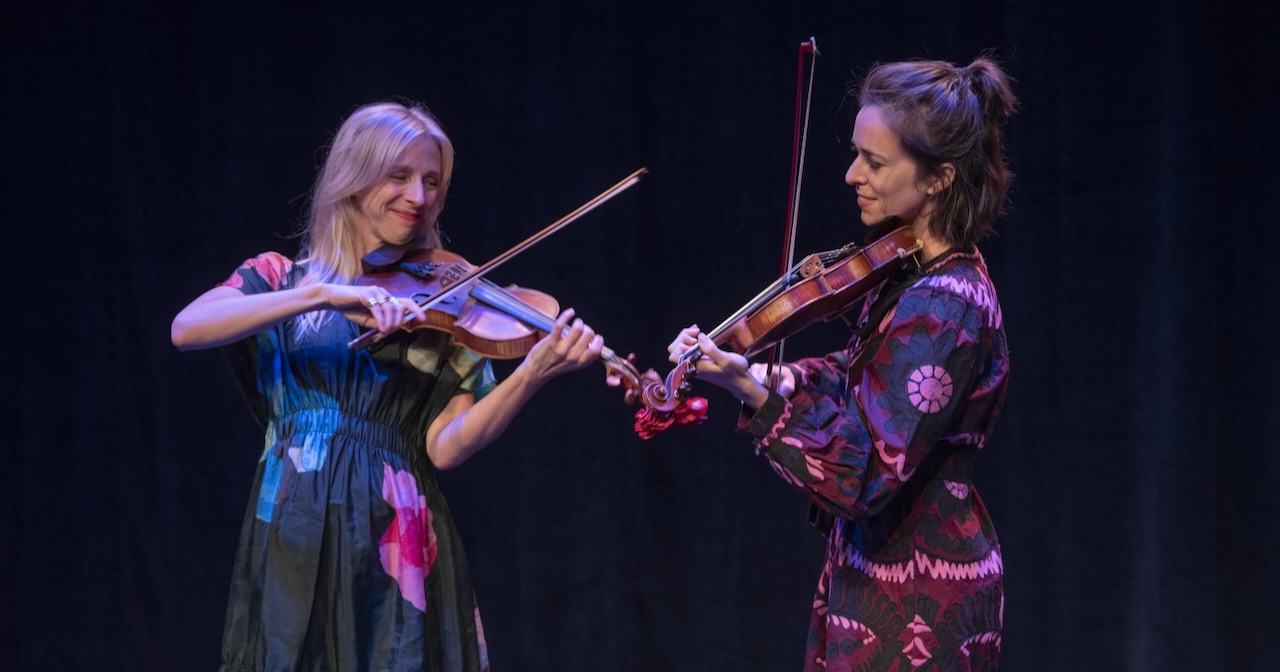
Behold, fiddle nerds! There is a new foundational collection of tunes to sink your teeth into, from two of the foremost fiddle players in Swedish and American traditions. Brittany Haas (Nashville) and Lena Jonsson (Stockholm), are award winning instrumentalists and have been long time collaborators and friends. The duo recently released their second recording together, and their first in nearly 10 years. The Snake explores old-time and Swedish fiddle traditions with finesse and subtlety, but is even more ambitious in scope than their first, self-titled record.

As part of the new collection, Jonsson and Haas composed a three-part suite for two fiddles, made up of entirely original material, but inspired by the format and musical stylings of J.S. Bach. Over a video call between Nashville, New York, and Sweden, we discussed how to stay inspired on the fiddle, what guides their accompaniment choices, and what records folks should start with if they want to learn more about Swedish fiddle and folk music.

We’ve put together a playlist of their recommendations at the bottom of this piece.

Okay, this is a weird place to start, but I noticed a distinct lack of chopping on this album. Was that intentional? I mean as someone who played in a two fiddle format a lot, you only have so many options for how to arrange. Were you like, “WE WILL NOT CHOP” on this record?

Brittany Haas: [Laughs] Honestly, I didn’t even think about it! But you’re right, I think maybe there’s just a little bit of chop on “10 Days of Isolation?” And maybe, Lena, did you chop on “Fiddle Claw?”

Lena Jonsson: I mean, maybe I kind of chopped! I can’t really chop. I think part of it is that for Swedish tunes, chopping doesn’t feel as natural. It isn’t really in the tradition, so it wouldn’t be a “go to” choice. It would more be an option if you wanted to do something really different sounding.

BH: Yeah, in Swedish fiddle music, the most common way that fiddles play together is in harmony, but the harmonies are way more diverse than in American traditions. The Swedish harmonies are all over the place, you call it second voice I think.

Totally. And considering that the options are so open ended for harmony, how do you decide where to go with it?

BH: I think I’ve just heard it done a lot, and often the second voices will be lower, being more fluid with direction and rhythm. So when I’m playing with Lena, she will play under me, and then I don’t want to do the exactly same thing, so I might try and play something above her to explore and change it up.

LJ: The harmony above is really unusual in Swedish music, but now that I’ve heard Brit do it so much, I’ve started to do it and it sounds really cool, I love it!

BH: Because we’re just the two of us and because we are coming out of a heavily Swedish tradition on this record, the harmony is not so chordally rooted, it’s much more based on the melody and the implied chords can change completely from repeat to repeat.

That’s super interesting! So in Swedish music, what would the main chordal instruments be?

LJ: The chordal instrument would be guitar, accordion, cittern, or mandolin, an example is the band Dreamers’ Circus. But also, it’s a relatively new idea to play backup chords for fiddle tunes, so folks are always experimenting with how to do back up, but finding interesting ways to play it is always cool. For some tunes, it’s just really hard to define what are the chords are, especially with the the older tunes, the melody can be really open. So when you’re in a jam it can be very confusing, chordal instruments could be playing all completely different chords over the same tune. [Laughs]

Would it be fair to say that the Swedish tradition is very centered around the fiddle, and everything else is auxiliary?

LJ: Yes, I would say so.

You both have done a lot of playing in the old-time and Swedish traditions. In melding these two styles, I’m curious how you find a groove together? To me, these styles can traditionally land quite differently rhythmically, but it seems to be seamless between the two of you?

BH: My sense of that is that it happens pretty naturally and I think that the reason why we’re here, playing together, is because we naturally line up together on a groove.

LJ: I agree, I think that’s interesting too, to not be so decision oriented, to not say, “This tune should be traditionally this way,” or “That tune should be traditionally that way.” It’s more interesting to find the meeting of the two genres as it happens naturally.

BH: Over the years of knowing each other and playing together, we’ve probably come together groove-wise by teaching each other tunes, etc.

Of course, that makes sense. You’re learning each other’s groove within the tunes you’re learning from one another.

I wanted to ask you, there’s a really interesting series on the record called “Låt efter Back,” which is a three part composition, divided into Vals, Visa, and Polska, Can you tell me about it?

LJ: Yes! Well, I went to Nashville in March a few years ago to just visit and play tunes in Britt’s house, we didn’t have a plan to make an album. We started jamming and playing and writing typical tunes that we would write. But then, we decided to have a challenge, to write something in the style of Bach – and we wanted to write it in two fiddle parts at the same time, kind of inspired by the Bach double, so that the two parts are equal voice. It was fun but so hard, I mean much harder than the writing of a typical fiddle tune.

So, in writing this, were you through-composing it? Or were you creating a basic structure and then improvising around it.

BH: Somewhere in between, I think. I mean, sometimes we were improvising the harmony, but then that became how it went.

LJ: Yeah, because there’s long notes in the melody. You wouldn’t have those long notes in a regular fiddle tune, and it left room for another melody to come from the other part. I remember having the sheet music out, we were writing it out in front of us, and then moving things around, taking sections from here and there.

In using Bach as an inspiration, did you take any actual melodies from his work or were you just using stylistic inspiration?

BH: More the style, but we did examine it closely. Like checking out, “Where would he typically repeat a section? When do you move on from one idea?” So we were referencing it a lot.

LJ: Also, we looked at how the movements relate to each other – one fast, one slow, one medium – but we wrote it as a mix of that influence and our own, so that it would still have a part of fiddle music in it. I remember when we were on tour, there was a lady in Norwich who was a Baroque musician, and she thought it was inspiring to hear a Bach-influenced piece being played like dance music.

Yes, it’s like bringing “historical performance” full circle into the living tradition of fiddle music, which is in a way also historical performance.

Speaking of historical, it’s been some years since you two last recorded an album together. What inspired you to make this recording now?

BH: Well, we had both been doing different work for a while. I’m mainly in collaborative settings and not necessarily writing a bunch of music on my own, so it’s helpful to have someone who is really good at being creative to show up and bring me into that space. It’s really fun and I think easier than a lot of co-writing settings I’ve been in. This one is very fun and explorative.

LJ: This record was also easier, because there wasn’t a clear plan, like “We are gonna make an album.” It was kind of like, “Let’s see what happens.” I think that also opens up the creative space, because you don’t have pressure. You just want to find music that’s good and fun to play, and sounds nice. I think a lot of the time in the writing process, if it feels good to play, if it feels good on the instrument, then that’s a good indication that it’s a successful composition.

You two have both been playing fiddle music for a long time now. And as someone who struggles in my own relationship to the instrument, I’m curious how you stay inspired by the fiddle?

LJ: I’m super inspired by Brittany’s playing and in playing with her I learn so much and become a better fiddle player, so that’s a great way to stay inspired – and also a reason to do this project.

BH: I feel the same about Lena, I do think that seeing what someone else is doing is kind of the best resource for inspiration. Like, “Oh, there’s someone else doing it different than me, but it’s really cool, how does that work?”

LJ: Also, Instagram can actually be a source of inspiration, just checking out what everyone is playing and also listening to other styles of music, like classical music. Sometimes I work on a classical piece that’s really hard just to challenge myself. I don’t perform classical music, so it’s kind of disconnected from work and I don’t have to feel that I’m gonna perform it. It’s just there for me to grow and take inspiration from.

Here in the states, I think I understand where the fiddle as an instrument and fiddle music falls in the popular psyche. Of course there’s the nerds like me who go to fiddle camp, and the festivals like Clifftop that have their own entire subculture, but the general public also knows what fiddle music is as something that happens at barn dances or square dances and in their favorite country songs. They know of Charlie Daniels, and Oh Brother, Where Art Thou? And the fiddle licks in “Wagon Wheel” or Dave Matthews Band. I’m curious what relationship fiddle music has to pop culture in Sweden?

LJ: That’s a really interesting question. It’s definitely a sub-culture, but people know primarily of the fiddle players and dancers at Midsommar celebration, so everyone knows about that. But a lot of people don’t know that there are fiddle festivals and Swedish folk music, unless you’re from an area where there are fiddlers and more of a strong tradition. But there are some artists that break through a little bit, like Sara Parkman, who is a pop artist but will play a fiddle tune in the middle of her set.

But, at school for example, being a fiddle player is not “cool?”

LJ: [Laughs] definitely not. I mean some people come to school a little early just so they can hide their fiddle case away so nobody will see!

Well that feels pretty universal! Thank you both so much for your time and this wonderful album!


Photo Credit: Douglas Robertson

Chris Thile Takes Us to Church in Official Music Video for “Laysong”

For a musician who has seemingly done it all and has the awards to prove it, Chris Thile found an excellent opportunity to create a solo record in the throes of the early pandemic. The project of that period of introspection and seclusion is one that has been, in some ways, a long time in the making, as his label Nonesuch had been hinting for some time to make an album centered around faith and spirituality. When the circumstance arose, Thile decided it should be done in as honest and straightforward a manner as possible: performed entirely by himself and recorded within the walls of a beautiful old church in upstate New York.

Titled Laysongs, the album offers a host of incredible performances, including compelling arrangements of Bartok and Bach, re-imaginings of traditional folk tunes, and original pieces inspired by literature. Enjoy this video of Chris Thile, our BGS Artist of the Month for June, performing the album’s title track in the church where it was recorded. And, check out Part 1 and Part 2 of our exclusive, AOTM interview.


Photo credit: Josh Goleman

Artist of the Month: Chris Thile

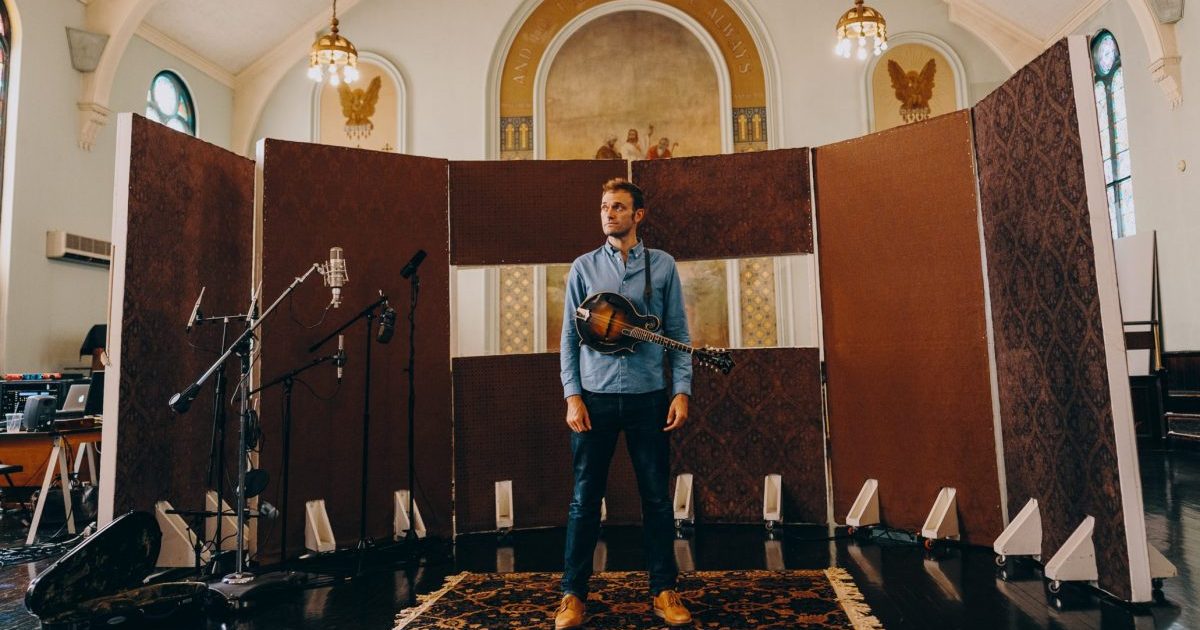
Chris Thile found solace during the pandemic in a church — more specifically, a remodeled one that now houses Future-Past recording studio in Hudson, New York, where he and his family were temporarily living in the summer of 2020. “I went in there to look at the space and instantly felt so at home,” Thile said upon announcing his new album, Laysongs. “I loved the amount of sound around the sound. I had two sonic collaborators on this record: the tremendous engineer Jody Elff and that church.”

With a suggestion from Nonesuch Records’ Chairman Emeritus Bob Hurwitz to make a record that was both spiritual and a snapshot of the pandemic, Thile decided to pursue the idea, putting together six originals and three covers with only his voice and his mandolin. In April, he introduced the project with the lead single, “Laysong.” As he noted, “It is a lifelong obsession of mine, even post-Christianity, what the impact of that kind of devotion to any organized religion is.”

Laysongs offers the three-part “Salt (in the Wounds) of the Earth,” which was inspired by C.S. Lewis’s The Screwtape Letters; a song Thile wrote about Dionysus; a performance of the fourth movement of Béla Bartók’s Sonata for Solo Violin; “God Is Alive, Magic Is Afoot” based on Buffy Sainte-Marie’s adaptation of a Leonard Cohen poem; a cover of bluegrass legend Hazel Dickens’ “Won’t You Come and Sing for Me;” and an original instrumental loosely modeled after the Prelude from J.S. Bach’s Partita for Solo Violin in E Major. Thile’s wife, actor Claire Coffee, serves as co-producer.

It’s the latest creative endeavor from the MacArthur Fellow, whose exceptional career spans far beyond his solo work. From Nickel Creek and Punch Brothers to a pair of Goat Rodeo albums and the much-missed Live From Here series, Thile remains one of acoustic music’s most visible figures. You can read part one of our Artist of the Month interview here. Read part two here. Meanwhile, enjoy our BGS Essentials playlist, a tip-of-the-iceberg hint at the remarkable breadth of this masterful musician.


Photo credit: Josh Goleman

STREAM: Christopher Jones, ‘Bach: The Goldberg Variations’

Artist: Christopher Jones
Hometown: Morgantown, West Virginia
Album: Bach: The Goldberg Variations
Release Date: May 7, 2021

Editor’s Note: Christopher Jones is director of the Appalachian Music Ensemble, a performing group at West Virginia Wesleyan College. He got his start, however, in the classical world. He holds a bachelor’s degree in cello performance, and a master’s and doctorate degree in music composition from West Virginia University. For his newest project, he has reworked Bach’s iconic Goldberg Variations for mandolin, banjo, and guitar.

In Their Words: “This project is something that I had thought about for a long time. Not necessarily that I wanted to record it myself, but that it was something that I really wanted to hear. When everything shut down last year and the world was upended, I made a split-screen video of the ninth variation, and then the second, and realized I might as well do a studio recording of the entire thing. I think I turned to this piece as something that had that satisfying and comforting sense of order and normalcy, even though the scope of the whole thing can feel chaotic. Each variation is an exercise in perspective, begging the question of ‘How many different ways can I look at the same problem?’ It was a lens to try and make sense of things.” — Christopher Jones


Photo credit: Lauren Smith

As ‘Goat Rodeo’ Returns, Edgar Meyer Makes Every Three-Note Chord Count

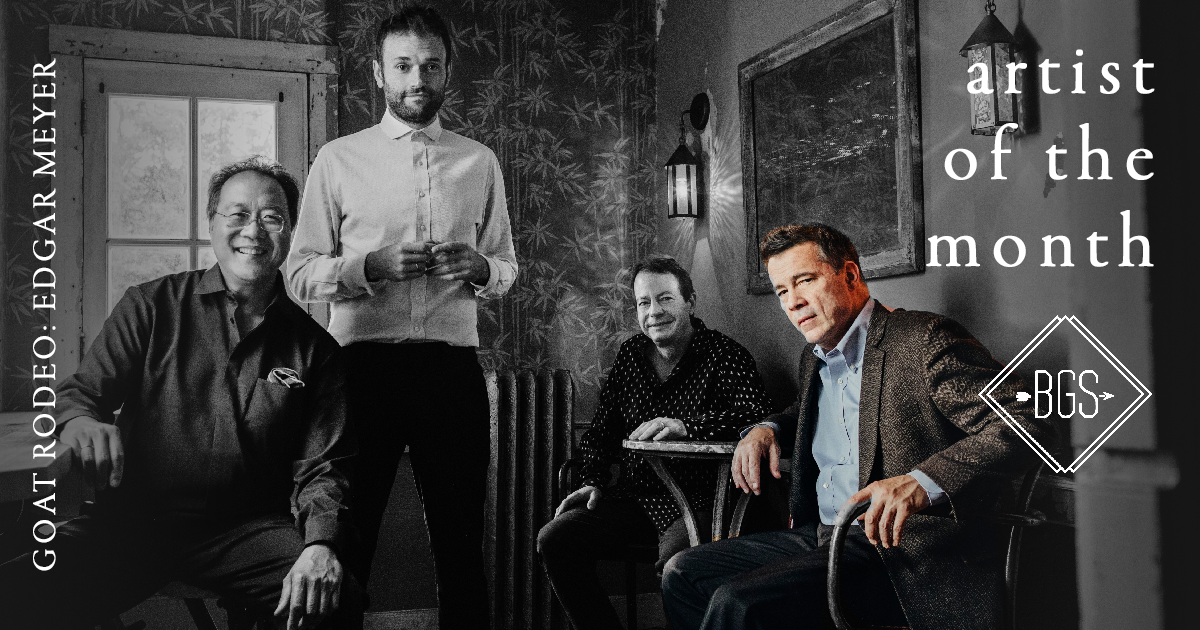
Lucky is how Edgar Meyer says he feels that he and his Goat Rodeo collaborators — Yo-Yo Ma, Chris Thile, and Stuart Duncan — were able to get together for the ensemble’s second album, Not Our First Goat Rodeo. They weren’t so lucky, however, when it came to their tour, which was supposed to start in August. “That’s not going to happen right now,” he tells BGS, adding, “We were looking forward to cherry-pick from both records.”

Along with their 2011 debut, which won two Grammy Awards, the Goat Rodeo albums represent two of the many high points in Meyers’ illustrious career. Renowned for his artistry on the double bass as well as for his compositional skills, the award-winning musician has been honored with a MacArthur Fellowship and the Avery Fisher Prize — the only bassist to have won either. Meyer also might be the man most responsible for Goat Rodeo’s existence. Having collaborated with both Ma and Thile, he introduced them to each other; later he and Thile recommended Duncan to Ma as the one to round out their quartet.

This Artist of the Month interview is the second of four installments as BGS salutes the incredible and iconic musicians of Not Our First Goat Rodeo.

BGS: Was there less preparation time for Not Our First Goat Rodeo than for the first album?

Meyer: I’d say in terms of learning how to play the parts, yes. But Stuart, Chris, and I spent 20 days together writing and that’s very similar to the first one. That’s probably more important than learning how to play it. We were not particularly well rehearsed or knew the music when we [all] got together, but the important part — which is the writing — had about the same amount of effort.

How was it building these pieces together?

It’s a joy. It is a unique endeavor and we were able to go somewhere we probably wouldn’t go with another set of people.

And did songs evolve a lot once you all got into the studio?

Not much in terms of the actual notes. Maybe the feeling of it — that would evolve some. Occasionally, there might be a kind of loosely mandolin/bass improvised area that became more consistent in what it is. But there’s not a lot of that. Actually [the] music did not change immensely while recording, except in terms of it gelling. And in terms of people really understanding everyone else’s and their own roles, and making it into a whole.

All four of you had more familiarity playing with each other this time. Did that make it easier for everyone to gel?

Overall, yes. It’s tricky in that we attempted to try to find things that were wholly different from the first one. I wouldn’t say that we entirely succeeded in that, but I don’t think we were disappointed either. We just felt obligated to try and find brand new places to go. At the end of the day, it still sounds exactly like that same set of people — and I don’t think we were able to deeply change it. I think it is nine years later and I think we are all a little bit different. It is a different record, but very recognizable from the first one.

Were there musical territories that you all were specifically interested for this album?

For each piece we do, there’s always something that we are trying to explore that is new in some way for one or all of us — that’s almost a baseline. An esoteric example would be… I relate to harmony most centrally as a three-voice thing. For me if there’s more than three voices usually, no matter what the type of counterpoint is, most of these things are not going to track all four at the same time. But it is possible with good three-part writing to have the listener track all three voices almost all the time. That’s just what I find. Obviously somebody with enough skills will try to turn that on its head.

Depending on which way you count, there are either 19 possible three-note chords or there are 12. The modern music guys like to say 12, but their way of counting says that the major chord is the same thing as a minor chord. So, I prefer to count 19 and make those redundancies separate chords.

So, for “Not for Lack of Trying,” we experimented; there’s a chorale that it’s kind of built around — a three-part chorale. It has a repeated phrase. I think we tried to get one of each kind of chord. And maybe it’s a 24-note chorale [because] the last five chords are the ones that were used in the beginning. But there’s at least one of each of the 19 kinds of three-note chords in that chorale. That’s not something we did on the first record.

But there’s always some kind of something that somebody or all of us are trying to explore. And it’s not going to usually be something like, “Oh, we wanted to see if we could mix some bluegrass with some Caribbean music.” It’s going to be much more melodies, rhythms, harmonies — very specific musical questions.

What was your reaction listening to how Not Our First Goat Rodeo came together as a completed album?

I think mainly good… it’s a little more even than the first one. Maybe it doesn’t have some of the crazy highs, but it is a little more consistent. It’s more like somebody’s doing it for the second time.

This time everyone was a little more consistent with what instruments they played. Was that a conscious choice?

It’s just how it went down. The truth is on that count we were trying to emulate the first record. I probably like the variety of the first one slightly more. What we knew before we started the project was that an instrumentation of mandolin, violin, cello, and bass is not a very good instrumentation, and we knew the three of us would have to switch instruments in order to make the textures really work. Then when we are all on our main instruments, you can hear the comfort. You can hear all of us doing what we do best, but if you had to listen to those four instruments for a whole recording it wouldn’t work as well.

Song titles on both Goat Rodeo albums are very fun, like “Waltz Whitman.” Does one person tend to come up with the titles or are they batted around and one title rises to the top?

Chris and I had a session on the phone for about a half an hour the day before we turned in the album. “Waltz Whitman” was Chris’s, and he didn’t like it when he said it. I liked it a lot and made him stay with it. And, of course, he likes it now.

A lot of projects that Chris and I’ve done, and that I have done in general probably, have a lot of titles with useless meanings that the listener will never know about. Because we don’t put a lot of stock in titles. And so we could slap almost anything on there. This one actually didn’t have anything that we wouldn’t be afraid to have on the front page of the paper. There’s no hidden stories behind these titles. That’s unusual. Maybe it’s a new trend for me.

What is one recording that ranks as a G.O.A.T. (greatest of all time) for you?

It’s a tough one because I will start by rejecting the question. What has had bigger impressions on me are particular pieces of music, and not particular recordings of them. The set of my favorite Beethoven, Bach, and Mozart pieces have had a bigger influence on me than single recordings have. My primary method of browsing in my formative years was less recordings than sitting at the piano and going through those composers’ scores. Although my list of influences is broad, at the top of it is Beethoven, Bach, and Mozart, and my primary way of knowing them is not through recordings.

So it’s their compositions overall?

Yes, that is exactly right. And the scores themselves. Because that is what we have from them. Whereas with Stevie Wonder, the way I know him is through a recording; so that’s how I’m influenced by him. But with these classical composers, it is not through the recordings. Like I’ve said that’s the most important. It probably depends primarily on the vintage. It’s a tough one, because some people who lived during the times of recordings are not well-documented. Anyway, that’s a true answer though. That’s how it works for me. The essence of what moves me is the writing.

(Editor’s note: Read the remaining installments of our Artist of the Month interview series here.)


Photo credit: Josh Goleman

BGS 5+5: Ross Holmes

Artist: Ross Holmes
Hometown: Fort Worth, Texas
Latest album: Not Very Good at Winning
Nickname: ‘Rooster’ is a nickname that has lingered since the glory days of Cadillac Sky.

What’s your favorite memory from being on stage?

I can’t say I have one favorite memory from being onstage, but I do have a great story about a particular gig in late 2014. As a native Texan, there isn’t a more sacred shrine than the Alamo. I’d been invited to perform at an annual ceremony in March of ’14 inside the Alamo chapel. I wound up composing an original piece an hour before the event honoring those who perished in the fight.

An iPhone recording I made of the piece, “We Fall a Sacrifice,” made its way to Phil Collins (who is an avid collector of artifacts from the battle of the Alamo and war for Texas independence), and I was invited to perform this tune again at a ceremony honoring Phil for the donation of his extensive collection to the state.

We took it a step further and, with permission from the Witte Museum in San Antonio, borrowed Davy Crockett’s supposed fiddle for the gala. Here I was, onstage with Crockett’s fiddle at the Alamo, playing this piece I’d written, in the presence of presidents, politicians, astronauts, sports legends, and recognized Texans. My sister, Katie Shore (Asleep at the Wheel), joined me for the set and, to this day, we still laugh at the absurd “WTF just happened” of that evening.

What other art forms — literature, film, dance, painting, etc — inform your music?

Imagery and color stimulate my musical thinking the most. I often turn on films or pull out prints of my favorite artists to glean inspiration from their creativity while I practice. The imagination of others is revelatory and channeling the intent of these minds has helped me grow as a composer and player.

Try this sometime: turn on Planet Earth, mute your TV, and play a soundtrack for the episode as you’re watching. Let the dynamic environment of each scene take you to a place of quiet calm or intense fear. You’ll be amazed at what comes out, maybe a familiar idea you filed away will emerge again, or maybe a new melody or groove will come to you. If anything, it’s really fun to provide fiddle accompaniment to snakes chasing lizards and sloths chilling on a branch.

What rituals do you have, either in the studio or before a show?

I don’t have a set routine when I record or when I take the stage, as those environments are always changing. I do, though, have a special relationship with my case and the process of opening it and taking out my violin and bow. My case is my home-away-from-home and inside I keep a small, personal collection of memories. I find it’s a spiritual experience to unlatch and lift the lid, remove the blanket over my violin, and prepare my heart and mind to play. Those first moments are filled with thoughts and energy, like a prayer, and the respect I show my instrument feels like an abiding friendship when the first notes come so easily.

If you had to write a mission statement for your career, what would it be?

Early in my career I focused, obsessively, on being the “best” player I could be — the most technical, cleanest, impressive, etc., because I felt those skills would prove to listeners I was “elite.” Time has gone by, life has happened, victories and losses, the ups and downs that come with this profession, then something clicked a couple of years ago. I arrived at a point where I didn’t care about being the “best” anymore (thank god), and a new word replaced that selfish adjective — HONEST. I will always push the limits and challenge boundaries, but now my heart’s desire is to simply be the most honest musician I can be. That’s my mission statement, “In all things, be honest.” That’s it.

Which elements of nature do you spend the most time with and how do those impact your work?

There’s no hiding that I’m a bona fide space junkie, completely taken with the cosmos and the notion of leaving earth on the greatest adventures to explore the deep expanse of our universe (I have a tattoo of the Apollo SM, CM, and LM on my right arm). We can’t see beyond blue skies during the day, but we know endless creation is still above us. When night falls and the sky is peeled back, the heavens are once again revealed and we sit and gaze at the mysteries between the stars.

The relationship between mankind and space and music is intrinsically linked because of curiosity and our need to explore. The greatest composers and players continue to seek new heights with their melodies, chords, and expression because that is our nature, journey to the new place. What will beings find on that golden record affixed to Voyager? Bach. Chuck Berry. Blind Willie Johnson. The human voice.


Photo credit: Allen Clark

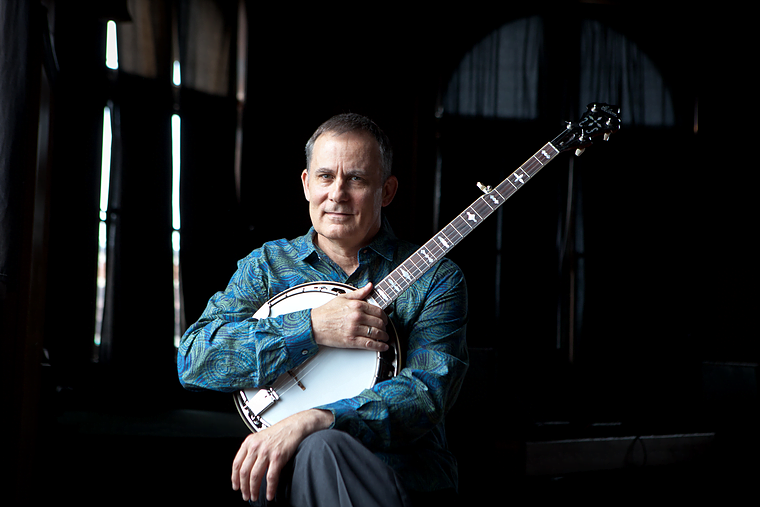
Banjo Man John Bullard Marries Southern and Baroque Influences on Latest Album

The banjo isn’t typically the first image that comes to mind when one considers classical music. For Virginia banjo player and teacher John Bullard, however, the banjo is just as suited to Mozart as it is to mountain music. Last Fall, Bullard released Classical Banjo: The Perfect Southern Art, his third full-length album of banjo interpretations of classical music. The album is an impressively rendered collection of 25 tracks, parts of which Bullard has worked decades to master. 

“[The project] came out of me having a discussion with Jayme Stone, who was the producer and is also a banjo player and has some great albums out,” Bullard says. “He asked, ‘When was the last album you did?’ And it was a long time ago. He ended up being interested in being the producer, so it ended up that we did it together.”

Stone — known for, among many other things, his 2015 Lomax Project — worked on the album with Bullard from its inception, lending a hand with recording, of course, but also with what Bullard considers to be one of the most difficult parts of his musical endeavors: exploring ways to play complex classical pieces on an instrument viewed by many to have limited capabilities. Stone and Bullard found novel approaches to counter such issues, like experimenting with various conversations of backing instruments to make certain arrangements easier to play.

“You’re trying to make the banjo do some things it doesn’t normally do, like sustain a note for a long time,” he explains. “In bluegrass, you pluck a note and it’s a 16th-note and there are a zillion more following it, and it doesn’t matter what happened with that one note so much. But in the classical stuff, sometimes you have a half-note or a whole note, and you have to figure out what you have to do to make this note last and sound okay. It’s really different.”

The pair recruited a number of skilled musicians as well as an eight-person choir to bring Bullard’s vision to life, part of which was for each of the album’s pieces to remain as loyal to their original counterparts as possible. The album also features a solo performance from Bullard, one that was truly decades in the making.

“The fugue, which is the only solo banjo piece on there, which is from Bach’s ‘Sonata No. 1’ for solo violin, is one of my favorite pieces that I’ve ever heard in my whole life,” he says.”I’ve always loved it. I’ve been working on that for, gosh, around 20 years. I initially transcribed it and figured out what key I thought I could play it in — it was written in G-minor and I do it in C-minor on the banjo. I’d done that and, two or three different times, had gotten to where I could play through it very slowly, but it was really hard and I would just say, ‘I think this is too hard,’ and I would put it down and forget about it for a year or so. Then I would pick it back up. I did that a few times. Then it was weird: When Jayme and I decided to work on this project, I picked it back up and finally I could play it. It just, all of the sudden, seemed to come to me. Maybe it needed to percolate for a few years.”

That Bullard was able to pull off playing such intricate pieces on an instrument that has long been excluded from traditional orchestras may seem like a massive stretch to some, but he doesn’t believe that the banjo is that far removed from the sounds of Baroque and Romantic music. “When I first started doing this, what really struck me is that the harpsichord and the lute, to me, sound a lot like the banjo,” he explains. “They’re in a different context, but they’re plucked instruments. So it seemed like a natural thing for me.” 

He also believes classical music has just as large a place in Southern culture as the banjo does — an idea reflected in the album’s matter-of-fact title with hopes of both deterring cultural gatekeepers and inviting new listeners into the fold. “It’s the perfect art form for Virginia gentlemen,” he says. “You’re playing this genteel music, but you’re playing it on the banjo. The banjo puts a different perspective on the standard repertoire of the classical world and lets people get a different perspective on the music. I think and I hope that it will bring some folks into the music that maybe wouldn’t take the time to listen to classical music, and they might decide they like it.”


Photo courtesy of the artist