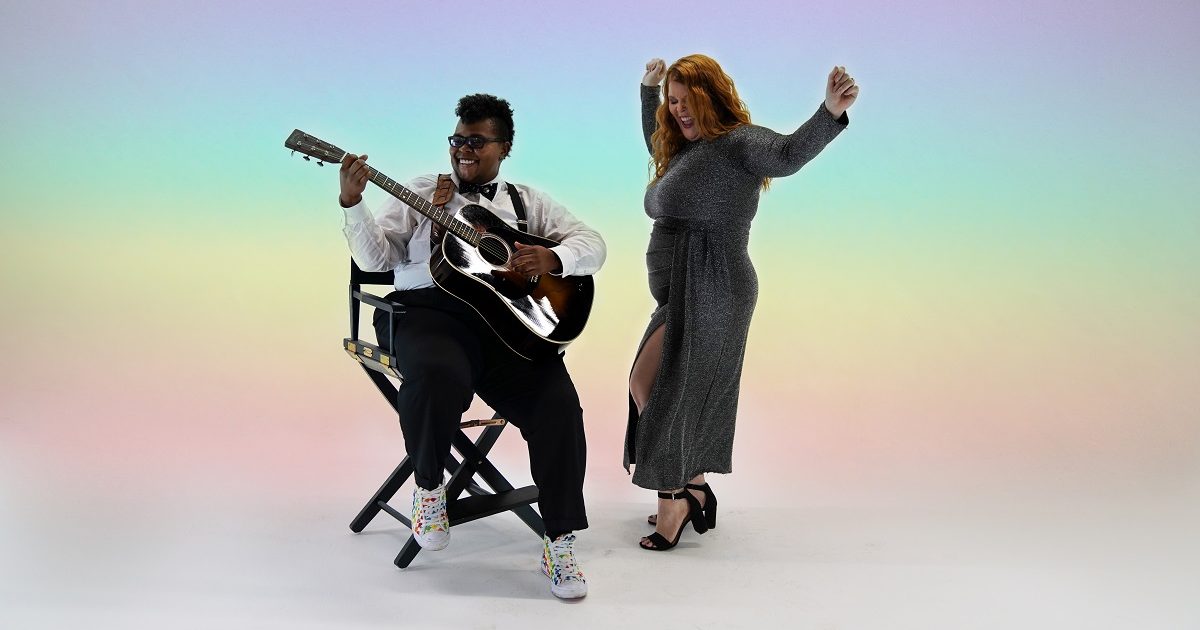
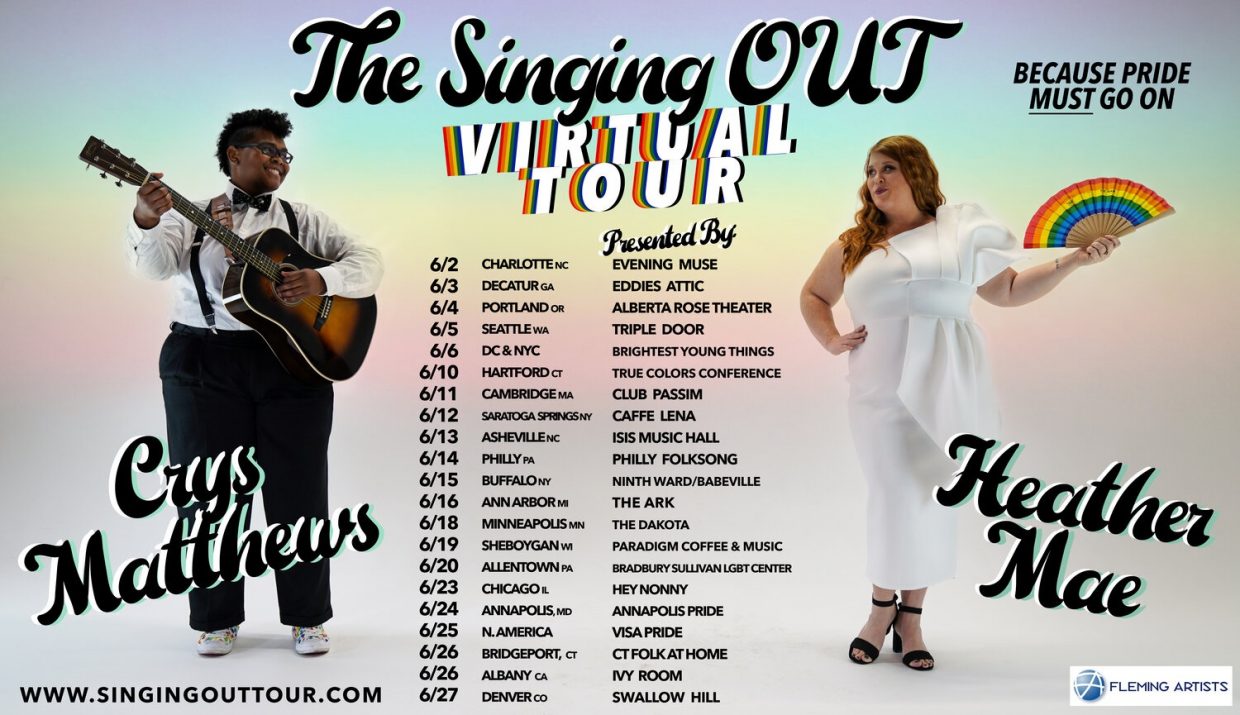
Artist:Crys Matthews & Heather Mae Single: “Six Feet Apart” Latest Project: The Singing OUT Tour, a celebration of LGBTQ+ Pride
In Their Words: “Until our love is accepted as universally as everyone else’s, LGBTQ+ love songs will, by their very existence, be protest songs. ‘Six Feet Apart’ is a snapshot of the current time: love in the time of a pandemic. It’s about actively making the choice to turn away from fear and lean in to one another. For LGBTQ+ people, Pride is a time to celebrate who we are and how we express, identify, and love. It’s a time for us to lean into our community. Right now, we aren’t able to gather in-person but we don’t cancel Pride — we adapt. This would have been our third year of the national Pride tour — Singing OUT — and when social distancing threatened to cancel all our in-person shows, we went virtual. As our song says ‘six feet apart won’t stop us,’ and it won’t stop the Singing OUT Tour either.” — Crys Matthews & Heather Mae
Out of 270 floats, companies, and queer associations, a roots music organization’s marching contingent was crowned “Best of the Best” at San Francisco’s world-famous Pride parade in 2017. And they did it on their very first try — the only organization to ever achieve such a feat. Who was that overalls-and-rainbow-glitter-clad crew of more than a hundred bluegrass fans, pickers, and professionals? Bluegrass Pride.
The Bluegrass Situation has been proud to support Bluegrass Pride since 2017, with our logo emblazoned on the inaugural float that carried three bluegrass and old-time bands down Market Street to the cheers of thousands of brand new “Foggy Mountain Breakdown” fans. In 2020, the nonprofit organization had planned its biggest Pride celebrations yet (in San Francisco; Portland, Oregon; Raleigh, North Carolina; and Nashville, Tennessee) while still welcoming the rural and non-metropolitan LGBTQ+ folks who love and make these musics, too.
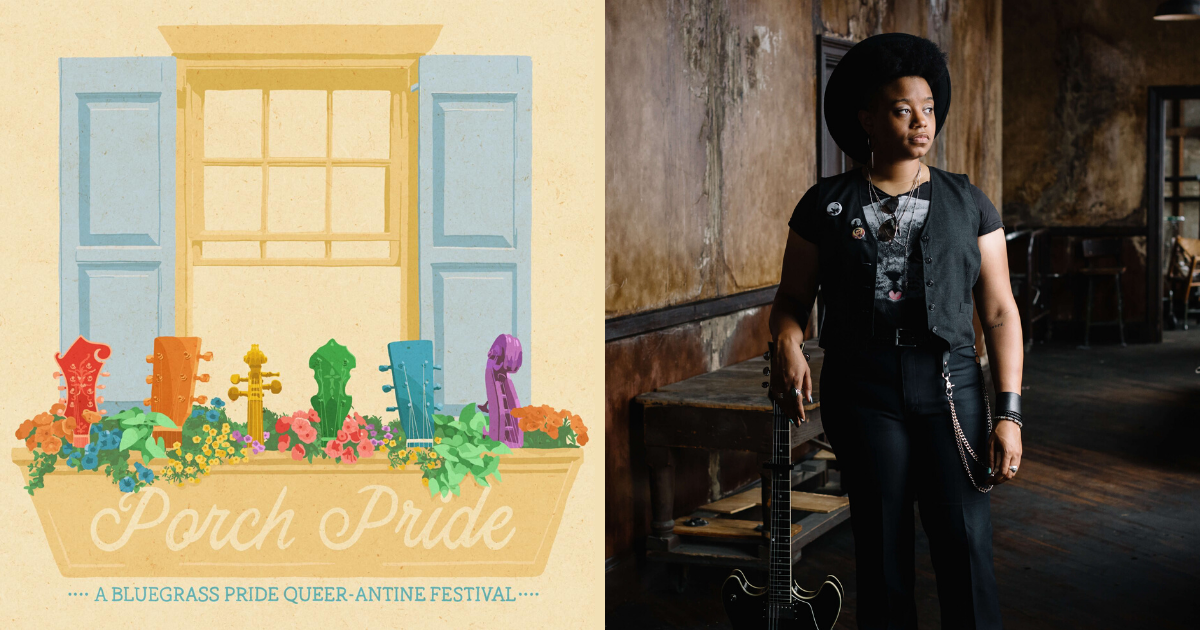
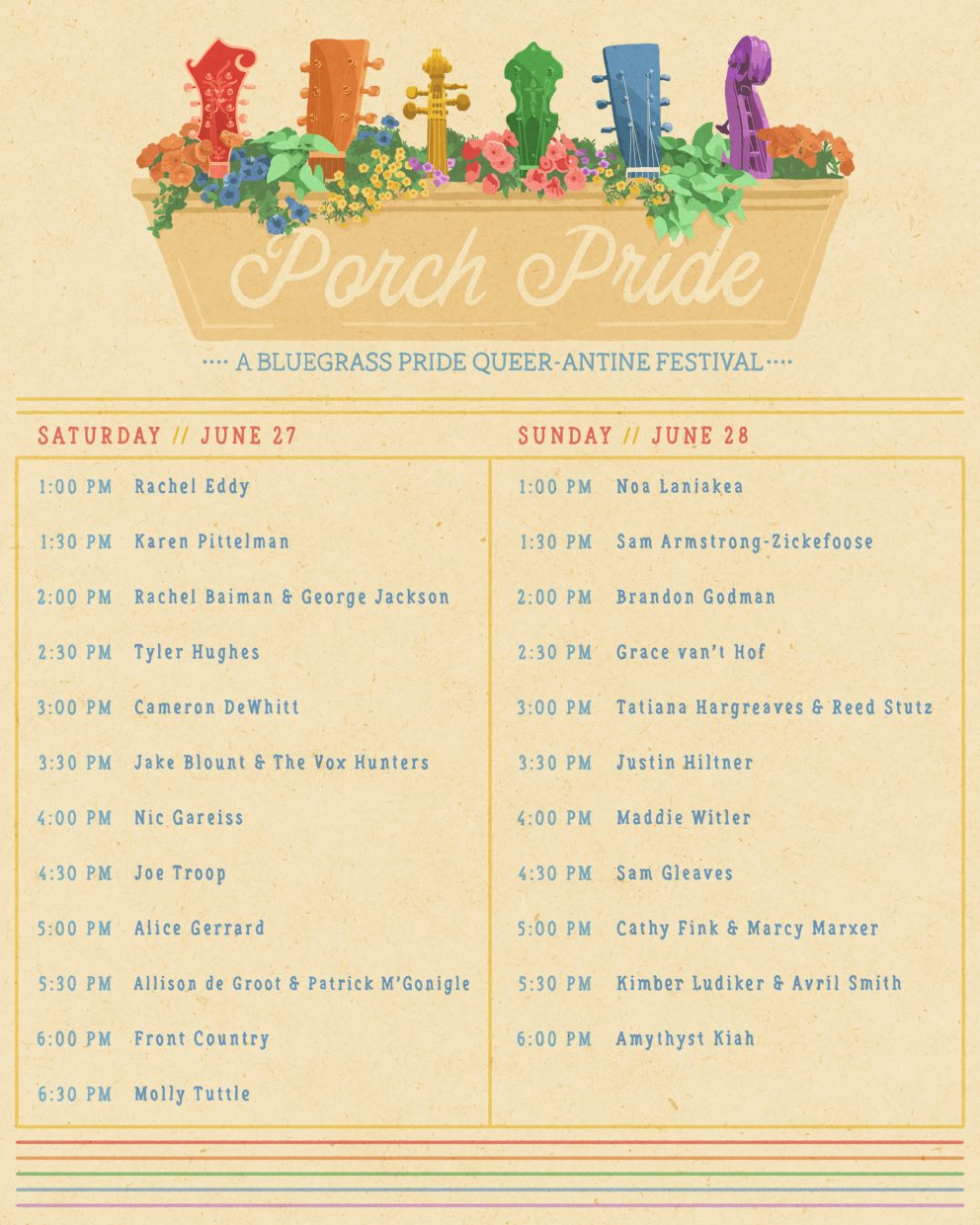
Enter our most familiar villain, COVID-19. In response, Bluegrass Pride has shifted to a new concept, Porch Pride: A Bluegrass Pride Queer-antine Festival. Featuring more than ten hours of music by queer and allied artists such as Cathy Fink & Marcy Marxer, Molly Tuttle, Sam Gleaves, Jake Blount, Rachel Baiman, and more, the livestream event will air June 27 and 28 on Bluegrass Pride’s website, YouTube channel, and Facebook and Instagram pages. Porch Pride will raise money for Bluegrass Pride and all of the musicians on the bill. Fans and followers are encouraged to donate now.
To celebrate Porch Pride with our longtime friends at Bluegrass Pride, we connected with Executive Director Kara Kundert and powerhouse singer/songwriter and the digital festival’s “headliner” Amythyst Kiah.
BGS: For those unfamiliar with Bluegrass Pride, how would you describe it?
Kara Kundert: Oh, what a big question. In a purely statutory sense, I would say that Bluegrass Pride is a nonprofit organization devoted to the advancement of LGBTQ+ people within the bluegrass, old-time, and broader roots music traditions. To get a little bit more descriptive, we work every day to make bluegrass a more welcoming place for people of all backgrounds. Our mission is to show the world that bluegrass is for everyone, so we try to create programs that serve all kinds of people who love and participate in American traditional music. We put on local beginner-friendly jams and create introductory video content to help people get involved with the community even as they’re just starting out, and we host concerts and showcases to create paid opportunities for professional musicians.
Amythyst Kiah: …Simply, my idea of what something like Bluegrass Pride represents: It is about accepting all forms of identity and expression in a style of music that is known for having a more traditional culture, and it’s also an outlet for queer people who don’t fit the stereotype of gay club culture. As iconic and important gay club culture is historically, it isn’t everyone’s experience.
How did the idea for Porch Pride come to you?
Kundert: Via the incredibly talented Jake Blount! Jake is on the Bluegrass Pride board of directors and he came to me back in March (just as everything was starting to shut down and we were holing up for quarantine) to suggest that Bluegrass Pride host a digital festival to support artists in the face of the first round of gig cancellations. He had participated in the first iteration of the Stay At Home Festival and had seen how much energy and support there were for these artists, and thought that it was a natural fit for Bluegrass Pride and our mission.
At that point in time, it was still really unclear how long and how bad the COVID pandemic was going to be — we still believed that SF Pride was going to march down Market Street in June — so I was a little nervous to take on the project. I was worried that we wouldn’t have the resources to do everything and do it well. We started discussing smaller-scale projects, like weekly concert series or short little weekend showcases, things that we would have the budget to do in addition to our regular programming.
But within a couple of weeks, it became pretty clear that our whole season was going to change dramatically, and that was when the plan shifted from being “maybe we’ll host a couple of digital concerts to keep momentum before Pride” to creating Porch Pride and really making it the center of our entire year.
People don’t tend to think of bluegrass or roots music when it comes to Pride celebrations, and obviously y’all think that needs to change! Why? What does bluegrass and string band music bring to the greater LGBTQ+ community?
Kiah: I see this event and organization as a way to formally recognize that LGBTQ+ have always been present in the communities where bluegrass and other roots-based music originated from. Historically, media has projected many ideas of what being queer looks and sounds like, and it’s high time to recognize and celebrate other ways of being and doing when it comes to music.
Kundert: I think that there’s a problem whenever people aren’t being represented. So it was a problem for bluegrass that LGBTQ+ stories and music weren’t being heard onstage. It was a problem when queer folks were being excluded from jams and from gigs just because of their identity. And it’s a problem for the LGBTQ+ community that this portion of our family isn’t being included in the conversation about what “gayness” is. We as a culture have this extremely metropolitan, white, male-centric idea of what the LGBTQ+ community is, which is what you really see on display on these corporate floats at the major cities’ Pride parades, and it leaves out so many people. There are as many ways to be queer as there are colors under the sun, and that’s something that we as a [bluegrass] community need to do more to embrace in order to support and uplift every single person in the LGBTQ+ community.
Amythyst, with your songwriting and your work with Our Native Daughters you’ve been a powerful voice, lifting up Black songs and stories. How does that perspective as a Black woman complement Bluegrass Pride for you? What do these two movements have in common, and what do they combine?
Kiah: Both movements involve recognizing and uplifting marginalized voices, due to the continued generational trauma that both have had to endure. Being Black, a woman, typically gender-nonconformant, and queer, I have experienced some form of questionable actions, treated as if I was invisible, and [received] looks of contempt by other people. I am fortunate that I haven’t experienced much worse, but that being said, I was terrified of my own shadow for years before I really started to embrace myself and be myself. So Bluegrass Pride is about recognizing that we all have value, just as Songs of Our Natives is about.
Kara, planning a Pride event can be a major undertaking. What is the reward for you, on a personal level, after putting in so many hours to prepare?
Kundert: Creating and running these events is always such an emotional rollercoaster. There’s so much anxiety and energy in the planning: Are people going to show up? Is it going to go well? Are people going to connect with it, or are they just not going to care at all? But then in the moment, you get to listen to this wonderful music by talented people, and be with a crowd of people that want to support Bluegrass Pride, and it’s euphoric. So far, I haven’t been let down by that moment of standing in a crowd and experiencing that kind of threefold-payoff of enjoying the music as an audience member, enjoying the crowd and energy as someone standing on stage, and enjoying the sheer relief of not totally fucking up as a producer.
But beyond that very selfish gratification, I also know how much these events mean to people. I know there are people who play bluegrass right now — people who are showing up at jams and forming bands and going to festivals — because Bluegrass Pride made them feel welcome and safe to be there. There are people who found Bluegrass Pride and realized that maybe they could come out after all. I know that these events — our parade float in San Francisco, our LGBTQ+ Musician Showcase in Raleigh, our beginner-friendly jams — they mean something to people. So when I get to stand in the crowd and see people’s smiles and feel people’s energy, both on- and off-stage, it makes me feel like what we’re doing matters to people. That all of the work and the hours and the stress: they add up to something bigger than just myself or my own feelings of relief and exhaustion. And that’s what keeps me going after four years of being a part of Bluegrass Pride.
What are you most looking forward to during Porch Pride?
Kundert: I know this is a cliche to say, but I’m looking forward to all of it — I put together the lineup after all! We have so many talented artists, I’m just looking forward to hearing all of their great music and seeing how people come together to celebrate Pride with us this year.
Kiah: I am looking forward to (hopefully) finding a quiet place outside to share some stories and music! If only it could be done in person, but I’ll take what I can get! Being safe [is a] top priority.
How can we all celebrate Pride “better” this year?
Kiah: I think one thing to keep in mind is that not everyone can safely be out of the closet, and that we should always keep those folks in our thoughts and to remember that [there is] more than one way to live out our truths in a way that we see most fit. Whenever we are waving our rainbow flags or wearing our rainbow suspenders, we’re also wearing them for the ones that can’t be with us.
Kundert: I think the key to best celebrating Pride — and to best doing most things in life — is to take a page from the author John Green and put energy into imagining people more complexly. If we imagine Pride more complexly, we see beyond the metronormative, white, cis, corporate stereotypes of Pride and begin to see new possibilities — for a Pride without all the weird classist, toxic binarism and gate-keeping. If we imagine bluegrass more complexly, we can break out of these same tired tropes that we’ve been falling into years and start telling new stories — using this art form as a way to create authentic and fresh connections with people.
We must do everything we can to see and honor people in all of their nuance. By forming connections with people, we are able to glimpse outside of our own lives. To do so enables us to generate empathy for each other, to see each other as family rather than strangers, or worse, as adversaries. To expand our circles and grow our vision of humanity will help us to better fight for justice for all, rather than justice for a few.
Photo credit: Anna Hedges Artwork: Courtesy of Bluegrass Pride
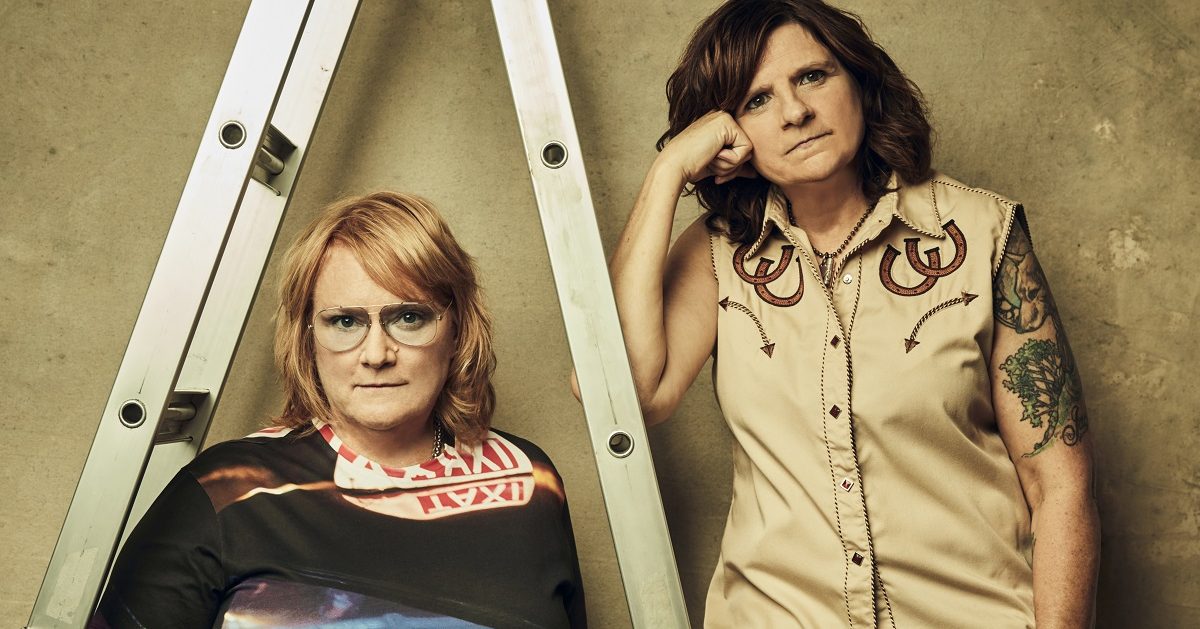
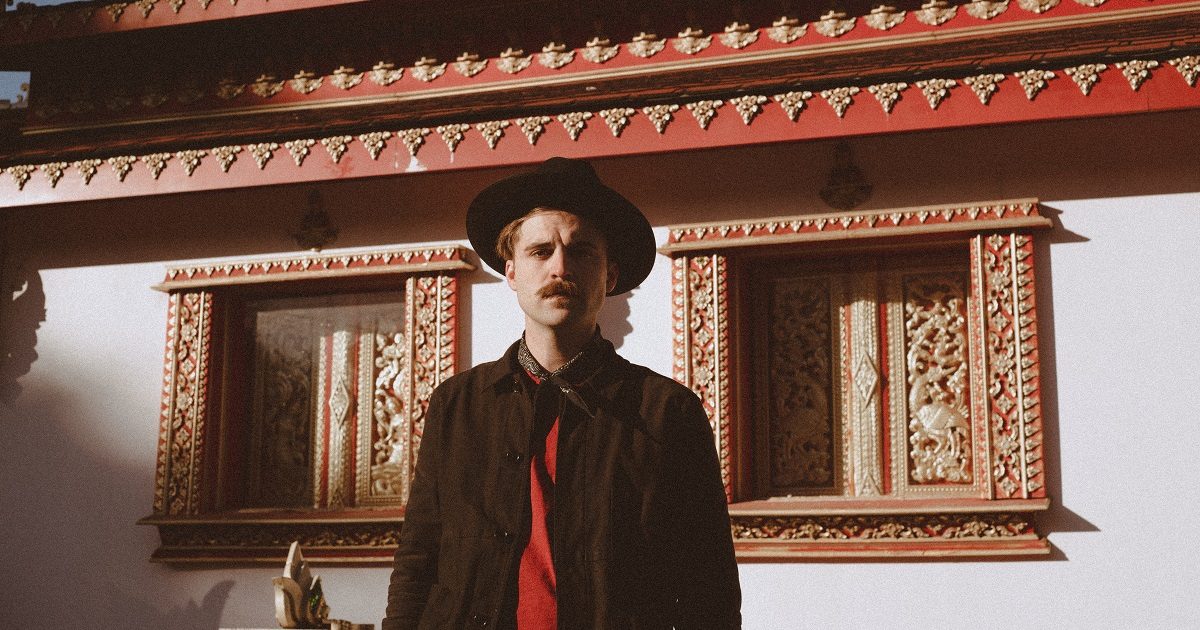
Artist:Indigo Girls Hometown: Atlanta, Georgia Song: “Country Radio” Album:Look Long Release Date: May 22, 2020 Label: Rounder Records
In Their Words: “I can tell it’s resonating with people. When I get to that line, ‘I’m just a gay kid who loves country radio,’ there’s an audible verbal response from the audience. This song is the way I felt doing those four-hour drives from Nashville to Atlanta, listening to country music radio. I could almost put my own life story in these songs, but I can’t. There are gender divisions and heteronormative realities. There’s a lot of self-homophobia that I’ve had to work on in my own life that plays into this as well.” — Emily Saliers, Indigo Girls
Artist:Grace Pettis Hometown: Mentone, Alabama; current residence is Austin, Texas Song: “Landon” Release Date: March 20, 2020 Label: MPress Records
In Their Words: I spent about ten years writing ‘Landon.’ It was a tough sentiment to get just right. Landon and I became best friends in a high school in a small town in Alabama. He came out right after graduation and I was one of a few trusted people. My job, in that moment, was to listen. Instead, I responded with a canned answer — one that was drilled into me by a devout Christian upbringing. I knew, deep down, that I was wrong. It took me years (I’m embarrassed by how many years) to confront my conscience and admit that to myself.
“In a lot of ways, my faith journey as a liberal Catholic was jump-started by these questions. It was scary. It was liberating. I felt closer to God than I ever had. By the time I’d figured out how to write the song and how to face up to it, we’d both come to a new place of understanding ourselves in the world. ‘Landon’ is an apology. When I play ‘Landon’ at shows, I like to dedicate it to anybody in the audience who’s owed an apology; one that’s many years coming. And then I dedicate it to anybody in the audience who owes somebody else an apology; one that’s many years in the making.” — Grace Pettis
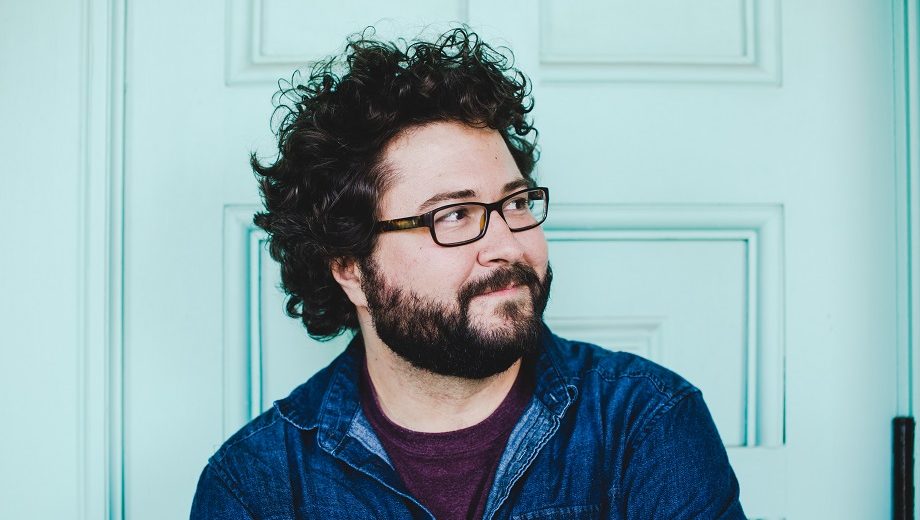
A lush, resplendent, living and breathing album, Sam Lee’s brand new record, Old Wow, is something of a garden — and not simply because the opening track, “The Garden of England/Seeds of Love” sets such a tone. In this arboretum, Lee is collecting the most rare and fragile of cultivars — ancient folk songs. He is carefully tending them, gently fertilizing, grafting, hybridizing, and cross-pollinating them with bits of himself, bits of this global moment, and bits of this generation.
BGS contributor Justin Hiltner strolled down New Orleans’ Canal Street with Lee during Folk Alliance International to find a secluded, sunshine-y balcony for a chat about action, queerness, folk traditions, fatherhood, and much more.
My first experience with the new record was the video for “The Garden of England.” It felt so lush and verdant, it immediately made me think of your relationship with nature and the ecosystems you operate in, as well as your environmental activism. How strong of a presence do you think that part of your life — the activism, especially the environmental aspects — carries through the album? It’s visible in a lot of places overtly, but there’s an undercurrent in there, too.
It’s funny, you use all of the words that I use, “How overt/covert” or “how implicit/explicit it should be.” Since the previous album I’ve gone through a very different journey of who I am, what I am meant to be doing, and why I’m doing music. I’ve come to the acceptance that actually, first and foremost, I’m an activist, not a musician. Music is the medium through which I disseminate, articulate my activism and my beliefs within that.
I’m very thrilled that I can do it in a way that is emotionally guided, as opposed to having to be statistically informed, or having the best persuasive political argument, which I’m terrible at. Through the mediums of song, ancient song, song that’s connected to the land by nature of its ancestry, I found I’ve got these really unusual resources and tools.
Something I like to ask musicians a lot is, how do we make this music relevant? How do we show people it’s not just throwback music or time capsule music? What I heard you describing is that you’ve found a relevance in these old songs for this current moment in geological time, due to the climate crisis, but also socially and politically.
It is that, but I say it’s more about the essence of the songs. … I’m playing with tradition, but there’s a certain distillation process that I’m using within them, which like any distillation process is also highly adulterative and adaptive. I’m contorting them, but I’m also working with an unusual aesthetic, because that’s all we can do, be artists. I’m taking risks.
Like, with videos like [“The Garden of England”] and the one that’s just come out last week for “Lay This Body Down.” I’m going to use mainstream values and imagery and concept on some deeply ancient ideas in a way that doesn’t really happen very much. And I’m not saying that’s because I’m pioneering! [Laughs]
I think it’s a vital thing to have to address, how does one tell these stories in ways that are going to be digestible by a new audience? One that actually would never encounter the tradition, in certain ways, because in the UK we live in a very musically segregated society. Most people aren’t thinking about music or that music can change identity, especially on such an ancient level. I’m having to test these things out.
Roots music and eroticism don’t really feel like they go together. “Lay This Body Down” feels so timeless and ancient, but the video for it has this level of eroticism and sensuality that feels current. I may be projecting my own queerness onto it, but I wanted to ask you how much of that eroticism comes from your queerness, or doesn’t it?
You know, you might be the first person to ask me these questions. Generally music journalists where I come from are uninterested in that, or the ones that are wouldn’t come across me.
I didn’t approach it from a sense of wanting to work with queerness, I love working with dance. I come from a dance background
And dance is very queer as is.
It is, but why does it have to be? Because the irony is, and it shouldn’t make any difference, that all the dancers in that video are heterosexual. That doesn’t matter, but it was so wonderful working with men who were actually very comfortable with their heterosexuality, but also in their intimacy and physicality and their sense of body contact. Working and being in that space was so energizing. It wasn’t erotic, it was simply sensual. The funny thing is it comes across as erotic, as homoerotic, but in all honesty I think that’s the viewer’s perception.
Maybe what I mean by “the video feels queer” or “dance itself is queer” is more accurately, “It leaves the door open for non-normative ideas and feelings.” Is that what you mean? The viewer can sense this because you left a crack open in the door of normativity for people to step through?
You’re absolutely right, and I’m very conscious of that. There’s a very Caravaggio-ness to this film. You couldn’t put any more arrows pointing [toward eroticism and homoeroticism.] I’m also fascinated with the queerness of folk song, particularly in the ambiguity when men are singing from the perspective of women and all those sort of rule-breaking things that were never rules in the first place.
I think it’s only the conservatism, in the sense of boxing what “is” and what “isn’t,” that binary-ness, that starts to do that. When you actually go back into history, those sorts of boundaries [weren’t as present], and I think that’s what I’m celebrating a little bit.
It’s a song about death, actually. These aren’t sexual beings, they’re mortal or immortal or transitionary. Their nakedness is as much about that shedding of materiality of the living and this idea of the trajectory from one realm to the other. They’re all expressions of myself… That’s what these movements are all about, for me.
That sort of ambiguity you mention, “Sweet Sixteen” felt to me like it was pulling from that tradition — am I reading too much into that? Where did that song come from?
Interesting. It’s not [from that], in fact, for me it’s the most heterosexual moment of my entire career, that song. [Laughs]
Interesting! And right, I heard heterosexuality in it, but also — and again, perhaps this is my projection — more than that, too.
This is the funny thing about making music, once you’ve put [the songs] out, you don’t own them anymore. They’re not yours. And never would I ever want to make music that was utterly explicit.
The song was a really hard one to choose to do and I don’t know why I did choose to do it. It’s actually more about me being a parent, because I’ve become a dad. In many ways I’m living in a heteronormative set up, even though it is unusual. We’re not together and we don’t live together and we never have, but the itinerant-ness of being a musician and leaving mum doing most of the care requires a little bit of me acknowledging that, through song.
This is my acceptance that I am a bit of that, packing my bag and heading off, away from the family set up. It also holds a little bit of my judgment upon that nuclear family thing, of husband and wife and child at home, and my terror of that. Which, I think has nothing to do with being gay. I think if I was straight I’d probably feel like that, too. [Laughs] It’s very much me trying to channel what a baby’s mother is thinking.
You carry on this tradition of folk singing unencumbered by music, a capella, but that to me, as someone who is a singer and musician, is kind of terrifying. The space that you play with, as a vocalist, on this record feels so vulnerable. What does it feel like to you?
I think I’m quite comfortable with vulnerability. Which is sort of a paradox, in a way, because the point of vulnerability is that it is uncomfortable. I think that space of exposure, for me, is a very exciting place. It’s not exciting because I get to see myself more, it’s because by being vulnerable you have to step outside the realm of protection, of comfort, of security. In that position you can do much more interesting things, finding perspective and placement and by that, a relationality to the world around you.
[Sometimes] you have to be an outsider, and that’s something that, by nature of who I am — by being gay, by being Jewish, by being the kid that never quite fit into any of the places that I was I’ve always been in that position. It’s a place I’ve always been drawn to, most artists are like that one way or another. I’m not particularly exceptional, I’m not saying I’m necessarily special, but that’s something that I’ve certainly been accustomed to.
When it comes carrying on the tradition, I did exactly the same. I went down the deepest root of folk music, but never went fully into those folk scenes. I was always an outsider in the folk world. I was always an outsider in these deep traditions, I was never part of the communities that I’m learning from. Yet, at the same time, you find yourself weirdly in the center of these places as well. This idea of, there is no center and there is no outside. Actually, these are all constructs only in our minds and we are all outsiders in the end.
When it comes to the music — and it’s funny, because I didn’t mix the album, though I was very involved in it — when [producer] Bernard Butler did that we were very aware of keeping the voice up front and center. Maybe there’s a little bit of ego and selfishness that he’s recognizing. That, as a singer, you need to be center. You are your voice. Not because I want to be up front, but maybe because I’m very clear about what I want to say in this record, so I think I have to mark my place in that respect.
Artist:Kirby Brown Hometown: Nashville, TN (by way of New York City; Dallas; Sulphur Springs, Texas; Damascus, Arkansas) Song: “Justine” Album:Dream Songs EP Release Date: July 2019 Label: Soundly Music
In Their Words: “As I have continuously sought to do with my writing, this song is an exploration of duality and juxtaposition. It’s about the courage to accept love as a gift, even against the backdrop of a dog-eat-dog barter culture. It imagines a world where the mighty Universe itself stoops to your level, cigarette in hand, to affirm who you are… to say, ‘Honey, you beat all I’ve ever seen.’ I wanted the video to visually represent a similar dichotomy, but I also wanted to give voice to someone else, to hear another story about what acceptance of self can look like — and to perhaps, with reverence and nuance, challenge us all to be more accepting of others. I threw the reins to Queen Robert and Gabriel, and I got out of the way.” — Kirby Brown, artist
“I was refreshed by the concept of God [as represented in Kirby’s lyrics] being visually represented by the duality of drag. Religious ideologies of God and wrath have historically oppressed queer people for centuries — I have felt that fear and oppression firsthand. Appearing in this video presented me with the opportunity to confront those fears while challenging a new audience with ideas about masculinity and femininity. I admire Kirby and Gabriel’s risk in taking an otherwise heterosexually-dominated music genre and infusing it with some queerness. Some people will love what we’ve done, but some won’t be ready for it. Those with open minds will make the connections within the dichotomy presented. Regardless, If God is THE almighty, then drag queens are a close second — just look at Dolly Parton!” — Queen Robert, actor
“Being asked to direct the video for Kirby’s song ‘Justine’ was a true gift, made even more special when Kirby told me his concept. He asked me, with genuine concern and empathy, if it felt appropriative to utilize this decidedly queer form of art as a cis straight man. I reminded him that, though I’m married to a woman, I am a queer person still. This was a generous opportunity for me to own my queer identity through his song and this video. The shoot itself was an embarrassment of riches. Kirby shared his song and in turn we were able to share ourselves.” — Gabriel Barreto, director
Artist:Andrew VanNorstrand Hometown: Central New York Song: “Boy With Gray Eyes” Album:That We Could Find a Way to Be
In Their Words: “There’s this moment when you realize something; when it finally clicks and the clouds part and you see things as they are. It feels like you’re just… hovering. Suspended between worlds. That moment when you first face a truth, but before you know what happens next. Before you know what it really means. There is so much life in those moments. They are brief, rare, terrifying and beautiful. May we be better than we’ve been. And everyone said ‘Amen.'” — Andrew VanNorstrand
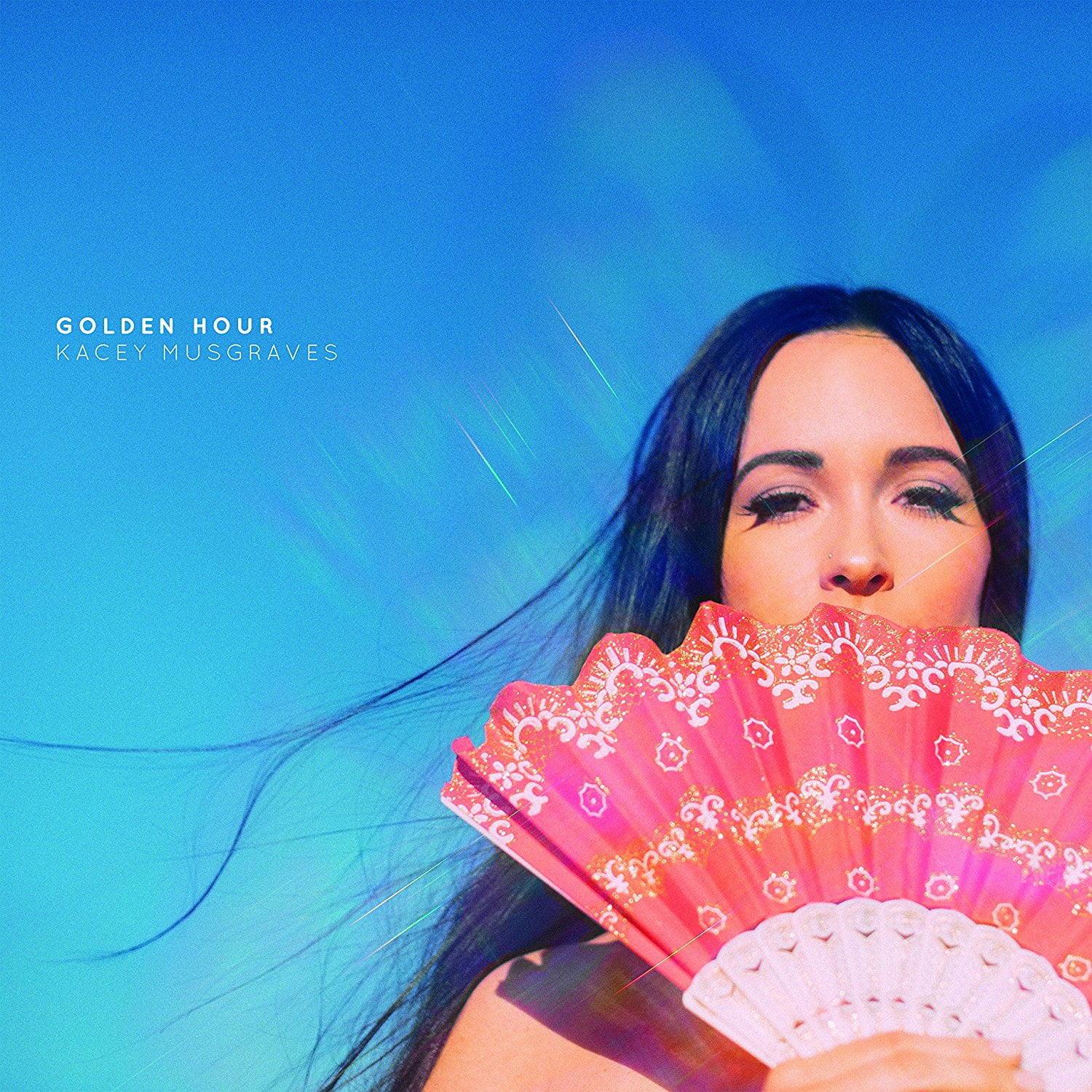
Kacey Musgraves’ dominance during Sunday’s 61st Annual Grammy Awards has certainly solidified her place as country music’s newest queer icon. She offered simply stunning, near-perfect performances during the primetime broadcast and took home four trophies: Best Country Solo Performance, Best Country Song, Best Country Album, and one of the most prestigious awards of the night, Album of the Year. So-called “Gay Twitter” devolved into a tizzy as the show unfolded through the afternoon and evening with Musgraves decidedly at the top.
Said Album of the Year, Golden Hour, saw a critical mass of LGBTQ+ fans embracing Musgraves’ music, but her relationship to the broader gay community has been percolating since her debut album, especially given its overt “Follow Your Arrow” message. All combined, her eye for gratuitous-yet-effortless glamour, her acid-steeped, anime-meets-California-meets-trailer park aesthetics, and her singular, pop-influenced countrypolitan sounds are gay country manna from heaven. And it’s not just in the music. This year, she made an appearance as a guest judge on VH1’s RuPaul’s Drag Race All Stars and she routinely advocates for LGBTQ+ fans and their causes on her social media feeds.
To be sure, Musgraves fits the diva-idolized-by-gays criteria impeccably, but there’s a certain passive erasure that can occur when fans consciously or subconsciously become myopic in their praise of and infatuation with straight, cisgendered, female artists. It’s true that Musgraves has played an important role in expanding country music’s borders — musically, socially, and otherwise — but at the same time a burgeoning community of LGBTQ+ writers, artists, musicians, and creators are carving out their own space within country, Americana, folk, and even bluegrass and old-time.
This writer would never go so far as to suggest that one ought not squeal with delight at Musgraves’ fierce-as-fuck costumes, her tear-jerking solo performance of “Rainbow,” or her impossibly long and flowy Cher-callback, bump-it wig. Rather, if you love Kacey Musgraves and Golden Hour — because queer identities can be seen and reflected within her work, because she opens the door to the idea that country isn’t a forbidding place for these identities, and/or because she’s unabashed and unapologetic in her pursuit of these goals — you’re going to love these eleven badass, talented, inspirational, openly queer roots musicians, too.
Time to get stanning:
Brandi Carlile
After last night’s show this name should no longer need mentioning or introduction, as Carlile and her twin collaborators, Tim and Phil Hanseroth, absolutely brought down the Staples Center with one of the most moving performances of the night, the soaring, galvanizing, overtly queer, and now Grammy-winning masterpiece, “The Joke.” Carlile is openly gay, married, a mother of two daughters, and a tireless voice for representation and progress in Americana and its offshoot genres. If “The Joke” resonates with you (i.e. if it makes you sob uncontrollably, as it does this writer), check out “That Wasn’t Me,” “Hurricane,” and, of course, “The Story.”
Mary Gauthier
Gauthier’s latest, Rifles & Rosary Beads, was nominated for Best Folk Album this year and though it didn’t take home the prize, the album has received universal acclaim for its message of hope, empathy, and visibility for members of our armed services and the struggles they face during and after their service. Gauthier collaborated with veterans of the military in writing all of the record’s heart wrenching, honest, raw songs — which might seem counterintuitive given gays’ historically tenuous relationship with the military writ large. But Gauthier’s own life story, and the trials she’s faced, make her the perfect writer to prioritize empathy above all else in these songs.
Don’t sleep on the rest of her discography, though. The simple profundity of her writing is consistently awe-inspiring. Check out “Mercy Now” after you’ve given Rifles & Rosary Beads a listen.
Karen & the Sorrows
Jewish New York City native Karen Pittelman may seem like an unlikely frontwoman of a country band, especially when you factor in her past punk and queercore experiences, but it turns out she grew up bathed in the country compilation albums her father produced and sold for a living. Her voice recalls country mavens of bygone eras — it’s delicate yet powerful, with a pin-up girl quality that’s as subversive as it is natural. Also check out “Take Me for a Ride,” a Pittelman original that plays like a trad-country, queer version of Sam Hunt’s smash hit, “Body Like a Back Road,” but without the cheese.
Little Bandit
All of the hollerin’, barn-burning, hell-raising country soul of your favorite outlaw country rockers, but with lacy gay edges, Little Bandit (AKA Alex Caress, et. al.) is as honky-tonk as it gets. It’s a beautiful balancing act, presenting as an impossibly big-voiced, piano-smashing, charismatic frontman while singing male pronouns without hesitation. He leans into a beautifully paradoxical queerness that equally embraces diamonds, Waffle House allusions, platform shoes, and plain ol drinkin’. If you like it — and you will — check out “Diamonds,” too.
Sarah Shook & the Disarmers
Outspoken outlaws in a crop of alt-country artists who align with that eponymous country movement of the 70s, Sarah Shook & the Disarmers are a road-dogging band that would seemingly fit that mold, excepting Shook’s deliberate efforts to challenge the inherent heteronormativity of country music at every turn. For Shook it’s not necessarily about having a political message, as she put it in a 2018 interview with BGS, “I feel like doing what I’m doing — touring relentlessly, putting out records, and being unapologetically myself — is a very powerful and political maneuver as well… I’ve never been concerned about that because I feel it’s important to be honest and forthright as a human being, and as an artist and certainly lyrically as well.”
Indigo Girls
Both Amy Ray and Emily Saliers — the two halves that make up the absolutely iconic Indigo Girls — have released solo albums in the past year, both of which draw heavily on folk, Americana, and country influences. This should be no surprise to even the most casual IG fans. Banjos, mandolins, ukuleles, and so many other hallmarks of roots music have been integral to the Indigo Girls’ sound all along. But the songwriting, devastating and personal and oh so very real, is the real takeaway from both projects.
kd lang
This list might as well not exist if it excluded kd lang. Before her crossover to more mainstream genre designations, kd pretty much originated the role of badass queer making unimpeachably trad country music that refused to shy away from its queer touchpoints. Just take a look at this video! “Honky Tonk Angels,” sung with Loretta Lynn, Brenda Lee, Kitty Wells, and finally, kd in all of her butch, gender-bending, binary-eschewing glory — complete with a Minnie Pearl cameo! Country has always been (more than) a little queer, y’all.
Lavender Country
A man well, well ahead of his time, Patrick Haggerty (AKA Lavender Country), released his debut, self-titled album in 1973. It was a groundbreaking work, but the world, let alone the country music community and its commercial machine, were not ready for it. A Seattle DJ was fired for playing “Cryin’ These Cocksucking Tears” on the airwaves, only one thousand copies of the album were printed, and the band was relegated to performing exclusively at LGBTQ+ events and programs. But, despite being largely shut out of the industry, Haggerty and Lavender Country never ceased. In 2018, at the age of 74, Haggerty took part in AmericanaFest’s very first queer-focused showcase.
Amythyst Kiah
Amythyst Kiah’s booming, captivating voice, and her haunting, Southern gothic approach to Americana, bluegrass, and old-time set her apart from almost anyone else on the scene at this moment. Her reimagination of Dolly Parton’s magnum opus, “Jolene,” is a perfect example of how she carefully turns tradition on its ear. Based in East Tennessee herself, she draws on the rich musical heritage of the region, adding her own spin, creating space to allow herself to soar. And there’s plenty more soaring in her future, as she has opened shows for artists such as Rhiannon Giddens and Indigo Girls across the country and in Europe, and her collaboration album with Giddens, Allison Russell (Birds of Chicago), and Leyla McCalla, Songs of Our Native Daughters, is set to drop February 22.
Alynda Segarra
Singer/songwriter, activist, and Hurray for the Riff Raff frontwoman Alynda Segarra entrances with The Navigator, a concept project that focuses on the life and times of a fictitious Puerto Rican youth living in New York City. Themes of immigration, identity politics, displacement, disenfranchisement, and capitalistic overreach are threaded throughout the album, which offers its songs as tableaus of this girl’s — Navita’s — reality. It’s a stunning reminder that the intricacies and nuances that define us, and by doing so, separate us, are not so difficult for us to overcome with empathy and understanding. “Pa’lante!” (which translates to “forward!”) is the album’s battle cry, a song that turns utter despondency, grief, and a sore lack of humanity into a glimmer of hope.
Trixie Mattel
While almost all other drag queens who delve into the music scene release dance tracks, rap albums, or similar club-ready jams, Trixie Mattel (AKA Brian Firkus) draws upon her rural Wisconsin roots on two folk-adjacent, country-ish albums, Two Birds and One Stone. (Get it?) This isn’t just an opportunist attempt to punch up Trixie’s Dolly Parton-esque, country barbie aesthetic, she’s really got the chops. Not only is she a talented humorous-while-poignant songwriter, her technical skills on guitar and autoharp (yes, autoharp) are precisely honed to showcase her original music. This is no gimmick — though the Doves in Flight Gibson guitar and the custom, pink d’Aigle autoharp are jaw-droppingly perfect additions to Trixie’s lookbook.
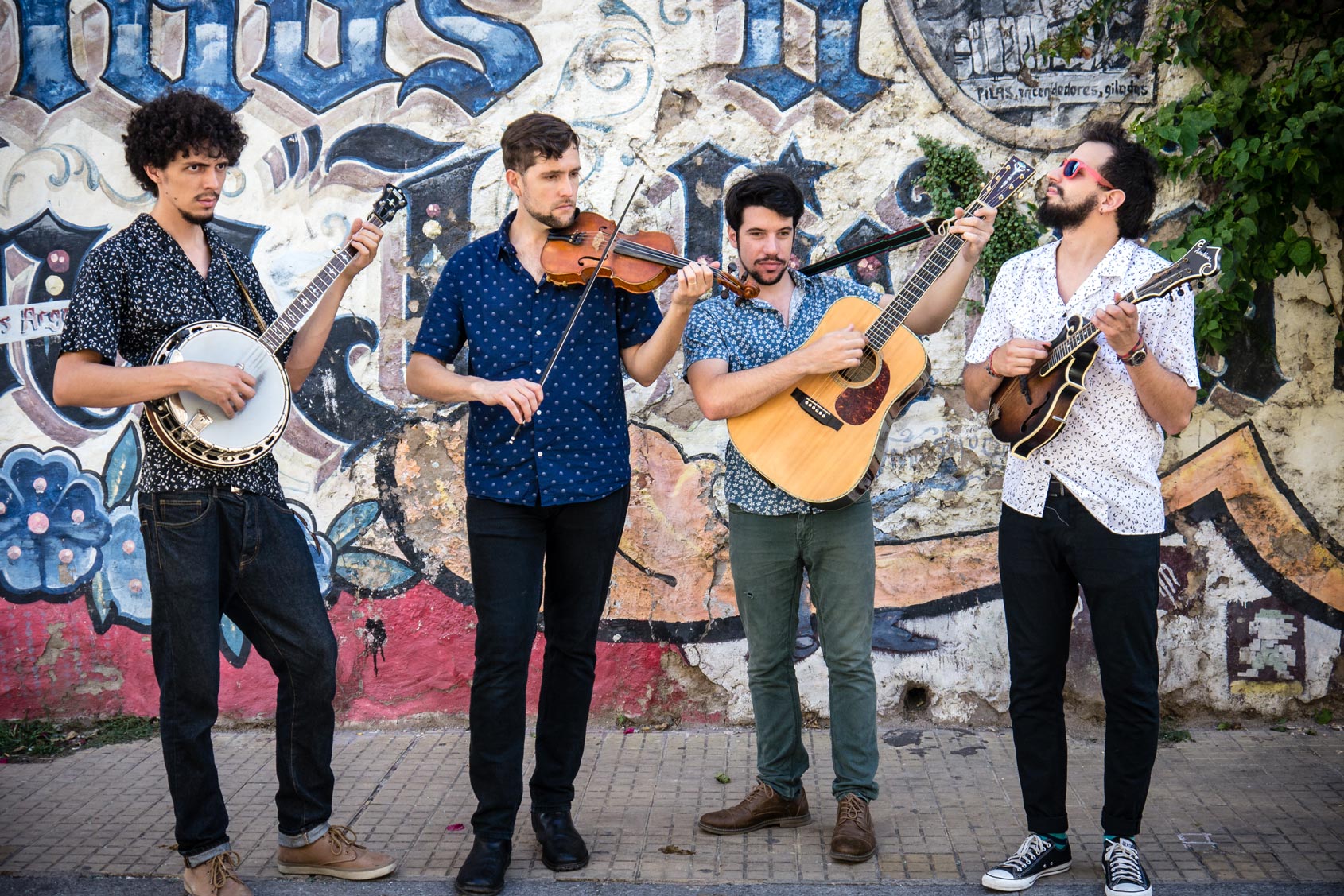
As a column, Shout & Shine tends to hinge on unpacking, refuting, and/or subverting expectations about who does and doesn’t “own” American roots music and its constituent genres. So it’s interesting that, in a conversation with Joe Troop, frontman of Argentina-based, bluegrass-flavored, Latin-infused string band Che Apalache, not only would we come up against those sorts of expectations — and how the band refuses to fit any molds set forth by them — but also in certain cases, we realize they fit quite tidily into the norm, the tradition, and the heritage of the music. Despite however far or wide a band may stray from what we may automatically suppose these genres ought to look like, feel like, and sound, roots music will almost always demonstrate that we are more connected and more similar than we’ve been led to believe.
This whole slew of unspoken, subtle expectations about who has a claim to roots music is already being subverted by just the existence of Che Apalache, so I wonder, as you tour — especially right now, as you tour the U.S. — how have you felt yourselves coming up against those expectations with your audiences, or perhaps anyone who wouldn’t ever suppose someone from a different hemisphere would even want to play bluegrass?
I fell in love with bluegrass because it’s amazing music, really. It’s such a beautiful thing to have happened in the world. This instrumentation, this ensemble, I tend to think of it also outside of bluegrass, but bluegrass is what gave it technique, there’s a lot of evolution that came from bluegrass. Don’t get me wrong, I love bluegrass, but there are some social issues in the bluegrass world — but there are also things that are understandable, because it’s an extension of American society. As American society continues to evolve and change, bluegrass is naturally going to do the exact same thing. It’s kind of a self-evident history. Being historically accurate is something that bluegrass musicians were never good at. They took something that wasn’t an Anglo-Saxon “pow-wow” and they made it into that.
Americans are not good at historical accuracy; our culture is predicated upon the exact opposite.
America’s perhaps the most hyper-nationalized country in the world right now. That’s something that you get to reflect upon a lot when you spend years — I, personally, have been out of the country for thirteen years of my life, so I’ve thought about that a lot, how nationalism seeps into every nook and cranny of your construct of identity. It’s pretty frightening. I would say bluegrass never escaped from that. Because of advertising and marketing and corporate dominance, Americans basically just want sunshine shoved up their asses 24/7. They just want to be told how great they are.
Not only because you come from South America, but the array of backgrounds and starting points for all of you in the band, I wonder how you feel you are working to deconstruct that paradigm? Is that an active thing?
Yes. Absolutely. It’s 100 percent intentional. I’m also cognizant of the fact that I’m privileged, regardless of the fact that I’m gay. I’m a middle-class American, that puts me way ahead of almost anyone anywhere else in the world, as far as having economic ability and being able to go to college without breaking a sweat, all that. My parents were not privileged growing up. They’re baby boomers, they had this idea of what they wanted for their children, that’s what they procured for us, but that gave me a different view than most of my family, who were blue collar. I grew up between two worlds and my parents were the segue between those worlds. Back then, identity was constructed very differently and there wasn’t much wiggle room.
So why be intentional through art? Personally, I developed an empathetic point of view because I had multigenerational friendships, and bluegrass is a brilliant genre because it does — unlike almost any genre in the United States — allow you to intermingle with people of different social statuses. Bluegrass is more of a launching pad than almost anything else, contrary to the very conservative ties it may have. If not the best, it’s one of the best musical forms with which to cultivate a greater sense of empathy. Then, when you want to make a greater artistic statement, you know how to untangle that mess a little bit more. Che Apalache tries to put out things that are very intentional, to help people reflect who may not have had any exposure to certain belief systems before — and I’m referring to my own belief systems as well. I have an agenda, clearly. Mainly that’s to help this process [of breaking down these paradigms] along in some sort of way where people are obligated to think.
I want people who hate these things — immigrants’ rights and gay people — to first fall in love with us almost like someone would as a child, because art has that innocence and beauty that’s primordial. If we can hook them in with artistic prowess and then challenge them to grow, that’s social art. That’s what we’re going for.
Musically then, what are the similarities and differences in your approach to string band music coming from the perspective of Argentina and South America, rather than North Carolina or Appalachia?
So we’re in Latin America, and in the 1970s, the United States backed Operation Condor, which was an intentional ousting of and/or assassination of democratically-elected governments in the southern cone of South America. They were replaced by very violent dictatorships. American intermingling in Latin America has led to the basic destruction of young intellectuals in the ‘70s, their baby boomers, who were pressing very important social issues. All of this led to some serious bullshit down in South America. Our histories are very intertwined. Talk about Americans needing sunshine shoved up their asses — to deny the fact that America and the CIA were directly responsible for what happened in South America would be equivalent to saying that Hitler and the Third Reich weren’t responsible for the Holocaust. It’s an important thing to understand when presenting a string band in South America, because most people are going to simply reject it. A lot of people would not look favorably on anything iconically American. That’s just part of what you have to understand before you even start to understand what an Argentinian string band means. You have to have context to know what you’re doing in the world. That’s what Americans are so pitiful at, having context. The inherent symbolism of a string band in South America is something that we’re conscious of both there and here.
What I hear you saying is that you’re patently, obviously American in Argentina and Latin America, but at the same time, you’re existing in this odd middle ground where, in the U.S., folks will view you as patently foreign. How do you bridge that divide?
Through queerness! [Chuckles] That’s my guiding light. It all started because of queerness. I fell in love with bluegrass simultaneously with the recognition of my own sexuality. That was the major defining factor in the construct of my identity. Being different, while at the same time being 100 percent Anglo-Saxon, North Carolinian, banjo and fiddle player, was like trying to tame two wild, bucking mules with a rope around each, trying to pull them back together.
Something that I continually go back to is that if we, as othered folks, are able to stand in the center of disparate halves like this–
Yeah! Who else is going to do it? I think being “other” means that you’ve already had societal defeat, you’re nothing. Back when I was coming to terms with my sexuality, gay meant death. I went to Spain when I was 19 and no one gave a shit. I have to give Spain a hand, I love that place. In a personal way, queerness plus Latin culture gave me the liberty to deconstruct my own idea of my identity.
I want to be very clear in connecting all of these thoughts, for our readers, to Che Apalache’s music. Let’s talk about “The Wall.” I love how it subverts that style of song with what it talks about. I feel like it’s the perfect synergy of all of these things you’re talking about.
That song was again, very intentional. I knew it had to be about the wall. It took getting piss drunk on a bottle of whiskey and writing it all out, in my friend’s bathroom crying — it had to be exactly that. The whole mission there was to create a song inspired by Ralph Stanley and what he represented. He’s one of those luminous voices that comes once in a century, he sounded like he was a hundred years old even in his 20s. He was an amazing but also very humble guy. He campaigned for workers’ rights, unions, and workers’ syndicates. He may have fallen into the clenches of Obama, in a way — because Obama didn’t deliver on a lot of the key issues he campaigned for — but the symbolism of Ralph Stanley campaigning for Obama, that speaks for itself, regardless of what happened afterwards. The idea was to put democracy back into the hands of the people. Ralph Stanley has that legacy.
Sure, there are degrees of radicalism — it all tends to be relative.
In southwest Virginia, what he did was extremely radical. You have to contextualize it.
There’s such a history and legacy in that region of folks who would have been relegated to the forgotten pages of history being on the front lines of progressive issues.
Totally. So that song, [“The Wall,”] on a musical and ethnomusicological level, comes from that! Four-part vocal harmonies and Southern gospel unify our band. In April we even did a residency in southwest Virginia through the Crooked Road. We got to play at the Ralph Stanley Museum and his birthplace. In those regions, a lot of those folks are conservative, they identify as Trump voters. We couldn’t think of a better way besides taking that style of music and try to somehow rope them in, then when the fourth verse comes through, they’ve already fallen in love with us, but then we’re tearing their wall down.
And that act isn’t something that you’ve set out to do just because Trump is president; you’re building on what all of these artists and people have done before you, using this specific style of music to make these changes in the world.
Totally. Exactly. We performed this song at [the Old Time Fiddler’s Convention in] Galax, Virginia, and you can see a lot of people listening politely, and only a couple of folks getting angry, but most sat listening respectfully. But hopefully, when they got up the next morning, it made them think.
Once again, queer people, othered people, are the perfect example of this hot button issue of “come togetherness.” We, the othered folks, are leading the way, showing how to come together despite our differences in a way that honors ourselves and our identities, without being complicit in our own oppression. That’s the power we have, to show people what it looks like to truly come together, to start these dialogues, and conversations. Whether it’s at IBMA and Shout & Shine, or at Galax, or around the country, or in Latin America.
That’s it exactly. I made a promise to myself to fly the gay flag, the rainbow flag at Galax next year over our campsite, because it’s usually just stars and bars there. I think that it would be nice to have other folks there to be a part of that! There’s strength in numbers. I would be reticent to go in there with an overt political agenda, though. Because that’s not strategic enough. I think what people like about Che Apalache is that it’s fresh, it’s breathing new energy into something, that for a lot of people has grown stale. That’s the majority of the comments we get. There are a lot of traditional bluegrass fans that follow us because they feel that the genre is doing what it always has — a resurgence of a new kind of thing. That new kind of thing isn’t going to be tipping the hat to the past in a cheeseball, more mash sort of way. People aren’t stupid. People want symbolism. People want string band music.
American music and dance have always gone hand-in-hand. Immigrants, bringing their folk traditions, art, and music to North America, combined and cross-pollinated with and stole and borrowed from the art and music of Native Americans, African Slaves, and African Americans. In that beautiful, conflicted, human, melting pot way we arrived at the incredible roots genres of our modern time. Dance had always been an integral part of that reckoning, of the growth, adaptation, and molding of our country’s vernacular music, but at the advent of the recording industry and the commercialization of music, musical dance and percussive dance were left by the wayside. They fell from ubiquity and popularity, largely relegated to preservationist, folklorist, familial, and rural niches.
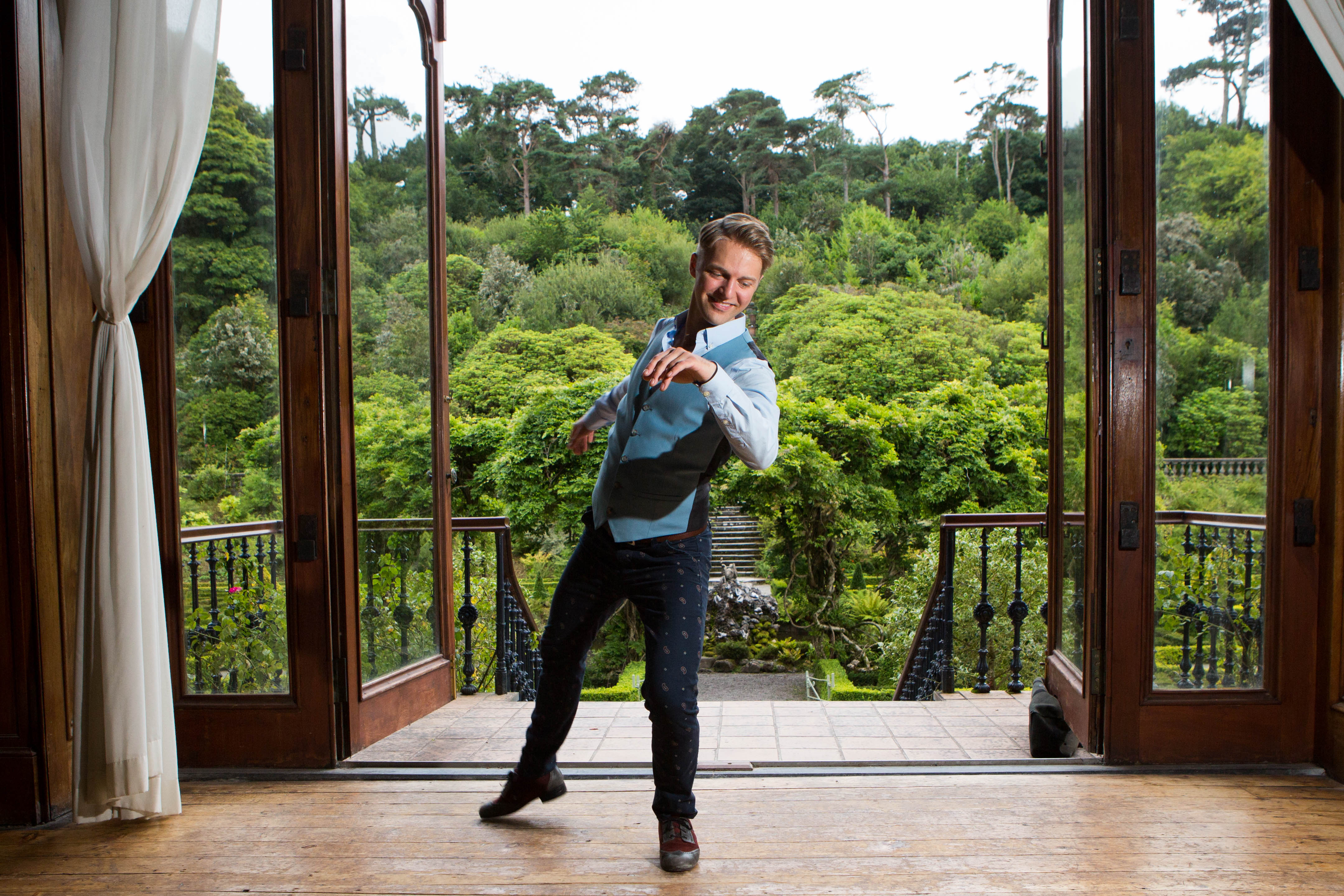
Nic Gareiss doesn’t believe that dance belongs in those shadowed corners of our musical realms. A percussive dancer, scholar, and ethnochoreologist (think ethnomusicologist, but for dance — choreography), Gareiss devotes his creativity to bringing dance as music back into the traditional and vernacular genres that have slowly but surely lost nearly all of its influence. In the process, he explores greater ideas about his listeners’ and audiences’ expectations about the relationships of dance and melody, dancer and musician, dance partner and dance partner, song and singer, and performer and audience. Not only does he “queer” dance, by stripping it of its normative trappings, and laying its essentials bare, he also queers its heteronormativity, its patriarchal tendencies, and its binaryism — in a fashion that’s supremely gorgeous to both the ears and the eyes.
A good starting point would just be that we’re a music site, right? We cover music, not so much dance. Some readers might need a quick briefing on your mantra that “dance is music.” Can you give people a quick 101 on your worldview that dance is something that’s essential to music, not just tangential to it?
I work as a dancer who makes sound. The traditions that I study and continue to study — and love — are dance traditions that are percussive. Whether that’s Appalachian clogging, Irish step dancing, or step dance from Canada, all of these dance forms have as their impetus rhythm-making with the feet and body. Also characteristic of these styles is the fact that they occur in environments where traditional music is being played. One might actually argue, and I would probably puckishly argue, that the soundscape that’s created by dancers is actually as much a part of the soundscape of traditional music as someone playing a fiddle or a banjo.
It’s interesting that that is an extant truth about vernacular music — especially American vernacular musics — but the way that American music has grown and evolved, it’s extirpated dance from itself, and then brought it back in, in different ways.
I think that because of the commercialization of music over the years, especially because of recording technology, dance hasn’t had as prominent a role, sonically. For some reason people didn’t think that the sound of a moving body was worth recording as much as the sound of another moving body, but holding a guitar. [Chuckles] What I’m interested in doing as I work mostly with musicians, and usually musicians that come from folk music backgrounds of some kind, is creating dance for listening. That manifests in mostly concerts, but also in some recordings, some teaching, some lecturing — there are a lot of things that make up my year along those lines.
One of those things is Solo Square Dance, a show that you’ve worked up, which strips away all of the old-time music and folk music that’s a part of these forms of dance and just showcases the actual, physical dancing — the part that had been lost, perhaps due to that commercialization, like you were just saying.
Exactly. In Solo Square Dance there are no musicians, except for me! [Laughs] There are no sounds except the sounds that I create myself, using my voice, using my feet, snapping my fingers, whistling. The idea is to reference and pay homage to traditional music and dance as a symbiotic entity. Because I don’t play instruments in that show, that means that traditional music shows up almost as a specter, or as a concept of something that’s been erased, so you can still feel a trace of it. It’s not just the idea of traditional music as a nebulous canon of the music writ large. Instead, there are actually specific pieces of music that come from, say, the fiddle playing of Tommy Jarrell or a traditional Irish dance tune that shows up in a tribute to one of my Irish dance teachers. There is various music in the show, it’s just music as made through a sounding body without a prosthesis, without an instrument.
Something that you’re also digging into with Solo Square Dance is leaving behind a whole host of presuppositions and expectations about dance, but you specifically call out heteronormativity. There are so many layers here, because you have to unpack that dance is music, and that it’s always been an integral part of these musical styles, but then you have to unpack that dance is inherently heteronormative, too. That’s a lot of ground to cover!
The interesting thing for me came out of these video clips of Bascom Lamar Lunsford dancing on the porch, in this film by David Hoffman that was shot in 1962. [In the film] Bascom is demonstrating what it would be like to be in a square dance, but he only has one body to do it, instead of the usual eight people that it takes to make up a square. I saw that and thought that that was kind of inherently lonely and beautiful. But also, it somehow simultaneously was merry and celebratory. I think Bascom’s reimagining or demonstrating of the square dance is kind of a queer thing — and by “queer,” in this moment, I mean a set of stylistics that are somehow “beyond,” somehow an outsider, that have that “crooked” or critical relationship to the normative. Making that first piece a solo square dance and building the rest of the show around it, I tried to think so much about the way that dance possibly enacts some kind of revolutionary potential. Through touch, through interaction of sound and gesture, through [considering] what it might be like to have communities that move together, and what it might be like to have an individual that a community watches.
In all those things, I kept coming up against this idea that there are, indeed, heteronormative facets of that. Like [in square dancing] when we say, “Gents, swing your corner lady.” We say only “gents” and “ladies.” We say only, “Gents do this.” So there’s also a patriarchal power there, in who does what to whom. There’s also a binary that doesn’t allow for, perhaps, the existence of something like polyamory, where there are multiple people involved in a romantic or physical connection. I started thinking about what it would be like, if instead of singing, [Sings] “I’m gonna get that, get that, get that, I’m gonna get that pretty little girl,” what is it like if someone who performs the gender that I perform sings about someone who has a similar gender as themself? That subtle switch turns more than I ever could’ve imagined. It didn’t take putting on heels and a feather boa to queer square dance, just the simple expression of speaking about intimacy, thinking about the gender dynamics of that special social form, and then creating that little shift in the reiteration of that call. Which, I’m really happy about! At first, to decide, I’m gonna “queer” traditional dance — it’s a little bit of an arduous project. I’m finding that it’s these subtle nuance shifts that maybe make the biggest strides to imagining anti-normative futures as well as pasts.
I read an interview of yours, years ago now, in which you mentioned so succinctly that straight people have always let their identities shine through their art, so why wouldn’t queer people do that, too? That was a groundbreaking moment for me, realizing that my identity has an equal right to being included in my art, because no one else is filtering out their identities, their identities just happen to be the norm. It doesn’t take a lot of effort, like you were just saying, it just takes a change in perspective to open that paradigm up. How do we help all kinds of folks to realize that anti-normative future that you see?
I think it’s important to remember that queer people are not a facet of postmodernity. Queerness has always existed.
That’s such an important point! It just hasn’t always been visible.
Right. When we think about traditional music, oftentimes we relate that not only to a particular place, but a particular time. It’s important to remember that there have always been LGBTQIA+ people in those historical moments, again, whether those people were allowed to visible or whether it was okay for them to be visible is another question. Now, some of what we’re starting to see is nascent queerness beginning to whisper, or to sing, or to dance. That feels like a very exciting time, but we’re not inventing that. Queerness [has] been around for a long time.
For example, people who sing ballads, who maybe keep the pronoun of the song the same, or maybe switch pronouns to express a sexual object choice that is somehow other than straight, this is a simple, subtle way people have always enacted some kind of queer performance. And for a long time! I don’t only think that it’s always related to romantic connections, to be honest. I really like the idea of queerness as a critical set of stylistics. For instance, my relationship to percussive dance is a little queer — or bent — because I had a teacher who always said, “There will be no scraping in our class.” That means, in percussive dance, good technique is a sharp, short, adroit connection to the floor, where you strike your foot against the ground, but you don’t leave it on the ground. That, for me, sort of became a provocation. It made me want to slide my foot, to whisper, to create this foot-to-floor fricative, for many reasons: One, it got me closer to a fiddle’s bow, sliding slowly across the strings, but secondly, simply for the pure joy of transgressing! It opens this world of other tambours I didn’t have access to before.
So then, in conclusion, if a reader and roots music fan is looking to have their ideas about traditional and percussive dance queered, where will they be able to find you in the near future?
Solo Square Dance will continue to tour, there are shows in Ireland and Scotland lined up. I have a new project called DuoDuo with cellist Natalie Haas, guitarist Yann Falquet, harpist Maeve Gilchrist, and myself. That project is out on the road. Also, my band, This Is How We Fly, is getting together to make our third record starting in November, which is very exciting. Then, in the fall, I’m touring with this incredible tap dancer, who is also interested in vernacular dance forms, vernacular jazz and swing — his name is Caleb Teicher. We have a duo dance project, again a project without any instruments! Just us, making the music with our bodies and voices.
Because dance is music, damnit.
Exactly! And, to be honest, music is dancing as well! [Laughs] I found, in my collaborations with musicians, when there’s a moving body on stage, musicians begin to consider their own bodies a little bit more. They start to think about where they stand and how they move. It’s actually an interesting metamorphosis to witness and be engaged with. It reminds everyone that if one person can cross the sound/movement divide, if a dancer can be heard, maybe a musician can be seen!
Editor’s Note: Gareiss will be featured in the Bluegrass Situation Presents: A St. Patrick’s Day Festival at New York’s New Irish Arts Center, participating in an opening night jam session with fiddler-banjoist Jake Blount, clawhammer banjoist Allison de Groot and fiddler Tatiana Hargreaves on March 17 as well as a headlining performance with Blount on March 18.
Photo credit: Darragh Kane
This website uses cookies to improve your experience. We'll assume you're ok with this, but you can opt-out if you wish.AcceptRejectRead More
Privacy & Cookies Policy
Privacy Overview
This website uses cookies to improve your experience while you navigate through the website. Out of these, the cookies that are categorized as necessary are stored on your browser as they are essential for the working of basic functionalities of the website. We also use third-party cookies that help us analyze and understand how you use this website. These cookies will be stored in your browser only with your consent. You also have the option to opt-out of these cookies. But opting out of some of these cookies may affect your browsing experience.
Necessary cookies are absolutely essential for the website to function properly. This category only includes cookies that ensures basic functionalities and security features of the website. These cookies do not store any personal information.
Any cookies that may not be particularly necessary for the website to function and is used specifically to collect user personal data via analytics, ads, other embedded contents are termed as non-necessary cookies. It is mandatory to procure user consent prior to running these cookies on your website.