The world’s most famous cellist Yo-Yo Ma is spending the pandemic at home in Cambridge, Massachusetts, with his family. It has been a situation that he describes, rather humorously, as being an adjustment for everyone. “Two-thirds of my marriage has been on the road. Forty-two years and suddenly my wife sees me home every night, and every day and every morning.”
Yet he says the experience has been a real blessing, too. “All the tensions of being home and preparing to leave, or coming back home to recuperate and then leave again, are all gone,” he explains by phone, before adding “replaced by, of course, the incredible fractures and ruptures in our society.”
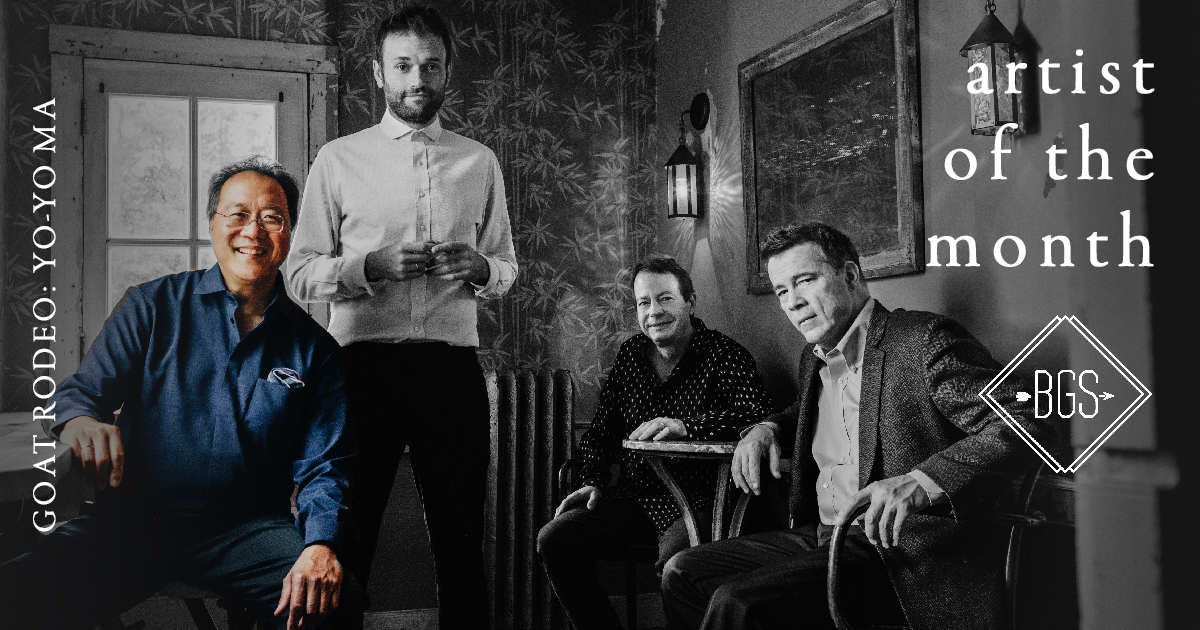
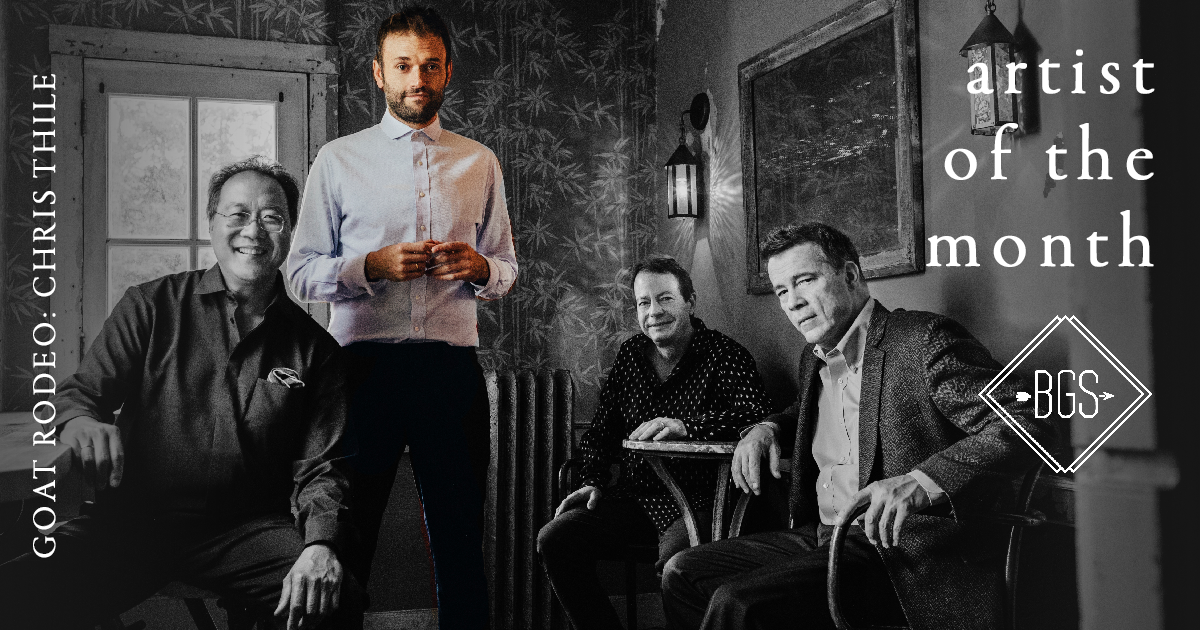
Besides pondering a “tsunami of crises,” Ma talks about the joys of getting the band back together — a lineup informally known as Goat Rodeo, which also encompasses Stuart Duncan, Edgar Meyer, Chris Thile, and special guest Aoife O’Donovan. This Artist of the Month interview is the fourth of four installments as BGS salutes the incredible and iconic musicians behind the ensemble’s second project, Not Our First Goat Rodeo.
BGS: Like the first album, Not Our First Goat Rodeo was recorded at James Taylor’s studio in the Berkshires. Was there a comfort level about returning there?
Totally. The studio is aesthetically beautiful. It is right there in the middle of the Berkshires, the middle of the woods, and it’s a barn that has been built for that reason. We work hard. We play hard. And going back to it is fabulous because everybody in the band is so busy. So, just to get the time from their busy lives to get together is a feat, but when we get together, it feels like we never left. So, add to the great acoustics and the set-up of the barn, another added feeling of “the band is getting back together again.”
Since it was in August, was there a summer vacation vibe?It was like camp except we weren’t 12 years old. [Laughs] Adult camp! We spend all day together. We have meals together. But it was also work. I have to say that Edgar, Chris, and Stuart worked like dogs, way into the night. Working on scores, working on correcting things. They worked really, really, really hard, but we also had a really good time.
Although the four of you don’t play together often, it seems that a high level of trust exists within the group and with the audience.
That’s such a good question, because you are talking about both the external and internal relationship of building trust. It starts with the trust we have in one another, interpersonally. Between Chris and Edgar. Between Chris and Stuart. Stuart and Edgar. Edgar and me. If you were to draw a networking line between all of us, and Aoife included, it’s trust on every level. Trust and respect. I think the two go together. In that, if someone has a deep opinion about something, there’s going to be deep respect for that. We might try it and it might evolve into something else. There’s never an argument…
The trust also comes from the philosophy: it’s not “It’s my way, your way or the highway.” It’s more like “I know certain things and you know certain things and I love what you know and you like what I know and respect what I know.” So we are just working it out all of the time.
So that allows for the freedom of creativity, to follow a musical idea and see where it takes you? You know, that other thing about that is where you place your ego. We live in a world where some people think their ego walks in front of them. And [with Goat Rodeo], every one of us has a pretty strong ego because otherwise we can’t go and perform. But the egos never lead. We actually make fun of our own egos or each other’s.
Another thing is, we all have strengths and vulnerabilities, [but] we never, ever pounce on anybody’s vulnerability. I’m the oldest guy there. I’m full of warts. You can probably make fun of me until the cows come home but I think they treat me nice. There’s respect but they never step on someone’s vulnerability. It’s like a great relationship — a great domestic relationship. We didn’t get into pushing buttons. We’re so clear about the work that needs to be done. That’s how you build trust. You accept the whole person, and you treasure the parts that they excel in. You don’t tramp on weaknesses. But while we have a lot of fun!
What is one recording that ranks as a G.O.A.T. (greatest of all time) for you?
When you ask a question like that, I can’t help but think about different time periods. If the well-lived life is the life that has been explored, then obviously at all times in your life you will have had different influences that have sparked new interests.
I will give you a musical example of recent vintage. There’s this 23-year-old musician named Jacob Collier from England. He’s almost self-taught. He sings. He plays dozens of instruments. He goes and creates. I find more and more as I get older and older, I am just stupefied by young talent in a way I never was. So someone like Jacob Collier comes along and he does harmonies in ways that are so astounding. I think he studied with Herbie Hancock and his level of inventiveness is so astounding. I feel like Salieri hearing Mozart for the first time. This guy just appears and he can spin and juggle 36 balls in the air while he’s talking to you. I just can’t take this! It’s just so amazing!
Chris is someone like that. Chris has that kind of mind. And I think working with Edgar gives me that sense of him. Because here’s this mind who is a perfectionist mind, in that he works things out in the perfectionist mentality where the abstract is really close to the reality. Usually I have an image of something and I’m going to translate that into a feeling, into a sound, and here it is. Edgar likes manipulating things in the abstract. That’s hard to do, because most of us like to work in the visible world, [which is a] tiny part of the spectrum in the universe.
So the invisible world, whether it is the larger universe or the micro universe, is something that most of us can’t experience… To go to trusting the abstract world, which we can’t see, and say that it’s real is very difficult. And so the question is, What is our faith in the invisible? That’s a big question. For me it is not a political question. It is a human question. As in, who do you trust and on what subjects? That’s very difficult because the world has become so complex.
And the world is so immediate and immense, and you are inundated from so many sides.So, I grew up in three cultures, and each culture said, “We are the best!” I grew up as a 7-year-old — that is when I came to the States — saying, “Are you all crazy? You can’t all be right because you are claiming you’re the most right and that’s not logical!” So I had to figure out what that means. Just like, is bluegrass music the best? Is classical music the best? Is jazz the best? Is R&B the best? Is hip-hop the best?
I decline to think that way because that just gets me in trouble. Just because it doesn’t make sense. It doesn’t make sense logically. It doesn’t make sense to me sociologically. It doesn’t make sense to me as an American citizen because I take pride in all of the inventions we have made to the expressive world. And every new invention we have is a combination of a number of worlds.
You posted some music performances to your pandemic-inspired project, Songs of Comfort, to bring a little solace to people. How gratifying is it that it’s taken on a life of its own, with people around the world uploading videos?
One of the things that I have found out in this first trimester of the pandemic is how deeply people need one another. How deeply they need community. After lockdown, we see the beaches fill up, the bars fill up, and some people say that the economy must move. It’s totally understandable that we have that drive to be together. My way of thinking about it is to say, let’s be a community given the means we have.
In music, in service, it is always asking the question, “How can we help?” So it came from that impulse. That is a very natural impulse, which so many people have added to, or responded to, because we are all going through different versions of the same thing. We’re losing people. We’re stressed. We can’t find food. We can’t earn our living. We can’t plan. We can’t move around. We can’t be with one another.
But guess what? Music travels lightly. This is where the ephemeral is an advantage. It’s not something that needs to be moved by FedEx or a delivery person, but something we can transfer anywhere we want. It goes through walls. That’s why I say, in culture, music builds bridges because the bridges are not physical. Music doesn’t build walls; it builds bridges, because I can send you a link and there you have it.
I relished not only doing Songs of Comfort, but being able to Zoom into hospitals or getting to play for one patient. To send some music to one specific person to say, “I hear this is what you are going through. I’m so sympathetic. I’d like to send you this piece of music. Here it is. I recorded it on my phone.” And then send it to someone. That’s pretty personal. That to me is the essence of the aesthetic experience.
(Editor’s note: Read the remaining installments of our Artist of the Month interview series here.)
Photo credit: Josh Goleman