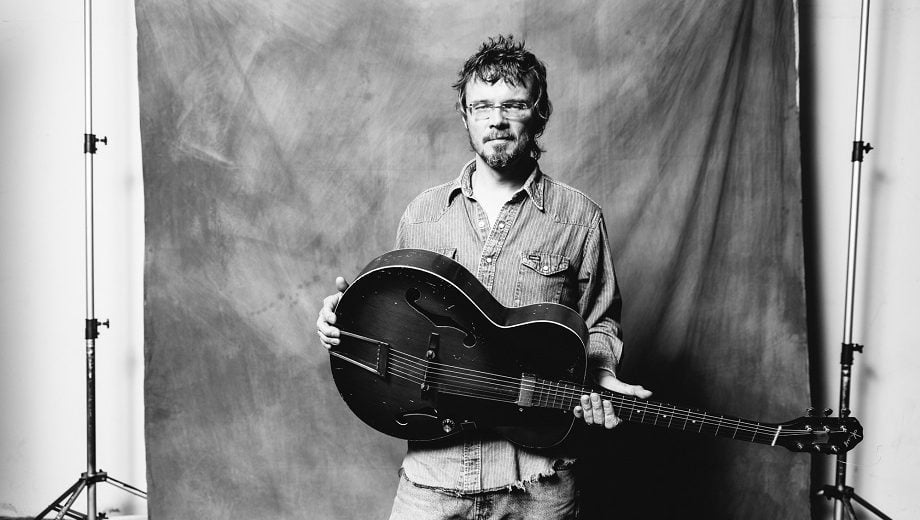
WATCH: Anthony da Costa, “Shadow Love”

Artist: Anthony da Costa
Hometown: Nashville, Tennessee
Song: “Shadow Love” (Acoustic)
Album: Shadow Love EP
Release Date: Single – May 31st; EP – June 14th

In Their Words: “This is a song that has followed me around for years. I first wrote this song back in 2015 and have performed it live with my band many times… I always had fun playing it, but never felt like it was all the way there. My friend Ruth Moody (of The Wailin’ Jennys) and I had recently been discussing the possibility of writing songs together. While working on the EP, I decided to send ‘Shadow Love’ to Ruth and asked her to write another verse. She sent me that second verse while on the road, and it haunted me for days afterwards. ‘Maybe I knew you long before I met you / a hologram, a winter mist / Not everything can last forever / Not everything can feel like this.’ The song was done. What was once a loud Weezer-rock shredder became a duet between two loves, two ghosts. I wanted to share this live, acoustic version of the song (featuring Ruth as well as Sam Howard on bass) as a capture of friends sharing a feeling in real time. Enjoy!” — Anthony da Costa


Photo credit: Jacqueline Justice

Robert Earl Keen Explores Americana in New Podcast

Years before the term Americana entered the musical lexicon, Robert Earl Keen was out on the road that goes on forever, playing his unmistakable blend of folk, country, and Texas roots music. With decades of insight to provide, he’s launched Americana Podcast: The 51st State, where he sits down with some like-minded artists for warm conversation. His first two guests are Jamestown Revival (listen) and Lucero (listen).

“Is there a substitute for close-up, in-the-same-room communication?” Keen remarks. “I’ve spent my entire career on the interviewee side of the microphone. We are trying to replicate the environment that in my experience I’ve felt the most comfortable. I’m sure as we move through this podcast journey that we’ll make exceptions or compromises, but for now we want to be up close and face to face with the artists. It’s more real.”

Keen answered some questions by email for BGS.

BGS: What prompted the idea for you to launch a podcast?

REK: As a touring band it’s easy to spend all your time working the road. One can become isolated from the current music culture. Consequently, I keep my eyes and ears open for things that keep me connected.  My producer, Clara Rose, suggested a podcast. We decided Americana was our best route. She secured the name, and started making calls to artists. It’s been an accurate way to keep in touch with the current music culture. We are standing on the precipice of an artistic revolution overlooking the most creative group of artists in the last hundred years. I didn’t know this before our podcast. I’m sure some will argue to the contrary, but because of this podcast, I’m able to contribute to the discussion.

What is it about this community of songwriters and musicians that appeals to you?

I love the warts-and-all quality of Americana. I lived in Austin, Texas, in the ’80s and it was home to the richest artistic and chaotic neutral environments anywhere. Of course, there were world-class songwriters and guitar players (Willie Nelson and Stevie Ray Vaughan), and there were legendary folk heroes (Kenneth Threadgill and The Grey Ghost) but there were unclassifiable things as well. The Uranium Savages, Spamarama, the O’Henry Pun-off, Eeyore’s Birthday Party, Max for Mayor, and an untold amount of crazy music venues. One night I went into what might be considered the first craft beer emporium in the Southwest, Maggie Mae’s, and there was a guy on stage playing pots and pans from his kitchen. Maybe Americana doesn’t encompass a pots and pans player, but I love the kitchen-sink quality of Americana.

Is there a common thread among your guests for far?

Most all the artists were either guitar players or in a guitar sound-driven band. The thread that is most apparent to me is these are all seasoned and passionate musicians. They are all committed for the long haul. Not in for the money or fame, but like me, play music because the idea of any other kind of life doesn’t appeal.

What has surprised you the most as this podcast project has come to fruition?

The interest and positive reinforcement are overwhelming. When I told family I wanted to play music for a living, except for my mom, they were less than encouraging. Even she tried to talk me into going to piano-tuning school to have something as a backup. When I told my friends in the music industry that I wanted to jump from an independent label to a major label, they asked, “Why?” When I tell people that we’re doing a podcast, they send me confetti texts before they even ask what kind of podcast. I don’t know what the difference is but it’s a big difference.

What do you hope the fans will take away from the first two episodes of Americana Podcast?

I hope they hear in the first three minutes of this podcast that we’re dedicated to the highest quality of production values and we are adamantly committed to shining a ten thousand candle power light on the beauty and magic of Americana music. Anything less means we should up our game.


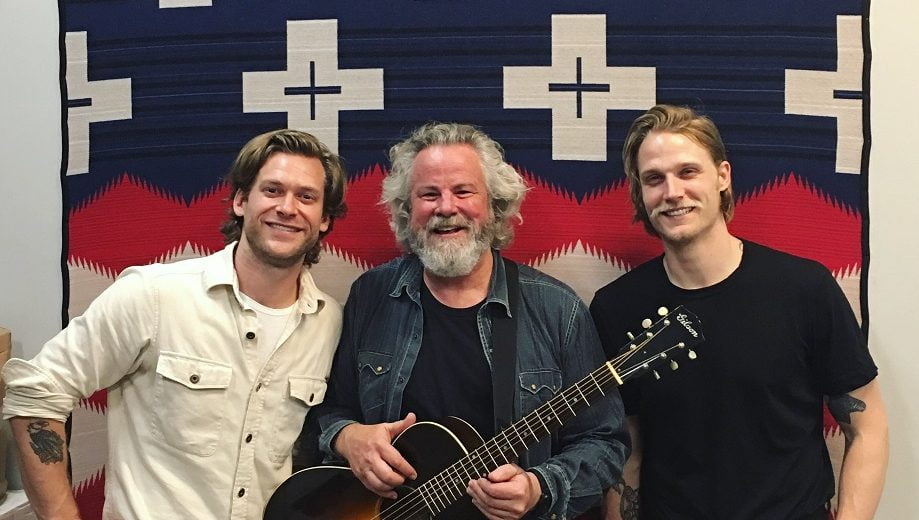
Top photo (L-R): Jonathan Clay of Jamestown Revival, Robert Earl Keen, Zach Chance of Jamestown Revival
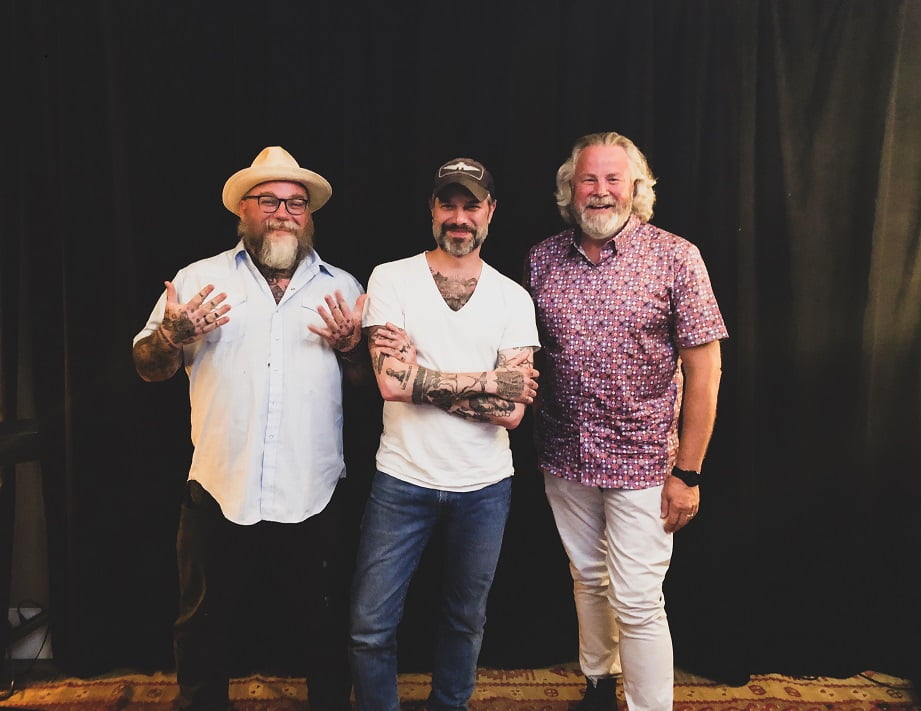
Middle photo: Lucero’s Brian Venable and Ben Nichols with Robert Earl Keen
Photos used with permission.

JJ Cale’s Unheard Songs Collected on ‘Stay Around’

When it came to guitars, gadgets and such, JJ Cale bought plenty of stuff and more often than not wound up giving it away eventually. When it came to his music, however, Cale was not one to cast anything aside. Over the decades of his long and storied career, he amassed hundreds of recordings of songs, fragments, alternative mixes and other sonic ephemera. Fifteen songs, all complete and finished by Cale himself, have been rescued from his hard-drive vaults for the posthumously-released new album Stay Around.

“I wanted to make sure everything on this was really ‘new,’ songs that people hadn’t already heard,” says his widow, Christine Lakeland Cale, who oversaw the project. “You know, you go on YouTube and there’s a bad-sounding grainy video from a gig somebody recorded on their phone. I tried to find things that hadn’t even been out that much. I was looking for the most Cale I could give people.”

Cale, who died from a heart attack in 2013, was a marvel of consistency as a recording artist. Well beyond “After Midnight,” “Cocaine,” and his other signpost compositions, he left behind more than a dozen albums long on relaxed, amiable grooves. So it should come as no surprise that Stay Around offers that same level of quality, even though it consists of recordings spanning more than three decades.

The album’s tracks range from solo recordings to full-band arrangements, with highlights including the loping ode to road life “Chasing You” to the title track’s romantic crooning. Christine compiled the material in collaboration with her late husband’s longtime manager Mike Kappus, who was well-versed in Cale’s working methods. It wasn’t unusual for Cale to leave songs sitting around for years, or even decades, before releasing them. “Roll On,” the title track of Cale’s final 2009 studio album, was a song he’d had in the bag since the mid-1970s.

“I was kind of in on the complete evolution of it all,” Kappus says. “He would send me cassettes, with something like a picture of his driver’s license as artwork, just this private little clever thing between us. We’d be talking about the next album and not everything he sent would make it. At one point I told him, ‘Man, you’ve got a couple of really good, solid records here.’ But the temptation for any artist is to do what’s fresh and that’s what would happen. So there was all this material left over.”

Christine admits it took her “a couple of years of walking around foggy and not all there” until she felt up to diving into Cale’s recorded archive, which was not stored on a pile of tapes. Instead, Cale left behind about 50 hard drives on Alesis HD24 machines, a format Christine says has been obsolete for years. But Cale didn’t upgrade beyond that because the format worked and he was comfortable with it.

“He used to joke to people, ‘I’m too old to learn something new, I like what I have and I use my ears, not my eyes,’” Christine says. “So he never made the transition to Pro Tools. He could hear peaks of distortion that had to come out, instead of seeing a line on a screen to edit. He liked the familiarity of his home studio because he didn’t have to spend any time setting things up — just flip the switch and get creative.”

But just because Cale’s recording methodology was to set it and forget it, one shouldn’t conclude that he was any sort of behind-the-times Luddite. Cale was a skilled studio technician who “loved engineering more than anything else,” according to Kappus, and he had a lifelong fascination with the tools of his trade. After buying new gear or instruments, Cale would usually take them apart and rebuild them. He’d do the same thing with records, after a fashion, going to record stores and buying the entire top 10 bestsellers to study.

“He’d want to check out whatever people were buying,” Kappus says. “Not to try and copy, but to check the engineering and production aspects. We were at McCabe’s Guitar Shop in Los Angeles once, where most of the people working were pretty into acoustic or folk music. And Cale starts talking about the mixes on ‘Back That Ass Up’ and some new Britney Spears record. Everybody there was going, ‘What?!’ They figured he’d only know about Willie and Waylon. But he had a lot of curiosity and he’d appreciate the mixing and recording of that stuff in a very true, knowledgeable way. It was the furthest thing from snobbery.”

Of particular note on Stay Around is its one song that Cale didn’t write, “My Baby Blues” — which Christine calls “my nod of self-indulgence,” because she wrote it herself. “My Baby Blues” is a song she and Cale recorded in 1977 at the first session where they met. Cale’s version here dates back to 1980 and Christine considers it a real find. But her favorite cut on the album is the title track, a meditation on the pleasures of being with the one you love (“Stay around, stay around, girl/And let’s make love one more time”).

“That one just floored me when I found it,” Christine says. “I couldn’t believe that one, and the guys at the label came up with the idea to make it the title because, ‘We hope his music stays around.’ That’s brilliant, how come I didn’t think of it? But I was too close to it. It takes a village.”

Some of the solo recordings are particularly intimate, especially “If We Try,” which comes by its kitchen-table feel honestly. That was one of his favorite places to record when he was home alone, and the track feels “as if you’re right there sitting at the table with him,” Christine says.

While Christine isn’t yet thinking about a follow-up, there’s more than enough material still in the vaults to make another album, which could be 100 percent previously unheard material the way this one is. And she thinks that the spirit of her late husband, who would have turned 80 last December, probably approves.

“I have had a lot of weird things happen,” she says. “Probably more so during the foggy period. But even now, things happen where I think, ‘Somebody’s just making sure things go this or that way.’ This world can’t just be it. I do think there’s something once we leave here, I just don’t know what. There’s got to be another level of intelligence in the universe because we’re such a flawed species. Without sounding too much like an old hippie, it seems like there’s the ability to let somebody know it’s okay. And he has.”


Photo credit: Stephane Sednaoui

Sing to Me: Luther Dickinson & Sisters of the Strawberry Moon

Luther Dickinson trusted his intuition when he set aside two or three days to make an album with like-minded friends who had never met each other. By pulling together these kindred spirits — now known as Sisters of the Strawberry Moon — Dickinson crafted a beautiful roots collection, simply titled Solstice.

“It was amazing that we all converged. We picked two or three days, met in Mississippi, and recorded the record,” he says. “Everybody brought two or three songs and we just took turns backing each other up.”

The luminous cast include Birds of Chicago, gospel group The Coco Mamas, Amy Helm, Amy LaVere, and Shardé Thomas, with finishing flourishes from fiddler Lillie Mae and B3 organ master Charles Hodges. Intimate as well as immediate, Solstice serves as a testament to the power of fast friendship.

The Bluegrass Situation caught up with Dickinson, Amy Helm, and Birds of Chicago’s JT Nero before a show at Nashville’s City Winery.

BGS: You only had two days together, people were bringing their own songs, and not everybody knew each other. You must have been operating on instinct. Is that fair to say?

Dickinson: Totally. I feel the most alive when I’m producing because you’re in the moment and you’re making instinctual decisions, but you’re drawing from your whole life and all of your experiences, and everything I learned from my dad and everything he’s taught me, and everything he’s learned from all the producers who taught him. But also you have to be open and sensitive to what’s going on in the room.

It really is a very exhilarating feeling, producing records. And sometimes it can go completely wrong if you say the wrong thing. But I really do love it. Yeah, you’re running on instinct and you’re running on blood and guts. But it’s like doing anything when you’re in the zone, whether you’re an athlete or a pilot. You’re just trained to be in that moment. Time slows down and everything comes together.

Amy, why did this concept appeal to you, to go to Memphis and make this record?

Helm: I mean, any invitation to go hang out with Luther and a bunch of cool people in Memphis is an instant yes. I had not met any of the other people on the project but I was excited about it and I trust him and trust his compass of coolness. It was a delight to be down there and hang out in Memphis. I rented a Jeep and drove around down South, which is always one of my favorite things to do — to just roll around down there. My aunt Mary lives in Memphis so I got to see her. It was a really, really nice time, and it’s led to some incredible friendships that have turned into other projects. Ally [Allison Russell from Birds of Chicago] and JT came and sang on my record that I made with Joe Henry. Now we’re doing this tour with this record. Those guys made a record together afterwards, so it’s been a nice chain reaction – the right kind of chain reaction.

For this record, everybody brought in their own songs, but the record feels unified as a whole. Do you sense a common thread that runs through the album?

Helm: I would say that, the spirit of friendship is where everybody was coming from with it. So there’s a relaxation that happens with that for me, and I’m sure for these guys. When it’s your own thing and the clock is running and there’s money going down the drain fairly quickly, you’re trying to make it work and hope you got the best performance, it’s really easy to get inside that head for me. So if you’re in a cool room in the middle of Memphis, and you’re eating great food and having great conversations on your way to the studio, and then you get to hear a singer like Allison Russell, that’s it, you’re there.

Nero: The thing that will always be particularly special about this record to me is that you can hear lifelong friendships being made on record. We hadn’t met each other, really, but we’re a family now, and part of that is Luther’s instincts. That’s the thing with music – there are a million things out there that are brilliant but they wouldn’t easily be simpatico with what we’re doing. So finding your tribe members is what it’s all about. I think Luther had an inkling that it would be that way, but you never know – and it was that way. And you can hear that happening on record. It’s rare you get to bottle that lightning.

Dickinson: Man, the music is just an artefact of our friendship. I hope that’s maybe what they’ll feel. A warmth, and we all have longing in our music, and we’re singing about our musical families and our loved ones who aren’t with us. So, hopefully we will generate a place of love. It has a grandmother’s Sunday dinner type of vibe to it.

I like “Sing to Me” — there’s power in that song. What mood were you hoping to set with this recording of it?

Helm: I recorded that song on my first record, with my dad playing drums on it, but I recorded it then with no harmonies. I knew that there were going to be a lot of other voices there this time, and I’ve always wanted to hear that song with an angel choir on it. So I brought it in for that, hoping to gain that, and it became a very cool, vibey thing. I love the way it turned out.

What goes through your mind when you hear that song now, in its new incarnation?

Helm: Just really the mastery of a master player, and how it can change a song and make you sound better! [Laughs] That’s one of the things! Because the playing on it is so exquisite, with the organ that Charles Hodges put on and the guitar that Luther put on. And just also getting to sing it with Ally and finding the magic of that vocal collaboration, and the overtone that she and I get.

Dickinson: Do you remember that take when they walked in? Like, that was the moment that you guys met, right?

Helm: Yeah, that was it.

You met basically in front of a vocal mic?

Helm: We did! They came in and sat down. Ally sat there cross-legged and started listening and closing her eyes. I don’t know, I was a little intimidated …

Dickinson: But that second take — that was the one.

How often did that happen, with the second take being the one?

Dickinson: Oh man, some of this record, especially on Ally’s songs, are the run-throughs! We had to go back and save the run-through because she pours blood and guts into the microphone. Just this heartbreak, I get goosebumps thinking about it! I usually edit two takes together – like the second half of the first take, and the first half of the second take.

But a lot of her stuff was the run-through and we’d patch it up from there. That’s the great thing about modern technology – you can capture moments. Amy LaVere, on the bass, she’d done her homework. She knew every song and had them charted out, and the fact that she was nailing the run-throughs even, really made it work. She really did a good job.

There was a lot of re-interpreting going on, with some of the songs being recorded a long time ago, but Shardé has a real unique beat. She’s a character, man, and growing up with her grandfather [Otha Turner]’s fife and drum music, but also growing up with Beyoncé, who is her idol, she is a very unique musician with great instincts. What I like about her is that you can bring a country song to her, and she won’t play anything near a country beat. And I love that!

Amy, what does that feel like when you’re singing so closely with these people you just met?

Helm: You know what, that is my favorite of all time! That’s the thing that makes all of us gamble everything else in our lives, for better or for worse. [Laughs] For financial distress or not, to keep on doing it because there’s nothing more satisfying than finding that. It revitalizes my faith, honestly. It’s like a spiritual ease that I feel when I get to do that stuff.

It reminds me that all things are possible, and all things are new upon each song and each recording. And it’s limitless, the people you can connect with and interact with in music. There’s such joy in that way. I think for people who make it and for people who listen to it, you’re having that same experience. Following that and finding that – as you can see, I could go on and on about this. It’s magic for me.


Photo credit: Joshua Black Wilkins
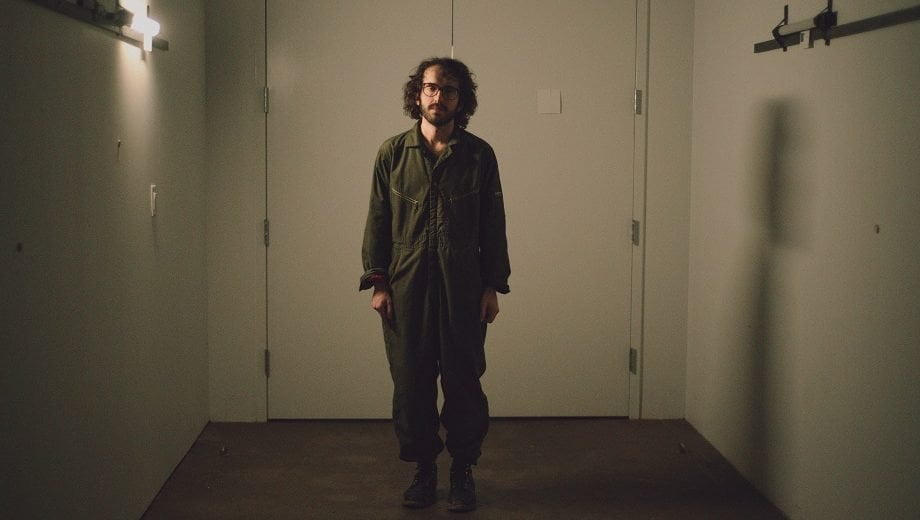
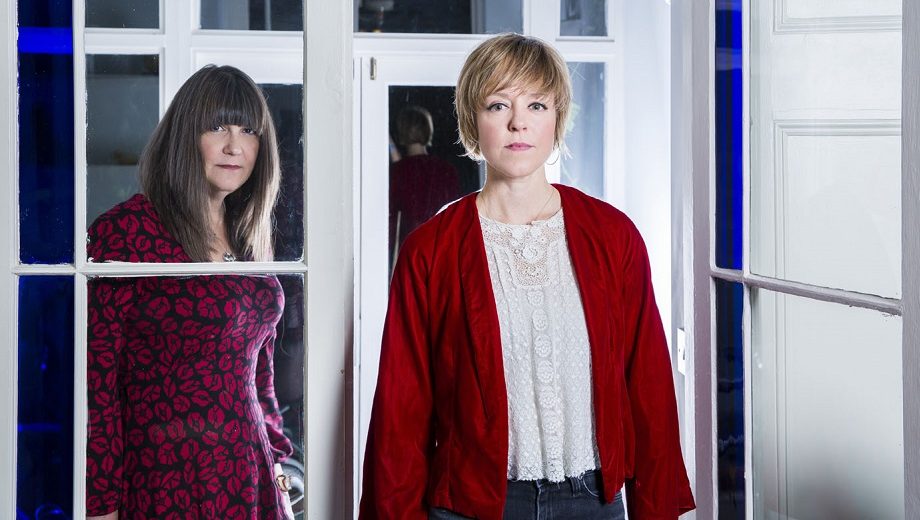
Baylen’s Brit Pick: Marry Waterson & Emily Barker

Artist: Marry Waterson & Emily Barker
Hometown: Marry is from Kingston Upon Hull, Yorkshire; Emily grew up in Bridgetown, Western Australia, but now lives in the UK
Latest Album: A Window to Other Ways

Sounds like: A folkier Liz Phair and Lucinda Williams

Why You Should Listen: Is there such a thing as a superduo? There probably should be. And if there were, this pair would be the definition: Emily Barker, named UK Artist of the Year at last year’s UK Americana awards, has a devoted following in her adopted homeland; Marry Waterson, meanwhile, bears the name of British folk royalty. The two women met at a songwriters retreat organised by Liverpudlian singer-songwriter Kathryn Williams, and their connection, born out of a mutual respect and appreciation, was so strong they decided to keep the partnership going after back in the “real” world.

For all their individual, independent success, it turns out that this collaboration suits them very well indeed. Marry hails from the Waterson-Carthy folk clan – her mother Lal, uncle Mike and aunt Norma have lifetime achievement gongs a-go-go — and her vocal style certainly echoes her famous forebears. But Barker’s Memphis-drenched vibe pushes her sound into new realms and while A Window to Other Ways is very much folk it is also at times quite indie rock.

It’s also no-holds-barred on the lyrics front, which speak powerfully of the world we’re all living in right now. Take “Little Hits of Dopamine,” a fantastically trippy reflection on “one-click communication.” “I’d rather be rock’n’rolling, but you just keep on scrolling”, the women croon in different octaves, as text message sounds bing in the background.

At no time are you ever in any doubt that these two have something to say and no one is getting in their way — which sums up their music, too. This project captures a special moment when two great musicians find unexpected synergy – while the songs themselves keeps a close eye on all the little things that make up a life. Sometimes you just know people were meant to meet and this is one of those times.


As a radio and TV host, Baylen Leonard has presented country and Americana shows, specials, and commentary for BBC Radio 2, Chris Country Radio, BBC Radio London, BBC Radio 2 Country, BBC Radio 4, BBC Scotland, Monocle 24, and British Airways, as well as promoting artists through his work with the Americana Music Association UK, the Nashville Meets London Festival, and the Long Road (the UK’s newest outdoor country, Americana, and roots festival). Follow him on Twitter: @HeyBaylen

Photo credit: Rosie Reed Gold

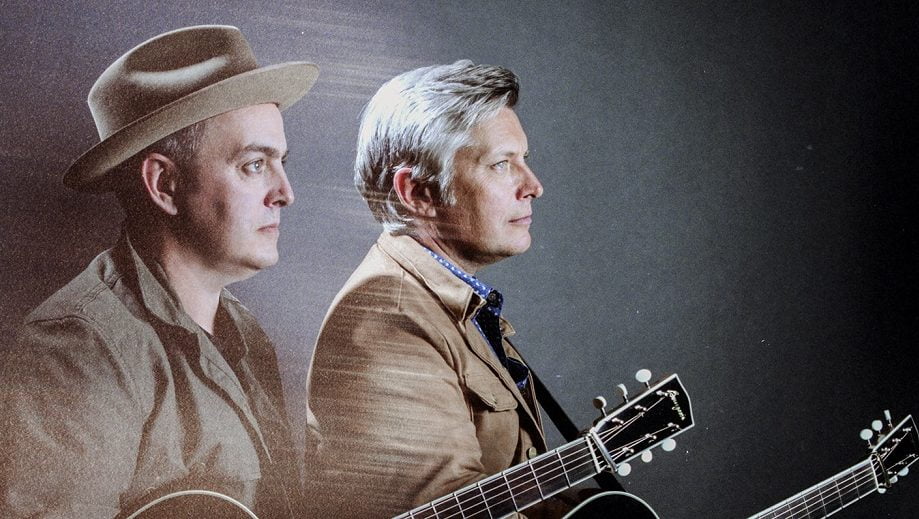
WATCH: The Gibson Brothers, “Sweet Lucinda”

Artist: The Gibson Brothers
Hometown: Ellenburg Depot, New York
Song: “Sweet Lucinda”
Album: Mockingbird
Label: Easy Eye Sound

In Their Words: “We wrote ‘Sweet Lucinda’ with Dan Auerbach and Joe Allen. Before cutting it, I knew we had a song that lent itself to harmony, which it does, but then the band got a hold of it in the studio. What a GROOVE! I remember the guys being pumped after we got the take, lots of smiling and laughing. Here we’re recording with all these legends who have cut countless songs, and they’re excited by what we’ve all just done. I think of that every time I hear this song.” — Eric Gibson, The Gibson Brothers


Photo credit: Alysse Gafkjen

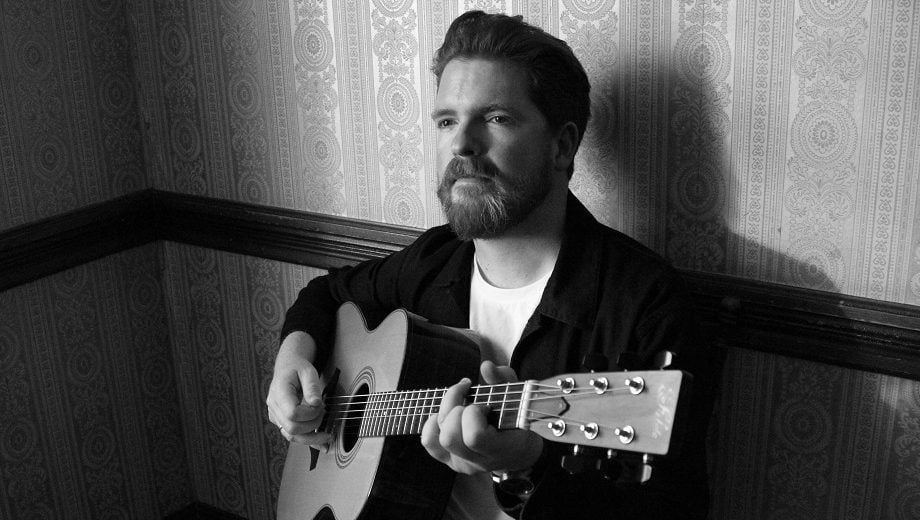
BGS 5+5: John Smith

Artist: John Smith
Hometown: Essex, UK
Latest Album: Hummingbird
Personal nicknames (or rejected band names): Smitty (Joe Henry and The Milk Carton Kids started calling me this around the Invisible Hour recording sessions and it stuck. I like it). Johann Schmidt (when on tour in Germany and Austria). When I first started gigging I had a little outfit of bass, cello, and violin. I called us The Wooden Ducks for about five gigs. Since then it’s been the John Smith Trio. I’ve always admired jazz musicians and to me, the words Trio and Quartet are innately very cool words to use, even for a folkie like me.

What’s the toughest time you ever had writing a song?

I remember it took almost a year to write “Great Lakes.” I had the first verse and the chorus but I spent months trying different ideas, looking for the right path and tripping over myself the whole time. That’s what got me into co-writing. I started to share ideas with others which opened up my creative thinking in a new way. Suddenly I felt more receptive even to my own ideas. I finished writing “She Is My Escape” with Joe Henry and then “Great Lakes” revealed itself to me. I’ve been into co-writing since then.

What’s your favorite memory from being on stage?

I used to play electric guitar with David Gray. There was a moment during a slide solo at Red Rocks when the band went quiet. I had a very brief moment of very loud guitar heroism with the sun going down over the mountains and I didn’t screw it up! It’s so easy to screw up a guitar solo though. I think they are often best avoided or attempted alone at home. I played a bum note in the Royal Albert Hall around that time and half the crowd laughed. I had to die a little inside before I was able to see the funny side. My classical musician friend told me, “Darling, you’re no one until you’ve whacked out a spare at the Royal Albert Hall.”

In Amsterdam a guy in the audience asked if he could play and sing a song on my guitar, and he performed a beautiful rendition of one of my own. That was a kind of magic. It’s one thing seeing it on YouTube but another entirely when it’s onstage at your own gig. That would be my current favourite memory.

What was the first moment that you knew you wanted to be a musician?

When I was 11 years old I had already passed a few grades on the piano. I thought nothing of it beyond the fact that I was simply playing piano in school. I enjoyed music of course but I don’t think I knew that I could live my life through its lens.

So my dad sat me down one day and put on the Physical Graffiti LP and I heard “Kashmir” by Led Zeppelin for the first time. It completely blew my mind, a totally definitive experience. I saw a different world on the other side of the needle. Doors opened in my mind and I felt alive in a very different way to before. It might sound a little hyperbolic but it’s true. I knew right then that I wanted to make music and I actually needed to play guitar. My dad gave me a Stratocaster and that was it for me.

What rituals do you have, either in the studio or before a show?

I learned early on from Joe that if you’re going to work you need to dress the part. Not just for yourself but for the people around you. When I’m in the studio I make sure to iron my shirt and comb my hair. I work harder and concentrate well if I’m holding myself to a reasonably high standard. The same goes for being onstage. I believe you should look good for the people who’ve paid to see you.

In the dressing room, or maybe it’s just a corridor or a bathroom, before a show, I warm up with a song or two and write a couple of notes. I don’t believe in carrying much around with me. I try to use what’s in my guitar case.

Since food and music go so well together, what is your dream pairing of a meal and a musician?

I once ate a bowl of olives at an Allen Toussaint concert and those were the best olives I ever tasted. I like to listen to Ry Cooder when I eat. I reckon Bop Til You Drop is the record I’ve listened to the most in my life. My dad used to put it on every time we had friends over for dinner, and he cooks Indian food. Therefore I like to cook curries and play Ry Cooder records for my friends. I don’t know a better way to do it. If ever I have a clear day off at home, I’ll spend it cooking and listening to Freddie King, Joni Mitchell, Keith Jarrett. Sometimes I’ll crank up Mastodon to help chop the onions.

About the Playlist: Songs and interpretations by the artists who have influenced my life as a folksinger, not only in the musical sense but in the way I think about the bigger picture; each of these records has helped to guide me to where I am now.


Photo credit: Rose Cousins

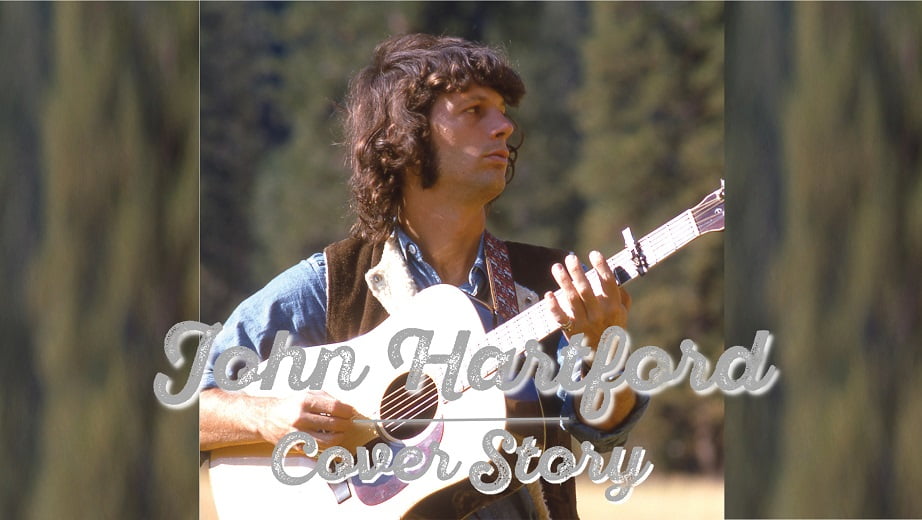
New John Hartford Set Shows Evolution of a Singular Figure

Sum up the importance of John Hartford in one sentence?

That’s the challenge given to Skip Heller.

Five minutes later, after a stream-of-consciousness run of superlatives, analogies and tangents — songwriter, entertainer, transitional figure and simply great are among the terms employed, as is the declaration that Hartford was a “gateway drug to bluegrass music” — Heller finally sighs.

“You are talking with someone who, with money he got on his fourth birthday, bought a John Hartford record,” he says.

In other words, Heller is just too deep into all things of Hartford’s life and music to boil it down to one line. While that worked against coming up with a neat summary, it served him very well as compiler and producer of the new Backroads, Rivers & Memories album.

It’s an illuminating and lively collection of previously unreleased early- and mid-1960s recordings that pre-date and pre-sage Hartford’s soon-to-come impact as a major songwriter (the 1967 Glen Campbell hit “Gentle on My Mind”), a “newgrass” pioneer (the much-beloved, still-unique Aereo-Plain album), and a solo banjoist, fiddler, foot-stomper, noted wit and colorful chronicler of life on Mississippi (a St. Louis native, he piloted the steamboat Julia Belle Swain every summer for much of his life).

And it comes as the presence and adoration of Hartford, who died in 2001 at 63 of Non-Hodgkin lymphoma, has had a resurgence, with a new legion of young fans discovering his music and prominent posthumous places on the soundtracks to the Coen Brothers’ O Brother, Where Art Thou? and 2017’s Lady Bird. For the latter his melancholy “This Eve of Parting” underscores a key scene, his sad baritone conveying the distress of the mother, Laurie Metcalf’s character.

But the genesis of the set can be traced to a fateful ’68 evening in Heller’s family’s Philadelphia living room, the TV tuned to CBS. It was a moment for the then-tyke comparable for him to what many experienced a few years prior watching the same network when the Beatles made their American TV debut on Ed Sullivan’s show.

On the screen was The Smothers Brothers Comedy Hour, and Hartford, a regular on the show picking banjo and appearing in some sketches, was duetting with Glen Campbell on “Gentle on My Mind.” That appearance essentially previewed Campbell’s own variety show that would be inaugurated soon as the Smothers’ summer replacement, with Hartford a major presence on it as well — that was him each week standing up in the audience to pluck the same song’s intro on banjo to start the show.

“If you were inclined toward music and you were going to spend your money on a record, it was going to be that or a Monkees record,” he says, allowing that perhaps Campbell would have been the attraction here for most, “but my parents already had those records.”

The album in question was either 1967’s Earthwords & Music (which included the version of “Gentle on My Mind” that caught Glen Campbell’s ear) or the next year’s Gentle on My Mind & Other Originals (piggybacking on Campbell’s massive hit with the song). He had them both, one that he bought, the other given to him by his “cool uncle,” but he’s not sure which was which. Regardless, the boy’s path in life was set.

So let’s — pardon the expression — skip ahead to the present. Heller, an accomplished and respected roots-and-far-beyond musician based in the Los Angeles area, stands as perhaps the foremost authority on his hero’s life and music, and this new album came from that and from the close relationship he developed with Hartford (opening for him at a Philadelphia concert in 1996 remains a personal highlight) and with his family. The family, including Hartford’s son Jamie, a guitar ace and singer who has carried on some of his dad’s traditions, had already released some archival material and talked with Heller about other possibilities. Ultimately, Heller was sent an extensive digital library and set to assessing, quite the task as Hartford was an obsessive taper.

“He had a tape of pretty much any show he played,” Heller says. “He also had a tape of every jam session.”

After contemplating a compilation of live recordings, Heller hit on the notion of building an album from Hartford’s ‘60s songwriting demos, adding to that some airchecks from his regular radio show on WHOW in Clinton, Illinois (near St. Louis) and — a real treat for fans — the entire eight-song output of his early Ozark Mountain Trio, pretty straight bluegrass.

Overall, it shows an evolution of a singular figure, someone who took traditions and made them his own, infused them with his distinctive talents and personality, and in turn shaped sensibilities of others to come. Along the way there are demos of “Gentle on My Mind,” “Eve of Multiplication,” “This Eve of Parting,” and other songs he would record for his late-‘60s run of albums on RCA. And, as a tantalizing if brief and ephemeral bonus, there’s a 30-second excerpt from a rehearsal with a band of Nashville pros of what would become “Steam Powered Aereo Plane,” which a couple of years later would become a centerpiece of that forward-thinking album he made with fiddler Vassar Clements, guitarist Norman Blake, Dobro master Tut Taylor, and bassist Randy Scruggs.

“The Ozark Trio and radio things, those are the makings of John Hartford,” Heller says. “And you can hear how when he starts finding his own voice through this, Pete Seeger was the transitional figure who was around. He really gets clearer about who he’s going to be. His batting average as a songwriter gets much better, a combination of Pete Seeger and Roger Miller. He gets his elliptical words stuff from Miller.”

Heller found a lot of epiphanies and revelations in the course of putting this all together. One that may strike many is in the Ozark recordings.

“If you didn’t know that was John on banjo, you’d go, ‘Who is that?’” he says. “He’s amazing. Not doing anything J.D. Crowe or other of the ‘real’ guys would be doing, and you can hear Earl [Scruggs] on it, and maybe also Doug Dillard’s influence. One of the things in this album for me was to show how incredibly grounded he was in traditional bluegrass. He could have gone on and just done that, could have made a life of that, just be a banjo player. And on those radio airchecks, he is one of those old-time country guys. To hear that professionalism before he even got to Nashville was an epiphany.”

But even more so, Heller was astounded by how meticulous Hartford was in the songwriting process.

“The revelations to me were often how he would evolve a piece of material in the process of writing before he ever played it,” he says. “There are songs for which we had four, five, six versions. He really could get in the weeds. Any really good songwriters can.”

The biggest questions may revolve around the “Aereo Plane” clip. Why just 30 seconds? And what can we learn from that short passage?

“The whole rehearsal of ‘Aereo Plane’ is like 40 minutes,” he says. “You hear the band that’s on the RCA records rehearsing it — and not quite getting it.”

These are ace musicians, Heller notes, some of the top that Nashville had to offer. But Hartford’s vision has moved in a way that they couldn’t quite follow.

“Once he hits [the album] Aereo-Plain it’s all going to change,” he says, citing that later album’s fusion of old-timey string band gospel and progressive flights of fancy, spiked by touches of both heartfelt tenderness and witty Dada-hippie absurdities (including the two spellings of plane/plain) only hinted at in his earlier works.

“To me that feels like the natural cut-off point, the end of the RCA years. Why? The band he has can’t quite play the next thing he had in mind.”

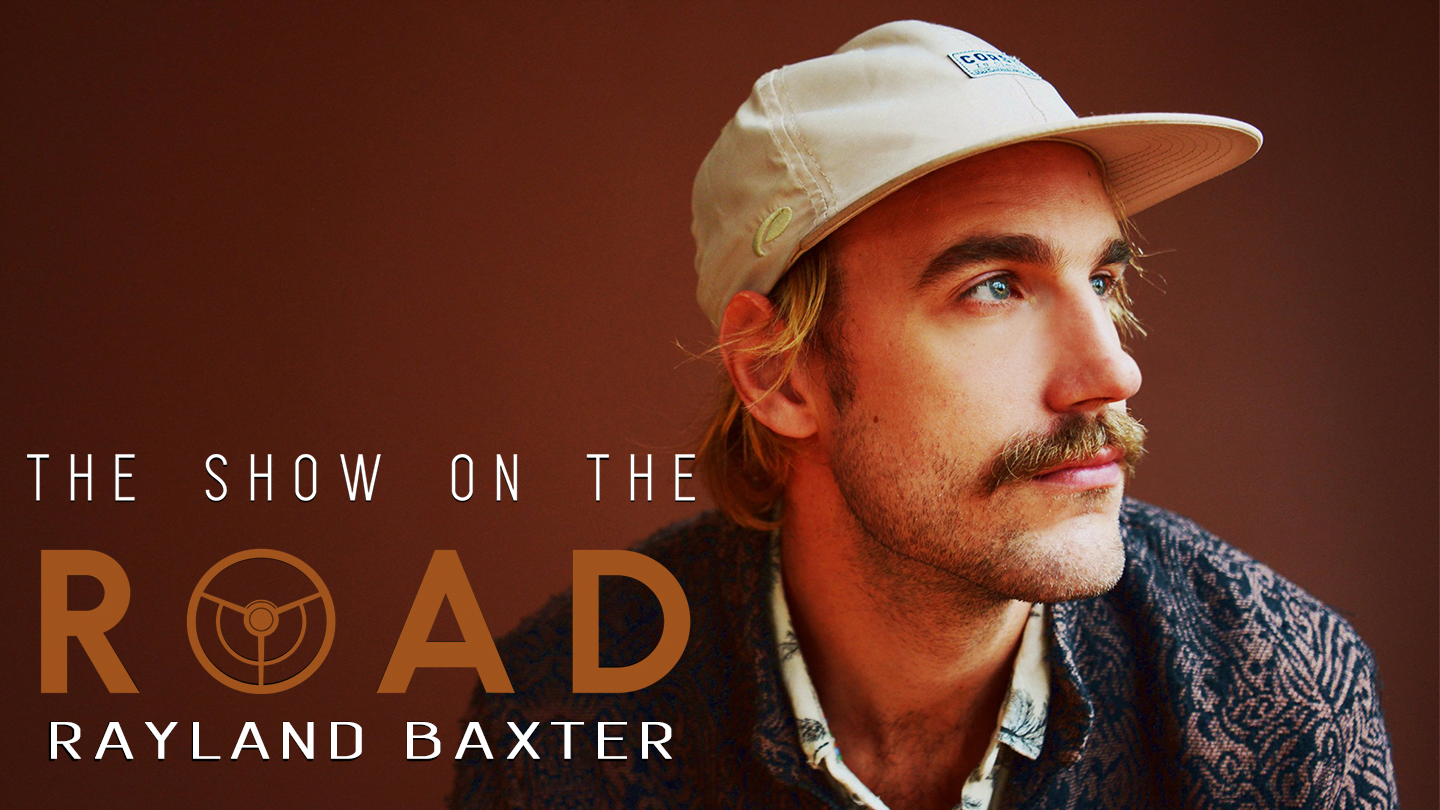
The Show On The Road – Rayland Baxter

This week on the show, Z. meets up with songwriter and rock ‘n’ roller Rayland Baxter on the road in Las Vegas.


LISTEN: APPLE MUSICMP3

Beyond Rayland Baxter’s mellow, easy going demeanor lies a deeply perceptive and sharp-as-a-knife craftsman who takes his songwriting deadly serious. His newest record, Wide Awake, deepens his focus and finds him questioning the very existence of the American dream being bought and sold all around us. 

LISTEN: Steel Blossoms, “Kentucky’s Never Been This Far”

Artist: Steel Blossoms
Hometown: Nashville, Tennessee
Song: “Kentucky’s Never Been This Far”
Album: Steel Blossoms
Release Date: April 26, 2019
Label: Billy Jam Records

In Their Words: “‘Kentucky’s Never Been This Far” is the first song we ever recorded that we didn’t write. The second we heard it, we looked at each other and said, ‘We need this song.’ We both travel so much and are constantly away from our loved ones, that sometimes 100 miles feels like a million miles away. This song is so beautifully written and what Jerry did with the instrumentation is just amazing. We are so lucky to have it on our album.” –Steel Blossoms


Photo credit: Stacie Huckeba