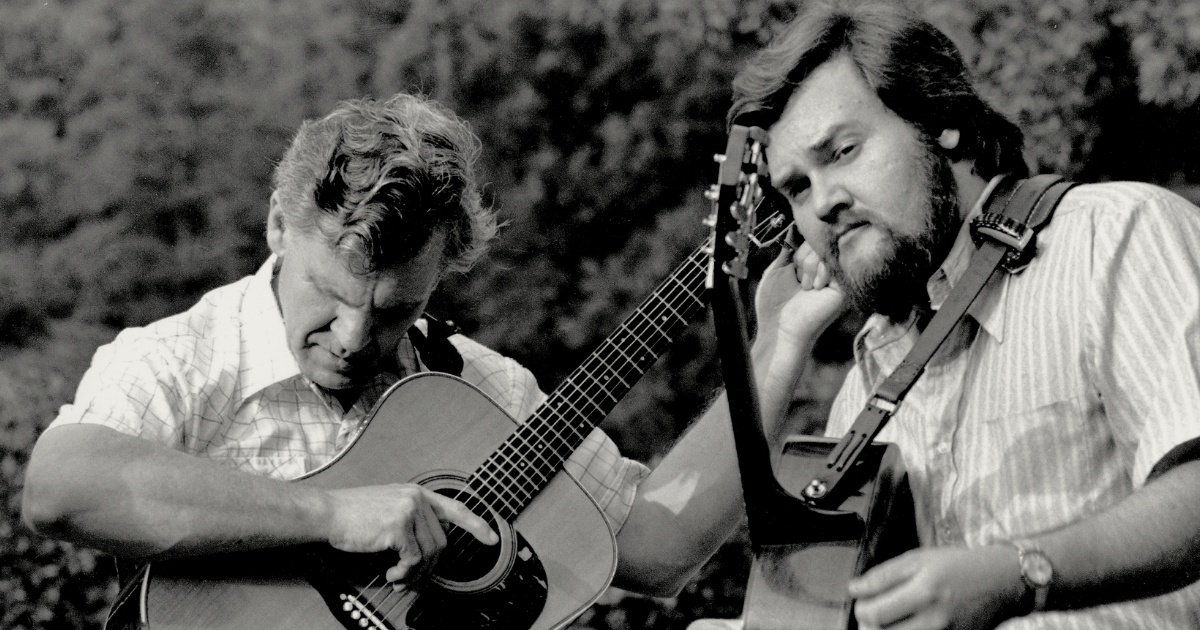
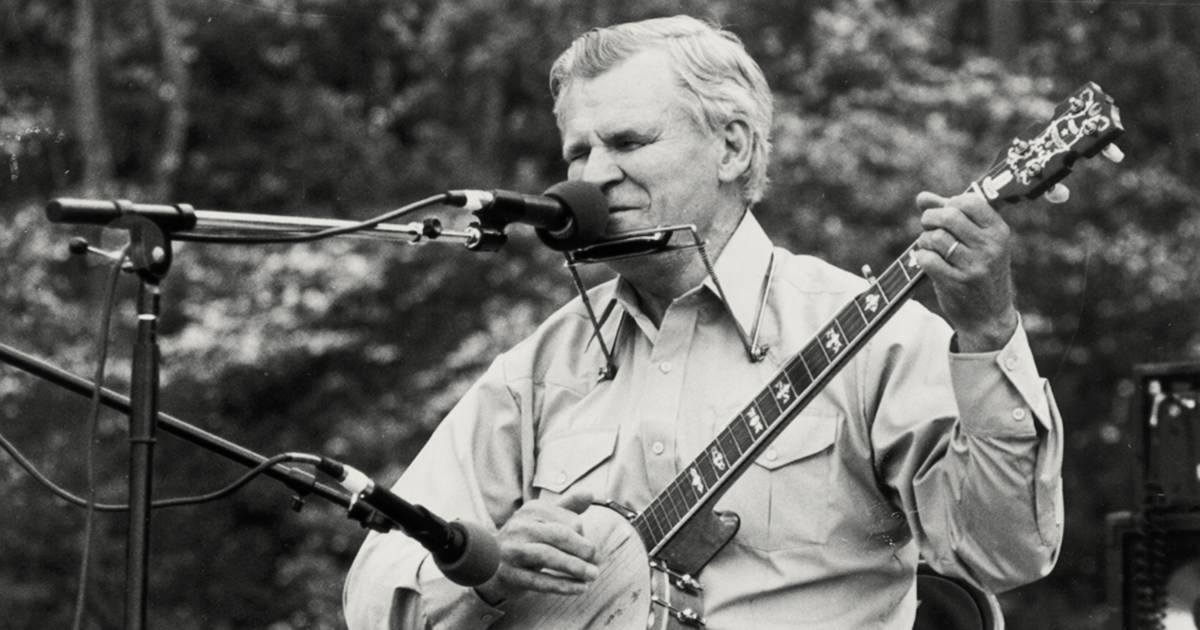
It’s no secret that Earl Scruggs and Doc Watson were great friends, collaborators, and mutual admirers. Both of the bluegrass, old-time, and mountain-music stylists took inspiration and borrowed heavily from the other across their careers, whether they were making music together or separately in any of their many endeavors. The moments they came together, though – from The Three Pickers album and concert film, to David Hoffman’s iconic backyard jam session film of the Scruggs and Watson clans picking together, to many more appearances and recordings – were always magical. Two legendary stylists bouncing musical ideas off of each other as only these two could.
In honor of our Doc in December series for Artist of the Month, we’ve partnered with our friends at the Earl Scruggs Center in Shelby, North Carolina, to bring you an exclusive look inside their collection and archives at photos of Scruggs and Watson together. The Center’s executive director, Mary Beth Martin, pulled a selection of historic photos from the collection as well as a handwritten quote directly from Scruggs’ notes about Watson and his influence:
“There are two people’s sound no man can, in my estimation, duplicate,” Earl states in a notebook. “Of course I’m referring to Mama Maybelle and Doc Watson. I’ve had the pleasure to work [with] and visit these people. I will never cease to admire the courage of these people.”
You can certainly hear the impact and influence of Watson and Maybelle Carter on Scruggs’ playing, especially his approach to acoustic guitar, when he would most often fingerpick the six-string.
“Earl had enormous respect for Doc and admired him deeply,” says Martin of the Earl Scruggs Center via email. “Both grew up in humble North Carolina homes surrounded by rich musical traditions and went on to leave an incredible mark on music. Having Earl’s personal memories and photos of Doc in our collection makes their connection feel especially meaningful.”
Over the course of their careers in roots music, Scruggs and Watson performed, collaborated, and recorded together dozens and dozens of times. We’re very proud to be able to share these photographs from the Earl Scruggs Center Collection to celebrate the cross-pollination of these two Bluegrass Hall of Famers and Doc in December.
The Earl Scruggs Center is located in downtown Shelby, North Carolina, and celebrates the life, legacy, and groundbreaking sound of Earl Scruggs. Their collection includes many treasured Scruggs family objects and remarkable pieces from Earl’s career – including more than 2,000 photographs. In January, they’ll install new interactive exhibits that dig deep into the roots of the region’s music and the history of bluegrass. The entire ESC team is excited to welcome everyone back to the museum when they reopen on February 3, 2026, after renovations and completion of the new exhibits.
Beyond the museum, the Earl Scruggs Center team are also restoring the Earl Scruggs Homeplace in the Flint Hill community of Cleveland County, bringing Earl’s childhood home back to the formative era that shaped him as a musician.
To stay in the loop and to catch upcoming Earl Scruggs Center events like the Earl Experience Banjo Camp, visit their website and connect with them on socials. We hope you enjoy our special photo story with our friends at the Earl Scruggs Center celebrating Earl Scruggs, Doc Watson, and Doc in December.
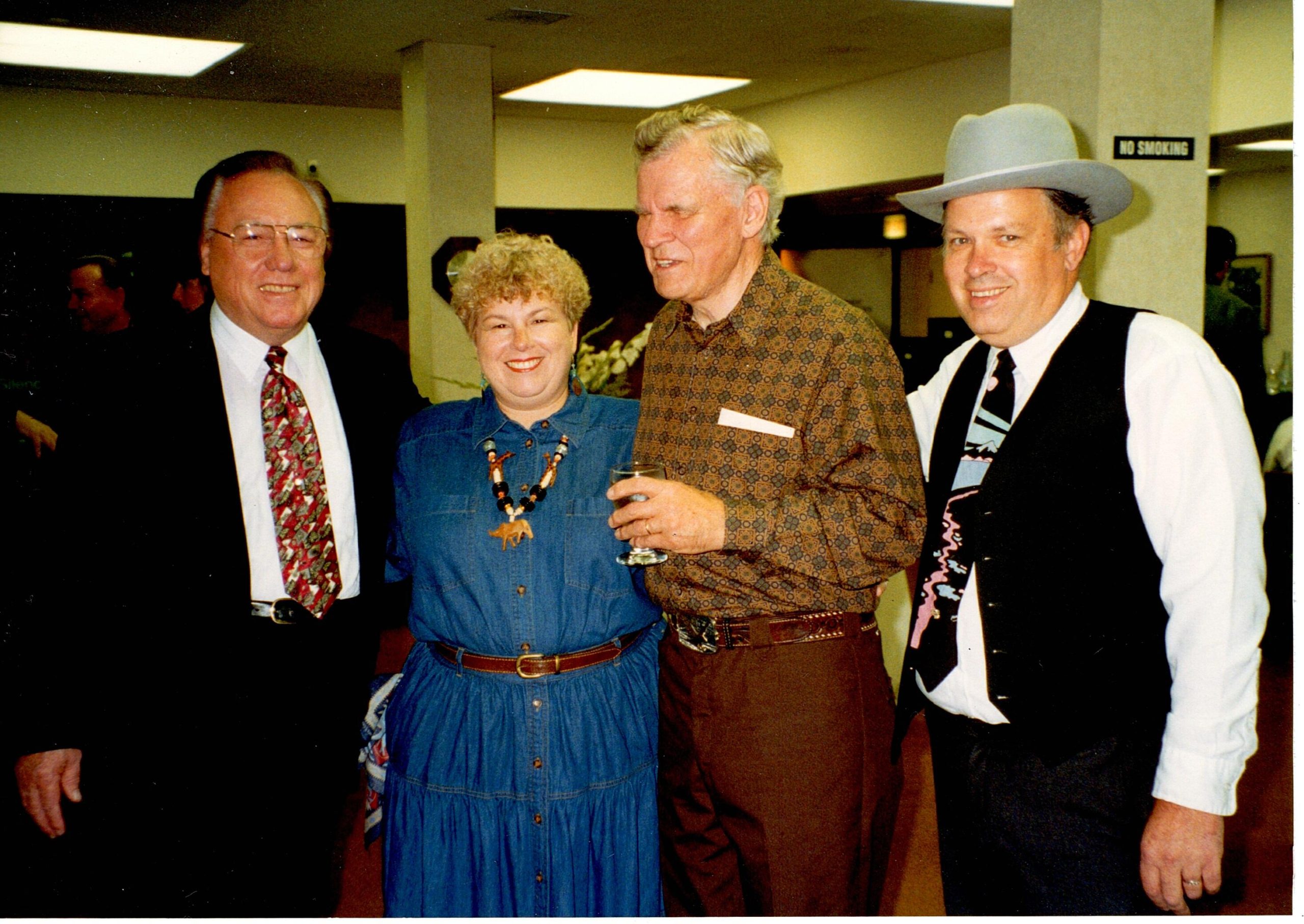
(L to R:) Earl Scruggs, Kitsy Kuykendall, Doc Watson, and Pete Kuykendall.
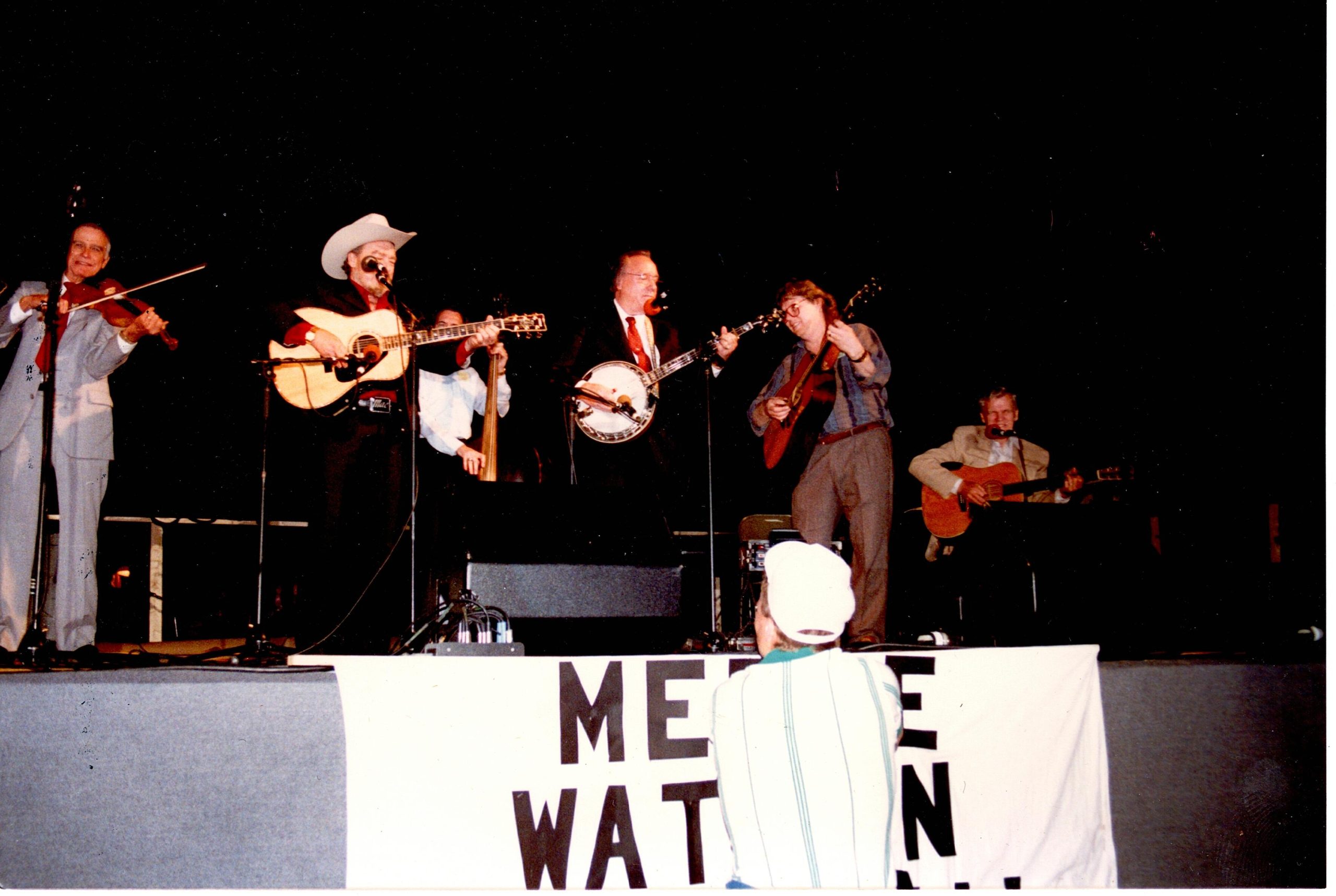
(L to R:) Jim Shumate (fiddle), Mac Wiseman, unknown bassist, Earl Scruggs, Jack Lawrence, and Doc Watson on stage at the Merle Watson Memorial Festival – what would become MerleFest.
Earl Scruggs and Doc Watson perform at the first MerleFest in 1988, then called the "Merle Watson Memorial Festival." (L to R:) Marty Stuart, Jim Shumate, Mac Wiseman, Earl Scruggs, unknown bassist, Jack Lawrence, Doc Watson.
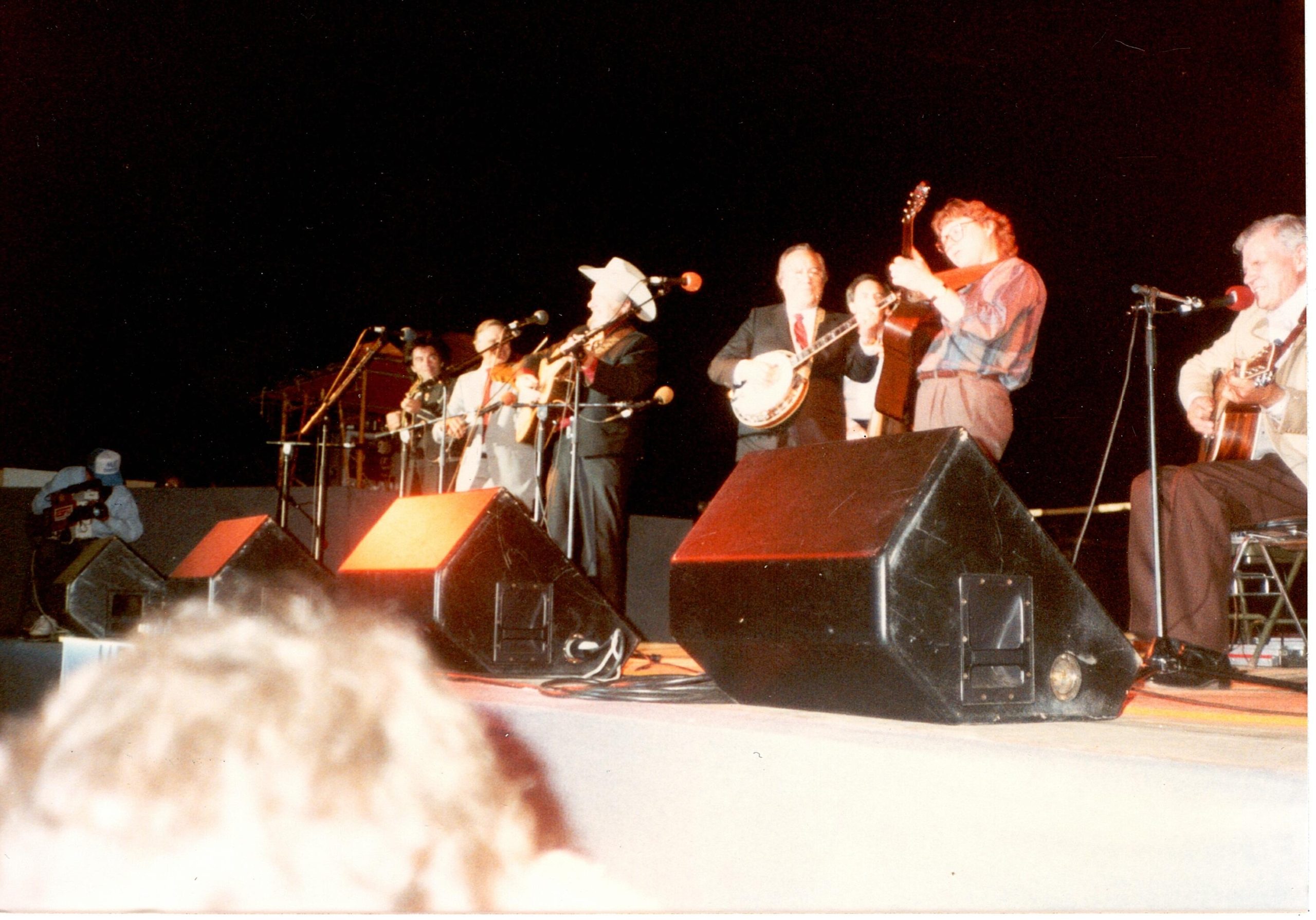
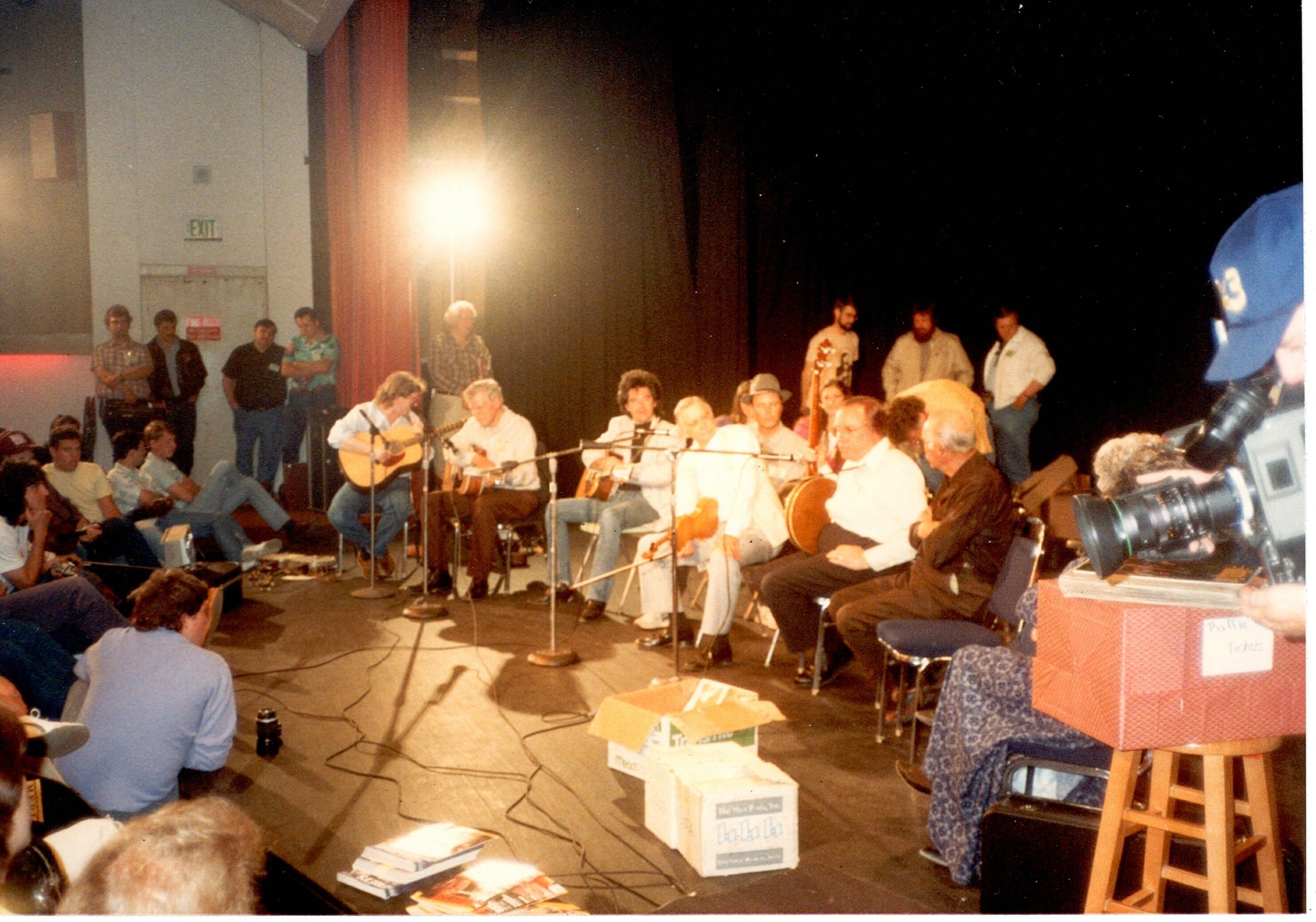
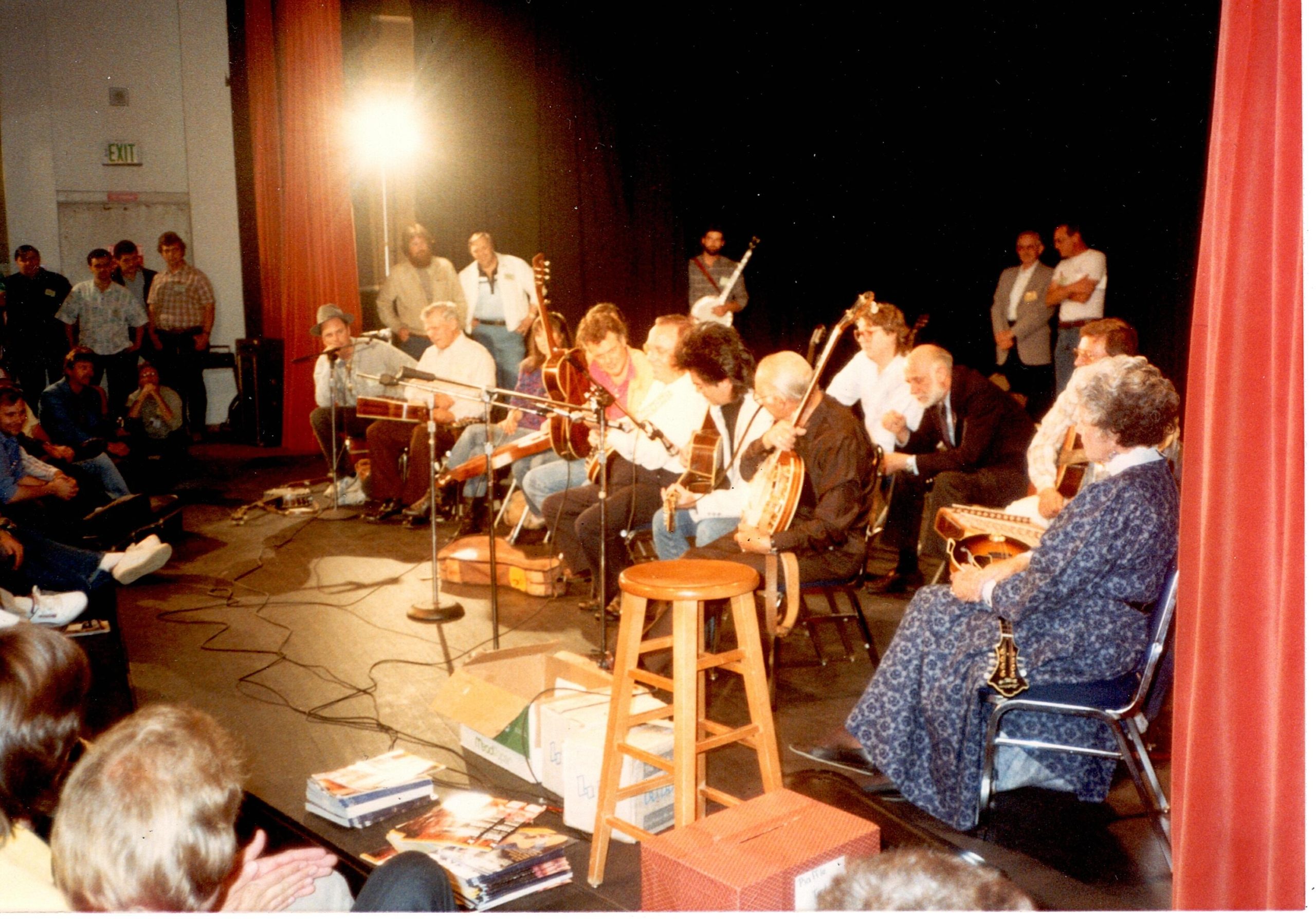
A workshop held at the first MerleFest in 1988. (L-R:) Jack Lawrence, Doc Watson, Marty Stuart, Jim Shumate, Earl Scruggs, Grandpa Jones. David Holt behind the first row of musicians, Ramona Jones on the far right, partially obscured by camera.
Another scene from a workshop at the very first MerleFest.
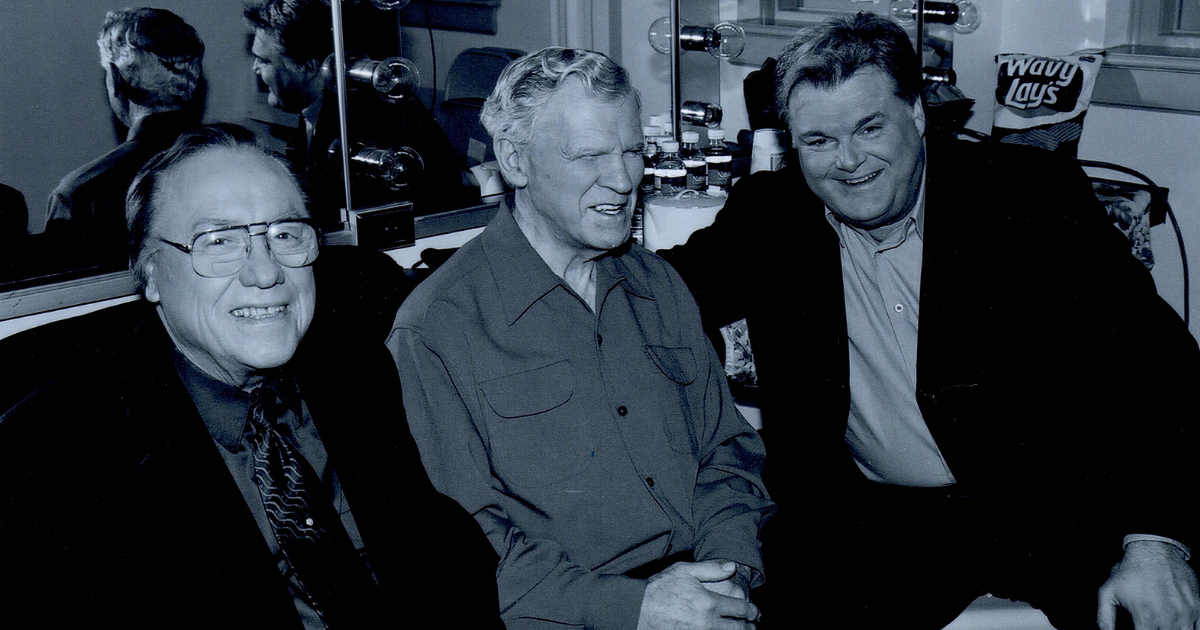
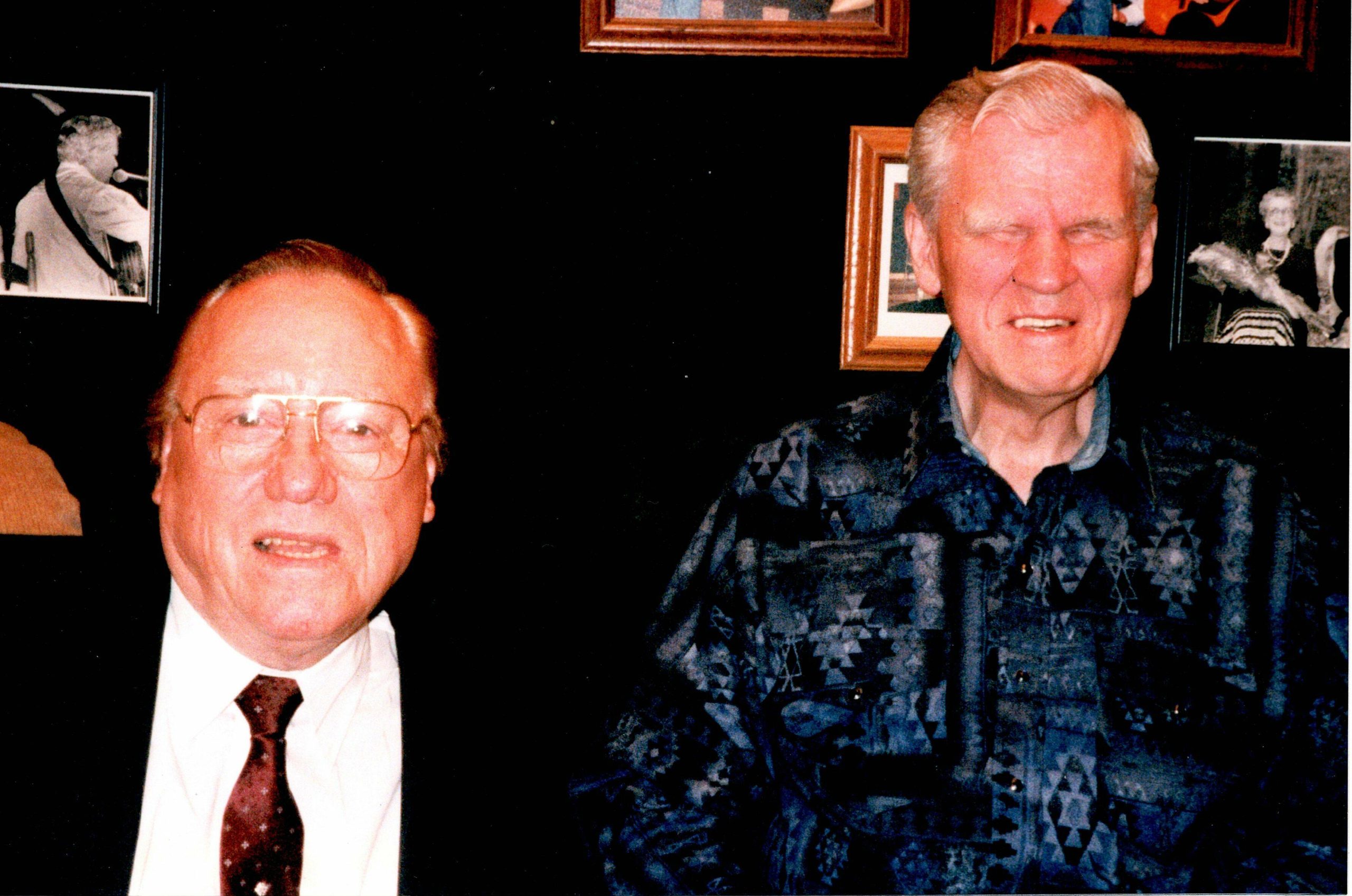
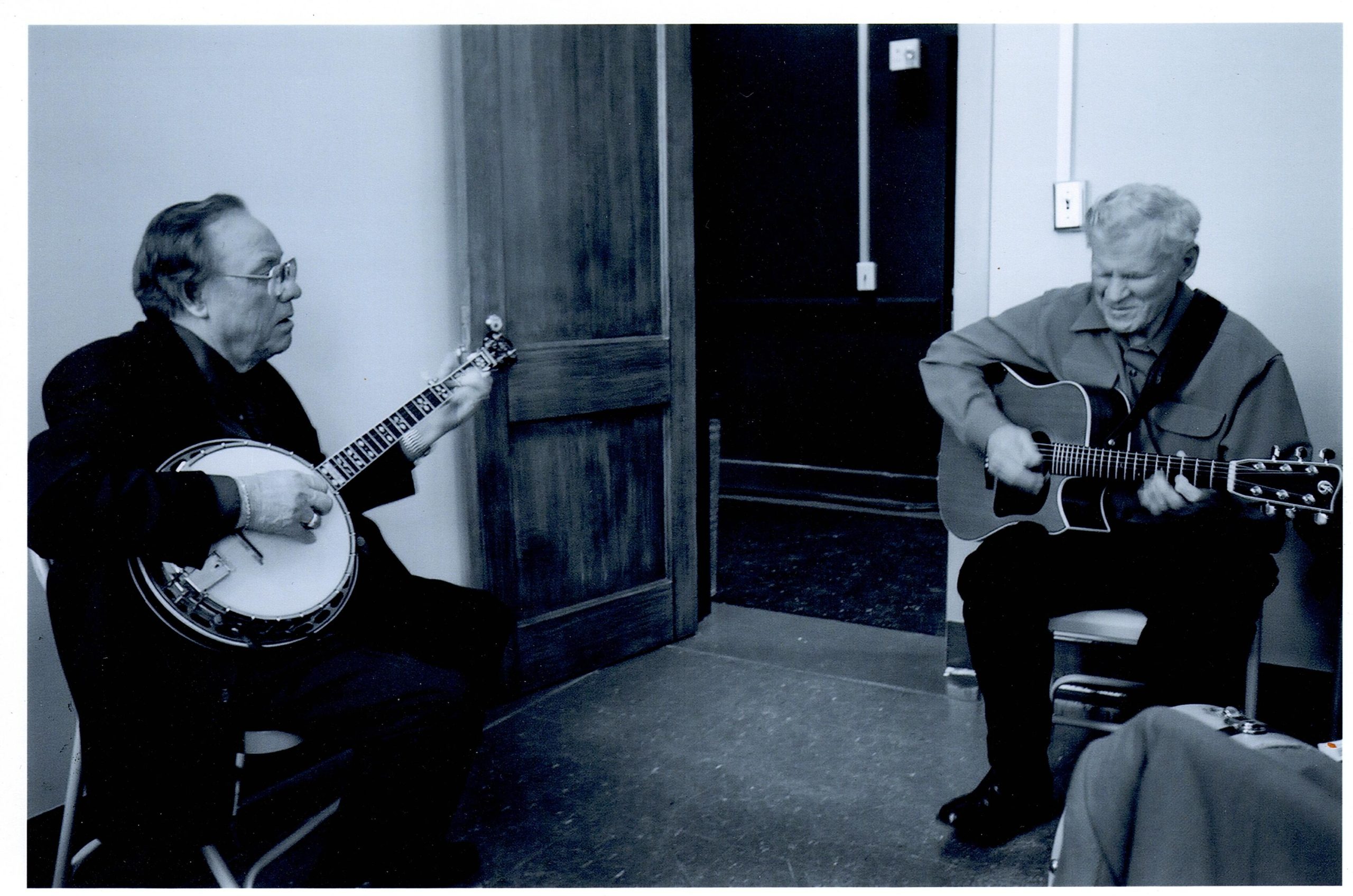
Earl Scruggs and Doc Watson backstage at MerleFest.
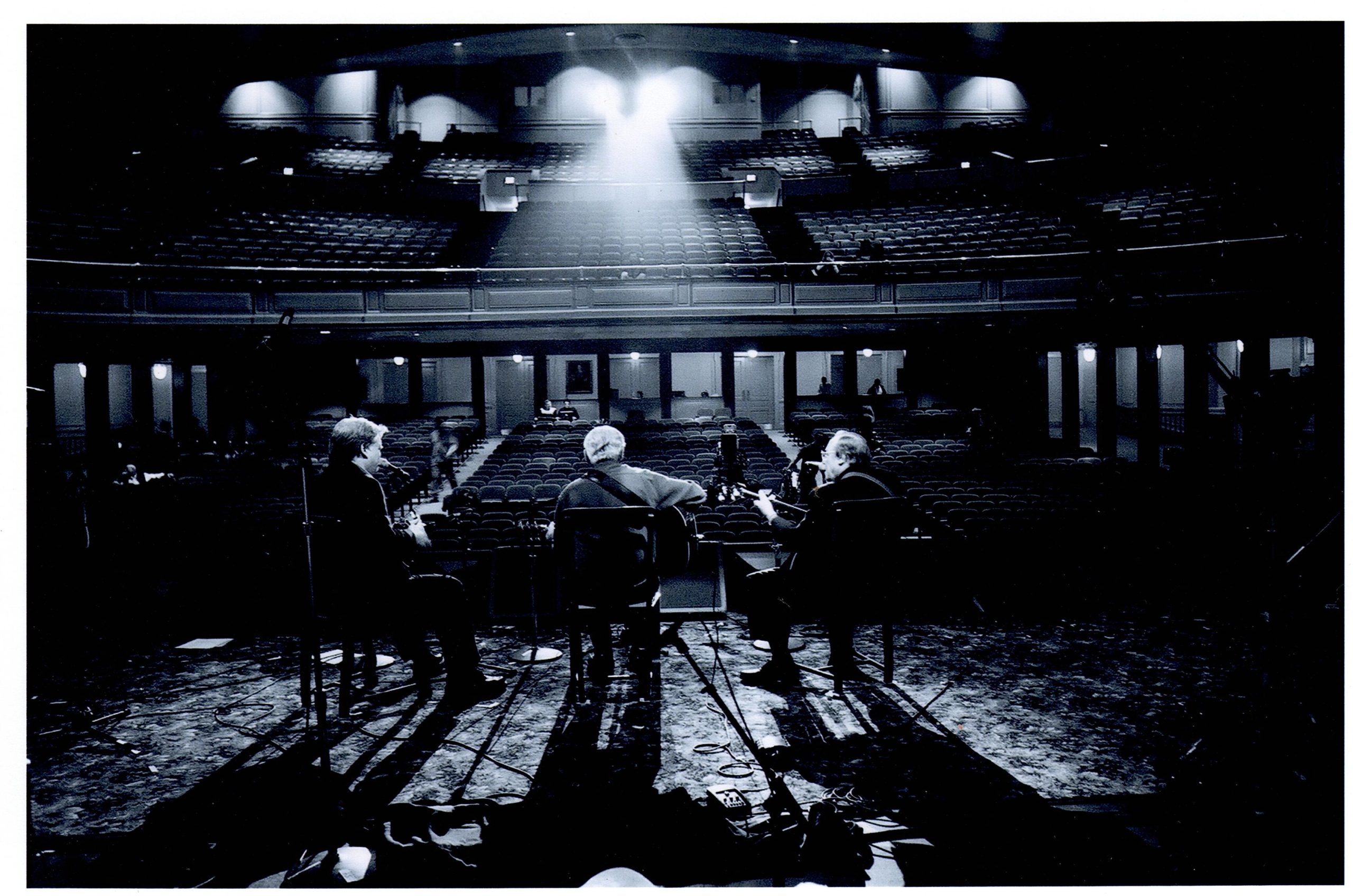
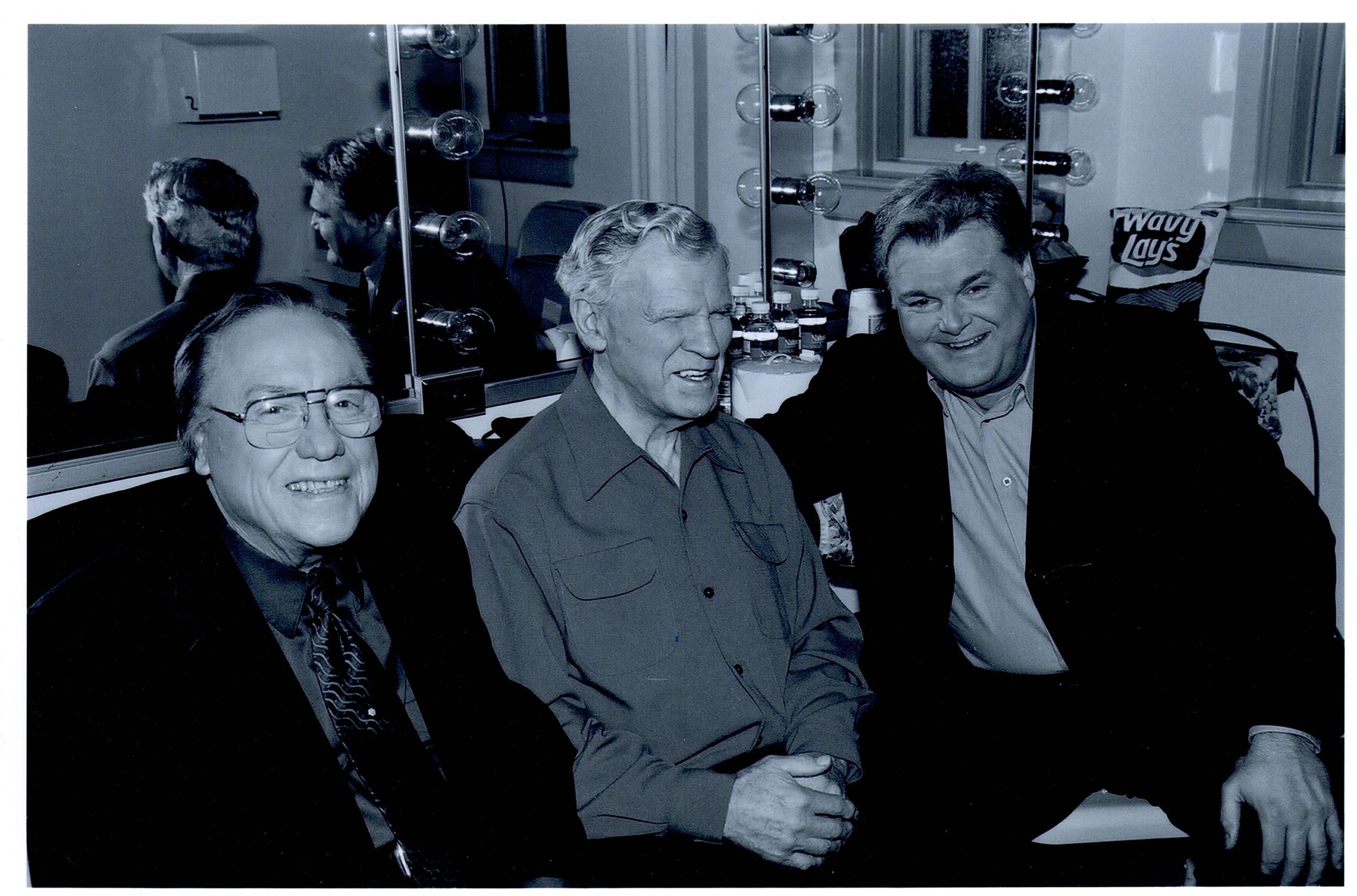
A behind-the-scenes shot of Ricky Skaggs, Doc Watson, and Earl Scruggs preparing for 'The Three Pickers.'
Earl Scruggs and Doc Watson backstage during filming of 'The Three Pickers.'
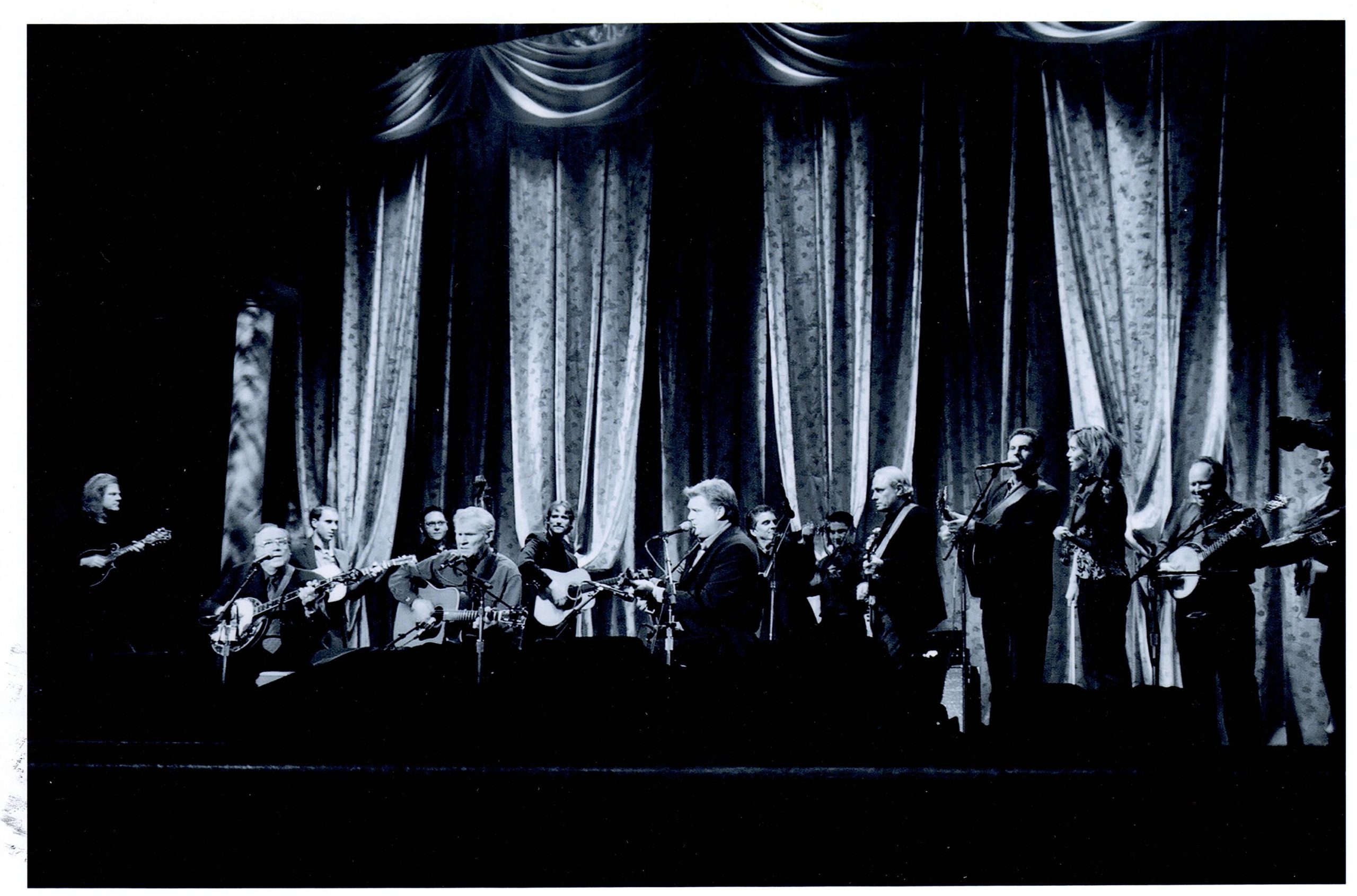
Earl Scruggs, Doc Watson, Ricky Skaggs, and many more musicians (including John Jorgenson, Cody Kilby, Mark Fain, Andy Leftwich, Alison Krauss, Jim Mills, and more) onstage filming 'The Three Pickers.'
The stars of 'The Three Pickers' pose backstage during the taping.
All photos courtesy of the Earl Scruggs Center Collection. Lead image: Earl Scruggs, Doc Watson, and Ricky Skaggs backstage at the taping for The Three Pickers.
Lots of people would like to think their lives have made a difference – whether through their family life, or work, or some sort of creative endeavor.
However, even to approach the enduring heritage of the great musician Arthel “Doc” Watson, a person would have to achieve lifetime landmarks as imposing as the North Carolina Appalachian mountains that were his home. During a lifespan from his birth in 1923 until his death in 2012, Watson created a legacy of music, folklore, and goodwill that no one has entirely equaled.
First a little background: Arthel Lane Watson was born March 3, 1923, near Deep Gap – he is not from Asheville – in Western North Carolina. An audience member suggested the nickname “Doc” when his given name was found less than compelling for an entertainer.
His life story before and after becoming an admired folk musician has been often told, notably in Doc Watson: A Life in Music, a 2025 biography by Eddie Huffman published by the University of North Carolina Press.
Blind since infancy, Watson started to develop life skills and musical ability from an early age. He learned both formal and popular styles when sent to the state’s school for the blind in Raleigh at about age 10.
The boy was consumed by music and persistent in getting better at it. Watson had learned both the rudiments of harmonica and a few banjo tunes from his father, General Watson, before he went off to Raleigh. While living within the strict environment of the school for the blind, Watson learned braille and grew familiar with classical and church styles of music taught there. Perhaps as strong an influence as that education was fellow student Paul Montgomery, the talented friend from whom he learned guitar chords. Young Watson and Montgomery, later a well-known Raleigh pianist and children’s show host, shared enthusiasm for the popular music of the day, including jazz and big-band sounds.
His parents, Annie and General Watson, taught the boy skills of growing crops and basic carpentry, and he contributed to the family despite his blindness.
After years of mostly local performances back in Western North Carolina, it wasn’t until the early 1960s, when East Coast musician and historian Ralph Rinzler tuned into and promoted his far-reaching ability as a singer and picker, that Watson’s name gained national, then international attention.
According to an account at the Blue Ridge Heritage Area website Watson recorded over 50 albums and was honored with “the National Medal of Arts, a National Heritage Fellowship, the North Carolina Folk Heritage Award, seven GRAMMY Awards, and a GRAMMY Lifetime Achievement Award.”
As fans know, Doc Watson contained multitudes of skills, a breadth of ability that inspired this list of the five pillars of his musical and artistic legacy.
The King Flatpicker
Watson largely created the challenging fiddle-inspired guitar style that led many followers along a flatpicking trail.
It was during the 1950s, when playing an electric Gibson Les Paul in the local Jack Williams Band, that Watson developed a style that would transform the way the guitar was played in folk and bluegrass music.
Generally, earlier acoustic guitarists in roots-derived styles used a flatpick to create basic “boom-chuck” back up, perhaps throwing in some fills and Jimmie-Rodgers-style bass runs.
But when dancers at Williams’s gigs wanted music for square-dancing, Watson worked up single-note versions of fast fiddle tunes such as “June Apple” and “Bill Cheatham” on his Les Paul. This approach enables lead guitar pickers to achieve the same flowing, rapid attack that fiddlers used for tunes, many of which had come over from the British Isles in past generations.
It’s not possible to say that Doc Watson was the first guitarist to flatpick fiddle tunes. After all, it wasn’t until Watson emerged as a folk artist in the 1960s that the broader music scene caught on to his musicianship. And high achievers such as Arthur Smith on “Guitar Boogie,” Don Reno on “Country Boy Rock ‘n’ Roll,” and Bill Napier on the Stanley Brothers’ “Mountain Dew” – along with some jazz and blues players – all recorded hot-licks acoustic soloing before Watson did. Joe Maphis was also cranking out ultra-fast flatpicking numbers in the 1950s.
But it was Watson’s 1960s performances that created a precedent for a wave of guitarists who had to muscle up to the speed and dexterity he displayed.
A long line of guitarists at the top of the field – from Clarence White to Tony Rice, from Bryan Sutton to Billy Strings – all show Watson’s clear influence not just in recreating fiddle tunes, but also in rapid-fire picking and clean sound on a broad range of material.
Player and educator Alan Barnosky wrote in “An Exploration of Doc Watson’s Innovative and Joyful Guitar Stylings” for Acoustic Guitar in 2023 about the spread of this kind of playing.
“Watson amazed folk fans in the early 1960s by taking tunes typically reserved for the fiddle and reworking them for the acoustic with speed, clarity, and flash,” he wrote. “He never claimed to be the first to play fiddle tunes on a guitar, but for the majority of listeners at the time it was an entirely novel and groundbreaking approach.”
Another world-class, tradition-based player, Earl Scruggs, praised Watson’s adaptation of fiddle tunes as the two were joined by Ricky Skaggs for the 2003 The Three Pickers performance and album.
“He was the first man I ever heard on the guitar that was fooling with tunes like that,” Scruggs said in a Three Pickers introduction. “You had all these good G-C-D pickers – that’s chord positions – but I had never heard anybody that actually took over a lead like a banjo or a fiddle or a mandolin and do those tunes. He could do it.
“And what amazed me about Doc Watson’s picking, and still does, is he’s got that – I call it ‘mountain sound’ to his picking, and he’s one of the best to keep it in that mode of sound.”
New generations of players have immersed themselves in Watson’s style. When I interviewed him for a Bluegrass Unlimited article, leading guitar picker and multi-instrumentalist Bryan Sutton talked about being captivated by Watson’s playing during Sutton’s youth on Western North Carolina.
“Doc and Dan Crary were the first great influences on me,” he said. “Doc Watson was one of the first professional musicians/guitar players that I ever saw. He doesn’t live too far from Asheville, so I saw him play some different festivals and at Maggie Valley. So, he was the first one to really catch my ear as far as what you could do with the flatpick.
“My right hand – it may not as much anymore – but I remember at one time it was kind of like Doc’s. It’s kind of like the way Sam Bush plays, using the whole forearm and wrist involved in the playing, whereas with jazz players or Tony Rice it’s more of a wrist thing. I think I’ve got a little bit of both now.”
Billy Strings, the artist who’s likely doing the most to promote Watson’s legacy in the 21st century, sounded almost evangelical during a September 2025 interview for NPR’s Fresh Air.
“He’s like the ground upon which I stand, you know?” Strings said. “My dad played his music all around the house growing up. And by the time I could play guitar, you know, 5, 6 years old, I was learning those tunes, too. I might’ve been able to play some of them before I knew how to tie my shoes or something, you know?
“It was like, I was learning how to speak and talk and walk, and I was learning all these Doc Watson tunes at the same time. And it was just, like, a religion in my house, you know? His music is just – it’s the best.”
To see some of the top pickers in the field paying tribute, check out this video shot at the Merle Watson Memorial Festival – what would become MerleFest – in Wilkesboro, North Carolina, in 1992.
A Model Fingerpicker
From his first albums on, Watson regularly also played guitar with a thumbpick and index finger. As he noted with his customary self-deprecating humor in the DVD “Doc’s Guitar: Fingerpicking & Flatpicking,” “See, I just play with one finger and a thumb. I don’t use the sensible three-finger method that you should use on finger-style guitar.” (Watch below.)
Watson sounded great with that approach, making finger-picked tunes such as “Deep River Blues,” “Nashville Blues,” “Omie Wise,” and “Doc’s Guitar” fan favorites and objects of long study. For every striving guitarist who practiced hard on his fiddle-tune adaptations, plenty of pickers also worked on showcases such as “Windy and Warm,” with its alternating bass, pull-offs, note bending, and a jazzy minor sixth chord at its conclusion.
Watson’s fingerpicking often showed off his acquaintance with diverse approaches, as in “Deep River Blues,” with an E diminished as its second chord. It also illustrates the way he put his touch on existing pieces such as 1933’s “Big River Blues” by the Delmore Brothers, who played with flatpicks.
“There were two guitars, a tenor – a little four-string, and the regular flattop, and I never could get my guitar to sound like both of theirs did,” Watson said. “Then I began to hear brother Merle Travis, the late Merle Travis, on the radio. And I thought, Now, wait a minute. If I can steal me a lick off brother Travis, maybe I can learn ‘Deep River Blues.’”
Multi-talented Kentuckian Merle Travis (1917-1983) popularized a style in which the thumb plays an alternating bass on the guitar’s lower strings while picking the melody on treble strings. Watson also studied the work of the great guitarist Chet Atkins. The picking buddies released the album Reflections in 1980.
The centuries-old, transatlantic ballad “Georgie” would have once been sung unaccompanied, leaving Watson and others free to craft a brand new style of guitar back up. With no clear precedent on guitar, he might employ the flowing, almost classical patterns that became popular among folk revivalists.
And fingerpicking became the tool Watson used to play the blues that he loved and drew on so deeply, music he followed from the time he heard Mississippi John Hurt on the family’s disc player in childhood.
In the end, there’s no easy way to pin down the many elements Watson brought to his picking, musical points of view that enriched his listeners along the way.
A Standout Singer
Doc Watson’s vocal abilities don’t generally get as much attention as his top-drawer chops as an instrumentalist. However, he was also a tuneful singer with a natural, angelic mountain baritone.
Watson came along during an era when rougher-voiced vocalists such as Hobart Smith, Dock Boggs, and his picking buddy Clarence Ashley represented mountain singing to a growing audience. And Watson’s less mannered style likely contributed to acceptance among listeners less familiar with the high lonesome sound. His direct vocal approach was often heard in performances with no instrumental backing.
It’s useful to remember that Watson also enjoyed the smooth country vocalist Eddy Arnold so much that his son Merle Eddy Arnold was named not just after fingerpicker Merle Travis, but also for Arnold.
Tunes from the Tennessee Plowboy’s repertoire such as “Tennessee Stud,” “I Couldn’t Believe It Was True,” and “Anytime” also showed up in Watson’s repertoire. These were only a few examples of the eclectic side of Watson’s vocal approach, with emphasis on great material over genre labels.
Given his broad taste, Watson at times put some extra grit into his singing on a number such as “Blue Suede Shoes” from his Jack Williams days of the 1950s, later a concert favorite. But more often he sang songs straight, even on one like “Nights in White Satin,” a 1967 pop hit by British rockers the Moody Blues. With waltz-time guitar and plain singing, Watson makes the song come across as relevant to himself and listeners as songs by the Delmore Brothers and Jimmie Rodgers.
Watson’s first memories of vocal music came in church, and he prized the straightforward, no-vibrato sounds that carved such songs in his memory.
“If you love music, you have to listen from the time you’re big enough to notice music,” he told me when recording his 1991 GRAMMY-winning CD On Praying Ground.
“If you’re looking for old-time material in songs, those old songs that you heard when you were young were the easiest to put down.”
From his first commercial recordings on, Watson featured gospel numbers such as the a cappella version of “Talk About Suffering” from 1964 and “Down in the Valley to Pray” from 1966. Both radiate belief and unornamented clarity.
More recent listeners may know the latter song as “Down in the River to Pray,” as it was opportunistically relabeled to match a scene in the 2000 hit film, O Brother, Where Art Thou?.
Always A Song Man
Doc Watson had an impressively broad range of musical interests, perhaps markedly so, given the period in which he came along.
Country or folk music didn’t start appearing on commercial records until Watson was about two years old. In childhood he listened to down-home picking as well as church and gospel songs. It wasn’t until the 1930s that the family owned a radio that let them hear music beyond their 78-rpm record collection.
Virtually every great musician is a song collector at heart. And like Bob Dylan, Watson took on songs from tradition and added new elements. Take the mournful ballad “Omie Wise,” based on a North Carolina murder from the early 19th century.
In the 1920s notable old-time artists G.B. Grayson and Clarence Ashley recorded it with modal accompaniment that was neither truly major nor minor. When Watson recorded in the 1960s, he ventured into folky, arpeggiated picking that put it squarely into minor-chord territory, opening up the song to young folkies who couldn’t play fiddle like Grayson or banjo like Ashley.
In fact, Watson’s playing on “Omie Wise” occupied the same guitar realm as folk star Joan Baez’s playing on “East Virginia” and other traditional songs.
He also tuned into compositions by folk musicians Bob Dylan (“Don’t Think Twice It’s All Right), Tom Paxton (“The Last Thing on My Mind,” “Leavin’ London,” and “Bottle of Wine”), and Townes Van Zandt (“If I Needed You”).
Watson isn’t chiefly known as a songwriter, but he enjoyed notable success with “Your Lone Journey,” which he wrote with wife Rosa Lee. The starry duo of Led Zeppelin frontman Robert Plant and bluegrass’s own Alison Krauss released it as “Your Long Journey,” leading to what biographer Huffman called significant royalties for the family.
Watson’s greatest legacy in songs may have come with the wealth of lasting favorites – just a few are “Deep River Blues,” “I Am a Pilgrim,” “Banks of the Ohio,” “House Carpenter,” and “Shady Grove” – that made their way into the folk, old-time and bluegrass repertoire and could otherwise have been forgotten.
Ambassador for the Old-Time Way
This role for Watson may be the hardest to pin down, as it overlaps with almost all the others. By cleaving to his Appalachian heritage while also making the most of decades of change, Doc Watson was able to introduce countless fans to a rich, living culture.
“I don’t live in the past,” Watson told me in 1991. “I still burn wood in a furnace at the house, but I have heat ducts and a blower on it just like an oil furnace.
“I love to burn wood and I love to split wood. There’s a few of the old-timey things I love to do. I like good dried-apple pie and I like ‘leather britches’ beans.
“And I like to be at home, dadburn it. I hate the road.”
Watson’s long career of traveling to take his music to listeners, often in the company of his beloved son, Merle, nourished their taste for music that he built upon sold timbers of musical tradition.
Wade Smith, a legendary Tar Heel lawyer, told me once about his first experience of hearing Watson, at a small coffeehouse in downtown Raleigh in 1965.
“What word would I choose to describe how I felt?” Smith said for a later Raleigh News & Observer story. “Electrified, stunned at the speed of his fingers and the way he played single strings, and the clarity of the sound. Each note was like a piece of gold, so amazing.
“We stayed to the last note. When we left, I remember thinking that I had never heard anything like it and that in some way I had been changed by it, that I was in an altered state of existence.”
Watson’s national and international impact becomes more impressive given that he wasn’t heard outside his North Carolina stomping grounds until his late 30s. That’s when he honed his broad range of expertise into a mountain-based style that captivated and often amazed listeners at first hearing.
When the Society for American Music, a distinguished non-profit scholarly and educational organization, made Watson an honorary member in 2012, musicologist and musician Greg Reish paid tribute to Watson’s broad impact.
“As I discovered more of America’s traditional musical styles through my teenage years, Doc Watson always seemed to be at the core, an entrée into both older and newer styles,” Reish wrote. “Through Doc’s music I found my way to the pre-war music of the Carter Family, Jimmie Rodgers, and the Skillet Lickers; to the first-generation bluegrass of Bill Monroe and Flatt & Scruggs; to the classic country of Merle Travis, Chet Atkins, and Eddy Arnold; to the country blues of John Hurt and Frank Hutchison; and to the contemporary and progressive flatpicking of Clarence White, Norman Blake, and Tony Rice.”
Huffman’s book quotes the great bluegrass musician Roland White as he talked about the way his guitarist brother Clarence was caught up in Watson’s flatpicking after hearing him at California’s Ash Grove club.
“After seeing Doc, his picking became an obsession, an everyday part of everyday life. To play music and practice every day. Whether we played gigs or not, he was always playing music.”
Sixty years after White’s epiphany, Doc Watson’s music continues to gain and inspire new followers, whether through the picking and testimony of contemporary players such as Sutton and Springs, or through his own dozens of albums and videos. His legacy of tradition and innovation still flows like one of the ancient streams that nourish his cherished mountainsides.
Thomas Goldsmith is an award-winning journalist based in Tennessee and North Carolina. In addition to producing many hundreds of articles for newspapers and magazines, he edited The Bluegrass Reader and authored Earl Scruggs and Foggy Mountain Breakdown: The Making of an American Classic, both for the University of Illinois Press.
Few musicians have ever moved as fluidly between eras, genres, and generations as Doc Watson. From front-porch duets to grand-stage bluegrass revivals, Watson’s collaborations have a way of dissolving categories entirely.
His flatpicking precision, rhythmic calm, and vocal warmth made him the kind of performer who elevated everyone within earshot – young prodigies, genre pioneers, folk-tradition torch bearers, and musical iconoclasts alike. His reputation as a consummate accompanist was built not on showmanship or flamboyance, but on musical generosity and an intuitive sense of timing, phrasing, and expression that allowed others to shine while retaining his unmistakable voice.
Part of Watson’s power lies in the consistency of his musical identity. He never strained to fit into a new format or trend; instead, others bent gratefully toward his center of gravity. Whether playing an old-time fiddle tune, trading licks with a jazz-influenced mandolinist, or harmonizing with a younger bluegrass singer, he brought a sense of ease and groundedness that anchored every ensemble. That stability gave his collaborators the freedom to explore, improvise, and innovate – knowing Doc would be right there, steady and sure.
This sense of balance between precision and freedom made him a model collaborator for musicians across generations, and his impact can be traced through countless recordings, festival lineups, and mentorships of younger players.
Watson’s influence was not just technical but communal. He could guide a performance without overwhelming it, offering the ideal blend of authority and humility. In his guitar, listeners hear the voice of the North Carolina mountains, the pulse of Appalachian tradition, and the adaptability of a musician able to engage any genre without losing authenticity.
Today, YouTube’s patchwork archive of footage allows us to witness these collaborations anew: small moments of musical connection, sometimes real-time, sometimes reconstructed from archival sources. Below is a curated set of eight standout filmed or recorded collaborations that illustrate Watson’s reach. From storied duets with Chet Atkins or Earl Scruggs to meetings with newer-generation players.
“Roll in My Sweet Baby’s Arms” – Doc Watson, Earl Scruggs & Ricky Skaggs (The Three Pickers)
This relaxed but virtuosic performance features Watson, Scruggs, and Skaggs playing with the ease of a porch jam made public. Watson’s crisp flatpicking forms a warm foundation, while Scruggs’ banjo drives with characteristic agility and Skaggs adds mandolin flourish and bounce.
The trio exhibits mutual respect and joy, and their lines interweave with natural conversation. The recorded performance comes from the 2003 album The Three Pickers. The energy and clarity of the musicianship exemplify Watson’s ability to anchor an ensemble while remaining entirely supportive, a model of intergenerational teamwork. It is a performance that displays the combination of technical mastery and intuitive musical empathy that defined Watson’s career.
“Tennessee Stud” – Doc Watson & Nitty Gritty Dirt Band (Will the Circle Be Unbroken)
Watson’s performance of “Tennessee Stud” on the Will the Circle Be Unbroken project exemplifies his ability to blend seamlessly with both established musicians and a younger ensemble eager to learn from him. His deep, resonant vocals float over understated but fluid flatpicking, supporting the Nitty Gritty Dirt Band’s harmony vocals and rhythmic drive.
Watson’s musical sensitivity allowed for a dialogue that bridged generations, bringing traditional songs into a contemporary context while retaining their original heart and vibrancy. This track also highlights Watson’s ability to adapt to the studio environment, shaping a sound that was both authentic and polished. The 1972 studio album is well-documented, though various YouTube versions may mix studio, rehearsal, or live takes.
In this medley, Watson and Chet Atkins engage in a playful, masterful guitar dialogue. Watson’s flatpicking exhibits crisp, percussive articulation, while Atkins’ thumb picking introduces a smooth, jazz-inflected counterpoint. Both artists navigate tempo and dynamics with precision, creating a performance that is both technically dazzling and deeply musical.
The track appears on the Reflections album and while some online performances derive from live shows or reissued audio, the studio recording itself exalts the collaborative interplay. This duet demonstrates Watson’s ability to move effortlessly between folk and jazz guitar traditions, honoring both while creating something uniquely their own. The performance underscores his adaptability, an essential quality in a musician sought after by so many genres and generations.
“Black Mountain Rag” – Doc Watson & Merle Watson
The father-son dynamic between Doc and Merle Watson is in full display in this live rendition of “Black Mountain Rag.” Merle’s nimble, rhythmic energy dances atop Doc’s grounded guitar tempo, producing an interplay that is conversational, playful, and intricate. Their shared history and years of touring allow for spontaneous embellishments and musical commentary woven into the tune.
This performance captures the essence of the Watson family legacy, showing how Doc nurtured both musical skill and expressive interpretation in the next generation. The piece also serves as a lesson in ensemble sensitivity, as Doc balances his playing to give Merle ample space while maintaining rhythmic and harmonic cohesion.
“What Would You Give in Exchange for Your Soul?” – Doc Watson & Bill Monroe
Watson and Monroe’s pairing on this traditional tune combines the latter’s piercing, high-lonesome tenor with the former’s warm baritone, creating a striking emotional contrast. Watson’s guitar provides steady, unobtrusive accompaniment, allowing the vocal interplay to take center stage.
This recording exemplifies Watson’s ability to adapt to any partner, responding in real time to vocal phrasing and tempo shifts. The performance demonstrates his interpretive sensitivity, highlighting how he could honor a song’s emotional core while integrating his own stylistic voice.
“Shady Grove / Summertime” – Doc Watson & David Grisman
Watson’s collaboration with David Grisman blends Appalachian folk with progressive acoustic styling. In this rendition of “Shady Grove,” Watson’s rhythmic guitar backgrounds Grisman’s mandolin flourishes, resulting in a lively, conversational back-and-forth. Improvisation is key, as both musicians respond to each other’s phrasing, demonstrating mutual respect and spontaneity.
This collaboration underscores Watson’s versatility, showing he could navigate between traditional melodies and innovative interpretations, elevating both in the process. It is a reminder of his role in bridging traditional and progressive acoustic music for audiences and colleagues alike.
“Amazing Grace” – Doc Watson & Jean Ritchie
Watson and Jean Ritchie’s collaborations were well-established, including performances at venues like Folk City in the early 1960s. However, the specific attribution of some YouTube uploads titled “Amazing Grace” is ambiguous. The Live at Folk City album recording is the most reliable source, showing their complementary styles: Watson’s gentle, precise guitar lines support Ritchie’s clear, expressive vocals, blending Appalachian tradition with personal interpretation. They represent the transmission of Appalachian folk music to wider audiences and the seamless melding of their similar sensibilities.
“Summertime” – Doc Watson & Mark O’Connor
Watson’s influence on multi-instrumentalist Mark O’Connor is well-known; O’Connor cites him as a formative inspiration and their collaboration remains significant as a symbolic bridge between generations. Watson’s teachings and style informed O’Connor’s fiddle mastery, illustrating Watson’s mentorship and the continuity of American acoustic tradition. Indeed, their shared repertoire speaks to the passing of musical knowledge and the sustaining of tradition through personal and professional interaction.
These eight performances above collectively highlight Doc Watson’s role not only as a primary musician, but as a profoundly generous collaborator. He created space for others to excel, whether alongside legends like Bill Monroe, Earl Scruggs, and Chet Atkins or with younger rising stars such as Alison Krauss and Mark O’Connor. Watson’s approach combined technical mastery with emotional intelligence, allowing him to respond intuitively to fellow musicians in real time.
His collaborations illuminate the breadth of his influence. Watson moved with ease between old-time Appalachian tunes, rag medleys, gospel-inflected ballads, rocking hillbilly sounds, and improvised jam sessions. Across these contexts, he remained unmistakably himself: grounded, warm, and adaptable.
By mentoring younger musicians, bridging generations, and seamlessly adapting to new musical contexts, Doc Watson demonstrated that tradition is not static; it is a living, evolving practice. His legacy continues to teach musicians the art of generosity, the importance of listening, and the beauty of musical dialogue. Perhaps in every collaboration, Watson’s spirit resonates, ensuring that his contribution to music endures across time, space, and audience.
For the past few years, as the music industry goes quiet, spooling itself down for a two-week sleep over the Christmas and New Year’s holidays, the team here at BGS has taken the opportunity to utilize December to spotlight a few of our heroes. We began the series with Dylan in December in 2018 and followed up the success of that nontraditional “Artist of the Month” pick in following years with Dolly in December, Del in December, Dawg in December, and last year’s incredibly popular Dead in December.
What better way to spend a cozy, holiday-filled, wintry month than celebrating some of the legends – artists, songwriters, musicians, and bands – that have made our roots music scene what it is today? This year, it’s clear who our December Artist of the Month should be: “Doc” Arthel Watson, himself.
Born in Deep Gap, North Carolina, in the heart of Appalachia in 1923, Doc Watson started playing guitar – and other instruments, too – as a child. Doc lost his vision in his youth, but would go on to become one of the most important American guitarists in history even with his disability. His position in modern roots music, especially in bluegrass, old-time, and folk, is canon. He is a legend to any and all, from the diehard lifelong acolytes to the recently initiated neonates. He’s one of our Americana music figures who tends to get lost, like the forest for its trees, within his own ubiquity and universal adoration. But no matter from which angle you drill down into his career, discography, artistry, and legacy there’s always more to find. To explore. And to enjoy, of course.
Over the course of December, we’ll be doing just that. Our writers and contributors will offer new articles considering Doc’s songs and output and his career as an American guitar hero. And, how even after his passing in 2012, he continues to be a definitional stylist on flat-top, flatpicked guitar. But don’t sell him short, either. Though most known for his fiddle tunes, folk songs, and old-time and bluegrass licks, Watson was accomplished in many genres across the roots continuum; he dabbled in and conquered sounds from hillbilly and rockabilly, electric guitars, blues, ragtime, fingerstyle, chicken pickin’, and more. He collaborated with artists from well within his own circle and far outside it – sonically, socially, and geographically. Watson was incredibly dynamic, a characteristic that has contributed greatly to his lasting, ongoing appeal.
We will also be dipping back into our BGS archives to share past features, playlists, and articles about Doc, and his son Merle; about his festival MerleFest, which continues to this day; and about the albums and offerings celebrating the 100th anniversary of his birth that were released in 2023. Truthfully, there’s nearly an endless supply of BGS content that touches on, focuses on, or mentions Doc. Because of course there is – these genres we all love and hold dear wouldn’t be what they are today without him.
You also won’t want to miss perhaps the most exciting aspect of our Doc in December Artist of the Month celebration. In 2023, BGS was invited to Bryan Sutton’s Blue Ridge Guitar Camp in Brevard, North Carolina. Sutton, alongside his friend and peer Billy Strings, is one of the most prominent proselytizers for Watson in the 21st century, so it’s no surprise his annual camp just up the mountains from Watson’s hometown of Deep Gap is usually dripping with Doc’s music.
That year, one of Doc’s most famous guitars, “Ol’ Hoss” – a 1968 G-50 Gallagher Guitar Watson played in the late ’60s and early ’70s and on many recordings – was also at the Blue Ridge Guitar Camp. The instrument was one of the first of a few Gallaghers that Doc owned. BGS made the trip to Brevard to capture special video performances and interviews with many of the event’s instructors and pickers, each of whom played Doc tunes and shared stories and memories while picking Ol’ Hoss. It was a magical week in the mountains. Now, for the very first time, we’re making select songs from these tapings available in a new series, the Ol’ Hoss Sessions. Three sessions pulled from the shoot celebrates Doc in December and features Bryan Sutton, Courtney Hartman, and will also feature Billy Strings. Stay tuned as we share those videos right here on BGS and on our YouTube channel throughout the month.
It’s not that Doc Watson is underappreciated or underrated, or that he needs any of the visibility that being a BGS Artist of the Month might afford. In our neck of the woods, seemingly everyone knows and loves Doc Watson already. But with so many folks and institutions shouting Watson’s praises from the rooftops lately – artists like Sutton, Strings, and a host of guitar pickers and roots musicians from across our community and scene; the folks who put on and attend MerleFest; the communities of Boone and Deep Gap, North Carolina; projects like I Am a Pilgrim: Doc Watson at 100 – it’s clear there’s always more to learn, love, and enjoy about Arthel Lane Watson.
Get started with Doc in December with our Essential Doc Watson Playlist, below. Plus, follow along right here on BGS and on social media as we share Doc Watson content throughout the month. We’ll have a new feature on Watson’s status as American guitar hero, and you can see our YouTube playlist of his incredible musical collaborations here. Plus, of course, our very special Ol’ Hoss Sessions, exclusively available right here on the Bluegrass Situation. (Watch Bryan Sutton here. Watch Courtney Hartman here.) Plus, we’ll be combing through the BGS archives for everything Doc Watson for y’all to enjoy. Buckle up for a mighty month of guitar pickin’ glory, it’s Doc in December!
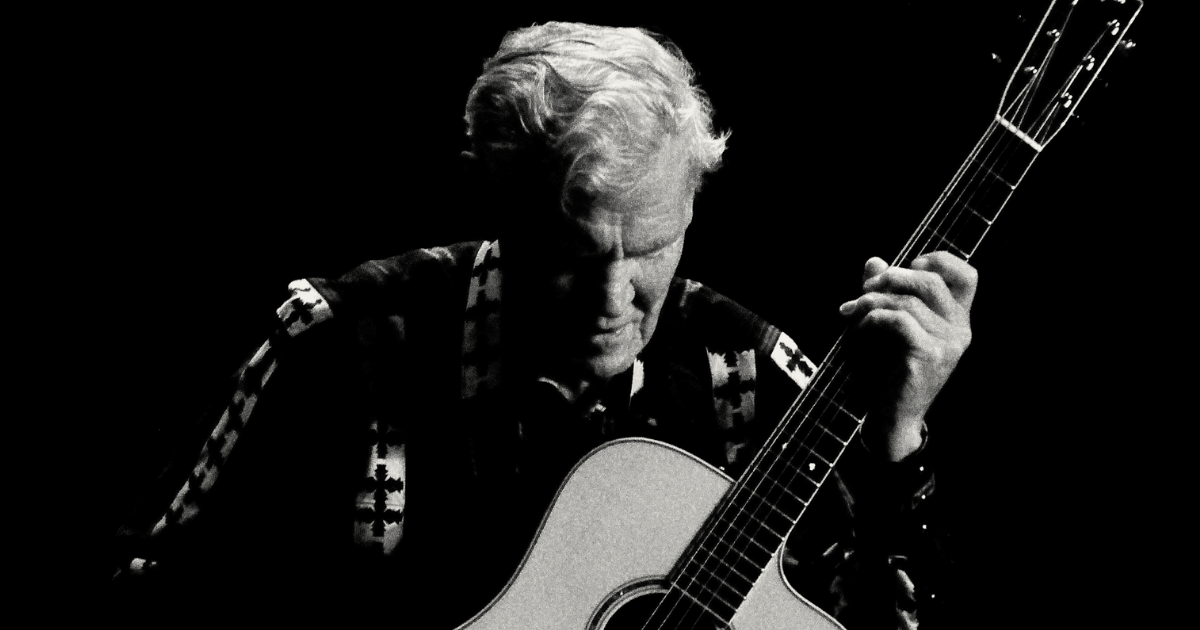
Lead image courtesy of MerleFest.
This website uses cookies to improve your experience. We'll assume you're ok with this, but you can opt-out if you wish.AcceptRejectRead More
Privacy & Cookies Policy
Privacy Overview
This website uses cookies to improve your experience while you navigate through the website. Out of these, the cookies that are categorized as necessary are stored on your browser as they are essential for the working of basic functionalities of the website. We also use third-party cookies that help us analyze and understand how you use this website. These cookies will be stored in your browser only with your consent. You also have the option to opt-out of these cookies. But opting out of some of these cookies may affect your browsing experience.
Necessary cookies are absolutely essential for the website to function properly. This category only includes cookies that ensures basic functionalities and security features of the website. These cookies do not store any personal information.
Any cookies that may not be particularly necessary for the website to function and is used specifically to collect user personal data via analytics, ads, other embedded contents are termed as non-necessary cookies. It is mandatory to procure user consent prior to running these cookies on your website.