The Five Pillars of Doc Watson’s Legacy

What a difference a Doc made.

Lots of people would like to think their lives have made a difference – whether through their family life, or work, or some sort of creative endeavor.

However, even to approach the enduring heritage of the great musician Arthel “Doc” Watson, a person would have to achieve lifetime landmarks as imposing as the North Carolina Appalachian mountains that were his home. During a lifespan from his birth in 1923 until his death in 2012, Watson created a legacy of music, folklore, and goodwill that no one has entirely equaled.

First a little background: Arthel Lane Watson was born March 3, 1923, near Deep Gap – he is not from Asheville – in Western North Carolina. An audience member suggested the nickname “Doc” when his given name was found less than compelling for an entertainer.

His life story before and after becoming an admired folk musician has been often told, notably in Doc Watson: A Life in Music, a 2025 biography by Eddie Huffman published by the University of North Carolina Press.

Blind since infancy, Watson started to develop life skills and musical ability from an early age. He learned both formal and popular styles when sent to the state’s school for the blind in Raleigh at about age 10.

The boy was consumed by music and persistent in getting better at it. Watson had learned both the rudiments of harmonica and a few banjo tunes from his father, General Watson, before he went off to Raleigh. While living within the strict environment of the school for the blind, Watson learned braille and grew familiar with classical and church styles of music taught there. Perhaps as strong an influence as that education was fellow student Paul Montgomery, the talented friend from whom he learned guitar chords. Young Watson and Montgomery, later a well-known Raleigh pianist and children’s show host, shared enthusiasm for the popular music of the day, including jazz and big-band sounds.

His parents, Annie and General Watson, taught the boy skills of growing crops and basic carpentry, and he contributed to the family despite his blindness.

After years of mostly local performances back in Western North Carolina, it wasn’t until the early 1960s, when East Coast musician and historian Ralph Rinzler tuned into and promoted his far-reaching ability as a singer and picker, that Watson’s name gained national, then international attention.

According to an account at the Blue Ridge Heritage Area website Watson recorded over 50 albums and was honored with “the National Medal of Arts, a National Heritage Fellowship, the North Carolina Folk Heritage Award, seven GRAMMY Awards, and a GRAMMY Lifetime Achievement Award.”

As fans know, Doc Watson contained multitudes of skills, a breadth of ability that inspired this list of the five pillars of his musical and artistic legacy.

The King Flatpicker

Watson largely created the challenging fiddle-inspired guitar style that led many followers along a flatpicking trail.

It was during the 1950s, when playing an electric Gibson Les Paul in the local Jack Williams Band, that Watson developed a style that would transform the way the guitar was played in folk and bluegrass music.

Generally, earlier acoustic guitarists in roots-derived styles used a flatpick to create basic “boom-chuck” back up, perhaps throwing in some fills and Jimmie-Rodgers-style bass runs.

But when dancers at Williams’s gigs wanted music for square-dancing, Watson worked up single-note versions of fast fiddle tunes such as “June Apple” and “Bill Cheatham” on his Les Paul. This approach enables lead guitar pickers to achieve the same flowing, rapid attack that fiddlers used for tunes, many of which had come over from the British Isles in past generations.

It’s not possible to say that Doc Watson was the first guitarist to flatpick fiddle tunes. After all, it wasn’t until Watson emerged as a folk artist in the 1960s that the broader music scene caught on to his musicianship. And high achievers such as Arthur Smith on “Guitar Boogie,” Don Reno on “Country Boy Rock ‘n’ Roll,” and Bill Napier on the Stanley Brothers’ “Mountain Dew” – along with some jazz and blues players – all recorded hot-licks acoustic soloing before Watson did. Joe Maphis was also cranking out ultra-fast flatpicking numbers in the 1950s.

But it was Watson’s 1960s performances that created a precedent for a wave of guitarists who had to muscle up to the speed and dexterity he displayed.

A long line of guitarists at the top of the field – from Clarence White to Tony Rice, from Bryan Sutton to Billy Strings – all show Watson’s clear influence not just in recreating fiddle tunes, but also in rapid-fire picking and clean sound on a broad range of material.

Player and educator Alan Barnosky wrote in “An Exploration of Doc Watson’s Innovative and Joyful Guitar Stylings” for Acoustic Guitar in 2023 about the spread of this kind of playing.

“Watson amazed folk fans in the early 1960s by taking tunes typically reserved for the fiddle and reworking them for the acoustic with speed, clarity, and flash,” he wrote. “He never claimed to be the first to play fiddle tunes on a guitar, but for the majority of listeners at the time it was an entirely novel and groundbreaking approach.”

Another world-class, tradition-based player, Earl Scruggs, praised Watson’s adaptation of fiddle tunes as the two were joined by Ricky Skaggs for the 2003 The Three Pickers performance and album.

“He was the first man I ever heard on the guitar that was fooling with tunes like that,” Scruggs said in a Three Pickers introduction. “You had all these good G-C-D pickers – that’s chord positions – but I had never heard anybody that actually took over a lead like a banjo or a fiddle or a mandolin and do those tunes. He could do it.

“And what amazed me about Doc Watson’s picking, and still does, is he’s got that – I call it ‘mountain sound’ to his picking, and he’s one of the best to keep it in that mode of sound.”

New generations of players have immersed themselves in Watson’s style. When I interviewed him for a Bluegrass Unlimited article, leading guitar picker and multi-instrumentalist Bryan Sutton talked about being captivated by Watson’s playing during Sutton’s youth on Western North Carolina.

“Doc and Dan Crary were the first great influences on me,” he said. “Doc Watson was one of the first professional musicians/guitar players that I ever saw. He doesn’t live too far from Asheville, so I saw him play some different festivals and at Maggie Valley. So, he was the first one to really catch my ear as far as what you could do with the flatpick.

“My right hand – it may not as much anymore – but I remember at one time it was kind of like Doc’s. It’s kind of like the way Sam Bush plays, using the whole forearm and wrist involved in the playing, whereas with jazz players or Tony Rice it’s more of a wrist thing. I think I’ve got a little bit of both now.”

Billy Strings, the artist who’s likely doing the most to promote Watson’s legacy in the 21st century, sounded almost evangelical during a September 2025 interview for NPR’s Fresh Air.

“He’s like the ground upon which I stand, you know?” Strings said. “My dad played his music all around the house growing up. And by the time I could play guitar, you know, 5, 6 years old, I was learning those tunes, too. I might’ve been able to play some of them before I knew how to tie my shoes or something, you know?

“It was like, I was learning how to speak and talk and walk, and I was learning all these Doc Watson tunes at the same time. And it was just, like, a religion in my house, you know? His music is just – it’s the best.”

To see some of the top pickers in the field paying tribute, check out this video shot at the Merle Watson Memorial Festival – what would become MerleFest – in Wilkesboro, North Carolina, in 1992.

A Model Fingerpicker

From his first albums on, Watson regularly also played guitar with a thumbpick and index finger. As he noted with his customary self-deprecating humor in the DVD “Doc’s Guitar: Fingerpicking & Flatpicking,” “See, I just play with one finger and a thumb. I don’t use the sensible three-finger method that you should use on finger-style guitar.” (Watch below.)

Watson sounded great with that approach, making finger-picked tunes such as “Deep River Blues,” “Nashville Blues,” “Omie Wise,” and “Doc’s Guitar” fan favorites and objects of long study. For every striving guitarist who practiced hard on his fiddle-tune adaptations, plenty of pickers also worked on showcases such as “Windy and Warm,” with its alternating bass, pull-offs, note bending, and a jazzy minor sixth chord at its conclusion.

Watson’s fingerpicking often showed off his acquaintance with diverse approaches, as in “Deep River Blues,” with an E diminished as its second chord. It also illustrates the way he put his touch on existing pieces such as 1933’s “Big River Blues” by the Delmore Brothers, who played with flatpicks.

“There were two guitars, a tenor – a little four-string, and the regular flattop, and I never could get my guitar to sound like both of theirs did,” Watson said. “Then I began to hear brother Merle Travis, the late Merle Travis, on the radio. And I thought, Now, wait a minute. If I can steal me a lick off brother Travis, maybe I can learn ‘Deep River Blues.’”

Multi-talented Kentuckian Merle Travis (1917-1983) popularized a style in which the thumb plays an alternating bass on the guitar’s lower strings while picking the melody on treble strings. Watson also studied the work of the great guitarist Chet Atkins. The picking buddies released the album Reflections in 1980.

The centuries-old, transatlantic ballad “Georgie” would have once been sung unaccompanied, leaving Watson and others free to craft a brand new style of guitar back up. With no clear precedent on guitar, he might employ the flowing, almost classical patterns that became popular among folk revivalists.

And fingerpicking became the tool Watson used to play the blues that he loved and drew on so deeply, music he followed from the time he heard Mississippi John Hurt on the family’s disc player in childhood.

In the end, there’s no easy way to pin down the many elements Watson brought to his picking, musical points of view that enriched his listeners along the way.

A Standout Singer

Doc Watson’s vocal abilities don’t generally get as much attention as his top-drawer chops as an instrumentalist. However, he was also a tuneful singer with a natural, angelic mountain baritone.

Watson came along during an era when rougher-voiced vocalists such as Hobart Smith, Dock Boggs, and his picking buddy Clarence Ashley represented mountain singing to a growing audience. And Watson’s less mannered style likely contributed to acceptance among listeners less familiar with the high lonesome sound. His direct vocal approach was often heard in performances with no instrumental backing.

It’s useful to remember that Watson also enjoyed the smooth country vocalist Eddy Arnold so much that his son Merle Eddy Arnold was named not just after fingerpicker Merle Travis, but also for Arnold.

Tunes from the Tennessee Plowboy’s repertoire such as “Tennessee Stud,” “I Couldn’t Believe It Was True,” and “Anytime” also showed up in Watson’s repertoire. These were only a few examples of the eclectic side of Watson’s vocal approach, with emphasis on great material over genre labels.

Given his broad taste, Watson at times put some extra grit into his singing on a number such as “Blue Suede Shoes” from his Jack Williams days of the 1950s, later a concert favorite. But more often he sang songs straight, even on one like “Nights in White Satin,” a 1967 pop hit by British rockers the Moody Blues. With waltz-time guitar and plain singing, Watson makes the song come across as relevant to himself and listeners as songs by the Delmore Brothers and Jimmie Rodgers.

Watson’s first memories of vocal music came in church, and he prized the straightforward, no-vibrato sounds that carved such songs in his memory.

“If you love music, you have to listen from the time you’re big enough to notice music,” he told me when recording his 1991 GRAMMY-winning CD On Praying Ground.

“If you’re looking for old-time material in songs, those old songs that you heard when you were young were the easiest to put down.”

From his first commercial recordings on, Watson featured gospel numbers such as the a cappella version of “Talk About Suffering” from 1964 and “Down in the Valley to Pray” from 1966. Both radiate belief and unornamented clarity.

More recent listeners may know the latter song as “Down in the River to Pray,” as it was opportunistically relabeled to match a scene in the 2000 hit film, O Brother, Where Art Thou?.

Always A Song Man

Doc Watson had an impressively broad range of musical interests, perhaps markedly so, given the period in which he came along.

Country or folk music didn’t start appearing on commercial records until Watson was about two years old. In childhood he listened to down-home picking as well as church and gospel songs. It wasn’t until the 1930s that the family owned a radio that let them hear music beyond their 78-rpm record collection.

Virtually every great musician is a song collector at heart. And like Bob Dylan, Watson took on songs from tradition and added new elements. Take the mournful ballad “Omie Wise,” based on a North Carolina murder from the early 19th century.

In the 1920s notable old-time artists G.B. Grayson and Clarence Ashley recorded it with modal accompaniment that was neither truly major nor minor. When Watson recorded in the 1960s, he ventured into folky, arpeggiated picking that put it squarely into minor-chord territory, opening up the song to young folkies who couldn’t play fiddle like Grayson or banjo like Ashley.

In fact, Watson’s playing on “Omie Wise” occupied the same guitar realm as folk star Joan Baez’s playing on “East Virginia” and other traditional songs.


He also tuned into compositions by folk musicians Bob Dylan (“Don’t Think Twice It’s All Right), Tom Paxton (“The Last Thing on My Mind,” “Leavin’ London,” and “Bottle of Wine”), and Townes Van Zandt (“If I Needed You”).

Watson isn’t chiefly known as a songwriter, but he enjoyed notable success with “Your Lone Journey,” which he wrote with wife Rosa Lee. The starry duo of Led Zeppelin frontman Robert Plant and bluegrass’s own Alison Krauss released it as “Your Long Journey,” leading to what biographer Huffman called significant royalties for the family.

Watson’s greatest legacy in songs may have come with the wealth of lasting favorites – just a few are “Deep River Blues,” “I Am a Pilgrim,” “Banks of the Ohio,” “House Carpenter,” and “Shady Grove” – that made their way into the folk, old-time and bluegrass repertoire and could otherwise have been forgotten.

Ambassador for the Old-Time Way

This role for Watson may be the hardest to pin down, as it overlaps with almost all the others. By cleaving to his Appalachian heritage while also making the most of decades of change, Doc Watson was able to introduce countless fans to a rich, living culture.

“I don’t live in the past,” Watson told me in 1991. “I still burn wood in a furnace at the house, but I have heat ducts and a blower on it just like an oil furnace.

“I love to burn wood and I love to split wood. There’s a few of the old-timey things I love to do. I like good dried-apple pie and I like ‘leather britches’ beans.

“And I like to be at home, dadburn it. I hate the road.”

Watson’s long career of traveling to take his music to listeners, often in the company of his beloved son, Merle, nourished their taste for music that he built upon sold timbers of musical tradition.

Wade Smith, a legendary Tar Heel lawyer, told me once about his first experience of hearing Watson, at a small coffeehouse in downtown Raleigh in 1965.

“What word would I choose to describe how I felt?” Smith said for a later Raleigh News & Observer story. “Electrified, stunned at the speed of his fingers and the way he played single strings, and the clarity of the sound. Each note was like a piece of gold, so amazing.

“We stayed to the last note. When we left, I remember thinking that I had never heard anything like it and that in some way I had been changed by it, that I was in an altered state of existence.”

Watson’s national and international impact becomes more impressive given that he wasn’t heard outside his North Carolina stomping grounds until his late 30s. That’s when he honed his broad range of expertise into a mountain-based style that captivated and often amazed listeners at first hearing.

When the Society for American Music, a distinguished non-profit scholarly and educational organization, made Watson an honorary member in 2012, musicologist and musician Greg Reish paid tribute to Watson’s broad impact.

“As I discovered more of America’s traditional musical styles through my teenage years, Doc Watson always seemed to be at the core, an entrée into both older and newer styles,” Reish wrote. “Through Doc’s music I found my way to the pre-war music of the Carter Family, Jimmie Rodgers, and the Skillet Lickers; to the first-generation bluegrass of Bill Monroe and Flatt & Scruggs; to the classic country of Merle Travis, Chet Atkins, and Eddy Arnold; to the country blues of John Hurt and Frank Hutchison; and to the contemporary and progressive flatpicking of Clarence White, Norman Blake, and Tony Rice.”

Huffman’s book quotes the great bluegrass musician Roland White as he talked about the way his guitarist brother Clarence was caught up in Watson’s flatpicking after hearing him at California’s Ash Grove club.

“After seeing Doc, his picking became an obsession, an everyday part of everyday life. To play music and practice every day. Whether we played gigs or not, he was always playing music.”

Sixty years after White’s epiphany, Doc Watson’s music continues to gain and inspire new followers, whether through the picking and testimony of contemporary players such as Sutton and Springs, or through his own dozens of albums and videos. His legacy of tradition and innovation still flows like one of the ancient streams that nourish his cherished mountainsides.


Thomas Goldsmith is an award-winning journalist based in Tennessee and North Carolina. In addition to producing many hundreds of articles for newspapers and magazines, he edited The Bluegrass Reader and authored Earl Scruggs and Foggy Mountain Breakdown: The Making of an American Classic, both for the University of Illinois Press.

Lead image courtesy of MerleFest.

Explore more of our Doc in December Artist of the Month series here.
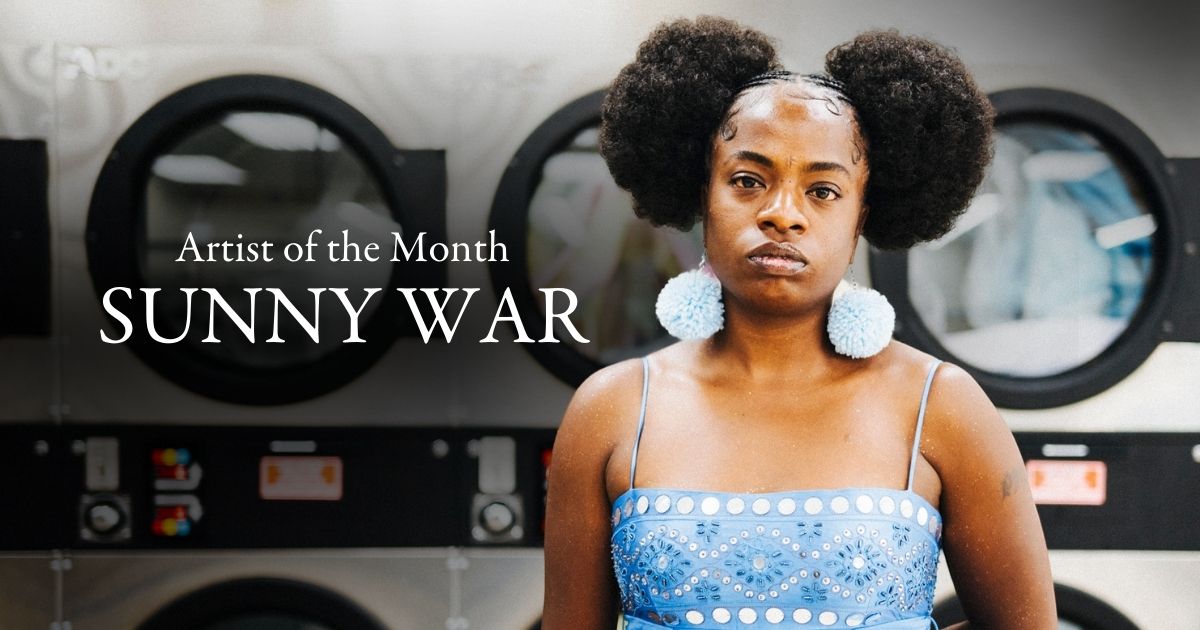
The Subtle Danger of Guitarist Sunny War and ‘Armageddon in a Summer Dress’

In 2022, punk-blues innovator Sunny War moved into her late father’s house in Chattanooga, Tennessee, and began making repairs. There was no heat that first winter and the house needed a full electrical rewiring. By winter 2023, she had the money to heat the place, but as the temperature rose each night, Sunny felt a strange impulse to patrol the house in the dark, swinging her grandfather’s machete at the ghosts inhabiting the top floor.

At the start of our Zoom call interview in January, Sunny recounts the bizarre magical realism of the weeks she spent living with an undiscovered gas leak. I ask enough follow-up questions to be reassured that my friend is not still being fumigated in her own home before I allow myself to belly laugh. “I have to fix everything,” she sighs.

Sunny goes on to explain that by the time the city discovered and fixed the problem, the mood had already been set for her forthcoming album, Armageddon in a Summer Dress. I would describe the results as psychedelic and subtly dangerous.

My friend Sunny can be a little hard to read, a fact which she mentions at one point during our call. We first met at Americanafest in 2019. It was my second year traveling from New York to Tennessee for the annual roots music conference and festival. That summer I had made up my mind to bring Black artists together during the festival for our own unofficial day party. I booked Dee’s Country Cocktail Lounge, cross-referenced names on the festival poster with Google image searches, and sent out a few invitations. Sunny agreed to perform, as did Tré Burt and Milwaukee folk duo Nickel & Rose (featuring Carl Nichols, the artist soon to become Buffalo Nichols). One after another we played our songs then stepped out onto the Madison, Tennessee, porch, most of us meeting for the first time. It was the greatest number of Black people I had ever been around in a professional space since releasing my debut album in 2017.

It was clear to me even then that Sunny was a star. Carl, Tré, and I were on ascendant career arcs of our own, but Sunny was out ahead somehow. She was already well known in songwriter circles for her inimitable movements on the guitar and for her punk rock roots, but it was the intensity of her stage presence that stood out to me most on that first meeting. I watched her suck in the air and light around her as she sang, quietly commanding the audience’s attention. Songs like “Drugs Are Bad” and “Shell” became spells when sung in War’s almost-effortless, warmly breathy style. She appeared peaceful in her own creative world amidst the restless energy of the festival.

2019 was also the year that Sunny founded the downtown Los Angeles chapter of Food Not Bombs, a national network of community groups addressing hunger. In interviews about the movement she was candid about having experienced houselessness herself and how she noticed the disproportionate presence of veterans on the street. She organized weekly meetups in which volunteers made meals and shared them, potluck-style, with their unhoused neighbors on skid row. When COVID hit they switched to burritos and sack lunches. On “Deployed and Destroyed,” one of the outstanding tracks from Sunny’s 2021 album, Simple Syrup, she invites her listener to spend three minutes and 54 seconds in the shoes of a 26-year-old unhoused veteran experiencing PTSD. When I listen to her sing “I still love you/ We’re still friends” I feel like I am sitting beside her. This is what Aristotle and contemporary Marxists call “praxis.”

Sunny is fearless on stage. Six years into our friendship I remain awed by the way in which she commands attention without ever seeming contained by it. Her presence has a kinetic power that you can more easily get lost in than describe. We met up in Chicago on a winter night in early 2023 when Sunny was on tour and I was in between tours. Both of us were depressed, I think. Wide, wet snowflakes were beginning to fall outside while we caught up over drinks. We bribed the DJ into letting us jump the line for karaoke and then launched into a formally unconventional performance of Destiny’s Child’s “Jumpin’ Jumpin’.” The mostly-white crowd of beer-drinking twenty-somethings were amused at first and then bored. I gave up. Sunny stayed the course, winning the audience over with mischief in her eyes.

Later that year Sunny released Anarchist Gospel on New West Records to well-deserved, unanimous acclaim. The album featured Americana heavy hitters Allison Russell, Dave Rawlings, and Chris Pierce. She also toured with Mitski, broadening her fandom to include more indie listeners. I cheered my friend from afar, mostly on Instagram, as her star continued to rise.

When I ask about her memories of that album cycle, Sunny enthusiastically recalls the younger audiences who discovered her music. She expresses gratitude that a 14-year-old at a Mitski concert, someone who “actually is into music for the first time in their life, in the way that you are when you hate your parents and all you have is music” would become a fan. A lot of journalists described her as an “emerging” artist or a songwriter soon to be one of the most beloved in Americana. But for those of us on the fringes of the format, Sunny had been the best around for a minute and the momentum of her career spoke for itself.

Sunny’s latest album, Armageddon In A Summer Dress, comes out on February 21. I ask her to describe the new record in her own words. “Silly,” she responds. I ask if there is a genre descriptor for her music in general. She says, “No.”  I am going to follow the artist’s lead and not do her album the disservice of describing it too much. I will say that Armageddon In A Summer Dress is her seventh full-length effort and contains her most inspired vocal performances yet – and some of her finest lyrics.

There is a haze hovering in the top layers of some of these tunes. The winding guitar melodies often weave themselves into the vocal lines, but sometimes they go their own way. I ask her if audiences are reacting to the Black anarchist content of her songs differently than they did the last time she released a folk album with transparently leftist politics. “I don’t feel like people pay that much attention to my lyrics,” she responds. Her primary musical concern, she reflects, is playing the guitar. And in any case, the best way to metabolize these songs is by listening to them repeatedly.

Sunny, Carl, Tré, and I have remained loosely intertwined in the years since that first Americana kickback. We have toured together. We run into each other at festivals and in thrift shops. Tré and Sunny were roommates for a time and in the summertime can be seen riding bikes like cousins in Sunny’s recent music video for “Scornful Heart.” I interview my friends periodically.

We all continue to embody aspects of the blues tradition while resisting categorization. Sunny continues moving patiently through her own cycles of living, transforming, creating in darkness, and then telling the story. She leaps unexpectedly from now to the future and then doubles back to sample tradition, inviting you to keep up. Her lyrics are disarmingly empathetic. Like all great artists, Sunny moves in her own time, less concerned with debating the canon than she is with creating the future. She looks back on the nights she hunted ghosts with her grandfather’s machete joking, “That wasn’t me!”

There is great integrity in Sunny’s storytelling, which means that no matter how long it has been since we last spoke, she will catch me up quickly when we meet again. I ask her who the narrator of “No One Calls Me Baby” is, trying to signal that I am a feminist who recognizes women writers as authors beyond the world of autobiography. But she quickly tells me that the narrator is her and fills me in on the past few months of her life. She has been single for over a year, and has been learning to enjoy the alone time in a house she owns. We commiserate about being single, but we are both leaned back by this point, looking down on loneliness together. “No one calls me baby anymore/ I hold my own hand now…”

One of my favorite things about Sunny is that whether she’s playing a dive bar or a sold-out theater, everyone walks away dazzled. She is just as warm and entertaining sitting across from you in her home. She accompanies herself.


Find more Sunny War Artist of the Month coverage here.

Photo Credit: Joshua Black Wilkins

Artist of the Month: Yasmin Williams

No one on earth plays the guitar like Yasmin Williams. When the BGS team was first introduced to her music – back a few years now, in 2017 or 2018, during our annual programming for our Shout & Shine diversity showcase – it was an objectively jaw-dropping discovery. We’ve covered many singular musicians, instrumentalists, and guitarists over the years on our site, but here was something completely and totally brand new. Then, in 2021, she wowed our BGS audience with her Shout & Shine livestream performance. From our staff to our followers, we were all hooked.

Immediately upon hearing Williams’ ethereal, otherworldly, and effortlessly charming guitar-centered compositions, it’s natural, reflexive even, to imagine how listeners may have first reacted to encountering Sister Rosetta Tharpe’s earth-stopping rock and roll, or Elizabeth Cotten’s unassuming backwards-and-upside-down guitar genius, or Jimi Hendrix’s showy shredding behind his head. There’s a jolt of electricity, a child-like wonder, and proper awe that each result from even the slightest encounter with Williams’ talents.

But, like those legends before her, this is not merely toxically masculine, performative, over-the-top “guitar culture” music. You can tell, from the first breath of tone from her instruments, that Williams is not now nor has ever been the guitarist trying to impress or outdo all of the AC/DC or Led Zeppelin rehearsers plucking through “Stairway to Heaven” at the local Guitar Center.

No, Williams’ approach to the instrument is totally brand new, too – and a remarkable breath of fresh air in a scene that is often derivative, competitive, exclusive, and rife with “Um, actually…” Instead of focusing her ambitions or goals entirely on the insular, inward-facing guitar world, Williams has demonstrated over two impeccable, critically-acclaimed albums – 2021’s Urban Driftwood and her first Nonesuch project, Acadia (out October 4) – that her community is far broader, richer, and truly incandescent.

Acadia builds on the rich and resplendent universe Williams built for Urban Driftwood – and has been cultivating for years, since her full length debut in 2018, Unwind. With a foundation centered on fingerstyle acoustic guitar with plenty of blues, bluegrass, flatpicking, and Americana infusions, Williams approaches the instrument as if a just-invented, novel machine; pedagogy, tradition, and technique are all present, but only ever in service of the melodies themselves – never as exercises in “correctness” or propriety. She’ll play with the guitar in her lap, tapping with both hands on the surface of the strings and fretboard. She’ll affix a kalimba to the face of the instrument and play both simultaneously. She quite literally turns her six-string (and her harp guitars, banjos, and more) on their ears, throwing all expectations and convention out the window.

There’s showmanship evident herein, of course, and a tinge of acrobatics, but these are merely knock-on effects and not the entire point. Instead, it seems Williams’ intention is to follow each and every tendril and tributary of her musical ideas to their natural conclusions, raising no barriers to herself in the process. Not even the barrier of the guitar itself. What even is a guitar, if you approach it from a unique perspective or through a fresh lens each time you pick it up? Williams shows us this common, everyday, century-spanning instrument can always find new sounds and styles.

Again, in contrast with “norms” in the guitar scene, Acadia is a testament to Williams’ community, as well. Her albums as yet never feel like guitar vanity projects, as the picker decidedly brings in so many facets of her musical and creative community to her music making. In just the first three singles from Acadia she taps an impressive array of featured artists, from Aoife O’Donovan to Darlingside to Allison de Groot & Tatiana Hargreaves. On prior releases, she’s recorded with the legendary Tommy Emmanuel, Taryn Wood, Dobrotto, and many more. Her approach to the instrument is singular, but it’s never solitary. Where other guitarists might prefer to leverage the instrument and their virtuosity to center themselves, Williams seems determined to do the opposite. The results are, as always, stunning.

Fingerstyle acoustic guitar is engaging and lovely music to begin with, but given her particular touch, her compositional voice, and her community collaborations, Yasmin Williams is showing roots music fans everywhere that even our most familiar instruments can be wellsprings of originality, inspiration, and joy. Acadia is a masterwork, and a perfect album to spotlight as we name Yasmin Williams our Artist of the Month. Enjoy our Essentials Playlist below to kick off the month and read our exclusive interview feature here. And, read an excellent op-ed on Williams written by buzzworthy viral guitarist and improviser Jackie Venson here. Plus, we’ll be dipping back into the BGS archives for all things Yasmin throughout October.


Photo Credit: Ebru Yildiz

Brooklyn Guitarist Jeremiah Lockwood Delivers ‘A Great Miracle’ for Chanukah

Lamenting a lack of quality Chanukah music has become nearly as much a part of the Jewish winter holiday season as latkes, the delicious potato pancakes served with apple sauce and sour cream.

So excuse us if the arrival of A Great Miracle, Jeremiah Lockwood’s new album of instrumental acoustic guitar performances of Chanukah music, seems if not exactly miraculous, then certainly something holding many marvels: A John Fahey-esque fantasia on the blessing for the lighting of the menorah? The children’s song for the spinning of the dreydl delivered as a Piedmont-style rag? And influences going from Bessarabia to Brooklyn to Bamako?

One question looms, though: What took so long?

“I know!” says Lockwood, a Brooklyn-based musician who has long explored and created crossroads of Jewish music and other traditions. “It seems like it’s so obvious, especially given the role of musicians with Jewish heritage in Americana and the folk revival — especially guitarists. I think there’s a reticence around embracing that aspect of one’s heritage, or that musicians who go that route jump all the way in. For me, it’s the question of ‘How can we articulate multiple faces at the same time and be true to different aspects of oneself?’”

Arguably that has been the quest driving Lockwood’s career, whether mixing Jewish themes with rock and experimental jazz in his band the Sway Machinery, as guitarist in the global mélange Balkan Beat Box, or in his arresting Book of J collaboration with radical artist Jewlia Eisenberg, who died in March.

It’s something he’s also pursued in a parallel academic career. In 2020 he earned a doctorate from Stanford in education and Jewish studies, his thesis revolving around young Jewish cantors influenced by seemingly anachronistic cantorial styles of the early 20th century. He’s now at work on a full book on that topic and has produced an album featuring the young cantors. Currently he’s a research fellow at UCLA School of Music’s Lowell Milken Center for Music of the American Jewish Experience.

This album, released by the Jewish culture endeavor Reboot, is the real fulfillment of all of that. In particular, the collection braids together the foundational impact of the two key mentors of his youth: His grandfather, famed cantor Jacob Konigsberg, and the blues guitarist known as Carolina Slim (a.k.a. Elijah Stanley), a master of Piedmont-style fingerpicking. A Great Miracle is the album Lockwood was born to make.

“For sure,” he says with an enthusiastic laugh. “I mean, on a quite literal level.”

To a great extent, A Great Miracle is modeled on the 1968 re-envisioning of Christmas music, The New Possibility: John Fahey’s Guitar Soli Christmas Album. The Fahey album came into Lockwood’s life as the seasonal go-to for his mother-in-law at family gatherings, his first contact with the musician’s influential and extensive catalog.

“They listened to that every year,” he says. “They were an Irish family that was no longer Catholic. For them the Christmas holiday was a lot about these songs and this particular record, the way he synthesizes the ‘60s perspective on spirituality and religious music, some kind of American concepts related to Easter religions, kind of revering this kind of austerity and sweetness.”

The aesthetic resonated.

“That’s what spoke to me,” he says. “And his style is so similar to the kind of fingerpicking that I do, that it was very easy for me to learn those pieces. Over the years I just kind of picked them up. I’d play the record [on guitar] instead of turning on the stereo. And then I started doing a similar stylistic approach to playing Chanukah pieces.”

Where Fahey famously mixed his deep Delta blues influences (Charley Patton prominently) with, among other things, strains distilled from such post-Romantic composers as Anton Dvorak and Jean Sibelius and Indian raga modalities, Lockwood brings in East Coast blues fingerpicking, cantorial modes and West African guitar styles.

Fahey’s array of hymns and carols was in many ways a rejection of the commercialization of Christmas, though ironically A New Possibility gave him by far the biggest seller of his catalog. Lockwood’s album also, in its own way, involves reckoning and reconciling with the distinctly American Jewish celebration of Chanukah.

“This record kind of goes in two directions,” he says. “One is that it’s about trying to find a foothold in which to participate in the beautiful thing which is Christmas, and also its kind of goofiness. It’s kind of the most commercial experience possible. But it’s our culture just as much as anybody else’s, because we’re American.”

That Christmas Envy is experienced by many American Jews and has shaped the occasion’s profile. Through the ages Chanukah was a minor holiday, only in recent times elevated in importance, largely due to its calendrical proximity to Christmas and a desire to have a comparable celebration for Jewish children. But for Lockwood there is a personal layer.

“The other direction is my usual concerns about my family and the musical legacy from my grandfather, growing up in a cantorial family and what the Chanukah celebration was for us,” he says. “So I have a couple of the intense cantorial pieces I did transcriptions of. And then also it’s playful. There are a lot of kids’ songs and this, in a way, is almost a children’s album.”

The Fahey-inspired modalism of “Al Hanisim” is based on something he learned from his grandfather.

“I think he learned if from Samuel Malavsky, a great cantor who had a family choir with his daughters,” he says. “It has a similar vibe to my family. I love them and apparently my grandfather did too, although he didn’t talk about where he learned things from all the time.”

A second take on “Al Hanisim” references a version by Izhar Cohen, an Israeli pop star of the 1970s.

“This song is sung by American Jews, very commonly,” he says. “Also this has an older story. It’s from the pre-state Palestine, part of the early Zionist push to create Israeli music, create something that represented the identity of the new state. I’m not coming from a Zionist perspective, but that music is part of American Jewish culture. These are the songs that the family sang every year for Hanukkah. The ones that are more American mainstream are the ones that are from Israel, actually, which is ironic. Those were coming from my uncle who was the cantor in a suburban, conservative synagogue.”

There’s also a delightful surprise in the musical approach of “Al Hanisim Izhar Cohen.”

“The guitar sound is a little bit like Doc Watson,” he says. “He has this thing in his pieces where he’s playing kind of in a Travis-picking style, or it might be like ‘Windy and Warm,’ this classic Doc Watson fingerpicking piece.”

Then there are the two odes to the dreydl. First is the rag version of the children’s song “Little Dreydl,” done in the syncopated-gospel style of blues great Reverend Gary Davis. The other, “Dre Dreydl,” opens up a great wealth of the history of American Judaism to which Lockwood is so connected. His version interprets a recording by Moishe Oysher, who was born in Bessarabia (now Moldova) and became a major figure in New York.

“He was a great cantor, a star of Yiddish theater, and one of the great pop stars of Jewish music in the 1940s and ‘50s,” he says. “The mainstream narrative about Jewish American music is that it went into decline or hibernation in the post-Holocaust period. But that’s not completely true. Stars of Yiddish theater were working in the Borscht Belt circuit and making movies. Moishe was in a bunch of movies, and the Oysher family was very important. His sister Fraydele Oysher was also an amazing singer and sang cantorial music. The Oyshers push the story in a different direction about Jewish American music.”

With the two songs that draw on West African influences, Lockwood continues explorations he’s made with the Sway Machinery, which even played at the famed Festival au désert near Timbuktu. On “Mi Yemalel,” his playing pays tribute to the lyricism of the late Malian guitarist Ali Farka Touré. The album’s closer, the familiar sing-along “Chanukah oy Chanukah,” incorporates inspiration from another Malian guitar great, Boubacar Traoré, connecting Lockwood to the emotional core of this project.

“He’s the master of pathos,” he says. “That isn’t a song we associate with that, but it is for me, maybe because it’s the nostalgia of this kind of childhood world that has gone. My grandparents are gone and the source of the wealth that I think of as being Jewish music, where I’m drawing from now, I have to create it myself. And that’s a very sad thing.”

And what would his grandfather, who died in 2007, think of these recordings?

“He appreciated the things I did,” Lockwood says. “But he wasn’t going to change his musical interests to accommodate anybody else. I don’t want to say he wouldn’t like it. But basically he listened to European classical music, opera, art music. And he listened to cantorial music.”

Regardless, Lockwood hopes that he has created something in A Great Miracle to take a place in modern Hanukkah tradition the way Fahey’s album has for Christmas.

“I’m not expecting a hit record off of this or anything,” Lockwood says. “But on the other hand, it’s the kind of record that’s functional, right? It’s made for people to be able to listen to in a very specific context and hopefully it will become a thing that people can turn back to, you know, every year.”


Image Credit: Justin Schein

The Show on the Road – Silvana Estrada

This week, to help celebrate Hispanic Heritage Month, The Show On The Road brings you conversation with a rising star in folklorico-pop hailing from Veracruz, Mexico: Silvana Estrada.

LISTEN: APPLE PODCASTSSPOTIFYSTITCHER
 

Currently on her first tour of the United States opening for Rodrigo y Gabriela, Estrada has already made a name for herself in Mexico, renowned for her deft finger-picking on the Cuatro, and her ever-bending, darting vocal mastery. Songs from her first EP, including the soaring electronic-beat driven “El Guardo,” have been listened to over twenty million times and counting — and a collaboration with Mexican roots-rock hero Natalie Lafourcade came last year too.

At only 24, Estrada, the daughter of two instrument makers, is just coming into her own as a songwriter, dipping into her love affairs and private passions with a true, clear-eyed, poet’s pen. Singles off her debut album Marchita for Glassnote Records have already landed to great acclaim, and she’s the label’s first Spanish-language signing ever. Look no further than the heartbreaker “Tristeza” for a first taste of her rustic, primordial sound.


Photo credit: Sofía López Bravo

WATCH: Abigail Dowd, “Beautiful Day”

Artist: Abigail Dowd
Hometown: Carthage & Southern Pines, North Carolina
Song: Beautiful Day
Album: Beautiful Day
Album Release Date: April 23, 2021

In Their Words: “I started writing ‘Beautiful Day’ sitting on our neighbor’s front porch one morning. I was living with them at the time, after our house flooded and my husband and I were waiting for the city to buy and demolish it. He was still living in our house with no heat, taking care of our cat and dog, and it got a little lonely month after month of waking up alone in other people’s houses. It was such a wild experience of not knowing what each day would bring or when the sky would clear, so to speak. As the verses started shaping up, I remembered all of the times in my life that felt dark and uncertain, but were actually necessary parts of growing into better versions of myself. This song became a reminder to enjoy the moment and have faith that it was leading to a brighter day. And now, I look back on those days as gifts of time with friends, with my guitar, and without the distractions that used to keep me from having long stretches to write.” — Abigail Dowd


Photo credit: Todd Turner

LISTEN: Luke LeBlanc, “All My Love”

Artist: Luke LeBlanc
Hometown: Minneapolis, Minnesota
Song: “All My Love”
Album: Better Now EP
Release Date: January 12, 2021

In Their Words: “‘All My Love’ came about while I was scrolling through some year-old voice memos on my phone. It was one of those song ideas that I recorded quickly in the moment and then left alone for a while and almost forgot. The lyrics came pretty quickly, but musically it took awhile to figure out what I wanted to do with it. I’m happy with how it turned out; it starts small and builds consistently the whole way through. All the fingerpicking is done on a Les Paul electric which gives you the option to really highlight certain notes louder than others while you’re playing.” — Luke LeBlanc


Photo credit: Mark Walentiny

LISTEN: Garrett Owen, “Souvenir”

Artist: Garrett Owen
Location: Fort Worth, Texas
Song: “Souvenir”
Album: Quiet Lives
Release Date: September 18, 2020

In Their Words: “I wrote the opening guitar figure and first verse to ‘Souvenir’ a long time ago. I showed what I had written to a friend — ‘I put our love in a jar and drove it around in my beat-up car….’ He thought it was catchy. I started slowly trying to coax the rest of it out of myself and used it as an opportunity to take some really tricky chord work in the chorus and impose a massive key change for the second chorus. I have a lot of songs inspired by a long-term relationship I was in; the rest of the lyrics are a mix of abstract expressions of pain and emo-dramatic statements about how things with her ended.” — Garrett Owen


Photo credit: Melissa Laree Cunningham

Fingerstyle Guitarist Sunny War Wants Punk’s Honesty Back in Music

Guitarist and singer/songwriter Sunny War doesn’t necessarily miss performing live, in-person shows — she’s not even sure she ever really liked playing shows that much in the “before COVID-19” times at all. But, as she connects with BGS over the phone in preparation for another pandemic-tailored event, her Shout & Shine livestream show on Wednesday, September 16 (live on BGS, Facebook, and YouTube at 7pm ET / 4pm PT) her general feelings regarding the pandemic and its far-reaching impact on the music industry are very clear: It’s all just really weird.

She, like many creators in the March-and-April maelstrom that swallowed up any/all meaningful work for an interminable period of time, became depressed, distant, and took some time to work her way back into a creative mode that feels respondent to our harsh everyday without being bogged down in it. A punk-influenced and inflected lyricist, she’s once again turning to her songwriting pen as an outlet. 

While her peers turn to that same outlet to process many of the myriad daily tragedies and injustices we’re all so attuned to in this global moment, War instead pauses. “I kinda don’t like protest songs from people who didn’t do it before,” she explains, calling to task the frantic and frenzied rush to pivot records, releases, and pressers into more “appropriate,” digestible bits for a newly awakened, activist reality — and consumer. 

(Watch Sunny War’s complete Shout & Shine performance above.)

But War’s identity, her selfhood, as evidenced through every note of her idiosyncratically finger-plucked songs and through her carefully chosen words in her lyrical poetry and our conversation, calls upon her to challenge that propriety. “[Democracy] actually is working” she explains, noting hypocrisy and/or tone deafness in our roots music communities. “It’s working, it’s always been working. It just hasn’t ever been in our favor.” 

BGS: I’m a banjo player, I came up through bluegrass, and there’s something about your right hand in your guitar playing that’s really entrancing and relatable to me. It conjures bluegrass and fingerstyle, but it is so unique to you, it’s idiosyncratic. Where did your style come from? What influenced your right hand technique, how did it develop? 

SW: I think it came from mimicking banjo, actually. My stepdad’s friend played banjo, so I was around a banjo player sometimes growing up. The first fingerpicking thing I learned was “Blackbird” by the Beatles and that was the first time I thought I sounded kinda good. When I was a kid, I thought, “Wow! This [fingerpicking] sounds way better than just strumming a chord.” I never really learned a lot of chords, I still just play a lot of chords in first position. I was just playing C and G and D open and I thought, “Well now I sound like I’m really playing something.” 

I didn’t listen to blues until I was in high school and then I was kind of imitating country, blues, and my stepdad’s friend on banjo. Later, I was trying to be like Mississippi John Hurt; and I kinda wanted to be like Chet Atkins. But I couldn’t ever figure that out. 

I see plenty of folks in the scene who idolize Derek Trucks or Joe Bonamassa or even Molly Tuttle and Billy Strings who are coming up. There are these guitar fans that just idolize and adore them. Have you seen guitar fans trying to capture what you’re doing with your playing?

Not really? I don’t know. There are some people on Facebook and Instagram who message [me] and want to talk about my guitar style, but they’re usually just into old-timey blues stuff. Then we just talk about that. Sometimes they ask who I listen to. But I think [the implication is], “You’re really close to maybe being like this person I know of.” 

I can think of a lot of shredders out there, but I do the same kind of riffs in every key that I play in. I feel like I can say I really do fingerpick well, but I know people that really do it and can play as well with their left hand as their right. I’m not quite there. [Laughs]

It’s hard to talk about music and performing right now without acknowledging the giant, COVID-19 elephant in the room. It’s interesting to me that this moment of pausing, of stopping everything, especially in the music industry, has given artists a chance to refocus or realign their priorities – have you been thinking about the future? Thinking about the present? How has the pandemic felt to you? 

The first three months I was just depressed and drinking a lot and not doing anything. Then recently, I’ve been trying to write. I’ve been jamming with my friend Milo, who plays a lot of lead guitar on two of my albums, and we’re going to make some demos together. I’ve also been thinking about going to school, trying to get into some kind of two-year program. Since music might not [come back], there might not be live music for two more years. I’m thinking about getting a job. [Laughs] 

It’s daunting to wake up every day like, “I’m going to keep doing this now, because I believe — I think — it’s going to happen in the future.” It’s a lot! 

Yeah, it’s like, “Maybe music is just not essential…” You know? [Sad chuckle] 

Then, with the whole Zoom thing and the livestream thing, I’m just not really into it. I’m not enjoying it at all, it feels weird. It’s just like, sitting in a room by yourself, trying to make a video, and then you think, “Should I look into the camera? Should there be talking in between?” You’re trying to imitate a set at a venue, but you’re just sitting by yourself. It just feels weird! I would rather just play by myself, without a camera. 

I liked playing shows [before] kind of, but I almost didn’t even like that. At least it felt like there was a reason for doing it. I was talking to my mom and we both realized we used to watch concerts before, too. Just then it was an actual concert on film. Even that would be better! If there were somehow an audience in the livestream… I guess that can’t be, but it’s just awkward [without them.] Seeing a band play off of the energy of the room is more what it’s about.

Well, for your Shout & Shine livestream performance we’ll have to ask our audience to be “loud” in the comments! Use that clapping hands emoji! [Laughs] Who would you like to see as a guest on Shout & Shine? Whose music is inspiring you right now and getting you through the day-to-day?

I like Tré Burt! Amythyst Kiah, too. 

Have you heard of Yes Ma’am? They’re from New Orleans – the singer sometimes plays solo, but also has a band. They used to busk on the street in New Orleans. It’s just really good, a great kinda folky string band. 

I like the new Run The Jewels album. I listen to Elliott Smith still, and a lot of ‘90s music. I like Black Pumas a lot.

What would you like to see from the music community, as far as a response to this moment in our culture’s history — not only the racial injustice and righteous rebellions against police brutality, but also how divided and polarized our musical community is now. It’s like half people who want music to “remain apolitical” and half folks who are like, “Music has always been political, where the fuck have you been all along?” What do you see as the urgent need of our community to reconcile all of this? I know that’s a huge question.

I think it just needs to become about honesty again. That’s something I would like to see. I’m not really that into “Americana” music, but even so I feel like [Americana] musicians are going to be faced with not being able to let these issues go unaddressed anymore. I think that’s interesting. At this point, you can’t just put out your weird corny love song that’s not even about anything that happened in your life, but is actually just something that makes sense pop-wise and hit-wise. You should have to really be honest. People don’t necessarily have to be “political,” they can just write about all the emotions they’re going through. We’re all dealing with the pandemic and with Trump and with police brutality — it’s a lot. Even if people don’t want to write a song about why we should get rid of the police, they could at least write about how scared they are. I don’t know, there’s a different, new kind of folk that could happen about just being freaked out and unsure of your future. I love shit like that. 

I kinda don’t like protest songs from people who didn’t do it before. It’s just not hitting right. I don’t want your protest music if you weren’t writing it before. Whatever issue is being highlighted, it’s always like, “Yeah, we’ve BEEN talking about that.” [Expectant pause] This has been the conversation. I’m into punk, I’ve always liked protest music. As far as folk, I do like its protest music, but I mostly like punk or really politically-charged hip-hop. It’s kind of annoying when say, a really poppy country person who’s never said anything about anything is writing a protest song. It’s just cashing in. It’s corny. It’s weird. 

And another thing, a lot of people who are going out to these Black Lives Matter protests and stuff, I still don’t feel like they would treat me any differently than they normally would. I saw people posing and taking pictures. This is a weird thing to just be a trend. 

Like Breonna Taylor now being a meme.

Yeah. It’s offensive, it’s too much. 

And how many times they show those videos [of Black people being murdered by police]. There’s a lot of murder porn going around! People are saying one thing, but showing someone die every day. I was kind of like, “You know, I don’t think they would show a video of a white person being killed, over and over again.” A lot of things happening right now are really dehumanizing and I don’t think people can see it unless they really, really think about it. Or maybe put themselves in that position. It’s murder porn.

I know what happened. I don’t want to see this over and over again. I don’t need to physically see it to be angry about it. Think of all the bad this is doing to our psyches on top of everything else, seeing people murdered every day. 

But, a lot of musicians are “activists” now, I guess. I just… don’t really know what that means. They were going to put out a song anyway. That’s what they do for a living. Obviously they can’t just put out the typical love song — that’s what people always write about, love. That would be “offensive.” Or, it wouldn’t be “appropriate.” So they all have to change and pretend to be “activists.” It’s just a reflection of what’s trending right now. 

I just want to know: Are they actually going to change in a year? I’m curious to know how long the Black Lives Matter profile pictures are going to stay up. 


Photo credit: Randi Steinberger

The Show On The Road – Richard Thompson

This week, Z. Lupetin speaks with British-born folk-rock rebel and underground guitar icon, Richard Thompson.

LISTEN: APPLE PODCASTSMP3

With his signature grimace, that seems to dare you to look at his album covers, his salty slam poet vocal delivery, his slashing fingerpicked guitar style, and imposing black beret — which makes him look more like a hardened revolutionary than a kindly grandpa who just turned 70 — Richard Thompson is a true icon of rock and folk music.