WATCH: Jeremy Garrett, “I Can’t Lay Your Lovin’ Down”

Artist: Jeremy Garrett
Hometown: Loveland, Colorado
Song: “I Can’t Lay Your Lovin’ Down”
Album: Circles
Label: Organic Records

In Their Words: “‘I Can’t Lay Your Lovin’ Down’ was a song that I co-wrote with Jon Weisberger and Josh Shilling. I just loved the vibe of the tune and how it fit with my style, so I decided to record it on my upcoming solo release, Circles. I blend guitar, mandolin and fiddle with a looper to create this arrangement for the song. Conner Pannell shot the video for me and I love how he captured this song. All of it was shot in the studio, partly while tracking and in-between takes.” — Jeremy Garrett


Photo credit: J.Mimna Photography

Three Decades In, Leftover Salmon Let out a ‘Festival!’ Yell

Three decades ago at the Telluride Bluegrass Festival, two bands of oddballs who couldn’t get invited to play the main stage said “screw it,” and teamed up for a bar gig back in town… And the rest, as they say, is history.

That slapped-together combo took the name Leftover Salmon. They’ve since gone on to influence an entire generation of bluegrass-based music. Most fans are familiar with the broad strokes of their tale — the renegade musical brotherhood of Vince Herman and Drew Emmitt, the band’s bluegrass/rock fusion and resulting evolution into the prototypical jamgrass group, and the spirit of good times, good friends, and good tunes which still permeates the scene they helped create. But few have heard the entire story until now.

In Leftover Salmon: Thirty Years of Festival!, author Tim Newby dives deep into hazy memories and unforgettable highlights, tracing the twisted path that led the band to its current, esteemed place in roots music lore. Across 13 chapters and more than 300 pages Newby coaxes the story from the band’s revolving lineup — deftly treading the line between historian and hardcore fan — and in the end much is revealed of the band’s high-minded beginnings and unshakable ethos, as well as the struggles they’ve seen along the way. And it’s all done with a wild “Festival!” yell running between the lines.

To be sure, the Leftover Salmon story is not over yet. The band continues to traverse the country on tour – recently swinging through Nashville’s Ryman Auditorium and thrilling a hometown crowd at Denver’s Red Rocks Amphitheatre shortly after — and they plan on returning to the studio this fall to record “three or four tunes” for release “over the interwebs.” But in the meantime, Herman shared some laughs with The Bluegrass Situation about the process of looking back, what the book means to the band, and why none of this would have happened if not for the Iran-Contra scandal.

BGS: Were you surprised Tim wanted to do this book?

Herman: Absolutely. It’s a massive endeavor and he put like three years into it. That alone is an amazing honor — no matter how it came out. [Laughs] But no, we were definitely surprised and delighted that he wanted to do it.

Was there any hesitation in laying everything out there?

Not on my part. We were pretty psyched about all the fun we’ve been able to have over the years, and to have somebody locate it within the larger picture of the music community, it just felt like an honor. Sure, we had some rowdy times and wild things have happened, and it might sound a little more like a rock ‘n’ roll band in the book than a bluegrass band, but I hope it throws some light on how deeply we respect the bluegrass tradition, where that all sprang out of and how we are trying to integrate that along with a more inclusive rock ‘n’ roll vision. I think the book addresses pretty well how we tried to walk that tightrope.

Tim told me you let him root around in your lives for weeks at a time. He said he was at your house digging through old file cabinets and everything. What was that like from your perspective?

Well, it was comforting because I’ve moved around a whole lot over the years and I’ve been toting that stuff with me for a long time. [Laughs] There was finally some validation of “All right, maybe it was a good idea to keep this stuff.”

Did he dig up anything you had forgotten about, or give some insight on how the others viewed things that happened?

One of the things he dug up that I hadn’t looked at in years and years were [late, founding banjo player] Mark Vann’s calendars. He was sort of like our manager early on, and it was cool because they had notes on them about booking gigs and what we got paid, some expenses and all that. Man, we played a lot of years for $500 a night! [Laughs]

One thing I learned was that the Iran-Contra scandal helped create the band, and this was not a connection I would have made on my own. Can you explain?

[Laughs] Well, there are two ways it affected me. When I moved to Boulder, [Colorado] from Morgantown, [West Virginia] in 1985, I was just gonna be here for a couple of months and then go be a witness for peace on the border of Nicaragua, so that part of the Iran-Contra scandal was definitely on my mind when I moved here.

But a few years later when I started a band called The Salmon Heads, we had played our first gig on the hill at Taylor’s in Boulder, and we had an accordion and washboard instead of drums. We played our first set and the bar manager said, “You guys don’t have to do your second set. We’re gonna call it, you don’t play college music.” But we said “Fuck that shit” and continued to play, and it was fun.

That night after the show, someone threw a brick through the window of the club in a random act — and it was not related to us in any way shape or form — but the next morning everyone on the hill was wondering what happened to Taylor’s last night. So we seized that opportunity and made some posters for a house party we were playing, and they said, “Come see what the Aya-Taylor had determined was not college music!” At the time the Ayatollah was in all the papers, so we created the Aya-Taylor, and that party was raging that night. It’s the intersection of history and music.

It’s not all funny stories, as the book goes into some of the more difficult decisions you’ve had to make and plenty of hard times. Were there any tender spots where it still hurt to think about?

Oh yeah, definitely. Especially around Mark Vann [who died from cancer in 2002] and rebuilding and trying to keep going. We finally decided to call it quits for a while and didn’t really expect to come back, and that was an intense time. We were driven to the point where we just weren’t having fun hanging out together anymore, and it was tough because we never really took the time out to grieve Mark, I think. We had to push on because that’s how we all made our living — it’s always been a blue collar band working paycheck to paycheck. That was really difficult and eventually the spiritual price of it was just too much.

The book also traces the evolution of Colorado’s music scene, which you guys were sort of inadvertently at the epicenter of.

Yeah, when we got to town there wasn’t a bluegrass scene. I rolled into a Left Hand String Band show when I drove here from West Virginia and that connection was made immediately. But bluegrass was kept in its corner and the big thing in town was blues and electric stuff. We just felt like we were this musical niche that was best used for Grange Halls and old-timey dances, and to see it move out of Grange Halls and into concert halls over time was definitely a satisfying experience for us, and something I think we might have had a little to do with.

But it’s certainly not like we started anything new, and I’ve always been the guy who says we were really just walking in the footsteps of New Grass Revival and the Nitty Gritty Dirt Band. People like to say, “This started here” and “That started there,” but it’s always a continuation of some tradition with a new twist, perhaps.

After looking back on these 30 years, do you feel like the band has changed – musically or as friends? Or is it still the same spirit as when you began?

I just had a friend from Japan who was my college roommate in 1982 come visit, and I hadn’t seen him all those years. He came and we went to our show at Red Rocks, and then a friend of mine gave him a ride to the airport. On the way my friend asked my old roommate, “So how’s Vince seem to be doing all these years later?” And he answered, “Vince is still in college!” So I guess we won!

Maybe that’s part of why this thing has worked for so long.

We get to have these joyous jobs where we meet new friends and constantly reconnect with old ones, and play a lot of festivals, which is when humans are at their finest form, I think. And through all this stuff, we’ve been able to build this life that’s pretty dang pleasurable. Not that it’s easy on relationships or anything, but our day-to-day living is pretty dang pleasant.


Photo credit: Bob Carmichael

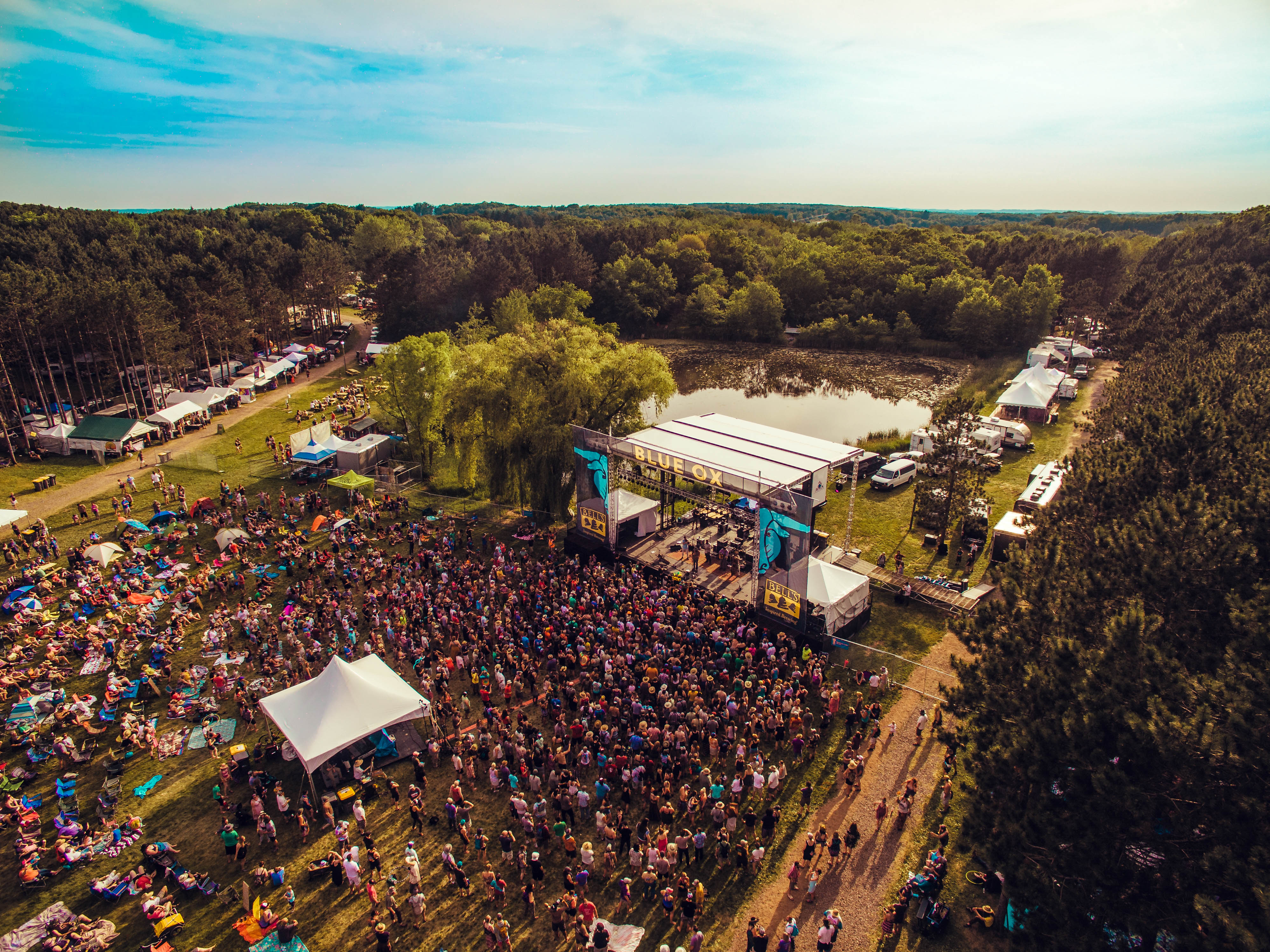
Blue Ox Music Festival: Six Reasons to Go

As I have attended Blue Ox Music Festival each of the past three years, I have found it’s about both the music and the people who love the music. A lot of folks come from isolated rural areas or spread-out small towns, so spending a weekend with so many like-minded, friendly, and positive music lovers is a refreshing and special feeling. There’s a strong sense of community — that’s what keeps bringing me back.

Blue Ox Music Festival 2019 will be held June 13-15 at Whispering Pines Campground in Eau Claire, Wisconsin. Here are six reasons to go.


View this post on Instagram


A post shared by Blue Ox Music Festival (@blueoxmusicfestival) on

1. The Mornings
A short stroll through the campground in the morning really shows the best in people. You’re sure to have more than a handful of strangers greet you cheerily or invite you into their campsite for coffee and conversation. Additionally, the festival offers yoga every morning — it’s a great place to wake your body up in the morning, limber up before the long day, and meet new folks.


View this post on Instagram


A post shared by Blue Ox Music Festival (@blueoxmusicfestival) on

2. Friends of Friends
Blue Ox is a meeting point for music lovers from all around the Midwest. You’re bound to run into a friend, a friend of a friend, or maybe even a long-lost relative. The festival is a beautiful representation of how music brings people together.


View this post on Instagram


A post shared by Blue Ox Music Festival (@blueoxmusicfestival) on

3. Diverse Sounds
The lineup draws from a very diverse variety of genres and styles. There’s truly something for everyone, from Deadheads and alt-country lovers to traditional bluegrassers and funky folks. If you were to walk around the grounds and asking passersby which act they’re most excited about you might hear dozens of different answers. It’s really special to see so many fans of so many different styles all in one place.


View this post on Instagram


A post shared by Blue Ox Music Festival (@blueoxmusicfestival) on

4. Emerging Talent
Sure, there will be plenty of names on the bill that you already recognize, but one of the finest features of a music festival is discovery — discovery of new bands and sounds from near and far. Like Armchair Boogie, an eclectic group from Madison, Wisconsin. They offer a totally unique and original cocktail of sounds from rockabilly to funk to bluegrass and beyond. The guys recently began recording their sophomore album, What Does Time Care?, so be on the lookout for some new tunes soon.

The Lil Smokies played the Blue Ox side stage in 2018 and the crowd nearly doubled in size over the course of their set. They combine incredible technique and heaps of talent with extremely well-crafted songwriting. It’s really easy to get hooked on their music.

The Wooks are a string band made up of five absolute shredders who blur the lines between traditional bluegrass, honky-tonk, jam bands, and more. This is their first year at Blue Ox and you won’t want to miss them.


View this post on Instagram


A post shared by Blue Ox Music Festival (@blueoxmusicfestival) on

5. The Backwoods Stage
Twelve hours of music every day can make it easy to forget about (or be too worn out for!) the Backwoods Stage. It’s the place where all the beautiful late-night weirdness happens. You might find Billy Strings jamming a few tunes with Horseshoes & Hand Grenades, or Jeff Austin picking a few with The Travelin’ McCourys. There’s no telling what might go down, but it’s sure to be a highlight.

6. The Jams
Blue Ox jams — whether on the main stage, during late-night, around the parking lot or the campground — are unique in that you’ll hear everything from The Rolling Stones to John Hartford, and Andy Statman to Hank Williams over the course of an hour or so. Most Blue Ox folks are totally open-minded, which makes for some very cool and unique jams. It’s an event that really does have a little something for all roots music fans out there.

Don’t forget to follow along across BGS social media channels this week as well for special on-site coverage from Blue Ox. Even if you can’t make it to the festival, you can watch key sets from the weekend on BGS.com via JamgrassTV.


Photo credit: Scott Kunkel

LISTEN: Andy Thorn, “Thornado”

Artist: Andy Thorn
Hometown: Boulder, Colorado
Song: “Thornado”
Album: Frontiers Like These
Release: June 21, 2019
Label: Thornpipe Music

In Their Words: “This tune came from exploring the key of A on banjo with no capo. Playing in A with no capo opens up a lot of different melodic possibilities on banjo and when I found the main riff I started basing a song around it. The tune really comes to life with the tasteful back and forth of Bobby Britt’s fiddle and Andrew Marlin’s mandolin. I love Jon Stickley’s creative use of open strings and harmonics on the jam. And Miles Andrews holds the whole thing together on his gut string bass. At just over six minutes it’s longer than your typical banjo tune, but if you give the whole track a chance it will take you on quite a ride. Enjoy ‘Thornado’!” — Andy Thorn


Photo credit: John Ryan Lockman (Show Love Media)

Frank Solivan Finds Room for All Kinds of Bluegrass

Frank Solivan has steadily built a foundation in bluegrass, from going to festivals as a kid, touring in acoustic bands while living in Alaska, and playing fiddle in the US Navy Band’s bluegrass ensemble. For nearly 10 years he’s fronted Frank Solivan & Dirty Kitchen, an IBMA award-winning group that embraces its eclectic influences. A few days before releasing the new album, If You Can’t Stand the Heat, Solivan traced his journey with the Bluegrass Situation.

BGS: Let’s start with “Crave.” I feel like it captures everything that you’re about – the melody, the picking, and the big singing voice. Did you think it sets the tone for this new album?

Solivan: Yeah, a little bit. Right from the beginning, I had an idea for long, sustaining notes, and this chordal thing, and the words started coming together. Becky Buller and I started writing that song… gosh, it’s been a while now. We took some artistic arrangement liberties in the studio and came up with what’s there. I almost feel like I painted myself in a corner because it is a tough song to sing, and it takes a lot of vocal energy, that’s for sure.

You do build up to a big note. While you’re singing that song, do you think, “Oh no, here it comes…”

You know, if I’m in good voice, I’m not terribly worried about it. There’s a lot of arrangement stuff that goes on in there too, keeping it together. Singing well while you’re playing an arrangement like that – I’m really the only person I have to worry about. Everybody else is great. It’s fun, though, and it’s a challenge.

I was having some trouble with my hands over the last decade or so, my left hand especially, and it was getting progressively worse up until we were recording this record. I never considered myself a great singer or whatever, but I really wanted to focus on the singing on this record, because I thought maybe I won’t be able to play as well as I want to later.

Then I had carpal tunnel release surgery on my hand and it turned out great. I went to a top-class surgeon and my hand is fine now. But, you know, as a musician you worry about that, thinking maybe I should just focus on singing well on this record and keep my playing within my limitations, and not reach out too far. I was able to focus and find a singing voice. I’m constantly trying to become a better singer and I think maybe this record helped with that a little bit, too.

On your albums, you often go for honest, confessional lyrics, and I don’t hear that a lot in bluegrass. Do you think you have that more “sensitive songwriter” side to your music?

Oh, I’m just a big teddy bear. [Laughs] My songwriting comes from inspiration in life, for sure. But I didn’t write every song on this record. I wrote “Crave” with Becky, then there’s a song that closes the record called “Be Sure” that was based on an experience of mine, and some other experiences of others around me at the time, when I was 19 or 20 years old. And it’s finally seeing the light of day and got recorded.

But the formula is having songs that I can relate to – either songs that I’ve written or written with somebody, or from a family member or a band member. My cousin Megan McCormick wrote two songs on there – “My Own Way” and “Shiver.” Our banjo player Mike Munford composed the banjo tune on there. Also, friends write songs, like Sarah Siskind. She wrote the song “Set in Stone” with Ari Hest. That’s the formula for us — keeping it kind of close.

How did you wind up living in Washington DC?

Back when I was 18, I graduated from high school and moved from Central Valley, California, to Alaska. I drove my pickup truck up there. I was with my mom, and also I was invited to play music up there with Ginger Boatwright. She was doing a tour that first summer with Doug Dillard – she was the singer and guitar player for the Doug Dillard Band. I thought, “OK, I’m going to hang out and play it by ear.” We had a little bit of family up there, so we stayed with them. My mom got a job and then I went off and moved all around Alaska.

Long story short is, I loved it and stayed. I worked all kinds of jobs, from explosives, to a perforating service, to driving trucks and delivery vehicles, to driving a school bus and being a substitute school teacher, to construction… whatever I could do that would allow me to go hunting and fishing and play music. I played with a lot of bands and went to the University of Alaska in Anchorage and studied violin performance. And then heard of an audition for the US Navy Band in Washington DC, for the country band and bluegrass band, and when they had an opening, they offered me the job.

The next thing you know I’m going to boot camp, doing about a million push-ups. Anyway, Leah — who is my wife now but was my girlfriend at the time — and I moved to the DC area in 2003 and I reported for duty. We got locked in here and I did six years with the Navy Band. I decided at the five-year mark that I needed to get out and I gave them my notice. I needed to get out and make music. It was a good job and I was proud to serve, but for me, I needed to be an artist. I needed to make music, not just play music.

Growing up, who were some of the people who encouraged you?

Well, we’d have these huge family gatherings and we’d end up doing big meals, and the next thing you know, everybody’s pulling out instruments and everybody’s encouraging other. I had a cousin Ty that passed away last year — Charles Tyson Smith – and I’ve recorded a number of songs that either he’s written or that we wrote together. He was somebody I looked up to in my family as a musician, writer, and singer.

And of course my parents would take me to concerts and music festivals. I remember when I was pretty young, going to see Ray Charles, Tower of Power, Stevie Wonder, The Judds, Merle Haggard, whoever it might be. I had all these opportunities to see these greats and we’d go to music festivals as well – bluegrass festivals and old-time fiddle contests and jam sessions. That’s what I grew up doing. Now of course I realize what a gift it was.

When I was in high school, I heard about this band who was looking for a fiddle player. My mom took me to the audition and I got the job. She took me to a number of these gigs and helped me buy the gear I needed for it. I played with a number of bands in high school, but they weren’t high school bands. They were regional bands that would open up for big names and big concerts, and play big clubs and dancehalls. Luckily I carried myself a little older than I was, which was great, because if they knew I was 16, 17, or 18 years old, I probably wouldn’t have been allowed to go into these places!

Being exposed to so many different kinds of music, do you think that shaped the way you hear songs or seek out songs?

Yeah, I think it’s a more open-minded approach for sure. People are always trying to categorize — “So, what kind of music do you play?” A graphic artist friend of mine and I came up with a shirt design, and we sold out of ‘em pretty quick, but it was basically an umbrella, and on the umbrella, it said, “ALLGRASS, Frank Solivan & Dirty Kitchen.” Then underneath it, like raining coming down inside the umbrella, it had words like Appalachian, mashgrass, newgrass, bluegrass, country, acoustic, and all these different titles people think you need to categorize somebody. But the idea was, we try to pull from all of those things and beyond. But also to say, all of those styles are, shall we say, bluegrass.

I think people are really scared these days about losing traditional bluegrass music. But it’s kind of like everything – if it’s really good, which it is, and authentic and organic and beautiful and done well, then it’s not going anywhere. It will stand the test of time. And the beauty about all those traditional bluegrass people like Bill Monroe, or moving on into the Osborne Brothers and Jim & Jesse, all those guys were innovating. They were trying to get it to a larger audience, and to me, that’s the tradition of bluegrass – to constantly have it evolve for people right now.


Photo credit: Courtney Jarrell Middleton

LISTEN: The Infamous Stringdusters, “Somewhere in Between”

Artist:The Infamous Stringdusters
Song: “Somewhere in Between”
Album: Rise Sun
Release Date: April 5, 2019
Label: Tape Time Records

In Their Words: “I remember back when my wife and I had our friend Daniel Walker over for dinner. He brought his guitar and had this little idea he wanted to write about, so we threw on some dinner and started a fire in the outdoor pit. We were both wanting to write about a state of mind we had been experiencing a lot and decided that it was ok to be feeling it. That feeling centered on being somewhere in between where we have come from and where we are going, but not being there yet. Sometimes it’s ok to be in that state of mind and we shouldn’t always be feeling pressure to have it all together all the time. Sometimes when writers write, it’s for our own healing and well-being and when a song is finished, it’s awesome to be able to share it and have other people identify with the meaning.” — Jeremy Garrett, The Infamous Stringdusters


Photo credit: Aaron Farrington

LISTEN: Daniel Rodriguez, “Johnny”

Artist: Daniel Rodriguez
Hometown: In His Van, USA
Song: “Johnny”
Release Date: December 14, 2018 (Single); February 15, 2019 (New Album)

In Their Words: “‘Johnny’ was recorded live with everybody in the same room, so we were able to achieve a big room sound. We fell into a fun Latin groove and went with it. The story in the song follows Johnny, who steps outside the box of society, the neighborhood block, the bounds of pavement, electric wires and cell phone towers. It’s a getting lost is being found kind of song. Featuring Tyler Thompson and Jeff Leonard of Fruition, Darren Garvey of Elephant Revival, Sam Trump of Sidewalk Chalk and Lewi Longmire.” — Daniel Rodriguez


Photo credit: Meleah Shavon Photography

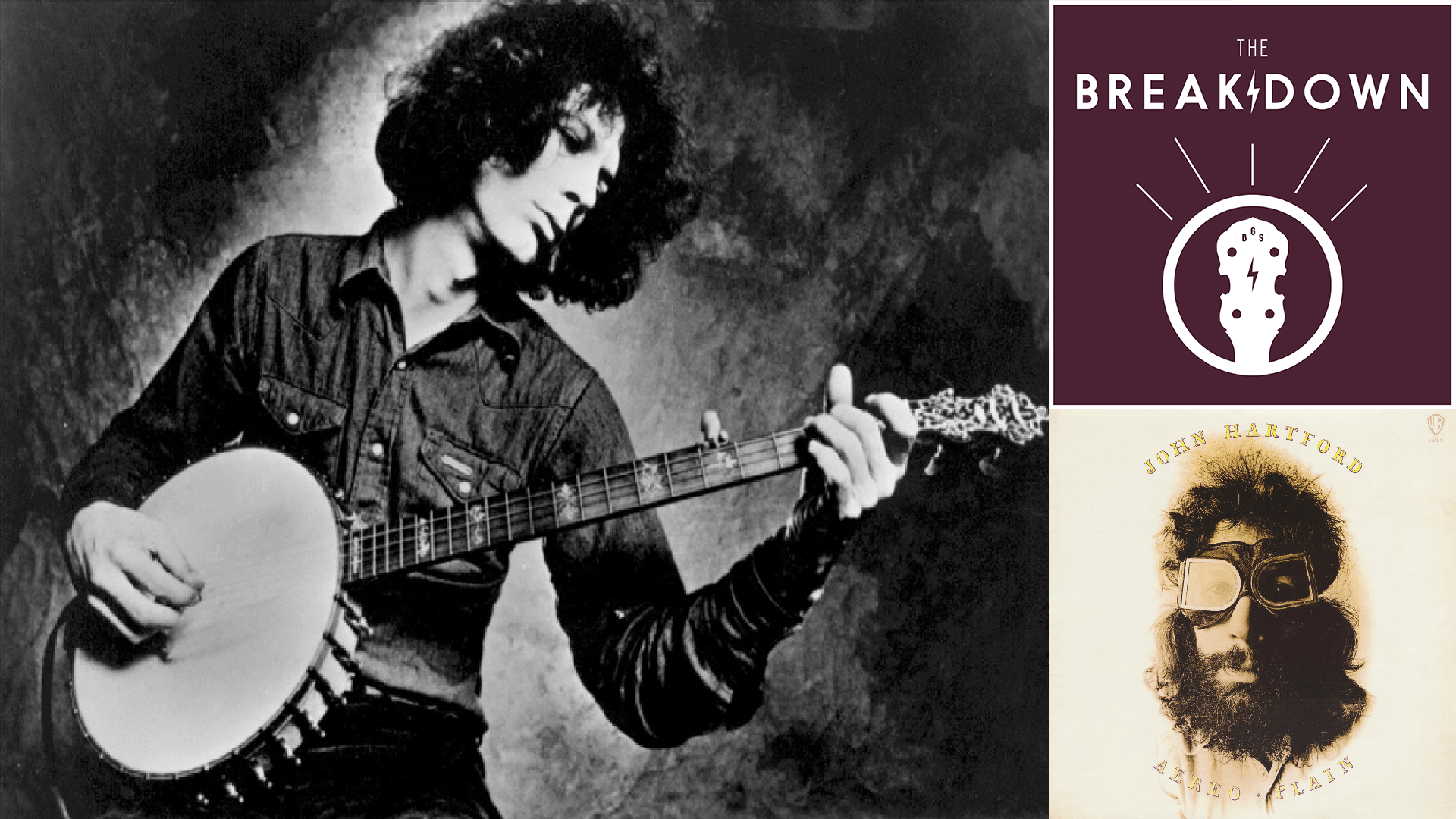
The Breakdown – John Hartford, ‘Aereo-Plain’

Aereo-Plain is probably the greatest album John Hartford ever made — but when it came out in 1971, even his record label didn’t know what to make of it.

LISTEN: APPLE PODCASTSMP3

We’re still not quite sure – is it a genuine nostalgia fest, or was hippie Hartford pulling bluegrass’ leg? And can producer David Bromberg and Vassar Clements superfan Alex Hargreaves help solve the mystery?

Featured Song Clips From “Aereo-Plain”:
“Turn Your Radio On”
“Steamboat Whistle Blues”
“Back in the Goodle Days”
“Up on the Hill Where They Do the Boogie”
“Boogie”
“With a Vamp in the Middle”
“Steam Powered Aereo Plane”
“Tear Down The Grand Ole Opry”
“Station Break”

For WinterWonderGrass, Cold Is a State of Mind

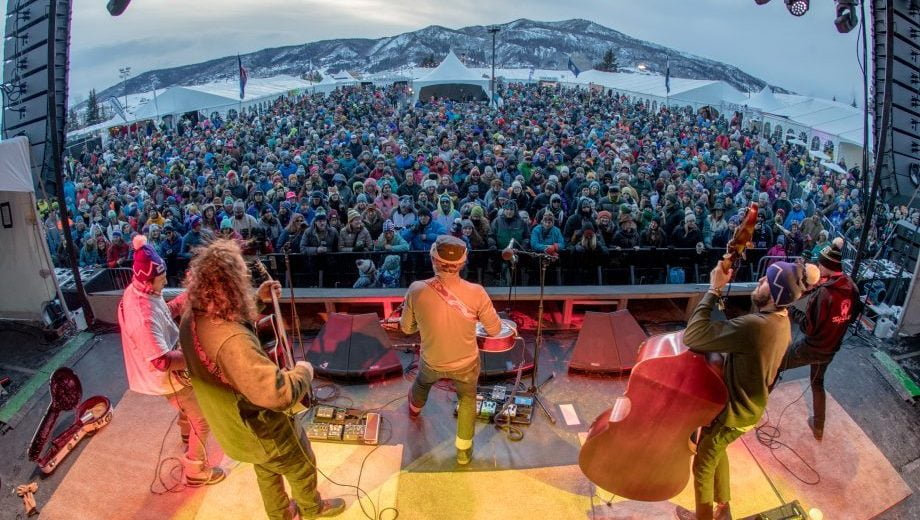
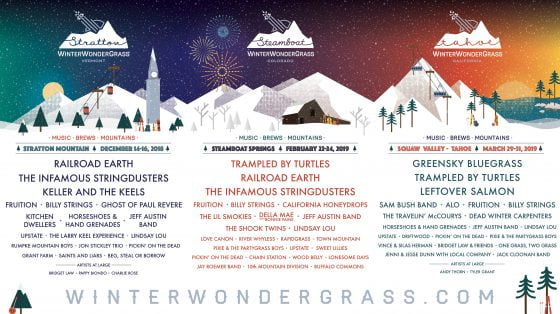
WinterWonderGrass believes that festival season should be experienced year-round. With an impressive lineup of talent, the outdoor music series comes to Stratton, Vermont, on December 14-16, with bands like Railroad Earth, The Infamous Stringdusters, and Keller and the Keels, to name a few. (Early 2019 events are scheduled for Colorado and California as well.) Festival marketing director Ariel Rosemberg fielded a few questions by email.

Putting a festival like this together is definitely a team effort. How would you describe the group of individuals who work behind the scenes at WinterWonderGrass?

Our team is second to none where everyone truly makes contributions at the highest level. We have experts dedicated to sustainability who ensure we’re properly and most effectively managing waste, experts dedicated to curating an ultimate winter fan experience, experts at each of our resort partners and so on. For me being relatively new to the core team, it’s truly a breath of fresh air to be a part of the wheel that is WinterWonderGrass.

WinterWonderGrass will take place in three destinations in the months ahead. As you plan and execute these events, how would you describe your commitment to the community?

The manifestation of community is one of the principles that keeps the WWG ship at sea. Our potential energy immediately transitions into kinetic at the mere rumble of discussion and stoke within our host resort communities. Additionally, since inception, the festival has contributed upwards of $100k to our local/regional non-profit partners and it’s our intent to continue on that path.

Environmentalism is an important aspect of this festival. What steps are taken to ensure this festival is environmentally responsible?

We work very closely on a national level with an organization out of Burlington, Vermont, called Waste-Free Earth. With their help we’re able to confidently promote that we’ve held a diversion rate of 80-90 percent for each festival in California and Colorado. Our intent is to bring that same model to Vermont, by the way. Every bag of trash, recycling, compost, etc., is sorted through on site with the help of volunteers. And the festival has committed to using only reusable or compostable product wherever possible (since ’15) and has eliminated all single-use plastic (since ’16).

A couple quick stats from 2018 alone: WWG diverted +23K lbs of waste from landfills due to composting, recycling or donation programs. It’s estimated that WWG saved +68K single-use compostable cups from being produced thanks to a partnership with Klean Kanteen (all three-day ticket holders receive a Klean Kanteen reusable cup). It’s estimated that WWG saved +76K single-use plastic water bottles from being used thanks to our single-use plastic ban and our free filtered water stations.

Summer festivals are plentiful, of course. Why did the concept of a winter festival appeal to you?

I love this question and we get it a lot. For me in short, there’s nothing better than huddling up with your closest friends (old AND new), listening to your favorite band, sipping a delicious craft beer or whiskey in the dumping snow at the base of the most iconic ski resorts in the country. The idea of being “cold” to a certain degree (no pun intended) can be easily masked by experience. Cold is a state of mind, it’s an opportunity to just let go of all the BS that surrounds us on the daily and just be absorbed by the moment. Plus, there’s no way to ski fresh powder after a humid, rainy, muddy summer festival night!


Passes are still available for all three WWG weekends.  Buy your tickets and discover more at winterwondergrass.com


Pappy, “Susquehanna Breakdown”

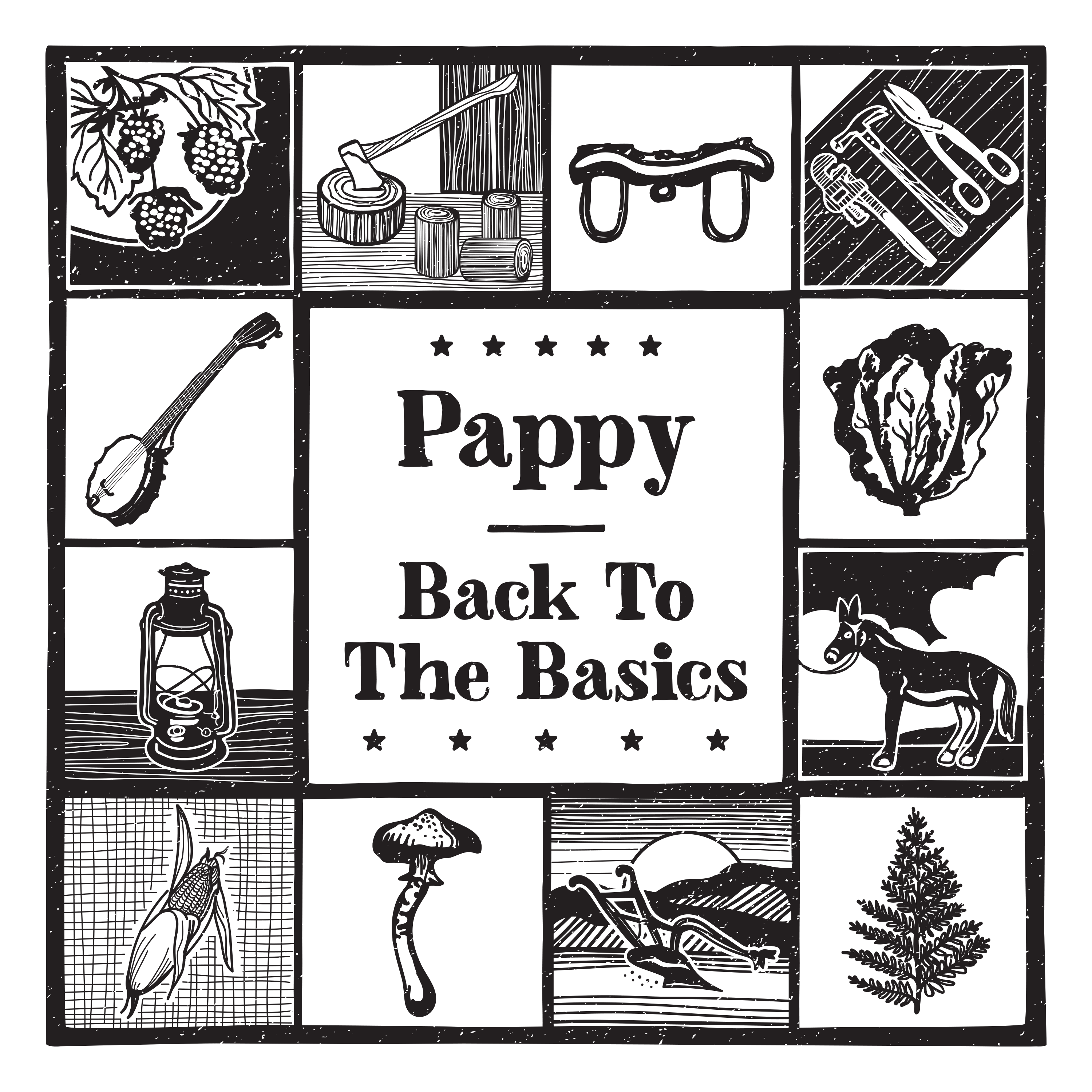
If it ain’t broke, well, you ought not fix it. Pappy (AKA Patrick Biondo), being a bluegrass-centered musician and songwriter, understands this timeless adage. On his most recent release, Back to Basics, he reinforces the wisdom intrinsic to this clichéd phrase through five tracks that each remind that it’s difficult to go wrong if your focus is on the primal, bare bones elements that make up an art form — in this case, jammy, high-flying, swift-going bluegrass.

“Susquehanna Breakdown,” one of two instrumentals on the project, may not return to the elemental origin point of breakdowns — it hardly conjures “Foggy Mountain” or “Earl’s” or “Shenandoah” — but instead focuses on the nuance and detail of this breakneck format by letting the instruments and their handlers shine. The entire EP was cut straight to tape, without the requisite over-analyzing or rehashing that comes hand-in-hand with modern multi-tracking and overdubbing. As a result, the tune crackles with live energy, rushing ahead with its listeners on the edges of their seats, as if careening down roiling, adventurous rapids on the Susquehanna River itself.

Pappy’s jam-grass background, informed by his time with popular Scranton-based string band, Cabinet, informs his banjo playing in so many unexpected and exciting ways, bringing the free, unencumbered, exploratory tendencies of more jammy acts into what already feels familiar: The breakdown’s foundational bluegrass sensibilities, its solid picking, and Pappy’s hard-driving (though deliciously oddball) banjo.