12 Fantastic Merle Haggard Covers

April 6 would have been Merle Haggard’s 89th birthday – and was also the tenth anniversary of his death. So, before these anniversaries get too far in the rearview mirror, I wanted to take a moment to remember one of country music’s all-time legends – and one of the great singer-songwriters in all American popular music.

One lesson of Haggard’s career is that you best honor your musical heroes, not only by playing their records at home or talking up their influence in interviews, but by continuing to perform their songs – on stage and in the studio. Merle released tribute albums to Jimmie Rodgers, Bob Wills, and Elvis Presley, and across his catalog cut at least an album’s worth of Lefty Frizzell songs.

Since his death, it’s been nice to see how often Merle’s musical contemporaries and descendants have taken Haggard’s model to heart, recording his songs and even releasing entire Merle Haggard tribute albums.

In recognition of his ongoing legacy, I’ve chosen 12 of my favorite cover versions of songs by Merle Haggard. I shared a kind of companion piece to this list last week, at No Fences Review, pulling choices from the 20th century only. Now, for Good Country, I’m focusing my dozen picks on Hag covers from this century.

I could assemble similarly strong lists every week for months without running out of possibilities. But these dozen Hag covers are among the very favorites.

“You Don’t Have Far to Go” – Candi Staton (from His Hands, 2006)

Co-written with trucker-song specialist Red Simpson, “You Don’t Have Very Far to Go” was the earliest of Merle’s songs to have legs. Recorded more than a couple dozen times through the years (including three versions from Hag himself), it’s proven a special favorite of first-name-basis country women. Bonnie and Connie, Rosanne and Lucinda, and others all seem to sing the song directly to some toxic asshole: “If I’m not crying, you’re not satisfied.”

My favorite reading of the song in that way is by Candi Staton. She became renowned for her disco and gospel recordings, but when first establishing herself as an R&B star circa 1970, it was with striking country soul takes on hits by Tammy Wynette and Patsy Cline. Decades later, she deploys Merle’s old song to deliver a master class in soulful, thought-by-thought phrasing. Staton sounds fragile and beaten down yet, by the end, her tone hints she may finally have had enough.

“Hungry Eyes” – Leona Williams (from Leona Williams Sings Merle Haggard, 2008)

Leona Williams may be best known as Haggard’s third wife, but she’s a tremendous artist in her own right, a country music lifer who played bass behind Loretta Lynn in the 1960s, enjoyed a solo career worth tracking down, and wrote or co-wrote chart toppers “You Take Me for Granted” and “Someday When Things Are Good” for Merle in the early ‘80s.

Leona’s version of “Hungry Eyes,” from her superb 2008 Haggard tribute, always stops me in my tracks. In the verses, she sounds haunted by her parents’ long-ago struggles. At each chorus, she gulps and springs to the top of her range, once again meeting her mother’s dissatisfied gaze. “She only wanted things she really needed!”

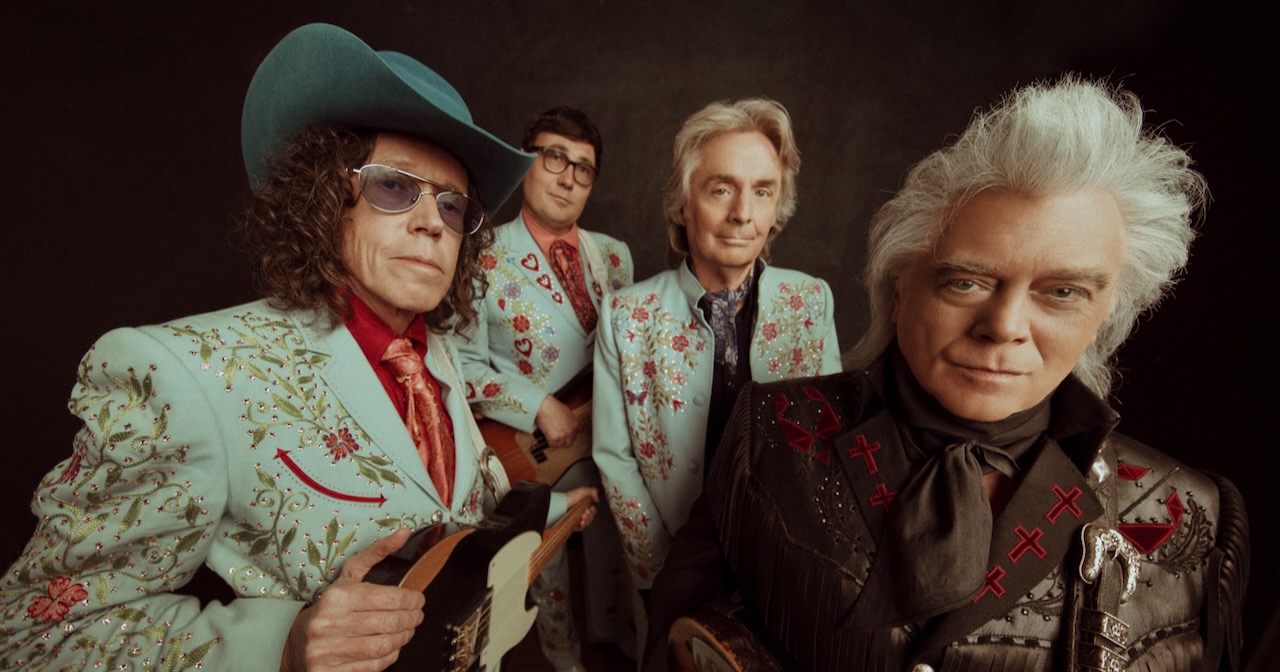
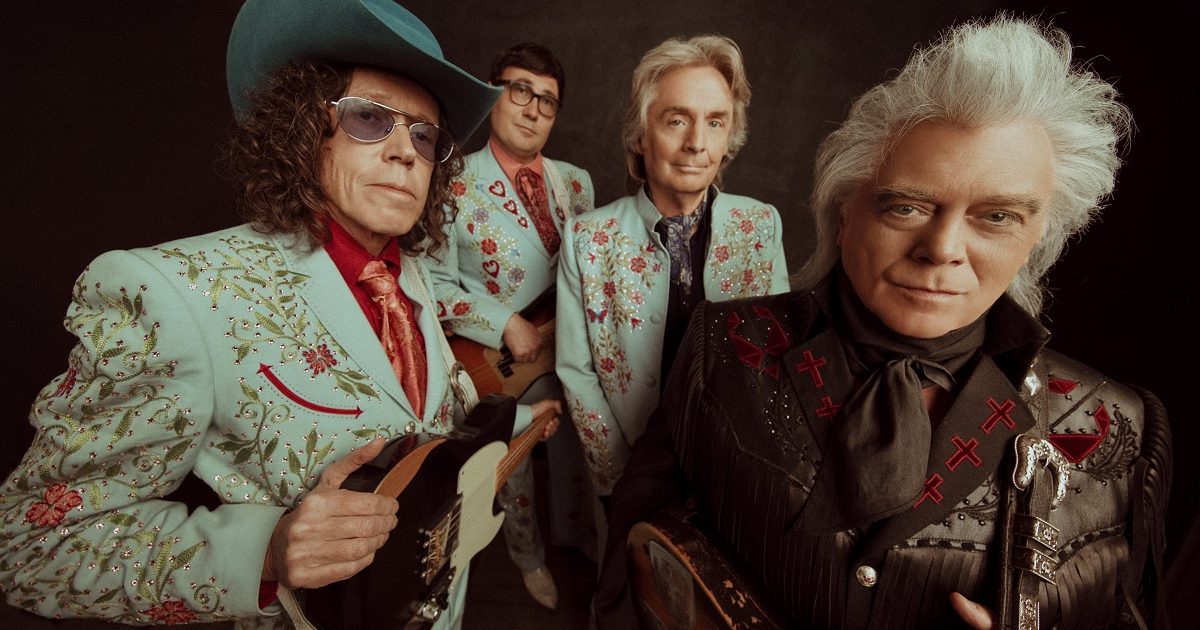
“The Running Kind” – Marty Stuart & His Fabulous Superlatives (from The Marty Stuart Show, c. 2009 or 2010)

“The Running Kind” is both one of country music’s great declarations of independence and, for Haggard, a great self-own: Merle boasts that he’s always on the run from one thing or the other even though, “I know running’s not the answer” to anything. The sentiment can serve as a kind of thesis statement for the Hag’s own restless life and career, so it’s ironic that my favorite version of the song isn’t Merle’s but this live cut from Marty Stuart. From an episode of the singer’s television series, Stuart and his Superlatives rage noisily and headlong, while staying absolutely controlled, through Merle’s tune. The solos from Kenny Vaughan and Stuart are my idea of Telecaster heaven.

“Ramblin’ Fever” – Tanya Tucker (from My Turn, 2009)

My pick for the best-ever “Ramblin’ Fever” is this version by Tanya Tucker. Riding an outlaw thump spiked by country disco high-hat, Tucker honors a musical hero, a former paramour, and a kindred rambling spirit. To that end, she loves it when some good-lookin’ fella rubs her back, but what really turns her on comes in the a.m. when she can drink a cup of coffee before leaving. The series of guitar solos that play out the final 1:20 here sound like she’s already out the door.

“How Did You Find Me Here?” – k.d. lang (from Sweet Relief III: Pennies from Heaven, 2013)

“How Did You Find Me Here?” was among Merle’s finest new songs of this century. From 2010’s I Am What I Am, Merle sings the number like a grim but grateful gospel ballad – his savior has come for him in his grave. “Thank you, Lord,” he prays at the close.

k.d. lang’s spare, ethereal reading feels less straightforwardly religious but, if anything, more spiritual. She’s desperately alone, at her nadir, but now someone – a lover or friend, her sponsor or her community – has seen her for who she is, taken her in. Lang’s contralto sounds bleary-eyed and dumbfounded, but she gains strength as she goes, ready to move on up.

“I Think I’ll Just Stay Here and Drink” – Suzy Bogguss (from Lucky, 2014)

Back in 1989, one of Suzy Bogguss’ earliest charting singles was a cover of “Somewhere Between,” still my favorite version of that great Haggard ballad. So my expectations were unreasonably high for Lucky, a full-length Merle Haggard tribute that she released in 2014. But the album’s a gem straight through, and I especially recommend her take on “I Think I’ll Just Stay Here and Drink.”

Most versions of Merle’s boozy romantic complaint have been done by rowdy dudes who sound like they’re slamming shots while ordering their fourth pitcher ahead of passing out. Bogguss, by contrast, comes off country-jazz cool, sipping a good bourbon and commiserating with herself in some dark corner. Don’t wait up. She’s going to be here awhile.

“Shelly’s Winter Love” – Lonesome River Band (from Turn on a Dime, 2014)

Merle’s most haunting song is about depression: Shelly’s depression each winter, the narrator’s the rest of the year round when the sunshine’s lured her back to town. This Lonesome River Band rendition from 2014 is the most haunting I know. Brandon Rickman sings beautifully but frighteningly too, and LRB’s pacing, like seasonal affective disorder set to a melody, reflects the long, slow days of a long dark winter. Midway through, Sammy Shelor’s banjo plunks a drip, drip, drip, that quickly gathers to a stream. A thaw’s coming; spring is on the way. It won’t be long now…

“A Working Man Can’t Get Nowhere Today” – Rob Ickes & Trey Hensley (from Before the Sun Goes Down, 2015)

This was a savvy cover choice by Rob Ickes, 15-time winner of the IBMA’s Resophonic Guitar Player of the Year award, and Trey Hensley, the association’s pick for Guitar Player of the Year in 2023. For one thing, the song is an underappreciated gem of the Haggard songbook, recorded maybe not even half a dozen times since Merle had a hit with it in 1977. More importantly, this Hag number lets Ickes and Hensley trade elegantly exhausted solos while tapping into a perpetually frustrating and common condition: Working your ass off every day to to put food on the table yet still coming up short. Hensley moans, “I’ll still be deep in debt the day that I fall dead.”

“Some of Us Fly” – Bonnie “Prince” Billy (from Best Troubador, 2017)

Merle’s “Some of Us Fly” served as the concluding track to his underrated release Chicago Wind, from 2005, and featured a guest vocal from Toby Keith. Because both men had already experienced such heights in their career, the message of each chorus – “Some of us fly but all of us fall” – comes off a little like superstars performing their humility. But where Haggard and Keith share hard-won wisdom, Bonnie “Prince” Billy casts a spell. With his duet partner, Irish singer/flutist Nuala Kennedy, he surrenders to a mystery.

On the remarkable 2017 Haggard tribute album, Best Troubador, Billy (AKA indie songster Will Oldham) and Kennedy whisper their way through Merle’s song in cautious harmony, their hands clutched tightly. The whole performance feels so fragile a strong wind might blow it way.

“Today I Started Loving You Again” – Eli “Paperboy” Reed (from Down Every Road, 2022)

Eli Reed specializes in making over all manner of roots-adjacent material into cool, committed soul music. Down Every Road does that for the Haggard songbook with thrilling results straight through. (A duet between Eli and Sabine McCalla on Merle’s most covered song, “Today I Started Loving You Again,” was inspired by a famous, but officially unreleased, 1969 version by Buck Owens and soul singer Bettye Swann.)

I especially appreciate Reed’s take on Merle’s celebratory kiss-off “I’m Bringing Home Good News,” which he relocates from Merle’s dusty, country-rocking San Joaquin all the way down to Louisiana for some funky Tony Joe White-styled swamp.

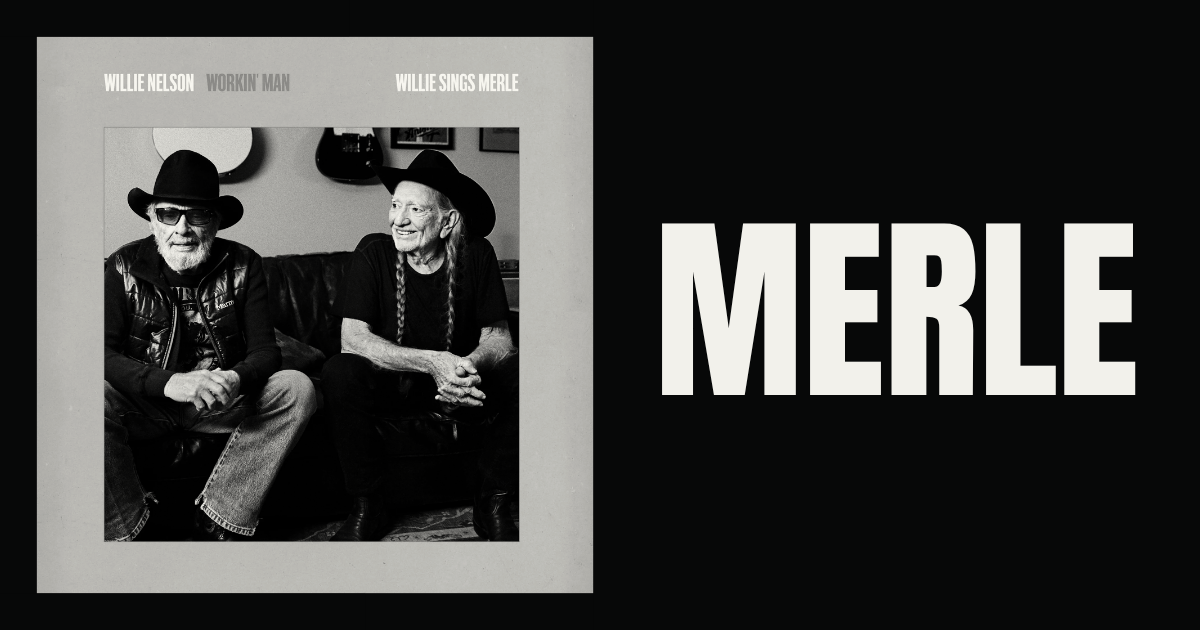
“Workin’ Man Blues” – Willie Nelson (from Workin’ Man: Willie Sings Merle, 2025)

One of Hag’s signature hits, “Workin’ Man Blues,” is usually framed as a purely blue-collar anthem, but it’s good to remember he identified the song as a blues. Having to work to survive while hoping your body holds out as long as you’ll need it is something to be cursed more than celebrated.

From last year’s Workin’ Man: Willie Sings Merle, a 92-year-old Nelson delivers his friend’s lines with a bit of a slur, weary and resigned but also grateful still to be working, to be on the road again until he runs out of road. Similarly, Willie’s arrangement sheds Merle’s Elvis-y fanfare for some hard, use-it-or-lose-it swing. “Play it, little sister,” he says, introducing one of the hot-jazziest solos in the career of the late Family band pianist Bobbie Nelson. Willie’s solos up top and midway through, meanwhile, are things of singular beauty, guitar work that sounds like play but refuses to hide the callouses and the miles. “As long as my two hands are fit to use…”

“Daddy Tried” – Jade Jackson (single, 2026)

Merle’s “Mama Tried” has been covered well over 100 times since he wrote it for the Killers Three soundtrack in 1968. But the song’s indelible ascending chorus and its universal theme – Merle sings it as if he’s as proud of defying his mom as he is remorseful for disappointing her – have encouraged people to use the song in all kinds of ways. Country comic Don Bowman parodied it as “Pappa Tried” as early as 1969 and more recently Angeleena Presley was clearly in conversation with Merle’s classic when she released “Mama I Tried” in 2017. As was Keith Urban when he sampled its lick for “Coming Home” in 2023.

Jade Jackson grew up in a small Cali town between Bakersfield and the Pacific, and her updated, gender-flipped take on Merle’s tale sounds just like that: Her voice feels a little dusty and a little sunny. Switching out Merle’s locale from “prison” to “Nashville” is funny because those two aren’t at all alike, but also because maybe they’re a little alike. For sure the ache in her voice reveals her as another singer-songwriter in a long line of kindred spirits to Merle; she’s going to go her own way, no matter her dad’s good advice.


David Cantwell is the author of The Running Kind: Listening to Merle Haggard, the co-author of Heartaches by the Number: Country Music’s 500 Greatest Singles and the co-creator of No Fences Review. His byline has appeared at Rolling Stone Country, The New Yorker, Slate, and No Depression, among other publications.

Photo Credit: Workin’ Man: Willie Sings Merle on Legacy Recordings
What to Do, See, and Hear at Earl Scruggs Music Festival 2024

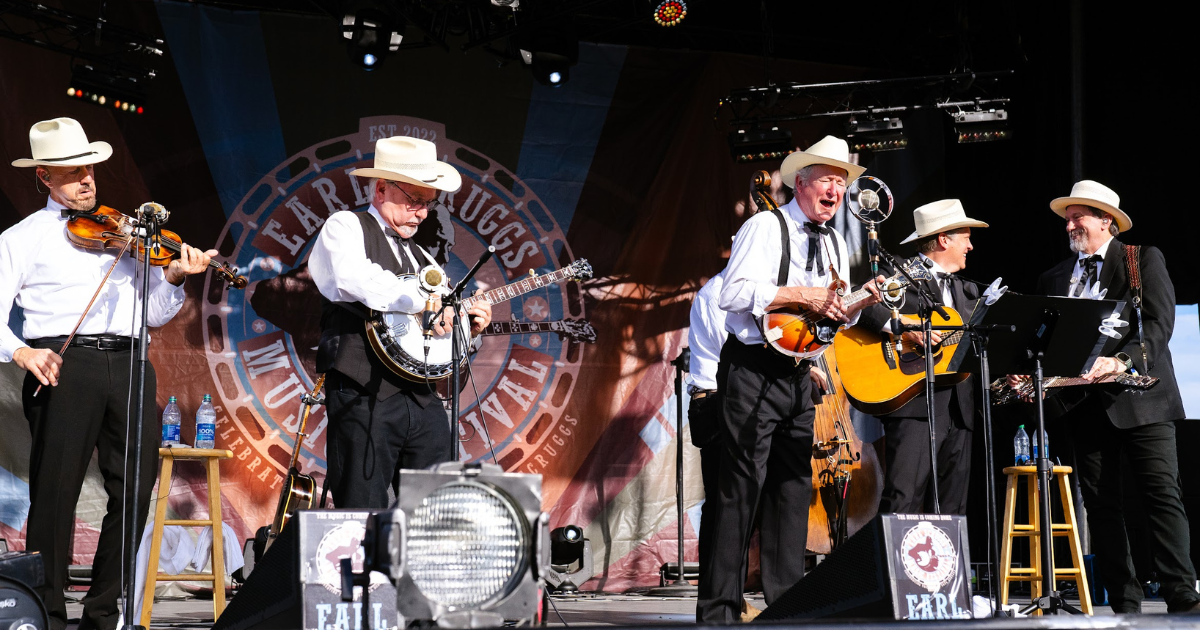
From August 30 to September 1, the legacy of banjo innovator and bluegrass forebear Earl Scruggs will be celebrated once again at the 3rd Annual Earl Scruggs Music Festival. Held at Tryon International Equestrian Center in the western North Carolina foothills – just beyond where the Bluegrass and Country Music Hall of Fame inductee was born and raised – the festival will see Jerry Douglas and the Earls of Leicester return as hosts and will include performances by roots superstars like Tanya Tucker, Old Crow Medicine Show, Marty Stuart & His Fabulous Superlatives, Yonder Mountain String Band, and many more. (Full lineup below.)

BGS is excited to be returning to ESMF for the third year in a row, this time presenting the Scruggs Sessions with the Earls of Leicester. On Saturday, August 31, from 3 to 4:30p.m. on the Foggy Mountain Stage – nearest the festival gates – the Earls of L will pay tribute to Flatt & Scruggs’ seminal live album, Flatt & Scruggs At Carnegie Hall!, with special guests and appearances from across the festival lineup. This is a brand new iteration of our fan favorite tribute sets from the past two years that highlighted albums by the Earl Scruggs Revue. Last year’s performance was hosted by Tony Trischka and included guests such as Della Mae, Tray Wellington, members of Greensky Bluegrass, and more. We cannot wait for you to see what’s in store for this year’s Scruggs Session.

Below, find a few of our tips and insider tricks for attending ESMF, plus we’ll highlight a few of the acts, artists, and bands we’re most excited to catch at this year’s festival. From the posh grounds to engaging workshops and sessions, horse jumping demonstrations to excellent brick-and-mortar restaurants and local food trucks, up-and-coming groups and world-class talents, Earl Scruggs Music Festival truly has something for everyone.

The Grounds: Tryon International Equestrian Center

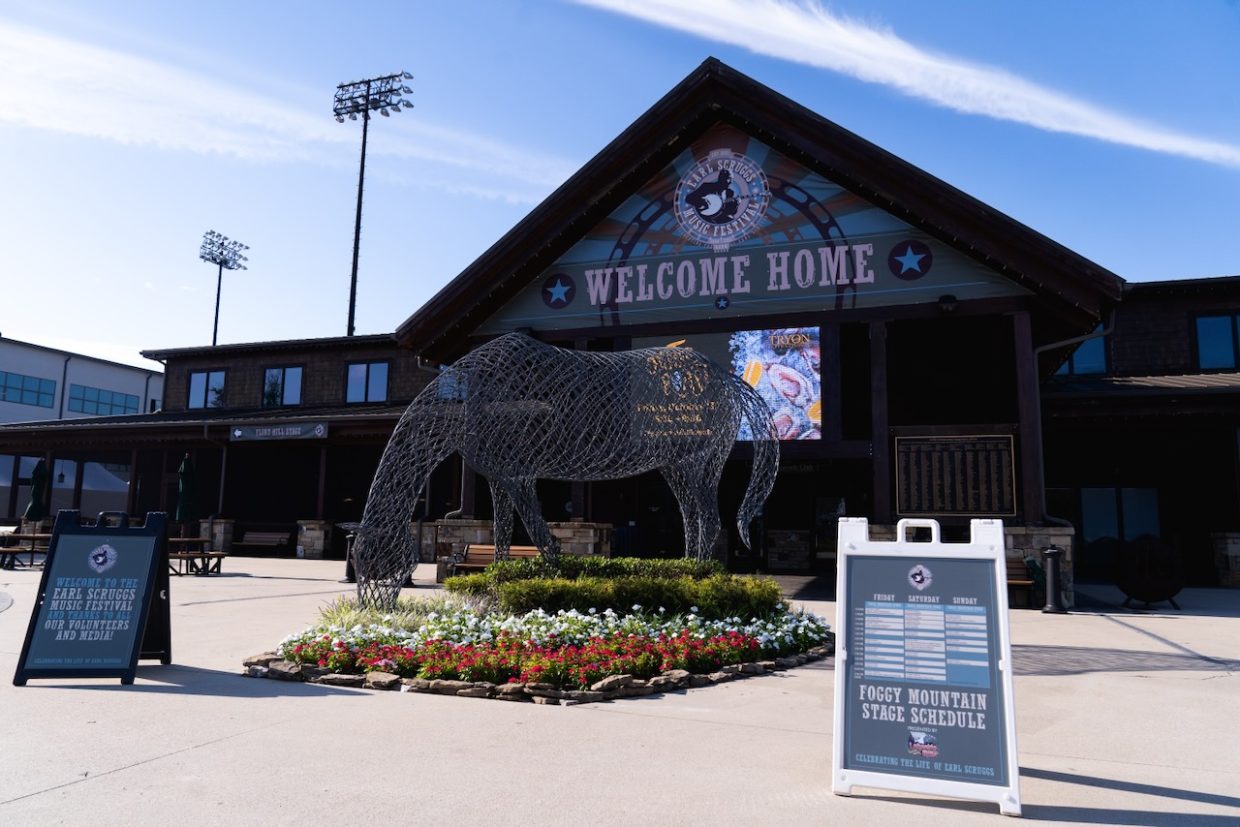
The Earl Scruggs Music Festival entrance. Photo by Eli Johnson.

Your first impression of the Earl Scruggs Music Festival grounds – the Tryon International Equestrian Center in Mill Spring, North Carolina – might be that this is a very fancy locale for a bluegrass festival. But after your first day, or even your first few hours, you’ll see how perfect a setting this state-of-the-art equestrian park is for a music festival. It can be very hot in late August in Mill Spring, but the permanent amenities, ample shade, high quality air-conditioned restaurants, and relatively compact footprint make the usual pitfalls and inconveniences of a hot summer festival fade to the background.

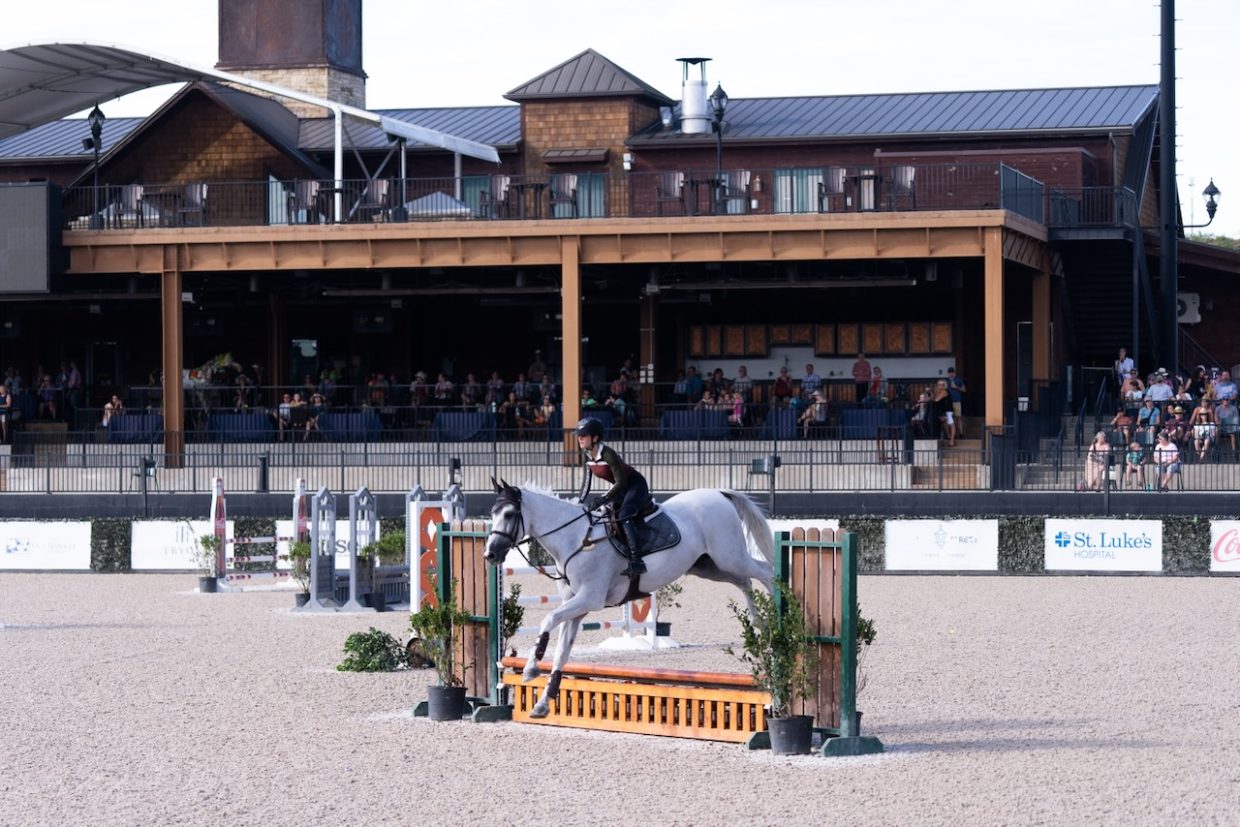
A horse jumping demonstration held during the festival. Photo by Eli Johnson.

Catch a horse jumping demonstration or one of the center’s mini-horse ambassadors doing a meet and greet to get the full equestrian experience. VIP ticket holders can enjoy the shady grandstand with perfect views of the main stage. There’s plenty of space in the sandy arena grounds for folding chairs, too. The General Store, near to the festival entrance, sells drinks, ice cream, snacks, and treats and has many festival essentials you may need – whether you’re camping on site or just visiting for the day.

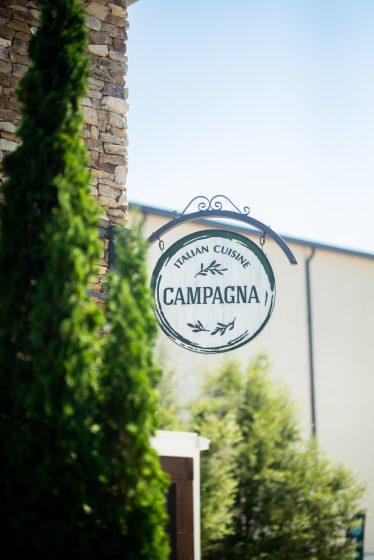
Definitely don’t miss the delicious Italian restaurant, Campagna, on the grounds, as well. Pro tip: order their delicious wood-fired pizzas to go and enjoy while watching your favorite bluegrass bands take the stage. Or, dine in and cool off – whether lunch or dinner, we loved always having Campagna nearby. Other brick-and-mortar options on site include Blue Ginger Sushi, Legends Grille, Roger’s Diner, and more. Plus, plenty of delicious fair foods are on sale with carnival-style vendors and food trucks coming out in force for the fest.

Campagna Italian Cuisine raises the bar for bluegrass festival food. Photo by Eli Johnson.

The Area

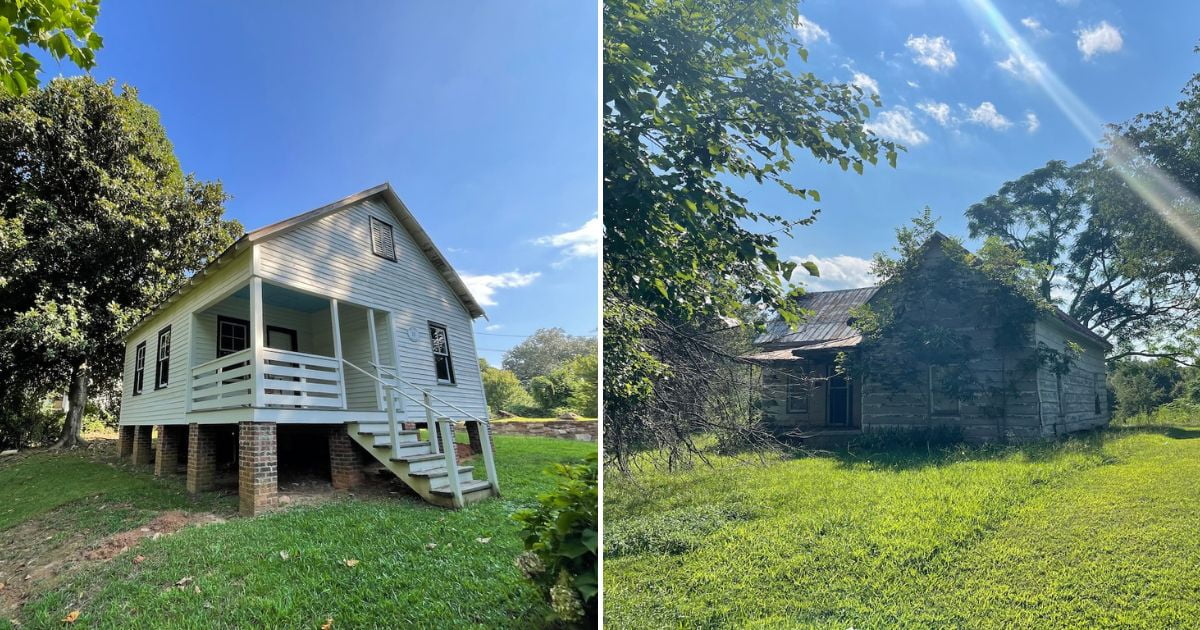
L: Nina Simone’s childhood home. R: Earl Scruggs’ childhood home.

Sure, there’s not much to mention directly surrounding the oasis that is the Tryon International Equestrian Center, but there is so much to explore just beyond the festival grounds. Whether you head up towards the mountains and Tryon proper (hometown of Nina Simone, where you can visit her historic home place) or head down the road to Shelby (Scruggs’ home turf), this area of North Carolina holds so many treasures. A visit to the Earl Scruggs Center, which calls the former Shelby county courthouse home and is located just up the road from Scruggs’ homeplace(s) in Flint Hill, is essential. The museum tells the story of Scruggs, his banjo, and his music within and outside of Shelby county and includes plenty of local history, too. If you’re not able to make it the short drive to Shelby to see the Center, don’t worry! They have a great booth set up at the festival for the entire weekend.

There are a few excellent trails and hikes nearby, like Alexander’s Ford Trail at Bradley Nature Preserve pretty near to Mill Spring, and there are so many mountain-y treks and water fall hikes just a short drive west – we recommend Little Bradley Falls. If you like cute little railroad towns, Saluda, North Carolina is worth a stop. Just up the mountainside, it used to be the home of the steepest standard gauge railway line in the United States. As you drive back down the interstate east, down the titular Saluda grade toward Tryon and Mill Spring, it’s a stunning view of North and South Carolina beneath you, with the Appalachians at your back. It’s lovely country!

The Music

ESMF does an excellent job demonstrating the sheer depth, width, and breadth of Earl Scruggs’ impact on American roots music. The lineup boasts country, Americana, singer-songwriter, old-time, and endless bluegrass. It’s curated thoughtfully and intentionally and there’s always someone new to discover and someone legendary to nerd out over. Here are a few of the sets we’re most excited for, below. Plus you can peruse the entire announced lineup and find links to the full schedule of events. We hope we see you this year at Earl Scruggs Music Festival!

Casey Driessen’s Red Shoe Stringjam (Sunday)

Fiddler Casey Driessen has turned his infamous and beloved Red Shoe Stringjam into a traveling roots music festival variety hour! We can’t wait to see what he cooks up at ESMF with this superlative lineup. His recent appearance at Grey Fox earlier this summer boasted and incredible roster of guests and collaborators.

AJ Lee & Blue Summit (Saturday)

We can’t wait to catch up with our pals AJ Lee & Blue Summit, fresh off their Grand Ole Opry debut and the release of their critically-acclaimed new album, City of Glass. Our recent feature on that new record has been a reader favorite ever since it published – check it out here. Don’t miss their main stage (Flint Hill Stage) performance and their Foggy Late Night set (Foggy Mountain Stage), which will surely be a raucous and rowdy end to day two of the festival.

Marty Stuart & His Fabulous Superlatives (Saturday)

If you’re a true fan of Marty Stuart, you know just how intimately his own story in music is woven into the stories of Flatt & Scruggs. What a perfect addition to the lineup. From psychedelic country to surf rock to driving bluegrass to shredding the mandolin – like he did with F&S as a kid all those years ago – Marty and His Fabulous Superlatives epitomize so many distinct facets of Earl’s music and legacy. This is especially noticeable with Stuart carrying on the bluegrass tradition of mentorship bestowed on him by Flatt & Scruggs – like with young mandolinist, Wyatt Ellis, who is also on the festival roster this year.

Miko Marks (Sunday)

Bay Area-based country singer, songwriter, and recording artist Miko Marks is a “must-see” on our list! She’ll be playing the Foggy Mountain Stage on Sunday evening, bringing her thoughtful, engaging, fun, and polished post-genre country to western North Carolina. Marks is a musical activist, a truth teller, and a community builder who has blazed a trail – nationally, in Nashville, and in the Bay Area, as well – in country and roots music.

Darrell Scott’s String Band (Friday)

Even though Darrell Scott’s solo shows are just as engaging and jaw-dropping as when he tours with a band, we’re certainly pleased that his recent string band album, Old Cane Back Rocker, included Shad Cobb, Bryn Davies, and Matt Flinner – and doubly pleased to still be able to catch this crack ensemble on the road! Darrell will also play a set on the Foggy Mountain Stage in the evening Friday, after the band’s afternoon appearance on the Flint Hill Stage.

The Scruggs Sessions with the Earls of Leicester (Saturday)

There is no one better to tribute a classic and iconic bluegrass album like Flatt & Scruggs At Carnegie Hall! than the Earls of Leicester. We’re tickled to be presenting the Scruggs Sessions, where the Earls and many special guests will perform songs from Flatt & Scruggs’ appearance at Carnegie Hall, a set and an album that have become keystones in the bluegrass canon. We’ll see you at the Foggy Mountain Stage on Saturday at 3p.m.!

Twisted Pine (Saturday)

Twisted Pine blew us away last year at Earl Scruggs Music Festival, so we were especially excited to see them set to return to the event this year, too. They’ll be doing double duty, again, playing both stages at different points on Saturday – catch them at 12p.m. on the Flint Hill Stage and at 5p.m. on the Foggy Mountain Stage.

The Wilder Flower (Friday)

A local string band trio based in western North Carolina and upstate South Carolina – making them essentially festival neighbors! – the Wilder Flower are a group to look out for. Made up of Danielle Yother (guitar), Madeline Dierauf (fiddle), and Molly Johnson (banjo), we’re looking forward to catching the band’s set on the Foggy Mountain Stage on Friday at 3p.m. Especially given their debut album, If I Wait Anymore, will be released in September. Keep your eyes and ears on this trio!

Explore the full Earl Scruggs Music Festival schedule and purchase tickets here.

The Full Lineup:

Hosted By:
Jerry Douglas
The Earls of Leicester

Featuring:
Tanya Tucker
Old Crow Medicine Show
Marty Stuart & His Fabulous Superlatives
Yonder Mountain String Band
The Steeldrivers
Peter Rowan & Sam Grisman Project
Mighty Poplar
Lindsay Lou
Pony Bradshaw
Darrell Scott’s String Band
Miko Marks
Shawn Camp
The Grascals
Darin & Brooke Aldridge
AJ Lee & Blue Summit
Chris Jones & The Night Drivers
Travis Book Band
Shadowgrass
The Scruggs Sessions, Hosted by The Earls of Leicester
Casey Driessen’s Red Shoe Stringjam
Twisted Pine
Wyatt Ellis
Rachel Sumner & Traveling Light
Carley Arrowood
The Faux Paws
Larry & Joe
Martha Spencer & The Wonderland Country Band
Tanasi
The Wilder Flower
The Well Drinkers
Warren Wilson College Bluegrass Band
Ryn Riley and Appalachian Roots
PacJAM Ramblers
The Biscuit Eaters
Creekwater Collective
Fine Tuned Sessions Presented by Rare Bird Farm & Blue Ridge Music Trails


All photos courtesy of Earl Scruggs Music Festival. Photo credits as marked. Lead photo by Eli Johnson. 

Marty Stuart: From Bluegrass to Psychedelia and Back

Told that a song on his new album brings to mind The Doors, Marty Stuart is bemused, but open to the idea.

“Did it?” he responds during an interview. “That’s fine. If so, why not?”

“Nightriding,” from new album Altitude by Stuart and His Fabulous Superlatives, kicks off with droning guitars, then evolves to a riff somewhat like that of Jim Morrison’s “Roadhouse Blues”   

“Cadillac, sundown,” Stuart intones. “Think I’ll investigate this town.”

To be clear, most of the cuts on the Altitude are more evocative of The Byrds than The Doors. So, is Marty Stuart really a country music traditionalist, as many people perceive him? Yes. And also no.

“I’m totally fine with it,” Stuart says when asked if the country music purist reputation is OK with him. “It’s a self-appointed mission. But my comment would be that country music has broad shoulders.”

Dante Bonutto, who heads up Snakefarm Records, which is releasing Altitude, says that Stuart has earned the right to experiment. 

“Since he’s definitely someone who pretty much invented the wheel, he’s allowed to put different spokes on it when he wants to, I think,” Bonutto said. 

Stuart, who’s been a bluegrass prodigy, a mainstream country music star, and remains a prodigious collector of country music artifacts, was born in 1958, making him a child of the 1960s, with all that comes with it. 

“I still think of when The Byrds and Bob Dylan and all those guys came to Nashville to make their records in the late ‘60s,” he says. “That is like contemporary stuff to me. …That was the stuff that touched me when I was growing up, so it was just a part of country music to me.”

At a recent benefit concert for Northwest Mississippi Community College, Stuart’s base was definitely country — he and the group appropriated the whole history of the genre as their back catalogue, doing songs by Merle Haggard (“Brain Cloudy Blues”), Marty Robbins (“El Paso”), Waylon Jennings (“Just to Satisfy You”) and Stuart’s own hits from the early 1990s such as “The Whiskey Ain’t Workin.’” 

The casually virtuosic Fabulous Superlatives band (Kenny Vaughan on guitar, Chris Scruggs on bass and Harry Stinson on drums; all of them sing) wore matching glitter-flecked black suits, and Stuart’s performing style still owes a debt to his former boss and mentor Johnny Cash.

But that wasn’t all. During the hour-long set before a well-heeled audience dressed in tuxedoes and evening gowns, there was also a Woody Guthrie indictment of the rich, a mandatory gospel number, and a big helping of surf rock, obviously a favorite of Vaughan in particular.

“We hereby declare Senatobia, Mississippi, as the surf capital of the world,” Stuart announced before Vaughan launched into a Telecaster version of “House of the Rising Sun.” Also, “Wipeout” was played by Scruggs solo on the upright bass, with Stinson slapping out the drum solo on the cheeks of his face. 

“Well, it doesn’t really matter how people categorize us,” Stinson said. “If anybody’s interested in what you’re doing, then they listen a little bit deeper and find a much wider spectrum, in terms of the music. I think Marty is much more than just a traditional country artist. He came from that world and uses that as a place to plant himself, and then branches out in different directions.”

Possibly because the Altitude album hadn’t been released yet during the March 25 concert in Mississippi, that audience didn’t get a taste of its cosmic, sometimes psychedelic country music.

The album’s beginnings go back to 2018, when Stuart, Vaughan, Stinson, and Scruggs toured with Roger McGuinn and Chris Hillman to celebrate the 50th anniversary of the pioneering country rock album Sweetheart of the Rodeo by The Byrds. McGuinn and Hillman were original members, along with the late Gene Clark, David Crosby, and Michael Clarke. 

“That was Roger McGuinn’s idea,” Hillman recalled. “Roger had done some dates with Marty; he knew him really well. …He knew the Superlatives would be right on the money because he had done a couple of Byrds songs with them onstage.”

Hillman rates the Superlatives as “the best band probably in this country right now, if not the Western Hemisphere.”

“We had so much fun doing the Sweetheart of the Rodeo Tour,” said Hillman, who was also a member of the Flying Burrito Brothers and Desert Rose Band. “The arrangements were the same as we did on the album in 1968,” he said. “We played the songs better, but we didn’t change anything. It was a joy to go back out and do those songs, especially with the Superlatives.”

Stinson says the tour with The Byrds was “a joyous experience.”

“I got to play with some of my heroes,” he said. “I grew up on those records and so to get to play that music, especially the Sweetheart record, which was kind of groundbreaking. I got to go back through it and really dissect it, and then put it on stage. It was surreal for me.”

The Sweetheart of the Rodeo Tour, coming around the same time Stuart and the Superlatives were opening for Chris Stapleton and the Steve Miller Band, had a profound effect on Stuart’s songwriting. 

“It got me in the mood to write songs with all the sounds that were left hanging around in my head,” Stuart said. “We were hot on those ideas, and I just carried the inspiration in with me.”

Like a lot of albums released in the past year, Altitude was recorded while COVID-19 was at its height. 

“We rehearsed,” Stuart said. “Most of the producing of this record was done in dressing rooms and at soundcheck and trying songs out there in shows before we ever went to the studio.” The original plan to record was ruined by the coronavirus. 

“We were hot, we were ready to go to Capitol Studios in Hollywood (California), and make a record,” Stuart said.  “Well the pandemic crashed and Capitol Studios shut down, so we found East Iris Studios (in Nashville). We put on our masks and stood 6 feet apart and soldiered on.”

“I’m glad everybody agreed to do that, because I think this record would not have sounded like it does if we would have had to wait several months and relearn it.”

The album’s Byrd-like sound, complete with the jangling guitars that are McGuinn’s trademark, has Hillman’s endorsement.

“What they’ve done is not a tribute to The Byrds,” Hillman said. “It just has a few little nice, ever-so-tasty hints of what we did.”

Hillman thinks the driving “Country Star,” which also owes a debt to Chuck Berry, has the feel of Byrd’s songs such as “So You Want to be a Rock ‘n’ Roll Star.”

“There’s a lot of influence there — not overtly, but it just is there. Marty doesn’t stray far from the well, meaning the bluegrass well. I never did either.”

Stuart’s ability on mandolin shouldn’t be overlooked, Hillman said. “Marty is an unbelievably gifted musician,” he said. “I love Ricky Skaggs’ playing and Ronnie McCoury,” he added. “But I told Marty when we were on the road, ‘You got that machine gun hand.’ He says, ‘Yeah, that’s Everett Lilly.’”

Lilly (1924-2012), played mandolin and sang tenor with the Lilly Brothers and Don Stover. He also spent a couple years with Flatt and Scruggs.

“(Lilly) had that cool right hand and when he took a break on ‘Earl’s Breakdown,’ when he played with Flatt and Scruggs, it was great,” Hillman said.  Factor in Vaughan on guitar in the Superlatives, and “you can’t get any better,” Hillman says. “But it’s two different approaches to music.

“Marty really grasped ahold of the pulled string stylings of Clarence White (who played with The Byrds and Kentucky Colonels before his 1973 death)”, and then Kenny “is so good, all over the place.” 

“He doesn’t overblow; he plays just what is needed,” Hillman said of Vaughan.

While Stuart released his last album, Way Out West, on his own Superlatone Records, he’s partnered with Snakefarm, a subsidiary of Universal Music Group, for Altitude.

Bonutto, a journalist and record company executive, heads up the roots-rock focused Snakefarm and its sister label Spinefarm Records, which specializes in heavy metal. In addition to Stuart, Snakefarm has acclaimed Southern rocker Marcus King on its roster. 

“(Stuart is) obviously an artist I’ve always been aware of, because I love country music and I’m aware of its legacy,” Bonutto said. “The first time I saw him was when he played the Country to Country (music festival) in London, which is a big annual country music event. I thought his personality was fantastic and his playing is obviously unbelievably good.”

Bonutto wrangled a quick meeting with Stuart at the festival, but had to wait a while before Stuart and his management were ready to sign a new record contract.

“I’m trying to build the Snakefarm label into a global entity [in Americana music],” he said. “The best way you can build anything is to attach yourself to people who are legendary and iconic. Hopefully you do an amazing job for them and they speak well of you and they become part of the fabric of what you do.”

Bonutto noted that Stuart, who is also a photographer and working on a facility to display his country music artifacts, is not “a one-dimensional character.”

“He’s a man with a fantastic vision,” Bonutto said. “I think that comes across in the other things.”

Stuart is a leading collector of country music memorabilia, and he’s working on a $30 million museum to display it in his hometown of Philadelphia, Mississippi. A 500-seat theater is already open, and 50,000-square-feet of exhibit space for 20,000 artifacts will be the second phase. An education center is planned after that. 

“I was a fan, going back to those country or gospel groups or bluegrass groups who come through my hometown when I was a kid,” Stuart said. “I’d always buy a record and ask for an autograph or ask one of the pickers if I could grab a pick.”

In the 1980s, he observed that “old timers, the pioneers, the people who had raised me, were being disregarded.”

“Their treasures, their personal effects, their guitars and costumes, were winding up in junk stores around Nashville,” he said. “I found Patsy Cline’s makeup kit for 75 bucks in a junk store on Eighth Avenue in Nashville. I couldn’t believe it.”

Stuart met Isaac Tigrett of Hard Rock Café in London, and he showed Stuart how that restaurant chain was investing in and exhibiting rock music memorabilia.

“Even though it was a hamburger joint, I understood the importance of them collecting and curating stuff from The Beatles and the Stones and The Who. … Beyond the Country Music Hall of Fame, I didn’t see anybody doing it, so it just became a self-appointed mission to start rescuing a lot of those things that were winding up in junk stores.”

Stuart’s collection includes treasures such as the handwritten lyrics of “I Saw the Light” and “Cold, Cold Heart” by Hank Williams Sr., the boots Patsy Cline was wearing during her 1963 fatal plane crash and Cash’s first all-black performance outfit.

Speaking of country music history, Stuart began his career in bluegrass backing up Lester Flatt before joining Cash’s band. He’d like to return to those roots and record a bluegrass album.

“I need to, I need to,” he said. “But it needs to be authentic. It needs to be the real deal, blood-curdling bluegrass.”


Photo Credit: Alysse Gafkjen 

LISTEN: Marty Stuart and His Fabulous Superlatives, “Altitude”

Artist: Marty Stuart and His Fabulous Superlatives
Hometown: Nashville, Tennessee
Song: “Altitude”
Album: Altitude
Release Date: May 19, 2023
Label: Snakefarm

In Their Words: “I’ve been quoted as saying the most outlaw thing you can possibly do in Nashville, TN, these days is to play country music. It can be done. On Altitude, there’s twin fiddles, steel guitar, and the legendary Pig Robbins playing piano on what turned out to be one of his last recording sessions. The song is a reminder to me, and to anyone else still interested, that there’s a few of us out here who still know how to make authentic country music. I have an absolute belief that there’s a world of people out there who still love it. As my wife Connie Smith says it’s the ‘cry of the heart,’ Harlan Howard said it’s ‘three chords and the truth’—that’s country music.

“I’ve always loved songs that feel like old friends but still sound new and fresh. The beautiful thing about country music is that the blueprint Jimmie Rodgers laid down—rambling, gambling, sin, redemption, Heaven, Hell—it’s all just as relevant now as it ever was. It’s the human condition, and if you’re honest about it and you’ve got a real band around you, you can make something that’s uniquely yours and stands the test of time.” — Marty Stuart


Photo Credit: Alysse Gafkjen