Musician, folklorist, and instrumentalist Willi Carlisle is a bona fide troubadour in genres often populated by mimics and pretenders. But even so, and quite strikingly, his professional and artistic persona is not at all cast through a “greater than thou” light – or through the self-righteousness with which most creators stake their claim to the outlaw fringes of roots music. His debut album on Free Dirt Records, Peculiar, Missouri, is a testament to this dyed-in-the-wool road dog’s commitment to a populist, accessible, and identity-aware brand of country music.
Peculiar, Missouri is all at once intimate and grand. Brash and rollicking radio-ready singles intermingle with raw, “warts and all” tracks that sound live and visceral, tender and ineffable. Stories of cowhands and wagon-train cooks and circus performers and legendary figures are peppered with queer text and subtext and underlined with a class consciousness. The result is not only inspiring, it will stop a listener dead in their tracks.
But the pause that this album supplies is not due to Peculiar being demonstrably extraordinary. Just the opposite. The simplicity, the downright everyday-ness of this record is its shining accomplishment. The seemingly infinite inputs that Carlisle distills, synergizes, and offers to the listener – regional roots music, old-time country, queerness, vaudeville showmanship, folklore and storytelling, the Ozarks, poetry, and so on – are perfectly synthesized in a remarkably simple and approachable format. Peculiar, Missouri is fantastically free, but not scattered. It’s extraordinary in its refusal to be anything other than ordinary.
We spoke to Carlisle via phone ahead of his appearances this week at AmericanaFest in Nashville, where he’s excited to continue to grow the community that centers around the small business of his music. “I want to play a hundred and twenty, a hundred and fifty shows a year. I want to work my ass off,” he explains, excited for the weeklong conference and festival. “I’ve got a small business and it’s built on this group of people that I really love and that I really trust. Now I get to bring them together. It feels like a really unique and positive situation in a pretty garbage industry, sometimes!”
Our conversation began with Peculiar’s extraordinary simplicity.
BGS: I think the most extraordinary thing to me about the record is that it kind of refuses to be anything other than ordinary. And I hope that that doesn’t seem like a backhanded compliment, because to me the music feels so grounded, raw, and authentic – but in a way that doesn’t just propagate antiquated ideas around what “authenticity” is. So, I wanted to ask you how you crafted the vision for the project, because it did end up so simple, but I know that simplicity doesn’t necessarily mean building the concept for the album was simple at all.
WC: Simplicity is hard to do and I’m the kind of person that has forty ideas and maybe a couple good ones in there, so I had a lot of songs. I give a lot of credit to friends and family in Arkansas and the folks at Free Dirt for helping me figure out how to try to nail [my vision] to the wall. I wanted to play old-time music on the record. I’ve been really lucky to do square dances and play old-time music in the Ozarks for a long time. I want to be old-time music and I want to be country and I want to be queer and I want to be a poet. I want [the album] to be grounded in American literature, and also want it to be grounded in American old-time music, so that it feels like the songs are highly regional and from specific traditions that I’ve learned from.
This might make it sound like getting to simplicity was simple, but it really came down to a series of checkmarks. I want to be able to learn from Utah Phillips forever and his legacy and the legacies of the people that worked with him. So I knew I wanted to do a Utah Phillips song. I wanted to do something that felt more like a square dance call than like a capital S “song.” So we did “The Down and Back.” I’ve been setting poems to music for fun for a long time and that was why we did that song, “Buffalo Bill.” I’d always wanted to just tell a story, too, so we set a story to my own fingerpicking, because there’s a lot of that style in the ‘70s and from people I admire the most, like Steve Goodman and Gamble Rogers. It also came down to what traditions we were working in. “How do we evoke these different traditions in a way that is diverse but is unified?” At the end of the day, it might just be my voice and limited capacity instrumentally that unifies it. [Laughs]
The record feels “agnostic” to me in so many ways: The genre aesthetic (or lack), agnostic. The songwriting perspective, agnostic. The identity narratives, agnostic. The regional qualities, too. And when I say “agnostic” I mean, they all feel very defined and tangible, but not that you’re professing any one of them as traditional or as truth. You’re placing this music so specifically within a longstanding tradition of old-time country and string band music, but you’re doing it in a way that doesn’t feel like it’s trying to ensconce a “correct way” to make music.
Carl Jung, who writes the best shit [Laughs], writes about some kind of “spiritus mundi,” some kind of larger idea of the world that can bind us all together, psychologically. In a lot of these things about America, we receive these overarching stories about what it is to be an American, what it is to be free, what it is to be this, that, or the other. These stories have identity concerns, but they have to be agnostic, because they’re too general to ever be specific. Which is to say, it’s all sort of false.
I guess as I was looking at all of the historical moments that I wanted to underline, I found that the overarching narrative was that there was not going to be one. The title track is about traveling for a long time and having a panic attack in a very specific place, but also a very non-specific place, which was a Walmart. It may be the most unifying place in the country, now. I wanted to take the idea of this universal American spiritus mundi and locate it within as many specific voices that were inspiring to me. And usually those are people that tried to do folk music or vernacular music in this big, all-encompassing way.
That agnosticism, that acceptance of the duality of all things, that’s such a queer perspective. And it’s not just because of the pink album cover. [Laughs] It feels like the undercurrent and overcurrent of this record.
Yeah, it’s designed to be, it has to be inclusive. [The album] also includes voices that are on the very edge of slipping out of existence. It also sort of includes failure and incompetence and foolishness and folly. I think a lot of our “sad bastard,” dude country – which is really one of my favorite genres, it ain’t me ragging on sad, sad country. [Laughs] “Tear in my beer,” I’m 100% behind that! But for some reason we’re willing to valorize those feelings, but not valorize historical discomfort and the total dissipation of huge groups of feelings. And [we valorize] money.
Like, if I was going to do a Utah Phillips song, the one to me that fit the most was “Goodnight Loving Trail.” One, because it’s stone cold banger and two, because it’s about a cook on a wagon train. And if I think that somebody is going to get the idea that I’m going to talk about rootin’ tootin’, gunslinging, and stuff, I wanna fight that with, “Here’s a song about the emotional condition of a pissed off cook who stays up all night playing melancholy songs on his harmonica.” That’s it! There’s nothing else, the only message of that song is we get old and we die. We outlive our youthfulness, and to what end?
“Sad bastard” or, as I like to call it, “sad boi country” – sad boi anything is so, so hot right now. Especially this kind of idea of “sad boi” or “dirt boi” country, and it’s really prevalent in Americana. But I feel like this record is turning that new-ish trope on its ear. Something about straight, cis-, white, privileged men self ascribing “sad boi” or “dirt boi” always rings untrue to me as a listener. But Peculiar, the sadness intrinsic in it doesn’t seem like “sad boi country” to me, because it does have that queer thread. Do you agree or disagree?
Well, the title of the record is intended to be a pun: “Queer sadness, peculiar misery.” I guess I would include that. I think there are perfect sad boi country songs out there. Formally, I don’t really have anything against the form, I just want to do my own version of it. If I’m totally honest, that’s mostly the way it comes out. That tends to be the way it comes out, in this format. I have written songs that go in circles around, I guess, a more normal sort of self-indulgent sadness, but I’ve never felt them to be my best work. It’s nice to lean into the thing that hurts you, I think that there’s power in that.
I think that a lot of that sad boi country is angry at women, or is saying, “I’m no good and women hate me.” Or, “I’m no good and my mama knows I’m no good.” Or there’s “I’ve tried to be good and I can’t.” Instead of like, looking inward and being like, “I want to be better, I need to be better. My problems are my own.”
I want to talk about production, because one of the things I love about the record is that you’re playing with sonic space so much. Some of the songs are placed very close to the listener, like a radio mix. Others are really quite distant and you play around in that space, kind of mischievously at times. Where did that production quality come from and why was it important to you?
Well, I don’t want to take credit after the fact. It was the idea of the producer, Joel Savoy, who essentially was like, “Hey, I’ve got this old vaudeville theater, I’ve never gotten to use it, but I think that you could spread a couple tracks out in this old theater.” It’s like hundreds of years worth of people dancing in this theater, it’s just gorgeous. I also told him, “Look, I want a couple tracks ready for the radio. I want to be able to take a real shot.”
On the other level, it’s just me and an instrument. I want it to sound like I’m sitting on the edge of somebody’s bed and they’re sitting with the covers pulled over them. That’s pretty much what I said [to Savoy]. A lot of the production is me having an interest in the record reaching some kind of minimal commercial viability, I want to say pretty clearly that that’s an intentional move. I know that I can make a record that will never reach commercial viability. I just got nominated for an award in outlaw country and that really just means I’m not ever going to reach commercial viability, but they do agree that I’m country. [Laughs]
I wanted to be able to share the project and create a couple of things that would invite people in that might never normally hear the message on the record. But, if I was only known for the tracks that were radio-produced, I wouldn’t like that at all. The idea is to invite people into the whole record.
I’ve said quite a bit, what’s more outlaw country than being anti-normative, anti-idyll (in this case, read: queer) in country music? That’s what I feel like is coming through in “I Won’t Be Afraid,” because it’s not outlaw country in that it’s professing that you must forsake emotion and forsake heart and forsake these sort of non-masculine, anti-normative ideals to be outlaw. It’s outlaw in a way that embraces otherness and any form of the other can be outlaw. To me, it’s not a song that’s just a personal declaration, but also an industry-wide one. And it’s more than that, too.
The song came out all at once. It was one of those crying fit songs. I was like, “Okay, that’s a crying fit song, I know what that is. That goes deep in the drawer and we don’t really bring that one out.” Well, I did share it with a couple of people and they liked it. At the point I recorded it, I’m still, I’m just… I almost used the phrase “a sack of shit,” but I guess I wanna say I was an absolute mess in that place. I was not able to contain the feelings I was having in order to play a G chord. I think that does give it a quality that I like, but also gives it a quality that I wish I could, oh, slap a little tape or a little rouge or something on it.
As far as outlaw stuff goes, I made up this saying that outlaw shit is kissing your buds and dancing like your grandma is proud of you. [When I came up with that,] I was thinking about how hard it is to do. And what kind of risk it entails, to actually feel happy with yourself and happy with where you come from. … I do agree, on some level, with the maxim from the outlaw country guys early on that it’s about doing things your own way and it’s about not doing what the institution tells you to do. But that’s also a marketing scheme that’s appeared on T-shirts at Spencer’s in the mall ever since I was a kid, right? It’s not going to work for me. I want to revise it. I’ve gotten some kickback over the virulence with which I might be revising it, but we’ll see how it goes. I don’t think my career’s over or anything. [Laughs]
What’s more outlaw than people saying you’re not outlaw?
It’s a snake eating its own tail!
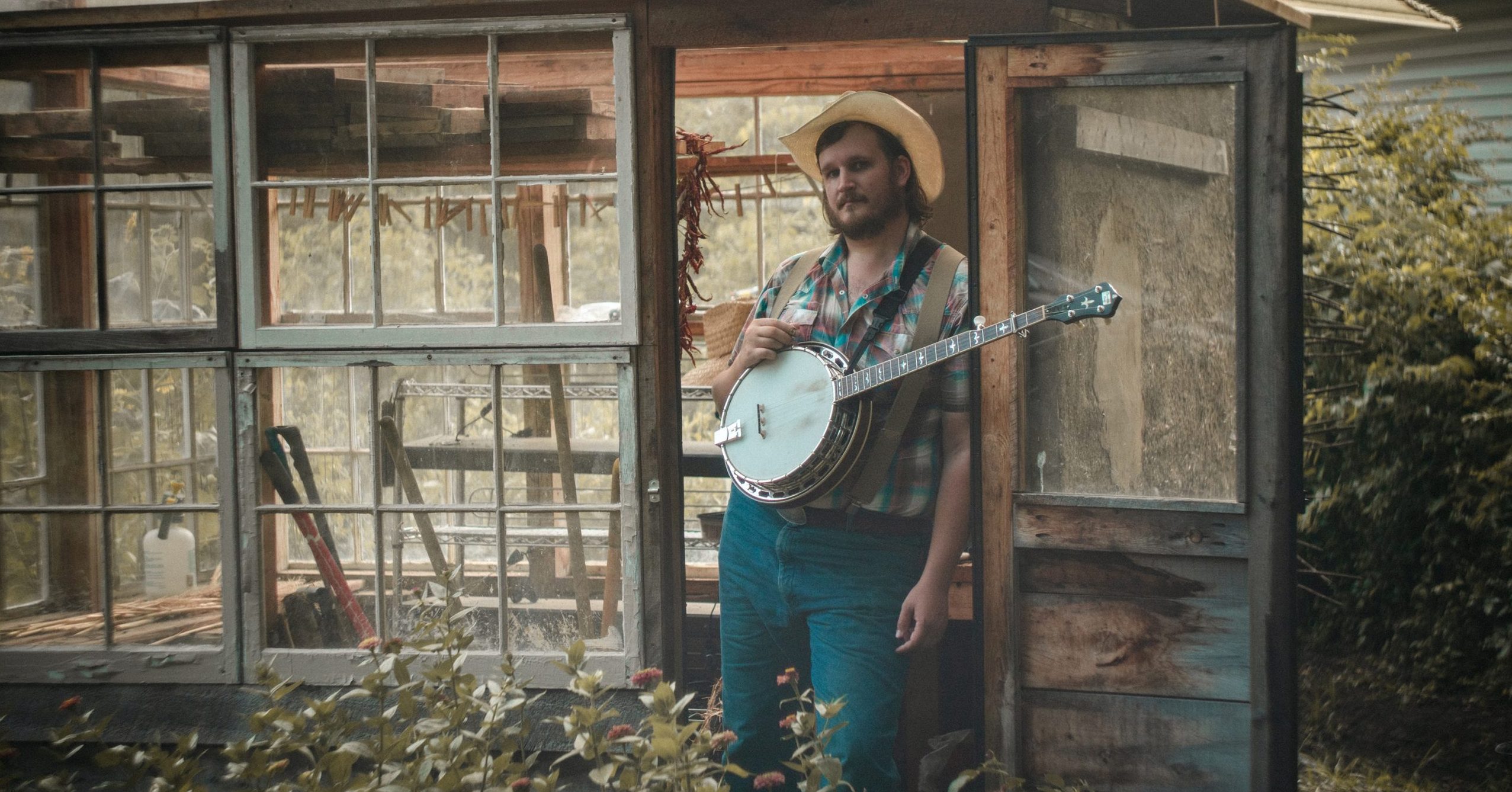
Photo credit: Lead photo by Tim Duggan, square thumbnail by Jackie Clarkson.