2025: Another Year of Ed’s Picks

As our second year of Good Country comes to a close, we’re reflecting on another 12 months’ worth of the best in country music. Whether Americana, bluegrass, or string band, blues, outlaw, or Western swing – or any of the many styles of country we know and love – there’s been plenty of excellent picks from my ear buds directly to your inboxes and playlists.

We sampled post-modern Mississippian country from KIRBY, got funky and soulful with Memphis family band and GRAMMY nominees Southern Avenue. We celebrated Suzy Bogguss’ invitation to join the Grand Ole Opry and traveled to the remote center of the Pacific Ocean for Maoli’s particular twang.

Fiery twin fiddle by Jason Carter & Michael Cleveland had our jaws on the floor, while we were surprised – but not really – at how well Brooks & Dunn went together with the Earls of Leicester. Huge stars like Billy Strings, Warren Zeiders, Sabrina Carpenter, and Carín León were enjoyed alongside everyday working musicians like Jordan Tice, The Creekers, Nick Shoulders, Sunny War, and more.

That depth and breadth – of artists and styles, of notoriety, or approach – is exactly what we’re going for with Good Country.

Good Country isn’t any one thing. It’s a feeling. It’s a place. We’ll be chasing more Good Country feelings and places in 2026, and we’re so grateful to have you along for the ride. Look back at all of Ed’s Picks for 2025 with our master playlist.


Want more Good Country? Sign up to receive our monthly email newsletter – and much more music! – direct to your inbox.

2025 Good Country

What is Good Country?

We wouldn’t ever begin to even try to define it. Good Country is a place. A feeling. A sense of knowing it when you hear it. Whatever you consider to fall under the term or qualify for the moniker, there certainly is plenty of Good Country to be found these days – and especially in 2025.

To wrap up the year in country, we asked our GC contributors not to simply select their favorite country song or album of the year, but to consider that titular question. We gave our writers no parameters or qualifiers for what their picks could be or include, leaving the prompt as open-ended as possible, asking our folks to focus in on the music that stuck with them, whatever the reason or impulse or staying power. Most selections are albums and songs, but some are artists, books, soundtracks, live shows, or other more intangible moments.

The results perfectly illustrate how much easier it is to triangulate the location of Good Country by showing, rather than telling. Spanish-language and Mariachi-infused country fall alongside twangy Mississippian working class messages over hip-hop beats and contemplative singer-songwriter mental health reckonings. Bluegrass pickers can be found beside books and motion picture soundtracks and songs sung in te reo Māori. Smash hits and household names bump up against newcomers and fresh discoveries. It’s all here. It’s all Good Country.

As you scroll, we hope you enjoy the broad, borderless, and endlessly entrancing territory we’ve come to know as Good Country. As we turn the page from 2025 to 2026, we’re proud of the community of folks who love and make Good Country – and beyond excited to hear what they’ll continue to bring to us in the very near future.

Sammy Arriaga, “Before The Next Teardrop Falls”

Freddy Fender’s masterful 1974 hit, “Before The Next Teardrop Falls,” with its Tejano guitar and half-Spanish chorus, is so cemented into the history of the place it was made that it sounds as contemporary as Willie in Austin, and older than the Carter Family, even maybe older than Nashville itself. Recording a cover of it, especially in this era of ICE raids and xenophobic facism, is to argue for a kind of double heartbreak – where the loss of a lover and the oppression of a culture work concurrently. I would have never thought that Sammy Arriaga was capable of this, his previous work was often vapid and derivative, but 2025’s Heart in Texas has an immediate, difficult tenderness.

If Fender’s work has hope that his lover will eventually need him in the same way that country music will need him, then Arriaga’s work is devastating because he knows that he will not be asked to be there at all. – Steacy Easton

William Beckmann, “Por Mujeres Como Tú”

Few things brought me more joy this year than videos of country crooner William Beckmann performing Pepe Aguilar’s “Por Mujeres Como Tú” at Floore’s Country Store in Helotes, Texas, in September. Beckmann was joined by Mariachi Campanas de America, a San Antonio-based group that’s been active in different iterations since 1978.

A native of Del Rio, Texas, Beckmann has made no secret of his bilingual roots – he sang Vicente Fernández’s “Volver, Volver” during his Opry debut in 2023 and included a cover of “Por Mujeres Como Tú” on his major-label debut, Whiskey Lies & Alibis, earlier this year. But this was clearly a special moment, as evidenced by the triumphant expressions on Beckmann’s and the mariachis’ faces and the sounds of the delighted crowd singing along. It offered proof of what many generations of Texans already know to be true: Mariachis make everything better. – Will Groff

Luke Bell, The King is Back

Luke Bell was a country music chameleon like no other. Western swing, country blues, classic country, outlaw, cowboy, trucker songs, and rowdy barroom country – he sounded at home in it all. Enigmatic and tough to pin down, Bell was a quintessential driving force in the Americana and independent country scene as it blossoms now. He also struggled with mental illness and substance abuse, and was found dead at 32, truncating his musical contributions.

Now, a posthumous double album, The King is Back, delivers both Bell’s ineffable joie de vivre and his remarkable songwriting in the most complete form yet. The King is Back’s 28 tracks range from bravado on “Rattlesnake Man,” “Long Gone Love,” and “Cold Stew,” to vernacular country with “Roofer’s Blues” and “Irrigator’s Blues,” and classic country weepers like “Seven and Steady” and the album’s spectacular, tragic closer, “Tiger’s Mouth.” Bell’s songwriting was often stunningly prescient. And on the album’s title track, it’s easy to imagine Bell’s just stepped back on stage with a wink and a grin: “I heard things just ain’t the same without me/ Hold your hats, the party’s on, the king is back,” he sings. This album is as close as it gets. – Meredith Lawrence

Cole Chaney, In The Shadow Of The Mountain

In 2023, as I was wrapping up an interview with music industry counselor JT Nolan about the mental health benefits of playing music, he asked, “Have you heard Cole Chaney? Go to YouTube and listen to ‘Spirit.’” When friends and family turn away, houses of worship slam-lock their doors, and society at large stigmatizes and ostracizes, the broken take refuge in the arts. Sometimes it’s complex work. Sometimes it’s the gentle strumming of an acoustic guitar and a high lonesome refrain: “I want to let go, I don’t want to hurt no more, I want to let go … spirit … I’m tired of holding on …”

A lot can happen in two years. Cole Chaney grew his hair, plugged in, turned up, and released In The Shadow Of The Mountain. The result owes as much to Cobain and Cornell as it does to Doc and Merle. Chaney describes it as “a little bit of a darker album.” That’s saying something, considering the emotional outpouring that is his debut, Mercy. Settled in midway on the new release is a revisited “Spirit,” somehow even more plaintive than the OurVinyl session.

Albums like In The Shadow Of The Mountain, in all its aching beauty, are reminders that while our brokenness may never truly leave us, music is the kintsugi that helps fill its deepest cracks. – Alison Richter

Tyler Childers, Snipe Hunter

Sure, Tyler Childers’ grungy Rick Rubin-produced masterpiece, Snipe Hunter, has been nominated for a GRAMMY Award in the Best Contemporary Country Album, but placing the project alongside releases by fellow nominees Miranda Lambert and Kelsea Ballerini illustrates how limiting this buzzworthy category split really is. To this listener, every single fascinating song on Snipe Hunter is built upon a centuries-old foundation of country and Appalachian tradition.

While the album has certainly had a polarizing effect among those who describe themselves as Childers fans, folks “in the know” inside and outside of the region – be it central or southern Appalachia, Kentucky, the South, or rural haunts in general – found endlessly artful complications and narrations of country (and country-ness) throughout the collection. Childers’ lyrics are all at once demonstrable and fantastic, far-fetched and absolutely grounded in reality. Over the half-year since its release, I find myself returning to Snipe Hunter over and over again to delight in new discoveries and freshly raised eyebrows and first time laughs-out-loud as I find more and more whimsical magic flowing from Childers’ true country pen. You may not see yourself reflected in this EP, but to those of us who do, the sensation is joyous – and addicting. – Justin Hiltner

Madeline Edwards, FRUIT

When Madeline Edwards started turning in songs for her 2025 album, FRUIT, an “industry leader” on her team suggested she package the project as a “grief EP” – a moment of catharsis in the wake of her younger brother’s death that would not distract her from more commercially viable musical pursuits. But the grief songs kept coming and the suits lost faith.

Edwards stuck to her guns and delivered the brilliant concept album independently. The pangs of mourning ring out throughout FRUIT, but so do hard-won determination and joy. Edwards’ range as a storyteller is on marvelous display from the instantly memorable piano ballad “Just A Dream” to the wall of guitars on “American Psycho” and gospel timelessness of “Holy Fire.”

Edwards is at home among the many different shades of contemporary country, while also dipping her toes in soul, rock, indie and her very own brand of classical pop vocals. Somebody please put this multifaceted performer on a massive headlining tour ASAP so we can watch her soar to even greater heights. – Lizzie No

Sierra Hull, A Tip Toe High Wire

With the release of her latest album, A Tip Toe High Wire, Sierra Hull has broken through a new level of national and international notoriety. With a songbird voice and soothing stage presence, the mandolin virtuoso took her deep bluegrass roots and blended it with a heady helping of Americana and indie-folk stylings.

Always cognizant of her traditional bluegrass foundation, Hull continues to use that steady footing to step over musical fences and into new realms of sonic possibilities, as seen with her appearances onstage in recent years with the likes of Slash, Cory Wong, and the Allman Betts Family Revival. If anything, A Tip Toe High Wire is, in many respects, Hull finally arriving into her own space and signature sound, something she’s chased after since she was a young kid playing alongside legends like Alison Krauss, Sam Bush, and Béla Fleck. The album itself is a testament to the unlimited possibilities she possesses and radiates with such ease and pure enthusiasm.

Not to mention, Hull also took home her seventh Mandolin Player of the Year honor at this year’s International Bluegrass Music Association Awards. – Garret K. Woodward

Nicholas Jamerson, The Narrow Way

Those plugged into Kentucky’s music scene will often put Nicholas Jamerson’s songwriting on the same level as that of Tyler Childers, Chris Stapleton, and Sturgill Simpson. With his latest record, The Narrow Way, it’s easy to see why.

On the 12-song project, the singer’s humility shines through as he tackles topics like the bond he’s built with his partner (“One With You”), remaining hopeful in life’s dim moments (“Dark In Every Day”), not taking your time for granted (“Running Out Of Daylight”) and reflecting on moments you can’t get back (“Prater Creek”).

Further recognition of Jamerson’s prowess as a writer can be found in the feature spots littering the project, which range from its producer Rachel Baiman to Ketch Secor (Old Crow Medicine Show), Tim O’Brien, Shelby Means (Molly Tuttle & Golden Highway), and his sister, Emily Jamerson (another artist to keep your eye on). Altogether, The Narrow Way follows the same formula Jamerson has rode to success for over a decade now – serving the song above everything else – and the best part is he’s showing no signs of slowing down. – Matt Wickstrom

KIRBY

@singkirbysing Did you know Mississippi has the most food deserts in America ? A food desert is where residents have limited access to affordable healthy & nutritious food options due to a lack of grocery stores. Spread the word. #fyp #foryou #foryoupage #fypシ #fypppppppppppppp #viraltiktok #viralvideo #fypdongggggggg #singing #relatable #singer #fypage #mississippi ♬ The Man – KIRBY

I spend more time on TikTok than I’d like Good Country’s readers to know, and it seems like most country artists’ content sits on a continuum between “here’s a bonfire scene that cost two million dollars to produce” and “pardon my PJs, the label made me post this :(.”

Mississippi songwriter KIRBY, however, used short-form vertical video as a canvas for her Southern Gothic storyscapes to great effect all year, turning album promotion into an opportunity for site-specific performances. In July, KIRBY posted a lyric video for “The Man,” a song from her then-forthcoming album, Miss Black America. She sings straight to camera in front of the yellow Dollar General sign you see on every block in the hood. Her vocal winks at Ann Peebles and the caption explains the prevalence of food deserts in America.

This fall, clips of “Na$ty” created their own cultural moment on the Black Internet. You kinda had to be there, which is a lesson in itself. On KIRBY’s internet, everything is text and anything can be useful. Hair, thighs, grooves, intertextual comparisons, and accents are thick, and AAVE will not be translated. We are cordially invited to keep up. – Lizzie No

Olivia Ellen Lloyd, Do it Myself

West Virginia native, now New York-based songwriter Olivia Ellen Lloyd taps into a deeper sense of love, heartbreak, liberation, and resilience on her sophomore album, Do it Myself. The release features an all-star band with Dave Speranza on bass, Connor Parks on drums, Duncan Wickel on fiddle, James Woodall on pedal steel, Sarah Glades on percussion, and Mike Robinson as producer – as well as playing guitar and pedal steel.

Lloyd’s storytelling is vivid, emotional, and quite powerful. Listening to both this album as well as her first, it’s beautiful to watch her story unfold in sentimental songs, which have a country twang, but you can also hear influences from other genres. Whether punchy songs or soft ones, all of her music has a groove that makes you want to sing and dance along – while also giving you a space to experience your own feelings, as she does while singing. – Emma Turoff

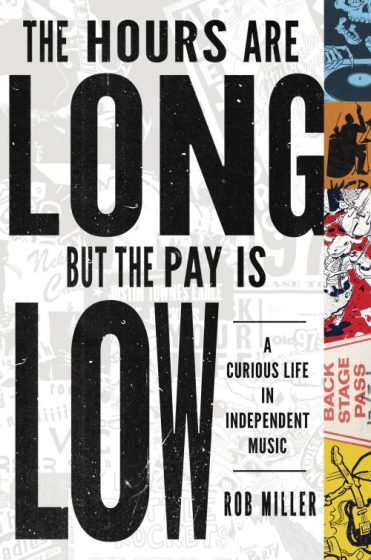
Rob Miller, The Hours Are Long But The Pay Is Low: A Curious Life in Independent Music

A question anyone who pursues a creative life will ask themselves: Why do we take a vow of poverty to put art into the world? As put forth in Bloodshot Records co-founder Rob Miller’s memoir, The Hours Are Long But The Pay Is Low, it’s because not doing it is not an option.

Chicago-based Bloodshot caught the wave of mid-1990s alternative country, releasing seminal works by Old 97s, Waco Brothers, Robbie Fulks, Sarah Shook, and more. Miller comes across as an OCD character straight out of High Fidelity, and his memories of the label’s hardscrabble early days are refreshingly unpretentious.

Bloodshot’s story wasn’t entirely positive. Its original incarnation ended badly amid disputes between Miller and his business partner (the label was ultimately purchased by Exceleration Music, which operates it now under new management). But Miller summarizes the bad-vibes part only briefly, concentrating instead on telling one man’s love story for music. It’s honestly impossible to imagine him doing anything else. And as the cherry on top, Miller dedicates the book to a pair of late friends including Dex Romweber, who he writes “left this world before he could read what his music meant to me.” – David Menconi

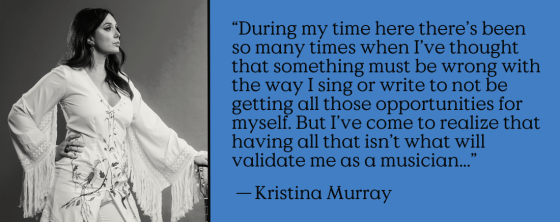
Kristina Murray, Little Blue

Little Blue is an understatement. Kristina Murray’s sterling third LP could convincingly have been called “Huge Bummer,” which is coincidentally the mark of a great country record.

“It’s gonna get worse, just give it time,” Murray incants on “Has Been,” a cheekily dour turn-of-phrase that just may stop you in your tracks. (Surely she means it’s gonna get better, right?) Later, on the dreamy “Fool’s Gold,” Murray tries her best at seeing beyond the proverbial grey skies, only to come up short: “It’s just more clouds,” she sighs. Such moments are appropriately slathered in pedal steel, but there’s also a swampy, rock ‘n’ roll groove to tracks like the deliciously jaded “Watchin’ the World Pass Me By” that makes the whole set go down easy. – Will Groff

Drew Parker

My introduction to Drew Parker was his 2020 single “While You’re Gone,” about missing a girl and drinking a gas station PBR while waiting for her to come back. That song had the classic hallmarks of a contemporary country breakup song. Little did I expect the curveball to come five years later.

For over a month earlier this year, Parker teased a big announcement with cryptic social messages like, “Some chapters end. Some chapters begin. This one… isn’t about me. 9•15•25.” The day came and Parker revealed in a short film testimonial that he’s felt God speaking to him, culminating in Parker’s non-religious manager calling and saying Parker should record Christian (country) music. This “moment” stuck out to me not only for the unexpected manner in which Parker revealed his decision, but because it’s obvious this isn’t a creative “phase.”

I don’t see Parker putting together a “token” record about believing and then going back to just girls, beer, and his pickup. Furthermore, Parker exudes unwavering peace about it all – whether he loses fans or faces mean-spirited judgment. There’s tangible risk to this move and there’s something to be said for Parker’s resolve and frankly, his faith in making this change. – Kira Grunenberg

Nathaniel Rateliff & The Night Sweats Live at the Kia Forum

Thinking back on all the great music I saw this year, the concert topping my list is one I saw at Los Angeles’ Kia Forum in February. The amazing triple bill – a solo Sam Beam, Waxahatchee, and headliner Nathaniel Rateliff & The Night Sweats – all delivered dynamic performances. But it was the unexpected parts of the concert that really made it so memorable.

During his set, Rateliff welcomed several special guests: Lucius’ lead singers Jess Wolfe and Holly Laessig, Taylor and Griffin Goldsmith from Dawes, and Grateful Dead bassist Bob Weir. What especially impressed me, however, was how Rateliff generously let his guests take the spotlight – a gesture that conveyed his joy for making music, particularly in a “more-the-merrier” collaborative way.

The Colorado-based Rateliff and his band also made the extraordinary gesture of using the concert to raise funds for victims of Southern California’s January wildfires as well as partnering in a purchase of a mobile food pantry to assist those left homeless by the destructive fires. This night reminded me how musicians can not only create a genuine sense of community through their rousing performances, but also through their inspiring actions. – Michael Berick

Sinners (Original Motion Picture Soundtrack)

Ryan Coogler’s Sinners is the horror film of 2025. It’s been hard to ignore, and for good reason. Michael B. Jordan, who plays double duty as twin outlaws Smoke and Stake, leads the cast which also includes Hailee Steinfeld, Wunmi Mosaku, and Thomas Pang (also known by his stage name, Yao). The film ultimately raked in $367 million in worldwide box office receipts. From its unique spin on vampires to its rootsy, blues-driven music, Sinners excels in celebrating the rich history of Black music and connects the dots between African tribal music to modern day hip-hop and R&B.

Songs like “Travelin’” (a standout moment from newcomer Miles Caton as musician hopeful Sammie) and the mind-blowing time-traveling song “I Lied to You” (paired in the movie with a visual mixing all the styles of Black-made music throughout history) mark the soundtrack as one of the year’s best releases. It’s sure to give the audience a renewed sense of Black history that’s often correlated to specific moments and eras in time. The film and its soundtrack will be talked about for decades as being a vital cinematic moment. – Bee Delores

Ringo Starr, Look Up

Way back at the beginning of 2025, Ringo Starr reminded us how different the world would look today if not for his love of American roots music. Teaming up with GRAMMY-winning producer T Bone Burnett, Starr’s country album Look Up is a love letter to the sound that drove his imagination.

Over 11 new songs written mostly by Burnett for the occasion, a classic American art form got a British Invasion makeover, with modern masters like Billy Strings, Molly Tuttle, and Alison Krauss joining Starr’s fun. Yet, what made this project a year-end highlight was not just the tunes. It was what they represent. As Starr openly declared, his first musical love was American blues and country. Artists like Lightning Hopkins sparked a creative impulse that would ultimately help redefine pop forever. From releasing music as a self-contained band and writing their own songs, to making youth culture a dominant force, The Beatles would change the world – and who knows? With a different drummer behind the kit, maybe none of it happens. Look Up shows where Starr was coming from. – Chris Parton

Vandoliers, Life Behind Bars

Vandoliers’ fifth studio album, Life Behind Bars, is both joyous and contemplative as the raucous country-punk band dive deep into themes of gender, grief, and sobriety in equal measure. “Dead Canary” blasts eardrums with a Mariachi flavor that barrels full steam ahead, setting the stage for their most impressive record to date. Other essentials such as “Bible Belt” and “Thoughts and Prayers” take aim at the current social and cultural moment, addressing religious fanaticism and how it clouds any sense of empathy.

Songs like “You Can’t Party with the Lights On” and “Valencia,” another Mariachi-intoned moment, are just plain fun. These round out the album into a well-crafted snapshot of the group right now and where they fit into the ever-changing world. Additionally, Vandoliers have never sounded so in tune with one another, vocally and musically, opting for compelling and intricate choices that expand their style without sacrificing what’s made them so good. – Bee Delores

Kelsey Waldon, Every Ghost

As the editor for Good Country and BGS, I listen to hundreds of albums a year, but they rarely stop me in my tracks. That happens even more rarely when album creators are longtime close friends of mine. But despite having met Kentuckian singer-songwriter Kelsey Waldon nearly 15 years ago and adoring all of her LP releases in that time, when Every Ghost first arrived in my email inbox earlier this year, I was floored.

In a world – and industry and genre – absolutely dripping with affectations of country music in lieu of the “real deal,” Waldon’s sixth studio album is dyed in the wool, but unconcerned with meeting those expectations or checking the boxes of trends and salability. These honky-tonking songs are infused with old-time, bluegrass, outlaw, confidence, and Prine-ian philosophizing. Waldon somehow turns introspection and identity into gritty and engaging wit and metaphor, without ever needing to obscure her messages to make them feel artistic or serious or poetic.

Even listeners like myself, who have been in Waldon’s fan club for a decade and a half or who have swapped vegetable seedlings and chicken pics with her, or who have crisscrossed her Ohio river floodplain homeland dozens of times, will learn much more about Waldon, her approach, her sonic loves, and her inner machinations as she pulls back the curtain for all of us on Every Ghost. – Justin Hiltner

Marlon Williams, Te Whare Tīwekaweka

Down here at the bottom of the globe in Aotearoa and Te Waipounamu (the North and South Islands of New Zealand), 2025 has very much been the year of the Māori singer-songwriter Marlon Williams (Kāi Tahu, Ngāi Tai).

Back in April, I interviewed Williams for a Good Country cover story to celebrate his stunning fourth solo album, Te Whare Tīwekaweka (The Messy House) and director Ursula Grace Williams’s equally affecting documentary film Marlon Williams: Ngā Ao E Rua – Two Worlds. Since then, he’s brought his antipodean blend of country and western, folk, rock and roll, and mid-to-late 20th-century pop to audiences across the U.S., UK, Australia, and at home, culminating in taking home the coveted APRA Silver Scroll songwriting award for his single “Aua Atu Rā” in late October.

Written and sung entirely in te reo Māori, the indigenous language of New Zealand, Te Whare Tīwekaweka is a masterful example of how music can use mood and emotion to cross geographic borders and linguistic barriers effortlessly. Even when we don’t speak the same language, we can still find common ground. Sometimes a sense of connection is only a song or two away. – Martyn Pepperell


Photo Credit: Tyler Childers by Sam Waxman; Kelsey Waldon courtesy of the artist; Olivia Ellen Lloyd courtesy of the artist.

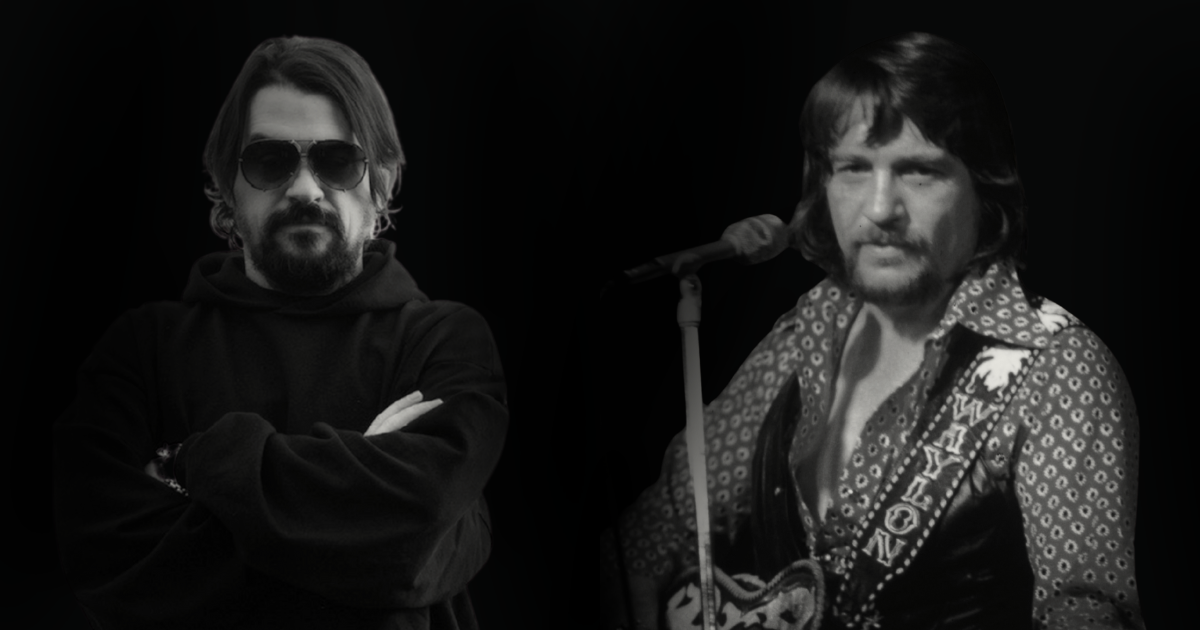
Shooter Jennings’ Heartfelt Tribute to His Legendary Father

Being the son or daughter of a legendary artist can often cause self-esteem and identity problems, especially if offspring choose their famous parent’s profession. But that clearly hasn’t been the case with Waylon Albright Jennings, much better known to music fans as “Shooter.”

The son of greats Waylon Jennings and Jessi Colter, Shooter Jennings has forged an impressive career as a singer, songwriter, instrumentalist, and producer covering over three decades, while displaying an idiomatic flexibility that’s seen him excel with both country and rock projects. Though he never uses the term “prodigy,” he was playing drums at five, taking piano lessons at eight, and sitting in with his father’s band on guitar at 14, while often spending time riding on his dad’s tour bus. Since then, he’s done an array of projects from heading bands to helming sessions, but he’s also always upheld a mantra of his father’s, which is stressing authenticity and passion in whatever he’s doing, writing, or playing.

Towards that end, Shooter’s newest venture both pays tribute to his famous father and reaffirms the musical values both have always championed. That’s the album Songbird (released October 3 via Son of Jessi/Thirty Tigers), which is the first of a planned posthumous trilogy of releases from the famed vocalist, who was one of the most distinctive and dominant voices to emerge in modern country during the ’70s and ’80s. Waylon’s landmark recordings, both as a solo artist and later in collaborations with Willie Nelson, Johnny Cash, Kris Kristofferson, Tompall Glaser and Jessi Colter, not only ushered in the “outlaw country” movement, they signaled a major step forward for artistic independence and creative freedom that resonated across the popular music spectrum.

Waylon Jennings was an innovative and vital figure not only as a performer, but as a personality. His voice and stature helped give gravitas to an otherwise forgettable TV show (The Dukes of Hazzard) and helped fuel a drive for authenticity within country. Still, despite that quest for freshness and originality, Waylon knew how to make hits. He had 16 number one tunes on Billboard‘s Hot Country Songs chart and 11 number one albums on Billboard‘s Top Country Albums chart during his amazing career, while always being a staunch advocate for his view of what constituted country.

Though Shooter has always called himself “an MTV kid who went down the rabbit hole with rock and roll,” he’s also long held a great reverence and respect for country. He began sorting through hundreds of his father’s personal studio recordings during the summer of 2024. Having just begun an exclusive residency at Hollywood’s historic Sunset Sound Studio 3 (which he redubbed “Snake Mountain”), Shooter began examining the tapes with veteran engineer Nate Haessly. Things moved quickly, his initial goal of finding previously lost Waylon songs he could share with the world morphing into instead deciding the best way to present what turned out to be a rich treasure trove of recordings. The material he was hearing was recorded between 1973 and 1984 and featured such guest stars as Tony Joe White and Jessi Colter.

“I started listening to this material last year and knew right away I had to put it out,” Shooter said during a recent phone interview with Good Country. “Once we began thinking about what we would put out there first, ‘Songbird’ just really kind of took over.

“Everyone that I played the song for heard it and they were really emotionally affected. Many broke out in tears the first time they heard it. It was an example of my father’s philosophy about doing songs from other people. Any song that he chose to record he would turn it into his own type of anthem. I really think that was the case with ‘Songbird,’” Shooter continued. “It gives the album a power and special flavor, and I’m really proud of everything on it.”

Songbird was released the first week of October, with Jennings’ evocative and stirring cover of the Fleetwood Mac tune its lead single. It debuted at number six on Billboard‘s Top Album Sales chart and it’s been in either the Top 10 or 20 on a host of other charts as well, representing the highest any Jennings LP has charted in 35 years. The 10-track release contains several other notable singles, most of them already previously complete. But on a couple of cuts, Shooter utilized the talents of surviving members of The Waylors, including guitarist Gordon Payne, bassist Jerry Bridges, keyboardist Barny Robertson, and backing vocalist Carter Robertson to add some spice. Elizabeth Cook and Ashley Monroe were also enlisted to help propel Songbird to new heights. Shooter mixed the songs in a purely analog fashion on Sunset Sound Studio 3’s custom 1976 DeMedio API mixing board.

Another song that’s quite appropriate in these times of extreme social conflict and division is Waylon’s version of Johnny Rodriguez’s “The Cowboy (Small Texas Town),” which finds him urging both cowboys and hippies to direct their ire away from each other and towards those causing greater structural harm to society. Additional recommended cuts include a sizzling Jennings version of Johnny Cash’s “After The Ball” and “I’d Like To Love You Baby” that features Jessi Colter.

Both “Wrong Road Again” and “I’m Gonna Lay Back With My Woman” are trademark Jennings numbers, while his version of Jesse Winchester’s “Brand New Tennessee Waltz” is also solid. The one criticism that some hardcore Waylon fans might make is Songbird doesn’t offer any previously unissued gems that he penned, feedback that Shooter’s been around long enough to anticipate. “What we went through and chose here were numbers that were made memorable through his treatments,” he continued.

“That’s something that my father always talked about and stressed, that whenever you do a song, make sure that you’re not just replicating something else, you’re making your own statement. That’s why Songbird has such an impact and that’s the case with everything on this album. These are songs that he loved from other people and wanted to perform and put his own stamp on them.”

Though born in Nashville, Shooter made the move to Los Angeles in 2001. Since then, he’s comfortably moved back and forth between rock and country. He’s had a mixed amount of success as a performer, cutting 11 albums and EPs in both genres. His biggest country hit came on the 2005 LP, Put The O Back in Country. That album’s lead single, “Fourth of July,” peaked at No. 22. The album version featured a cameo by George Jones, who sang the chorus to his signature song, “He Stopped Loving Her Today,” at the end. Unfortunately that was purged from the radio version, but Jones was credited on the Billboard charts.

The album also spotlighted Shooter’s then-new band, The .357s, which consisted of Leroy Powell on guitar, Bryan Keeling on drums, Ted Kamp on bass, Robby Turner on steel, and backing vocals by Bonnie Bramlett. Later that year his song “Busted in Baylor County” was featured in the 2005 film version of The Dukes of Hazzard. Furthermore, Jennings portrayed his father in the Johnny Cash biopic Walk The Line alongside Joaquin Phoenix and Reese Witherspoon. His rendition of his father’s song “I’m A Long Way From Home” was featured on the film’s soundtrack.

Still, Shooter’s greatest fame has come as a producer for a wealth of recordings. He was introduced to the studio as a child, his earliest exposure being inside Chips Moman’s studio in Nashville. His rock influences come through in his at times freewheeling use of studio technology that wasn’t in general use during his father’s heyday, but on any of his productions he’s never let the artist’s voice be overwhelmed by layers of excessive production or backdrop.

He’s been nominated for five GRAMMYs in that role and won two. A short list of memorable sessions he’s produced include such artists as Brandi Carlile (Best Americana Album GRAMMY), Tanya Tucker (Best Country Album GRAMMY), and American Aquarium, as well as Jessi Colter, Jamey Johnson, Jaime Wyatt, The White Buffalo, Hellbound Glory, The Mastersons, Julie Roberts, Kelsey Waldon, Yelawolf, Marilyn Manson, Jason Boland, Billy Don Burns, Avi Kaplan, Billy Ray Cyrus, and Angry Grandpa. Just this year alone, Shooter Jennings produced acclaimed releases by the Turnpike Troubadours, Charley Crockett, and Jake Owen.

When asked what he enjoys most or looks for in terms of production collaborations, Jennings says, “The people that I truly enjoy working with the most are the ones who have their own ideas of what they want to do, how they want to sound, or what they want to sing. Then they bring those ideas into the studio and we take it from there. I’m not really quite as good when it comes to just taking someone who doesn’t really have a sense of who they are and saying why don’t you try this or try that.

“With Charley [Crockett], for instance, that guy comes into the studio and he’s already got all these things together and we can just hit the road from there and take it forward. A guy like Duff [McKagan], who can just write their ass off, or a group like American Aquarium, I can get really excited. Brandi [Carlile] came to me and wanted me to work with her and that was a fantastic experience. But in general, if you’re someone who has their concept of what they want to do, then we can sit down and really make it work in the studio.”

Shooter also has amassed some good credits in the worlds of broadcasting, film, and television. As well as getting the chance to portray his father in the 2005 film Walk The Line, he has made celebrity appearances on television shows CSI, Marvel’s The Punisher, and American Revolutions, while also playing a gunslinger in the 2013 film The Other Life.

Back in 2009, Shooter participated in a CMT Crossroads session, paired with close friend and fellow musician Jamey Johnson. The evening’s set list consisted entirely of duets, including a cover of “Outlaw Shit” from the Waylon Forever album, two songs from Jennings’s discography – “God Bless Alabama” and “It Ain’t Easy” – and four songs from Johnson’s album That Lonesome Song including “High Cost Of Living,” “Mowing Down The Roses,” “Between Jennings and Jones,” and “In Color.”

Shooter cites Glenn Danzig and the band Oasis as folks that he hasn’t yet worked with whom he’d like to in the future. But right now, his main focus is on the two remaining Waylon Jennings posthumous recordings – though he’s not sure yet exactly when they will come out or what will be on them.

“One thing I can say for sure is that there’s a lot more great music coming,” Shooter concluded. “I was really amazed at how much great stuff is there, and I think the fans are going to really be thrilled when we get these next two out there. My father did a lot of great music before he passed, and we’re going to get as much of it out there as we can.”


Photos courtesy of Shooter Jennings.

Outlaw Country That’ll Make You Smile

Holding the attention of a roomful of moderately smashed bar-goers is no small feat, let alone with a traditional Irish folksong. But last May, country singer-songwriter Dylan Earl ended his set at Brooklyn’s Skinny Dennis standing on top of the bar and singing an a cappella version of “Wild Mountain Thyme.”

“Will you go, lassie go/ And we’ll all go together/ To pull wild mountain thyme/ All around the blooming heather,” Earl implored in his warm baritone, towering above the room in worn jeans, boots, and a sleeves-cut-off T-shirt from his Arkansas-based label, Gar Hole Records. In spite of all the alcohol collectively consumed by the listeners who packed the venue to its beer-tinged walls that evening, the room was just about as quiet as a divey honky-tonk can be.

By ending his set with the kind of folk song which, passed down through generations, comprises one major lineage of country music – indeed, “Wild Mountain Thyme” is based in a much older Scottish folk song – Earl invoked a deep vernacular tradition and history often left out of modern country. Earl’s music attracts labels like “old-school” and “classic country,” and his voice certainly lends itself to those comparisons, but his own compositions convey a whole lot more. Rejecting the banality of tired Southern stereotypes, Earl writes punk-hearted, poetic music rooted in a love of people and place; music which is both socially and class-conscious and captures wide-ranging cultural unease and indignation with nuance and wit.

On his fourth studio album, Level-Headed Even Smile (released September 19), Earl makes clear that his is not a return to a bygone era so much as a carrying on of a long tradition of speaking truth to power and of imbuing dimension and worth into the lives of overlooked characters and issues too easily reduced to absolutes.

“I’d rather be an outlaw than in with the law/ All this authority worship is the strangest thing I ever saw,” he sings in “Outlaw Country,” a thesis statement of sorts for the album and Earl himself. Earl wrote “Outlaw Country” out of frustration at how many people made assumptions about his beliefs and morals because of his appearance – and because he plays country music with a whole lot of Southern twang. Earl wanted to make it clear where he stands.

“I finished high school in a very rural part of Arkansas; I identify with the Deep South, but I don’t identify with its most prevalent fucking right-wing rhetoric… I still want to remain approachable to those people I completely disagree with, because I think that’s an important part of making art, is creating discourse,” he says. “I want to try to approach these people and try to have that conversation. Be like, ‘Listen here, brother, I’m just like you, but you don’t have to be a racist piece of shit. It’s way more fun in life to be happy and be inclusive. Your soul will be happier because of that.’”

Lately, outlaw country morphed from its subversive roots into a shorthand for wicked good independent country or a slightly more specific alternative to Americana. While both wicked good and independent, Earl’s version also rekindles contempt for the establishment that fueled the original outlaw country movement:

I’d rather be a bootlegger than a bootlicker
A side stepper than a homewrecker
And I don’t get a pick me up
From putting other people down

It’s clear to see by the air I breathe
Working class solidarity
Is the only way
We’re gonna stamp that fascist out

Sardonic and irreverent, “Outlaw Country” is an anthem for anyone who ever believed in love and community over corruption and power. But rather than a callback, Earl’s music is of and for the next generation of ne’er-do-wells and dreamers living on the fringes, hoping for something better.

Earl grew up in Lake Charles, Louisiana, where he split his time between separated parents. Chafing at the craven habits of money and influence that he witnessed from his father, a powerful local lawyer, Earl preferred the warmth and love he felt in the house his mother shared with his grandmother. (Despite a rocky childhood, Earl’s now building a relationship with his dad.)

“I was living in poverty on one side and then I was living in opulence on the other side, and the poverty side is where I wanted to be, because that’s where all the love was,” Earl says. “I’m so lucky to have that, to be able to have identified where love was at a young age and identify where my soul felt good.”

Earl’s mother showed him how to seek joy and adventure, filling life with road trips and camping weekends. When he was just five years old, Earl’s mother plopped a map in his lap and taught him to navigate. Perpetually tight on money and resources and mired in an enduring custody battle with his father, she nonetheless taught him how to get away from it all, instilling in him a curiosity about the world. On the road, they stopped to check out historical markers, explored parks and rivers and the Gulf Coast, and watched giant boats come in while picnicking along the Intracoastal Waterway.

“That developed a sense of wonder and being like, ‘I don’t fucking need money to feel this type of happiness, to feel this sense of joy and adventure and love of life, just life in its purest form,” Earl says, choking up. (He firmly believes more men should cry, and that it helps him be more humane.)

“Her sense of adventure, her true passion for living, it’s amazing to me; it still is amazing to me.”

The album’s title and thematic heart – level-headed even smile – are derived from that approach to living life fully. For Earl, it’s an essential mechanism of coping and connecting. Remain engaged in the world and aware of all its horrors and tragedies, he says, but then, when it gets to be too much, know when and how to take a break:

Some nights I’m crying on the backroads
Rolling my smoke backwards
Trying to keep a level-headed even smile
Don’t you know I might take a while to get there
Just hoping I get anywhere
Trying to keep a little level-headed even smile

“At some point we’ve got to unplug from the fucking screen and just go explore things that are fucking real, like the trees around us, or the grass, or the water, or the sun or the moon, and try to get in touch with that more primal sense of ourselves,” Earl says. “That is where we can really most quickly and most efficiently achieve happiness, it’s getting in touch with the simplest form of ourselves.”

Beside the love from his mother, Earl describes himself as a depressed kid who struggled in school and wanted desperately to escape his hometown and father and stepmother. At 15, he convinced his father to send him to boarding school which, in part because of Hurricane Katrina’s devastation of Louisiana, ended up being in rural Arkansas. At the Subiaco Abbey and Academy, Earl studied with monks who’d taken a vow of poverty and offered rigorous, benevolent study, kindness, and care. Though he’s an atheist, Earl counts the monks, whom he visits regularly, as mentors, connecting with them still through shared spirituality.

“We all fucking showed up pissed off as hell. And we found love and we found love amongst each other; we found love from those monks and found nature,” Earl says, reverently, of his time at Subiaco. “It saved my fucking life. The whole thing; I found joy and happiness for the first time in my life.”

Level-Headed Even Smile is dedicated to Earl’s late friend, William, who was the first to befriend him at Subiaco. “He helped me clear my heart,” Earl says. As he sings of those halcyon days on “Two Kinds of Loner,” “We were two kinds of loner/ A misfit and a wayward son…”

Armed with the sense of wonder his mom taught him, liberated by the fallow morals of youth, and subsumed by the ready escapism afforded by their surroundings, Earl and William learned every back road. They’d steal beer from the back of William’s dad’s Crossroads Tavern and drive for hours exploring the backwoods and levees along the Arkansas River.

“William was the first to show me the country air. Hanging out with him, something about getting in that truck after class, taking off down Lile Ridge Road, cracking a beer, putting on whatever weird music he was listening to at the time, that was the first sense of fucking true freedom I ever had in my life,” Earl says.

Stopping just shy of wistful, “Two Kinds of Loner” is a bittersweet, intimate portrait of the desperately important work of becoming oneself as a teenager – and of the raw beauty in forming kinship through human connection rather than blood relation:

Down where the kudzu meets the bodark
And the darkness first let go of me
High in a cab of a buddy I had
He showed me the county air
I used to not care about nothing
Because no one seemed to care for me

After high school, Earl attended Hendrix College, a liberal arts school which lived up to its name situated in Conway, Arkansas. A few years earlier, Earl borrowed his father’s old guitar – a Yamaha FG 180 Red Tag, which he still plays today – and learned enough chords to make himself useful around a bonfire and impress the local girls. Encouraged by one of the monks at Subiaco, who noticed him straying from lesson plans, Earl started writing his own music.

When he got to college, he landed feet first in a robust DIY music scene. Together with a group of friends – including Gar Hole Records cofounder and label manager Kurt DeLashmet – Earl played a circuit of local house venues: White House, Blue House, Brick House, and occasionally Shit Mansion, where both also lived for a time. To this day, their two-day, 28-band Butt Ranger music festival thrown by friends at the White House remains one of Earl’s favorite shows.

“We were drunk off our fucking asses on plastic bottle whiskey and snorting Adderall and fucking ripping cigs and shit like that. It was fucked up. It was so awesome. It was just blood and piss everywhere,” Earl says. He recalls the floor at White House buckling so deeply that by the end of the night all his gear, including his oversized amp, wound up in a pile in the middle of the floor. Volume was of primary concern, tone and other nuances distinctly secondary. “What a fucking beautiful, carnal, amazing culture to be a part of,” he says.

Two songs on Even Smile come from those early days playing music first in college and, afterwards, in Little Rock, where Earl and his band Swampbird moved. (Earl lived in Little Rock for a few years then moved to Fayetteville, where he still lives.) Both songs are paeans to the chaotic moil of early adulthood rendered heady and hazy by too much booze and too little grounding: “Broken Parts,” which he first recorded with Swampbird, and “Little Rock Bottom,” about his time in Arkansas’ capital city.

“I don’t really quite realize it until I am talking about it, how much of my life and my story is wound up into that album,” Earl, who’s now in his mid-30s, admits. The album feels like a fitting way to process and close that chapter of life. “I do feel like I’ve left it on the table and I’ve left it all out on the field, so to speak.”

In total, Even Smile is a loving, layered depiction of both Arkansas specifically and the south in general. Among his many influences, Earl includes Arkansas gonzo poet Frank Stanford (who also attended Subiaco and whose burial there Lucinda Williams memorialized in her song, “Pineola”). Stanford’s realism and wild abandon creep into Earl’s songwriting sensibilities; they share a love of the South and its complexities and a reverence for and dedication to illuminating those stories.

Alongside a few cheeky disquisitions on life on the fringes – including road dog ode “Get In The Truck” – throughout the album Earl relishes the beauty of his home territory. Perhaps nowhere more so than on “High On The Ouachitas,” an extended soliloquy on the wild beauty of the mountain range, his chosen retreat for a reset and solace:

When I’m high on Ouachita
High as I ever saw the Arkansas
With goldenrod and reindeer lichen
Twist flowers in bloom
There’s just no place
I’d rather waste my afternoons
Than high on Ouachita

“I love it so fucking much, because I know all of the nuance and I know all the beauty that’s deep underneath all of the stereotypes. And just how fascinatingly complex our communities are,” Earl says. “It’s fucking beautiful. You have two and a half million acres of national forest. So we have the cleanest drinking water in America; we have endless amounts of outdoor recreation; the food is fucking kick ass; the people are the sweetest ever.”

Earl rounded out Level-Headed Even Smile with two very on-theme cover songs: beloved Arkansas folksinger Jimmy Driftwood’s “White River Valley,” a love letter to Arkansas’s pastoral beauty, and Utah Phillips’ peripatetic wanderer’s lament, “Rock Me to Sleep,” which concludes the album. Together they bracket the glib “Lawn Chair,” written with Cameron Duddy and Jonathan Terrell.

Earl jokes when playing the song live that it might be the worst song he’s ever written. And superficially it sounds like the kind of redneck anthem that might confirm the uneducated listener’s worst stereotypes about uncouth Arkansans: “It’s a whipass life just being me/ It don’t cost much to be the free/ I got my lawn chair/ And I’m sitting on top of the world.” Yet the song is also a sly rebuke against taking everything too seriously. Convivial in its roughness, it’s a gleeful, carefree reminder of the many ways to keep a level-headed even smile.

“If I’m feeling bogged down and feeling depressed, oftentimes it has nothing to do with the task at hand, it’s just that I’ve been absorbing how terrible the fucking world is and it makes me incapable of interacting and interfacing with my immediate world, because I’m so fucking caught up in that goddamn bullshit… and it is not allowing you to reach your full potential as a biological piece of anatomy that is somehow living on this planet,” Earl says.

“[A level-headed even smile is] an attempt to focus on your humanness and try to reattach yourself to the earth and detach from the problems of the earth; and just go out and find your smile. Go find your joy amongst all the fucking evil.”


Photo Credit: Justin Cook

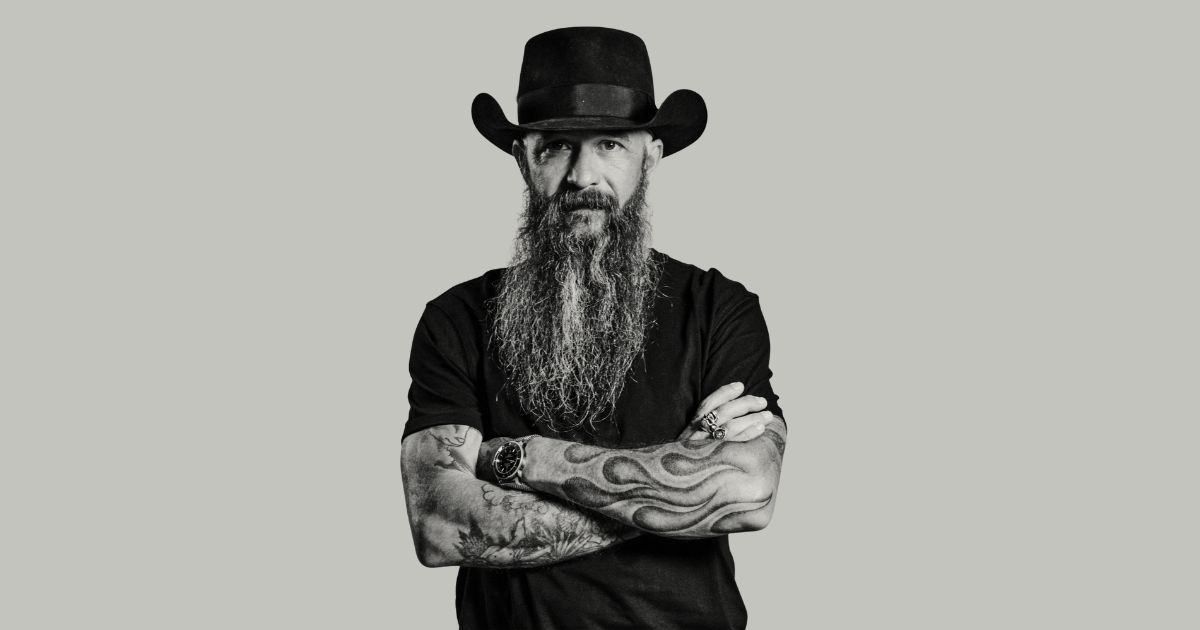
Cody Jinks:
“You Never Stop Coming of Age”

For Texas country star Cody Jinks, his latest album – the fiery and rough-around-the-edges, yet poignant and sorrowful In My Blood – is a liberation of sorts. Not of sound or scope, but of self.

It comes from the eternal quest to find balance within the body, mind, heart, and soul of a singer-songwriter, one trying to understand just what it means to be human in the modern, chaotic world – which is why “Better Than the Bottle” was purposely placed as the opening track on the record.

“Been layin’ things down one habit at a time/ Never thought we’d get old…” Jinks rumbles through the melancholic number. “Now we’re damn sure tryin’/ And makin’ the most of the time that we have left.”

With his sobriety in recent years, Jinks has been taking a hard look at what he sees in the mirror. It’s not about having regrets or cringing at one’s past. Instead, it’s taking personal accountability and professional inventory of the wisdom gained from your existence in real time, all while the calendar on the wall seemingly changes faster and faster each year.

Now 44, Jinks is more focused on what’s just around the corner than continually looking back over his shoulder at the ups and downs along his life’s journey. It’s about a clear head, a keen focus on what matters most – family, friends, fellowship, the freedom to create and perform.

It sounds like you’re in a really good place right now.

Cody Jinks: Yeah. Well, whenever you’re a late bloomer like me, it takes you [til] later in life to figure things out. It’s a practice. I mean, obviously the last couple years I’ve been trying to work on myself, work on my family. I think it’s helped a lot creatively, as well. None of it’s been easy. It’s not like anything’s ever peaches and cream or roses or whatever. The music business is tough, and if it was easy, everybody would do it. I spent much of my marriage while I was on the road. Having been off the road the last four or five years, [not touring] as much as I used to be, I’ve learned that being a great husband and father is even harder than being in the music business.

And it all ties into everything though, because that creative side is also a big balancing act, where you need that outlet in your life.

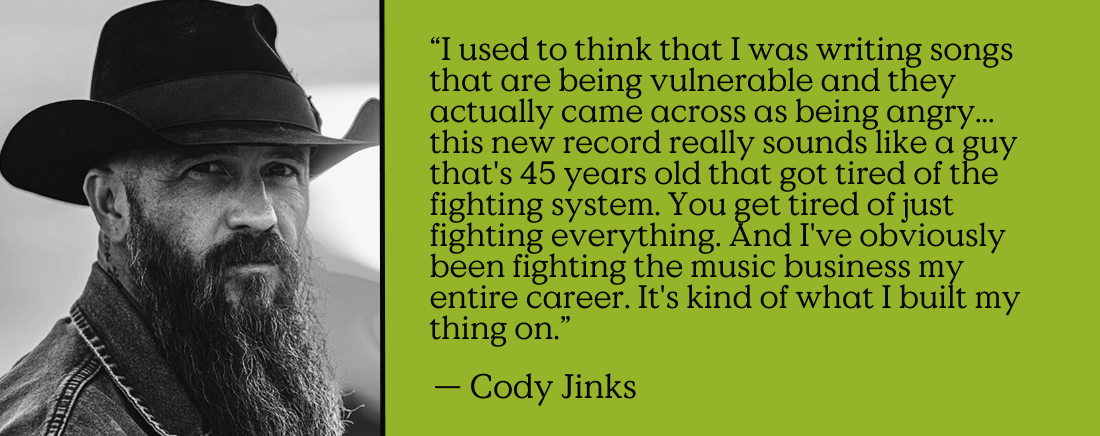
Well, not only the creative outlet, it’s that I used to think that I was writing songs that are being vulnerable and they actually came across as being angry. There was an edge to [the older songs], where this new record really sounds like a guy that’s 45 years old that got tired of the fighting system. You get tired of just fighting everything. And I’ve obviously been fighting the music business my entire career. It’s kind of what I built my thing on.

And, at the same time, I had started bringing the guy in the music business home – that’s who my wife and kids had to live with, as well. So, we’ve been correcting some stuff like that. I’ve been getting some really vulnerable songs out of it. You never stop coming of age. No matter how old you get – when you’re in your teenage years, when you get in your forties – life is a continual movement, man. And if you are not moving forward, you’re going backwards. So, vulnerability is a strength to an extent.

How does that play into the album? I would surmise that the opening track [“Better Than the Bottle”] was purposely placed there.

I was actually going to speak to that track specifically, because that was the second-to-last song written for this record. I wrote it with a friend, Tom McElvain. We both quit smoking cigarettes. We quit doing recreational drugs. We’ve written together a lot over the years. I’ve got several songs with his name on it, but [“Better Than the Bottle”] was a real conversation.

He came over one morning, and in 20-plus years of friendship, it was the first time we had ever been around each other stone cold sober. We were talking about how we used to live versus how we’re trying to do things now and who we’re trying to be now for ourselves and for the people that we love, the friends that we lost along the way that didn’t pull out of it. We’re old enough to have friends that have died from it now. That song made its way to the first slot because it was everywhere – that song’s true. Tom was over here that morning in January and you talk about two grown men in their 40s and 50s just laying all out, teary eyes. Dude, we fucked a bunch of shit up in our lives and there’s a lot. At this point, we’re trying to atone for a lot of things.

That’s one of the beauties about getting older – perspective. There’s this kind of weird intrinsic value to hitting this age, where you still have mobility and your wits about you, but you also got some road miles on the tread.

[Laughs]. Yeah. At 40, I tell people the “check engine” light comes on. It’s not usually that serious, but you gotta change some things. It might be time to trade in the Lamborghini and get an F-150, slow down a little bit.

You have a family, as well, with these personal responsibilities and people that want you around for a long time.

That was really the big player. I quit smoking for my kids. I’d still probably be smoking cigarettes if it weren’t for my kids. I quit drinking for myself and for everybody around me. But, the cigarettes, I finally got that licked about five, six years ago. That was the one my doctor said, “Your kids are gonna thank you.”

This year also marks the 10th anniversary of your breakout album [Adobe Sessions]. I don’t know if you’ve been thinking a lot about the last 10 years, who that person was when you broke into the national scene and then who you are right now.

[I’m] a lot more patient [these days]. It’s been 10 years, [and back then] we’d been [playing for] 10 years by the time that breakout record came out. [I] still have hunger in this business, I just put in a smarter, more calculated manner these days.

I also found it interesting that you’ve mentioned Ray Bradbury as an inspiration for In My Blood. Can you speak to why that is and what he represents for you?

Yeah, absolutely. The focal point of the record, it’s a travel life, right? That’s where the record takes you, on this up-and-down journey of life. And, in that life, in everyone’s life, every fork you come to in the road, you take one way or the other, which leads you to another fork in the road. By the time you’re done, you’ve taken a bunch of forks, you’ve taken a bunch of different roads, and hopefully you took more good forks than you did the bad.

We planted a Ray Bradbury-inspired song (“Something Wicked This Way Comes”) right smack dab in the middle of this damn record, because it was the perfect frickin’ spot for it. It’s the only song that was snuck in the record that wasn’t really based on my life. If you’ve read the [Bradbury] book Something Wicked This Way Comes, it’s part of a series called the Green Town Trilogy. They’re all really good [books], but that one stands out. It’s my favorite. It’s a brilliant book. It’s good and evil.

We all have the same wants, needs, desires. What’s good for us? What’s not good for us? Is it good for me if I try to do this to obtain this or achieve this or to be this or to look like this? And those are the decisions that we make every single day. I had just read the book and I came up with this really badass little blues riff. It feels like a carnival ride.

That also plays into one of the things about getting older, which is that you choose to keep moving forward. When you’re younger, you might feel the pressure. And as you get older you realize there’s a lot of things you don’t need to worry about.

Yes. My parents had told me, “Don’t sweat the small stuff.” And then, when you’re at the age we’re at, the big stuff you thought when you were 20, 25 years old, you’re [now] like, “Well, that’s small stuff.” And then, by the time you get to our parents’ age, they’re looking at stuff we’re worried about in our 40s and they’re thinking, “Oh, that’s small stuff.” We’re gonna get to the point, hopefully, where we’re looking at [things] going, “Ah, man, why was I worried about that?”

Case in point, the other night we had a very mild water leak in the upstairs [of our house]. My daughter came downstairs at two o’clock in the morning and there was dripping on a custom turntable in our living room. This was nobody’s fault. And I got upset about it. We stopped the leak. We dried the water up. I woke up the next morning and there’s flooding in Central Texas and there’s like a hundred families who have lost their children. Let’s not sweat the small stuff, man. Some people got real problems.

There’s probably a lot of weight that’s come off your shoulders in the last couple years, whether it’s personal or professional. Obviously life’s a continued journey. Whether you want to participate in it or not, that’s up to everybody on their own. But, it feels like you’re kind of leaning into life in a really good way right now.

Yeah, I’m living it more, as opposed to getting up and butting heads with [life] every day.

How do you square that with the outlaw image that the media puts on you? Because there’s stereotypes that get equated into that. At your core, you’re a singer-songwriter, you’re a country musician.

You know, my whole career, they’ve been calling me [an “outlaw”]. Look, I know they need an “outlaw,” whatever. I’ve never called myself an outlaw. That was something the media called me, and I just agreed. I’ve kind of gone with it. It’s okay. It’s easy to call me that. I’m not an outlaw, dude. I’m a punk.

And underneath all of that is still your punk rock and metal blood.

Yeah. It’s too big a piece of me. It’s just who I am. It’s the way I run my organization. It’s a family. It’s us against the world. We don’t belong with anybody, so we belong to everybody.


Photo courtesy of The Oriel.

Sad Songs & Storytelling

As an artist who believes the sad songs of the world could be a little sadder, of course there’s a haunting beauty to the work of Ken Pomeroy.

With her debut album, Cruel Joke, the 22-year-old Oklahoma-born Cherokee Nation member gives fans a gorgeous tribute to inner unease rooted in the wisdom of her own hard times. Pairing a feathery, lilting vocal with an earthy folk sound – plus metaphoric themes filled with animals and the lessons of nature – she looks back on a difficult upbringing, turning tears into sonic transcendence.

Pomeroy’s “Wall of Death” was featured in the 2024 film Twisters, and she’s been on the road with everyone from Lukas Nelson and Iron & Wine to American Aquarium and John Moreland. Good Country even featured the track “Cicadas” back in 2024. But with Cruel Joke, the world finally gets a full look at a “deep feeling” talent on the rise.

Speaking from her home in Tulsa, Pomeroy fills us in on the making of her debut album and an origin story with no punch line.

For folks who don’t know, tell us a little bit about where you’re coming from. You grew up in Oklahoma and you’re part of the Cherokee Nation, right? Does that show up in the tunes?

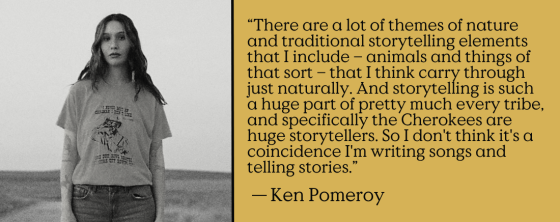
Ken Pomeroy: Oh, yeah. I never really tried to put it in anywhere. I think it just fits in naturally with how I write music in general. There are a lot of themes of nature and traditional storytelling elements that I include – animals and things of that sort – that I think carry through just naturally. And storytelling is such a huge part of pretty much every tribe, and specifically the Cherokees are huge storytellers. So I don’t think it’s a coincidence I’m writing songs and telling stories.

No, I bet not. I love the way you’re able to use animals. It seems like a great way to talk about yourself or other people, but through metaphor. Does [the use of animals] make that a little bit easier?

Absolutely, yes. I think kind of assigning someone something, it makes it 10 times easier, not so direct.

Like an artful way of saying something that’s hard to say?

Yes, absolutely.

Tell me a little about where your sound comes from. So many moments on Cruel Joke are hushed and haunting. What did you grow up listening to? Where did you pick up music?

Well, honestly, I’ve been playing music and writing for longer than I haven’t been. I really got started from hearing John Denver when I was 6 or 7 years old. That was the start. I wanted to do that and I wanted to make people feel like he made me feel at that moment. It was like a third eye opening about maybe I could do this. And the album, when I sit down and write a song, I am not thinking about production really. I just kind of write the song, me and my guitar, and then that’s the song. My partner, Dakota McDaniel, produced most of the record. It’s such a natural working. … It’s been so easy getting to the right final form of the song with Dakota and I’m really thankful that that worked out. For the record, we were listening to Big Thief and Buck Meek and Jake Xerxes Fussell. Jake was a huge inspiration with the instrumentation we used. It was a very steel-heavy approach.

I can hear that for sure.

It’s called Cruel Joke. What do people need to know about this album from your perspective?

I think from the beginning, with any of my music in general, I just don’t want people to feel alone in anything. I am a real deep feeler, so sometimes I feel like it’s just the tip of the iceberg with sad songs in the mainstream. I feel like they’re not as sad as they could be. I try to make people not feel so alone in those really deep feelings, just because I’ve kind of had to feel that.

Your songs definitely cut pretty deep, emotionally. Have you always been the type of person to root around inside yourself and stir things up?

Oh, yeah. Yes. I grew up very quickly and I had a lot of adult-sized feelings as a kid that I didn’t really know how to deal with. And dealing with these unresolved childhood feelings later on is not for the weak. I feel like everyone goes through it, and I’ve really always tried to stay in touch with just how I’m feeling, or what goes on in my head. Songwriting is how I feel like I do that.

You’ve had some big things happening, like with Twisters and being on the road with John Moreland. How do you feel about today’s appetite for the music you make? Are we ready for another folk revival?

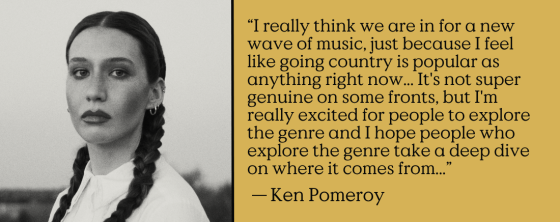
That’s a great question. I really think we are in for a new wave of music, just because I feel like going country is as popular as anything right now. Everybody is going country, which can be a little disheartening. It’s not super genuine on some fronts, but I’m really excited for people to explore the genre and I hope people who explore the genre take a deep dive on where it comes from and who were the pioneers, because it has so much history. I feel like country and bluegrass and folk music have so much history.

I read that you wrote one of these songs at 13, right? Does it still speak to you or still feel true?

Yeah, totally. It’s “Grey Skies.” I remember that being the first song I was ever proud of and I think that’s really special to have still around. Even though I might get tired of it, I have to remember my 13-year-old self was proud of it. But yeah, that was also the first time I feel like I really found “my thing” with writing. I included a lot of imagery with nature and animals and that was the first time I was like, “Maybe this is kind of my vein.”

Tell me about “Wolf in Sheep’s Clothes.” This one is a love song, but which person is the hidden wolf?

Oh, gosh. … Everyone laughs, because I say it’s a love song and then it’s called “Wolf in Sheep’s Clothes.” So it’s kind of like, “Well, is it?” But it definitely is. The person I’m writing to is a protector of some sorts, can see through all of the bullshit in the world that maybe I can’t see sometimes, and has my best interest. Whenever this wolf, whoever or whatever it may be, when the dark parts of life come around, this person can kind of clear through it and say, “You’re just a dog. Just get out of here, shoo.”

That’s interesting. How about “Coyote” with John Moreland? You guys toured together and I love the idea of looking at yourself like a coyote, sort of scared of the world. Why do you feel that?

I actually asked John to be a part of this before we started touring together and it was a huge deal for me, because I’ve been a fan of him for so long. I went out on a limb and texted him like, “Hey, I have this song and totally chill if you don’t want to do it, but I figured I would just stick my arm out and ask if you wanted to be a part of it?” And I think that he just said, “Yeah.” And I was like, “Okay, cool.” So that was a really cool thing.

That song was– so, my mamaw gave me the name [ᎤᏍᏗ ᏀᏯ ᏓᎶᏂᎨ ᎤᏍᏗᎦ], which means Little Wolf, but she called me Coyote. That was a big thing, because coyotes are not the greatest omen at all. They’re kind of like the trickster. So I grew up a little bit and remembered that that was my nickname and I was not happy with myself at that point. I think it was two or three years ago. I was just like, “Man, I need to do something different, because this is not who I want to start being or get on this path. I just don’t feel comfortable in my skin.” So I wrote a song. I wrote the song “Coyote” kind of being all right that I can be the coyote and also be the person I wanted to be.

Did it help?

Yeah, absolutely. I think so.

That’s good. How about “Cicadas.” This is one of the most energetic songs, in my opinion, and it’s got this line in there about the cicadas crying out to you. Why were they crying to you?

“Cicadas” was actually the first song that we recorded when we started the record. We weren’t even sure if we were going to do a record, but after that song, [we knew]. It was such an experience, because the ending of the song, when it kind of goes back and forth, that was a total accident. I did not mean to do that, but beautiful things kept happening in this song just completely by accident, so it was a really great sign of reassurance that we were doing something in the right direction. I was so, so worried. I had been working on my music for a bit, and I was like, “Man, I really hope this is the one.” … I wrote that song as I was about to turn 20 years old, and cicadas were always a constant in my childhood. That was one of the only constants that I just knew 100 percent they were going to be there every summer. And I wanted a reminder of that a little bit, just to maybe prove to myself, that there was something stable.

“Innocent Eyes” is such a beautiful track about, I guess, looking back on life with clarity. When you look back, what does the story look like?

Yeah, so “Innocent Eyes” is totally about taking off the rose-colored glasses. Looking back at some of the things you had gone through growing up, or even looking at your parents in a different way. Growing up, it’s really difficult to just see parents as people. “Innocent Eyes” is when you’re a kid, you think your parents can do no wrong and they’re there for you and that they want everything the best for you. And then you grow up and you realize they’re just people. They’re just people that had a kid. And in my case, I was a complete accident and kind of a product of something very quick, and so I was not necessarily meant to be here. And the two people that brought me here did not love each other whatsoever. And so I looked back at that wondering how that shaped me a little bit. And I think that’s where the song started.


Photo Credit: Kali Spitzer

GC 5+5: Southern Avenue

Artist: Southern Avenue
Hometown: Memphis, Tennessee
Latest Album: Family
Personal Nicknames (or rejected band names): We don’t remember any rejected band names, but being from Memphis we definitely call everybody “mane.”

Answers have been provided by Tierinii Jackson, Southern Avenue lead vocalist and songwriter.

What was the first moment that you knew you wanted to be a musician?

It wasn’t one moment, it was the absence of one. I never imagined not being a singer and a songwriter. I grew up singing in church with my sisters and family and even when I ran away from all of that, the music stayed with me. Beale Street gave me my second education. That’s where I chose to be a full-time musician, even if the world didn’t choose it for me.

What is a genre, album, artist, musician, or song that you adore that would surprise people?

I love musical theater. It’s drama, it’s storytelling, it’s emotion on 10. I used to want to be on Broadway. Sometimes I still do. The song “Flying” on our new album is just about that. My mom actually turned the plane around mid-air so I wouldn’t fly to New York to make my dream come true. I do believe that it all connects and I have plenty of time to still do something special in that world.

What’s one question you wish interviewers would stop asking you?

People always ask how we met and how the band started. It’s everywhere online already. We just hope to get asked about new things now, go a little deeper. But it’s all good, no hard feelings at all. We love it when we have an interview where the person in front of us already has an understanding of who is in front of them.

What’s your favorite memory from being on stage?

When we toured with Willie Nelson, Bob Dylan, and John Mellencamp, it was already unbelievable. But then we found ourselves on stage at FarmAid, after two weeks on the road with them for the Outlaw Tour. I remember standing there thinking, “Am I dreaming?” It was one of those moments where everything just hits you, how far we’ve come, and how real it all is.

Genre is dead (long live genre!), but how would you describe the genres and styles your music inhabits?

We like to describe our music real simple. It’s Memphis music. That’s what raised us. We’re a mix of where we come from, how we grew up, and everything we dreamed of becoming. It all comes together in the sound.


Photo Credit: Rory Doyle

Little Blue

Patience and persistence have long been traits embodied by the music and songwriting of Kristina Murray, but with her new album, Little Blue, she can add another “P” word to the mix: perseverance.

Now a decade into her time in Nashville, Little Blue (out May 9 on New West Records) is poised to be her “ten year town” breakout moment. Through its blend of old school country twang and swampy southern R&B she ruminates on everything from the grind, pursuing her honky-tonk dream, to finding love, and the unseen burdens placed on women. She shows off her formidable knack for storytelling in the process. The project is also direct evidence of the inroads she’s made in Music City, with artists like Erin Rae, Logan Ledger, Sean Thompson, Miss Tess, Frank Rische, and John Mailander all lending a hand.

Originally from Atlanta, Murray was introduced to country as a child via a cassette of Patsy Cline’s greatest hits in her mother’s car. She eventually got her first guitar in high school, but didn’t play it anywhere outside of open mics and church camps until she moved to Colorado in the mid 2000s to pursue a degree in recreational therapy. While there, she became immersed in the regional bluegrass scene and began playing out more, slowly gaining confidence and building toward her eventual move to Nashville in 2014. While she was only in Colorado for six years, Murray still looks back on her time out west as foundational for her direction in life and the art she’s pursuing now.

“I’d never lived outside the South before and had a couple mentors of mine tell me I should give it a try for a little bit,” recalls Murray. “It was out there where I realized that being a musician is what I wanted to do with my life. Once you get bit by the playing-on-stage bug, there’s no going back. It’s so much more than just playing for people, too. It’s also being in sync with your band and performing at a high level and the energy feedback loop that can come from that.”

Since relocating to Nashville, Murray has become a linchpin of the city’s dive bar and juke joint scene, frequently popping up at places like Dee’s Country Cocktail Lounge and Bobby’s Idle Hour, and became one of the first women to front a full band at Santa’s Pub. But despite all this, she was starting to feel stuck as the pressure of things like her father’s sudden death, car wrecks, watching others have the success she’d been waiting on began to weigh her down. But in that darkness she was able to find a glimmer of light, and Little Blue was born.

Leading up to the album’s release, Good Country caught up with Murray to discuss imposter syndrome, expectations in the music business, the healing power of music, and more.

If going from open mics and church camps in Georgia to diving into Colorado’s bluegrass scene was a big step, then moving from there to Nashville must’ve felt like being on another planet. What was that transition like?

Kristina Murray: My time in Colorado was foundational in some ways. I learned the Nashville number system, how to play with a band, and how to execute a bunch of different songs really well while I was there. But, eventually, it got to being a big fish, small pond kind of thing. You can make a living out there just by playing cover songs in bars, but what I wanted was to write songs and be around people my age who were also writing the kind of songs I like, wanted to listen to, and wanted to write. Moving there was a big step because Nashville is the place where the music I love was and is still being made.

You’ve been grinding away in Nashville for a decade now as an independent musician, but this new record marks your debut with New West. How’d that partnership come about?

Southern Ambrosia [was] the first record I put out after moving to Nashville and, quite frankly, I didn’t know what I was doing. I had seen a lot of my peers kind of take off and naively I thought, “Well, this is a really good record full of great players and good writing and I’m in this kind of circle community; because all those things are true, then this record should get me to the next place that I wanted to go.”

It was actually on the radar of Normaltown and New West back in 2018, but things fizzled out because I didn’t know how to go about having conversations with business people about my music – I’d never done anything like that before. Fast forward a few years, this record was done in 2023 and by early 2024 I was talking with them again about picking it up. Their support means a lot, because it’s really difficult to get your record and your career to the places that you want to go without it.

New West and Normaltown are also based out of Athens, Georgia, and I’m from Atlanta, so it means a lot to be involved with them on that level as well. I was a huge Drive-By Truckers fan in my 20s and can’t get enough of Jaime Wyatt, Lilly Hiatt, Nikki Lane and others. There’s just a lot of people that I love and respect on that record label and I’m happy to be a part of the family.

Better late than never, I suppose! You just mentioned the feedback for Southern Ambrosia not meeting the lofty expectations you had for it. I imagine seeing friends and colleagues having success with their music – from signing with labels to getting on bigger and bigger shows to nailing down high-profile writing sessions – doesn’t help to keep the imposter syndrome at bay.

It’s funny, because during my decade in Nashville I really have seen so many people just skyrocket, and it’s all been so deserved, like Erin Rae – nobody sings or writes like her – or Sierra Ferrell, I mean who else sings like that? Logan Ledger, who also joins me on this record, is one of my favorite singers and songwriters around. During my time here there’s been so many times when I’ve thought that something must be wrong with the way I sing or write to not be getting all those opportunities for myself. But I’ve come to realize that having all that isn’t what will validate me as a musician, writer, performer, and person who simply loves this music, because at the end of the day, if I still get something out of it, shouldn’t that be enough? It’s something I’ve grappled with a lot through the years and continue to do on this album.

Speaking of expectations in the music business not always being reality and the illusion of success, are those things you’re tackling head on in the song “Watchin’ the World Pass Me By”?

What’s funny about that song is it started out as me just trying to see if I could write a basic “outlaw” country song. It obviously evolved a bit from a writing exercise parody to a commentary on getting “so tired of watching ‘em livin’ my dreams” and “daddy’s bankroll to make the rules” nepotism and suddenly being a country singer, because you threw on a cowboy hat. But I also poke a bit of fun at myself, too, with lines like “She’s just a bitter, jaded, helpless fool.”

Another tune I’ve really enjoyed is “Phenix City.” In many ways it seems like an outlier on the record, a story song amid a sea of deeply personal, autobiographical tales. With that in mind, what was your intention for including it here?

Most of this record is autobiographical or composite sketches of me and those around me, but that one specifically is a story song. It very much paints a picture of small-town circumstances in Phenix City, a small town in Alabama along the Georgia border. One time I was driving down to a gig in Columbus, Georgia, and instead of going through Atlanta I decided to head straight down from Nashville through Alabama. I rented a car because my van was out of commission, and about a half hour outside Columbus I broke down after running out of gas because I had my music so loud I couldn’t hear it beeping. I eventually got it to a mechanic shop in Phenix City where the man told me I just needed some gas, which was both a relief and a moment that made me feel like the biggest idiot around, but briefly getting stuck there did inspire the song in a roundabout way.

Similar to “Phenix City,” another outlier of sorts on Little Blue is the lead track, “You Got Me,” which seems to revolve around the early, butterflies-fueled stages of love. Mind telling me a bit about it and the mood it sets for the remainder of the project?

I’m not one for writing love songs too much. The only other real love song I have is “The Ballad Of Angel & Donnie” from Southern Ambrosia, which is another story song about a meth dealer and his girlfriend. I wrote “You Got Me” early on in my relationship with my now-partner. It’s a very true-to-life song and I knew if it was going to be about him that it had to be a really cool-sounding song. My guitarist, James Paul Mitchell, came over one night when I was writing it and helped to come up with that signature lick you hear on it right at the beginning, which I loved. I really wanted it to be like a Band song with the Clavinet sounds that they twin throughout the song. My partner, Corey [Parsons], also plays percussion on this one, which is really sweet that he got to put some of his touch on a song about him.

The song also starts with the word “and,” which came from a writing exercise after listening to Robert Johnson’s “Love in Vain.” It begins with “And I followed her to the station.” I thought it was so cool to start a song with “and,” because it’s like you’re just dropping someone into the middle of a story.

While “You Got Me” is a bright spot, a lot of this album leans more toward the somber and dark. What are your thoughts on the catharsis and healing that can come from writing through difficult times such as the ones you’re encountering here?

The album is titled Little Blue for a reason. We are remiss to forget how significant the pandemic was and how devastatingly sad that period of time in our collective human history was. A good chunk of these songs were written during that two-year period along with general ruminations about the sad and unjust world we live in that even the music industry isn’t immune from. It feels silly at times to whine and cry about the music industry when there’s so much other crazy stuff happening, but that’s the world I live in so I have to write through that.

I wouldn’t say that writing songs is cathartic for me as much as sharing in the collective. What grabs me about music is when it feels real and is relatable to me and I hope that I’ve done that here with what I’ve written about. Music is magical, so the fact that I get to do this at all is amazing and continues to drive me. I’m never not going to be amazed by music. For instance, I took a harmonica lesson the other day with Ilya Portnov, who also plays on the record. I’ve done a little bit of Bob Dylan-esque singer-songwriter harmonica, but I really wanted to understand the harp a little bit better. It’s a magical feeling when the music and notes and scale are all working together. I feel endlessly humbled by it and very proud that I get to be a small ripple in the river of music.

What did the process of bringing Little Blue to life teach you about yourself?

That I’m gonna keep doing it regardless of if it makes any sense at all. I didn’t get my record deal until after everything for this album was done, meaning that I funded it all myself. It was a lot to handle, because making records isn’t cheap, especially if you’re paying people what they deserve to get paid. I feel very lucky and grateful for all the folks that lended their talent to this record. It made me realize that the more I keep pushing ahead to more everything will begin to make sense around me. It’s a mix of perseverance and understanding that good things take time and intention. I feel really good about this record and even though it’s only my third, and first in six years, I’m glad to put it out in the world because we need art now more than ever.


Photo Credit: Schuyler Howie

Dallas Burrow on Only Vans with Bri Bagwell

One of my favorite people on earth, Dallas Burrow, stopped by for this new episode of Only Vans to talk about owning a music venue, shamans, Charley Crockett, having a complicated past, and all the good vibes!

LISTEN: APPLE • SPOTIFY • AMAZON • MP3

Find Dallas’s music, podcast, tour dates and merchandise here.

Thanks to our sponsors for this episode, The MusicFest at Steamboat, Lakeside Tax & CH Lonestar Promo!


Editor’s Note: Only Vans with Bri Bagwell is the latest addition to the BGS Podcast Network! Read more about the podcast coming on board here. Find our episode archive here.

You Gotta Hear This: New Music From Danielia Cotton, Unspoken Tradition, and More

To say good bye to the week and to August, we’ve got one more premiere round-up for the month – and, as always, You Gotta Hear This!

Among all the fine new music being released, we’re highlighting a handful of tracks newly minted or arriving very soon. First, there’s “Bring Out The Country (In Me),” the sole original number from Danielia Cotton’s new EP paying tribute to Country Music Hall of Famer Charley Pride. Then, check out singer-songwriter David Luning’s “Every Day I Am,” which explores the fear and anxiety of being a fugitive on the run.

As you continue, John Surge and the Haymakers bring us a properly Tex-Mex track, “Marisol,” from their upcoming album Maybe You Don’t Know Me. And, to bring us home, North Carolina-based bluegrass outfit Unspoken Tradition have a stellar cover of Alabama’s hit, “I’m In a Hurry (And Don’t Know Why).”

It’s all right here on BGS and You Gotta Hear This!

Danielia Cotton, “Bring Out The Country (In Me)”

Artist: Danielia Cotton
Hometown: Hopewell, New Jersey
Song: “Bring Out The Country (In Me)”
Album: Charley’s Pride: A Tribute to Black Country Music
Release Date: August 29, 2024
Label: Cottontown LLC with Symphonic Distribution

In Their Words: “Coming to New York City from a small town was a major transition for me. What surprised me was how much of my small town ways and sensibility I didn’t lose. The big city can engulf you, however that made me more myself and embrace more of my country roots. Big cities, especially New York, are full of what is seemingly countless numbers of confident people, when in fact so many are struggling with the same need to define themselves and stand out. I think I finally realized that what makes me most unique is when I am true to myself.” – Danielia Cotton

Track Credits:
Danielia Cotton, Marc Copely – Songwriters
Danielia Cotton – Lead vocals
Marc Copely – Guitars, backing vocals, programming
Andy Hess – Bass
Aaron Comess – Drums, percussion
Ben Stivers – Piano, organ
Rocco DeLuca – Pedal Steel
Produced, engineered, and mixed by Marc Copely at Casa Copely Recording, NYC.
Mastered by Greg Calbi.


David Luning, “Every Day I Am”

Artist: David Luning
Hometown: Los Angeles via Forestville, California (Near Petaluma)
Song: “Every Day I Am”
Album: Lessons
Release Date: September 6, 2024

In Their Words:“Movies, songs, and stories, particularly set in the American west, have highly romanticized the life of running from the law, but in reality, in the long run, it’s gotta suck. So much fear and anxiety all the time. Always on the run. ‘Looking over your shoulder.’ Fleeing the consequences of your actions. Can’t trust anyone. At least I know in my life, running from my fears or consequences of things that I’ve done has never improved a thing. So on the surface, ‘Every Day I Am’ is about somebody running from the law, but underneath lies the story of somebody that is ‘…always hoping that one day it’ll be alright,’ without realizing that it could be, if they stop running.” – David Luning

Track Credits:
Written by David Luning.
David Luning – Vocals, Acoustic guitar, electric guitar, piano
Linden Reed – Drums
Ben Dubin – Electric bass
Dave Sampson – Electric guitar
Alex Leach – Electric guitar
Damien Lewis – Percussion, sound design


John Surge and the Haymakers, “Marisol”

Artist: John Surge
Hometown: Los Angeles, California
Song: “Marisol”
Album: Maybe You Don’t Know Me
Release Date: September 6, 2024 (single); September 20, 2024 (album)
Label: Blackbird Record Label

In Their Words: “‘Marisol’ is a historical lament about a woman who claims ‘my love is like a heart attack, the kind of love that’ll keep you coming back.’ It has a rollicking feel that comes straight from the Doug Sahm playbook. The song has a natural Tex-Mex feel. I kept asking Tommy [Detamore], ‘What would Doug do?’ Detamore shared stories of producing Sahm’s final album, The Return of Wayne Douglas. We followed that inspiration and traveled down Sahm Highway.” – John Surge

Track Credits:
John Surge – Vocals, acoustic guitar
Randy Volin – Electric guitar, baritone guitar, harmony vocals
Brennen Leigh – Harmony vocals
Michael Guerra – Accordion
Brad Fordham – Bass
Tom Lewis – Drums
Floyd Domino – Organ
Kevin Jarvis – Percussion


Unspoken Tradition, “I’m In a Hurry (And Don’t Know Why)”

Artist: Unspoken Tradition
Hometown: Cherryville, North Carolina
Song: “I’m In A Hurry (And Don’t Know Why)”
Release Date: August 30, 2024
Label: Mountain Home Music Company

In Their Words: “I was born in ’85, so ’90s country was a part of life during that period. I still use ’90s country to get back there, nostalgically. Alabama was an awesome country band, and vocally, this song is just so fun to sing. The a capella intro always grabbed my attention back then and knowing our band has so many capable singers, I wanted to give this one a try as a fun cover. As a father with a family, a full time job, and also juggling music and other things, the message of the song is a reminder to slow down some and enjoy the little things.” – Audie McGinnis, guitar and lead vocals

Track Credits:
Audie McGinnis – Guitar, lead vocals
Sav Sankaran – Bass, vocals
Tim Gardner – Fiddle
Zane McGinnis – Banjo
Ty Gilpin – Mandolin


Photo Credit: Danielia Cotton by Chía Messina; Unspoken Tradition by Sandlin Gaither.