Bluegrass Memoirs: ‘Industrial Strength Bluegrass’ and the Dayton Bluegrass Reunion (Part 1)

On April 22, 1989, Cityfolk, a Dayton, Ohio-based concert series, mounted their most ambitious evening to date, The Dayton Bluegrass Reunion, “An All-Star Salute to Dayton’s 40 Year Bluegrass History.” It was held at Memorial Hall in downtown Dayton.

I’m reminded of this concert now because of an essay I wrote for its program booklet: “Industrial Strength Bluegrass.” That is the title of a new book by Fred Bartenstein and Curtis W. Ellison, subtitled “Southwestern Ohio’s Musical Legacy.” This anthology presents a remarkable in-depth portrait of a key regional bluegrass scene, which co-author Bartenstein has likened to seminal regional scenes in other genres like blues (Chicago) and jazz (New Orleans).

In March, Smithsonian Folkways released a 16-track album with the same title, edited by Joe Mullins and son Daniel Mullins. On it are 16 contemporary recordings by today’s leading bluegrass artists, doing the region’s key repertoire — like “Once More,” the Osborne Brothers and Red Allen’s 1958 high lead trio, recreated on the album by The Grascals; and “20/20 Vision” by Jimmy Martin and Osborne Brothers in 1954, done here by Dan Tyminski. Joe Mullins opens the album with his band, The Radio Ramblers, doing “Readin’, Rightin’, Route 23,” an anthem to the Appalachian migrants who nurtured bluegrass in the region.

My experience with the Dayton Bluegrass Reunion began in Albuquerque, New Mexico, in the fall of ’87 at an annual meeting of the American Folklore Society (AFS). One month to the day after the Earl Scruggs Celebration, I met Phyllis Brzozowska, executive director of Cityfolk, “an arts organization,” as she later wrote, “working full time to bring to the public the variety and excellence that exists in traditional arts today.” 

Phyllis grew up with Irish dancing in Dayton. By 1978 she had a Celtic music radio show on WYSO-FM, the Antioch College station, and began booking bands. “A band I knew from Pittsburgh called ‘Devilish Mary’ was coming through town. They were a great dance band that played ole’ timey music and Irish traditional music.” She and a friend organized a “ceili” at a downtown club in Dayton. By 1981 she’d formed Cityfolk. 

By 1987, Cityfolk had branched out from Irish to include other roots music in their events — including bluegrass. In the 1980s a broadening of interest in the traditional arts was nurtured through public sector folklore lobbying in Washington. The Festival of American Folklife, established in 1967 by Ralph Rinzler at the Smithsonian, led to the establishment of a Folk Arts department at the National Endowment for the Arts and the creation of the American Folklife Center at the Library of Congress. The National Folk Festival, around since the ’30s, moved to Washington and became the National Council for Traditional Arts (NCTA) in 1976. 

These national institutions supported performing arts markets for traditional artists. Local and regional arts organizations like Cityfolk and PineCone grew and flourished during the ’80s, and public folklorists were active in the AFS. Phyllis was wanting to talk with me because I’d written a book about bluegrass. She was planning a reunion concert to celebrate 40 years of bluegrass in Dayton, applying for funding from the Ohio Arts Council and the Dayton Performing Arts Fund. She asked me if I would work as a consultant and writer for this event’s program. 

Brzozowska wanted to tell the story of bluegrass in Dayton as dramatically as possible, so they were hiring Don Baker, “one of the leading theater directors in the South.” Baker had grown up in Appalachia and started his career at Appalshop in Whitesburg, Kentucky. In 1984 he co-founded Lime Kiln, a theater in Lexington, Virginia. 

For the Reunion, Brzozowska later recalled, Baker “constructed a theatrical foundation on which the music and narrative would be presented. He also designed the set, contributed input to the script, set the pacing of the show and when the lights went up, was the perfect stage M.C. for the evening.” 

In producing the show Brzozowska took counsel from three Dayton old hands — Harley Allen, Fred Bartenstein, and Paul “Moon” Mullins. Additional input came from old-time fiddler and Dayton City librarian Barb Kuhns and writer-musician Larry Nager. As a consultant and writer, I worked with them on the planning of the concert and on program booklet. I also helped backstage on the night of the concert. 

My experiences with southwestern Ohio bluegrass began in the late fifties. Oberlin classmate Jeff Piker came from Cincinnati as a freshman in ’58. Inspired by a Pete Seeger concert at Antioch, he’d bought a used Vega banjo at a music shop in the Appalachian migrant neighborhood of Over-The-Rhine that Nathan McGee writes about in Industrial Strength Bluegrass (pp. 164, 166). It had homemade Scruggs pegs

That made Piker a popular guy with us campus bluegrass jammers. We all borrowed the banjo to learn how to use the pegs. During the January 1959 winter break we took it with us when we went to Yellow Springs to visit Antioch College friends. Bluegrass was catching on there. 
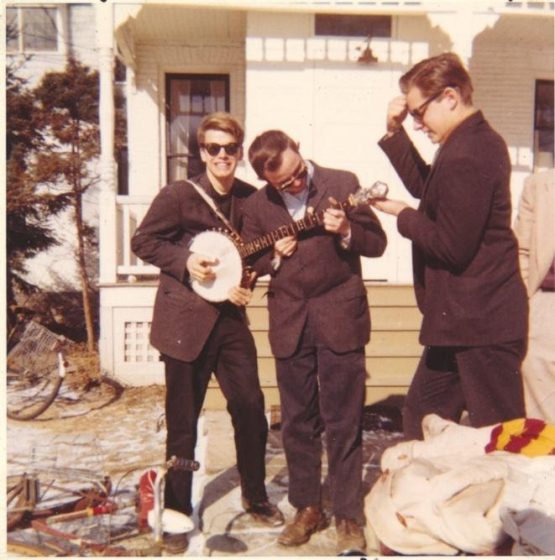
Chuck Crawford, Neil V. Rosenberg, Franklin Miller III at Pyle Inn, Oberlin, Ohio, January 1959

A year later, in March 1960, our band opened for the Osborne Brothers at Antioch. I’ve written about that in Bluegrass: A History (pp. 155-58). In 1962, another band I was in opened at Antioch, for Sid Campbell and Frank Wakefield, and I’ve written about that too, in Bluegrass Generation: A Memoir (119-123).

One detail from that 1960 concert I didn’t mention: when Jeremy Foster called to invite us to open the show for the Osbornes, he said he’d booked the Osborne Brothers because they were nearby and available. We knew of this band only from the sound of their MGM album, The Osborne Brothers and Red Allen. Jeremy was disappointed that they had changed — Red Allen was no longer with them. That made their music less appealing to him. But, as I learned later, Bobby and Sonny didn’t want fancy guitar backup and didn’t need a flashy lead singer. They were focused on their trio.

In the fall of 1963, when I was managing Bill Monroe’s park, the Brown County Jamboree, in Bean Blossom, Indiana, we got reacquainted when they gave their first show there (Bluegrass Generation, pp. 224-226). With Benny Birchfield playing guitar and singing the lowest voice in the trio, they had moved from MGM to Decca. Their first single, “Take This Hammer,” had just come out. Their final MGM album, Cutting the Grass, was due out soon.

They were polishing the high lead trio they’d been working on for five years. That winter I taped them guesting on the WSM’s after-the-Opry broadcast, Ernest Tubb’s Midnite Jamboree. Their harmonies were attracting attention in country music circles.

At Bean Blossom, Bobby and Sonny had told me about their regular Thursday night gigs Ruby’s White Sands in Dayton and invited me to come over some time. In May ’64, Jim Work and I took friends from California, Jerry Garcia and Sandy Rothman, to see them there. 

The Osbornes joined the Opry a few months later. By then they were coming to Bean Blossom twice a year and we’d gotten better acquainted. “Banjer” talk with Sonny was always entertaining. He had experimental bridges, banjos, and capos. On stage, he had great new licks for every show. 

With Bobby I shared an interest in bluegrass history. One Sunday in 1964 I invited the band back to our apartment in Bloomington for supper. While they were there I showed Bobby the work I was doing on the Bill Monroe discography and asked him if he was interested in doing something like that for the Osborne Brothers. He was. We began corresponding about their discography, and started trading tapes.

Benny Birchfield left the Osborne Brothers at the end of ’65. The following spring, in Cincinnati for an academic meeting, I ran into him at the Ken-Mill Café in Over-The-Rhine. He was playing bass in a band that included lead singer and guitarist Jim McCall, with Vernon McIntyre Jr. on banjo. Benny introduced me to the band as a banjo picker from Bean Blossom and invited me to sit in for a set on banjo. That was fun.

On Labor Day, 1966, Carlton Haney held his second Roanoke Bluegrass Festival in Fincastle, Virginia. The Osborne Brothers were there — riding high with their first charted Decca hit, “Up This Hill and Down.” Their Sunday trio on “I Hear A Sweet Voice Calling” with Bill Monroe was one of the high points of the festival that year — a religious experience for many who heard it. 

At that festival, my first, I finally met Pete Kuykendall. We’d been corresponding and trading tapes for several years, and he’d published bluegrass discographies in the mimeo magazine Disc Collector. Now he was promoting a new bluegrass monthly, Bluegrass Unlimited. I told him about the Osborne Brothers discography, and he agreed to publish it in BU (it appeared the following July). Promoter Haney invited me to join him, Ralph Rinzler, and Mayne Smith in introducing Bill Monroe and the Blue Grass Boys and The Osborne Brothers in a special broadcast about the festival on the local TV channel.

In April 1967 I saw them at a club outside Indianapolis. The third voice in the trio was now being sung by Harley Gabbard, later the co-founder of The Boys from Indiana. His name comes up often in Mac McDivitt’s chapter on the southwest Ohio recording scene in Industrial Strength Bluegrass (pp. 43-76). One of Gabbard’s contributions to the regional repertoire, “Family Reunion,” written with his nephew, Aubrey Holt, is performed on the new Folkways CD by Rhonda Vincent and Caleb Daugherty. 

I saw Gabbard again the following October when he dropped in and sang bass on one cut we were recording for George Brock’s gospel album at Rusty York‘s Jewel Records in Mt. Healthy, Ohio. McDivitt’s chapter also devotes a section (pp. 63-65) to Jewel and York’s remarkable careers in bluegrass and rockabilly. Here’s Harley Gabbard with the Osbornes doing what was, as of May ’67, their new single: “Roll Muddy River.”

So, during the years I’d lived in Indiana (1961-68) I’d dipped into the Southwestern Ohio bluegrass scene a number of times. I knew some of the music, some of the people and some of the history. But I had been living in Newfoundland for twenty years. Fortunately Barb Kuhns (Dayton City librarian) and Larry Nager knew the Dayton region scene deeply in a way I didn’t, which was essential, because the sequence and repertoire of the concert had to reflect the drama of the reunion story.

(Editor’s Note: Read part two here.)


Neil V. Rosenberg is an author, scholar, historian, banjo player, Bluegrass Music Hall of Fame inductee, and co-chair of the IBMA Foundation’s Arnold Shultz Fund.

Photo of Neil V. Rosenberg: Terri Thomson Rosenberg
LISTEN: Karen Matheson, “Glory Demon”

Artist: Karen Matheson
Hometown: Oban, Argyll, Scotland
Song: “Glory Demon”
Album: Still Time
Release Date: February 12, 2021
Label: Compass Records

In Their Words: “‘The Glory Demon’ is a phrase taken from Brewer’s Dictionary of Phrase and Fable. It means war. It’s essentially an anti-war song, about how we never seem to learn and how it just goes on and on (life and afterlife) endlessly repeating itself. I thought also about how the phrase might fit the hubris, megalomania and idiocy of certain politicians.” — Karen Matheson


Photo courtesy of Compass Records

5 Uncommon Trad Instruments Played Like You’ve Never Heard

We’re all familiar with the standard bluegrass five-piece band (also a common lineup in old-time or string band music), but there are quite a few second- and third-string instruments — no pun intended — that are rarely invited to join ensembles of guitar, fiddle, upright bass, mandolin, and banjo. Dobro is perhaps first on this short list, but accordion, dulcimer (hammered and mountain), autoharp, washboard, harmonica and dozens of other music and noisemakers could be encountered alongside these acoustic staples.

The five musicians below are awe-inspiringly adept at their instruments, each considered more like afterthoughts or casual embellishments in American roots music, rarely considered centerpieces themselves. But no matter how uncommon they may be at your local jam circle, or around the fire at the campsite, after you’ve been introduced to each of the following, you’ll be craving more unexpected and uncommon sounds in your bluegrass lineups.

From bones to nyckelharpa to Irish harp, here are five uncommon traditional instruments played like you’ve never heard them before:

Simon Chrisman – Hammered Dulcimer

A familiar, towering figure in the West Coast old-time, folk, and DIY roots music scenes, Simon Chrisman is criminally underappreciated on a national or international level. He most recently released a duo album with acclaimed banjoist Wes Corbett, he has been touring and collaborating with the Jeremy Kittel Band, and he’s performed and recorded with the Bee Eaters, Bruce Molsky, Laurie Lewis, and many others. His hammered dulcimer chops exist on a plane above and beyond even the most accomplished players on the trapezoidal instrument, throwing in pop and bebop-inspired runs, reaching down to bend strings by hand to achieve particular semi-tones, bouncing along at a rate only matched by a three-finger banjo player’s rapid-fire sixteenth notes. It’s jaw-dropping, even in Chrisman’s most simple, tender melodies and compositions. This rollicking number, named for Corbett’s beloved cat, is neither simple nor overtly tender, but your jaw will find the floor nonetheless.


Rowan Corbett – Bones

Rowan Corbett is a singer-songwriter, multi-instrumentalist, and percussionist best known for his time with seminal modern Black string band, the Carolina Chocolate Drops. Also a longtime member of Baltimore-based acoustic-grunge/world-folk group ilyAIMY and a veteran of Celtic outfit Tinsmith, Corbett is something of a musical chameleon, though it never feels as if he’s just putting on genre costumes to match whatever melodic motif suits the moment. Instead he inhabits each one authentically and wholly. ilyAIMY, for being billed as a folk band, are captivating, passionate, and energetic, perhaps most of all while Corbett fronts the group. But all of his musical moxie across all of his instruments pales when he pulls out the bones — traditional, handheld percussion instruments similar to their more mainstream (if not more vilified) counterpart, the spoons.

It’s no wonder a bio for Corbett begins, “What are those and how does he do that?” Corbett’s percussion skills are precise and technical, laser-like accuracy meshed with generation-blurring soul. During a guest appearance with Rhiannon Giddens at the North Carolina Museum of Art in Raleigh, North Carolina, in September 2019, Corbett brought thousands of listeners gathered on the hillside by the amphitheatre to their feet with his bones and just a couple of bars. This improv/battle video with Greg Adams displays just a taste of Corbett’s prowess on the ancient instrument.


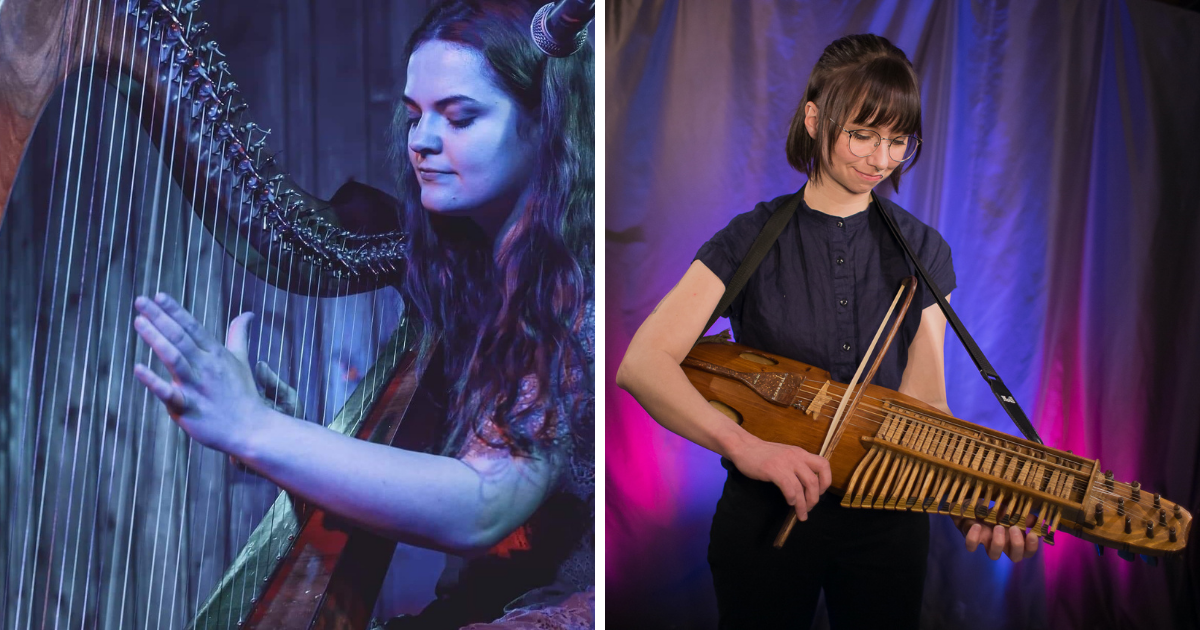
Amy Hakanson – Nyckelharpa

Pandemic aside, if you’ve jammed with an old-time fiddler in the past two years you’ve probably fumbled (if you’re like this writer) or charmingly tripped your way through a Swedish fiddle tune or two. Musicians like Brittany Haas and Molly Tuttle have brought Swedish tunes into their repertoires, birthing dozens of new acolytes of the crooked, wonky, joyful tunes. Many an American fan of Swedish folk traditions were introduced to them by Väsen, a genre-blending, nearly 30-year-old Swedish folk band adored by multiple generations of American musicians, thanks to their status as a favorite band of everyone’s favorite pickers. (Väsen counts Chris Thile, Mike Marshall, Darol Anger, and others among their most vocal proponents and collaborators.)

Nyckelharpa player and scholar Amy Hakanson was first introduced to the instrument by Väsen as well and in 2014 she took her fascination with the heady, engaging music to the source, to study nyckelharpa with Väsen’s Olov Johansson himself at the Eric Sahlström Institute in Tobo, Sweden. Her approach to the instrument — a traditional Swedish, bowed fiddle-like apparatus played with keys — has a storied, timeless air, even as she carefully places the nyckelharpa in modern contexts. This original, “Spiralpolska,” for instance, utilizes a loop machine, ancient droning and modern droning combined.


Sarah Kate Morgan – Mountain Dulcimer

The mountain dulcimer is simple and beautiful in its most common use, a gentle, pedalling rhythm section for languid, introspective folk tunes. Counterintuitively much more common in the hallways and hotel rooms of Folk Alliance International’s conference than IBMA’s or SPGBMA’s gatherings, this writer first encountered Kentuckian Sarah Kate Morgan and her melodic-style dulcimer among the many booths of IBMA’s World of Bluegrass exhibit hall. She was holding her own in an impromptu fiddle jam with mandolins, fiddles, banjos — all instruments much more familiar with picking intricate, free flowing hornpipes and hoedowns. But Morgan doesn’t just strum the dulcimer, capitalizing on its resonant sustain and open tuning, she shreds it. Playing a finely-tuned, impeccably intonated instrument with a radiused fretboard, she courageously and daringly dialogues with whomever accompanies her down every bluegrass and old-time rabbit hole she meets. It’s incredible to watch, not only with the understanding that most mountain dulcimers are treated as an aesthetic afterthought, but also knowing that Morgan’s prowess outpaces just about anybody on any instrument. A truly transcendent musician.


Alannah Thornburgh – Harp

Harp keeps coming up lately! And for good reason. No matter the genre label applied, harp is having a moment. We’ve kept up with Alannah Thornburgh for a few years, featuring her work with Alfi as well as across-the-pond collaborations like this one, with mandolinist (and BGS contributor) Tristan Scroggins. Living in Dublin, Thornburgh plays in the Irish harp tradition, but has toured and traveled extensively in the United States, giving her style a distinctly old-time and fiddle-tune-influenced approach. She takes on the complicated, contextual vocabularies of American old-time music with ease, almost leading listeners to believe that emulating the banjo or mandolin or executing new acoustic compositions or modern reharmonizations of old-time classics is what the harp was designed to do.

An Instagram video of Thornburgh displays a mischievous, winking arrangement of Béla Fleck’s “The over Grown Waltz,” from one of his masterworks, The Bluegrass Sessions: Tales from the Acoustic Planet, Vol. 2. An earworm of a tune well-worn and familiar to any acoustic music fan Generation X and younger, it’s not uncommonly called at some jams, but its hummable melody is secretly, deceptively, subversively complicated. Once again, Thornburgh simply smiles and pushes onward, as if reaching and pulling these intricate licks and banjo phrases seemingly out of thin air on a harp were as everyday an activity as brushing one’s teeth — or a wedding performance of Pachelbel’s Canon in D.


View this post on Instagram


A post shared by Alannah (@alannahthornburgh) on


Photo credit: Alannah Thornburgh (left) by Tara McAuley; Amy Hakanson by Amy Hakanson.

The String – Dirk Powell plus Maeve Gilchrist

Dirk Powell has build a Grammy-winning career by standing out in all aspects of folk and roots music.


LISTEN: APPLE PODCASTS

He’s an outstanding fiddler and banjo player, a singer and songwriter, a curator and producer. And he’s made marks in three related realms of music – Appalachian, Cajun and Celtic. Now the Louisiana-based Powell has turned back as he periodically does to recording his own music, and he’s released When I Wait For You, a rangy album of songs that dip into new territory. Also, as we say farewell to our latest theme music, I meet the artist behind it, Scottish harpist Maeve Gilchrist.

Alex Sturbaum, “Radish in Spring”

There’s an immediately whimsical, transatlantic quality to Alex Sturbaum’s original tune, “Radish in Spring” that feels intuitive, like a long-forgotten melody on a medieval video game’s pause menu or the perfect backing track to a montage scene in a sepia-toned, independent film. The cheerily wonky descending chromaticism feels like a wry, knowing smile, teasing listeners’ ears for expecting the predictable.

A genderfluid musician, educator, composer, and multi-instrumentalist, Sturbaum is full of delightful turns such as this on their new release, Loomings, purposefully and pointedly queering a musical aesthetic that hearkens far back, beyond Appalachia, American shores, and across the sea. The title, a serendipitous reference in a pandemic that has forced many a backyard gardener to embrace homegrown brassicas of all varieties, is a reference to Sturbaum’s partner, Rae, whose pet name is “Radish.” 

“I had to include ‘Radish in Spring’ [on Loomings];” Sturbaum explains via email, “Not just because I love playing the tune, but to honor the person whose love and support has been integral to my journey as a musician and as a person.”

Knowing, sensing this tender tribute allows listeners to untangle even more of the song’s subtly captivating themes — including that prerequisite spiciness we all know, love, and expect from a crisp, icy cold, earthy radish. Sturbaum’s Irish-style button accordion combined with fiddle supplied by Brian Lindsay and bass by Loomings producer Alicia Healey are together a textbook less-is-more approach to instrumental tune-crafting. And, whether metaphorically or literally, they’re a reminder of the beautiful simplicity of a just-after frost, freshly-tended garden bed full of bright, new, homegrown radishes in spring.


Photo credit: Brian Lindsay

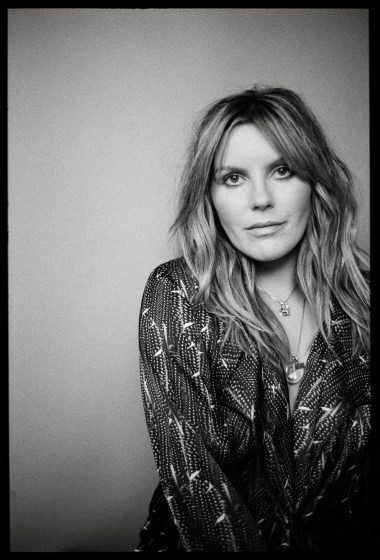
Grace Potter Sets the Scene with Dramatic ‘Daylight’

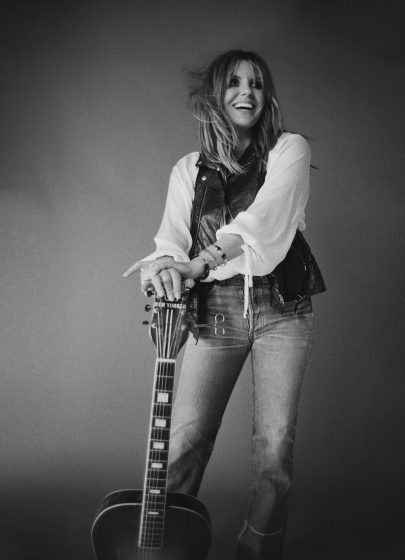
Grace Potter possesses one of the most commanding voices in popular music — which is a good thing, because on Daylight she’s got something to say.

Potter co-wrote much of the new solo album with producer Eric Valentine, with whom she fell in love while still married to a member of her band — which is now broken up, too. After their divorces, Potter and Valentine married, started a family, and now live in Topanga Canyon, California.

The overwhelming emotions of these dramatic life changes are channeled into Daylight, with many of the songs written with Valentine, and on occasion, his longtime buddy Mike Busbee, who died in September.

“Love Is Love,” a potent opener to the project, grabbed immediate attention as the first single, but in this interview with BGS, Potter goes deeper into musical pathway that ultimately led her to Daylight.

“Release” is about the aftermath of the breakup. Who was the first person you played that for when you finished it?

Grace Potter: Eric. Busbee actually texted it to Eric but it was only half the song. Our voice recorder cut off before we finished. But he just wanted Eric to hear where we were at with the writing and Eric had to pull over the car because he was bawling listening to it. And Eric doesn’t cry easily. So that was a really important moment and one that I didn’t expect.

That song, I’d started it myself in the bathtub and it had sat in my voice memo bank for like a year and a half before Eric had heard it and was like, “Let’s not sleep on that one. Let’s pursue that and see where it goes.” Obviously it went and went and went and it’s definitely the one that gets under my skin, every time. It’s hard to play live actually.

And you’re setting yourself up as the character that set this all in motion, too.

Yeah. “I know that I caused this pain…” And that really is the full taking ownership and being accountable for your choices and knowing that those choices are not always this self-righteous, “I can do no wrong” thing. Humans are vulnerable. Humans do make mistakes. Humans change their mind. Lives and careers and happiness and financial fortitude – it all shifts and changes over the time that we live. And the more I’ve lived, the more I realize that it’s okay to give yourself permission, to be that vulnerable.

You quoted the opening line to “Release,” and the opening line on “Shout It Out” sets up that song’s storyline, too. I’ve always thought that those opening lines are something you do really well, but I didn’t realize until researching for this interview that you went to film school.

Oh yeah.

So I’m curious, do you think there’s a correlation there? Because when you make a movie, you have those establishing shots in the beginning, and in your songs you have those establishing opening lines.

And sometimes I like to mislead. I like that opening line to take you in, like, a Quentin Tarantino direction. But it’s actually like a Nora Ephron romance. But I really love storytelling. It’s the same thing I do when I’m writing my sets too. Every single song and every musical experience has to take you on an emotional journey. So there’s a launch point and there’s a revelation, which you know, within the first 20 minutes of a movie, you’re always supposed to basically set up the premise of the movie and potentially introduce one twist. For me, my life was full of so many twists while I was writing Daylight that it wasn’t hard.

After the Nocturnals ended, you had to start a band again. What’s an audition process like to be in your band?

I just want to be around people I like first. Then hopefully they’re good at music. For real. Life is too short to be in a band with people that don’t fit into your ethos or feel, or just don’t feel right. You get these feelings, you get a sense when you’re in a room with someone, if they suck the air out of the room and they have that negative energy, it really changes your entire life and your entire demeanor.

You can feel yourself going kind of gray. I call it the Eeyore effect. You know, it’s this “uhhhhh” feeling. So I generally avoid Eeyores. Although an occasional well-balanced, calm person who doesn’t talk all the time is a wonderfully welcomed part of the road because we can’t all be psychotic extroverts. It’s enough with just me and my baby. But I really enjoy finding musicians who specialize in something that’s just one step quirkier than what you would expect.

Busbee, what I loved about him was that not only was he an amazing songwriter, he played the trombone. Just randomly, like, “I studied trombone.” Really? Eliza Hardy Jones, my keyboard player and singer in my band, is a next level, Olympic champion quilter. Quilting is her thing. She’s actually got a huge show in 2020. She’s doing a massive exhibition in Nebraska at the quilt museum.

Our new drummer, Jordan West, was working for Roland demoing the audio equipment, but actually was hiding in plain sight for so many people. I was looking for a female drummer who could sing, or a female bass player who could sing, or a female guitarist who could sing. I just wanted two female voices that could do all the Lucius parts. So it was fitting the puzzle pieces together for me. Instead of auditioning a bunch of people saying, “I know exactly what I’m looking for,” I just waited until I found a flow of people that felt right. And if they happen to play an instrument I needed, then you’re hired.

Kurtis Keber, our bass player, who’s been with us since last year, came into our world through my previous drummer, Matt Musty, who is now out with Train. We miss him all the time, but these happy accidents happen where you find your people. I saw Kurtis the other day. I was like, “Kurtis, what are you doing? Are you in the studio?” He goes, “No, no, I’ve been building. I’m helping do some carpentry.” My longtime guitarist [Benny Yurco] is now becoming obsessed with recording and becoming one of those crazy studio guys — from the humble beginnings of not even using one guitar pedal to this mad scientist lab they have in Burlington, [Vermont] now.

I like jack-of-all-trades people who like doing lots of things. Those are the things that attract me to people. Their strangeness. Their idioms, their specific obsession with just the tiniest little thing. You know, loose leaf tea. You can talk for an hour and a half about loose leaf tea? I’m in, count me in.

I read the lineup of your Grand Point North festival this year and you did an acoustic set on that Sunday night. What is it about that presentation that you enjoy?

Well, Warren Haynes from Gov’t Mule has been a longtime collaborator and it’s been something that we have talked about doing because we share a joy of being musical and not really knowing what’s going to happen. And not having the stakes be so high that there’s an entire band behind you train wrecking. You know what I mean?

Usually you have to rehearse and really gain a mastery over every single song and arrangement, but when you’re doing an acoustic set, there’s so much freedom to explore. Warren’s musicality and my musicality are complementary to one another where we can take it in a lot of different directions and kind of wring out the towel different every night.

We’d done it a lot backstage and not in front of people, but we felt like it would be a cool thing to share because so many musicians, they just get out there and they run the Ferris wheel, they crank the thing up and they do the same show night after night. There’s been nine years of my festival. People have seen me play with my band. They’ve seen Warren play. He’s played three times in my festival. So I really wanted to treat the audience to a different experience.

Is part of that perspective because you went to a lot of festivals growing up?

Yeah. I came from the jam band world. Warren really ushered me into it. I was very much standing in the shadows of some amazingly talented people who paved the way for me. The festival circuit is really the only way that I was able to break out on my own and be noticed and stand out. I think it’s because of those festivals that I have the sense of diversity. I can take it in a lot of different directions and it’s more fun that way.

And if you’d go to a music festival, you’re going to hear seven, eight, ten genres of music in one place and love every single one of them. I think my instincts took me in that direction, to continue on in my career through creating in the moment, more than creating for a forever thing. …

I think none of my records have ever done my musicality justice because it’s like a high school photo album. It’s this one moment — and maybe it was a very manipulated moment that isn’t even the real reflection of what I was feeling in that moment. So Daylight was the opportunity to completely break that down, take away that premise, take away this idea of having to bottle lightning, and package it and sell it to the world. And instead have an experience. Be vulnerable and open to it and see where it takes you.

As you were talking about festivals, I was wondering, did you ever get an ear for bluegrass?

Absolutely. I grew up listening primarily to Appalachian and Celtic music, which have so many deep connections. And from my family’s record collection, I was obsessed with traditional English, Irish, and Scottish songwriting because the storytelling has these archetypes in it. It’s like the Brothers Grimm. There’s these really intense, very dark stories of women that are shape-shifting and there’s these evil goblins, and then they turn into a beautiful woman. This is a combination of fantasy and reality and love and lust and danger and war. There’s all these amazing cinematic storytelling moments in those songs.

So I grew up around that, but then bluegrass came into my world because in the festival scene, there was so much crossover. I got to meet and be in a songwriter circle early on in 2006 with Béla Fleck, Chris Thile, Jim Lauderdale, and Buddy Miller. It was such a cool lineup, pulling all these people together from all these walks of life and just playing. And it was very humbling. It made me realize I got to get my shit together, my instrumentation, because these guys know how to hold it down.

I understand that you’ve moved from Vermont to Topanga Canyon, which must’ve made your inner hippie very happy.

Oh man! My inner hippie became my outer hippie. I walked to the store two days ago in a pirate shirt with a Burberry trench coat, sweatpants, Doc Martens, and a flower crown. And I didn’t even think about it until somebody sent me a photo of it and I was like, “I did what?” That was just my usual day-to-day getup. That’s Topanga. I live and breathe that lifestyle and those people really get me.

It’s a real community too. It’s a small, small group of people. And again, I think the thing I’ve been finding that I want in life is accountability. And in a big city like L.A., you can hit someone with your car, drive away and never see them again and not really ever worry about getting caught. But if I, or anyone in town, sees anything out of the ordinary, we check in on each other. That’s how tight-knit we are, and how much we care about one another. And it’s a really, really wonderful community to be a part of.

What do you hope that fans will take away from the 2020 version of Grace Potter on tour?

You know, everything about my life has been unexpected, even to me, so I certainly can’t tell people what to expect yet because I just — every bit of it has been this ride. And as I’ve gone on as a musician, I realized that my favorite part of being a musician is inviting people into that ride with me. Instead of presenting them with a packaged thing, that is what it is, I don’t know what it is! I don’t know how this is all going to work. I’ve got a baby now and my life has fundamentally changed in so many ways. I can’t wait to see how it manifests onstage. I guarantee you there will still be headbanging, that’s for sure!


Photo credit: Pamela Neal

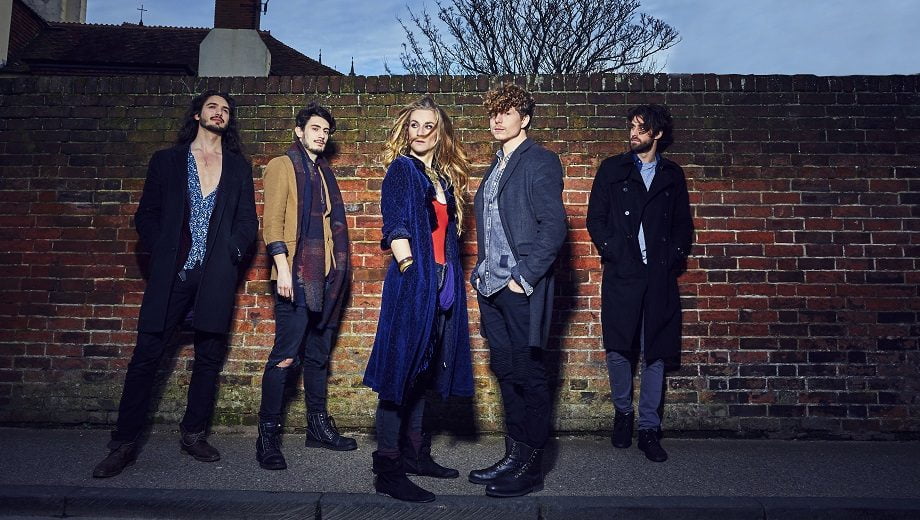
Baylen’s Brit Pick: CoCo and the Butterfields

Artist: CoCo and the Butterfields
Hometown: Canterbury, England
Latest Album: Monsters Unplugged

Editor’s Note: Look for CoCo and the Butterfields and BGS – UK at AmericanaFest UK, held Jan. 29-31 in London. 

Sounds Like: Bellowhead, Seth Lakeman, Florence and the Machine with added indie pop

Why You Should Listen: CoCo and the Butterfields are just joyful and January should be joyful. Ok, I know we are all trying to stick with our “new year new you” goals. New fitness regimes, meditation apps, veganuary, dry January, etc., but come on, surely we can all get on board with more joy!? Great, we are agreed! First thing to do then is listen to this rowdy good time group of multi-instrumentalists who combine folk, bluegrass, hip hop, indie pop, Celtic, and country. Hell, there’s even some beatboxing thrown in for good measure. I said they are rowdy and they can be, in the best possible way, but they also do soft and sad, again in the best possible way.

I first met the band when they rolled up for a session on my radio show in a multi-colored minivan they had painted themselves. They all piled out looking like a touring version of Hair, the musical, and I knew they were my kind of people. Incidentally they do all have amazing hair, but that’s beside the point. The main thing for us to note is their music is wholly and completely original, it’s a sound only they could make and I’m so glad they do. A true ensemble band, sharing vocals and switching instruments at will. They are crowd pleasers and joy makers. I’ve seen them in a packed out basement club and in an expansive field in the middle of the country and they are at home in both.

I think the reason they aren’t bigger in a “mainstream” type of way, is because they are so undefinable. A great thing in my book. So, let’s all treat ourselves, close that fitness app, and open up the playlist below and let’s start the year in the way we mean to continue, with more joyful music and fantastic hair.


As a radio and TV host, Baylen Leonard has presented country and Americana shows, specials, and commentary for BBC Radio 2, Chris Country Radio, BBC Radio London, BBC Radio 2 Country, BBC Radio 4, BBC Scotland, Monocle 24, and British Airways, as well as promoting artists through his work with the Americana Music Association UK, the Nashville Meets London Festival, and the Long Road (the UK’s newest outdoor country, Americana, and roots festival). Follow him on Twitter: @HeyBaylen

Photo Credit: Nicky Johnstone